
The BLADE Blogs

The blogs of the BLADE editors, Steve Shackleford and Erin Healy.

FORGE FAVORITES: Adam and Haley DesRosiers

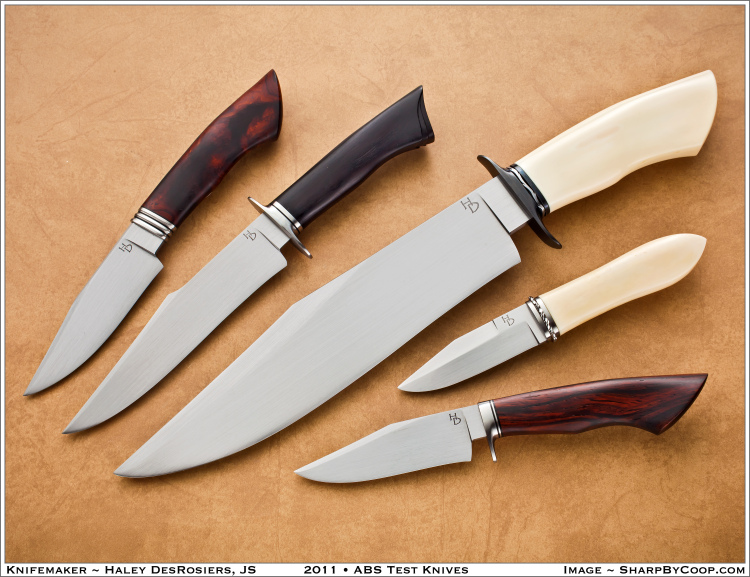
Haley DesRosiers’ five applicant knives for the rating of ABS journeyman smith include the one (center) judged best of all those submitted by JS applicants, thereby winning the 2011 George Peck Award. (SharpByCoop.com photo)


By B.R. Hughes, a founding member of the American Bladesmith Society, a member of the Blade Magazine Cutlery© and ABS Halls Of Fame, and BLADE® field editor


If you are old enough, you may recall a 1954 hit song written by Johnny Richards and Carolyn Leigh that went something like this:

    Fairy tales can come true, it can happen to you,

    If you’re young at heart …

    Don’t believe in fairy tales? After reading the storybook saga of Adam and Haley DesRosiers and the adventures they experienced at the 2011 BLADE Show, you just might alter your thinking.

    Let’s begin with Haley, a winsome lass born in Stika, Alaska, the daughter of a commercial fisherman and a mother who assisted in the family business. The future Mrs. DesRosiers spent many days on her dad’s fishing vessels working as a deckhand, and there were occasions when her boat was at sea for as long as several weeks.

    At 17 she developed an interest in knives, and, inspired by a video, decided to be a bladesmith. Her first forge was a hole in the ground, the air power supplied by an electric hair dryer via a pipe.

    As her skills improved, so did her smithy. One day she decided her beat-up anvil needed repairing. On an Internet knife discussion forum she learned her anvil could indeed be fixed, and ABS master smith Jason Knight e-mailed her about Adam DesRosiers, an Alaskan ABS journeyman smith who might be willing to help. In turn, Jason told Adam of the young Alaskan lady interested in bladesmithing. Adam promptly e-mailed Haley and offered his assistance.

    Setting up the initial meeting between the future husband and wife was not so simple. Both lived in remote areas, approachable only by air or sea, so they agreed to rendezvous at a folk festival in Juneau on April 8, 2008. While there, Adam took Haley’s anvil to the shop of ABS journeyman smith David Mirabile, where it was refurbished. Haley gave Adam some caribou antler and he presented her with a handmade gas forge. At the time, Haley was still using a hairdryer as a blower. Many communications between the two followed. A bit later, Haley’s father offered Adam a job as a deckhand for the balance of the season. He accepted and so, in reality, Adam and Haley’s first date consisted of six weeks of offshore fishing, both working as deckhands.

    Born in Anchorage in 1976, Adam is the son of a commercial fisherman and a nurse. After Adam was graduated from high school, he attended the University of Alaska, studying marine technology.  While there he worked at a local boatyard and, after college, joined the Merchant Marine, serving as a deckhand for three years.

    As for his first memory of making knives, at the ripe old age of 5 he took his mother’s butter knife and “improved it” in his father’s workshop, using the cement floor as a grinder. It must be noted that his mother was not impressed with the “improvements.”

    Adam’s first forge was a galvanized washtub, also featuring an electric hairdryer. In 2001 he attended the William F. Moran School of Bladesmithing in Washington, Arkansas, for the introduction to bladesmithing class, where his instructors were Kevin Cashen and Dickie Robinson. The same year he took a damascus class taught by John Fitch at the school. Adam returned the following year to take another damascus class, one taught by Steve Dunn. In 2006, Adam received his ABS journeyman smith rating. I was the head judge of the review panel that year, and Adam received not one negative vote from the panel.

    As Adam and Haley’s romance flourished, Haley took the introduction to bladesmithing class at Haywood College in Clyde, North Carolina. Adam joined her, deciding it would not hurt to take a refresher course. The instructors were Burt Foster and Jason Knight, the latter the man who initially introduced Adam and Haley. It was on the bank of Jason’s pond in South Carolina that Haley and Adam became engaged on April 12, 2009. 

    They were married Sept. 13, 2009. Haley was borne by a raft down an Alaskan creek to the ceremony. Using the anvil that had brought the bridge and groom together for the first time as an altar, the service was performed by Pastor Berry Byrd. ABS master smiths Knight and James Rodebaugh were among the groomsmen. Adam wore a sword for the ceremony, as did the groomsmen, and their swords provided the arch under which the happy couple departed. (For more, see Haley’s story “A Match Made in Handforged Heaven” in the October 2010 BLADE®.)

    Haley set up bladesmithing in Adam’s shop. There they made their first knife together, featuring a blade of 5160 carbon steel. Adam prefers to make camp knives and Haley likes hunters, which is certainly natural enough since she is a devoted outdoors enthusiast. When I inquired what type of game she most enjoyed hunting, she quickly replied, “Deer, duck, caribou, black bear and brown bear.”

    “Ever been charged by a bruin?” I asked.

    “Once.”

    “What happened?”

    “I dropped him with my .30-06.”

    Verily, a modern-day Diana!

    As the 2011 BLADE Show neared, the DesRosiers were extremely busy. Adam was preparing to test for ABS master smith, while Haley was getting ready for her quest for a JS stamp.

    “Did Adam do anything to help you get ready?” I asked. “Yes,” Haley smiled, “Among other things, he told me to quit playing with damascus!” For the ABS JS review, no damascus is permitted on any of the five applicant knives. Hence, she concentrated on knives featuring blades of 1084 and W2, her two favorite carbon steels.

    During the BLADE Show, each took his/her five review knives to two separate rooms in Atlanta’s Cobb Galleria Center, where judging panels awaited. In addition to passing or failing the applicants, the panels were also required to select the winners of the George Peck Award and the B.R. Hughes Award. The former is for the best knife submitted by a JS applicant, the latter for the single finest knife made by an MS applicant.

    A happy ending for this tale would have both Haley and Adam earning their respective ratings. They did—but there’s more. An incredible conclusion would have Haley winning the Peck Award and Adam receiving the Hughes Award—and they did! (See page 48, January BLADE.)

    If that is not a fairy tale come true, it will do until one comes along.


THE DESROSIERS’ FILE


Adam and Haley DesRosiers

POB EXI

Juneau, AK 99850

907-321-7258

www.alaskablades.com

Adam’s Specialties: Forged fixed blades, especially camp knives

Haley’s Specialties: Forged fixed blades, especially hunters

Adam’s Steels: W2, damascus in 1084 and 15n20

Haley’s Steels: W2 and 1084; damascus

Handles of Both: Natural materials, including the ancient ivories, assorted woods and others

Adam’s Honors: ABS master smith, winner of 2011 B.R. Hughes Award

Haley’s Honors: ABS journeyman smith, winner of 2011 George Peck Award

For more on the latest knives, knife legislation, knifemaking instruction, knife trends, knifemakers, what knives to buy and where and much more, subscribe to BLADE® Magazine, the World’s No. 1 Knife Publication. For subscription information click on http://www.shopblade.com/product/blade-magazine-one-year-subscripti…?r+ssfb040912#BL1SU.
 

Twas The Knife Before Christmas

Twas the knife before Christmas, when all through the house
Not a creature was stirring, not even a Blade-Tech Mouse.
The scabbards were hung by the chimney with care,
In hopes that knives of nickel silver soon would be there.

The children were nestled all snug in their beds,
While visions of sugar-plums danced in their heads.
And mamma with her Kershaw, and I looking for my Loveless painter’s cap,
Had just settled our brains for a long winter’s knap.

When out near the forge there arose such a clatter,
I sprang from the workbench to see what was the matter.
Away to the window I flew like a SOG Flash,
Tore open the shutters and threw up the sash.

The moon on the breast of the new-fallen snow
Gave the lustre of mid-day to blades below.
When, what to my wondering eyes should appear,
But a miniature sleigh, and eight tiny sambar deer.

With a little old bit driver, so lively and slick,
I knew in a moment it must be St. Nail Nick.
More rapid than Al Mar Eagles his coursers they came,
And he whistled, and shouted, and called them by name!

“Now Trapper! now, Whittler! now, Lobster and Slim Jack!
On, Muskrat! On, Canoe! on Tickler and Swayback!
To the top of the porch! to the top of the wall!
Now cut away! cut away! cut away all!”

As wood chunks before the bowie fly,
When they meet with a sharp edge, pieces multiply.
So up to the knife shop they flew,
With the sleigh full of Toys, and St. Nail Nick too.

And then, in a stropping, I heard on the roof
The prancing and pawing of each little hoof.
As I turned on the grinder and listened for the sound,
It was obvious ol’ St. Nail Nick had come to ground.

He was dressed in overalls, from his head to his foot,
And his clothes were all tarnished with ashes and soot.
A bundle of knives he had flung on his back,
And he looked like a bladesmith, just opening his pack.

The bolsters how they twinkled! The quillons how merry!
The scrimshaw like roses, the pommel like a cherry!
The knife exhibited just the right amount of “flow,”
And the blade’s belly was full as the BLADE Show.

The body of the knife held tight in the sheath,
And the guard encircled the tang like a wreath.
It had a sharp edge and was a perfect cutter,
That whisked when it cut like a hot knife through butter!

It was keen and useful, a right sprightly tool,
And I laughed when I saw it, me being an ol’ fool!
A honing of its edge and a twist of my wrist,

Soon gave me to know it was on St. Nail Nick’s list.

He spoke not a word, but went straight to his work,
And filled all the scabbards, then turned with a jerk.
And laying his Sharpfinger aside of his nose,
And giving a nod, up the chimney he rose!

He sprang to his sleigh, to his team gave a whittle,
And away they all flew, not one blade brittle.
But I heard him exclaim, ‘ere he drove out of sight,
“Happy Christmas to all, and to all a good-knife!”

On behalf of the staff of BLADE® Magazine, the BLADE Show and F+W Media, it is my honor to wish you all a Merry Christmas and/or whichever holiday you are celebrating at this most special time of year.

For information on how to subscribe to BLADE, click on http://www.shopblade.com/product/blade-magazine-one-year-subscription-us/?r+ssfb241211#BL1SU

Green Beret’s Edged-Weapon Set Up For Auction

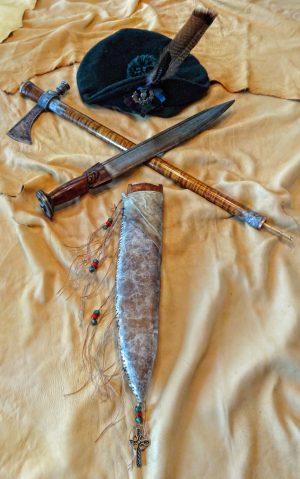
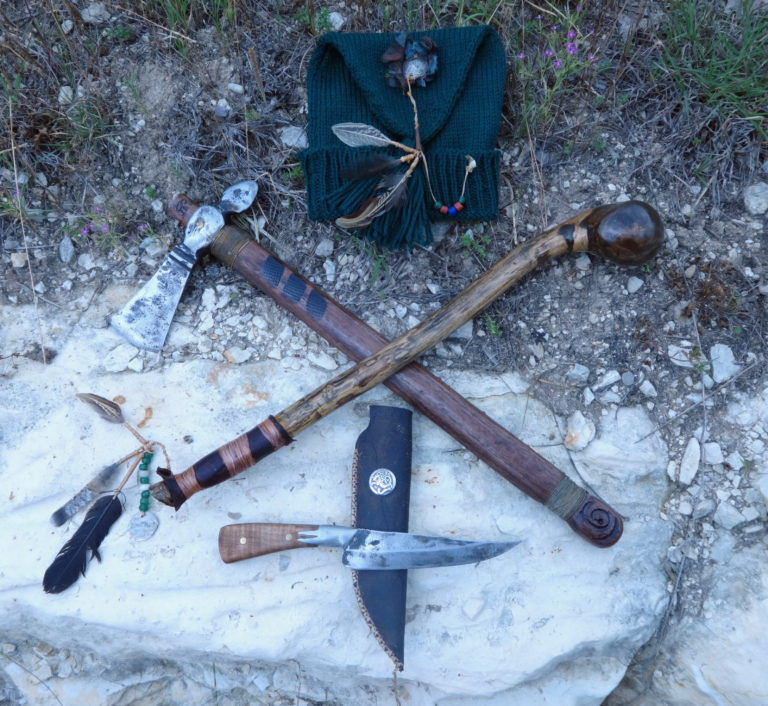
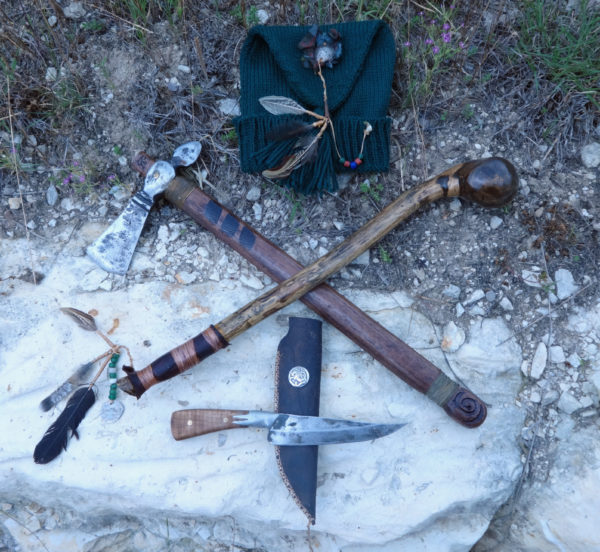
Don Shipman made an edged-weapon set that includes a knife with a sheath, a tomahawk, a bonnet and a war club.
Custom knifemaker Don Shipman’s edged-weapon set is on auction until June 30, 2017 to benefit the Green Beret Foundation. In addition to a Rogers’ Rangers bonnet, a knife and sheath, and a tomahawk, the set also includes a war club. These are all items a Ranger during the French and Indian War might have carried.

Don Shipman of Shipman Knife & Hawk and Longfear Forge in Waco, Texas, has made a Rogers’ Rangers III edged-weapon set for auction to benefit the Green Beret Foundation, which helps Special Forces members and their families. This new set includes items that the precursor to today’s U.S. Army Ranger would have carried with him in the eastern woodlands of North America during the French and Indian War, 1754-1763. The kit includes a knife and sheath, a tomahawk, a Rogers’ Ranger bonnet and an item stirring interest: a war club.  If you would like to bid on this hand-crafted and meticulously researched collection, you only have until Jun 30 to do so. As of this writing, the highest bid is $1310. You can read about Don’s decision-making process for this set in detail in the October issue of BLADE magazine. Be sure to subscribe.

Don is nothing if not thorough. Whether in love, service to country or researching and assembling his edged-weapon Heritage Sets, he strives to honor the spirit of the warrior, the frontiersman and the gentleman.

Rogers Ranger II was fashioneed by Shipman Knife & Hawk for the Green Beret Foundation.
This Rogers Rangers II set by Shipman Knife & Hawk included items a young Ranger serving under Major Robert Rogers might have carried in 1755 during the French and Indian War: a Scottish bonnet, pipe hawk and a dirk and sheath.

Take, for example, the name of his forge. In Irish Gaelic, “long” means “ship” and “fear” means “man.” But The Ship Man, as his Special Forces friends sometimes refer to him, doesn’t stop there. “I use the analogy that ‘long’ gets its meaning from the Norse ‘longships,’ which raided medieval Ireland,” Don explains. “‘Man,’ especially ‘strange men,’ is frequently associated with ‘danger’ in languages. So, ‘man’ equals ‘danger’ equals ‘fear.’ Thus, Longfear forge equals Shipman Forge. All of the above works especially well with my Norse and Irish ancestry,” he concludes.

So, on his blades, you will find the crossed-arrow Shipman logo, and if Don forged the item, you’ll also see the Longfear stamp. “The stamp is…wait for it…a Viking longship prow! Totally badass!” And that’s what it’s like talking with Don. You’re going to get an education, and you’re going to enjoy the lesson because he makes it entertaining.

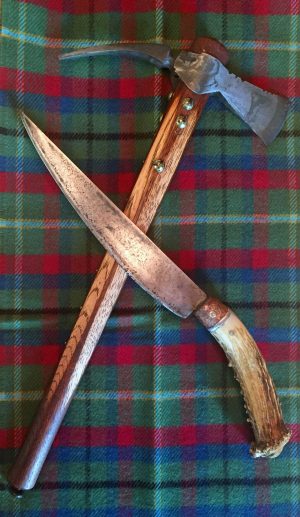
The Wild Geese I was crafted for a U.S. Army Ranger and Special Forces soldier.
This kit included a pipe hawk, a Joe De La Ronde-designed spike hawk, a roach-belly blade with sheath, the family tartan, and an caubeen, or Irish beret, with three badges.

Don makes edged weapons that could have been used or made by the common man on the American frontier, no matter where that frontier may have been at that point in history. Sets can include a knife and a tomahawk, or more than one of each, along with usually a bonnet, blanket or piece of clothing. He’s working on one now that may include a gun. Each item in the set is researched thoroughly, from handle woods to clan tartans used in the headgear cockade—think rosette on a prize-winning ribbon.

First, if you don’t already know your family’s origins, Don will research your family’s heritage using Ancestry.com, the online genealogical site that assists in tracing your family tree. He establishes where your family came from and where your family settled or migrated to when they arrived in America. The frontier may have been upstate New York at the time, or Ohio, or Kentucky as westward expansion continued. If you’re of Irish or Scottish descent, for example, he’ll determine, to the best of present-day knowledge, to which clan your family belonged. Similarly, if you think you may descend from Vikings, he’ll investigate your Nordic heritage.

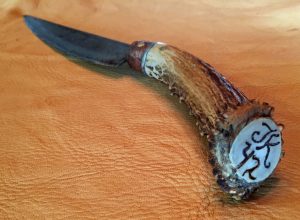
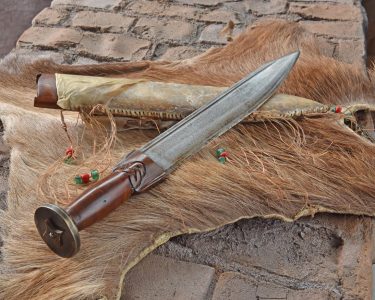
This roach-belly blade is part of a Shipman Heritage Set called Wild Geese I.
This roach-belly blade was forged out of 1095 steel by Longfear Forge. The ferrule is comprised of beaten copper and poured pewter. The handle is whitetail antler and “JK42” is engraved into the pommel using Colonial (Allegheny) font in recognition of the client’s service in Special Forces Operational Detachment (ODA) 542.

Next, he’ll research available materials in the region where your family lived once they arrived in the New World. Was that variety of maple tree growing in the area where and when your family settled? Yes. Then Don may use that wood to fashion a knife handle. What styles of knives or tomahawks were being used in that region and for what purpose? For instance, there’s the tomahawk that has a bowl in one end used for smoking tobacco and passing around, what we would think of as a peace pipe. There’s the ’hawk with the spike opposite the cutting edge, which our ancestors used in times of combat for striking their opponents. And, hawks with nubs on the back were often used as a mallet or hammer, making the weapon double as a utility tool.

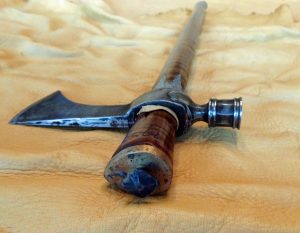
This pipe hawk is part of the Shipman Knife & Hawk Rogers' Rangers II set.
The tomahawk in the Rogers’ Rangers II set has a 22-inch curly maple shaft with a pewter inlay. The copper butt cap has a 2-inch brass mouthpiece. The head is an R.E. Davis blade in 4140 steel. Patina added to all metals.

Every facet of the collection is thus researched. If Don wants to use a turkey feather, for example, to adorn a bonnet, he first confirms if turkeys were plentiful where your family lived and at that time. The woolen bonnets are supplied by reenactment companies such as Jas. Townsend & Sons out of Pierceton, Indiana. In Scottish versions, the headgear is larger and of thicker material, but the Irish renditions are precursors to the berets used by U.S. Special Forces. And like our elite warriors wear what’s called a flash—think a shield-shaped patch adorned with symbols from their unit—on their berets, Colonial-era warriors would wear a cockade made with their clan’s tartan, say, or other emblem representative of their heritage.


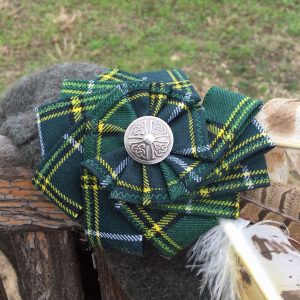
Forresster Tattered Cockade 2
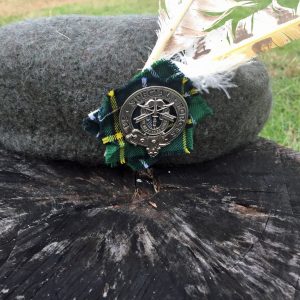
A tattered Forrester tartan cockade was one of three cockades for this bonnet.
Shipman Knife & Hawk can also assemble bonnets for those who might not be able to afford the whole set at once.
This bonnet came with tattered, bow and rosette cockades in the client’s Forrester tartan. Due to the client’s service in elite forces the red-tailed hawk, wild turkey, ring-neck pheasant and mallard feathers are prominently displayed, his family hailing from an area where the species were prevalent.

Don will educate his clients on the proper time and place to wear certain emblems. For instance, your set may include one bonnet with multiple cockades or other adornments. There may be a tattered cockade appropriate for everyday wear, or one that should only be worn at formal occasions. The headgear may include a feather, which, Don explains, would only be appropriate for a chief of a Native American tribe to wear. However, he acknowledges that his clientele may correctly believe they have earned the honor and they will wear the feathers to military galas, for example.

Don knows more than a little something about warriors of many nations and their weaponry. He ended up serving 30 years in the U.S. Army. “All I wanted to do was not embarrass my father and be a good soldier,” Don said. His father was an Army sergeant major, and Don was born and raised in Wurzburg, West Germany (at the time) until he was 13 years old. His dad’s final duty station was at Ft. Hood, Texas, where his parents went through the process of naturalizing Don. At the time, Germany had compulsory military service. This entailed sacrificing his dual citizenship, but saved him from possible conscription into the German army.

When his father retired, the family moved back to the home state of both his parents: West Virginia. So, Don was a high-school kid in a very foreign world. How foreign? “This kid got on the school bus and he had a fat bottom lip. I’m thinking, ‘It isn’t even 9 o’clock yet and this kid’s already been in a fight.’” Thus was young Don’s introduction to chewing tobacco. On the very same day on the very same bus, a few stops along the route, three redheaded sisters get on the bus. “My eyes immediately go to the tallest one, ’cause that’s how I roll,” Don said. “She had wire-rimmed glasses, and I thought, I’m cool with that.”

This Scottish dirk and sheath was part of the Rogers' Rangers II set.
The sheath for this 18-inch Scottish dirk has a 14-inch basswood shell wrapped in rawhide with a sinew running stitch. It is adorned with sinew fringe and green and red padre beads and a 2-inch Celtic cross.

Fortunately, through an old-timey bus driver who lined the students up by sex and height, eventually the tall girl and older boy ended up sitting beside each other. Don barely said a word. Unbeknownst to him, however, the future Mrs. Shipman, Diane, or Annie as Don calls her, took matters into her own hands, putting the word out that the seat beside her was always reserved for Don. She knew right from the get-go that he was “the one.”

Don was dating his best friend’s sister, and although he got to the point where he could talk to Diane—a lot—and wanted more than anything to be with her, he couldn’t figure out a way to break it off with his friend’s sister without hurting her. “Next thing I knew, I was in basic training,” Don says, laughing. The other attachment dissolved naturally during the separation. In another example of his thoughtfulness, when Diane wanted to skip the hassle of a wedding, he told her he understood and that she could scale the event back, but that a wedding was bigger than both of them. “I told her I couldn’t do that to my parents, and that if she thought about it, I didn’t think she could do it to her parents either.” The Shipmans have now been married 37 years. They have a son, Isaac, born when Don became a Green Beret, and a daughter, Samantha, whom Don delivered.

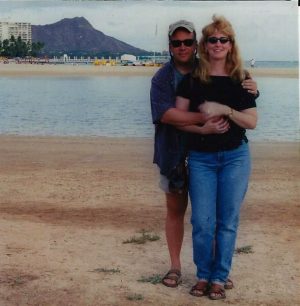
Don and Diane Shipman visited Hawaii in 2000.
Don’s favorite picture of him and Annie was taken on Oahu in 2000 with Diamond Head in the background.

Following a long family tradition, Don joined the U.S. Army in 1977 as an armored reconnaissance specialist, completing basic and advanced training at Ft. Knox, Kentucky. Although he hadn’t intended to stay, he did well and acted on the guidance of superiors, continually accumulating the schooling and assignments that allowed him to advance. When he wanted to join Special Forces, he was advised to take drill sergeant school. He did, and soon got accepted to qualify for Special Forces. The only problem was, he would have to wait for a slot in his preferred specialty: engineer, “because, yeah, I wanted to blow things up.” Or, he could go in immediately as a physician’s assistant, and have a marketable skill when he transitioned back to civilian life.

Qualifying on both the physical level and being required to “drink from a fire hose” medically speaking, Don made it through. “I was never afraid of the academics.” Because medics are limited in number and a Special Forces unit cannot deploy without one, Don deployed frequently. Honduras, twice; Somalia, pre-involvement; Kenya, four times; Tanzania; Djibouti; Egypt; Pakistan and Afghanistan, pre-involvement; Bosnia-Kosovo; Saudi Arabia; Kuwait; Iraq…in other words, he was exposed to the warrior tradition of many cultures.

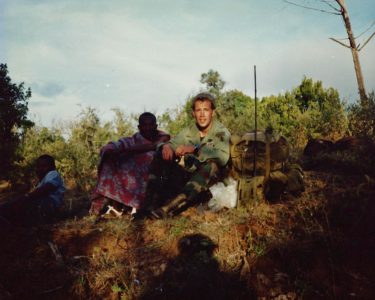
SFC Donald G. Shipman served with 5th Special Forces Group in Kenya in 1989.
In November of 1989 Don Shipman was a sergeant first class with 5th Special Forces Group on guerilla operations in Kenya.

But it was when he was face-down in the sand during Desert Storm, yelling at the next closest man, who was yelling back because neither could hear the other that Don began bargaining with God to get him and his brothers out of this. “God, family, country. I’d done a lot for my country. It was time for more God and family.”

Stateside, Don accepted a research position with a special operations medic from the Vietnam era who would encourage him to accept the Army’s offer to get his doctorate. Don finished out his career teaching at Ft. Sam Houston in San Antonio, Texas. In the course of his medical training he was made an officer and retired as a major.

In all those years, aside from an occasional fishing trip, Don had never had a hobby. Now with time and resources he could indulge his creative side. About seven years ago he was on the Military Times Hall of Valor website where you enter your surname and up pops a database of recipients of the Silver Star up to and including the Medal of Honor. There were more Shipmans than Don could count. He’s a firm believer in the line that Rudyard Kipling made famous in his poem “Recessional”: “Lest we forget—lest we forget!” No soldier truly dies unless he is forgotten.

Don wasn’t even drawn to knifemaking, not right away anyway. But in feeding the home fires, it began to bother him that hardwoods like black walnut were being burned. “It’s practically a sin,” he said. So, he fashioned a hawk handle out of one piece and enjoyed the process. He gave it away. Then representatives from the Ranger Lead The Way Fund asked Don if he would make something for them to auction off at their 2013 gala. He made Rogers’ Rangers I, a set including a bonnet with a Roger’s Ranger badge, a 23-inch tomahawk and an 18-inch Scottish dirk with sheath. In 2016, he was asked to make Rogers’ Rangers II for a Green Beret Foundation auction. He had found the perfect outlet for his love of history, his brethren and the various streams of humanity that forged our country’s beginnings.

Don’s pieces look old and homespun, in keeping with both the available technology of the era and the skill level of the common men who fashioned them. If he doesn’t forge the blade himself, he uses The R.E. Davis Company in Woodville, Ohio, which specializes in weapon reproductions. Pieces from Shipman Hawk and Knife are pitted, worn and sometimes slightly warped, because that’s what a centuries-old edged weapon should look and feel like.

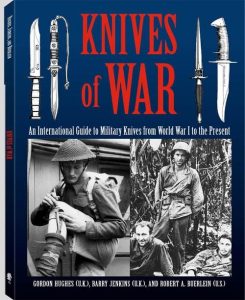
‘Knives of War’ Reveals Elite Forces Use of Knives in Combat

"Knives of War" explores the use of knives by elite fighting forces from WWI to the present.
“Knives of War” is the “International Guide to Military Knives from World War I to the Present,” and costs $25.

Compiled by two British and one American author, “Knives of War” is a guide to edged-weapon use from World War I to the present. Of particular interest is behind-the-scenes information on the use of the Marine Raiders Gung Ho Knife, the Gerber Mark II Combat Knife as well as the most famous fighting knife of all time, the Fairbairn-Sykes. This is a must-have for any knife lover’s library.

Bear & Son acquires GATCO sharpener division

Acquiring GATCO has positioned Bear & Son Cutlery to be a true one-stop shop for knife enthusiasts.
Bear & Son Cutlery, Inc., has purchased the sharpener division of GATCO.

Bear & Son Cutlery, Inc. announced Nov. 14 that it has acquired the sharpener division of GATCO. Ken Griffey, president of the Jacksonville, Alabama, manufacturing company, said he’s been in the knife industry for 39 years, and for 28 or 29 of those years Bear & Son has worked trade shows and other events side by side with the Great American Tool Company, Inc., or GATCO, as it was better known. Griffey expressed confidence that Bear & Son can now truly be a one-stop shop for knife enthusiasts. “It’s a natural fit,” he said.

Sharpener production at GATCO ceased in June or July, Griffey explained, so the number one order of business is to get merchants restocked. For the immediate future, GATCO sharpeners will continue to be made in both the USA and China. In short order, Bear & Son executives will assess whether some manufacturing can be moved back to the United States.

All GATCO sharpeners will continue to be made with the possible exception of one or two models. In place of those, Bear & Son will debut two new sharpeners to complement its knife lines. Griffey said he saw 3D models of these new sharpeners but wants to see the real thing before he approves production and sets price. Decisions will be made in time for any new products to make their first appearance at the SHOT Show, Jan. 17-20, in Las Vegas, Nevada.

GATCO celebrated its 25th anniversary in 2014. Founded by John Anthon and originally based in Getzville, New York, its specialty was offering a wide range of sharpeners. Angle guide, pull-through, stone, diamond abrasive, ceramic, carbide—GATCO had a model. The company’s Tri-Seps sharpener was the BLADE Magazine 1999 Accessory Of The Year.

Griffey said the purchase of GATCO makes Bear & Son Cutlery a full one-stop shop for knife enthusiasts. Always strong on the outdoor and hunting side of the knife market, the company also offers its Bear Ops line that focuses on law enforcement, military and self-defense knives. A new line, the affordable Bear Edge, will offer knives with some components made in China but assembled in the USA.

Steve Shackleford, BLADE® editor, contributed to this article.


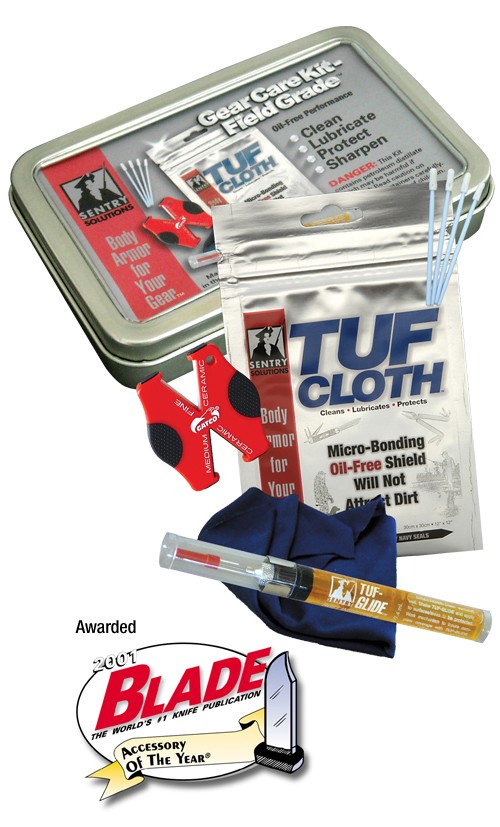
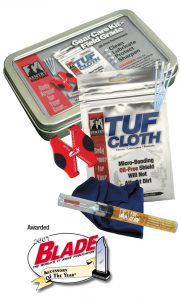
gear-care-kit-field-grade-tinThis Gear Care Kit Field Grade Tin is a perfect stocking stuffer and includes a GATCO Super Micro sharpener.


Save

Save

Good and Bad Knife Bills Brewing


There is both good and bad news from Washington state. Starting with the good, two companion bills, Senate Bill 6179 and House Bill 2347, would make it legal to manufacture spring-assisted and switchblade knives in the state. The bills also clarify the definition of a switchblade, or what is referred to in Oregon law as a “spring blade knife,” so as to not include assisted-opening knives that are currently subject to adverse interpretation of the state statute, making them technically illegal. In addition, the bill would expand the existing law enforcement exemption for possession of “spring blade knives” to members of the military, full-time first responders and the citizens who hold a valid Washington concealed pistol license (Washington is a “shall issue” state).

Knife Rights Director of Legislative Affairs Todd Rather will be in Olympia on Wednesday to testify in support of the bills on behalf of Washington’s knife owners. The bills are a big incremental step forward in a state where any knife with a spring assisted blade has been interpreted as being illegal and where Washington knife companies, such as Fox Knives USA and SOG, were prohibited from even manufacturing such knives in the state, sending those jobs to other states with more rational knife laws, including neighboring Oregon.

The bad news is that last year’s ridiculous anti-knife bill, HB 1006, which would make it illegal to conceal any knife over 3 1/2 inches long even with a Washington concealed pistol permit (since it is not a concealed weapon permit), has been resurrected. In a state where a long coat is a normal part of every outdoor enthusiast’s, fisherman’s and hunter’s attire for a good part of the year, this would turn honest citizens into criminals for carrying a modestly sized sheath knife on their belt, along with quite a few common folding knives longer than the arbitrary length limit.

If you live, work or travel in Washington state, please contact BOTH your Senator and Representative in Olympia and ask them to support SB 1234 and HB 2347, respectively, and ask your Representative to help kill HB 1006 for good. Click here to locate your legislators, or the legislators who represent where you work or travel.

 The preceding is courtesy of Knife Rights. For more information click on http://kniferights.org/


For more on the latest knives, knife legislation, knifemaking instruction, knife trends, knifemakers, what knives to buy and where and much more, subscribe to BLADE® Magazine, the World’s No. 1 Knife Publication. For subscription information click on http://www.shopblade.com/product/blade-magazine-one-year-subscripti…?r+ssfb230112#BL1SU


Cutlery Hall Of Fame: Buster Warenski

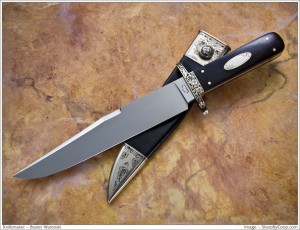
Any discussion of the greatest custom knifemakers of the modern era must include the late Buster Warenski, a member of the BLADE Magazine Cutlery Hall-Of-Fame.

While best known for his reproduction of the King Tut Dagger in the late 1980s, Warenski’s influence on custom knives, knifemakers and the Knifemakers’ Guild was immense and, in many ways, continues to this day. One of the early Guild voting members, he was considered among the best custom makers from the get-go. He excelled not only by the example of his workmanship but also by his leadership, serving on the Guild’s board of directors for a number of terms, including as president (1977-79).

No mention of the greatest knifemakers is complete without mention of Buster Warenski. (SharpByCoop.com photo)
A member of the BLADE Magazine Cutlery Hall Of Fame, Buster Warenski was one of the greatest knifemakers ever. (SharpByCoop.com photo)

The workmanship of his knives pretty much spoke for itself. He could make just about any fixed blade, folder or sword, and make it extremely well, though it is his art daggers for which he is most remembered. He taught himself how to engrave and although he may not have been the best engraver, the early examples of his engraving held up among other knives of the time.

But then it always seemed that Buster found a way to make his knives the best—and one way was marrying Julie, who learned how to engrave and became one of the best, lending her talents to Buster’s knives and making them even more fabulous. (Julie Warenski-Erickson continues to engrave today and is married to knifemaker Curt Erickson.)

Perhaps the greatest tribute to any knifemaker is one from one of his peers who also happens to be one of the world’s best makers—in this instance, Steve Johnson. As Steve noted, “Putting myself in even the same sentence as a ‘fellow knifemaker’ with Buster makes me uncomfortable. No one will ever attain the skill and ability as a knifemaker as this great man did.”

For the latest knives, knife news and much more, stay tuned to www.blademag.com.


Knife Museum “Dissolved”; Collection to 3 New Venues

After over 30 years of operation, the National Knife Museum (NKM) is “being dissolved.” However, the old museum’s knife inventory will carry on at three separate museums, according to Lisa Sebenick, president of the National Knife Collectors Association (NKCA) and secretary of the NKM.

The only museum of its kind in the USA, the NKM had been housed on the mezzanine of Smoky Mountain Knife Works in Sevierville, Tennessee, since late 2006. The original rent for the space was all of $1 per year. “The officers, directors and staff of the National Knife Museum sincerely thank Smoky Mountain Knife Works/Kevin Pipes for giving our collection of cutlery a home these past seven years,” an NKM release stated.

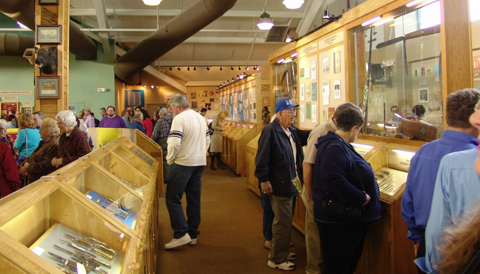
National Knife Museum is dissolved. (Mike Carter image)
The National Knife Museum is being dissolved. Its knife inventory will be relocated to three new locations. (Mike Carter image)

According to Sebenick, the museum’s knife inventory will be donated to three different museums: the National Rifle Association Museum in Springfield, Missouri, the Berman Museum of World History in Anniston, Alabama, and the Janney Furnace Museum in Ohatchee, Alabama.

As for the 50 or so Bill Moran knives that were exhibited at the NKM, an official statement from the Moran Foundation was that no decision had been made for those knives at press time. At some future date, perhaps some of the Moran knives would be put on loan elsewhere, the statement concluded.

The NKM was the vision of BLADE Magazine Cutlery Hall-Of-Fame© member Jim Parker. Located in Chattanooga, Tennessee, the original museum was built in 1981 and was the creation of the NKCA as a separate, educational, non-profit corporation. It opened its doors in 1982. It was moved to Sevierville in 2006.

According to Pete Cohan in BLADE’s Guide to Knives & Their Values, 7th Edition, while many NKCA members were heavily involved in the original museum’s creation, it was the donation of three major individual knife collections—those of Cutlery Hall-Of-Famer Frank Forsyth, Dr. James Wilkison and Dr. William Rosenthal—that created the foundation for a comprehensive museum display collection.

During its run at Smoky and in addition to the many other knives it exhibited, the NKM also included the custom knife collection of Cutlery Hall-Of-Famer Joe Drouin, a number of club knives from knife clubs around the country, various knife ephemera and more.

For the latest knives, knife news, trends and more, stay tuned to blademag.com.

Advertisement

Must Read Articles

Read this before you make a knife

Knifemaking 101 – Read This Before You Make a Knife

  by Wayne Goddard My experience has taught me that there's nothing like digging in and getting started. I've often said the hardest part of the...
how to forge damascus steel

How to Forge Damascus

Advertisement
Advertisement