
The BLADE Blogs

The blogs of the BLADE editors, Steve Shackleford and Erin Healy.

What To Ask/Not Ask a Knifemaker

Don't ask a maker how long it took him to make a knife.
Knowing what not to ask a knifemaker is almost as important as knowing what to ask him. (Point Seven photo)

When you buy a knife from a knifemaker, it’s your money and you have the right to ask him or her any question—within reason—about the knife. However, there are certain questions we recommend you ask and others we recommend you don’t ask. For instance:

•Don’t ask how long it took to make the knife. Why? For one, depending on the maker’s expertise and equipment, some knifemaking operations may take some makers longer than others. Some makers may have equipment that performs a knifemaking operation faster, or some makers may simply be faster than others. Besides, how long it takes to make something doesn’t always translate into it being better or worse. It’s the quality of the end product that matters, not how long it took to make it. Besides, the question is usually one asked by people new to knives—and you don’t want to look like a knife newbie, right? Professional makers who have been around many years have heard the question umpteen times, and while some makers are patient and will answer it, it’s a good way to get off on the wrong foot with others. And it’s almost always good to get off on the right foot with anyone, including knifemakers.

•If a price for a knife seems high, don’t ask incredulously, “That knife cost HOW much?” Most knifemakers take their work seriously. They know how much talent and work goes into a knife or how much the knife brings on the market—and some knives bring four figures and higher. If the price seems too high, simply acknowledge it or nod your head, thank the maker for his time and move on.

•Things to ask the maker include how long he’s been making knives; how he tests his knives for cutting ability; why he outfits a knife with a certain feature or how he achieved it/made it that way, such as a flat grind vs. a hollow grind, blade temper line, etc.; whether he’s a full or part time maker; does he accept custom orders and how long his waiting list is; and what knifemaking training he’s had or knifemaking schools he’s attended. There are others but this is a start.

For the latest knives, knife news and more, keep your eyes on www.blademag.com (www.blademag.com).

You Know Your Knifemakers, but Do You Know Knife Laws?

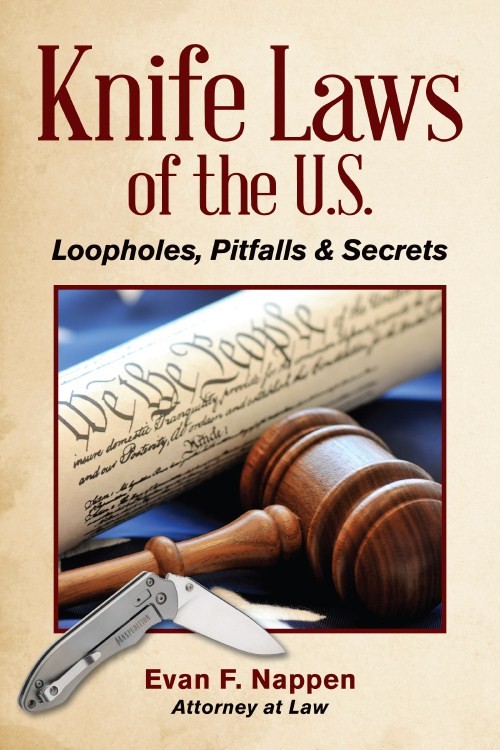
Knife Laws of the US bookKnife Laws of the U.S., by renowned knife rights attorney Evan Nappen, is an indispensable guide to the legal issues every knife enthusiast should understand. It’s not just a book of laws, though. Nappen expertly explains the history behind knife regulation, the state of mind to have when dealing with law enforcement and the legal traps that are all too easy to fall into.

Order Knife Laws of the U.S. direct from BLADE here to get the best price. A few bucks can save you a lifetime of hassle.
New BLADE: Makers To Watch in 2015!

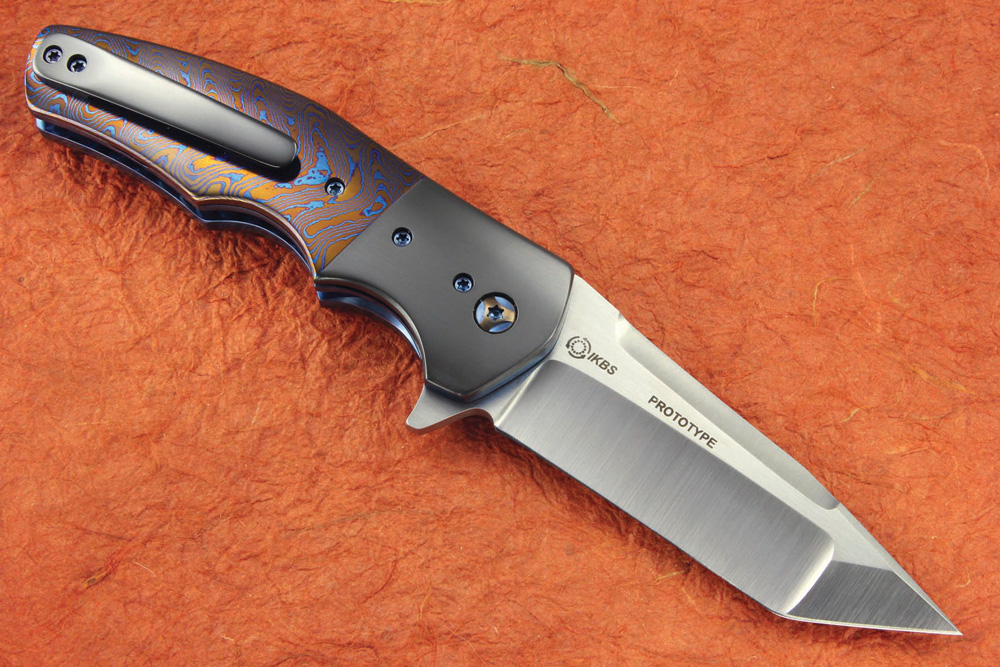
Kirby Lambert resumes his perennial presence on the to-watch list of Neil Ostroff of True North Knives with such models as the Prototype Crossroads flipper in CTS XHP stainless steel, a Mokuti handle with zirconium bolsters and an IKBS bearing system. (TNK image)
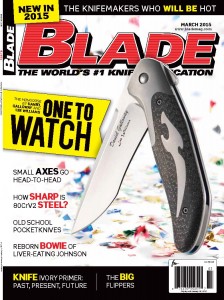
Dave Stark of Steel Addiction Custom Knives said two of knifemaker Lee Williams’ protégés are gaining attention quickly: Daniel Galloway and Pat Hammond. A collaboration with Williams, Galloway’s Mongoose is the cover knife of the March 2015 issue of BLADE®. Galloway’s price: $1,600. (Kris Kandler image)

Who will be the knifemakers to watch in 2015? How sharp is one of the hottest new knife steels in the industry? What were the most important knife stories of 2014? Learn the answers to these questions and much more in the new BLADE®, on newsstands today!

Some of the USA’s top custom knife purveyors were polled for the knifemakers to watch in the new year, with one of those makers, Daniel Galloway, having his “Mongoose” collaboration knife with Lee Williams serving as this issue’s cover piece. See who the other makers are, along with some of their top work, in the new BLADE on page 12.

The high-carbon steel known as 80CrV2 is among the newer and hotter blade materials among custom knifemakers especially.

Follow ABS master smith and BLADE field editor Joe Szilaski as he makes a knife of the steel and tries it out in his knifemaking and knife-using instructional, “How Sharp Is 80CrV2?”

The year past has seen many highlights and lowlights, from the landmark announcement by the Knifemakers’ Guild and the American Bladesmith Society that, after almost 40 years of jousting, they will finally hold their first annual combined knife show in 2015, trends—or were they just fads?—in the industry, to the back-and-forth between the federal government and legal ivory owners over changes in ivory regulations. Get the scoop on these happenings and more in “’14’s Blades of Grey.”

While on the subject of ivory, award-winning knifemaker Jim Hammond has made knives for decades, a number with ivory and ancient ivory handles.

Not only did he conduct an in-depth seminar on ivory at the 2014 BLADE Show, he also volunteered to write a three-part story on the past, present and future of the misunderstood substance. Check out part one in the new BLADE on page 78.

KnifeArt’s Larry Connelley said Duane Dwyer’s reputation for knife innovation helps place him among the makers to watch in the coming year. Dwyer’s SnG with a titanium frame carries a KnifeArt price of $1,200. (KnifeArt image)

There’s much more in this issue, including the latest in big flipper folders, profiles of Masecraft Supply and Pohl Force Knives, a test of two compact custom axes, four hot factory slip joints, HEPK master smith and BLADE field editor Ed Fowler’s essay on how knifemakers must follow their inner muse in “It Takes Courage To Be Yourself,” and much more, all in the March BLADE.


New BLADE on newsstands now!Check out the custom knifemakers to watch in 2015 in the new BLADE®, on newsstands now!


Midweek Maker Military-Style: Dustin Driver

Dustin Driver owns Driver Defense Knives in Guntersville, Alabama.
We’re kicking off a new series at BLADEmag.com called Midweek Maker. Each Wednesday we’ll feature a different knifemaker. The first six installments feature active-duty military or veterans. This week: Midweek Maker Military-Style: Dustin Driver of Driver Defense Knives.

Dustin Driver of Guntersville, Alabama served in the U.S. Army from 2004 to 2010. He was a communications expert, deploying to Iraq, 2005-2006, and Kuwait, 2007-2009. He uses that training and experience in his current job as a system and network administrator for a government contractor.

In October 2015 he was looking for a hobby. “I have always been into knives and have always been creative and good at making things,” Dustin noted. Aside from some You Tube videos and Internet research, he is essentially self-taught. “I have a beautiful daughter who has cerebral palsy, so I try and do a few charity knives a year to benefit cerebral palsy and other special needs areas.”

  • Best-selling knife patterns: Belladonna, an EDC mini cleaver; Toxin, an everyday carry with several blade styles; Timber Rattler, a small neck knife
  • Favorite blade steels: 1095 for consistent heat-treat; S35VN as a good all-around steel; pattern-welded steel from Alabama Damascus Steel
  • Blade grinds: flat with plans to offer hollow. “I like thick blades with full or high flat grinds. The thick spine makes for a strong blade, and the high flat grinds make them nice slicers.”
  • How he tests his knives: chopping 2-by-4s, field use, slicing paper
  • Favorite handle materials: canvas Micarta; combinations of stabilized woods, carbon fiber, G10 liners.
  • Price range: $95-$500
  • Knife shows he attends: BLADE Show®
  • Forums he participate in: Usual Suspect Network
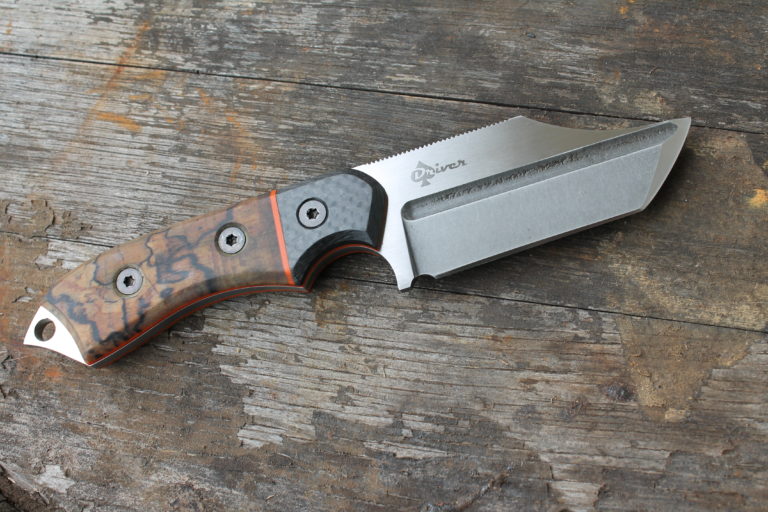
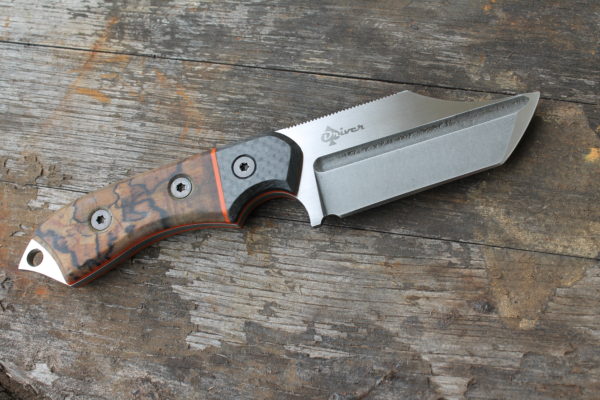
Dustin Driver of Driver Defense Knives enjoys the look of a fuller, especially when it ends in a bevel.
Dustin Driver bought a mill and he’s experimenting with fullers. He likes the looks of them when they end in a bevel. His Toxin model comes in a variety of blade styles, including a drop-point with or without hamon.

The 7.5-inch Driver Defense Toxin is a tanto-bowie with fuller made out of S35VN steel. The flat-ground blade measures 3 inches. The scales are stabilized spalted maple with carbon fiber bolster and orange G10 liner and spacer. Maker’s list price: $350 with Kydex sheath.

Contact Dustin Driver, 256-975-9857, [email protected], on Facebook at Driver Defense and on Instagram @driverdefenseknives. His Facebook Group is Driver Defense EDC. You’ll want to ask to join that one. Dustin makes beef jerky, too, and he’s a big-hearted guy with frequently donates portions of proceeds to charity.

Subscribe To BLADE For More Stories Like This

A U.S. subscription to BLADE magazine, 13 issues, is $21.98.
An annual U.S. subscription to BLADE is $21.98. You can get your 13 issues sent to Canada for $39.98 and internationally for $49.98. Or go green and get your issues sent digitally for $17.98.

A one year’s subscription to BLADE will ensure you’re the first to read all six Knifemaker Showcase stories. You’ll also get the latest knife news, knifemaking how-tos, knife reviews, plus knife history and articles that tap into the knowledge of both the legends and the up-and-comers. Don’t miss out. Subscribe.

Merritt-Loveless Knives Do Indeed Hold Merit

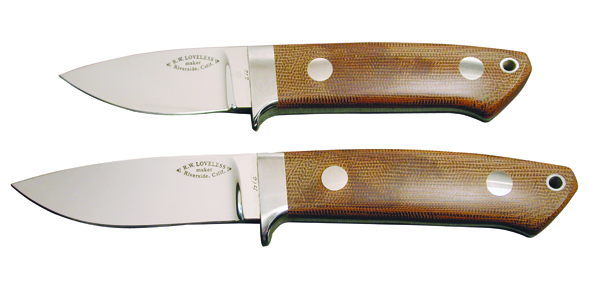
“The Loveless knife design is all about function,” Jim Merritt once noted. “A Loveless knife is made for the guy who wants to have the best knife possible for field work.” Merritt worked side-by-side with Loveless in his shop for 30 years, and toward the end was making Loveless’s knives on his own, with Bob pitching in and helping whenever he could.

This pair is a prime example of the combined efforts of Bob Loveless and Jim Merritt. Their skill as knifemakers is simply without peer.

The knife photo is by Durwood Hollis and was used in the book he authored titled Knifemaking With Bob Loveless.

Photos: 8 Red-Hot Forged Knives 

Robbins Fighter

Image 1 of 8

This Landon Robbins fixed blade in 1084 carbon steel won Best Fighter at the Branson Hammer-In & Knife Show. (Chuck Ward image)

Today’s red-hot forged knives include some of the best in utility and other patterns, most all in blades of high-carbon steels such as 5160, 1095, 52100 and others. Though the steels are not classified as stainless, you can control the pitting and rust on the blades by simply wiping them down after each use. No biggy, really, if you think about it. Properly heat treated and ground, the blades are easy to sharpen and cut like bandits.

Here are eight knives hot from the forge, starting with a sexy fighter in 1084 carbon steel by American Bladesmith Society journeyman smith Landon Robbins of Crane, Missouri. The understated hamon or temper line of the clip-point blade, S-guard and “dropped” blackwood handle make this puppy stand out—and it also took home the award for Best Fighter at the recent Branson Hammer-In & Knife Show.

Knife Collecting Books
Check out BLADE’s collection of its best knife collecting books and resources, all in one bundle at a hot price. Click the image to go to ShopBlade.com.

David C. Lemoine embellishes the blade of 5160 on his drop-point hunter with a short burst of filework on the spine. A single mosaic pin accents the contrasting brown and black lacewood bird’s beak handle. Overall length: 8.25 inches. A pouch sheath completes the package.

ABS master smith Don Fogg says a sign of a well-done hamon is one that stands out and is easy to describe. We christen the hamon on the W2 tool steel blade of ABS journeyman smith Tad Lynch‘s bowie “thundercloud” for its resemblance to an oncoming storm. The handle is Micarta®. Overall length: 14.5 inches.

Lyons and tigers and bears—oh my! In this instance the Lyons is ABS journeyman smith Bill Lyons of Palisade, Nebraska, maker of a slick hunter with a deep-bellied blade of 5160. The silver-wire-inlaid handle is separated from the blade by a minimalist guard. Overall length: 7.5 inches. The knife includes a leather belt sheath.

ABS journeyman smith Don McIntosh captures the “Musso Style Bowie” in a brass-backed blade of 5160 carbon steel and an ironwood handle. The brass guard and ferrule augment the blade’s brass back. For those unaware, “Musso” refers to bowie authority Joe Musso, who reportedly has every prop knife used in the early 1950s classic movie about BLADE Magazine Cutlery Hall-Of-Fame© member Jim Bowie, The Iron Mistress, the film that inspired many a knifemaking legend to build knives.

ABS master smith Jerry Lairson enjoyed past success on the cutting competition circuit and parlays some of that experience into his kukri in 5160 carbon blade steel and an ironwood handle. The kukri designs lends itself to chopping, one of the main requirements of any good competition cutter. Overall length: 16 inches.

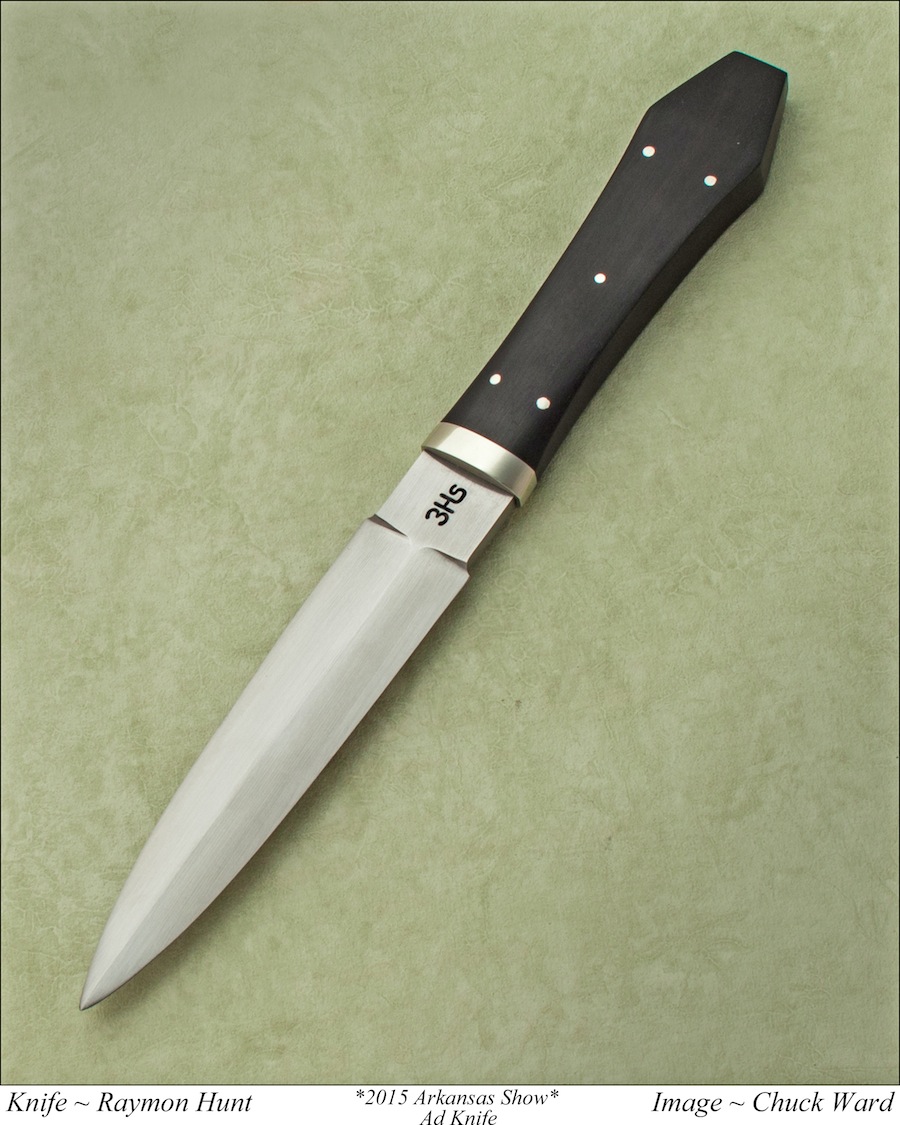
Raymon Hunt of Irving, Texas, chose O1 tool steel for the 5.25 inch blade of his boot dagger. A silver ferrule separates the knife’s double-ground blade from the ebony coffin handle. Overall length: 9.75 inches. Boot daggers, a very popular style in the early days of the modern custom knife movement, aren’t seen much anymore, so Mr. Hunt’s offering is a welcome window on a bygone style long overdue for a comeback.

Another carbon steel blade with an understated hamon—this time in 1095—highlights Joel Austin‘s bowie. The straight-back blade and Spartan features make this a knife we could see Jim Bowie wearing back in the day walking down some dark alley in Natchez-Under-The-Hill, Mississippi. The handle is ironwood. Overall length: 13 inches.

What To Look For in a Knife Handle

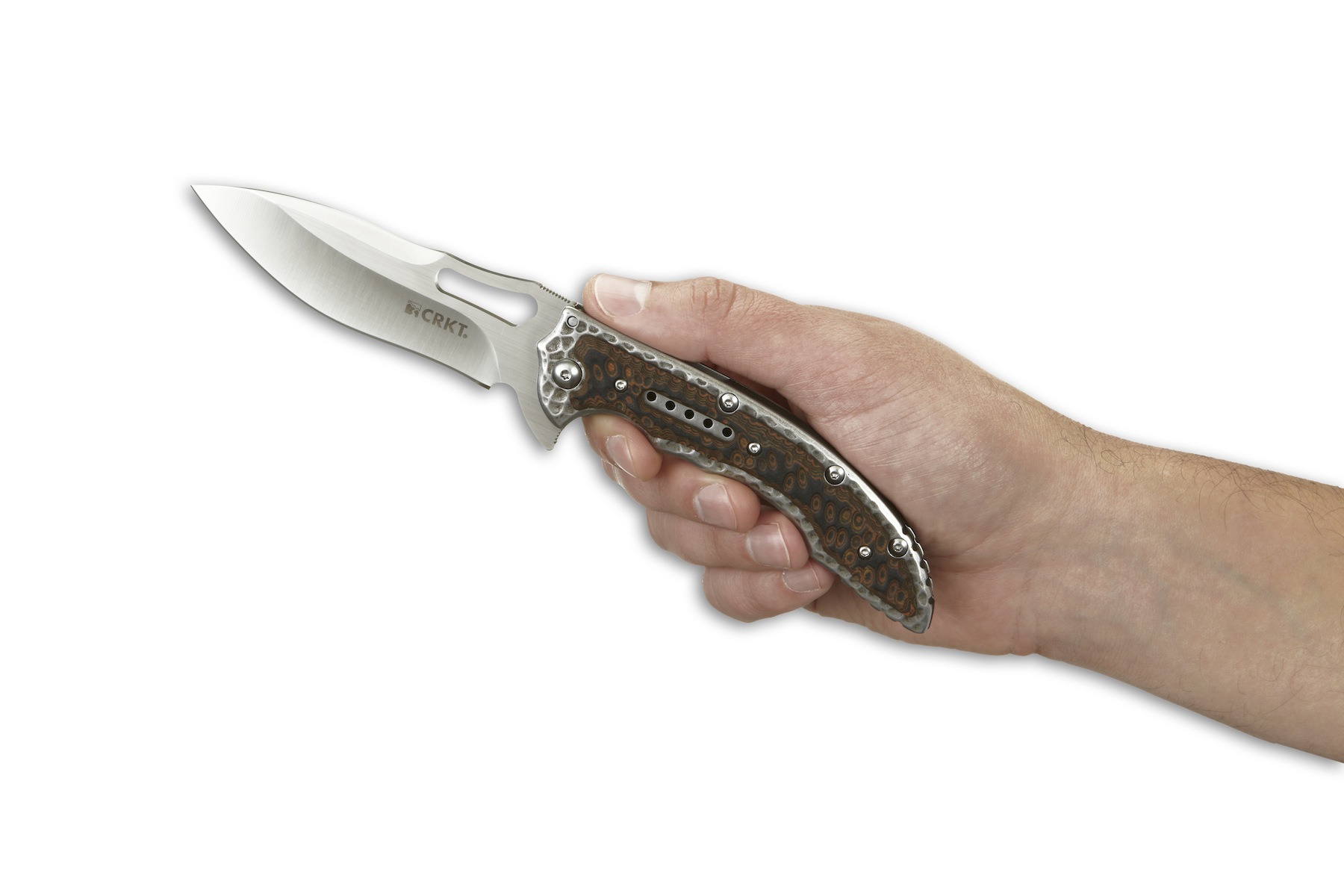
The knife handle should fit your hand snugly. The knife is the CRKT Fossil.

What to look for in a knife handle is a question whose answer—as with most things knife—depends on many factors.

For one thing, no one knife handle fits everyone. Hands come in all shapes and sizes, so a knife handle that will fit a large hand probably will not fit a small one—and vice versa. As a result, no matter how much a knife handle is touted as being “user friendly,” you can’t know if it will suit your needs unless you pick the knife up and use it. Of course, that’s hard to do when you can’t use the knife unless you buy it. Then, if you don’t like the knife, you’re stuck with it.

One way around that is to find a friend who has the knife in question and borrow it. Of course, you will need to take good care of the knife and give it back when you’re through.

Barring the above, look for a knife handle with gentle curves, contours and palm swells that fit the shape of your palm snugly. This will help prevent the knife from sliding around in your hand or cause you to have to constantly regrip the knife handle with your hand. Avoid finger grooves as they are too restrictive in terms of the way you can hold a knife handle. Besides, you may find over time that grooves you thought fit your fingers/hand really don’t.

Avoid a knife handle that has sharp corners at the butt or any place that tend to dig into your hand. Those can cause hot spots or even cut you. Avoid a knife handle that is too soft. It may feel good at first but it, too, can cause hot spots/friction on your palm and/or fingers over extended periods of use.

Single, integral guards are good as they keep your hand from sliding onto the blade. That’s one of the good things about flipper folders—not only do the flippers ease the job of opening the knife but they also serve as single guards.

For more on the best knife handle for you, see your local knife retailer and ask him to show you the many different options you have when it comes to a knife handle.


The latest issue of BLADE is on newsstands now!Recommended:

Stay abreast of the latest developments on this and many more knife rights issues with a subscription to BLADE.

Great Knives Have “Face”

Great knives have face. I’m not talking about a face like on a Halloween mask, but a knife with a design or style that’s recognizable by a large number of knife enthusiasts as having been made first by one knifemaker and one knifemaker only.

The face, in this instance, is the unmistakable knife design or style of the maker in question.

How the term came about I’m not exactly sure but I’ve heard it from or read it written about by long-time observers of the knife scene, including BLADE Magazine Cutlery Hall-Of-Fame© members Bernard Levine, Bruce Voyles and others. One explanation of face that applies here is that I may not know or remember a person’s name, but if I know his or her face I almost always instantly recognize it. The difference in the instance of knives with face is that I recognize both the knife design or style and the maker’s name.

There are at least two provisos: 1. To fully qualify as a knife with face the knife must be recognizable by a large number of knife enthusiasts. Now, there no doubt are great knives made by makers that one or a few enthusiasts may recognize as being the knives of specific makers, but the ones that really fill the bill are the ones many enthusiasts can look at and say, “Yep, that’s so-and-so’s knife.” It’s effective in terms of a conversation starter among knife enthusiasts who are friends, or as a conversation icebreaker among those who have just met. They don’t know each other but they do know great knives with face.

2. Some of the makers of knives with face have had their designs with face emulated by many others. Even so, if the knife has face those who recognize it will say that it’s in the style of the maker who originated it.

Following is a selection of great knives with face and why they qualify. Enjoy!

  1. The Bob Loveless dropped or drop-point hunter. The Loveless drop-point hunter is one of the great knives with face on this list that meets Proviso 2 above. While it may not appear to be all that unusual, the drop-point style of the blade—where the blade tip falls below the plane of the spine—is something Loveless popularized in the 1970s and ’80s, and it remains his signature style to this day.
  2. The Bill Moran style. Actually, as with Loveless, any number of Moran knives have face, though I’ve chosen one of my favorites: the ST-24.  The flowing blade with a long clip point and ergonomically contoured dropped handle with silver wire inlay is unmistakably a Moran.
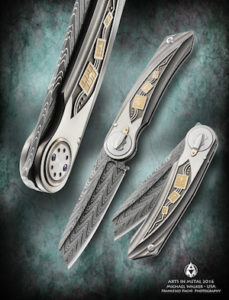
  3. The Michael Walker style. Walker’s linerlock folder changed knives forever but he also makes models unlike anyone else. Outfitted with any number of his clever and innovative locks, each of which gives the handle a notably different look at the pivot, Walker’s knives use the latest and most exotic materials, are embellished in any number of creative and ornate ways, and usually have some of the most interesting blade shapes you’ll ever see.
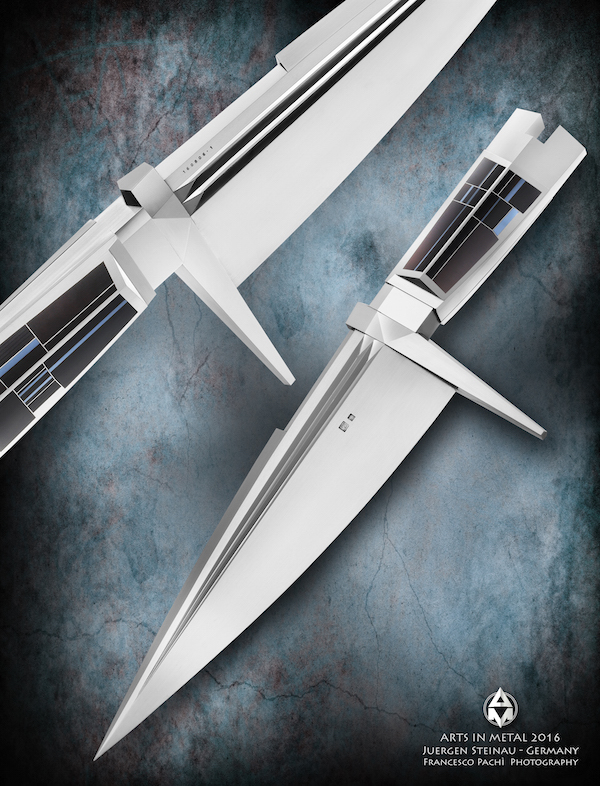
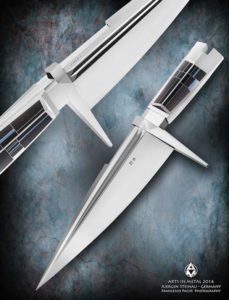
  4. The Jurgen Steinau style. When I first saw one of Jurgen Steinau’s knives, at first I wasn’t even sure I was looking at a knife. The designs, angles and materials of his knives are like something from a book on intergalactic architecture. Suffice it to say, Steinau’s great knives have face—and then some!
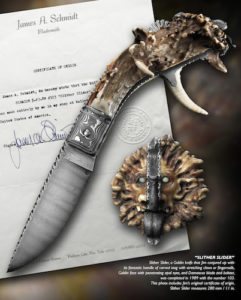
  5. Jim Schmidt’s Goblin Folder. Schmidt’s Goblin Folders have face in more ways than one. Not only do they have the face of a goblin on the handle’s stag butt, but that face makes the knife unmistakable as the style originally made by Mr. Schmidt. A number of his other models have face as well.

There are others who make great knives with face. Which ones make your list?

Loveless and Schrade
1 The Loveless dropped or drop-point hunter has face in large part because of the drop-point blade with the tip that drops below the plane of the spine. An original is shown at bottom here, with a Schrade repro at top.
Jurgen Steinau knife
4 Jurgen Steinau’s great knives have face for their design, angles and materials that look like something straight out of a book on intergalactic architecture.
Michael Walker folders
3 Michael Walker’s spectacular folders have face for any number of reasons, from their distinctive pivots to their exotic materials, creative embellishments and standout blade shapes.
Moran ST-24
2 Bill Moran’s ST-24 has face thanks to the long, flowing blade and ergonomic dropped handle with silver wire inlay—not to mention his distinctive sheaths. Those who know great knives recognize the Moran style immediately.


Schmidt's Goblin Folder.
5 Jim Schmidt’s Goblin Folder has face in more ways than one—it actually has the face of a goblin on the handle butt!
Advertisement

Must Read Articles

Read this before you make a knife

Knifemaking 101 – Read This Before You Make a Knife

  by Wayne Goddard My experience has taught me that there's nothing like digging in and getting started. I've often said the hardest part of the...
how to forge damascus steel

How to Forge Damascus

Advertisement
Advertisement