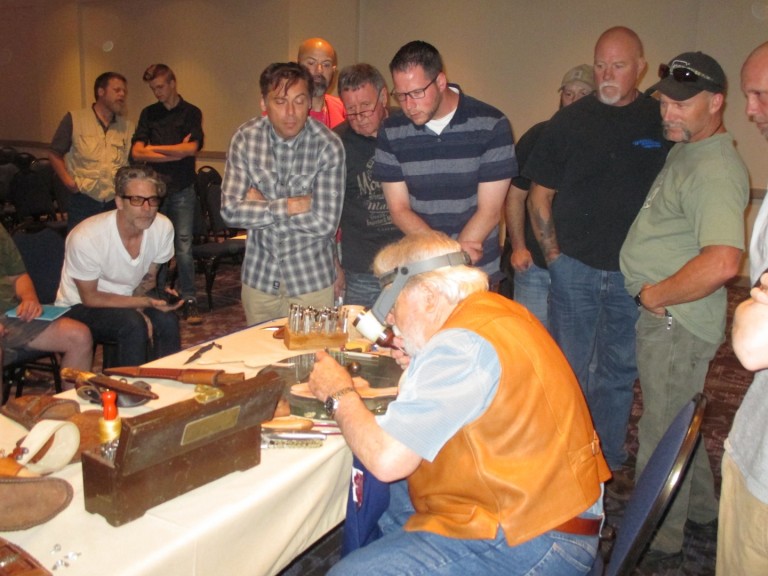
Joe Keeslar (at table) has the full attention of his students during his BLADE U. class on leather sheath and pattern making.
Record crowds, unbelievable knives, the world’s best makers, the BLADE Magazine 2016 Knife-Of-The-Year Awards and so much more highlighted the 35th BLADE Show June 3-5 at the Cobb Galleria Centre in Atlanta.
Featuring almost 1,000 exhibitors covering all segments of the cutlery industry from over 20 countries in the world’s largest knife show, the event kicked off Thursday with the 3rd Annual BLADE University. The comprehensive school of knifemaking began by featuring Knives The American Bladesmith Society (ABS) Way, including how to forge and heat treat knives, how to make a cut ‘n shoot knife, pattern making and making a leather sheath, and how to make the dogbone bowie handle, all taught by some of the world’s top bladesmiths.
The show proper kicked off noon Friday with VIP ticket holders pouring into the show hall after waiting for hours—some as long as from the day previous—in long lines that snaked all though the show lobby and beyond. And once the patrons flooded the show hall, the race was on to get to their favorite exhibitor’s/exhibitors’ tables and booths. All told, more people attended the show the first two days of the event than for the entire show last year—and last year’s show enjoyed the highest attendance ever until this year’s rendition. A number of exhibitors commented on the large crowds, with many selling out of knives the first day.
The custom knife competition was conducted Friday, with Mike Quesenberry and Saign Charleston winning for both Best Collaboration and Best In Show to highlight the 16 awards in total. BLADE University also continued Friday with such classes as how to grind a knife, building and tuning a flipper folder, bushcraft knives survival school, how to build a knife from a kit and how to make a spike tomahawk. Friday night the ABS announced the new inductees to its Hall Of Fame, including ABS master smiths Harvey Dean, Jim Crowell and Greg Neely. They will be formerly inducted along with others in Little Rock, Arkansas, Aug. 6.
With enormous crowds continuing to swarm through the show hall, Saturday saw knives bought and sold by the score. BLADE demos included knife and tomahawk throwing, Japanese sword-cutting and others. Nicole Warden won the first-ever BLADE Show Women’s World Championship Cutting Competition and Dan Keffeler took the 14th Annual Men’s World Championship Cutting Competition—winning an unprecedented fourth title and fourth in a row. BLADE University presented classes on how to make knives on a budget, how to make a combat dagger, how to get your knife design put into production, how to be a contestant on Forged In Fire and more.
Sunday saw more activity—even by Sunday standards it was a busy day—and show patrons left with their knife bags full and wanting more. They will have to wait another year for the next show, though, which will be held June 2-4, 2017, once again at the Cobb Galleria Centre. Make plans now to attend. If you love knives, you’ve got to go!
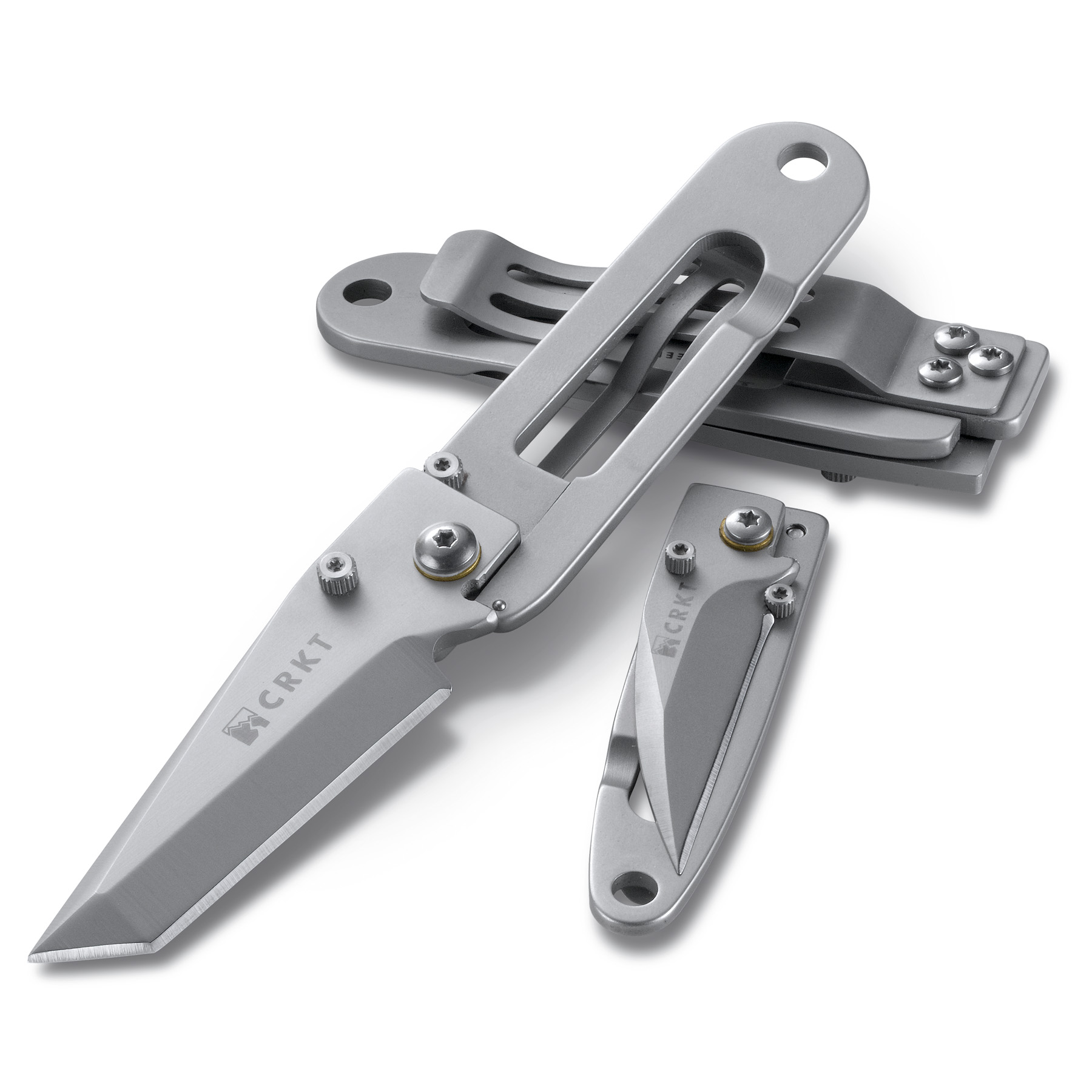
Ed Halligan’s K.I.S.S. design (left) revolutionized factory folding knives. At right is his Delilah’s P.E.C.K. design. Both knives are reproduced by CRKT. (CRKT image)
An unusually high number of knifemakers have died recently, all of whom left more than their fair share of lifelong marks on family, friends and the knife industry. In terms of influence on knife design, though, the two that probably had the largest impact were Ed Halligan and Kit Carson.
Ironically, both men designed wildly popular folding knives for CRKT, and it is those folders that have been so influential on the knife industry.
The K.I.S.S. is a simple yet ingenious folding knife. In the closed position, its two-piece frame-lock construction and safe, user-friendly design “seals” the cutting edge of the chisel-ground blade against the handle. As Halligan once explained, “With the K.I.S.S., the frame and the lock are all one piece … I made the original knife with the blade chisel ground on one side only so it would slide against the frame when folded and make a seal so you wouldn’t cut yourself.”
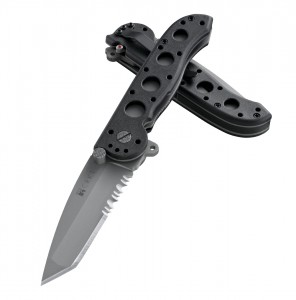
Kit Carson’s M16 design remains one for the ages. This is the M16-12Z CRKT repro. The flipper is the extension with the hole in it seen here acting as a guard just below the handle pivot. (CRKT image)
In fact, when it first came out, I recall talking to one long-time industry observer who thought the K.I.S.S. was a lawsuit waiting to happen because he thought consumers would cut themselves on the blade edge despite the blade’s seal against the handle in the closed position. However, Halligan’s version of the design works so well that such accidental cuts never happen. One of the main reasons the design is safe is that Halligan tested it in real-life conditions to be sure that such accidents never occur. “Safety is a big reason why I carried the knife around so much to make sure it worked properly,” Halligan said.
In 1997, Halligan signed a deal with CRKT for the company to reproduce the K.I.S.S., and CRKT launched the repro of the knife at the 1998 SHOT Show. Only four years old at the time, CRKT was struggling to find a knife that would help “drag the rest of the product lines along,” as CRKT’s Rod Bremer put it. The K.I.S.S. was that knife. Unfortunately, a number of unscrupulous companies blatantly knocked the K.I.S.S. off so much that it eventually became one of the most copied sporting knives worldwide. CRKT and Halligan weathered that storm, though, and Ed designed a series of K.I.S.S. iterations and spinoffs for CRKT that included the Delilah’s P.E.C.K. (for Precision Engineered Compact Knife), Samson’s K.I.S.S., the H.U.G. (Halligan’s Ultimate Gadget), the Slip K.I.S.S., the Neck P.E.C.K., the blackened K.I.S.S. In The Dark, even a fixed-blade version called the Stiff K.I.S.S. and others.
Just as they were linked in their passing, Halligan and Carson were also linked in their CRKT collaboration deals. CRKT must have been living right back in those days because it was just a year after signing the deal with Halligan to reproduce the K.I.S.S. that it signed the deal with Carson to reproduce Carson’s M16 folder. Even though Carson did not invent the flipper, his M16 is universally credited as the model that popularized flipper folders—folding knives with one-hand-opening “flippers” that double as guards when the blade is opened. “The M16 with the Carson Flipper was a huge improvement on non-assisted blade opening, making a manual knife open almost as fast as an auto without a secondary thumb stud or hole mechanism,” observed long-time knife writer Mac Overton. “Because it had less moving parts and its opening relied on inertia rather than a spring or torsion bar, the mechanism was inherently stable and reliable.”
The M16 and its military look—Carson was a U.S. Army career man—soon became not only immensely popular with consumers but with service personnel as well. In fact, by many accounts, the M16 was the most popular knife among active duty service personnel in the wars in both Iraq and Afghanistan.
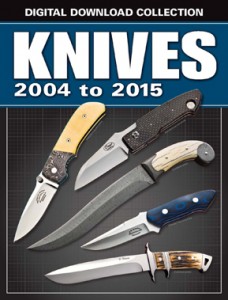
Turn back the clock with BLADE‘s digital collection of annual KNIVES books. Get every KNIVES book from 2004 to 2015 in one PDF download for just $79.99.
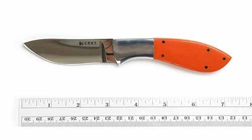
There is no single profile that fits all hunters, and there isn’t a specific hunting knife that fulfills all needs. That’s a good thing for the knife industry. Some guys like a standard fixed-blade, drop-point hunter that comes in a leather belt sheath, maybe even with a slight hump near the tip of the blade where they can rest their finger and choke up on the blade. One of custom knifemaker Russ Kommer’s favorite packages is the 2-Shot. He has used it daily in the field as a hunting guide in Alaska and around the world. Russ says, “I’ve always preferred a smaller semi-skinner, even for the biggest of game. You just use the hump near the end of the blade to locate your index finger. And the blade is short enough that you can work inside the animal and feel where you are at all times.” The CRKT Kommer 2-Shot Skinner Knife has a 3.15-inch full-tang 12C27 Sandvik stainless steel blade, stainless bolsters, orange G10 handle scales and stainless steel pins.
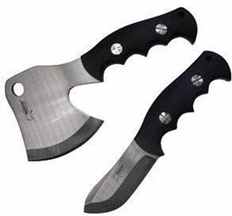
Some ever-prepared hunters aiming for big game opt for a hatchet/skinner combination pack such as the Timberline Hatchet/Bush Guide Skinner Combo. It includes Kommer’s Alaskan Bush Pilot Hatchet and Alaskan Skinner. Expertly crafted from polished 440 stainless steel, the Alaskan Bush Pilot Hatchet boasts a 4-inch, full-tang head, while the Alaskan Skinner sports a 3.625-inch 440A stainless steel skinner blade. Each handle is precision machined Zytel for a non-slip grip and ease of use. The Alaskan Combo includes a ballistic nylon sheath with belt loop, and weighs 2.28 lbs.
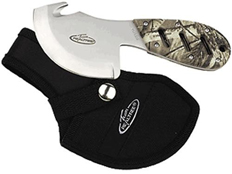
Gut hooks come in handy for skinning game animals, and a Realtree-pattern handle is a plus. The Kutmaster Team Realtree Guthook Knife dons a 420 stainless steel blade with sharp gut hook on the spine, a Realtree camo handle pattern, and a nylon belt-loop sheath.
For many more quality options, visit ShopBlade.com, and stock up for the hunt!
Steve is survived by his wife, Mary, six brothers, one sister and a number of nieces and nephews. Memorials may be made to the charity of your choice. Condolences may be expressed online at www.robinsonfuneralhomes.com or visit www.legacy.com/obituaries/charleston.
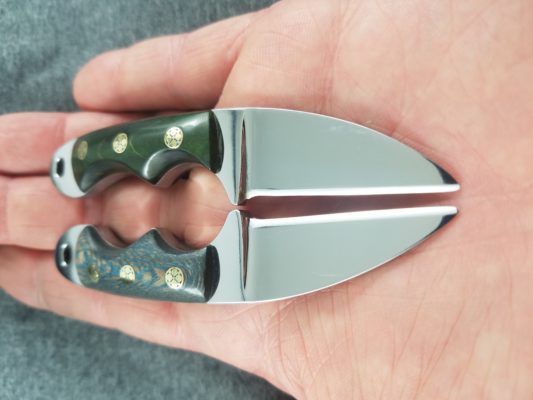
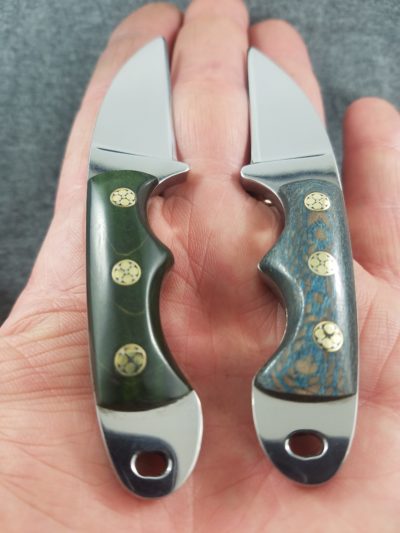
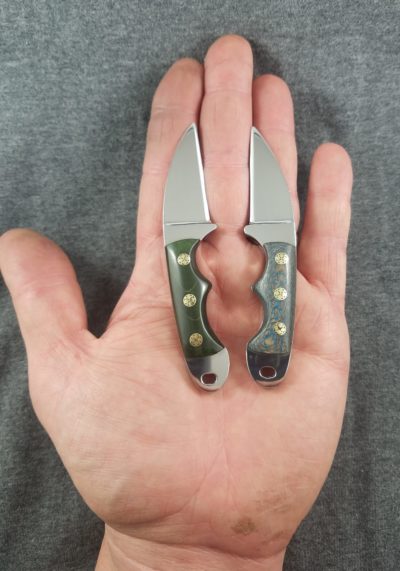
Pete Sloan made two neck knives for the wife and son of his friend and fellow maker Spencer Aplin. He used his daughter’s hand to perfect mini knife’s design, ensuring it fit the tiny hands of Lisa Johnson Aplin and son Alexx who suffer from brittle bone disease.
“One thing that Spencer is very good at is knowing what I’d like,” Lisa Johnson Aplin said. Lisa is the co-founder and chief operating officer of STA Custom Knives out of Brazoria, Texas. She and knifemaker Spencer Aplin were married in 1993, and together they have a son Alexx who will be 24 in a couple of months, a journalist and sometimes quality controller in his father’s shop. Lisa had no idea that a Sloan Custom Knives creation she admired had already been custom-ordered for her by her husband. Lisa suffers from osteogenesis imperfecta, or brittle bone disease, so although she does not have dwarfism and is therefore not a “little person,” she is a very little person. The one thing that Pete Sloan has plenty of access to is little people in the form of children, 9 to be exact. So, he used one daughter’s hand to perfect the mini knife fit and design.
Erin Sloan is 9 now, but she was 5 when her dad, Pete, asked her to help him custom-fit a tiny neck knife. Erin is one of 9 Sloan children.
Lisa’s favorite color is green and Spencer had been admiring a green knife he saw on Facebook that his friend Pete had made. “He asked me if I could make one for his wife,” Pete said. Pete was surprised and honored that Spencer, a maker he greatly admires for his knifemaking in general and blade-carving in particular, would ask him for a knife. Pete told Spencer that he was welcome to make the knife if he wanted, but Spencer said, no, that Pete had a good command of the Wharncliffe design and he wanted Pete to make it.
Pete Sloan started out with an old 4-by-36-inch belt grinder–generally considered underpowered and not ideally configured for knifemaking–and some hand files. “I liked it,” he said.
Humbled, Pete was determined to get it right. But he lived in Medina, Tennessee, and had never met Lisa. He only had Spencer’s description of her size to go on. Lisa is 2 feet, 10 inches tall. Pete’s daughter Erin was 5 at the time. So, he roughed out the 440C stainless steel blades and then with a Sharpie marked the first finger groove using Erin’s grip as a guide, grinding until it was just right for her petite hand. Spencer requested the stainless steel because the Aplins live next to salt water, and he wanted to minimize corrosion. Pete said he mostly gets requests for pattern-welded steel.
Spencer Aplin of STA Custom Knives, standing, took his son, Alexx, and wife and business partner, Lisa, to the 2015 BLADE Show.
If you’ve ever seen the movie “Unbreakable” starring Bruce Willis, you know what osteogenesis imperfecta entails. Mr. Glass’ character, played by Samuel L. Jackson, has a form of the condition that allowed him to grow to full height, but his lifestyle is still hampered by debilitating bone breaks. Lisa and subsequently her son Alexx have Type III OI. A genetic mutation causing a lack of collagen, subsequently prompting connective tissue issues. The result is that bones fracture easily and those with the affliction will be short in stature with a curved spine and barrel-shaped chest. Type I is the most mild form of the condition, Type II and Type VIII the most severe and most often fatal. Types III through VI vary in symptoms and genetic causes. OI has been traced through mummies back to 1000 BC Egypt. Even though the condition has been around a long time, there is still no cure.
Pete Sloan used green-dyed curly maple for the scales on Lisa Aplin’s knife and blue-dyed and natural sycamore for Alexx’s. You can contact Richard Beam on Facebook for such impregnated wood products.
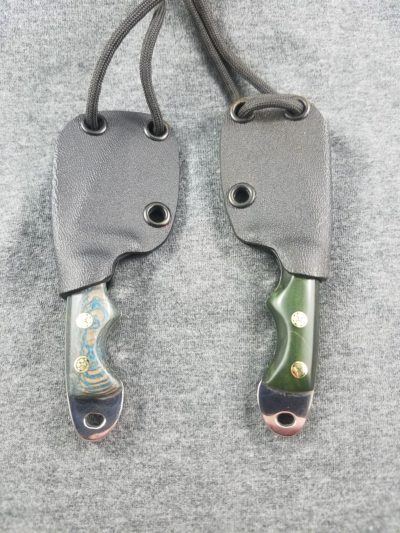
Pete used stabilized curly maple dyed green from Richard Beam at Nicholas Impregnated Woods to make the handle for Lisa’s knife and a combination blue-dyed and natural sycamore for Alexx’s. Each came with a Kydex sheath and cording to wear around the neck. At the 2015 BLADE Show, Lisa finally met Pete in person and he presented her with the knife. She loved it! “Green is my favorite color,” she said. She uses the knife all the time, opening boxes that come to the shop and for everyday uses around the house. Although it can be used for food preparation, Lisa doesn’t cook, she said laughing. Spencer does the cooking. She treasures the knife. “It’s one of my favorite’s in my collection.” She continues to be impressed with the fit and with how Pete obtained it.
Push Kydex sheaths away with your thumb rather than struggling to pull the knife out. If they are too tight, contact the maker. He can heat and loosen the fit while still ensuring the knife does not fall out.
The only thing that Pete could not have accounted for was hand strength or lack thereof. Both Lisa and Alexx had a hard time drawing their knives. Spencer simply heated up the sheaths and worked the knives in them so that they released more easily without falling out. “It not something he could have known about,” Lisa said. “I think he did a great job.”
When asked how she adapts to daily activities in a full-size house at her stature and in a wheelchair, Lisa’s answer was immediate and delivered in as cheery a tone as everything else she talks about. “The great thing about being married to someone who works with his hands,” Lisa explained, “is that Spencer can make me anything I might need customized.” The Sloan Custom Knife was an unexpected surprise, but in hindsight typical of Spencer to have picked out exactly what she would have picked out for herself long beforehand.
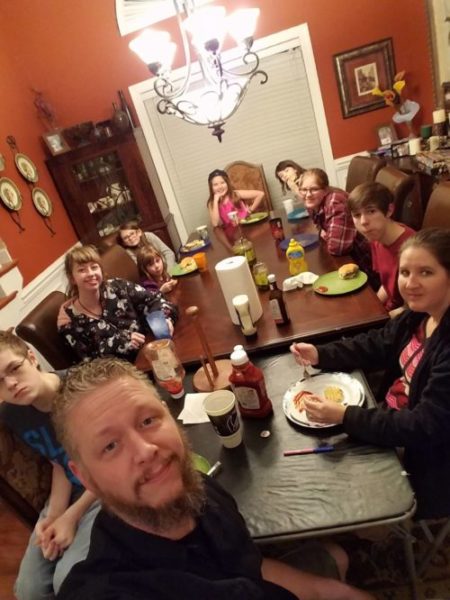
It’s a challenge to get all the Sloans in one place. This is the whole family minus oldest daughter, Becca, who is in the U.S. Air Force.
Pete visited Spencer before the 2017 BLADE Show and the two slept little working hard to finish up knives to sell. Spencer and Pete make knives with similar styles as Spencer shares his knowledge with Pete. And if Pete ever needs another hand model, he can turn to one of his and his wife, Holly’s, nine children, some biological, some adopted, some that came by other means: Becca, 19; Carson, 18; Gage, 15; Brant, 14; Makenzie, 13; Leigha, 10; Erin, 9; Madeline, 8; and Grace, 7. The couple used to be foster parents. “There a story to just about all of them,” Pete noted with a laugh.
Contact Pete Sloan at [email protected] or on Facebook at Sloan Custom Knives.
These mini neckers are 4.25 inches overall. The 440C stainless steel blades are 2 inches. The full-tang construction allows for a lanyard through hole. These were designed for child-sized hands, but come in larger versions. Handle material is impregnated wood from Richard Beam. Maker’s list price: $200 shipped with Kydex sheath.
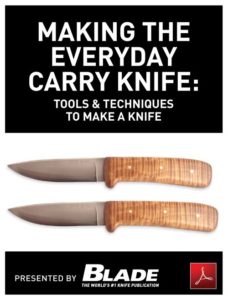
Are You Looking to Perfect Your Own Everyday Carry?
Another thing you’ll learn more about in Wayne Goddard’s “Making The Everyday Carry Knife” is selecting the right materials for a handle that lasts.
“Making the Everyday Carry Knife” by Wayne Goddard includes information on how to determine the best blade and handle length. You’ll also get tips on how to use your computer to assist you in designing your knife, plus lots more including grinding and tempering techniques and tool suggestions. At only $4.99 in digital format it’s a wealth of information at a steal.
There aren’t many dull, boring or mundane trends, and for good reason.
Knifemakers embrace the old saying, “change is constant.” The “same old, same old” never catches on with a new generation. Knife craftsmen strive for fascinating and innovative ways of blade building, and collectors seek out the rare and unusual.
Eventually knifemakers find something modern that is not only aesthetic and utilitarian, but it also catches on with other artists. That’s the start of a trend.
You get the idea—trends are born out of creative thinking and design capabilities, and not from copying old patterns without any tweaking, improving or thinking outside of the box.
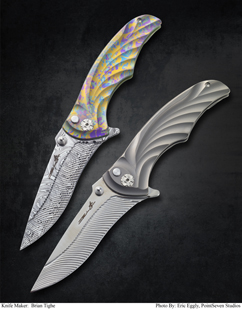
Sure, some trends have staying power. There are many new trends to take in, like dimpled, sculpted, grooved and glass-beaded knives, for example.
It is a trend in knives that presented itself to me while I poured over 1,000s of images from knife photographers for possible inclusion in the Knives 2014 book, now available and a gorgeous book, if I may say so myself, but not because of anything I did. It’s the knives and images thereof that make it a handsome title, and the Trends, State Of The Art, Factory Trends and Feature articles therein.
Enjoy, and keep your eyes peeled for new knife trends in the industry, particularly if you’re a collector, investor or general enthusiast with a habit of accumulating custom or production pieces.
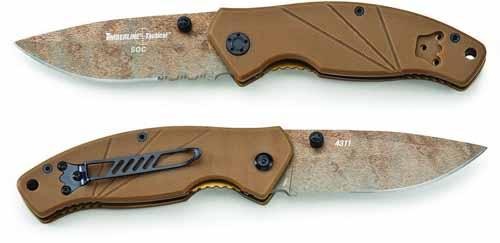
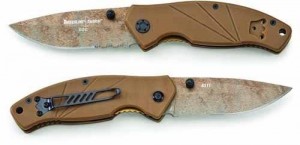
The Timberline SOC folding knife uses thumb studs to open the blade.
So which do you like best to open the blade on your folding knife? Are you a fan of the “Spyderco hole” or do you prefer the thumb studs of such knives as the Timberline SOC Folder? How about a disc atop the blade? Or do you simply grasp the blade between thumb and index finger and snap the knife open? Do flippers do it for you or are you one of those rugged individualists from the 1960s who can open your Buck 110 folding hunter one-handed by the nail nick? Or do you go back even further and prefer opening your traditional slip joint with two hands? Or do you shun all folders and use fixed blades only?
Opening folding knives is one of those things that seem to galvanize Americans everywhere. From the anti-switchblade hysteria of the 1950s caused by Hollywood’s sensationalizing the knife through such film fantasies as The Blackboard Jungle, Rebel Without a Cause and West Side Story to today’s assisted openers, methods for opening folding knives have been miscast as the root of all evil, the means of corrupting our nation’s youth and other social pariahs. Meanwhile, those who use knives for 99.9 percent of what most are used for—cutting—have hailed them for their convenience, utility and, at times, ability to save lives in situations where the user had only one hand to open his blade and cut his way out of danger.
Yes, the one-hand folder is one of the most sensible tools on the planet, and we want to know what your favorite version is. Tell us in words, pictures or however you want to do it. Here’s your chance to set the record straight and maybe even convert some poor miscreant who really thinks one-hand knives are the modern equivalent of the apple in the Garden Of Evil.