

|
||||||
The blogs of the BLADE editors, Steve Shackleford and Erin Healy.

|
||||||
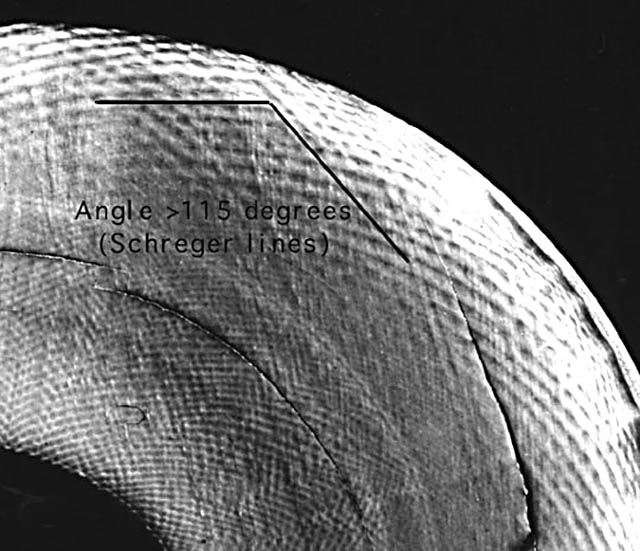
Distinguishing elephant from ancient ivory is challenging and becoming more and more important for the owners of knives with handles of ancient ivory. However, there are two reliable keys to make the determination easier.
Polished cross sections of elephant and mastodon/mammoth ivories display stacked chevrons of cross-hatched lines called Schreger lines or Lines of Retzius—incremental lines of rhythmic deposition of successive layers of enamel/dentine matrix during development. The Schreger lines closest to the outer bark of the tusks are the most visible—and the ones to measure—though there are also inner Schreger lines that are less discernible around the nerve cavity. The intersection of Schreger lines form angles, and this is the key—if the average angle is greater than 115 degrees, then it’s elephant ivory; if the average angle is less than 90 degrees, it’s mastodon or mammoth. Variations in the angles can occur in individual tusks, particularly as the patterns tighten more toward the center. Plus, the visible cross section must be cut square to the axis of the tusk—otherwise the chevrons’ angles will be distorted.
Specimens from both extinct and existing animals can show angles between 90 and 115 degrees in the outer Schreger lines, so the differentiation should never be based solely on a single angle measurement when the angles fall in this range. When averages are used, a clear separation between the ivory of existing elephants and extinct mammoths/mastodons exists. Elephant ivory averages above 100 degrees and mammoth/mastodon ivory averages below 100 degrees.
Another I.D. key, though more involved, can also distinguish mammoth or mastodon ivory from elephant. These ancient ivories can often have blue-green or brownish blemishes on the surface produced by an oxidized iron phosphate called vivianite. Even if the discoloration is barely visible, ultra-violet light will make it stand out with a dramatic velvety-purple appearance. Even if elephant ivory were similarly discolored—though in its natural state, elephant ivory will not display the same discoloration—it would not exhibit the characteristic fluoresence of vivianite.
With recent ivory laws handed down by Fish and Wildlife greying the lines between elephant and ancient ivories, it is possible the laws may give federal agents the right to seize knives and materials that cannot be proven as outright ivory but simply have the ivory look. As a result, if you own knives with ancient ivory handles, having an at least a general knowledge of how to differentiate elephant from ancient ivory could save you from having your knives confiscated, from being fined or both.

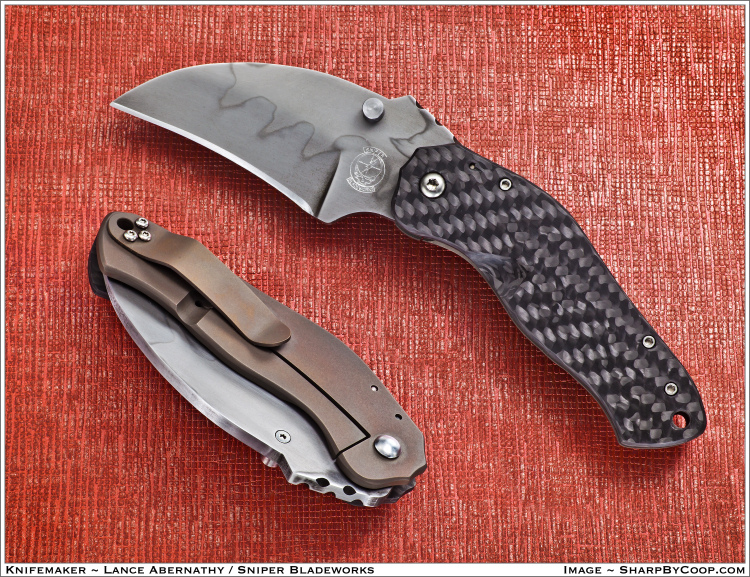 It’s five days and counting to the 31st Annual BLADE Show (www.bladeshow.com) June 8-10 at the Cobb Galleria Centre in Atlanta, where purveyor Les Robertson will tell you what to look for in a tactical folder in his special seminar. An example of one of the hottest tactical folders going is shown above—the Mini-DH Hawkbill by Sniper Bladeworks (www.sniperbladeworks.com).
An Army veteran and long-time purveyor of tactical folders and handforged knives, among others, Robertson will conduct his seminar on show Saturday at 12 p.m. in Room 104. Join him as he outlines not only what to look for in the features of the knives but also what to look for in terms of trends, pricing, the makers and much more.
The seminar is but one of many that will take place during the event, including those conducted as part of the Survival+Tactical Gear Expo held in conjunction with the show. BLADE Show ticket holders can attend the seminars free of charge.
For more on the latest knives, knife legislation, knifemaking instruction, knife trends, knifemakers, what knives to buy and where and much more, subscribe to BLADE Magazine, the World’s No. 1 Knife Publication.

According to a new History™ Channel video trailer and television commercial, Season 2 of Forged In Fire premieres on February 9th at 10 p.m. EST/9 p.m. CST. All-new participants/bladesmiths are ready to forge edged tools and weapons, so tune in to History Channel and see for yourself.
ABS master smith J. Neilson tests a blade on History Channel’s Forged In Fire. (Miller Mobley/HISTORY image)
Forged In Fire (page 84, December BLADE) pits bladesmiths against each other to see who can make the best knife in a limited amount of time, with the winner of each episode earning a $10,000 first prize. Last year’s FIF included such well-known forgers as ABS master smiths Murray Carter, Ray Kirk and J.D. Smith, David Goldberg, Peter Martin, ABS journeyman smith Mace Vitale and others, as well as many relatively unknown bladesmiths.
The combination of having to complete knives in a set time limit along with the other contestants before television cameras and over a million viewers makes for a great pressure environment and high drama. As a result, some of the smiths struggle to perform at their best. See the December 2015 issue of BLADE to find out more.

It’s nice to do something you know is right, and even better when the intentions are pure, and that’s exactly what BLADE® did four years ago with its December 2010 issue. Since then, every December issue, including the upcoming December 2013 BLADE, has been and will continue to be devoted entirely to our fighting men and women in the military.
It was an idea hatched four years ago in an editorial meeting. The staff had two questions: What could BLADE do that no other knife magazine does?; and How can we honor soldiers fighting for our freedom in Iraq and Afghanistan?
Here are a couple of our first December military issues.
I was and am extremely proud of the fact that we’re able to set aside a single issue each year and devote it to the military. It’s the very definition of freedom. The December issue will hit newsstands and subscribers’ doorsteps on September 10th, 2013. Please look for it and help us support our troops. I can’t think of anything more honorable than that.
On this Thanksgiving, one New York citizen is giving thanks to Knife Rights Foundation for a holiday without the threat of a year in jail hanging over his head.
The New Yorker, whose name is being withheld to prevent possible harassment, said, “words cannot express my thanks to Knife Rights Foundation for coming to my aid and helping me gain a measure of justice when things looked pretty bleak for me.”
“Knife Rights is pleased that our legal team’s first foray against New York County District Attorney Cyrus Vance Jr. is resulting in dismissal of charges against a wrongly accused citizen,” said Knife Rights Foundation chairman Doug Ritter.
Charges against the defendant, who was carrying a Gerber one-hand opening pocketknife used daily in his work, were resolved with an Adjournment in Contemplation of Dismissal (ACD) in the first case in which Knife Rights Foundation lent its assistance. This citizen originally faced up to one year in jail and a criminal record which could have jeopardized his professional license and livelihood. Until the Knife Rights legal team became involved in his defense, an ACD had not been offered, even though it had been sought. After Knife Rights’ research and legal arguments were stated in an extensive brief, the DA offered the ACD rather than proceed with prosecution of the case. A typical ACD results in dismissal of a case after passage of a brief period of time and satisfaction of certain conditions (often a brief period of community service), and that was the result in this first case.
Knife Rights Foundation denounces the DA’s continuing expenditure of scarce time and taxpayer dollars to prosecute innocent citizens carrying perfectly legal pocketknives. “Police and prosecutors ought to be focused on real criminals who threaten the safety and livelihood of hardworking taxpayers,” said Ritter.
Due to their practicality and added safety, one-hand opening pocketknives represent 80% of the pocketknives sold in America today and were specifically excluded from being considered a gravity knife or switchblade by a bipartisan act of Congress in 2009. Ritter also noted that “New York’s statutes prohibiting gravity knives and switchblades clearly do not cover these popular tools.” A recent ruling by a Federal District Court in New York made this clear and pointed out that arrests for mere possession of such knives would have the unintended consequence of “transform[ing] thousands of honest mechanics into criminals, subject to arrest at the whim of any police officer” (United States v Irizzary).
“At least through the efforts of Knife Rights, this honest citizen will not have a criminal record to besmirch his good name and can enjoy a truly thankful Thanksgiving with his friends and family.”
“Clearly, we’d prefer to take a case to trial where we feel confident we will win on merit. Just as clearly, the DA doesn’t want to us to establish clear legal precedent and the ACD was tantamount to an admission that he had no real case against the defendant, just as he hasn’t a case against the thousands of honest citizens that the police are wrongfully arresting for carrying lawful pocketknives,” said Ritter.
Sooner or later, however, the legal issue is going to be heard by a court and the DA’s perversion of New York law and persecution of innocent citizens, along with his waste of taxpayers’ funds, will end. Knife Rights Foundation is expanding its efforts to aid law-abiding citizens and businesses caught up in the DA Vance’s unfortunate persecution of these lawful tools.
Knife Rights Foundation is available to assist honest citizens or businesses targeted in DA Vance’s illegitimate effort to proscribe perfectly legal pocketknives. Those arrested for possession of a so-called “illegal knife” in New York can contact Knife Rights at [email protected] or 866-889-6268.
Rhett Stidham, long-time knife collector and purveyor who probably will be best remembered for founding the Randall Knife Society, succumbed to a long illness Saturday, April 23.
Along with wife Janie owner of Meadows Edge retail knife store in Meadows of Dan, Virginia, Rhett was a familiar site at knife shows, selling and trading Randall knives and just about any knife, for that matter, that caught his fancy. A big man with a big smile and laugh to match, Rhett, along with Janie, was constantly on the road attending knife shows all over the country until failing health curtailed his busy travel schedule.
In the early years of his knife experience, Rhett specialized in selling and trading antique pocketknives, and later included custom knives and even knives by William Scagel among those he sold and traded before starting the Randall Knife Society. He also wrote and published the society’s newsletter and coordinated the RKS meetings at the BLADE Show. Early on, he wrote a book about the old (1900-1919 and 1931-1939) Napanoch Knife Co. of Napanoch, New York. As these words were written, this year’s RKS meeting was to be held as planned at the BLADE Show.
Funeral arrangements were pending.





