The BLADE Blogs

The blogs of the BLADE editors, Steve Shackleford and Erin Healy.

Knives Of Summer: Keep Those Puppies Sharp!

When you use one of our “Knives Of Summer,” you will need to sharpen that puppy. In fact, a little edge maintenance after each use—when feasible—is the best way to keep your knife sharp for the next time you need it.

    GATCO’s Natural Arkansas Sharpening Kit is a great way to keep your edges keen at all times. Designed for sporting, kitchen and other knives, it features a novaculite stone mined from Arkansas. The kit includes a block-mounted 5-inch stone for sharpening, a 3-inch stone for final touch-ups, honing oil and a storage case.

For more info click on http://www.shopblade.com/gatco-natural-arkansas-sharpening-kit-80005/?r+ssfb070912.

Nothing Says Thanksgiving Like A Carving Knife

Happy Thanksgiving! And what better way to say it than with a carving knife for that roast turkey? Messermeister’s Meridian Elite 8-inch carving knife is one way to do it. It features an 8-inch blade of X50 CrMoV15 stainless steel with a hand-polished edge and a triple-rivet handle.

For more information contact Messermeister at www.messermeister.com.

To get the latest information on the newest knives, knifemakers, how to make knives, what to collect and much more, subscribe to BLADE® by clicking on http://www.shopblade.com/product/blade-magazine-one-year-subscription-us/?r+ssfb241111#BL1SU

And HAPPY THANKSGIVING from the staff of www.blademag.com, BLADE®, the BLADE Show and everyone at Krause Publications and F+W Media.

Grace Horne: And Now For Something Completely Different

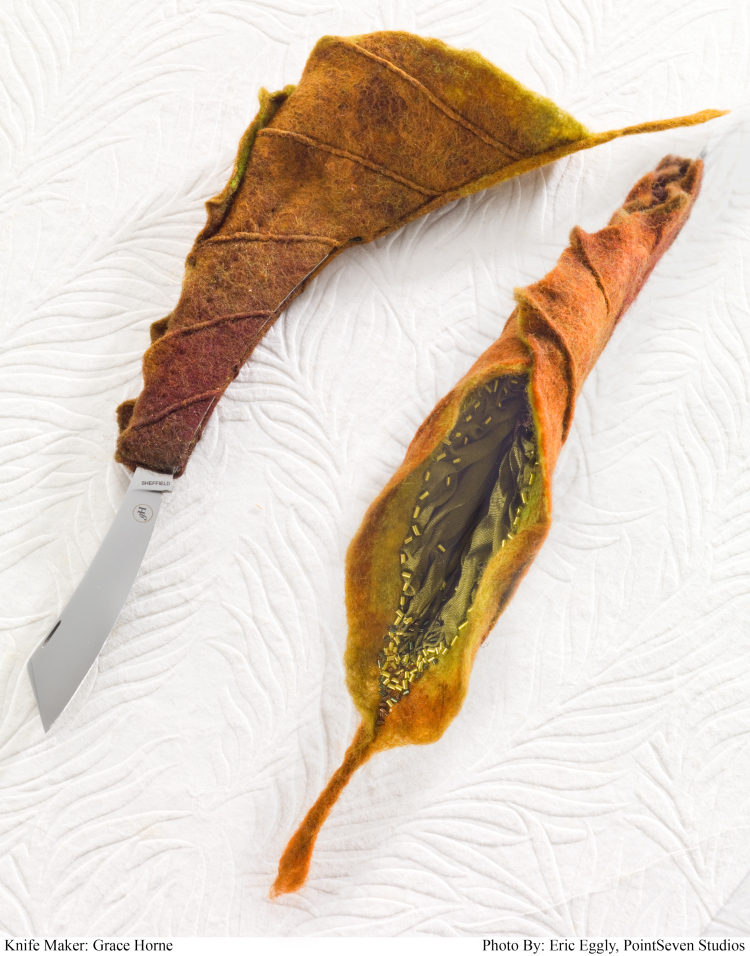
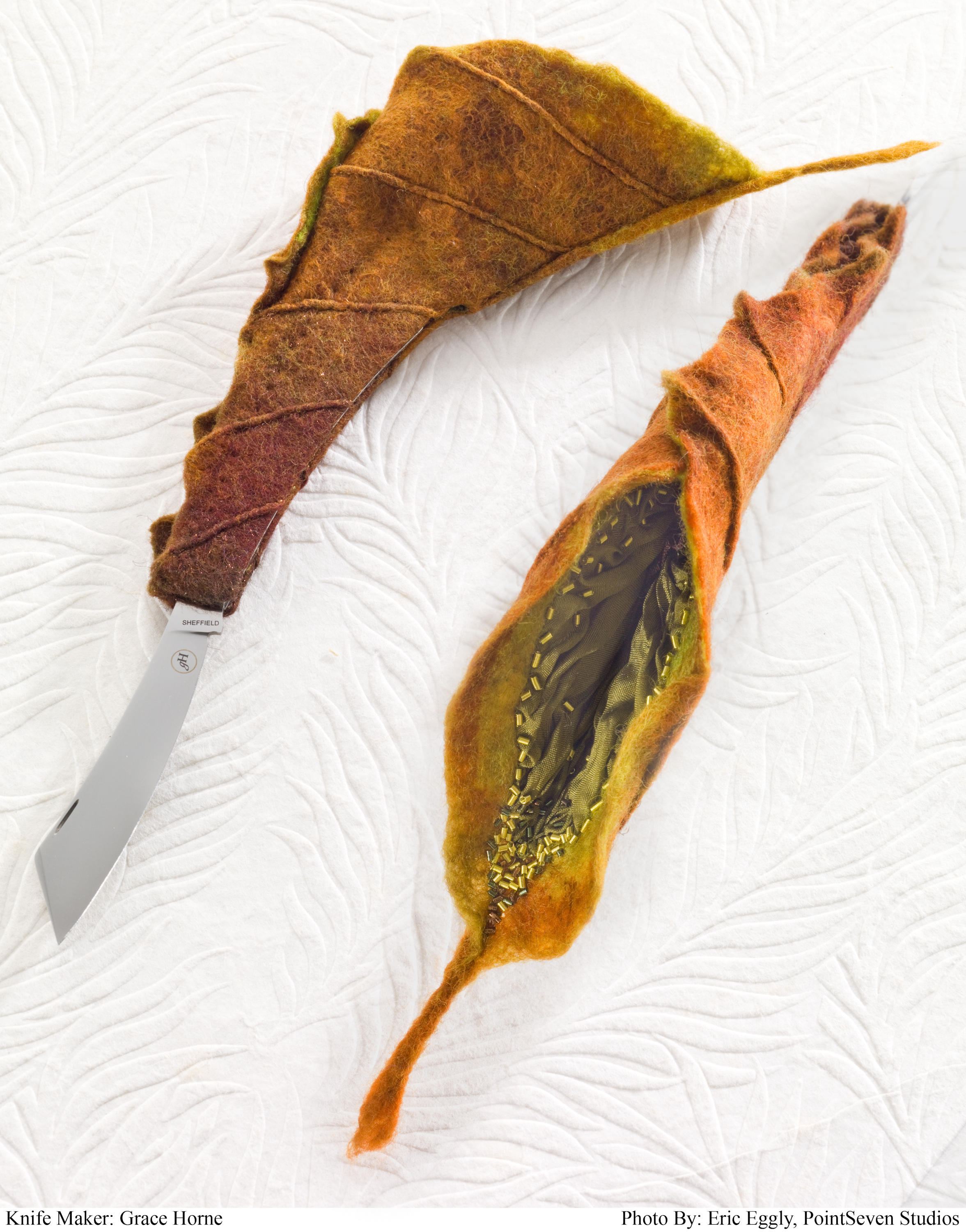
Grace Horne’s “Cocoon #2” incorporates felt, wool, silk and aluminum for the cocoon handle. The 2.9-inch blade is RWL-34 stainless. (Point Seven photo)


     Grace Horne is an artist, embracing the basic elements of her subject and then allowing them to take flight in her imagination. For two decades, she has plied her craft in the cradle of knifemaking, Sheffield, England.

     Completing her college degree in design, craft and technology required a project, and she ambitiously chose a set of three slip joints with damascus blades, making the steel with artist and blacksmith Richard Quinnell at his forge in the Fire and Iron Gallery in Surrey. By 1994, Horne had relocated to Sheffield to seek an apprenticeship in knifemaking with Stan Shaw, perhaps the last of the legendary “Little Mesters,” the independent Sheffield knifemakers who helped establish the city’s storied reputation for quality cutlery through those many years. (See “Stan Shaw: Little Mester of Sheffield, March 1994 BLADE®.)

     Though Shaw was unable to hire an apprentice, he gave Horne a box of old blades to work with, some having been forged a century before. “I decided to take a more academic approach,” she recalled, “completing both a knife-related masters degree and Ph.D. at Sheffield Hallam University. My work was workshop based, and the material I ended up working with was layers of carbon steel separated by 99.99 percent pure silver foil. Visually, I like steel and silver together. It is a combination I have often come back to over the years. But if the two main research questions were ‘Can it be done?’ and ‘Was it worth the effort?’ then the answer would have to be ‘Yes.’”

     Horne produces only about 10 to 12 knives each year and does not accept custom orders. She does not sell through purveyors but maintains a list of people to notify when a knife is available or when her online portfolio is updated. She describes her work as material-and-concept driven yet deeply embedded with the historical Sheffield knifemaking tradition. While knives are one of her loves, another is textiles, and a recent foray combined the two.

     “A couple of years ago,” she recalled, “while my new workshop was being converted from an old Victorian public toilet, I didn’t have knifemaking space but my textile studio was still accessible. This led to my first pieces that cross the boundaries between knives and textiles. These modified Spyderco knives were the result of a project to visually represent the value of knives as everyday tools. During a three-week period I collected everything that I cut with the knife, and at the end of each week I made all the bits into new scales for that knife and then went on to the next one.”

     The modified knives actually incorporate pieces of items such as corrugated board, duct tape, envelopes, and packaging mesh into the handles, and the effort has been followed by a series of “fluffy” knives. Since knife laws are restrictive in Britain and the sight of a pocketknife can elicit comments, Horne covered the Spyderco UKPK that she often carries with woolen felt.

     “I love felt making,” she said. “It is versatile and the final product can be very hard wearing. My complete knife just gets washed when it’s dirty, and how can anyone be scared of a woolly knife?”

     From a woolly knife, the innovative artist progressed to “cocoon knives” that she characterized as soft, warm and visually non-threatening. “Most of the foundation work is a woolen felt,” she commented. “I use a combination of wet, needle and nuno felting to create the desired effect, incorporating silk, cotton and other meshes into the structure of the felt. The surfaces are then stitched, reworked, embroidered and embellished.

     “Folding knives fascinate me because they are all about change—open and closed, dangerous and safe, big and small. A cocoon holds a similar fascination; it is full of potential to be something completely different.”

     When she completed her academic studies, Horne said she recognized her education had been not only about the production of metal, but also about the creative process. This led to the keeping of extensive notes and sketches.

     “I rarely take on commissions but, if I do, then part of the creative dialogue is often conducted through photos of drawings from my sketchbook, and then photographs as the work progresses,” she related. “The story of each knife is important—why I made it, the inspiration behind it, what makes it different from the other knives I have made. Because of this, each knife has its own little book containing vital statistics, life story, background information and pictures.”

     Every knife Horne makes is one of a kind, like the creative energy she channels into her work. “Much of my work develops like a series of slightly misheard whispers,” she smiled. “The title of a picture or a written description of an event will create an image in my head that often is very different from the one that would have developed from a visual input. A physical event becomes a written or spoken distillation and is then reinvented as a new object. Very often, when I track back, I am surprised at how far my creative process has taken me from the original source.”

     Though she never makes the same knife twice, Horne does see recurring themes in her work, and she revisits basic forms from time to time. She does not operate a forge in her shop but does enjoy making her own pattern-welded steel. Award-winning damascus makers Daryl Meier, Hank Knickmeyer and Ed Schempp work with her in steel making after some “gentle coaxing and tuition” on Horne’s part. She also likes to use RWL-34 and other Swedish stainless steels for knife blades.

     Most of the work she does is by hand or with a small surface grinder, and she has plans to have a belt grinder up and running soon. A visit to her shop reveals a number of hand tools used by jewelers, cutlers and watchmakers through the generations. An old Sheffield knifemaker would probably feel right at home there.

     Annual trips to the BLADE Show are vital in maintaining contact with other knifemakers and supplement her use of social media such as Facebook. When she comes to the USA, she has knives photographed by Point Seven and catches up with others in the global knifemaking community. She also attends the KnivesUK show and the SICAC show in Paris.

     “I’m not entirely sure what my knives will look like next year,” Horne laughed. “I’ve started playing with glove leathers, and I fancy incorporating some visual elements from the corsets that I make. One thing I am certain about is that, yet again, they will be completely different from the stuff I’m working on at the moment!”—by Mike Haskew


To read similar stories and all about the latest knives, knife trends, knifemakers and much more, subscribe to BLADE® Magazine. For information on how to subscribe, click on http://www.shopblade.com/product/blade-magazine-one-year-subscription-us/?r+ssfb211211#BL1SU


 

9 Hottest Facebook Makers in New BLADE

9 hottest Facebook makers in BLADE®!
9 hottest Facebook makers help highlight the new BLADE®, on newsstands now!

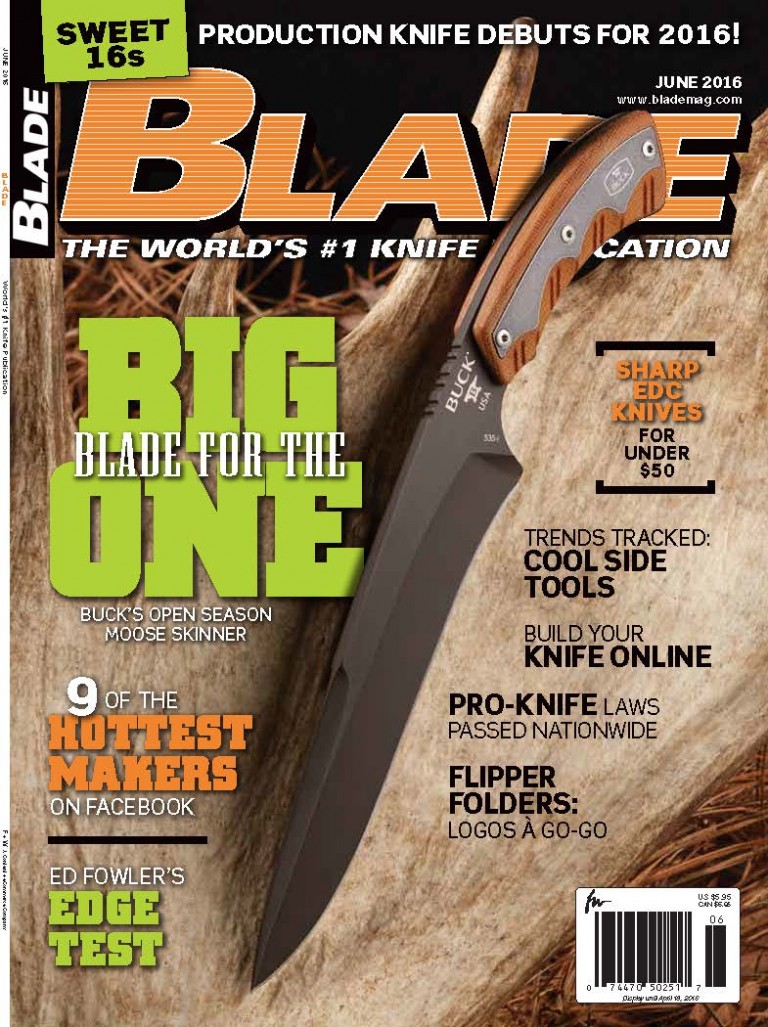
Nine of the hottest Facebook makers, the latest factory knives for 2016, one of the hottest trends going in cool side tools and much more inundate the latest issue of BLADE® Magazine, on newsstands now!

With social media embracing the cutlery industry like James Bowie’s long-lost knife, Facebook is near or at the top of the list of those peopled by any and all who admire sharpened steel. As a result, BLADE used its BLADE Facebook page to poll its friends on who they think are the hottest custom Facebook knifemakers who post pictures of their work on Facebook. Check out the results of our Facebook poll in “9 of Facebook’s Hottest Makers.”

Along with the annual BLADE Show, the annual Shooting, Hunting, Outdoor Trade (SHOT) Show is the place many factory cutlery companies introduce their latest knives. Feast your eyes on some of the latest in tactical, folding, fixed, traditional, hunting, bushcraft, automatics, flippers and other state-of-the-art blades in our edged exclusive, “Sweet 16s: The New Factory Knives for 2016.”

According to ABS master smith Wally Hayes, a side tool is “an ancillary tool for cutting, opening, turning; something useful and fun.” Cool side tools are flooding the industry, from the Dual Action Dragon Opener by Suz and Bob Terzuola on the custom side to the MacV Tool from SOG Specialty Knives on the factory side and everything in-between. Pop a top, cut a rug or whatever hones your edge with one of the latest in these handy multi-tools outlined in “Side-Tool Cool.”

Also this issue: How to build your own knife online; custom logo’d flipper folder tabs; some of the best EDC knives for under $50; the latest in pro-knife laws passed nationwide; the conclusion of Jeffrey Dane’s historical six-part series, “Bowie Legend: Fact or Fable?”; Chad Mock’s “Texas Ulu”; and much more in the latest issue of BLADE.

Kickstarter Campaign for Documentary of Knifemaker Eddie White

 
Shadowland is a documentary about a knifemaker who spent most of his career working in the shadows of other knifemakers and knife companies. He finally set out on his own and has made a success of it in these hard times of recession, nonetheless.
 
That fella’s name is Eddie White.  We’ve been friends since we were in the Boy Scouts together and when he came home from the Navy he was looking for something to do.  I had a custom knife shop and offered Eddie a job.  On his first day I showed him how to grind a blade and as his dad says “and from there he went.”  He was good at it and it wasn’t long before he was grinding 70 knives a day.  Mind you that these blades were already profiled and just needed the blades ground, but still quite a feat.
EdgeGrind1.JPG
He spent years repeating that process and knife assembly for various knife shops before striking out on his own.  I thought it would be a good idea to document how he progressed in the custom knifemaking business and give an inside look at the challenges a craftsman like Eddie faces in keeping the business going.  There is also plenty of footage of Eddie carrying a knife from start to finish.  While not a tutorial it does give you an idea of how to make a knife and not work yourself to death.  Because if anyone knows efficiency and economy of movement it’s Eddie White!


Please take a moment to check out the project on Kickstarter.

Shadowland Documentary Project at Kickstarter.com

Carter Cutlery BLADE Show Wrap Up

See us on CarterCutlery.com!

We are just back from the world’s premier cutlery event — the BLADE Show in Atlanta, Georgia. What a show!

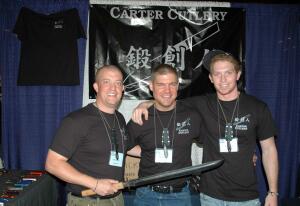
This year marks a new chapter in the history of Carter Cutlery as we moved from a cramped 6-foot show table to a large booth with five tables and room to spare. Our new company logo banner TanSouNin hung proudly on the wall behind to announce our location, and this year all the our staff were wearing new logo T-shirts making us readily identifiable.

Of course, the hanging neck knives were quite distinctive, too.

This year we debuted several new products which were very well received by our customers. They included a new line-up of custom-made exotic hardwood kitchen knife blocks, custom-made maple and ebony laminate cutting boards, our Japanese Shozaburo scissors, premier Japanese axes and logo T-shirts.

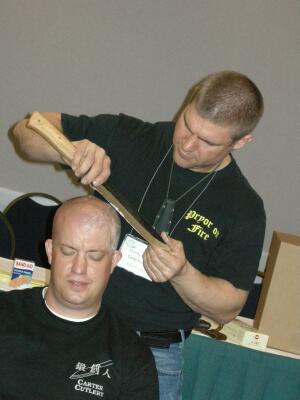
Murray was once again a guest demonstrator/lecturer at the show and successfully shaved volunteer Troy von Kutzleben’s head with a koshinata in front of a crowd to raise awareness for a special disease called Alopecia Areata. We’ll be posting a YouTube video on that soon. Be sure to subscribe to our YouTube channel so you’ll know when that clip has been uploaded.

Immediately following that demo, Murray rushed to another room where they were waiting for him so that they could get an informal kitchen knife cutting competition underway. Murray, equipped with a 9-sun SFGZ Funayuki, diced and sliced his way to a decisive victory over competitors from Buck Knives, Boker and Benchmade knives.

While the knife was easily up to the task, Murray, who almost never cooks, is not resting easy on this victory and has resolved to spend some time with a kitchen knife in his hand to practice up for next years official version of this competition.

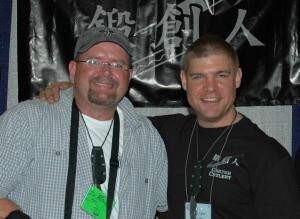
We were honored to have a special visit from Tim McCalla and his dad. Many of you might remember that Tim worked in our office and sales department before Wes, our current assistant, came on board. Tim is a dear friend and we were happy to visit with him.

See you at CarterCutlery.com!

Knife Bill Veto Targets Minorities

New York Gov. Andrew Cuomo’s knife bill veto at the end of 2016 targets minorities and others who carry pocketknives.

Flippers among those affected
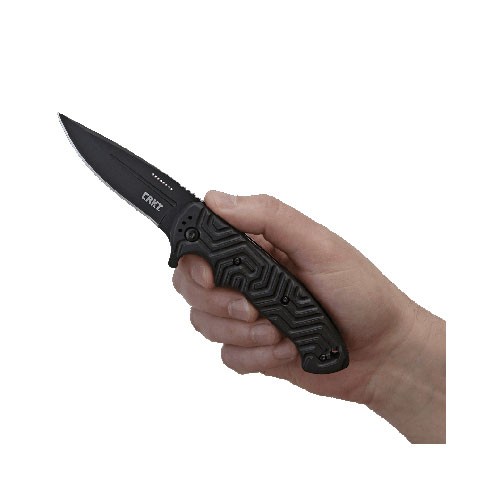
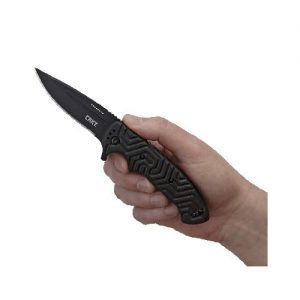
Flipper folders such as the CRKT Acquisition, pocketknives, linerlocks, framelocks and other folding knives remain subject to the definition of switchblade and/or gravity knife as a result of Gov. Andrew Cuomo’s veto of S. 6483-A.

According to Knife Rights, Cuomo vetoed the Gravity Knife and Switchblade Reform Bill, or S. 6483-A. If he had approved it, the bill would have excluded the vast majority of pocketknives, linerlock and framelock folders, flipper folders, assisted openers and other one-hand-opening folding knives from being designated as gravity knives or automatics (aka switchblades) under existing law. As a result of Cuomo’s knife bill veto, those who carry pocketknives, flipper folders, linerlocks and framelocks, and other one-hand-opening folders in New York remain subject to violating the state’s ban on automatics and gravity knives.

Since many minorities in New York City and others throughout the state carry pocketknives and folders and are the ones most likely to be targeted by the law that stays in place as a result of Cuomo’s knife bill veto, they remain subject to a fine and jail time if arrested for carrying said knives. As BLADE® field editor Ed Fowler notes in his story in the upcoming issue of the April BLADE, on newsstands Jan. 24, “The ultimate display of bureaucratic stupidity are the thousands of knife laws that serve no purpose other than to turn law-abiding citizens, usually minorities, into criminals in the name of public safety.”

According to the Knife Rights news release, Knife Rights will return when the New York legislature convenes this year to the job of fixing “the state’s Gravity Knife law to prevent these arrests and prosecutions. This bill passed with such large majorities in both houses of the legislature that an override of a veto is theoretically possible.”

As Knife Rights noted, Cuomo effectively thumbed his nose at a New York legislature that had overwhelmingly passed S. 6483-A, as well as at other New Yorkers, many of whom include his own constituents, who had supported the bill. In so doing, he joined the “Nexus of No” that includes New York City Mayor Bill de Blasio, New York Police Department Commissioner James O’Neill and District Attorney Cyrus Vance, Jr., in being virtually the only ones who oppose S. 6483-A.

The defeated bill would have added wording excluding knives with “a spring, detent or other mechanism designed to create a bias toward closure and that requires exertion applied to the blade by hand, wrist or arm to overcome the bias toward closure and open the knife” from the existing bill’s definition of switchblade. In other words, knives such as pocketknives, linerlocks and framelocks, assisted openers and others could not be defined as switchblades in New York if Cuomo had not vetoed S. 6483-A. Similar wording would have excluded pocketknives, etc., from the definition of gravity knife as well.


Save

Save

Save

Save

Save

Save

Save

Save

Save

Save

Save

Save

Advertisement

Must Read Articles

Read this before you make a knife

Knifemaking 101 – Read This Before You Make a Knife

  by Wayne Goddard My experience has taught me that there's nothing like digging in and getting started. I've often said the hardest part of the...
how to forge damascus steel

How to Forge Damascus

Advertisement
Advertisement