Summertime colors for knife handles just seem right, especially when you’re going on vacation to Florida or some other sun n’ fun locale and need a sharp tool for any number of jobs.
The Spyderco Endura with a blue handle is such a knife. The textured grip is great for safe handling and the lockback adds to the blade-lock safety factor. A high-performance VG10 stainless steel blade tops off the package.
ShopBlade’s price: $79.96.
Oh, and whatever your travel destination, be sure to check local knife ordinances to be sure you follow the law concerning knife carry/possession.
This is pretty cool. Many of you know the American Knife & Tool Institute (AKTI), a knife rights advocacy group working for the entire knife industry. Now it’s easy to support the AKTI, and get a neat gift item at the same time. The AKTI is offering bright red luggage tags labeled with the organization’s emblem, with every cent of the sales procedes going to support AKTI’s effort to protect your right to own and carry knives. You can put a luggage tag on every piece of luggage you own, making it easy to find your black bag among all those other black bags on the airport carousel; and it identifies your bag for the airlines if it is lost. Measures 4-1/4″ x 2-1/2″. Visit http://akti.org/ to learn more about AKTI and their efforts.
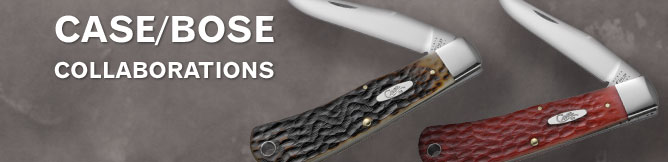
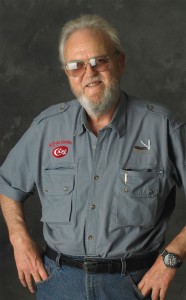
Learn how custom knifemakers and manufacturers join to make knife collaborations from two of the best at it: knifemaker Tony Bose and John Sullivan of Case at BLADE University.Award-winning custom knifemaker Tony Bose.
Learn how to have your design turned into a custom/factory knife collaboration from renowned custom knifemaker Tony Bose and John Sullivan, marketing director at W.R. Case & Sons Cutlery Co., at BLADE University.
Held in conjunction with the world’s largest knife show, the BLADE Show, BLADE U. will be held the day before through show Saturday at the Cobb Galleria Centre in Atlanta. The BLADE Show will be June 5-7.
In Bose and Sullivan’s “Your Knife Design Into Production,” you’ll learn the keys behind the decision to produce a particular knife pattern and what knife manufacturers are looking for in new production concepts. Additional topics will include how to plan for the production of the first knife samples and the steps involved in preparing for a larger-scale production run. Product packaging, promotion, marketing, sales and post-sales support also will be discussed.
Bose is an award-winning custom knifemaker of international renown whose custom slip-joint knives set the standard in the genre. Working out of Shelburn, Indiana, he has long been a proponent of traditional pocketknives, and few manufacturers have a better reputation for such knives than Case. Bose has designed knives for special collaborations with Case since 1998, including but not limited to a sowbelly pattern (2001), his Saddlehorn design (2004), a sway-back jack/gent’s knife (2008) and the BackPocket.
Based in Bradford, Pennsylvania, and owned by Zippo, the famous lighter manufacturer, Case is the leading name in collectible factory knives. Sullivan has worked hand-in-hand with Bose on the Case collaborations and will share his insight on the relationship from a manufacturer’s point of view.
For more on this class and the many others of BLADE U. visit BLADE University.
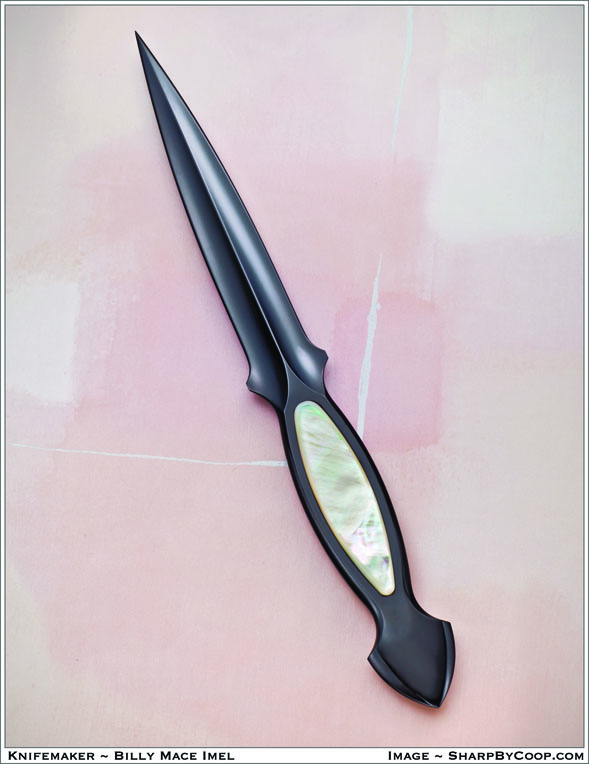
My second Editor’s Favorites pick from the Knives 2013 book is included for its sweet simplicity. Don’t let the straightforward, integral form of Billy Mace Imel’s dagger fool you, though, the lines flow symmetrically, with rounded edges along the grip, a pointed pommel and penetratingly pointed blade.
Only mother-of-pearl interrupts the shapely, blackened 01-tool-steel dagger. (SharpByCoop.com photo)
The knife is featured on page 86 of Knives 2013. Click here to order your copy today!
An article posted by Bee Wilson on The Guardian website’s Life & Style blog is titled “Bring Your Own Cutlery: Why We Should All Carry Our Own Knives and Forks.” Following is a short excerpt from the interesting and informative article about the practice—and suggestion that the tradition continue—of bringing your own knives, forks and necessary cutlery to restaurants.
In China and Japan, a “bring-your-own-chopsticks” movement has sprung up. Could a similar trend take off here, or are we too wedded to disposable plastic cutlery?
In medieval Europe, people used to carry their own personal knife – a sharp one – for every eating occasion. There was no expectation that cutlery would be provided, except perhaps for spoons. When the meal was done, the knife was wiped clean on a napkin and carefully returned to your person. The knife was worn so habitually that – as with a watch – you might start to regard it as a part of yourself and forget it was there. A 6th-century text reminded monks to detach their knives from their belts before they went to bed, so they didn’t cut themselves. Like many aspects of medieval life, this knife carrying now seems pretty weird.
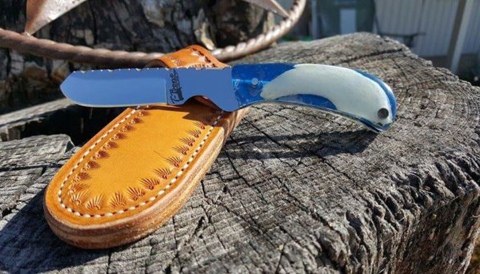
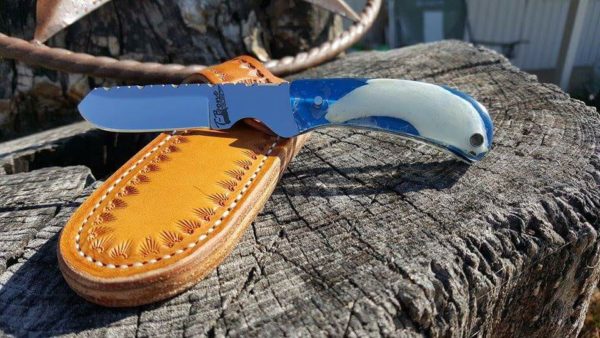
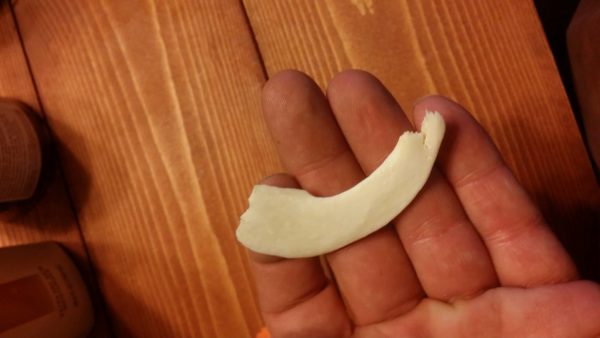
Travis Payne of T-Bone’s Custom Creations was hesitant at first, but when Kelly Pilcher asked, he made a knife with her rib. The overall length on this spey knife is 6.75 with a 2.5-inch cutting edge.
Kelly Pilcher of Collinsville, Texas, was 20 years old when doctors told her that hope of regaining feeling in her right side lay in having her first rib removed. She put the surgery off for as long as she could, but at 22 opted to go under the knife to alleviate her thoracic outlet syndrome. During surgery preparations Kelly asked, “‘What happens to body parts that come out of people?’” She was told that they were disposed of properly, but that if she wanted to take her rib home with her, she could. It was hers. She was adamant that she wanted to keep it. When she awoke from surgery, her dad was there and he had an idea of what to do with the bone. Shane Pilcher works at the New Gainesville Livestock Auction barn and when someone had mentioned making a knife with the rib, they knew just who to ask. Travis Payne, of T-Bones Custom Creations in Telephone, Texas, makes castration knives so all the cattlemen knew he could fashion a knife made from her rib. “Let’s do it!” Kelly remembers saying.
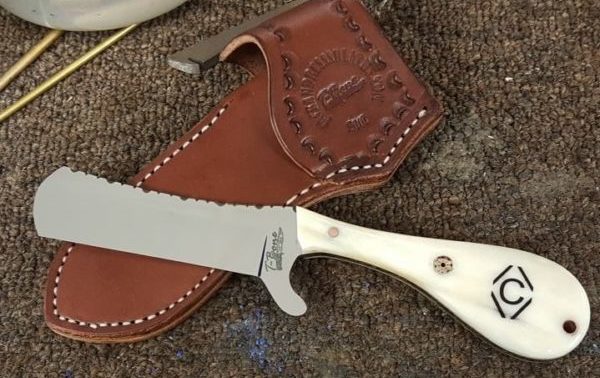
Travis Payne is renowned for his castration knife design. It is often copied by manufacturers using low-grade steel. Look for the T-Bone’s makers mark to ensure you’re getting the real thing.
TOS is a condition in which the surrounding soft tissue constricts nerves and blood vessels between the collar bone and first rib. Normally it is something diagnosed in people in their 40s to 60s, more commonly women, or perhaps mail carriers who consistently carry a heavy bag on their shoulder. Kelly was diagnosed when she was 14. It is believed in her case that years of catching slow-pitch softball as well as playing volleyball may have constituted the kind of overuse usually only seen in older patients.
By 17 Kelly had undergone a year of physical therapy. Although the therapy improved the symptoms of her TOS, it did not eliminate them. She went for an additional course of physical therapy a couple of years later, but the results were not as good. Her condition continued to worsen. “It’s different in each person,” she explained. She endured numbness that started in her arm, but then advanced to her whole side. Although she learned how to teach her body to move when numb, she was left with few options if she wanted to become fully functioning again. She decided to have her rib removed.
Shane Pilcher wasn’t sure about his daughter Kelly’s plan to keep her rib, but the cattlemen at the livestock sale barn convinced him that a knife might be the perfect solution. “I don’t leave home without it,” Kelly said of the knife Travis Payne fashioned from her first rib.
Shane had been at the livestock sale barn and was expressing some hesitation about Kelly’s decision to keep her rib. Someone pointed out that knives are made with animal bone and antler all the time, why not a human bone? “‘And doesn’t T-Bone make a knife?’” Travis said, recreating how the conversation may have gone at the barn. Since 1993 when Travis was still in high school he’d been making knives. His father and brother work the ranch where he lives in Telephone, Texas, but he makes knives full time. He is renowned for a style of castration knife that is frequently copied, most annoyingly by manufacturers using cheap steel. Since Travis’ father-in-law frequents the same sale barn where Shane works and the barn owner had purchased several of Travis’ knives and many of the cattlemen owned his knives, he was the first knifemaker that came to mind. Shane warmed to this idea and presented it to Kelly in the recovery room.
Travis Payne was nervous about slicing Kelly McGuire’s removed rib. What if it broke?
Like everyone involved in the project—except Kelly—Travis was hesitant, but he agreed to make the knife. He decided on his 3100T everyday carry model, a spey in cowboy parlance, usually the second blade on an old-school slipjoint trapper. Only this would be a fixed version. “It came to me in a hospital specimen jar,” Travis said, taking a drag on his cigarette and waiting for the laughter. “With the meat still on it.”
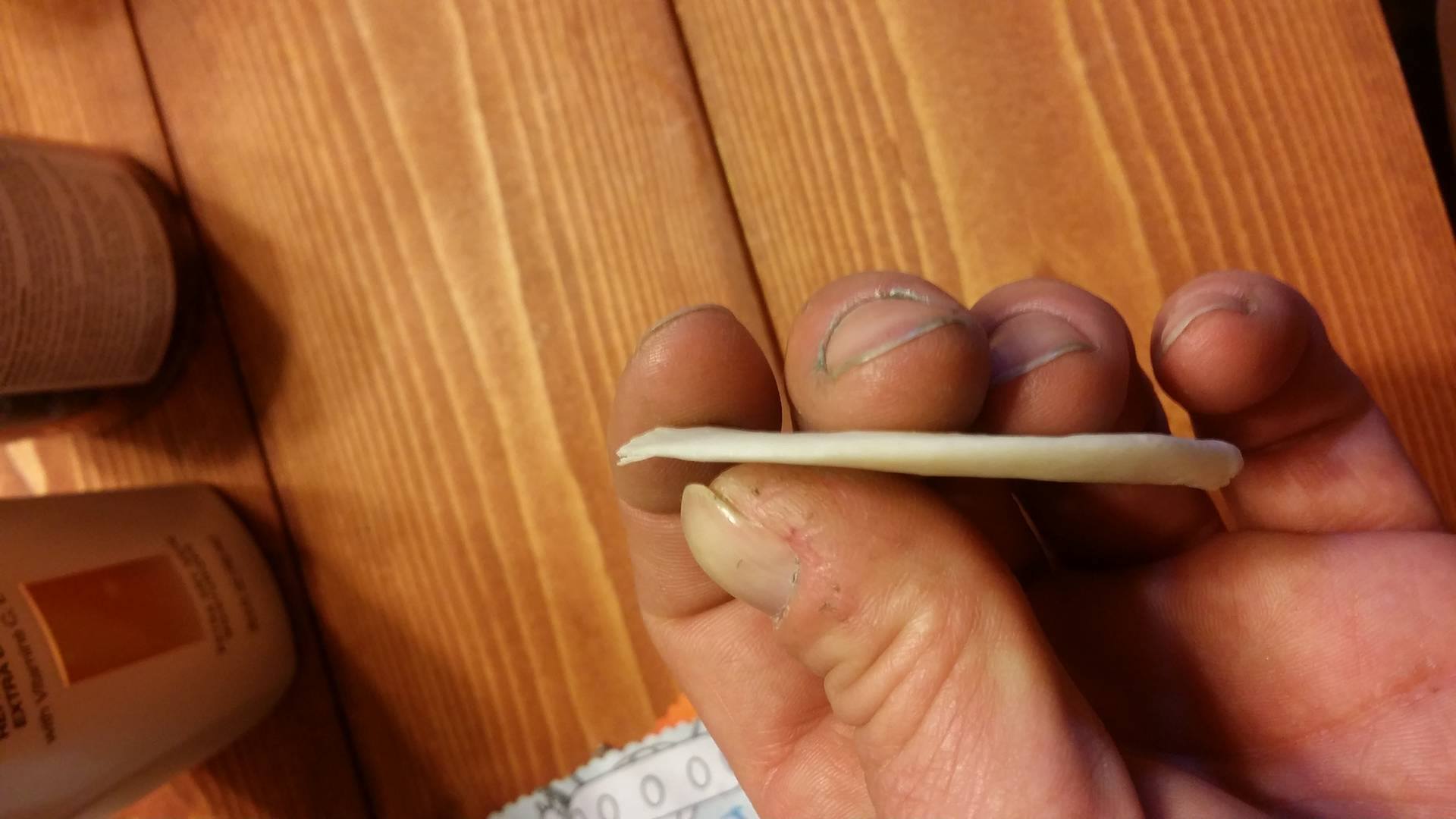
He approached the project like he would any deer skull. “Only I knew I wasn’t going to be using my wife’s cook pot,” Travis said, laughing. He bought a throw-away pot and boiled the bone to get off any connective tissue. Although bleaching a bone works, it also can break the bone down. Travis soaked the 3-inch bone in hydrogen peroxide for a week. The same whitening was achieved without compromising the strength of the bone. Then he let it dry for several months, providing a convenient delaying excuse. The bone was very thin, only an 1/8-inch at its widest point. Travis feared breaking it.
Once the rib was clean and dry, knifemaker Travis Payne was able to see its true size. It would need to be cast in resin if it was going to be used as a knife handle.
“I had to regroup and talk to Kelly,” he said. She remembers the call. He explained to her that the bone was too small and thin to make a handle out of, but that he could arrange for it to be cast in resin. Only he would need to slice it down the middle to have bone on each side of the handle. He could break it in the process. “I told him to go for it,” Kelly said.
“Anyone who knows me, will tell you that I procrastinate,” Travis said. He continued to analyze the problem. Meanwhile, he needed to find someone who would cast a human rib. Travis figured if anyone would do it, it would be Robert Belcher of Mental Co. Robert eschews phones and social contact, but his resins like Plantstone are innovative. “‘No, but hell no. I can’t be touching that,’” Travis recalled him saying. Travis moved on and got similar responses, but at least there was no point cutting the rib if he didn’t have someone lined up. Finally, he took the rib to a show and unwrapped it for Pat Ankrom, of Ankrom Exotics in Centerville, Iowa, specializing in natural and cast scale materials. “Pat was like, ‘I’m leery, but I also think it’s kind of cool,’” Travis said. The men discussed the casting, and Pat agreed to do the job. Pat did not want something to happen to the bone in the process of packing up from the show, so Travis said he would mail the rib to him.
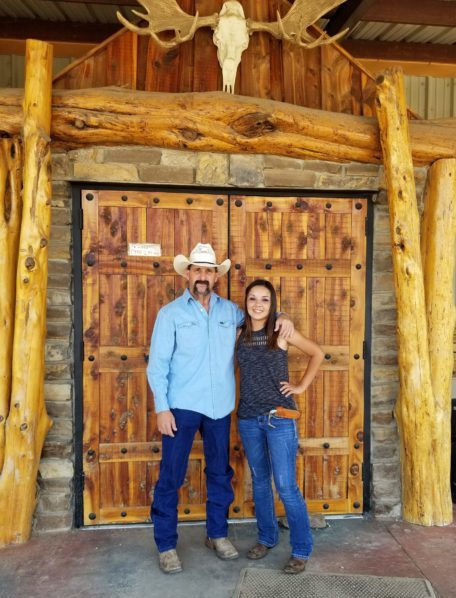
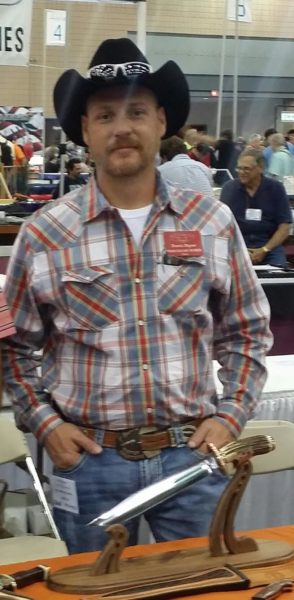
Travis Payne, 41, started making knives in high school before everyone had access to the Internet. He’s been a knifemaker for 20 years.
Now Travis had no choice but to cut the bone, but it was a nerve-wracking proposition. Travis wasn’t about to charge a young woman who didn’t have a lot of money and who had a debilitating condition more than the $200 he normally charged for such a knife, but in hindsight the cost to attempt something like this again would be closer to $500, Travis said. Kelly, of course, was excited to both see the knife and to have her rib back in her possession, so periodically she’d call for a status update. Finally, Travis got his courage up and sat down with a jeweler’s saw. “Even with a jeweler’s saw it was a tedious process,” he said. The whole project was “intense,” he said, laughing.
The two halves were packaged up and shipped to Pat, an exercise in trust in itself. Meanwhile, the blade awaited. It was made out of PSF27, a powered version of D2 that allowed for a true mirror finish. The lack of a point on a spey design means it’s ideal for active cattlemen, ensuring nobody stabs themselves or punctures a sheath. It has a hollow grind, and a finger groove for more controlled cutting. The file work on the spine increases a sure grip in what can be wet or messy work.
The bone was cast in clear resin so you could see it, but so that you couldn’t see the full tang Travis consulted with Kelly about colors. She was open to a turquoise or blue. Travis added a blue liner, which casts the clear with a blue tone. The knife was then sent to Jack Andress, who made a sheath in a yellow leather, complimenting the blue perfectly.
How’d it come out? “I love it,” Kelly declared. Shane and Kelly came together to pick up the knife from Travis. Kelly said that she’d had that rib her whole life and she saw no reason why she shouldn’t have it with her for the rest of her life. She carries it everywhere, either on her person or in her vehicle. Although she does use it, she tries not to. Her surgery was a success, and feeling has mostly returned. There is no cure for the many variations of TOS and symptoms can return, however, Kelly’s pluck and resolve are ever-present. “I can’t complain,” she said.
Which Knife Designs Work?
Do you want some fresh inspiration for your knife designs? The best inspiration is to look at the designs that have lasted and learn why.
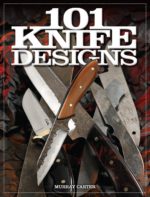
“101 Knife Designs” gives you 101 scaled patterns that you can use to design your own knives. Learn how to compare patterns and understand how some designs survive the test of time. If you’ve enjoyed Murray Carter’s other writings, you will be sure to enjoy this one. On sale now for $19.53.
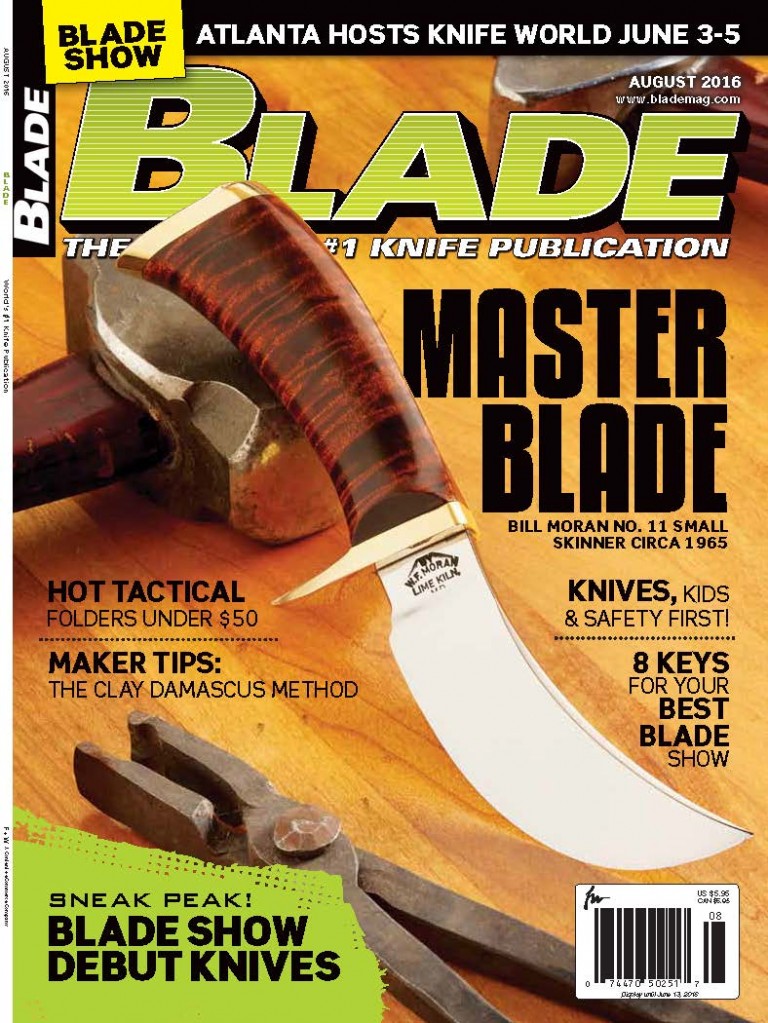
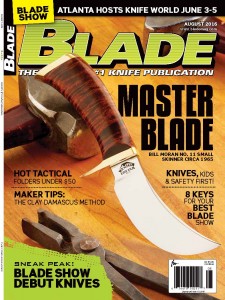
BLADE Show preview highlights the latest issue of BLADE® Magazine, on newsstands today!
The knives, knifemakers, events within the event, the people, awards—these and much more are the focus of the BLADE Show preview in the latest BLADE® Magazine, on newsstands today.
•A selection of the hot new factory knives that will debut during the show’s three-day run June 3-5 at the Cobb Galleria Centre in Atlanta;
•The highlights, instructors and complete class schedule of the 3rd Annual BLADE University;
•The BLADE Magazine Knife-Of-The-Year® Awards, the factory industry’s most coveted individual knife honors;
•The 14th Annual BLADE Show World Championship Cutting Competition sponsored by BladeSports International, which also will include the first-ever Women’s World Cutting Championship;
•The annual custom knife judging competition, which annually entertains 200 or so of the world’s finest custom knives, with this year’s Best Of Show winner slated to receive special recognition during the BLADE Magazine Awards reception the Saturday night of the show;
•The show’s extensive slate of seminars and demos, and;
•BLADE field editor and High Performance Endurance Knife Mastersmith Ed Fowler’s eight keys to having your best BLADE Show yet.
Also this issue: ABS master smith Wally Hayes shows you how to bring out the hamon on folder blades; how to introduce your kids to knives, including the latest knives designed especially for them, collecting clubs for children and more; tests of the latest in bowies and affordable tactical folders; how to use clay as a teaching aid in making outstanding damascus; and a whole lot more in the latest BLADE.




 Summertime colors for knife handles just seem right, especially when you’re going on vacation to Florida or some other sun n’ fun locale and need a sharp tool for any number of jobs.