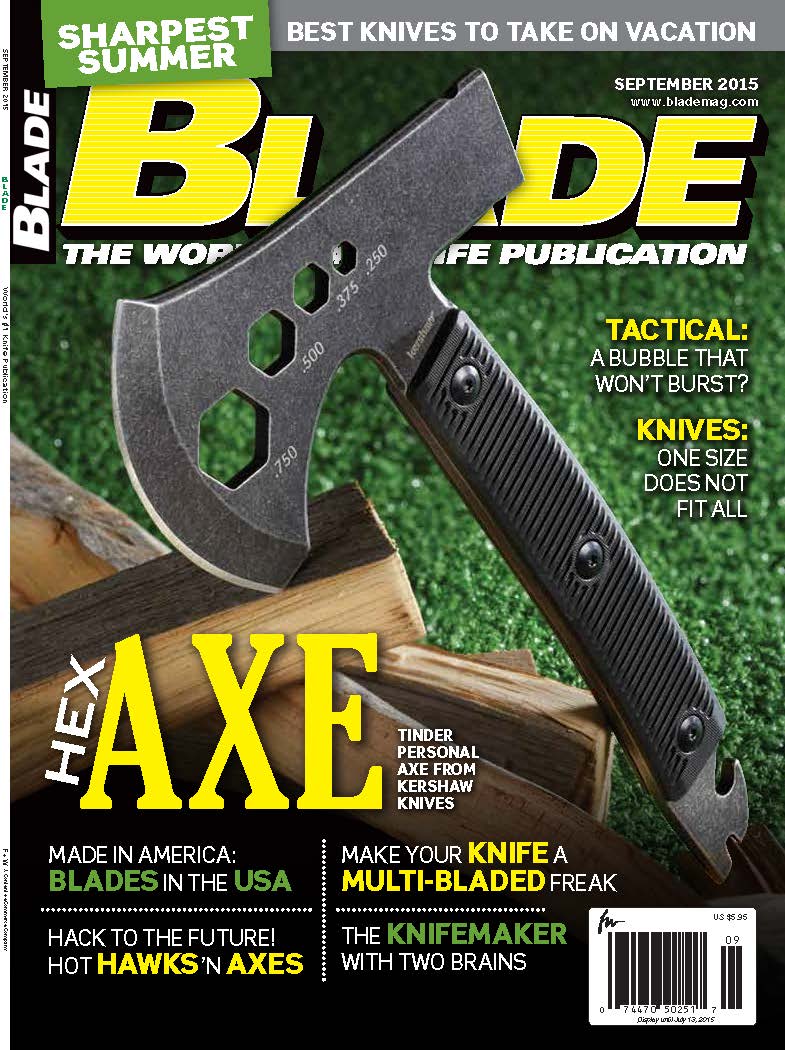
The hottest knives of the hottest summer are here—and nobody covers them like the latest issue of BLADE®, on newsstands NOW!
The hottest knives of the hottest summer are here—and BLADE®’s got ’em!
It’s summer vacation time and you need to know which knives to take—and not to take—whether you’re hitting the beach, camping, traveling overseas or what have you. Daniel Jackson shows you the way in “National Knife Vacation.”
Speaking of camp knives, BLADE field editor Kim Breed tests two bodacious fixed blades of 5160 carbon steel by Little Bear Forge and Owens Weaponsmithing in “Spec Sheet.” And if you’re looking for folders with blades and tools for most any need, check out Dave Rhea’s “Multi-Bladed Freaks.”
Time was tomahawks and little axes—such as the Kershaw Tinder cover axe—were for small chopping chores like splitting kindling. They can still do those tasks but they also do much more, including prying, nail lifting, firestarting, opening bottles, tightening/loosening nuts and bolts, and much more. Get schooled on the changing face of these fascinating tools in “Hack to the Future!”
The United States has been the world leader in knives for many years now, not only because of such old school names as Case and Ontario but also due to such relatively newer companies as TOPS Knives and the baby of the four, Hogue Knives. See why the state of red, white and blue edges was never keener in Stephen Garger’s “Blades In The USA.”
Daniel Winkler has made period pieces used in such movies as the early ’90s classic The Last of the Mohicans clear to the tactical knives used in today’s Zero Dark Thirty. Through it all he’s transitioned from being a traditional bladesmith to, with partner Karen Shook, running the production operation of Winkler II Knives. You might say Winkler has reinvented himself and his business. Find out more in “The Knifemaker With Two Brains.”
BLADE covered the factory side of warranties in the August issue but what about the custom side of the ledger? BLADE field editor Ed Fowler has forged knives for decades and knows a thing or two about custom warranties. Consider his thoughts on the matter in “A Matter of Trust and Ethics.”
Collectibles Retailer Partners With World-Class Designers
Moultrie, GA – (January 26, 2011)
United® Cutlery, industry leader in licensed adult collectibles, is proud to announce new partnerships with three custom designers: Mykel Hawke, Wesley Hibben and Mikkel Willumsen. Their world-class custom designs and innovative ideas will allow United® Cutlery to discover the newest mechanisms, modern materials and custom finishing techniques.
Mykel Hawke is a U.S. Army Special Forces Veteran and Co-founder and Director of Specops, an international tourism and training company. Hawke stars in Discovery Channel’s hit survival series, MAN, WOMAN, WILD. Hawke also serves as a media personality in TV and film and is the author of two bestselling books, Hawke’s Green Beret Survival Manual (Running Press) and The Quick and Dirty Guide to Learning Foreign Languages Fast! (Paladin). Renown for his survival skills and tactics, Mykel Hawke brings his talents and real field experience to his exclusive knife designs. Hawke’s designs prove to be the most useful all-purpose utilitarian survival knives on the market today.
Wesley Hibben has been making knives since he was eight years old, having learned the craft of knifemaking from his father, Hall of Fame knifemaker Gil Hibben. Hibben makes a variety of knives including fantasy, hunting and tactical knives. Hibben spends his time knifemaking and teaching Kenpo Karate in Anchorage, Alaska. Renown for his survival skills and tactics, Wesley Hibben brings his talents and real life experience as an avid hunter and fisherman in Alaska to his exclusive knife designs. Hibben’s designs are quickly becoming recognized on the market today.
Mikkel Willumsen graduated as a teacher in metal and woodwork and decided that since he was always interested in knives as a child, knifemaking was what he would do. Willumsen has been a custom knifemaker for the past ten years in Copenhagen, Denmark, calling his designs Urban Tactical. Specializing in folders, fixed blades and balisongs, Willumsen’s designs are based on functionality and quality, mixing classical designs with modern tactics. Willumsen also makes kitchen knives that have been used on Danish National Television and TV2 “Goodmorning Denmark” for several years.
“I am excited to add three talented designers to the United® team,” said Clint Kadel, CEO and owner of United® Cutlery. “These new designers will help United® continue to offer the most innovative and functional designs in the industry.”
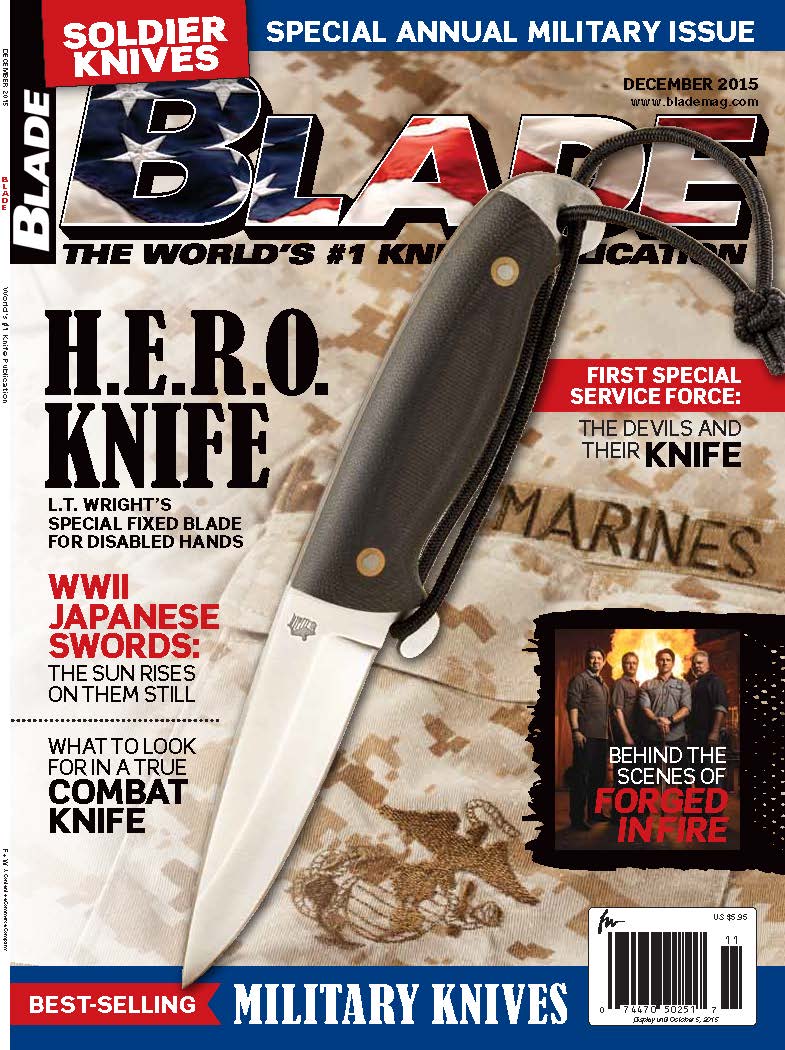
A knife for disabled vets is the cover knife for the latest BLADE®, on newsstands NOW!
A knife for disabled vets, behind the scenes of the hit TV show Forged In Fire, World War II Japanese swords and much more highlight the annual military issue of BLADE®, on newsstands NOW!
L.T. Wright’s H.E.R.O. (Helping Everyone Reach the Outdoors) knife is specially designed to accommodate people with finger and/or hand injuries. Join Abe Elias as he examines how the knife came about, how it’s designed, how it works and more in his story on page 12.
Forged In Fire has been one of The History Channel’s hottest shows in recent months and has brought the skill required to make a forged knife into full view of a wide-ranging television viewing audience. Go behind the scenes of this fascinating, action-packed show with our special story on page 84. In addition, on page 10, see if you agree that FIF may be the “Eureka moment” the knife industry has been waiting on for these many years.
The Japanese signed the formal World War II surrender on the U.S. battleship Missouri 70 years ago this month. But what of all those Japanese swords carried by those in the Japanese Army and Navy? Who made them and whatever became of them? Leon Kapp gives you the poop in part one of his “The Sun Rises On Them Still” on page 80.
There’s much more in the annual military issue, including a visit with two surviving 90-something members of the First Special Service Force that fought so well in World War II; three military veterans who are new to the knifemaking game in Pat Covert’s story on page 20; the best-selling military knives in the factory realm on page 36; a test of four military-style autos by James Morgan Ayres on page 44; “How To I.D. A True Combat Knife” by BLADE field editor Ed Fowler on page 52; the “Ultimate Survival Knives” of special-operations veterans Grady Powell and Jared Ogden, stars of National Geographic’s action TV series, Ultimate Survival Alaska; a test of two tomahawks by BLADE field editor/retired Green Beret Kim Breed on page 48; and much more in the latest issue.
Subscribe:
Stay abreast of the latest developments on this and many more knife rights issues with a subscription to BLADE.
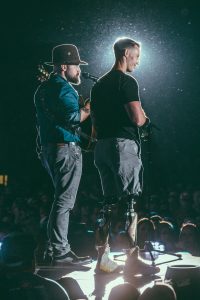
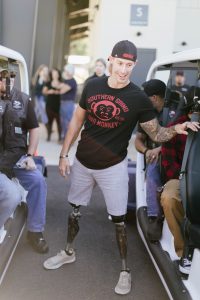
Zac Brown’s Southern Grind deploys formidable spokesman, Johnny Joey Jones, a double amputee Marine staff sergeant.
Johnny Joey Jones, Triple J to his friends and Explosive Ordnance Disposal technician to his Marine Corps brethren, wrote a poem about a particular day, a particular explosion, a particular knife, while on patrol in Afghanistan.
Jones, a double amputee and motivational speaker, is the spokesman and more for Zac Brown’s Southern Ground, which is an umbrella company that represents numerous 100-percent American-made and -sourced products, including the knife company, Southern Grind. Proceeds from the sale of these patriotic items benefit Camp Southern Ground, which strives to give kids of all races and religions, and especially those with neuro-developmental challenges, the positive influence of a camp experience. The camp also helps military families by offering the same experience to children who are dealing with a deployed, injured or deceased parent.
In May 2010, about three months before Staff Sergeant Jones would step on an IED and lose both legs above the knee, he was on patrol with a group of Marines. (In the Corps, EOD units go where they are needed, with whom they are needed.) They came to a small canal. “There is always lots of learning,” Jones said, and in this case, it was that you don’t want to use foot bridges to cross waterways. Such crossings would create bottlenecks, ideal spots for the enemy to booby-trap.
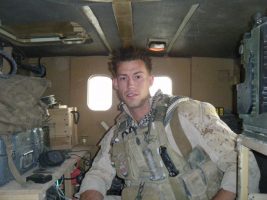
Prior to losing both legs above the knee Johnny Joey Jones was an Explosive Ordnance Disposal technician in Afghanistan.
To get across, first the sweeper, the Marine with the metal detector, went and then the mine-detecting dog and his handler went. “We think the dog stepped on the mine,” Jones said. “The Water So Cold” tells the story.
Joey Jones not only took the lead in combat, he became a mentor to recovering wounded veterans like himself.
The knife was a folder issued to Marines. “I was going to cut off his gear, but guys reached down to pull him out. Days later I realized I still had his knife in my cargo pocket,” Jones said. “I gave it to his first sergeant to give it back to him,” Jones said. That first sergeant is the man in the poem of whom the speaker asks about the Marine’s condition.
Jones has had a poetic streak most of his adult life. Since separating from the service, he has earned his Bachelor’s degree from Georgetown University in public policy. “I don’t go back and edit,” Jones said. He wants the poems to represent him authentically, as he was at the time.
Check back to read more about this inspirational wounded warrior.
To learn more about how Jones and Brown met and the knives made by Southern Grind, be sure to subscribe to BLADE® Magazine.
In “Fighting Folders” Michael D. Janich instructs viewers on the myths surrounding folding knives and how to employ them in a self-defense situation.
You don’t have to have been in combat to know that sometimes Plan B—the knife—can quickly become Plan A when it comes to self-defense. Often our everyday carry is a folder. This DVD can get you started on proper grip, one-handed openings and other tactics using folding knives. The $39.95 price is less expensive that a class and can be watched repeatedly in the comfort of your home.
In cooperation with industry leaders, the American Knife and Tool Institute (AKTI) approved updated standard knife definitions to use for legislation and law enforcement purposes. Visit http://www.akti.org/resources and click on the red “AKTI Approved Knife Definitions” link to see official, legal definitions for such edged tools as an “Arkansas Toothpick,” “Bowie Knife,” “Dagger,” “Ballistic Knife” and many more.
By accessing the updated definitions, knife owners, lawmakers and law enforcement officers can learn the history of knife terms in common and legal use, various states that prohibit specific types of knives, and the standard definitions the AKTI is encouraging be used for interpreting and enforcing knife laws.
“AKTI members believe that knives are inanimate objects, regardless of various differences such as length of blade, shape or style, the mechanism for opening, or the name used,” said AKTI President Goldie Russell of A. G. Russell Knives. “As a reasonable voice of the knife community, we have worked to change restrictive and vague knife laws to protect all knife owners.”
Originally adopted in 2005, the “AKTI Approved Knife Definitions” was revised to reflect clarifications to knife definition language that AKTI successfully used in law changes in Texas and the 2009 amendment to the 1958 Federal Switchblade Act. Clarification of the terminology “bias toward closure” and states where certain knives are prohibited were included to make the publication even more informative. The “AKTI Approved Knife Definitions” has been distributed to lawmakers, police officers, attorneys and judges who recognize the credibility of the industry’s organizations and efforts to promote consistency and clarity. The details and diagrams have been very informative in discussions with legislators.
“We want to build on the work we’ve done and the reputation we have as an organization for those who work with or benefit from knives, and to support those who have questions about legal knife usage,” Russell said. “We encourage everyone to share the document with their legislators and local law enforcement.”
Florida HB 179 and companion bill SB 356, which would have made it illegal to carry a “common pocketknife” on school grounds in Florida, have been “withdrawn,” according to the Knife Rights e-mail newsletter.
“Knife Rights, along with our good friends at Florida Carry, shined a bright light on this unnecessary legislation and helped to derail it,” the Knife Rights e-mail newsletter reported.
According to the Florida Senate website (www.flsenate.gove/Session/Bill/2012/0179), the general bill, if passed, would have prohibited “possession of [a] common pocketknife, except as authorized, at [a] school-sponsored event or on [the] property of any school, school bus, or school bus stop.” Also according to the website, on Oct. 24, the bill was “withdrawn prior to introduction” in the Florida House.
Long-time knifemaker Glenn Marshall has passed away after a knifemaking career that spanned eight decades. He was 92.
He was laid to rest today, Sept. 21, in his hometown of Mason, Texas.
Glenn started making knives in the 1930s only to have his knifemaking interrupted by World War II. He joined the Navy and served as a demolition man, including surviving an explosion on Okinawa that cost him an eye and an ear and his spleen and gall bladder.
Glenn made fileworked lockback folders in a style reminiscent of the 1970s and ’80s—which should come as no surprise, of course—and fixed blades for hunting, camping and other uses. He said he liked native woods for handles, especially desert ironwood, mesquite burl and others. Since he had only the one eye—a 92-year-old one at that—he said some of his knives “might have an extra scratch or two.”
No matter how many scratches he or they may or may not have had, Glenn Marshall and his knives will be missed by many very, very much.