Featured Knives

Here are BLADE Magazine’s Featured Knives of the Week. Browse through these articles to find the best knives available from both custom knifemakers and factory knives.

Click here to browse through our list of Featured Knifemakers.

Knifemaking – – Knife Collecting – – Tactical Knives – – Survival Knives

The Many Moods Of Mosaic Damascus

Mosaic Damascus Can Be Made Numerous Ways, And These Master Smiths Are All Putting Their Own Spin On The Craft.

The many moods of mosaic damascus provide the bladesmith and custom knifemaker with an ever-changing form of artistic expression. The possibilities of a new pattern, a different look, and yet another lasting impression are endless.

For several makers, mosaic has become a signature steel in their presentations, and these imaginative artists are pushing the envelope in an already dazzling array of motifs for blades and knife fittings.

Kelly Vermeer-Vella

Kelly Vermeer-Vella said she initially called the mosaic damascus of her fighter Riptide because it looks like “calm waters, but also because the forging process is pretty brutal. So, now I call that process ‘ripping it!’” Blade and overall lengths: 7.5 and 12.5 inches. At press time the knife was available through Arizona Custom Knives for $3,800. (SharpByCoop knife image)

In her Riptide pattern, American Bladesmith Society Journeyman Smith and past Forged in Fire champion Kelly Vermeer-Vella provides a great example of the new frontiers being explored with mosaic damascus. 

“It’s initially called that because it looks like calm waters,” she commented, “but also because the forging process is pretty brutal. So, now I call that process ‘ripping it!’ Sometimes I win and sometimes I make hunters!”

Kelly showcases the Riptide pattern on her 12.5-inch fighter with a 7.5-inch blade and mammoth ivory handle sporting a long, modified “S” guard. 

“I really enjoy swooping forged guards that complement the curves of the blade and handle. And I love mammoth ivory, so I make a lot of frame handles,” she added. “I think the best-looking frame is in a low-layer twist, 25 layers or so.”

The Vermeer-Vella mosaic involves a commitment to hard work to produce the desired results. 

“The pattern is not san-mai,” she revealed, “rather, different layer counts of stacked W’s with heavy 1075 steel on the edge. The wing effect comes from forging. I push and pull the pattern with a hand hammer and forge to shape so that the pattern flows with the edge.” 

The blade material is the 1075 carbon steel, which appears as the dark areas, and 15N20 nickel alloy, which shows as the grey, shiny areas. “I etch in 3-to-1 ferric chloride and also do a coffee etch,” she added. Her power hammer is an Anyang 88 and she uses a Riverside 24-ton press.

Jack Rellstab

Jack Rellstab said he wanted the blade of his Western Chef’s Knife to “look alive.” As he noted,
“My idea was with the taper in layers to give it an organic look that appears as if the elements are actually growing.” Thus, the pattern’s name of Frogs and Flowers seems most apropos. His price for a similar knife: $2,600. (SharpByCoop image)

Like Vermeer-Vella, Jack Rellstab is an ABS journeyman smith who enjoys the creative process of forging mosaic damascus. His Western Chef’s Knife brings a robust profile to life in a mosaic pattern called Flowers and Frogs.

“The pattern is one of my styles of W’s explosion,” he noted. “I started the original billet with the layers of both 1080 and 15N20 getting progressively thinner from one side of the billet to the other. After using square dies to resquare the billet for W’s, I drew it out with a taper so the W’s would get tighter towards the end. Then I did a restack and a four-way to finish it. So, the steel is 1080 for the dark portion and 15N20 for the bright.”

The handle is amboyna burl, bronze and G-10. He says the grip is designed around most Western-style kitchen knives on today’s market, though the belly/underside might be a bit shallower.

“With this mosaic pattern, I wanted the knife to look alive,” he offered. “My idea was with the taper in layers to give it an organic look that appears as if the elements are actually growing. I used a 165-pound hammer belonging to New West Knifeworks, and I also used their Anyang hydraulic press for resquaring.”

Jack began his bladesmithing journey with mosaic damascus by watching a YouTube video, and then let his imagination kick in to develop the exciting pattern that is sure to generate conversation in any kitchen.

Will Stelter

The Serpentine Multi-bar Santoku by Will Stelter sports a mosaic damascus pattern of the same name. He used 1080 and 15N20 steels for the pattern-welded twisted bars and Cruforge V for the edge. The Cruforge V etches darkly, and its wear resistance and high working hardness make it ideal for culinary knives. Blade and overall lengths:
5 7/8 and 10.75 inches. His price for a similar knife: $3,500. (SharpByCoop knife image)

The Serpentine Multi-bar Santoku by ABS Journeyman Smith Will Stelter sports a mosaic damascus pattern of the same name. The handle is ivory paper Micarta®. He used 1080 carbon and 15N20 nickel-alloy steels for the pattern-welded twisted bars and Cruforge V for the edge. The Cruforge V etches darkly, and its wear resistance and high working hardness make it ideal for culinary knives.

“I started by forging up 28 layers of W’s,” he recalled, “and then worked that billet down to a half-square twisting stock. I twisted three bars right hand and two bars left hand, lining up my twists as best I could before forge-welding them together. After they were stuck, I forge welded on a solid Cruforge V edge bar that was around 40 percent as wide as the multi-bar billet, but the same thickness. With my final stock stuck together, I then laid out and cut away several three-quarter-inch-deep grooves or divots from the profile of the rectangular 2-inch wide bar, which still left Cruforge V on the edge, and two full twisted bars at the thinnest parts of the patterned area on the spine.

“I then flattened down the billet, which took the previously straight layers and gave them the bold ‘serpentining’ that came out in the blade. I then forged my blade to shape and forge welded on some of the base W’s stock that I twisted from as bolster material. This is a very similar technique to how the classic ‘River of Fire’ pattern is done, but with a different base pattern other than the usual feather pattern.”

Will used his 1924 400-pound ram Beaudry hammer to do the majority of the forge welding and a twisting machine to twist the five bars. He learned his pattern-welding technique and the ability to visualize the way the steel moves from bladesmith Salem Straub, crediting Straub with teaching him how to design patterns “with intentionality behind them.” The pattern itself is sole authored by Stelter, who has done some serpentine multi-bar patterns prior to the subject piece. However, this was his first attempt with a monosteel-edged bar.

“The serpentining is purely aesthetic,” Will said. “It’s meant to give a bold line for the eye to dance down rather than the straight, more classic intersection of the edge bar that is normal for a composite construction. This also means that from far away you see an interesting pattern, and then when inspected up close the explosions of the twisted W’s really pop out, which gives the overall piece an interesting level of depth.”    

Will considers this particular mosaic “an intermediate-level pattern, easy to try, though somewhat difficult as well. The most challenging part is building a high-quality multi-bar pattern with adequate layer density and well-matched twists. The rest of the pattern is fairly simple.”

Brent Stubblefield

Brent Stubblefield’s integral chef’s knife has an 8-inch blade of his shimmering Crossroads mosaic damascus, and a stabilized Hawaiian koa wood handle with mammoth tooth spacer. Overall length: 13 inches. His price for a similar knife: $1,500. (SharpByCoop image)

At the Join or Die Knives Forge in Richmond, Virginia, Brent Stubblefield hammered a beautiful blade in his Crossroads mosaic pattern—and did so with multiple techniques. 

According to Brent, “There is the initial damascus forging, crushed W’s, twisting, four-bar-squaring welds, ferry flip tilting, edge bars, and a ‘fish mouth’ tip to make the edge bars meet. There are multiple elements that are forged on the edge or corners to manipulate the pattern, and finally the knife shape and integral bolster are forged to shape.”

The mosaic is comprised of 1084 and 15N20 steels, with the 15N20 appearing as a silver white on the blade while the 1084 blackens with a ferric chloride etch. 

“The shapes in this pattern reflect a desire to incorporate all the different techniques of mosaic damascus making I have learned over the years,” he explained. “I’m always trying to find a way to create never-before-seen patterns in order to add something totally new to the American bladesmithing tradition.”

Stubblefield used an Anyang 88 power hammer and homemade 30-ton press to create the Crossroads mosaic. A Bridgeport mill was helpful in the squaring-up process and flattening pieces for rewelding. A Miller welder assisted in tacking materials up before they went into the forge, while an Evenheat kiln and Broadbeck Ironworks grinder were key tools in the process as well.

“Although I did not have any single mentor,” Brent mused, “many knifemakers have gone out of their way to share tips and tricks with me. While they didn’t teach me directly, [bladesmiths] Mareko Maumasi and Salem Straub have been very generous with sharing their processes through social media. I certainly have referenced them among others.”

Stubblefield continues to challenge himself as his career advances, and he sees no slowdown in the creative process. “This knife is very difficult to do simply because the higher number of forge welds create more opportunities for failure,” he reasoned. “Any complex damascus blade is actually just many simple techniques combined together. The hardest part for me is understanding how manipulating the pattern early in the process will affect the outcome, and visualizing the end pattern.”

Read More

First Look: CRKT Squid II Carbon Fiber

CRKT Has Reimagined The Squid II With Their New Carbon Fiber Version Of The Beloved EDC Folder. 

The Squid line of folding knives is one of the most beloved in the cutlery world. CRKT has given the classic a new look with the Squid II Carbon Fiber.

The Italian-made knife features a 2.68-inch blade made from Bohler M390 steel, designed for edge retention and to resist wear, and treated to a 59-61 HRC. The satin finish gives the knife a clean, elegant look. The steel is connected to the carbon fiber handle and stays securely in place via a liner lock, which is the first liner lock on a knife in the Squid line.

Even with the carbon fiber handle, the knife has a nice bit of heft at 4.9 ounces. As you would expect from the Squid line, nothing was forgotten. The new Carbon Fiber is an excellent addition to the Squid line.

MSRP: $195

Read More

First Look: GiantMouse GMF4

GiantMouse Has Taken A Big Step With Their New Fixed Blade. The GMF4 Is The Company’s Biggest Blade Ever And First Camp-Style Knife.

It’s a new era for GiantMouse. The company has stepped into the world of camp knives with the new GMF4. The knife is the company’s largest blade ever and comes in multiple finishes.

The star of the show is the blade. The N690 blade is 5.65 inches long, and the overall length is 10.45 inches. The steel has a flat grind and comes in two finishes: a traditional stonewash and a PVD stonewash. The PVD version is married to a Double Black Canvas Micarta handle, and the traditional blade is meted to a Double Red Canvas Micarta handle.

The handle is sturdy. The high flat saber grind is razor sharp, and the jimping helps stabilize it when cutting. There’s been a lot of thought put into the construction of this knife. A prime example of that is the lanyard hole.

Designed for outdoorsmen and campers, the lanyard hole is placed on the front of the knife so if a branch sneaks in there and pulls at the knife, it will be pulled forward and out of your hand rather than potentially snapping back and slicing you open.

No stone has been left unturned with this knife, and it will serve any and all campers well for a very long time.

MSRP: $245

Read More

Best Ka-Bar: Modern Options Of The Historic Knife

Ka-Bar Makes One Of The Most Legendary American Combat/Utility Knives. First Issued In 1942, The Knife Continues To Impress And Inspire Today.

Few knives are as beloved and inspire more contemporary blades, than the Ka-Bar USMC fighting/utility knife. Ka-Bar Knives’ designation for it is the 1219C2, aka “the Ka-Bar,” and the knife was, and still is, a high-quality combat/utility tool. Ka-Bar Knives makes the contemporary version in its factory in upstate New York. 

The History Of The Ka-Bar

As America entered World War 2, the Army and Marines took issue with the old World War 1-era trench knives that were being issued to them. The handles were too bulky, the blades were too brittle, and they were expensive to make. 

After trying a few stopgaps, the Army asked arms suppliers to design a new combat/utility knife. Marine officers John Davis and Howard E. America worked with the Union Cutlery Company (now Ka-Bar Knives) to design a model that took elements from an old Navy knife and civilian hunting knives to create the 1219C2. In addition to Ka-Bar, Camillus, PAL, Robeson Shuredge, Case and Ontario were among those who made a USMC fighting/utility knife or a reasonable facsimile.

The knife was first issued to elite Marine units in November, 1942 and became standard issue for all Marines by 1944. Today, the knife is manufactured for military use and marketed to civilians as a utility/hunting knife.

Modern Ka-Bar Knives

Along with the original USMC fighting/utility knife, Ka-Bar makes many different combat/utility knives. This trio is a prime example of what the company produces today.

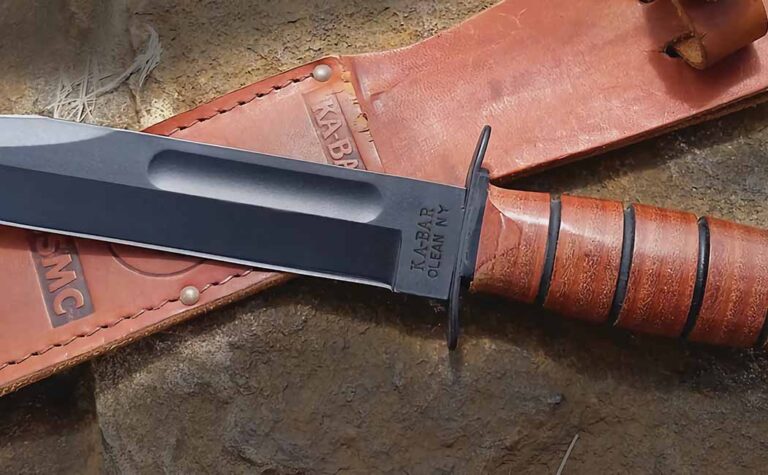
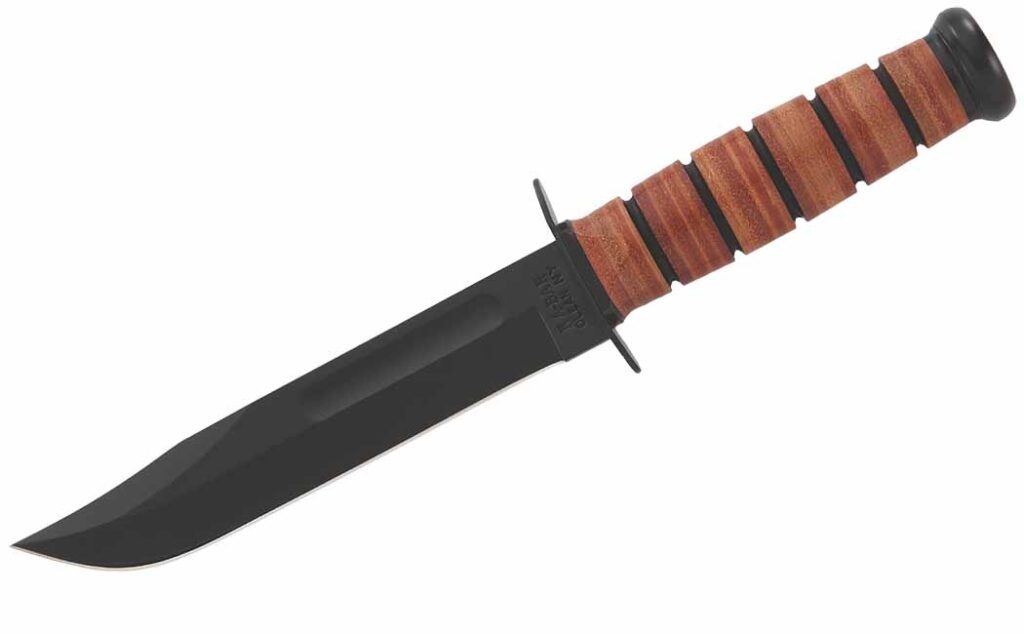
USMC Ka-Bar Plain Edge

Ka Bar Straight
The knife that made the Ka-Bar name famous is as popular as ever. There’s also a serrated version, but the plain edge is the original and is a hefty, economical knife.

The 7-inch clip point blade is made from 1095 Cro-Van steel with a 20-degree flat grind and a Rockwell hardness of 56-58 HRC. At just 11.2 ounces, it’s lighter than you might expect from a knife that size, which lets it flow smoothly when slicing, and the leather handle provides a secure grip. The rigid plastic sheath is MOLLE-compatible and can be carried vertically or horizontally.

Classics are classic for a reason, and the USMC fighting/utility knife is everything you could ask from a combat/using piece.

MSRP: $128.53

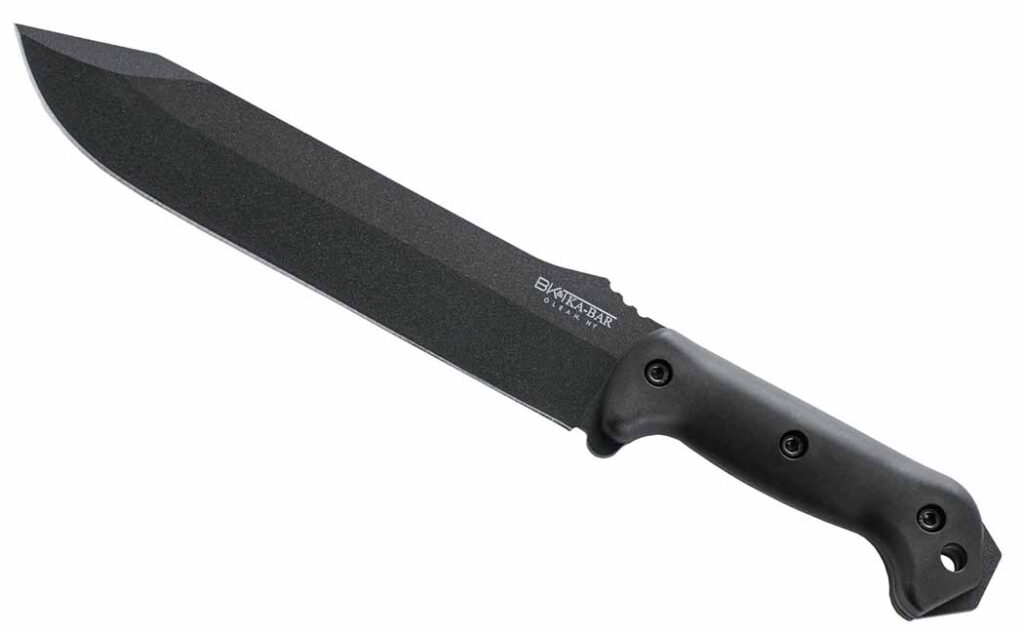
Becker Combat Bowie

Ka Bar Bowie
Melding an American bowie-style blade with Becker’s trademark ergonomic handle design and you get this sleek, all-black combat knife. It is designed for bushcraft or camping too.


The 9.25-inch blade is married to an Ultramid handle that provides a strong grip. At 17.12 ounces, it’s a bit heftier than the USMC fighting/utility, making it excellent for more heavy-duty work like trimming thicker branches and vines or cutting through medium brush. Similar to the USMC fighting/utility, the Combat Bowie is made from 1095 Cro-Van and has a Rockwell hardness of 56-58 HRC.

A heavy-duty polyester sheath is included and is MOLLE-compatible as well.

MSRP: $178.61

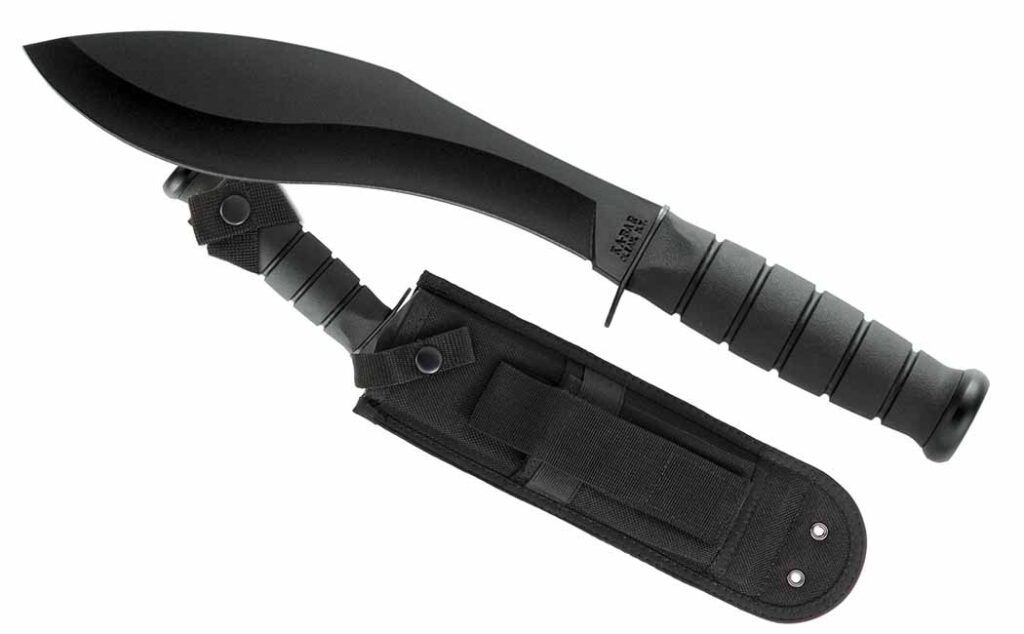
Combat Kukri

Ka Bar Kukri
This knife may have “combat” in the name, but its bread and butter is decimating small trees and vines. The kukri is smaller than a standard machete and is more finite in its cutting. That doesn’t mean that this blade can’t flex its muscle and chew through almost any brush you put in front of it.

This knife may have “combat” in the name, but its bread and butter is decimating small trees and vines. The kukri is smaller than a standard machete and is more finite in its cutting. That doesn’t mean that this blade can’t flex its muscle and chew through almost any brush you put in front of it.

At just under 16 ounces, it’s relatively lightweight yet robust.

If you’re buying it you’re most likely looking for a high-quality outdoors knife, and this kukri is it. The 1095 Cro-Van will need to be maintained to get the best out of it over time, but that comes with the territory of owning good knives. This knife will make a great companion working through the bush while camping or while cutting through bushes in the backyard.

MSRP: $122.68

Read More

Flipping In: The Rise Of The Custom Flipping Folder

Custom Flipping Folders Are Becoming More And More Popular By The Day. These Are Some Of The Coolest Custom Flippers.

The energy surrounding the custom flipper folder market is rising to new heights these days with the fit and finish, good looks and liveliness of high-quality materials, incredible skill, and, best of all, imagination.

A look at the current trends among some of the best in the class offers the custom knife market perspective on the future while also allowing a moment to appreciate and absorb the excellence around us. The commitment to make flipper folders isn’t taken lightly; it involves a concentrated effort to achieve, meet, and overcome the challenges in bringing this type of custom knife to life.

Dan Thornburg – Albuquerque, NM

Of his flipper folders Dan Thornburg said, “Little things like the cutout on the lockbar or depth of bearing pockets all affect how smooth the action will be.” The blade is Moku-Mai by Baker Forge and the handle is ancient walrus ivory. Closed length: 5 inches. His price for a similar knife: $2,000. (Image: SharpByCoop)

“I really enjoy making flipper folders because of the challenge they present in both mechanical function and working with different materials,” explained Dan Thornburg of Albuquerque, New Mexico. “I like figuring out how things work or why something doesn’t.”

Thornburg got started in flipper folders after meeting Paul Lusk at a Houston knife show years ago. “This guy is one of the smartest people I’ve ever met and is one heck of a good businessman,” Dan said of Paul. “His encouragement helped my knifemaking get to the next level.”

Evidence of that next level is readily apparent in Dan’s flipper in a handle of ancient walrus ivory with damascus bolsters. Made by Baker Forge, the blade material is Moku-Mai—mokume forge welded over 80CrV2 carbon steel. Dan said it’s not unlike a san-mai construction using mokume. The product of his ingenuity reflects an intense technical appreciation. 

“I don’t think I’ve changed the design as much as refined the design,” he reasoned. “Little things like the cutout on the lockbar or depth of bearing pockets all affect how smooth the action will be. I do try to keep it simple and not reinvent the wheel, so to speak.”

Thornburg succeeds handsomely in his mission, paying close attention to detail and applying a natural talent for precision. He indicated he likes the flipper tab to double as a single guard and fashions it with the same material as the blade. Then, he advises the owners of his flipper folders to learn their safe operation.

“I think, just like most things, operating a flipper folder is a learned thing,” he said. “The more you flip it open, the easier it becomes. My dad still couldn’t open the best and smoothest folder I’ve made—too old school I guess! For someone that owns and loves flippers, most will fly open.”

Eliot Maldonado – Bulverde, TX

“Having a shorter tab is easier on pockets and looks cleaner,” Eliot Maldonado stated. “When the knife is closed, the tab doubles as a guard, but it is still short enough so that it does not ‘ouch’ your finger when closing.” His flipper employs a tanto blade of Moku-Mai by Baker Forge Steel and a marbled-carbon-fiber handle and Micarta® bolsters. Closed length: 4 inches. (Image: SharpByCoop)

Eliot Maldonado of Bulverde, Texas, started his custom knifemaking career making slip joints and then saw an opportunity. About 15 years ago, he had helped knifemaking friend Alan Davis work with slippies, and Davis assisted Maldonado with linerlocks in turn.

“Soon after, and knowing the function of linerlocks, I experimented with flippers,” Eliot explained. “It was a successful outcome and the passion for flippers started.”

Eliot’s flipper in Baker Forge damascus, a Micarta® bolster, and a marbled carbon-fiber handle demonstrate his appreciation of the finer points in the endeavor. His use of materials has also progressed from the early days. Back then he used basics just in case something went wrong. As he has become more proficient, upgrades to higher-quality blade and handle materials followed.

“I also started changing up patterns, those patterns that appealed to me,” Maldonado said, “like, I enjoy making folders with a classic kind of western—cowboy—look but still make more traditional tactical-type flippers as well.”

Eliot pays special attention to the flipper tab, applying a technique that enhances the action of blade deployment.

“Of course, the use of bearings changes the game when it comes to flippers, and I like a shorter tab with a checkering or ridge for traction. I feel having a shorter tab is easier on pockets and looks cleaner. When the knife is closed, the tab doubles as a guard, but it is still short enough so that it does not ‘ouch’ your finger when closing.”

Eliot is a firm believer in the assertive action of a flipper folder, and he makes no apologies for being a purist. 

“I believe a flipper should snap to open position when flicked by a finger,” he related. “Anything other than that is just not acceptable to me. The way I achieve that is by using caged bearings, stop pin position, the liner relief cut, and the perfect tolerance on the blade and back spacer. The result should be a fast opening with zero blade play and strong lockup.”

Todd Rexford – Florissant, CO

Todd Rexford’s futuristic flipper folder features a stainless damascus blade and a handle of DarkTi zirconium and titanium overlays. The overlays extend into the inside of the frame, while the mechanism features an inlaid lockbar and detent pin. Closed length: 4.6 inches. (Image: SharpByCoop)

The flipper folder genre has changed since Todd Rexford of Florissant, Colorado, began his journey some years ago. He credits demand as the catalyst for focusing his creativity on flipper folders.

“They were in their infancy when I started making them,” he commented. “There were some very good makers doing it, but back then the thumb stud still ruled the folder world. It was really my customers that wanted me to start making them, and I had ideas for my own flippers as well, for what I wanted to see and what the way forward was for my knives.”

The way forward for Todd is clearly indicated by a fine flipper folder of stainless damascus with a handle of DarkTi zirconium and titanium overlays. The overlays extend into the inside of the frame, while the mechanism features a hardened stainless pivot, inlaid lockbar, and detent pin with the Rexford radius bearing system integrated. A titanium pocket clip and back spacer complete the stunning package.

Todd sees the operation of the flipper folder as a critical element of the overall presentation, but hesitates to favor fully opening vs. more of an assisted movement. 

“I don’t judge,” he offered. “If a wrist snap is needed, then so be it. We can’t forget that when I make a stiff-detent lockbar flipper, you won’t be able to open it slowly. It will open with authority and everyone around you will hear it. This goes to show that each detent force has its own place depending on the end users and their task requirements.”

Nonetheless, the smooth operation of the flipper folder is a hallmark of a successfully completed professional effort. 

“The detent force, and how much preload you can place on the system before it overcomes the detent, is one factor that determines if the knife will fully open or not,” Rexford asserted.

“The other factor is the person and his or her finger,” he continued. “Through my years of building flippers, I’ve built everything on the spectrum of this force. Take a stiff detent to a show and half the people love it; half the people can’t open it. I’ve had users time some of my very fast knives in a pseudo drag race using camera-frame timing because they love it, but for a lot of people they may not be able to open that knife. At the end of the day it’s a preference, and I have stopped ‘standardizing’ my force. Yes, a flick will open the knife, but the velocity of the tip may change to suit different customers.”

The Skiff Family – Broadalbin, NY

The Culprit flipper folder by Steven Skiff, Jr. and Sr. won Best in Show at the 2022 NCCA Show. The blade is Damasteel stainless damascus in a Fafnir pattern. Closed length: 4.25 inches. The makers’ price for a similar knife: $1,495.

The father-son team of Steven Skiff, Sr., and Steven Skiff, Jr., from Broadalbin, New York, collaborates to make their own bold statement in the flipper folder realm. While Steven, Sr. makes the blades and does fit and finish, Steven, Jr. handles the CNC milling and produces blade bearings for the Skiffs’ projects, as well as bearings for other customers in the knife industry.

The Skiffs enjoy tackling the relative intricacy of flipper folder construction and relish the opportunity to demonstrate their proficiency, particularly with their team approach. 

“Making flippers is a challenge,” Steven, Sr remarked. “They are deceptively simple looking to make. It can be difficult to get the action exactly the way you want. It’s that challenge that I enjoy and it makes me prefer making them over other knives.”

The Skiffs’ Culprit framelock flipper folder features a blade of Damasteel stainless damascus in a Fafnir pattern, and a titanium handle with zirconium accents and seafoam anodizing. The result is dazzling, and Steven, Sr. credits custom knifemaking greats Andre Thorburn, R.J. Martin, and Kirby Lambert for “having a hand in increasing my interest to continue making flippers.”

The flipper construction process has progressed in the years since the Skiffs began to concentrate on the style. One aspect of that progress is the addition of an over-travel stop. 

“That’s an example of one important advancement that [a number of] us makers started using on framelocks a while ago,” Steven, Sr. observed. “Another advancement includes the evolution of using bearings instead of thrust washers, and we also use a hardened insert in the lockbar to prevent wear.”

The Flipper Folder Continues To Grow

The firm foundation of the flipper folder, both in popularity and mechanical and aesthetic quality, sets the stage for the future.

“I do predict we will see further refinement in materials, as well as in material quality over the coming years,” Rexford assessed. “We have also seen new locking mechanisms being adapted for the flipper category of knives.”

Maldonado looks ahead to “future advances in making a double-action flipper/auto. Of course, using new and exotic blade and handle materials is always something that keeps evolving.”

Future generations of collectors and users come to mind with Thornburg’s ideas of tomorrow. He commented, “I like to use materials that are not common when making my flippers. Mammoth, walrus and elk antler are my main scale materials, and my idea is a fine gentleman’s flipper folder for the upscale customer that will be handed down to their children.”

Altogether, the custom makers and their colleagues are doing their part to ensure that the flipper folder has staying power.

Read More

Knife Review: Kizer Drop Bear

The New Kizer Drop Bear Is An Excellent EDC, And The Clutch Lock Is A Worthy New Addition To The World Of Axis Lock Knives

In the ever-growing world of EDC knives, finding ways to stand out is difficult. So many brands, so many steels, so much of everything. And even in that crowded field, the new Drop Bear from Kizer finds ways to catch the eye.

Boasting a high-quality blade, simple handle, and innovative lock, the Drop Bear is the kind of knife you’ll want to use every day … more so, it’s the type of blade you’ll go out of your way to use. 

Getting The Drop On The Drop Bear

The Drop Bear in both of its colorways: Gunsteel on top and Black, with the bright purple thumb stud, below.

First that name. For those wondering it originates from a beast of Australian folklore that–as the legend goes–drops from trees to attack humans. Pleasant.

However, Kizer’s Drop Bear (MSRP $158) allure isn’t its reference to free-falling arboreal bruins. Instead, it’s Kizer’s twist to Benchmade’s Axis™ lock configuration.

Called a Clutch Lock by the China-based company, the mechanism provides a dead-tight lockup. I put this through the wringer, but we’ll get to that in a moment. And while few locking mechanisms have ever sold a knife, this adds enough of a spin to the traditional drop point to make it stand out.

So, let’s talk a little bit about the Drop Bear’s Clutch Lock.

Clutch Player

The clutch lock seen after removing one of the scales. The lock can be adjusted, and scales replaced, in less than two minutes.

As the fidgety type, I have to confess up front I love this knife. Right off that should give some indication of what the Clutch Lock brings to the table.

Where Kizer gets it correct is by not improving an already proven system, with the blade unlocking similar to most other Axis-type locks. For those unfamiliar, a pair of buttons situated on either side of the knife–in this case behind the pivot–are retracted, thus releasing the blade. As mentioned, it’s an ideal lock for those of us who fidget.

However, Kizer has improved the system by tinkering with the pair of Gemini springs hidden beneath the scales. The rub here, their tension is adjustable. This is a big deal.

This concept is not entirely foreign to those bold enough to have skunk worked spring tension for years. Many times the results were less than optimal, which is why Kizer’s setup is desirable. Basically, you won’t make the Drop Bear a victim of shoddy kitchen-table knifesmithing.

The tension adjustment itself is simple, even for the mechanically challenged. The frame has five holes on each side in which the spring is loosened or tightened. If you want a faster open and tighter lockup, crank it up to the holes closest to the blade. Desire a looser action, dial it down.

Interestingly, and probably grasped by the mathematically inclined in the audience, the five holes on each side don’t add up to five settings. Instead, it’s 5X5 settings for a total of 25. Boy, if you can’t find what you’re looking for in that range, then nearly any knife is likely to leave you cold.

Bear Necessities 

The Drop Bear is a sleek, nimble knife as seen from above.

Novel as the Drop Bear’s Clutch Lock is, it wouldn’t add up to a pile of scrap if Kizer didn’t finish the job with all the parts to make a solid knife. Overall, they make it worth the price of admission.

With a quality EDC knife in mind, Kiser outfitted the Drop Bear with a blade a shade under 3-inches long–legal in most jurisdictions. The 154CM stainless steel, again becoming popular in this role, offers a Rockwell hardness of 58-61 HRC.

Topping off this end of the knife, Kizer applies a flat grind to help create the edge. Good choice, because it comes out of the box frighteningly sharp. Outfitted with moderately sized thumb studs with plenty of clearance, this attribute is quickly deployed.

In the hand, the knife feels light–listed as 3.7 ounces–but not light as air. This is a good middle ground for this class of knife, where it feels substantial in your hand yet won’t tear the rivets out of your jean’s hip pockets.

Much of the weight savings come from an attractive skeletonized frame, under the aluminum handle scale. With an ergonomic swell toward the middle of the handle, the Drop Bear offers purchase and plenty of control.

As for aesthetics, the knife comes in two colorways. The first style is a gun steel blade with a satin finish and black thumb stud. The second has a black blade with an eye-catching purple thumb stud.

Finally, a tip-up clip keeps the knife at hand and riding deep in the pocket.

Testing The Drop Bear

The Drop Bear was a joy to test and cuts most types of material with ease.

It’s an EDC so I wasn’t going to try and chop through the vines slowly overtaking the corner of my backyard fence. I used it around the house for a few days. 

It cut through plastic and tape like there was nothing there at all. It’s a perfect letter opener. The Drop Bear easily handles the daily tasks you’ll see every day. Taking it a step further, I used it as my only knife when prepping dinner for my wife and I.

First was the romaine lettuce, which the knife handled with ease. Whether holding the Drop Bear in the pinch grip like a chef’s knife or by using the jimping and pressing down with my thumb from the top down, the knife dispatched the lettuce easily.

Up next was the tomatoes, and it was the best experience I’ve had with a flat-edge knife cutting tomatoes. They were Campari tomatoes, so smaller and more delicate than beefsteak or Roma tomatoes, and the Drop Bear went through the flesh easily. This was best done in a pinch grip and got incredibly thin slices of tomato for the salad.

Celery is stiff and crunchy, and it was no problem for the Drop Bear. The chicken breast was easy too. I preferred cutting the chicken by utilizing the jimping, and the knife bit down easily and sliced through the meat without a hiccup.

My single favorite cutting task was the bell pepper. I chose to cut the pepper through the skin side as that is traditionally more difficult than cutting through the interior flesh. I have never cut through a bell pepper easier than I did with the Drop Bear. It left me thinking that this could reasonably replace a paring knife.

However, the Drop Bear did meet its match against a large carrot. The knife did not enjoy fighting through the harder, denser flesh, forcing me to switch to a kitchen knife to finish the job.

Beyond the kitchen, the Drop Bear shined. It gets through cardboard boxes like nothing. The corrugated cardboard can be the test upon which many knives fail, but the Drop Bear didn’t even blink. 

Additionally, I tested it on some brand new ⅜-inch polypropylene cord. I figured that the cord would provide some sort of fight for the Drop Bear. Instead, it was a first-round knockout as the blade smoothly sliced through the rope, leaving a clean cut with little in terms of frayed strands.

As for the action, I preferred the knife a little looser and set it at the second position. And the lock, I put the strength of the lock through the ringer. I did everything I could to break it. I bent it backward, sideways, every which way I could to flex the knife. The lock held firm and never budged.

Final Cut

Overall, the Drop Bear makes the cut for me. 

The knife has enough mechanical allure to make it intriguing while remaining practical. For tinkers and fidgeters, this is a big plus. For those less inclined to get wowed by engineering wizardry, Kizer’s creation still shows sharp.

The Drop Bear is more than ready to tackle most EDC jobs, though you might not want to push it too far out of its comfort zone. What knife isn’t that true for? But for the price, it seems Kizer has hit the mythological sweet spot for this class of knife.

Knife Specs

MSRP: $158

Blade Material: 154CM stainless

Blade Length: 2.97 inches

Blade Style: Drop Point

Full Length: 7.15 inches

Handle Material: Aluminum

Handle Length: 4.17 inches

Opening Mechanism: Thumb Stud

Lock: Clutch Lock

Pocket Clip: Tip-Up

Weight: 3.7 ounces

Read More

The Gerber Mark II: A Historic Fighting Knife

The Gerber Mark II Is One Of The Most Famous Combat Knives Ever Issued To The American Military. First Introduced In 1966, It Still Endures Today.

When it comes to military knives, few are as universally beloved as the Gerber Mark II. First issued for use by U.S. service personnel in the Vietnam War in 1966, the knife has stayed in production since with the exception of 2000-2008.

The Mark II was successful due largely to its well-designed blade and lightweight. The blade is 6.5 inches long, and contemporary versions of it are made from 420 HC stainless steel. The handle is made from die-cast aluminum which helps keep the weight to just eight ounces. 

What Makes The Gerber Mark II Special?

The Mark II stands out thanks to its blade design. There are many combat knives and bayonets, such as the M7 and M9, that are modeled after the classic dagger or spear point. The Mark II also has a double-edged spear point blade but with one massive exception: the wasp waist.

The wasp-waisted blade has a narrower section of steel, akin to how a wasp’s body narrows at its waist. On the Mark II, this narrower section comes toward the guard, and the edge on both sides has small serrations. Not the deepest you’ll find on a knife, the serrations are still there to cut.

Very few modern combat knives have the wasp waist (other famous American models like the M7, USMC fighting utility knife, and M9 don’t have it), and it is the visual signature of the Mark II.

Can I Buy A Gerber Mark II Today?

Yes, you can, but it’s not so straightforward. Gerber is, of course, still in business and thriving, but go to its website and you won’t find a Mark II for sale. There are other serrated tactical knives but no Mark II.

To purchase a Mark II today you’ll have to either go to sites like ebay or retailers such as Knifecenter, Smoky Mountain Knife Works, etc. Other makers offer knives similar to the Mark II, but if you want the real deal you’ll have to dig a little bit to purchase one yourself. 

However, the ones of recent make that are available are reasonably priced at right around $100-$115.

Read More

Advertisement

Must Read Articles

Read this before you make a knife

Knifemaking 101 – Read This Before You Make a Knife

  by Wayne Goddard My experience has taught me that there's nothing like digging in and getting started. I've often said the hardest part of the...
how to forge damascus steel

How to Forge Damascus

Advertisement
Advertisement