


East Beasts: Four Parangs Built To Last

This Quartet Of Knives, Inspired By The Parang Of The Malay Archipelago In Southeast Asia Are Tough, Rugged Fixed Blades.

There’s something about large blades with an Eastern flair, an exotic look, and that offer devastating function. They generally are built stouter and able to complete multiple hard-use tasks beyond those of a machete. Such knives clear vines and weedy vegetation, take out small saplings, and split wood for campfires. They are equal parts tool and, if necessary, weapon.

Condor Tool & Knife Pack Golok

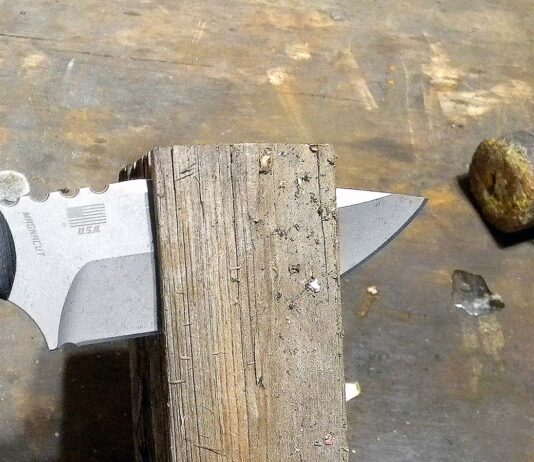
Batoning the Condor Tool & Knife Pack Golok is easy. The convex edge bites right in and tackles the task with gusto.  

Originating in the Malay Archipelago, the golok is used primarily in Indonesia, Malaysia, and the Philippines. Varying in size and weight, it is typically anywhere from 10 to 20 inches long. Often shorter and heavier than machetes, the golok is used for bush and branch cutting. Cutting edges tend to be convex, preventing the blade from being stuck in green wood. Carbon steel is often the preferred blade material, usually with a softer temper for ease of sharpening.

A good modern production example is the Condor Tool & Knife Pack Golok. The 11-inch upswept blade is 1075 carbon steel with a convex edge great at not sticking in green wood. The handle curves down near the butt and flares out a bit to prevent the knife from sliding out of your hand while chopping. The rich brown appearance of the walnut handle material elevates the Pack Golok’s appearance. Three large brass rivets secure the walnut slabs to the tang. A thong tube provides a hole for a lanyard.  The overall length is 17 inches, long enough to tackle heavy work but not too long for belt carry or easy storage.

In use, the Pack Golok feels very sturdy and comfortable. The large diameter of the rounded walnut handle turns down a bit to help keep your hand in place. The generous diameter makes the handle easy to grip and fills the hand nicely. You feel in control of the knife at all times.

The solid convex grind puts a maximum amount of meat behind the edge for durability and helps resist chipping and rolling through heavy chopping.  The edge is very sharp and easy to maintain so the knife serves well in the field.

The Pack Golok performs like a larger knife without being one. Of the test bunch, it’s the best chopper. It also excels at baton work. Conversely, it works just as well for finer tasks such as whittling.

The leather sheath is extremely well done. It features two button snap closures to secure the knife. Unsheathe it by simultaneously lifting the handle and pulling it out. There’s a large loop for belt carry. 

MSRP: $107

DPx Gear HEFT 12 Chop

Chopping is what the DPx Gear HEFT 12 Chop does. It’s like an axe—swing up, let gravity take the blade down and it strikes with plenty of inertia. Chopping is almost fun with the HEFT 12.

DPx Gear’s HEFT 12 Chop is a serious piece of kit. Robert Young Pelton, aka RYP, is the founder of DPx Gear, a noted journalist, and a documentary film director who spent considerable time in Iraq and elsewhere covering various conflicts. Based on the parang, which also is a favorite in the Malay Archipelago, the HEFT 12 Chop is optimized for cutting woody growth. Sporting a sweet-spot belly for chopping and forward-weighted balance, the parang is a multi-use cutting tool that can be quite handy in the wilderness.

In the HEFT 12 Chop, RYP wanted a tool that would serve as a machete, hatchet, and large survival knife all rolled into one. As a result, one knife can be carried instead of several. This is especially beneficial on long treks—the old “less is more” maxim. 

The 12.5-inch blade is flat-ground D2 tool steel, a proven and highly consistent performer for hunting and survival knives. A black mil-spec blade coating enhances corrosion resistance and low reflectivity. The green G-10 handle is 3D machined and contoured for comfort with no hot spots to speak of. The grip turns down and flares out somewhat to act as a catch and prevent the hand from sliding backward. Three large Torx-head screws fasten the G-10 slabs to the full tang. There’s also a lanyard hole in the exposed tang. A single guard keeps the hand from sliding forward.

At 18.6 inches overall, the HEFT 12 Chop is a formidable cutting tool. Made in Italy by Lionsteel, it looks great with the black blade and OD green handle. When you lift the HEFT 12 Chop, you immediately notice the heavy blade-forward balance. This enhances chopping, building momentum, and using gravity to your advantage as you swing the blade. If you go into it with all muscle, trust me, you will get tired. Relax and let gravity do the job.

Rest the guard on your hand as if you are choking up and let the handle pivot a bit in your paw for additional power. A semi-loose grip works best—or at least it did for me. As you chop you can feel the power with each blow and where the blade’s sweet spot is (just behind the angled tip). The HEFT 12 takes out smaller and thinner vegetation with abandon—a testament to RYP’s design vision.

This is a wonderful blade for baton work. You can use the length for leverage as you pound the spine. The full flat grind is like a wedge, splitting wood effectively and quickly. The HEFT 12 Chop does not come with a sheath. It’s a bit on the pricey side but the design is backed by RYP’s years of real-world experience.

MSRP: $375

APOC Chop House

The APOC Chop House is a good chopper, though the author indicated the handle does raise some hot spots. Wearing gloves is a way around that.

Boasting a flared reverse-tanto-style tip, the Chop House from APOC Survival Tools is based on the dao, which originated in China as a single-edge sword primarily used for slashing and chopping. The blade’s moderate curvature and angular tip are effective for thrusting. A 12.75-inch blade and overall length of 18 inches puts the Chop House right in the middle of machete territory. It boasts 9260 carbon blade steel, full-tang construction, and a black G-10 handle. A black oxide coating reduces glare and enhances rust protection.

Featuring 3D-machined and contoured facets, the handle is certainly one of the knife’s most interesting elements. Three sets of Torx®-head screws fasten the G-10 slabs to the tang. A prominent finger groove trails a recessed grip area, and the handle flares out to create a catch for your hand, stopping rearward sliding. 

An integral double guard provides additional protection. Wrap your hand around the handle and feel your fingers nestle in and lock into place. Depending on your hand size, you might feel some hot spots around the palm. In fact, those with bigger hands might find the grip objectionable.

The Chop House feels agile and has more of a neutral balance than the rest of the test bunch. As a result, it excels more at such machete tasks as cutting tall weeds, grass, vines and maybe taking out the occasional sapling. To be an effective chopper, the balance must bias toward blade-heavy, something the Chop House does not do. It has a balance more typical of a standard machete. This isn’t bad, it just means carefully selecting what you use it for.

The factory edge did not last long out of the box and I wound up resharpening the blade to my liking. It might be wise to apply your own edge before putting the knife to use as well. 

MSRP: $159

Fox Knives Parang

Don’t let the Fox Parang’s short length fool you. It chops quite well, with plenty of bite to the blade.

The Fox Knives Military Division (FKMD) Parang is an outstanding example of a compact fixed blade that serves as a chopping, camp, and kitchen knife while remaining easy to manipulate and carry. Taking design cues from the traditional parang with the forward-weighted feature, the 7-inch blade has a bulbous, rounded tip great for slicing and as a skinning knife if need be. 

The N690 stainless blade steel has a layer of black Cerakote® for additional corrosion protection. N690 is higher-end steel that exhibits an excellent balance of edge holding, corrosion resistance, and sharpening ease.

The ergonomic handle is Forprene, a molded thermoplastic tacky to the touch. Several large scallops on the grip section accommodate the user’s fingers comfortably. Along with the main groove, the largest scallop seats the index finger. This locks in your grip and the rest of the fingers fall naturally into place. The tang has a choil and gimping ahead of it to promote a secure choke-up grip for finer cutting tasks that require additional control. Though the handle is boxy, the edges are rounded to soften things up.

In action, the Parang—one of this issue’s cover knives—is impressive. As a chopper, the blade bites in deep and hard. The flat grind and excellent edge quality out of the box help make this possible. The Fox entry can give some larger knives a serious run for the money in terms of chopping effectiveness. When you choke up, tasks that require control like whittling are as easy as chopping. The knife feels comfortable and balanced in the choke-up grip. The large blade belly slices very well and the grip is no slip.

The Forprene handle mitigates some shock from impact when chopping. Its slightly tacky quality makes for a good grip with wet, dry, hot, or cold hands. Some may think the handle material looks cheap but the Forprene offers function rather than aesthetics—crucial when considering an outdoor blade for hard work. I wear gloves when using big fixed blades and even with gloves, the Forprene still felt very secure.

The Parang seems the most useful of the review models as it serves well as a chopper/camp and kitchen knife. If you stash a chopper in your vehicle, the compact length makes it ideal for the role. You can do the same with the other test knives but their additional length may pose an issue.

A very nicely made ballistic nylon sheath with Kydex liners for rigidity and protection from blade puncture comes standard. A wide dual-snap retention strap fastens around the handle. A smaller strap secures the knife at an additional point below the main retention straps. 

This might seem redundant but when wearing the Parang on your belt in the wilds, you don’t want it to exit accidentally! A loop accommodates a variety of belt widths. There are MOLLE attachment points and a leg tie, too.

One drawback: the sheath is OD green and the Forprene handle is tan. I’d prefer the handle color to match the sheath. An aluminum box with a snap-on lid that contains common assorted survival items is included. 

MSRP: $365

Read More

Bad And Beautiful

Few Patterns Are As Stunning And Audacious As Daggers And Fighters. These Four Makers From Around The World Show What Elite Craftsmen Are Creating Today.

Knives with attitude always have been popular among many makers and cutlery enthusiasts, and, if you’ve ever been to a BLADE Show, chances are you’ve seen some eye-popping examples. Many have in-your-face themes, with daggers and fighters getting lots of love among them.

Wardog Fighter By Samuel Lurquin

The Wardog Fighter by Samuel Lurquin includes a handsome leather pouch sheath with logo by Jeremy Guillaume, a sandblasted-then-blued blade, a tight-waisted bird’s beak handle, and a dog tag with appropriate verbiage and logo. Overall length: 12.8 inches.

If Samuel Lurquin’s Wardog Fighter looks familiar, that’s because it is—it served as one of three cover knives for the June BLADE®. However, due to space requirements, we were unable to give the knife its just due in that issue, so we correct that oversight here.

Sam is an ABS master smith from Belgium who makes bullet-proof tactical fixed blades ticketed for extreme “rough ’n tumble” use beyond the call of duty. Sam’s English is somewhat limited, so we turned to Dave Ellis, proprietor of Exquisite Knives, who specializes in upscale cutlery from around the world. Dave is California’s first ABS master smith who has since retired from hammering steel to become a purveyor of fine custom knives. Dave’s overview of the Wardog is insightful. 

“Sam’s combat knife was designed to be very concealable, nothing flashy that sticks out! Twenty years discussing the needs of end users helped him design a knife to be used hard in the field,” Dave observes. “Rather than taking credit for the knife’s design, Sam instead deferred to the many experts when it came to ergonomics, concealment, and design to ultimately come up with this sleek fighter.”

The beefy clip-point blade is 7.5 inches to go with the 5.3-inch black G-10 handle. 

“I asked Sam if he considered this to be the perfect combat/field knife,” Dave states. “His response was quite sincere. He said, ‘There’s never just one perfect knife.’ Use dictates the design of each piece, and this design Sam hopes is one that he could stake his own life on. This is very important to Lurquin—that if all else fails, his knife will prevail.”

Dave explained the Wardog’s finish process: “The blade was sand blasted then cold gun blued. The bluing produced a forced rusting [patina] that Sam removes with steel wool. The blade is stonewashed for the final finish, one that will stand up to hard use.”  

Sam designed the thick, all leather sheath and had his friend, Jeremy Guillaume of 8 Ball Leather, make it. “It’s double welted and has double latches to keep the knife secured on many media—belts, backpacks and the like,” Dave concludes. “Sam felt that Kydex is too noisy, thus the use of leather.”

Commando Dagger By Joe Israel

Joe Israel offers his Commando Dagger with the smaller Shrike EDC knife. A big fan of the Fairbairn-Sykes dagger of World War II fame, Joe patterned the handle on that of the F-S classic. The Kydex sheaths are by Harry Savage.

One of this issue’s cover knives, Joe Israel’s Commando Dagger is born out of Joe’s intense fondness for the armed forces knives with a double edge. 

“I’m inspired by all the great military daggers like the Case V-42, Fairbairn-Sykes, Gerber Mark II—these knives have always fascinated me,” he observes. “I wanted to create something both beautiful and a bit sinister which, after all, is what I think daggers are.”

Though very stylish, Joe’s knife is meant to be used. 

“For the Commando Dagger, I start with 3/16-inch CPM 154 stock that I flat grind by hand and heat treat myself, including a liquid nitrogen cryo. The blade is 6 inches long and the overall length is 11 inches,” he states. “It’s then hand sanded to 3,000 grit and mirror polished.” 

The blade is sharpened on both sides. If the curvaceous handle smacks of a certain famous World War II combat knife, it is purely intentional. 

“I always loved the shape of the Fairbairn-Sykes handles and I try to emulate their elegant shape in my Commando Dagger,” he comments. “The knife is full tang with a brass guard that I pin and solder in place old-school style.” The scales are black linen Micarta® with blood-red G-10 liners secured with brass pins.

Joe supplies his knives with no-frills, all-business black Kydex sheaths, and also offers them in leather. “Harry Savage makes the sheaths for the daggers and he’s just great to work with,” the maker opines. “His work is always top-notch. The small knife in the picture accompanying this story is my Shrike EDC. It’s available in a variety of steels and handle materials. I offer Kydex and leather sheaths for my other knives, too.”

The Toothpick By Matthew Roberts

Matt Roberts chose ladder-pattern damascus for his Toothpick dagger because it complements the symmetrical blade profile, and the coffin-handle design for its simplicity and flowing lines.

Matthew Roberts is an ABS journeyman smith with a passion for forging. 

“I modeled the Toothpick after the Gold Rush daggers and Arkansas toothpicks of the 19th century,” he explains. “I have no knowledge whatsoever of historical knives and their dimensions. I made this because it looks vicious. Utility was an afterthought for this build.

“I forged the blade from 15N20 and 80CrV2 steels,” he continues. “I chose ladder-pattern damascus because it complements the symmetrical profile. The blade geometry is very acute with a full distal taper—the point is ground to near zero.” The Toothpick has a 7.25-inch blade length and is 12 inches overall. The blade is 1.2 inches wide at the widest and has about a .165-inch maximum thickness.

Matt chose a coffin handle design for its simplicity and flowing lines. The radius of the handle profile mirrors the blade profile. The handle material is African blackwood that Matt faceted heavily. 

“Blackwood seemed to be an appropriate choice because I wanted the blade to be the focus of the piece,” he notes. “Also, blackwood is a very heavy wood which helped bring the point of balance well into the handle.” The guard and spacer are 416 stainless. The spacer fluting is mirror polished.    

Matt chose a simple sheath to reflect the clean lines of his dagger. “It’s buffalo hide over bridle leather,” he states. “The hide has a matte finish and is very soft.”

Coffin Dagger By Julian Sacco

Julian Sacco’s Coffin Dagger features a W2 tool steel blade made via the stock-removal method and an unusual smoky hamon he chose for an “ominous feel.” The African blackwood handle is configured in what the maker calls an “old-school-coffin” style.

Julian Sacco’s dagger redefines the word sleek—and that only begins to describe the distinctiveness of his take-down-construction Coffin Dagger. 

“The inspiration for this piece came from seeing a lot of other makers do coffin-style bowie knives,” Julian relates. “I felt a shape like a coffin would fit really well on this dagger, as it’s an entirely mirrored piece all the way around. Essentially I wanted it to have an old look and feel to it and I think the coffin style fit that profile perfectly.”

The blade is ultra-slim and has a notable hamon.

“The blade is W2 tool steel and is done in the stock removal method,” he notes. “I don’t have much experience with hamons but, as per the theme of this dagger, I tried to create a smoky pattern to give it an ominous feel.” The knife has a 7-inch cutting edge and is 13 inches overall. “I wanted this to be more of a nimble and easy maneuvering piece,” Julian states, “somewhat like a stiletto dagger, but not quite.”

The grip’s modified wasp waist exudes creativity as well. 

“The handle is shaped entirely to look like an old-school-style coffin, which I think it resembles quite well. I wanted to have an aggressive look to the overall construction, which is why I shaped the pommel with such sharp lines,” he remarks. “To match the guard I kept those similar shapes and lines on the outside while smoothing the areas that would be gripped in order to make it comfortable for the user. The brass pommel and guard were an excellent choice as I knew they would patina in a way that would fit the overall rustic look and feel I was going for, while the African blackwood handle complemented that look exactly how I hoped it would. It perfectly fits the profile of an old coffin with its rich lines and bold grain, tying the entire theme of the piece together.”

Read More

BLADE Show West Custom Knife Awards

Awards Were Given Out In Nine Different Custom Knife Categories Including Best In Show At BLADE Show West In Salt Lake City.

Dozens of makers entered knives in competition across eight different custom knife categories. The skill on display was tremendous, and numerous knives wowed the judges. However, these were the blades that stood out from the crowd and took home the awards. All images are SharpByCoop Images.

Best In Show/Best Kitchen Knife: Trevor Morgan

Best Hunting Knife: Shayne Carter

Best Damascus Custom: Shane Taylor

Best Custom Slip Joint: Evan S. Nicolaides

Best Custom Tactical: Michael Jarvis

Best Custom Locking Folder: Tim Robertson

Best Custom Bowie: Shayne Carter

Best Custom Chopper: Mardi Meshejian

Read More

Bowie Beauties: Three Quality Factory Bowie Knives

The Bowie Is A Beloved, Historic Knife That Continues To Inspire Makers Today. This Trio Of Factory Bowies Stands Out. 

Perhaps no other pattern in knife history has as rich a legacy as the bowie. It is a highly recognizable design featuring a large blade in a variety of shapes, some of which have a prominent swedge, and handles of varying designs, often with a guard.

The pattern dates back to 1827 as a knife given by Rezin Bowie to his legendary brother, BLADE Magazine Cutlery Hall-Of-Fame® member Jim Bowie, the famous American pioneer who participated in the Texas Revolution and who was killed in the Battle of the Alamo on March 6, 1836. Jim Bowie was a principal in the Sandbar Fight of Sept. 29, 1827, a melee that established the bowie’s reputation as a fearsome combat knife that lives on to this day.

Boker Magnum Giant Bowie

Whittling is easy for the Giant Bowie. The knife is well balanced and agile in hand.  

The bowie remains a widely sought-after pattern for knife collectors and users alike. Its commanding stature attracts attention. A striking example is the Boker Magnum Giant Bowie, Magnum being Boker’s more affordable knife line made in China.

Boasting a stacked leather-washer handle with integrated finger grooves, polished double guard and pommel, and clip-point blade with a pronounced swedge, the Giant Bowie looks all business. 

The 8-1/8-inch blade is 440A stainless steel. The handle is comfortable and the finger grooves index your grip nicely. The leather is covered with a clear coat that prevents moisture from soaking in and ruining the handle. The buttcap screws down to compress the washers.

One drawback is I cannot find any evidence that the handle is of a full-tang construction. It doesn’t have the balance of such in hand, as it is slightly blade heavy. As a result, use this one with caution—meaning no use bordering on abuse.

The black leather sheath has a single retention strap with a button snap. A small accessory pocket also has a button-snap closure and contains a sharpening stone. The stone is too small for major resharpening but can be used for quick field touch ups. 

MSRP: $65.95

Spyderco FB44GP Respect Bowie

The Respect chops with controlled reckless abandon and makes chunks of wood fly. The massive stock thickness gives a blade-heavy feel, an excellent trait for such tasks

Spyderco’s FB44GP Respect Bowie pays homage to classic bowie design, hence its name. Sal Glesser, company founder and BLADE Magazine Cutlery Hall-Of-Fame® member, designed this beast to be his version of the bowie executed in modern materials and manufacturing techniques.

Incorporating massive .3-inch-thick CPM 154 stainless steel, the 7-inch blade is fully flat ground. While the blade is massive, the distal taper of the spine lightens it progressively toward the tip and makes it feel agile in hand. The ergonomic G-10 handle has rounded edges, which make for a very comfortable grip. 

A stainless steel double guard provides ample protection from your hand sliding up on the blade, and acts as a positive stop for choking up for additional control. You can move your grip rearward on the handle to shift the balance point to where the feel is blade heavy for chopping tasks. Torx® screws fasten the scales to the full tang securely.

The Respect makes an excellent expedient chopper, with the flat-ground blade providing excellent bite into saplings. It aggressively eats away at green wood, sending chunks flying with each blow. Toning it down, the blade makes a great slicer with the graceful curve of the cutting edge that terminates at the tip. It sliced foam blocks easily, an indication that the cutting edge quality and blade grinds are spot on. There is enough of a defined tip to perform scoring jobs if needed. The blade can do some serious penetration as well. There were no problems with cutting performance.

The heavy-duty sheath is sewn leather. A brass frog helps secure the leather retainer strap over the guard to prevent the knife from falling out of the sheath. A belt loop on the reverse side provides further ease of carry should you opt for it. 

The Respect is a high-end production knife through and through and very well engineered at that. Made in Golden, Colorado, at the Spyderco facility, the bowie comes with a zippered padded storage pouch.

MSRP: $616

A.G. Russell Knives California Bowie

Though the knife is not blade heavy, chopping with the California Bowie is possible. The edge quality and flat grind make the blade bite into green wood easily. You will have to use more deliberate muscle action than relying on a heavyweight blade.  

Built in the A.G. Russell Knives shop in Rogers, Arkansas, the California Bowie is based on an English-style pattern popularized by knifemaker D.E. Henry in the 1960s and ’70s. Henry was thought by many to be the best at the time in crafting this style of bowie, the end result being a handmade knife of meticulous fit and finish that garnered him fans worldwide. ]

The 8.5-inch clip-point blade is 154CM stainless steel with a full flat grind. Stock thickness is .185 inches, thick enough to handle the heavy work but not so thin as to be fragile. The stainless steel guard fits tight to the tang with no gaps.

The handle is beautiful wild African wild olivewood, and there is also a version with African Ironwood scales as well. The material is a blonde color with a highly contrasting grain for a stimulating visual effect. Red fiber liners give a pop of color, something seen more in custom knives than production. 

The wood scales are pinned to the full tang, and the inward curved handle lines make the knife sit in your grip very nice and secure. It may be a boxy style handle but the way it is executed makes for a comfortable feel. There is no lanyard hole.

The sheath is done right: brown leather with contrasting white stitching and a simple button-snap retention strap. The shade of brown complements the color of the scales quite well. Knife and sheath are a “10” in overall appearance. Another nice touch is the satin finish throughout, including the blade, double guard and tang, so there’s that continuity.

The California Bowie is a real slicer. The knife is balanced in proportion to the hand and feels agile and very controllable, though it is not much of a chopper due to the lack of a blade-heavy feel. If you are primarily slicing, this knife is for you. It may be a looker but it’s also a really nice user. 

MSRP: $395

Read More

Best M9 Bayonet Options For The Civilian Enthusiast

On a rifle or in close quarters, the M9 Bayonet has kept its edge for nearly 30 years.

The M9 bayonet was first issued by the United States Army in 1986. It partially replaced the M7, which was first issued during the Vietnam War. The M9 is slightly longer than the M7 and has been manufactured by multiple different makers including Buck and Ontario Knife Company. The M9 has a bigger, thicker blade than the M7, and some versions come with serrations.

The M9 is compatible with the M16 series of rifles as well as the M4 carbine. It’s also a high-quality fighting and utility knife, and, unlike many other bayonets, the M9 can also be fitted to a shotgun. In this case, specifically the Mossburg 590.

The M9 is used by multiple militaries and some police forces throughout the world from the armed forces of Singapore and Thailand to the Netherlands army and the security forces in Abu Dhabi. 

Can I Buy An M9 Bayonet Today?

Yes, you absolutely can buy an M9. 

Ontario Knife Company still makes the bayonet for commercial sale, and several other companies make versions of the knife. It’s important to remember that you need to keep your local knife laws in mind before buying an M9. 

States and countries may ban the ownership and carry of the knife, most time due to the length of its blade. However, it oftentimes also gets the switchblade treatment and is classified as a “dangerous knife”–a vague and ominous distinction meant to scare old ladies and small children.

Ontario Knife Company M9

Ontario Knife Company has been making knives in New York State since the late 19th century. During that time, the company has become a regular maker of arms for the United States Armed Forces.

The OKC M9 is a beautiful knife. The clip point is just over 7-inches long and made from 420M steel. The thermoplastic nylon handle provides excellent grip without adding too much weight, and the nylon sheath keeps everything secured.

This is a knife that looks and feels like it’s ready for anything. It shines through its simplicity with quality construction. It’s easy to see why the U.S. military continues to issue the OKC M9 today.

MSRP: $223.75

Snake Eye Tactical M9 Bayonet

This M9 from Snake Eye Tactical is vastly different from the OKC version in numerous ways. Combined with its sheath, this M9 is more multi-tool than the Ontario version.

The 8-inch stainless blade has a large fuller made from stainless steel. The majority of the spine is a sawback blade to provide more versatility to the knife, namely the ability to saw through thick wood. The sheath has a built-in sharpening stone, and a section of it can be used as both a flathead screwdriver and a wire cutter.

Yes, it’s an M9 but this piece can be used for much more than a traditional bayonet. It’s also much less money than the OKC variety, so if you’re interested in the M9 this is a great entry point.

MSRP: $39.95

Read More

First Look: Condor Buccaneer Sword

Sometimes You Want A Blade That’s Fun And Exciting Even If It Isn’t An EDC. The Buccaneer Sword From Condor Is All About Having A Good Time.

There’s a pretty good chance you’re not a pirate in the Caribbean or off the Barbary Coast. Even if you’re just a lifelong resident of a landlocked place like Kansas City or Nashville, you’ll absolutely love the new Buccaneer Sword from Condor Tool & Knife.

The massive blade is 15.5 inches in length and is made from 1075 high-carbon steel with a convex. It weighs a shade under 30 ounces so it’s a burly, heavy knife that can be used for bushcraft or for making a big show of slicing large cuts of meats. If you’re a performer, using this sword to prepare steaks for your family at the next barbecue will be remembered for years.

It all stays solid in your hand thanks to the leather-wrapped hardwood handle that is as strong as the blade and stays true while you wield this mighty sword. The included leather sheath will keep the sword safe when stored away. 

The Buccaneer Sword is so much fun. If you want a showstopper, and stay on top of maintaining the high-carbon blade, you’ll have yourself a thrilling conversation piece for years to come.

MSRP: $174.70

Read More

Trench Knife: The WW1 Relic Still Endures

With More Than A Century Of History, The Trench Knife Soldiers On As A Historical Collectible And A Modern Outdoor Knife.

The trench knife may be the ultimate weapon for close-quarters combat. With a sharp blade designed for stabbing, and a finger guard that doubles as a knuckle duster, the blade is excellent for messy, claustrophobic situations, which you would expect as it was named for the intimate and brutal trench warfare of World War I.

By the time World War II began, trench warfare was nowhere near as common as it had been previously. In turn, the trench knife evolved.

The United States issued the Mark I in 1942 and 1943 to certain special military groups like the Army Rangers and Marine Raiders. The Mark I was a newer version of WWI trench knives, including a finger guard, a stiletto blade, and a skull crusher cap built into the pommel. 

However, over the course of WWII, the trench knife gave way to the combat knife. Most notable of these, the US M3 fighting knife, which was adopted in 1943. The M3 became the framework upon which more contemporary bayonets and fighting knives like the M4 and M7 were built.

Can I Own A Trench Knife Today?

That’s a complicated question to answer. 

The trench knife is classified as a dangerous weapon in many states and countries for a variety of reasons. Some places prohibit them because they have double-sided blades while others focus on the knuckle dusters or the length of the blade as reasons to ban them.

Owning or carrying a trench knife is banned in numerous countries including the United Kingdom, Australia, Ireland, Canada, China, and Singapore, among others.

In America, the knife is outlawed in some form in 23 states, and even among the states where it’s legal to own and/or carry, 18 of those states either only allow you to keep the knife in your home or require a permit to carry it on your person. 

The only states with no permit rules for owning a trench knife are Texas, South Dakota, Indiana, South Carolina, Idaho, Hawai’i, Georgia, Arizona, and Alabama.

Modern Trench Knives

There aren’t many companies left making trench knives similar to those blades from a century ago. However, the two below are modern takes on the combat classic.

M48 Liberator Trench Knife

This is the souped-up version of the original trench knife. Everything about the Liberator is big and bold and in your face.

It starts with the 7.5-inch 2Cr13 cast stainless blade that is ground sharp on both sides. The blade has a satin finish and black oxide coating to add to its intimidating aura. The handle scales are made from a light, rugged fiberglass-reinforced nylon that provides a strong grip without adding too much weight.

And then there’s the knuckle duster tang. It both acts as a knuckle guard and an intense defense weapon. The added spikes on the handle allow you to use more force in case you are defending yourself. The knife fits into an injection-molded Vortec and nylon belt sheath that snaps shut and easily fits on your person. 

It’s bad. It’s unapologetic. It’s the ultimate modern version of the trench knife.

MSRP: $79.99

Cold Steel Chaos Double Edge

A more muted version of the trench knife, the Chaos Double Edge from Cold Steel gives a modern, tactical spin on the old classic.

The blade itself is made from SK-5 high-carbon steel and is 7.5 inches long. The full-tang construction allows for a well-weighted knife that can be used to defend or to slice through dense brush. Both sides are ground sharp and meet at a spear point so the knife can puncture as you would expect.

The handle is made from 6061 aluminum and features a pair of D ring guards, which are a newer version of the old-school knuckle duster guards that is used for the same purpose. The pommel of the knife is tapered to allow for more force when using the cap to strike.

The included sheath is made from Secure-Ex and is both Molle-Lok and Tek-Lok compatible so transporting the Double Edge will be a breeze.

MSRP: $99.99

Read More

Advertisement

Must Read Articles

Read this before you make a knife

Knifemaking 101 – Read This Before You Make a Knife

  by Wayne Goddard My experience has taught me that there's nothing like digging in and getting started. I've often said the hardest part of the...
how to forge damascus steel

How to Forge Damascus

Advertisement
Advertisement