

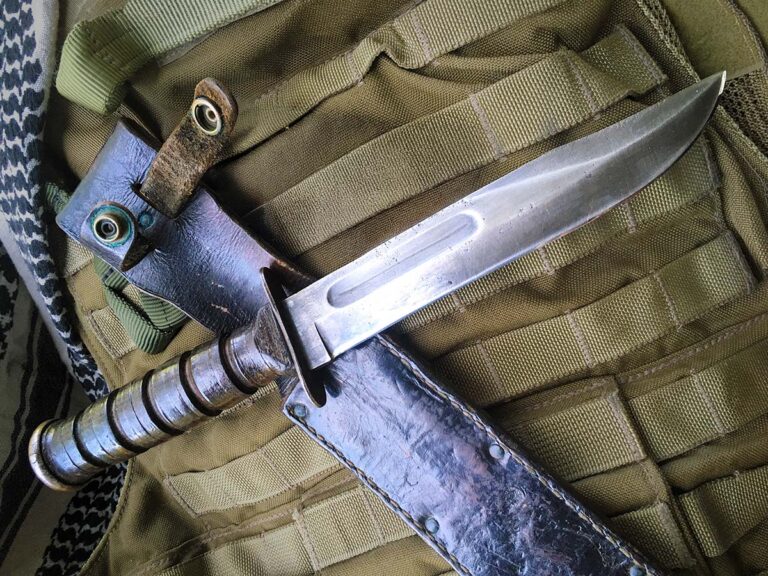
Few knives have served America more than those of the U.S. military.
Editor’s Note: This is the first of a two-part series on the most influential knives to serve the U.S. Military and explores some of the early influences on military knife design.
As what many call the greatest country in the history of countries approaches its 250th birthday, now’s a good time to salute some of the top knives that played pivotal military roles in the forging of the world beacon that is the United States of America.
It is, of course, impossible to recognize in one magazine story every single knife that played a crucial role in the many battles of the wars fought by the USA. However, with the help of some of the knife industry’s leading military authorities—including several of whom have seen the elephant in service to our nation—BLADE® will endeavor to touch on some of the more consequential knives of U.S. military history.
Before embarking on such a quest, the first task is to identify a basic group of the most indispensable knife types over two-and-a-half centuries of American land warfare. At the risk of omitting one or more, five stand out: bayonet, all-purpose utility fixed blade and/or bowie, dagger, machete/chopper and utility folder.
“These encapsulate everything that an infantryman used during the 250-year history of our country,” noted Louis Chow, a 24-year U.S. Army veteran who retired with the rank of major and is one of the leading collectors of the knives of BLADE Magazine Cutlery Hall-of-Fame® member Bob Loveless. “The bayonet, of course, from the get-go, from the Revolution to today.”
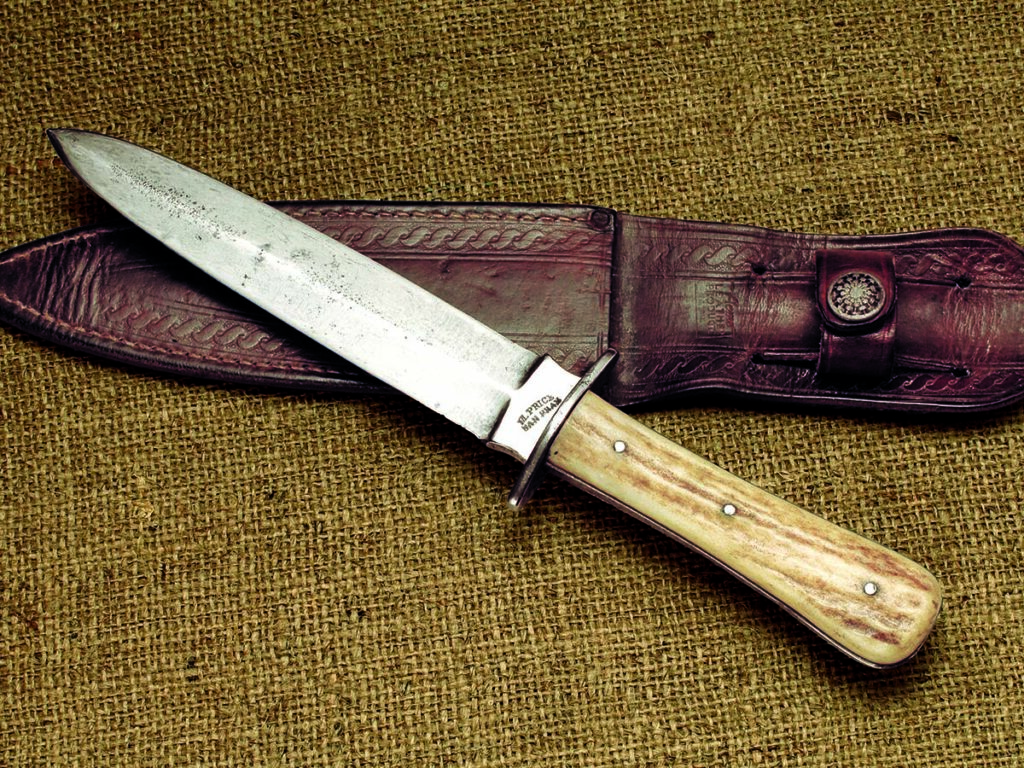
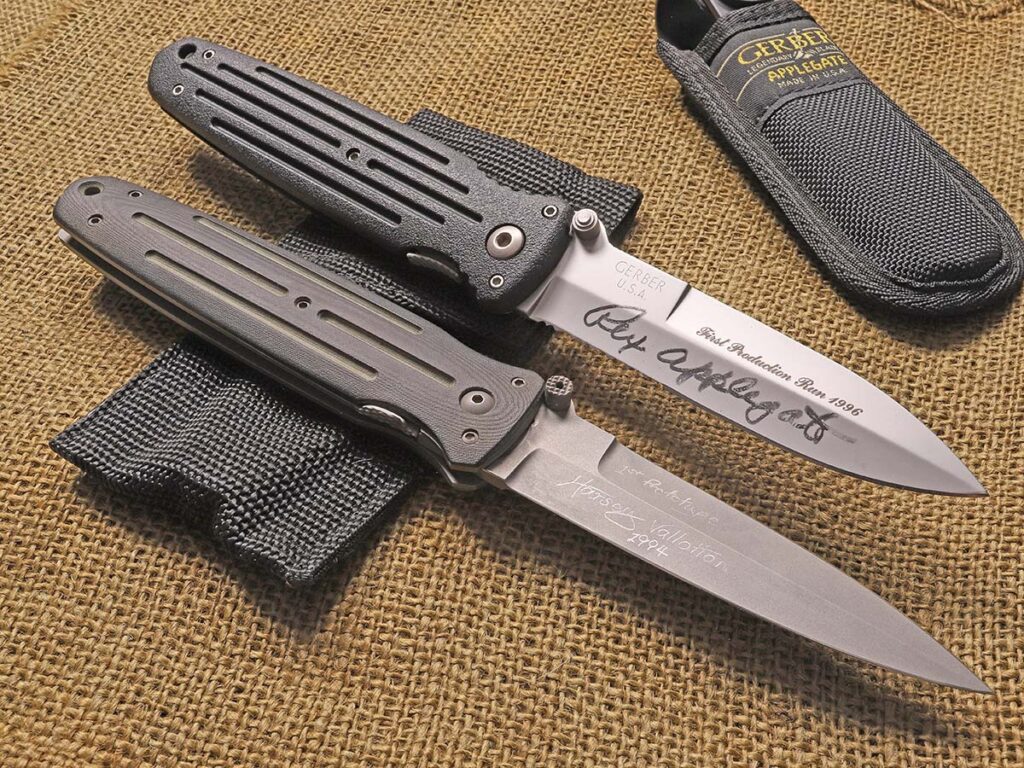
Louis indicated the all-purpose utility fixed blade/bowie could include privately purchased knives such as the Randall Model 1 and, of course, double-guard bowie types like the USMC fighting utility knife, aka the Ka-Bar. He pointed to the mid-19th-century designs of Michael Price as highly influential on daggers through to today, and machetes such as those made by Collins used in the Spanish-American War and before to Vietnam as vital to U.S. war efforts. Though pocketknives were indeed carried by American patriots during the Revolutionary War, the utility folders to which Louis referred are more of the modern Leatherman/Gerber multi-tool type, not to mention the Buck 110, Al Mar SERE, CRKT M-16 and others. As Louis noted, almost every soldier, male or female, in the modern military carries a multi-tool folder.
Many knife enthusiasts know that bayonets are rarely, if ever, used in combat today, nor have they been for well over a century. “It’s hard to actually find someone who used one in combat,” Louis said. Probably the most legendary American bayonet charge was the eminently successful one by Union forces led by Col. Joshua Chamberlain against Confederate troops down a hill called Little Round Top, a major turning point in the Battle of Gettysburg and, of course, the entire Civil War. Ironically, as Louis noted, “the most famous bayonet charge of all was the last one.”
While bayonets have rarely been used in American combat for many decades, that does not mean they do not remain significant teaching tools in today’s U.S. military. “When I was a company commander in 1990, we trained with the bayonet,” Louis recalled. “There are established bayonet courses on every installation, such as Fort Hood in Texas and Fort Benning in Georgia, and we would go there and train with the bayonet.” The rifles and bayonets have changed over the years but the bayonet training techniques remain the same.
Throughout U.S. and nearly all other nations’ histories, governments have been responsible for the issuance of combat knives in the form of bayonets for their infantry fighting forces. During World War II, the USA issued all-purpose fighters and utility knives to many soldiers, sailors and airmen. However, as Louis noted, privately purchased edged tools and weapons have always been the mainstay of our servicemen. During the earliest American conflicts, including the Revolutionary through the Civil Wars, kitchen, utility, farrier-forged and European-imported cutlery were the sidearms of the multitude of militiamen and patriotic volunteers.
The knife carried and made famous by Cutlery Hall-of-Famer James Bowie in the 1820s and 1830s was copied in various forms by makers worldwide and served as inspiration to any number of fixed blades carried in the U.S. military. Another large fixed blade that met with success in military circles was the Rifleman’s Knife made by the Ames Mfg. Co. circa 1860. Ames also made the Dahlgren Bowie Bayonet around the same time. Collins & Co. made a variety of bowies/machetes, the most famous probably being the No. 18, also incorrectly called the V-44 by many (according to D.E. Henry in his book Collins Machetes and Bowies 1845-1865, V-44 was the real name of a 1944 Case Survival Knife, not the No. 18).
Generational Blades
Circa the mid-19th century, Michael Price was considered one of the premier cutlers in the western United States. He was best known for exquisite presentation knives that incorporated marine ivory and a variety of beautiful shells. However, as Louis wrote, to create a viable knife for self-defense and combat, Price recognized that form must follow function. His solution was to use the full-tang construction method. And for a century and a half, some of the most notable American cutlers adopted the full-tang method that significantly improved a knife’s dependability and durability.
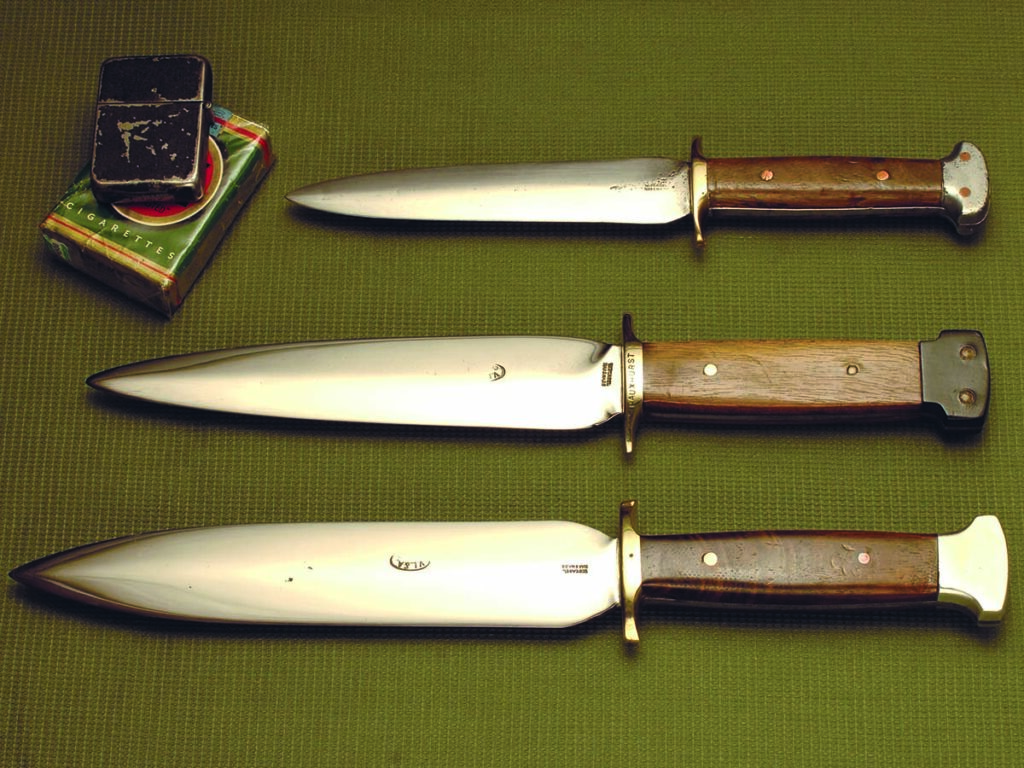
Early in 20th-century Michigan, Cutlery Hall-of-Famer William Scagel began forging axes and knives of various sizes and styles. He made most of his utility, hunting and bowie knives via the hidden-tang method. Though some of his combat knives were also hidden tang, many others employed the full-tang method.
“It was purported that the Scagel hidden-tang fighters with stacked leather washers were made for the European theater, while the full-tang fighters with wood-slab handles were made for the Pacific theater,” Louis wrote. “It was believed that stacked leather washers would be too susceptible to the humidity, high temperatures and salty air” of the applicable Pacific region. As a testament to Scagel’s outstanding craftsmanship and exceptional design, many of his fighters survived the war in good condition.
In 1937, Cutlery Hall-of-Famer W.D. “Bo” Randall observed an older man scraping the bottom of a boat with a knife that appeared undamaged by the abuse. Intrigued by the improvised tool, Bo purchased it from the owner and contacted its maker, who just so happened to be Scagel. Randall eventually became Scagel’s student and soon opened his own shop, making Scagel-style knives.
“At the onset of World War II, Randall designed and produced some of the most recognizable combat knives ever made,” Louis stated. “Nonetheless, all were made with the hidden-tang method. It was not until the early 1960s that Randall introduced the full-tang Model 14-Attack and the Model 15-Airman combat knives.”
Continuing the generational theme, Cutlery Hall-of-Famer Bob Loveless read a magazine article about Randall knives in 1953. He corresponded with Bo and made his interpretations of Randall knives before experimenting with and then making his own full-tang models.
From the mid-1960s through the early ’70s, Loveless accepted many orders from service members awaiting assignment to Vietnam. He also received bulk orders from units stationed there. One bulk order in early March 1967 from a unit commander in the 1st Cavalry Division was for 37 fighting knives.
“The unit commander and his troopers were stationed in Saigon and were supporting Operation Junction City, one of the largest airmobile operations in the war,” Louis wrote. “As a patriot and former veteran himself, Loveless would temporarily halt all other orders and place top priority on knives destined for combat. As for those 37 fighters, he worked day and night and completed the order in less than a month. For the next four decades, the Loveless full-tang designs were copied and reinterpreted by countless knifemakers and knife companies in the United States and abroad.”
In addition to the foregoing cutlery legends, the full-tang method was also preferred by many other U.S. World War II knifemakers. Among them: Alfred Bimson, John Ek, Taylor Huff, A.R. Kephart, Kennedy Arms, Bob Riggs, Ernest Warther and Cutlery Hall-of-Famer M.H. Cole. Cole also authored the comprehensive U.S. Military Knives, Bayonets & Machetes series of books and has been dubbed the “Sage of Military Knives” by Cutlery Hall-of-Famer Bruce Voyles. Continuing Cole’s legacy is knifemaker/author Michael Silvey through his reproductions of Cole’s designs and his lavishly illustrated books on the knives of the United States military in World War II and Vietnam, and other works.
More On Military Knives:
- What U.S. Military Members Look for in a Knife
- Combat Legacy: Modern Military Knives
- Military Knives: Soldiers’ EDC From The Past 50 Years
- U.S. Made Military Knives And Makers
 NEXT STEP: Download Your Free KNIFE GUIDE Issue of BLADE Magazine
BLADE’s annual Knife Guide Issue features the newest knives and sharpeners, plus knife and axe reviews, knife sheaths, kit knives and a Knife Industry Directory.Get your FREE digital PDF instant download of the annual Knife Guide. No, really! We will email it to you right now when you subscribe to the BLADE email newsletter.





