When It Comes To Beautiful Custom Knives, Few Are Doing It As Well As Dawson Knives. This Fixed Blade Shows Everything The Maker Can Do.
A knife doesn’t just need to be a showpiece. A knife doesn’t just need to be a utilitarian tool. The Dawson Chief perfectly blends the two into a piece that could be mounted in a case or used out on a hunt.
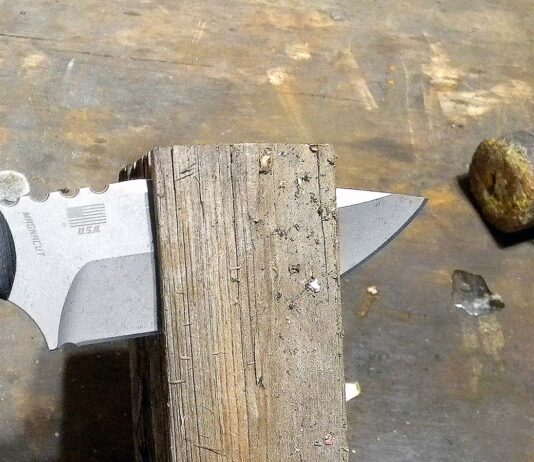
The knife is a behemoth. At 10 ounces in weight with a 5.25-inch blade, the Chief is anything but dainty. The blade can attack almost anything. Made from a CPM MagnaCut stainless powder steel, its heat treated to a rugged 60-61 HRC and can hold an edge like a champ.
The finger choil and thumb ramp allow for maximum control and smooth cutting strokes when in use. You can choose between a G10 or carbon fiber handle. Both provide a secure grip and won’t warp. No stone was left unturned in the design of this knife.
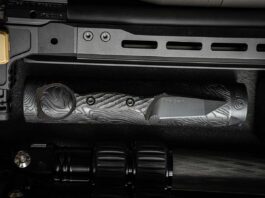
Visually it’s beautiful thanks to the two-tone Specter finish. The custom hybrid leather/Kydex sheath is just as tough as the blade and allows you to carry the Chief on your belt line or on a pack. Everything together makes for the total package when it comes to a fixed blade.
The M7 Bayonet Has Been Used By The United States Military For Almost 60 Years. The Dynamic, Multi-Purpose Tool Is Just As Useful Now As When It First Went Into Service.
When you first think of a bayonet your mind probably goes to the battlefields of the Revolutionary and Civil Wars. But no, bayonets aren’t some relic from a bygone era. While the days of bayonet charges are long long, the knives are still in use by the military today and have evolved into a multi-faceted tool.
The M7 Bayonet stands out due to its longevity. Built on the back of the M4 bayonet, which was issued toward the tail end of World War 2, the M7 is designed to be used with the M16 or the M4 carbine, although it can fit on numerous other rifles.
The History Of The M7 Bayonet
The M7 was first introduced in 1964 during the Vietnam War. The knife was initially made by Bauer Ord Company, but numerous companies did eventually manufacture the M7. Today, the lone remaining maker of combat-deployed M7 bayonets is Ontario Knife, though the knife is still available from at least one other company (Smith & Wesson).
Despite being issued by the United States military, the M7 was also made in Canada, West Germany, Australia, and in several countries in Asia.
How Does The M7 Work?
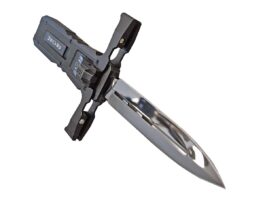
The M7 connects to the M16 via a lug thanks to a dual-lever locking mechanism. This secures the blade to the barrel while keeping the muzzle unblocked. A release mechanism on the pommel of the knife allows it to detach from the firearm easily.
Ontario Knife Company M7 Bayonet
Ontario Knife Company M7 Bayonet
Ontario Knife Co. was one of many makers to manufacture the M7, and it is the last to make the military issue variety of the blade. There is also a commercial version as well, which will be reviewed here.
It starts with a 1080 carbon steel blade with a zinc phosphate finish married to a modified Kraton handle. The blade is 6.7 inches long, and the whole construction is just shy of a foot in length. It tips the scales at 1.15 pounds. It looks beefy and feels hefty in the hand, as you would expect from a such a knife.
The included molded plastic sheath is a pistol belt clip. The lightweight sheath allows for safe, easy transport of the knife. While this knife is designed for combat, it’s burly design allows for multiple different uses. This would be a an excellent all-rounder when camping.
New Kitchen Knife Set From Imarku Looks Spectacular And Is Packed With Features That Any Home Chef Would Want.
The new 9-piece knife set from Imarku has everything a home cook could ask for. The most noticeable thing about it is the color and design. The rich blue hue of the knife block is complemented by the acrylic window that lets you look inside and see the knives while they’re inside the block.
Imarku has made a comprehensive knife set with this new release. The blades are made from high-carbon Japanese stainless steel, and the flat-edge knives are sharpened to a 16-degree edge with a Rockwell hardness of 57-59 HRC.
The set includes an 8.5-inch chef’s knife, 8.5-inch bread knife, 8-inch slicing knife, 7.5-inch Santoku, 6-inch boning knife, 5-inch utility knife, 3.5-inch paring knife, and a honing rod. The ergonomic pakkawood handle and tapered bolsters allow for an easy, firm grip when slicing and matches the bright blue of the solid walnut block.
This knife set is not only an excellent set of tools for your kitchen, but it’s also a great conversation piece and will add a bright splash of color to any countertop.
Survival Knives Need To Be Versatile, Durable, And Strong. These 10 Blades Are Everything You Could Ask For When In A Sticky Situation
A survival knife is most often a heavy-duty fixed blade built to withstand hard use in multiple roles, generally in the wilderness. It must be able to whittle, carve, chop, slice, and maybe dig. It also holds down the regular duties of a knife and assists in all cutting chores. Additionally, if your back is up against a proverbial wall, it should have the chops to serve as a weapon.
Survival Knife Features
When looking for a quality survival knife there are four key things you need to look for: the quality of the steel, handle material, the robustness of the guard, and the caliber of the sheath.
Steel
As with all knives, it all starts with the blade steel. Carbon steel and stainless steel are both used with survival knives, both have their pros and cons.
Carbon steel requires a bit more diligence to maintain and keep from rusting but offers ease of in-field sharpening. Stainless steels are more resistant to the elements and, if you spend the money, the higher grades offer enhanced edge-holding capabilities.
Handle
Next, you want to look for a knife that has a comfortable handle. This is key, given you’ll use the knife for extended periods of time.
What you need to consider is:
How is the handle contoured?
Does it feel good in your hand?
Is it made of synthetic or natural handle materials?
Personally, I would stay away from leather because of its nature to soak up moisture. I would look to some sort of synthetic like G-10, micarta, or reinforced thermoplastic. These synthetic materials are dimensionally stable and are not affected by changes in temperature, humidity, and exposure to UV.
Guard
The guard keeps your hand in place by preventing any forward movement while the knife is in use. You might be able to wrap a finger around the guard to further choke up on the handle for extra control during cutting or whittling.
Given survival knives are tasked with a number of rough-and-tumble duties, it’s wise to consider an ample guard—at least for the sake of safety.
Sheaths
Not as sexy, sheaths are equally as important as the knife itself. Essentially, the accessory helps protect the knife when not in use, as well as provides a means of portability. Most attach to a belt or MOLLY field, in the case of a backpack.
Materials such as Kydex provide the best options. Why? The thermoplastic is light, form-fitted to the knife blade, and impervious to the elements. What more could you ask for?
You might also notice some sheaths are made of ballistic nylon with a hard plastic liner inside to prevent the knife from destroying the sheath. These are also a good alternative and are more cost-effective along with being fairly weather resistant.
Leather and other natural materials on the other hand, generally ware out quickly with active use. Worse yet, they retain moisture, which can be hell on a blade—especially a carbon-steel blade.
What To Avoid When Buying A Survival Knife
Yes, survival knives come with a host of features but there are some that are useless or worse. These three features aren’t worth the price.
Spine Serrations
Ugh … serrations on the blade spine. Admittedly, some like having serrations as a cutting option for certain materials. However, generally blade spine serrations offer limited use at best and are more of a hazard because of how close they are to your hand.
Honestly, if you need serrations, bring along a serrated folding knife like a Spyderco Delica or Endura. Problem solved.
Blade Holes
Alright, these serve no function at all, except they make the knife look cool. That might be alright for a collection novelty, but not a wise course when in the wilds.
Worst of all, the holes in the blade do nothing but weaken it. Stay away from them.
Odd Blade Designs
Like blade holes, they may look cool but rarely do they enhance the function of a survival knife. We’re striving for utility here, not unique looks.
Stick with the traditional blade styles—spear point, clip point, and drop point. These are proven and do the job perfectly.
10 Best Survival Knives
There are countless makers producing dozens of different survival knives. These 10 stand out from the pack for either their features, their toughness, or their price.
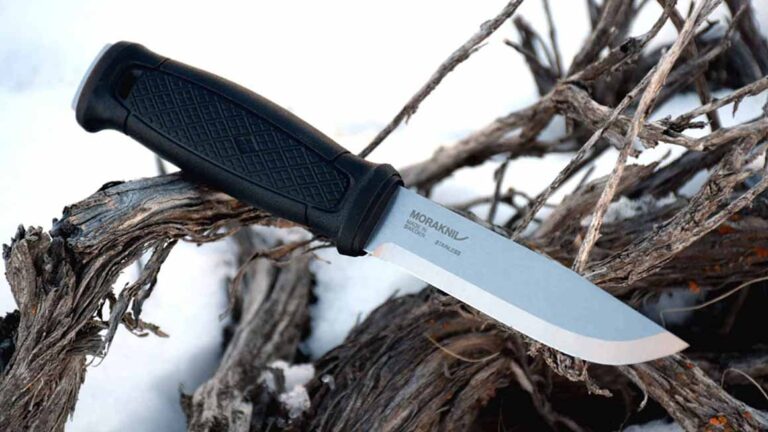
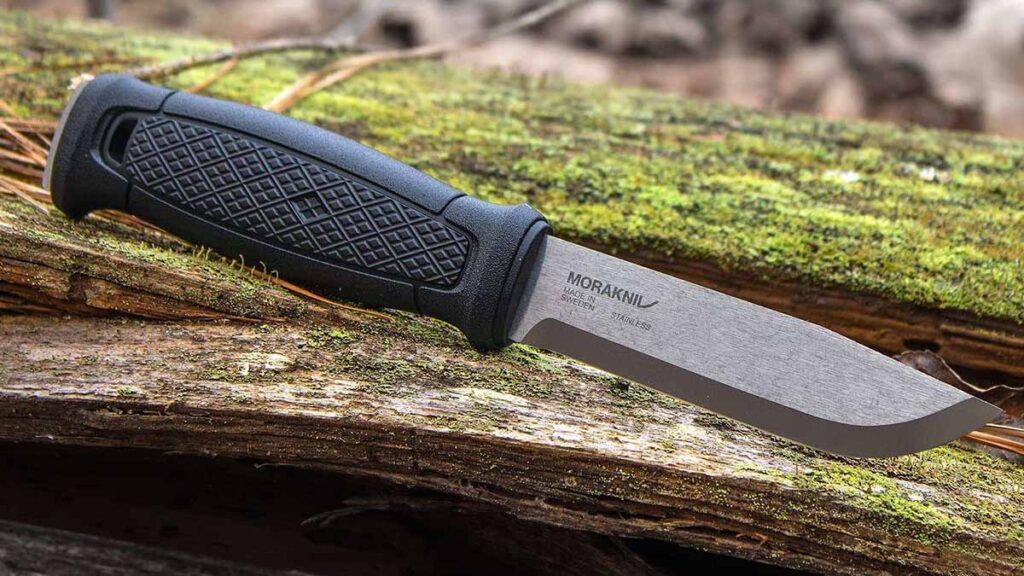
Mora Garberg
Mora is the king of value when it comes to inexpensive survival knives. Most come in at less than $50, but you are hardly compromising in quality.
I personally favor the Garberg, which has a 4.3-inch carbon-steel blade with a Scandi grind and a full tang through the handle.
The blade spine is at 90-degree, designed specifically for use with a ferrocerium fire starting rod. The dual-molded handle is made from weather-resistant polyamide. Its unique Multi-Mount sheath is included and fastens the Garberg to an ATV or snowmobile, as well as a belt.
It’s a tough too, so you are getting a lot of knife for your money. It’s made in Sweden and sold worldwide.
MSRP: $111.99
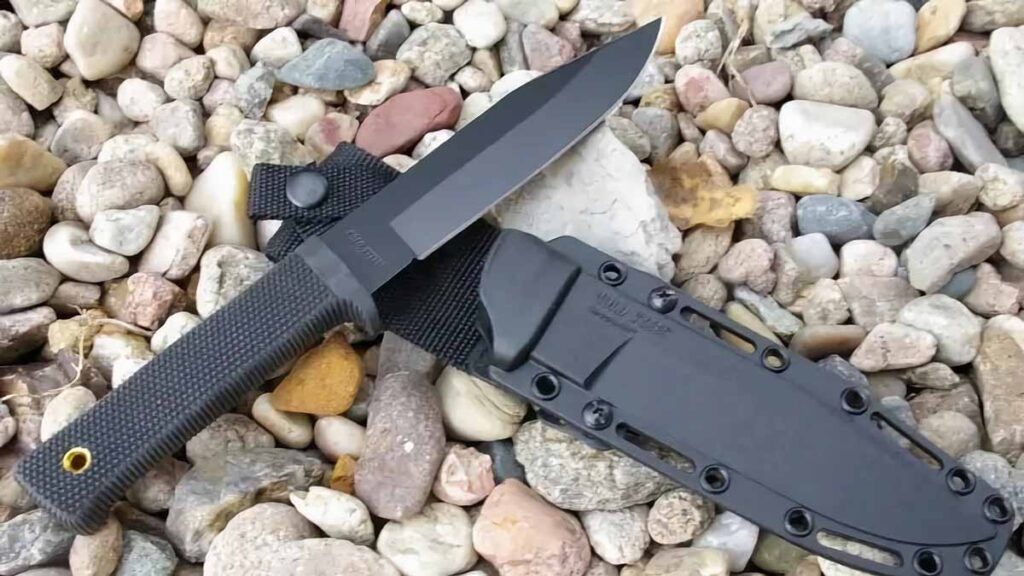
Cold Steel 49LCK-DTBK SRK Survival Rescue Knife
A long time classic of the Cold Steel product line, this knife is a proven, solid performer in the outdoors. Its 6-inch clip point blade is made of SK-5 carbon steel and attached to a textured desert tan Kray-Ex rubber-like handle that is textured for a great all-weather grip.
The blade has a black, epoxy-coat for low visibility and high weather resistance. And its single lower handle guard indexes to the grip.
The SRK is suitable as a hunting knife, survival knife, or even a fixed blade for military use. It’s a very handy design that excels at camp utility and food prep.
The stainless-steel blade provides ample resistance to the elements and holds an edge well. Its drop point design has plenty of belly for slicing and the partial run of serrations adds a bit more utility to the knife.
The handle material is rubber for an excellent non-slip grip. The large finger recess indexes your grip and allows for maximum user comfort. The butt cap of the handle is steel and can be used as a light-duty hammer when needed.
The hybrid nylon webbing and molded plastic sheath is durable and includes a fire starter and blade sharpener.
Superior handle ergonomics paired with a useful blade shape and partial serrations are what makes this one a winner.
MSRP: $62
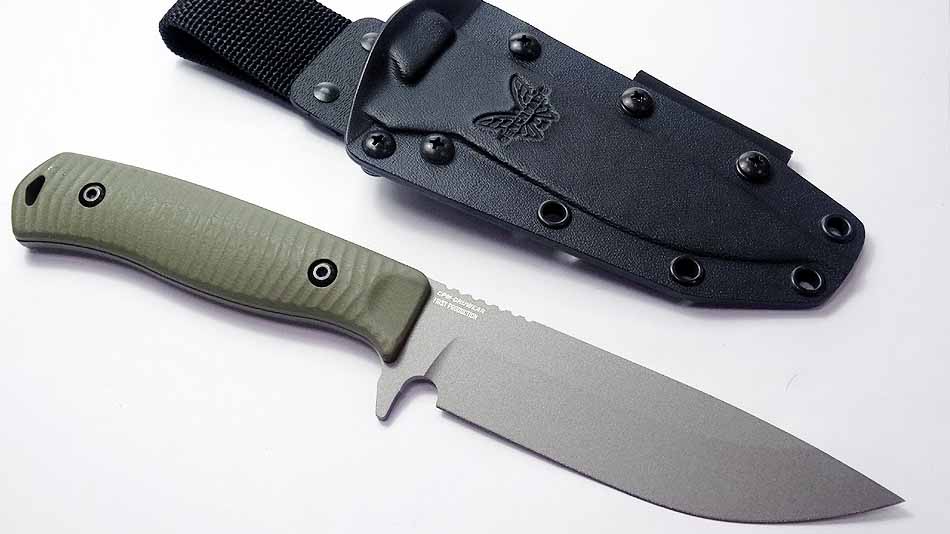
Benchmade Anonimus 539GY
This is Benchmade‘s new high-end fixed blade, with some excellent features. First and foremost, high-end CPM CRUWEAR tool steel, which provides ultimate wear resistance and edge retention.
The flat ground, 5-inch long drop point blade offers plenty of belly for effective slicing and cutting. Notches on the blade spine provide a secure non-slip grip for your thumb or index finger, and the single, lower guard keeps your hand in place.
The Anonimus is secured by a molded Boltaron belt sheath very similar to Kydex. The G-10 handle sports machined-in texturing for a non-slip grip.
MSRP: $290
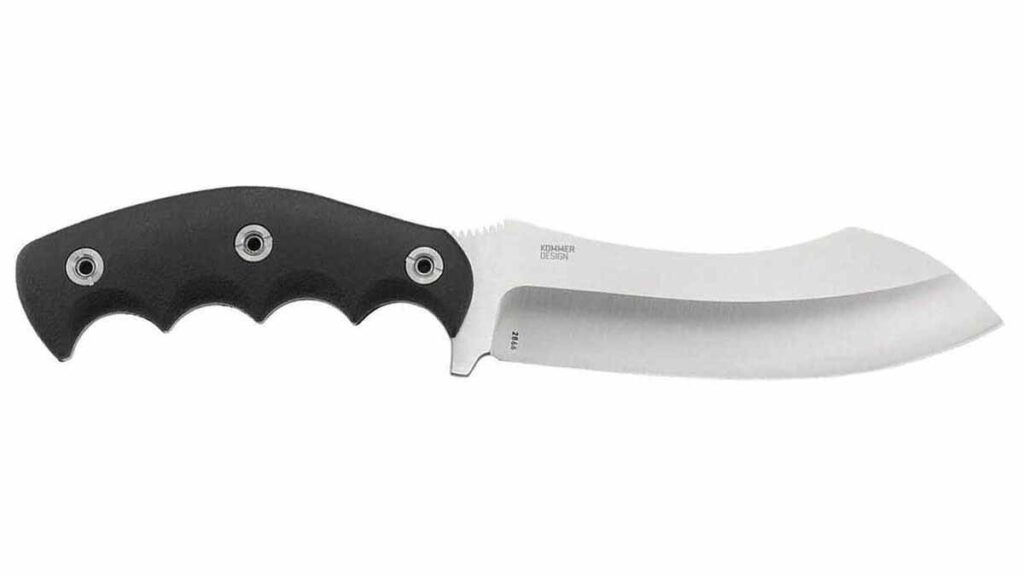
CRKT Catchall
Designed by custom knifemaker Russ Kommer, the Catchall by CRKT is on the heavy-duty side of things.
This broad chopper-style blade measures 5.5 inches in length and has a sheepsfoot-style blade. The blade is made from 8Cr13MoV stainless steel, which holds a decent edge and provides excellent corrosion resistance.
The ergonomic handle features finger grooves for a secure hold, and the handle material is rubberized glass-reinforced nylon. The Catchall might not be the type of knife for lighter cutting jobs but rather more intense tasks, such as chopping and baton work for splitting kindling for firewood.
The Catchall would be great paired with a lighter duty survival knife dedicated to finer chores. The sheath is a glass-reinforced nylon variation with ballistic nylon webbing belt loops. A single webbing strap with button snap holds the knife inside the sheath securely
MSRP: $79.99
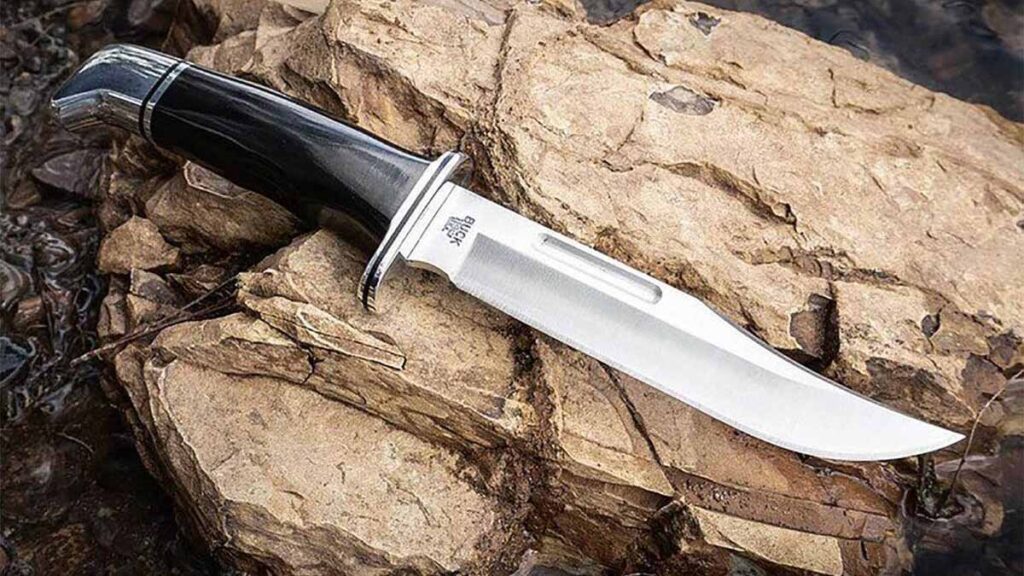
Buck Knives 119 Special
This is one of Buck‘s signature fixed blades. Sporting a 6-inch-long Bowie-style clip point blade made from 420HC stainless steel, the 119 Special has found its home in the outdoors with hunters and outdoorsmen alike.
The handle is a black phenolic resin, which is durable and highly weather resistant. And the knife comes with a black leather sheath. The handle butt cap and double guard are made from aluminum. The 119 Special is capable of handling both camp utility chores like whittling and baton work. The piece is also balanced enough to handle food prep.
MSRP: $96
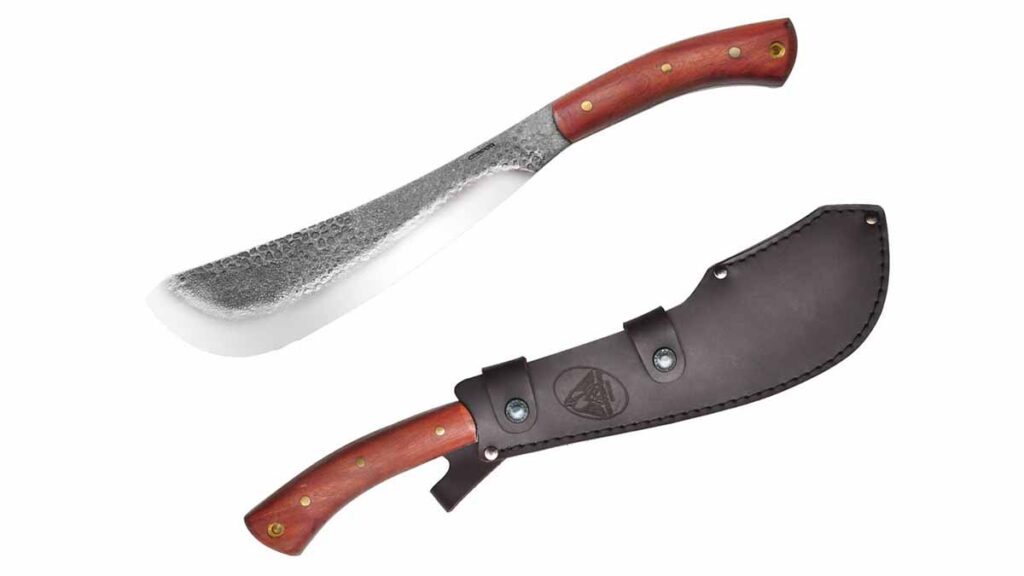
Condor Knife and Tool Pack Golok
The Pack Golok from Condor Tool And Knife is a devastatingly effective chopping tool, with its 11-inch long, convex-ground 1075 carbon-steel blade attached to a rounded walnut wood handle that adds tons of user comfort and control.
The upswept blade profile adds forward weight to the balance, which is key to the performance of this knife. It can take down saplings with ease and slay its way through weedy growth like a machete. It also handles baton work like a champ.
The Pack Golok is much more than just a machete and more useful than one, and it comes with a leather sheath and swivel belt loop for portability.
MSRP: $101
White River Knives’ Firecraft FC3.5 Pro
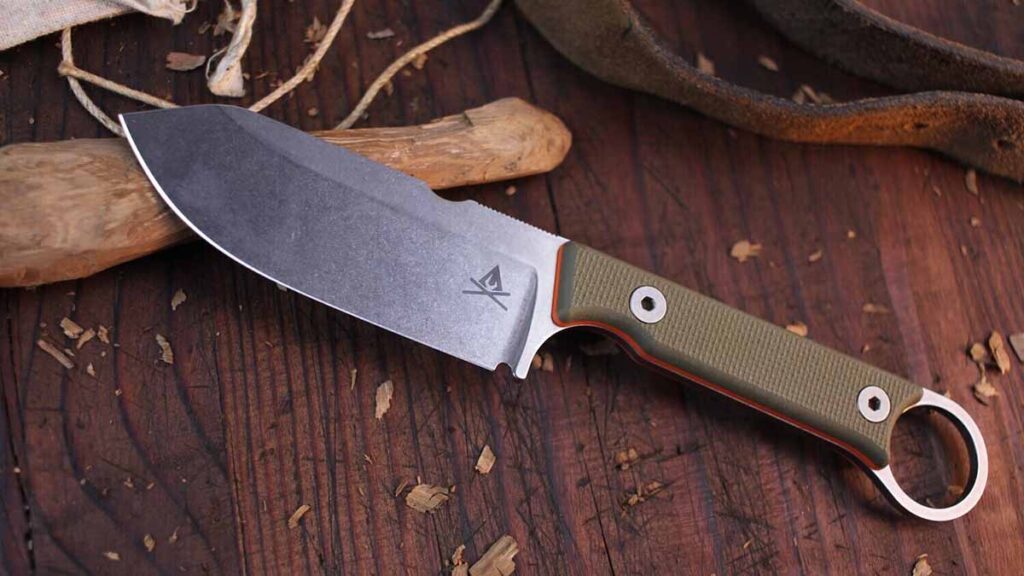
TheFirecraft FC3.5 Pro from White River Knives has a 3.5-inch-long spear point blade ground from high end CPM S35VN stainless steel. The handle is coarse-textured G-10 and comes in a choice of orange, black, or OD green.
Regardless of which handle color you choose, you are getting a no-nonsense fixed blade able to handle a wide variety of tasks at the campsite or out in the wilderness.
The notch in the blade spine allows for easy use with a ferrocerium fire starter rod. The wide blade can handle food prep chores and camp utility tasks. The finger ring allows you to dangle the knife from the pinky finger, keeping it close at hand, while retaining the ability to use your hand to grab or hold items.
The S35VN steel holds an edge well and is able to power through tough cutting. Each knife comes with a molded Kydex belt sheath.
MSRP: $160
RMJ Tactical Combat Africa
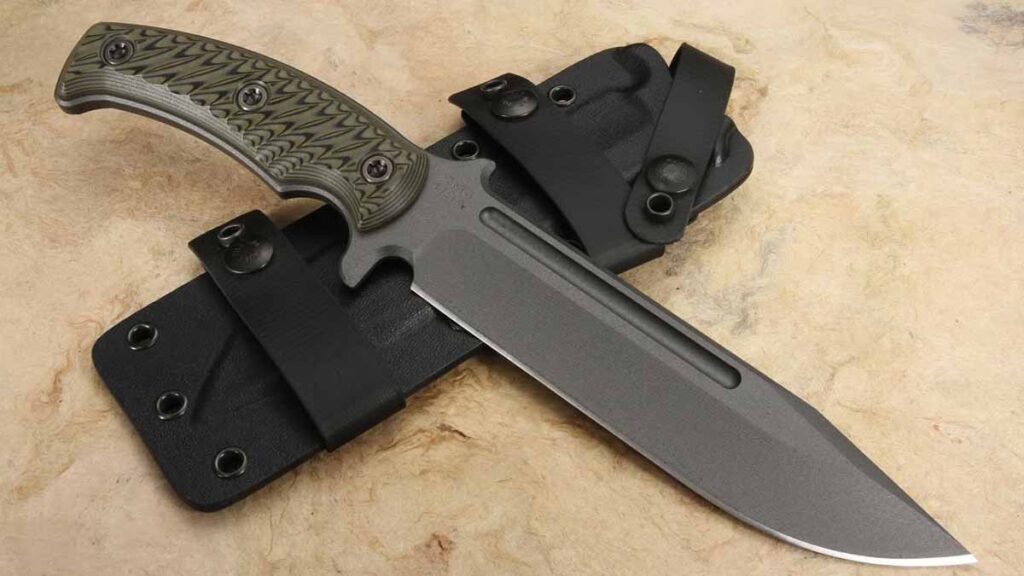
The RMJ Tactical Combat Africa is one serious piece of bladeware that can serve as a survival or military knife. It’s 7-inch-long blade is made from 80CRV2 tool steel. The .25-inch thick stock means this knife can withstand some serious use and some prying as well.
The clip point shape allows for optimal penetration, with some belly for slicing applications. The 3D machined G-10 handle has diagonal flutes, adding hand traction and channeling water away for a comfortable grip.
Furthermore, the lower hand guard and blade spine thumb ramp help to keep your hand safe from sliding forward. The knife is capable of chopping, prying, batoning, and slicing.
The knife is a bit on the steep side when it come to price. But in return you receive the superior engineering and craftsmanship for which RMJ Tactical is known.
MSRP: $395
TOPS Brakimo
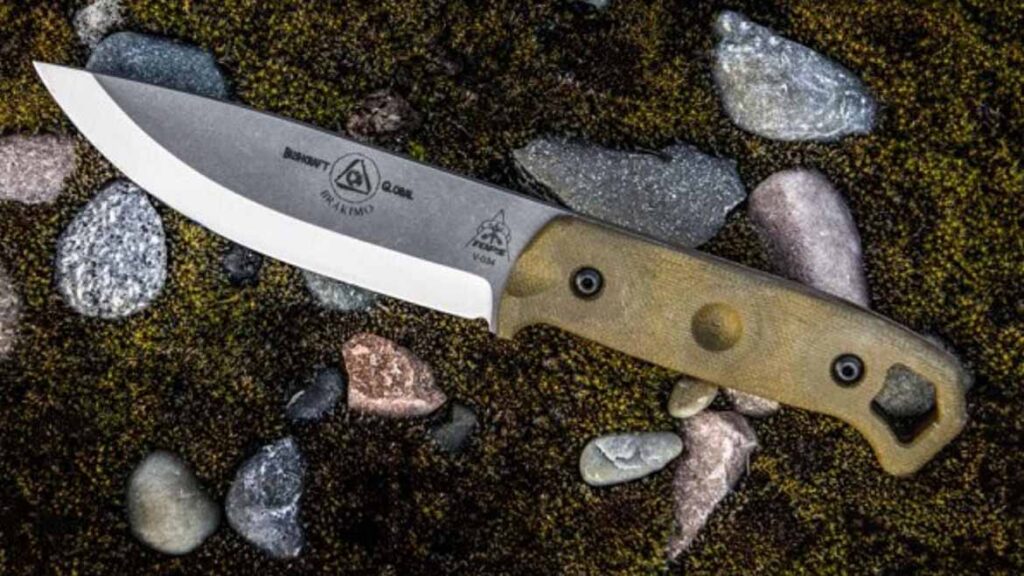
The TOPS Brakimo was designed by noted survival expert Joe Flowers, who owns and runs Bushcraft Global, a renowned survival school.
Flowers designed this knife to be a backup to a machete or a main camp knife. The 5.25-inch drop point blade is made from 1095 carbon steel. It is wide and sports a Scandi grind for optimal edge geometry for camp tasks. As a bonus, the carbon steel is easy to sharpen in the field.
The knife is rather weighty for its size at 9.4 ounces. The sculpted handle is made from OD green canvas micarta for a comfortable and nonslip grip. The handle’s downward turn at the butt allows you to choke up at the end of the handle during chopping. Each Brakimo comes with a molded Kydex belt sheath with large metal clip for easy belt attachment.
The history of cutlery has many different facets but none any more glorified than the fixed-blade knives that have seen battle for centuries. Fixed blades are still a major part of our fighting forces’ need for strong steel and they’ve become more diverse since the modern tactical age began in the early-to-mid 1990s.
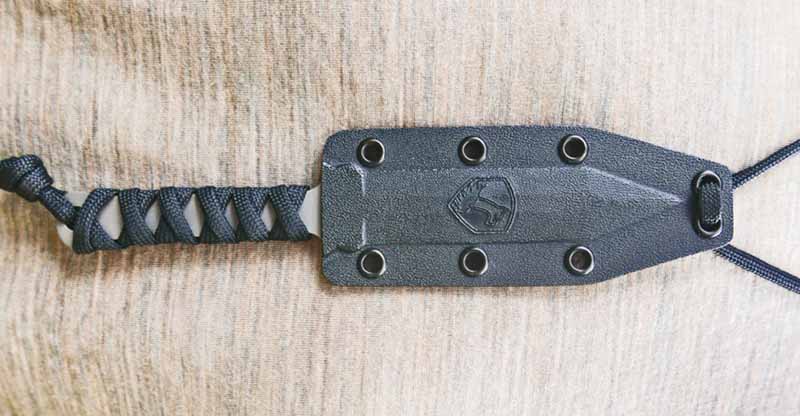
Condor Tool & Knife’s Neck Gladius
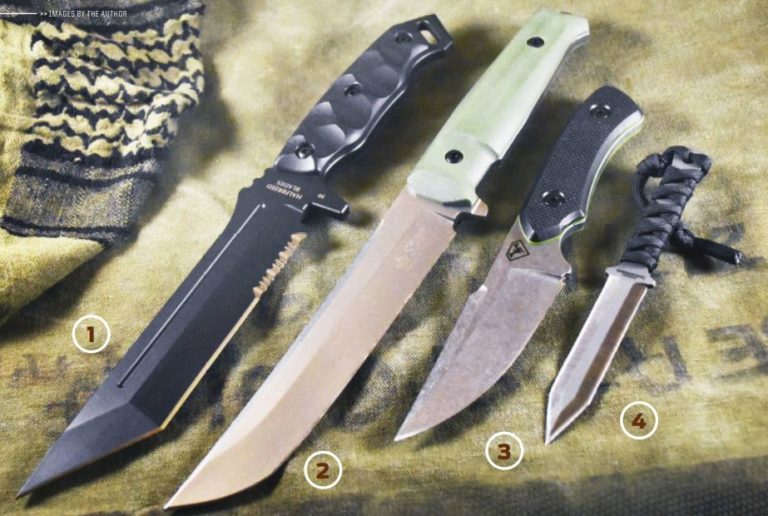
One thing hasn’t changed: such knives must perform duties outside of combat. An example is Condor Tool & Knife’s Neck Gladius, a diminutive version of the classic Roman combat sword. Designed by writer/outdoorsman and BLADE University instructor Joe Flowers, its double-edged blade is handsomely ground in Condor’s favorite blade material: 1075 high carbon steel. The black-paracord-wrapped handle has a tail at the base. A black Kydex neck sheath includes a nice length of paracord for neckwear.
The black Kydex sheath of the Neck Gladius includes a suitable length of paracord for neck wear.
One of the best uses I’ve found for small neck knives is preparing tinder as a firestarter. The neck knife makes for an excellent companion to a larger knife for doing detail work, so I put the Neck Gladius to work doing just that.
Hitting my sweet spot, a pine forest north of town, I used the small blade to dig out some nice chunks of pine resin, which burns nice and long as tinder. I complimented the pine resin with some fine pine shavings to complete the kit. The little Condor will handle other small tasks as well, such as cutting paracord to length. “Handy” is its middle name!
Condor Tool & Knife Neck Gladius Designer: Joe Flowers Blade Length: 3.14″ Blade Material: 1075 high-carbon steel Handle Material: Baracord wrap Weight: 2.12 ozs. Overall Length: 6.06″ Sheath: Kydex with paracord lanyard Country Of Origin: El Salvador MSRP: $54.98
DoubleStar Blades Chico Diablo X
Designed by BLADE® field editor Kim Breed, the Chico Diablo X from DoubleStar Blades is, as you might expect, tough as nails. It is a medium-sized sheath knife with a harpoon-pattern blade. A deep index finger groove extending from the bottom/front of the checkered scales into the tang adds grip when getting down to business. The black Boltaron sheath has a real-deal Tek-Lok for carry options. Weight is a manageable
6.24 ounces.
A deep index finger groove extending from the bottom/front of the checkered scales into the tang of the DoubleStar Chico Diablo X adds grip when getting down to business.
The knife’s size is perfect for medium-duty field tasks such as dressing game, prepping meals, cutting rope and working wood. It’s not heavy enough for chopping but is a serious slicer. I tested the blade across the grain on a 4.5×2.25-inch slab of cold corned beef brisket. Despite the blade being shorter than the chunk of beef, the Nitro-V stainless steel glided through the brisket, taking off one clean quarter-inch slice after another. The Chico Diablo X is a well-built multi-tasker worth every penny of its surprisingly affordable price tag.
Doublestar Blades Chico Diablo X Designer: Kim Breed Blade Length: 3.75″ Blade Material: Nitro-V Stainless Handle Material: Black G-10 with green G-10 liners Weight: 6.24 ozs. Overall Length: 8″ Sheath: Black Boltaron with Tek-Lok attachment Country Of Origin: USA MSRP: $149.99
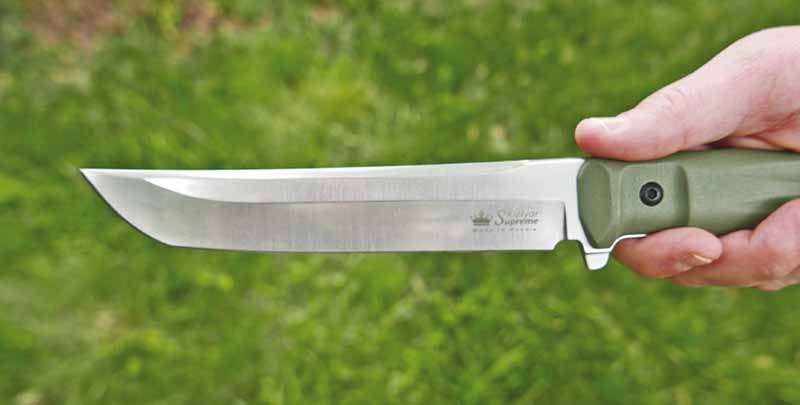
Kizlyar Supreme Senpai
The Kizlyar Supreme Senpai is the longest knife of the test group, including a tanto blade in more of a traditional Japanese curved-tip style. The handle is spare of curves save for a slight finger groove and short guard. The scales are nicely rounded and Kizlyar provides a sandwiched matching green synthetic belt sheath for carry.
The Senpai includes a traditional Japanese tanto blade. The handle has nicely rounded scales spare of curves save for a slight fi nger groove and a short guard. The knife comes with a matching green synthetic belt sheath.
Given its weight and slim blade profile, I liked the Supreme Senpai for slicing and shaving from a utility standpoint. I roughed out a seasoned hardwood tent peg using a small hatchet, and tested the blade at finetuning the pointed tip and shaving the sides. The long blade came in handy as I could pull it through while slicing and shaving rather than simply pushing it downward against the tough hardwood—my reasoning being, if it could handle stout wood, simpler chores like meal prep and cutting rope would be a snap. The Supreme Senpai blade performed well shaping the challenging wood, leaving no doubt it could be handy around camp.
Kizlyar Supreme Senpai Blade Length: 6.75″ Blade Material: AUS-8 stainless Handle Material: OD green Kraton/ABS plastic Weight: 10.3″ Overall Length: 12″ Sheath: Polyamide Nylon Country Of Origin: Russia MSRP: $150
Halfbreed Blades Medium Infantry Knife
How brutish is the Aussie-made Halfbreed Blades Medium Infantry Knife? Consider this—it’s around just one ounce shy of the other three test knives combined in weight! The blade is a whopping .23-inch thick at its thickest, features 1.5 inches of serrations from the tang forward, and has a black, rust-resistant Tefl on coating. The ample handle scales are “chunked” black G-10 and there’s a wicked skull crusher. The sheath has rear attachments for MOLLE (Modular Lightweight Load-carrying
Equipment) or belt carry.
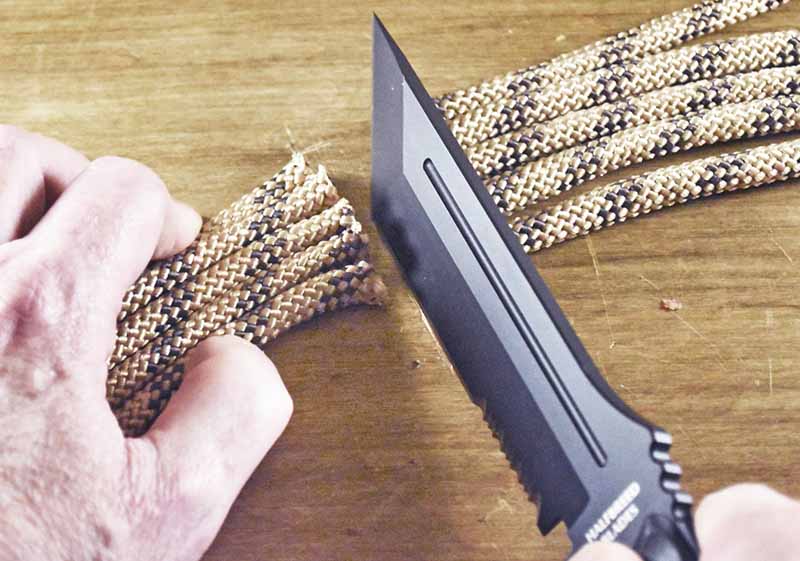
The Halfbreed Medium Infantry Knife incorporates brutish .23-inch blade steel. The author pulled it through five lengths of 3/8-inch rappelling rope in one clean slice using the forward plain edge portion of the blade.
This overbuilt brute is a handful capable of chopping, slicing and shaving. Given its near three-quarter-pound weight it will no doubt chop, but the serrations somewhat limit the chopping ability of the blade’s plain edge portion. (Serrated edges will chop but it’s hard on them, and resharpening the teeth is a royal pain.)
I tested the knife at slicing and started with lengths of ⅜ -inch synthetic rappelling rope. Working my way up, I was able to slice cleanly through five lengths of the rope side-by-side before I ran out of rope. The handle offered superb grip throughout the testing process. The Halfbreed entry has the ability to perform heavy-duty camp chores like
shelter building, chopping branches for firewood and shaving wood.
Halfbreed Blades Medium Infantry Knife Blade Length: 6.69″ Blade Material: Bohler K110 D2 Handle Material: Black G-10 Weight: 17.08 ozs. Overall Length: 11.77″ Sheath: Black Kydex Country Of Origin: Australia MSRP: $335