Autumn is here and, unlike the weather, knifemakers show no signs of cooling down. If anything, factory and custom makers are as hot as ever with a ton of new knives hitting the market. We picked out 12 great-looking recent drops certain to carve a place into your heart.
Jess Hoffman Donegal
Knife pattern: Skinner Blade length: 4” Blade steel: AEB-L stainless Blade grind: Full flat Handle material: Camel bone Overall length: 8.25” Sheath: Leather Maker’s price for a similar knife and sheath: $230 Maker’s remarks: “My Donegal is a cross between a Nessmuk and a Canadian belt knife. It’s available in three different overall sizes: 8.25, 6.75 and 5.75 inches.” Maker: Jess Hoffman, jhoffmanknives.com (Jocelyn Frasier image)
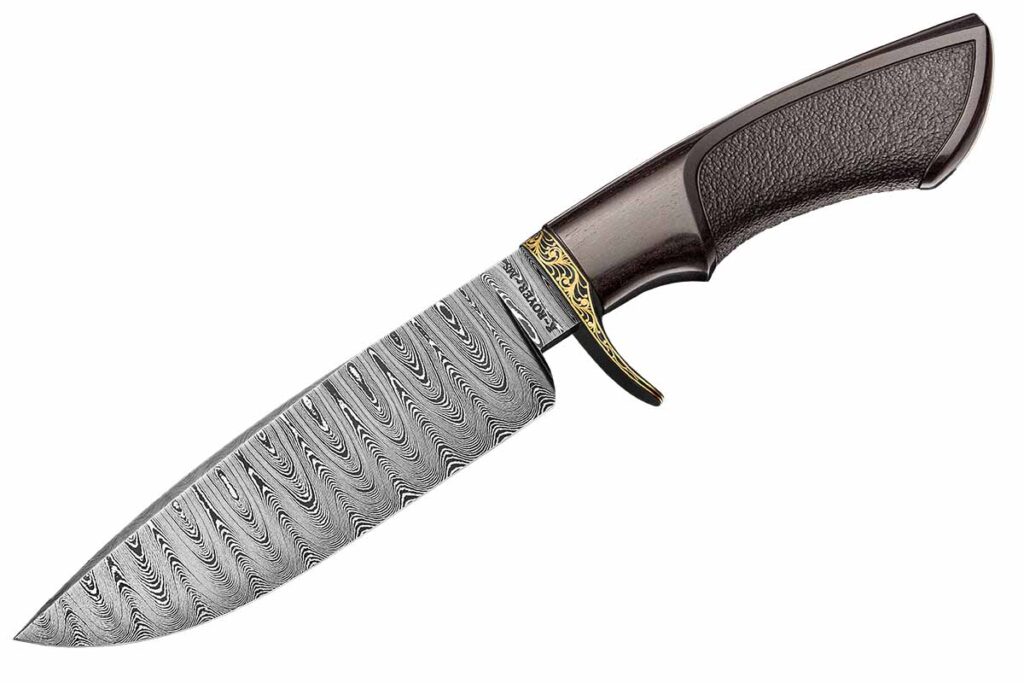
Kyle Royer Damascene Hunter
Knife type: Fixed blade Blade length: 5” Blade material: Ladder-pattern damascus of 1084 carbon and 15N20 nickel-alloy steels Blade grind: Flat w/convex edge Handle: Sculpted blackwood w/texturing Bolster: Damascene-covered guard w/24k gold and gun bluing Overall length: 9.25” Maker’s price for a similar knife: $9,500 Maker’s remarks: “This piece is particularly special as it’s the first gold overlay I’ve done using hundreds of tiny 24k-gold wires. Additionally, it has a beautifully textured blackwood handle.” Maker: Kyle Royer, kyleroyerknives.com (Jocelyn Frasier image)
Bear & Son Cutlery Farmhand
Blade length: 3 5/8” Blade steel: 440 stainless Blade pattern: Drop point Blade opener: Nail nick Handle material: Aluminum, bone and rosewood (shown) options Pocket clip: Yes Lock: Lockback Weight: 1.1 ozs. Closed length: 2.75” Knife to know: Handle color options include black, blue, orange, purple, red and white smooth bone, and brown rosewood Country of origin: USA MSRP: $37.49 to $51.99 Company: Bear & Son Cutlery, www.bearandsoncutlery.com
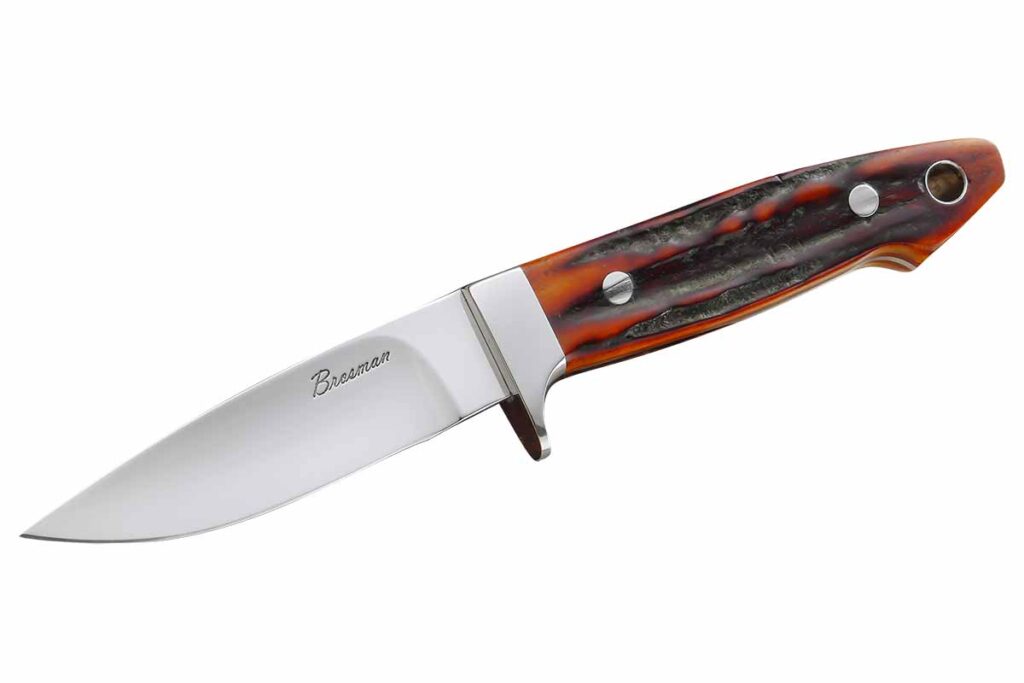
Craig Brosman Hunter
Blade length: 2.75” Blade steel: RWL 34 stainless Blade grind: Hollow Blade pattern: Drop point Blade finish: Mirror polished Handle material: European red stag and Westinghouse Micarta® liners; w/hole for lanyard Construction: Tapered tang Bolster/guard: 416 stainless Overall length: 6 9/16” Sheath: Leather pouch w/clip by Aaron Sybrant Maker’s price for a similar knife & sheath: $550 Maker: Craig Brosman, (SharpByCoop image)
Billy Pearce Hunter
Blade length: 5.1” Blade material: 1075 carbon steel Blade grind: “V” Blade thickness @ricasso: .177” Blade @widest: 1.18” Blade pattern: Clip point Handle: Bocote wood Spacer: G-10 Guard & pin: 416 stainless steel Overall length: 9.64” Knife to know: Billy Pearce is an apprentice smith in the American Bladesmith Society Maker’s price for a similar knife: Contact maker for info Maker: Billy Pearce, (Rod Hoare image)
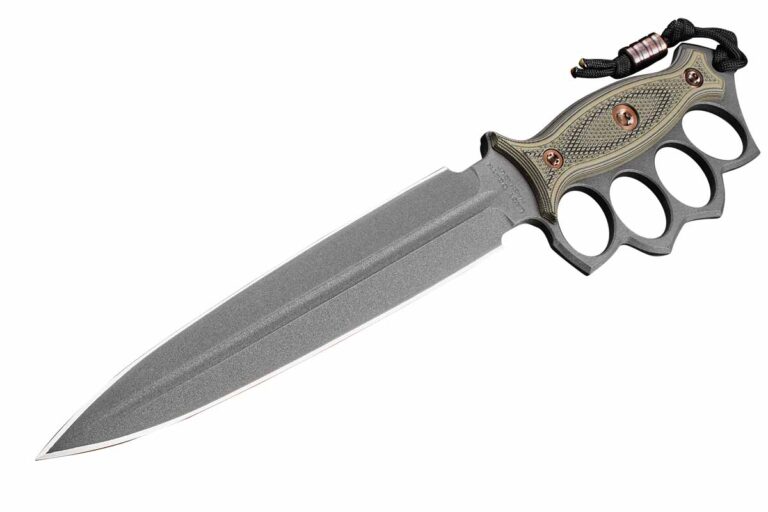
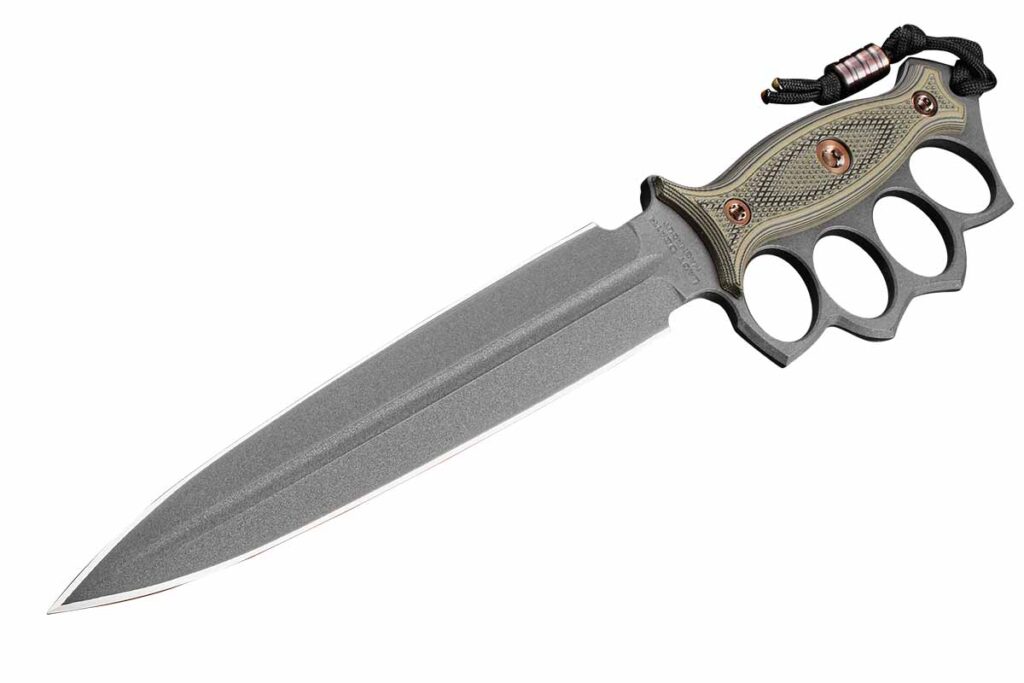
RMJ Tactical Lady Death
Knife pattern: Classic trench knife Blade length: 9 5/8” Blade material: CPM 3V carbon steel Rockwell hardness: 60-61 HRC Blade @thickest: 3/16” Blade finish: Cobalt Cerakote® Handle: Checkered Dirty Olive G-10 Handle hardware: Grade 5 titanium anodized bronze Weight: 18.3 ozs. Overall length: 15” Sheath: Brown leather w/green canvas inlay; ambidextrous and wears on a belt or attached to PALS webbing Knife to know: Double-edged blade w/long fuller; knuckle-duster-style handle; pommel pronounced for use as a hammer Country of origin: USA MSRP: $975 Company: RMJ Tactical, www.rmjtactical.com
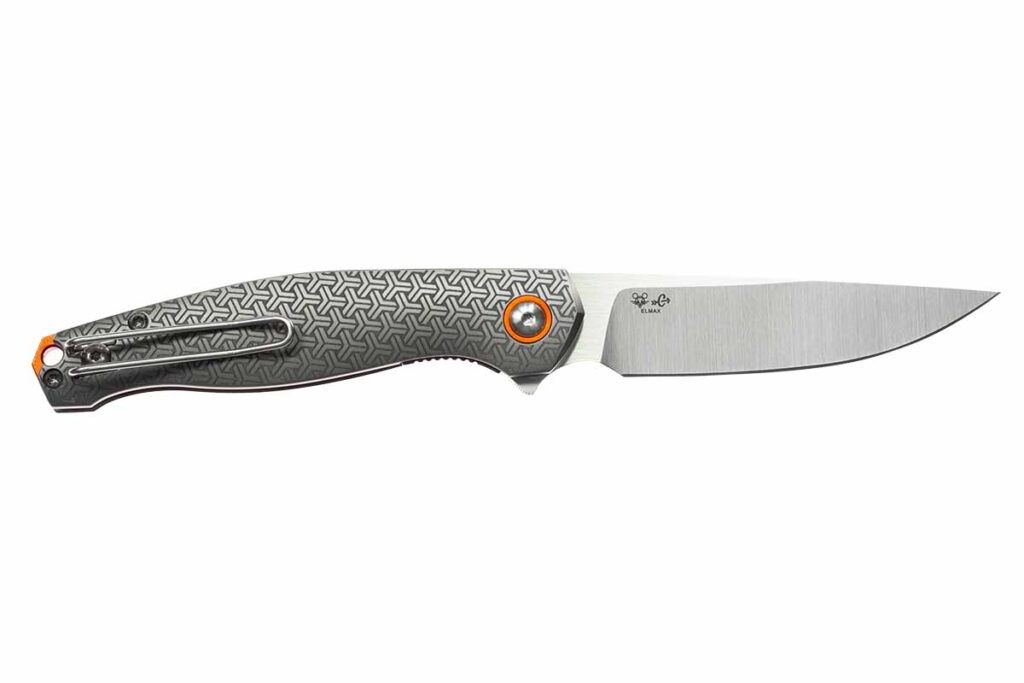
GiantMouse Carryology Sonoma V2 Auxikko
Knife type: EDC folder Blade length: 3.425” Blade steel: Elmax stainless Rockwell hardness: 60 HRC Blade @thickest: .138” Blade finish: Satin Lock: Linerlock Pivot hardware: Ball bearings Handle material: Titanium laser engraved w/the Carryology Auxikko pattern Backspacer: Aluminum anodized orange w/built-in hole for a lanyard Pocket clip: Wire, deep carry, reversible Weight: 3.8 ozs. Closed length: 4.5” Knife to know: Limited edition of 400 numbered pieces Country of origin: Made by Reate in China MSRP: $295 Company: GiantMouse, giantmouse.com
Gary Martindale Loveless Chute Knife Repro
Blade length: 4.25” Blade steel: CPM 154 stainless Blade grind: Hollow Handle: Amber stag Bolster/crossguard: 416 stainless Overall length: 9” Sheath: Basketweave-leather belt pouch w/snap Maker’s price for a similar knife: Contact maker for info Maker: Gary Martindale, (SharpByCoop image)
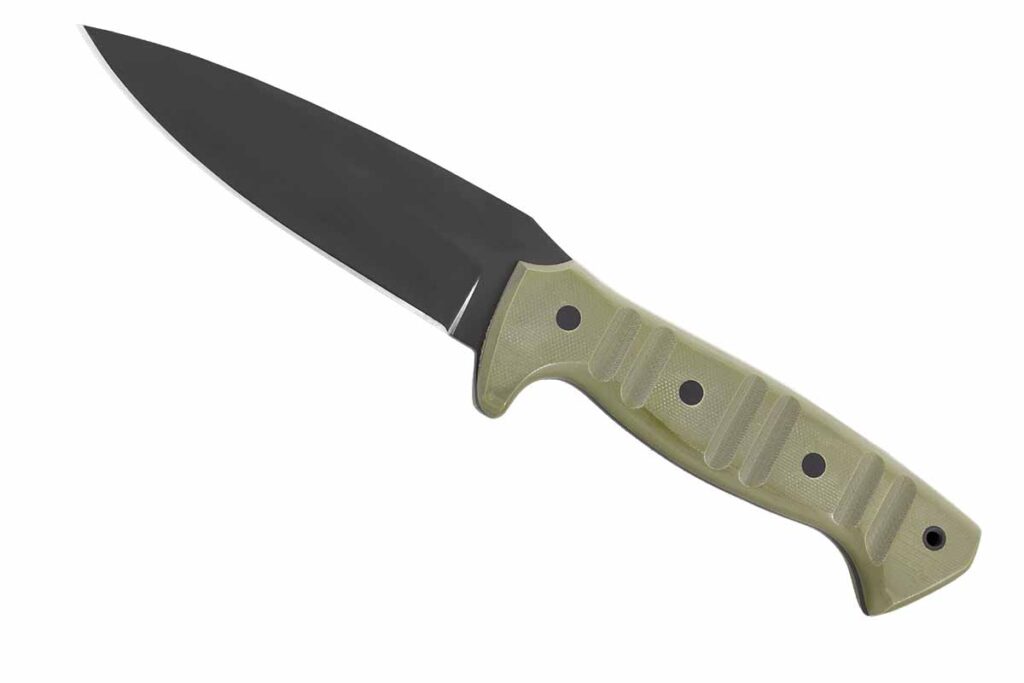
Grimdog Blades Australia Draugr Mk III
Knife type: Military utility Blade length: 4.9” Blade material: Thyssenkrupp 80CrV2 carbon steel Blade grind: Flat sabre Blade thickness @ricasso: .138” Blade finish: Cerakote® H190 Armour Black Handle material: Olive green G-10 Overall length: 10.47” Maker’s price for a similar knife: Contact maker for info Knife to know: Christian Holm is a member of the Australian Knifemakers Guild Maker: Grimdog Blades Australia, (Rod Hoare image)
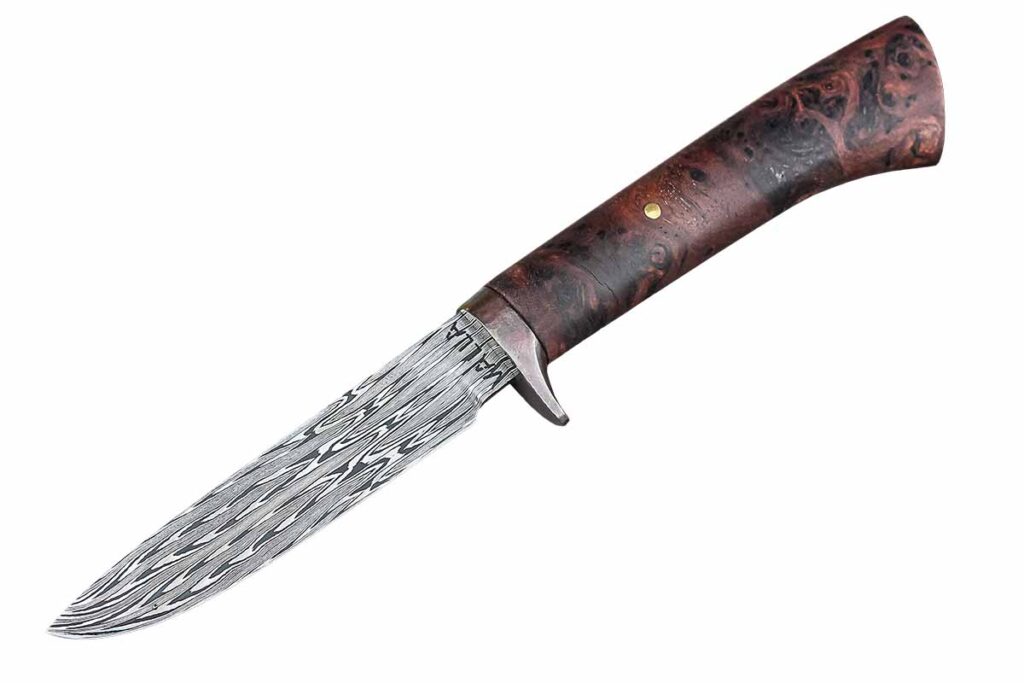
Liam Walle Bird & Trout
Knife type: Fixed blade Blade length: 3.6” Blade materials: Crushed W’s damascus of 1084 carbon and 15N20 nickel-alloy steels Blade grind: Flat Handle: Pōhutakawa wood w/domed brass pin Guard/bolster: Antiqued bronze Overall length: 7.6” Maker’s price for a similar knife: $750 at press-time exchange rate Maker: Liam Walle, liamvallaknives.com (Jocelyn Frasier image)
Cold Steel Full Metal Atlas
Knife type: EDC folder Blade length: 3.5” Blade steel: CPM S35VN stainless Blade grind: High saber Blade pattern: Drop point Blade opener: Thumb stud Lock: Atlas® Lock Handle: Textured titanium Weight: 3.8 ozs. Closed length: 5 7/8” Knife to know: Knife comes in all-black (shown) or standard stonewashed finishes; handle includes a single finger groove w/integral guard Country of origin: Taiwan MSRP: $229.99 Company: Cold Steel, www.coldsteel.com
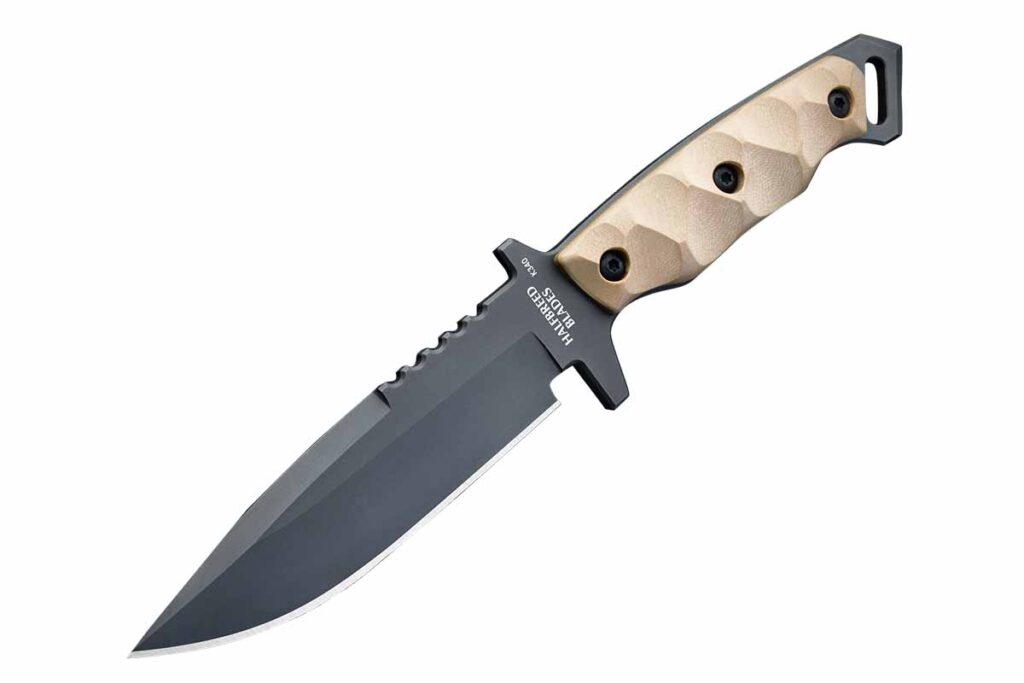
Halfbreed Blades MIK-03P Gen-2 K340
Knife type: Fixed blade Blade length: 5.31” Blade steel: K340 ISODUR Rockwell hardness: 59-60 HRC Blade @thickest: .25” Blade pattern: Modified drop point Blade finish: PVD coated Construction: One-piece full tang Handle: G-10 Weight: 11.14 ozs. Overall length: 10.43” Sheath: Injection-molded plastic w/belt & PALS/MOLLE mounting Knife to know: MIK stands for Medium Infantry Knife MSRP: $212 at press-time exchange rate Company: Halfbreed Blades, halfbreedblades.com.au
The Poros by Spartan Blades is a great feeling folder. The flipper design is spot-on for hand placement.
Company co-founders Curtis Iovito and Mark Carey are excellent to work with and built Spartan from scratch. Both are retired from Special Forces and have a lot of pride in workmanship. The Poros is their field-grade-version linerlock. It might not have the fancy material and looks but the performance is top shelf.
Poros Light Cutting Duties
Initial slicing of 20-pound copy paper was excellent. The Poros was very smooth and aggressive. The blade shape really helped slicing paper, especially when I employed a roll cut. The flat-ground blade sliced straight with no curling of the paper.
The 154CM stainless steel blade was exceptionally aggressive in the 8-ounce leather slice.
The Poros easily devoured single-walled cardboard. As with the copy paper, the blade sliced it both forcefully and effortlessly, resulting in nice, straight cuts. The slices were extremely quick with no resistance felt.
The folder was quite aggressive again in the 8-ounce leather slice. It was very easy to control the thickness of the skiving—I just needed to move my fingers faster. I had two fingernail nicks after the skiving. The edge remained sharp.
Poros Medium Cutting Duties
It was time to do a fire stick. The flat grind produced excellent curlicues. It sliced the wood incredibly fast and I had to slow down for more control to keep the curlicues on the stick. The handle was comfortable while making the deeper cuts. It was awfully simple to whittle with the knife.
The flat grind produced excellent curlicues. It sliced the wood awfully fast and the author had to slow down for more control to keep the curlicues on the stick.
For the next exercise I used 1-inch manila rope. The Poros crunched to 197 cuts before I ran out of rope. The edge was still good. The handle was very comfortable during heavy use. There were no issues with the blade lock. Nicely done, Spartan.
Poros Heavy Cutting Duties
I split kindling into smaller pieces to check lockup by doing baton work. There continued to be no issues with lockup or edge retention. The knife can handle a beating for sure. It’s not that I recommend baton work with a folder but if you have to it can be done with the Poros.
The author split kindling into smaller pieces to check lockup via some baton work. There were no issues with lockup or edge retention.
To push the knife a bit further, I grabbed my trusty whitetail deer antler. After 30 hard whacks on it, the edge was still sharp with no rolling or chips, indicating spot-on heat treatment.
The last test was back to the copy paper slice. The Poros continued cutting smoothly and my arm was tired. Outstanding job, guys!
Final Cut
The Poros folder is worthy of riding in anyone’s pocket. It’s well designed, sharp and easy on—and comfortable in—the hand. I really don’t know what I’d change on this one, though I would love to see an A-2 tool steel version.
Poros Specs Maker: Spartan Blades Knife type: Flipper folder Blade length: 3 7/8” Blade steel: 154CM stainless Rockwell hardness: 58-60 HRC Blade finish: Black PVD Handle: Carbon-fiber-patterned G-10 Lock: Linerlock Closed length: 5 1/8” Country of origin: USA MSRP: $190
In the conclusion, consider the balance of the BLADE Show’s factory knife debuts
It’s hard to believe it’s been almost three months since BLADE Show 2024 blew the doors off the Cobb Galleria Centre in Atlanta. With all the commotion and introductions of new knives, even if you were there you couldn’t help but miss many.
Previously we featured some of the factory knives that debuted in the Cobb but, as those of you who were paying attention know, we didn’t have enough room for the balance of the few we were able to assemble. Ergo, the conclusion this time. We think you will enjoy them all. As for the many we are unable to publish in this two-part story due to space and other limitations, stay tuned to future issues of BLADE® for a goodly number of them.
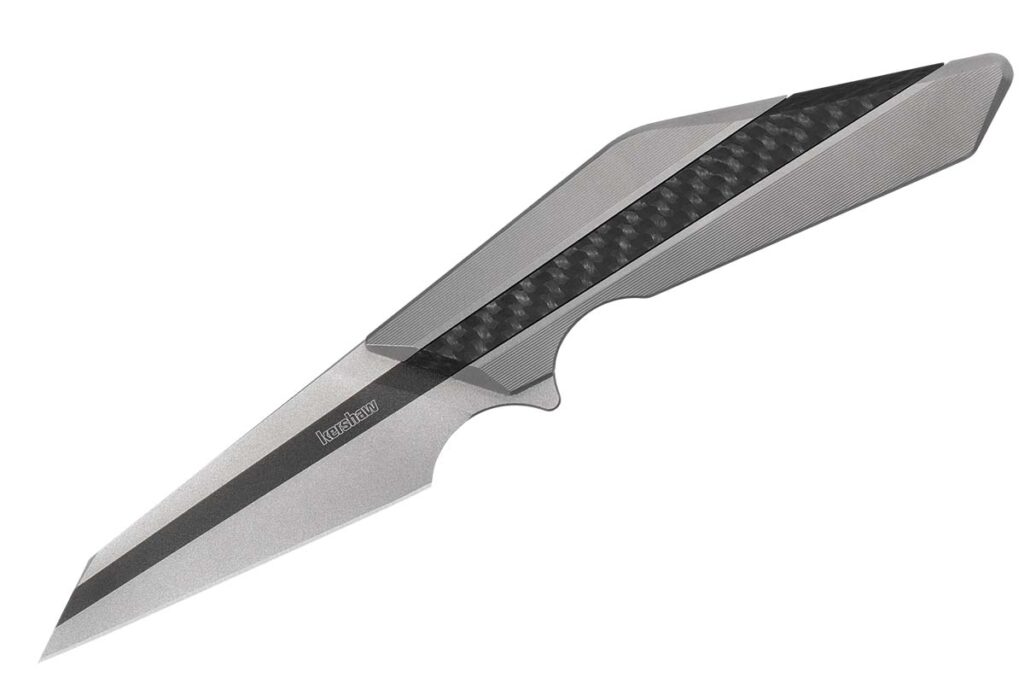
Kershaw Tilt 50th Anniversary
Knife type: Folder Blade length: 3.65” Blade steel: CPM CruWear, 14C28N Rockwell hardness: 60-62 HRC Blade grind: Flat Blade @ thickest: .156” Blade pattern: Composite Blade finish: Bead-blasted Blade opener: Flipper tab Handle material: Titanium Lock: Sub-Frame Pivot materials: KVT ball-bearings Pocket clip material: Titanium Weight: 5.7 ozs. Closed length: 5.8” Knife to know: Carbon fiber inlay front and bank; hidden hardware Country of origin: USA MSRP: $500 Available: NOW
A.G. Russell Knives Premium Scout
Model type: Traditional slipjoint pocketknife Designer: A.G. Russell Main blade length: 2 5/8” Blade steel: VG-10 stainless Rockwell hardness: 59-61 HRC Blade grind: Flat Blade @ thickest: .09” Blade pattern: Spear point Blade finish: Satin Blade opener: Nail nick Handle material options: Stag and red saw-cut bone Weight: 3.5-3.7 ozs. Closed length: 3 3/4” Special features: Can opener, screwdriver, caplifter & leather punch Country of origin: China MSRP: $74.95-$94.95 Available: NOW
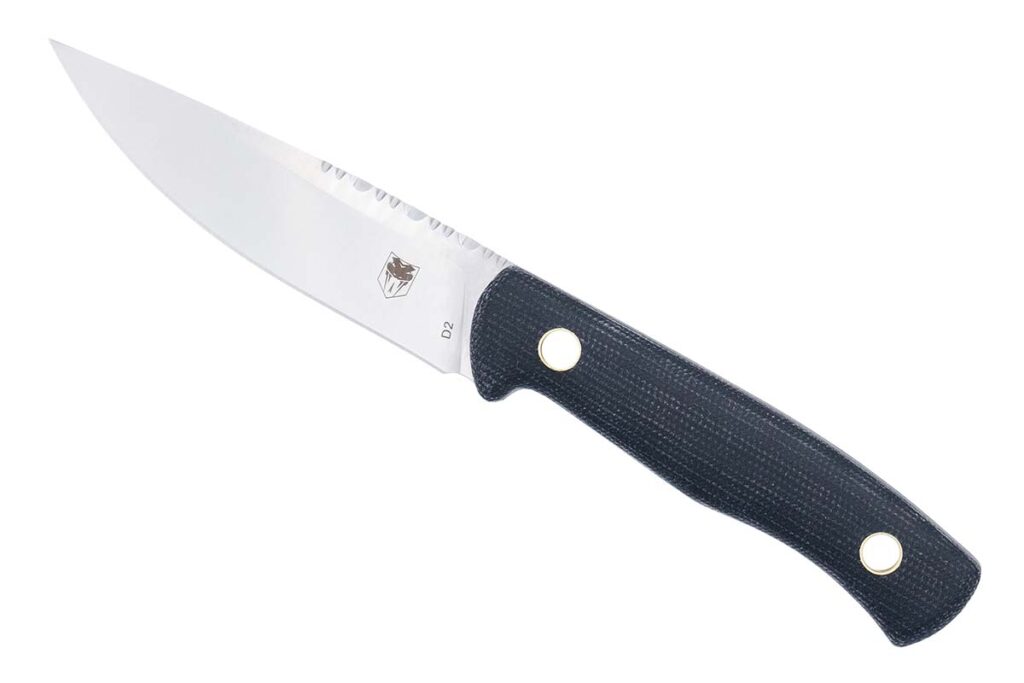
CobraTec Koonsman
Knife type: Fixed-blade hunter Designer: Chad Cochran Blade length: 4” Blade material: D2 tool steel Rockwell hardness: 61 HRC Blade grind: Convex Blade @ widest: 1.125” Blade pattern: Drop point Blade finish: Satin Construction: Full Tang Handle material: Micarta® in color options of black, green and tan Weight: 5.7 ozs. Overall length: 8.4375” Sheath type and materials: Belt/pouch and leather Country of origin: China MSRP: $79.99 Available: NOW
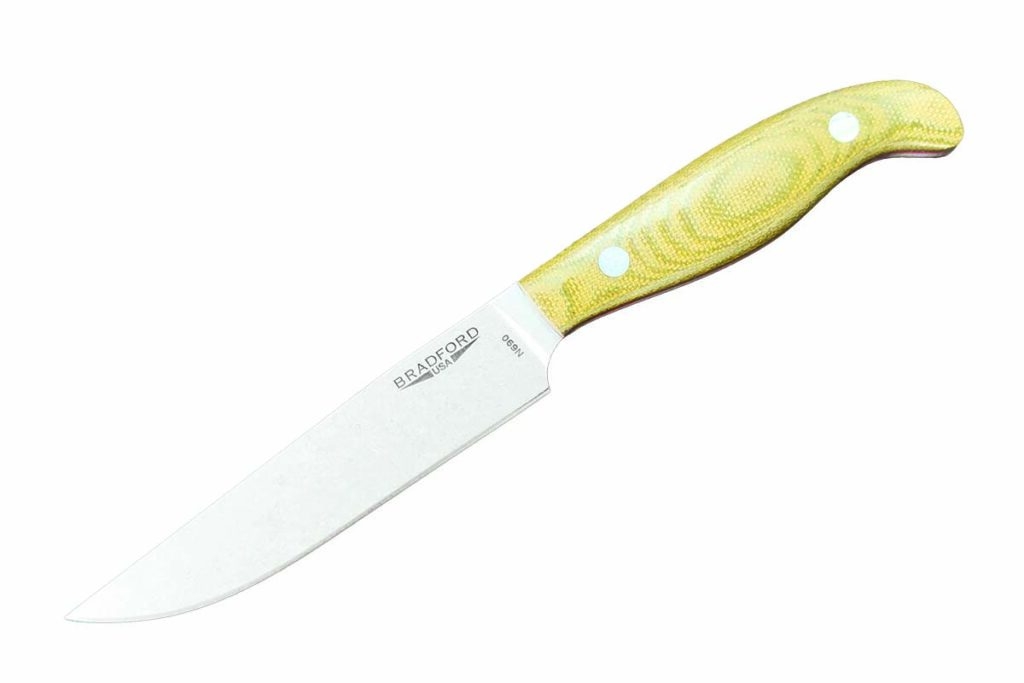
Bradford USA Gatsby
Knife type: Specialty steak knife Blade length: 4.5” Blade steel: N690 stainless Rockwell hardness: 61 HRC Blade grind: Full height flat Blade @ thickest: .11” Blade finish options: Stonewash and high polish Handle material options: Maroon, wheat, ivory canvas Micarta® and carbon fiber Overall length: 8.5” Country of origin: USA MSRP: $199 Available: NOW
Spyderco Techno 3
Knife type: Folder Designer: Marcin Slysz Blade length: 2.64” Blade steel: CTS XHP stainless Blade grind: High flat Blade @ thickest: .127” Blade pattern: Drop point Blade finish: Satin Blade opener: Flipper Handle material: Titanium Lock: Reeve Integral Lock (R.I.L.) Pivot material: Ball bearings Pocket clip material and type: Titanium, right-handed, tip-up Weight: 3.3 ozs. Closed length: 3.7” Country of origin: Italy MSRP: $400 Available: To be announced
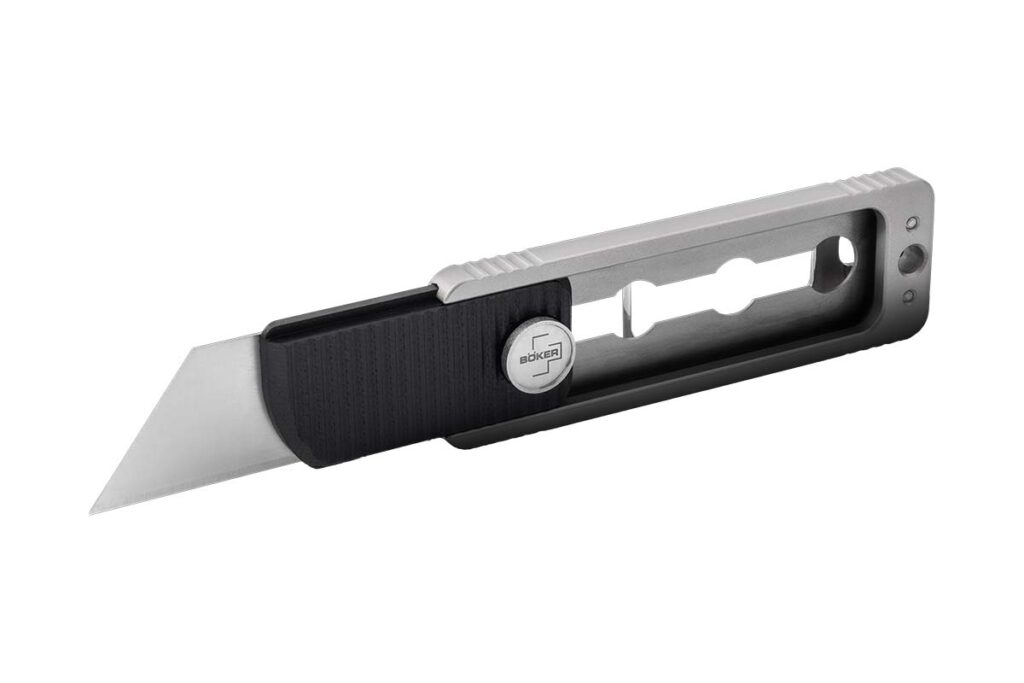
Boker Plus Cutweazle
Knife type: Utility Designer: Ben Logan/Turnback Knife Co. Blade length: 1.18” Blade steel: Standard replaceable stainless utility blade Blade grind: Flat Blade @ thickest: .03” Blade finish: Satin Handle material: G-10/stainless steel Lock: Button lock Blade opener: Thumb slide Pocket clip material and type: Stainless steel, deep carry, right-handed, tip-down Weight: 1.38 ozs. Closed length: 3.7” Special features: Push button on slide lock allows the blade to be pushed forward in stages or in a single movement and locked in the predetermined recesses; retracts into the handle when pushed again w/a sliding movement Country of origin: China MSRP: $56.95 Available: September 2024
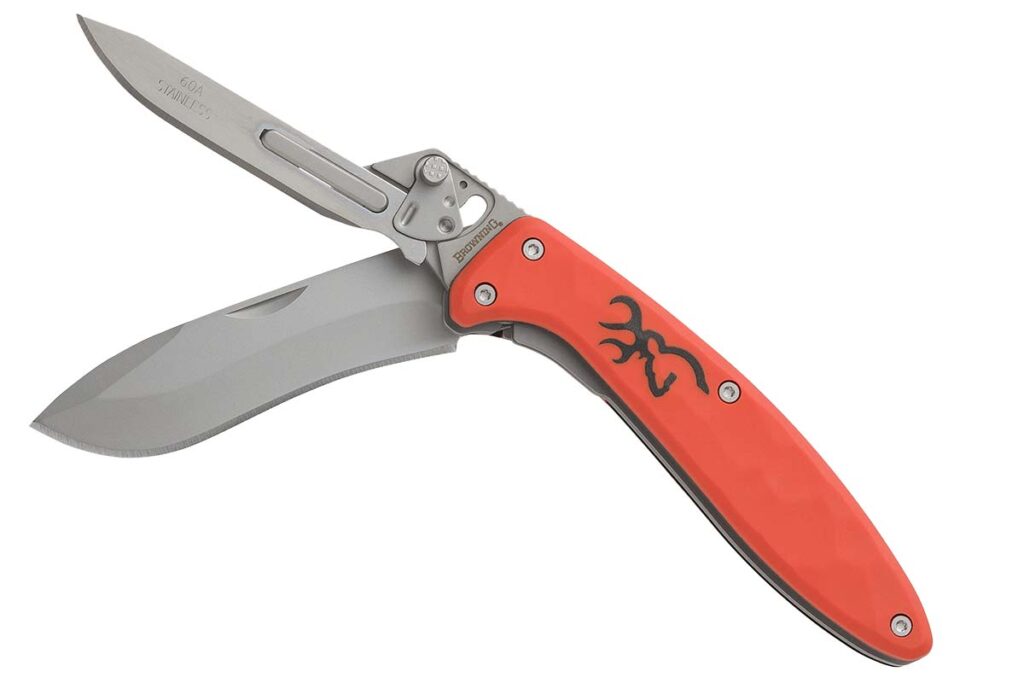
Browning Primal Scalpel 2-Blade
Main blade length: 2.75” Blade steel: 420-J2 stainless Rockwell hardness: Scalpel 50-55 HRC, drop point 55-59 HRC Blade openers: Thumb stud and nail nick Lock: Linerlock Handle: Synthetic in orange or black Pocket clip: Tip-up Closed length: 4 1/8” Country of origin: China MSRP: $59.99 Available: NOW
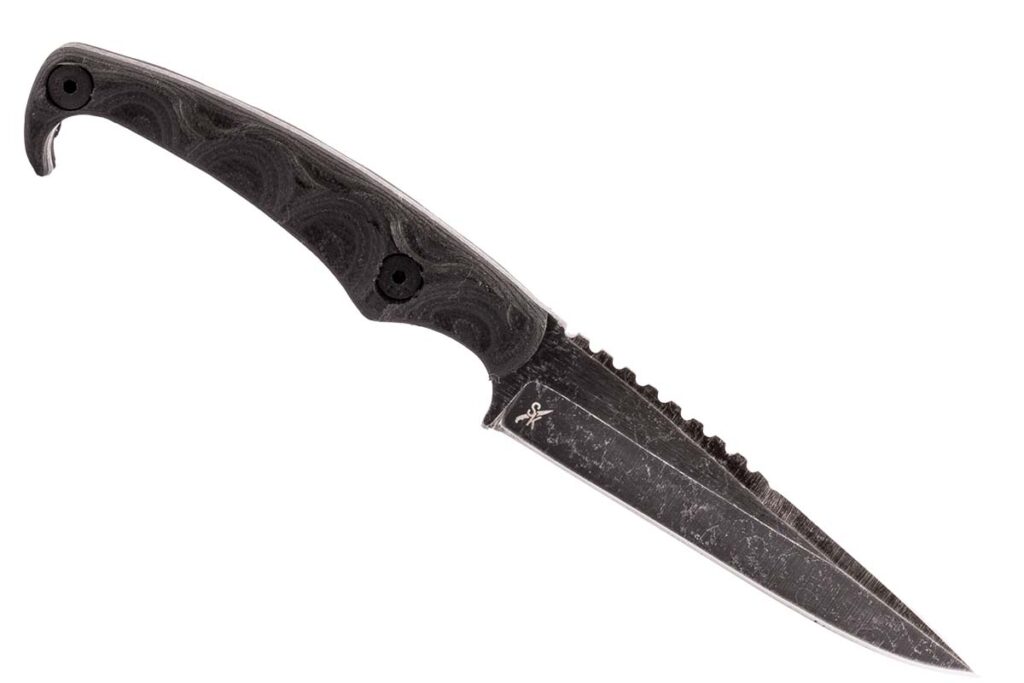
Stroup Knives MK2
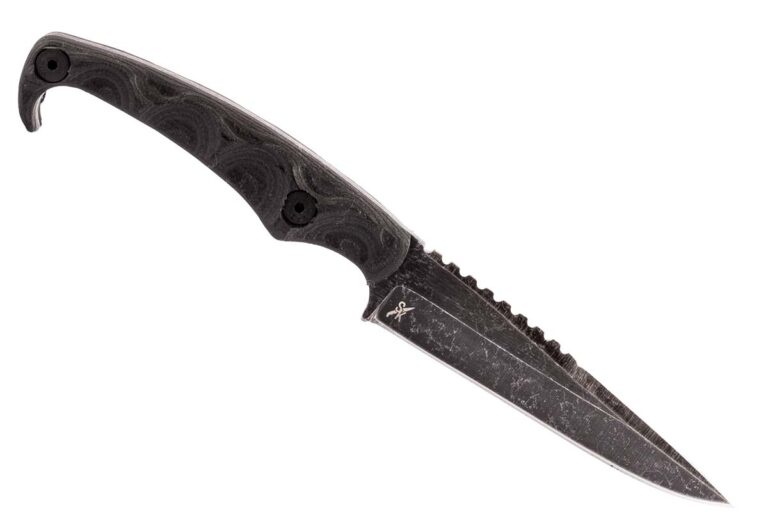
Knife type: Fixed blade Designer: Unnamed active-duty Tier 1 Operator Blade length: 4” Blade material: 1095 carbon steel Rockwell hardness: 58 HRC Blade grind: Flat Blade @ thickest: 3/16” Blade pattern: Spear point Blade finish: Acid etched & rock tumbled Construction: Full Tang Handle material: G10 & nitrile Pocket clip: Designed by Discreet Carry Concepts, Inc. Weight: 4.2 ozs. Overall length: 8” Sheath material: Kydex Knife to know: The nitrile in the handle provides extra grip, especially when wet Country of origin: USA MSRP: $279.99 Available: NOW
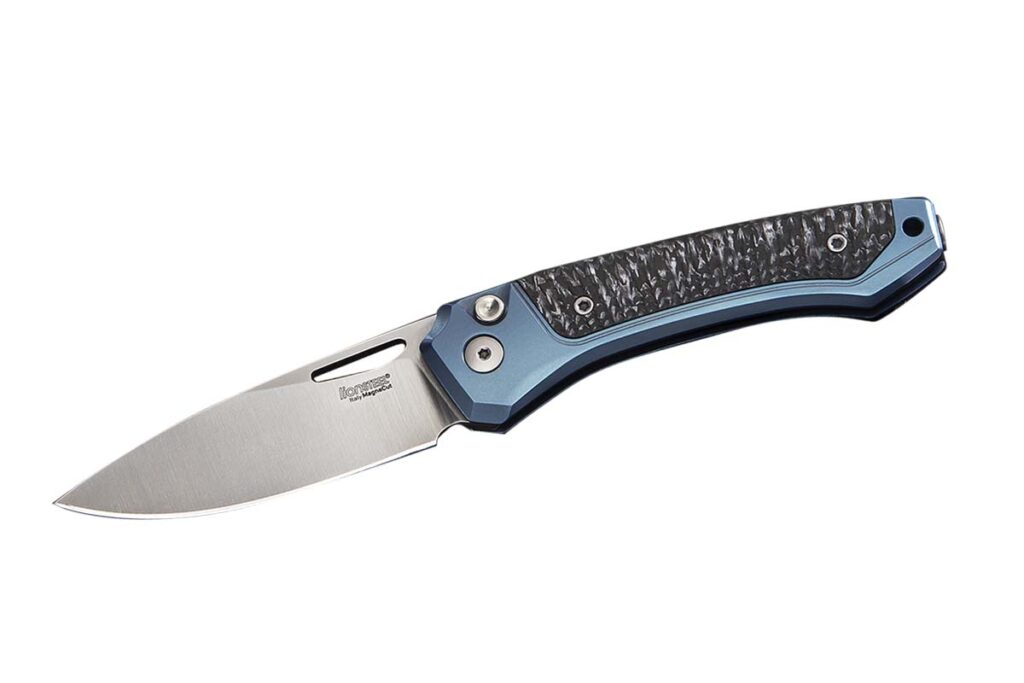
Lionsteel Twain
Model type: EDC folder Blade length: 3.15” Blade steel: CPM MagnaCut stainless Blade grind: Flat Handle material: Titanium + carbon fiber or Micarta® Lock: Button lock Pocket clip type and material: Bent steel Special features: Double Solid construction (integral frame and integral handle) Weight: 3.03 ozs. Closed length: 4.14” Country of origin: Italy MSRP: $380 Available: NOW
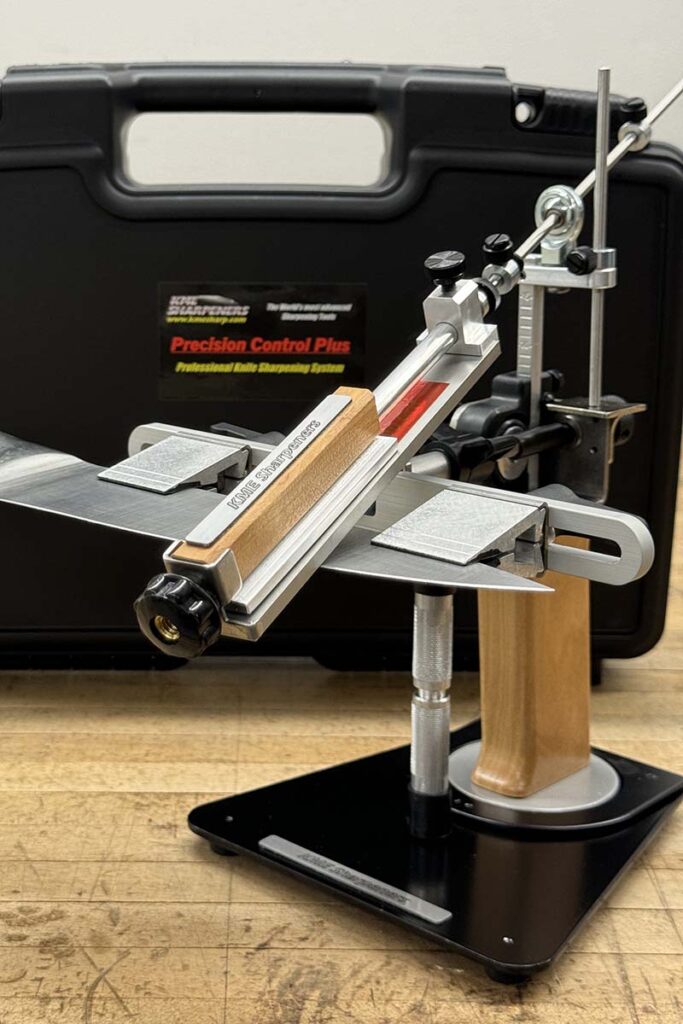
KME Precision Control Plus/Professional Knife Sharpening System
Abrasive type: Diamond-coated stones Grit assortment: 140, 300, 600, 1,500 Dimensions: 13” x 12” x 8” Construction materials: CNC-machined, anodized aluminum components, laser-cut, powder-coated steel base, CNC cherry hardwood grip, stainless-steel-backed diamond stones Weight: 2 lbs., 13.9 ozs. Blade sizes sharpened: Maximum-blade-thickness saber grind 3/8” or more and full flat grind 3/16” Angle range: 10 to 45 degrees per side Special features: Smooth friction-drive angle system w/micro adjustment feature; operates w/one hand and absolute angle control; rod end guide w/360° rotation; threaded Monopod brace provides rock-solid sharpening platform; adjustable stone carrier w/magnetic plate for angle cube sharpening uses any stone between 4” and 6”; full line of accessory stones, strops and diamond lapping films in both 4” and 6” lengths Country of origin: USA MSRP: $474.95 Available: NOW
CIVIVI Biophase
Knife type: Folder Blade length: 3.48” Blade steel: Nitro-V stainless Rockwell hardness: 58-60 HRC Blade grind: Hollow Blade @ thickest: .12” Blade finish: Black stonewash (satin finish and black stonewash w/satin flat and damascus are optional) Handle material: Aluminum & G-10 Lock: Button lock Blade opener: Flipper tab Pivot materials: Stainless steel pivot w/caged ceramic ball bearings Pocket clip material and type: Stainless steel, tip-up, ambidextrous Weight: 2.61 ozs. Closed length: 4.67” Country of origin: China MSRP: $98.70 at press-time exchange rate Available: Late summer
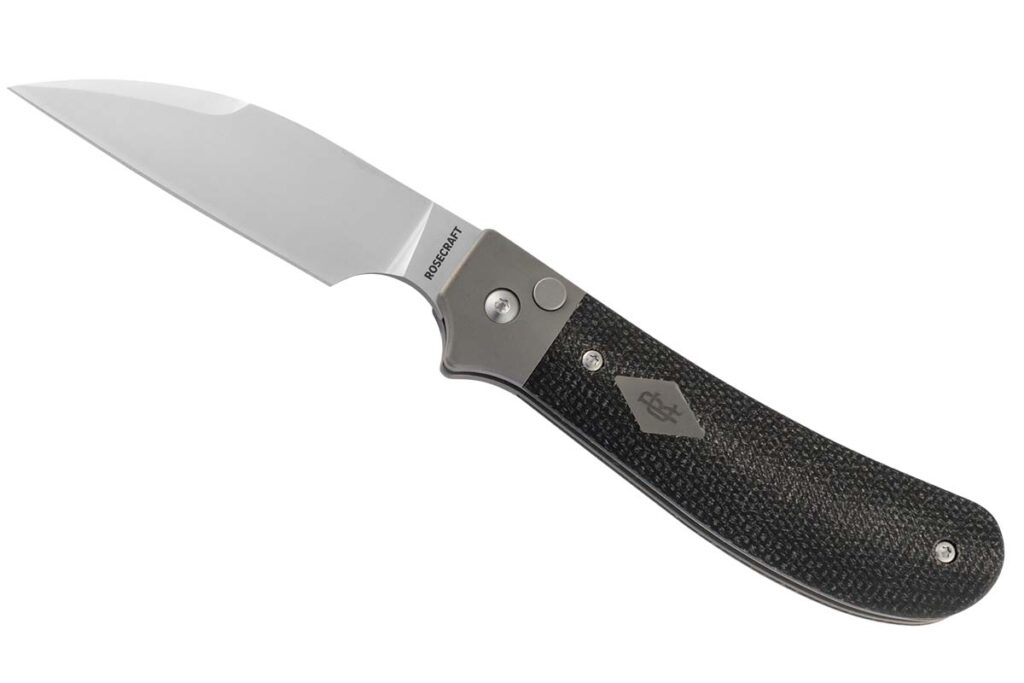
RoseCraft Clinch River Button Lock
Model type: Modern/traditional pocketknife Blade length: 3.125” Blade material: M390 stainless Blade grind: Flat Handle material: Micarta® or Ultem w/titanium bolster & liners Lock: Button lock Pocket clip material: Titanium Knife to know: Modern take on the Clinch River Swayback that won BLADE Magazine 2023 Imported Knife of the Year®; opens and closes via a button lock Weight: 2.8 ozs. Closed length: 4” Country of origin: China MSRP: $129.99 Available: NOW
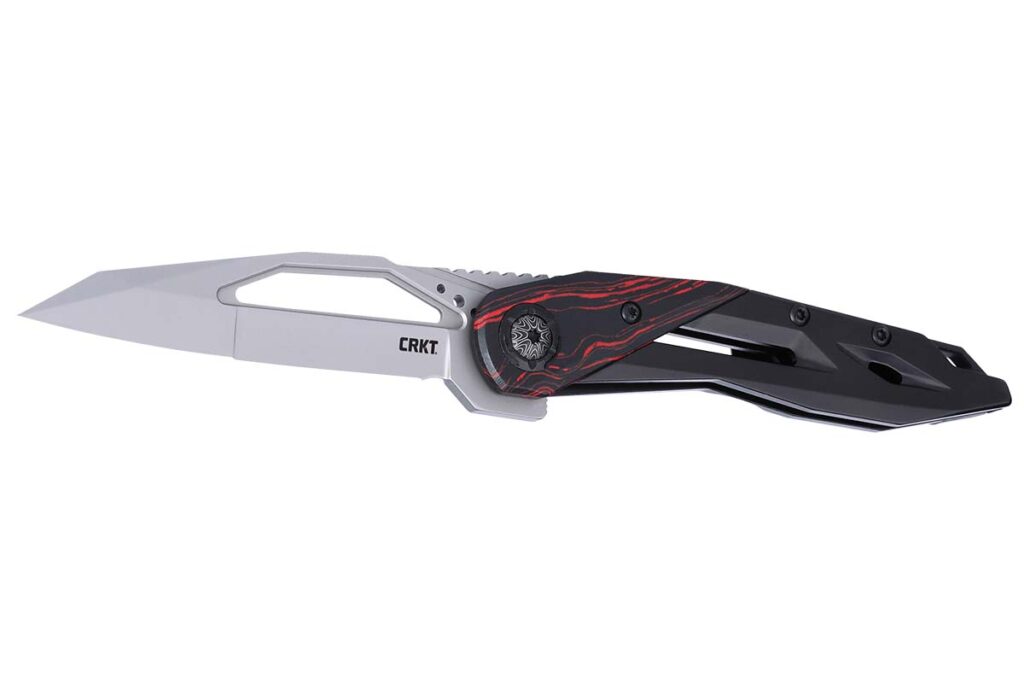
CRKT Nucleus
Knife type: Folder Designer: Princeton Wong Blade length: 3.19” Blade steel: 12C27 stainless Rockwell hardness: 58-60 HRC Blade grind: Flat Blade @ thickest: .13” Blade pattern: Reverse tanto Blade finish: Bead blast Construction: Screw Handle material: Stainless steel w/G-10 overlay Lock: Framelock Blade openers: Front and rear flipper tabs & blade hole Pivot material: Ikoma Korth Bearing System (ball bearings) Pocket clip material and type: Stainless steel; tip-up Weight: 3.1 ozs. Closed length: 4.19” Country of origin: China MSRP: $113 Knife to know: The knife opens three ways: front and rear flipper tabs and via the blade hole Available: NOW
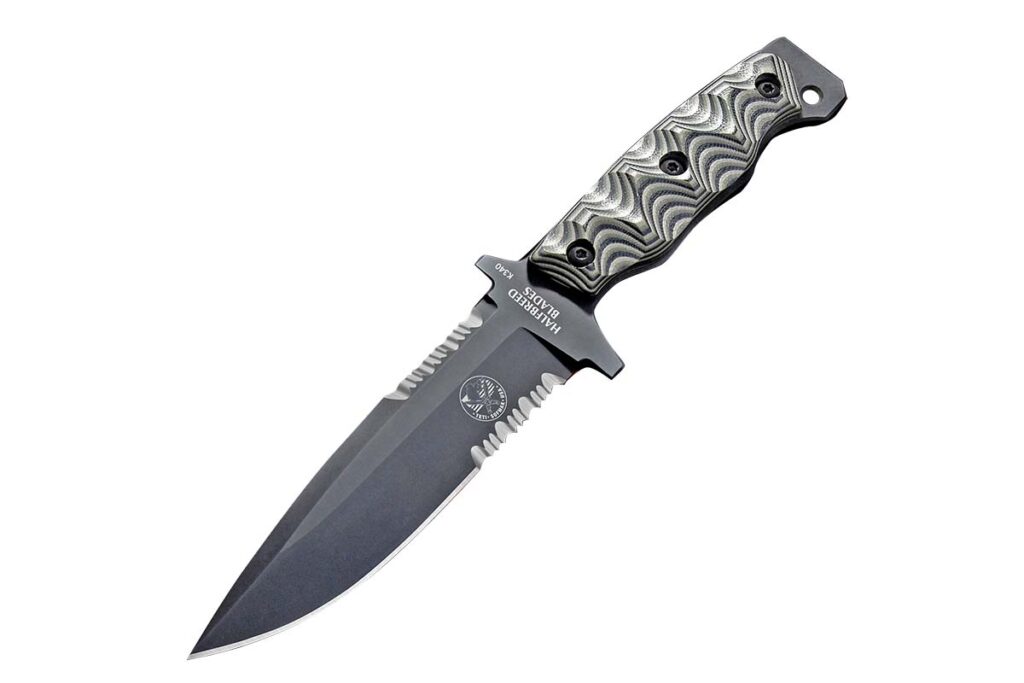
Halfbreed MIK-04 SOFMAK
Knife type: Fixed blade Blade steel: K340 stainless Rockwell hardness: 59-60 HRC Blade finish: PVD coat Blade style: Drop point Blade length: 5.31” Blade @ thickest: .25” Handle material: G-10 Weight: 11.14 ozs. Overall length: 10.31” Sheath material: Injection molded plastic Mounting: Belt & PALS/MOLLE (DOTS) Country of origin: Comprises Australian & Taiwanese make MSRP: $285 Knife to know: The knife is a collaboration between Halfbreed and Joseph Teti, Force Recon Marine and Army Special Forces Green Beret veteran and former operative with the CIA Special Activities Division/Special Operations Group; MIK stands for medium infantry knife and SOFMAK for special operations forces multi-purpose assault knife MSRP: $285 Available: September 2024
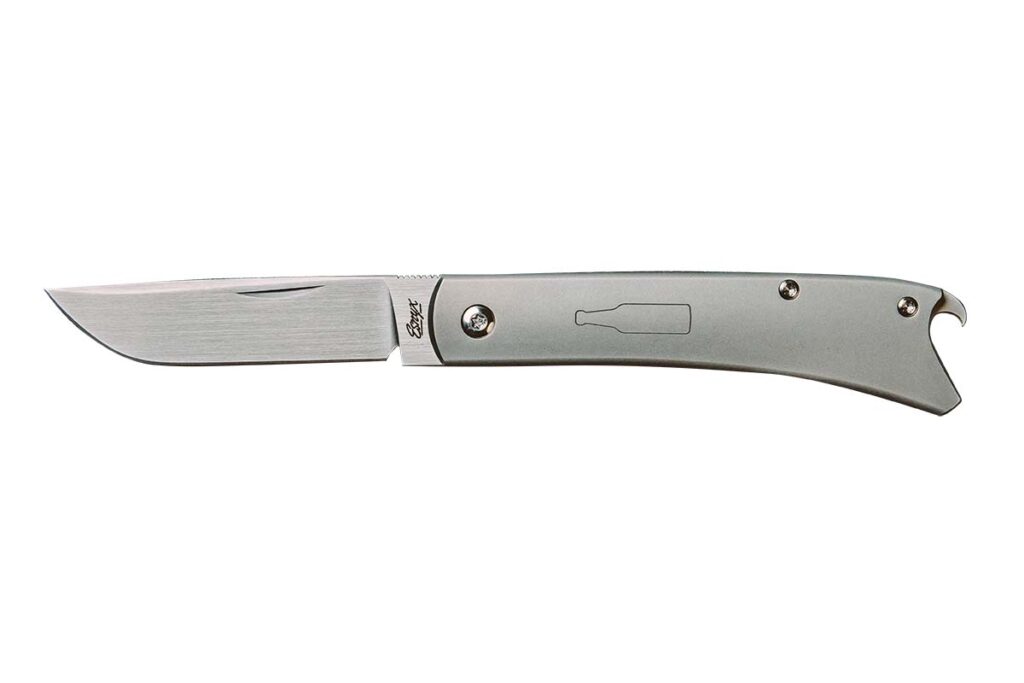
ESNYX Silver Line Beer Buster Jr.
Knife type: Slipjoint Blade length: 2.63” Blade steel: M390 stainless Blade @ thickest: .125” Blade grind: Flat Blade pattern: Drop point Blade finish: Handrubbed satin Blade opener: Nail nick Handle: Blasted titanium Weight: 2 ozs. Closed length: 3.5” Country of origin: China Knife to know: Slipjoint has half stop; bottle-shaped handle shield; bottle opener in butt MSRP: $265 Available: NOW
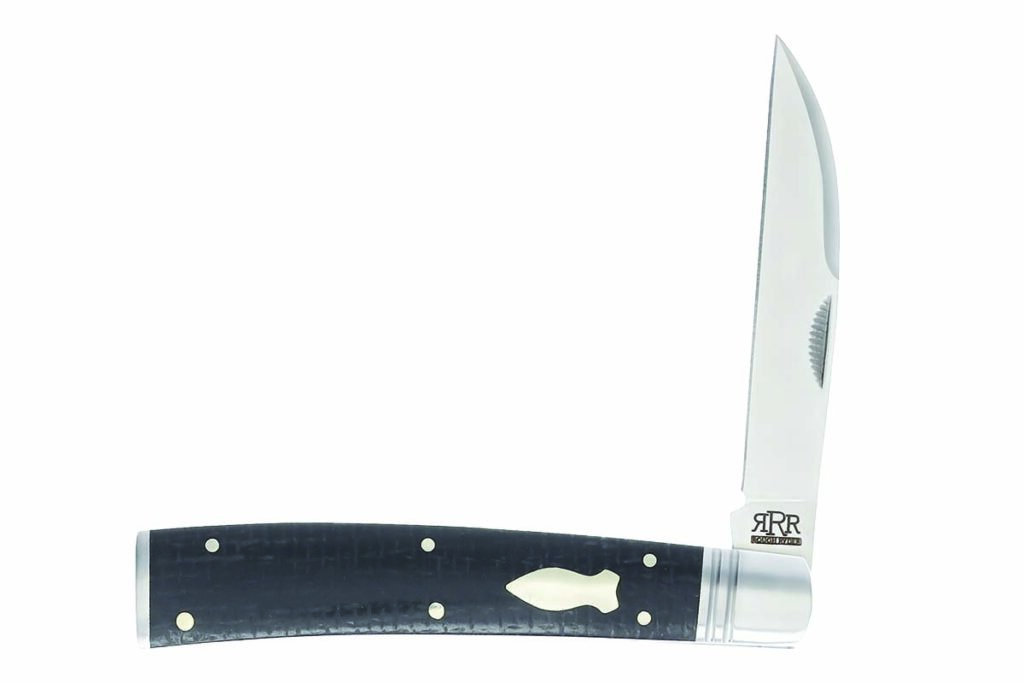
Rough Ryder Reserve Whiskey Ryder
Knife type: Swayback doctor’s knife slipjoint Designer: Brian Wilhoite Blade length: 3.5” Blade material: D2 tool steel Blade @ thickest: 3/16” Blade pattern: Wharncliffe Blade finish: Brushed satin Handle material: Black burlap Micarta® Weight: 3.2 ozs. Closed length: 4.5” Special features: Slipjoint features half stop Country of origin: China MSRP: $54.99 Available: NOW
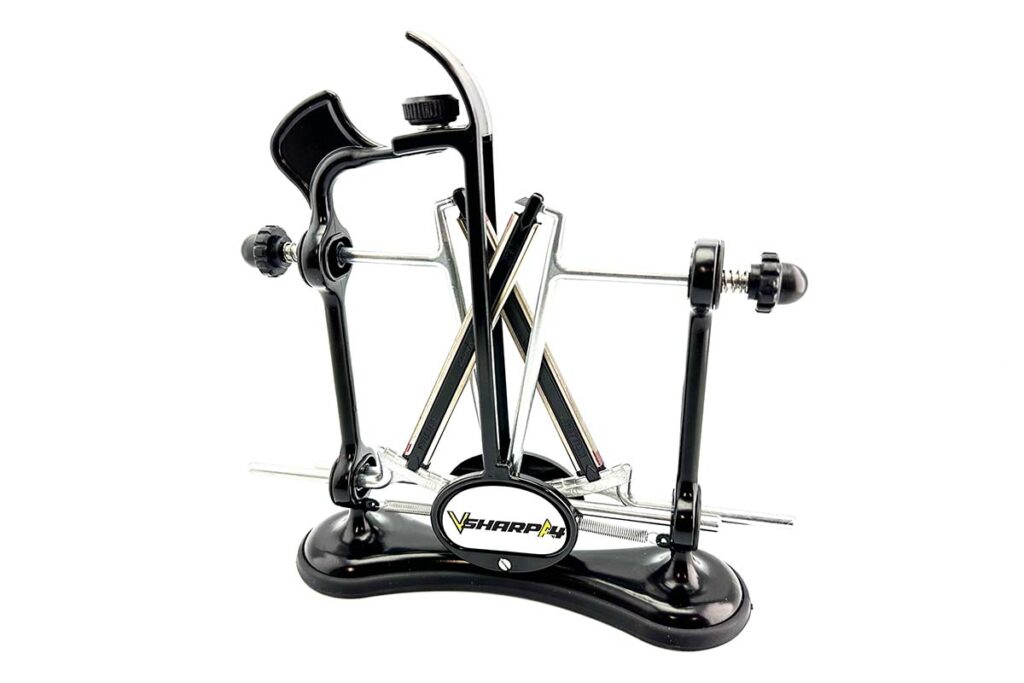
Warthog V-Sharp A4 Model
Sharpener Type: Patented V-Sharp spring-loaded pull-through Abrasive Type: Diamond-coated Grit selection: 325 grit natural diamond hone & hardened hone steel for finishing the edge (270, 325, 600, 1,000 and ceramic hones available) Dimensions: 8.75” x 8.25” x 2.25” Construction Materials: Lightweight zinc-cast metal frame, non-slip rubber base and durable powder coat finish Weight: 1.1 lbs. Special Features: Four adjustable sharpening angles: 15, 20, 25 & 30 degrees Types of blades sharpened: All plain-edge knives; serrated knives can be sharpened w/the ceramic hones Country of origin: South Africa MSRP: $109.99 Available: NOW
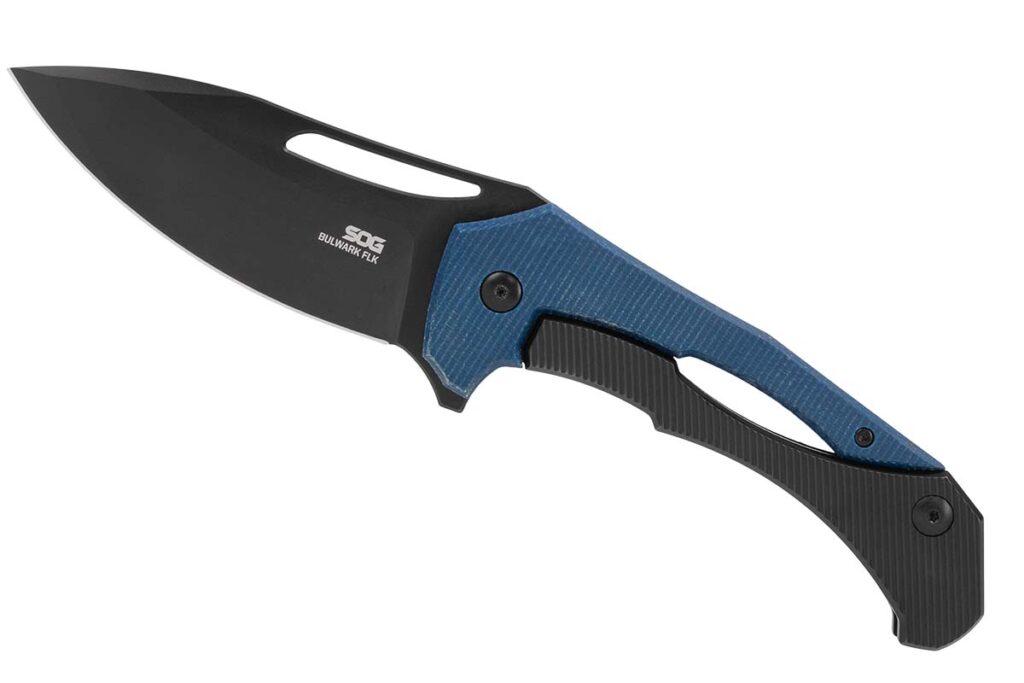
SOG Knives Bulwark
Designer: Mikkel Willumsen Knife type: EDC flipper folder Blade length: 3” Blade material: D2 tool steel Blade grind: Hollow Blade @ thickest: .14” Blade finish: Black PVD coat Blade pattern: Drop point Blade openers: Flipper tab and blade hole Handle material: Micarta® in blue and OD green color options Pocket clip: Tip-up Lock: Framelock Weight: 6.25 ozs. Closed length: 4.2” Country of origin: China MSRP: $134.99 Available: Late summer 2024
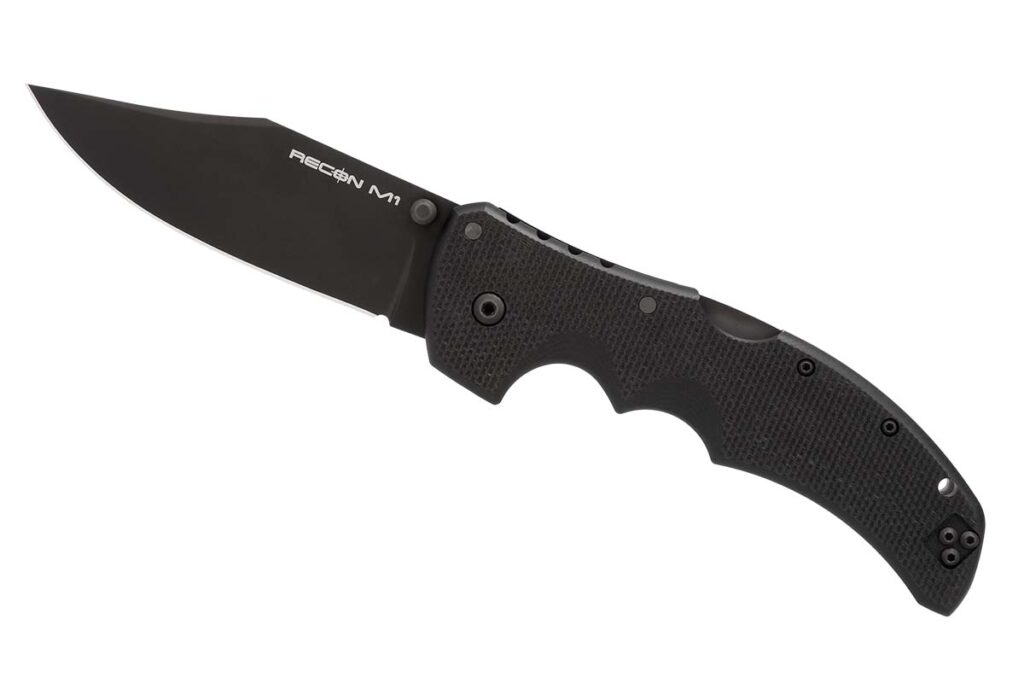
Cold Steel Recon M1
Knife type: EDC folder Blade length: 4” Blade steel: CPM MagnaCut stainless Blade finish: Stonewash Blade pattern: Clip point Handle material: G-10 Lock: Tri-Ad Pocket clip: Yes Weight: 5.2 ozs. Closed length: 5.5” Country of origin: Italy MSRP: $259.99 Available: NOW
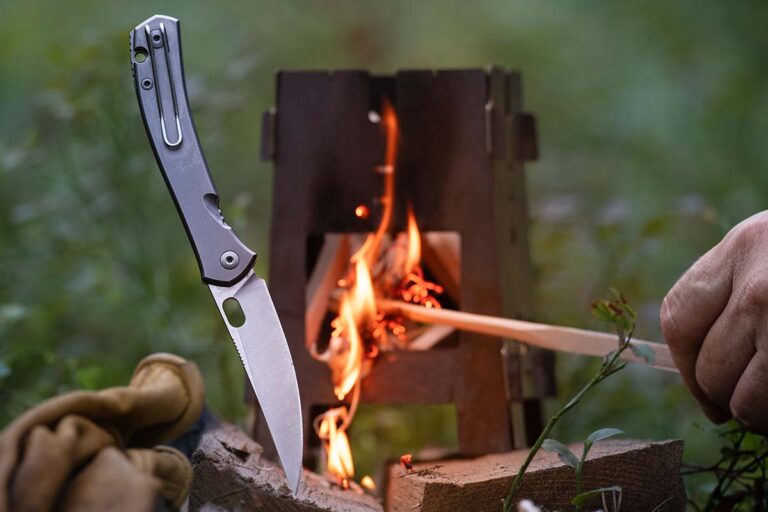
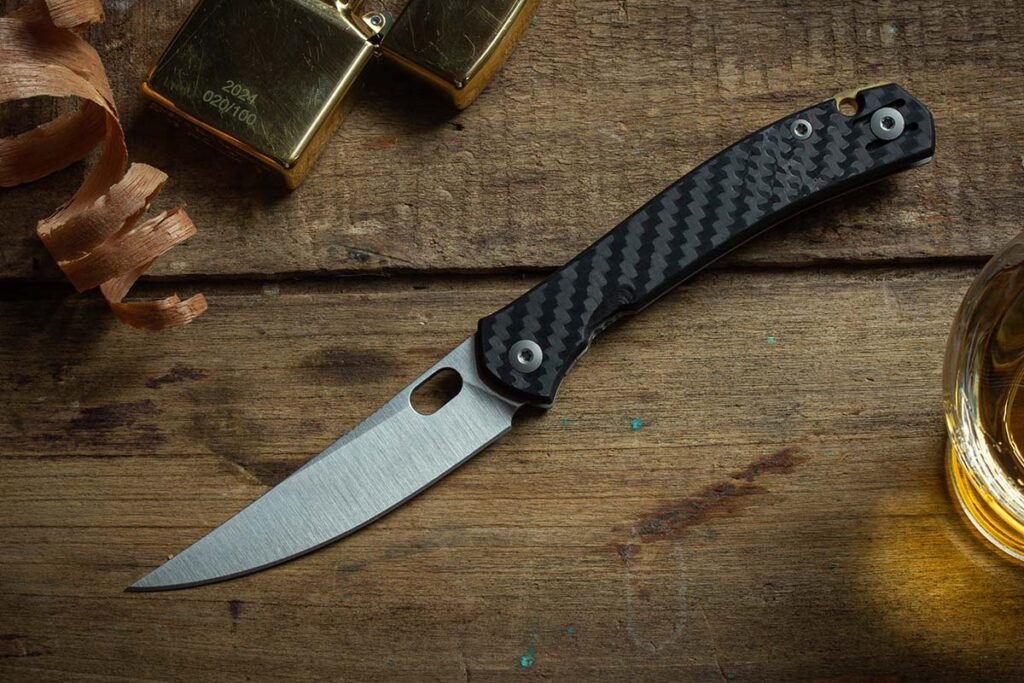
Somewhere between an EDC and a gentleman’s knife, the ACE Bleecker looks to be a slick sidekick.
Giant Mouse is going gentlemanly but with an attitude. At least, that appears to happen with the newest addition to its catalog—the ACE Bleecker.
Named after Manhattan, N.Y.’s trendy Bleecker Street, the company seems to aim the frame lock toward hipsters’ hip pockets. The same with the sleek, yet somewhat understated lines. However, robustly built with premium steel and components the Italian import likely has the chops to pull off EDC duty—at least for those who tend to smaller knives.
Right off the bat, the notable aspect of the ACE Bleecker is its slim design accentuated by a trailing point blade. In many respects, it’s reminiscent of Giant Mouse’s Knife of the Year award-winning GMX, only smaller and without an integral handle. Despite its svelteness, the company has ensured the knife is capable of more than cutting the foil off wine bottles by making the handle full-sized. It is a bit skinny in the hand, yet it nestles in the palm well enough to handle more aggressive cutting duties.
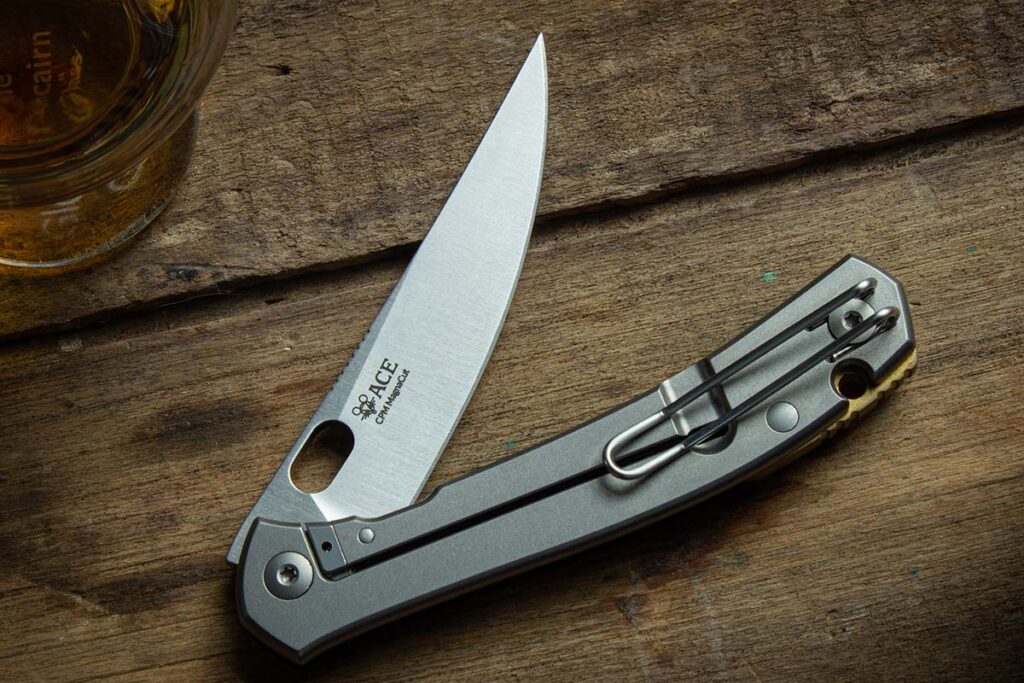
Giant Mouse went top-shelf for the blade steel, choosing Magnacut—albeit a softer version than some prefer. The company rates it at 62 HRC, a facet that might raise the hackles for the edge-retention obsessive. That aside, the geometry of the 3.26-inch blade is exquisite with a thick(ish) spine adding toughness to the design. The tip doesn’t jut too far above the spine, allowing users to choke up on the blade for finer work. And, boy howdy, should it ever prove apt at fine work, with a very fine tip.
The company has opted for a thumb hole as the opening mechanism on the Bleecker but has made it oblong. The choice is for more than aesthetics, making the knife deployable not only in the traditional style—the thumb—but also in reverse open. As an added benefit, this also makes the knife relatively left-hand friendly. The Bleecker’s well-tuned detent also goes a long way in adding to all these aspects—not so light as to facilitate a negligent deployment, but not overly stiff where users will struggle to get the blade to work.
As for the handle, Giant Mouse offers two options—titanium and carbon fiber. Both are attractive, though I tend to the titanium as it gives the knife more overall continuity and class. In both cases, the knife tips the scales at right around 2 ounces—the titanium a hair more—and measures at 7.43 inches in overall length. Worth note, Giant Mouse includes a notch on the thumb side and a chamfer on the lock that go a long way in making opening the knife simple. Also, it boasts a reversible wire pocket clip for tip-up carry.
With a gentleman’s design comes a gentleman’s price on the Bleecker. Giant Mouse lists the titanium model at $285 and the carbon fiber version at a slightly more affordable $245.
First Case/Ruple collaboration officially debuts at BLADE Show ’24.
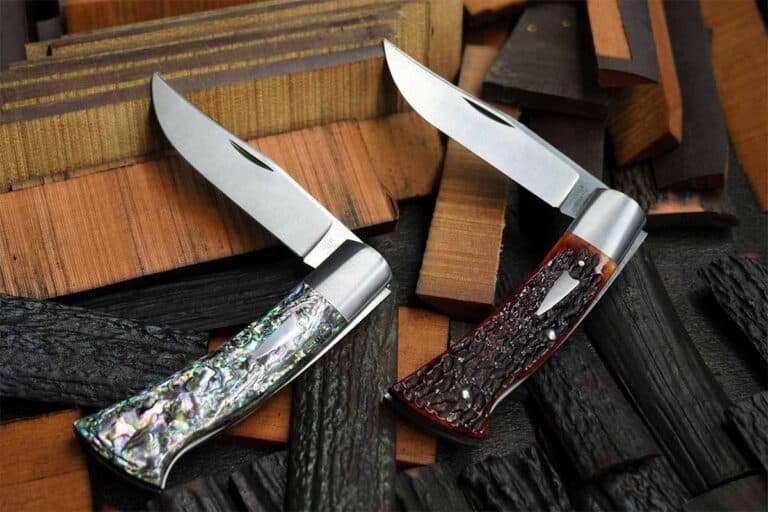
The combination of mechanical features, artistic design and choice of handle materials make the Bill Ruple x Case Axe Handle collaboration a unique knife for the user and collector.
Case Knives and BLADE Magazine Cutlery Hall-of-Fame® member Bill Ruple didn’t just bump into each other at the convenience store one day and say, “Hey, let’s do a knife collaboration.” That alone likely would have led to a great pocketknife, but no, there was a lot more planning and history that went into this new joint venture. We’ll talk about some of that but first let’s talk about the knife itself. It’s got some special character.
Case Axe Handle Design
Despite both being giants in the slipjoint field, Bill and Case sifted through some ideas and came up with a lockback pattern for an initial collaboration. It was not just one part but several features Bill combined together to make this knife unique.
Preeminent member of the Texas Slip Joint Cartel, Ruple more than understands what makes a good slippy.
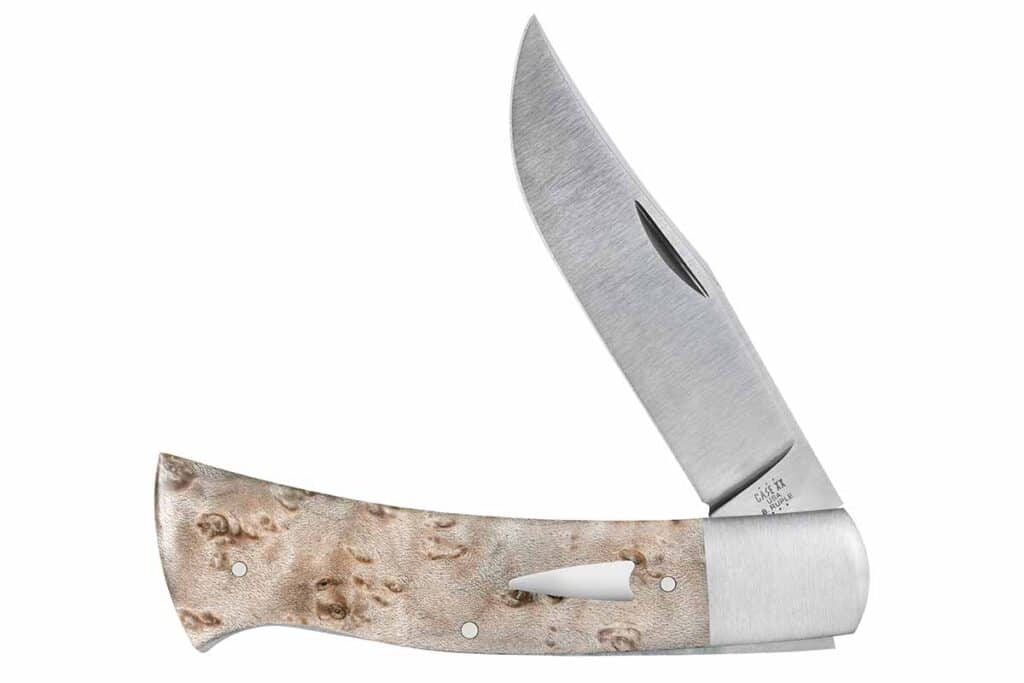
As a man who had farmed the soil, he noted the end of the knife resembled the shape of an axe handle, thus the name. The upward curve of the handle butt provides some useful ergonomics but also strategically holds the tail of the lockbar. In this location, there is resistance to accidental unlocking of the blade while it’s in the open position. As well, it eliminates the need for a thumb cutout in the handle to release the blade. With an upward curve partially concealing the lockbar plus the absence of a thumb cutout, the handle makes the knife appear not to be a lockback pattern at all. In fact, since at first glance it seems to be a slipjoint, it has a bit of the trick-knife or mystery-lock character.
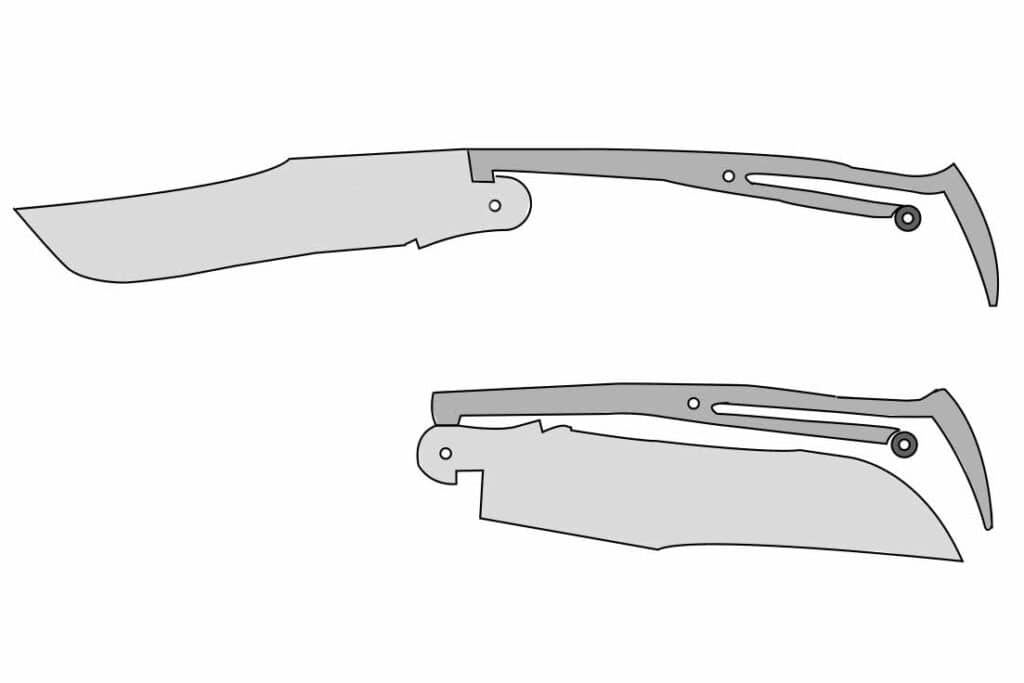
Initial prototyping by Bill in his shop hit a snag in that the slipjoint knives he’s used to creating have a rear bolster. That did not fit the artistic design for the new collaboration. However, Bill cleverly overcame the so-called snag by using a feature called a scissor spring (see illustration, page 40), which rests on a bushing to provide the needed tension to work the lockbar. Bill has prototyped knives for Case and also assisted with some aspects of manufacturing just as his Case collaboration predecessor, mentor, very close friend and fellow Cutlery Hall of Famer, Tony Bose, had done. Bill stated that nobody could replace Tony Bose and Case misses him. (Don’t be at all surprised if Case makes a commemorative knife in honor of Tony in the future.)
A few notes on Ruple’s design, the scissor spring (rear top right) is an efficient use of space with a one-piece unit of lockbar and spring. The bushing (lower fork of the spring), the spring rides on this avoiding excessive wear and taking up less room. It also acts as a rear spacer.
Both Case officials and Bill say Tony would be pleased with the new collaborative effort. The initial run will be 1,000 knives. Then the model will be made in a traditional slipjoint pattern. There is an aim at “near custom maker quality” for the first run, glibly naming the process “almost custom,” beginning with the parts being wire cut. That’s the cool way to say electrical discharge machining, or EDM. Production is assigned to a specific group of three workers only. No one else will work on the knives. That sort of consistency helps maintain quality control in manufacturing the knives.
MORE TO COME Is this collaboration just an outlier or will there be more Case/Ruple lockbacks in the future? Interest in the knife at BLADE Show 2024 (page 26), where the knife was officially introduced, was quite favorable. Both Bill and Case officials were pleased with how things have turned out, so expect to see another collaboration introduced at next year’s BLADE Show. That knife likely will be a slipjoint. Another lockback might be seen in the future, though a bit further down the road.
Natural birdseye maple is one of but several handle material options on the new Bill Ruple x Case Axe Handle.
As collaborative efforts go between manufacturer and custom maker, the Axe Handle knife is a superlative effort. And there is strong motivation to produce more collaborations, both commemorative and unique.
Ruple’s First Case
Does BLADE Magazine Cutlery Hall-of-Fame® member Bill Ruple remember his first Case knife? Is Texas big?
“Oh yeah,” the good-natured, award-winning knifemaker and South Texas Slipjoint Cartel trail boss said. “My dad gave me a Case knife when I was 9 or 10 years old, and it was a yellow handle Case trapper. And man, in about a month I had sharpened the blades completely out of that knife. And he gave me another one, and so he told me not to sharpen it quite as often. But yeah, a long time ago.”
Case Axe Handle Specs Knife type: Lockback Designer: BLADE Magazine Cutlery Hall-of-Fame® member Bill Ruple Blade length: 3.46” Blade material options: Wire-cut 154CM stainless steel or damascus Rockwell hardness: 57-59 HRC Blade grind: Flat taper Blade @ thickest: .126” Blade pattern: Clip point Blade finish: Satin Handle material options: Natural birdseye maple, Rogers jig chestnut bone, standard jig antique bone, marbled black carbon fiber, abalone, English walnut Lock: Lockback Opener: Nail nick Pocket clip: None Weight: 4.21 ozs. Closed length: 4.4” Carry: Suede leather taco pouch Special features: One-piece designed backspring & lock mechanism. Country of origin: USA MSRP: $599.99 to $774.99 Available: Late Summer 2024
See why the hot powder metallurgy steel is all the rage in knives.
You might have heard that CPM MagnaCut is the latest in high-end blade steels. You might have seen that knives with MagnaCut blade steel have been selling fast. Everyone wants MagnaCut! But what exactly is it?
What Is Magnacut Steel?
MagnaCut is the latest super steel offered by Crucible Materials of Syracuse, New York, the same folks who make such high-end blade materials as CPM S30V, S35VN, S45VN, CPM 154, 20CV, 3V and others. Metallurgist Larrin Thomas, winner of the BLADE Magazine 2024 Publisher’s Award, invented MagnaCut. His objective was to create a stainless blade steel whose properties are balanced and that would perform well in the critical areas of edge holding, corrosion resistance and toughness.
With other high-end steels there’s usually a degree of give and take where you might sacrifice a bit of one characteristic to gain more in another. This is something knife folks have endured for so long that they’re used to a certain degree of compromise in order to get a blade steel suitable for their needs. Simply put, MagnaCut could very well be the steel that has all the characteristics knife guys want in a blade material. Basically, it’s their dream steel come to life.
Compared with other CPM steels, MagnaCut has less toughness, though don’t look at that as a bad thing. It’s actually very good in that MagnaCut is easier for a knifemaker to work; that is, it grinds and drills easier. On the knife user end, it means MagnaCut is easier to resharpen than other CPM steels whose toughness rates higher. Still, I recommend using diamond abrasive sharpeners on MagnaCut to obtain the best results.
See now why MagnaCut is all the rage in the knife industry? Just about every major manufacturer is using it and even some custom makers. The switch to MagnaCut can be seen as a way for manufacturers especially to level up the performance of their knives.
Kershaw Launch 17
The Kershaw Launch 17’s clip-point blade in MagnaCut offers great utility for a wide variety of cutting chores.
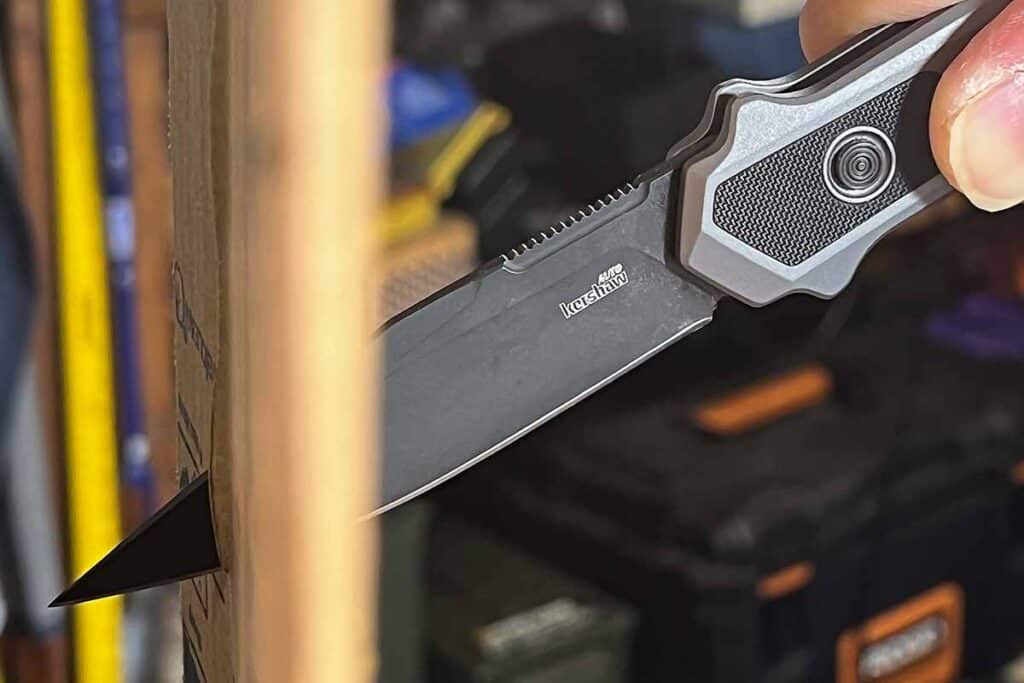
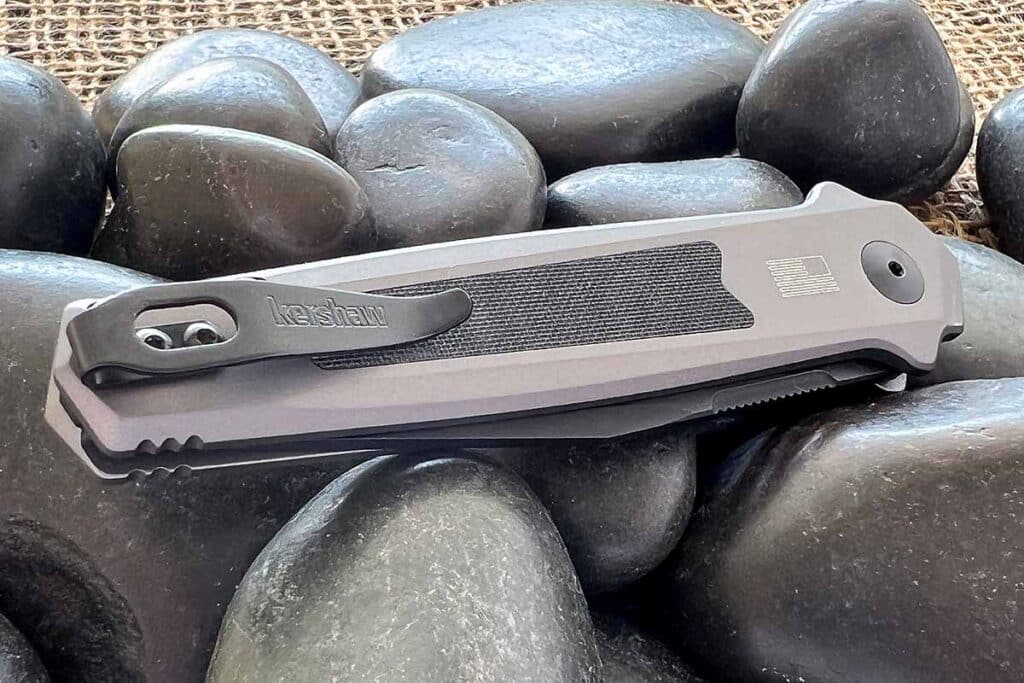
Among the latest factory knives to offer MagnaCut blade steel is the Kershaw Launch 17. The Launch 17 presents a slender carry handle profile with a highly usable 3.5-inch clip-point blade. At 5 inches closed the Launch 17 is on the bigger side of EDC knives, but its svelte handle makes it very comfortable to carry. The flat-ground blade is a great working shape that tackles just about any cutting chore.
The handle is machined T6 6061 aluminum anodized grey and features textured black G-10 inlays for a neat contrast of color as well as purchase. The grip is symmetrical and an integral double guard keeps your hand in place. The handle is mainly an open-frame construction that allows easy cleaning with compressed air or water, and a clip mounted at the butt provides very deep pocket carry for ultimate concealment.
The deep-carry clip of the Kershaw Launch 17 allows the knife to sit very low in the pocket for ultimate understated carry.
The only downside I see is the placement of the firing button. I want to grab the handle in a way that my thumb falls right into the button. I had to consciously readjust my grip to where I hold the handle a bit further toward the butt so my thumb falls just behind the button. It’s not really a big deal and certainly not what I would call a dealbreaker, but just something to be aware of.
The clip point blade is one of the knife’s key selling points. An excellent shape for general use, it has a defined point for scoring and fine cutting tasks, and there’s plenty of edge real estate to tackle your toughest chores quickly. The opening action is quick yet with very little recoil. The lockup is very tight with zero play. The Launch 17 makes a great EDC auto that’s light both in the pocket and on the wallet. MSRP: $239.99.
Kershaw Launch 17 Auto/Folding Knife Clip Point, Gray – Smooth Action for Easy Use – 7951
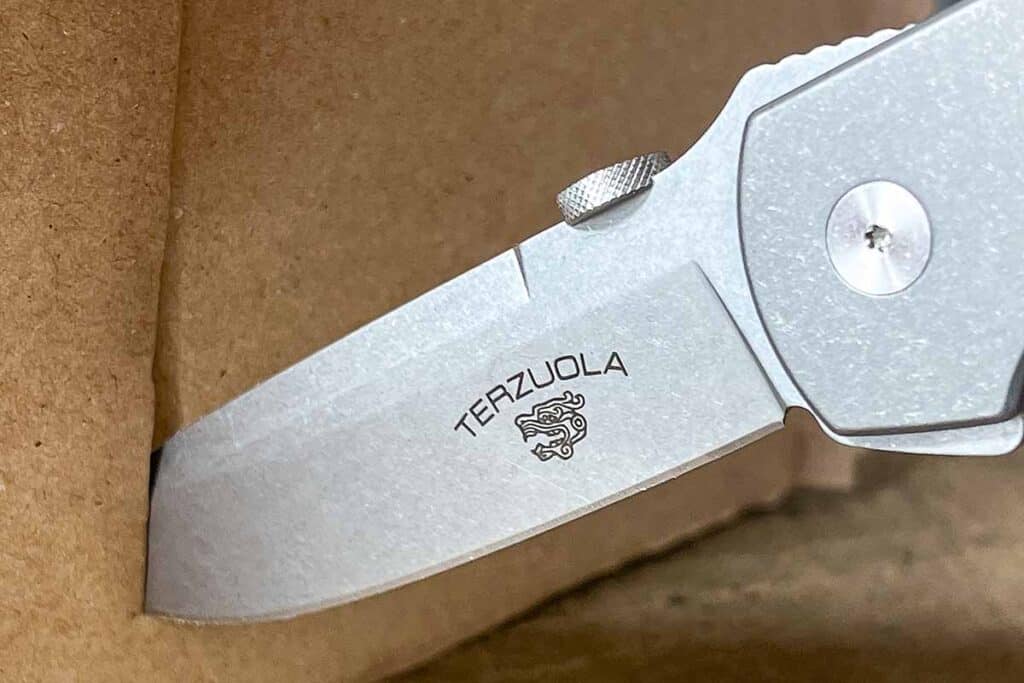
The ATCF Original Gangster from Fox in MagnaCut blade steel is an homage to Bob Terzuola’s iconic custom ATCF tactical folder. The initial Terzuola ATCF helped define the tactical folder era by incorporating features that are now standard with many folding knives of the genre.
BLADE Magazine Cutlery Hall-of-Fame® member Bob Terzuola introduced his quintessential custom tactical folder, the ATCF (Advanced Technology Combat Folder), in 1986-87. It is Terzuola’s best-known folder and most imitated design. The original included a host of features that are now standard on any top tactical folder, custom or production, including screw-together construction and a notched thumb ramp for aid in a nonslip grip and applying pressure for power cuts. It also incorporated a checkered thumb disc for ambidextrous blade deployment.
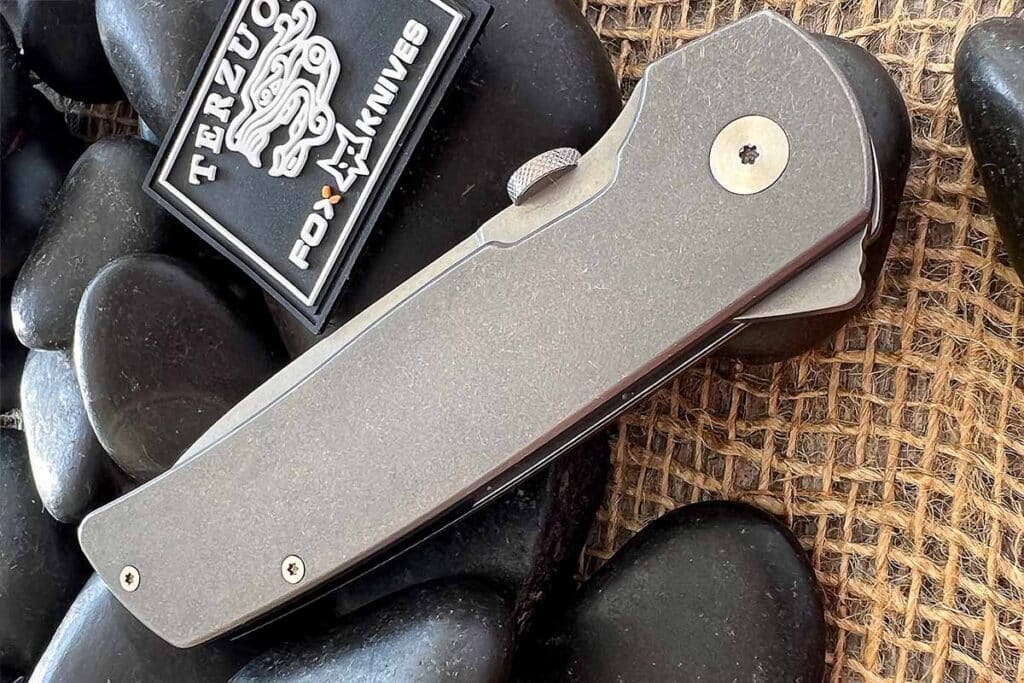
Fox Knives teams with Terzuola to release the ATCF Original Gangster. The knife is built almost exactly the way Terzuola builds his custom version, complete with the aforementioned features as well as MagnaCut. The 3.5-inch modified drop-point blade has a swedge. The addition of a flipper tab ushers the ATCF OG into the modern tactical realm and provides two blade-deployment options: ambidextrous thumb and flipper opening. The test sample is the SQ-ATC-OG01 with a titanium handle and stonewashed blade. The blade rides on bearings for ultra-smooth action. Like the addition of the flipper, this is also a modern innovation incorporated into the reproduction of the legendary folder.
The Fox ATCF Original Gangster features a flipper tab to aid in quick one-hand deployment. This was not a feature found on Bob Terzuola’s original ATCF design but rather incorporated by Fox as a modern convenience.
With its integral forward guard and slanted butt, the handle is another Terzuola signature design. The titanium scales have a matching stonewash finish and are devoid of any machining—just smooth titanium that’s comfortable in-hand. The lock is the tried-and-true linerlock. The blade-tip-up-carry clip secures via a single T6 Torx head bolt and is held in place inside a machined cavity that captures the clip and prevents it from rotating. Before you complain about the clip not being reversible, remember that the ATCF was introduced at a time when pocket clip folders were still a relatively new concept, much less ambidextrous clip carry. A solid G-10 spacer rounds out the look and leaves most of the handle spine open for easy cleaning. A pin recessed in the butt accepts a lanyard, though standard 550 cord is too thick to fit.
Everything works on the knife, from the integral single guard to the thumb disc for ambidextrous opening. The flipper works well, too. I like the drop-point blade, an all-around favorite of mine for a variety of tasks. It’s highly adaptable, from utility to survival to tactical. The titanium handle has a nice heft and it’s pure function with no additional machining or coloring added. It just works. Country of origin: Italy. MSRP: contact Fox for more information.
Spyderco’s Para Military2 Salt Black G-10
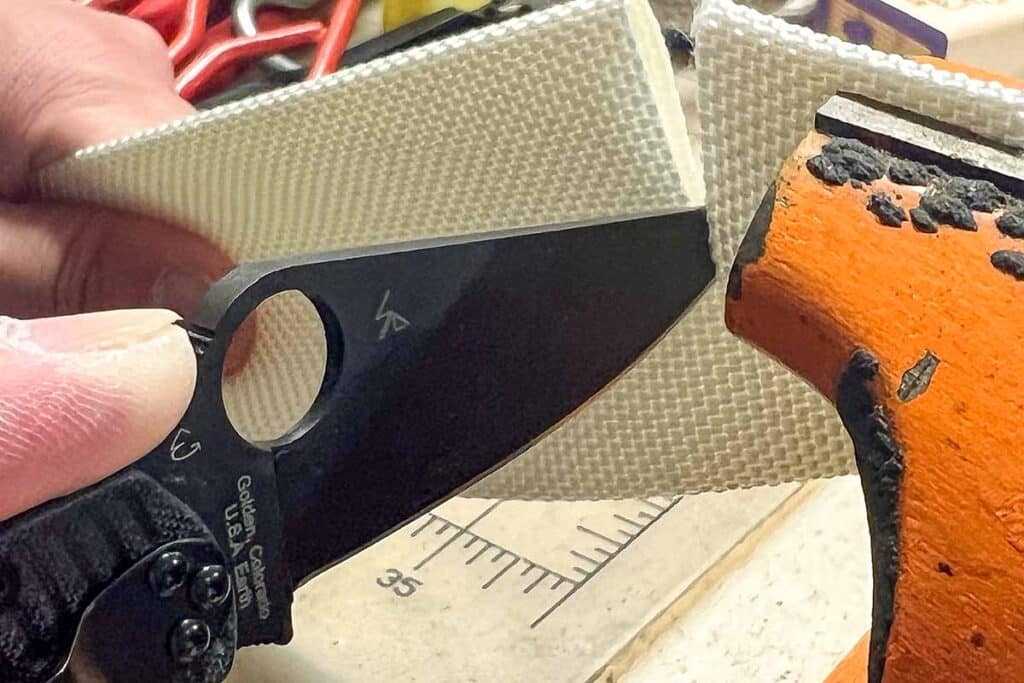
The Spyderco Para2 Salt has a full-flat ground blade of CPM MagnaCut stainless steel with a distal taper that allows the knife to be an extremely effective slicer with aggressive bite, perfect for tough tasks like cutting through fire hose material. It is the BLADE Magazine 2024 Most Innovative American Design.
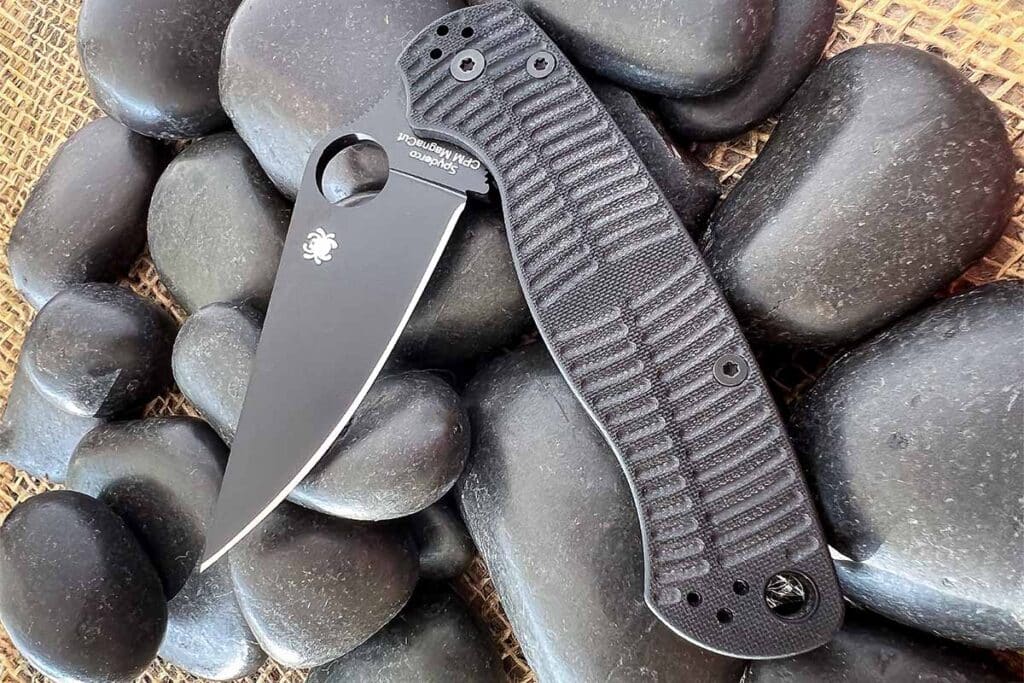
The BLADE Magazine 2024 Most Innovative American Design, Spyderco’s Para Military2 Salt Black G-10 is in the company’s line of corrosion-resistant knives designed especially for fresh water and saltwater environments. It is basically a regular Para2 with the addition of MagnaCut blade steel and other steel parts such as liners, pocket clip, screws and standoffs covered in a black protective coating to boost corrosion resistance.
The 3.45-inch blade is a great size for a work knife. It’s not too long nor too short. A large blade hole aids in easy thumb opening and works well if you’re wearing work gloves. The blade secures open via Spyderco’s Compression Lock, which is designed to be both strong and easy and comfortable to operate. The blade’s full flat grind allows it to sail through a host of media, and right out of the box is razor sharp and ready to work. That’s one thing about any Spyderco knife—the blade shapes and grinds are optimized for high-performance cutting.
The Para2 Salt’s machined handle grooves offer enhanced traction even with wet hands. The texture is a nice extra touch for a working knife.
The handle surface is machined in a radial groove pattern that distinguishes the knife as a premier member of the Salt Series. Spyderco calls it the Caribbean Bi-Directional Texture pattern and it greatly enhances grip traction, more so than standard peel-ply texturing. An excellent choice when dealing with wet hands, the grooves channel water away for a surer grip. The handle includes four-way pocket-clip mounting, open spine construction and a Compression Lock. Releasing the lock is super easy and can be done with one hand, as well as closing the blade. The way you release it keeps your fingers out of the way of the blade’s rotation path, therefore negating accidental cuts. The Compression Lock is a rock solid design, one of the best locks around.
The full flat grind coupled with a distal taper of the blade from tang to top make the Para2 Salt a lean cutting machine. It goes through most any material, thick or thin, with ease and little force—a sign of a well-engineered blade. Not only is the blade shape very efficient but the handle design is, too. It fits my average-sized hand very well and instills true user confidence in its comfort and safety. Country of origin: USA. MSRP: $315.
The Dead Reckon Ridgeback’s canted MagnaCut blade allows for greater knuckle clearance when working on a flat surface.
Dead Reckon is a new knife manufacturer and the Ridgeback folder is its first offering. There’s a lot going on with this folder, from the button lock mechanism, flipper opening and sealed bearings in the pivot to the integral handle. Crafted in the company’s Grove City, Ohio, facility, each knife is precisely and carefully manufactured to high standards that would satisfy the pickiest knife enthusiast.
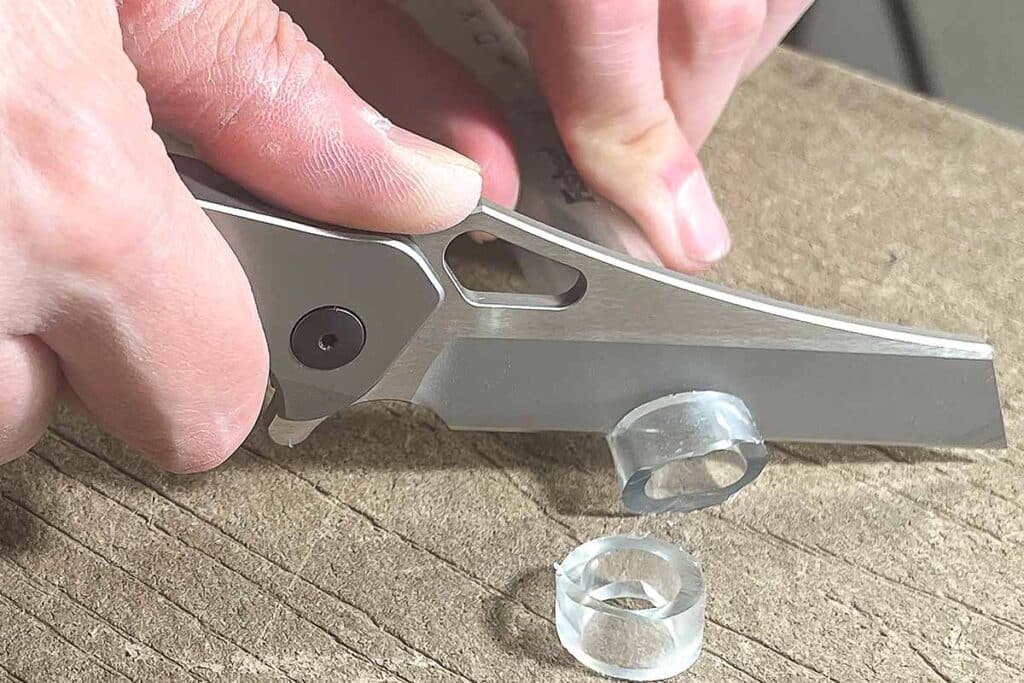
An example is the Ridgeback in its “wharncleaver” blade and integral titanium handle. The 4.1-inch MagnaCut blade is of a hybrid wharncliffe/cleaver pattern with a distinctive slant nose tip and straight-line cutting edge. The knife offers two methods of opening: flipper tab and oblong blade hole. Whatever method you prefer, the blade operates smoothly thanks to the sealed bearing pivot. Just ahead of the flipper is a cutout for choking up for precise control.
The handle is Grade 5 titanium, which is 6Al/4V titanium alloy. It is of an integral construction, which is difficult to manufacture. Only one other company I know of has pulled this off successfully. The Dead Reckon production staff takes one billet of titanium and machines the channel in the middle where the blade rests in the closed position. It’s all one piece with no assembly screws. It’s a very strong handle design and the lack of screws makes for a very clean appearance.
On most knives the pocket clip is a stamped and bent piece of steel. Nothing fancy or flashy but utilitarian. The Ridgeback clip is of a milled titanium that sports a very cool-looking geometric shape. It is quite eye catching, not an afterthought but an aspect that adds to overall appearance. The clip is at the right tension to hold the knife to the pocket without it wanting to slip out, while the ability to remove the knife remains fairly easy—the best of both worlds!
The one-piece handle construction of the Dead Reckon Ridgeback allows for a very strong grip but requires considerably more machining time than a standard handle, and therefore is more expensive.
For a very utility-friendly blade shape, the wharncleaver is it. There’s a lack of a defined blade tip, though there is one of sorts at the front of the cutting edge. Using a gentle pulling motion, you can use it to score materials easily. When cutting full on, the straight-line edge does so smoothly. With multiple grip options and a notched thumb rest, along with the cutout, this knife is easy to adapt to the cutting scenarios at hand.
Want more power? No problem. Use the thumb ramp to place more pressure on the blade. Want more control? Choke up on the blade using the finger cutout. The canted blade makes the Ridgeback more comfortable to use on a flat surface by offering enhanced knuckle clearance. You might think the appearance is a bit weird but don’t knock it until you try it. Country of origin: USA. MSRP: $475.
Barret Chrisman puts a modern spin on a vintage Remington design.
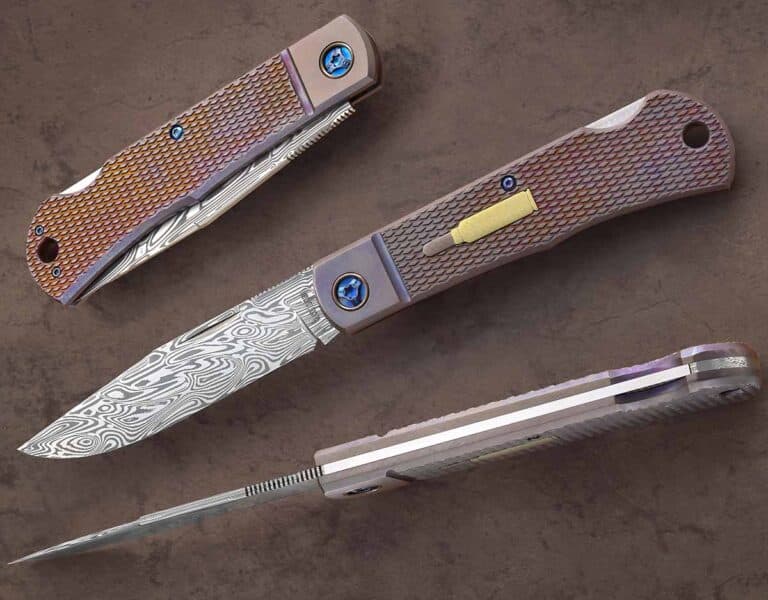
Barret Chrisman’s contemporary take on the classic Remington 1306 Bullet lockback combines tradition and hi-tech in one handsome custom pocketknife.
Barret outfitted his repro with all cutting-edge materials, including a blade of Loki pattern damascus by Damasteel, a handle of checkered titanium that resembles jigging and a titanium bullet shield. “I’ve seen people jig titanium before but I wanted to try checkering, so I made up a custom pantograph template and tried it out,” he said. He anodized the handle a purplish bronze.
Barret Chrisman
“It’s a modern take on an old school knife everybody likes,” Barret noted, “and I’ll probably be doing the same kind of thing in the future.”
Remington 1306 Bullet Modern Reproduction Specs Maker: Barret Chrisman Blade length: 4” Blade material: Loki pattern damascus by Damasteel Blade grind: Full flat Handle frame: Titanium Handle scales: Checkered titanium w/inlaid titanium bullet shield Lock: Lockback Closed length: 47/8” Maker’s price for a similar knife: $1,500






![Spartan Blades Poros Review [Tested]](https://blademag.com/wp-content/uploads/Poros-2-768x511.jpg "Spartan Blades Poros Review [Tested]")