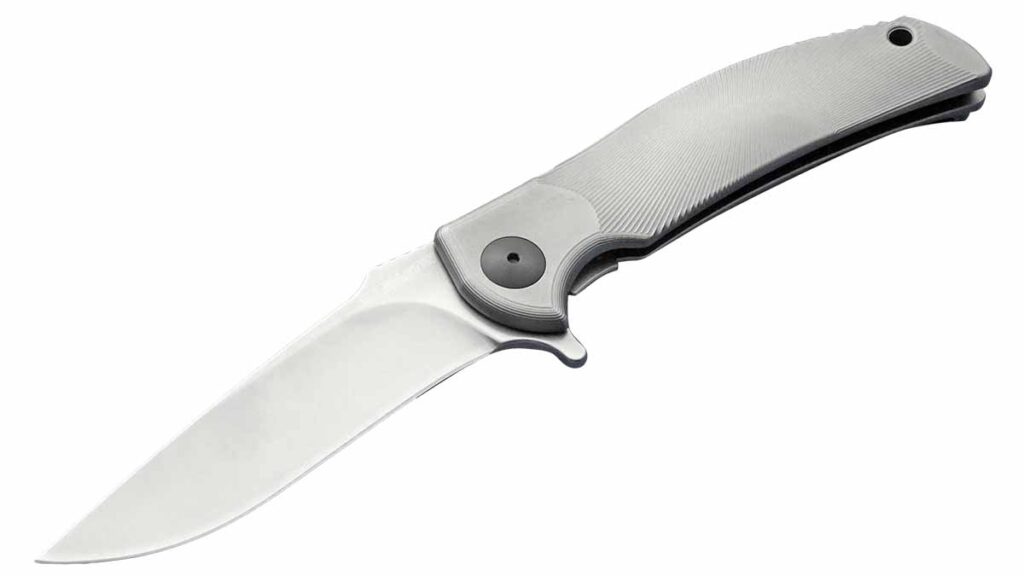
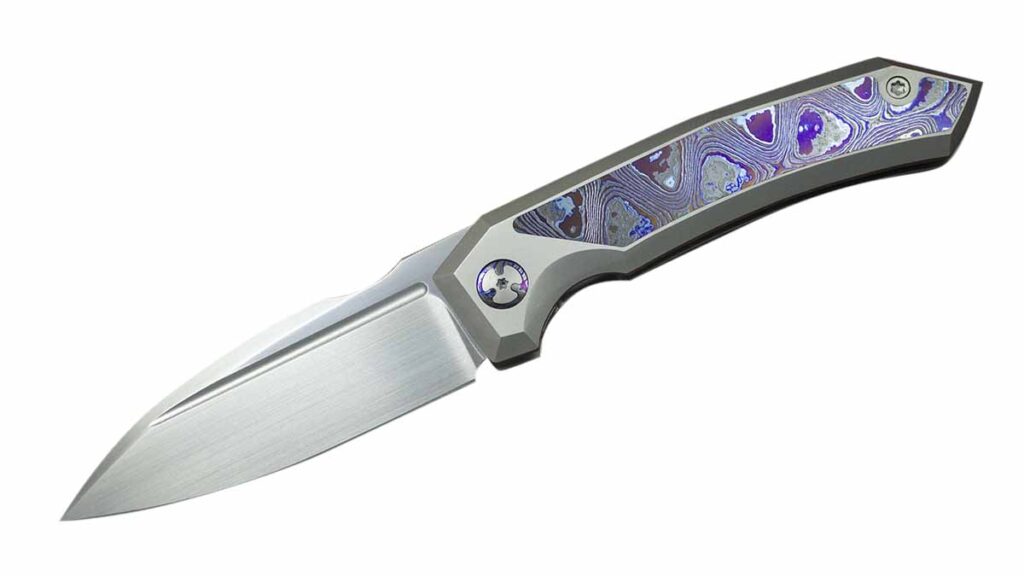
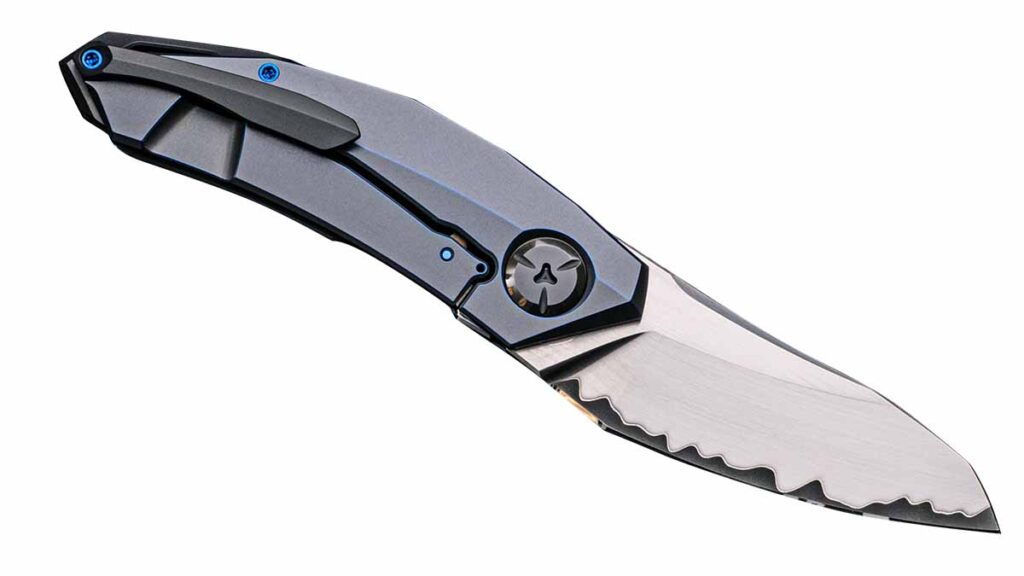
Rosecraft Blades expands its catalog with three new flipper-folders.
As the Rosecraft Blade crew was excited to herald during June’s BLADE Show, it has big things in store for this year. What the Tennessee designer was angling at became apparent this past month, with an interesting expansion of its catalog.
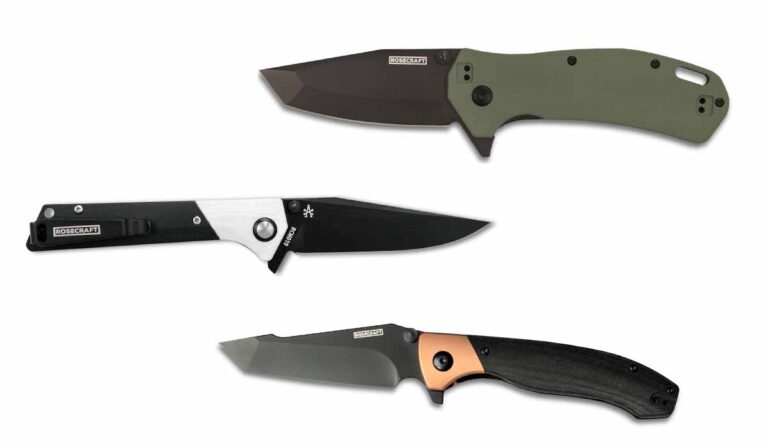
Rosecraft dropped three new knives in July, offering options in the mid to large range, all of them flipper folders. Here’s the breakdown of each.
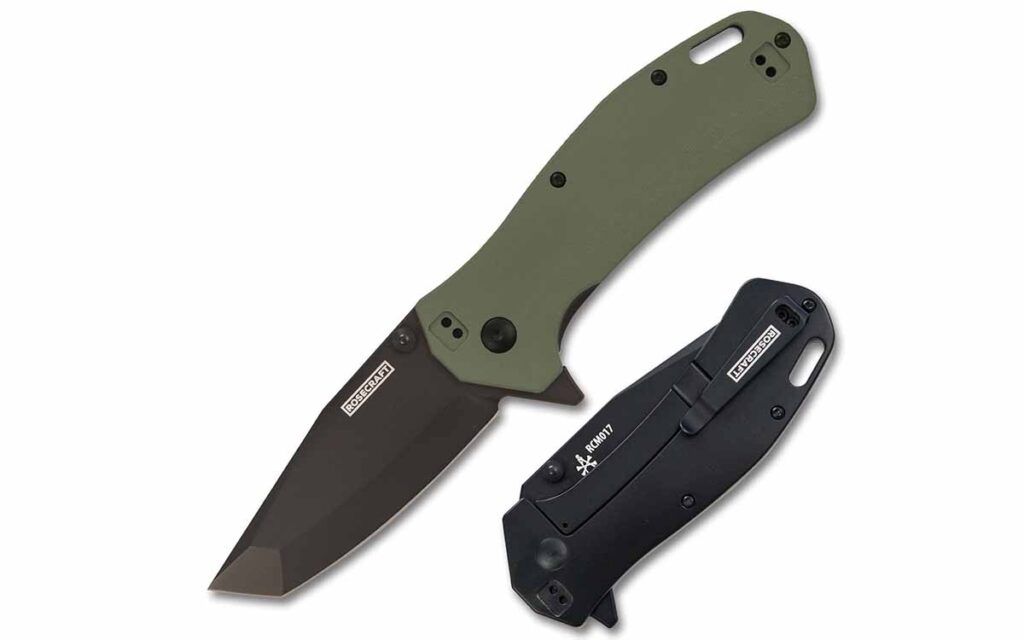
MA-11
One of two new designs from Andy Armstrong, the MA-11 is a robust tanto flipper with a tactical look, with Rosecraft stating it’s angled at military, law enforcement and first responders. However, it’s not so geeked to preclude it from EDC in milder environments. Catching the eye right off is the bulldogged nose of the 3.9-inch RPM9-steel blade, a much steeper angle than seen on a majority of factory tantos recently. The method to the madness here appears to be creating an ample prying surface, a task the relatively thick blade should prove adept at.
The MA-11 has a stainless steel handle with G10 front cover, nicely textured to give a bit more grip to the knife. The kicker and thumb stud on the frame lock is ample, but not so aggressive as to get in the way or initiate a premature deployment. However, when the blade is required it comes out in a snap, thanks to a ceramic ball-bearing pivot. Other notables include an ambidextrous tip-up/tip-down carry pocket clip and a lanyard loop. MSRP: $77
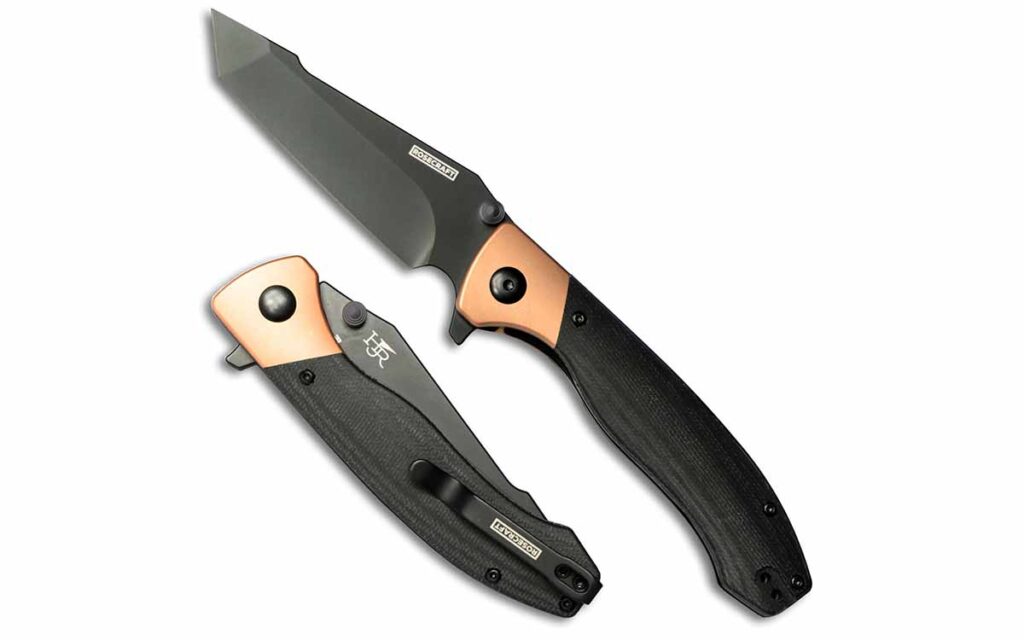
Aeris Rex
An offering by designer Hawkins Rose, an early run of the Aeris Rex proved among the best sellers at BLADE Show, according to Rosecraft. It’s easy to see why, the harpoon tanto is darkly handsome, set off with copper bolsters. Fairly sizable, with an overall length of 8 inches and 5 ounces in weight, the knife nevertheless has clean lines and looks that should make it comfortable in any setting.
Offering supreme control, the Aeris Rex—Latin for “King of the Air” or “Air King”— boasts a fairly sizable handle and the choice of Micarta or carbon fiber handles. Both options are attractive, but the latter material tacks nearly $20 on the MSRP. Again, Rosecraft outfits the knife with both a kicker and thumbstud for deployment and utilizes a ceramic ball-bearing pivot. This liner lock also has a hidden lanyard hole and is ambidextrous, with a configurable tip-up/tip-down pocket clip. MSRP: $86 Micarta handle; $107 carbon fiber handle
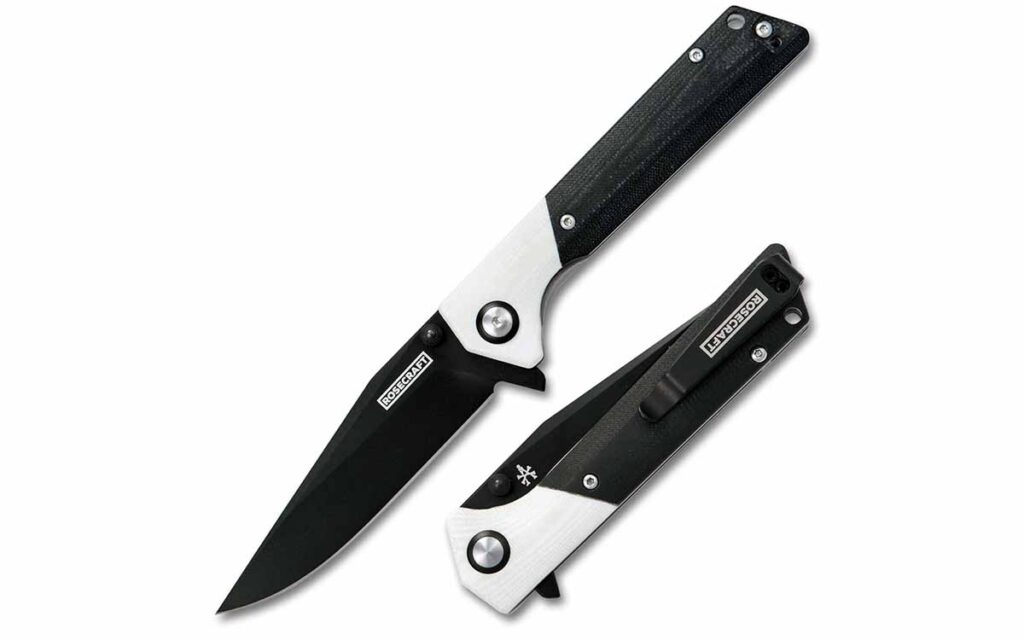
Waya
Cherokee for wolf, the Waya is perhaps the most dapper of the three new releases—yet another creation of Armstrong. The clip point presents very clean lines and a striking dark appearance, complimented by a split G10 handle—black and an off-white in the above case. Overall a classy package that cuts an executive knife’s figure.
The smallest of the releases, the Waya sports a 3.4-inch RPM9-steel blade, topped off with a black PVD coating. Again, the knife is outfitted with a flipper and thumbstud, as well as a ceramic ball-bearing pivot for fast and easy opening. The G10 handle should provide a solid purchase on the knife and comes with an ambidextrous, deep-carry, tip-up pocket clip that helps the Waya disappear into a hip pocket. There is also an OD green handle option that comes with a stonewashed blade finish. MSRP: $74
Feel the burn of the hottest makers’ hottest Custom EDC Knives—both folded and fixed.
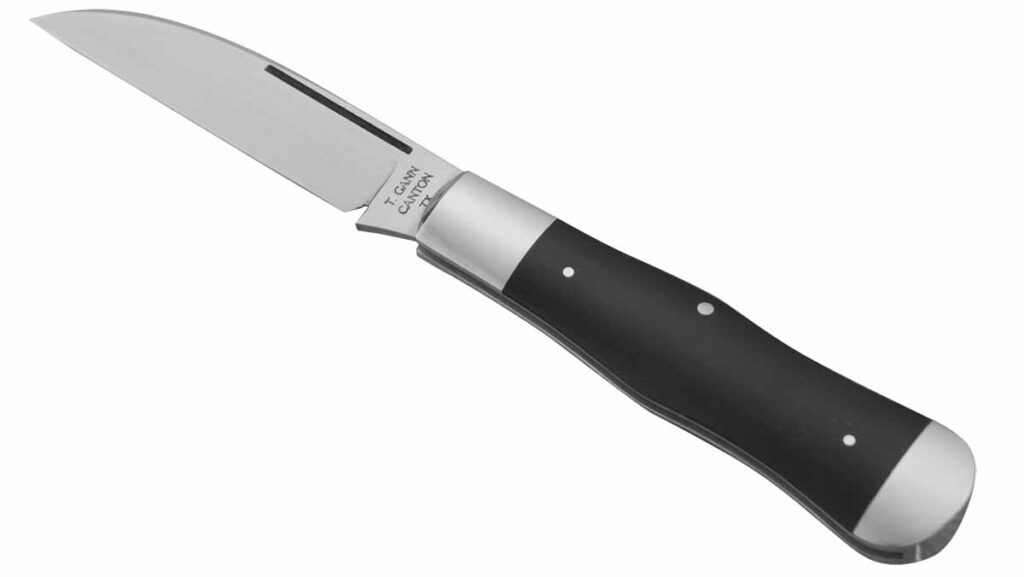
Tommy Gann: Coke Bottle Slip Joint
As Daniel O’Malley of BladeGallery.com noted, “ABS master smith Tommy Gann makes an exceptional knife. The 52100 carbon steel wharncliffe blade of his Coke Bottle Slip Joint has a handrubbed satin finish, smooth, consistent action, a firm half stop and easily opens with a light pull.” Blade and closed lengths: 2.9 and 3.9”. Bolsters: 416 stainless steel. BladeGallery.com’s price: $550. (BladeGallery.com image)
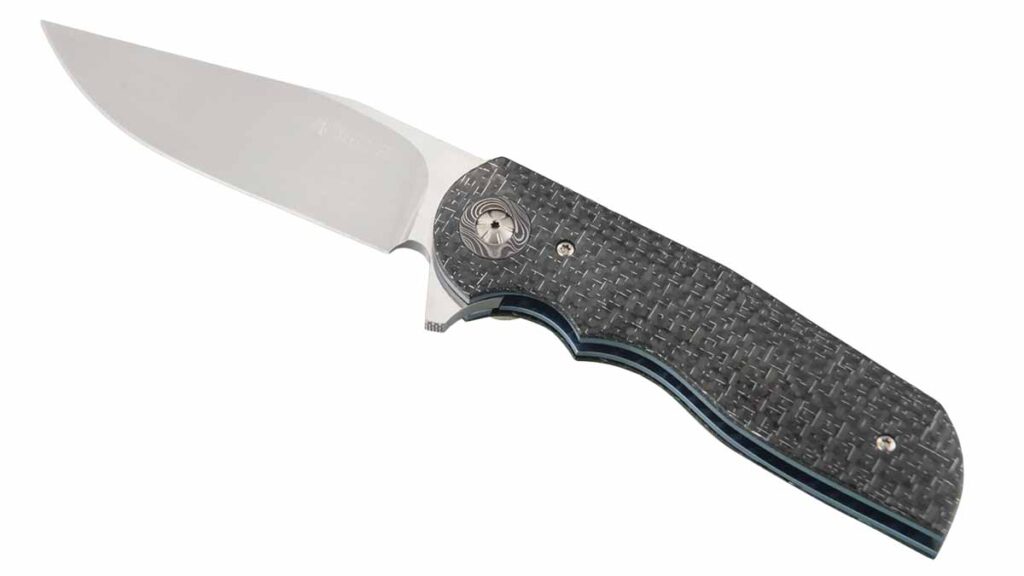
Willem Steenkamp: Raider Flipper Folder
The 3.5-inch blade of hollow-ground CTS XHP stainless steel on Willem Steenkamp’s Raider flipper folder pivots on an Ikoma Korth Bearing System. Handle: Silver-strike carbon fiber. Pivot collar: stainless damascus. Pocket clip: 3D-machined titanium anodized blue, configured for right-side, blade-tip-up carry. Lock: linerlock. Weight: 3.2 ozs. Closed length: 3.83”. BladeGallery.com’s price: $680. (BladeGallery.com image)
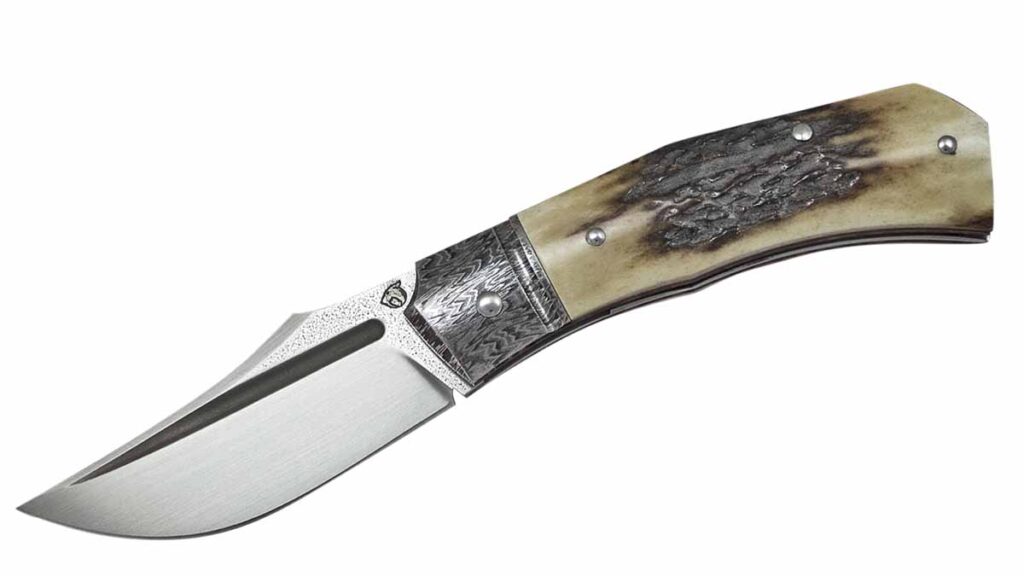
David Breniere: Mini Inglorious Slip Joint
“The Mini Inglorious slip joint by David Breniere offers a handrubbed Elmax stainless steel blade with David’s W’s pattern damascus bolster and Sambar stag scales,” stated Dave Stark of Steel Addiction Custom Knives. “The knife just melts into the hand. Truly topper fit and finish.” Blade and closed lengths: 2 7/8 and 3.25”. Weight: 3.2 ozs. Retail price: $2,000. (Steel Addiction Custom Knives image)
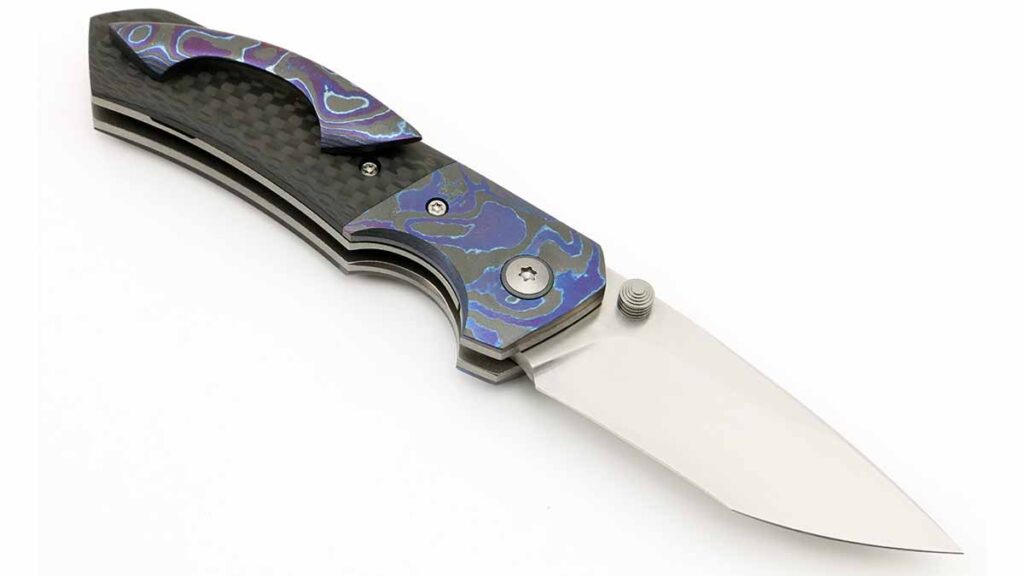
Brian Efros: Elder Tactical Folder
The Elder tactical folder by Brian Efros has a drop-point recurve blade with dual bead-blasted thumb studs. Blade length and steel: 3” and CTS XHP stainless. Handle: carbon fiber with Chad Nichols Dark-Ti damascus bolsters and backspacer, and zirconium pivot collars. The Dark-Ti pocket clip provides blade-tip-up carry. Lock: linerlock. According to Arizona Custom Knives (AZCK), the Elder has “very nice action, detent and blade seating.” Weight: 5.2 ozs. Closed length: 4.25”. AZCK’s price: $3,295. (AZCK image)
Jacek Hnatow: Bushcraft 1
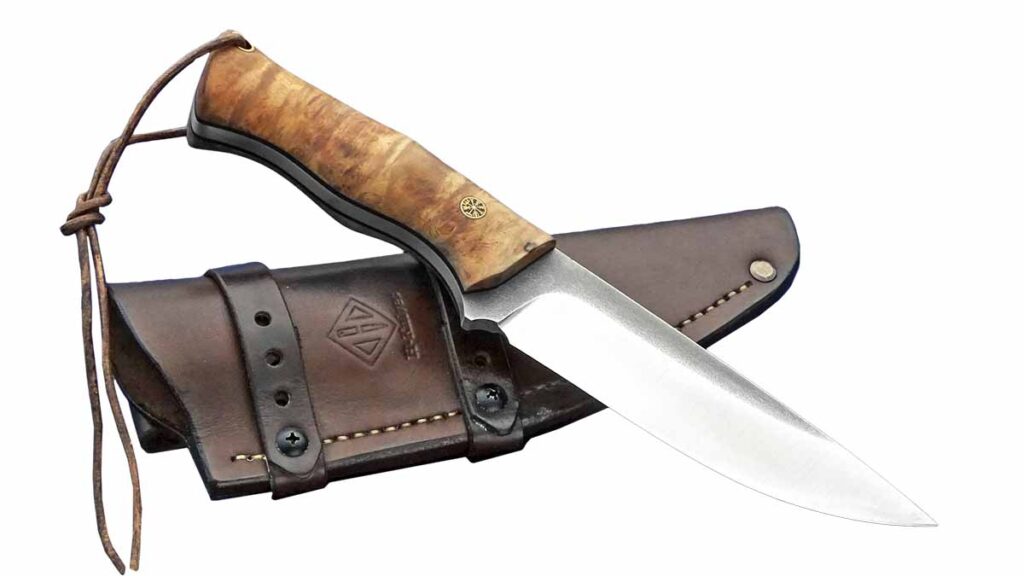
The Bushcraft 1 by Jacek Hnatow boasts full-tang construction and excellent balance and handle ergonomics. “Though designed for bushcraft, the knife makes an outstanding all-around utility tool,” observed Les Robertson of Robertson’s Custom Cutlery. Blade length, style and steel: 5.5”, drop point and Bohler N690 stainless. Handle width and material: 3.75” and textured black G-10. Overall length: 14.5”. Sheath: custom made of leather by the maker. Maker’s price for a similar knife and sheath: $325. (ImpressByDesign image)
Bill Koenig: Arius Flipper Folder
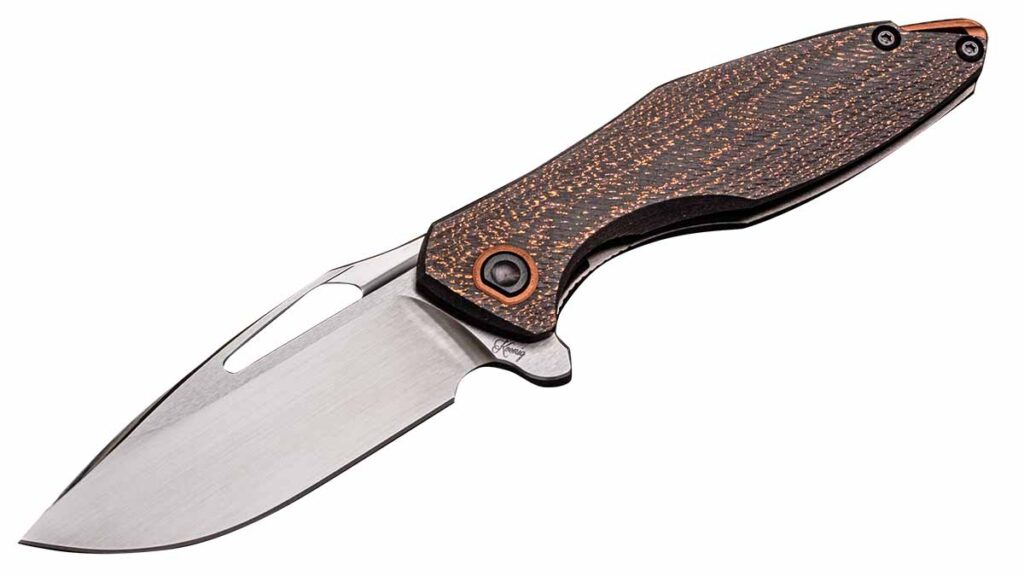
Bill Koenig’s Custom Arius flipper folder has a 3.5-inch blade of CPM 20CV stainless steel with a handrubbed satin finish and mirror-washed accents. The handle on the custom EDC knife is copper-dust carbon fiber on the front side and titanium with C-pattern milling on the framelock side. Hardware and screws: zirconium. Pocket clip: handrubbed titanium configured to carry the knife blade tip up. Closed length: 5”. Maker’s price for a similar knife: $3,510. Recon 1 sold price: $6,500. (Recon 1 image)
Piotr Gosciniak: Breaker Tanto
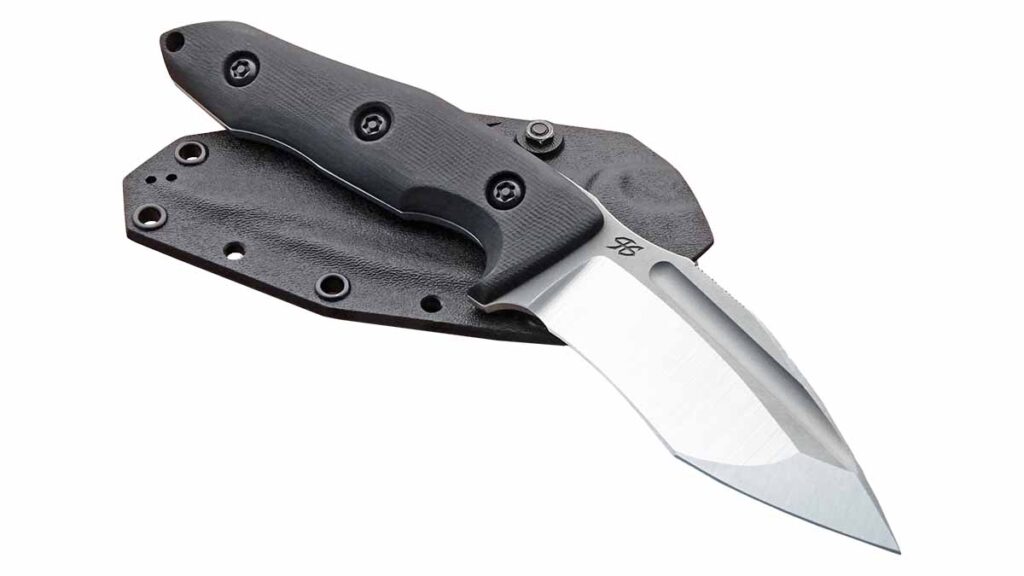
Of Piotr Gosciniak’s Breaker Les Robertson writes, “The compound grind provides the penetration of a tanto-style blade and slicing ability of a recurve blade. The texture of the black Micarta® handle gives additional grip, particularly in a wet environment.” Blade length, steel and finish: 4.7”, Elmax stainless and satin. Overall length: 10”. Sheath: custom made of Kydex® by the maker. Maker’s price for a similar knife and sheath: $415. (ImpressByDesign image)
Sean Kendrick: Ruiner Tactical Folder
Sean Kendrick’s Ruiner is a framelock tactical folder with a 3.125-inch black blade of an “unknown material,” zirconium thumb studs and a notched thumb rest. Handle: dark Timascus™ front scale, backspacer and blade-tip-up pocket clip, and an orange-peel-finished and anodized titanium lockside. Pivot: zirconium. Weight: 6.1 ozs. Closed length: 4.5”. Sean names Mike Franklin of Hawg Knives as one of his top mentors. AZCK’s price: $5,995. (AZCK image)
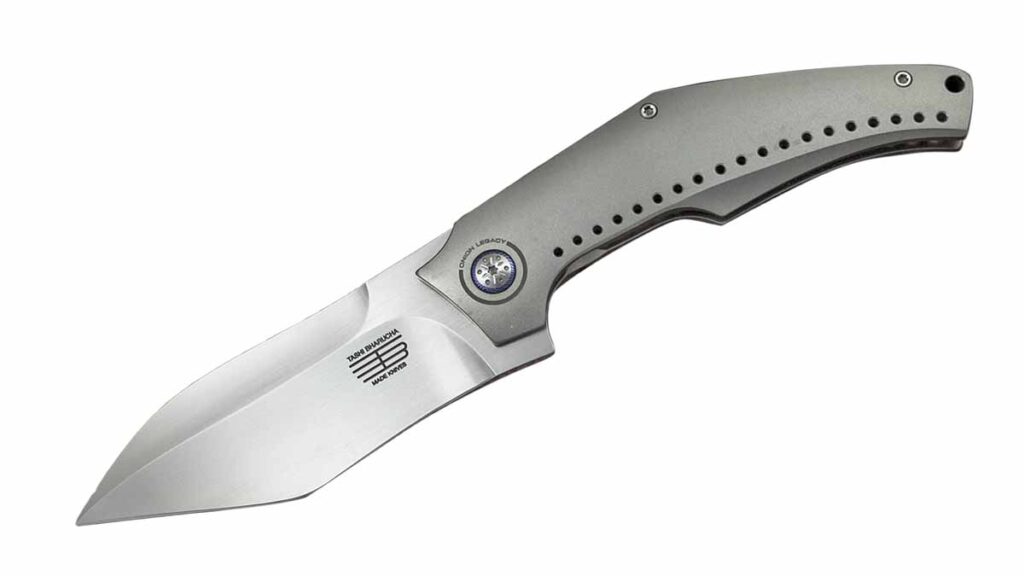
Tashi Bharucha: Onion LegacyFliper Folder
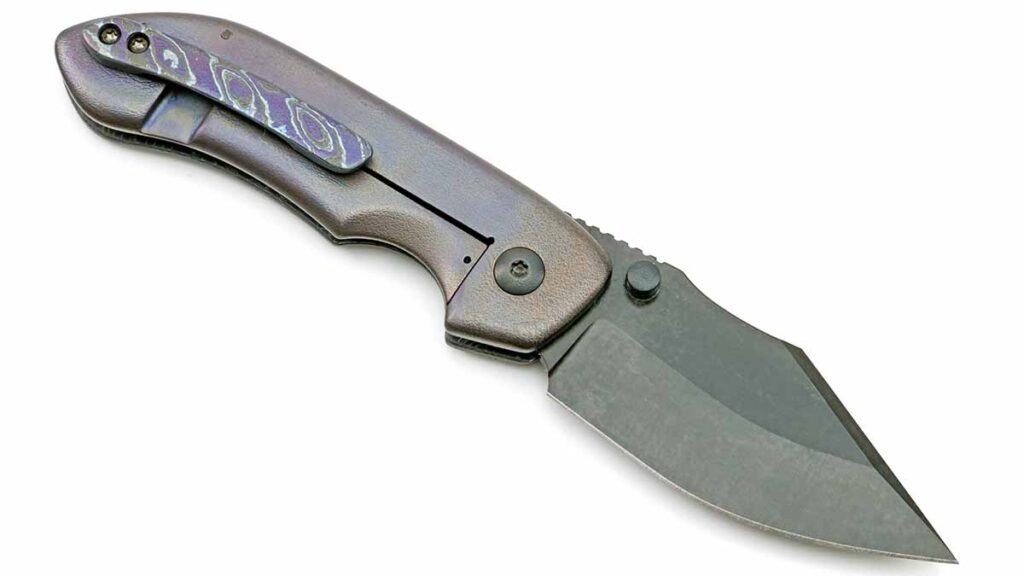
“The Legacy project is Tashi Bharucha’s way of paying homage to the icons of the knife world that have influenced him,” Dave Stark observed. “The Onion Legacy, his tribute to Ken Onion, was limited to nine pieces featuring a handrubbed RWL-34 stainless steel blade running on caged bearings. The frames are stonewashed and bead-blasted titanium with laser etching, accented by a custom-heat-colored Mokuti clip and pivot rings.” Weight and blade and closed lengths: 6.2 ozs., 4 and 4.75”. Retail price: $1,875. (Steel Addiction Custom Knives image)
Matthew Christensen: Full Dress Dreadeye
The Full Dress Dreadeye by Matthew Christensen sports a 3.375-inch high-satin-finished blade of Mike Norris Fire Clone damascus and dual zirconium thumb studs. Handle: Zirblast-finished Ant Farm Mokuti scales, and zirconium pivot collars, backspacer and blade-tip-up pocket clip. Weight: 4.9 ozs. Closed length: 4.625”. One of Matthew’s leading mentors is Dave Curtiss of Curtiss Knives. AZCK’s price: $3,595. (AZCK image)
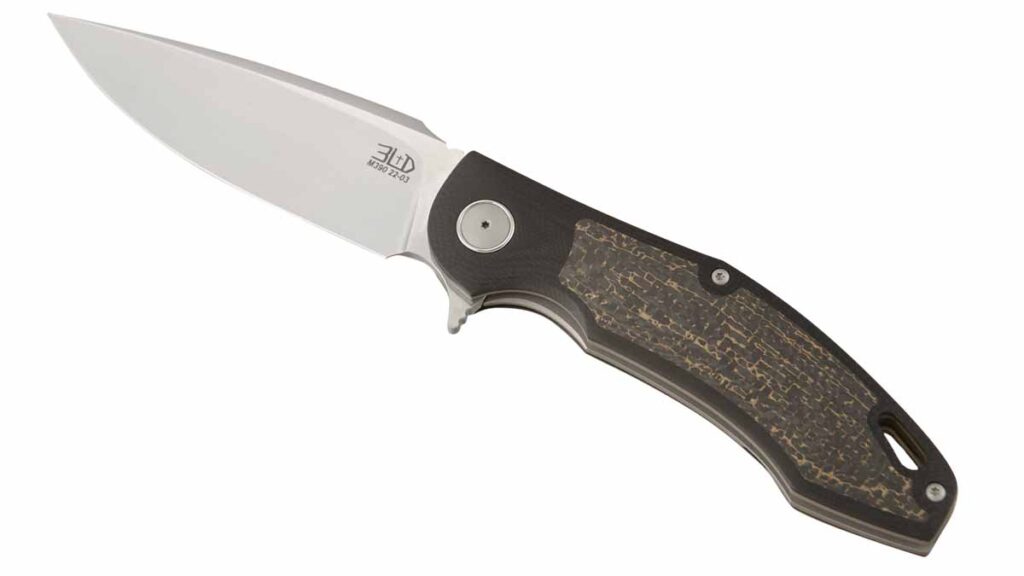
Riann Manser: H4 Flipper Folder
South African Riann Manser’s H4 custom EDC knife has a 3.7-inch blade of satin-finished M390 stainless steel that runs on caged bearings. “It is perfectly centered, has silky-smooth action” and opens easily via a flipper tab, Daniel O’Malley noted. Handle: black G-10 with gold snakeskin FatCarbon inlaid into each side. Backspacer: black G-10. Liners: bead-blasted Gr6 titanium. Lock: linerlock. Pocket clip: bead-blasted titanium, configured for right-side, blade-tip-up carry. Closed length: 4.8”. BladeGallery.com’s price: $695. (BladeGallery.com image)
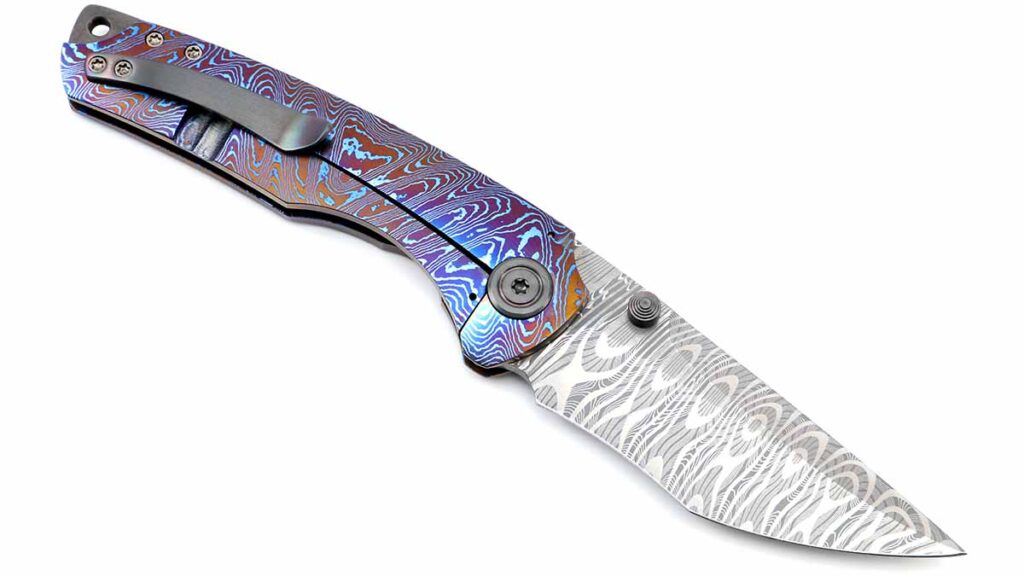
Sergey Shirogorov: Mini Quantum Flipper Folder
The Mini Quantum flipper folder by Sergey Shirogorov is highlighted by a rotating titanium pocket clip that carries the knife blade tip up. Blade length and steel: 3.5” and Mike Norris damascus. Handle: titanium. Closed length: 4.5”. Maker’s price: varies depending on what the knife brings at the various auctions where it is sold. Recon 1’s price: $10,000. (Recon 1 image)
RJ Martin: Q36 Flipper Folder
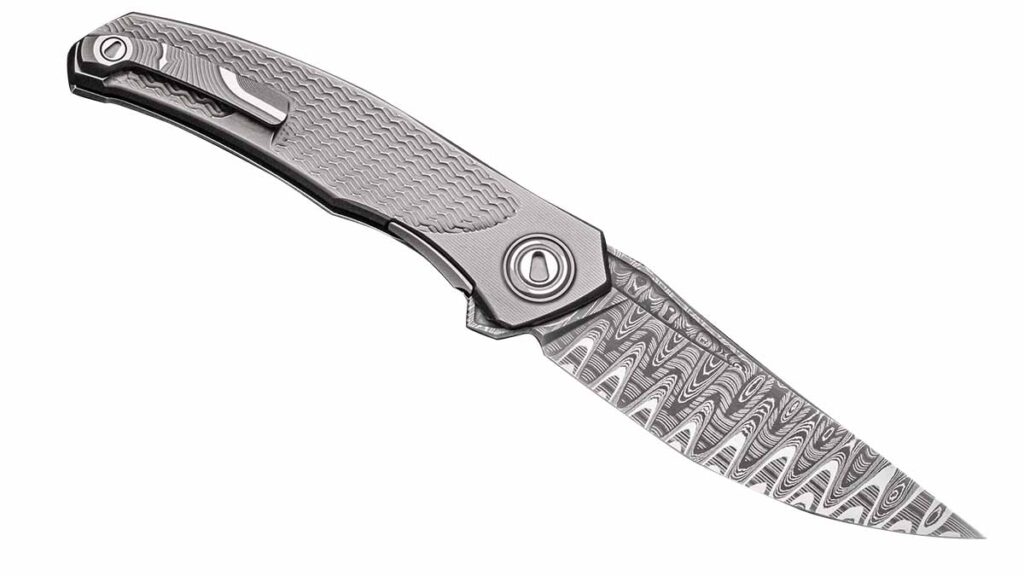
Custom knife purveyor Les Robertson has been buying Q36s since RJ Martin started making them. According to Les, “RJ never ceases to amaze me how he incrementally improves this knife: serrated thumb ramp, extremely lightweight, hypersonic flipper opener and bank-vault lockup.” Blade length and steel: 4” and MagnaCut stainless. Frame: grooved titanium. Closed length: 4 7/8”. RJ’s price for a similar knife: $3,200. (ImpressByDesign image)
Thomas Gony: Speartac Front Flipper
Frenchman Thomas Gony’s Speartac front flipper has a 3 3/8-inch blade of handrubbed RWL-34 stainless steel. The titanium handle features Zircuti inlays, pivot rings and pocket clip (blade tip up). Weight: 4.8 ozs. Closed length: 4.5”. Retail: $2,600. According to Dave Stark, there is such a huge demand for Gony’s work that Thomas can no longer take custom orders. (Steel Addiction Custom Knives image)
Dmitry Sinkevich: Skiving Tanto
A 3.125-inch tanto blade of K110-core san-mai and a titanium handle help complete the Skiving Tanto prototype by Dmitry Sinkevich. The pivot and blade-tip-up pocket clip are zirconium on this custom EDC knife, and the body screws are titanium. Closed length: 4”. Maker’s price: varies depending on what the knife brings at the various auctions where it is sold. Recon 1’s price: $10,000. (Recon 1 image)
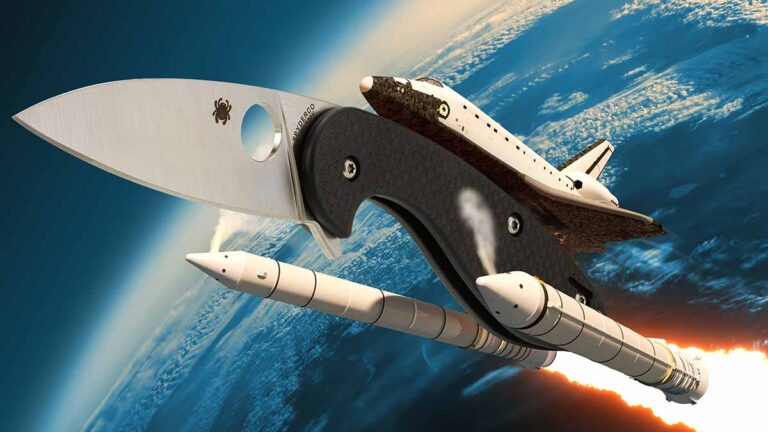
With a simple finger flick or even in promo art, today’s flipper knives fly.
Early flipper folders were used in conjunction with assisted-opening mechanisms as a means for initiating movement, allowing the spring or torsion assists to open the blades the rest of the way. A few years later, folder pivots incorporated ball bearings, nearly negating the need for assisted-opening mechanisms on flippers.
This reduced friction simplified folder construction and provided glassy smooth blade rotation. Although a few companies still offer assisted-opening flipper folders, most production versions rely on ball bearings.
Flipper Folders: Function Flows From Form
A flipper tab and ball bearings don’t necessarily equate a folder with quick action and secure deployment. A flipper mechanism will not work properly without a well-designed detent.
Imperative is the detent’s power to secure and hold the blade shut. When placing pressure on the flipper tab with an index finger, the user should be able to feel the grab of the detent. With more pressure on the flipper, the inertia of the blade overrides the pressure of the detent, and kinetic energy swings the blade into the fully open and locked position.
An imprecise detent results in either sloppy action or a flipper mechanism that requires too much pressure against the narrow tab. Optimally, with pressure on the flipper tab, the detent holds its load for a second before letting the blade go with enough energy to snap it open.
Finding Fun In The Fidget Factor
It’s the flipper action that is so satisfying. It imbues a “fidget factor” that causes knife users to snap open their folders while watching TV, talking on the phone, lying in bed or practicing any number of mundane daily routines.
The latest flipper folders not only offer pleasing aesthetics but stay true to the ideals of their predecessors. With premium materials, designs that make use a pleasure and looks that astound, they epitomize some of the coolest knives around.
Best Flipper Knives
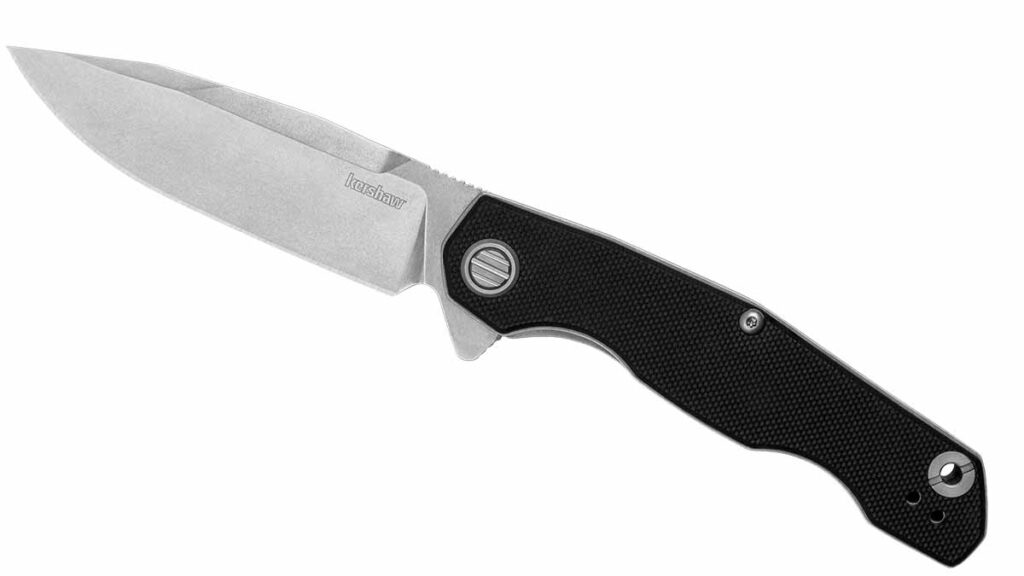
Kershaw Inception
The stonewashed blade of the Kershaw Inception pivots on KVT ball bearings. The custom pivot collar adds a touch of class.
At Kershaw, the Inception is looking good with performance to match. “I love the clean, stylish look,” related Kershaw Marketing Manager Dominic Aiello, “but the satisfyingly smooth action is what really makes the Inception a top-notch manual everyday carry.”
The flipper tab was not designed with the intention of acting as a single guard, Aiello says, but rather in combination with the textured handle overlays to help prevent the user’s hand from slipping. Along with that, the D2 tool steel blade .11-inch at the thickest provides enough heft to balance durability and ease of slicing. The clip is reversible and deep carry with flush screws that won’t snag in the pocket or impede quick deployment.
Kershaw Inception Specs Company: Kershaw Blade Length: 3.25 inches Blade Material: D2 tool steel Handle Material: G-10 Lock: Linerlock Weight: 3.1 ounces Pocket Clip: Ambidextrous/reversible, deep carry, tip up Closed Length: 4 inches Country Of Origin: China MSRP: $99.99
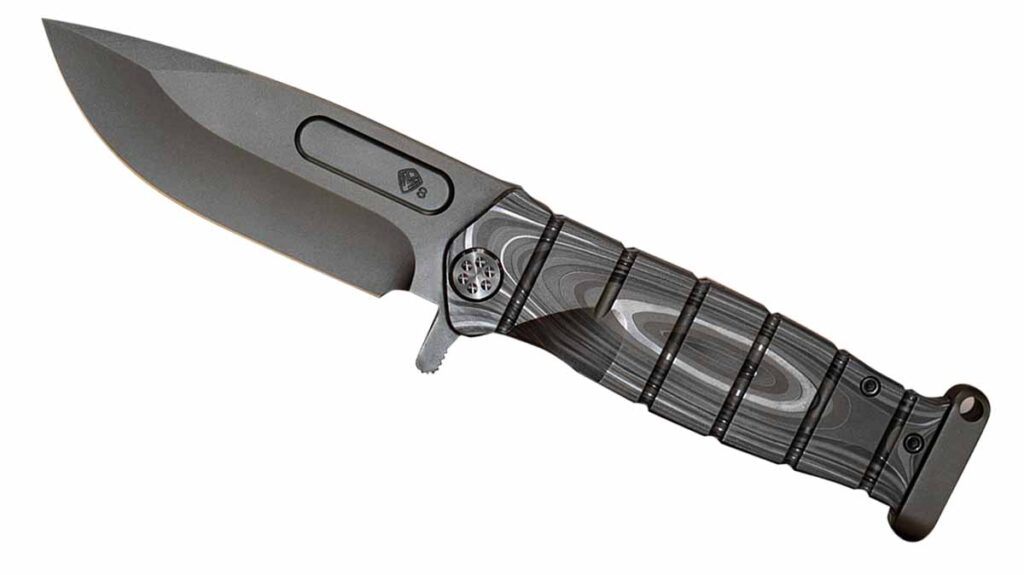
Medford Knife & Tool USMC Fighter Flipper
The CPM S35VN stainless blade of the Medford Fighter Flipper is 3/16-inch thick at the thickest and has a Rockwell hardness of 58 HRC.
The USMC Fighter Flipper from Medford Knife & Tool boasts an iconic name and incorporates titanium along with other highly durable components. “Where to start?” commented Medford representative Geoff Oprandy. “First, the USMC Fighter Flipper has superior design, engineering and aesthetics. When Greg Medford was inspired to make this knife, it didn’t take long for initial sketches to appear. He wanted a worthy companion piece for our top-selling Fixed Fighter, which has been a category king for quite some time.”
Oprandy describes the USMC Fighter Flipper as “a unique mixture of titanium components with the best CPM S35VN blade steel. This is a big, manly knife that’s as comfortable working as it is cruising around in your pocket. There is so much going on with it that it’s hard to take in, from the retro milling on the handles, drop-point blade, and integral Ti pommel to the bearing pressed into the one-of-a-kind pocket clip. The tab is designed to be a tad longer and has a unique radius with a knurled feature. For being a large knife [it provides] great purchase, and the flipper tab combined with the finger-indexing groove enable a great grip. The knife runs on phosphor-bronze washers custom made to meet our specs.”
According to Geoff, the knife has a special connection with the United States Marines Corps. As designer Greg Medford related, “When you hold it in your hand, almost 250 years of Marines speak to your soul.”
The design is intended to feel at home with users who prefer the “connection” made with a large folder, Oprandy says. “When people position the knife correctly and begin to use it,” he stated, “the energy transfer seems balanced, natural and confidence inspiring.”
USMC Fighter Flipper Specs Company: Medford Knife & Tool Designer: Greg Medford Blade Length: 4.25 inches Blade Steel: CPM S35VN stainless Handle Material: Titanium Pivot Action: Phosphor-bronze washers Weight: 9.8 ounces Pocket Clip: Titanium; standard carry Closed Length: 5.25 inches Country Of Origin: U.S.A. MSRP: $840 and up
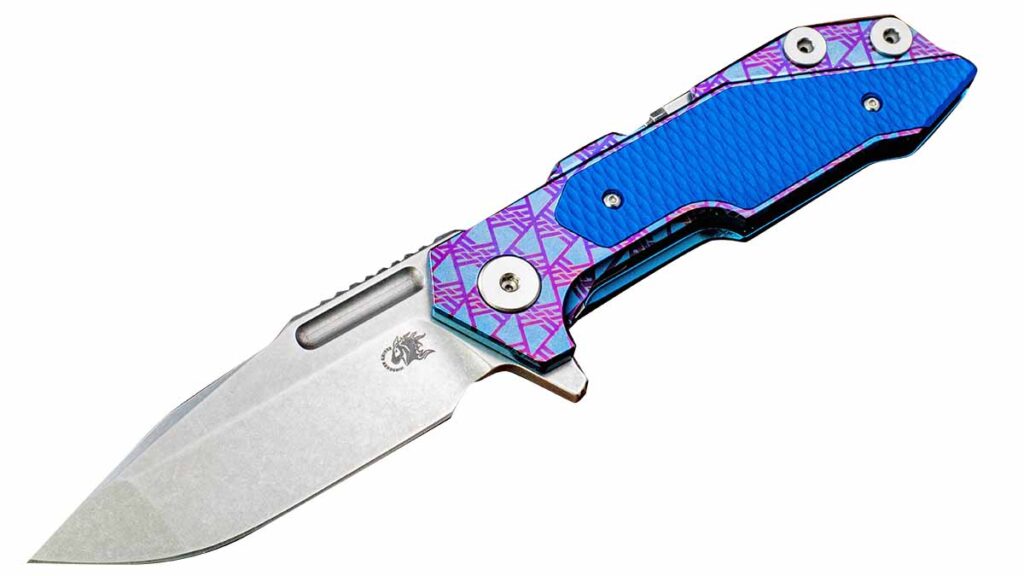
Rick Hinderer Knives Full Track Spearpoint “Nuked”
The Full Track Spearpoint “Nuked” has a removable tool seated in the spine for disassembly/assembly of the knife. The scale on the show side is removable to store spare washers and spacers.
Sam Santa Rita, general manager of Rick Hinderer Knives, says the Full Track Spearpoint “Nuked” is a bigger version of the company’s “very popular Half Track model. It is one of our larger folders at 3.75 inches and has titanium handles with G-10 inserts. The Full Track features a removable tool seated in the spine of the folder that is capable of complete disassembly of the knife.” The folder also utilizes a G-10 insert cover on its show side that hides a pocket for the storage of steel inserts and washers for the Rick Hinderer Knives Tri-Way Pivot System. This allows the user to easily swap from bearings to washers or vice versa depending on the situation.
“Its size and durability coupled with the ease of maintenance and ‘customizability’ makes the knife a perfect hard-use folder capable in any environment,” Sam added. The Full Track is available in stainless blade steel options of CPM S35VN, CPM 20CV and M390. Another blade steel option will be released later this year.
The Full Track flipper tab doubles as a single guard, while the blade pivots on caged thrust bearings. Meanwhile, the Tri-Way Pivot System allows for the aforementioned use of Teflon™ and phosphor-bronze washers as well, which come standard with the knife.
Full Track Spearpoint “Nuked” Specs Company: Rick Hinderer Knives Designer: Rick Hinderer Blade Length: 3.75 inches Blade Steel: CPM 20CV stainless Handle Material: G-10 Lock: Framelock Pocket Clip: Yes Weight: 6.9 ounces Closed Length: 5.125 inches Country Of Origin: U.S.A. MSRP: $820
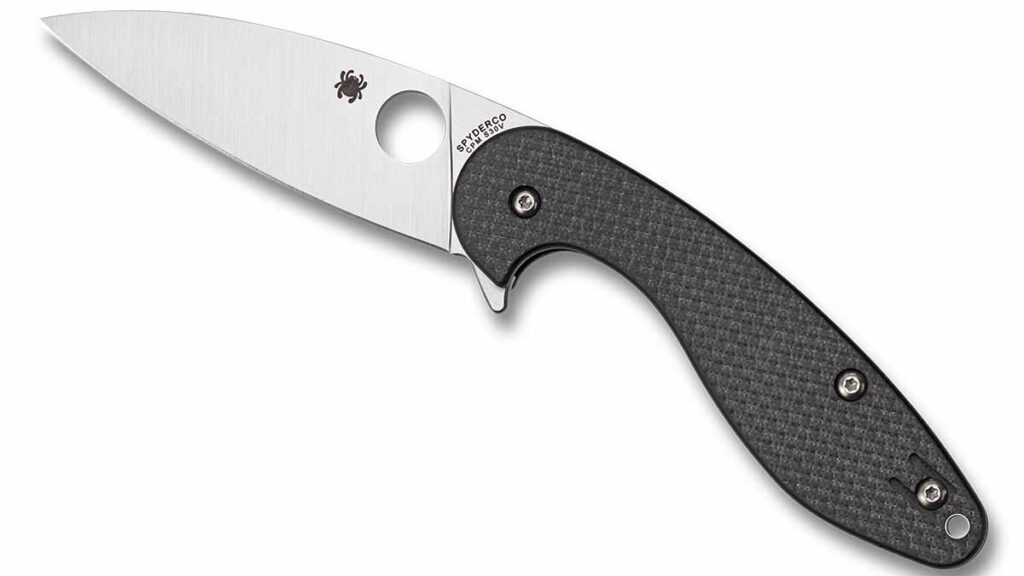
Spyderco Sliverax
The Sliverax is the first factory folder to combine Spyderco’s Compression Lock® with a flipper-style opener. Blade thickness and grind: .138 inch at the thickest and full flat.
The Sliverax is a bit of a departure for Spyderco. “It’s a flipper design, which is not common among Spydercos,” explained Joyce Laituri, company marketing manager. “The designer, Paul Alexander, is a different type of cutlery designer we have worked with in the past. He holds a doctorate in industrial design and mechanical engineering, and is a leading researcher for a company in the automotive industry.”
The Sliverax brings a shape with seamless flow and a slightly negative blade angle to enhance leverage, placing the point on the knife’s centerline for utility and control. “The negative angle also shortens the opening arc combined with the round hole and flipper mechanism for a full spectrum of positive, high-speed one-hand-opening options,” Joyce commented.
“The flipper tab doubles as a guard,” she continued, “and it’s easy to see and feel when the knife is held. There is a large, deep finger choil already, and the flipper mechanism in the open position extends the choil, creating a comfortable and deep guard for the index finger, or pinky if held in a reverse grip.”
Laituri describes the opening experience with the Sliverax as “slick as a Slip & Slide.” The mechanism features a phosphor-bronze bushing with ball bearings and a nested liner for structural strength. The CPM S30V stainless blade is exceptional in its combination of toughness, wear resistance and corrosion resistance as well, while the ergonomics of the handle are derived directly from its innovative shape, super-thin choil and expansion at the butt to fill the hand.
Spyderco Sliverax Specs Company: Spyderco Designer: Paul Alexander Blade Length: 3.48 inches Blade Steel: CPM S30V stainless Handle Material: Carbon fiber/G-10 laminate Lock: Compression Lock® Weight: 3.3 ounces Pocket Clip: Deep pocket, wire, ambidextrous, tip up Closed Length: 4.52 inches Country Of Origin: Taiwan MSRP: $306
Editor’s Note: Mike Haskew and Dexter Ewing contributed to this post.
Priced right and darkly attractive, the Spartan Poros offers a work-a-day option.
It’s been a big year for the folder end of Spartan Blade’s catalog. In June, the North Carolina manufacturer took home Manufacturing Quality accolades from the 2023 BLADE Show Knife of the Year awards. For the record, it was an artistically executed Harsey Folder that earned the company the honor. Now, the company has further expanded this end of its offerings with a wicked-looking flipper, home-cooked by one of Spartan’s founding fathers.
Shake hands with the Spartan Poros, a full-sized option with plenty of versatility baked into the package. The piece was designed by company co-founder Curtis Iovito, who has several standalone designs spotting the firm’s lineup, including Alala, Formido and Zelos, among others. The Poros appears to share a lot of the same lines and design points of auto Zelos, particularly in handle ergonomics. Though, the new knife has much more (pardon the pun) Spartan aesthetics than its predecessor, casting it into a much more work-a-day role.
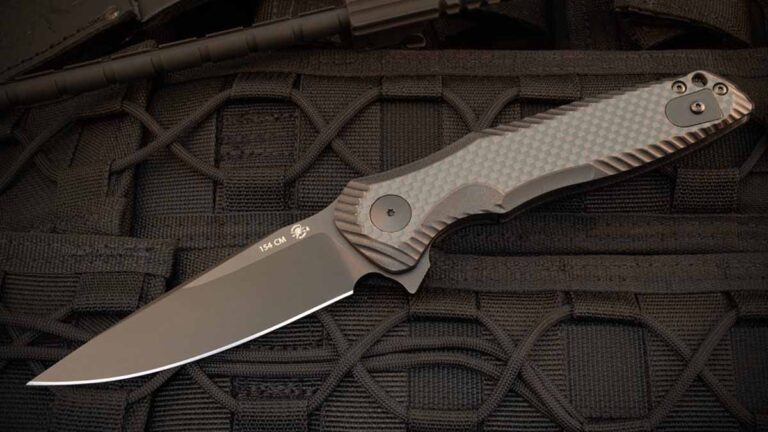
As to the tale of the tape, the drop-point knife sports a 3.75-inch blade that boasts an understated swedge running nearly its entire length. This adds a bit of character to the otherwise very liner overall blade design. Spartan uses 154CM stainless steel for the blade (58-60 HRC), applies a flat grind and finishes it with Black Titanium Nitride Coating (TiN) for added protection and dark good looks. The knife is a flipper-only affair, with a relative demure kicker that gets the blade into the action. IKBS bearings make it fast opening and give the knife a bit of snap when deploying.
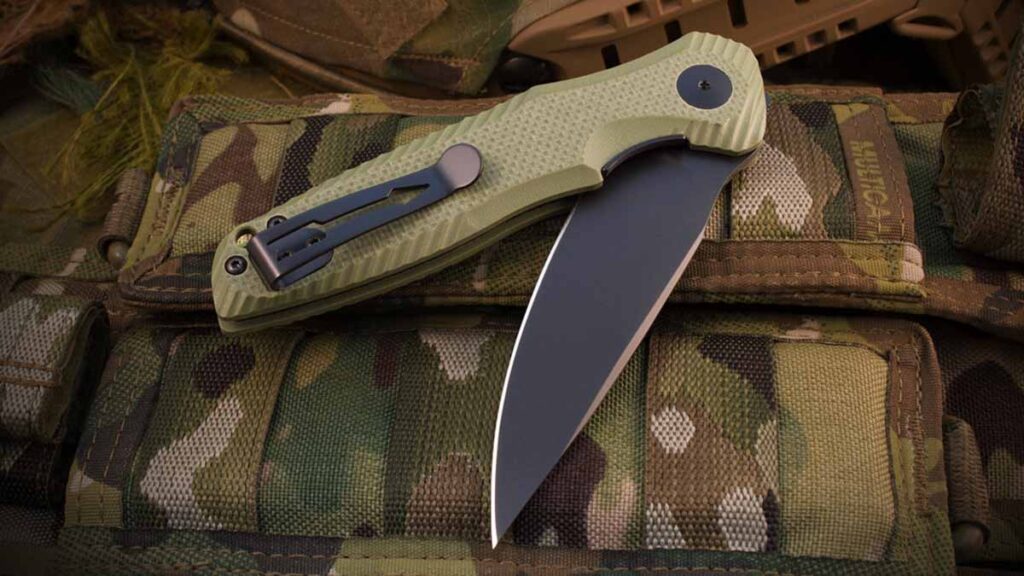
Spartan offers a trio of handle options, each nicely complimenting the blade—black or OD green G-10 or black carbon fiber-G-10 composite. In both cases, the handle adds to the overall sleek looks of the Poros. The liner lock’s aggressively textures the scale but keeps comfort in mind significantly chamfering the edges of the handle so its fairly sharp design wouldn’t tend to bite or create hot spots. Spartan tops it off with a reversible loop over clip with its signature Spartan arrow. Note, the company supplies a steel tab to fill the recess opposite to the side the clip is installed to maintain the overall continuity of the handle.
At 5.4 ounces, the Poros certainly won’t weigh down its carrier. And classified as “Field Grade” by Spartan, the knife comes in at the lower end of the company’s price range. In this case, Spartan lists it at $180 for the G-10 models and $190 for the carbon fiber-G-10 composite model.
Spartan Poros Specs
Designer: Curtis Iovito Blade Length: 3.75” Blade Thickness: 0.125” Overall Length: 9.0” Blade Steel: 154CM Stainless Steel Blade Hardness: 58-60 HRC Blade Style: Folding-Drop Point-Flat ground Blade Finish: Black Titanium Nitride Coating (TiN) Frame: Liner lock with black or OG Gree G10 scales, black carbon fiber-G-10 composite scales Weight: 0.330 LBS MSRP: $180 G-10 scales; $190 carbon-fiber-G-10 scales
Don’t let its throwback good looks fool you, Rothman’s Gentleman’s Trapper has serious EDC chops.
The original EDC knife is a pocketknife. It used to be a right of passage when you were allowed to have a hand-me-down knife in your front pocket. I received mine at the ripe old age of 5. I used it to sharpen pencils and crayons and for whittling.
After a few years and a few cuts on my fingers, I progressed to skinning and cleaning fish. The knife never left my front pocket. I carried it to school for daily uses. It also made quite a few trips in the washing machine and dryer. My mom would have a fit every time she heard it thumping in the dryer. Of course, the laws have changed now and the younger generation has found other things to entertain themselves. For me, my old pocketknife is retired.
Mike Rothman’s Gentleman’s Trapper would make a great pocket filler. It walks and talks perfectly. But how well does it cut? Let’s see.
Gentleman’s Trapper Sharpness Test
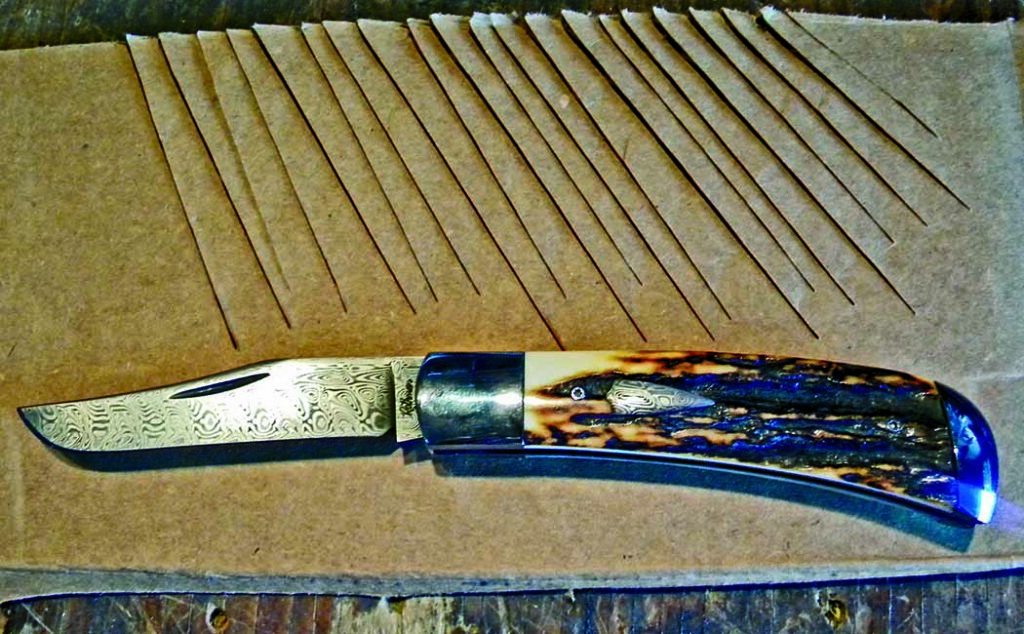
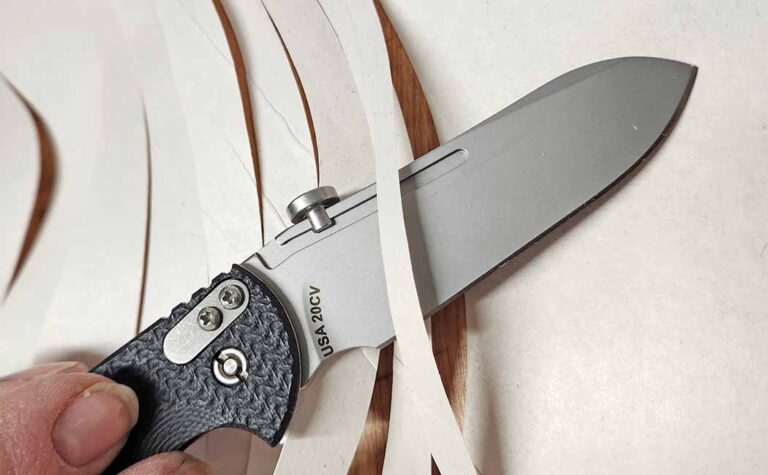
Twenty-pound bond copy paper provided the first test. The slip joint sliced it cleanly and effortlessly. The edge is very fine, so control was easy. It’s a nasty-sharp knife for sure—I could hear the blade slicing aggressively.
Light Duty Cutting With The Gentleman’s Trapper
After dispatching single-walled cardboard with the Rothman knife, the author only had to use a tad more pressure on the push cut to zip through double-walled cardboard.
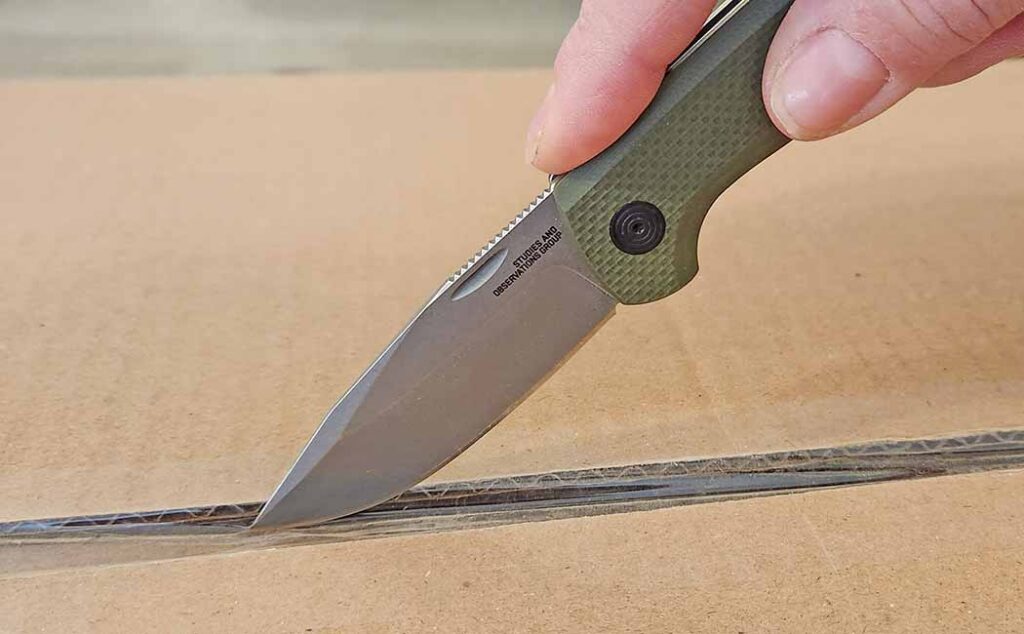
On to single-walled cardboard. The Gentleman’s Trapper made short work of it. In fact, it was very addictive slicing the cardboard. The blade made smooth, straight cuts with no deflection of the material. Very sharp indeed!
Next I found a piece of double-walled cardboard to try. I only had to use a tad more pressure on the push cut to zip through it. I could hear every cut again. The knife is a very forceful cardboard cutter.
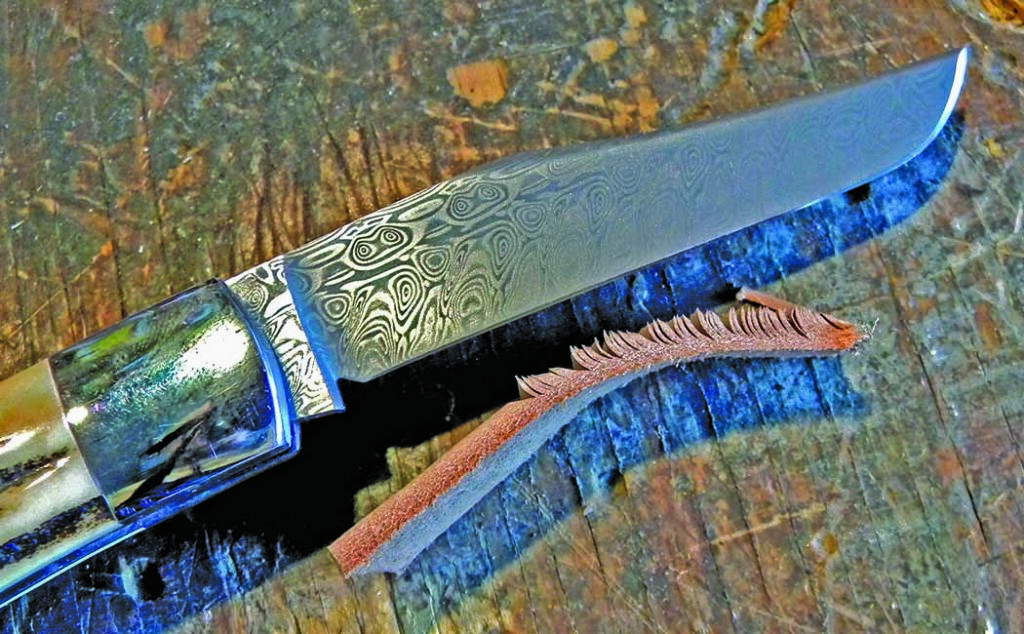
The thin blade made skiving leather simple, producing super thin slices repeatedly.
It was time for the leather slice and skiving. The trapper zipped through the leather quickly, so I had to use my knuckles as a stop to keep the piece together so it wouldn’t turn into a pile of pieces. The thin blade made skiving simple, producing super thin slices repeatedly. The stag handle worked perfectly providing a positive grip cutting the leather.
Heavy-Duty Cutting Duty
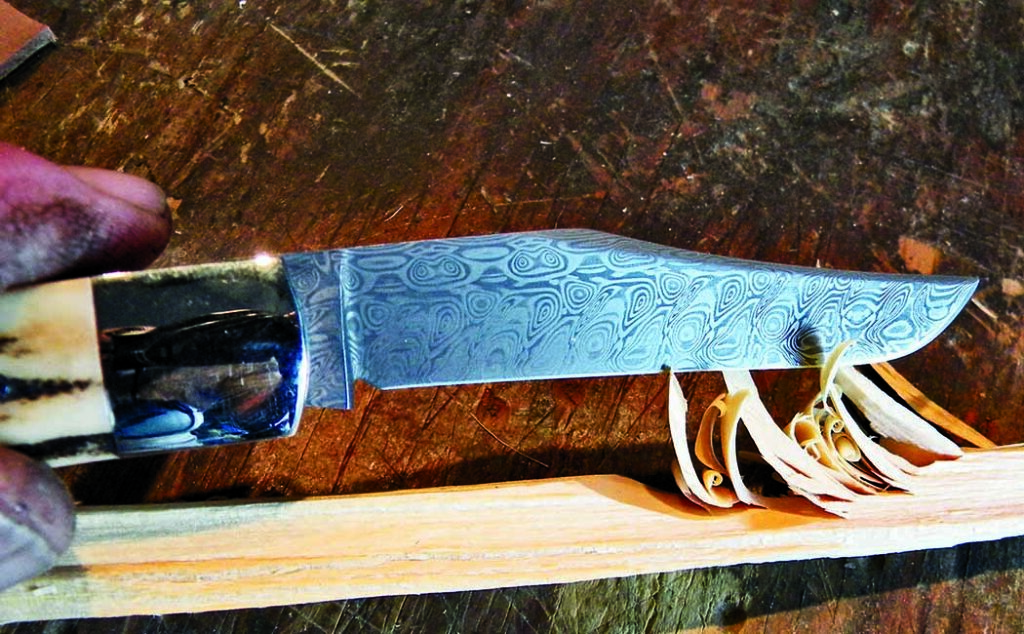
Whittling was up next. The thin blade produced some of the finest curly-cues I’ve seen. I changed the angle of cut for a deeper bite. I could see and feel the blade flex as deeper bites ensued. It was a very weird sensation, to say the least. I just moved the contact surface closer to the bolsters.
In the whittling test, the author changed the angle of cut for a deeper bite. He could see and feel the edge flex as deeper bites ensued.
Half-inch sisal rope beckoned. I was looking forward to this one. Dang, this trapper performs—273 crunching cuts and the edge was barely sliding! It was easy to cut with and the handle was comfortable with a tight grip. The insides of the liners are a bit sharp but there were no hot spots. Wow!
I returned to the 20-pound bond paper to see if the edge was affected by all the testing. Nope—same clean slices in the material, a sign of great heat treatment.
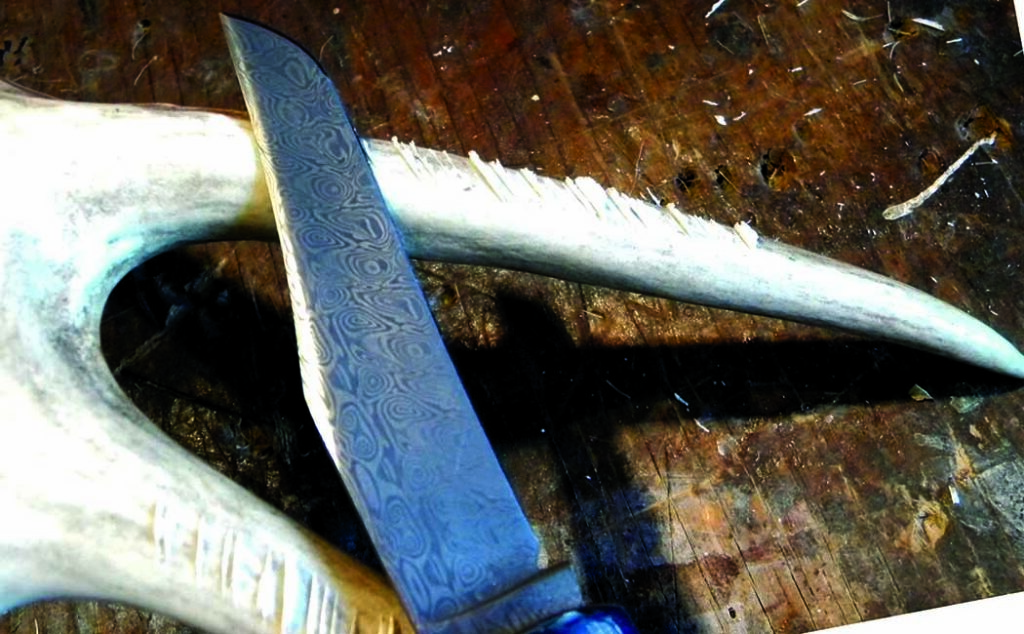
The author whacked the blade 30 times into the antler with no edge damage at all. The edge would still pull hair and the knife was as tight as when the author started, still walking and talking.
I was compelled to do a warranty-breaking test just to see how tough the Gentleman’s Trapper is. Where was the deer antler? I whacked the blade 30 times into the antler expecting to see some minor edge damage. There was no damage at all! The edge would still pull hair and the knife was as tight as when I started, still walking and talking.
Overall Impression Of Rothman’s Work
I was impressed with the performance of the blade considering how thin it is. Excellent workmanship!
Does Anything Need To Change?
Soften the exposed inside edges of the liners. That’s all, folks!
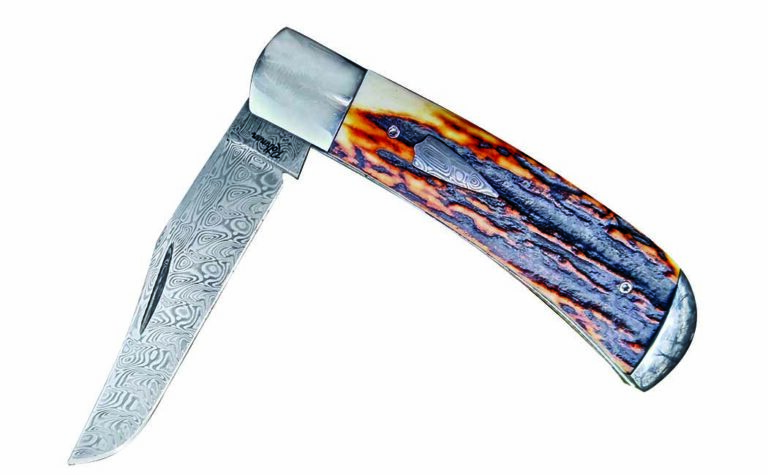
Gentleman’s Trapper Specs: Knife Type: Slip joint/pocketknife Maker: Mike Rothman Blade Length: 3” Blade Steel: Damasteel damascus in an Ægir pattern Blade Grind: Hollow Blade Pattern: Clip point Blade Thickness: Tapers on the spine from 1/8” above the ricasso to .039” at the tip; the edge is even thinner than the latter Handle: Sambar stag w/shield of same material as the blade Handle at the Thickest: .5” Liners: Fileworked of 410 stainless steel Bolsters: 416 stainless steel Backspring: CPM 154 stainless steel Weight: 3.5 ozs. Closed Length: 4” Knife to know: There is a seamless fit of blade to backspring in the open position Extras: Comes in black zippered pouch w/Rothman’s company name over shape of the state of New York Maker’s price: $750
The slip joint knife endures as a time-tested design, perfect as an everyday pocket companion. Here we look at some of the best modern takes on the classic style of knife.
The slip joint is perhaps the most recognized form of folding knife. Chances are you started your knife collecting journey by buying some sort of slip joint, such as a Swiss Army knife or other multi-blade.
Slip joints have been on the comeback trail for some time now, with an increasing number of factory knife companies offering new examples of the tried-and-true design. This is good for the entire slip-joint genre, as novice collectors discover, and veteran ones rediscover, their love for the classic traditional folders.
CRKT Venandi
CRKT and custom knifemaker Richard Rogers have a few factory collaborations under their belts. Richard’s distinct style lends to knives with both a signature-refined appearance and a high level of usability. He mainly makes higher-end custom knives, and his work is sought by discerning collectors.
CRKT’s newest Rogers collaboration is the Venandi, a single-blade trapper featuring a 3-inch
blade in a modified clip-point pattern and 8Cr13MoV stainless steel. The handle is a brown-and-black G-10, and the contour brings out the woodgrain-style layers for an exciting visual pop. The triangular-shaped bolts and pivot bolt provide a distinctive touch of class, and the bomb shield is a nice touch.
Despite being a larger slip joint, at 1.8 ounces the knife is lightweight and rides comfortably inside a pocket or next to your wallet. The blade’s pull is a bit stiff and that’s on purpose. There is a half-stop, in which the blade pauses midway through opening and closing cycles. A large nail nick assists in opening. A hollow grind and a bit of a swedge dress up the blade’s appearance.
The Venandi is stylish and functional. It’s a knife you can carry when dressed up for church or the office, tackling home improvement projects, or doing yardwork. Out of the box, the blade is centered and the action is crisp.
My only complaint is the lack of a hole to attach a lanyard for grabbing at the top of the pocket for easier knife access. With an MSRP of $49.99 and made in China, the Venandi is a highly functional custom-designed folder that won’t break the budget—and it’s really good looking to boot.
Spyderco Lil Native Slipit
With optimized ergonomics for enhanced cutting performance, the Spyderco Lil Native Slipit is a compact folder that feels larger in the hand than you might think. Of course, this is no surprise as Spyderco is the master of ergonomics for smaller knives, the result being an extremely comfortable user experience.
The Slipit line of slip joints offers traditional Spyderco performance for jurisdictions—most of which are overseas—that ban lockblade folders. The company’s Native locking folders have been great sellers, and it makes sense to offer the design in a Slipit version, too.
The Lil Native Slipit’s 2.4-inch blade is CPM S30V stainless steel, well known for its edge-holding power, and features Spyderco’s signature leaf shape. A full flat grind thins the cutting edge out nicely, enabling the knife to sail through a variety of materials quickly and efficiently.
The handle is peel-ply G-10 in a texture that provides enough traction without being overly aggressive. In an open length just shy of six inches, the folder is big enough to complete most daily cutting chores.
The action is extremely smooth thanks to bronze washers and a full polished tang, allowing the blade’s spring to glide effortlessly over the surface while opening and closing. Since the Lil Native isn’t a traditional slip joint, Spyderco uses a notched joint in the tang to allow the backsprings to firmly seat to hold the blade open.
To close, applying pressure to the blade spine generates enough force to overcome the notched joint and thus allows the blade to rotate closed. The action is akin to a lockback folder—firm yet smooth. The blade hole allows you to open and close the folder easily with one hand as you would with any of the company’s lockblade models—a rarity for a slip joint. A steel pocket clip mounts in one of four configurations for carrying the Lil Native Slipit most any way you desire.
Made in the USA, the MSRP is $198.
Boker Barlow Prime EDC
The barlow is a classic pocketknife pattern many workingmen know. It’s a simple design that holds up well to a variety of slicing chores. Through the years many companies have offered their own versions of the pattern, and the Boker Barlow Prime EDC is one of the latest iterations.
Featuring an old-school design executed with modern materials, the knife has a 2.4-inch spear-point blade ground from N690 stainless steel and a satin finish. Action is smooth opening and closing. There’s also a nice half-stop.
The handle is black canvas Micarta® with a smooth polished finish that is a touchy-feely delight. Even the pins are flush with the grip surface. The handle is linerless, which helps save weight and reduce thickness. The contoured handle allows the Barlow Prime EDC to both feel terrific and ride comfortably in a pocket. Speaking of which, the knife almost disappears in the bottom of one.
Weighing in at 1.23 ounces, the Boker makes a great EDC knife. It is perfect for those who do not like bulk when carrying a pocketknife. It takes on small, mundane daily cutting tasks with ease—opening mail and boxes, packs of crackers, pesky clamshell packages, etc. It’s small enough to not attract unwanted attention. For those who like single-blade slip joints for daily carry, add this one to your list.
Made in Germany, the Boker Barlow Prime EDC has an MSRP of $185.95.
LionSteel JKCF Jack
And now, for something a bit different—the LionSteel JK3CF Jack. LionSteel’s slip joints are a departure from the norm since they have nothing but high-end materials in their construction. The JK3CF is a perfect example. Taking the traditional jackknife and putting its spin on it, LionSteel offers the knife in three configurations.
The JK3CF has all the boxes checked. It has a main blade, a screwdriver/bottle opener combo tool, and a corkscrew. The handle is carbon fiber with titanium bolsters and liners. The 3-inch main blade is a traditional clip point with a swedge. Premium M390 stainless steel provides the ultimate in edge holding. Normally M390 is reserved for tactical knives, and this might be a rare occasion that it’s used on a slip joint.
The ambidextrous long blade pulls allow quick and easy deployment. The screwdriver/bottle opener also has matching long pulls. Everything fits up on the JK3CF, including excellent craftsmanship and smooth action of the blades. The spring tension is firm and does a great job holding the blades open.
A couple of things on this one I particularly like are not commonly found on slip joints. First is the use of Torx fasteners throughout. The scales are secured by the fasteners, as well as the pivot.
Second is the crowning (rounding) of the exposed edges of the liners, backsprings, and blade spines. The extra touch provides a lot of visual pop. Not every manufacturer takes the time and effort to crown the edges, so when you see a knife that has it done, it stands out even more—and I really dig it. You can tell LionSteel took extra measures for the knife’s aesthetics.
The flat grind allows the blade to sever various materials easily, and the M390 won’t give up when other steels do. It is in it for the long haul. The handle width is perfect for use as a thumb rest to apply pressure to the blade. There’s something about using a high-end production knife made with premium materials.
The JK3CF is meant to be used, so go ahead and use it with confidence. M390 is one of my favorite go-to steels when I need the ultimate in edge holding. The blade shape is conducive to work. The flat grind cuts a variety of tough materials easily and the defined tip is a good scoring tool.
Made in Italy, the JK3CF has an MSRP of $225, which arguably is fairly steep for a production slip joint. But remember, it uses titanium and a premium blade steel.
SOG Terminus SJ
The overall looks of the SOG Terminus might easily fool you into thinking it’s a modern linerlock.
I’ve had a hit-and-miss relationship with SOG’s folders over the years. Some I’ve liked the looks of and others not so much. Some were dead-solid users, some not so much. In the Terminus, SOG provides both a solid user and an attractive knife—you know, like that girlfriend you get along with and are OK being seen with in public.
The folder has a very modern appearance. It sports a set of textured G-10 scales in OD green. The blade is saber-ground CRYO D2 tool steel and has a false edge. For those who prefer a more contemporary look you have it in the Terminus, and you don’t sacrifice utility for aesthetics.
Right off the bat the edge cut well, but just for the heck of it I gave it a good stropping and took it up a level or two. Though not heavily contoured, the grip is comfortable and provides nimble control. SOG offers a nice, genuine user in the Terminus and at a reasonable price so you can put it to work without making it a safe queen.
Hinderer XM-18 Slippy
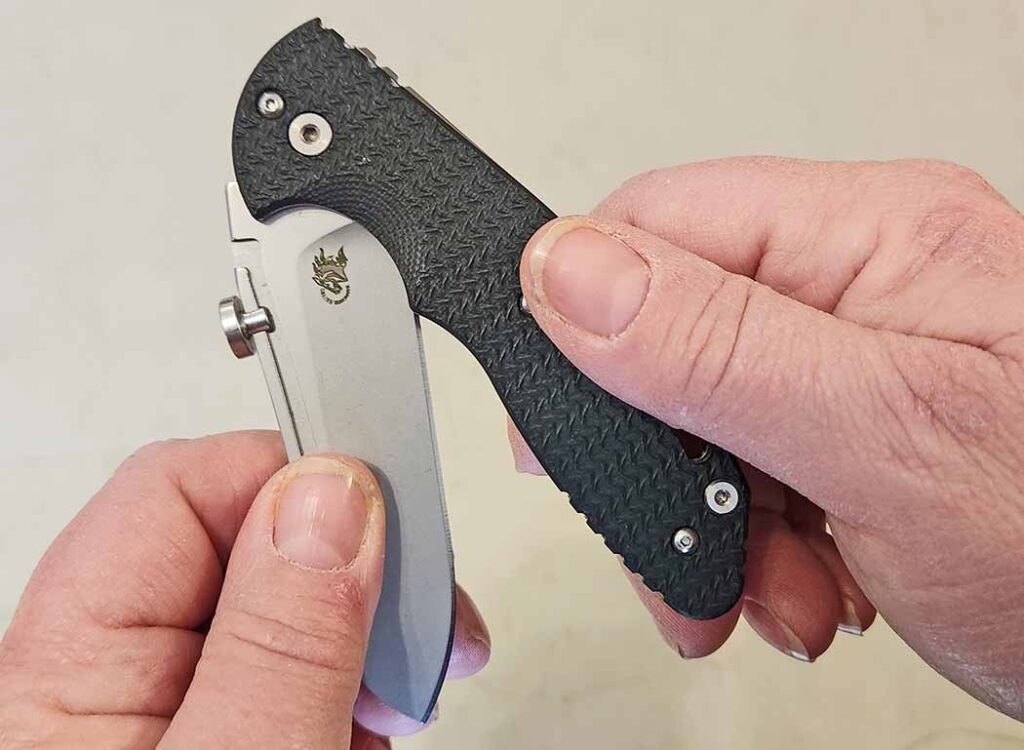
Though you can use the movable/sliding thumb disc of the XM-18 Slippy from Rick Hinderer Knives for one-hand opening, the author preferred simply using the long notch to open the blade.
Nothing quite says modern like a knife name that sounds like a football play. With the XM-18 Slippy slip joint, Rick Hinderer Knives executes a pocketknife design but adds Rick’s own special spin to it. At first glance you would think it is a contemporary linerlock folder. The spring system is tight to help prevent accidental blade closure. A heavy spring also makes it a bit challenging to open for me—so much so I prefer opening it with two hands rather than using the innovative thumb disc design. I just can’t seem to get an angle to easily allow me to overcome the spring tension. Hinderer has devised a design that allows you to move the thumb disc along the groove so you can find the best leverage point for your needs. My thumb is so large I can’t quite get it between the knife body and the disc.
The blade is a saber-ground sheepsfoot pattern of CPM 20V stainless steel. With a tip below center, it makes utility-style cuts simple. A pocket clip with a raised tip has no difficulty locking on a pocket rim. I had no issues while testing the XM-18 Slippy. It did everything you might ask it to do in daily life. It’s also a sturdy enough build that you can lean on it for tougher jobs.
Kershaw Zero Tolerance 0235
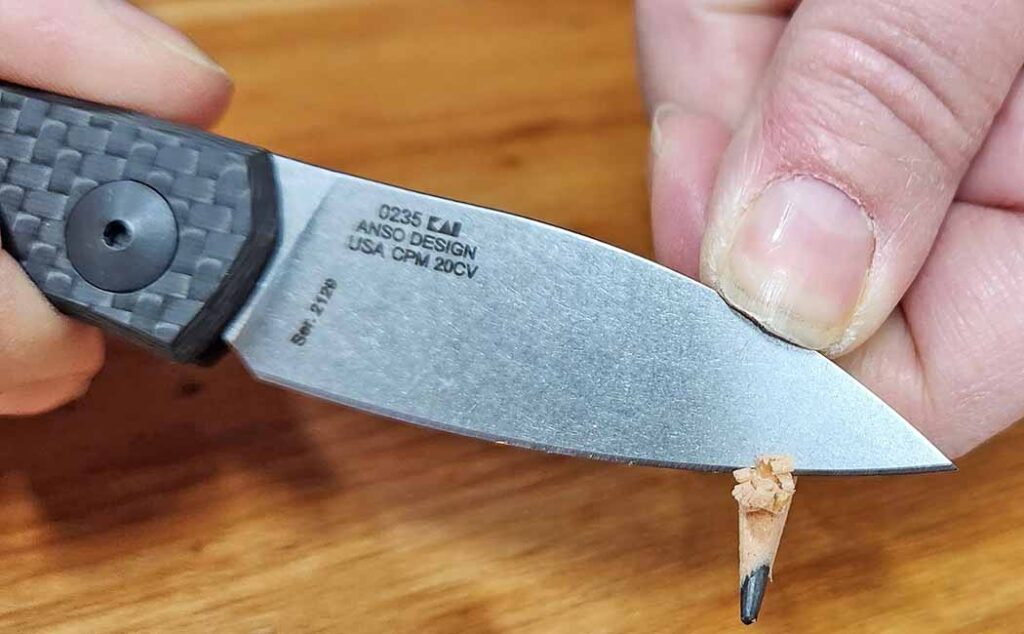
There is nothing like a thin ground blade like that of the ZT 0235 to get a wicked edge on a knife. Such a blade can make shavings so thin you can almost see through them.
Carbon-fiber scales give the 0235 by Zero Tolerance (ZT) an up-to-date look as well as the appearance of a trim, lightweight package. An open-frame body structure eases the job of keeping the Jens Anso design free of pocket lint. The spear-point blade of CPM 20CV boasts a full flat grind. A reversible saber-style pocket clip provides deep pocket carry. The clip is one of my disappointments as it’s rather small and doesn’t trap most pant pocket rims well. It’s a tight fit once on a pocket, which tends to make a smooth withdrawal with my bear-paw hands difficult.
The lanyard loop on the back of the handle tends to be a European thing in my eyes, and I wouldn’t necessarily use it given its location on the knife. You can’t put it at the back because of the clip position, but nothing is stopping you from running a cord or a chain through the clip.
Thanks to a detent ball system, the blade holds open both fully and also in the half-stop position. Once the detents disengage, the blade is freewheeling. On a backspring system the tension on the blade is constant and restricts the blade from moving freely. If enough pressure is applied to break the detents free, you’ll have a blade with no resistance to it, which worries me a bit.
The knife is on the small side and works well but the lightweight feel can be a bit deceiving—especially if you equate heft with durability. Handling is no problem but, due to the lack of mass, you can feel the strain of heavier cuts through the handle. I would classify the 0235 as a gentleman’s knife given the crisp presentation with the carbon fiber—well suited for small everyday chores while acting as a showpiece.
Editor’s Note: Abe Elias and Dexter Ewing contributed to this post.
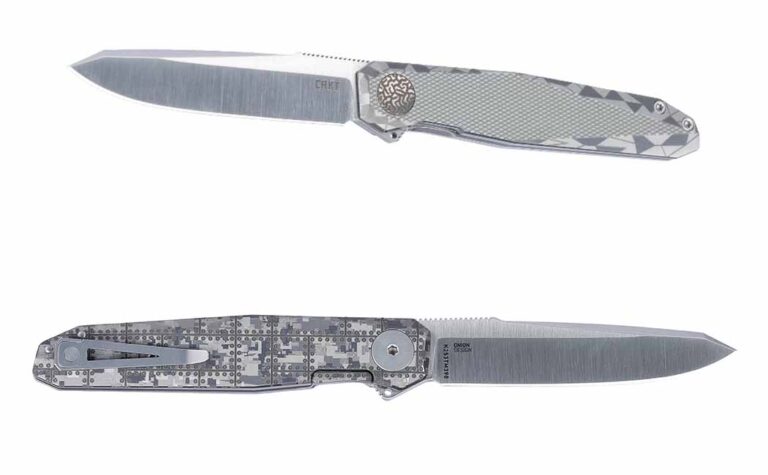
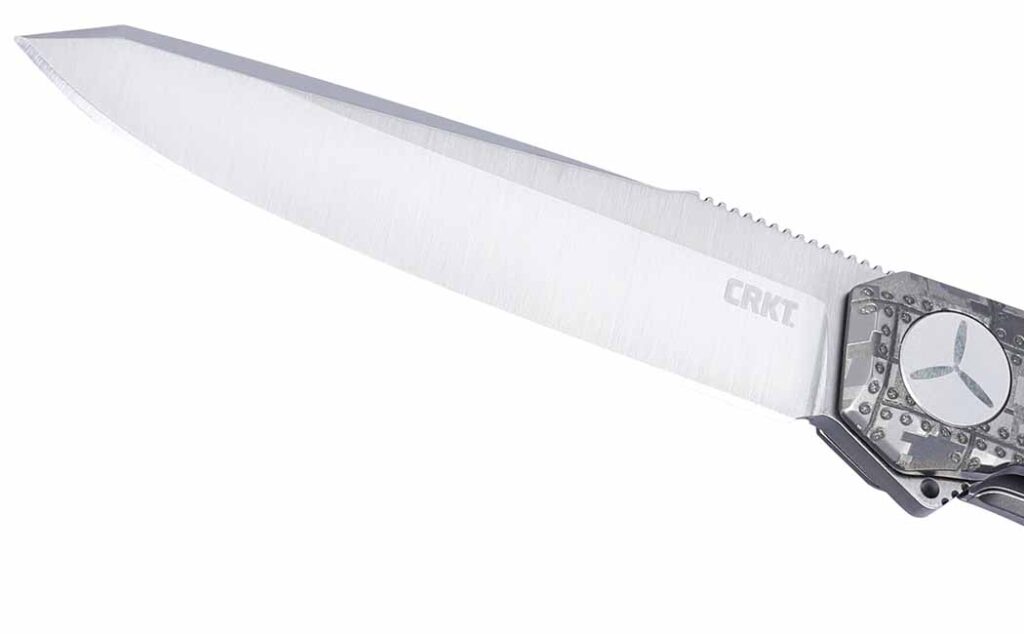
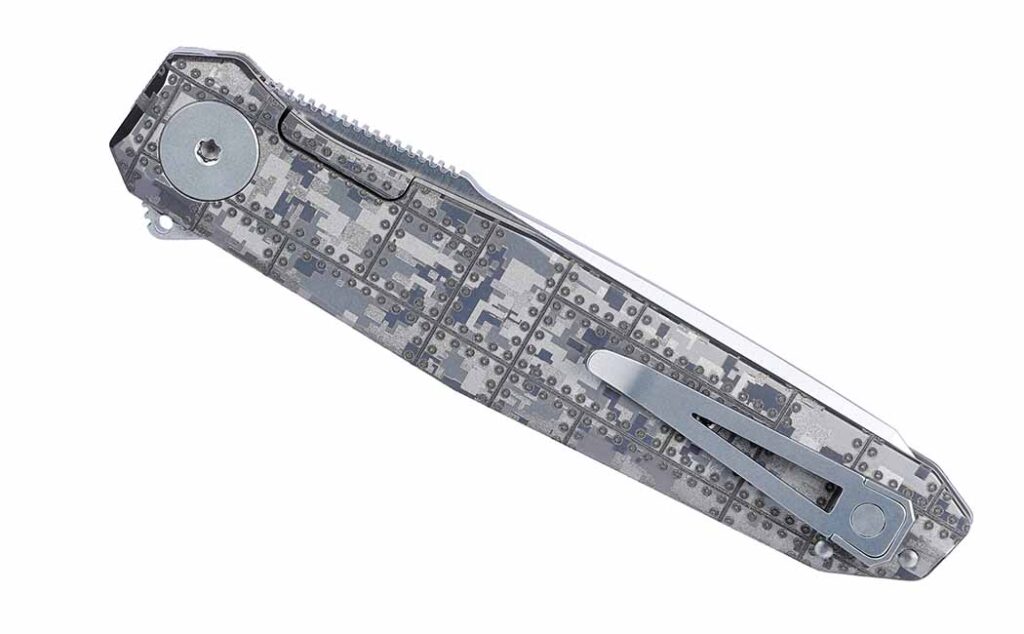
Adding a premium option to the Ken Onion designed line, CRKT unveils the Facet Rivet and Facet Viral.
If you’re into knives (you most likely are, as you’re reading this), you’re familiar with the name Ken Onion. The famed knifemaker has turned out his fair share of must-have blades over the years, with many collectors and aficionados bating breath for his next drop. Well, it’s here and it’s awful dang familiar.
Shake hands with the Facet Rivet and Facet Viral. Yes, they’re the same Facet knives fans have known and loved since its release a year ago, but dolled up plenty nice to make them legitimate premium options in the line. In fact, the duo of top-shelf-edition CRKTs both have some alluring attributes likely to get customers to pony up the relatively steep asking price of $275. Not the least of which is the player behind the scenes making the Rivet and Facet a reality—Lion Steel.
CRKT Facet Blade Material
The Maniago, Italy concern is the manufacturer of the knives, which brings not only one of the more respected manufacturers in the game but also a host of top-shelf materials. Where this shows itself in the M390 steel used for the Facets’ modified drop-point blade. Commonly used by Lion Steel and other manufacturers in the region, the super steel (Austrian in origin) is noted for its impressive edge retention compared to tool steel, as well as its superior corrosion resistance.
Impressive choice, particularly given the Facet certainly has the lines of a more gentlemanly EDC knife but should prove capable against more demanding tasks. Adding to its expected robust use is generous jimping on the knives’ spines, giving a solid purchase on them when more vigorously used.
Facet Handle Material
The handle scales on both the Rivet and Viral are titanium, but not some muted finish common to the material. Each is ornately decorated—the Rivet with a World War II-themed plate and rivet motif, common to the era’s military equipment. The Viral is more futuristic—CRKT says “apocalyptic”—stylings meant to conjure up an end-of-days zombie flick feel.
Away from the aesthetics, the titanium makes the knives fairly light affairs, each tipping the scale at around 3 ounces. For reference, the original Facet weighed 3.9 ounces, so this is creeping up on 1 full ounce of weight savings. The handle has a gradual tapper as well, fitting it well to most hands and allowing for a strong grip on the knife.
Action & Lock
The Facet remains a liner lock in its premium guises, and the flipper maintains its smooth and quick deployment thanks to its IKBS bearings. The flipper itself is somewhat understated, but nonetheless very functional, enhanced with a fair bit of aggressive jumping.
Final Cut
The CRKT Facet Rivet and Facet Viral are both currently available, but interested parties must act quickly. CRKT is limiting each to 500 units for the launch. And 50 lucky customers will receive a heavy-duty commemorative coin, which CRKT is placing in random boxes.