The history of knives and other edged instruments is tied to the history of people in general. As humankind’s oldest tool, unraveling knife history can lead to even more surprising and enriching information to better understand the world.
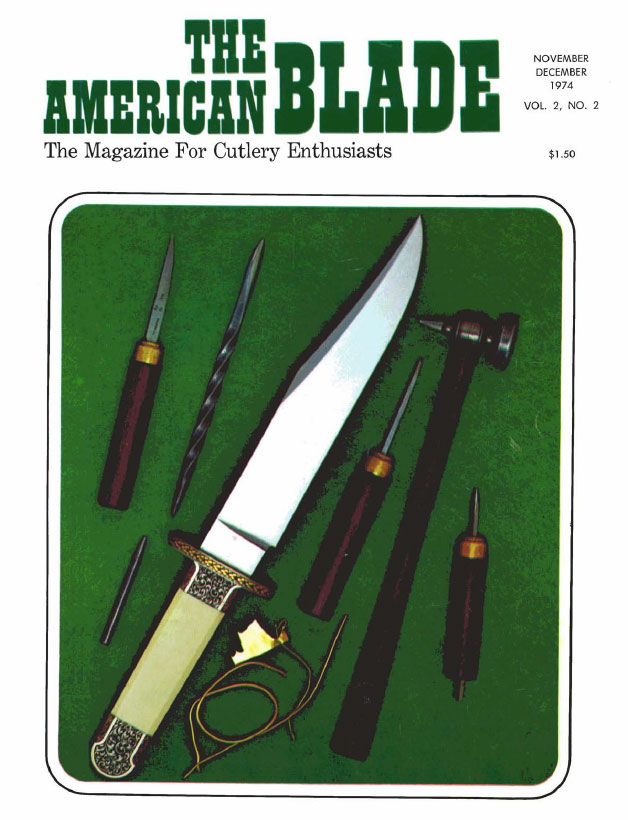
Known as The American Blade at the time, the magazine was traded by then-publisher Jack Marvich to Wally Beinfeld for a racehorse—or at least that’s what Beinfeld reportedly told one of his successors, former BLADE publisher and editor and BLADE Magazine Cutlery Hall-Of-Fame® member Bruce Voyles.
The cover of the November-December 1974 issue of The American Blade.
Beinfeld ran what was probably the country’s premier antique arms show and, in part to help promote it, published a gun magazine called the Arms Gazette. The Gazette had a large editorial, graphics and production staff that was more than big enough to produce a second magazine. Hence, Beinfeld decided to add a knife publication—The American Blade—to his, ahem, stable.
However, there was one problem. Marvich and Beinfeld could not make a deal, even if, apparently, the racehorse was at least part of the payment.
“They were sitting there talking about it one day and the more they talked, the worse it got,” Voyles recalled Beinfeld’s version of what happened.
Beinfeld and Marvich were making no headway at all. Finally, Beinfeld stood to call the whole thing off and leave when in walked Marvich’s wife.
“Marvich looked at her and said, ‘Honey, the deal’s not going to go through, we just can’t come to terms.’ And she looked at him and said, ‘What about my racehorse?’ And in Wally’s words, ‘So I sat back down.’ From what I understand,” Bruce recalled, “I don’t know if the racehorse was just part of the deal or what, but I believe it was the entire deal. That was the way it was told to me.”
And, thus, Beinfeld bought The American Blade. Bruce said he can’t recall the horse’s name, which is understandable considering how long ago it was. Meanwhile, Mr. Beinfeld passed away a few years back, and we don’t know the whereabouts of Mr. and Mrs. Marvich.
As for the horse, here’s hoping he was put out to stud and lived happily ever after. (Insert your impression of a horse whinnying here.)
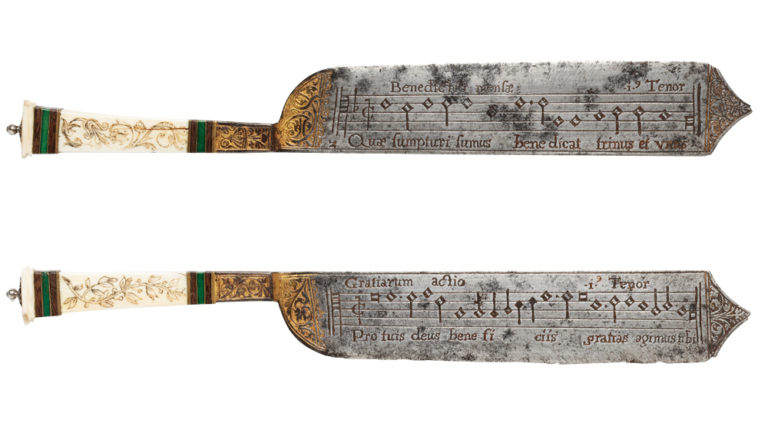
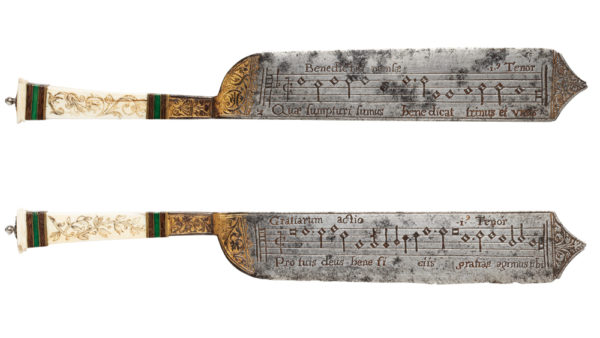
Notation knives dating from the mid-16th century were used to sing a pre-meal blessing and a post-meal grace. This example is on display at the Medieval and Renaissance Galleries at the Victoria & Albert Museum in London.
They’re called notation knives, and they’re engraved with what amounts to sheet music for multi-voiced song. They’re indicative of the formal role music played in medieval dining, according to Flora Dennis, an art historian and author of the book “Re-thinking Renaissance Objects: Design, Function and Meaning.” Holding the knife in the left hand, edge up, diners could see the notes and lyrics for the benediction, or blessing, sung before a meal. After the meal, again held in the left hand, edge down, the knife showed the music for the grace, thanking God for his generosity. Since cutting was done with the right hand, the knives may have been ritualistically transferred to the left hand, or they may have been solely used for singing purposes. Dating from the mid-1500s, one notation knife is on display at the Medieval and Renaissance Galleries at the V&A (Victoria & Albert) Museum in London, where Ms. Dennis works. There are others—seven in Paris, three in Philadelphia, two in The Hague, one in Austria, some in private collections—but as much as is known, much more remains unanswered about these rare items.
In addition to the 16 surviving notation knives, there are also written references to at least four others, according to Ms. Dennis. Essentially, though, the knives have been overlooked by historians because they don’t fit neatly into either “knives” or “music” and have been relegated to curiosity status. All the notation knives share a similar look. The steel blades are broad with straight spines and triangular points on center. According to V&A curator Kristen Kalber they may have been used to proffer a slice of meat to a diner, the point skewering the serving. Then again, squires normally carved meat and that was a highly skilled, status-imbued position. Carving rose to the level of entertainment with offerings carved from cooked fowls and beasts held aloft on forks. So, while some knives seem not to have been used other than to sing from, others show wear on the point and were definitely used.
Museum Curator And Historian Bring Notation Knife To Life
In this 2009 video V&A Museum curator Kristen Kalber shows the notation knife in the museum’s collection and demonstrates its use. Flora Dennis, an art historian at the museum, discusses the project that allowed the music on the knife to be recorded. Ms. Dennis holds a PhD in musicology, specializing in early music, and through an Arts and Humanities Research Council grant she was able to convert the music into modern notation, and then work with the Royal College of Music to bring it to life.
The points and the bolsters are engraved with leaf scrolls and strapwork, often gilded. The handles are made of ivory and green-dyed horn or bone with copper or brass spacers. The ivory is decorated with foliage, empty tablets of scrolls, Arabic or Moorish designs or winged cherub heads inlaid in black. The pommels are adorned with silver spherical knobs. The engravings are usually in Latin, though some are in the vernacular. The one from the V&A reads Benedictio mensae (The blessing of the table) on one side and Gratiarum actio (The saying of grace) on the other. The musical stave runs the length of the blade. In the upper right is the voice part, in this case “Tenor.” What this means is that there were different knives for different voices, in some cases as few as five or six or substantially more than 20.
Royal College Of Music Singers Record Two Versions Of The Meal Benediction
Knifemakers across Europe at the time would have been members of guilds and were specialized. Handles would have been made separately and assembled by the cutler who sold them. Ms. Dennis’ writings detail how challenging it can be to pinpoint where the notation knives were made or by whom. Knives were being made in Solingen and Nuremberg, Germany, and in Milan and Brescia, Italy. Possible guild marks show up in the form of arrows, fluers-de-lis or clovers, and etched Ns can be found on many of the blades, but those are more likely an engraver’s mark. One of Ms. Dennis’ knife consultants intimated that a Nuremberg mark would be on the tang, not the blade. The best guess is that they were made in France, with Italianate influence or for an Italian patron.
Were the knives collected after the gathering or did each singer keep his or her knife? In Ms. Dennis’ summation, judging by the scattering of surviving pieces, the latter might be more likely. It could also be that the knives were made for a group, such a monastery. In some instances, the strict, mass-like approach to such a shared meal could result in latecomers being fined for missing the benediction. What is clear is that the knives are not all from the same musical piece; there are two separate pieces of music represented by the known notation knives.
Royal College Of Music Singers Record Two Versions Of The Meal Grace
Interestingly, the notation knives are representative of both coming together and separating. It is the very nature of a knife to cut apart, but in this instance it is for the purpose of sharing, both repast and praise.
As Ms. Dennis writes:
“Benediction and Grace texts are inherently collective, expressing notions of conviviality and sharing. The knives reiterate this idea, needing to be brought together in a social context in order for their music to function. Simultaneously, however, they represent a contradictory action of dismembering and dividing. By slicing meat, the knives permit it to be shared between the gathered company in the same way that dismembering and scattering the musical text across the knives enabled a group to perform it collectively. The acts of uniting to say the Benediction and Grace, uniting to eat, and uniting to sing become inextricably intertwined with those of separating, dividing and sharing both meat and music.”
The Bladecrafing Ultimate Collection includes two paperbacks and four ebooks for $34.99
Makers can’t go wrong with this collection. You’ll get two paperbacks: the third edition of “Blade’s Guide To Making Knives” and “How To Make Knives; and four e-books: “Greatest Loveless Knife Designs,” “Knife Grinding Secrets,” “Making Everyday Carry Knives” and “Fashioning A High-Tech Folding Knife.” Normally, this collection would cost over $70, but you can get it for half that.
Each Tuesday in April, KA-BAR will release a video documenting a piece of its storied 120-year history. What, you thought it started with the USMC knife in the ’40s? You’d be wrong.
The KA-BAR website will host the videos, but you can also catch the installments on YouTube. Here is the first episode.
Beyond the marketing value of such a series, these episodes should serve as a history lesson for knife collectors. Often, the provenance of a knife, or a line of knives, is tied to its value or collectibility. And there are few companies with the kind of history that KA-BAR brings to the table.
Editor’s note: This article is an excerpt from the KNIVES 2004 book, but the information is still relevant.
Switchblades, or automatic knives, might attract the most attention, but reforms in recent years have relaxed restrictions in most U.S. states. The most banned knife in the country remains the ballistic knife.
Here’s a look at what ballistic knives are, how they became banned and why those bans should be repealed.
What Is a Ballistic Knife?
Federal law defines a ballistic knife as follows:
United States Code, Title 15 Section 1245
(d) “Ballistic knife” defined. As used in this section, the term “ballistic knife” means a knife with a detachable blade that is propelled by a spring-operated mechanism. Pub. L. 85-623, Sec. 7, Oct. 27, 1986. Amended Nov. 18, 1988.
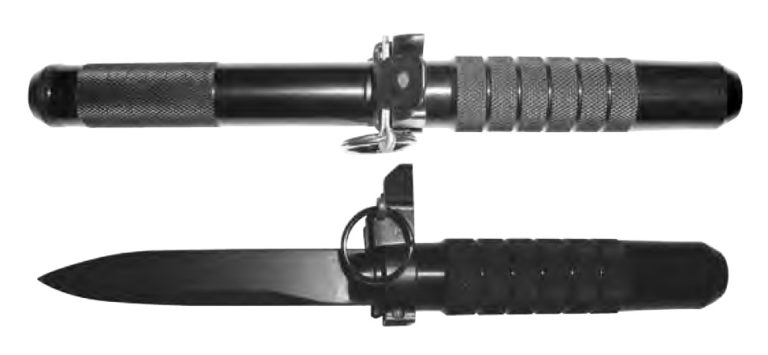
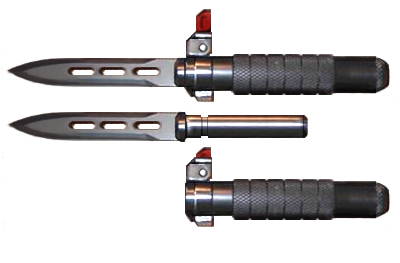
In plain English, a ballistic knife is essentially a blade attached to a hollow handle that fits inside of another outer hollow handle, which contains a coil spring. The coil spring compresses inside the handle, and a latch holds the knife blade down against the spring pressure. When the latch is released, the knife and attached inner handle launch and “go ballistic.”
The federal law on ballistic knives is very similar to federal law on switchblades, except that the switchblade law exception for “the possession, and transportation upon his person, of any switchblade knife with a blade three inches or less in length by any individual who has only one arm” does not apply to ballistic knives.
That means one-armed individuals are forced by federal law to have to throw their knives by hand just like everyone else!
Hollywood and Ballistic Knives
“¿Como esta?” asks Arnold Schwarzenegger in the 1985 movie Commando, as he fires a ballistic knife into the chest of a bad guy, which amazingly causes immediate death. Hollywood never misses a chance to help fuel a misguided weapons ban, and the ballistic knife was no exception.
In May of 1986, Francis Ford Coppola’s son and Ryan O’Neal’s son were in an automobile accident in which Coppola’s son died. O’Neal’s son was charged with reckless driving and possession of a ballistic knife.
Hollywood elitism and hypocrisy is nothing new. What made the ballistic knife so frightening to career politicians, media talking heads and assorted hoplophobes (those who irrationally fear weapons) is that it’s a knife that shoots!
Why are Ballistic Knives Illegal? Hype and Politicians
Politically, the ballistic knife helped fill the gap between guns and knives. It enabled knife haters to join ranks with gun haters and both had a common, new, inanimate object to wail and screech about.
In addition to the ballistic knife being slandered and falsely linked to drug abuse, this was the newest national attack on knives since the 1958 Federal Switchblade Law.
Republican Sen. Alfonse M. D’Amato held a news conference pushing for and spinning the proposed ban. He announced that a ballistic knife “is a favored weapon used by drug dealers.” He further proclaimed, “Ballistic knives are at least as dangerous as switchblade knives that have been banned since 1958.”
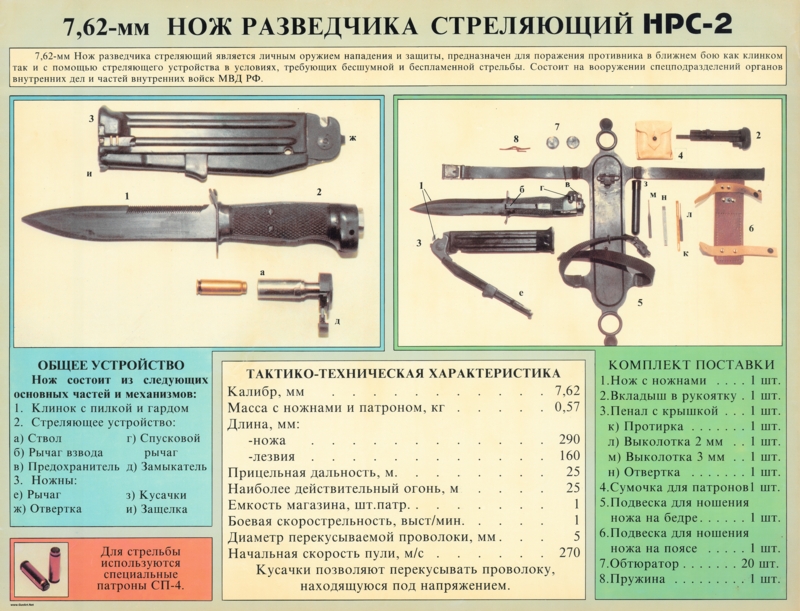
A vintage poster from the USSR showing parts of a ballistic knife. Note the firearm cartridge used to propel the blade. (image via RussianLegacy.com)
The hype surrounding ballistic knives did not help matters. The knives were advertised for sale in tactical magazines with the pitch “The Commies Had It. We Stole It. Now You Can Buy It!!!!” Ballistic knives were advertised as being able to “kill swiftly and silently.”
Sen. D’Amato claimed a ballistic knife to be a “dangerous weapon, a terrorist weapon.” He further declared, “Ballistic knives have no legitimate sporting purpose. They are sought by professional criminals because they are easily concealed and capable of penetrating a policeman’s bulletproof vest.”
Democratic Rep. Mario Biaggi (a well known anti-gun politician and a sponsor of the so called “Cop-Killer Bullet Ban”) appeared at a news conference and asserted that ballistic knives were the “latest in cop-killer technology,” and that the ballistic knife can “…fire its blade like a bullet” and “penetrate police bullet-resistant vests.”
He stated he had bought his ballistic knife via mail order from the Florida Knife Corp. by putting the $79.95 on his credit card. Biaggi stated, “…there were no questions asked. I could have been anybody. The ballistic knife is totally accessible to anyone who wants it.”
A button or switch in the handle, seen here in red, is usually used to release the blade. (By Jerryk50 at English Wikipedia)
At the news conference, the typical “dog and pony show” was conducted by a New York police officer who fired a ballistic knife from 30 feet at a silhouette target of a person. Of course, there were no known cases at that time of anybody ever being killed by a ballistic knife, no less any reported cases of a police officer being shot at by a “drug dealer or terrorist” (or anyone else for that matter) with a ballistic knife.
Furthermore, I could not find any official poll taken of drug dealers inquiring as to whether a ballistic knife was their “preferred weapon” of the 1980s, but somehow I doubt it considering the ready availability of cheaper and more effective black market firearms.
The Florida Knife Corp. issued a statement that their ballistic knives do NOT penetrate bulletproof vests, but noted that any ice pick could penetrate a bulletproof vest. Bulletproof vests are NOT ice pick-proof, however banning ice picks is not as politically correct or headline grabbing. A ballistic knife has as much “sporting purpose” as any throwing knife.
Since when is the “sporting purpose test” applied to knives, anyway? What sporting purpose does an 8-inch chef’s knife have? Then again, why should facts get in the way of a feel-good knife ban?
The Final Cut to the Ban: Throwing Knives
There are many books that deal with the subject of knife throwing for both fun and combat. A knife can be thrown with substantially more power and accuracy than can be achieved by firing a ballistic knife. This fact alone makes the ballistic knife ban patently absurd and useless.
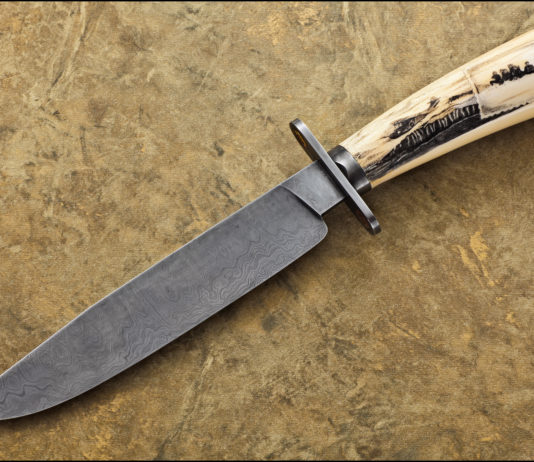
Any decent fixed blade knife can be thrown (although throwing your handmade, damascus, ivory-handled bowie is not recommended). But why should facts and logic stand in the way of any headline-grabbing politician pushing a weapons ban and holding news conferences?
So What? Who Needs a Ballistic Knife Anyway?
Okay, the law is ridiculous, so what’s the problem? Who needs to own a ballistic knife anyway, right?
Well, here is the problem: the ballistic knife ban is a KNIFE BAN, and just because it isn’t your ox being gored does not mean you should ignore it. This ban paves the way for more knife bans. The politicians see our knife rights as “easy pickin’s.” They can look like they are doing something about crime, terrorism or drug dealing, when in reality it’s just another hit on our knife rights.
Ballistic knife bans lay the groundwork for further knife bans and for activist courts to be judicially dishonest and to prohibit other lawful knives and weapons that are not ballistic knives. Don’t believe it? Then you have obviously not read State of Florida, Appellant, v. Pariya Darynani, Appellee, 4th District, Case No. 4D99-4172.
In this case, the Florida Court banned formerly lawful automatic/switchblade knives under the guise of Florida’s ballistic knife ban. The case is a classic example of anti-knife bias and the abuse of our knife rights that a wrongful knife ban can cause.
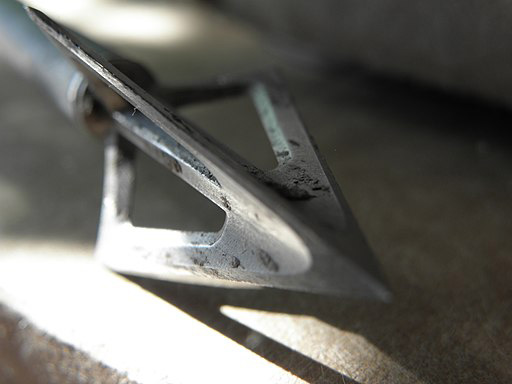
Modern broadheads used for archery remain legal, even though they function similarly to ballistic knives. (Wikimedia image)
New Jersey’s ballistic knife ban has even more potential for abuse. The New Jersey ballistic knife ban was signed into law by then Republican Gov. Thomas Kean, who stated, “We have to restrict the flow of knives that serve no useful or lawful purpose.” I
f the “bunny huggers” wanted to push it, New Jersey’s ballistic knife law is so overbroad that archery and bow hunting are threatened and could be banned.
Chapter 39 Of New Jersey Criminal Code Firearms And Weapons 2C: 39-1.
u. “Ballistic knife” means any weapon or other device capable of lethal use and which can propel a knife blade.
Bows and crossbows can all shoot broadhead arrows. Broadheads are and/or contain razor-sharp knife blades. Is a compound bow with a broadhead arrow a “weapon or other device capable of lethal use and which can propel a knife blade?” Of course it is!
Sure, it was not the intent of the New Jersey Legislature to ban archery and bow hunting, but it was not the intent of the Florida Legislature to ban switchblades/automatics, either, and yet the Darynani court did just that!
Stay Vigilant
Unfortunately, knife aficionados were not organized, prepared or ready for the ballistic knife fight in the mid-1980s. We were never warned about the future effect and ramifications of ballistic knife bans on our knife rights. We dramatically lost on the ballistic knife issue and are now paying a price.