The history of knives and other edged instruments is tied to the history of people in general. As humankind’s oldest tool, unraveling knife history can lead to even more surprising and enriching information to better understand the world.
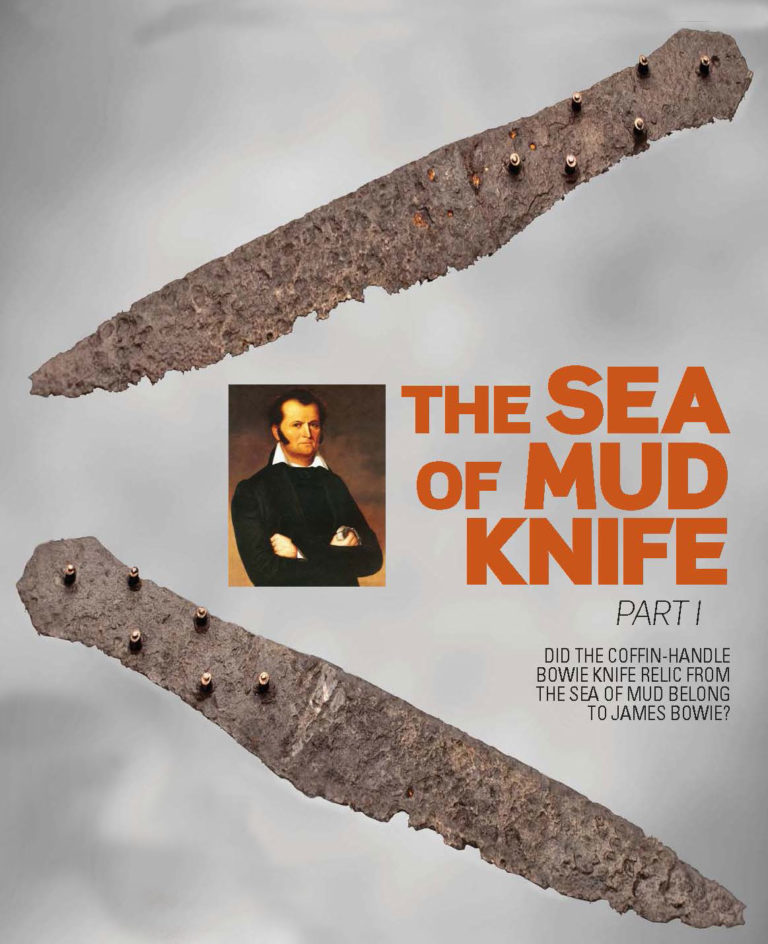
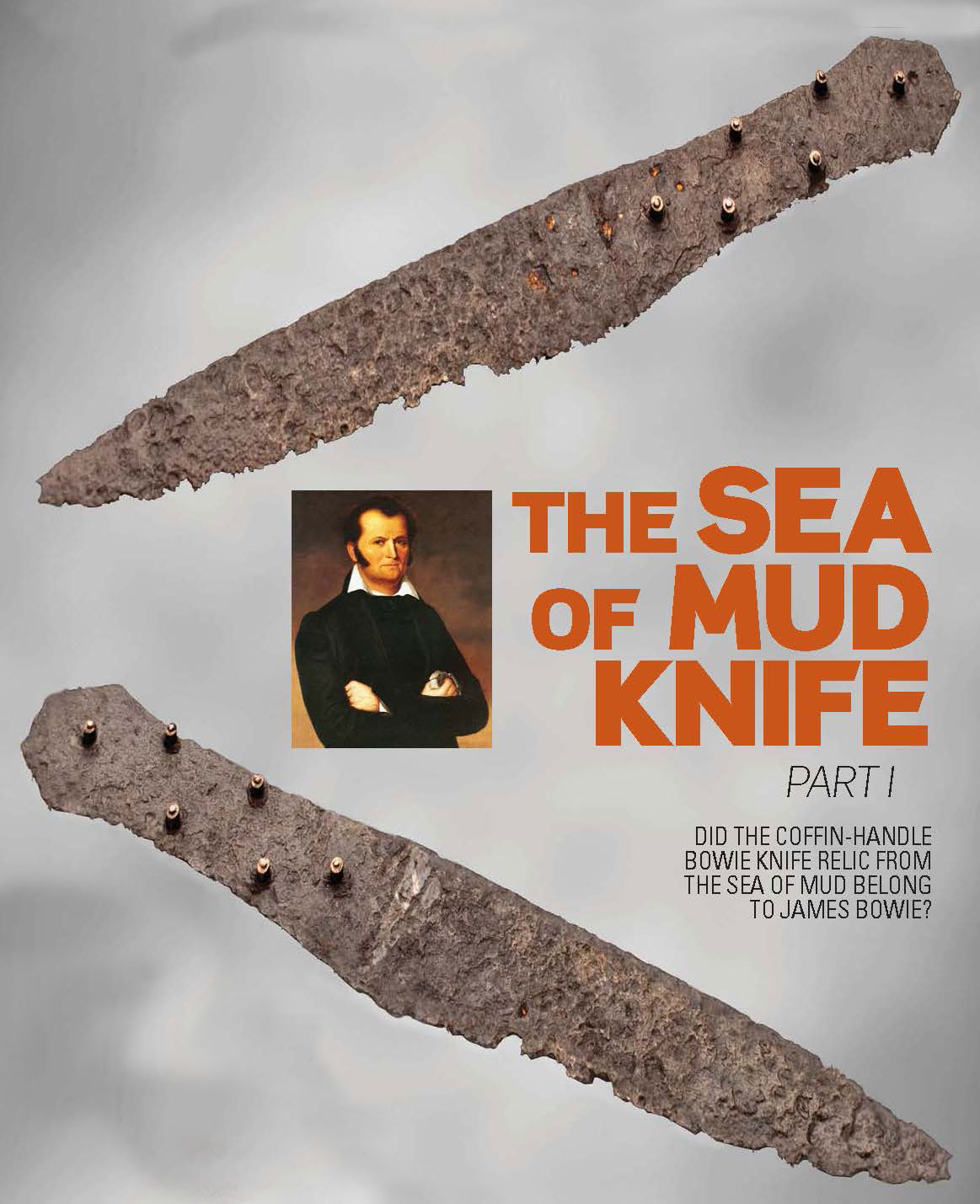
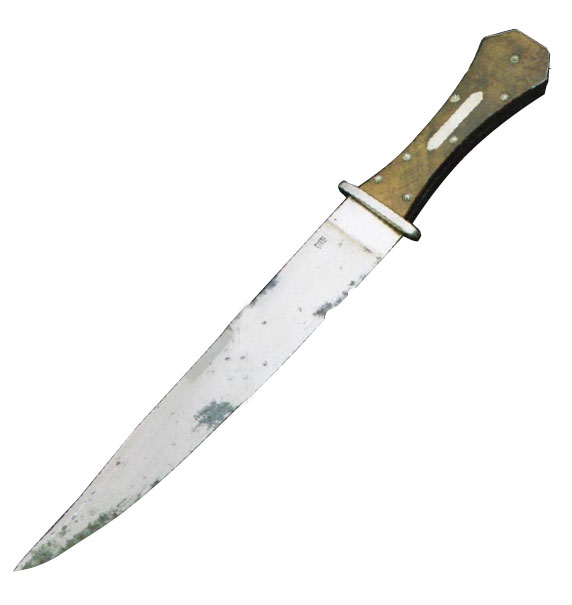
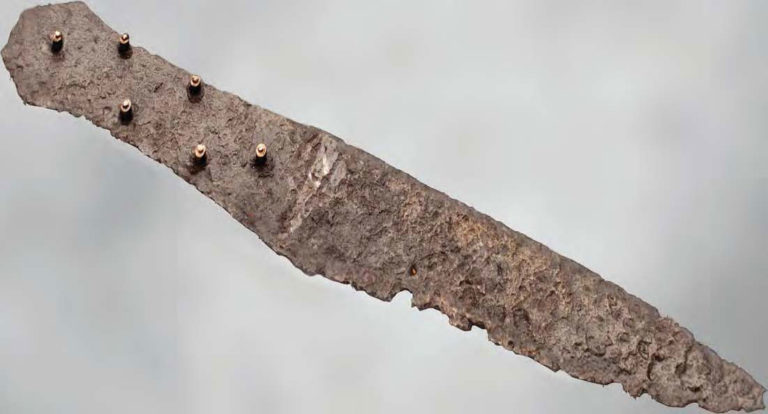
Did the corroded coffin-handle bowie knife relic found by Dr. Gregg J. Dimmick in the Sea of Mud belong to James Bowie? Note the absence of a guard, one of the design traits of James Black. At press time the relic was in storage at Texas A&M University along with other items found in the Sea of Mud. (relic image courtesy of the Cushing Memorial Library and Archives, Texas A&M University Libraries)
Made during Cutlery Hall-Of-Famer James Bowie’s lifetime, the relic may have been used in the defense of the Alamo, which fell on March 6, 1836. I had not seen the relic but ABS master smith Greg Neely had sent me a picture he had taken a few years earlier. Below the relic was a placard with the following inscription: BOWIE KNIFE.
The relic is iron and has brass connectors in the handle. There are two small strips of decorated silver on the blade near the handle on both sides. A very small amount of the silver can still be seen. The relic had been cleaned by electrolysis. The relic is interesting due to its similarity to Bowie No. 1, the coffin-handle bowie attributed to James Black of Washington, Arkansas.
Identification
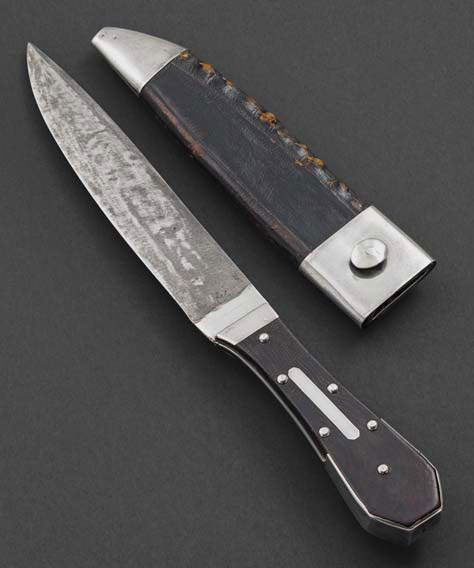
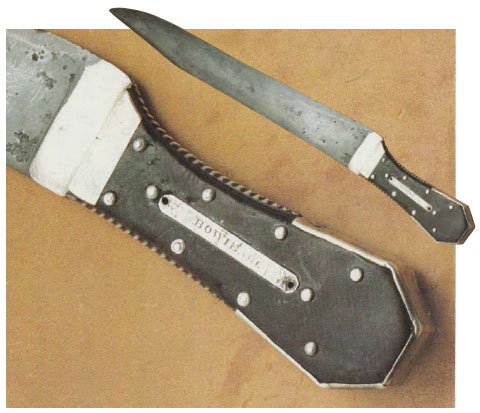
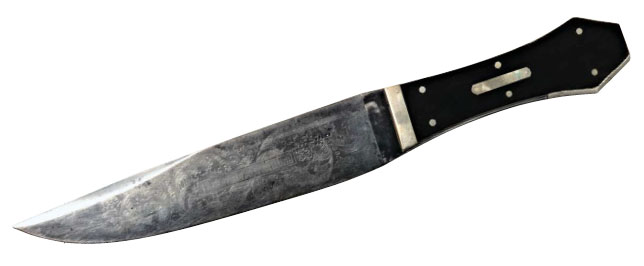
The Carrigan coffin-handle bowie knife James L. Batson indicates was made by James Black more closely resembles the relic than either the Marks & Rees or Crown Alpha knives. The Carrigan is on display in the Historic Arkansas Museum in Little Rock, Arkansas. (Courtesy Historic Arkansas Museum, Little Rock, AR)The knife known as Bowie No. 1 does not have the same pin pattern as the relic but has many of the same characteristics of the Carrigan bowie. Bowie No. 1 has a bigger handle and much longer blade. Overall length: 18.5 inches. (image from The Antique Bowie Knife Book)
I had learned early on that you cannot identify or verify an authentic bowie knife unless you hold it and see it—in this case, eyeball to rusty metal. From Greg’s picture I could not be sure how big the relic was. However, from the shape of the blade and coffin handle, along with the pin pattern and the studs in the handle and the silver overlays on the blade in front of the handle, I suspected that it was made by Black circa 1831-1838, in Washington, Hempstead County, Arkansas Territory.
From my bowie knife research, I have concluded that Black originated the coffin-handle style that became one of the most popular of bowie knives. A Black knife did not have a guard. Makers in America and Sheffield, England, incorporated guards into the design.
Crown Alpha of Sheffield, England, also made coffin-handle bowies with silver overlays on the ricasso, this one for Gravely & Wreaks of New York.Marks & Rees of Cincinnati, Ohio, made coffin-handle bowies with silver overlays on the ricasso. Marks & Rees was the first to advertise bowies for sale.
Two of those that made coffin-handle bowies with the silver overlays on the ricasso area were Marks & Rees of Cincinnati, Ohio, and Crown Alpha of Sheffield for Gravely & Wreaks in New York. Marks & Rees was the first to advertise bowie knives for sale, and the Crown Alpha Bowie had Arkansas Toothpick elaborately etched on the blade.
As you can see in the fourth image up, the small Carrigan knife made by Black more closely resembles the relic than the Marks & Rees (above) or the Crown Alpha knives (above Marks & Rees). Also, you can see that Bowie No. 1 (third image up) does not have the same pin pattern as the relic but has many of the same characteristics of the Carrigan. Bowie No. 1 has a bigger handle and much longer blade (13.5 inches).
“I Could Tell He Made It”
B.R. and I arrived at the Alamo gift shop after paying homage to the fallen by visiting the Alamo Chapel. Boy, was the Sea of Mud exhibit crowded! We had to stand in line.
There was the relic and I could tell Black made it. I could tell from the studs that at one time had secured wood scales to the full tang. To my knowledge, Black was the only person to use this technique. The blade lengths of the relic and seven known silver-mounted Black-made, coffin-handle bowies are about 6 inches, with handle lengths of about 4 inches. The placement of the six pins looks as if Black used the same pattern to drill the holes in the tang of each knife.
The relic had been on or in the ground for at least 160 years, but where were the top-and-bottom silver tang wraps? Where were the two silver wraps around the front of the wood scales? Where were the two silver escutcheon plates? Where was the silver pommel wrap, and where were the twelve domed silver washers that secured the scales to the tang? And where were the walnut scales?
If the relic had been dropped by accident or lost, some of the silver mountings should have been part of the artifact, since silver is a noble metal and difficult to corrode. The wood may have deteriorated or rotted away, taking some of the attached silver mounts with it.
Lost to Time
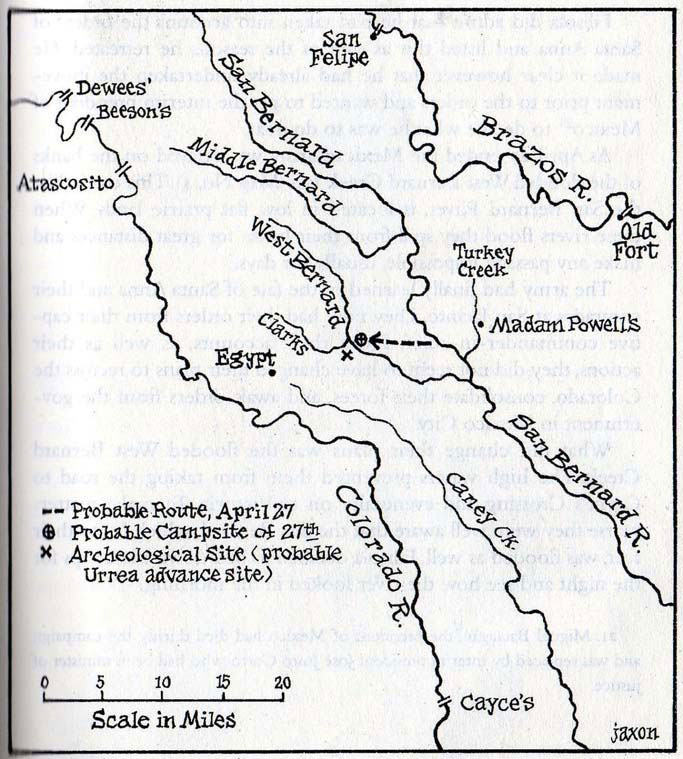
The coffin-handle bowie knife relic was found on the west side of the West Bernard River below the mouth of Clarks Creek in Wharton County, not far from Hungerford, Texas. Mexican Gen. José de Urrea’s division crossed the West Bernard River from west to east on April 20, 1836, the day before the Battle of San Jacinto and a month-and-a-half after the fall of the Alamo.
I contacted Dr. Dimmick and asked if he found any evidence of silver or wood in the soil adjacent to the artifact. He said nothing was found in the proximity of the relic but that a brass pommel cap was found at the same site, though not near the relic.
The relic could have been lost and over time lost the silver mountings. Or, a Mexican soldier or camp follower who needed money and valued the relic only for the silver he or she could remove from it may have retrieved the relic, and the relic was not lost but discarded after the silver fittings and wooden scales were removed. Silver could not be removed from the blade. It was soldered with tin.
A Mexican officer with some wealth may have kept the knife, especially if it had a coin-silver-mounted sheath.
The coffin-handle bowie knife relic was found on the west side of the West Bernard River below the mouth of Clarks Creek in Wharton County, not far from Hungerford, Texas. The West Bernard River was crossed from west to east by Mexican Gen. José de Urrea’s division on April 20, 1836, the day before the Battle of San Jacinto.
According to Dr. Dimmick, “Based on the distances recorded by the San Luis Battalion on April 19, it is believed that this site was not a campsite. The campsite of April 19 was probably near present-day Spanish Camp, Texas. If this is correct, it is theorized that the site discovered on the West Bernard is where Urrea and his division crossed the river during their advance. It is possible that these artifacts were discarded at the site as the units awaited their turn to cross. The artifacts from this site are consistent with the above theory.”
Gen. Urrea’s division was not at the Alamo. However, then-Col. Juan Morales and his men were, and they reinforced Urrea after the fall of the Alamo. (It was about 100 men under Morales’ direction who attacked the Low Barracks where James Bowie was killed during the Alamo battle.)
Urrea subsequently led his division along the coast from Matamoros to Goliad and Victoria. His primary opposition led by Col. James W. Fannin consisted of volunteer units from the United States.
These troops took steamboats down the Mississippi River to New Orleans and went over land or by sea to Texas. The Matamoros Expedition led by Col. Francis Johnson and Dr. James Grant consisted of the New Orleans Greys and the Mobile Greys. None of these troops had been through Washington, Arkansas, or heard of James Black.
So, was the coffin-handle bowie relic owned by a defender at the Alamo? And if so, how did it get from Washington, Arkansas, Territory to the Alamo, and from the Alamo to the West bank of the West Bernard River? Was this James Bowie’s knife?
The Bowie knife is named after James Bowie, although the design was likely around well before the infamous Sandbar Fight of 1827.
NEW ORLEANS – Today, archeologists with the University of Louisiana announced they’ve recovered the knife wielded by James Bowie during the infamous 1827 Sandbar Fight. The bloody encounter, which took place on the banks of the Mississippi River near Vidalia, cemented said knife’s design into what is now known as the Bowie knife. Researchers have attempted to locate the knife Bowie used ever since.
As surprising as this discovery is, it’s nothing to compared to the shocking truth hidden beneath nearly 200 years of history.
“We came across this discovery during a dig for a separate project to study Mississippi flooding patterns as expressed in pre-colonial pottery dispersal, in concert with our partners at [National Oceanic and Atmospheric Administration],” said Dr. Edward D. Wood, Jr. “I don’t often use the word ‘excited,’ but that accurately reflects the dig team’s feelings.”
“The World Of Knives Will Never Be The Same”
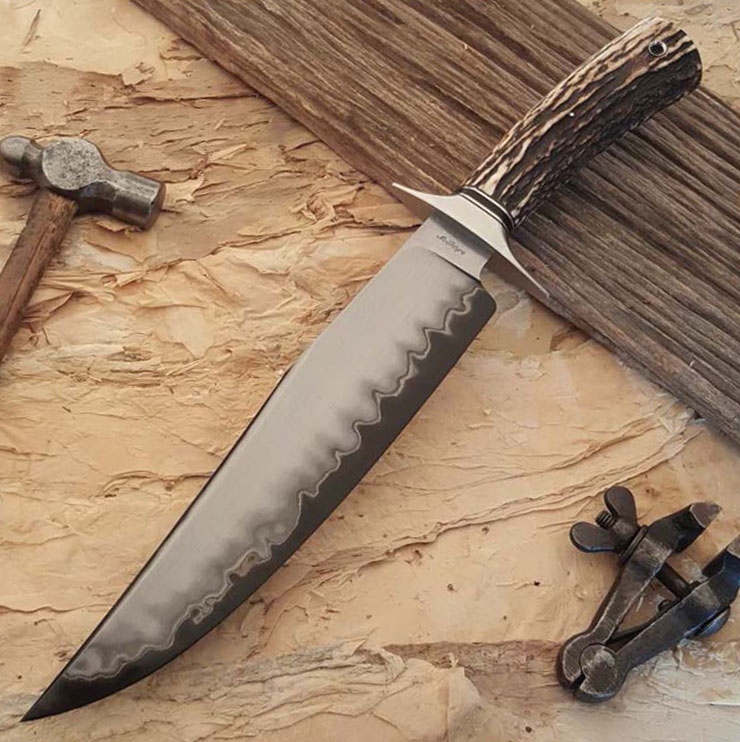
This example of a modern interpretation of a Bowie knife is by ABS master smith Shawn McIntyre. (Shawn McIntyre image)
Wood immediately contacted BLADE for confirmation following the discovery before going public with the find.
“The lore around the Sandbar Fight is so deep, it’s hard to separate fact from fiction. However, I feel confident that what Wood’s team discovered is, in fact, the exact weapon brandished by James Bowie at the Sandbar Fight,” said Steve Shackleford, BLADE editor-in-chief. “As such, it redefines our understanding of knife history and of James Bowie completely. Earth-shattering is an understatement.”
Other BLADE staffers echoed Shackleford’s sentiments.
“This is, hands down, the most important piece of knife history to come around in generations. There’s no going back after this. The world of knives will never be the same,” said Ben Sobieck, BLADE online editor.
The Bowie Knife: Not What Most People Picture
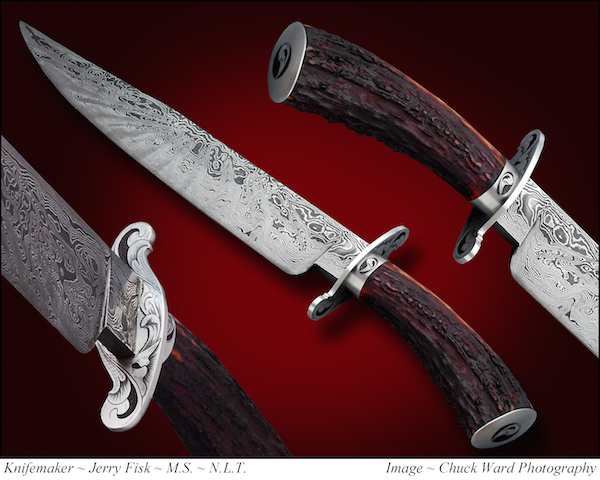
Jerry Fisk’s take on the Bowie knife features a damascus blade and stag handle. (Chuck Ward image)
As it turns out, the knife James Bowie used during the brawl isn’t actually the Bowie knife people know today (example above). Because the original knife was never photographed, it could only be described in written reports. This may have led to some confusion as word spread.
“It’s like a game of telephone, 19th century style,” Wood said. “Now that we know the truth, it’s easy to see how the original description morphed into something completely different throughout the decades.”
Only BLADE Has The Photo Of The Original Bowie Knife
BLADE is the first and only outlet authorized to share the photo of the original Bowie knife. Wood snapped the picture before recovering the artifact.
“Only now can we share this image with our audience,” Shackleford said. “It’s going to burst a lot of bubbles, but we feel it’s important.”
“This calls into question the entire Sandbar Fight. What really happened on the banks of the Mississippi River all those years ago?” Sobieck said. “Was there really a brawl? Or did the aggrieved parties resolve their disputes through non-violent means?
“Perhaps there was, dare I say it, a pie-making contest?”
The evidence certainly points that way.
“I can’t come to any other conclusion,” Wood said.
EXCLUSIVE PHOTO: The Original Bowie Knife Wasn’t A Knife At All
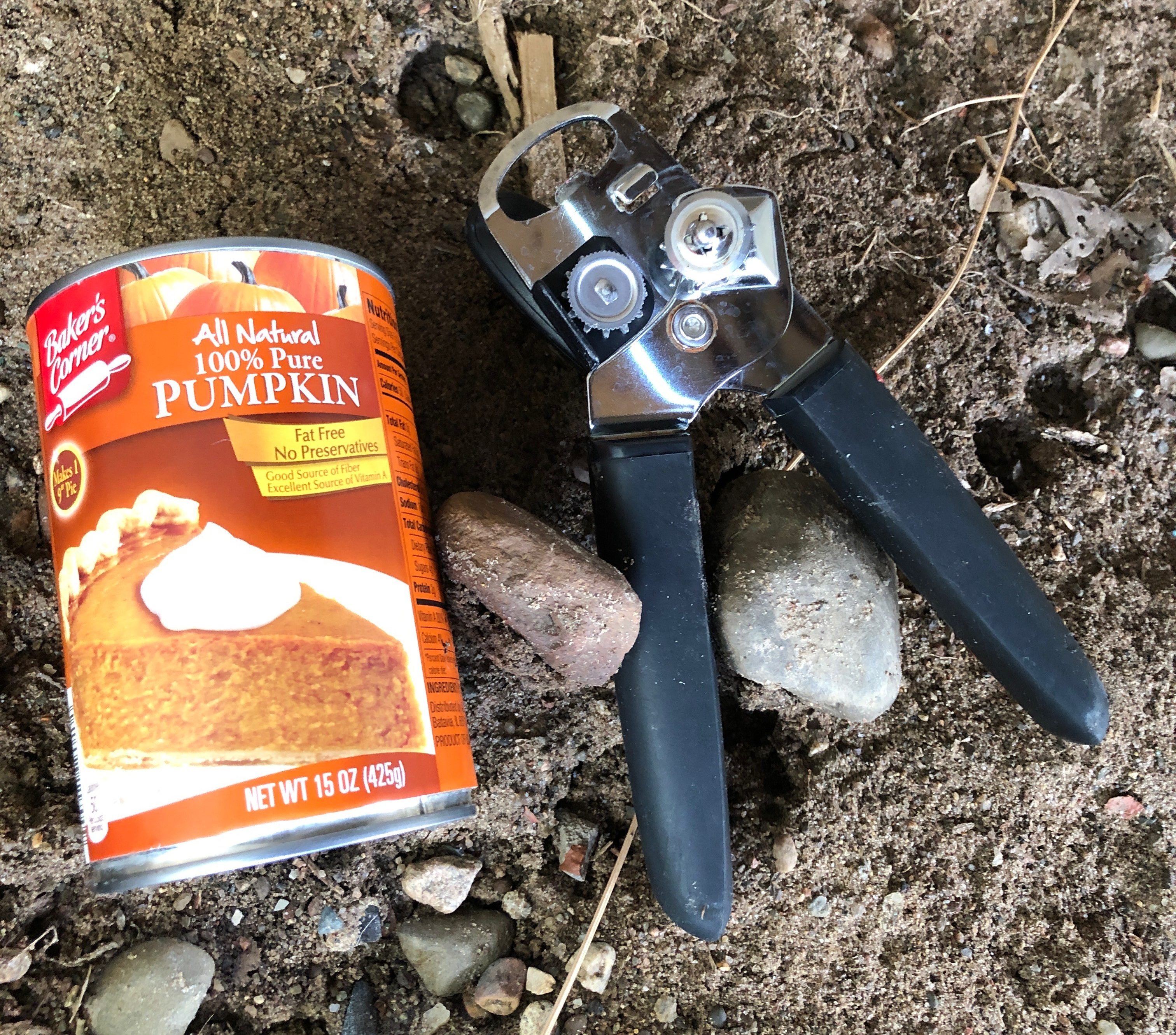
James Bowie’s “knife” was, in fact, a can opener.
Happy April Fools’ Day
“The can opener’s proximity to the canned pumpkin points to a pie-making contest, in which James Bowie was clearly the victor. How this simple fact distorted into a bloody brawl is beyond me,” Wood said. “We carbon dated the dirt and everything checks out.”
“One more note I’d like to add is that it’s April 1, which is April Fools’ Day, and that I feel that the BLADE staff did a great job with this year’s prank,” Shackleford said.
“Definitely. And now I’m hungry for some pie. Pumpkin, apple, strawberry, it doesn’t really matter. I’ll put a pot on, too,” Sobieck said.
George E. “Skeeter” Vaughan (Grey Otter) was a sergeant in the Army’s U.S. Moccasin Rangers during World War II when he eliminated a German sentry with a prodigious knife throw on a snowy night in 1944.
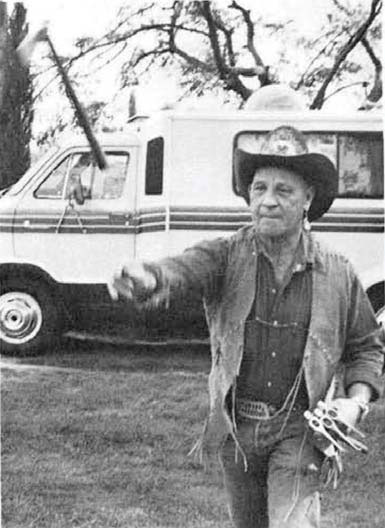
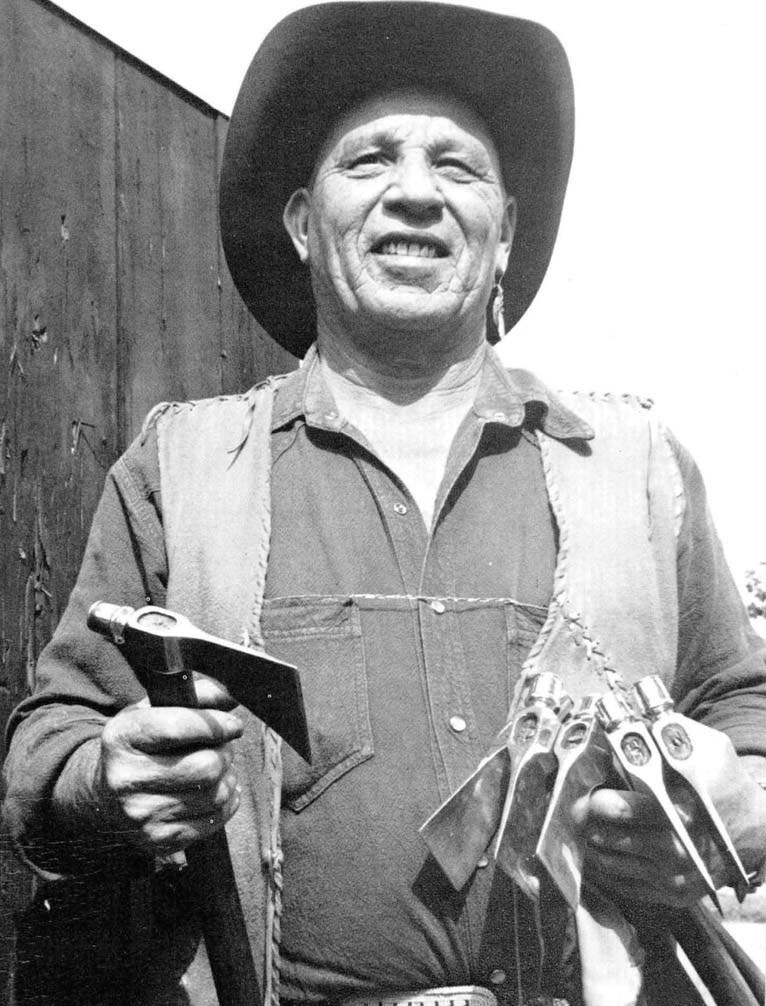
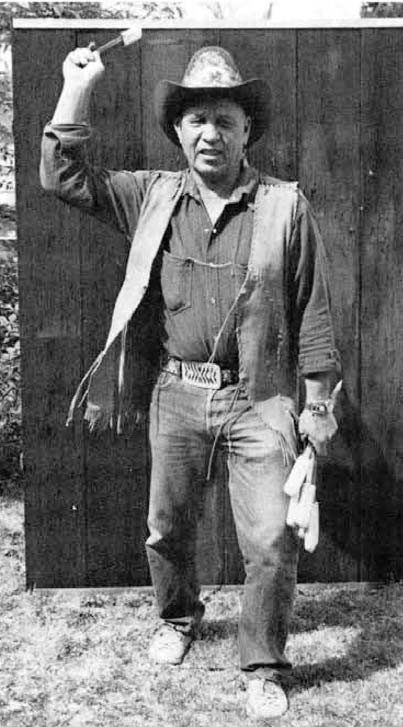
George E. “Skeeter” Vaughan holds the distinction of making the most fantastic knife throw in recorded history—and considering the circumstances surrounding his legendary feat, he most likely will maintain his grasp on that honor for a long time to come.
An American Cherokee Indian whose given name was “Grey Otter,” Vaughan was a member of an elite Army unit called the U.S. Moccasin Rangers, all 15 members of which were American Indians especially gifted with excellent night sight. At the age of 19 he enlisted in the U.S. Cavalry in 1942, and later landed with his unit on Omaha Beach two days after D-Day in June 1944. Two weeks later the Moccasin Rangers were formed.
On a snowy November night in 1944, Skeeter and five other members of the Moccasin Rangers were given the assignment of knocking out a German bunker with pillbox on the Siegfried Line to make way for an American advance. Belly down in the snow behind the bunker concealed on the brow of a hill in a small stand of timber about 35 yards away, Vaughan and his men were faced with the problem of how to neutralize the emplacement.
Skeeter contracted trench foot during the war and doctors recommended his feet be amputated. He went AWOL from the service hospital and returned to his old unit, asking to be put on active duty rather than lose his feet. His request was granted. He was wounded five times and decorated profusely. He was the only member of the Moccasin Rangers to survive the war. He passed away in 1989.
Outside the bunker was a German sentry with his back to the hill where Vaughan and his men were positioned. The sentry had to be eliminated—and eliminated silently so he could not warn the other German soldiers. There was too much open ground for one of the Rangers to cross it and silence the sentry, and a gunshot would alert the enemy.
A sergeant and commander of the patrol, Vaughan was asked by one of his men if he could take out the sentry by throwing his bayonet/knife. As a boy, Vaughan had lived on Indian reservations and was taught all about weapons by his grandfather, old Limping Bear, a Cherokee born in the Smoky Mountains of Tennessee. Skeeter’s training included throwing knives and tomahawks, and he had put that training to use prior to the war hurling hawks and 16-inch knives made from old bayonets in performances at rodeos and in “Doc Willetson’s Big Medicine Show” that toured the West.
However, that training was about to undergo a test like no other.
As adept as he was at throwing knives, Skeeter was believed to be the world’s best at throwing hawks. His model of preference was a pipe hawk.
Skeeter crawled from the timber as far as he dared and stood, hoping he would not be spotted. The sentry’s back was still toward him. Skeeter threw the knife with a high trajectory, aiming about three feet above the sentry’s head. The knife turned silently over and over in its long, downhill pinwheel flight. The sentry dropped without a peep face down in the snow.
Considering the distance thrown—later measured at 87 feet—it was probably the longest successful throw in battle in the annals of knife throwing.
Later in life, Skeeter found acting roles in Happy Days, Gunsmoke,The Six Million Dollar Man, Magnum, P.I. and Revolution, per IMDB. He died in 1989.
Video Re-enactment
To get a better feel for what happened on that snowy day in 1944, here’s a re-enactment. Remember that Skeeter only had one chance to get it right.
The Tomahawk Is One Of The Most Popular Survival Tools Today. This Dozen Stands Out From The Pack.
The tomahawk has been used for centuries as a hand weapon in battle and a tool for everything from chopping wood to processing animals. In modern times, it has evolved into an all-around survival tool used by military and civilians alike.
The parallels between the use of the tomahawk in the 18th century and that of the modern battlefield are numerous and worth consideration. It turns out the reasons behind the tomahawk’s popularity in the woods of Colonial America are often the same reasons they are popular with U.S. troops and backwoodsmen today.
Tomahawk History
The word tomahawk is a variation of the Algonquian word tomahac (also spelled in English multiple ways), which means “to strike.” It was a term that was used originally for any striking weapon, from wooden clubs to axes made of stone.
In 1608, Capt. John Smith of Jamestown, Virginiawas the first person to record the word in English, mentioning it was used to describe the hatchets carried by his men. Axes and clubs were symbols of power and status for native cultures going back centuries.
This, combined with the numerous advantages held by the metal tomahawk over its stone predecessors, made the European-fashioned metal tomahawks popular trade items with the local tribes. As trade increased, new forms evolved to meet the demands of the market, and tomahawks with pipes, spikes and hammers were traded by the thousands.
Carl Russell, author of Firearms, Traps & Tools of the Mountain Men, speculates that, as the classic trade ‘hawk’ became the norm with Native tribes, newer, less pragmatic forms evolved to fill the warrior status niche.
Tomahawk Uses
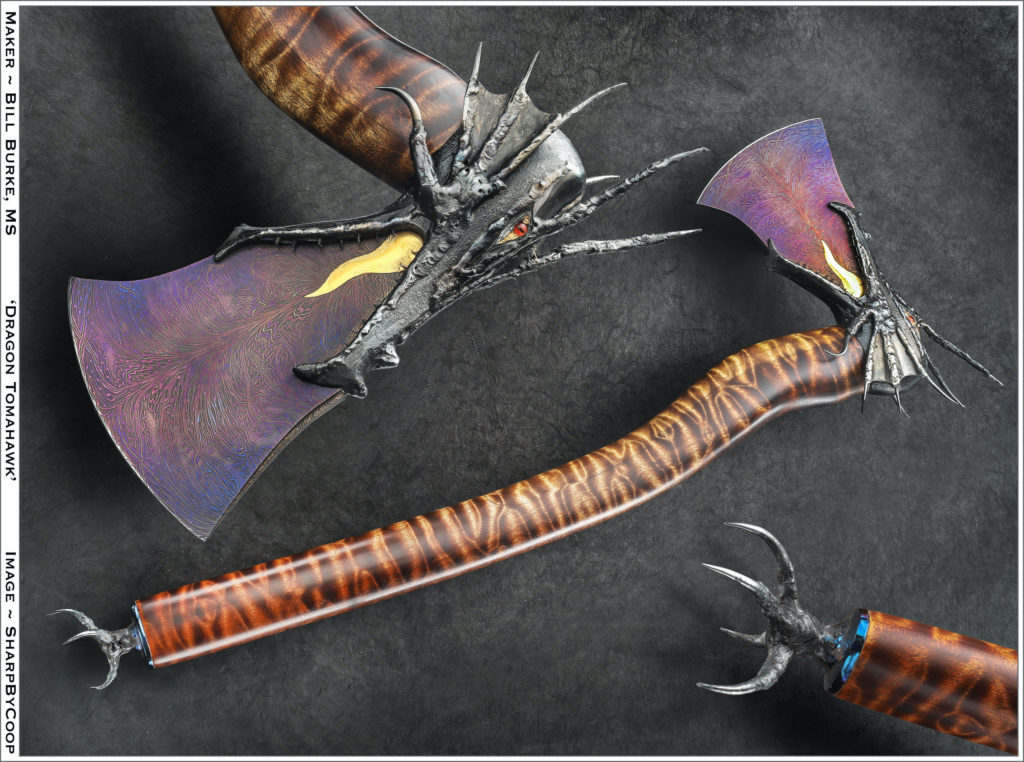
The Dragon Tomahawk is 20.5 inches overall, with a 4-inch cutting surface of damascus and a curly maple handle. The head is wrought iron and 1018 mild steel forged into a “W’s” pattern, and the blade steel is 1080, 15N20 and 201 series nickel forged together to create Bill’s Dragon’s Breath pattern. (SharpByCoop image)
The tomahawk is a true multi-purpose tool. With it one can dress game, chop wood, and clear brush. Choking up on the handle, the user can use it much like a knife. The length of the handle gives the blade tremendous velocity and force as well, making it a formidable weapon. These attributes were not lost on the Western frontiersmen who often adopted the tools and lifestyles of the Native tribes.
This adoption became even more apparent as the frontiersmen went to war. They employed the same guerrilla warfare tactics used by the Native tribes, and they carried the tomahawks so prized by them. One equipment list for volunteers into the American militias mentions “a sword or tomahawk” as a required item right along with a rifle, powder, and lead.
Tomahawk In The 21st Century
This rich history would be enough to secure the tomahawk’s place among the iconic tools and weapons of American history, but the story does not stop there.
Peter LaGana, founder of the American Tomahawk Company, was famous for his tomahawk made popular during the Vietnam War. Also privately purchased by soldiers, it proved a valuable tool and weapon in the jungles of Southeast Asia.
The true rebirth of the tomahawk, however, would be brought about by the Global War on Terrorism after the attacks on 9/11. Some members of the Special Operations community began carrying tomahawks as part of Col. John Mulholland’s Joint Special Operations Task Force, also known as Task Force Dagger, when only 300 Americans were in Afghanistan on the hunt for Osama Bin Laden.
The number of soldiers carrying tomahawks increased throughout the next decade of war, but why? The wars in Afghanistan and Iraq were asymmetric wars that had more in common with the guerrilla fighting of frontier America. The tomahawk once again served as a valuable tool and weapon in this environment.
Our 12 Best Tomahawks For 2023
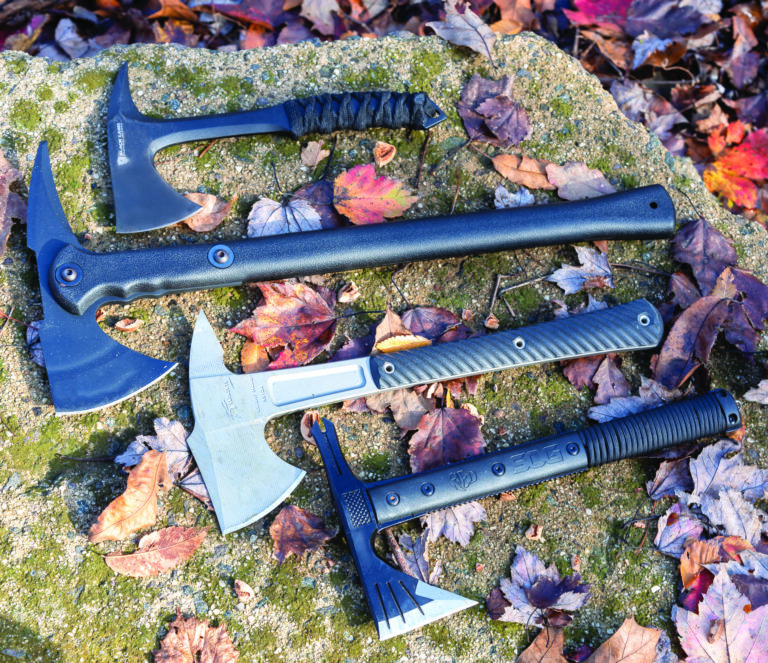
The modern tomahawk comes in all shapes and sizes with all sorts of uses and included features. These are a dozen across a variety of price points that show what the modern hawk is designed to do and how companies are getting creative with them.
Browning Shock’ N Awe
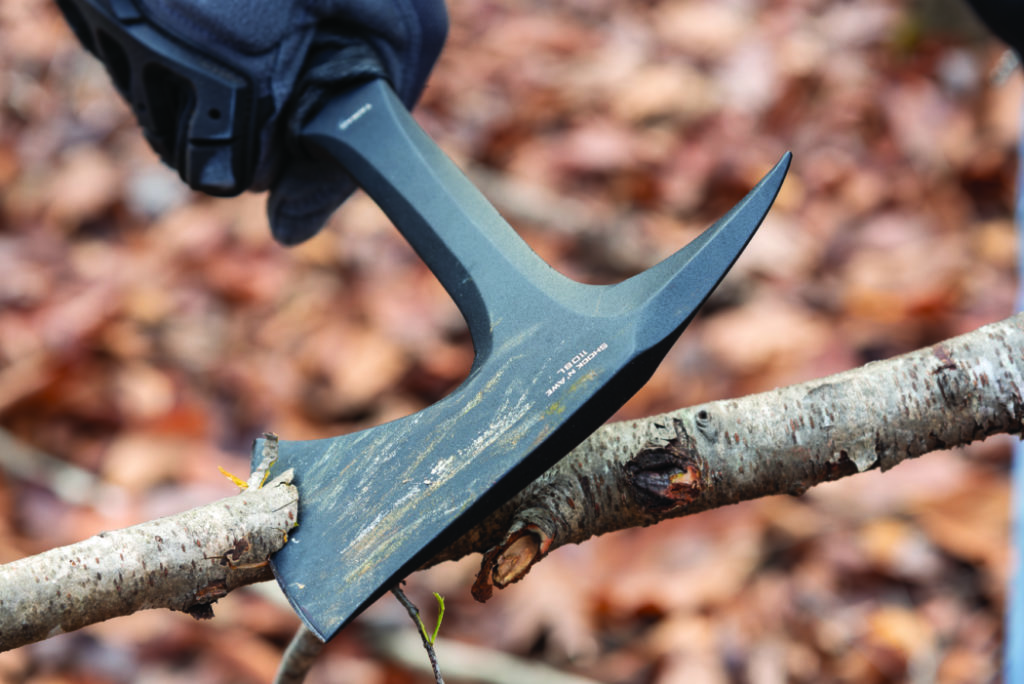
The Browning Shock ‘N Awe is a compact tomahawk that packs a big punch. Despite its small size, it still has the heft to be a very effective chopper.
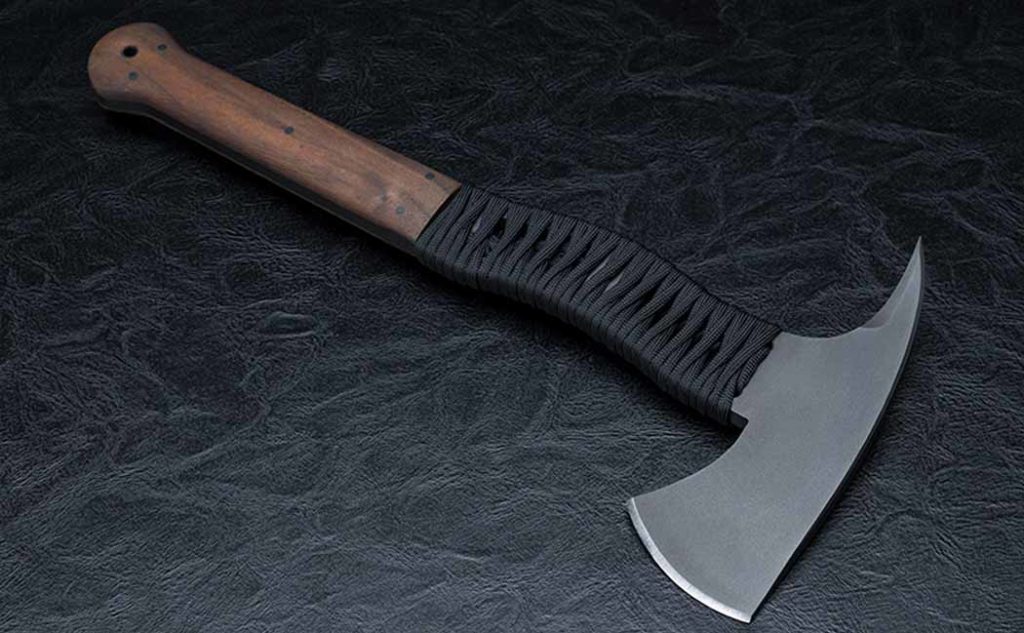
The Shock ‘N Awe is 10.5 inches overall. The head is 2.75 inches and offers a curved penetration spike for light breaching. The head, spike, and handle are forged from one piece of 1055 high carbon steel and covered in a black epoxy coating for corrosion resistance and low glare.
The handle is in a traditional Japanese style with a hand-wrapped overlapping cord. It looks great and it seems a perfect match for this size of hawk. The 3D nature of the wrap segments creates alternating ridges that help provide an ultra-secure grip in all conditions. The exposed pommel terminates in a skull-crusher shape.
The Shock ’N Awe comes with a molded polymer sheath with MOLLE-compatible attachment provisions. The sheath encases the entire head and spike which pivots into and out of the sheath. A locking tab that pivots down over the spike end of the sheath prevents the sheath halves from separating, effectively locking the hawk into the sheath.
The hawk gets into tight places easier and is more maneuverable than larger models. It’s easier to carry as well. It easily takes down small saplings and de-limbs them as well. The Shock ’N Awe would be great for splitting kindling, including via a baton.
The spike is pointy but not so much that it can break off. It penetrates wood and other materials effectively, and can be used for digging as well. It opened up a good-sized hole in plywood when used in a rocking motion after penetration.
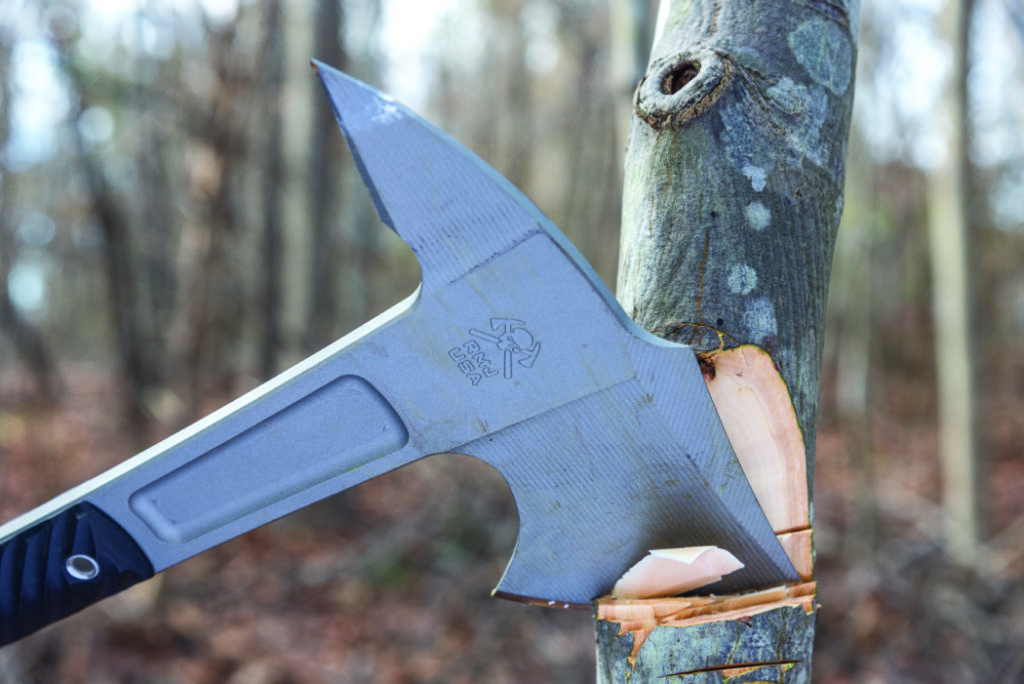
The RMJ Tactical Knight Hawk is an excellent chopper.
ABS master smith Jason Knight and RMJ Tactical co-designed the Tactical Knight Hawk to handle a variety of jobs, not just chopping. It’s 14.5 inches long and feels agile in the hand with a weight of 23 ounces. The cutting edge is 2.875 inches, and the blade is made from 80CRV2. Blade thickness: .275 inch. The handle is 3D-machined black G-10 riveted/permanently attached to the tang.
There is a slight downward turn to the cutting edge that accentuates power, which is in contrast to most hawks where the edge is parallel to the handle. As a result, the cutting edge engages and shears more effectively after impact. This is one reason why the Knight Hawk isn’t head heavy like many hawks, yet can outchop many of them.
This translates to extended use without wearing you out. By the same token, being agile in hand suits it for tasks few hawks are adept at, such as whittling and making fuzz sticks.
The spike is the shortest one of all the hawks tested, though that does not mean it is the least effective. Resembling a fat knife blade rather than a true spike, it sports a semi-sharpened edge at the bottom. The spine tapers down slightly but leaves more than enough material for tip strength and to withstand heavy penetration strikes.
The Knight Hawk is practically bulletproof, devastatingly effective, and a pleasure to use. It comes in a choice of three Cerakote® color options: Savage Steel , OD Green, and Desert Tan.
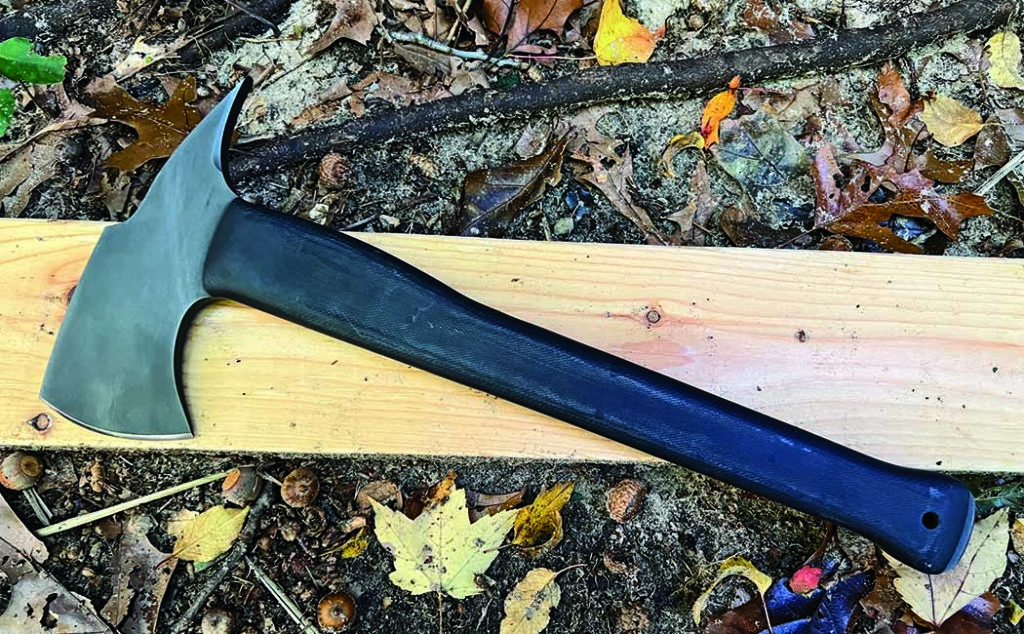
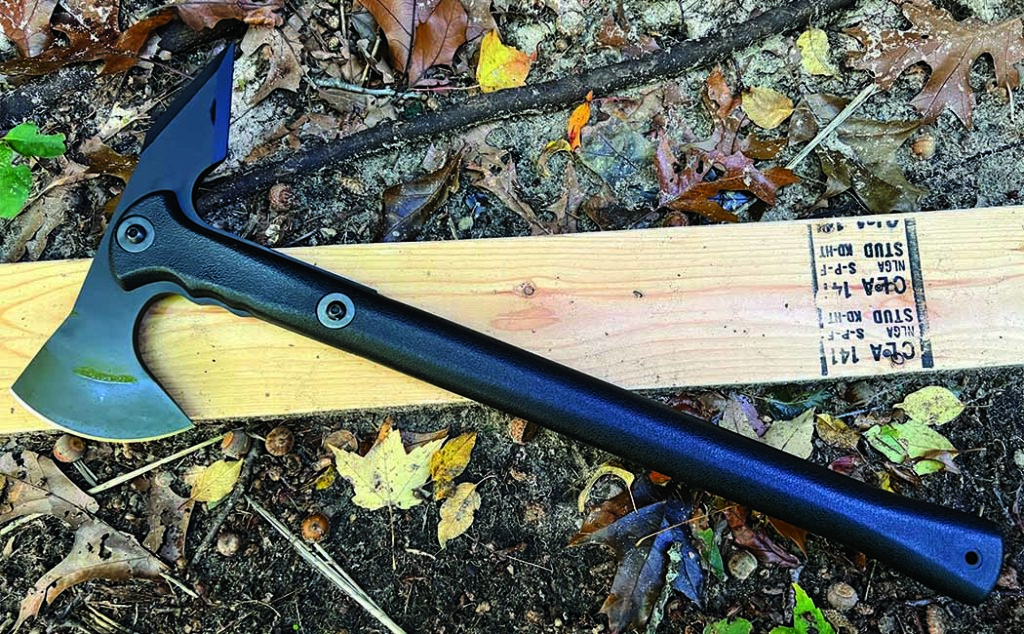
Measuring 19 inches overall, the Cold Steel War Hawk features a head of drop-forged 1055 carbon steel for toughness and a textured polypropylene handle. The partial tang is inset into the handle and secured by two large bolts, and you can replace it easily should it break.
The wide, bearded axe head excels at chopping and cutting. The tang area just behind the head has a few finger grooves for choking up for whittling or more precise cuts. The double-ground spike has a distinctive tanto-ish shape for maximum penetration and power. The spike is ground on top and bottom to remove material for enhanced penetration.
The handle is comfortable, and the texturing promotes good grip traction in various conditions. The sheath is a clever double-articulated design that encases most of the head. The sheath has two pivots—one at the spike end, the other at the beard end. The sheath is secure and doesn’t fall off. The only negative is there is no belt-attachment provision. Consequently, the War Hawk is ideal for storing in your truck for camping expeditions.
With the tanto-tip-beveled spike, the War Hawk had great penetration through plywood. In order for it to be an effective chopping/breaching tool, there must be zero flex in the handle. If Cold Steel went to a hickory wood handle it would improve the War Hawk’s performance. As is, it might make a great throwing tomahawk.
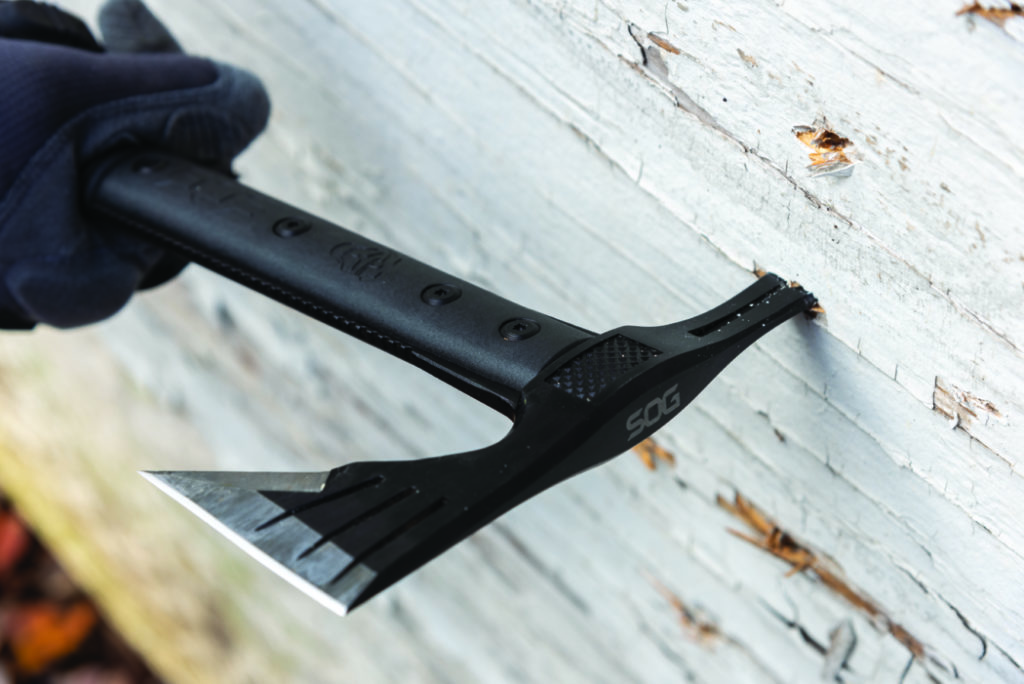
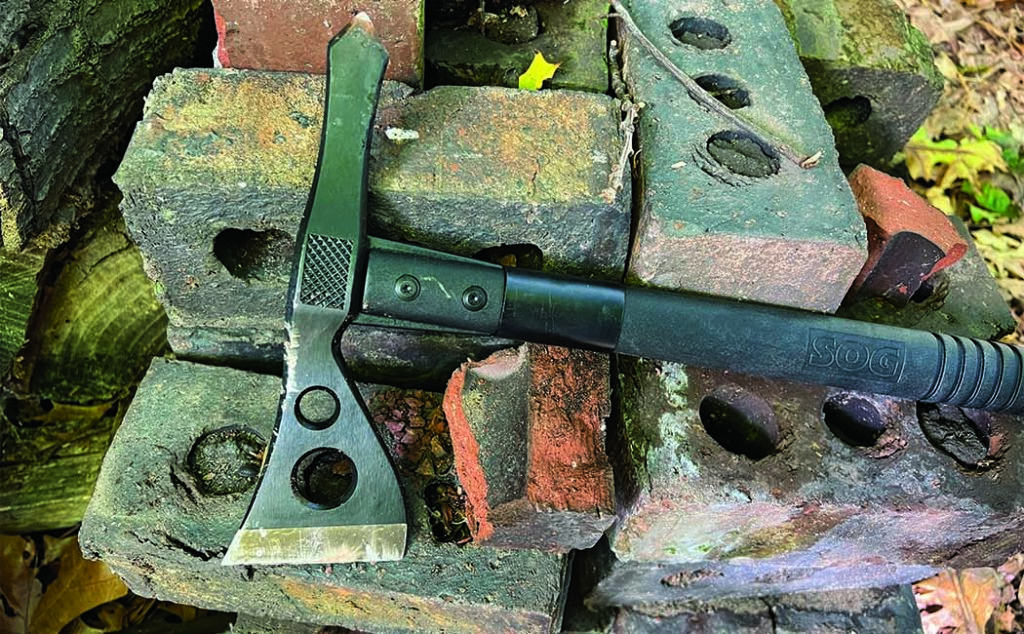
The spike of the SOG Survival Hawk works well and achieved good penetration into plywood.
A little over a foot long, the Survival Hawk is compact enough to tote around while camping. The head is cast from 2Cr carbon steel with a cutting edge of 3 inches and a distinctive spike on the opposite end. The spike is not only designed for penetration, but the slot can be used to pull nails or bend wire. When held in the icepick grip with the head pointed toward the ground, the Survival Hawk can be employed as a hammer.
For added versatility, a fire-starting ferrocerium rod screws into the handle butt. The glass-reinforced-nylon-handle material is lightweight while the full-tang design promotes strength and superb balance. The gripping area of the handle is wrapped with paracord for comfort. The exposed portion of the tang in between the paracord handle and the head has a series of traction notches. Grip the area tightly up against the head to carve or whittle with extra control.
The head is all black but the grind bevels are satin finished, creating a striking visual contrast. At 19.5 ounces the Survival Hawk has the weight it needs to deal effective chopping blows. Given its light weight and compact length, don’t expect it to tackle heavy/extended chopping tasks, as you’ll end up having to use more arm power. It actually works pretty well and bit hard into saplings. If you need a hawk for chopping on an as-needed basis, then this is an ideal one to consider.
The Survival Hawk comes with a sturdy ballistic nylon sheath with a stiff inner liner and sports sewn and riveted construction. A button-snap flap closure secures the sheath around the head. A large nylon webbing loop provides easy belt attachment.
The spike works well, and the notch in the center serves as a nail puller. However, the spike might penetrate better without it. Nonetheless, it achieved decent penetration into plywood. However, just like with the head, the spike would also be more effective if the handle were longer for extra leverage for a more powerful swing. Conversely, the Survival Hawk is still loaded with useful features.
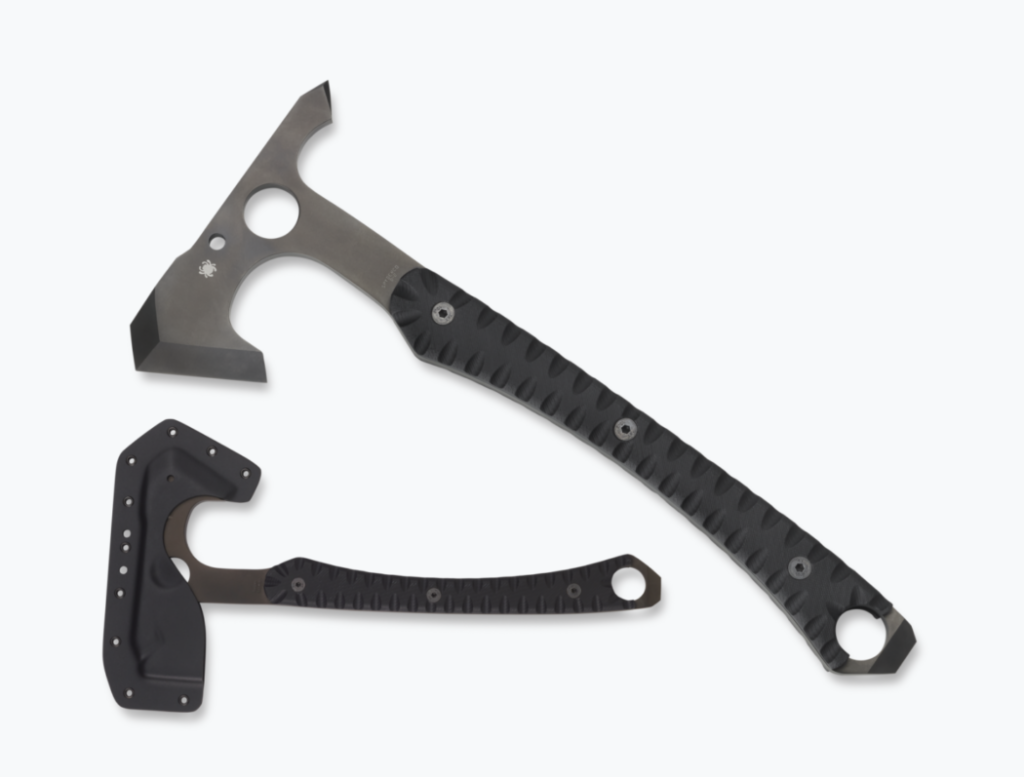
The holes are not just for aesthetics on the Spyderco Warrior Hawk. Designer Laci Szabo indicated the top hole can be used to create a leash similar to that used on ice axes, and a chain can be attached to the hole at the end of the handle so the hawk can double as a hook.
Laci Szabo, United States Marine Corps veteran and New Mexico police officer who served as a breacher on SWAT teams, designed an urban multi-tool to fill the bill. The result is the Spyderco Warrior Hawk, a striking modern design with an angular blade and Spyderco’s signature cutout holes.
The Warrior Hawk is designed to punch out tires, break vehicle windows, cut cables, and handle prying tasks. The apex of the angle ground into the cutting edge of the head concentrates the power of the swing while preventing the material from binding up on the edge.
The holes are not just for aesthetics. Szabo indicated that the top hole can be used to create a leash similar to that used on ice axes, and a chain can be attached to the bottom hole so the hawk can double as a hook.
Szabo wanted a handle different from existing tomahawk designs, so he configured the G-10 handle to resemble that of a conventional hammer. He said the overbuilt design consists of D2 tool steel that’s .3 inches thick, a material that can be heat treated to a high Rockwell hardness yet still has “wear resistance and pry ability,” according to Spyderco.
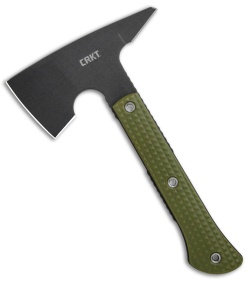
The challenge for Ryan Johnson in designing the Jenny Wren for CRKT was to make a pint-sized version of a tomahawk. The original version made by Johnson’s RMJ Tactical saw use by special operations forces starting in 2010. Meanwhile, the design also makes for a great outdoor tool.
When CRKT began offering its version of the Jenny Wren, the idea was to fill a need for people heading outdoors that were looking for durable and innovative axe designs.
One of the most notable features is the sharpened edge running across the top of the head. While it was originally designed to maximize slicing cuts, the edge also reduces drag. “It’s the material that is not in the way that makes a difference with this design,” Johnson said.
The ambidextrous sheath allows multiple modes of carry, including a belt, sling or attachment to a MOLLE system. “Everyone tends to forget the importance of the scabbard,” Johnson observed. “If you can’t carry it, you can’t use it. In the case of a tomahawk it’s important to have a safe way to carry it multiple ways.”
Designed by Jared Wihongi, this hawk features a Maori-inspired tribal motif on the head. The tomahawk-like patiti was a weapon of choice for Maori warriors in New Zealand shortly after they first began arming themselves with metal tools long ago, and the head design harkens back to that time.
The satin-finished 420 stainless head showcases the design well. At .25 inches thick, and coming it at 26.4 ounces, the hawk has the heft and size to make quick work chopping through most material. A semi-sharpened edge on the spike end allows for a moderately precise puncturing tool as well.
At 13 inches in length, it’s long enough to get a good whack without exerting your arm too much. The hawk features a paracord-wrapped polymer/composite handle, and where the head meets the handle is reinforced for sturdiness.
Daniel Winkler is tight-lipped when it comes to the teams and units he works with. His Winkler Knives Wild Bill tomahawk was designed with the help of Kevin Holland, Navy SEAL and U.S. Army Special Operations veteran
The axe was named after William “Wild Bill” Donovan, who was head of the precursor to the CIA, the Office of Strategic Services, during World War II.
The hawk is both a tool and art considering the craftsmanship that went into it. It starts with the flat-ground 80CrV2 blade with a black Caswell finish for improved corrosion resistance. The tapered-tang design ends at the integral spike at the butt of the axe, which works well to crush and pry. It’s not the best puncturing tool as it is unsharpened.
The 13.25-inch maple wood handle is wrapped in black cord for most of the top half of the handle for better grip, especially when choking up on the axe for precise slicing. The 22.2 ounces are distributed well, making for a great swing every time.
Wild Bill AxeSpecs Blade Material: 80CrV2 with black Caswell finish Overall Length: 13.25 inches Edge Length: 2.25 inches Weight: 22.2 ounces Handle Material: Maple Wood with Black Cord MSRP: $600
Estwing Black Eagle Tomahawk
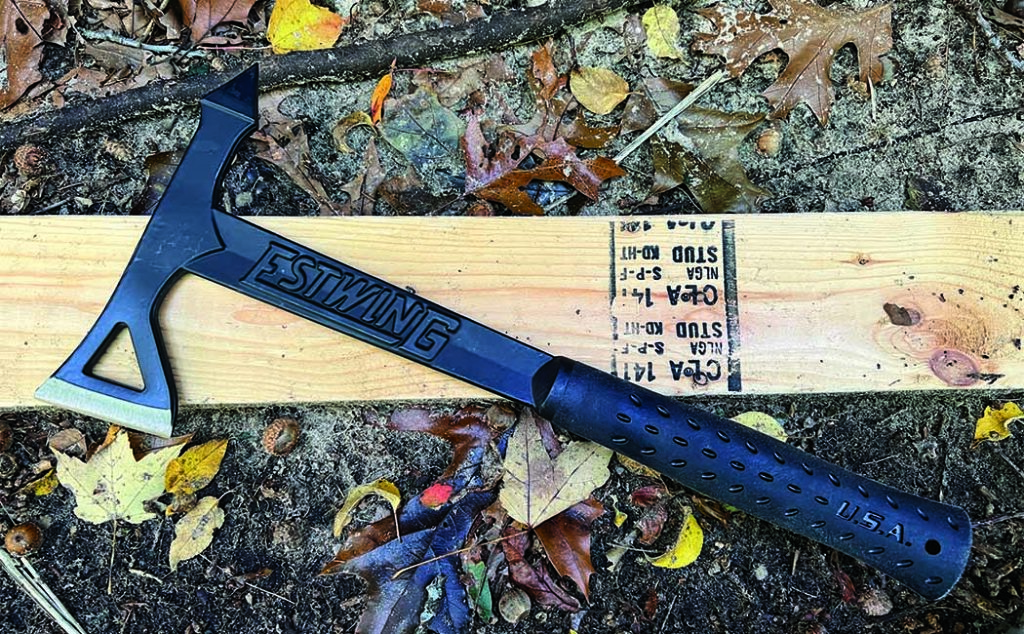
The Estwing Black Eagle Tomahawk feels much more like a tool than a hawk. The rubberized grip absorbs shock and is very comfortable. You can’t choke up on the head like you can some other hawks, though you could add some paracord for the purpose.
The Black Eagle is the epitome of durability. It’s not flashy and has the company’s logo deeply embossed on the tang. The balance is incorrect for throwing but that’s not really the Black Eagle’s role. It is a demolition tool, plain and simple. The head is dimensioned correctly for the same feel as swinging a hammer.
It has a raised equator from its high points, can be used to punch into various materials, and is very easy to withdraw. It can go through just about anything despite the fact it is not sharp on the corners and the tip is more or less rounded off.
In wet, grimy conditions it performed extremely well and goes through wood easily, both in destroying wood structures and splitting firewood. The hawk punches through sheet metal with ease. If you’re looking for a hawk that is less showpiece and more hard-working tool, this is your best bet.
At $600 the Winkler Combat Axe is not just a big chunk of change, it’s also an incredibly strong, rugged chunk of 80CrV2 carbon steel. Not only is it functional, it’s also forged at the company started by the individual largely responsible for the popularity of the modern tomahawk, Daniel Winkler.
The Combat Axe is easy to draw from the belt. The sheath is extremely functional and allows you to remove the Combat Axe one-handed with little effort. The handle runs all the way up to the head and provides an excellent grip at any point along its length.
Of note is the shape of the spike. It is reminiscent of a flat-end bayonet point commonly seen on Russian rifles like the SKS and Mosin-Nagant. Its shape allows it to be used as both a prybar and lever, and it can be swung into material with great force and then used to pull it apart.
The Combat Axe’s edge profile did just fine splitting light amounts of firewood. It also removes branches quite easily in one swing. Because the handle extends right up to the head, there is a risk of damage should you try to split large pieces of wood. The sheath is a major selling point.
The Combat Axe is definitely worth the price, though for the same amount you can buy numerous other hawks multiple times over.
When it comes to durability, the Cold Steel Trench Hawk is quite similar to many of the company’s edged tools. While none of Cold Steel’s functional cutters would win a beauty contest, they certainly have it where it counts when being used. The blade arrived razor sharp, almost too sharp for its own good. Likewise, the spike is substantially longer and much sharper than those of the other test models.
The Trench Hawk is a favorite for throwing.. The company sells replacement handles for around $7 should you break one. It severs branches with extreme ease, though such a task is more of a problem than you might think. The polypropylene handle doesn’t just go up to the head, it terminates right in the middle of it. If you strike too hard, it inevitably will drive the blade in up to the handle, which can cause damage.
The longest of the test hawks, it gains excellent velocity when swung. The handle shape, while correct for a tomahawk, is a bit too smooth and slippery when wet. Another issue is the spike’s length and profile. It’s simply so large that it borders on being unusable for standard chores. It punches through just about anything, from metal to wood, but tends to get stuck easily. Getting it dislodged can be somewhat dangerous
The SOG Pro Tactical Tomahawk is about as barebones as you can get while still being functional. Upon arrival it had a very sharp edge with a blunted, angular spike. The edge was covered in a transparent coating that flaked off during use. The balance of the hawk is excellent and, like the Estwing, has a modern, swept head with an upturned edge. It cuts deep, easily chops firewood, and is excellent for taking down branches. The overall shape and profile are quite minimal, a big plus across the board.
A major downside is the handle. While very strong, it’s rounded and the textured finger grooves don’t provide much extra grip. Because conditions were wet during most of the testing, it was difficult holding onto the handle if the swing wasn’t spot perfect. It wants to rotate in the hand and, while wearing a glove does fix some of that, it’s not an all-around solution.
The spike was functional but had a similar issue to the Cold Steel Trench Hawk in that once it punched through a material, it was hard to remove. For the price, it is an excellent working hawk. It could stand some improvement but should hold up quite well.
Pro Tactical TomahawkSpecs Blade Material: 420 HC Stainless Overall Length: 15.75 inches Edge Length: 2.75 inches Weight: 24 ounces Handle Material: Black Glass-Reinforced Nylon MSRP: $47.99
Editor’s Note: Dexter Ewing, Daniel Jackson, Josh Wayner, and Ryan M. Johnson contributed to this piece.
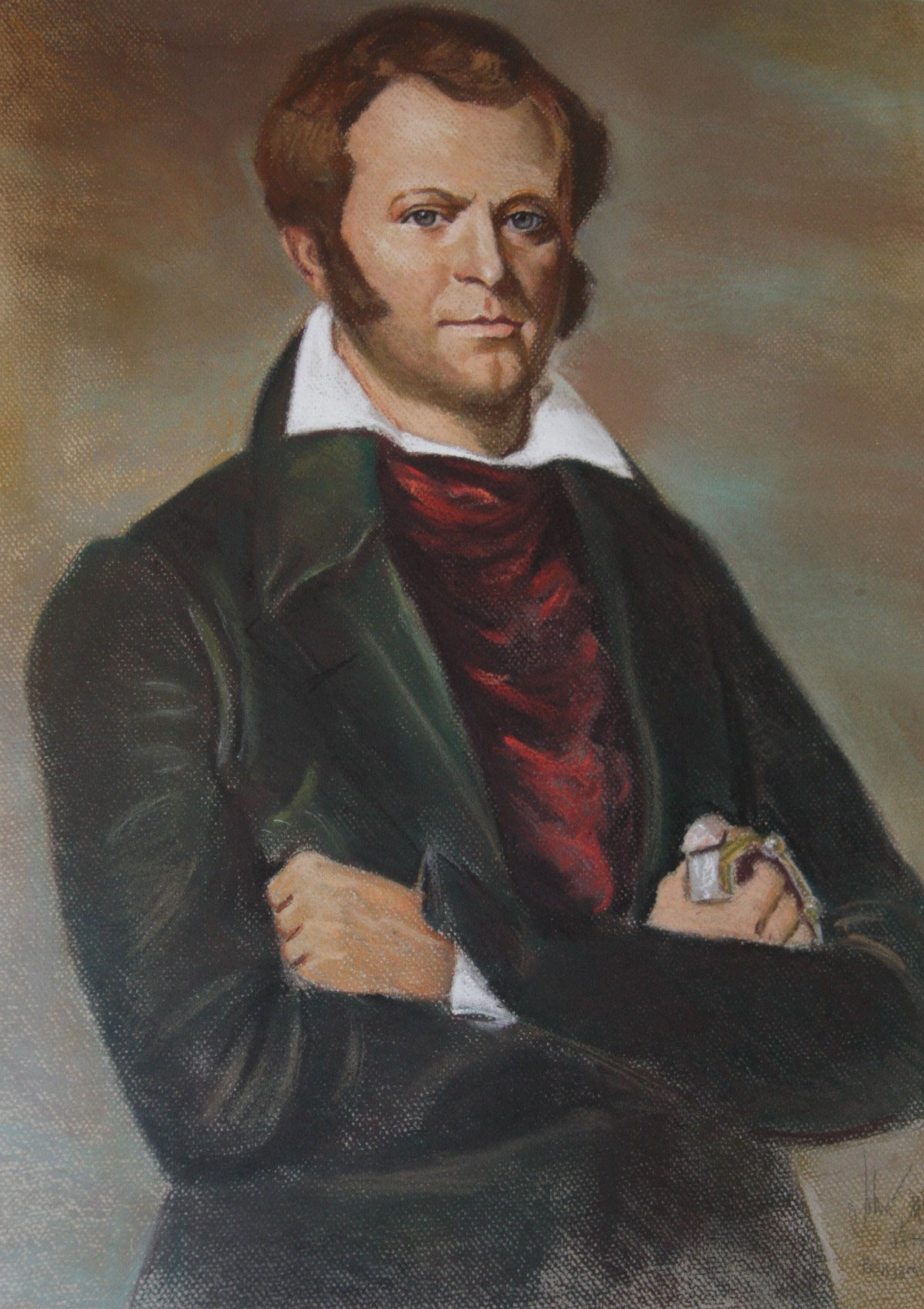
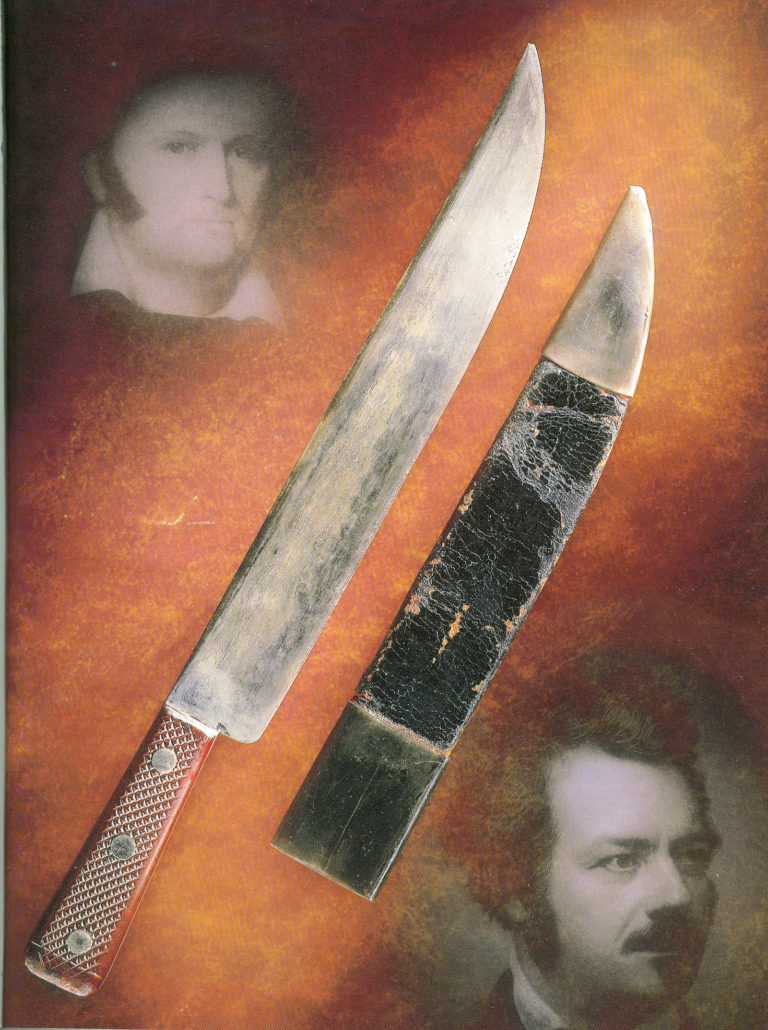
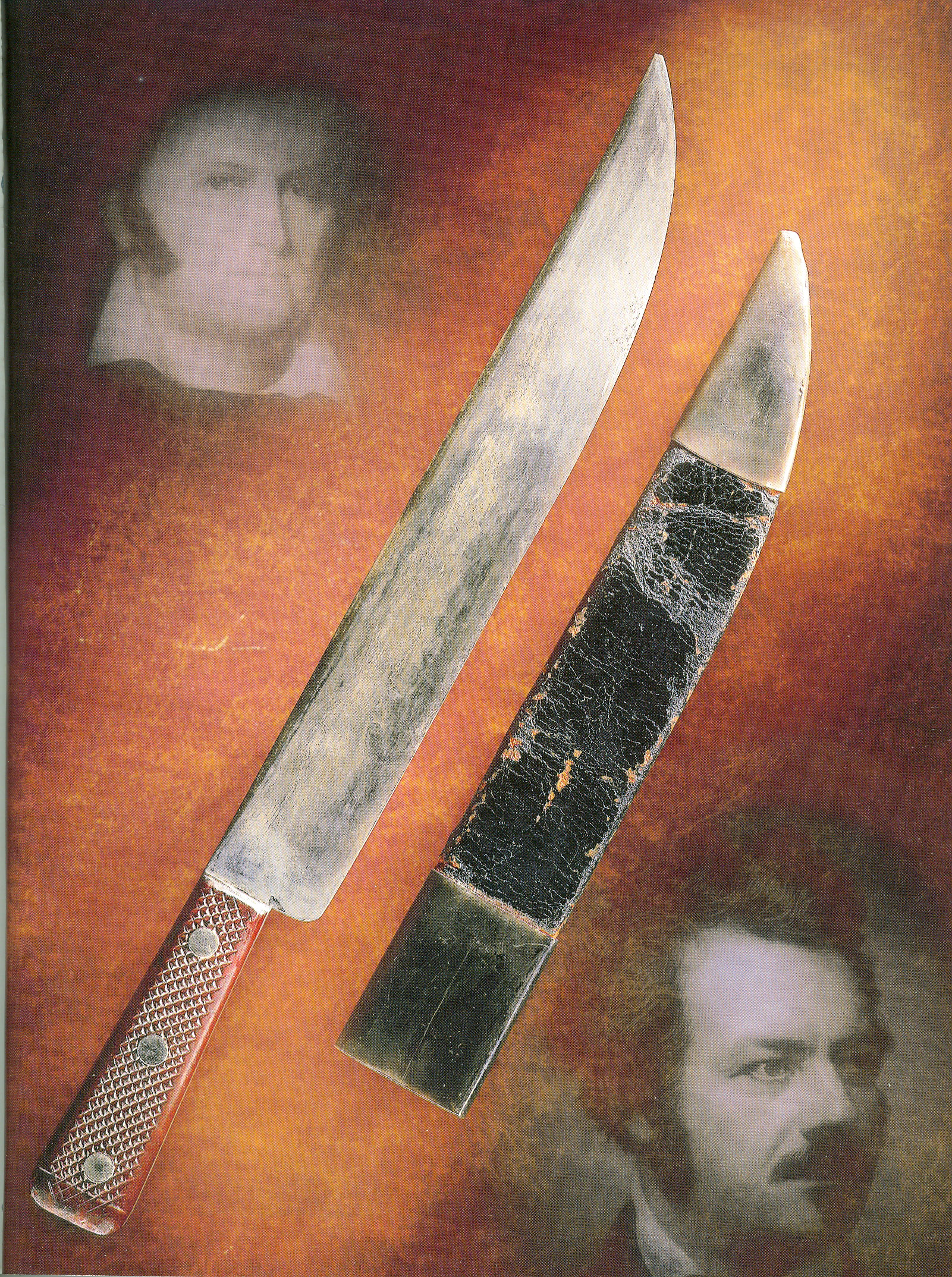
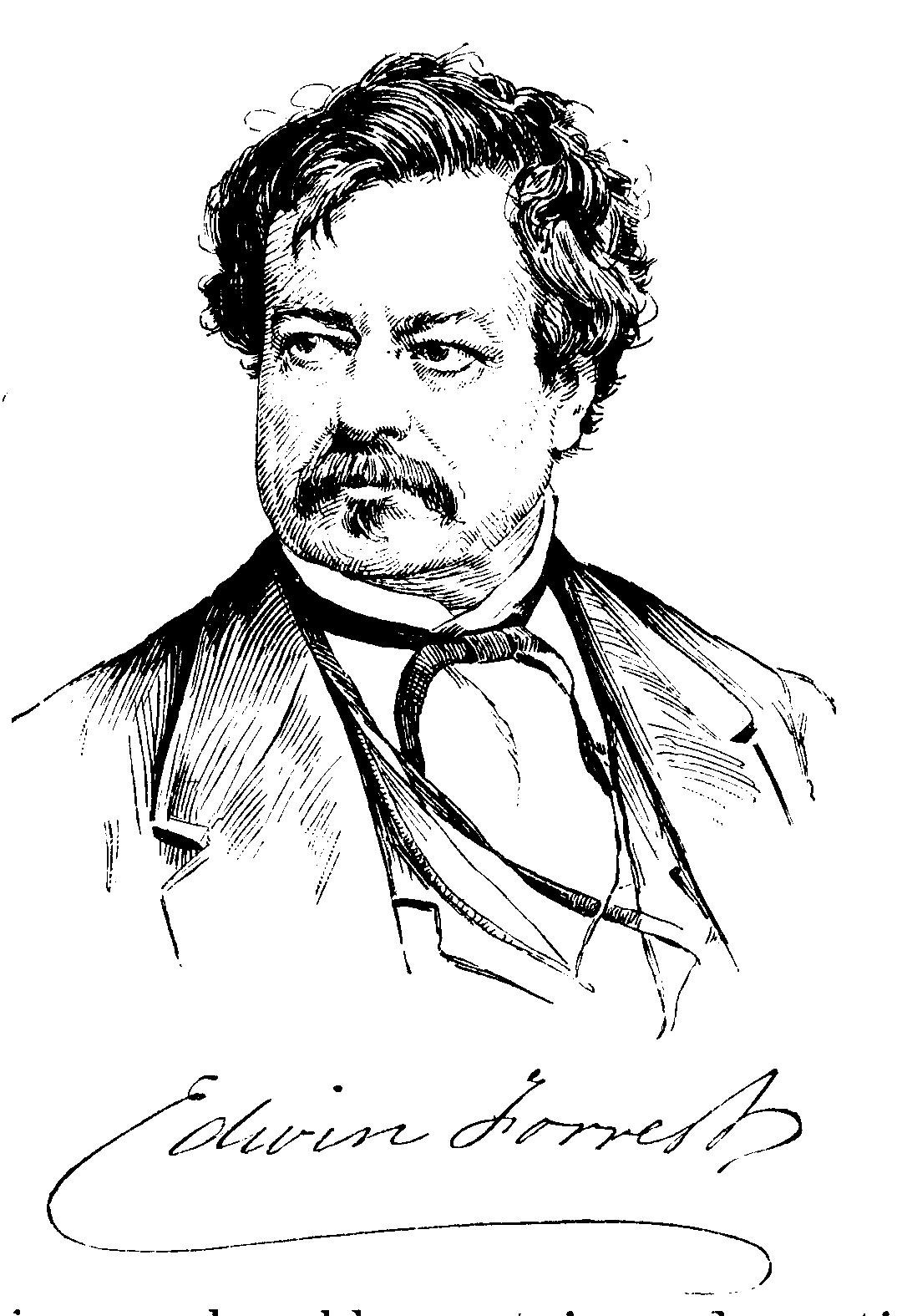
Some say that Jim Bowie (upper left) personally gifted a bowie knife (above) to Edwin Forrest (lower right). Jim Batson, one of the world’s leading bowie knife authorities, shares his findings on the subject.
Jim Batson
BLADE recently sat down for an extensive interview with Jim Batson, one of the leading bowie knife researchers in the world. The interview was recorded on video, which can be seen below, and consists of two parts.
Most significantly, Batson reveals what he discovered about the controversial Edwin Forrest bowie knife, claimed to be gifted to the 19th Century actor by James Bowie himself. That can be seen at 25:06 in the video.
Look below the video for further timestamps and summaries.
Batson Looks Back on 30
ABS master smith Jim Batson has been conducting his Batson Bladesmithing Symposium for three decades and just completed the 30th one April 8 at the Tannehill Ironworks near Bessemer, Alabama.
Join us for an exclusive interview with Batson as he talks about those 30 symposiums, the major industry changes he’s seen in his bladesmithing career, his induction into the BLADE Magazine Cutlery Hall of Fame in 2017 and what the future holds for this icon of the forge.
Use these timestamps to help you navigate the video.
ABS master smith Jim Batson has scoured the Bowie Trail from the Southeast USA to Texas for decades, researching anything and everything about James Bowie and bowie knives.
Watch the video above to see Jim recount the highlights of his research, including his book about the Sandbar Fight where the bowie knife legend was born, whether James Black really made bowie knives—including those in the Carrigan style—whether the Edwin Forrest bowie actually belonged to James Bowie and more in this exclusive BLADE® interview.
12:27 Contributions to bowie knife history research
15:01 Surprising finds
15:53 New facts about the 1827 Sandbar Fight
17:57 James Black controversy
23:14 The Carrigan knives 25:06 The Edwin Forrest “Gift” bowie knife 27:22 Where did the Forrest knife come from?
30:47 End
This year marks the 75th anniversary of many major battles that turned the tide for the Allies in World War II. D-Day, Bastogne, Anzio, Monte Cassino, the Leyte Gulf and more are forever etched in the minds of many millions of people. Yes sir, 1944 was a very bad year for the Axis.
For those who fought in those titanic struggles for freedom, 2019 designates the last of the major anniversaries they will see. Most of whom are at least 90 and older today, they obviously won’t be around for the centennial celebrations in 2044. Of course, many of the rest of us won’t as well, but then we didn’t serve in “The Big One,” as Dad liked to call it, either.
In a world that seems bent on forgetting its past, the Greatest Generation members who won that war, both at the front and the loved ones on the home front—including my parents—are unforgettable. No matter race, gender, creed or nationality, the Greatest Generation represents most of what’s good, wise, brave and kind about humanity.
Memories of them are indelible because their deeds are manifest in the subsequent accomplishments and successes apparent everywhere on the globe, including from the bounty of the USA to the remarkable recoveries of two of the Axis powers most devastated by the conflict: Germany and Japan.
Custom Knives & World War II
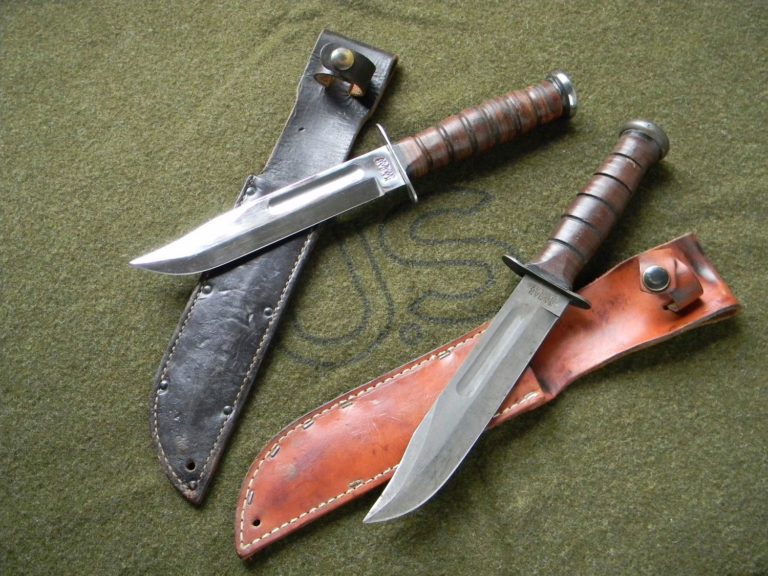
Bo Randall’s Model 1 journeyed to all theaters of World War II alongside U.S. forces. (Randall Made Knives photo)
The argument can be made that the custom knife industry can trace its roots to World War II. It was during the war that such knifemakers as BLADE Magazine Cutlery Hall-Of-Fame® members Bo Randall, Rudy Ruana, William Scagel, M.H. Cole and Dan Dennehy made knives for the troops. Dennehy, in fact, both made knives for the troops during the war and also served in it, joining the Navy in 1940 and seeing action in the Saipan, Philippines and other campaigns.
Other well-known makers to fashion knives for the troops during the war included Floyd Nichols, Hoyt Buck, David Murphy, John Ek, Donald W. Moore, Frank Richtig, E.W. Stone, John Nelson Cooper and no doubt more. Each played a role in inspiring what today is the modern custom knife industry.
World War II: Special Tasks Required Special Knives
The Case V-42 opened up new possibilities in knife design, proven on the battlefields of World War II. (Case photo)
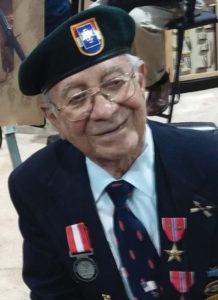
And then there were those who used knives in the war, people such as U.S. Army Corporal Eugene “Gene” Gutierrez of the First Special Service Force (FSSF). It was the FSSF that carried the legendary Case V-42 dagger and was comprised of specialists in mountain climbing, skiing, demolition and airborne ops.
Gene Gutierrez
Wounded eight times in combat, Gene was with the FSSF when it scaled the 10,000-foot-high Monte la Difensa in the Italian campaign and dislodged the occupying Germans.
The climb was “pretty much straight up,” he said of the monumental effort. It took all night under one of the heaviest artillery barrages of the war, but the Forcemen made it up the mountain and routed the enemy. Later the FSSF was inserted at Anzio, where they pushed the Germans back again.
According to Gene, the Forcemen also were specialists in psychological warfare. While on night patrol they would paint their faces black and, after dispatching Germans, leave notes on the vanquished enemy bodies that read, “The worst is yet to come.” The Germans who found the notes nicknamed the Forcemen the Black Devils, aka the famous Devil’s Brigade.
Ninety-eight now, Gene is one of the last of a rapidly vanishing breed. The surviving Forcemen get together for reunions when possible, and Gene has served as the president of their association twice. They are among the leading members of the only generation that is truly unforgettable.
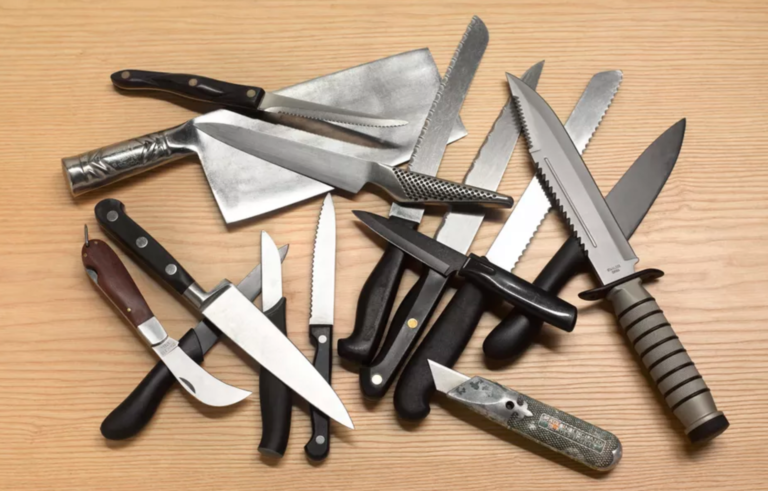
There’s a certain mystique to knives. They’re ancient, crafted with secret techniques and can instantly convey a message about the person in possession of them. It’s no wonder there are a few superstitions about knives out there. Here are four.
1) A Gifted Knife Can End a Friendship
The saying goes that a gifted knife will sever the ties between the giver and the receiver. To avoid the end of a friendship, the recipient needs to hand over a penny to the benefactor. Like that, the gift turns into a purchase and no harm will be done.
2) Ease Labor Pains During Childbirth
Placing a knife under the bed of a woman giving birth is believed to ease her pain during labor. Also, sticking a knife into the mattress of a laboring woman is supposed to help her birth a boy.
3) Don’t Lay One Knife Across Another
Crossed knives on a table will cause a quarrel. Crossing a knife with another piece of cutlery is a sign of witchcraft. And if you cross your knife with your spoon, you are implying the food didn’t taste good and that you wish bad luck on the chef.
4) Don’t Sharpen Knives After Dark
It was believed that sharpening knives after sunset was bad luck – which makes sense, considering that this superstition goes back to a time before electricity.
No matter if you follow the original advice or apply the antidote of keeping “a pinch of salt in the churn to keep the witches out,” we strongly advise against sharpening in the dark. Always.
Don’t Risk It! Knife Aid Will Sharpen Your Knives For You
No matter what time of day it is, Knife Aid can take care of your knife sharpening and repair needs. Knife Aid makes it easy to mail in your knives for maintenance.