The history of knives and other edged instruments is tied to the history of people in general. As humankind’s oldest tool, unraveling knife history can lead to even more surprising and enriching information to better understand the world.
The Navaja Is A Sleek, Svelte Folder Originating From Spain Hundreds Of Years Ago. Today It Remains Popular In Both The Real And Digital Worlds.
The Navaja is one of the most interesting knives in the world. Its history can be pinpointed to the Andalusia region of southern Spain, and its growth and evolution since its creation more than 400 years ago has been well-documented.
The History Of The Navaja
The first Navajas that resembled the modern version came to be in the 1600s. The name is derived from the Latin word “novacula” which means razor, and you can see the resemblance to a straight razor in its construction with the long, thin blade that folds away neatly into the handle.
The knife became popular during a period when, unless you were a nobleman, there were many restrictions on swords and other blades. This meant that the Navaja developed as a peasant’s knife and was used for all sorts of utility tasks. One thing that made using it a bit difficult was the fact that it didn’t lock when opened. Later Navajas would have locking mechanisms, but the first versions didn’t. Most notably the Navaja made a distinctive cracking/popping sound as the blade was opened, differentiating it from other knives.
Thanks to the steel innovations that allowed the knife to lock, the Navaja spread its wings and made its way out of Spain and to nearby countries like France. As the knife continued to evolve it was banned by rulers, then became a popular tool for rich and poor alike, and was used as a versatile combat knife. In fact, it became the knife of choice among muggers who would rob people in alleyways and other dark urban areas. Victims knew they were about to be robbed when they heard the unmistakable popping sound the Navaja made when a mugger opened it.
Roughly a century ago, the Navaja began to fall out of favor with knife lovers. However, it continues to endure thanks to a handful of makers crafting their versions, and, in an extremely modern twist, it has become a popular knife to use for players of the video game Counter-Strike: Global Offensive.
Kings County Tools Navaja-Style Knife
A great modern representation of the Navaja is seen in this folder from Kings County Tools.
The blade is not just razor sharp but also razor thin. At three inches in length and just .25 inch wide, the stainless steel knife is excellent at precise, detailed tasks. The brass and steel handle is both handsome and provides an excellent grip while cutting.
Not quite a razor and not quite a penknife, this Navaja shows what the knife can be and how different it is from other folders on the market.
MSRP: $34.75
Castillo Knives Navaja
Castillo Knives Navaja – Olive Wood Handle
A different interpretation of the Navaja comes from Spain-based Castillo Knives. Their Navaja is similar to contemporary lockback knives in many ways and is an all-rounder in every sense of the term.
The blade is made from Sandvik 14C28N stainless steel and the handle comes in a variety of materials, from two types of Micarta® to four types of wood. Every version looks great, and the 3-inch straight-back blade has a small bit of deep jimping on the spine to aid in grip and force when cutting. Every knife comes with a leather pocket sheath and a 240-grit bonded ceramic sharpening stone.
Harvey McBurnette etched his name in high-dollar knife sales.
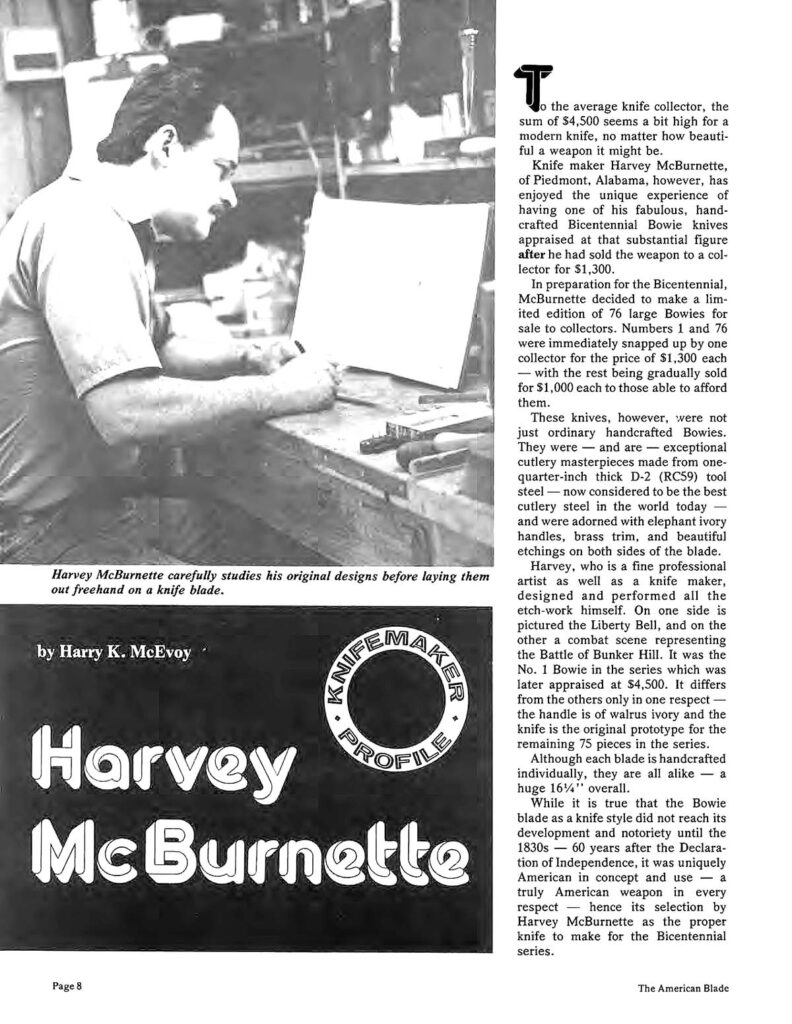
Harvey McBurnette of Piedmont, Alabama, landed in the July-August issue of the 1976 American Blade for somewhat patriotic reasons. Somewhat, because the lead of Harry K. McEvoy’s exposé on the maker was McBurnette’s celebrated Bicentennial Bowies. But there’s more to the matter than a simple commemoration of the nation’s birthday in steel.
McEvoy hooks readers by showing what the artistically talented knifemaker’s work commanded back when your dollar went a long way. In 1976, the exact sum was $4,500. As McEvoy wrote, “[O]ne of his fabulous, hand-crafted Bicentennial Bowie knives appraised at that substantial figure after he had sold the weapon to a collector for $1,300.”
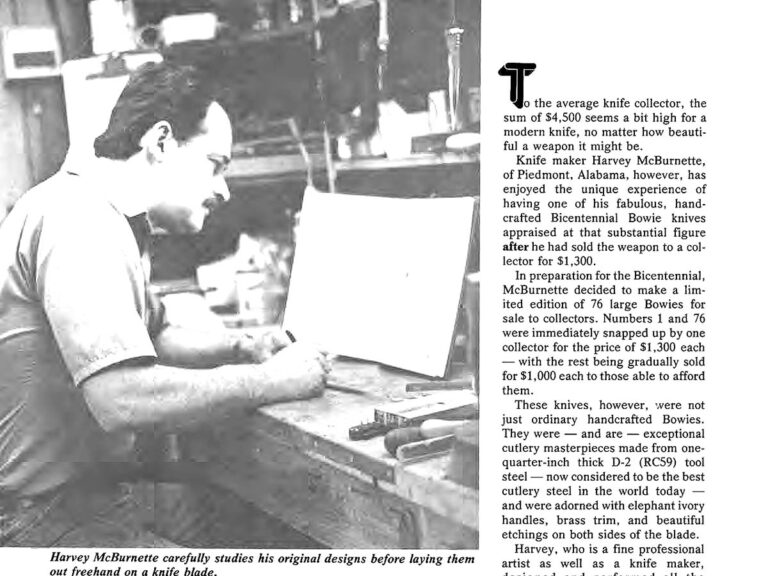
The lead image of the profile on Harvey McBurnette shows him studying his original knife design and free handing it to the steel. The maker had a strong artistic streak and was known, in part, for the embellishments he etched onto his knives.
For context, that’s roughly $26,000 in today’s dollars. What likely made the run of 76 bowies desirable was McBurnette’s unique system of adorning the knives—etching. This system, seen on many of his knives, was a very conscious choice on the maker’s part, as the story reports, serving to differentiate his work from other custom craftsmen of the day.
“I wanted to do something unique, or at least different, with my knives,” McBurnette was quoted as saying in the article. “And since I was an artist I thought if I engraved or etched my blade, I would add a touch I felt was needed to make them stand out. I chose the art of etching because there were a few other knife makers who engraved their knives. Besides, even a master engraver cannot do what an etcher can do.”
McBurnette’s Bicentennial Bowies had quite a motif etched on either side of their D2 tool steel blades. On one side of the 16.25-inch knife is an image of the Liberty Bell, and on the other a battle scene depicting Bunker Hill. The images are the same on all 76 knives, and 75 of them had elephant ivory handles. The knife appraised for the then astronomical sum did differ; the No. 1 of the series was a prototype with a walrus ivory handle.
There are many names elevating custom knifemaking to the heights it enjoys today, but none loom larger than A.G. Russell, Bill Moran and Bob Loveless.
Nobody would question the straight-up fact that A.G. Russell, Bill Moran, and Bob Loveless contributed mightily to making the knife industry in the United States, and indeed worldwide, what it is today.
Their contributions to the growth and prosperity of knife manufacturers and their partners in the custom knifemaking world are well known to many, but during BLADE®’s 50th year a moment to recognize their achievements and their contributions is appropriate.
Of course, there are others whose involvement and support have had a positive impact through the decades, but Russell, Moran and Loveless—all long-time members of the BLADE Magazine Cutlery Hall Of Fame®—are the core triumvirate that ushered the modern knife industry into its golden age.
Bill Moran
Bill Moran
“Moran gets credit at the top of the list because of the founding of the ABS [American Bladesmith Society],” related Cutlery Hall-Of-Famer Bruce Voyles, past publisher of BLADE and, along with Cutlery Hall-Of-Famer Jim Parker, co-founder of the BLADE Show. “That was followed by the development of the hammer-ins and the [Bill Moran School of Bladesmithing].” As he noted, the ABS was a team effort that included Cutlery Hall-Of-Famer B.R. Hughes, who was an educator.
“Bill was a renaissance man if there ever was one,” Voyles continued, “but he had the best publicist in the knife business in the form of B.R. Hughes. So, as a team they absolutely rank at the top. B.R. had the good sense to know that Bill Moran was the person to represent the ABS, and Bill was a leader in his own right, but without B.R. there may not have been a bladesmithing school.”
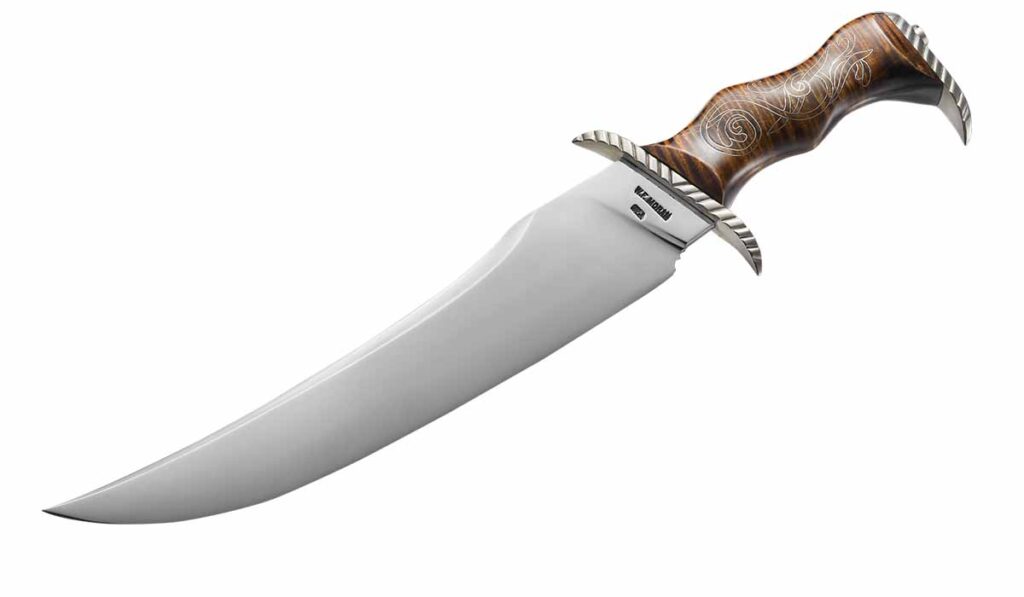
The ST-23 is one of if not the most coveted of Bill Moran knives. (Francesco Pachi image)
Hughes, now 91 and the elder statesman of knife writers, remembers his work with Moran and gives credit to Moran’s foresight at the forge as well. “Bill Moran saved bladesmithing with his reintroduction of damascus in Kansas City in 1973,” Hughes observed. “And when we formed the ABS in 1976, the only goal was to preserve the art of the forged blade. There were three people making damascus [in America] then: Moran, Bill Bagwell and Don Hastings. They met in Bagwell’s backyard and shop after the Guild met in Dallas. That’s how the ABS got started. There were four active members, including me named as a director. So, it started with four, and now there are 3,000 members. I’m still on the board, and now the main thing for me is not to go to sleep during the meetings!”
Bob Loveless:
Bob Loveless
Loveless stands out as a custom knifemaker and designer, as well as a pioneer in the organization of custom knifemakers into a cohesive group, setting standards, discussing issues, and assisting the growth and prosperity of many in later years. Loveless stands apart in his work, organizational input and one-of-a-kind personality.
Hughes recalls his introduction to Loveless courtesy of knife industry titan A.G. Russell. The men sat down at a diner, ate a meal together and Loveless spread some knives on the table. From there, Hughes authored an article about the California custom maker that appeared in GUNsport Magazine.
“Bob and I stayed in contact,” Hughes remembered, “and around that time Bo Randall was probably the most copied [of] knifemakers. Then, when Loveless [redesigned and repopularized] the tapered tang, he became the most copied knifemaker in America. He made that a standard and was very popular.” B.R. added that Loveless was also a good salesman and promoter, and his knives were selling for what were high prices even then.
Voyles said he appreciates the pure genius of Loveless to this day. “He was a phenomenally intelligent person,” he opined. “With Bob, they used to say that you loved him or you hated him. The thing about Bob was that what brought him into prominence was that he was the first person with an art background to make knives. He had gone to design school and made a handsome knife that was aesthetically pleasing, and noted that the knife’s top line should always fit a French curve.
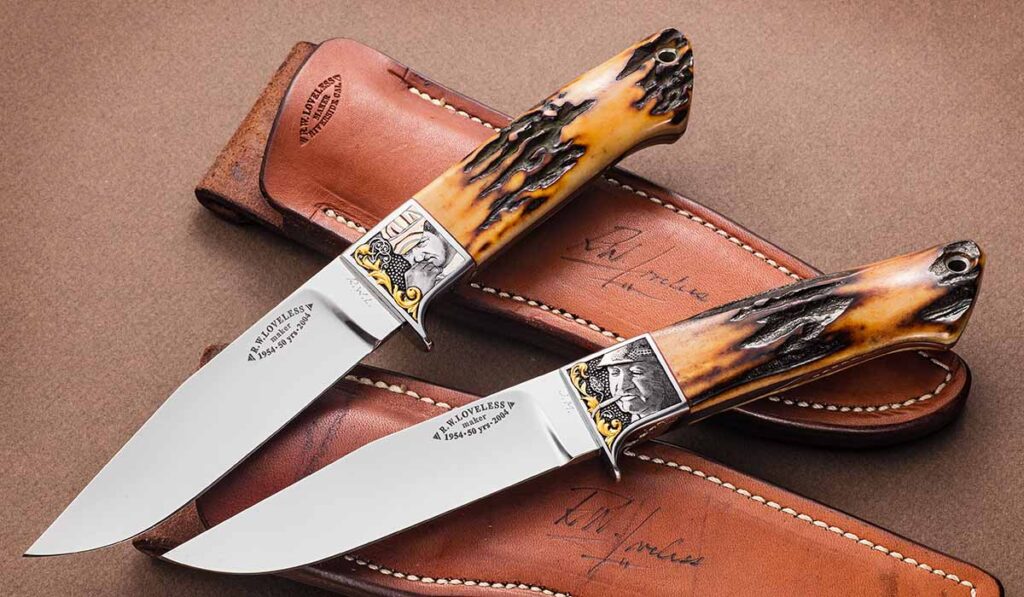
Bob Loveless helped celebrate 50 years of knifemaking in 2004 with this hunter set complete with engraving by C.J. Cai and a couple of autographed Loveless sheaths. (SharpByCoop image)
“Loveless made a good knife and a distinctive knife. Everybody started copying that, and the whole design of knives changed. Bob was also able to sum up a complex subject in one sentence. He was infinitely quotable, which meant outdoor writers loved him.”
According to Cutlery Hall-Of-Famer Dan Delavan, Loveless was a unique character in the knife world. “Loveless was a genius in the whole industry,” Dan related, “and underrated. Because of his antics, some people didn’t think that much of him at times, but Bob was super smart. He knew things would happen before they happened. His drop point was modernized and refined, and he helped a lot of people get started. A lot of them emulated his style.”
A.G. Russell
A.G. Russell
Universally, the contribution that A.G. Russell made to the knife industry is acknowledged as tremendous. He brought people together, tried to build consensus, established the liaison between custom makers and factories that produced magnificent collaborations, developed a robust catalog mail order business that remains the envy of any businessperson, and is recalled as a true gentleman—whew!
Hughes remembers Russell not only for his introduction to Loveless, but also for another moment that proved to be a highlight. “A.G. told me there was a bladesmith in Maryland named Bill Moran and said I needed to get in touch with him,” B.R. smiled. “I kept in touch with Bill. He was always laid back and reserved and shunned a lot of publicity. I wrote a book about him in 1995 called Master of the Forge. We spent several days with Bill and Margaret that fall, Bill and I in the back seat of the car talking and Margaret and Carolyn in the front seat talking. Carolyn has been with me through all these years. I married her in 1957, and she has been the editor of American Bladesmith Magazine now for 20 years.”
Voyles remembers Russell as “the one that lit the fuse and promoted the Knifemakers’ Guild for many years and almost singlehandedly created an aftermarket for handmade knives.” Imagine the foresight, power of persuasion and business acumen that could exert such influence in the knife industry as a whole. It’s safe to say that A.G. was the catalyst for so much of the positive interaction that has taken place in the knife world over the past 50-plus years. He bought tables at gun shows for knifemakers to display their wares back when there were no knife shows to attend. He supported knifemakers with his heart, head and pocketbook.
“Knives were his passion,” Cutlery Hall-Of-Famer Goldie Russell said in remembering her husband’s dedication. “He was determined to know everything there was to know about knives.”
A.G. Russell Knives not only is a landmark in the knife industry, it is in its hometown of Rogers, Arkansas, as well.
Goldie recalls her husband’s hard work that made things happen. “By June 1970, A.G. had reserved a block of tables at the Wanenmacher Gun Show in Tulsa and invited the makers he knew to exhibit and sell their knives,” she commented. “I believe it was at this show that he introduced the idea of the Knifemakers’ Guild. A.G. told me that two knifemakers that were on board from the beginning were [Cutlery Hall Of Famer] Dan Dennehy and Bob Loveless. At that show they decided to form the Guild, and there were 11 founding members.”
A.G. secured more tables at the Houston gun show in 1971, and more knifemakers joined the Guild. The following year, the first annual Guild Show and meeting were held in Kansas City, and the membership grew steadily.
In addition to his leadership in the formation of the Guild, A.G. was a visionary business owner. He created the first mail-order company that focused strictly on knives. Until that time, consumers could leaf through the pages of the Sears & Roebuck or Montgomery Ward catalogs and hope they found something. But Russell changed the game in 1964 when he started A.G. Russell Knives with the sale of Arkansas whetstones.
Goldie remembers another seismic achievement that her late husband was directly involved in—the establishment of the first high-profile knife collaboration. “He arranged for Bob Loveless to meet with Schrade Cutlery to produce a modern fixed-blade knife,” she commented, “and the result was the Schrade Loveless Hunter. I recently read something that said [Cutlery Hall-Of-Famer] Uncle Henry Baer facilitated that collaboration. I’m not sure how involved Henry Baer was, but if you look at what was happening, it was obvious that it was A.G. Russell who had direct involvement with Schrade and Bob Loveless.”
A.G. is also known for his innovative work with Schrade to incorporate the Knife Collectors Club, the first organization of its kind. “This was A.G.’s concept,” Goldie observed. “His idea was to create serial-numbered commemorative folders, which would be offered to club members. A.G. would select the knife, develop the project and sell the knives. Schrade would make the knives.”
Goldie personally witnessed her husband’s investment of time and treasure to promote knives from every angle. He supplied Cutlery Hall-Of-Famer Blackie Collins with his mailing list in the early 1970s so that the earliest issues of American Blade, which would eventually become BLADE, had somewhere to go. He supported new manufacturing brands during the 1980s. And he was willing to provide a frank and honest assessment of a knifemaker’s work when asked to do so.
A.G.’s wisdom came shining through when he discussed with Arkansas knifemaker/Cutlery Hall-Of-Famer Jimmy Lile why the two had not become closer friends. Goldie noted that Lile said, “A.G., when I could not do better, you told someone that my knives were not very good.” She added, “A.G. said that as soon as Jimmy expressed that, he realized what he had said. After that Jimmy and A.G. were friends.”
A.G. offered his advice when asked. Goldie remembers a meeting with Stuart Leatherman and his brother, Cutlery Hall-Of-Famer Tim Leatherman, regarding the direction of the composition of the Leatherman multi-tool. “I was in that meeting,” she related. “A.G.’s advice was to upgrade the blade steel and make handles of titanium. His other advice was to find a way to make the handles easier on the hand when using the pliers. The Leatherman Charge and Charge Ti quickly followed that meeting.”
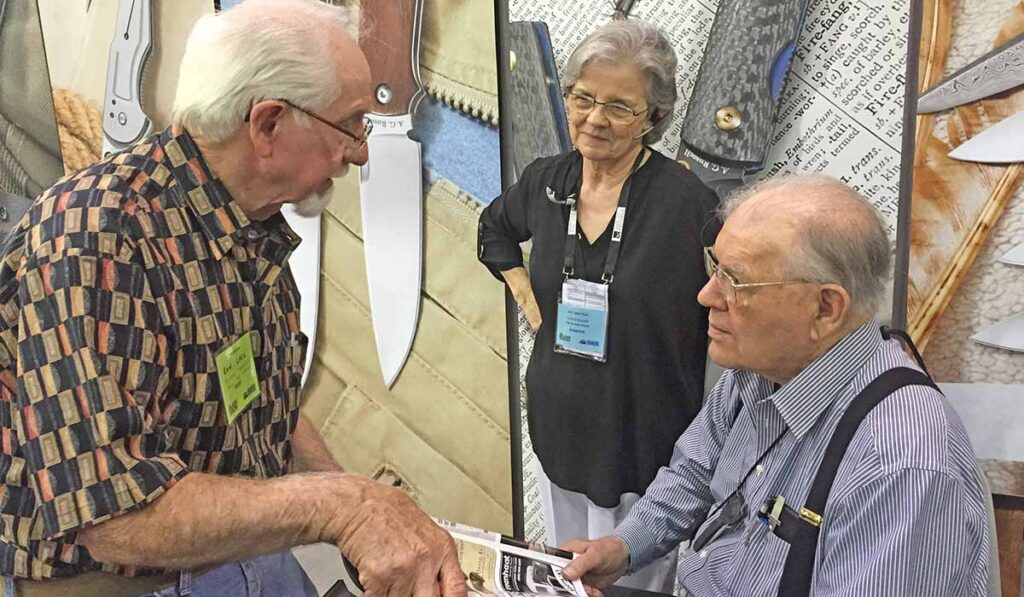
BLADE Magazine Cutlery Hall-Of-Fame® members (from left) Ron Lake, Goldie Russell and A.G. Russell share thoughts at the A.G. Russell Knives booth during a past BLADE Show. (A.G. Russell Knives image)
Among other contributions that Goldie and also Phil Gibbs, knife designer at A.G. Russell Knives, remember regarding A.G. are his design innovations, particularly as the first to create folders with handle materials other than metal that did not include metal liners, and in the human element, his willingness to take time with everyone. For example, one day a couple stopped by the A.G. Russell Knives retail store in Rogers, Arkansas. Goldie was asked to step over to meet them. They were unaware of A.G.’s passing until they had seen his portrait in the entryway, and they wanted to express their sympathy.
“They said they had often come into the store and spent time with A.G. talking about knives and knife history,” Goldie noted. “With tears in his eyes, the gentleman said, ‘Mrs. Russell, we are nobody, but he treated us like we were somebody.’”
Delavan, co-owner of the old Plaza Cutlery retail knife store in Costa Mesa, California, and now of plazacutlery.com, put A.G.’s impact into perspective from a professional standpoint. “We both had businesses and a lot in common,” he reflected. “A.G. was a wealth of knowledge. He seemed to know everyone and everything, and I looked up to him.”
No doubt, there are many other individuals whose contributions to the growth, expansion, and thriving entity that the knife industry is today are worthy of praise and recognition. These three—Russell, Moran and Loveless—are, however, more than just a good start. They are giants among other giants, and their accomplishments will continue to resonate across the decades.