Home Knife History

Knife History

The history of knives and other edged instruments is tied to the history of people in general. As humankind’s oldest tool, unraveling knife history can lead to even more surprising and enriching information to better understand the world.

Growing Up Loveless: Reflections On The Master From His Daughter

Robin Askew reflects on being the daughter of Bob Loveless.

It was intimate and distant. It was warm and aloof. It was youth, adulthood, hope and memory—all at the same time.

Robin Askew is 70 years old now. She lives a quiet life in Sacramento, California, and her recollections of growing up as the daughter of a legend offer insights into years of experiences that few could imagine. Her father, BLADE Magazine Cutlery Hall-of-Fame® member Bob Loveless, was and remains one of the titans of the custom knife industry. He has been gone more than 15 years, but his imprint on the past, present and future of custom knives is unmistakable and not about to wane.
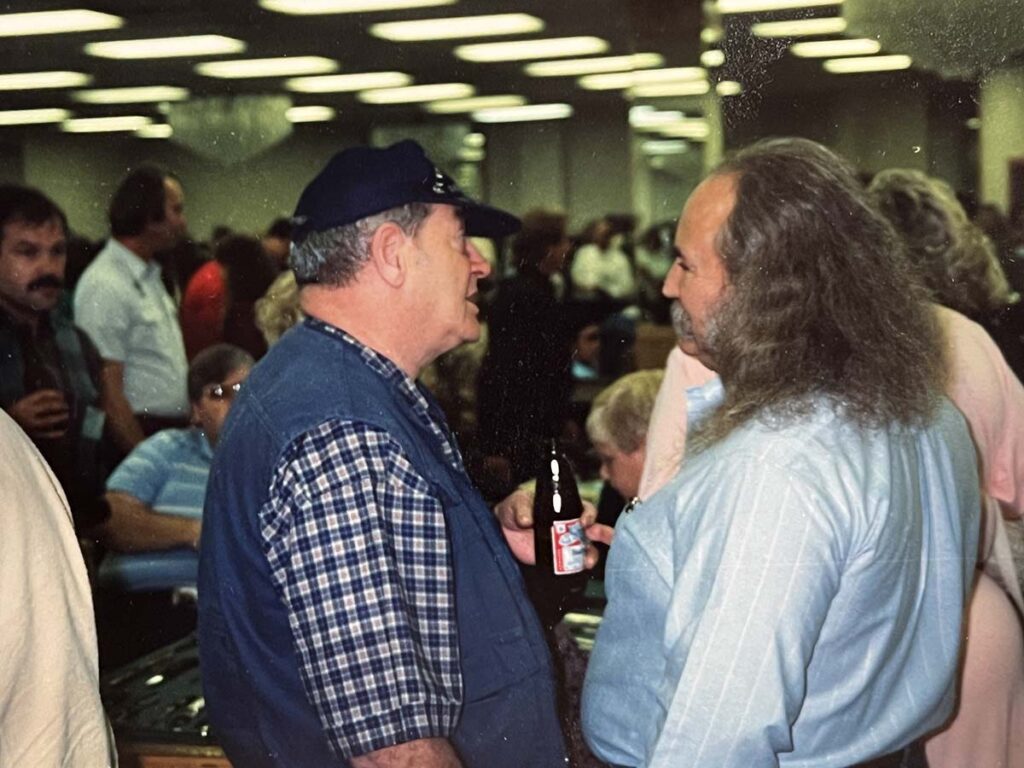
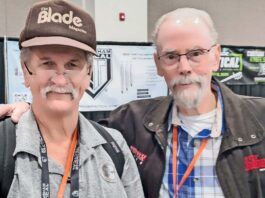
Bob Loveless (center) talks with David Crosby (right) of Crosby, Stills and Nash at the 1989 California Custom Knife Show. The two were good friends, with Loveless an inveterate harmonica player who at times would play with CSN at a local bar or night club. At left is a young, mustachioed Steve D’Lack, coordinator today of the New York and Nashville Custom Knife Shows. (John Denton image)

Likewise, those who knew him remember his unforgettable, often larger-than-life persona. Creative genius, irascibility, generosity and unique perspective came together in Loveless, the man who shaped custom knives and literally changed the landscape in tangible ways, including steel and its components, and in intangible ways such as the sweep of the blade, its flow and form, and the aesthetic qualities that characterized his legacy.

Robin experienced the evolution, both in the life of Loveless and in the industry that he forever altered. From her earliest memories, her father was a busy man building a future one knife at a time, crafting a legend—whether he knew it or not—one innovation after another from a basement in Delaware to his shops in California. In the midst of it all, growing up Loveless was a complex, frustrating, fallible, forgiving and ultimately joyous journey.
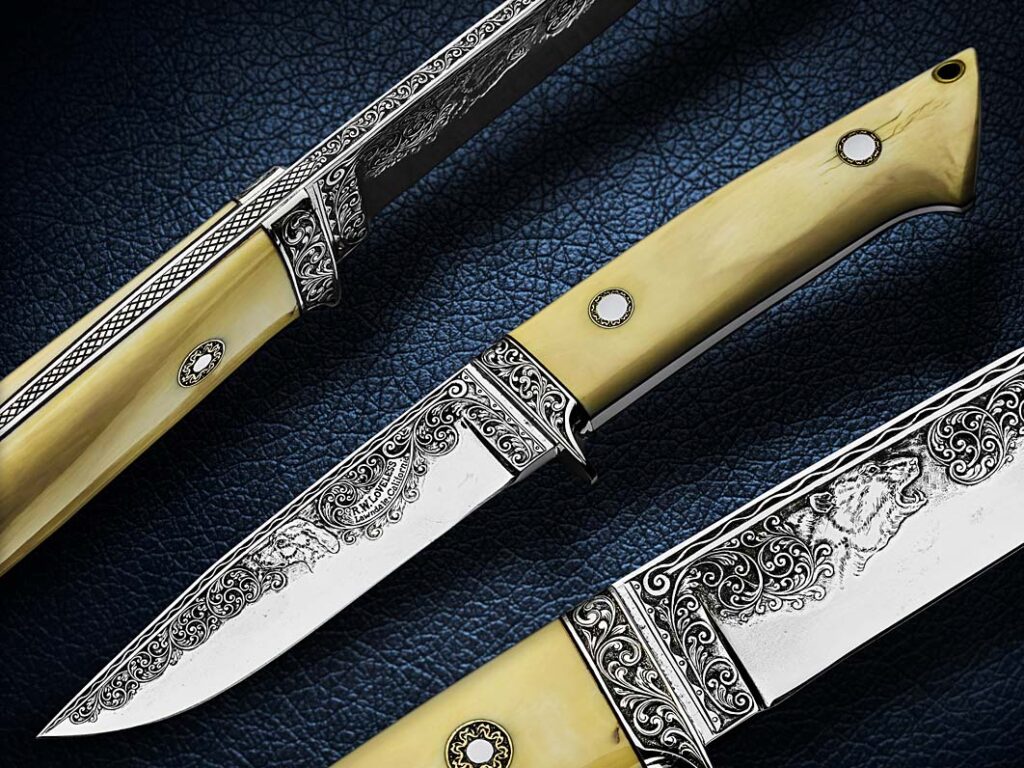
David Crosby owned this ivory-handled Loveless utility knife fully engraved by H.H. Frank. According to John Denton, it sold for $22,000 a few years ago. (Cory Martin image)

“Some people were actually frightened of him,” Robin smiled. “They might have been put off. But his bark was so much worse than his bite. Over the years, my father was so amazed by the fact that others regarded him with such a high standard. He didn’t embrace that at all. One time he said to me, ‘They still think I’m the greatest.’ That was something that he had never imagined and never really came to terms with.”

Bob Loveless made contributions to the knife industry on multiple levels. He was instrumental in the formation of The Knifemakers’ Guild and in establishing the custom knife market in concert with other great men like the incomparable Cutlery Hall-of-Famer A.G. Russell. Loveless reached across the globe and developed relationships in Japan that eventually brought ATS-34 stainless steel, a staple in blade construction, to other markets. He was a metallurgist who concocted his own steel composition and made Micarta® a handle material of choice. The curve and the sweep of the drop-point hunter and other Loveless creations touch the senses and influence generations of admirers even now.

Robin Askew is alive and living well today at 70.

For Robin, more than half a century of a legend in the making is remembered in light and shadow, the image of her father at work tirelessly building and brainstorming and striving to make his way, and in turn taking care of those close to him. It was, at times, both turbulent and tender, but always something new.

“Daddy was super, super busy,” Robin recalled. “I never made a knife, just swept the shop floor. He would do things in batches and stages, and one of the most fascinating things I remember was when he would cut the leather and make the sheaths on a big stitching machine. He did everything with the knives, from drawing out the patterns to grinding the blades down and shaping them and putting the Micarta, stag or ivory handles on them. After he ground batches of blades, he would test them, pointing them down and dropping them onto the concrete floor of the shop. If the tip cracked, the whole batch of blades would be thrown away—but that never happened.”

Through the years, there were times when the family fractured, quite probably due at least in part to the stress and strain of a one-man enterprise that was on the rise, moving through uncharted territory and challenges. While something incredible was eventually gained, there was a cost to be counted. But such is true in life, true for everyone and in every relationship.

Lawndale & Riverside

For much of her young life in Lawndale, California, Robin lived in a small house with her mother and sister while her father lived in a studio apartment just down the road and worked in his basic shop.

“At the time I grew up with my dad, Allison and I were the oldest, and then Mary came along nine years later,” Robin commented. “Dad was getting to be known while the shop was in Lawndale, and when I was a senior in high school in 1973, the shop in Riverside, California, was not quite ready.
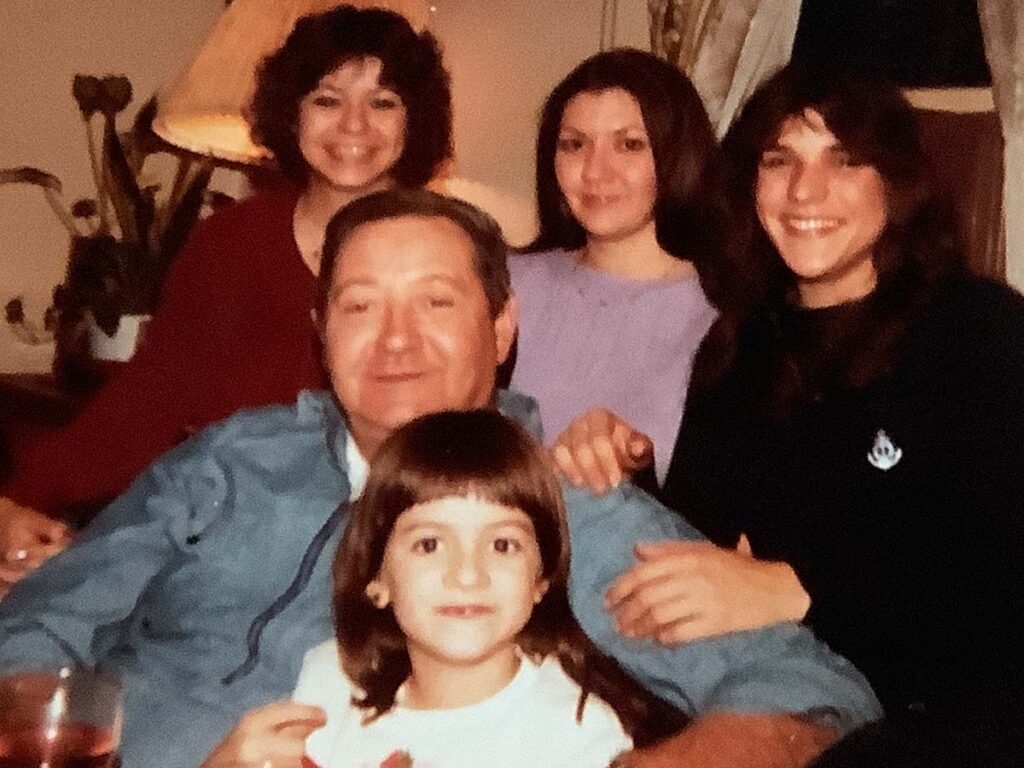
Taken on Christmas 1982, Loveless’s three daughters appear together, in back from left, Robin, Alison and Mary. Bob has his arm around Alison’s daughter Anna, the first Loveless grandchild.

“Still, he was getting telephone calls all the time. We would answer them in the house when he was working, and finally he put a phone in the shop because we had been taking all the calls,” she laughed. “He hired me to be his little secretary, and I would send out the catalogs and address them and seal them and take messages. It was a little weekend job, nice and fun.”

The relocation to Riverside occurred about 1974, and Robin remembers the dramatic change from Lawndale in terms of shop sophistication. “I had moved away,” she said, “and when I came to the shop in Riverside, it was so much more advanced than the little Lawndale shop with so many machines and things to look at. I was fascinated by everything he did, and it was fun to sit in his office.”

Along For The Ride

“Some people were actually frightened of him,” Robin said of her father. “They might have been put off. But his bark was so much worse than his bite.”

By that time, though, the Loveless mystique was already established. Bob was well on his way to custom knife stardom. And those around him? Well, they were along for the ride.

“People had started to come over and meet my dad,” Robin smiled. “There were so many people, different people, ordering knives. He would hang up the phone and say, ‘OK, John Wayne just ordered a knife.’”

Bob Loveless became a friend to the prominent, the eclectic and a diverse spectrum of admirers. Although they may have shared little else, they were each drawn, like moths to a flame, to the world and work of a master. Loveless met David Crosby, Stephen Stills and Graham Nash, stars of the pop music scene with their fame growing exponentially in the late 1960s. Crosby was a frequent visitor.

“When Dad first met them, the three were playing the circuit,” Robin remarked. “They were performing in bars and night clubs, and Dad would sit in with them on stage and play his harmonica. He loved to play the harmonica and had a lot of fun with them. Crosby would come to where Dad lived in the studio apartment about a quarter mile down the street from the house in Lawndale and just hang out. One time, he came to the door and said, ‘Is your dad here?’ and I yelled, ‘Dad, David Crosby is at the front door!’ They would just talk and enjoy themselves and do their thing.

“One time Crosby came into the kitchen and said, ‘Robin, can you make me a cup of coffee? You’re the only one who knows how I like it.’ This is 1973. These guys are really hot. And I’m a senior in high school!”

Vietnam
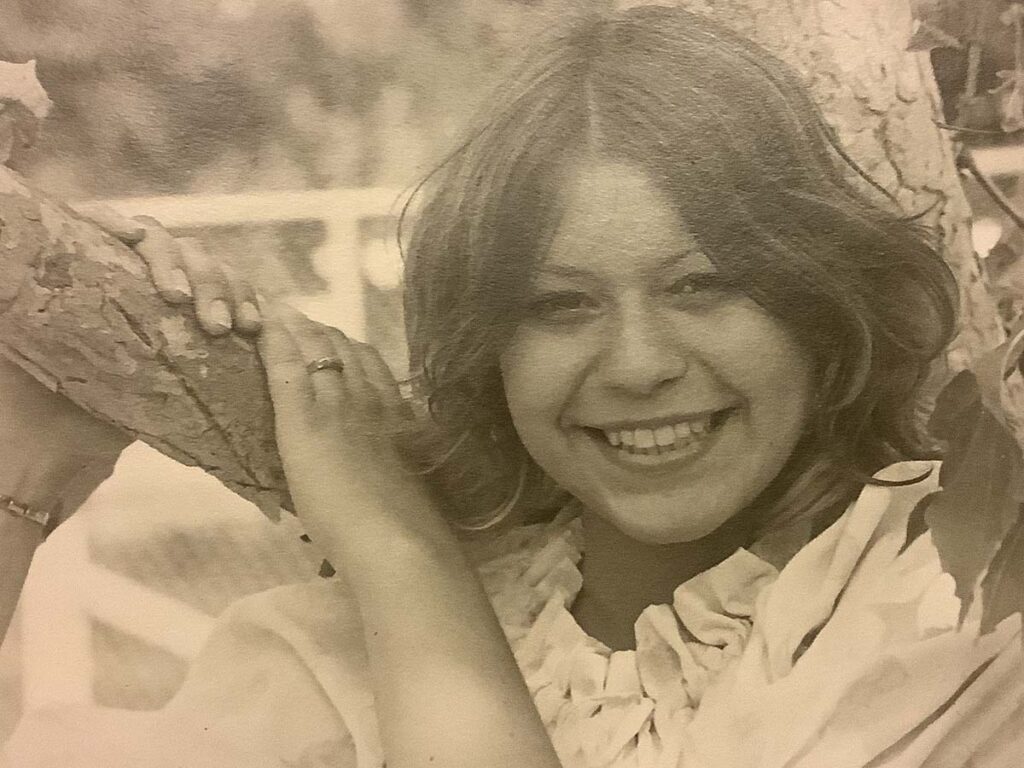
Robin visited her dad after he set up shop in Riverside, California, where this shot was taken in the backyard. She was 18.

During the 1960s and ’70s, Bob made many knives for military personnel, but Robin says he was sensitive to the situation when it came to his children. “My war was Vietnam,” she reflected, “and Dad made a lot of combat knives for Marines and Special Operations people who went overseas. I never knew that until I was an adult, and I don’t think Dad wanted us to know that. The war was so horrific in my eyes, but I supported everyone who ever went there. Some of them were my schoolmates.

“Dad was not a part of the California culture of that time,” she continued, “because he was always making knives. He had a lot of them on back order, and he would tell me the wait time was five years or six years, and later it got up to 10 years. He didn’t ever really have time to leave the shop, and he never discussed political things unless I called and asked his opinion about something. I do know that he made fighting knives—and these were like ‘killer knives.’ They were unbelievable. Then, his mother and stepfather were murdered in Ohio in 1985. They were stabbed to death in a robbery while he was in Japan.
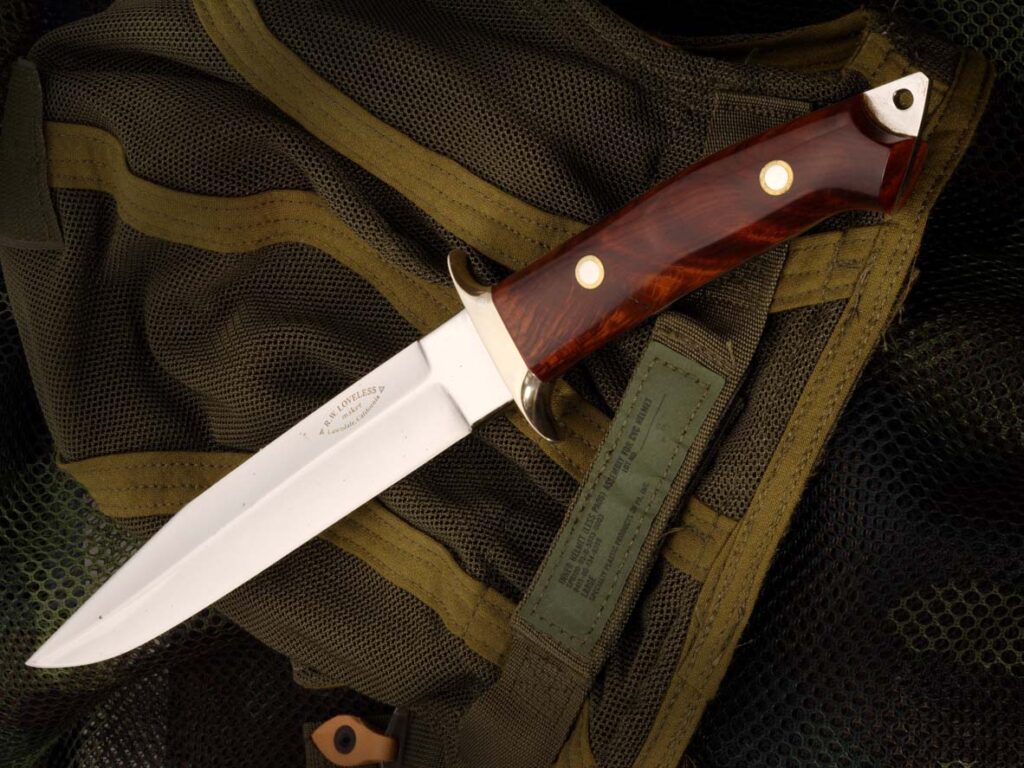
According to John Denton, Loveless made this fighter in tulip wood with skull-cracker in Lawndale, California, for CIA operative Harry Archer. (Hiro Soga image)

“The decision was made not to tell him about it until he came home. He had already had a heart attack. So, after he was given the terrible news, I believe he felt bad about making knives because sometimes knives took people’s lives. Afterward, he no longer made combat knives.”

The life and times of Bob Loveless were surreal, energized and unequalled in excitement. “I remember once when a gentleman from Japan visited us in California,” Robin added. “My dad was instrumental in helping the Japanese Guild get started, and they would send makers over to work with him. I had no idea who this gentleman was, and you’ve got to remember that the Lawndale shop was just a tiny square box, not fancy but where he had put everything he had into it. This Japanese gentleman bowed to me. I was 16 at the time—and honored that he would bow to me. I didn’t really understand, but Dad said, ‘That’s what they do. They respect us, and they copy us because they respect our work.’”

Bob’s Beehive
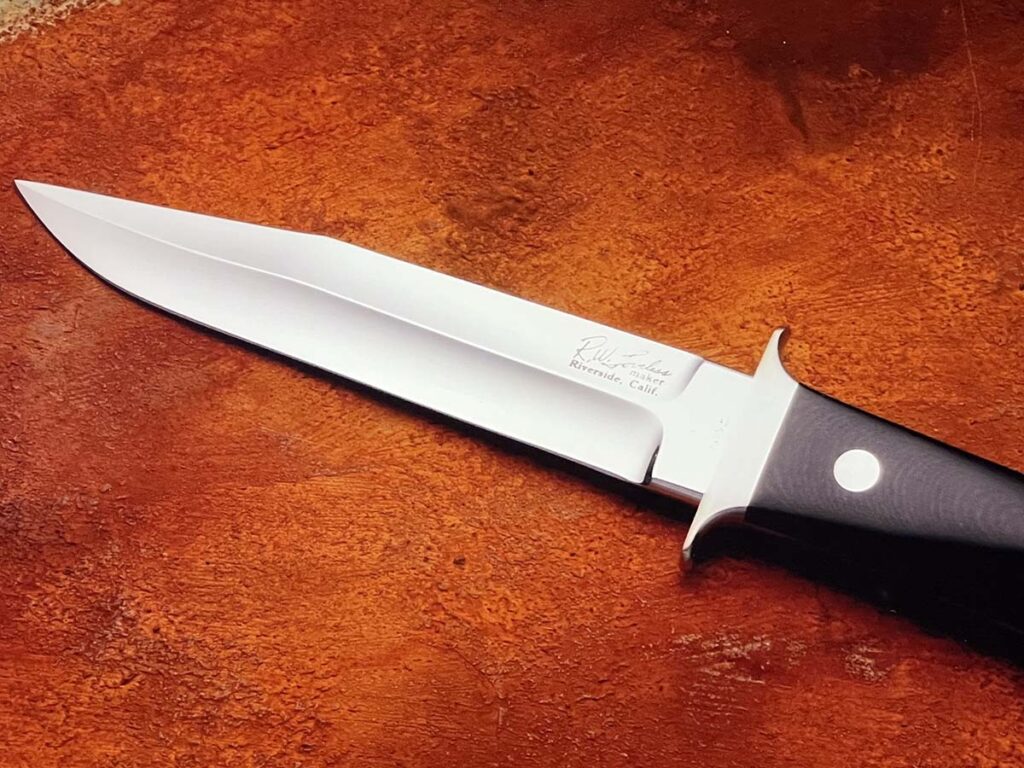
Bob also cultivated a relationship with his one-time landlord, Dr. Dixon. He rented a house from Dixon and subsequently bought it. He made knives that Dixon collected, even naming a fighter style after his friend, this one with the Loveless signature logo. (John Denton image)

The Loveless shop, in Lawndale and then Riverside, was a beehive of activity. First, Bob was a solo act, and then great partnerships and friendships emerged. “In the morning, I would go to school, and he was busy all day,” Robin said. “Steve Johnson came in and was his partner. Steve was like an older brother to me. He was a very good boy, very shy and dedicated to learning the craft from my dad. He is maybe five years older than I am, and he grew into a wonderful man.

“Steve had a Camaro, and he would let me drive it,” she continued. “It had a manual shift, not an automatic. I went for the test to get my driver’s license in that car, and it didn’t go too well. The instructor said, ‘Are you all right? You turned too much!’ When we got back to the DMV, I told Steve I had flunked. But he still let me drive his car back home.”
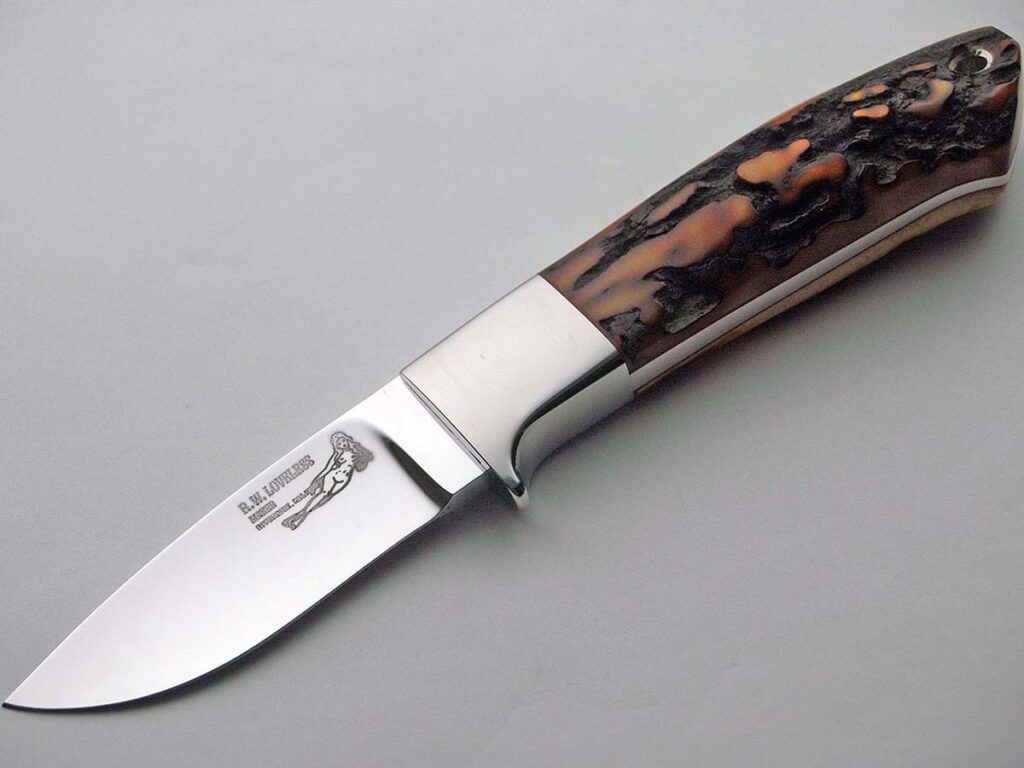
The most famous Loveless knife of all, the drop-point hunter or, as he called it, the dropped hunter.(Dave Ellis/Exquisiteknives.com image)

Bob also cultivated a relationship with his one-time landlord, Dr. Dixon. He rented a house from Dixon and subsequently bought it. He made knives that Dixon collected, even naming a fighter style after his friend. Bob’s buddy Ray Randall was a frequent visitor as well. Robin recalled, “Ray was a sales representative, and he would bring us girls all kinds of shampoos and cream rinses for our hair when he came out to visit Dad.”

Read More On Bob Loveless:

50 Years Ago In BLADE: Buster Warenski

BLADE Magazine Cutlery Hall-of-Fame® member Buster Warenski was the subject of an extensive six-page profile a half century ago in the January/February 1976 issue of The American Blade. He was larger than life then and would get even larger in the years to come.

Unmistakable in the low-crowned Stetson and mutton-chop sideburns he wore back then, Buster was interviewed in his new Richfield, Utah, knife shop by then editor L.V. Baker. Richard Barney, co-author with Cutlery Hall-of-Famer Bob Loveless of the landmark How To Make Knives book, was along to take photos. The lead image of Buster holding one of his latest knives at the time is about as iconic as it gets.

Done about half a decade before Buster would go on to make his reproduction of the King Tut Dagger, the story and spread reflect how consequential Buster was to the handmade knife movement of the 1970s. It covers from his early influences, including Harvey Draper and Cutlery Hall-of-Famers Gil Hibben and Bo Randall, the first two knives Warenski ever sold, some invaluable magazine publicity from Cutlery Hall-of-Famer B. R. Hughes, Buster’s first Guild Show in 1973 and his position on the Guild Board of Directors at the time of the interview.

One of Buster’s best quotes: “I think the industry is going to get bigger and better, just as our customers and collectors are going to become better educated about the knives they buy and are going to demand a better product.”

Buster was right, of course—and would be among the vanguard of makers to supply the knives for which he predicted there would one day be such great demand.

More Knife History:

Randall Airman: USMC Prototype Carried By The Father Of Marine Helicopters

The story of a prototype Airman and a Marine pioneer.

Editor’s note: The author contacted BLADE® and asked if we would be interested in his story on a special Marine Corps knife and a special Marine to coincide with the semi-quincentennial of the United States Marine Corps. Needless to say, it was an easy decision on our part. Meanwhile, please join us in wishing a happy 250th birthday to the Corps and Marines everywhere.

The core values of honor, courage and commitment have defined the United States Marine Corps since its inception on Nov. 10, 1775. To remain an elite fighting force, the Marine Corps has adapted as the world has changed over the past 250 years, incorporating new technology and developing new doctrine.

One of the most significant transformations began with the birth of Marine Corps aviation in 1912. During World War II, Marine aviators played a vital role in the Pacific campaign, working closely with ground units to seize heavily defended island strongholds. As Gen. Keith B. McCutcheon, a pioneer of Marine aviation, later emphasized, “The Marine Corps is proud of the fact that it is a force of combined arms, and it jealously guards the integrity of its air-ground team.”

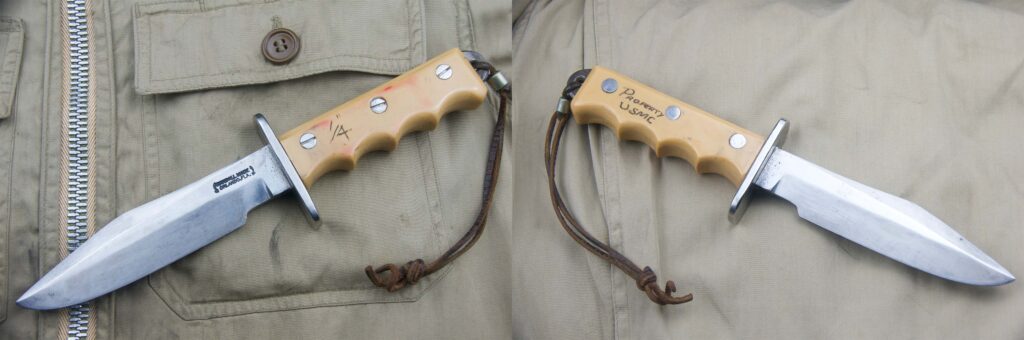
The mark and non-mark sides of a prototype Airman.

The evolution of air combat brought new challenges, challenges that extended even to the knives that aviators carried. One result was a collaboration between Marine aviators and BLADE Magazine Cutlery Hall-of-Fame® member Walter D. “Bo” Randall, who would redefine survival and combat knives with the now-iconic Randall Model 15. This article features one of Randall’s prototypes—a rugged, full-tang Airman’s Knife that was carried for more than 15 years by Gen. McCutcheon himself.

The Challenge

Marine aviators amassed extensive combat experience in World War II and Korea. By 1953, the Marine Corps recognized that the rigors of combat aviation demanded a new type of knife—one that was rugged, compact and versatile.

As documented by Randall historian Robert Gaddis, the Marine Corps Equipment Board assigned Lt. Col. H. Ross Jordan and Maj. Harold N. “Tex” Mehaffey to develop a survival and combat knife for Marine aviators. The knife had to be nearly indestructible—strong enough for an airman to pry, cut or smash his way out of a downed aircraft. At the same time, it had to be short enough to be worn in a cramped cockpit, and the sheath needed to allow the knife to be carried on the upper arm or lower leg.

Wearing his sheathed Randall Model 15 Airman on his left hip, United States Marine Corps Gen. Keith McCutcheon (center) is flanked by South Vietnamese Gen. Hoang Xuan Lam, Commander of I Corps, and USMC Gen. Edwin B. Wheeler (right), commanding general of the 1st Marine Division. (image of McCutcheon, Lam and Wheeler from somewhere near Da Nang, Vietnam, March 16, 1970)

After reading a December 1953 magazine article about Bo and his expertly crafted blades, Mehaffey and Jordan arranged to tour his knife shop in Orlando on Feb. 11-12, 1954. By the end of their fruitful discussion on February 12, Bo had arrived at the basic design of the Randall Airman’s Knife. He also planned a longer-bladed version for ground troops, a design that would become the Randall Attack. Thus, this meeting launched the line of full-tang Randall models that would expand and evolve over the coming years.

Bo moved rapidly to fabricate prototypes that embodied his innovative design. The 5.5-inch blade would be forged from quarter-inch-thick O1 tool steel, a material that had been proven in earlier Randall combat knives. To strengthen the tip, the blade would retain the full quarter-inch thickness nearly to the point. To strengthen the junction between blade and the handle, the tang would be 7/8-inch wide along the entire grip. An extended segment of the tang would have a hole for a wrist thong and provide a surface that could be used for hammering. A heavy double hilt would prevent a gloved hand from slipping forward onto the blade. The handle would be made from a single piece of Tenite plastic, shaped with finger grips and a channel to snugly fit the tang. Stainless steel bolts would secure the handle.

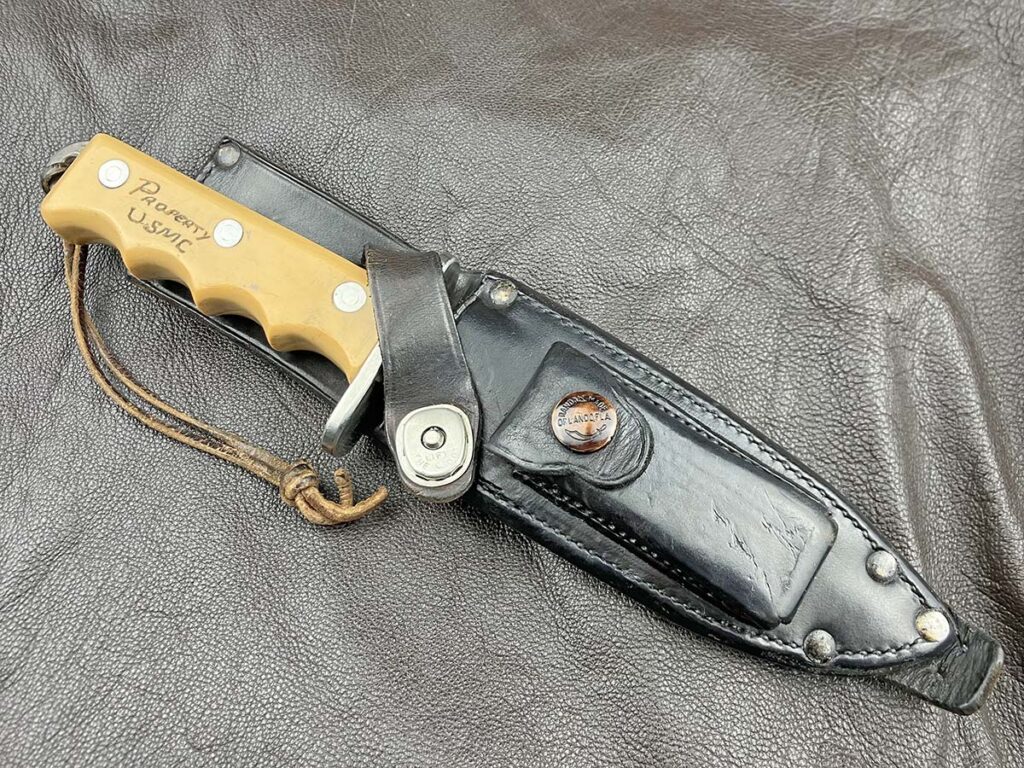
To complete the package, Randall designed a sheath that could be worn on a belt, attached to a harness, or tied to the lower leg or upper arm with leather laces. It featured a diagonal keeper and rivets at stress points. The Randall shop completed the prototypes of the Airman’s Knife and the longer Attack Knife by the end of February 1954—barely more than two weeks after the formative design discussion—and Clarence Moore readied the sheaths soon after.

Three-star Gen. Keith McCutcheon, February 1970

The innovative features of the new knife and sheath designs were memorialized on certified blueprints on March 4, 1954. Randall filed a patent application on Aug. 11, 1954, and the United States Patent Office granted patent 177,590 for the Randall Airman’s Knife on May 1, 1956.

Prototype Testing

With prototypes in hand, Randall travelled to Quantico, Virginia in mid-March 1954 to present the new full-tang knives to Mehaffey, Jordan and other USMC and U.S. Navy officers. The group enthusiastically recommended that the Navy’s Bureau of Aeronautics purchase 10 prototype Airman’s Knives for evaluation: five from quarter-inch stock according to the original design, and five lighter examples from 3/16-inch stock.

The requisition arrived in early April 1954 and the shop shipped the 10 prototypes in early May. The invoice listed the Airman’s Knife as the #14, but later that month Randall adopted the still-current model numbers: the Airman became the Model 15, and the longer version became the Model 14 Attack.

The Marine Corps Equipment Board received two of the prototypes, one of each blade thickness, and the remaining eight were sent to squadrons and other units for real-world testing. In late May, Mehaffey informed Bo that preliminary testing had begun.

One of the original Randall prototypes is featured in the accompanying photographs. Made from quarter-inch steel, as indicated by the inscription on the handle, the prototype closely follows Bo’s patented design, except the blade lacks the fuller shown in the drawing. As in the original design, the prototype’s handle is secured by three bolts; this feature sets the prototype apart from later production examples of the Model 15, in which only two bolts were used.

Leatherworker Clarence Moore made the sheath for the prototype Airman according to Bo Randall’s design. Moore made the sheaths for the earliest full-tang knives until Heiser took over production in 1955.

The handle is made from white Tenite, a material used only for a year or so before Randall adopted the more familiar green Tenite that was characteristic of production for nearly 10 years, until Randall Made replaced Tenite with Micarta® in the mid-1960s. The prototype’s hilt is nickel silver in contrast to the brass hilts seen on almost all Model 15s with Tenite handles. The sheath was made according to Bo’s design by master leatherworker Clarence Moore, who made sheaths for the earliest full-tang knives until Heiser took over production in 1955.

After more than 70 years, the knife and sheath are in outstanding condition—a testament to Randall’s craftsmanship and superb design.

Project Setbacks

Despite starting with such promise, the project faltered in the summer of 1954 when Mehaffey was transferred for duty in France and Jordan retired. The departure of the two enthusiastic advocates delayed testing and communications. The next official update was in December 1954, when Bo heard that testing had been underway for two months with positive feedback. In April 1955, the United States Air Force also ordered a group of Model 15s for evaluation. Bo wrote again to the USMC in June 1955 but heard nothing further from the Marines or the Air Force.

Although Randall was never officially informed of the results, author Frank Trzaska uncovered a September 1955 testing report in the USMC archives. The report was authored by USMC Maj. Norman W. Gourley, who had succeeded Mehaffey. Extensive testing of the Randall Airman prototypes showed that the quarter-inch-thick version (i.e., Bo’s original design) was “suitable for aviators’ survival use.”

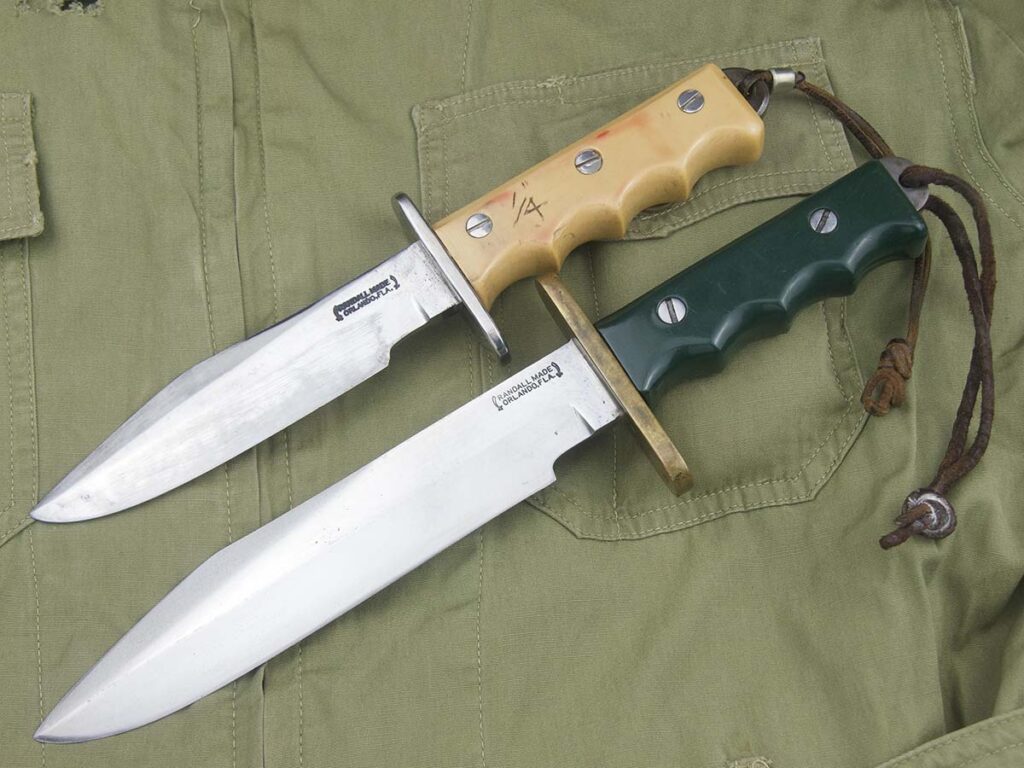
After a fruitful meeting on Feb. 12, 1954 with USMC Maj. Harold N. “Tex” Mehaffey and Lt. Col. H. Ross Jordan, Bo Randall had arrived at the basic design of the Randall Airman’s Knife (top). Bo also planned a longer-bladed version for ground troops, a design that would become the Randall Model 14 Attack (one from 1955 is shown at bottom). The meeting launched the line of full-tang Randall models that would expand and evolve over the coming years.
SONY DSCAfter a fruitful meeting on Feb. 12, 1954 with USMC Maj. Harold N. “Tex” Mehaffey and Lt. Col. H. Ross Jordan, Bo Randall had arrived at the basic design of the Randall Airman’s Knife (top). Bo also planned a longer-bladed version for ground troops, a design that would become the Randall Model 14 Attack (one from 1955 is shown at bottom). The meeting launched the line of full-tang Randall models that would expand and evolve over the coming years.

The report, which pictures this story’s featured prototype, notes the high quality of the design, materials and workmanship of the Randall knife and sheath and concludes that it is acceptable for extreme survival tasks. The report also noted potential changes that would improve the knife further, such as the addition of saw teeth, a flat butt surface for hammering, and different handle configurations. Bo independently incorporated most of these features in various full-tang Randall models by the mid-1960s, and presumably he would have made the changes sooner if the request had ever been made.

While the tests of the Randall Airman were underway, the Navy adopted the Imperial Pilot Survival Knife for its aviators. Because the Marine Corps operates as part of the Department of the Navy, this surely complicated any attempt by the Marines to adopt a different design. The Randall Airman was never issued by the military, but Bo added the Model 14 Attack and the Model 15 Airman to the new Randall catalog printed in 1954, which showed prototypes of both models as “patent pending.” As envisioned by Bo and the Marine aviators who helped to shape the design, Randall’s full-tang combat and survival knives were embraced by many American servicemen who purchased them privately, especially during the Vietnam War.

Pioneer & His Prototype

One Marine who had a high opinion of the Randall Airman was aviation pioneer Keith B. McCutcheon, who as a colonel served as Chief, Air Section, Marine Corps Equipment Board from June 1954 to July 1957. After the Randall Airman tests concluded, McCutcheon carried the quarter-inch prototype for the rest of his career.

An attack helicopter warms up in the background as Gen. McCutcheon surveys the situation six miles southwest of Da Nang, March 17, 1970, his trusty Randall Model 15 Airman sheathed at his side. At left is Gen. Edwin B. Wheeler.

In January 1966, while commanding the 1st Marine Aircraft Wing in Da Nang, Vietnam, then-Brig. Gen. McCutcheon wrote that the Airman was a “wonderful knife” that he had carried for “10 or 11 years.” Photographs from 1970 show McCutcheon wearing the knife when he returned to Da Nang as a lieutenant general and commander of the III Marine Amphibious Force (III MAF).

Commissioned as a Marine 2nd lieutenant in 1937, McCutcheon was a brilliant, courageous leader who transformed Marine aviation over the course of his illustrious 34-year career. Gen. Earl Anderson said McCutcheon “was one of the finest and most dedicated Marine officers [whose career] reads like a history of Marine Aviation. He earned his wings as an aviator in 1940 and served in World War II, Korea and Vietnam.”

McCutcheon was instrumental in integrating helicopters into Marine operations, and has been called “the Father of Marine Helicopters.” But, as historian William Fails observed, that title does not capture McCutcheon’s central contributions to numerous other areas. He also advanced close air support doctrine and techniques, guided missile systems, and the AV-8 Harrier jump jet. McCutcheon was also an effective leader of ground operations, launching successful operations as commander of III MAF.

For his exemplary service over 34 years, McCutcheon received many of the nation’s highest military decorations, including three Distinguished Service Medals, the Silver Star Medal, three Legions of Merit with Combat “V,” the Distinguished Flying Cross, 10 Air Medals and others. He was appointed to become the assistant commandant of the Marine Corps but was unable to assume the post because of failing health. He retired as a four-star general on July 1, 1971, and passed away from an illness soon after.

Enduring Legacy

On the 250th birthday of the United States Marine Corps, it is fitting to honor the legacy of Gen. Keith B. McCutcheon, an extraordinary leader who helped shape the modern Marine Corps. McCutcheon’s prototype Randall Airman remains as a tangible link to his many accomplishments and to the connection between the Marine Corps and Randall Made Knives.

Sources

William R. Fails. 1978. “Marines and Helicopters 1962-1973.” History and Museums Division, Headquarters U.S. Marine Corps.
Robert L. Gaddis. 1993. “Randall Made Knives: The History of the Man and the Blades” Paladin Press.
James Anthony Ginther, Jr. 1999. “Keith Barr McCutcheon: Integrating Aviation into the United States Marine Corps, 1937-1971.” Doctoral Dissertation, Texas Tech University.
Norman W. Gourley. 1955. Marine Corps Equipment Board report A9-E-1039 on Project E-1039.
Frank Trzaska. 2001. “Randall’s Model 15 & the U.S.M.C.” February 2001 Knife World.

More On Military Knives:

Blunted Blades And Knife Bans: England Has Gone Over The Edge

England has had an uptick in knife crime in recent years, including the horrible incident costing three young girls their lives in Southport. Certainly, crime of any kind deserves scrutiny and solutions so that society can conduct its daily affairs in a safe and secure environment. Unfortunately, it’s never the calmer heads that prevail when dark winds blow.

Case in point, the utterly asinine suggestions emanating from the host of a BBC documentary on UK knife crime.

From the New York Post:

“Actor Idris Elba announced amid his forthcoming knife crime documentary that the United Kingdom must consider “innovative” prevention methods such as blunting or banning knives.”

Let that sink in… blunting or banning knives. And he’s not talking about neutering simply what might be considered “scary” knives—tactical fixed blades, karambits and the like. No, it’s the whole megillah.

He said in the Post article:

“The truth is that kitchen knives are perhaps 25% of the knives used in most terrible crimes. That’s one of the stats in the film. And those kitchen knives are usually a domestic situation,” Elba warned. “So kitchen knives… of course, it’s very difficult. They’re a domestic knife.”

This walks hand in hand with other extreme actions that have taken place in England regarding knife sales. One of the more atrocious, ID requirements and live video sales to purchase knives online. Why, the next thing you know there’ll be a proposal for licensing knives.

Well, you don’t have to wait long for that either.

Elba thinks this might be the panacea for his country’s woes, banning nearly everything, and licensing those scant few deemed worthies to own their family’s cherished sword or knife.

“So let’s ban them all, and if you have one of those knives, get a license for it,” he suggested of people wanting to keep family heirloom swords. “Simple as that.””

And if you think this sentiment is contained to one crackpot actor, well you’d be wrong.

According to The Telegraph:

“A ban on the sale of pointed kitchen knives has been backed by the Church of England, judges, top trauma doctors and psychiatrists, the police and victims as they argue that it would make life-threatening injuries far less likely.”

It’s unfortunate England has endured an uptick in knife crime, yet this isn’t the license for it or certain segments of it to go off the deep end. I know it might sound crazy, but perhaps the English should address the root of the problem—the perpetrators.

The harsh truth is this: no amount of blunted blades, banned kitchen knives, or bureaucratic licensing schemes will stop individuals hell-bent on violence. You can’t legislate evil out of existence by targeting inanimate objects. England doesn’t have a knife problem—it has a people problem. A system problem. A failure-to-act-when-it-matters problem.

Axel Rudakubana—the perpetrator of the Southport killings—wasn’t some shadowy figure hiding in the margins; he was a neon warning sign flashing in plain sight. Reported repeatedly, known to authorities, radiating red flags—and yet, nothing substantial was done. But instead of holding systems accountable for their glaring incompetence, the knee-jerk reaction is to demonize cutlery.

Blaming knives for violent crime is as absurd as blaming spoons for obesity. The issue isn’t the tool; it’s the hands that wield it—and the institutions that refuse to act until it’s too late. England doesn’t need another ban. It needs accountability, courage, and the will to confront the real problem: violent individuals, not the utensils in their kitchens.

More on Knife Laws:

Antique Switchblades: World War II And Beyond

Harking back to American military glory and post-war prosperity, antique switchblades from the 1940s and 1950 have enduring appeal.

From its first patent in 1884, the switchblade was an important addition to most early U.S. cutlery companies.

According to Mark Erickson, author of Antique American Switchblades, between 35-to-40 companies made and/or sold switchblades, including almost all of whose names long-time collectors recognize: Aerial, Camillus, Case, Challenge, Colonial, George Schrade, KA-BAR, L.L. Bean, Novel Shapleigh Hardware, Queen, Remington, Schrade Cutlery Co., Utica, Wade and Butcher, and Shapleigh Hardware, to list a few.

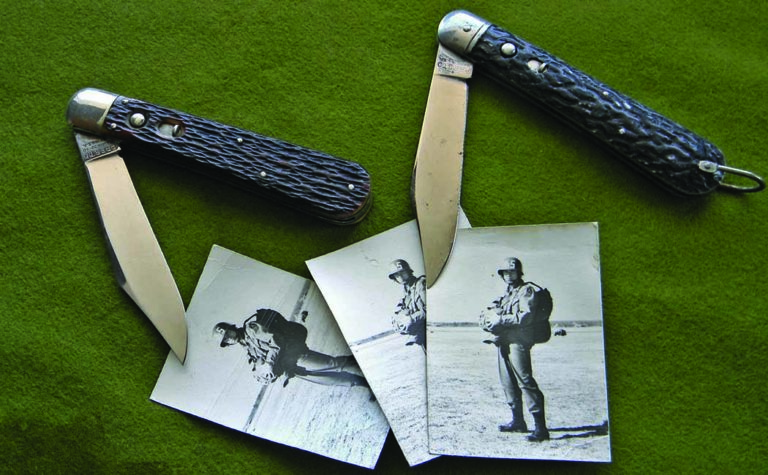
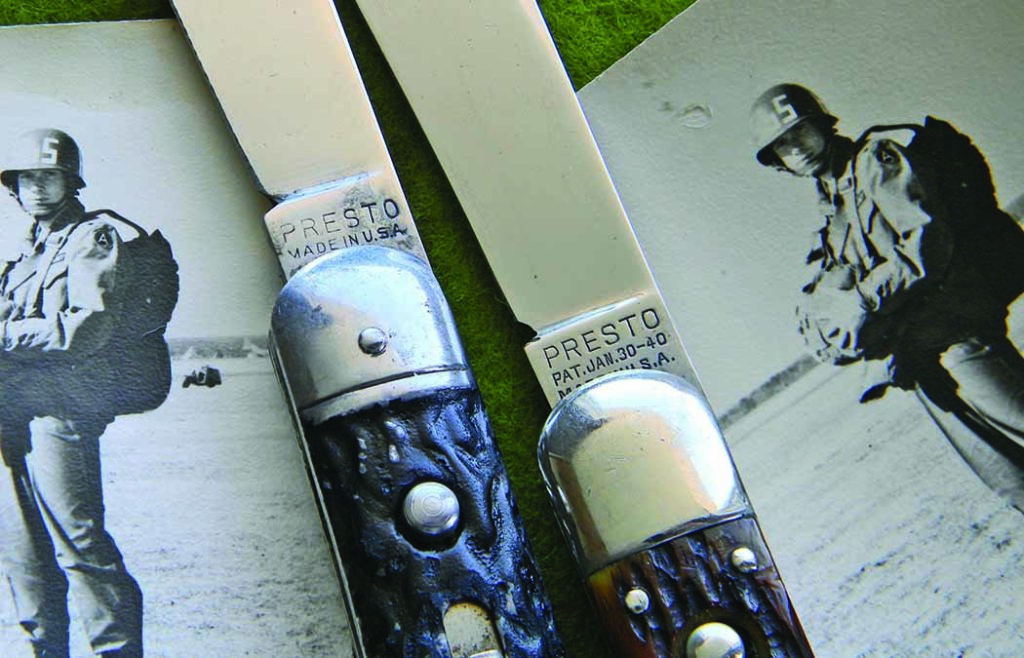
 These two switchblades with the Presto stamping by George Schrade Knife Co., are among those that played an important part in the success of American paratroopers during World War II. On the facing page, the one at left has “jigged iron” scales and the one at right has jigged bone.
These two switchblades with the Presto stamping by George Schrade Knife Co., are among those that played an important part in the success of American paratroopers during World War II.

Because of the collectibility of the named companies and the significant variety of styles, sizes and handle materials associated with them, switchblades have become a serious endeavor for many collectors of antique knives.

Invention Of The Switchblade

As a serious cutlery collector, my downfall has been fingernails that bend backward with even the smoothest opening blades. The switchblade innovators had fingernails in mind when they produced a knife that could be opened without using a nail. In fact, some of the best switchblades are found in women’s old sewing baskets.

In fact, early switchblade ads tout the folder’s ability to be used by people with weak fingernails. “These knives will be a wonder for those who have difficulty opening a traditional knife” stated one such ad.

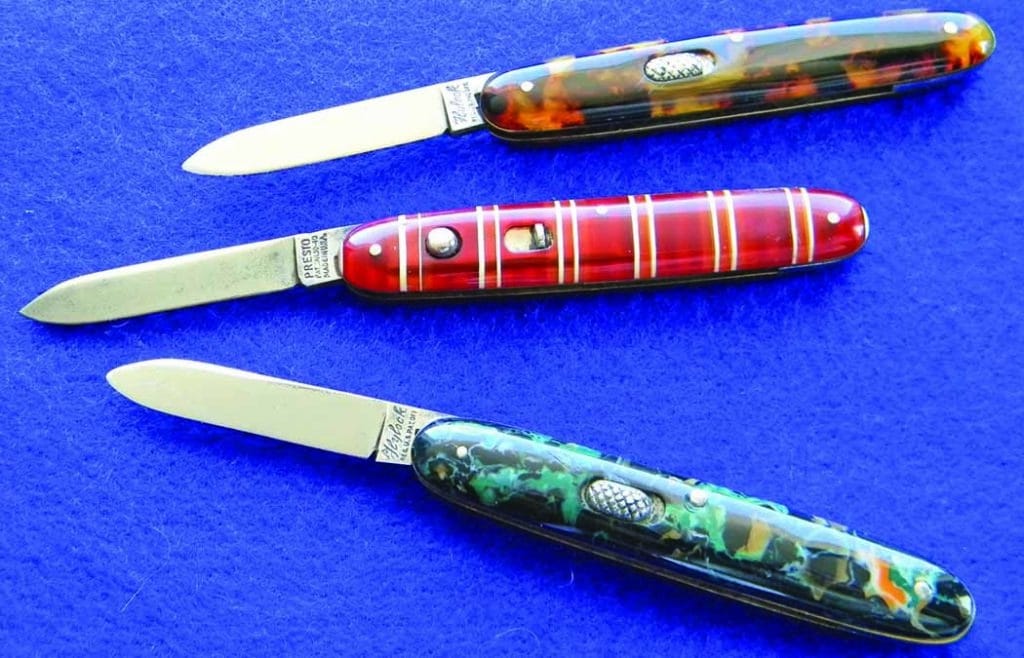
Celluloid was a very popular handle material on antique switchblades. Celluloid types, from top: a George Schrade in imitation tortoise, another George Schrade model in candy stripe, and one from Flylock Knife Co., in blue, pink and black swirl.

For many other occupations, the switchblade and its ability to be opened with one hand has proven immensely important. Mechanics, fishermen, ranchers, soldiers, veterinarians and even Boy Scouts were frequent users of the pocketknives. With a wiggling fish in one hand, it is easy to see how a switchblade could be a valuable asset to most fishermen when cutting a line.

Moreover, most switchblades have a lock/safety that keeps the blade from opening accidentally and the open blade from closing on the hand. An early Flylock Knife Co. ad touted, “The ideal knife for all outdoors and sports use. One hand only required to open or close, leaving the other hand free to grip a rod or gun.”

World War II Switchblades

World War II brought with it the necessity of supporting soldiers who parachuted behind enemy lines. Switchblades procured for the U.S. military were designed to cut the parachute suspension lines that became entangled during landing. The knives were carried in what has been described as “neck pockets’ in jump uniforms.

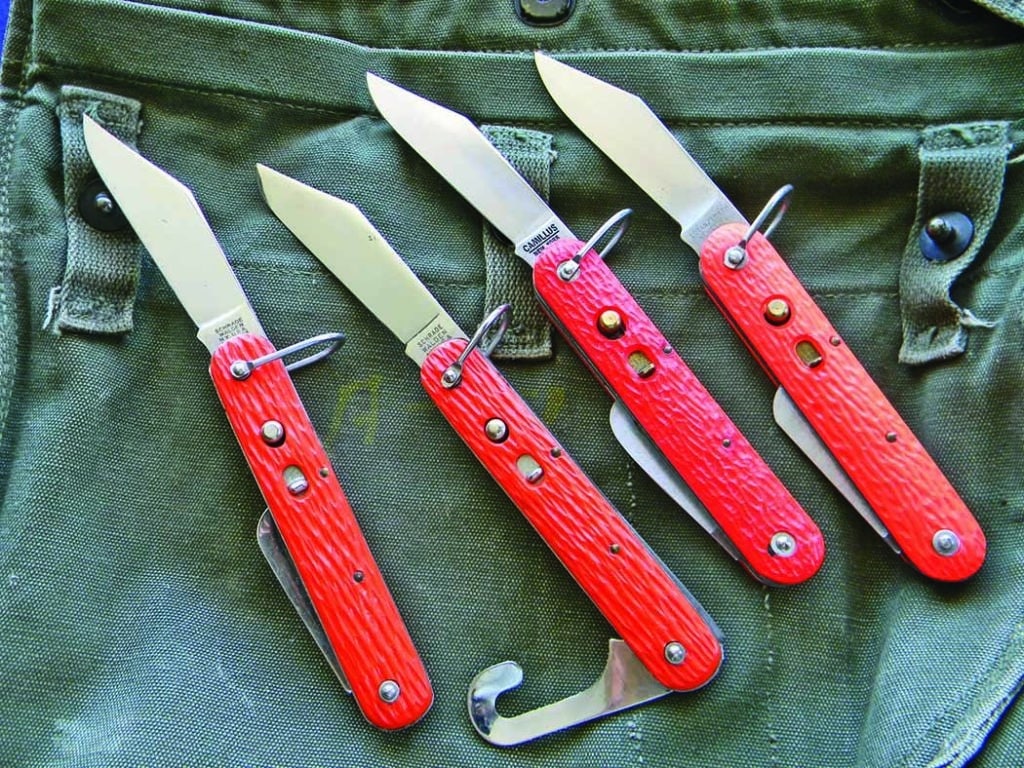
Military switchblades designated “MC1” included models in orange handles for heightened visibility. They were made by Schrade until 1960, when Camillus took over the contract. The knives have a master blade opened by a push button and a manual shroud cutter.

There are continuing discussions about the knives specifically made for and used by the U.S. military during the war. The discussions center around whether switchblades issued to troops all had jigged bone handles or jigged metal sides. Another discussion is whether all switchblades used by paratroopers had a bail—known in the military as a “lanyard staple”—or whether knives without bails also were used.

Units that used the knives included paratroopers in the 82nd Airborne and 101st Airborne Divisions, which included the 505th, 507th and 508th parachute infantry regiments. The 505th Infantry Regiment website shows switchblades made by Schrade Cutlery Co. stamped “Presto” with jigged bone handles and metal handles made to look like jigged bone painted black. Knives both with and without bails are included in the photographs. Switchblades made for World War II paratroopers also include those stamped Schrade-Walden and Schrade Cut. Co.

The book, 4 Stars of Valor: The History of the 505th Parachute Infantry, describes the equipment carried by paratroopers. In addition to main and reserve chutes, full uniform and helmet, the paratroopers carried over 70 pounds of equipment, including an M-1 carbine with ammo, Mae West life jacket, switchblade, water-filled canteen, trench knife, fragmentation and smoke grenades, mess kits, three days of K rations, escape map and compass, gas masks, toiletry items, 30 feet of rope, blanket, half a shelter and first-aid kit.

Post-War Military Switchblades

After World War II, several companies made switchblades for military personnel. According to one website, the first such knife was produced for the armed forces by Schrade Cutlery Co., designated as MC-1, an airman’s paratrooper knife, in 1957. Sometimes the knives are referred to as aircrew survival knives.

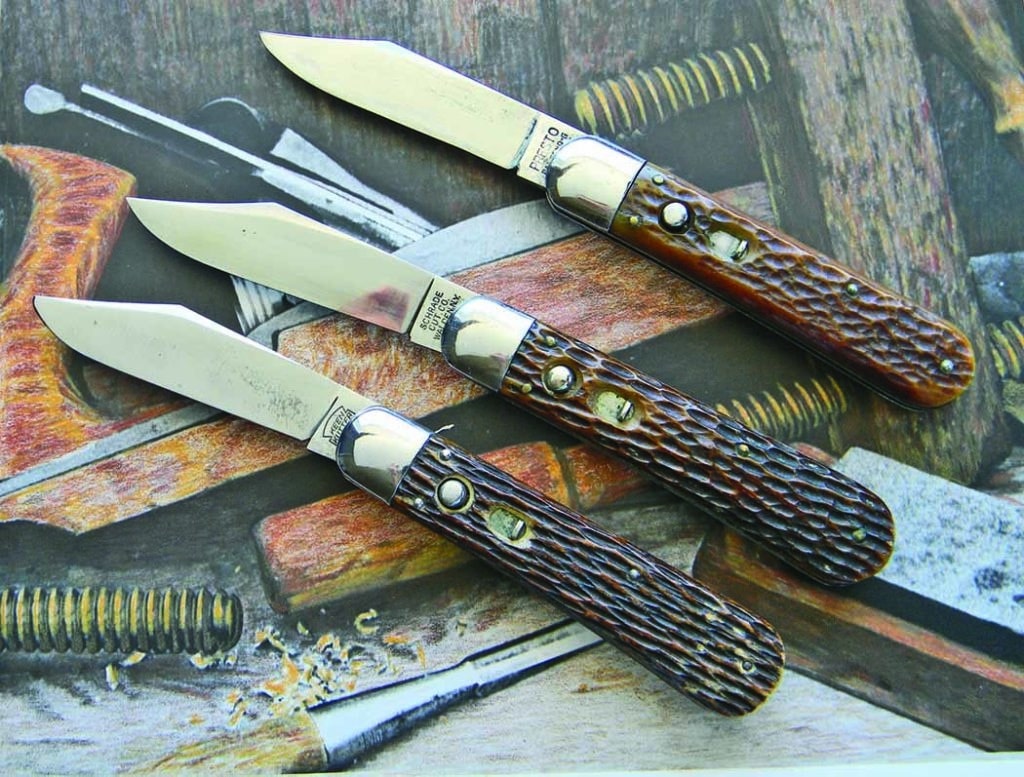
Three jigged bone switchblades, from top: Schrade Cutlery Co., George Schrade Knife Co. and one of the rarest of antique models, one stamped “Keen Kutter,” a trademark of Shapleigh Hardware. Schrade made the knife.

The first contract was awarded to Schrade Cutlery followed by a second contract to Camillus, and a third to Logan-Smyth. The orange-handle switchblades had two blades: one a master spear pattern opened by depressing the button, and a second blade shaped like a hook to cut parachute suspension lines. In my estimation, the hooked blade is not sharp enough to easily cut parachute lines and must be resharpened.

Civilian Switchblades

The early 1950s brought a renewed interest in cheap, colorful switchblades, with thousands of knives made by Imperial in its Jack-O-Matic Texas toothpick model, and Colonial, which used the Shur-Sharp stamp on its colorful models. The fishtail jackknives and the Texas toothpick styles were by far the favorite examples produced by the two companies.

The George Schrade Knife Co. continued to produce popular switchblades with celluloid handles stamped Presto. The knives were made with a single blade, double blades (the latter with a push button for each blade) and even a letter opener with a push button in one end.

Celluloid Handles On Antique Switchblades: Why?

The handle material for most of the inexpensive switchblades was celluloid. Thin sheets of the versatile plastic-like substance were molded around the knife’s metal sides. The most popular celluloid style was candy stripe. The knives also can be found in a wide variety of swirled celluloid handles in a myriad of different color combos, some with such recognizable celluloids as cracked ice and imitation tortoise.

Because the knives were inexpensively priced, they were extremely popular with boys in the 1950s. Because of the knives’ widespread use, some advertisers saw an opportunity to emboss various ads on them, giving them away as a novel company promotion gimmick.

Allure Of Antique Switchblades

Because of their connection with the heroic actions of airborne troops during World War II, antique switchblades have continued to be a popular cutlery collecting niche. Moreover, since almost three dozen companies, each producing a vast array of sizes and handle materials, made the knives, the collecting field is wide open.

Even in the 1950s cheap construction, made more evident by the continuous opening and closing of the blades, the knives remain popular collectibles. No doubt one reason for the popularity is that antique switchblades remind many of the Golden Age of the 1950s and ’60s when kids played outside all day, shot their BB guns, and hit the corner gas station for a cold soda and a candy bar.

Ah, those were the days!

More On Switchblades:

A Labor of Love: Lorenzi Foundation And Museum

The Lorenzi Foundation and Museum showcases one of the finest collections of rare and historical knives in the world.

One of the most extensive collections of ultra-rare modern custom and historical knives, cutting implements and many other items connected with the cutler’s art is displayed magnificently in a new museum in Milan, Italy.

A labor of love by Aldo and Edda Lorenzi, the museum is under the auspices of the aptly named Aldo and Edda Lorenzi Foundation (established July, 2020). The museum showcases the Lorenzi Collection consisting of about 2,000 pieces in all, catalogued and accompanied by specific information: era, origin, artisan (if known), function, material, construction and more.

Aldo & Edda Lorenzi
Aldo & Edda Lorenzi

It gathers cutting utensils and related items dating from the Etruscan period (approximately 900-27 B.C.) to today. It is complemented by a series of specialized publications, testimony to the incessant research that was necessary to bring the operation  of the Lorenzis’ internationally recognized G. Lorenzi retail knife store in Milan to exceptional levels, and to which Mr. and Mrs. Lorenzi devoted their efforts and creativity for many years. It is all housed in a state-of-the-art edifice containing many of the displays and other historical examples of the cutler’s art from the original G. Lorenzi shop and elsewhere.

The Foundation’s premises include a library where visitors and specialists may view the bibliographic materials. A special fit-out of the space enables visitors to relive the shop’s atmosphere. Thanks to an attentive recovery, a number of the original furnishings have been reinstalled on site. This includes an exterior window from G. Lorenzi, one of six “eyes” that communicated with window shoppers in one of Milan’s most exclusive retail store districts, and the display counters on which, over the years, over 18,000 types of sales items were placed. The space also features oak display cases in which the items were shown, as well as the copper-paneled room that featured the small entrance door opening onto the larger shop.

Historic Excellence

The collected items demonstrate, by starting from an artisanal craft as ancient and humble as that of the knife grinder, how it is possible to evolve and then achieve historic excellence. As further informational support, there are over 700 books, about 1,000 magazines and 150 prints, which for the most part depict traveling knife grinders. In fact, Aldo’s father, Giovanni Lorenzi, started his career as a professional knife grinder. Giovanni

Edda Lorenzi examines and arranges some of the many cutlery items from the Lorenzi Collection. (Lorenzi image)

founded  Coltelleria G. Lorenzi—a small shop at the time—at the address of via Montenapoleone 9, Milan, a shop later operated by his sons Aldo, the sole administrator, and Franco. (Regrettably, Franco passed away a few years ago.)

In the course of over 60 years, the Lorenzis collected and kept the pieces which best represented their profession until the closure of G. Lorenzi in 2014. Their selection of the most recent items from their collection was made possible thanks to the close, precious relationship with the artisans—many Europeans, a number of Americans and Japanese—whom Aldo and Edda visited periodically at their shops. It was in such shops that the artisans created their unique pieces, full-fledged artworks that stand the test of time and which enabled G. Lorenzi to become renowned and appreciated at the international level.

Custom Gems

Included in the collection are 150 custom knives by American makers, knives that are particularly near and dear to Mr. and Mrs. Lorenzi. Having collected such knives since the mid-1970s, the Lorenzis traveled the USA, not only visiting the makers in their shops but also attending most every major knife show, meeting just about every maker worth his or her steel along the way.

Among the Lorenzis’ honors are The Knifemakers’ Guild’s Nate Posner Award (1995); the BLADE Magazine Industry Achievement Award (2014); the American Bladesmith Society Special Achievement Award (2014); and the Gold Star Award of Recognition from the William Moran Jr. Museum and Foundation (2014). Three of the Lorenzis’ favorites among their favorite custom knives in their collection are:

  • The number one of an art piece by W.W. “Bud” Cronk, the maker some consider the father of the modern art knife. Aldo ordered a copy of the knife for one of the Lorenzis’ best customers, but Cronk passed away before he could finish it. It would’ve been a coup for the Lorenzis if they could have gotten the copy too, as Cronk never made duplicates of his work. The copy was used later as the model for the logo of the W.W. Cronk Award, a private honor Don Henderson sponsored for 25 years for the Guild Show’s best art knife
  • A Bob Loveless/Barry Wood folder Loveless gave to Aldo when the Lorenzis visited the Loveless shop in 1977. Unaware at the time that U.S. knifemakers’ shops were not retail knife stores, the Lorenzis knocked on the Loveless shop door unannounced. Loveless answered the door and, unsure at first what to make of the couple from Italy, soon hit it

    Loveless/Wood Folder
    Loveless/Wood Folder

    off with Aldo—so much so that he gave the Lorenzis the Loveless/Wood folder. Before the Lorenzis left, they asked Loveless why he had trusted them so much at first sight that he gave them a knife (at the time, Aldo and Edda had no idea what Loveless knives were worth). “He replied that we ‘had our history written on our foreheads,’ a phrase that we have never forgotten!” Edda wrote. “These are the kinds of bonds that have made us love American knives and knifemakers even more!” 

  • A Multilock folder by Ray Appleton. Edda recounted a memorable trip the Lorenzis shared with Appleton from Georgia to Chicago, including visits to an Atlanta racing museum and Kentucky’s Mammoth Cave in the process, the latter where the 6-foot-8-inch Appleton bumped his noggin on a cave overhead. Recounted Edda: “Since Aldo wanted to stop at every cutler shop he knew along the way, Ray generously offered to make the phone calls for him to warn the shops of our arrival. ‘I’m Aldo Lorenzi’s secretary, Hot Pants,’ he announced himself on the telephone, making us laugh a lot!”

These are but three of the many American custom knives and their stories among the scads of other custom and assorted knives and cutting implements in the museum. Meanwhile, a 300-to-400 page catalog of museum items is due for completion by early 2022 at the latest.

If you ever get Milan way, a visit to the Aldo and Edda Lorenzi Foundation and Museum is a bucket-list must. 


Read more about the Lorenzis

Chute Knife: Full-Spectrum Warrior

A fine example of a tool and weapon of war, the chute knife more than rose to fulfill the roles for which it was intended.

Harry Archer was a somewhat shadowy figure. At the height of the Vietnam War, he was engaged in nasty business—fighting a stealthy enemy in a steaming jungle, sometimes up close and all too personal.

Those who knew Archer acknowledged that some of his exploits were “larger than life.” They considered him an early non-movie version of author David Morrell’s fictional character of John Rambo*. Still, Archer was real, flesh and blood. And it seems altogether fitting that responding to his need for knives that “deliver” in a tight spot—survival, seconds along the fine line between life and death—he would come to know and rely on another legend.

According to John Denton, perhaps the world’s foremost authority on the knives of BLADE Magazine Cutlery Hall-Of-Fame® member Bob Loveless, Loveless and the man he came to describe as the “head of CIA operations in Vietnam” were introduced to one another by knife writer/Cutlery Hall-Of-Famer Ken Warner. It followed that Loveless made several knives for Archer’s use in the field, among them a fine sub-hilt and stag-handle example of his well-known Big Bear, along with several other  Big Bears. Loveless’s close friend and fellow maker Steve Johnson was working in Bob’s shop at the time and participated in crafting these. A fighter in a tulip wood handle is another cold beauty.

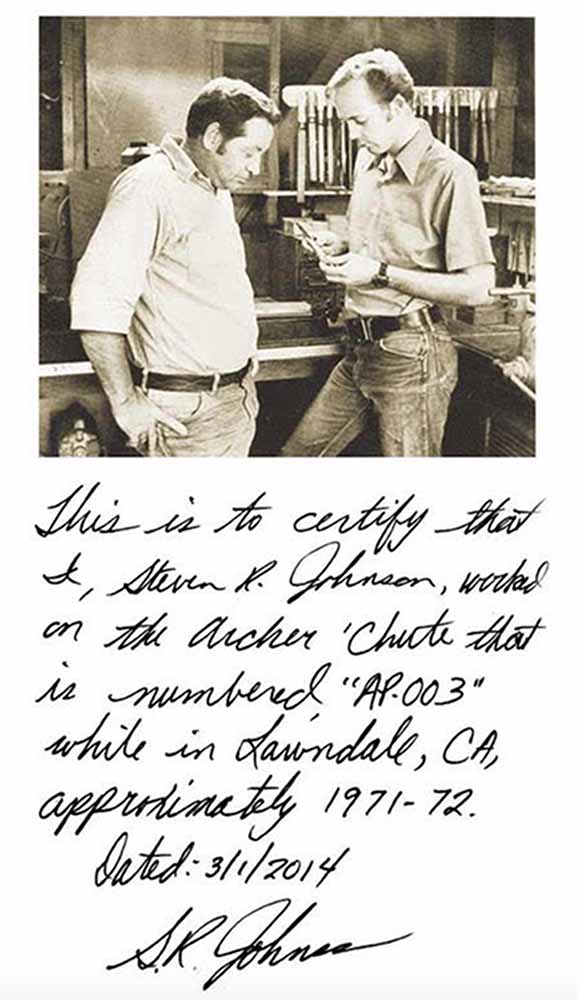
Johnson worked with Loveless from June 1971-October 1974 in the Lawndale and Riverside, California, shops. Steve had a hand in the production of the prototype chute knife in the earliest days, and 23 years later signed a photograph for John Denton attesting to his work on that piece of history. Steve’s inscription reads in part: “This is to certify that I, Steven R. Johnson, worked on the Archer ’chute that is numbered ‘AP-003’ while in Lawndale, CA, approximately 1971-72.”
Johnson worked with Loveless from June 1971-October 1974 in the Lawndale and Riverside, California, shops. Steve had a hand in the production of the prototype chute knife in the earliest days, and 23 years later signed a photograph for John Denton attesting to his work on that piece of history. Steve’s inscription reads in part: “This is to certify that I, Steven R. Johnson, worked on the Archer ’chute that is numbered ‘AP-003’ while in Lawndale, CA, approximately 1971-72.” (images courtesy of John Denton)

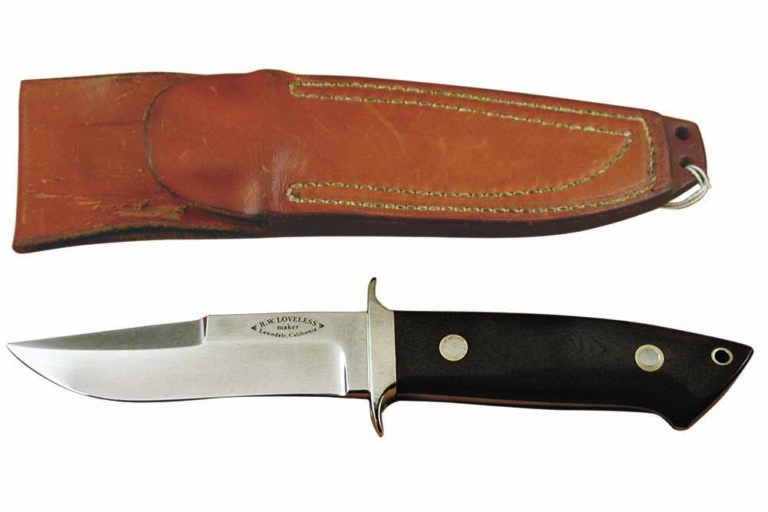
Then there is the well-known Harry Archer chute knife, a versatile fixed blade with good looks and the ability to travel light but cut paracord for a quick exit from a tangled parachute shroud, and with a stout spine for prying loose from the wreckage of a helicopter. The chute knife was made for the jungle. It was made for Harry Archer.

“It seems that Loveless had been left out of a book by Warner, and Loveless sent Ken some knives to review,” Denton recalled. “It just so happened that Archer was there with Warner. Harry saw the knives and bought them all.”

Johnson worked with Loveless from June 1971 to October 1974 in both the Lawndale and Riverside, California, shops. He had a hand in the production of the prototype chute knife in the earliest days and 23 years later signed a photograph for Denton attesting to his work on that piece of history. Steve’s inscription reads in part: “This is to certify that I, Steven R. Johnson, worked on the Archer ’chute that is numbered ‘AP-003’ while in Lawndale, CA, approximately 1971-72.”

Johnson explains that the chute knife is a fairly small, compact fighter and survival knife, short, light, double-edged and strong, but not made in stock thicker than 3/16 inch. Holes for thongs are placed in the rear of the handle and the guard for lashing the knife to a pole or limb to make an improvised spear. It rides into action atop a chest pack or secondary parachute for quick, easy access. Claims that Warner had a hand in the design are unconfirmed, but “the chute” simply looks the part of the warrior’s dependable asset.

“You’re able to cut both ways with the knife via the swipe of an arm or hand,” Johnson related. “Specifically, it’s for cutting parachute cord should it be tangled or caught in a tree. It’s a knife that a pilot, paratrooper or soldier should carry, and it would not be a burden but useful and available in every situation.”

HARRY ARCHER LORE
Stories of Archer’s combat prowess have been told and retold, but to raise awareness of the immediacy of a close-in fight, nothing is better than the harrowing tale that Denton remembers Loveless repeating. John points to a photo of a vintage Big Bear, identifies it as a knife that Archer took into combat, and says, “Harry and his men got into a hand-to-hand fight, and the tip of the blade was broken off inside the enemy. Harry took the knife back to Bob to fix, and Loveless said, ‘Where’s the tip?’ Harry replied, ‘It’s still in the rib cage of the Viet Cong soldier.’ So, Loveless fixed the blade.’”

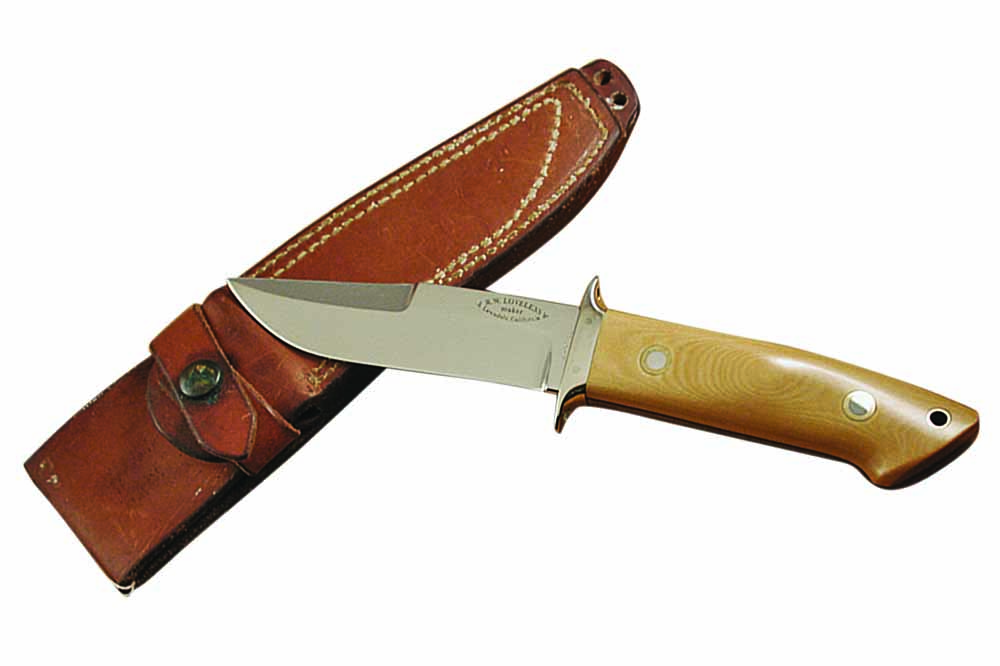
Made in Bob Loveless’s Lawndale, California, shop about 1973-74, this chute knife in ivory Micarta® is stamped BR-003. It was made for the Brass Rail, a famous gun shop in Hollywood, California, where all the celebrity types hung out to see guns and knives. Note the holes in the guard for lashing the knife to a pole to make a spear.
Made in Bob Loveless’s Lawndale, California, shop about 1973-74, this chute knife in ivory Micarta® is stamped BR-003. It was made for the Brass Rail, a famous gun shop in Hollywood, California, where all the celebrity types hung out to see guns and knives. Note the holes in the guard for lashing the knife to a pole to make a spear. (images courtesy of John Denton)

Like the Big Bear and other Loveless creations, the chute knife has its place in the lore of Harry Archer. After he collaborated to produce the prototype, Johnson continued to work with Loveless on more of the chute knives. He remembers meeting Archer in the California shops.

“Loveless really admired Archer and his adventures in the Vietnam War era, working with USAID**, the CIA and different assignments in various parts of the world,” Steve commented. “[Harry and I] discussed life in camp in Vietnam, interactions with Vietnamese soldiers and personnel with whom he was serving. That was quite interesting.”

Steve calls the chute “one great knife” and remembers conversations in Lawndale when the veteran operative praised it as light and small enough to carry so that it could always come along on a mission. Johnson also made a chute knife for Archer and continues to produce his own model today.

“We worked together on Archer’s order for a ‘Johnson’ version of a chute knife on a bench in the rear of Bob Loveless’s shop, in his garage in the back of his house in Lawndale,” Steve smiled. “Archer asked me to make my version, which we—mostly he—designed in the early 1970s. He did a drawing for me. The 154CM blade was about 4.5 inches long, the handle slim and a bit longer than normal, and it had a large thong tube, three handle screws, a stag handle, and checkering on the top and bottom of the tang just behind the guard.”

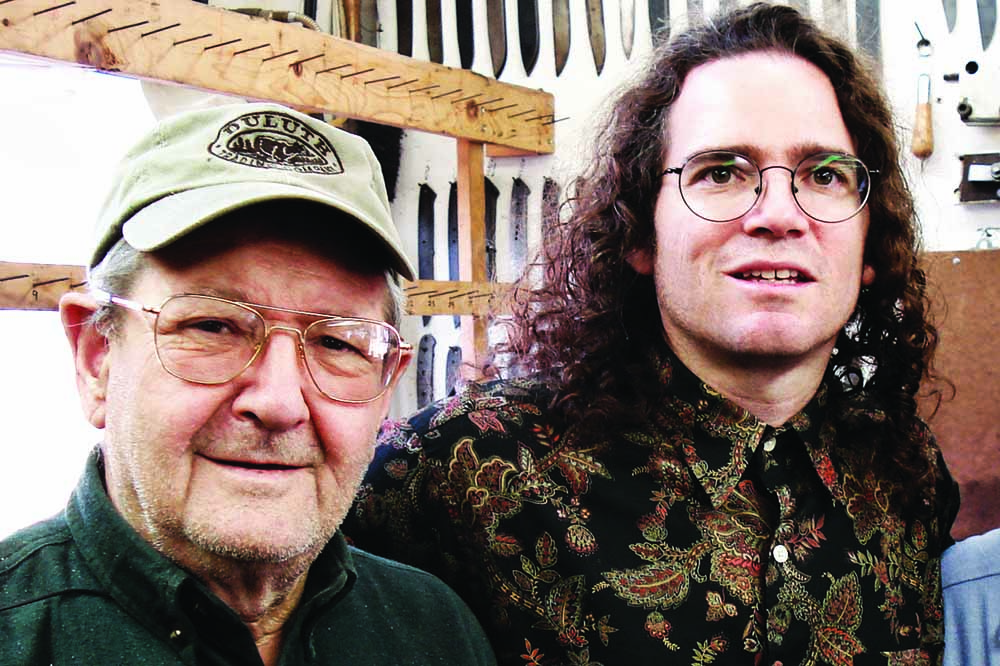
Bob Loveless (left) and John Denton (right)

For Johnson, working with Archer was a pleasure and a defining moment in his illustrious knifemaking career, which, after recovery from a serious accident, took him from Loveless’s shop to his own space in Manti, Utah, more than 40 years ago. “Harry Archer was a great guy who appreciated my work, as well as Bob’s,” Steve added, “and I made him a few knives after California. He was very easy to talk to, respected others, and he really was a man of intrigue and adventure. And Bob Loveless treated me like a son.

“I’m making a chute knife for Atlanta [Steve was interviewed prior to BLADE Show 2021] as we speak, with the blade polished so far, instead of the top grind being just the length of the clip,” Johnson concluded. “I use the pattern that Loveless gave me when I left his shop in Riverside in 1974 or 1975. This particular knife is going to have a stag handle and stainless steel fittings. I’ll make more when asked, and I still have a few on order in my books.”

Long-time maker and designer Bob Dozier was a friend of Loveless and went on to design a chute knife for Cutlery Hall-Of-Famer A.G. Russell. Though his only acquaintance with Harry Archer is through the recollections of A.G., who knew him, Bob says his version of the chute knife remains in demand for one simple reason: “It sells.”

Dozier turns out his chute knife with a 4.75-inch D2 tool steel blade and overall length of 9.75 inches. The handle is green canvas Micarta® “because Goldie [Russell] won’t let me put anything else on them. I’ve got some blades hanging right now, getting ready.”

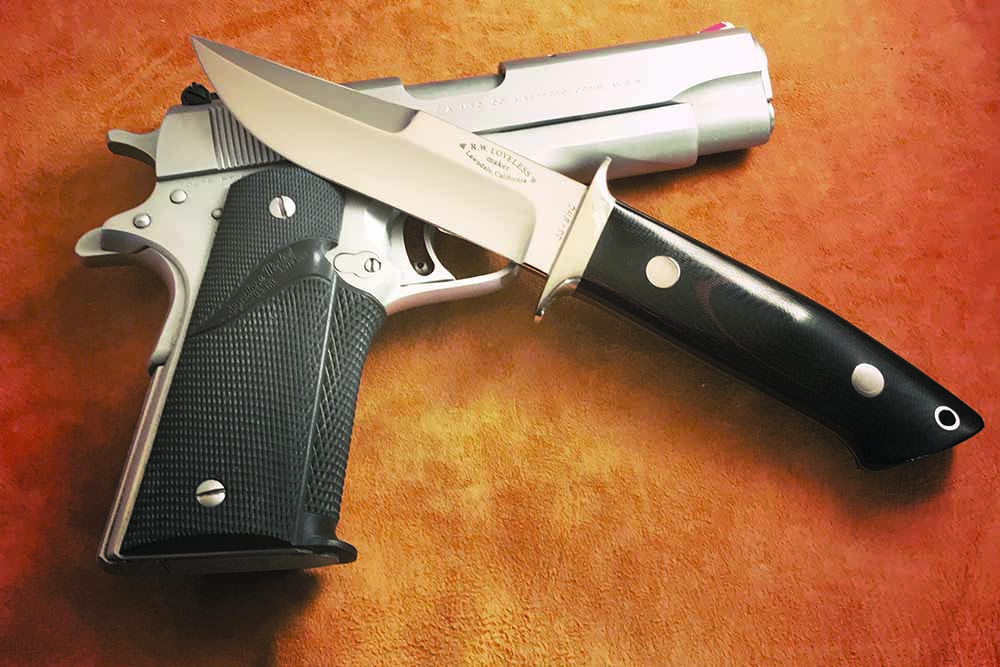
The “RR” on the guard of this Loveless chute indicates it was for the Ram Rod gun store in New Castle, Indiana. Early on Ram Rod sold knives by Loveless, Bill Moran, Ron Lake, W.W. Cronk and others. It appears here with a Smith & Wesson Model 41 modified by Loveless.

Dozier is familiar with the Loveless chute knife configuration but never had the Loveless pattern. He looked at the earlier chute knife profile and made some tweaks. “My handles are like the Loveless, but I don’t cut the butt off as square as he did. I leave more of a point on it than he did. Mine is still mostly like Bob’s, and he was one of the first to make a really good slab-handled knife. That’s one reason why most of us have copied him.” Dozier’s chute knife, designed and built for A.G. Russell Knives, has a manufacturer’s suggested retail price of $895.

SAGA of The CHUTE
The saga of the chute knife certainly has a human side. While Denton estimates that early Lawndale chute knives might fetch as much as $14,000 if found for sale today, and chute knives made in Riverside command up to $12,000 each, they are desirable on the collector market. Nonetheless, the greatest value of the chute knife lies in its lifesaving and protective capability in the hands of a dedicated professional such as Harry Archer.

Through those years of association, Loveless and Archer became friends, sharing a common bond of respect and admiration for the best in fighting and utilitarian knives.

“Loveless said that Harry would come by his shop after periods of being in the jungle for months at a time,” Denton remembered. “He used Bob’s place to unwind and try to become civilized again before heading home to Virginia. But Loveless also said, ‘Harry was like a wild animal when he came to the shop, trying to keep his head straight before he saw his family.’”

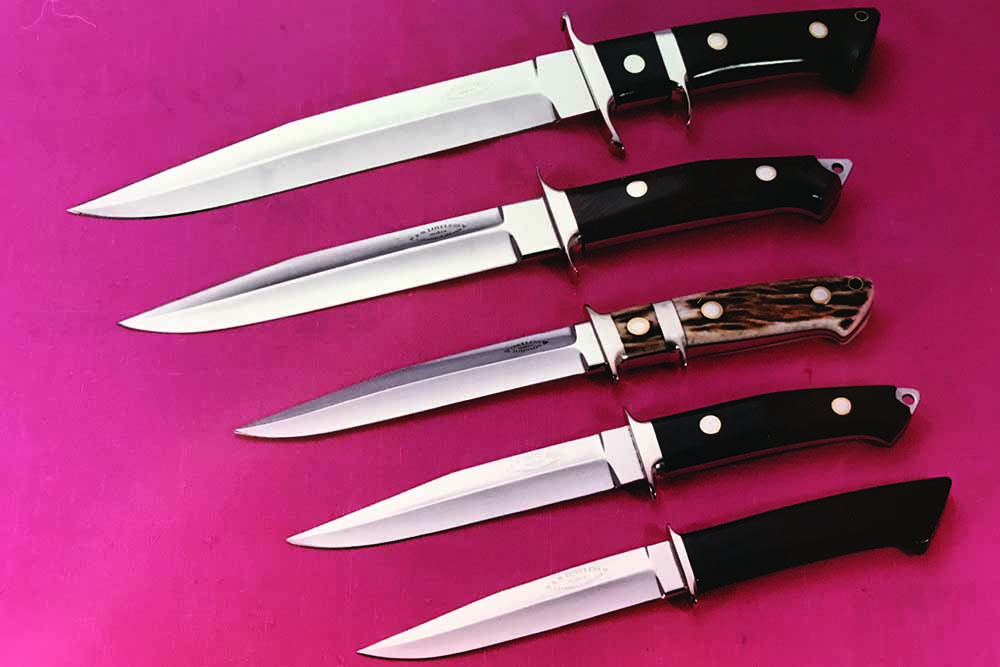
Whenever Harry Archer ordered several Big Bear fighters from Bob Loveless, Loveless said Archer told him to “send the bill to the Pentagon.” From top: the Big Bear Harry broke the tip off inside a Viet Cong soldier during the Vietnam War; tulipwood fighter with skull cracker; Loveless/Johnson sub-hilt with the initials HJA for Harry J. Archer; boot knife with skull cracker; and one Loveless called the Pig Sticker.
Whenever Harry Archer ordered several Big Bear fighters from Bob Loveless, Loveless said Archer told him to “send the bill to the Pentagon.” From top: the Big Bear Harry broke the tip off inside a Viet Cong soldier during the Vietnam War; tulipwood fighter with skull cracker; Loveless/Johnson sub-hilt with the initials HJA for Harry J. Archer; boot knife with skull cracker; and one Loveless called the Pig Sticker. (image courtesy of John Denton)

The chute knife is indeed a fine example of a tool and weapon of war rising to fulfill the roles for which it was intended. It remains a popular pattern because of its looks, quality and versatility. And for one other reason in particular: It helped men like Harry Archer survive the most desperate of situations and make it home.

*In actuality, Morrell based the Rambo character on Medal-Of-Honor recipient Audie Murphy.

**USAID is the acronym for United States Agency for International Development, with the inference here being that in this instance it functioned as a cover for the CIA.


More On Bob Loveless Knives:

  • 15 Best Bob Loveless Knives of All-Time
  • The Legacy of the Bob Loveless Dropped Hunter
  • Merritt-Loveless Knives Do Indeed Hold Merit
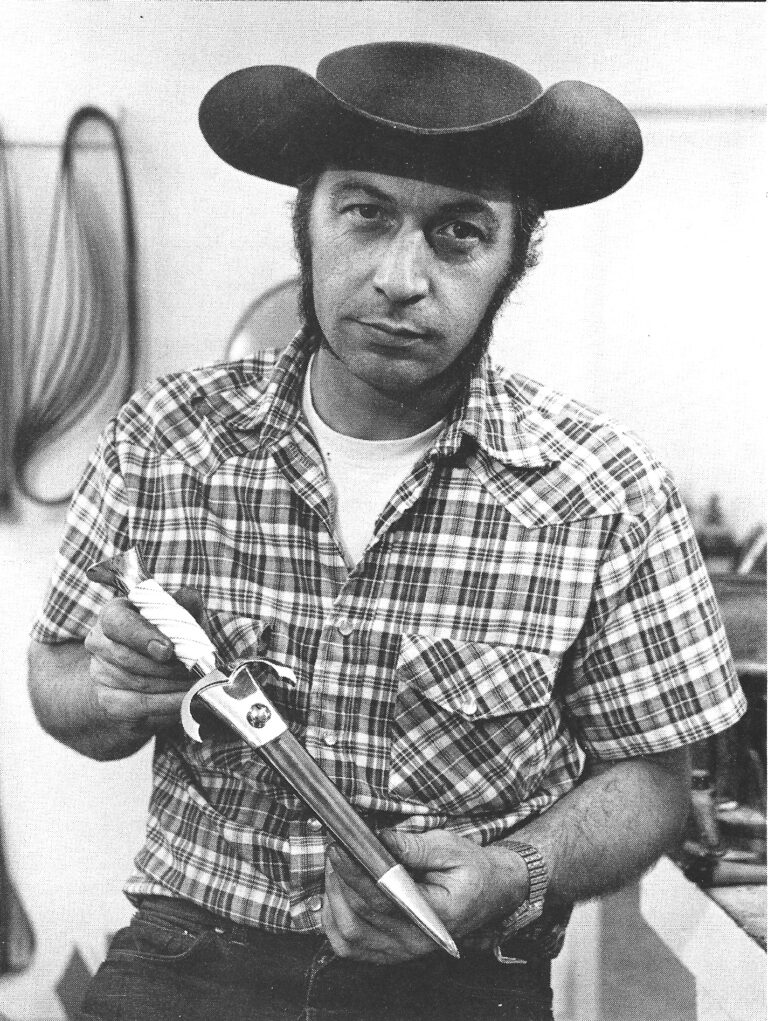
  • Fourth In Greatest Loveless Knife Designs Series
  • Advertisement

    Must Read Articles

    Read this before you make a knife

    Knifemaking 101 – Read This Before You Make a Knife

      by Wayne Goddard My experience has taught me that there's nothing like digging in and getting started. I've often said the hardest part of the...
    how to forge damascus steel

    How to Forge Damascus

    Advertisement
    Advertisement