The history of knives and other edged instruments is tied to the history of people in general. As humankind’s oldest tool, unraveling knife history can lead to even more surprising and enriching information to better understand the world.
Fowler had a lasting impact on handmade knives and knife writing.
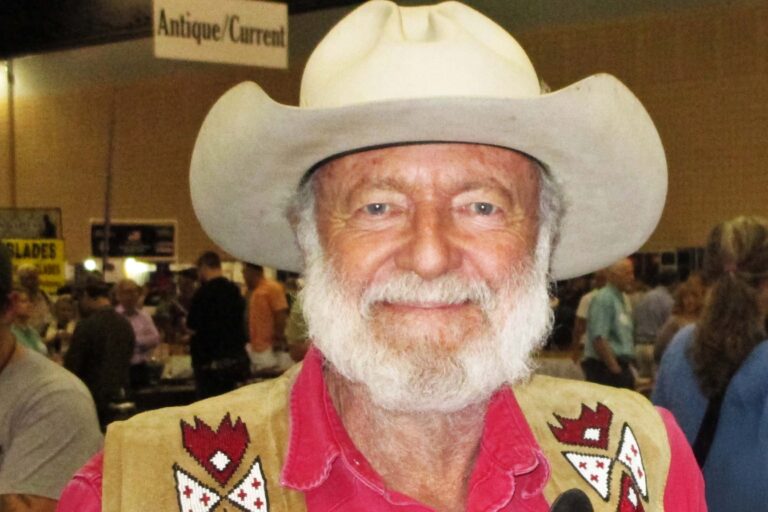
The cutlery world recently lost one of its most steadfast creators and philosophers. Ed Fowler, a man who epitomized the spirit of the custom knife movement, passed away on January 17.
Ed’s journey in the industry began in 1962. Over the following six decades, he became a driving force in the evolution of functional cutlery. While he didn’t invent the use of 52100 ball-bearing steel, he was arguably its greatest champion, popularizing the material alongside his then-controversial methods of multiple quenching during heat treatment. For Ed, a knife wasn’t just a tool; it was an ongoing experiment in maximum performance.
To the readers of BLADE Magazine, Ed was a household name. For over a quarter century, he penned his monthly “Knife Talk” column, which consistently ranked at the top of reader surveys alongside BLADE Magazine Cutlery Hall of Fame® member Wayne Goddard. His writings were eventually compiled into two essential volumes: Knife Talk I: The Art & Science of Knife Making and Knife Talk II: The High Performance Blade. Whether he was conducting demos at BLADE Show or teaching at BLADE University, Ed was always eager to share his findings with anyone who sought a deeper understanding of the craft.
A former ABS master smith, Ed eventually founded the High Endurance Performance Knife Association. This organization was a reflection of his own soul—dedicated to understanding the limits of steel and ensuring every knife reached its absolute potential.
Ed’s voice was unmistakable. In his writing, a knife was never an “it”—always a “she” or “her.” He spent his life in a relentless search for what he called “Excalibur,” his version of the perfect knife. He drew deep inspiration from the legends of the past, including Hall of Famers Bill Moran, William Scagel, Rudy Ruana, and the 19th-century bowies of Henry Huber.
He was perhaps most famous for his insistence on testing. Ed had no patience for makers or companies that didn’t put their blades to the trial, and he was never shy about saying so. This commitment to truth in steel earned him a fiercely loyal following. Many of his readers didn’t just follow his column; they traveled across the country to visit him at his Willow Bow Ranch in Riverton, Wyoming, to spend time in the shop with the man who helped define the modern high-performance blade.
Remembering Others The Knife Industry Has Lost:
Betty Dowell, Driving Force Behind Knifemaker Ted Dowell, Passes
B. R. Hughes, Pioneering Writer And Bladesmithing Teacher, Passes Away
Not only could you carry knives on flights, you could buy them in airports.
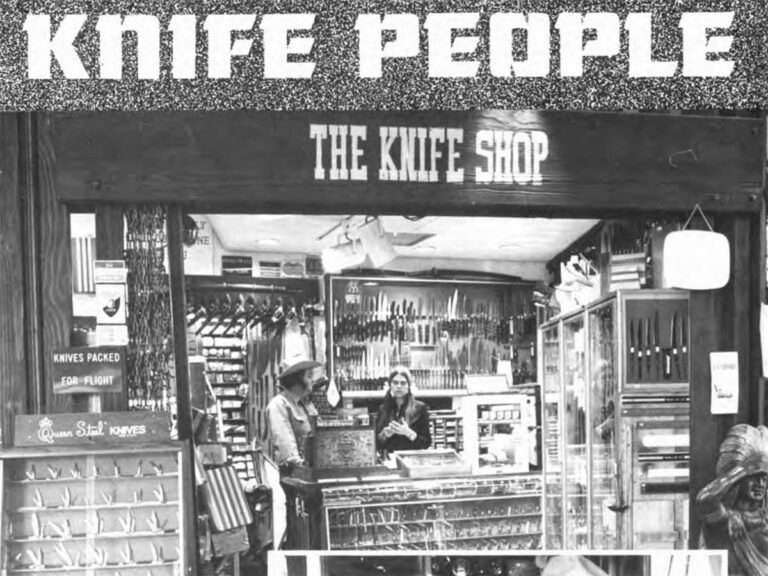
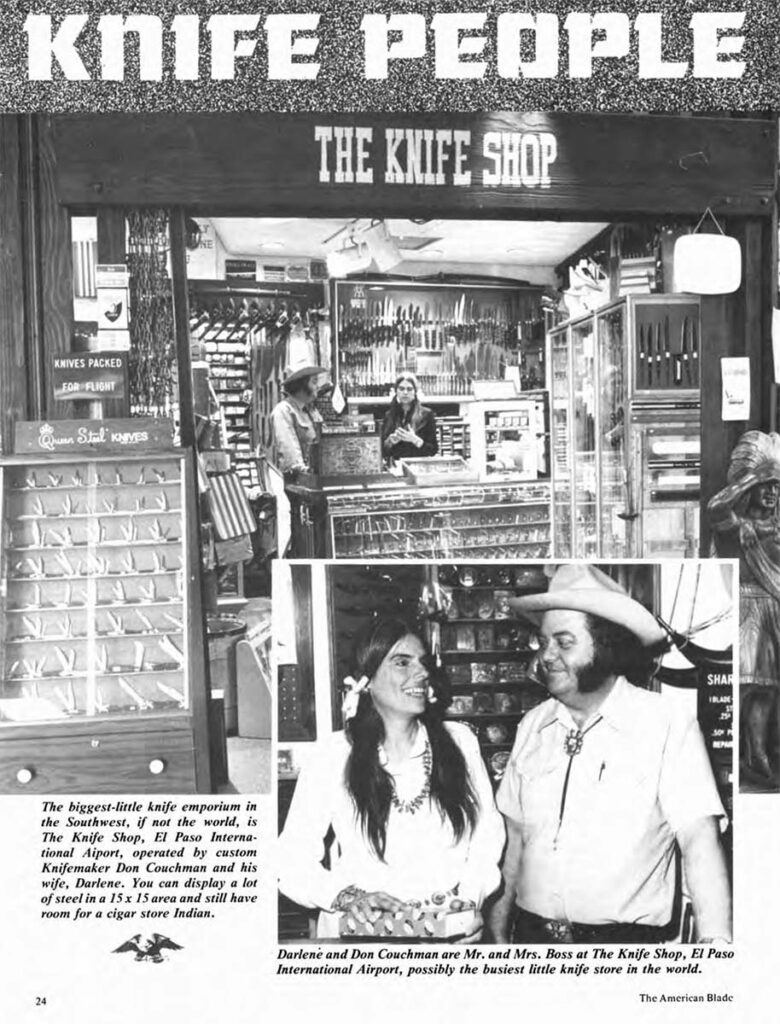
Operated by Darlene and Don Couchman half a century ago, The Knife Shop sold factory and custom knives, sharpeners, knifemaking supplies and more—all in a 15-by-15-foot store in the El Paso International Airport.
A knife shop in an airport is not exactly something you would expect to see today, but such was not always the case in 1976. It was then that Darlene and Don Couchman operated The Knife Shop in the El Paso International Airport.
Airline passengers on their way to parts unknown could stop and avail themselves of knives of almost “every major brand of commercial household and sporting cutlery,” antique knives, straight razors, sharpeners, cutting boards and various knife displays, along with a full line of custom knives that included Don’s custom models.
Of course, as writer/then The American Blade editor L.V. Baker noted in his story “Knife People,” how Don found time to both make knives and help tend the store was “problematical.” Moreover, the Couchmans provided a special packaging and delivery service through the air carrier so passengers could take their newly bought knives on their flights.
“The biggest-little knife emporium in the Southwest, if not the world,” The Knife Shop had a 15-by-15-foot sales area that somehow also found room for a cigar store Indian. What’s more, the Couchmans sold parts to make knives, including finished blades, brass for guards and buttcaps and more, all in neatly arranged drawers so you could find it all easily. Now boarding!
A week after BLADE Magazine Cutlery Hall-Of-Fame® member Bob Loveless died at age 81 on Sept. 2, 2010, Los Angeles Times reporter Valerie J. Nelson wrote a lengthy story on the man who sold his first knife to the Abercrombie & Fitch sporting outfitter for $14 more than 55 years earlier.
Nelson wrote that Loveless “made some of the world’s most coveted sporting cutlery by refining knife design to high art.” These succinct words convey a glimpse of the influence this giant in the cutlery industry wielded during his lifetime. In this 50th anniversary year for BLADE®, his legacy stands tall among those who have dedicated their lives in building the knife industry to what it is today.
Bob Loveless in his shop in October 2006. (image courtesy of Aaron Merritt, grandson of Jim Merritt)
Truth is, there’s scarcely an aspect, nook or cranny of the knife business that Robert Waldorf Loveless did not touch during his lifetime. He was forthright, sometimes gruff and always prone to speak his mind. During an interview for BLADE, he once asked this writer what the tapping noise was that he heard in the background. When I responded that it was the keys clicking as I was taking notes while we talked, he bluntly asked, “Can’t you remember anything? Why can’t you just listen?”
Loveless’ Defining Designs
No matter. Loveless was articulate, extremely intelligent and deep down passionate about art in knives. Cutlery Hall-Of-Famer Bruce Voyles knew Loveless and respected him for what he was.
“The thing about Loveless is he made a knife with eye appeal,” Bruce observed. “It was different, and a lot of people don’t understand why, but it was [his use of the] natural French curve. It was the design appeal.”
True enough, Loveless was a master of design. He had actually studied briefly at the Institute of Design in Chicago in the 1950s, and was a student of the Bauhaus Movement, a cultural and artistic design wave that peaked in the mid-1930s, something of a North Star, a muse if you will. Its dictum: Form Follows Function.
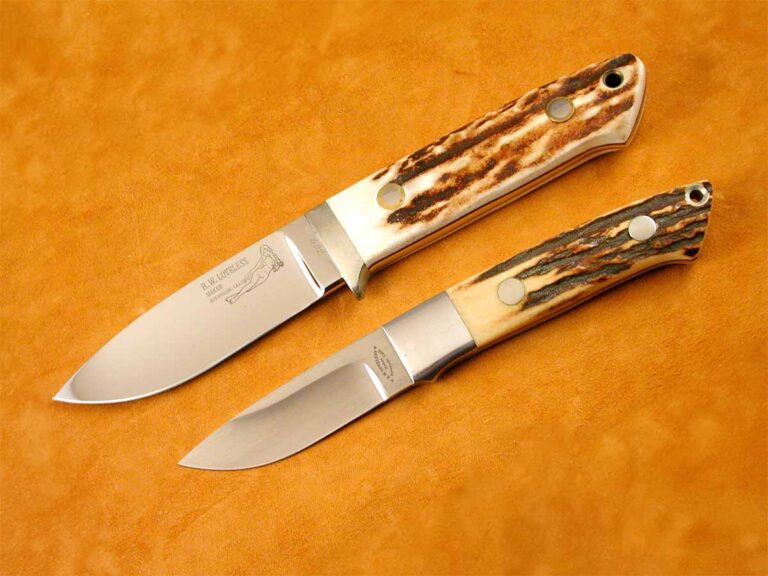
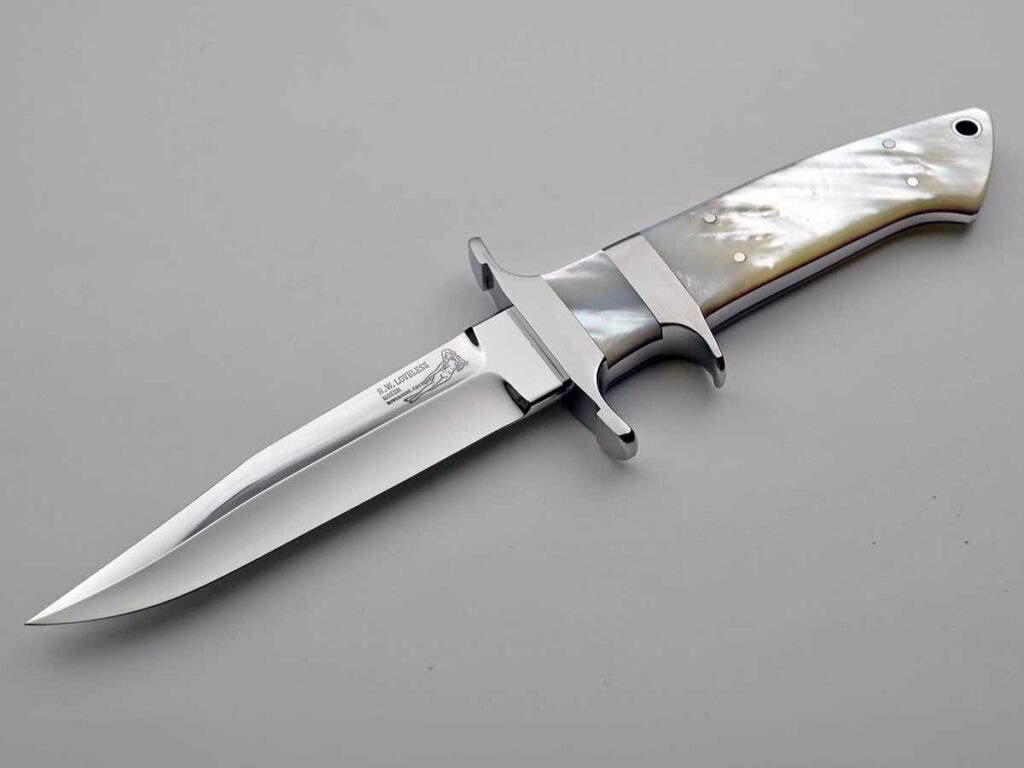
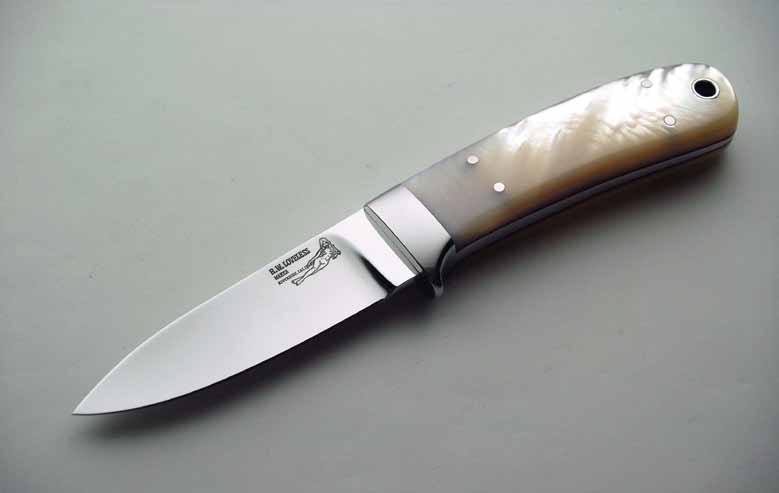
Another of Loveless’s favorite designs is the sub-hilt, radiant in one of Bob’s Baby Bear fighters with mother-of-pearl scales, Naked Lady logo and Riverside, California, stamp. (Exquisiteknives.com image)
Longtime Loveless authority John Denton told reporter Nelson, “He is pretty much the Picasso of the knife world and the father of 20th century knifemaking. His design is what made him famous.”
Dave Ellis, proprietor of Exquisiteknives.com, agrees.
“Going back to the 1950s, Loveless has been instrumental in perfecting some of the more common traits found in contemporary knives,” he related. “The dropped hunter is probably Bob’s most emulated design, although the Archer chute, sub-hilt fighter and more show that Bob did not rest on his laurels. When a smaller, carry-sized fighter was called for, Loveless came up with the New York Special.”
Denton recalled the Loveless willingness to revive and reintroduce design and construction concepts that caught hold in modern times and energized new frontiers of imagination and artistry.
“He was not the first to use the tapered tang,” John explained, “but he found out about it from an old knife made in the 1850s that was given to him by Billy DuPont of the DuPont family. Loveless brought it back into the modern world with the tapered tang taking the weight out of the knife. Bob said, ‘It has to look so good you want to pick it up and feel so good you don’t want to put it down.’”
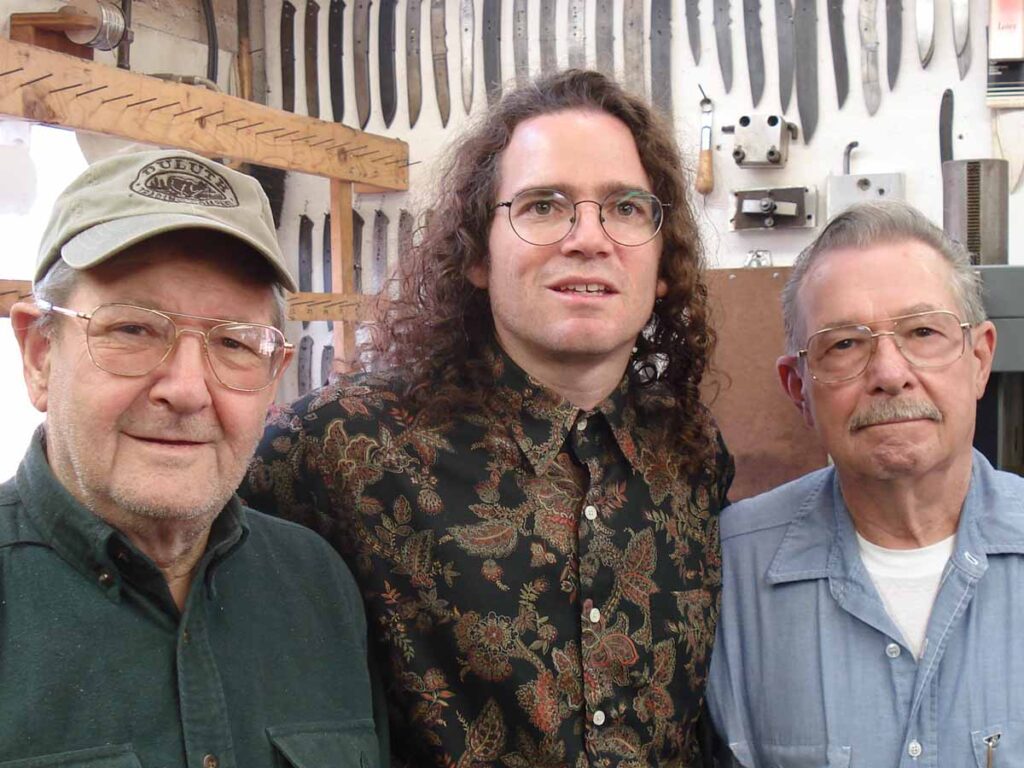
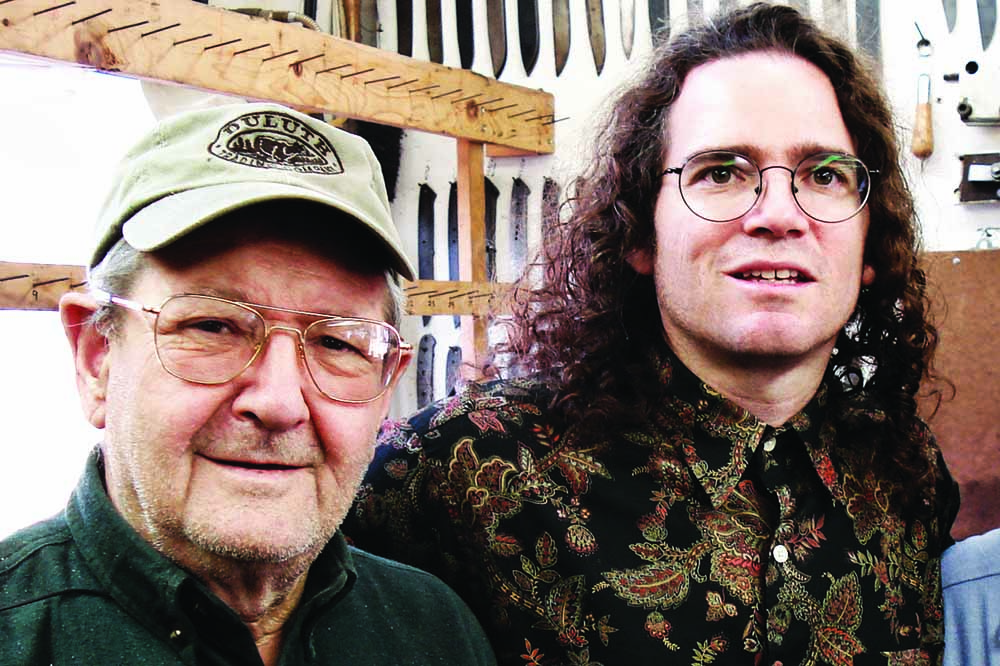
From left, Bob Loveless, John Denton and Jim Merritt in the Loveless shop in Riverside, California.
According to Denton, Loveless also brought the brass wrap handle, hidden pin, two-tone pins and half tang into play.
Design achievement crowns Bob’s career, but there was so much more to him—so much that attempting to compile a summary of his contributions would require more space than this publication might allot in another half-century.
Voyles commented, “I always liked him because he could sum up a complex subject in a sentence. He and I visited one time and I would throw out topic after topic, and he would snap back a quick response. When you left him you knew you left somebody that was phenomenally intelligent on a variety of topics, but that doesn’t mean he had social graces.”
One of Bruce’s favorite Loveless memories was Bob’s rationale during the controversy that raged within the Knifemakers’ Guild as to what truly defined a handmade knife. Loveless liked Jack Daniel’s, so Voyles and Cutlery Hall-Of-Famer Dan Delavan bought a 1.75-liter bottle of Gentleman Jack whiskey (Single Barrel wasn’t available at the time) and presented it to Loveless at his home in Riverside, California.
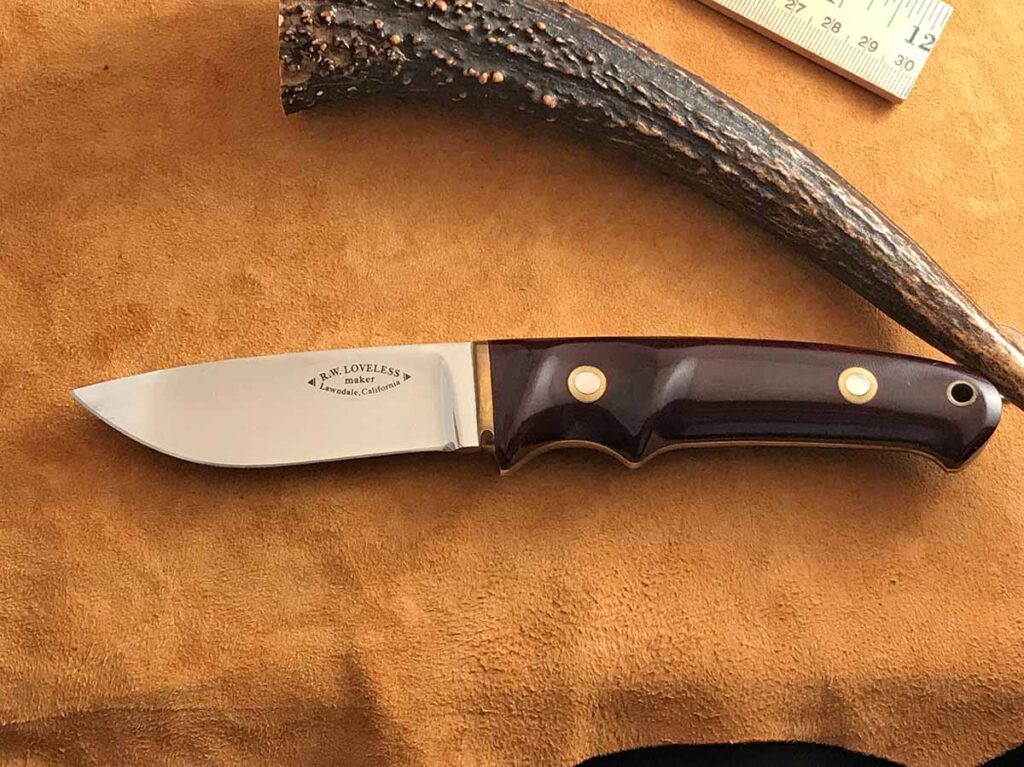
In an arrangement between Loveless and Schrade’s Uncle Henry Baer facilitated by A.G. Russell, Loveless sent this actual prototype to Schrade to copy and make the Schrade Loveless collaboration in the early 1970s. It has no guard, an “improved handle,” and a more pronounced belly than most of the Loveless dropped hunters of later years. The handle is burgundy Micarta®. As John Denton observed, the knife “has a magical feel from the ol’ man.” (Denton image)
“I said to him, ‘I hope you will accept this gift in the spirit in which it is intended,’” Bruce smiled. “He laughed and put the bottle on his shelf. Then we sat down and asked him what he believed to be the definition of a handmade knife. We videotaped his answer. He said, ‘I wish I had a machine that I could dump handle material, steel and pins into, and then a knife would come out the other end, boxed and ready to send to somebody. So, make your knives any way you want to. The marketplace will sort you out soon enough.’”
Simple, straightforward and wise.
Bob’s Impact On The Industry
Loveless played a pivotal role in the genesis of knifemakers’ organizations. He was a founding member of the Knifemakers’ Guild and a pioneer with the California Knifemaker’s Association. He was a staunch supporter of knife shows, bringing people to the events just with his mere presence. According to Ellis, Bob regularly attended the Guild Show, BLADE Show, Solvang Show, California Custom Knife Show and Phil Lobred’s Art Knife Invitational
Loveless also brought along younger knifemakers, working with them and offering advice. A few include Jim Merritt, D.F. Kressler, Yoshihito Aida, Cutlery Hall-Of-Famer D’ Holder and Steve Johnson. Bob’s style and artistic interpretation live on in part with the work of these incredible craftsmen.
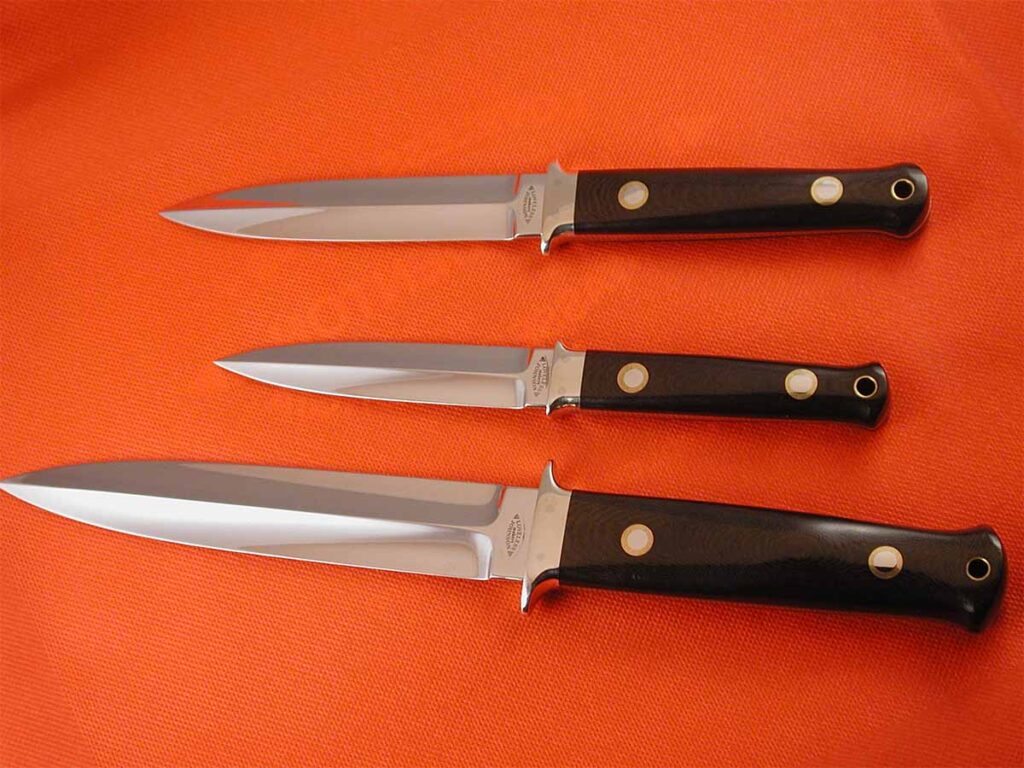
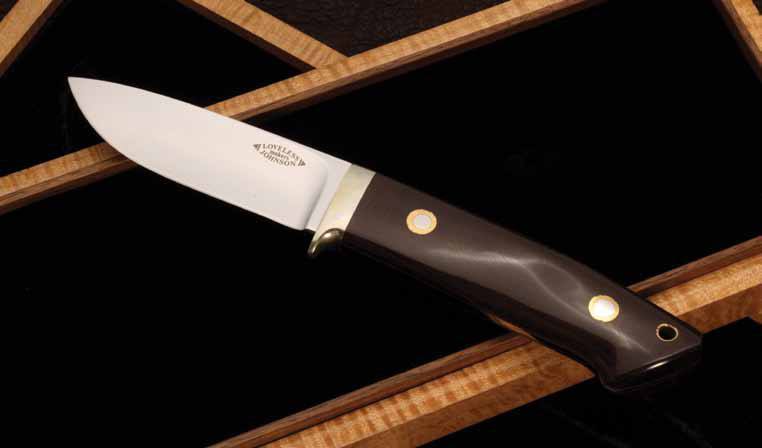
Steve Johnson worked in the Loveless shop in the early ’70s and remembers Bob fondly. “He was a true friend to those who were genuine and sincere with him,” Steve noted. Of this rare set of Loveless-Johnson daggers John Denton wrote simply, “Three really great knives.” (Denton image)
“Many a maker is in debt to Bob Loveless for the support, counsel, corrections and guidance that he gave,” Johnson said. “He was a true friend to those who were genuine and sincere with him, and the relationship that they had with him. Bob, as we know, was outspoken and quick to correct what he felt was not right or smart, which led to some loving him and others not, a bit like Ed Henry—love or hate—but both were so very good to me personally!”
Materials Maven
Loveless was an innovator in the aspect of materials as well, including 154CM stainless steel and the introduction of ATS-34 from Japan, while also popularizing Micarta® as a handle material.
Ellis commented, “Loveless pioneered the use of many of the common steels used today, especially 154CM. The shop was able to purchase such quantities that Bob could pretty much order what he wanted. The favorite handle material of the Loveless shop was green Micarta.”
Johnson remembered, “There was a stack of 154CM steel lying in the driveway at 4319 W 187th Street [the address of the Loveless shop] the day I first walked in. Bob mentioned that he was excited to get some blades done and heat treated right off. Green canvas Micarta was set in stone as the best handle material in Bob’s view. It’s still right up there on top and is used by many a maker. It’s because of Bob’s legacy that this happens.”
Global Influence
A lasting dimension of the Loveless legacy was his bridge to Japan, as well as his overtures in the European markets.
“Bob was deified to the extent that every Japanese knifemaker included his designs among their offerings,” Ellis explained. “Bob was an icon in Japan, and to this day many of the top makers in Asia have Loveless designs in their repertoires.”
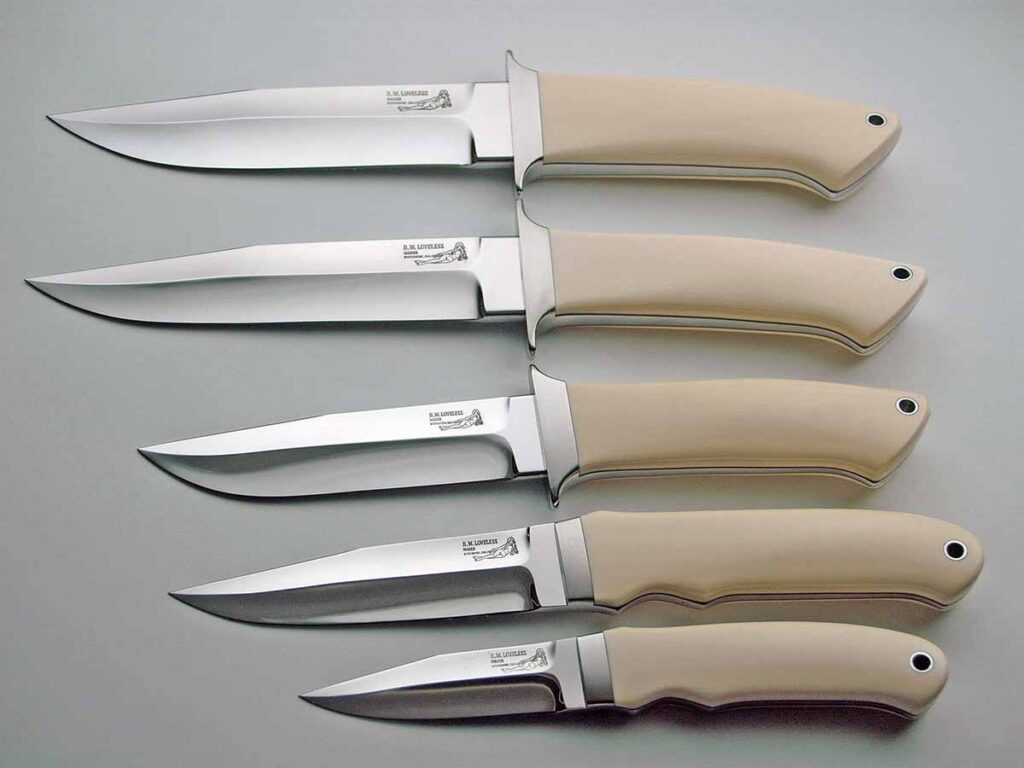
Five Loveless fixed blades sport the no bolt/no pin look in ivory handles. (Exquisiteknives.com image)
Voyles commented, “Bob went over there and showed the Japanese how to make good knives. I went to Japan in 1981 or ’82, and in every factory I went to there was a picture of Bob Loveless and the factory owner. The thing was that Bob’s wife, Yoshiko, was Japanese, so he didn’t have a problem with the language barrier, and he went to Japan to show them how to make knives that appeal to Americans.”
Loveless used his connections to make things happen, and Voyles credits him with the evolution of the folding knife among Japanese manufacturers, as well as a surge in the Japanese collector market.
“Bob didn’t make folders and the Japanese wanted folders,” Bruce recalled. “He had worked on a design with Jess Horn, and Bob put Jess and Japanese collectors in touch with each other. Horn also had a series of folders that he patterned after the old Remington Bullets. When Japanese collectors discovered that, their market for vintage Remingtons went straight through the roof. Loveless sowed the seeds in the 1990s for the collectibility of vintage knives in Japan.”
Collecting Loveless
Today, a Loveless knife is a collectible phenomenon in its own right. Name the year, name the mark on the blade, name the style and the materials, it will sell for astonishing dollars. Denton has noted some models made in the 1970s that sold for $400 then and have reached the rarefied air of $100,000 or more in recent years. The power of Loveless pricing simply takes your breath away.
Bruce is quick to add that Loveless was professionally unselfish. “If you wanted to make a style of his knife in your factory, that was OK,” Bruce noted. “Just ask him.”
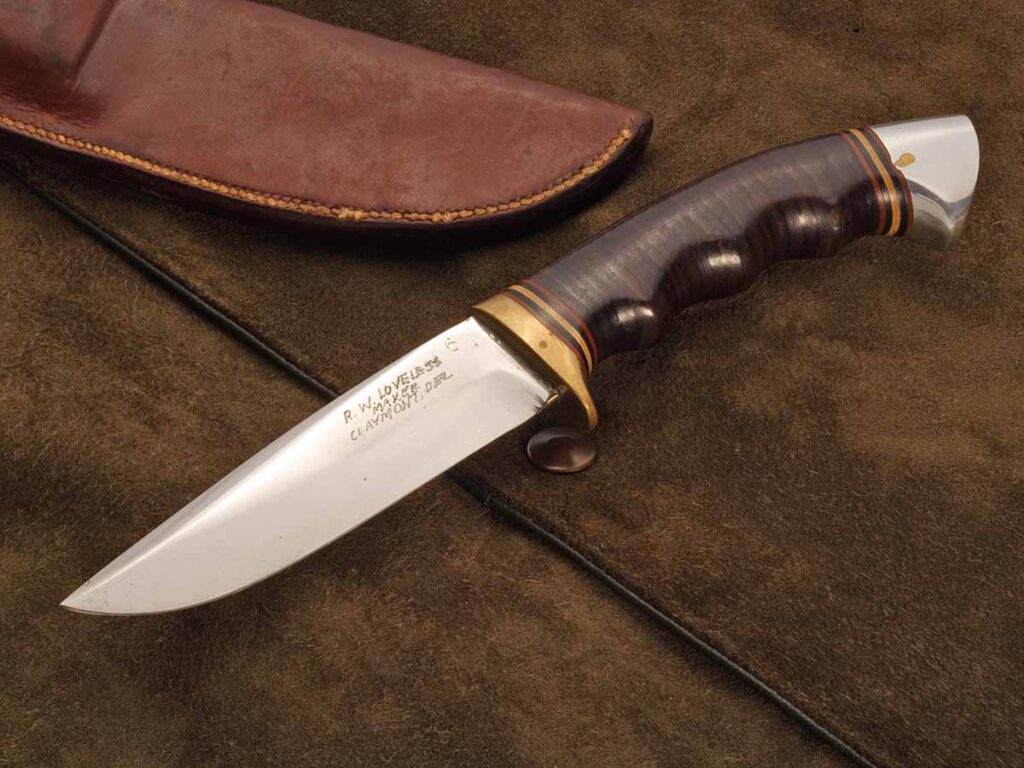
Circa 1955, Loveless sold his first knife to Abercrombie & Fitch for $14 (adjusted for inflation, almost $160 in today’s money). Loveless made this early model for A&F in his shop in Claymont, Delaware.
The pervasive Loveless influence stretched far and wide, from the custom knife shop to the factory.
“His designs for and collaborations with Schrade, Gerber, Lone Wolf and others, and the factory knife market in general, were significant,” Ellis recalled. “Early on the astute factories were taken by Loveless designs and made limited editions in dropped hunters and others. These days factory collaborations are quite common, and you can thank Bob Loveless if you want to give credit where it is due.”
When Sports Illustrated called Loveless for an interview in 1980 and the magazine published his words in the same edition that featured tennis superstar Bjorn Borg on the cover, the impact on the entire knife universe was transcendent. When asked why so many people considered his knives “better” than those of others, he mused, “A knife is an extension of your experience. And I’ve had more experiences than most people. There’s more character running in my veins.”
For those who knew Bob, just the knowing was an unforgettable experience. His contributions to his present and to the futures of others in the knife industry remains incalculable. And so, the longevity of a man does not reside in his years on Earth, but in the perpetual remembrance of his ideas, his workmanship and his innovative perspective on the world.
Therefore, it can be said that when Loveless left us he did not go gentle into that good night. He did not fade away. He didn’t drop the mic. He handed it to those with the foresight and the intestinal fortitude for the days to come. Now, what do we say and do? Loveless might grouse. He might gripe. But he just might also manage a grin.
Few Blades Are As Historic As The Bayonet. The Knife Has Evolved Into An All-Rounder Still Issued By The Marines.
Oddly enough, the history of the bayonet likely began in the hunting field, not the battlefield. By at least one account, the edged weapon was a tool of the French boar hunter in the 1500s. Tusks and a bad attitude, it’s understandable why these gents strapped their hunting knives to the muzzles of their muskets.
Soon after some enterprising soldier figured the invention–in original French baïonnette–might prove useful in warfare, and the iconic edged weapon was off to the races for the next four centuries. Presently, bayonets have essentially become military relics, if employed generally only as a training tool to acclimate soldiers to close-quarters combat.
Despite this, these fairly antiquated edged weapons still stir the imagination of military heroics of yore. Not to mention, in nearly all their versions, bayonets remain one of the coolest and most accessible historic edged weapons to collect.
In the article, we’ll look at some of the major styles of these modified edged tools, how the implement has evolved and who actually continues to make them. So gird your loins, we’re charging forward on bayonets.
Major Bayonet Styles
A bayonet is so much more than just that. There were, and still are, several different designs of the implement, most mirroring the technology and ethos of war fighting of its particular era.
Plug Bayonet
The plug bayonet is the earliest known bayonet and dates back to the 1500s or 1600s. The idea is rather simple. if you couldn’t use your gun to shoot or simply don’t have time to reload you turned to the knife. In this case, typically a double-edged dagger with a rounded handle that affixed the implatment directly in the muzzle of a musket barrel.
These earliest bayonets were really fully-fledged daggers in their own right. They lacked a proper pommel as can be imagined, but they could be used exactly like any other dagger. Most in this era were used in a manner of last resort. If a soldier found himself out of ammunition or facing a fast-moving enemy, he would likely want to put in his bayonet and hope for the best.
The bayonet at this time was the product of changing warfare. While firearms were becoming more prevalent on the battlefield, they were slow to load. Additionally, the close-quarters combat of the medieval era still reigned supreme. In turn, soldiers required an option to hold off infantry and cavalry charges once their one shot was spent.
Offset (Socket) Bayonet
While it may surprise some, the classic socket bayonet most think of during the flintlock era of warfare was not in full use by 1700. Attempts had been made prior to developing an offset bayonet allowing the soldier to load and fire with it attached. But it wasn’t until several critical battles in the late 1600s that evolution took hold. In particular, the battle of Killiecrankie in 1689. HereScottish Protestant forces were thoroughly defeated by Jacobite Scottish Highlanders, who charged and destroyed their enemy with broadswords and targes.
This defeat came in part due to the plug bayonets the Protestants utilized. In what would be a rather ironic turn, the Scottish Jacobites would eventually meet their end and the end of their cause at the tip of the bayonet. Outfitted with socket bayonets at the Battle of Culloden in 1746, the British were able to let loose a point-blank volley on the charging Highlanders, then finish the rest with their bayonets. The British had even devised tactical doctrine for the use of the weapon, training to a charging man to their side, instead of in front to strike beneath his raised sword arm.
History Of The American Bayonet
The M7 is a legendary American bayonet that is still manufactured today.
Americans were somewhat slow to adopt the bayonet in warfare, giving the British somewhat an edge in the early days of the Revolutionary War. Of course deadly in charges, attached to the British Pattern 1769 Short Land musket–or Brown Bess–the implement also was somewhat a psychological weapon. Said to be the most feared weapon of the British arsenal, the Red Coats mass assaults with a long, gleaming triangular knife at the end of their muskets made all but the most disciplined break.
The Continental Army proved a quick study once trained with the bayonet by Maj. Gen. Baron von Steuben at Valley Forge in 1773. By the end of the war, there were even strokes of genius with the American use of the bayonet, such as when American Lt. Col. Alexander Hamilton (also the first Secretary of the Treasury) led a bayonet-only assault on redoubt 10 during the last days of the Battle of Yorktown.
Early on, the Continental Army utilized a triangular socket bayonet similar to the British, however on the French Charleville Musket. But its use spread and the wicked device was eventually found on the Brown Bess–the most used arm of the Continental Army.
The bayonets in American service were standard European-style socket-mounted with triangular blades. This remains so through several iterations, including the Harper’s Ferry 1801 pattern, 1807 and 1810 Springfield patterns, M1816, and M1855.
The M1855 served through the Civil War, where it saw extensive use on the Springfield rifle muskets. The .58 caliber rifle muskets loaded the same way as old muskets and could fire quickly and were very accurate and had substantial range. The bullets used in these guns had a hollow base that expanded into the rifling when it was fired, thus imparting spin. The war was devastating, and there were many bayonet charges, most with mixed results and high casualties.
More accurate firearms and the introduction of repeating arms mitigated the effectiveness of the bayonet during the Civil War. It is estimated, only around 1 percent of all casualties were a result of bayonet wounds.
Sword Bayonet
Pattern 1907 Bayonet. (Source: CC by 4.0)
Despite the effectiveness of “cold steel” assaults waning in the face of technological advancement, the bayonet persisted, though evolved to remain relevant.
A more interesting detour around the time of the American Civil War, was the multi-purpose sword bayonet used by the British. The British Infantry Rifle of 1800–1840–later known as the Baker Rifle–utilized this style. The idea, essentially, was to give soldiers the ability to stave off cavalry charges when used as a bayonet, but also outfit them with a side arm–a short sword–for close-quarters combat. These sword bayonets had knife handles mated to exceedingly long blades, sometimes over 20 inches.
Surprisingly, this style of bayonet was used all the way into World War I, despite little evidence the elongated blade provided any advantage. Perhaps the most famous final rendition was the Pattern 1907 Sword Bayonet, found on the British Short Magazine Lee Enfield rifle in the Great War.
The American bayonets of the pre-WW1 era were a bit more well-designed. The bayonet designed for the American Krag rifle (the M1892), for example, had an 11.7-inch blade and could serve as a camp tool as well for daily chores. The Americans ended up following the Europeans’ lead in World War I a bit with the M1905 bayonet, which sported a 16-inch blade. Additionally, there were 17-inch versions used on the trench shotguns and backup rifles like the M1917 Enfield.
Knife Bayonet
The M9 bayonet works as a traditional bayonet but is more commonly used as a fighting/camp knife.
After WWI, most militaries of the world focused on making the bayonet in the form of a camp knife, something that was worth it to carry for general use that had more than one regular use. The time leading to WW2 produced the highly functional and realistically-sized M1 bayonet for the M1 rifle. The M1 carbine was also set up to use one, and it had its own small setup in the M4 bayonet knife. These knife-style bayonets eventually ran through several iterations leading up to the M7 bayonet for the M16 rifle in the late 1950s.
As a regular tool, the knife bayonet is great and doesn’t remove any of the function in either role. It can be used for all sorts of tasks and also be mounted on the gun. The later M9 became a full-on utility and fighting knife for the M16 series. It is a large, Bowie-style knife that closely resembles the Ka-Bar. It added some additional utility features like serrations for cutting straps and rope and a wire cutter. Later on, the OKC-3S knife bayonet was adopted by the USMC. These remain standard today.
Bayonet Realities
The reality of the bayonet is that it is not a principle fighting weapon. Today we are seeing most rifles fitted with a mountain of accessories, from variable power optics, lasers, suppressors, and bipods.
The bayonet has, for most of its history, been a weapon of intimidation. Very few times did any two armies charge each other with bayonets, usually one side fled first. Even in our modern era there have been bayonet charges, but again to no effect other than to scatter the enemy.
Edged weapons do have a role in modern warfare; everyone needs a good knife at minimum. If your rifle has no provision to attach one or you’re using a suppressor, there is no real need to carry a bayonet specifically as opposed to a dedicated knife that serves your purposes.
Bayonets will always be a curiosity not because of how they were used, but rather why they were used well beyond their abilities. While it is certainly a dangerous thing and absolutely lethal, getting that close to your enemies means you’re having an exceedingly bad day. But, as history has shown, a man with a sharp stick and nothing to lose can sometimes win the day.
Robert “Bob” Loveless is regarded as one of the most influential custom knifemakers of the modern era. Here are the 15 knives that show why.
1) R.W. Loveless and Abercrombie & Fitch: A Match Made In Heaven
This is one of Loveless’ first knives made for Abercrombie & Fitch during the early 1950s. The photo is courtesy of John Denton.
2) Loveless-Johnson Collab
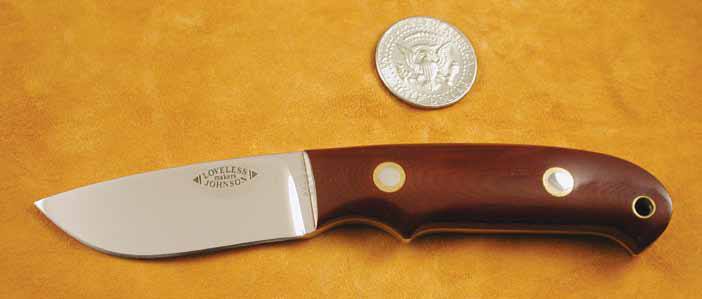
Steve Johnson, who worked as a junior partner with Loveless, says Bob made a huge difference in his life. Pictured is one of the few knives marked “Loveless Johnson” reportedly still in existence. The image is courtesy of John Denton and the John Denton collection.
3) The Most Beautiful Knife Bob Ever Made?
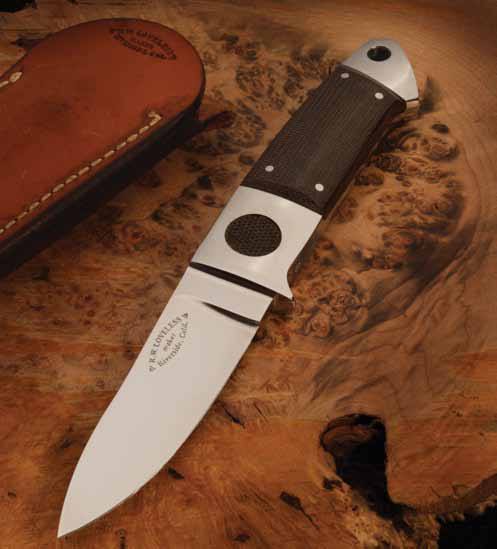
If Bob Loveless reportedly said that this integral semi-skinner, with its dark-green canvas-Micarta handle, is “the most beautiful knife I ever made,” then who can argue? The knife was crafted about 1987 and features a drop-point blade. It is from the John Denton collection, and the photo is by Hiro Soga.
4) The Loveless Dagger
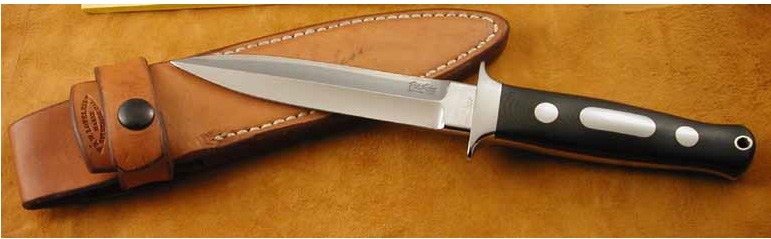
The dagger looks so good, you want to pick it up, and feels so good you don’t want to put it down. The dagger in a full, tapered tang, Micarta handle and double guard looks and feels good. It is from the John Denton Collection.
5) Loveless-Merritt Collab
The combined skills of Jim Merritt and Bob Loveless are simply without peer. This pair is a prime example of the combined efforts of Bob Loveless and Jim Merritt. The knife photo is by Durwood Hollis.
6) The Crooked Skinner
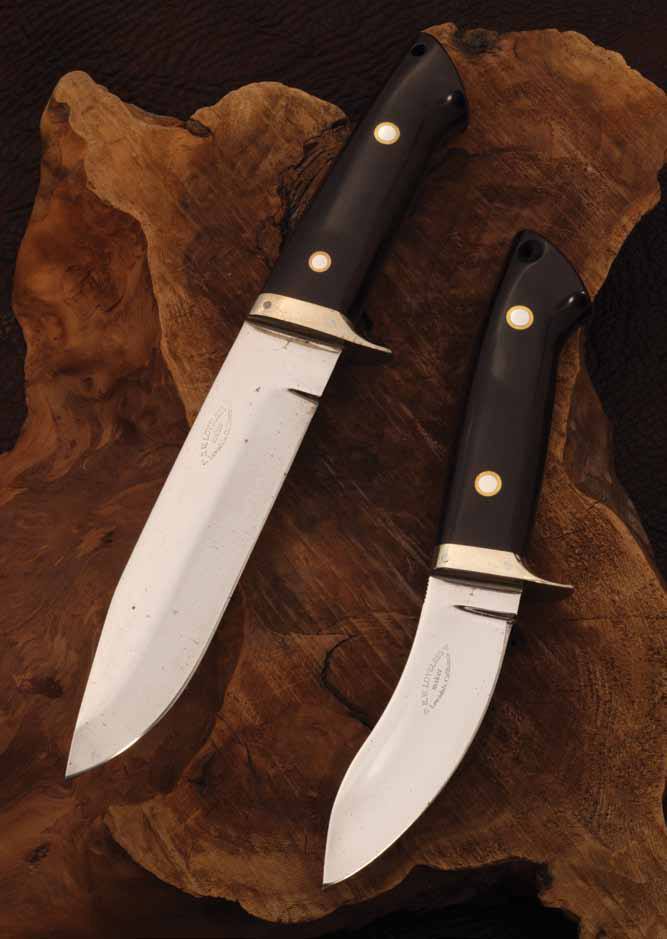
The Bob Loveless Lawndale-made crooked skinner at right in the Hiro Soga photo features a 4.5-inch skinner blade, a nickel-silver guard and ebony handle. The camp knife is wrought from 1/4-inch stainless steel stock with a 6.5-inch clip-point blade, full tang and ebony handle. The knives are in the John Denton collection.
7) Big Bear Classic
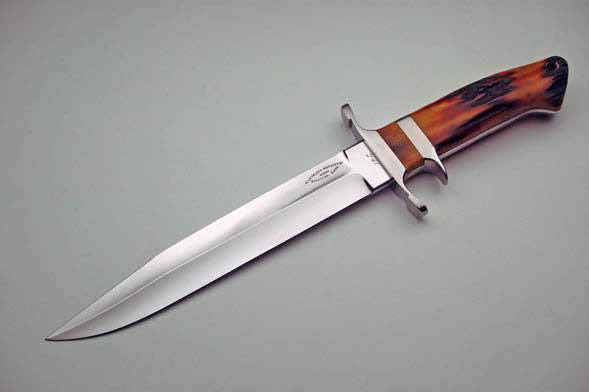
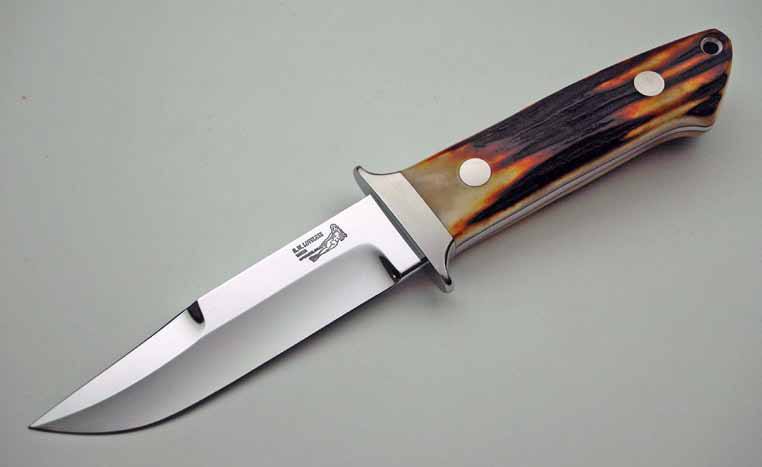
This particular Loveless Big Bear Classic fighter boasts an amber-stag handle, which makes it one of the few made, and no Loveless bolts. Its approximate value? $35,000. That’s a lot of bear bones. Image and information via Dave Ellis.
8) New York Special
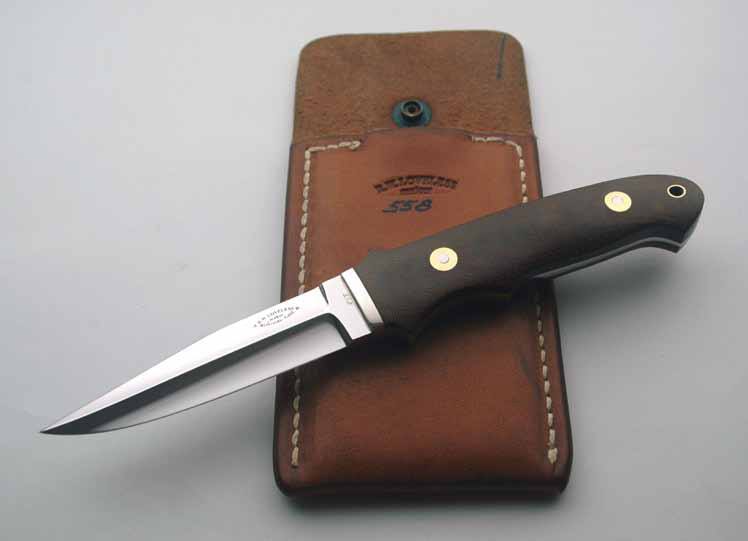
This is perhaps the rarest and hardest-to-find of Loveless pieces—the original New York Special with a snap in the sheath. According to Dave Ellis of Exquisite Knives, originally told, there were seven. This is the long-lost 8th! Image via Ellis.
9) The Pearl Gent
Loveless preferred Micarta handles. This “gent’s” model is one of the very few knives made with pearl. Image via Dave Ellis.
10) The Iconic Drop-Point Hunter
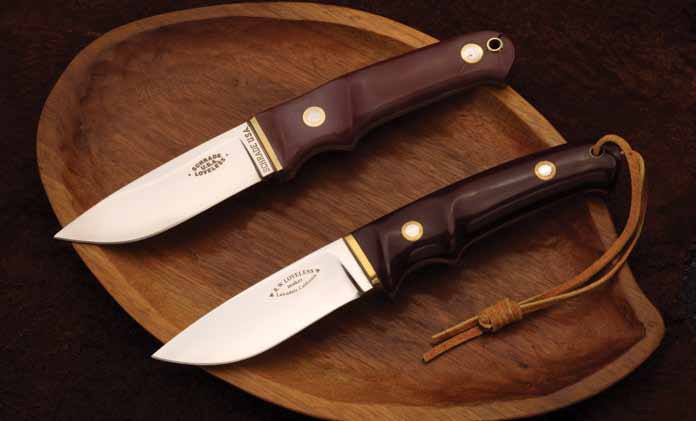
A prime example of a drop-point hunter, made in 1973 when Steve Johnson worked with Bob Loveless, it features hidden-tang construction, a single guard and a maroon-Micarta handle. How sweet it is! From the John Denton collection, this piece was photographed by Hiro Soga.
11) Loveless-Parke: Part Drop Point/Part Skinner
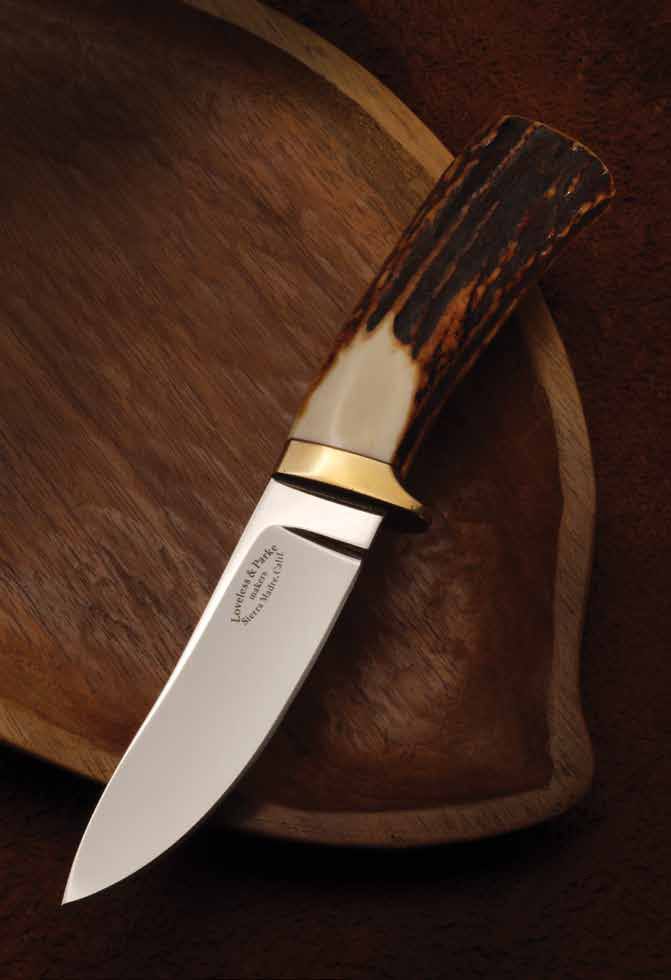
Only 36 knives bearing the Loveless-Parke logo were ever produced (Parke was an investor in Loveless’s knifemaking business for a short period of time.) This knife, made in 1967, is an example of that effort. The image is courtesy of John Denton and the John Denton collection.
12) The Delaware Knife
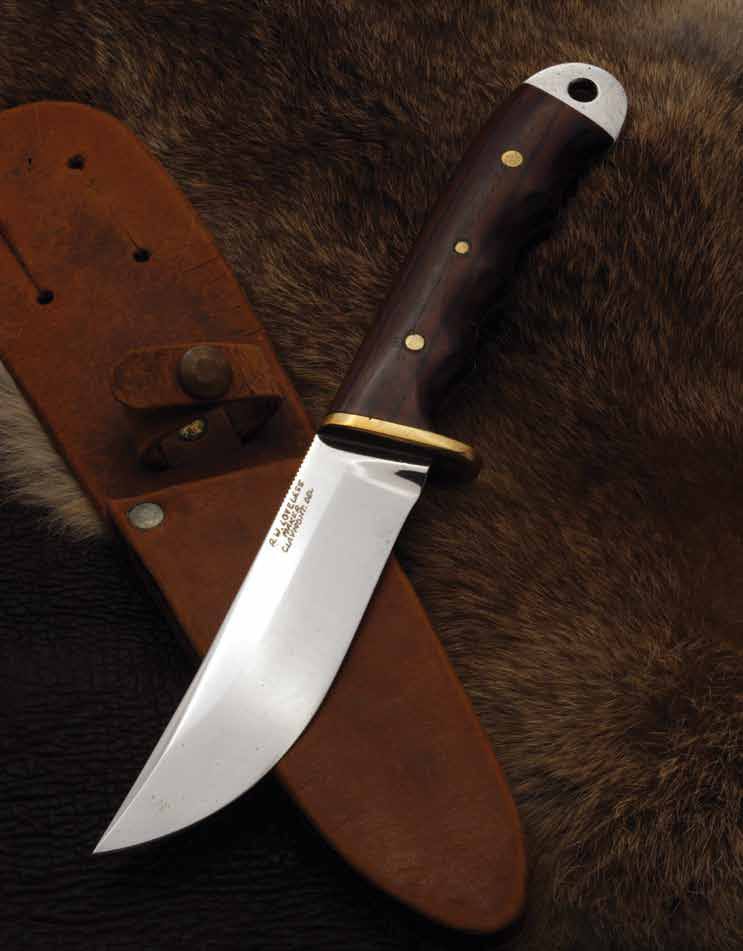
This is an early (1950s) hunter made by R.W. “Bob” Loveless when he lived in Claymont, Delaware. Interestingly, there are thumb notches on the back of the blade, just ahead of the guard. This is an extremely uncommon feature on a Loveless knife. Photo via Hiro Soga.
13) The Delaware Maid
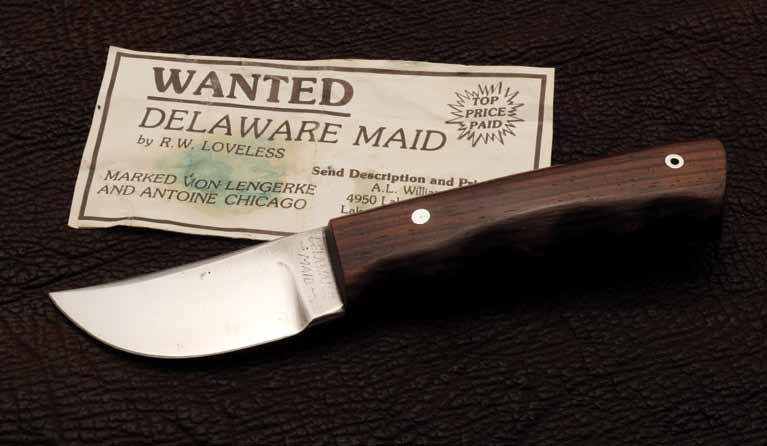
An ultra-rare (only three of seven survive) Loveless “Delaware Maid” hunter with the VL&A (Von Lengerke and Antoine) logo, this knife has a trailing-point blade and a slender double-pinned hardwood handle. The photo is by Hiro Soga.
14) $13,000 Chute Knife
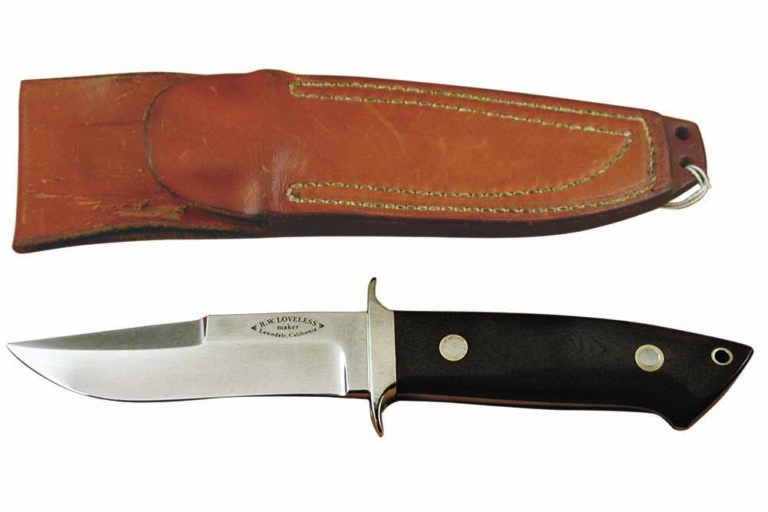
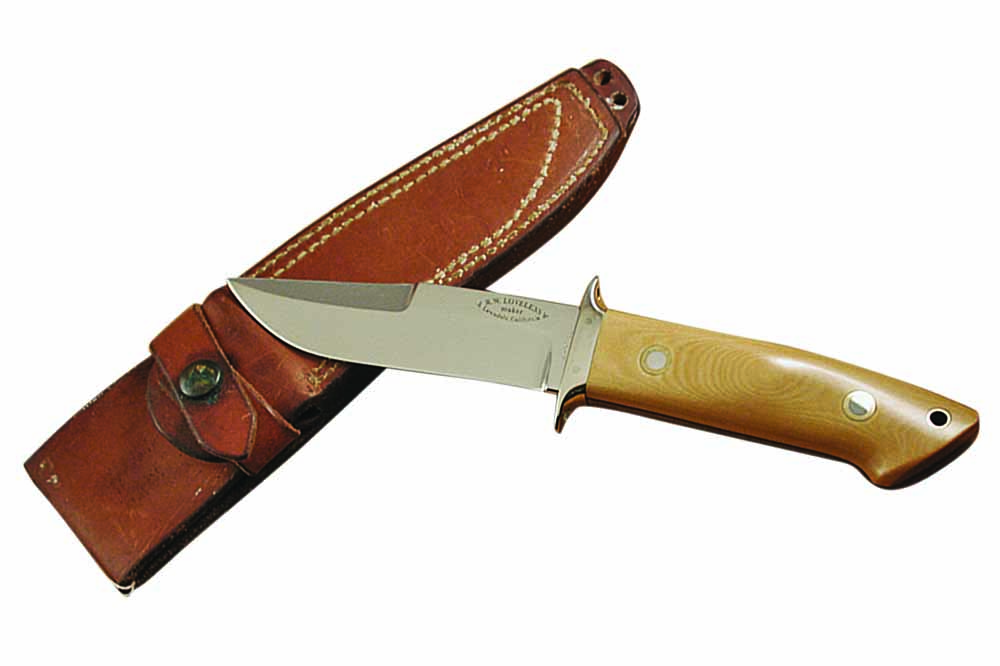
Originally designed for a Spec Ops parachutist working in jungle climates, the “chute” knife was fashioned to cut the lines of a parachute should the operative become entangled in them, a tree or other obstruction. This amber-stag handle model is valued at $13,000. Photo via Dave Ellis.
15) The Iconic Schrade Semi-Skinner
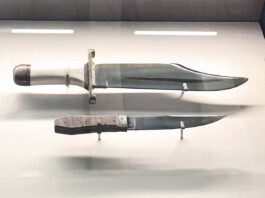
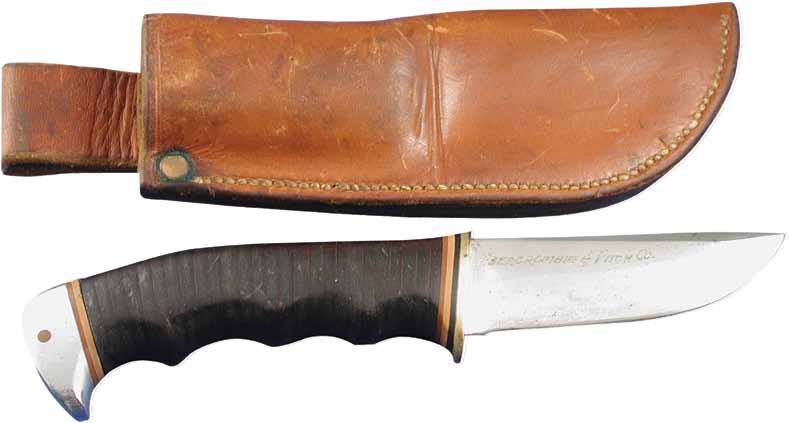
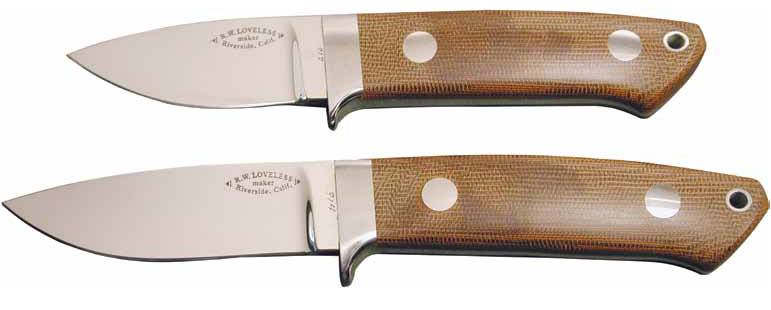
The knife Bob Loveless built for Schrade features a stainless steel blade and synthetic molded handle with no guard. The top piece is the Schrade knife, and the bottom is the Loveless semi-skinner prototype from which the Schrade knife was developed. Note the finger-grooved handle, a feature seldom seen on a Loveless knife. The photo is by Hiro Soga.
With More Than A Century Of History, The Trench Knife Soldiers On As A Historical Collectible And A Modern Outdoor Knife.
The trench knife may be the ultimate weapon for close-quarters combat. With a sharp blade designed for stabbing, and a finger guard that doubles as a knuckle duster, the blade is excellent for messy, claustrophobic situations, which you would expect as it was named for the intimate and brutal trench warfare of World War I.
By the time World War II began, trench warfare was nowhere near as common as it had been previously. In turn, the trench knife evolved.
The United States issued the Mark I in 1942 and 1943 to certain special military groups like the Army Rangers and Marine Raiders. The Mark I was a newer version of WWI trench knives, including a finger guard, a stiletto blade, and a skull crusher cap built into the pommel.
However, over the course of WWII, the trench knife gave way to the combat knife. Most notable of these, the US M3 fighting knife, which was adopted in 1943. The M3 became the framework upon which more contemporary bayonets and fighting knives like the M4 and M7 were built.
Can I Own A Trench Knife Today?
That’s a complicated question to answer.
The trench knife is classified as a dangerous weapon in many states and countries for a variety of reasons. Some places prohibit them because they have double-sided blades while others focus on the knuckle dusters or the length of the blade as reasons to ban them.
Owning or carrying a trench knife is banned in numerous countries including the United Kingdom, Australia, Ireland, Canada, China, and Singapore, among others.
In America, the knife is outlawed in some form in 23 states, and even among the states where it’s legal to own and/or carry, 18 of those states either only allow you to keep the knife in your home or require a permit to carry it on your person.
The only states with no permit rules for owning a trench knife are Texas, South Dakota, Indiana, South Carolina, Idaho, Hawai’i, Georgia, Arizona, and Alabama.
Modern Trench Knives
There aren’t many companies left making trench knives similar to those blades from a century ago. However, the two below are modern takes on the combat classic.
M48 Liberator Trench Knife
This is the souped-up version of the original trench knife. Everything about the Liberator is big and bold and in your face.
It starts with the 7.5-inch 2Cr13 cast stainless blade that is ground sharp on both sides. The blade has a satin finish and black oxide coating to add to its intimidating aura. The handle scales are made from a light, rugged fiberglass-reinforced nylon that provides a strong grip without adding too much weight.
And then there’s the knuckle duster tang. It both acts as a knuckle guard and an intense defense weapon. The added spikes on the handle allow you to use more force in case you are defending yourself. The knife fits into an injection-molded Vortec and nylon belt sheath that snaps shut and easily fits on your person.
It’s bad. It’s unapologetic. It’s the ultimate modern version of the trench knife.
MSRP: $79.99
Cold Steel Chaos Double Edge
A more muted version of the trench knife, the Chaos Double Edge from Cold Steel gives a modern, tactical spin on the old classic.
The blade itself is made from SK-5 high-carbon steel and is 7.5 inches long. The full-tang construction allows for a well-weighted knife that can be used to defend or to slice through dense brush. Both sides are ground sharp and meet at a spear point so the knife can puncture as you would expect.
The handle is made from 6061 aluminum and features a pair of D ring guards, which are a newer version of the old-school knuckle duster guards that is used for the same purpose. The pommel of the knife is tapered to allow for more force when using the cap to strike.
The included sheath is made from Secure-Ex and is both Molle-Lok and Tek-Lok compatible so transporting the Double Edge will be a breeze.
A fine example of a tool and weapon of war, the chute knife more than rose to fulfill the roles for which it was intended.
Harry Archer was a somewhat shadowy figure. At the height of the Vietnam War, he was engaged in nasty business—fighting a stealthy enemy in a steaming jungle, sometimes up close and all too personal.
Those who knew Archer acknowledged that some of his exploits were “larger than life.” They considered him an early non-movie version of author David Morrell’s fictional character of John Rambo*. Still, Archer was real, flesh and blood. And it seems altogether fitting that responding to his need for knives that “deliver” in a tight spot—survival, seconds along the fine line between life and death—he would come to know and rely on another legend.
According to John Denton, perhaps the world’s foremost authority on the knives of BLADE Magazine Cutlery Hall-Of-Fame® member Bob Loveless, Loveless and the man he came to describe as the “head of CIA operations in Vietnam” were introduced to one another by knife writer/Cutlery Hall-Of-Famer Ken Warner. It followed that Loveless made several knives for Archer’s use in the field, among them a fine sub-hilt and stag-handle example of his well-known Big Bear, along with several other Big Bears. Loveless’s close friend and fellow maker Steve Johnson was working in Bob’s shop at the time and participated in crafting these. A fighter in a tulip wood handle is another cold beauty.
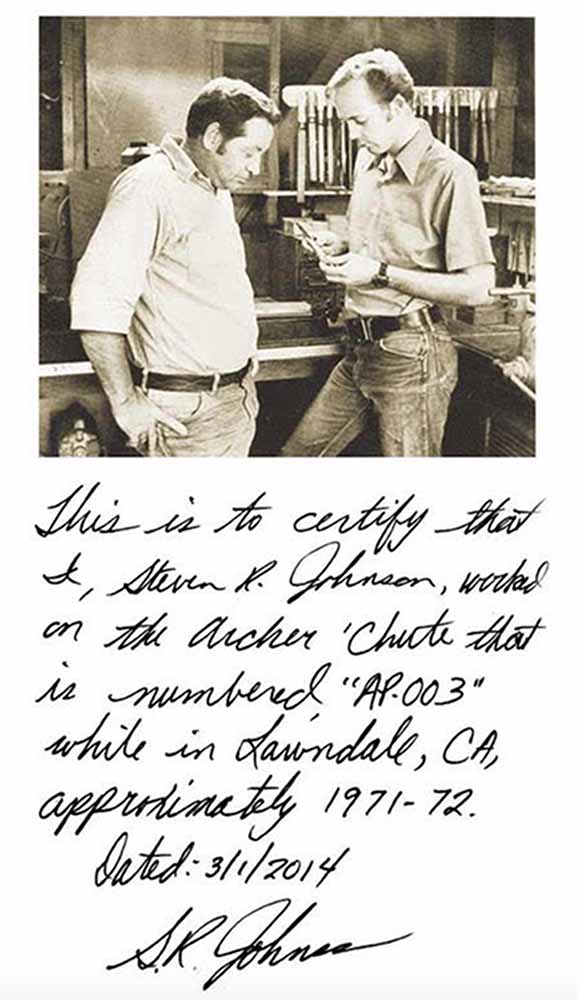
Johnson worked with Loveless from June 1971-October 1974 in the Lawndale and Riverside, California, shops. Steve had a hand in the production of the prototype chute knife in the earliest days, and 23 years later signed a photograph for John Denton attesting to his work on that piece of history. Steve’s inscription reads in part: “This is to certify that I, Steven R. Johnson, worked on the Archer ’chute that is numbered ‘AP-003’ while in Lawndale, CA, approximately 1971-72.” (images courtesy of John Denton)
Then there is the well-known Harry Archer chute knife, a versatile fixed blade with good looks and the ability to travel light but cut paracord for a quick exit from a tangled parachute shroud, and with a stout spine for prying loose from the wreckage of a helicopter. The chute knife was made for the jungle. It was made for Harry Archer.
“It seems that Loveless had been left out of a book by Warner, and Loveless sent Ken some knives to review,” Denton recalled. “It just so happened that Archer was there with Warner. Harry saw the knives and bought them all.”
Johnson worked with Loveless from June 1971 to October 1974 in both the Lawndale and Riverside, California, shops. He had a hand in the production of the prototype chute knife in the earliest days and 23 years later signed a photograph for Denton attesting to his work on that piece of history. Steve’s inscription reads in part: “This is to certify that I, Steven R. Johnson, worked on the Archer ’chute that is numbered ‘AP-003’ while in Lawndale, CA, approximately 1971-72.”
Johnson explains that the chute knife is a fairly small, compact fighter and survival knife, short, light, double-edged and strong, but not made in stock thicker than 3/16 inch. Holes for thongs are placed in the rear of the handle and the guard for lashing the knife to a pole or limb to make an improvised spear. It rides into action atop a chest pack or secondary parachute for quick, easy access. Claims that Warner had a hand in the design are unconfirmed, but “the chute” simply looks the part of the warrior’s dependable asset.
“You’re able to cut both ways with the knife via the swipe of an arm or hand,” Johnson related. “Specifically, it’s for cutting parachute cord should it be tangled or caught in a tree. It’s a knife that a pilot, paratrooper or soldier should carry, and it would not be a burden but useful and available in every situation.”
HARRY ARCHER LORE
Stories of Archer’s combat prowess have been told and retold, but to raise awareness of the immediacy of a close-in fight, nothing is better than the harrowing tale that Denton remembers Loveless repeating. John points to a photo of a vintage Big Bear, identifies it as a knife that Archer took into combat, and says, “Harry and his men got into a hand-to-hand fight, and the tip of the blade was broken off inside the enemy. Harry took the knife back to Bob to fix, and Loveless said, ‘Where’s the tip?’ Harry replied, ‘It’s still in the rib cage of the Viet Cong soldier.’ So, Loveless fixed the blade.’”
Made in Bob Loveless’s Lawndale, California, shop about 1973-74, this chute knife in ivory Micarta® is stamped BR-003. It was made for the Brass Rail, a famous gun shop in Hollywood, California, where all the celebrity types hung out to see guns and knives. Note the holes in the guard for lashing the knife to a pole to make a spear. (images courtesy of John Denton)
Like the Big Bear and other Loveless creations, the chute knife has its place in the lore of Harry Archer. After he collaborated to produce the prototype, Johnson continued to work with Loveless on more of the chute knives. He remembers meeting Archer in the California shops.
“Loveless really admired Archer and his adventures in the Vietnam War era, working with USAID**, the CIA and different assignments in various parts of the world,” Steve commented. “[Harry and I] discussed life in camp in Vietnam, interactions with Vietnamese soldiers and personnel with whom he was serving. That was quite interesting.”
Steve calls the chute “one great knife” and remembers conversations in Lawndale when the veteran operative praised it as light and small enough to carry so that it could always come along on a mission. Johnson also made a chute knife for Archer and continues to produce his own model today.
“We worked together on Archer’s order for a ‘Johnson’ version of a chute knife on a bench in the rear of Bob Loveless’s shop, in his garage in the back of his house in Lawndale,” Steve smiled. “Archer asked me to make my version, which we—mostly he—designed in the early 1970s. He did a drawing for me. The 154CM blade was about 4.5 inches long, the handle slim and a bit longer than normal, and it had a large thong tube, three handle screws, a stag handle, and checkering on the top and bottom of the tang just behind the guard.”
Bob Loveless (left) and John Denton (right)
For Johnson, working with Archer was a pleasure and a defining moment in his illustrious knifemaking career, which, after recovery from a serious accident, took him from Loveless’s shop to his own space in Manti, Utah, more than 40 years ago. “Harry Archer was a great guy who appreciated my work, as well as Bob’s,” Steve added, “and I made him a few knives after California. He was very easy to talk to, respected others, and he really was a man of intrigue and adventure. And Bob Loveless treated me like a son.
“I’m making a chute knife for Atlanta [Steve was interviewed prior to BLADE Show 2021] as we speak, with the blade polished so far, instead of the top grind being just the length of the clip,” Johnson concluded. “I use the pattern that Loveless gave me when I left his shop in Riverside in 1974 or 1975. This particular knife is going to have a stag handle and stainless steel fittings. I’ll make more when asked, and I still have a few on order in my books.”
Long-time maker and designer Bob Dozier was a friend of Loveless and went on to design a chute knife for Cutlery Hall-Of-Famer A.G. Russell. Though his only acquaintance with Harry Archer is through the recollections of A.G., who knew him, Bob says his version of the chute knife remains in demand for one simple reason: “It sells.”
Dozier turns out his chute knife with a 4.75-inch D2 tool steel blade and overall length of 9.75 inches. The handle is green canvas Micarta® “because Goldie [Russell] won’t let me put anything else on them. I’ve got some blades hanging right now, getting ready.”
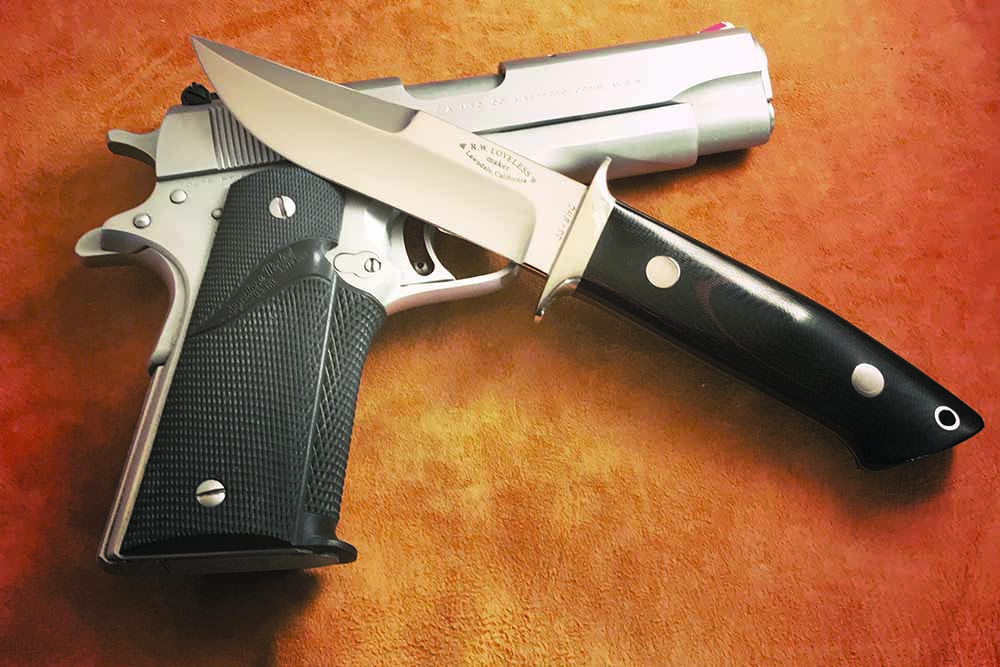
The “RR” on the guard of this Loveless chute indicates it was for the Ram Rod gun store in New Castle, Indiana. Early on Ram Rod sold knives by Loveless, Bill Moran, Ron Lake, W.W. Cronk and others. It appears here with a Smith & Wesson Model 41 modified by Loveless.
Dozier is familiar with the Loveless chute knife configuration but never had the Loveless pattern. He looked at the earlier chute knife profile and made some tweaks. “My handles are like the Loveless, but I don’t cut the butt off as square as he did. I leave more of a point on it than he did. Mine is still mostly like Bob’s, and he was one of the first to make a really good slab-handled knife. That’s one reason why most of us have copied him.” Dozier’s chute knife, designed and built for A.G. Russell Knives, has a manufacturer’s suggested retail price of $895.
SAGA of The CHUTE
The saga of the chute knife certainly has a human side. While Denton estimates that early Lawndale chute knives might fetch as much as $14,000 if found for sale today, and chute knives made in Riverside command up to $12,000 each, they are desirable on the collector market. Nonetheless, the greatest value of the chute knife lies in its lifesaving and protective capability in the hands of a dedicated professional such as Harry Archer.
Through those years of association, Loveless and Archer became friends, sharing a common bond of respect and admiration for the best in fighting and utilitarian knives.
“Loveless said that Harry would come by his shop after periods of being in the jungle for months at a time,” Denton remembered. “He used Bob’s place to unwind and try to become civilized again before heading home to Virginia. But Loveless also said, ‘Harry was like a wild animal when he came to the shop, trying to keep his head straight before he saw his family.’”
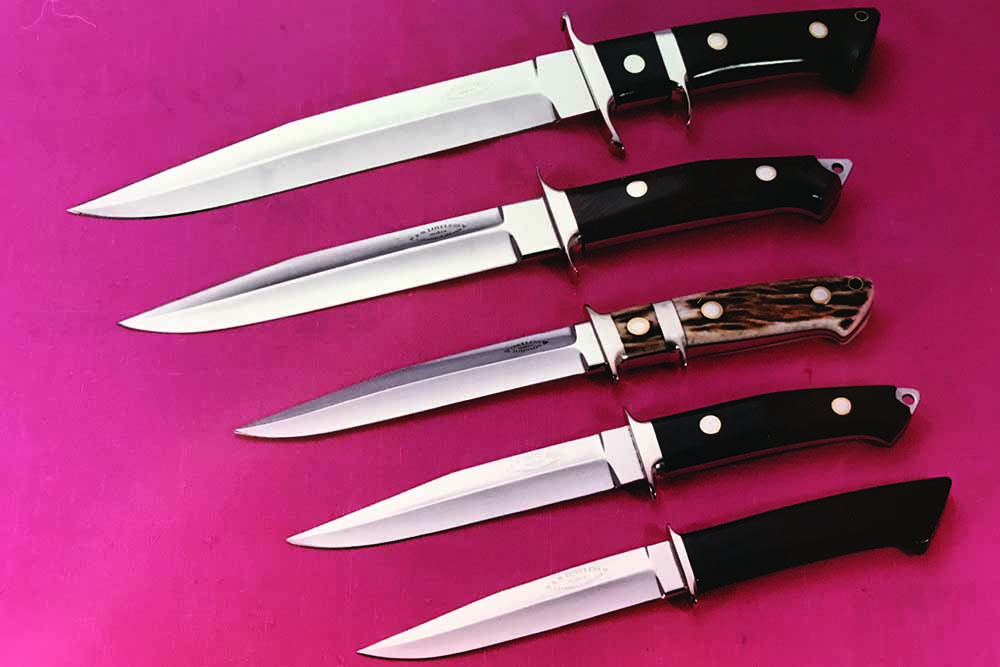
Whenever Harry Archer ordered several Big Bear fighters from Bob Loveless, Loveless said Archer told him to “send the bill to the Pentagon.” From top: the Big Bear Harry broke the tip off inside a Viet Cong soldier during the Vietnam War; tulipwood fighter with skull cracker; Loveless/Johnson sub-hilt with the initials HJA for Harry J. Archer; boot knife with skull cracker; and one Loveless called the Pig Sticker. (image courtesy of John Denton)
The chute knife is indeed a fine example of a tool and weapon of war rising to fulfill the roles for which it was intended. It remains a popular pattern because of its looks, quality and versatility. And for one other reason in particular: It helped men like Harry Archer survive the most desperate of situations and make it home.
*In actuality, Morrell based the Rambo character on Medal-Of-Honor recipient Audie Murphy.
**USAID is the acronym for United States Agency for International Development, with the inference here being that in this instance it functioned as a cover for the CIA.