The history of knives and other edged instruments is tied to the history of people in general. As humankind’s oldest tool, unraveling knife history can lead to even more surprising and enriching information to better understand the world.
Saturday, May 19, 2018, is Armed Forces Day. It’s a day to “participate in exercises expressive of our recognition of the skill, gallantry, and uncompromising devotion to duty characteristic of the Armed Forces in the carrying out of their missions,” as President Harry Truman put it in 1950.
BLADE is doing its part by taking a look back at the knives that accompanied those in uniform during World War II. When BLADE writes about lives depending on knives, it’s not only referring to the user. If a soldier depends on a knife, then citizens also depend on that knife.
Editor’s note: The following is by Richard D. White.
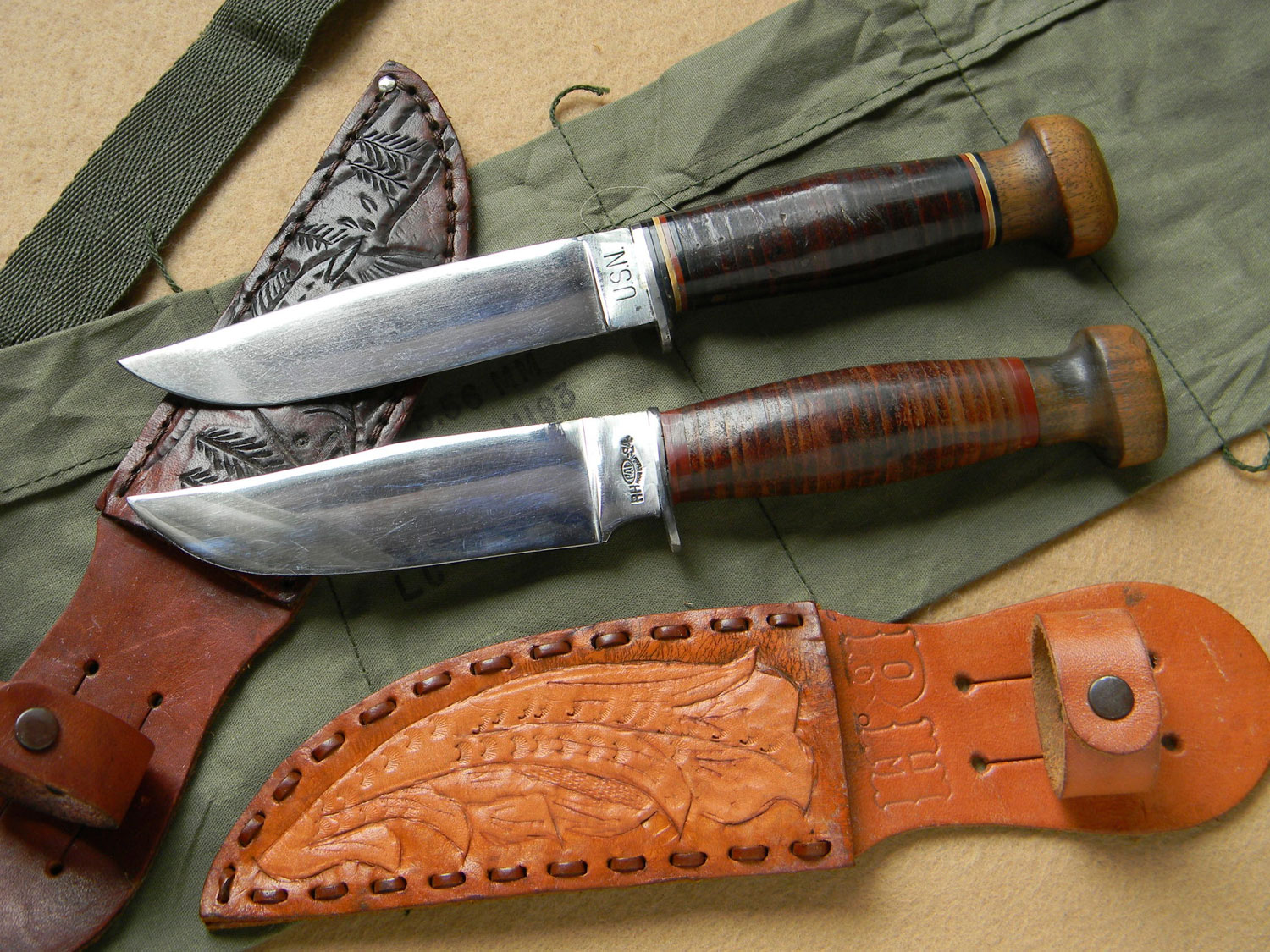
MARK 1
Pal (bottom) and Robeson made these Mark 1’s with wood pommels. Wood was used because of a shortage of aluminum during World War II. Both knives feature handmade sheaths, probably made on ships by servicemen. (All images by Richard D. White)
Featuring a 5-to-5.25-inch flat-ground blade, the Mark 1 utility knife was adopted by the Navy as a survival-type knife with sheath. Every sailor who worked “topside” was issued a fixed blade for cutting ropes/line.
The Mark I probably the World War II military knife encountered most in the marketplace. There are a significant number of different varieties—some historians say as many as 42. Camillus, Colonial, Geneva Forge, Pal, Robeson, KA-BAR, Boker and Kinfolks made them.
Blade finishes included polished, blued and Parkerized. Pommels were the traditional bird’s-beak design or flat of steel, plastic or wood. Handles generally were stacked leather—some with fiber spacers, some without. Mark 1’s by Colonial had injected plastic handles.
MARK 2
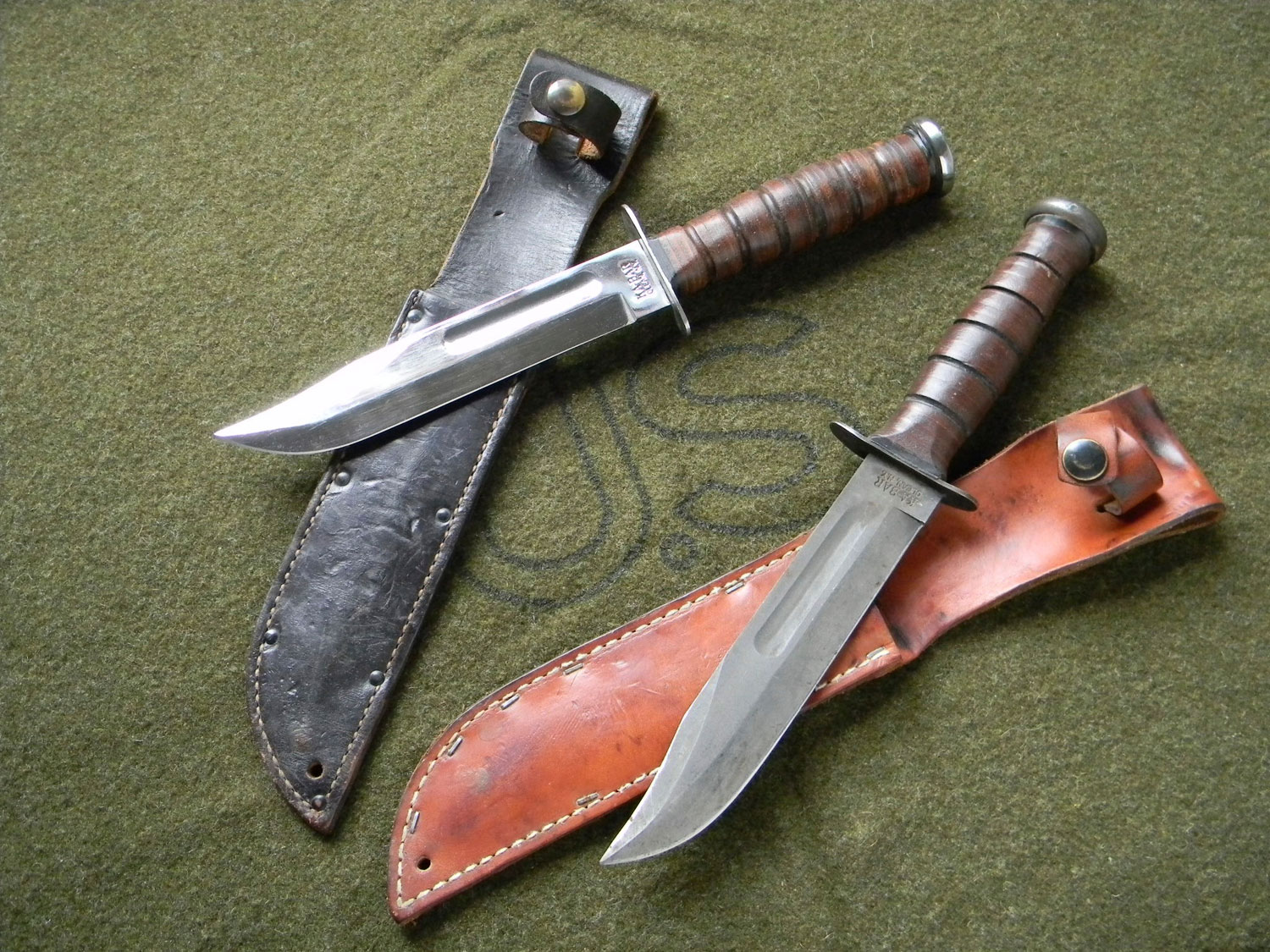
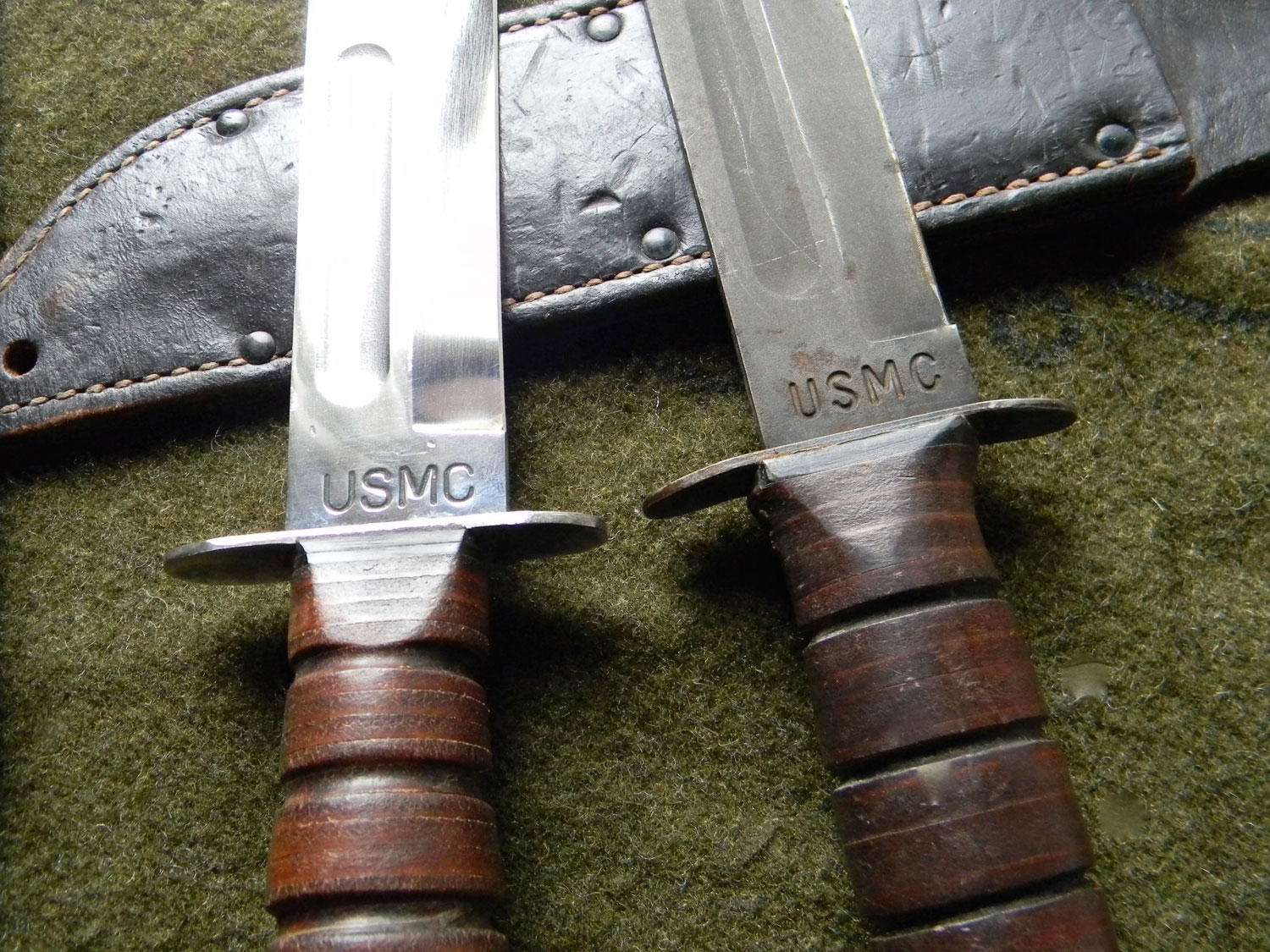
Two excellent Mark 2’s stamped “KA-BAR” are synonymous with World War II U.S. military combat knives. Union Cutlery Co. made approximately 1 million USMC-stamped KA-BAR knives for distribution in the South Pacific.
The Mark 2 was made available to combat soldiers in 1943. It was 12 inches long with a 7-inch blade. The handle was stacked leather, generally grooved. It was held in place with a steel washer pinned to the tang. Examples are plentiful and often were photographed hanging from the belts of soldiers who fought in the South Pacific Islands.
The backs of the KA-BAR Mark 2 tangs show the very deep, distinctive “USMC” stamping—a stated preference of the author’s—on the polished (left) and coated blades.
KA-BAR, Robeson, Pal, Utica, Ontario and Camillus were the major manufacturers of the Mark 2. Variations included different spacer colors, marks/stamps, pommel thicknesses and materials, piening vs. welding of the pommels, blue vs. polished blades, and smooth vs. grooved handles.
M3
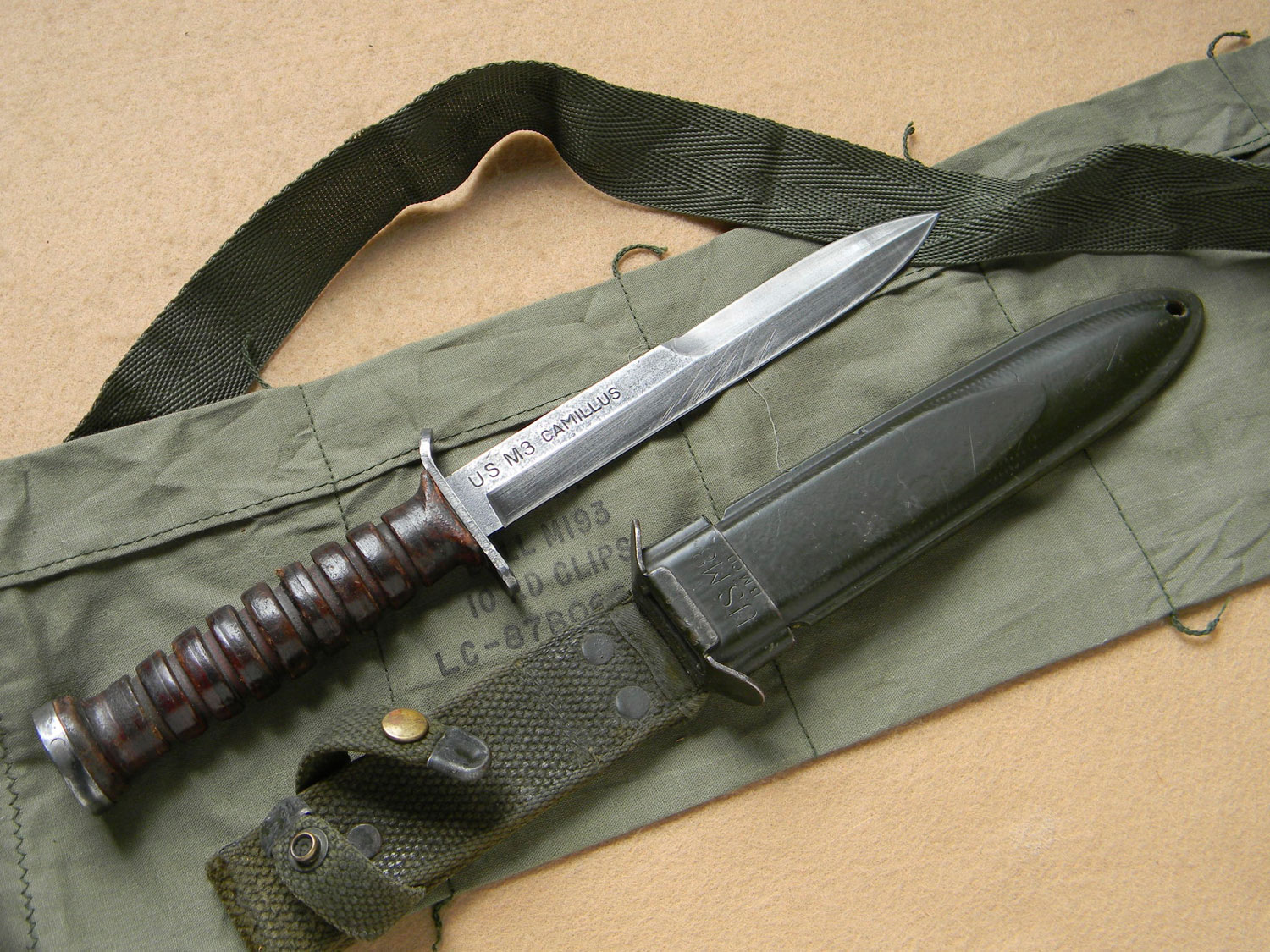
The M3—this one by Camillus—is one of the most desirable World War II combat knives because of its double-edge blade. Though over 2.5 million supposedly were produced during World War II, prices remain quite high for them. Boker, Kinfolks, Robeson, Utica, Imperial, Case, Aerial and Pal also made M3s.
The M3 was designed to meet a shortage of combat knives, especially in early 1942. According to Frank Trzaska, a military knife historian, the decision to design the M3 rather than continuing to produce the Mark 2 was based on a U.S. steel shortage.
The M3 was selected because it was easier to manufacture and had a thinner blade, which was 6.75 inches and sharpened the full length, excluding the stamped tang area. The top edge was sharpened about a third of the blade length. The guard was thick steel angled on top to form a thumb rest.
The handle was stacked leather with a series of cut grooves. Originally there were supposed to be eight grooves, but some companies generally used to six to seven. The grooves provided better purchase. The pommel was flat steel and pinned to the tang.
The M3 had many variations, including added spacers at the guard and pommel end, or piening the tang over to hold the pommel in place as opposed to pinning the pommel onto the tang.
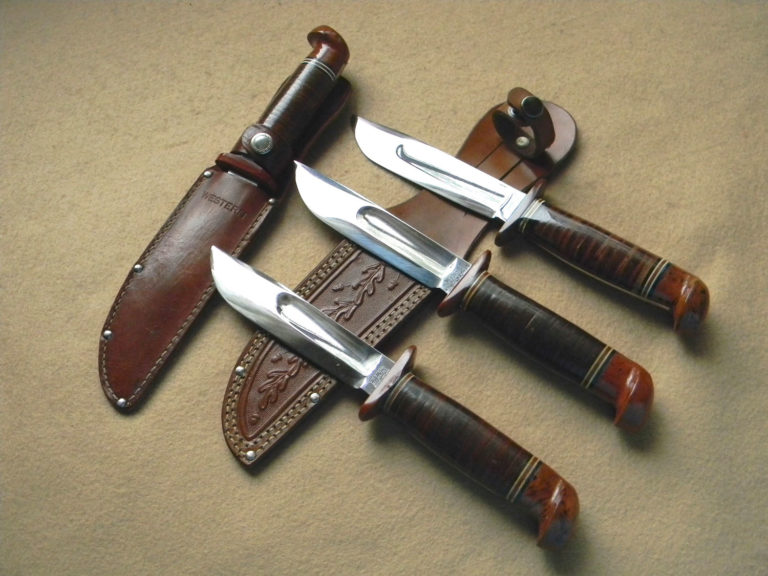
GO WESTERN
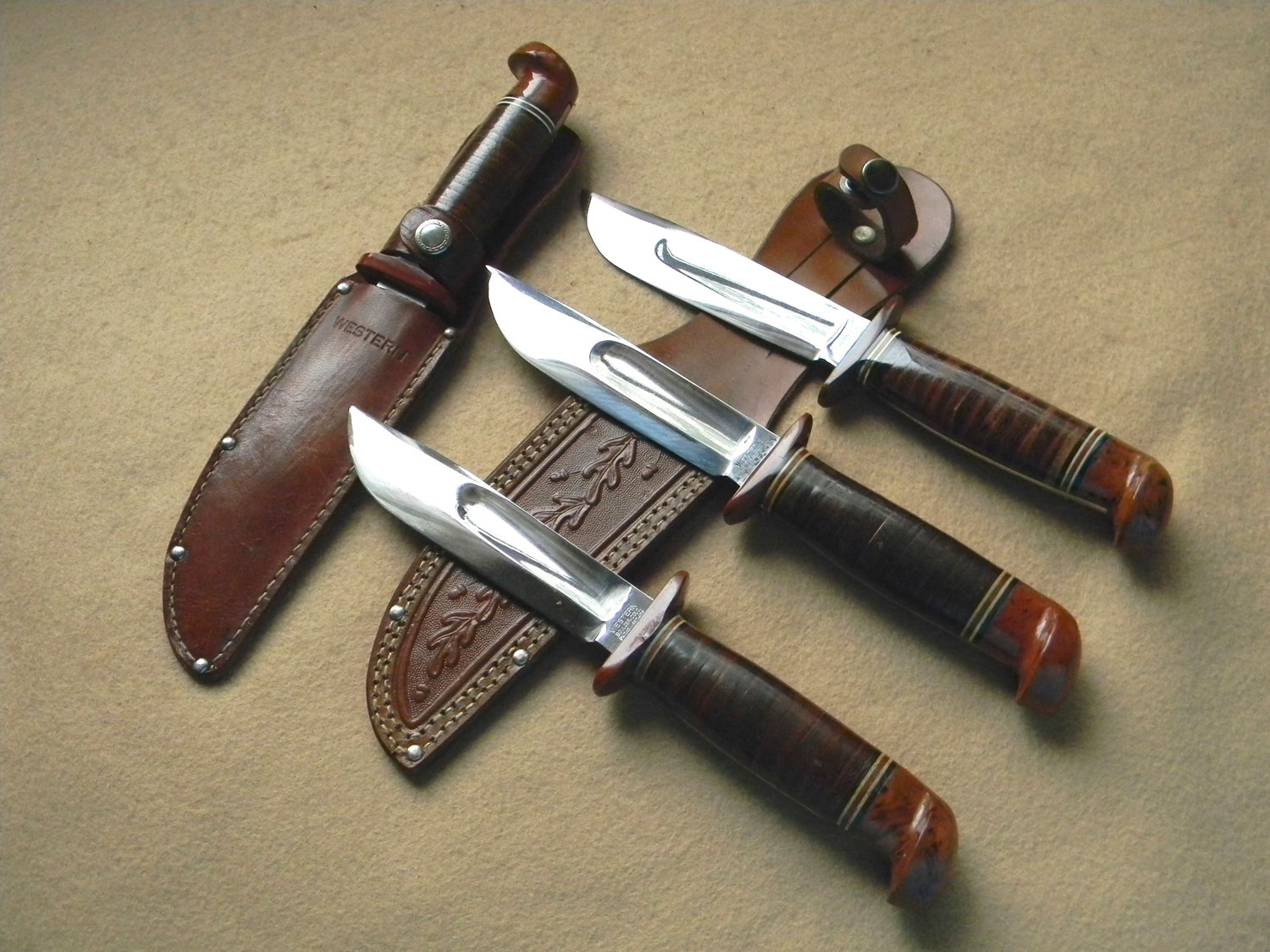
Because of the shortage of brass and aluminum during World War II, Western used plastic for the guards and pommels of its “Baby Shark” models.
Any review of World War II military fixed blades must include several examples of Western knives. While some are very rare, such as the L-76, L-77, “Bushman” and USMC parachutist knives, several examples are more ubiquitous.
One is the “Shark.” Western made two: one with a 6-inch blade, the G46-6, and one with a 5-inch blade, the G46-5. Both had huge blood grooves, stacked leather handles, and several different guards and pommels. Both came with flat steel, aluminum or mottled-brown-plastic pommels.
Guards were double steel, the very rare brass or plastic like the pommels. Many times the guards and pommels were mixed and matched. The smaller Sharks were issued to Navy and Army Air Corps pilots as a bailout knife. Blade finishes were blued and polished.
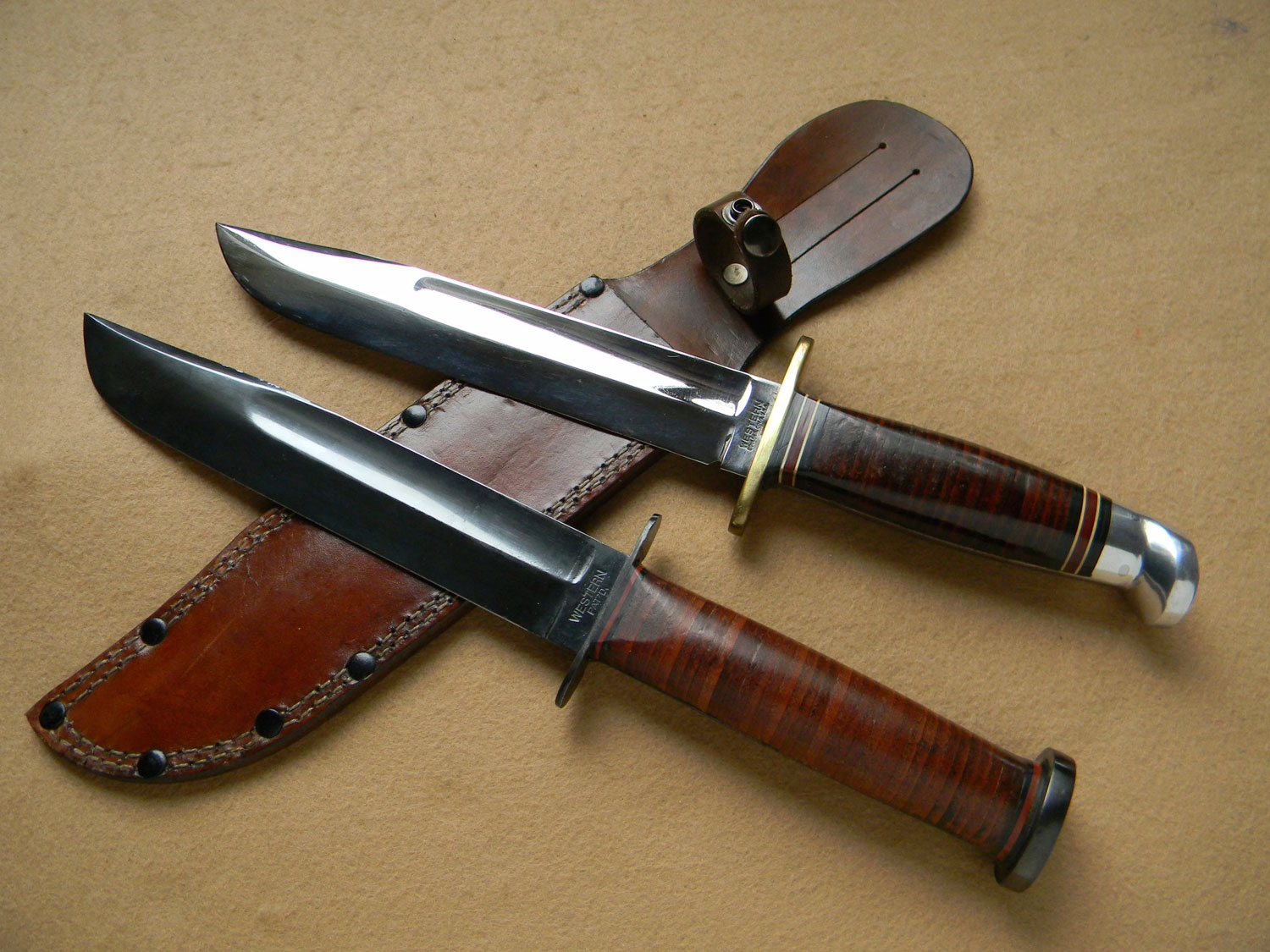
Of these two Western 46-8 combat knives, the more traditional World War II vintage is the bottom one, with flat steel pommel and blued blade. The top model is perhaps post-World War II because it features a brass guard. Because of the demand for brass for artillery shells and ammunition, few World War II military knives feature the material for guards.
Another Western World War II fixed blade was the 46-8, a huge, impressive combat knife with an 8-inch blade. It was officially known as the G46. The blade had a massive blood groove and upswept false edge on the spine. The knife featured stacked leather handles, double-sided steel guards, and flat steel pommels. Most had blued blades, though some were polished.
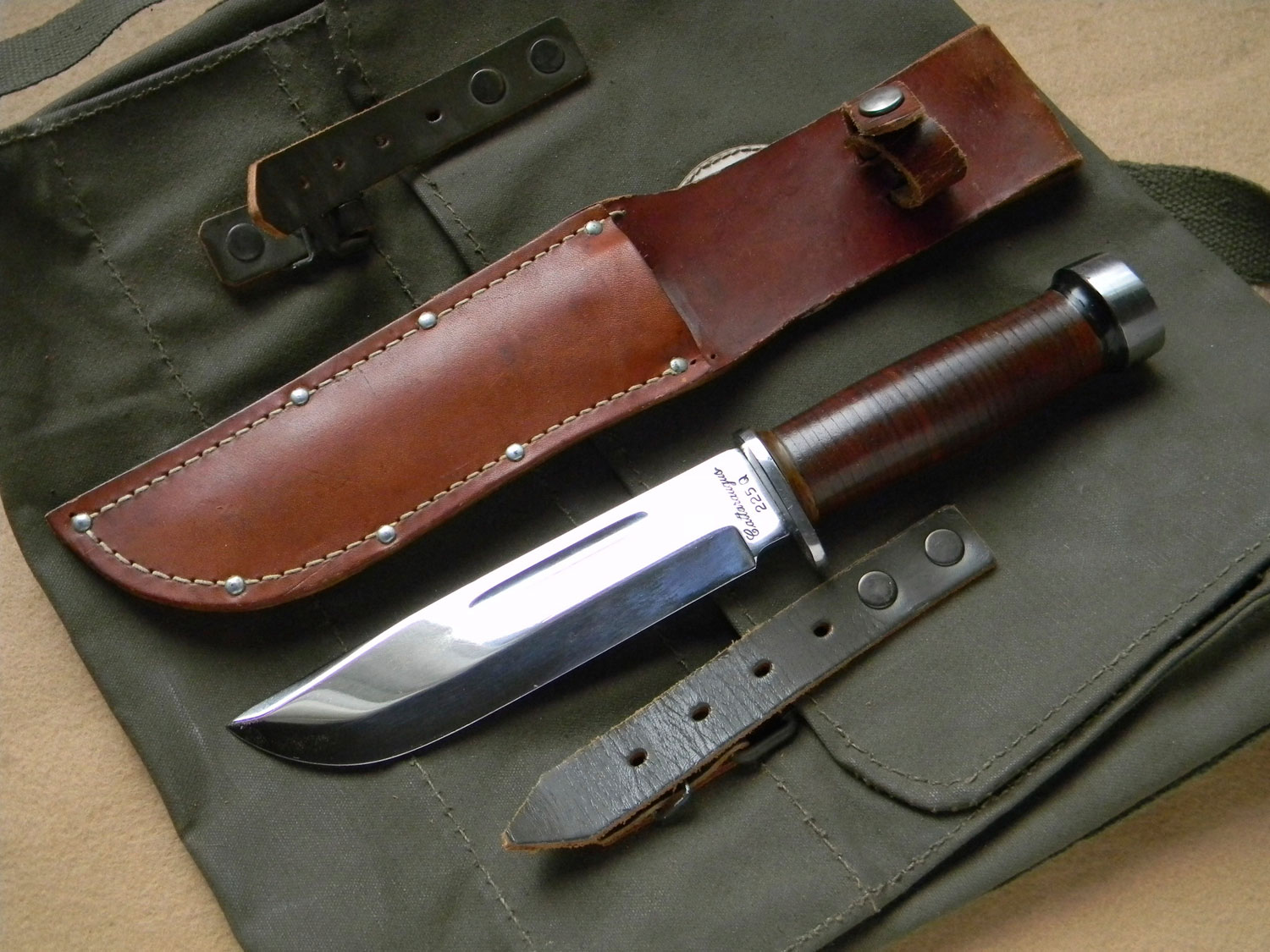
225-Q
The Cattaraugus 225Q was favored by GIs because of its massive, thick blade and the three-part steel pommel. The sheath is in mint condition and was bought with the knife from a 95-year-old veteran of World War II. Most 225Q’s have a rough groove cut into the stacked leather handle for enhanced purchase.
The Cattaraugus 225-Q had one of the strongest blades of any World War II combat knife. Many observers say it was for quartermasters, with the “Q” standing for quartermaster. As the thinking goes, the rather stout blade was designed to open various wooden crates—an important part of the quartermaster’s job—and the triple steel pommel was used to nail the crates closed.
Still others say the knife was designed for and used by U.S. special operatives during World War II. As with any military knife, be careful not to fall victim to the opinions of so-called experts, especially when they attribute particular knives to units like the Devils’ Brigade, Commandos, OSS, Underwater Demolition Team, etc.
Some military knives—not just the 225Q—were stamped very lightly, while others were deeply stamped.
Born as a side hustle, the legendary throwing knife company continues to hit the mark.
Small businesses that have operated continuously for 75 years are a testament to the quality of their products and the dedication of their founders and owners. Such businesses have stood the test of time and have been able to adapt to changing market conditions and consumer preferences. Knifemaking is no different.
In 1949, Harry K. McEvoy, who would soon be considered the father of modern-day knife throwing and one day be inducted into the BLADE Magazine Cutlery Hall of Fame®, was a long-time resident of Grand Rapids, Michigan. He worked for the Meyercord Co. as a traveling district salesman selling decals to wallpaper and decorating stores. In his spare time, Harry spent hours in his shop designing and crafting knives. His passion for knifemaking was fueled by his ongoing search for the perfect throwing knife.
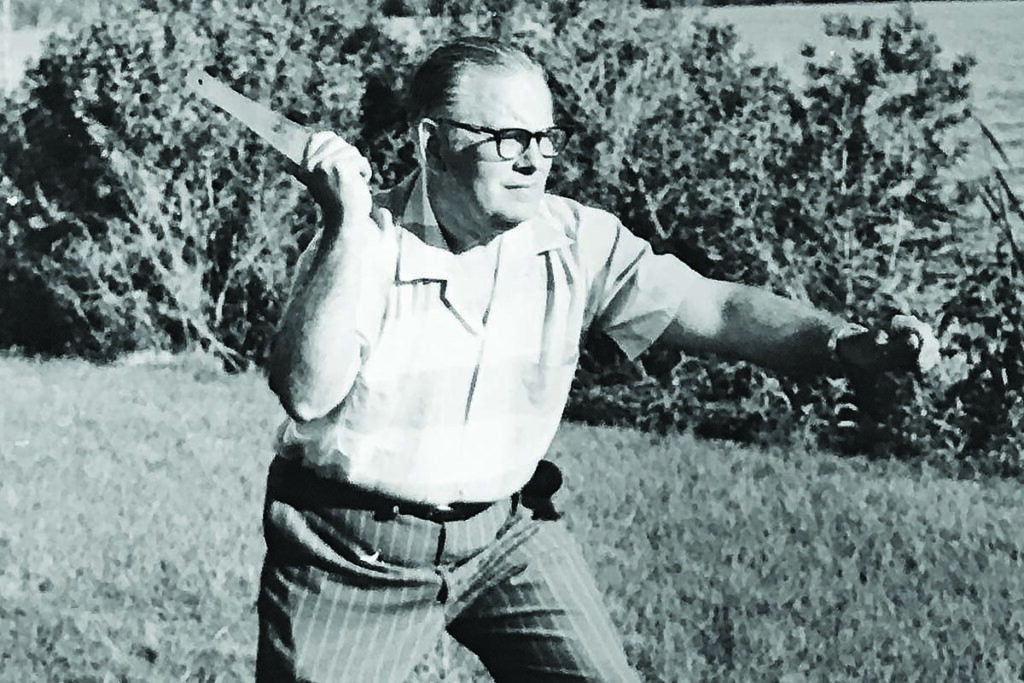
BLADE Magazine Cutlery Hall-of-Fame® member Harry McEvoy shows the form and throws one of the Tru Balance knives that helped revolutionize knife throwing.
Knife throwing as a modern sport began shortly after World War II and centered around a few individuals who threw knives at stumps or targets in their backyards. The knives they used consisted of very primitive homemade throwers that were often much smaller than the ones you see today. Harry began making his own knives around this time because he was unable to find any commercial knives suitable for throwing.
While he practiced throwing knives in his backyard, neighbors would gather to watch. Intrigued by how well his throwers performed, the onlookers were compelled to discover the source of his knives. When he responded that he, in fact, had made them himself, they asked him to make knives for them and others who were interested, and thus was born the Tru Balance Knife Co.
Randall & Scagel’s Influence
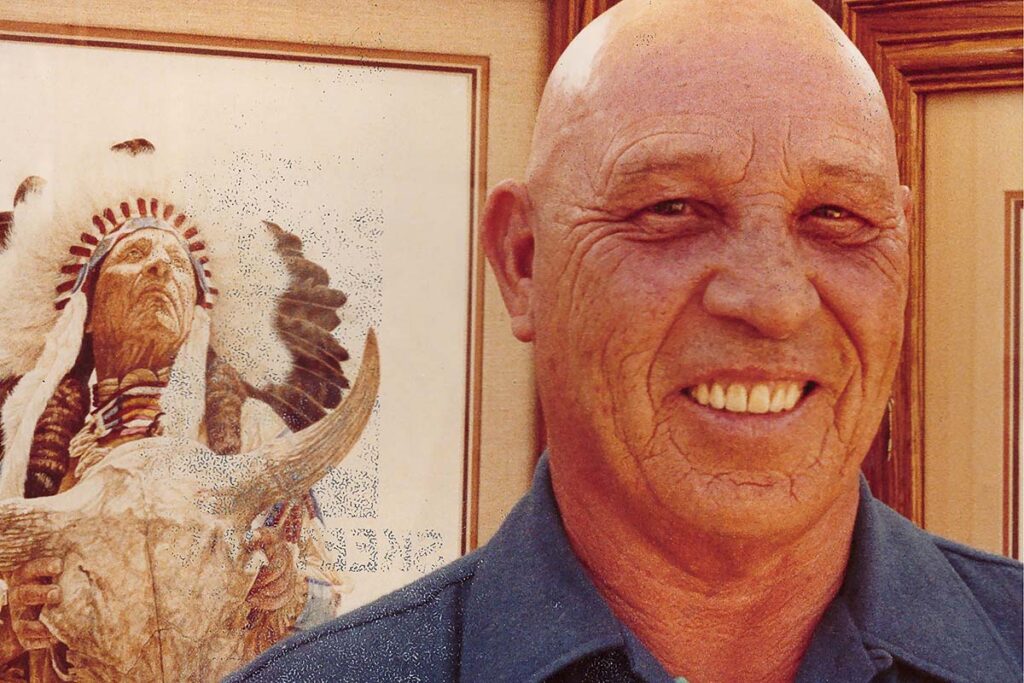
The author (left) bought Tru Balance Knife Co. from Stephen McEvoy (right) in 2017. The business continued to grow but the author had to sell in 2021 due to physical issues.
Around 1951, Harry learned of a knifemaker from Orlando, Florida, and another future Cutlery Hall-of-Famer by the name of W. D. “Bo” Randall. As a fledgling hobby knifemaker, Harry decided to write to Bo about his knives and the two became fast friends, exchanging letters regularly.
McEvoy soon found out that Bo had an interest in throwing knives and was surprised to learn that a throwing knife could even be found in Bo’s catalog. As a father with young children, money was scarce for Harry, so he convinced Bo to trade a Randall thrower for a couple of McEvoy throwers. Generous and willing to help a fellow knifemaker, Bo was happy to oblige.
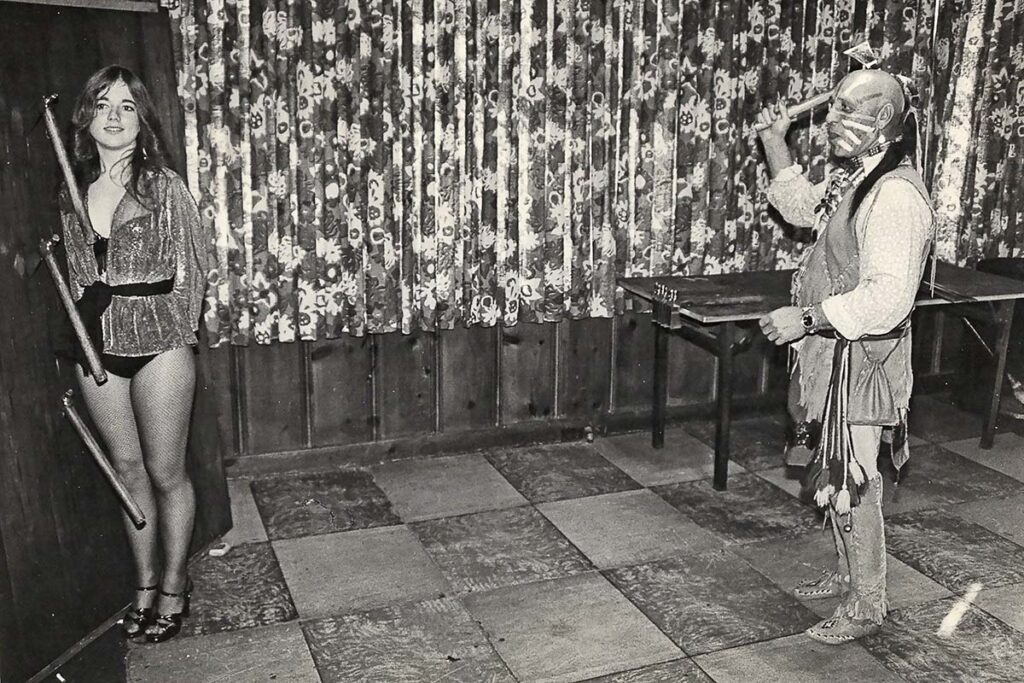
George E. “Skeeter” Vaughan made the most fantastic knife throw in recorded history, taking out a German sentry with a modified bayonet from 87 feet during World War II. Skeeter was also an outstanding tomahawk thrower, showing his skills here with the help of a “target girl.”
Around 1952, Bo asked Harry if he would visit yet another future Cutlery Hall-of-Famer, William Scagel, who lived very close to McEvoy in Fruitport, Michigan, and buy some of Scagel’s knives for his collection. McEvoy was more than happy to do his friend a favor. Harry would eventually befriend the reclusive Scagel, too, and on his visits watched him make knives and bought knives for himself and Bo.
As their friendship grew, Harry would visit Bo at the Randall summer home in Michigan and would even travel to the Randall home in Orlando, Florida. The two became quite close and eventually, Bo decided to feature two Tru Balance Models in the Randall catalog. The Model #1 Professional Thrower and the now world-famous Bowie-Axe Throwing Knife made their catalog debut in early 1960, which resulted in a spike in sales for Harry.
In his spare time, Harry McEvoy spent hours in his shop designing and crafting knives.
Bo thought so much of Harry’s work that he gifted one of Harry’s Tru Balance Bowie Axe throwers to astronaut Gordon Cooper. He also took Harry’s popular Bowie Axe design and modified it into a large machete-style knife and submitted it to NASA in the 1960s when NASA was looking for a machete for astronauts to carry on the Gemini missions. Unfortunately for Harry, NASA required a much thinner design and eventually chose another manufacturer, Case Knives, to make the machete.
AKTA
Meanwhile, Tru Balance soon became the go-to company for anyone who wanted a high-quality professional throwing knife. Tru Balance throwing knives became highly sought after by soldiers heading to Vietnam, professional knife throwers and knife collectors around the world.
In 1971, Harry started the American Knife Throwers Alliance (AKTA) to aid and offer guidelines to individuals and groups who wished to organize competitively in their local areas. Harry became very close friends with professional knife throwers like Kenneth Pierce, aka Che Che Whitecloud, Paul LaCross and George E. “Skeeter” Vaughan, who holds the distinction of making the most fantastic knife throw in recorded history. Considering the circumstances surrounding his legendary feat of taking out a German sentry during World War II with a modified bayonet from 87 feet, he most likely will maintain his grasp on that honor for a long time to come. “The Saga of Skeeter Vaughan” is told by McEvoy in the April 1982 BLADE®.
Harry went on to author such books as Scagel: The Man and His Knives; Archery Today; Crusader in the Wilderness; Knife Throwing: A Practical Guide; Knife and Tomahawk Throwing: The Art Of The Experts; For Knives Lovers Only; and co-authored Knife Throwing a Modern Sport, with Charles Gruzanski. McEvoy also held two design patents and trademarks for his knife designs. He also authored other articles for BLADE, as well as for Knife World (today’s KNIFE), Muzzleloading Magazine, Fighting Knives Magazine and many more.
McEvoy Legacy
In 1991, McEvoy was inducted into the Cutlery Hall of Fame for his exceptional contributions to the world of knives. It was around this time McEvoy’s son Stephen had taken an interest in his father’s knives and had begun learning more about the business. Stephen eventually took over the company in 1993 following Harry’s passing from an illness.
When McEvoy—here mugging during a lighter moment—practiced throwing knives in his yard, neighbors would gather to watch. The onlookers showed interest in the knives, and Tru Balance Knife Co. was born.
This writer, a friend of Harry’s and a fellow knifemaker, reached out to Stephen via telephone to offer condolences and advice. We chatted regularly and, over time, as we shared stories, we developed a friendship. Our phone conversations led to Stephen’s yearly visits to my home. During one of those visits, I asked him if I could take over the defunct American Knife Throwers Alliance (AKTA) and Stephen agreed.
Stephen would continue to run Tru Balance Knife Co. the same way his father ran it for many years. In 2015, after retiring from his job as an executive at a major insurance company, Stephen began speaking to me about slowing down and retiring from making knives. Already a full-time knifemaker with my own line of throwing knives, I envisioned bringing Tru Balance Knife Co. into the 21st century by selling Tru Balance knives on its own website and promoting the business via social media.
Skeeter Vaughan’s Cherokee Indian name is Grey Otter. He served as a chief of the Federated Indian Tribes for a number of years.
With the newfound success spearheaded by the new business plan, Stephen finally decided to fully retire from the business. A deal was brokered and I bought Tru Balance Knife Company in 2017, moving it to my hometown of Awendaw, South Carolina. The business would continue to grow but, not long thereafter, I developed some knee issues and struggled to keep up with the company’s new customer demands. Unable to find a qualified apprentice to help me fill orders, I decided to sell the business in 2021.
Tru Balance Heads Home
Though several companies made offers to buy the company, I decided I wanted to hand-pick my successor to ensure the legacy of the Tru Balance Knife Co. and that the knives would continue to be made in the USA. As the search for the right successor was underway, a mutual friend brokered a connection between me and two brothers from Michigan who had an interest in the business and the revitalization of the AKTA. The brothers made knives as a hobby and also happened to be skilled knife throwers.
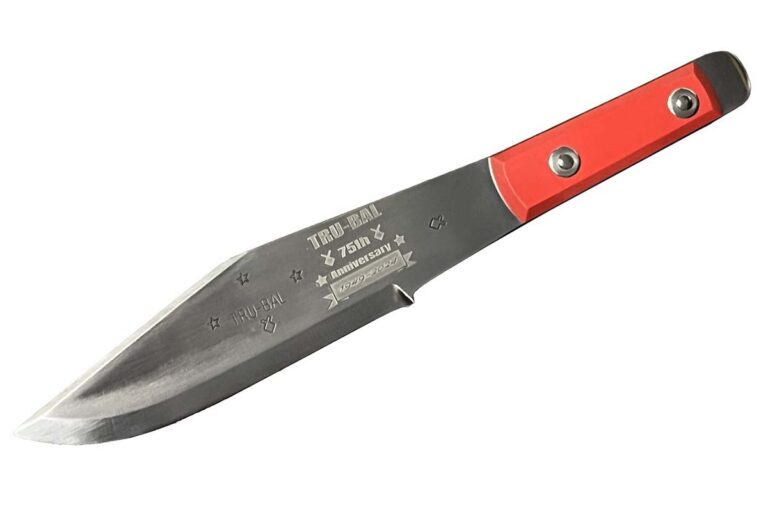
Bill and James Bednarick turned out to be the perfect choice to preserve the company’s legacy and bring it back to its original home in Michigan. With their keen eye for detail, quality and passion for knife throwing, their dedication has ensured that the Tru Balance Knife Co. has lived on to see its 75th anniversary in 2024.
From historic clashes to modern conflict, these fierce custom blades prove there is still a profound amount of art in the tools of war.
Since the dawn of man, the edge of the blade has been used to hash out disputes between everything from clans and tribes all the way to nations. While not the main battle implement in today’s conflict, the martial nature of the knife remains. This particular collection of fierce customs demonstrates there is a heap of art in war.
Caleb Ledford Long Sword
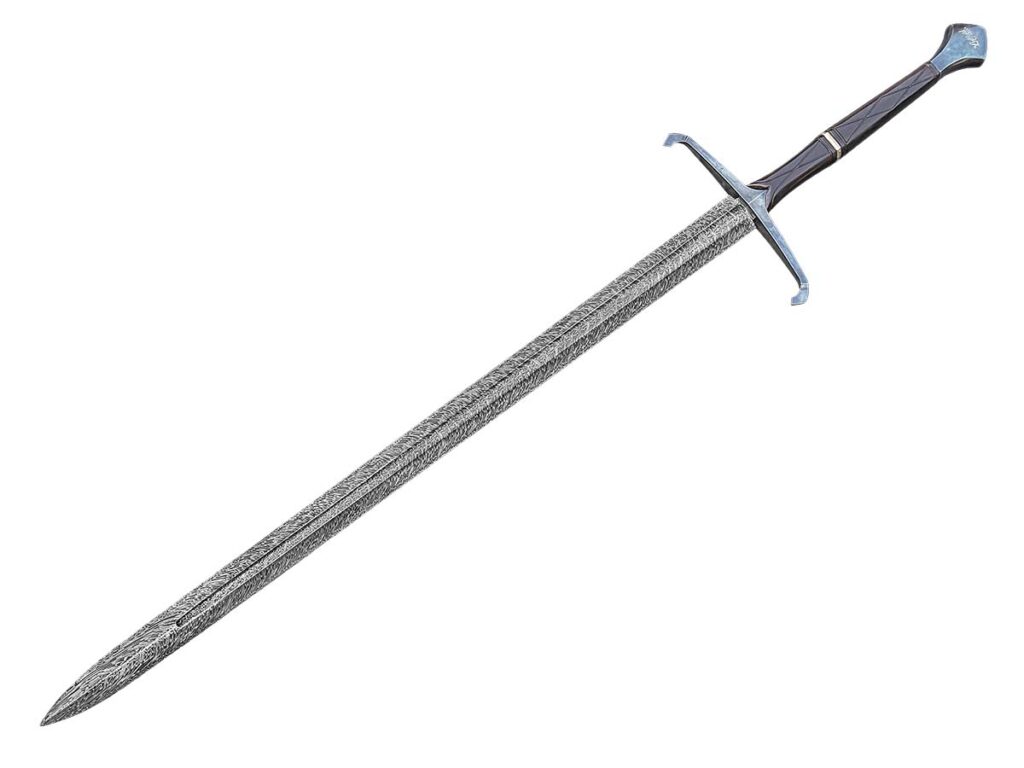
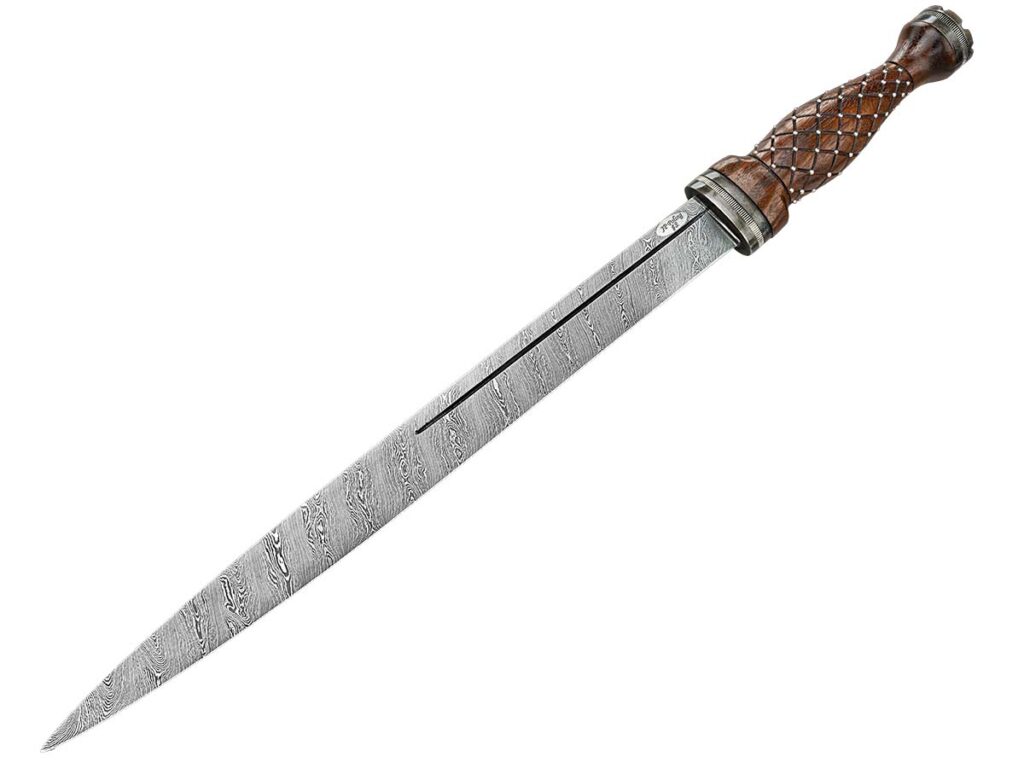
An electric 1084/15N20/mild steel Turkish-twist damascus defines the 31-inch blade of Caleb Ledford’s long sword. Lightening the sizable slicer’s load is a tapered fuller running on its midline. The handle is a pitch-black ebony, and the guard and pommel are cold-blued mild steel.
Jacco Van de Bruinhorst San Francisco Bowie
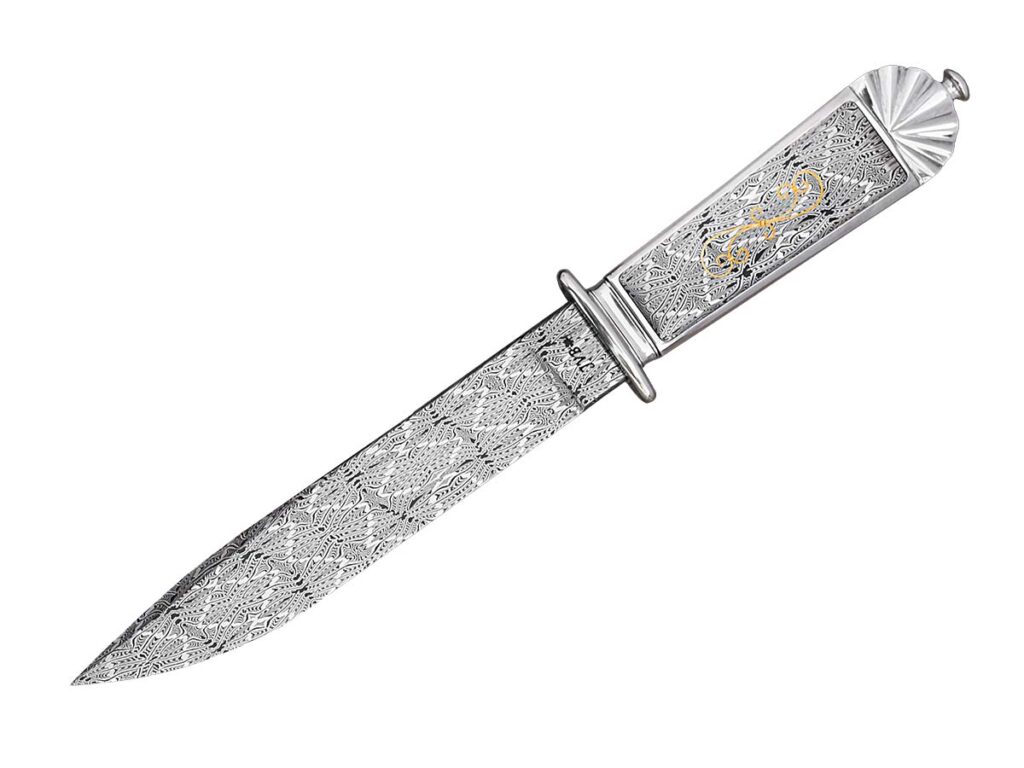
With matching blade and inserts, Jacco Van de Bruinhorst’s take on the San Francisco bowie is an elegant Barbary Coast brawler. The Canadian maker used ProCut/1084 to create what he calls a “snakeskin pattern.” If you study closely, the inserts harken back to the gold rush days with 24k gold inlay.
Jim Poling Dirk
Commissioned by a descendant of King James IV of Scotland, journeyman smith Jim Poling’s walnut-handled dirk appears freshly plucked from the highlands. The dagger boasts a 13-inch 1084/15N20 twist damascus blade, antiqued mild steel fittings and coin-edged nickel spacers.
Andrew Blomfield Pesh Kabz
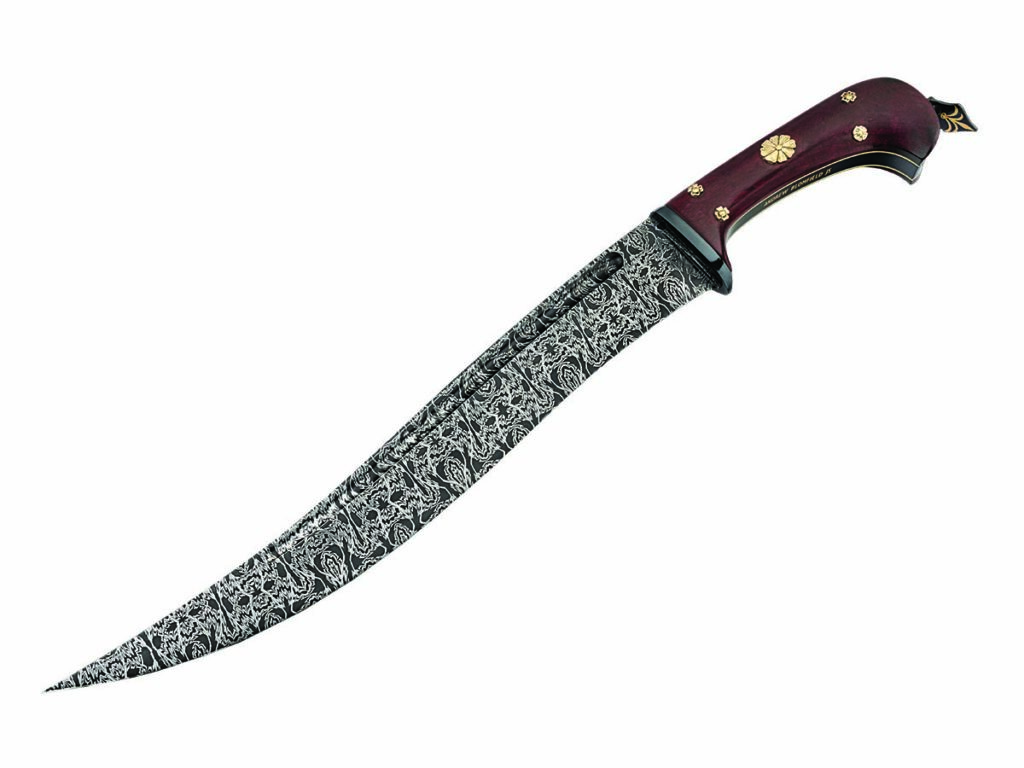
Master smith Andrew Blomfield has taken more than one stab at the pesh kabz in his career, and lands the blow with this 11.5-inch bladed example. The eye-catching mosaic blade is contrasted by the very conservative tones of the purple gidgee handle and blackened steel bolster. A traditional flourish, brass blossoms are on the handle’s pins.
Michael Deibert Wakizashi
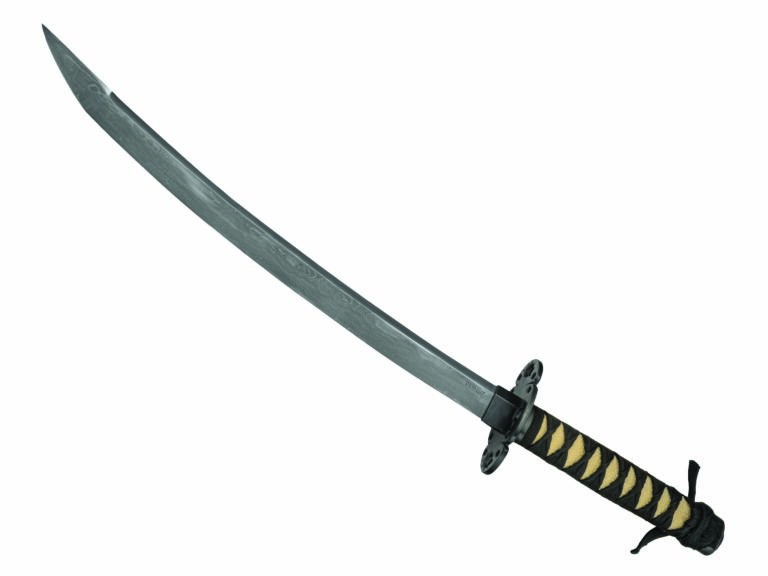
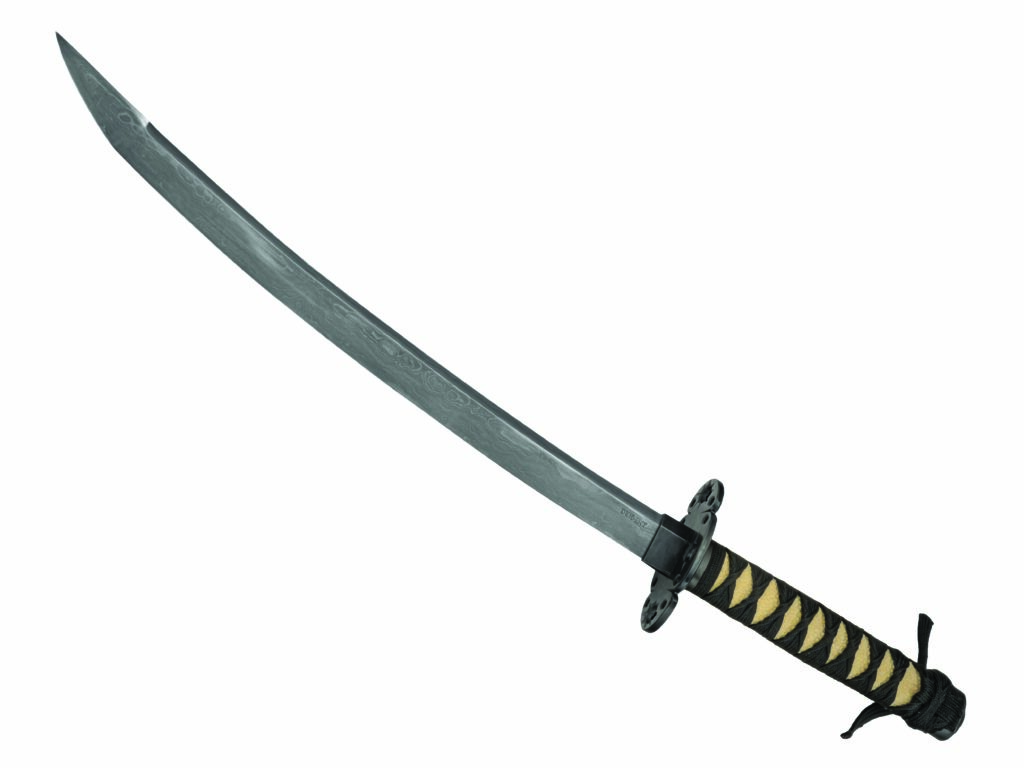
Alabama-based journeyman smith Michael Deibert brings traditional Japanese styling to life with this striking Wakizashi. The 18-inch blade features 1,100 layers of 1080/15N20 steel, paired with a wrought iron bolster. A classic stingray and an Ito-wrap handle complete the 28-inch overall build.
Nate “Tuna” Grant Pocket Fixed Blade
Nate “Tuna” Grant Pocket Fixed Blade
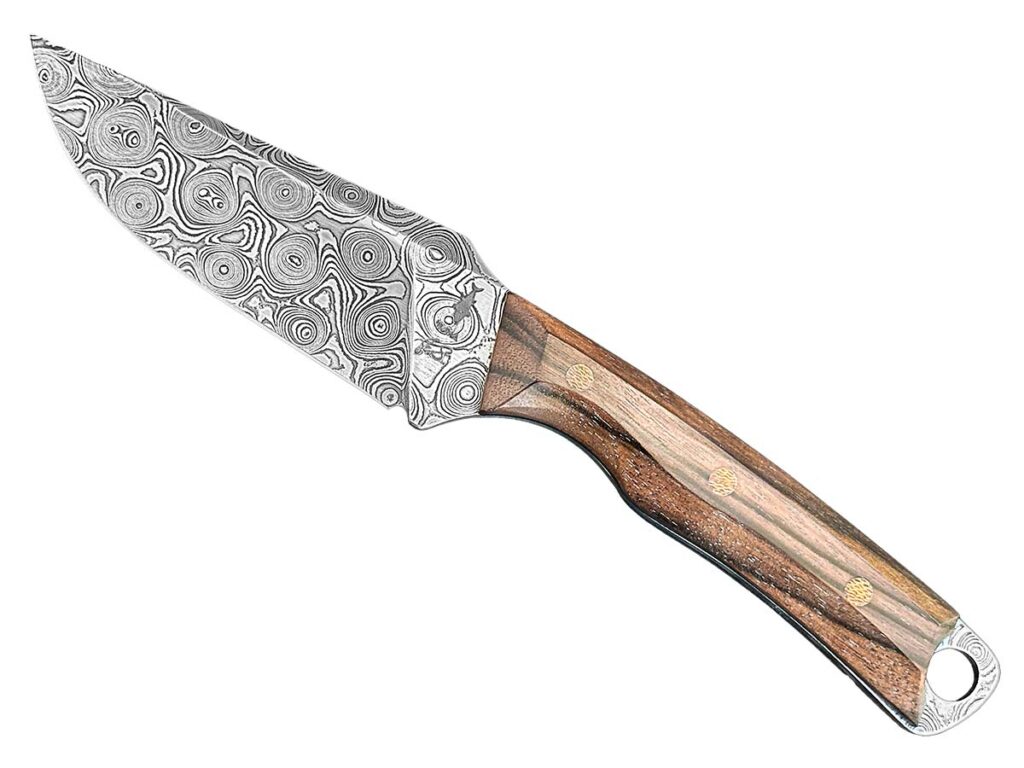
Journeyman smith Nate “Tuna” Grant delivers a compact powerhouse with the Defender. This 7.375-inch overall fixed blade features a 4-inch flat-ground blade forged from 1084/15N20 steel in a striking diamond drop pattern. The build is finished with rich Mun ebony scales.
Emmett Eitreim Dagger
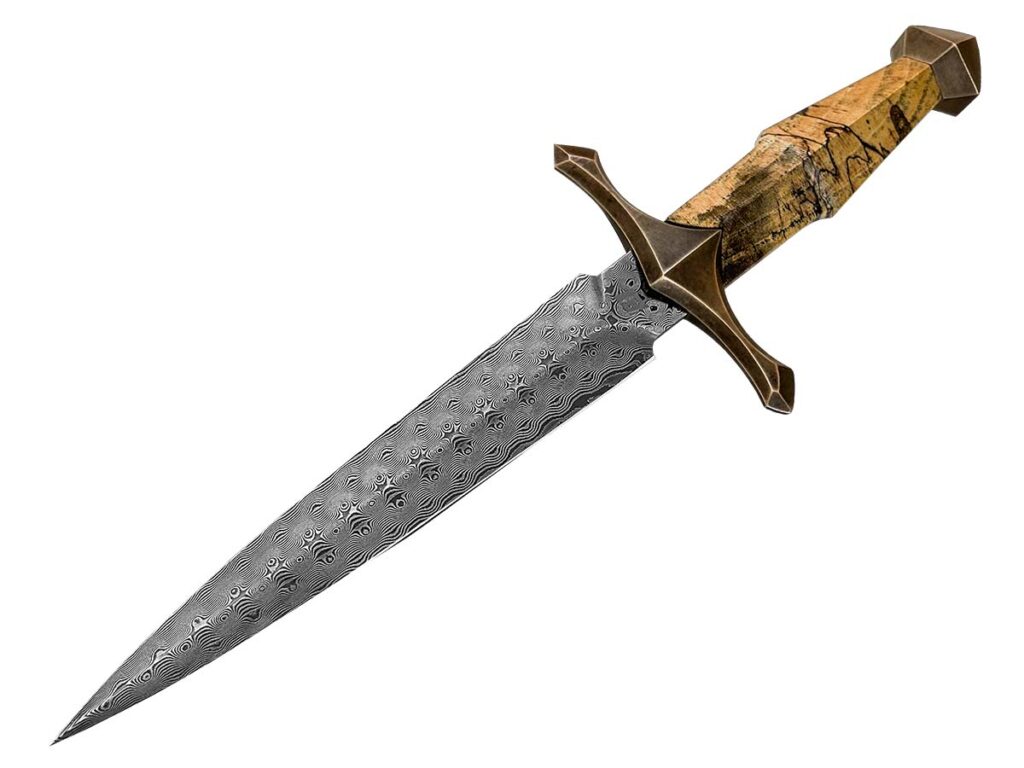
Emmett Eitreim presents a refined 12-inch overall dagger featuring a 7-inch flat-ground blade. The steel is a striking rose pattern forged from 15N20/1084, complemented by a 954 aluminum bronze guard and pommel. A stabilized spalted maple handle completes this elegant, high-contrast build.
Check Out More Cool Customs:
Cool Custom: Tony Lewis’ Tribute Knife To Steve Dunn
Cool Customs: Rocco Nawrocki’s Knife For Sergeant Bunker
Harking back to American military glory and post-war prosperity, antique switchblades from the 1940s and 1950 have enduring appeal.
From its first patent in 1884, the switchblade was an important addition to most early U.S. cutlery companies.
According to Mark Erickson, author of Antique American Switchblades, between 35-to-40 companies made and/or sold switchblades, including almost all of whose names long-time collectors recognize: Aerial, Camillus, Case, Challenge, Colonial, George Schrade, KA-BAR, L.L. Bean, Novel Shapleigh Hardware, Queen, Remington, Schrade Cutlery Co., Utica, Wade and Butcher, and Shapleigh Hardware, to list a few.
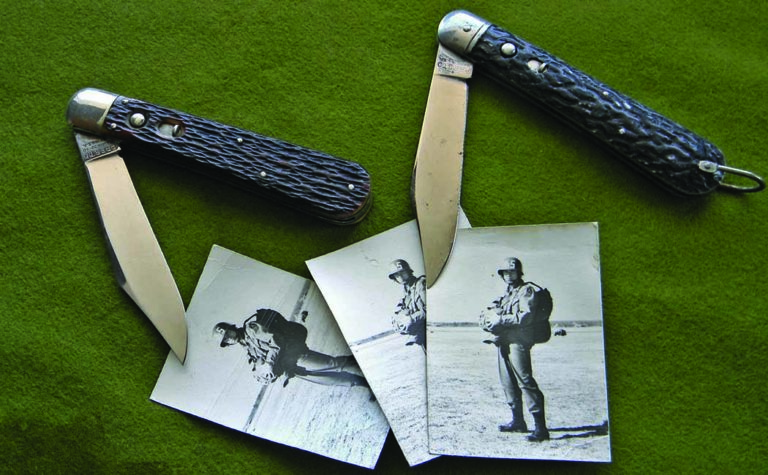
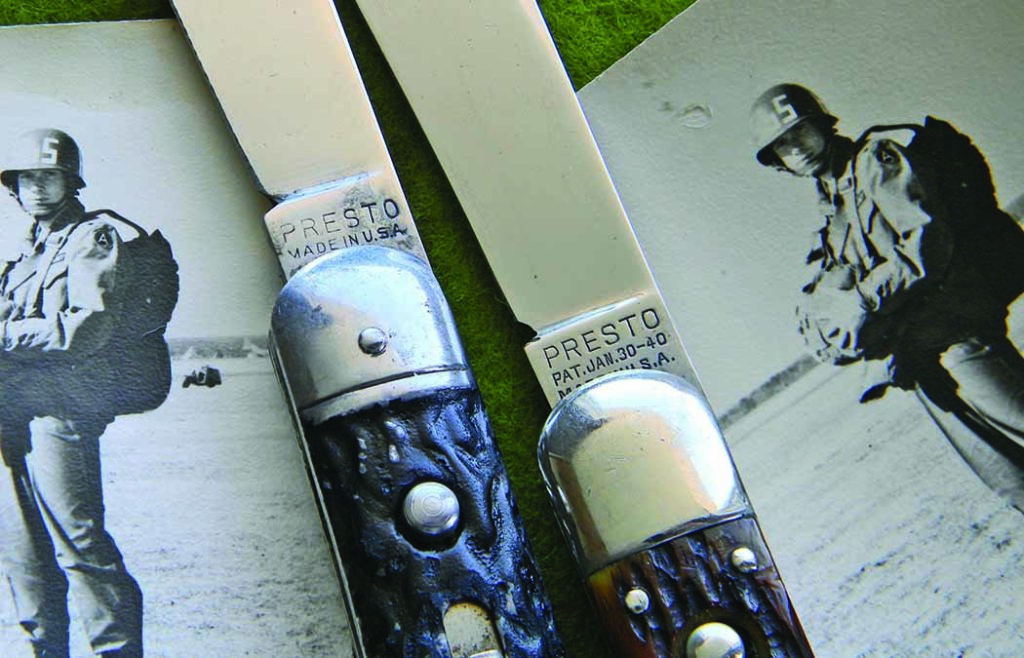
These two switchblades with the Presto stamping by George Schrade Knife Co., are among those that played an important part in the success of American paratroopers during World War II.
Because of the collectibility of the named companies and the significant variety of styles, sizes and handle materials associated with them, switchblades have become a serious endeavor for many collectors of antique knives.
Invention Of The Switchblade
As a serious cutlery collector, my downfall has been fingernails that bend backward with even the smoothest opening blades. The switchblade innovators had fingernails in mind when they produced a knife that could be opened without using a nail. In fact, some of the best switchblades are found in women’s old sewing baskets.
In fact, early switchblade ads tout the folder’s ability to be used by people with weak fingernails. “These knives will be a wonder for those who have difficulty opening a traditional knife” stated one such ad.
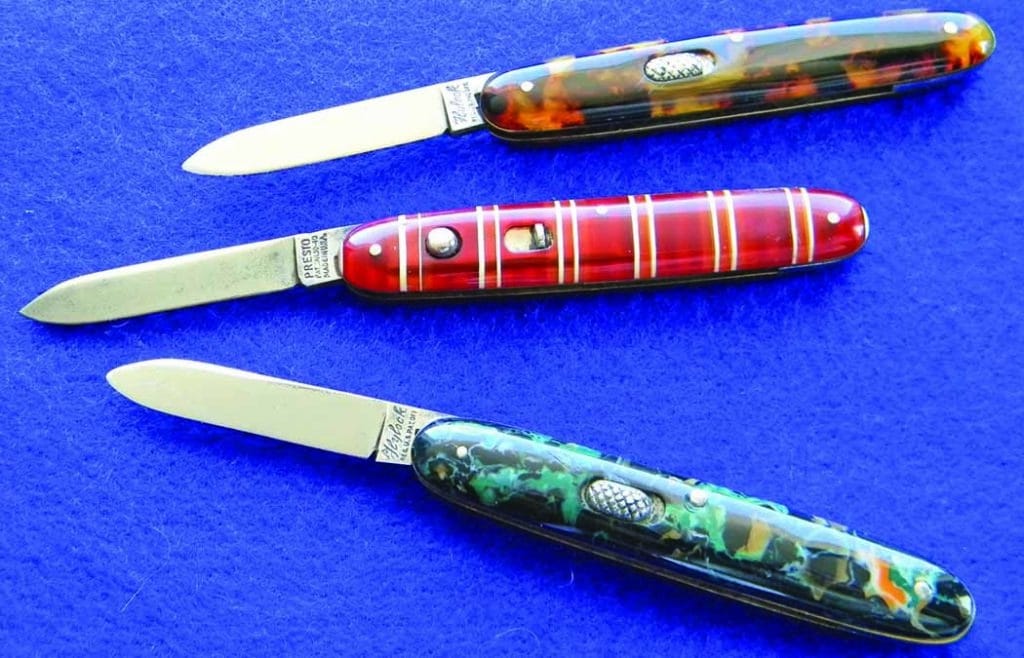
Celluloid was a very popular handle material on antique switchblades. Celluloid types, from top: a George Schrade in imitation tortoise, another George Schrade model in candy stripe, and one from Flylock Knife Co., in blue, pink and black swirl.
For many other occupations, the switchblade and its ability to be opened with one hand has proven immensely important. Mechanics, fishermen, ranchers, soldiers, veterinarians and even Boy Scouts were frequent users of the pocketknives. With a wiggling fish in one hand, it is easy to see how a switchblade could be a valuable asset to most fishermen when cutting a line.
Moreover, most switchblades have a lock/safety that keeps the blade from opening accidentally and the open blade from closing on the hand. An early Flylock Knife Co. ad touted, “The ideal knife for all outdoors and sports use. One hand only required to open or close, leaving the other hand free to grip a rod or gun.”
World War II Switchblades
World War II brought with it the necessity of supporting soldiers who parachuted behind enemy lines. Switchblades procured for the U.S. military were designed to cut the parachute suspension lines that became entangled during landing. The knives were carried in what has been described as “neck pockets’ in jump uniforms.
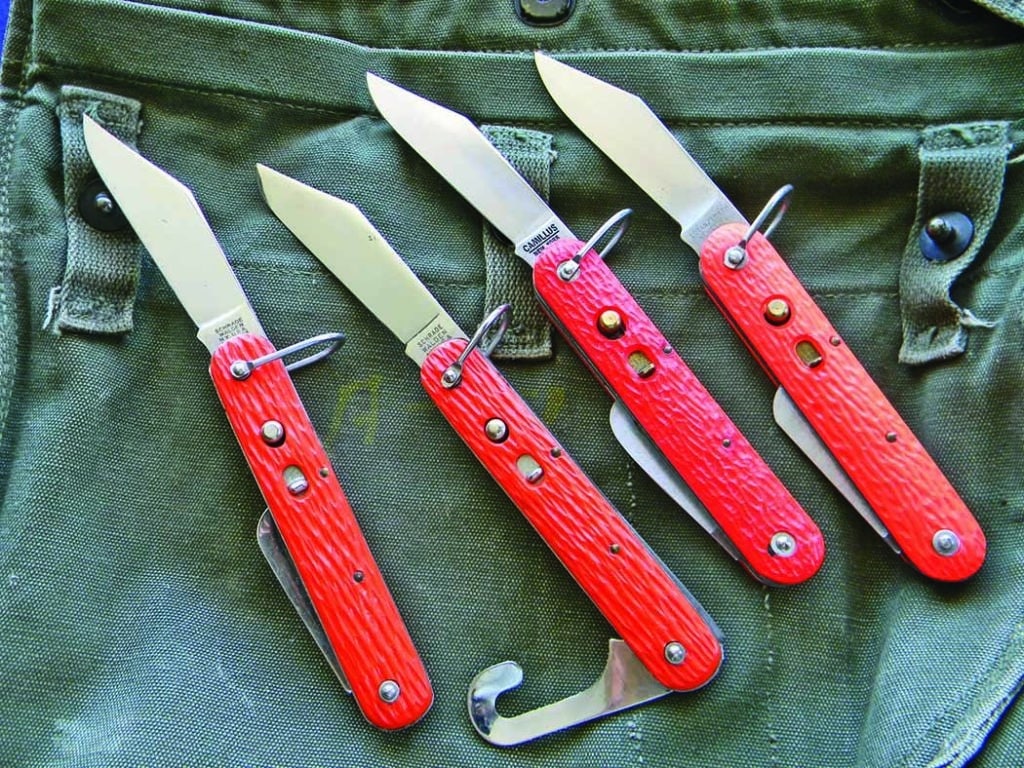
Military switchblades designated “MC1” included models in orange handles for heightened visibility. They were made by Schrade until 1960, when Camillus took over the contract. The knives have a master blade opened by a push button and a manual shroud cutter.
There are continuing discussions about the knives specifically made for and used by the U.S. military during the war. The discussions center around whether switchblades issued to troops all had jigged bone handles or jigged metal sides. Another discussion is whether all switchblades used by paratroopers had a bail—known in the military as a “lanyard staple”—or whether knives without bails also were used.
Units that used the knives included paratroopers in the 82nd Airborne and 101st Airborne Divisions, which included the 505th, 507th and 508th parachute infantry regiments. The 505th Infantry Regiment website shows switchblades made by Schrade Cutlery Co. stamped “Presto” with jigged bone handles and metal handles made to look like jigged bone painted black. Knives both with and without bails are included in the photographs. Switchblades made for World War II paratroopers also include those stamped Schrade-Walden and Schrade Cut. Co.
The book, 4 Stars of Valor: The History of the 505th Parachute Infantry, describes the equipment carried by paratroopers. In addition to main and reserve chutes, full uniform and helmet, the paratroopers carried over 70 pounds of equipment, including an M-1 carbine with ammo, Mae West life jacket, switchblade, water-filled canteen, trench knife, fragmentation and smoke grenades, mess kits, three days of K rations, escape map and compass, gas masks, toiletry items, 30 feet of rope, blanket, half a shelter and first-aid kit.
Post-War Military Switchblades
After World War II, several companies made switchblades for military personnel. According to one website, the first such knife was produced for the armed forces by Schrade Cutlery Co., designated as MC-1, an airman’s paratrooper knife, in 1957. Sometimes the knives are referred to as aircrew survival knives.
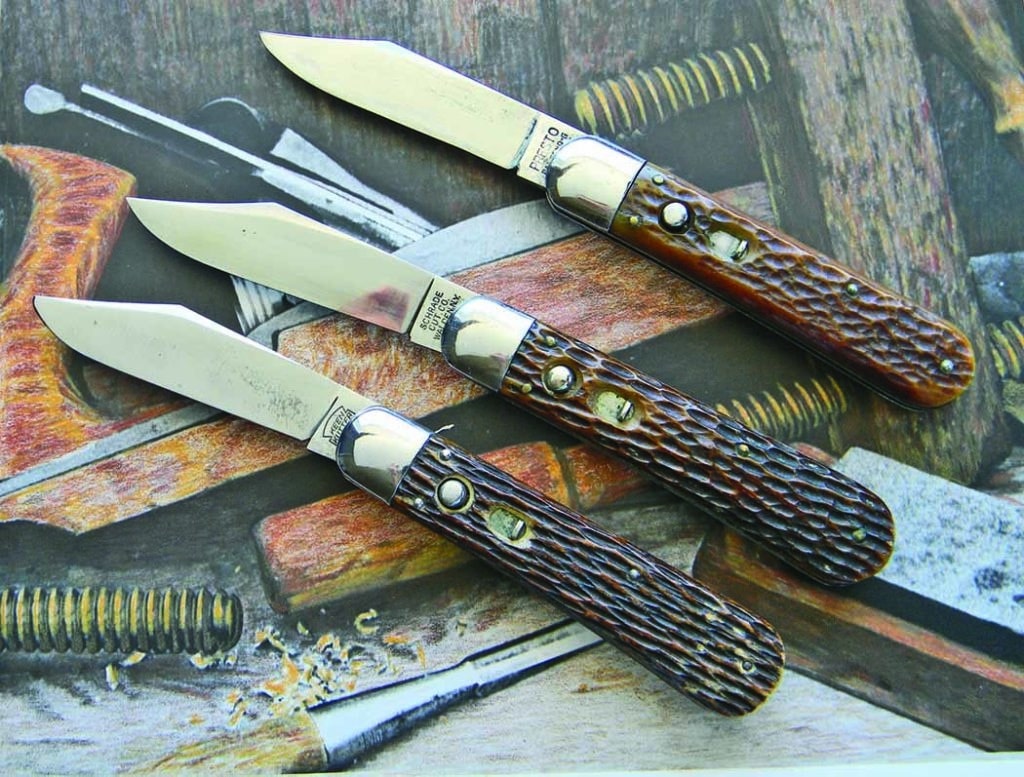
Three jigged bone switchblades, from top: Schrade Cutlery Co., George Schrade Knife Co. and one of the rarest of antique models, one stamped “Keen Kutter,” a trademark of Shapleigh Hardware. Schrade made the knife.
The first contract was awarded to Schrade Cutlery followed by a second contract to Camillus, and a third to Logan-Smyth. The orange-handle switchblades had two blades: one a master spear pattern opened by depressing the button, and a second blade shaped like a hook to cut parachute suspension lines. In my estimation, the hooked blade is not sharp enough to easily cut parachute lines and must be resharpened.
Civilian Switchblades
The early 1950s brought a renewed interest in cheap, colorful switchblades, with thousands of knives made by Imperial in its Jack-O-Matic Texas toothpick model, and Colonial, which used the Shur-Sharp stamp on its colorful models. The fishtail jackknives and the Texas toothpick styles were by far the favorite examples produced by the two companies.
The George Schrade Knife Co. continued to produce popular switchblades with celluloid handles stamped Presto. The knives were made with a single blade, double blades (the latter with a push button for each blade) and even a letter opener with a push button in one end.
Celluloid Handles On Antique Switchblades: Why?
The handle material for most of the inexpensive switchblades was celluloid. Thin sheets of the versatile plastic-like substance were molded around the knife’s metal sides. The most popular celluloid style was candy stripe. The knives also can be found in a wide variety of swirled celluloid handles in a myriad of different color combos, some with such recognizable celluloids as cracked ice and imitation tortoise.
Because the knives were inexpensively priced, they were extremely popular with boys in the 1950s. Because of the knives’ widespread use, some advertisers saw an opportunity to emboss various ads on them, giving them away as a novel company promotion gimmick.
Allure Of Antique Switchblades
Because of their connection with the heroic actions of airborne troops during World War II, antique switchblades have continued to be a popular cutlery collecting niche. Moreover, since almost three dozen companies, each producing a vast array of sizes and handle materials, made the knives, the collecting field is wide open.
Even in the 1950s cheap construction, made more evident by the continuous opening and closing of the blades, the knives remain popular collectibles. No doubt one reason for the popularity is that antique switchblades remind many of the Golden Age of the 1950s and ’60s when kids played outside all day, shot their BB guns, and hit the corner gas station for a cold soda and a candy bar.
The 12th president was and is a hot knife commodity.
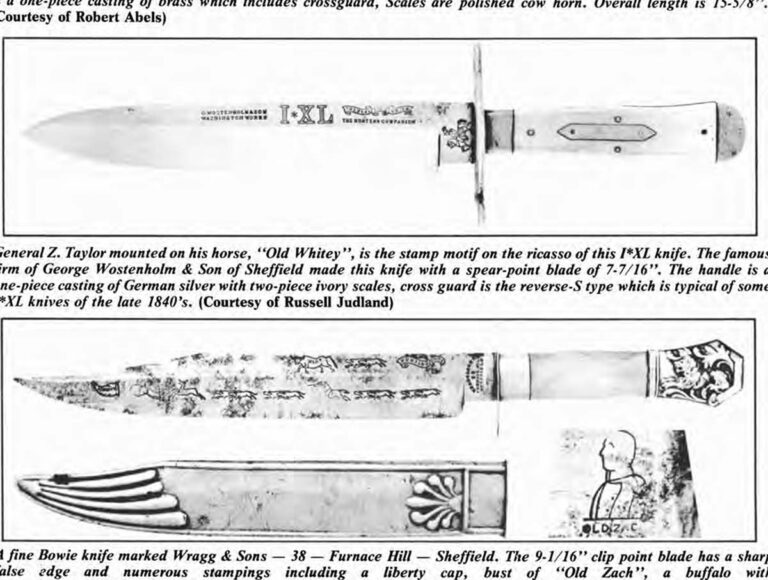
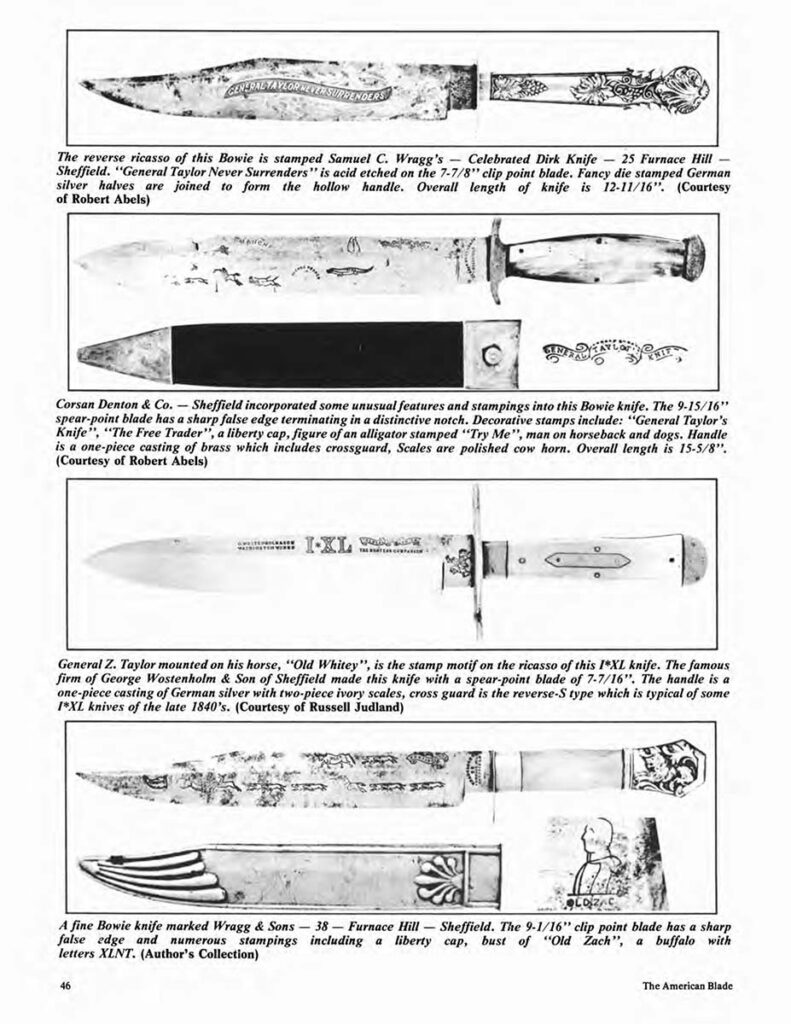
Some examples from the article of “Old Zach” bowies that included the American general and president’s name, slogans or likeness. The lower bowies have his visage, the second from bottom a stamp motif on the ricasso of Taylor on horseback, the bottom a bust of the celebrated general.
Ever in tune with what’s popular at the moment, knifemakers have never been afraid to cash in on a hot trend. William R. Williamson documented one of the more peculiar vogues of the middle 19th century when Zachary Taylor and bowie knives were all the rage.
Fresh off his triumphs in the Mexican-American War, Taylor was the 1850’s version of a rock star—Americans just couldn’t get enough of him. And while not known to carry a bowie nor affiliate with the hero of the Alamo—Jim Bowie—the general and president’s likeness began to pop up on the most American of knives.
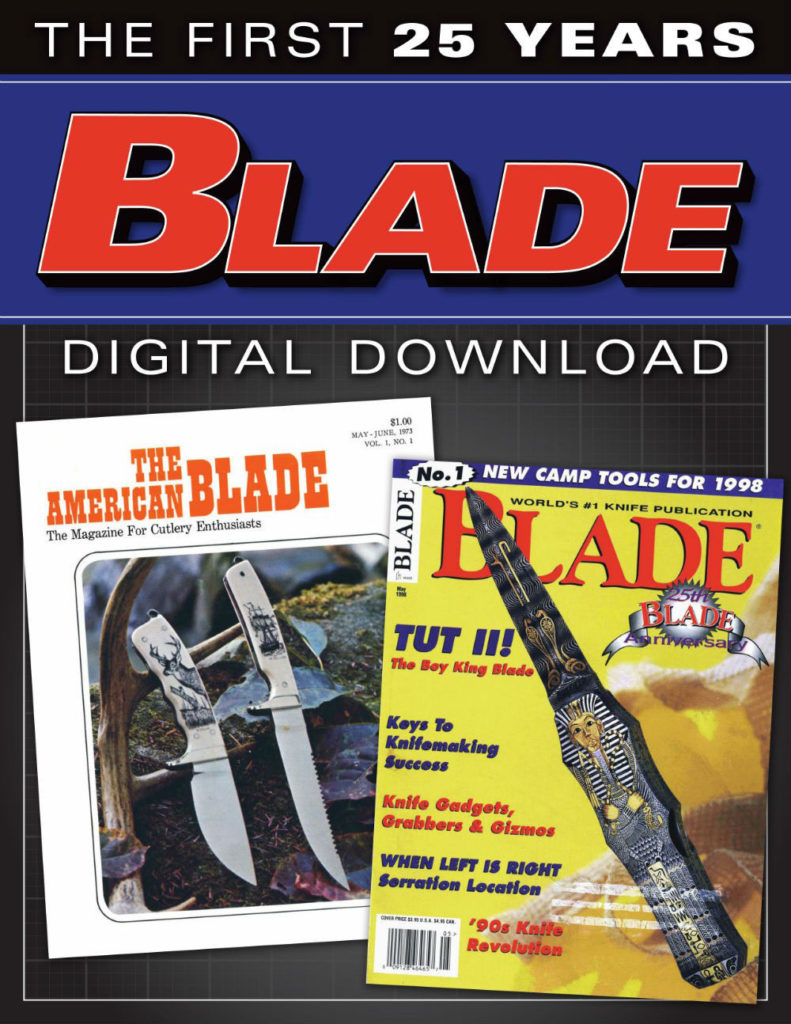
Funny thing is, as William’s points out in his article “Old Zach and the Bowie Knife,” from the March-April issue of The American Blade®, it wasn’t the Yanks cashing in. Instead, England Sheffield’s makers had the pulse of the USA and stamped Taylor’s visages on blades and bolsters.
Unfortunately, Old Rough and Ready’s short-lived presidency didn’t inspire the same outpouring of effigies. But modern collectors did and do find these unusual and patriotic blades desirable, as Williamson points out in his article.
We talk with those who know Bill Moran best to determine how many damascus blades the godfather of the craft forged.
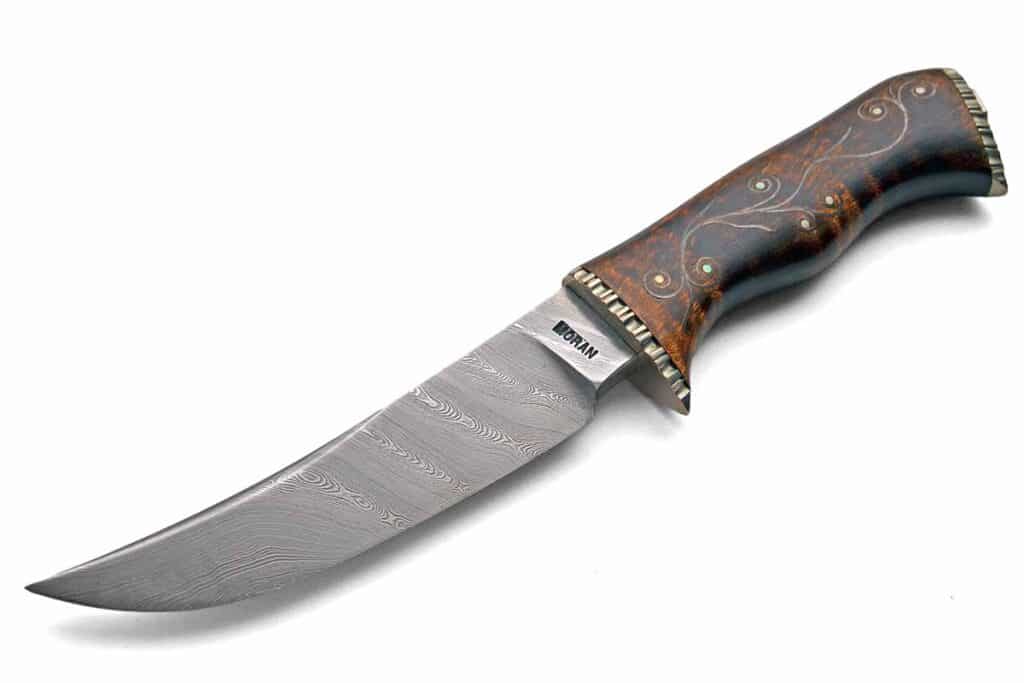
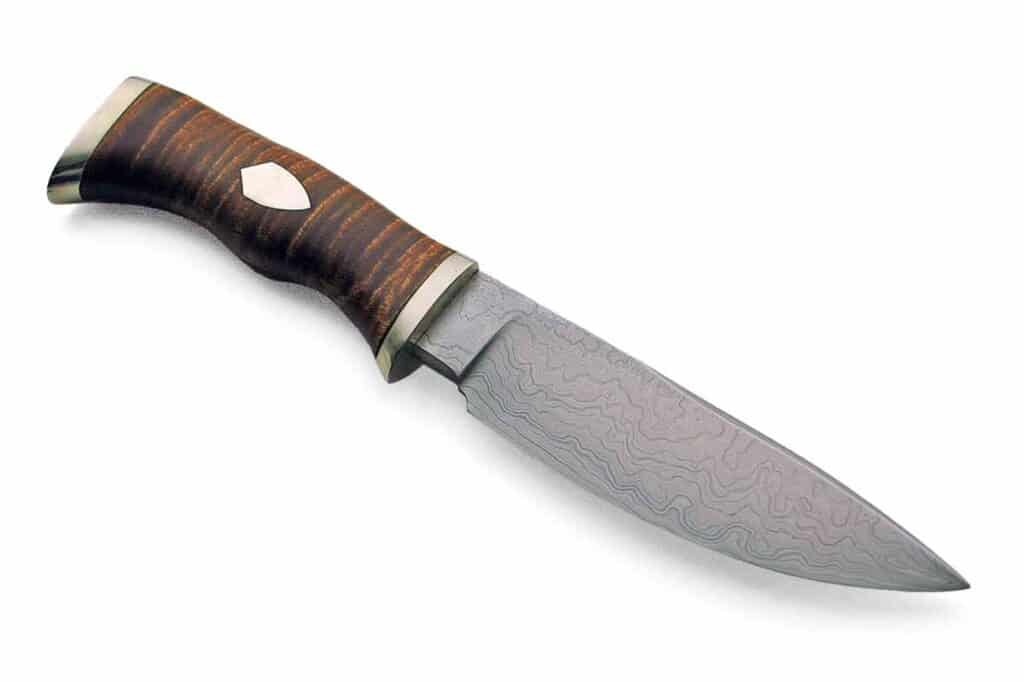
BLADE Magazine Cutlery Hall-of-Fame® member Bill Moran is and will forever be remembered as the father of modern damascus steel. He and a few early devotees popularized damascus during an era when the art of bladesmithing was an endangered species in the realm of the artisan.
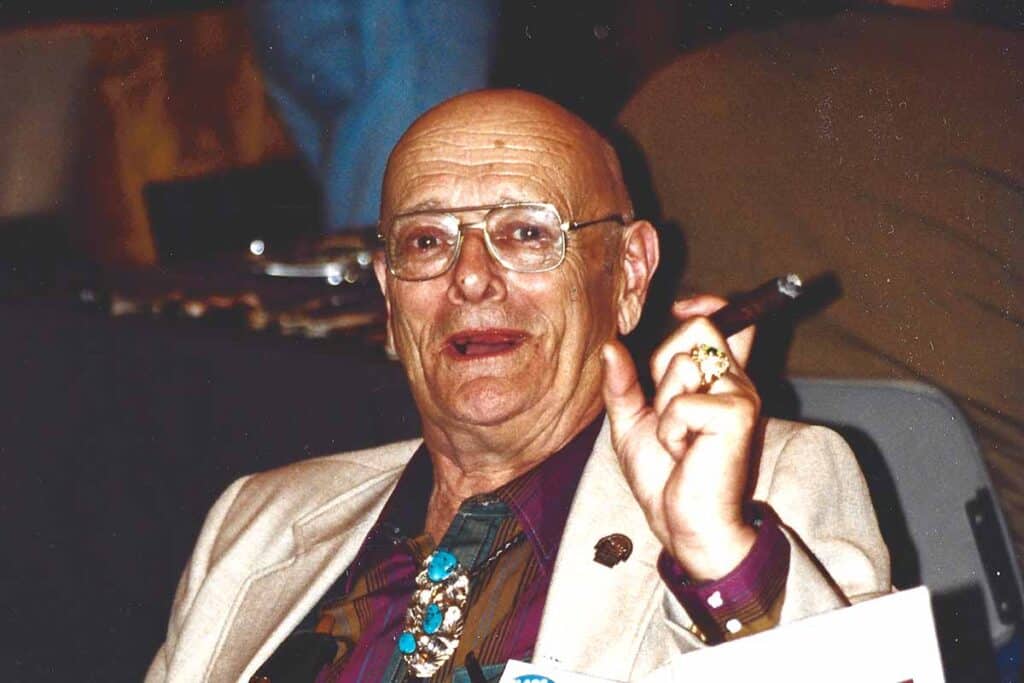
Though Moran was partial to smoking a pipe, he liked an occasional stogie as well. (Pete Cohan knife image)
It was Moran who shocked the custom knife world in 1973 when he brought eight knives to The Knifemakers’ Guild Show in Kansas City, Missouri. Those historic eight sported blades of Moran’s damascus steel and they created a sensation. Cutlery Hall-of-Famer, longtime journalist and friend of Moran’s, and a respected member of the knife community, B. R. Hughes remembered how the event electrified those who attended.
This is the first damascus knife Moran ever made. He forged “No. 1” circa 1972. It was misplaced for 30 years until Nancy Hendrickson found it in Moran’s house. (Pete Cohan knife image)
“When my wife [Carolyn] and I drove up to the Muehlebach Hotel in Kansas City, a friend of mine came out and said, ‘You gotta get in there and see the damascus knives Moran has on his table.’ Those knives were the talk of the show. Bill also had mimeographed sheets that explained what damascus steel was and how it was made. He gave those sheets away to anyone who desired one.”
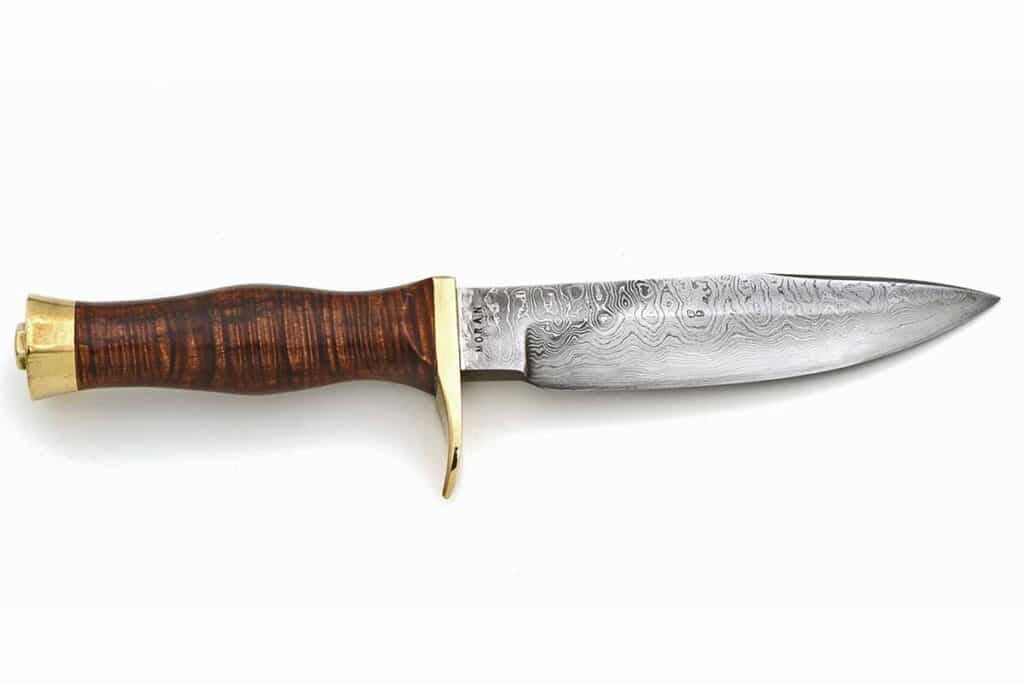
Moran made basic damascus knives. “They weren’t elaborate and this, that and the other thing, but most of them were for use,” B. R. Hughes noted. (Exquisiteknives.com image)
Three years later, Hughes joined Moran and bladesmiths Bill Bagwell and Don Hastings as the quartet that founded the American Bladesmith Society (ABS). When the ABS was founded in 1976, bladesmithing was on life support, and probably fewer than a dozen smiths were forging knives. Today, the Society includes more than 2,000 members and the future of the craft has been secured. Meanwhile, Moran deserves the credit as the catalyst for modern bladesmithing.
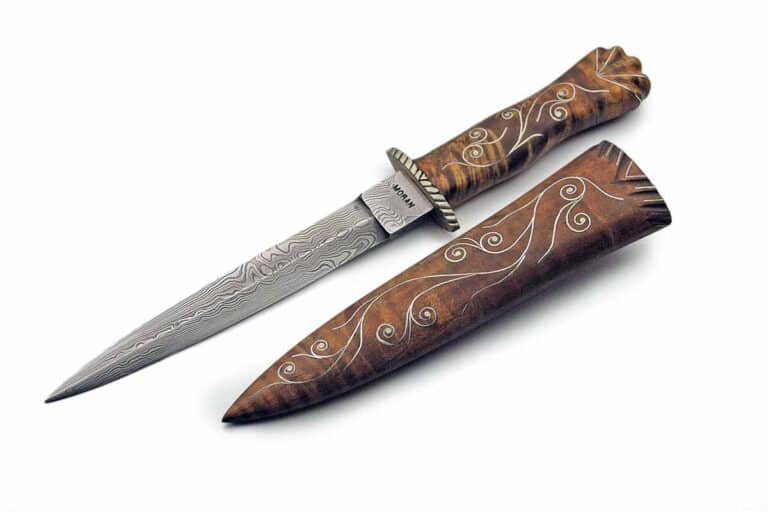
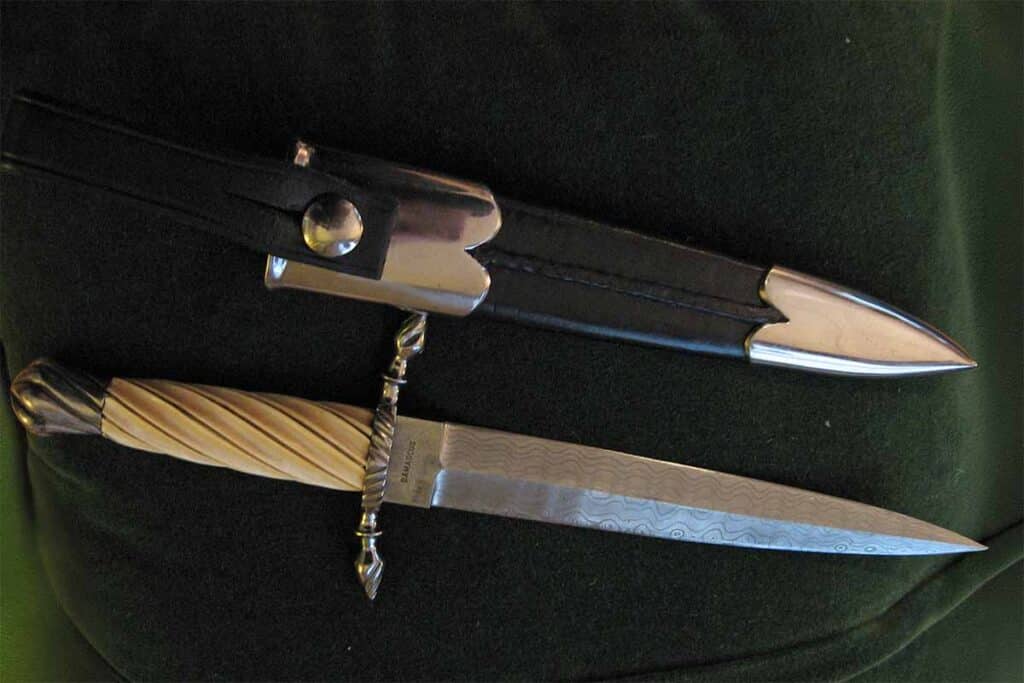
B. R. Hughes said Moran made some art daggers that “were a bit elaborate for the day.” An example is this large quillon dagger. (Exquisiteknives.com image)
How Many Damascus Knives Did Moran Make?
While there is no question that Moran and other dedicated disciples of the forged blade brought damascus and the ring of the hammer back to life in the early-to-mid-1970s, there is some conjecture as to just how many such knives the great Moran forged and completed himself. The thought of how many Moran damascus knives were made and exist today is tantalizing, and, of course, what’s a great legend without a bit of mystery and conjecture? Exploring Moran’s body of work and the damascus element within provides some insight into the man, the legend who padded about on the creaky floor of his Maryland shop, sometimes chewing tobacco, but rarely alone when his doors were open as crowds came to see the wizard work.
Back in the day, a Moran damascus knife was a challenge to own, considering the time Moran spent in his shop with the material actually able to work without the distraction of visitors, the many hours of labor required to produce a damascus billet, and the higher price for such a piece that naturally followed. (Exquisiteknives.com image)
Collectors such as Cutlery Hall-of-Famer Butch and Rita Winter bought the first of Moran’s damascus knives during that historic Guild Show more than a half-century ago, and, as Hughes relates, “Moran made basic damascus knives. Most of his were what folks would call ‘using’ knives. They weren’t elaborate and this, that, and the other thing, but most of them were for use. He did make some art daggers that I thought were a bit elaborate for the day.”
Dave Harvey, Nordic Knives
Hughes remembers that Moran himself was rather vague on the number of damascus knives he actually made. However, probably the best estimate is that fewer than 100 Moran damascus knives were made during a career that spanned more than 50 years.
“He liked the random pattern and the ladder pattern,” B. R. remembered, “and he could do some pretty good patterns, but it took a lot of time. He was very happy just making ladder pattern and stuff like that, and he continued making non-damascus knives and about 40 folders. When he was in his shop, there were always five or six locals in there talking to him and watching him work.” Agreed Cutlery Hall-of-Famer and ABS master smith Jay Hendrickson, a close friend of Moran for 30 years, “Bill had so many visitors to his shop on a daily basis that it is a wonder he ever got anything accomplished.”
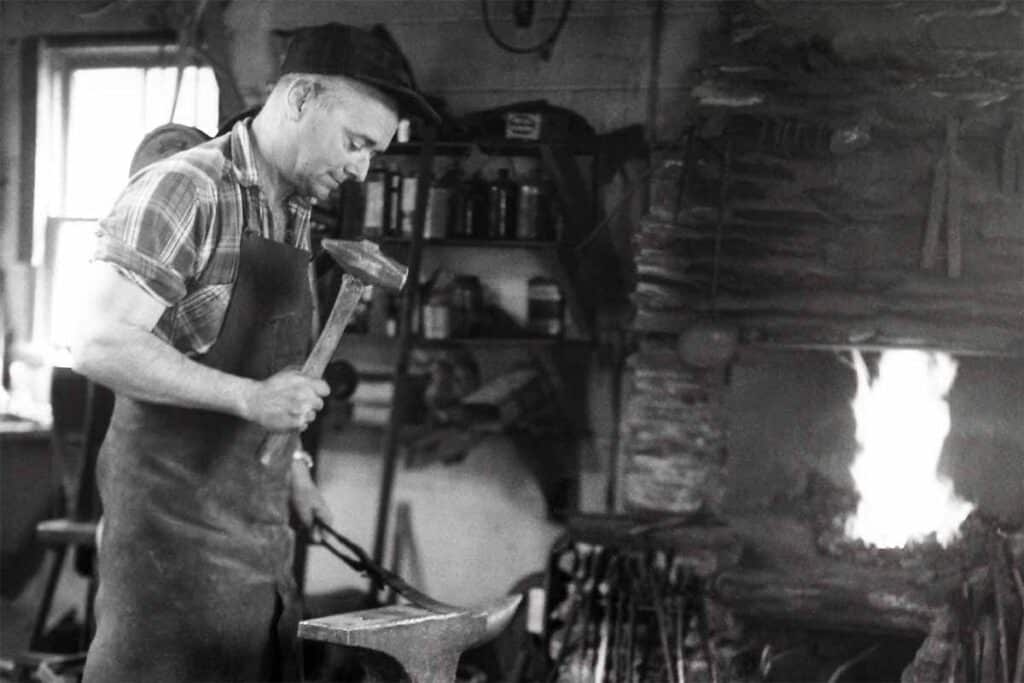
According to Jay Hendrickson, Moran made all of his damascus in a coal fire. “All of Bill’s experiments were with coal, as gas forges were not popular at the time,” Jay explained. “In today’s world, gas forges are almost always used for damascus making because of adjustable temperature and the cleanliness of propane gas.” (vintage photo of Moran in his shop circa the 1960s)
Hendrickson served as the executor of Moran’s estate and founded the Moran Foundation to preserve the great bladesmith’s legacy, serving as its president for 10 years. Jay observed that Moran made a workingman’s knife with quality that was spot-on, though there may have been an occasional flaw in the solder on his early pieces. Nonetheless, Jay says, Bill’s knives always cut.
As for Moran’s damascus knife productivity, Hendrickson offered, “This is strictly a judgment call on my part, but I would say Bill made less than 100 damascus knives. I counted 36 in our Forever A Legend book. I only know a few people that own Bill’s damascus knives, but I think they are sold and traded often between collectors. You also see Bill’s damascus knives occasionally sold at auctions.”
Butch and Rita Winter bought this damascus quillon dagger from Bill Moran at the 1973 Knifemakers’ Guild Show where Moran introduced modern damascus knives. It was one of eight damascus knives Moran brought to the show. The tang is marked DAMASCUS in all uppercase letters. (image courtesy of Rita Winter)
Jay verifies the original sale of a Moran damascus quillon dagger and sheath to Butch and Rita Winter and adds a bit more information. “Rita Winter recently sold Bill’s first damascus dagger to Mr. Doug Hook, a Tennessee collector,” he commented. “Two years ago, I repaired one of the twisted wires on the handle for Mr. Hook. Because of that contact I was able to confirm the original purchase as Doug has written verification of the original sales transaction and the invoice.”
So where are the majority of Moran’s damascus treasures today? Longtime purveyor Dave Harvey of nordicknives.com is straightforward—“in collections around the world. Values vary and depend largely on the particular knife. But they are generally worth at least double that of [one of Moran’s straight carbon steel blades], sometimes even more.”
Dave Ellis said the first of the Moran damascus knives are quite valuable and guessed they would start at least at $10,000 and go up from there. Dave holds an early 1970s Moran damascus hunter at BLADE Show 2023.
Back in the day, a Moran damascus knife was a challenge to own, considering the time Moran spent in his shop with the material actually able to work without the distraction of visitors, the many hours of labor required to produce a damascus billet, and the higher price for such a piece that naturally followed. Dave Ellis of Exquisiteknives.com reasoned, “I could not say how many damascus knives Moran made in his lifetime, but certainly not a large number. Many of Moran’s damascus pieces reside in private collections, as well as the Moran Museum. I personally have owned and still own some and have sold a number of the finer pieces to overseas clients.
“I believe he made four or five patterns. Damascus steel was and still is a laborious process. Bill’s prices for his damascus knives were quite high for the time, so he made and sold mostly carbon steel pieces. Damascus was reserved for higher-end clientele and foreign dignitaries. A good number of the damascus knives were fighters and bowies. Damascus hunters were also made, many with Bill’s twist pattern steel, maidenhair. I do not know of any mosaic steel knives that Moran made. The first of the Moran damascus knives are quite valuable, and I would guess that they would start at least at $10,000 and go up from there.”
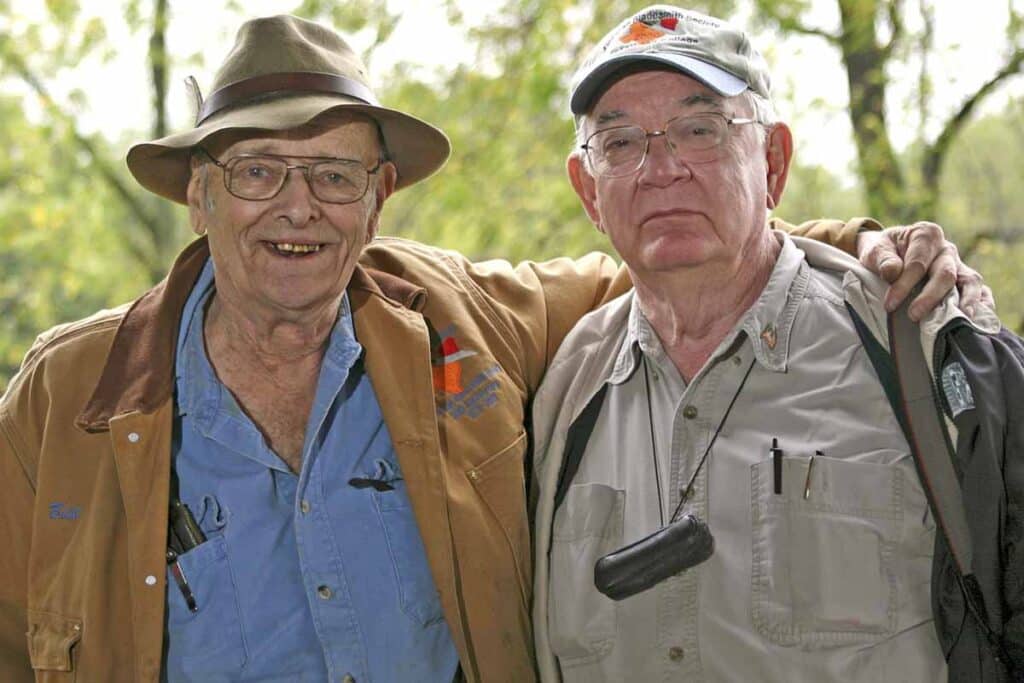
Along with Bill Bagwell and Don Hastings, Bill Moran (left) and B. R. Hughes (right) founded the American Bladesmith Society in 1976. Hughes is the only surviving founding member. (Buddy Thomason image)
HOW HE MADE THEM Hendrickson is familiar with Moran’s most common damascus patterns, the maidenhair twist, ladder pattern and others. “He knew how to fuse metal, as he learned that technique working on equipment on the family farm,” Jay remarked. “On the farm he made knives from whatever he could get his hands on, old springs, files, and rasps, for example. He could also buy steel from a local hardware store in town. Bill also knew the difference between plain iron and high carbon steel. His first damascus experience began by using one piece of steel and one piece of iron. He welded the two together, drew it out and folded it many times.”
The process yielded insight for Moran, and he learned from experience. At times during the process of hammering and folding, he realized that the steel was absorbing heat quicker than the iron because it was on the outside of the billet. Therefore, he moved to one piece of iron with steel in the center, and then a second piece of iron, using O1 tool steel and a carbon mix of 33 percent. According to Jay, this combination gave the billet the right hardness without the need for tempering. Moran’s test of the finished knife was to carve wood for two hours with no loss to the cutting edge, and he was satisfied with the results using this mixture.
Moran’s test of the finished damascus knife was to carve wood for two hours with no loss to the cutting edge. An example is this clip-point model, again in a ladder pattern. (Exquisiteknives.com image)
“Bill made all of his damascus in a coal fire,” Hendrickson recalled. “A hot coal fire can melt steel as temperatures can reach over 2,700 degrees Fahrenheit, which is the melting point of steel. That is why Bill added iron to the outside of the billet, as iron is less apt to burn as quickly as steel. All of Bill’s experiments were with coal, as gas forges were not popular at the time. In today’s world, gas forges are almost always used for damascus making because of adjustable temperature and the cleanliness of propane gas. Therefore, the burning of steel to a great deal has been eliminated with the use of gas forges.”
Hendrickson attributes the relative scarcity of Moran damascus knives to the maker’s affinity for producing using knives, constraints on time and other factors. “Bill was truly a supporter of the art knife,” he noted, “and along with others they created that industry. Collectors were willing to pay big time for exceptionally well-made knives, and Bill, like other top-notch makers, profited as this industry took hold. However, Bill’s true passion was in using knives, such as camp knives, hunters and small utility knives, of which he made many. The vast majority of his knives came from customers wanting working knives.
A good number of Moran’s damascus knives were fighters and bowies, according to Dave Ellis. This classic ST-24 in ladder-pattern damascus and curly maple handle with fancy wire inlay is a favorite of Moran collectors. (Exquisiteknives.com image)
“Bill liked to experiment with damascus. For example, he would slip in an added piece of iron after many folds to gain toughness in the end product. Another example was where he completed a damascus billet to the desired number of welds. He then cut it in two and added a piece of high carbon steel to form the middle and welded the two damascus pieces on both sides of the high carbon steel. Once that was completed, Bill forged the billet into a knife. One might call the finished product a damascus san-mai. Bill liked the various patterns that were being developed beyond the more basic patterns that he originally developed. To Bill, mosaic knives were art knives, not to be used but just admired. He didn’t like the process of welding pieces together to make a knife. Remember, he was more into using knives where the grain within the steel followed the entire edge of the blade.”
Through the years, Moran became a legend, leaving a legacy of learning, teaching, giving information freely, and welcoming many to his shop. He paid tribute in steel to the wonder of damascus, the art knife and the using knife. Today’s body of bladesmiths still looks to him as the guiding light that led them to the glow of the forge and the spark of the hammer on hot steel. Those who own or admire the few damascus knives that Moran completed continue to do so for their beauty, their imagination, their rarity, and simply because they bear the touch of the master’s hand.
Jerry Hossom makes a Navy-themed set for Capt. Ryan Heilman of the USS Nevada
Jerry Hossom had that twinkle in his eye again and this time it was by his table at BLADE Show in Atlanta, where he was all fired up about the latest set he had made for Capt. Ryan Heilman, USN, of the USS Nevada (SSBN-733).
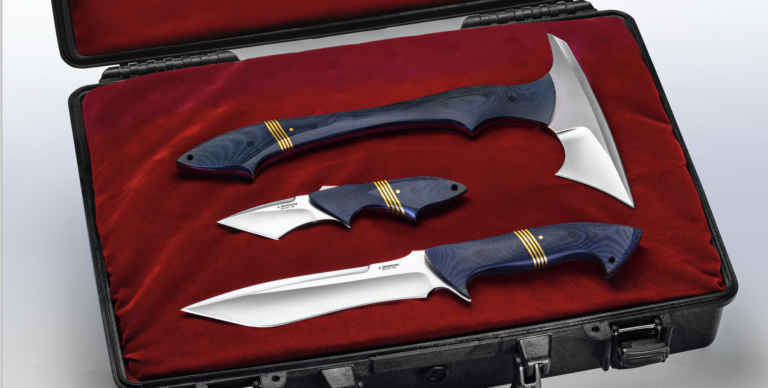
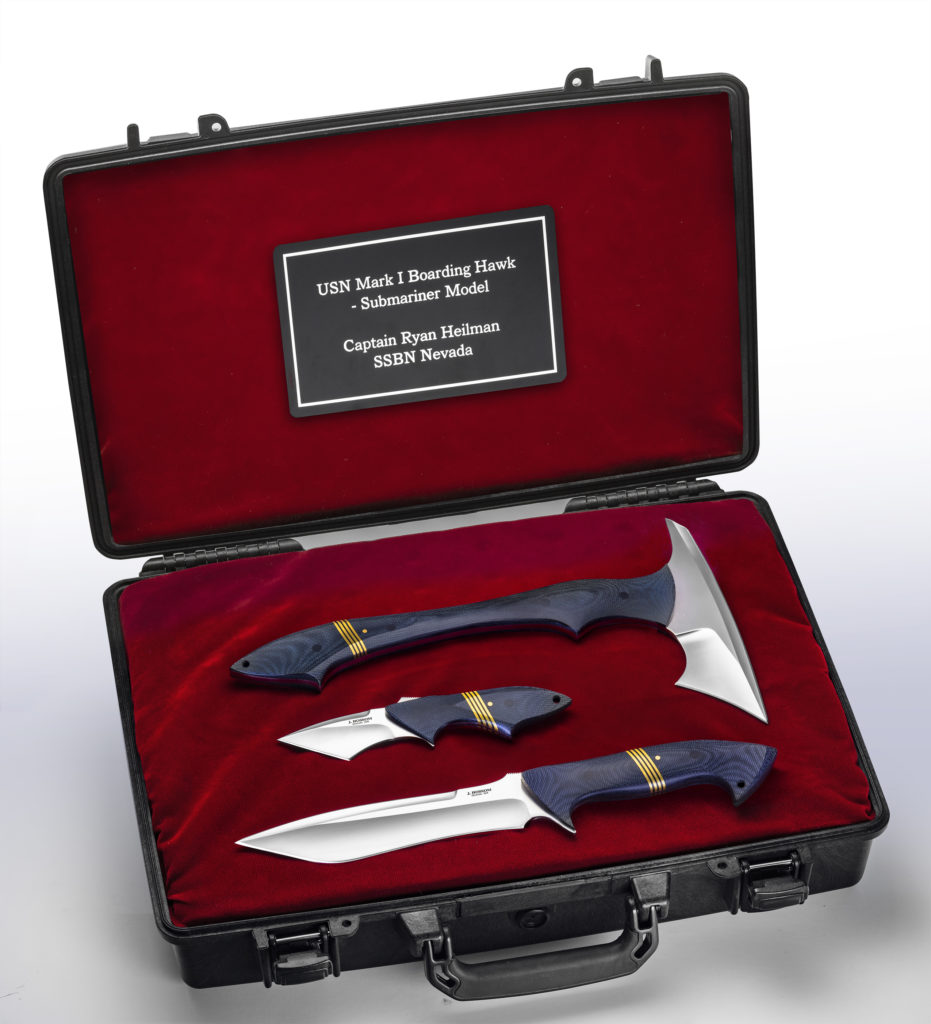
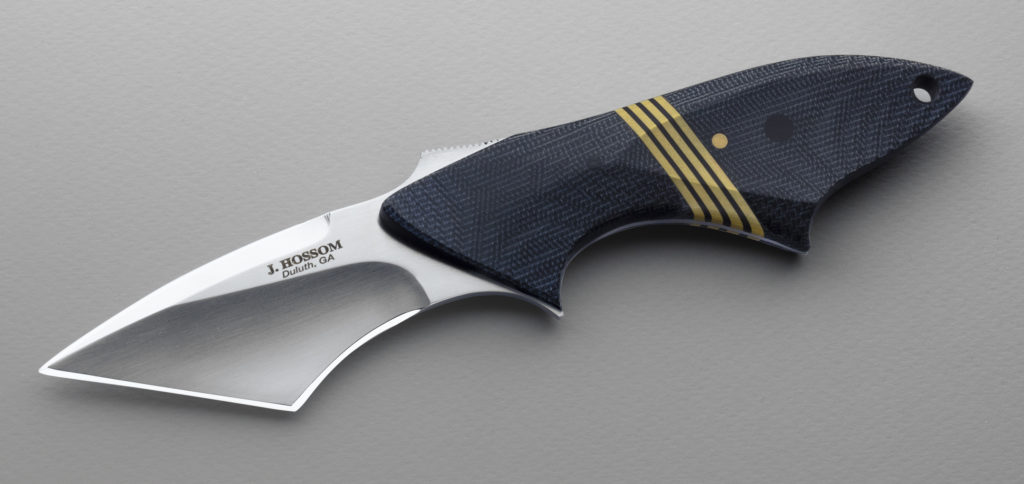
Sporting Navy blue Micarta handles, the set consists of Jerry’s USN Mark I Boarding Hawk-Submariner Model, a Retribution fighter and one of his small Dog Tag knives. However, as with many edged sets, it was a project that wound up a bit larger than when it first started.
In addition to the Submariner Boarding Hawk, the Retribution fighter and smaller Dog Tag knife complete the set and are contained in a red-velvet-lined briefcase. A sign with the set’s and owner’s names appears on the underside of the briefcase lid.
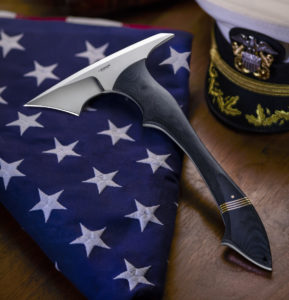
“Ryan’s wife Karen wanted something for him and I made the Boarding Hawk. I dyed the handle blue and I wanted it to look like the sleeve of a captain’s uniform. Captain Heilman has four gold stripes on his uniform sleeve and this would normally be a star, but I can’t do stars,” he laughed, pointing to the brass pin above the four brass stripes on the handle. “And so I made this and sent it to him.”
The USN Mark I Boarding Hawk-Submariner Model by Jerry Hossom is part of a three-piece set Jerry made for Capt. Ryan Heilman of the USS Nevada SSBN-733), a ballistic missile submarine in the United States Navy.
Soon after that Karen texted Jerry with an additional request. “She said what Ryan really wanted was one of my Retribution fighters, and so I did that,” Jerry smiled. “And then Karen said maybe you can complete the set with one of your little Dog Tag knives.” Pointing to the Dog Tag knife, Jerry said, “So this was the last one I did last week just before the show.”
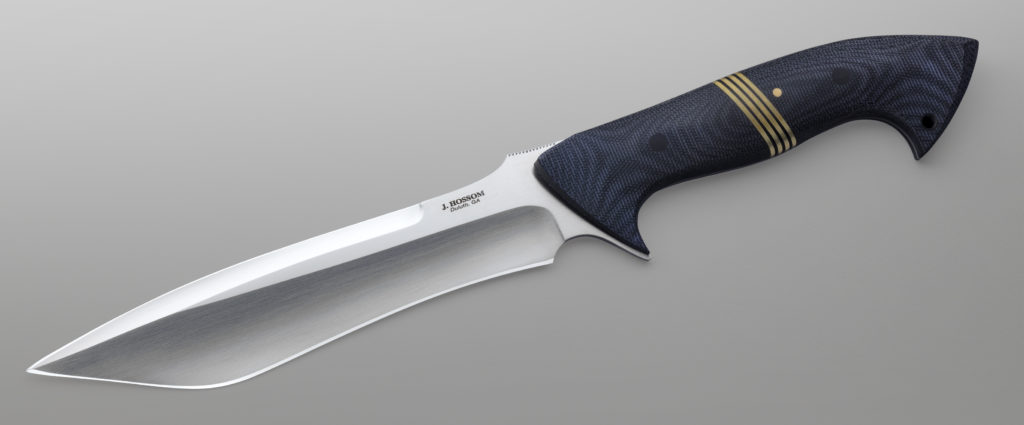
One of Hossom’s most recognizable knife models is his Retribution fighter. According to Capt. Heilman’s wife Karen it was the Hossom knife the Captain really wanted. Blade steel: Carpenter PSF-27 stainless. Handle: Navy blue Micarta® with bronze captain stripes and pin. Overall length: 13 inches.
Of course, Jerry outfitted both the Retribution and Dog Tag models with the same Navy blue Micarta handles and the brass stripes and pins to match the Submariner Boarding Hawk. In-between the stripes are thin layers of Navy blue G-10 that match the balance of the handles’ Navy blue Micarta. The handles of both the Submariner Boarding Hawk and Dog Tag knife have Jerry’s trademark palm cutouts that extend across the bronze pin and just north of the bronze stripes. The Retribution fighter, meanwhile, features a cradle handle style with the bird’s beak pommel on one end and the single guard on the other combining to form the cradle. The captain’s sleeve effect on all three is equal parts unmistakable and tastefully understated.
Hossom’s Dog Tag knife rounds out the three-piece set. As with the other three pieces, note the handle configured to resemble a captain’s sleeve with the four bronze stripes and pin. All the materials are the same for it as the Submariner Boarding Hawk and Retribution, including the blue G-10 in-between the stripes. Hossom would have made a regulation Navy star instead of the pin but, as he laughed, “I can’t do stars.”
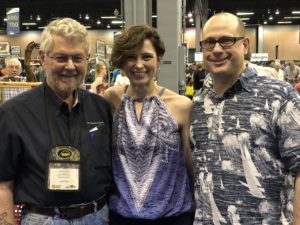
From left, Jerry Hossom and Karen and Ryan Heilman enjoy themselves at BLADE Show In between Jerry and Karen in the background knifemaker Grace Horne interacts with a customer at her table.
Blade steel for all three pieces is Carpenter PSF 27 stainless, one of Jerry’s favorites. Respective lengths for the Submariner Boarding Hawk, Retribution and Dog Tag are 14, 13 and 7 inches. All are contained in a red-velvet-lined briefcase with a sign inside the lid that reads “USN Mark I Boarding Hawk-Submariner Model” over “Captain Ryan Heilman SSBN Nevada.”
For more information contact Jerry Hossom, Dept. BL10, 3585 Schilling Ridge, Duluth, GA 30096 770-449-7809 [email protected], hossom.com.
The USS Nevada
The USS Nevada (SSBN-733) is a United States Navy Ohio-class ballistic missile submarine that has been in commission since 1986. Its homeport is Bangor, Washington, and its motto is Silent Sentry. This nuclear-powered craft is 560 feet long, has a speed greater than 25 knots (29 mph) and a test depth greater than 800 feet. It boasts a complement of 15 officers and 140 enlisted men, and its armament consists of 24 Trident II D-5 ballistic missiles, MK-48 torpedoes and four 21-inch torpedo tubes.
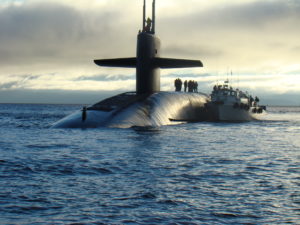
A United States Navy Ohio-class ballistic missile submarine, the USS Nevada has been in commission since 1986. (U.S. Navy image)
The 560-foot-long nuclear-powered USS Nevada calls Bangor, Washington, homeport.
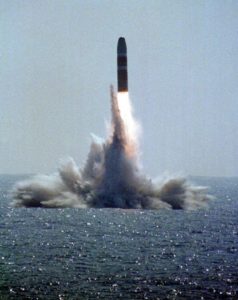
A crowd watches the contrail of a successful test launch of one of the Nevada’s Trident II D-5 ballistic missiles. (US Navy photo # 160722-N-OO32-040 by Mass Communication Specialist 2nd Class Cory Asato, courtesy of news.navy.mil.)
A Trident II missile breaks the surface after launch from the Nevada. (USN photo # DF-SC-87-12797, by TGS Technology, Inc., from the DOD Still Media Collection, courtesy of dodmedia.osd.mil.)
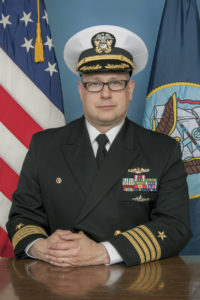
Capt. Ryan J. Heilman, USN
Capt. Ryan J. Heilman,
Capt. Ryan J. Heilman is commanding officer of the Blue Crew and captain of the USS Nevada (SSBN-73). He enlisted in the Navy as a machinist mate, nuclear option, and was selected for the Nuclear Enlisted Commissioning Program in 1991 and was commissioned from Officer Candidate School in Pensacola, Florida, in 1994.
Heilman was assigned to the PCU Wyoming (SSBN 742) in 1996, where he served as Navigation Division Officer and in several other positions. In 2002 he reported as Navigator/Operations Officer to the USS Nevada. He reported to Trident Training Facility, Bangor, Washington, in 2005 as the Engineering Training Department Director. In March 2008 he became Executive Officer of the USS Nebraska (SSBN 739). In 2011, after graduating from the U.S. Naval War College with a Master of Arts degree in National Security Studies, he was assigned as a Military Professor in the Joint Military Operations Department at the U.S. Naval War College in Newport, Rhode Island. In 2013, he reported to Submarine Squadron Seventeen in Bangor, Washington, as Deputy Commander for Readiness.
Capt. Heilman is a graduate of the U.S. Army’s Command and General Staff College, the Navy’s Naval War College and is a qualified Joint Service Officer. His awards include the Meritorious Service Medal, the Joint Commendation Medal, the Navy Commendation Medal (four awards) and the Navy Achievement Medal (two awards).