The history of knives and other edged instruments is tied to the history of people in general. As humankind’s oldest tool, unraveling knife history can lead to even more surprising and enriching information to better understand the world.
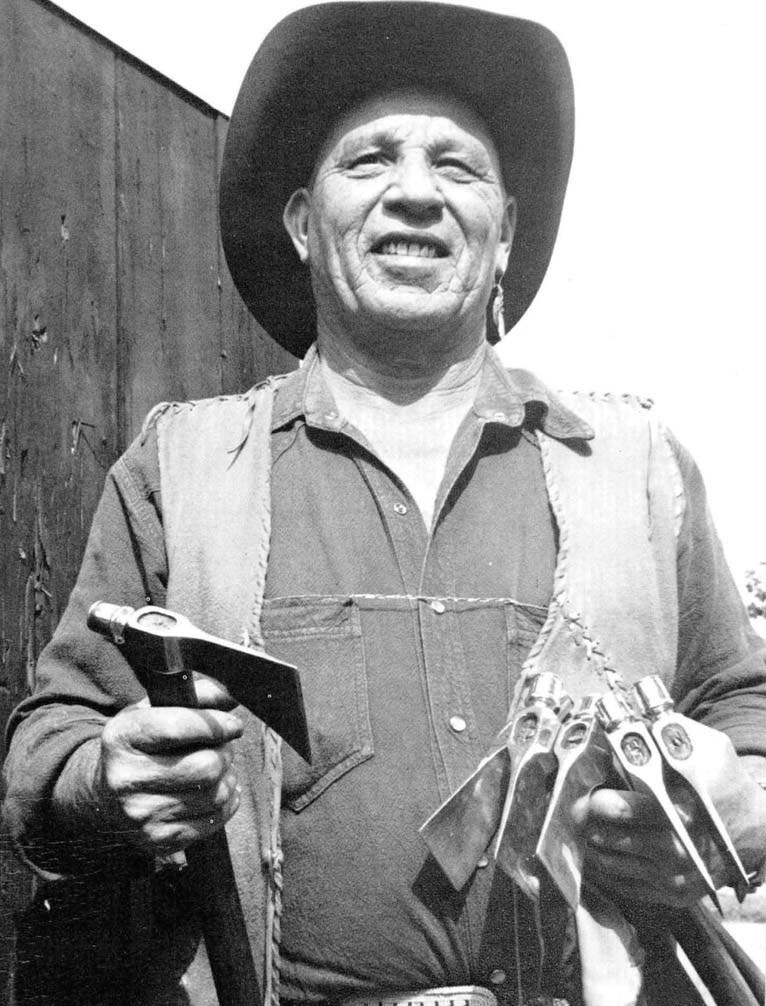
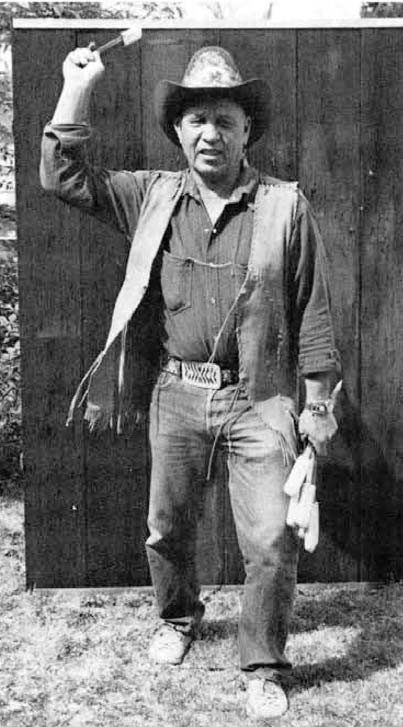
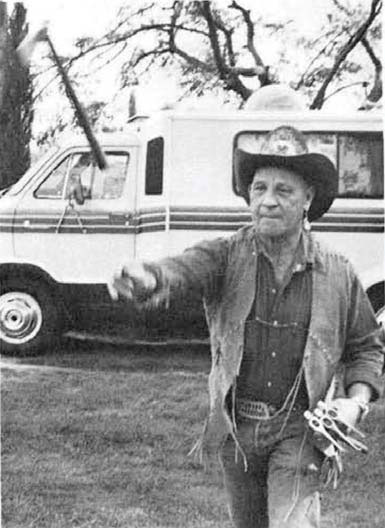
George E. “Skeeter” Vaughan (Grey Otter) was a sergeant in the Army’s U.S. Moccasin Rangers during World War II when he eliminated a German sentry with a prodigious knife throw on a snowy night in 1944.
George E. “Skeeter” Vaughan holds the distinction of making the most fantastic knife throw in recorded history—and considering the circumstances surrounding his legendary feat, he most likely will maintain his grasp on that honor for a long time to come.
An American Cherokee Indian whose given name was “Grey Otter,” Vaughan was a member of an elite Army unit called the U.S. Moccasin Rangers, all 15 members of which were American Indians especially gifted with excellent night sight. At the age of 19 he enlisted in the U.S. Cavalry in 1942, and later landed with his unit on Omaha Beach two days after D-Day in June 1944. Two weeks later the Moccasin Rangers were formed.
On a snowy November night in 1944, Skeeter and five other members of the Moccasin Rangers were given the assignment of knocking out a German bunker with pillbox on the Siegfried Line to make way for an American advance. Belly down in the snow behind the bunker concealed on the brow of a hill in a small stand of timber about 35 yards away, Vaughan and his men were faced with the problem of how to neutralize the emplacement.
Skeeter contracted trench foot during the war and doctors recommended his feet be amputated. He went AWOL from the service hospital and returned to his old unit, asking to be put on active duty rather than lose his feet. His request was granted. He was wounded five times and decorated profusely. He was the only member of the Moccasin Rangers to survive the war. He passed away in 1989.
Outside the bunker was a German sentry with his back to the hill where Vaughan and his men were positioned. The sentry had to be eliminated—and eliminated silently so he could not warn the other German soldiers. There was too much open ground for one of the Rangers to cross it and silence the sentry, and a gunshot would alert the enemy.
A sergeant and commander of the patrol, Vaughan was asked by one of his men if he could take out the sentry by throwing his bayonet/knife. As a boy, Vaughan had lived on Indian reservations and was taught all about weapons by his grandfather, old Limping Bear, a Cherokee born in the Smoky Mountains of Tennessee. Skeeter’s training included throwing knives and tomahawks, and he had put that training to use prior to the war hurling hawks and 16-inch knives made from old bayonets in performances at rodeos and in “Doc Willetson’s Big Medicine Show” that toured the West.
However, that training was about to undergo a test like no other.
As adept as he was at throwing knives, Skeeter was believed to be the world’s best at throwing hawks. His model of preference was a pipe hawk.
Skeeter crawled from the timber as far as he dared and stood, hoping he would not be spotted. The sentry’s back was still toward him. Skeeter threw the knife with a high trajectory, aiming about three feet above the sentry’s head. The knife turned silently over and over in its long, downhill pinwheel flight. The sentry dropped without a peep face down in the snow.
Considering the distance thrown—later measured at 87 feet—it was probably the longest successful throw in battle in the annals of knife throwing.
Later in life, Skeeter found acting roles in Happy Days, Gunsmoke,The Six Million Dollar Man, Magnum, P.I. and Revolution, per IMDB. He died in 1989.
Video Re-enactment
To get a better feel for what happened on that snowy day in 1944, here’s a re-enactment. Remember that Skeeter only had one chance to get it right.
The origins of damascus steel date to as early as 1500 BC.
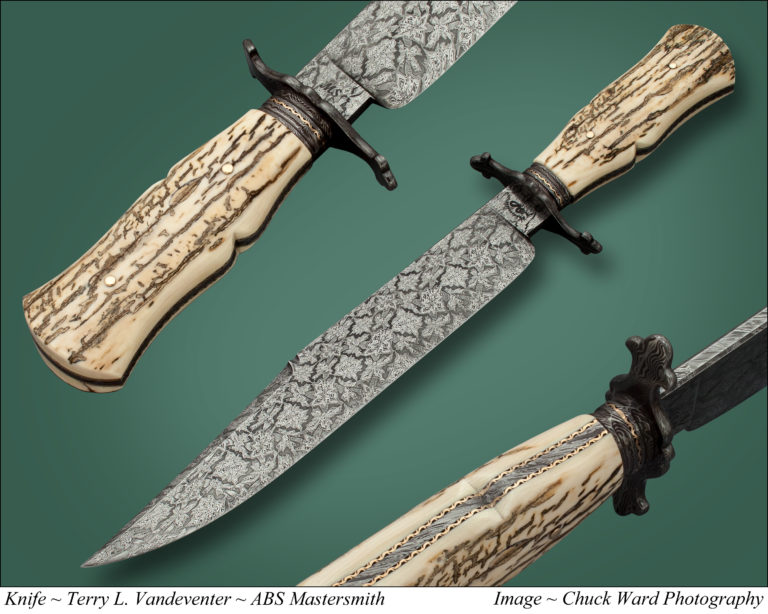
The allure of damascus steel lies not only in its beauty and utility, but also in the mystique of its origins. Though its development began in ancient times, the word damascus has grown to encompass more than one method of steelmaking, and the earliest method is believed to date back to 1500 BC.
“Damascus steel today can mean at least three things,” explained blacksmith and steel authority Rick Furrer. “First, there’s pattern-welded steel where a bloom of steely irons is welded into a solid mass which then has a pattern. This is the oldest of damascus-steel-making technologies and one which most blacksmiths reproduce with layers of modern steel welded together.
“Second is crucible steel, where the material is fully melted in a container and then the resulting ingot is forged into a bar, which may or may not have a surface pattern. Third is overlaid or inlaid wire, gold, silver, copper or such into a base metal surface such as steel or silver to make a surface pattern. Some call this damascening or damascene.”
Those who have studied the origins of damascus tend to agree that pattern welding did happen first and that it occurred in the Far East, the Indian subcontinent, the Middle East, Indonesia and Europe. Crucible steel production is also referred to as wootz, and its beginning, for some, is easier to pinpoint.
“Some call crucible steel, or wootz, the original damascus, but pattern welding predates it by more than 1,000 years. Pattern welding was in Europe by 1100 BC in Greece and easily by 600 BC in Central Europe. It was very widely spread by 400 BC,” observed Furrer, who in 2011 participated in the filming of a Public Broadcasting System NOVA segment on the famed Viking swords from circa 800-1000 AD with the Ulfberht inscription. The extremely low slag content of the Viking blade steel may indicate a new development in steel processing in Europe, or that the Vikings were forging blades from imported crucible steel.
“The earliest examples of blades made from wootz steel date from around the first century BC,” related ABS master smith Kevin Cashen, “and the oldest examples of the material seem to come from India. While the Indians seem to have been the first to produce crucible steel, they were soon followed by other cultures in the Middle East such as the large production centers in what would now be Turkmenistan and Uzbekistan. Pattern welding is a trickier process to pinpoint, date or credit to a given culture as it is very old, and just about any people working iron would have produced welded blades on some level.”
Technological Advancements Of Demascus
As technology evolved, production methods improved and fueled the availability of high-quality blade steel. Performance and purpose have contributed to the growth of the industry and the changes in the scale of production through the centuries.
“All of these steel processes were driven by warfare and weapons technology,” noted ABS master smith Steve Schwarzer. “As soon as someone discovered a new method, everybody who wanted to survive jumped on that new method. The moment the local smith developed a method to heat steel to a totally liquid state and control the carbon, the need for wootz and pattern-welded blades fell to the wayside except for the very few who viewed it as art. When the Bessemer converter came into use [in the 1850s] and steel was produced in tonnage at any carbon level desired, there was no need to use the labor-intensive process of making one small piece of material at a time.”
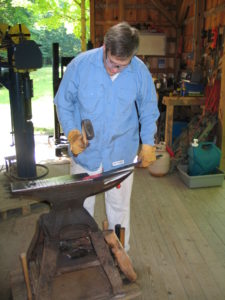
The basic tools used by early makers of pattern-welded damascus were quite similar to those used by the modern bladesmith—hammers, anvils and forges. Dan Farr hammers hot steel in his shop. (Dan Farr image)
Nonetheless, the craftsmanship and performance of forged damascus is timeless. Modern damascus makers take advantage of improved technology and know-how. The ancient producers worked with basic tools and equipment during a process of both production and discovery. The early makers of pattern-welded damascus combined bloomery steel with varying properties, says Cashen, but the basic tools were quite similar to those used by the modern bladesmith—hammers, anvils and forges.
“One difference is possibly the absence of the fluxes we use today,” Kevin added. “The simple bloomery products of that time period, when worked in a charcoal fire, would weld much more easily and not require the oxygen barriers that we have become so accustomed to today.”
The early crucible process would have involved sealing some amounts of premade iron along with certain organic/carbon-bearing materials and fluxes into a clay crucible that would have been placed in a charcoal-fired furnace, which would usually have been fired by a bellows or natural air drafts.
“The clearest difference in either method now compared to then is the fuel we have at our convenience today,” Cashen commented. “Gas-fired forges and furnaces make the tasks much more convenient than the arduous, dirty labors at ancient charcoal fires.”
Staying True To The Steel’s Roots
Maybe it is true that the more things change the more they stay the same, particularly as it relates to damascus steel. Surviving examples of either pattern-welded or crucible damascus are impressive in their quality. Modern bladesmiths produce damascus and mosaic damascus/canned steel that simply defies description, the beauty of the patterns speaking for themselves.
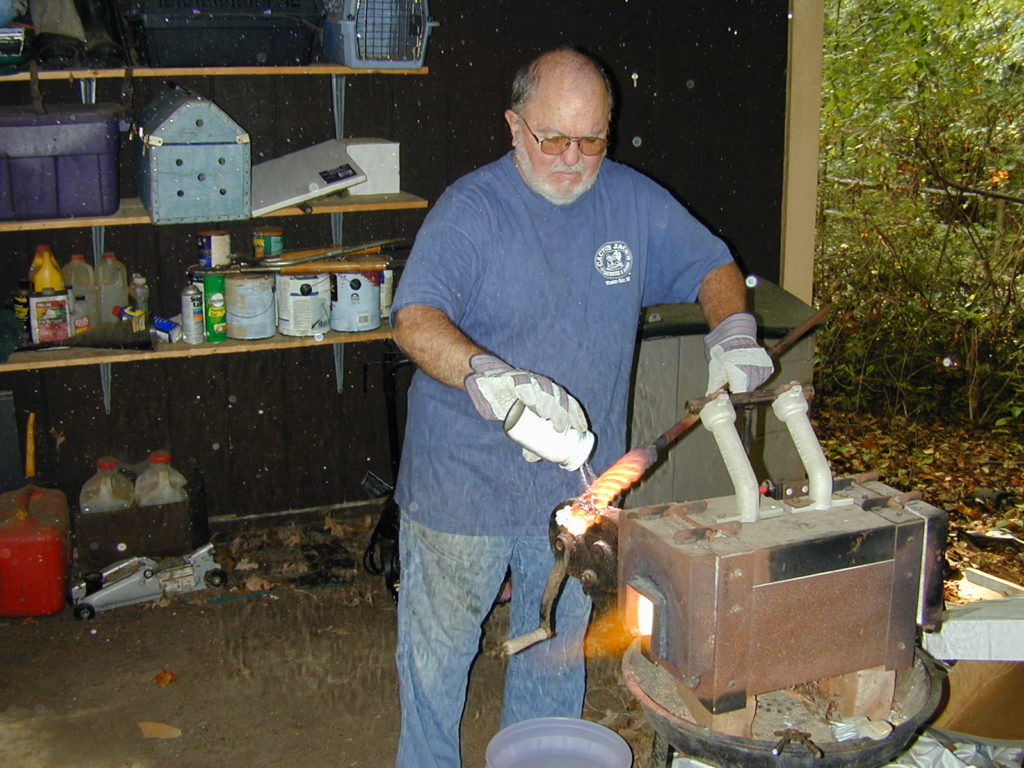
One of the differences between the way damascus is made today as opposed to centuries ago is the use of flux—applied here to a twisted billet by Tim Britton. (Britton image)
Damascus also originally occupied a transitional period in human history. As the Bronze Age waned in Europe, basic iron blades began to appear and pattern welding followed. In the East, iron blades of piled construction were made and pattern welding may have taken place concurrently with it, both being phased out as the crucible process came along. Most experts agree that Europeans were introduced to crucible damascus/wootz during the Crusades.
“With the wootz made by high-temperature smelting in a crucible and forming a cake, bulat or ingot, this ingot was then formed in a very slow, methodical process to produce a beautiful pattern of iron-carbide ferrite and cementite banding,” Schwarzer commented. “This was called watered or damascus steel. It is thought Europeans encountered this material for the first time during the Crusades near Damascus, Syria. Then, this cast material was traded all over the world.”
ABS master smith Al Pendray is well known for his work in wootz steel. Along with John D. Verhoeven, he is listed by the U.S. Patent Office as one of the inventors of “a method of making a steel article having an external surface appearance and an internal microstructure resembling that present on an antique ‘Damascus’ steel sword or blade.” Pendray contends that the earliest crucible damascus was made in Persia and quickly got the attention of Westerners who came in contact with it. “Wootz is ultra-high carbon and will take a real clean edge,” he remarked. “With all the nonmetallic stuff and impurities floating to the top in the process, it’s also a super clean steel.”
But Why Call It Damascus?
As intriguing as the steel itself, the name damascus has a mysterious origin. While the obvious link is to the ancient capital of Syria, the answer to the source of the steel’s moniker is open to speculation.
“One such story maintains that only wootz can be called damascus steel because it was wootz that the Crusaders first encountered in the Middle East, with the town of Damascus being the trading hub for its distribution, thus lending it the name,” Cashen offered. “This theory ignores the fact that there were also damask cloths [with intricate patterns formed by weaving], and that the treatments on many materials involving carving, inlay or otherwise were worked with an intricate flowing or water-like pattern called damascene. It is also worthwhile to note that an old Arab term for water is damas, a coincidence that’s hard to ignore when you consider the number of cultures that refer to patterned steel as ‘watered’ or having ‘watering.’”
Speculating about the origin of the name is intriguing, but Cashen says it is what it is. “In any case, the number of centuries that any steel with a pattern in it has been called ‘damascus’ sort of renders all of these speculative picky semantics irrelevant,” he noted. “Languages evolve, and the word means what it does today. When this is taken into consideration, any steel possessing an induced pattern could be safely referred to as damascus, with pattern welding or crucible steel being the more specific types of patterned steel.”
According to Master Bladesmith Steve Schwarzer, modern steels are far superior to even the best of the ancient materials because of quality control and repeatability.
Finest Blades Ever
As with many highly prized skills, individual bladesmithing and the production of high-quality damascus steel in small quantities has been eclipsed by mass production, given the availability of modern equipment and technology. However, the steel still owes its lineage to the blacksmiths of ancient times. Additionally, today’s bladesmiths keep the tradition and the skill alive like no mass production process can.
“Modern steels are far superior to even the best of these ancient materials because of quality control and repeatability,” Schwarzer mused. “What modern steels don’t have are beauty and the visual fingerprint of the steel artist’s hand. The damascus blades being made in modern times are far superior to the ancient blades because the modern smith is using these very sophisticated steels and modern scientific techniques to produce the finest blades ever made.”
(relic image courtesy of the Cushing Memorial Library and Archives, Texas A&M University Libraries)
Editor’s note: Read part one and two of this series first.
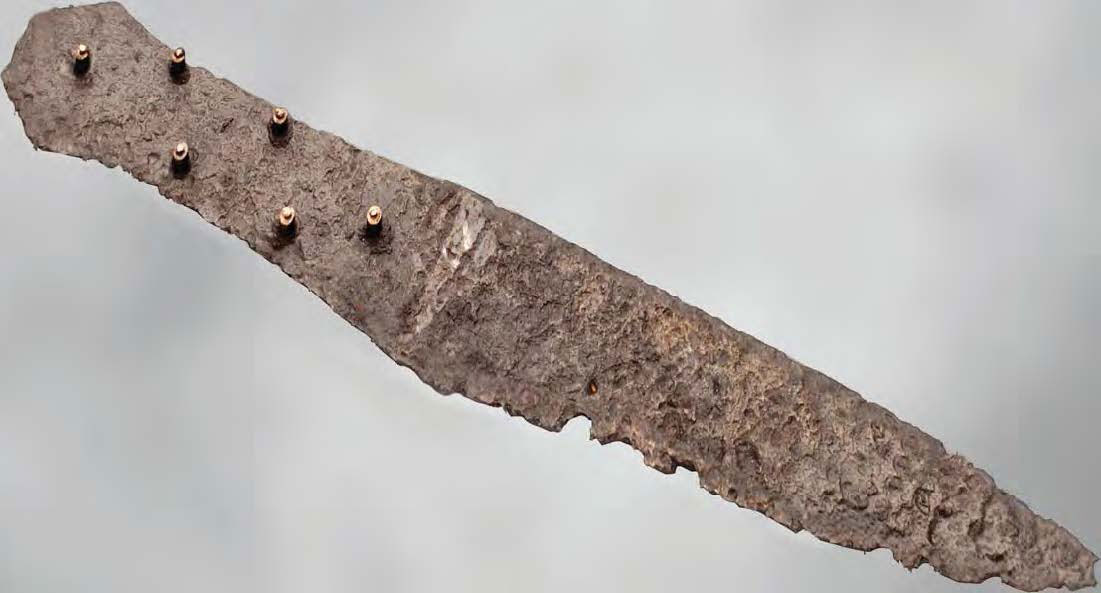
Did the Sea of Mud Knife Belong to Davy Crockett?
Davy Crockett passed by James Black’s Shop in 1835 on his way to the Alamo. Could he have bought the Sea of Mud knife (above) from Black or received it as a gift?
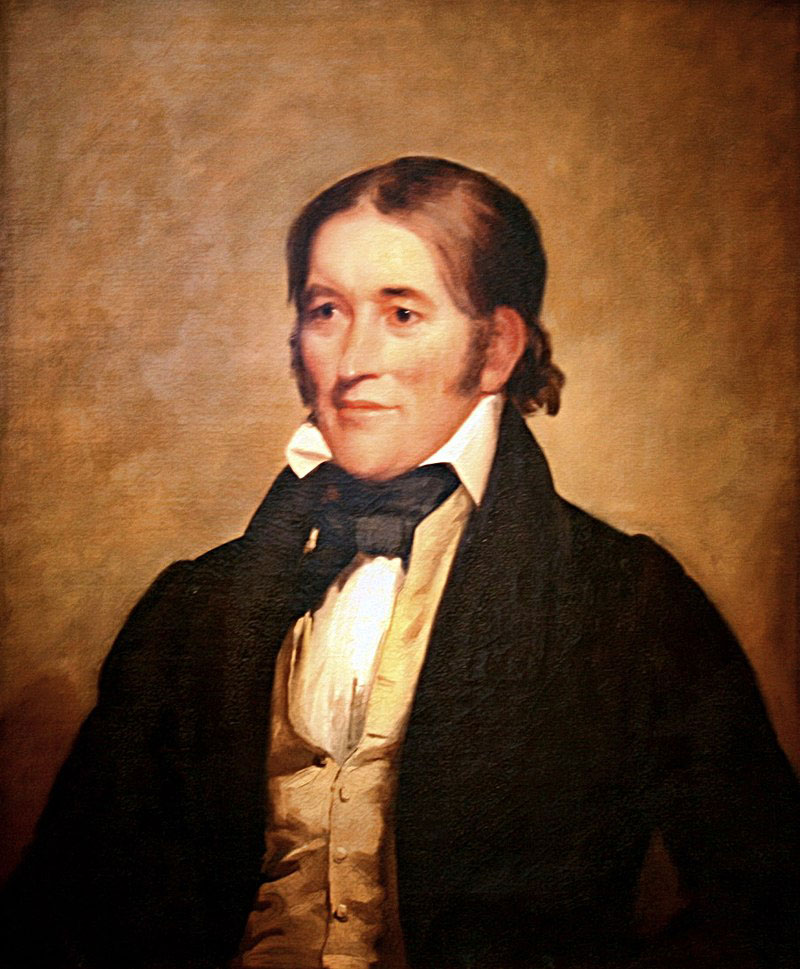
On about Nov. 18, 1835, the most famous fallen hero of the Alamo and his entourage crossed Town Creek on the Southwest Trail that led up the hill past James Black’s Shop to the Elijah Stuart’s tavern in Washington, Arkansas. Did former Tennessee congressman, Col. David “Davy” Crockett, or one of his companions buy the Sea of Mud knife from Black? Did Black give the knife to the famous folk hero?
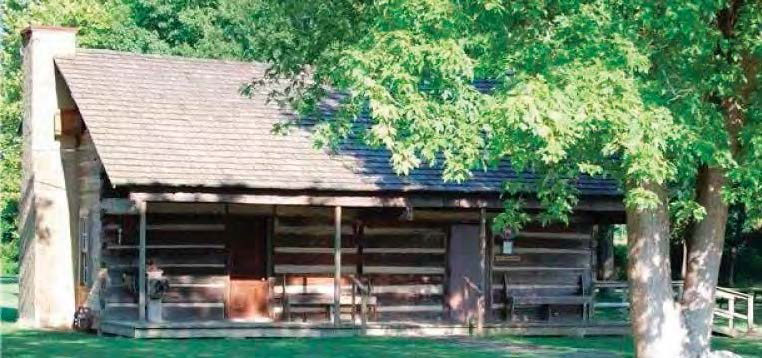
On Nov. 1, 1835, Crockett, along with three others—William Patton, Abner Burgin and Lindsey K. Tinkle—left Crockett’s log cabin home near Rutherford, Tennessee, on a journey of adventure, exploration and fortune hunting.
Having recently lost his U.S. House of Representatives seat to Adam Huntsman, “a one-legged Jacksonian,” Crockett told his constituents, “Since you have chosen to elect a man with a timber toe to succeed me, you may all go to the devil and I will go to Texas.” Most certainly he told this tale over and over, all the way to Texas, always to the delight of his audience. He traveled to Jackson, Tennessee, arriving there with 30 well-armed men, where he gave a speech from the steps of the Madison County courthouse.
Crockett left his log cabin home in Rutherford, Tennessee, on Nov. 1, 1835, on a journey of “adventure, exploration and fortune hunting.”
From there he rode southwest to Bolivar, where he spent the night at the residence of Dr. Calvin Jones, once again drawing crowds—including one that sent Crockett off the next morning.
He arrived in Memphis with a much-diminished company on Nov. 10. There that night much time was spent enjoying horns of drink with citizens and comrades at the Union Hotel, Hart’s Saloon and Neil McCool’s establishment.
At 7:30 a.m. on Nov. 11, Crockett and his entourage of six to eight men left Memphis on a packet steamboat. He obviously was recovering from a night of carousing. The steamboat traveled 311 miles down the Mississippi River and up the Arkansas River, arriving at Little Rock at 4:30 p.m. on Nov. 12. The local newspapers reported that hundreds of people swarmed into town to get a look at Crockett, and a group of leading citizens put on a dinner in his honor that night at the Jeffries Hotel. He spoke “mainly to the subject of Texan independence,” as well as federal politics.
Washington, Arkansas
Crockett had traveled 150 miles in nine days on his large chestnut horse with the star on its forehead. He had at least three more traveling companions with him when he left Little Rock that morning. It was only 125 miles down the Southwest Trail to Washington, Arkansas, and just a few more miles to Texas. It is not known how long he stayed in Washington, maybe just overnight, because he was so close to that wonderful land called Texas.
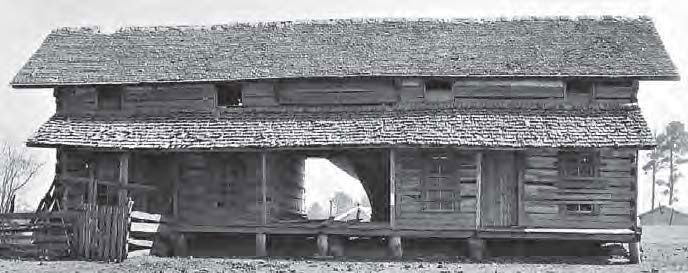
On the way to Washington, Arkansas, Crockett stayed at the home (above) of Hugh Armstead Blevins in present-day Blevins, Arkansas.
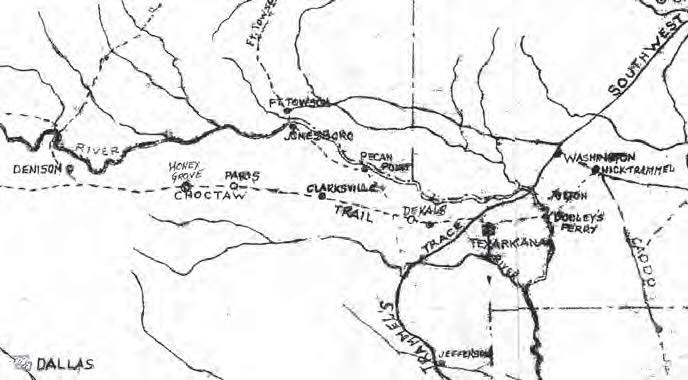
He had stayed with an old and dear friend from Rutherford County Tennessee, Hugh Armstead Blevins, in present-day Blevins, Arkansas, before riding into Washington. Blevins family tradition maintains that Crockett went on a weeklong deer-hunting trip with Hugh. Crockett stayed at Elijah Stuart’s tavern next to James Black’s shop in Washington. The people came in from all around to hear Crockett speak from the courthouse steps. After some celebrating, Davy and a half-dozen mounted companions could have ridden to the Red River and crossed into Texas at Dooley’s ferry.
Some historians say he went down the Fort Towson road 115 miles and crossed the Red River into Texas at Jonesboro, just north of present-day Davenport, Texas. He may have crossed the Red River at Dooley’s Ferry just as W.G. Featherstonhaugh did.
Crockett stayed at Elijah Stuart’s tavern next to James Black’s shop in Washington. He may have crossed the Red River at Dooley’s Ferry as did W.G. Featherstonhaugh. Some say Crockett went down the Fort Towson road 115 miles and crossed the Red River into Texas.
Several weeks after the fall of the Alamo Crockett’s widow, Elizabeth, received a small package from Isaac Newton Jones. The package contained a watch with Crockett’s name engraved inside. In an accompanying letter, Jones wrote:
“Last winter, Colonel Crockett … passed through Lost Prairie, on the Red River, where I live … the Colonel visited me the next day, and spent the day with me. He observed, whilst here, that his funds were getting short, and proposed to me to exchange watches. He priced his at thirty dollars more than mine, which sum I paid to him, and we accordingly exchanged … I was gratified at the exchange, as it gave me a keepsake which would remind me of an honest man, a good citizen, and a pioneer in the cause of liberty … the object of this letter is to beg that you will accept the watch which accompanies it … please accept, dear madam, for yourself and your family …”
Crockett’s Letter
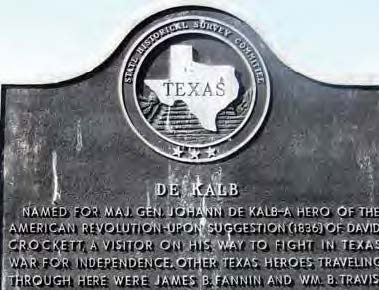
Crockett reportedly suggested the name for De Kalb, Texas and traveled through the area on his way to the Alamo.
The distance from Lost Prairie to Nacogdoches down Trammel’s Trace was 165 to 170 miles. At the rate of 25 miles per day Crockett should have arrived at Nacogdoches, Texas before the end of November. Crockett and his entourage were welcomed in Nacogdoches on Jan. 5, 1836.
Here is what Crockett stated in a letter written to his son and daughter from St. Augustine, Texas, dated Jan. 9, 1836:
“This is the first time I have had the opportunity to write to you with convenience. I am now blessed with excellent health and am in high spirits. Although I have had many difficulties to encounter, I have got through safe, and have been received by everybody with the open arm of friendship. I am hailed with a hardy welcome to this country. A dinner and a party of Ladys have honored me with an invitation to participate with them, both in Nacogdoches and this place. The cannon was fired here on my arrival, and I must say, as to what I have seen of Texas, it is the garden spot of the world. The best land and the best prospect for health I ever saw is here, and I do believe it is a fortune to any man to come here. There is a world of country to settle. It is not required here to pay down for your League of Land; every man is entitled to his head right of 4,000 & 428 acres. They may make the money to pay for it off the Land.
“I expect in all probability to settle on the Bodark or Choctaw Bayou of Red River. That, I have no doubt, is the richest country in the world. Good Land and plenty of timber, and the best springs and good mill streams. Good range, clear water and every appearance of good health, and game plenty. It is in the pass where the Buffalo passes from the north to south and back twice a year, and bees and honey plenty.
“I have a great hope of getting the agency to settle that country, and I would be glad to see every friend I have settle there. It would be a fortune to them all.
“I have taken the oath of the Government, and have enrolled my name as a volunteer for six months, and will set out for the Rio Grand in a few days with the volunteers from the United States. All volunteers is entitled to a vote for a member of the convention, or to be voted for, and I have but little doubt of being elected a member to form a constitution for this Province.
“I am rejoiced at my fate. I had rather be in my present situation than to be elected to a seat in Congress for life. I am in hopes of making a fortune for myself and family, bad as has been my prospects.
“I have not wrote to William, but have requested John to direct him what to do. I hope you show him this letter, and also your brother John, as it is not convenient at this time for me to write to them.
“I hope you will do the best you can, and I will do the same. Do not be uneasy about me, for I am with my friends.
“I must close, with great respects, your affectionate Father, Farewell David Crockett”
Crockett spent December roaming the north Texas countryside along the Red River visiting friends and looking for a prosperous place to settle down where there was good bear and buffalo hunting. He was also dodging Comanche Indians. He headed west along Ridge Trail or Choctaw Trail 175 miles along the Red River as far as Choctaw Bayou. Choctaw Bayou runs from Grayson County northeast into the Red River at the northwest corner of Fannin County above Sherman and Denison, Texas.
Crockett stayed at Elijah Stuart’s tavern next to James Black’s shop in Washington. He may have crossed the Red River at Dooley’s Ferry as did W.G. Featherstonhaugh. Some say Crockett went down the Fort Towson road 115 miles and crossed the Red River into Texas.
It is said that the morale of the defenders of the Alamo in San Antonio enjoyed a boost on Feb. 8, 1836, when the former U.S. congressman from Tennessee, bear hunter and Indian fighter rode in with a contingent of Tennessee Mounted Volunteers.
Next time: The fortifications by the defenders and the probing of them by the Mexican Army during the Alamo siege.
The American Blade Cover saluted the Marines’ bicentennial in grand fashion.
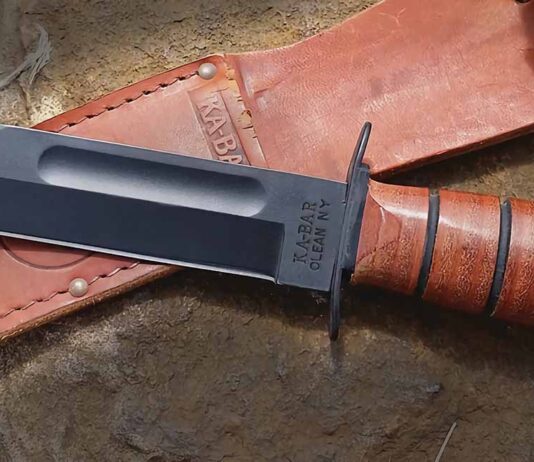
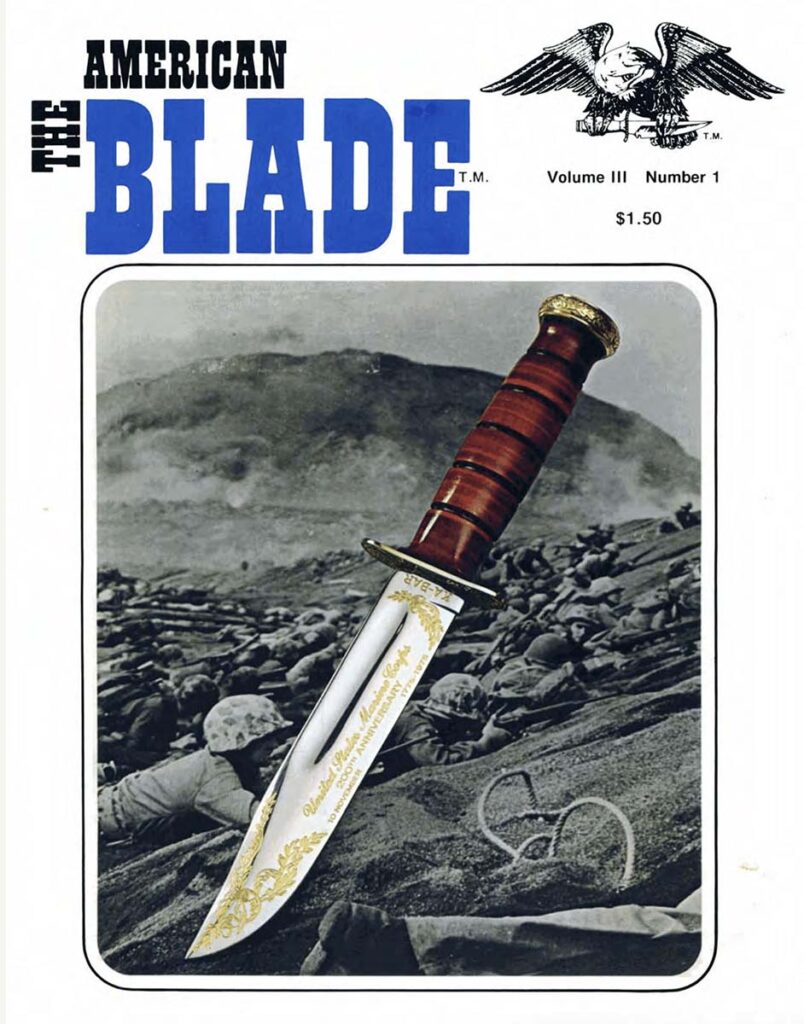
A half-century ago, the November-December issue of The American Blade recognized the 200th birthday of the United States Marine Corps with a special commemorative KA-BAR U.S.M.C. fighting/utility knife on the cover.
The cover of the November-December 1975 issue of The American Blade featured the 200th anniversary “Commemorative U.S.M.C. Fighting Knife” by KA-BAR Knives. The Corps celebrates its 250th anniversary this year.
Paired with the iconic image of U.S. Marines inching their way up the beaches of Iwo Jima during the titanic struggle to take the island from the Japanese during World War II, the cover knife featured a blade with “gold accents” that included the Corps’ founding date of 10 November and 1775-1975, oak leaf patterns and 200th Anniversary under United States Marine Corps in script.
The commemorative’s “top quality leather handle” was an exact duplicate of the handle on the original 1941-45 issue knife. The commemoratives were made in a limited edition of 2,500 with individual MSRPs of $300 for knives serial numbered two through 49, $200 for serial numbers 50 to 99, $150 for serial numbers 100-199, and $100 for serial numbers 200 and up.
The Wharncliffe Is An Interesting Blade Design With A Captivating History. Over The Years It’s Grown Into A Desirable EDC Blade. These Five Wharncliffes Stand Out From The Pack.
There aren’t many blade styles like the wharncliffe. The wharncliffe stands out from many other blade designs thanks to its long, straight cutting edge and spine that tapers to the point. This allows for a variety of shapes of wharncliffe blades, with some being more squared off with a sharp taper and others being more rounded with a more gentle taper.
Regardless of the taper or size of the blade, the wharncliffe has grown into a beloved blade that has evolved to meet the needs of knife lovers over the last 200 years.
Where Does The Name Wharncliffe Come From?
If you guessed that it was named for a person you’d be correct, or at least almost correct. The name for the blade dates back to the 1820s and British Colonel James Archibald Stuart-Wortley-Mackenzie, the first Lord of Wharncliffe.
One night, while having dinner with his cousin, Archdeacon Corbett, Wharncliffe was lamenting how staid and tired the cutlery industry in Britain had become. The two then worked on a new type of knife to present to the Joseph Rodgers & Sons cutlery company in Sheffield, the epicenter of the cutlery trade in the UK.
Rodgers liked the blade so much that the company put it into production and named it the wharncliffe in the Lord’s honor.
What Is The Wharncliffe Used For?
The wharncliffe initially was used mainly as a whittling knife. The long, straight edge made it perfect for long strokes on a piece of wood. Over time, the blade has evolved with the rest of the knife industry and is now a quality all-rounder EDC. The straight edge is excellent at transferring energy from the hand into the material being cut. Not great at puncturing, it’s very good at most other cutting tasks.
5 Wharncliffes You Should Look Into Buying
Today, the wharncliffe has become a standard blade design by makers around the world. These are five that you should take a look at.
Spyderco Salt 2
Few companies have dived deeper into wharncliffes than Spyderco. The Salt 2 is a prime example of how the company has smartly developed the blade style, although there are many knives on the company’s roster that utilize it as well.
The ergonomic green FRN handle makes this knife easy to use, especially considering how it was designed to be used near water. The H-1 steel is highly corrosion resistant, which makes this knife the perfect choice to use near water. You can choose between a plain edge and a serrated edge, and the lockback keeps everything secure even when drenched.
Spyderco is beloved because of the quality of its knives, and the Salt 2 shows many things the company can do.
MSRP: $124.25
CRKT Inara
A simple, elegant design from Richard Rogers, the CRKT Inara is a perfect example of a quality, affordable wharncliffe EDC.
The framelock is strong. The deployment is smooth. The G-10 stands firm even in extreme conditions. This little flipper really does it all and looks good while doing it. The stonewashed 8Cr14MoV stainless blade is 2.78 inches long and the whole construction weighs just 1.8 ounces.
A small, nimble knife, the Inara showcases why the wharncliffe has become a regular EDC blade.
MSRP: $56
Emerson Knives P-Sark
If the last knife was for day-to-day use, the Emerson Knives P-Sark is for the most extreme situations. This is the standard issue knife for U.S. Navy Rescue Teams, according to Emerson Knives. It’s a thick, beefy blade designed to extract people in severe situations.
The 3.5-inch blade is made from 154CM stainless steel with a chisel grind. The G-10 handle is waterproof and perfect for the type of intense moments this knife was built for. The blade comes in both black and stonewashed varieties.
Sure, this could be used as an EDC, but this knife is designed for much more than just opening boxes and stripping wires, and is priced accordingly. If you want a strong, physical knife, then this is the one for you, but you’ll be able to find good EDC wharncliffes at more affordable prices.
MSRP: $226.95
Kershaw Leek
Kershaw has them all, and it’s no surprise that it offers a solid EDC wharncliffe. The Leek line of knives runs 16 deep, but we are concentrating on the original.
The whole construction is stainless steel with a 3-inch blade made from 14C28N stainless steel. The Ken Onion-designed knife is a sleek, sturdy flipper held in place with a framelock. At 3 ounces it’s a bit heavier than some of the other knives on this list, which is good because it helps the piece feel better in the hand and more secure in use.
The assisted-opening flipper, the tip lock to keep it secure when closed, and the reversible pocket clip are all features on the knife that elevate it from just a good knife to a high-quality EDC.
MSRP: $79.99
Cold Steel Tuff Lite
Small. Tough. Durable. Three ways to describe the Tuff Lite from Cold Steel. This little wharncliffe is a rugged little beast. Made from Japanese AUS-8A stainless steel, the Tuff Lite’s blade is just 2.5 inches long with a relatively squared-off tip that makes it perfect for deep cutting tasks.
The handle is made from Griv-Ex which, when paired with Cold Steel’s Tri-Ad lock, provides a rock-hard construction when deployed. This is the most affordable knife on our list, but it may be the highest value thanks to how the knife was put together.
MSRP: $40.99
Read More
Bowie Beauties: Three Quality Factory Bowie Knives
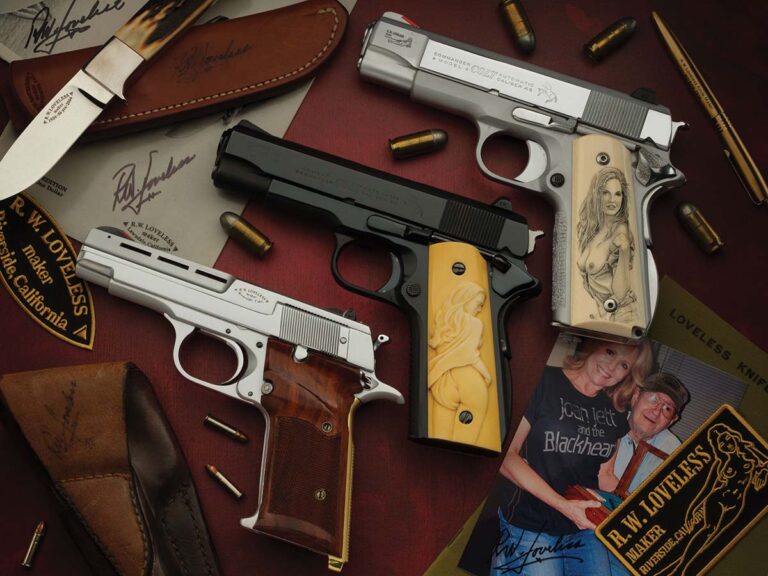
Three highly coveted firearms modified by the Cutlery Hall of Fame® legend—including his “de-fanged” Colt Commanders—head to Rock Island Auction.
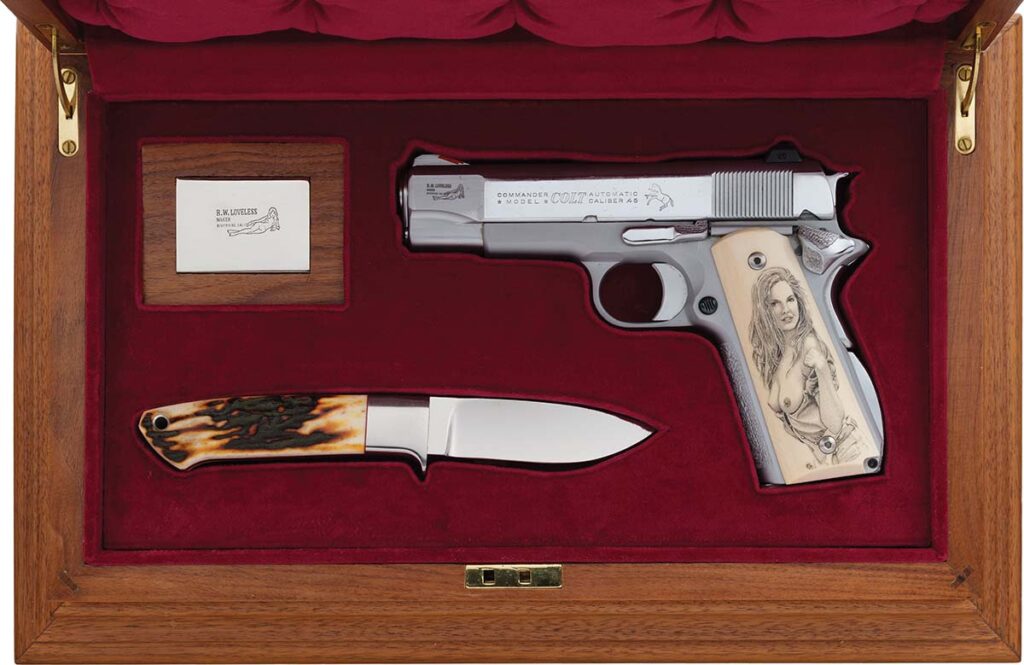
Bob Loveless Colt “Old Smoothie” Lightweight Commander semi-automatic pistol with scrimshawed ivory grips, drop-point Loveless Knife and sheath. Rock Island Auction image
While the late Bob Loveless secured his legacy as a titan of the cutlery world, the BLADE Magazine Cutlery Hall of Fame® member also brought his legendary eye for utility to the firearms world. His knives remain some of the most desirable, coveted custom creations on the planet, but a rare trio of his personal, customized handguns are now heading to the auction block at Rock Island Auction in the company’s June 27 American Sale (now live online). The selection highlights how the master craftsman applied his famous Bauhaus-inspired design ethos to custom gunsmithing.
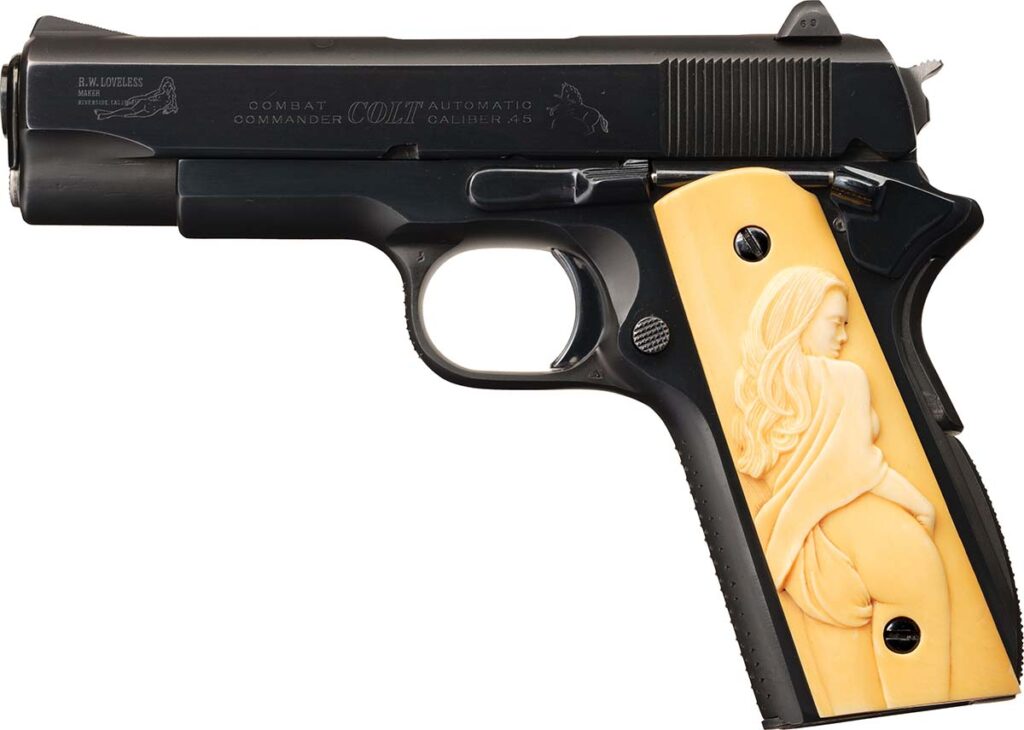
Bob Loveless Colt “Old Smoothie” Combat Commander semi-automatic pistol with relief carved ivory grips. Rock Island Auction image
The lineup features two Colt Commander pistols that Loveless thoroughly “de-fanged,” a signature modification process where he systematically bobbed the hammers, radiused the frames and smoothed away every sharp edge that could gouge a shooter’s hand. The first is a c. 1980 Lightweight Commander, featuring his electro-penciled initials, custom Browning cuts on the slide, and smooth ivory grips scrimshawed with nude artistry. This rare piece is housed in a custom hardwood case alongside a matching 2004 Loveless drop-point hunting knife. It is joined by a scarcer steel-framed Combat Commander variant, a platform Loveless rarely altered because he felt the extra weight defeated the purpose of a carry gun, making this particular build exceptionally rare.
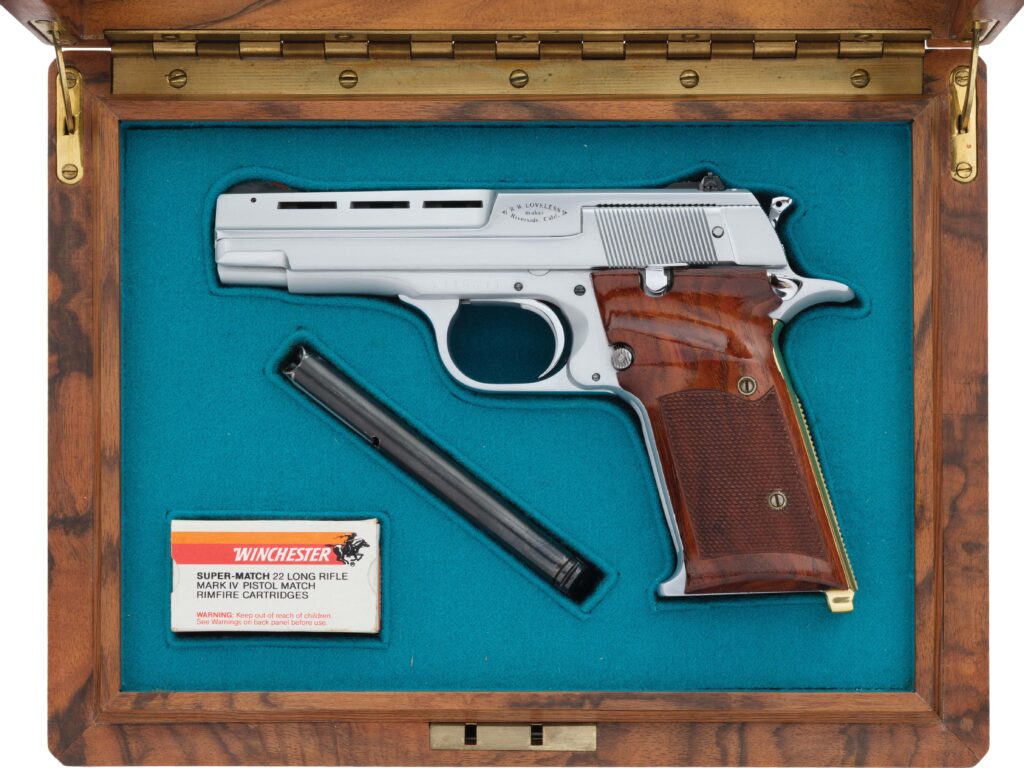
Bob Loveless Smith & Wesson Model 41 semi-automatic pistol with case and signed photographs. Rock Island Auction image
Rounding out the trio is an extensively reworked Smith & Wesson Model 41 target pistol, believed to be one of only 70 ever built by Loveless. This highly modified rimfire pistol features a shortened barrel with a custom vented rib, an exposed hammer conversion, a checked gold-washed backstrap with a lanyard loop, and his personal initials electro-penciled on the slide. Complete with signed photographs of Loveless, a custom leather holster and a glass-topped display case, the group offers collectors a rare look at how one of the greatest knifemakers of all time refined factory firearms into high art.
Read More On Bob Loveless:
Bob Loveless: The Icon’s Indelible Mark On The Knife Industry
Few knives have served America more than those of the U.S. military.
Editor’s Note: This is the first of a two-part series on the most influential knives to serve the U.S. Military and explores some of the early influences on military knife design.
As what many call the greatest country in the history of countries approaches its 250th birthday, now’s a good time to salute some of the top knives that played pivotal military roles in the forging of the world beacon that is the United States of America.
It is, of course, impossible to recognize in one magazine story every single knife that played a crucial role in the many battles of the wars fought by the USA. However, with the help of some of the knife industry’s leading military authorities—including several of whom have seen the elephant in service to our nation—BLADE® will endeavor to touch on some of the more consequential knives of U.S. military history.
Before embarking on such a quest, the first task is to identify a basic group of the most indispensable knife types over two-and-a-half centuries of American land warfare. At the risk of omitting one or more, five stand out: bayonet, all-purpose utility fixed blade and/or bowie, dagger, machete/chopper and utility folder.
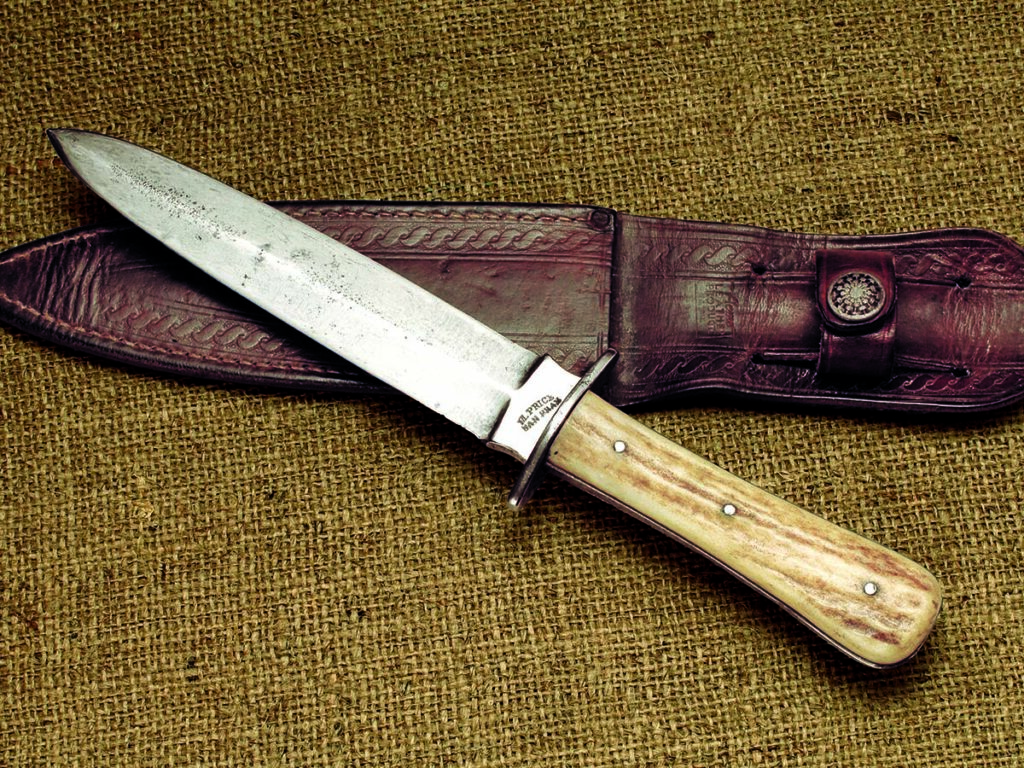
Michael Price recognized that to create a viable knife for self-defense and combat, form must follow function. His solution was to use the full-tang construction method, here on one of his classic mid-19th-century daggers. (Image courtesy of Louis Chow)
“These encapsulate everything that an infantryman used during the 250-year history of our country,” noted Louis Chow, a 24-year U.S. Army veteran who retired with the rank of major and is one of the leading collectors of the knives of BLADE Magazine Cutlery Hall-of-Fame® member Bob Loveless. “The bayonet, of course, from the get-go, from the Revolution to today.”
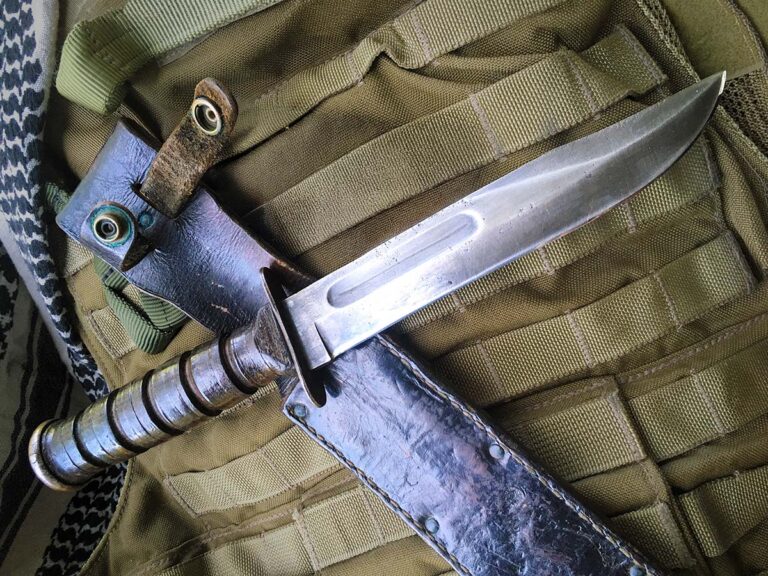
Louis indicated the all-purpose utility fixed blade/bowie could include privately purchased knives such as the Randall Model 1 and, of course, double-guard bowie types like the USMC fighting utility knife, aka the Ka-Bar. He pointed to the mid-19th-century designs of Michael Price as highly influential on daggers through to today, and machetes such as those made by Collins used in the Spanish-American War and before to Vietnam as vital to U.S. war efforts. Though pocketknives were indeed carried by American patriots during the Revolutionary War, the utility folders to which Louis referred are more of the modern Leatherman/Gerber multi-tool type, not to mention the Buck 110, Al Mar SERE, CRKT M-16 and others. As Louis noted, almost every soldier, male or female, in the modern military carries a multi-tool folder.
Many knife enthusiasts know that bayonets are rarely, if ever, used in combat today, nor have they been for well over a century. “It’s hard to actually find someone who used one in combat,” Louis said. Probably the most legendary American bayonet charge was the eminently successful one by Union forces led by Col. Joshua Chamberlain against Confederate troops down a hill called Little Round Top, a major turning point in the Battle of Gettysburg and, of course, the entire Civil War. Ironically, as Louis noted, “the most famous bayonet charge of all was the last one.”
While bayonets have rarely been used in American combat for many decades, that does not mean they do not remain significant teaching tools in today’s U.S. military. “When I was a company commander in 1990, we trained with the bayonet,” Louis recalled. “There are established bayonet courses on every installation, such as Fort Hood in Texas and Fort Benning in Georgia, and we would go there and train with the bayonet.” The rifles and bayonets have changed over the years but the bayonet training techniques remain the same. Throughout U.S. and nearly all other nations’ histories, governments have been responsible for the issuance of combat knives in the form of bayonets for their infantry fighting forces. During World War II, the USA issued all-purpose fighters and utility knives to many soldiers, sailors and airmen. However, as Louis noted, privately purchased edged tools and weapons have always been the mainstay of our servicemen. During the earliest American conflicts, including the Revolutionary through the Civil Wars, kitchen, utility, farrier-forged and European-imported cutlery were the sidearms of the multitude of militiamen and patriotic volunteers.
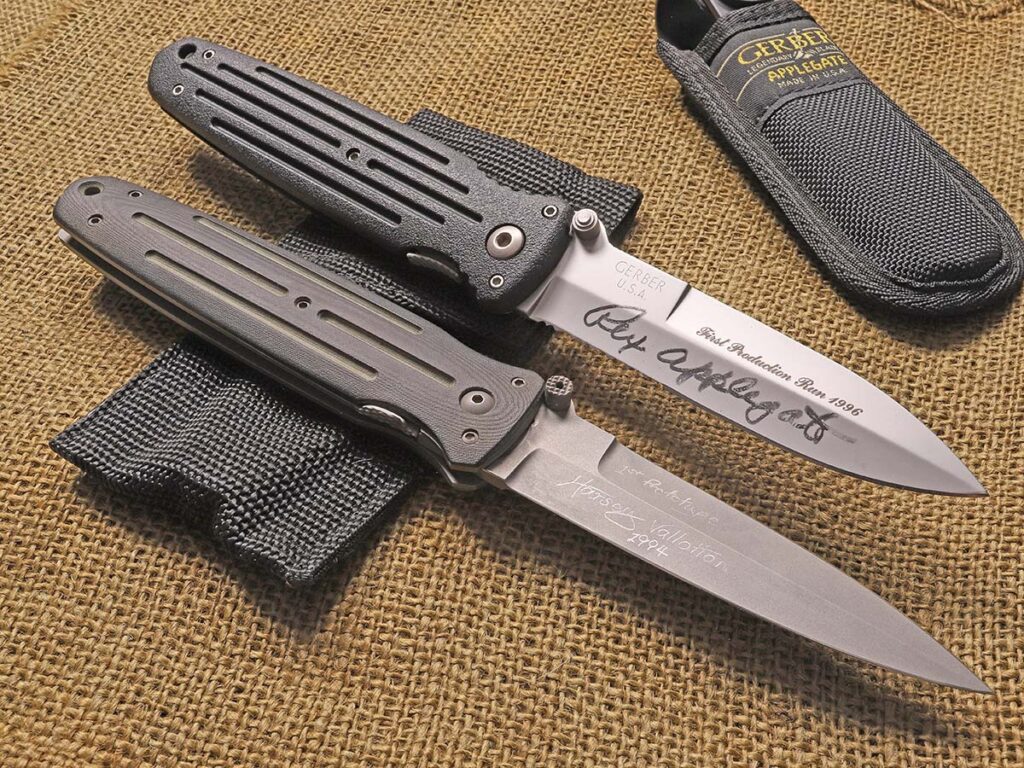
The original Applegate-Fairbairn Folder was a collaboration between Col. Rex Applegate and knifemakers Bill Harsey and Butch Vallotton. Harsey stated that a Gerber official said the Army ordered 50,000 of the knife at one time for the troops. At bottom is the original prototype and at top is a first-production Gerber version autographed by Applegate. (From the collection of Michael Janich)
The knife carried and made famous by Cutlery Hall-of-Famer James Bowie in the 1820s and 1830s was copied in various forms by makers worldwide and served as inspiration to any number of fixed blades carried in the U.S. military. Another large fixed blade that met with success in military circles was the Rifleman’s Knife made by the Ames Mfg. Co. circa 1860. Ames also made the Dahlgren Bowie Bayonet around the same time. Collins & Co. made a variety of bowies/machetes, the most famous probably being the No. 18, also incorrectly called the V-44 by many (according to D.E. Henry in his book Collins Machetes and Bowies 1845-1865, V-44 was the real name of a 1944 Case Survival Knife, not the No. 18).
Generational Blades
Circa the mid-19th century, Michael Price was considered one of the premier cutlers in the western United States. He was best known for exquisite presentation knives that incorporated marine ivory and a variety of beautiful shells. However, as Louis wrote, to create a viable knife for self-defense and combat, Price recognized that form must follow function. His solution was to use the full-tang construction method. And for a century and a half, some of the most notable American cutlers adopted the full-tang method that significantly improved a knife’s dependability and durability.
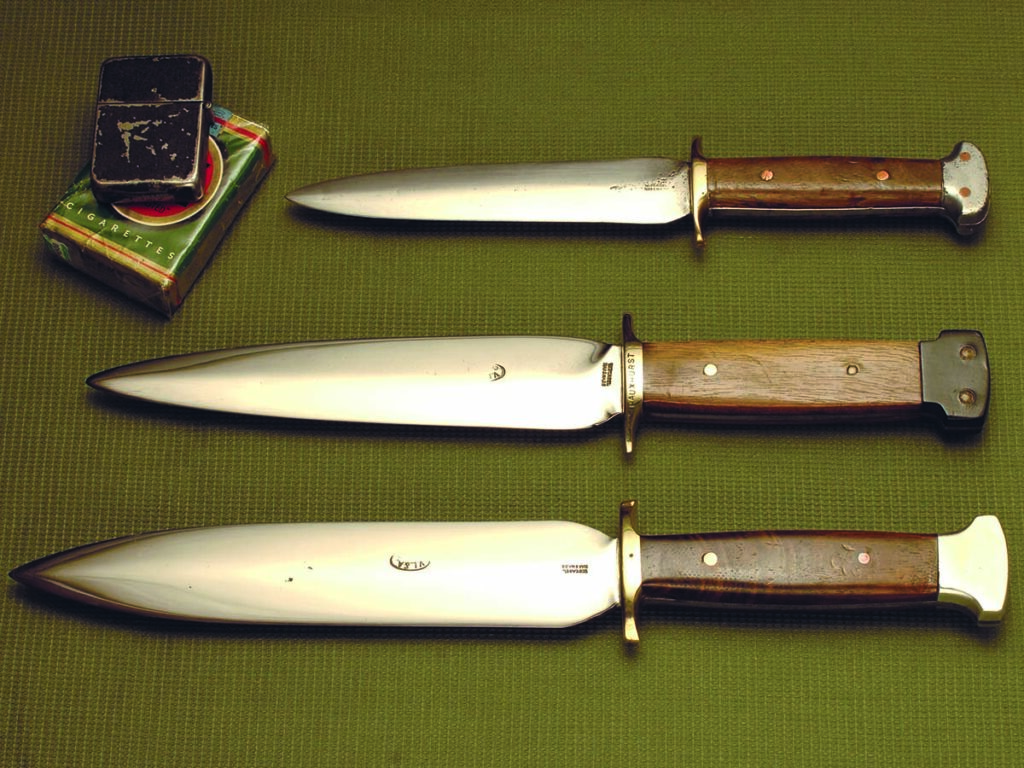
Early in 20th-century Michigan, Cutlery Hall-of-Famer William Scagel began forging axes and knives of various sizes and styles. He made most of his utility, hunting and bowie knives via the hidden-tang method. Though some of his combat knives were also hidden tang, many others employed the full-tang method.
“It was purported that the Scagel hidden-tang fighters with stacked leather washers were made for the European theater, while the full-tang fighters with wood-slab handles were made for the Pacific theater,” Louis wrote. “It was believed that stacked leather washers would be too susceptible to the humidity, high temperatures and salty air” of the applicable Pacific region. As a testament to Scagel’s outstanding craftsmanship and exceptional design, many of his fighters survived the war in good condition.
William Scagel’s hidden-tang fighters with stacked leather washers reportedly were made for the European theater during World War II, while the full-tang wood-slab fighters were made for the Pacific. The stacked leather washers were thought to be too susceptible to the humidity, high temperatures and salty air of the applicable Pacific region. (Image courtesy of Louis Chow)
In 1937, Cutlery Hall-of-Famer W.D. “Bo” Randall observed an older man scraping the bottom of a boat with a knife that appeared undamaged by the abuse. Intrigued by the improvised tool, Bo purchased it from the owner and contacted its maker, who just so happened to be Scagel. Randall eventually became Scagel’s student and soon opened his own shop, making Scagel-style knives.
“At the onset of World War II, Randall designed and produced some of the most recognizable combat knives ever made,” Louis stated. “Nonetheless, all were made with the hidden-tang method. It was not until the early 1960s that Randall introduced the full-tang Model 14-Attack and the Model 15-Airman combat knives.” Continuing the generational theme, Cutlery Hall-of-Famer Bob Loveless read a magazine article about Randall knives in 1953. He corresponded with Bo and made his interpretations of Randall knives before experimenting with and then making his own full-tang models.
From the mid-1960s through the early ’70s, Loveless accepted many orders from service members awaiting assignment to Vietnam. He also received bulk orders from units stationed there. One bulk order in early March 1967 from a unit commander in the 1st Cavalry Division was for 37 fighting knives.
“The unit commander and his troopers were stationed in Saigon and were supporting Operation Junction City, one of the largest airmobile operations in the war,” Louis wrote. “As a patriot and former veteran himself, Loveless would temporarily halt all other orders and place top priority on knives destined for combat. As for those 37 fighters, he worked day and night and completed the order in less than a month. For the next four decades, the Loveless full-tang designs were copied and reinterpreted by countless knifemakers and knife companies in the United States and abroad.”
In addition to the foregoing cutlery legends, the full-tang method was also preferred by many other U.S. World War II knifemakers. Among them: Alfred Bimson, John Ek, Taylor Huff, A.R. Kephart, Kennedy Arms, Bob Riggs, Ernest Warther and Cutlery Hall-of-Famer M.H. Cole. Cole also authored the comprehensive U.S. Military Knives, Bayonets & Machetes series of books and has been dubbed the “Sage of Military Knives” by Cutlery Hall-of-Famer Bruce Voyles. Continuing Cole’s legacy is knifemaker/author Michael Silvey through his reproductions of Cole’s designs and his lavishly illustrated books on the knives of the United States military in World War II and Vietnam, and other works.