Knife History

The history of knives and other edged instruments is tied to the history of people in general. As humankind’s oldest tool, unraveling knife history can lead to even more surprising and enriching information to better understand the world.

Randall Airman: USMC Prototype Carried By The Father Of Marine Helicopters

The story of a prototype Airman and a Marine pioneer.

Editor’s note: The author contacted BLADE® and asked if we would be interested in his story on a special Marine Corps knife and a special Marine to coincide with the semi-quincentennial of the United States Marine Corps. Needless to say, it was an easy decision on our part. Meanwhile, please join us in wishing a happy 250th birthday to the Corps and Marines everywhere.

The core values of honor, courage and commitment have defined the United States Marine Corps since its inception on Nov. 10, 1775. To remain an elite fighting force, the Marine Corps has adapted as the world has changed over the past 250 years, incorporating new technology and developing new doctrine.

One of the most significant transformations began with the birth of Marine Corps aviation in 1912. During World War II, Marine aviators played a vital role in the Pacific campaign, working closely with ground units to seize heavily defended island strongholds. As Gen. Keith B. McCutcheon, a pioneer of Marine aviation, later emphasized, “The Marine Corps is proud of the fact that it is a force of combined arms, and it jealously guards the integrity of its air-ground team.”
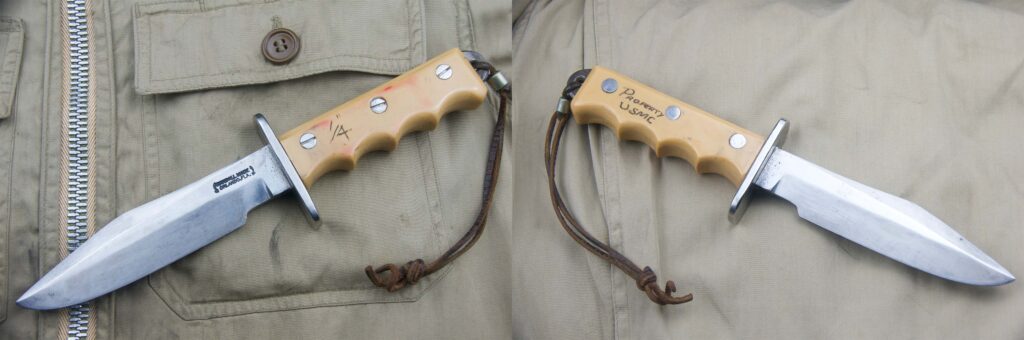
The mark and non-mark sides of a prototype Airman.

The evolution of air combat brought new challenges, challenges that extended even to the knives that aviators carried. One result was a collaboration between Marine aviators and BLADE Magazine Cutlery Hall-of-Fame® member Walter D. “Bo” Randall, who would redefine survival and combat knives with the now-iconic Randall Model 15. This article features one of Randall’s prototypes—a rugged, full-tang Airman’s Knife that was carried for more than 15 years by Gen. McCutcheon himself.

The Challenge

Marine aviators amassed extensive combat experience in World War II and Korea. By 1953, the Marine Corps recognized that the rigors of combat aviation demanded a new type of knife—one that was rugged, compact and versatile.

As documented by Randall historian Robert Gaddis, the Marine Corps Equipment Board assigned Lt. Col. H. Ross Jordan and Maj. Harold N. “Tex” Mehaffey to develop a survival and combat knife for Marine aviators. The knife had to be nearly indestructible—strong enough for an airman to pry, cut or smash his way out of a downed aircraft. At the same time, it had to be short enough to be worn in a cramped cockpit, and the sheath needed to allow the knife to be carried on the upper arm or lower leg.

Wearing his sheathed Randall Model 15 Airman on his left hip, United States Marine Corps Gen. Keith McCutcheon (center) is flanked by South Vietnamese Gen. Hoang Xuan Lam, Commander of I Corps, and USMC Gen. Edwin B. Wheeler (right), commanding general of the 1st Marine Division. (image of McCutcheon, Lam and Wheeler from somewhere near Da Nang, Vietnam, March 16, 1970)

After reading a December 1953 magazine article about Bo and his expertly crafted blades, Mehaffey and Jordan arranged to tour his knife shop in Orlando on Feb. 11-12, 1954. By the end of their fruitful discussion on February 12, Bo had arrived at the basic design of the Randall Airman’s Knife. He also planned a longer-bladed version for ground troops, a design that would become the Randall Attack. Thus, this meeting launched the line of full-tang Randall models that would expand and evolve over the coming years.

Bo moved rapidly to fabricate prototypes that embodied his innovative design. The 5.5-inch blade would be forged from quarter-inch-thick O1 tool steel, a material that had been proven in earlier Randall combat knives. To strengthen the tip, the blade would retain the full quarter-inch thickness nearly to the point. To strengthen the junction between blade and the handle, the tang would be 7/8-inch wide along the entire grip. An extended segment of the tang would have a hole for a wrist thong and provide a surface that could be used for hammering. A heavy double hilt would prevent a gloved hand from slipping forward onto the blade. The handle would be made from a single piece of Tenite plastic, shaped with finger grips and a channel to snugly fit the tang. Stainless steel bolts would secure the handle.

To complete the package, Randall designed a sheath that could be worn on a belt, attached to a harness, or tied to the lower leg or upper arm with leather laces. It featured a diagonal keeper and rivets at stress points. The Randall shop completed the prototypes of the Airman’s Knife and the longer Attack Knife by the end of February 1954—barely more than two weeks after the formative design discussion—and Clarence Moore readied the sheaths soon after.

Three-star Gen. Keith McCutcheon, February 1970

The innovative features of the new knife and sheath designs were memorialized on certified blueprints on March 4, 1954. Randall filed a patent application on Aug. 11, 1954, and the United States Patent Office granted patent 177,590 for the Randall Airman’s Knife on May 1, 1956.

Prototype Testing

With prototypes in hand, Randall travelled to Quantico, Virginia in mid-March 1954 to present the new full-tang knives to Mehaffey, Jordan and other USMC and U.S. Navy officers. The group enthusiastically recommended that the Navy’s Bureau of Aeronautics purchase 10 prototype Airman’s Knives for evaluation: five from quarter-inch stock according to the original design, and five lighter examples from 3/16-inch stock.

The requisition arrived in early April 1954 and the shop shipped the 10 prototypes in early May. The invoice listed the Airman’s Knife as the #14, but later that month Randall adopted the still-current model numbers: the Airman became the Model 15, and the longer version became the Model 14 Attack.

The Marine Corps Equipment Board received two of the prototypes, one of each blade thickness, and the remaining eight were sent to squadrons and other units for real-world testing. In late May, Mehaffey informed Bo that preliminary testing had begun.

One of the original Randall prototypes is featured in the accompanying photographs. Made from quarter-inch steel, as indicated by the inscription on the handle, the prototype closely follows Bo’s patented design, except the blade lacks the fuller shown in the drawing. As in the original design, the prototype’s handle is secured by three bolts; this feature sets the prototype apart from later production examples of the Model 15, in which only two bolts were used.
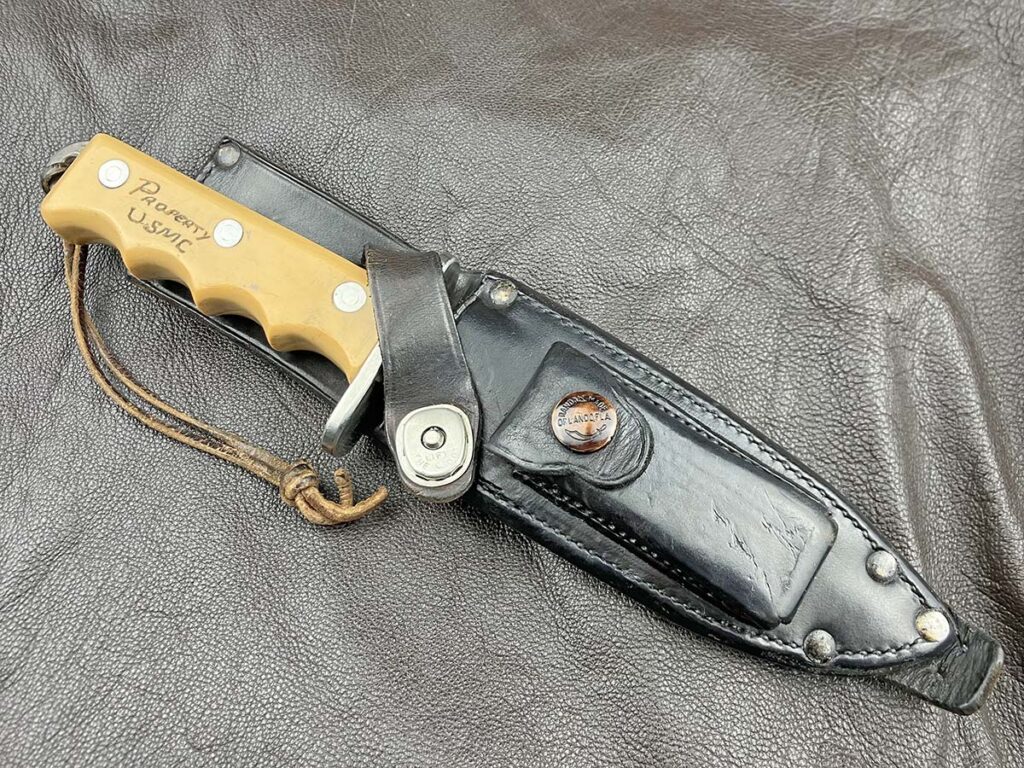
Leatherworker Clarence Moore made the sheath for the prototype Airman according to Bo Randall’s design. Moore made the sheaths for the earliest full-tang knives until Heiser took over production in 1955.

The handle is made from white Tenite, a material used only for a year or so before Randall adopted the more familiar green Tenite that was characteristic of production for nearly 10 years, until Randall Made replaced Tenite with Micarta® in the mid-1960s. The prototype’s hilt is nickel silver in contrast to the brass hilts seen on almost all Model 15s with Tenite handles. The sheath was made according to Bo’s design by master leatherworker Clarence Moore, who made sheaths for the earliest full-tang knives until Heiser took over production in 1955.

After more than 70 years, the knife and sheath are in outstanding condition—a testament to Randall’s craftsmanship and superb design.

Project Setbacks

Despite starting with such promise, the project faltered in the summer of 1954 when Mehaffey was transferred for duty in France and Jordan retired. The departure of the two enthusiastic advocates delayed testing and communications. The next official update was in December 1954, when Bo heard that testing had been underway for two months with positive feedback. In April 1955, the United States Air Force also ordered a group of Model 15s for evaluation. Bo wrote again to the USMC in June 1955 but heard nothing further from the Marines or the Air Force.

Although Randall was never officially informed of the results, author Frank Trzaska uncovered a September 1955 testing report in the USMC archives. The report was authored by USMC Maj. Norman W. Gourley, who had succeeded Mehaffey. Extensive testing of the Randall Airman prototypes showed that the quarter-inch-thick version (i.e., Bo’s original design) was “suitable for aviators’ survival use.”
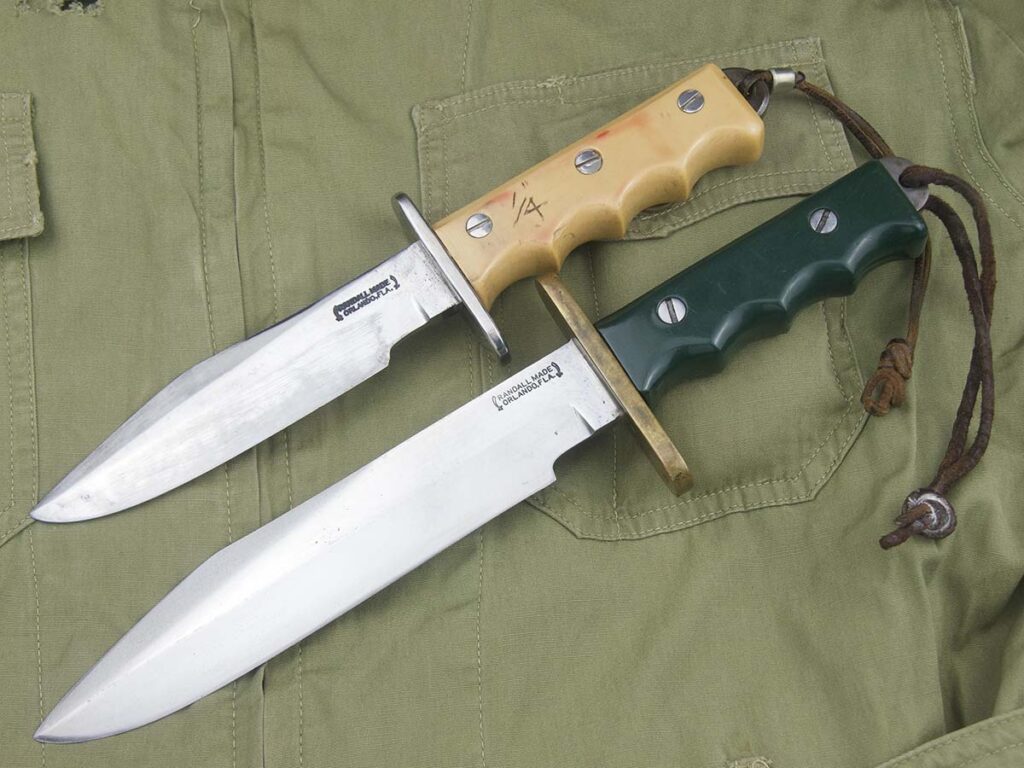
After a fruitful meeting on Feb. 12, 1954 with USMC Maj. Harold N. “Tex” Mehaffey and Lt. Col. H. Ross Jordan, Bo Randall had arrived at the basic design of the Randall Airman’s Knife (top). Bo also planned a longer-bladed version for ground troops, a design that would become the Randall Model 14 Attack (one from 1955 is shown at bottom). The meeting launched the line of full-tang Randall models that would expand and evolve over the coming years.
SONY DSCAfter a fruitful meeting on Feb. 12, 1954 with USMC Maj. Harold N. “Tex” Mehaffey and Lt. Col. H. Ross Jordan, Bo Randall had arrived at the basic design of the Randall Airman’s Knife (top). Bo also planned a longer-bladed version for ground troops, a design that would become the Randall Model 14 Attack (one from 1955 is shown at bottom). The meeting launched the line of full-tang Randall models that would expand and evolve over the coming years.

The report, which pictures this story’s featured prototype, notes the high quality of the design, materials and workmanship of the Randall knife and sheath and concludes that it is acceptable for extreme survival tasks. The report also noted potential changes that would improve the knife further, such as the addition of saw teeth, a flat butt surface for hammering, and different handle configurations. Bo independently incorporated most of these features in various full-tang Randall models by the mid-1960s, and presumably he would have made the changes sooner if the request had ever been made.

While the tests of the Randall Airman were underway, the Navy adopted the Imperial Pilot Survival Knife for its aviators. Because the Marine Corps operates as part of the Department of the Navy, this surely complicated any attempt by the Marines to adopt a different design. The Randall Airman was never issued by the military, but Bo added the Model 14 Attack and the Model 15 Airman to the new Randall catalog printed in 1954, which showed prototypes of both models as “patent pending.” As envisioned by Bo and the Marine aviators who helped to shape the design, Randall’s full-tang combat and survival knives were embraced by many American servicemen who purchased them privately, especially during the Vietnam War.

Pioneer & His Prototype

One Marine who had a high opinion of the Randall Airman was aviation pioneer Keith B. McCutcheon, who as a colonel served as Chief, Air Section, Marine Corps Equipment Board from June 1954 to July 1957. After the Randall Airman tests concluded, McCutcheon carried the quarter-inch prototype for the rest of his career.

An attack helicopter warms up in the background as Gen. McCutcheon surveys the situation six miles southwest of Da Nang, March 17, 1970, his trusty Randall Model 15 Airman sheathed at his side. At left is Gen. Edwin B. Wheeler.

In January 1966, while commanding the 1st Marine Aircraft Wing in Da Nang, Vietnam, then-Brig. Gen. McCutcheon wrote that the Airman was a “wonderful knife” that he had carried for “10 or 11 years.” Photographs from 1970 show McCutcheon wearing the knife when he returned to Da Nang as a lieutenant general and commander of the III Marine Amphibious Force (III MAF).

Commissioned as a Marine 2nd lieutenant in 1937, McCutcheon was a brilliant, courageous leader who transformed Marine aviation over the course of his illustrious 34-year career. Gen. Earl Anderson said McCutcheon “was one of the finest and most dedicated Marine officers [whose career] reads like a history of Marine Aviation. He earned his wings as an aviator in 1940 and served in World War II, Korea and Vietnam.”

McCutcheon was instrumental in integrating helicopters into Marine operations, and has been called “the Father of Marine Helicopters.” But, as historian William Fails observed, that title does not capture McCutcheon’s central contributions to numerous other areas. He also advanced close air support doctrine and techniques, guided missile systems, and the AV-8 Harrier jump jet. McCutcheon was also an effective leader of ground operations, launching successful operations as commander of III MAF.

For his exemplary service over 34 years, McCutcheon received many of the nation’s highest military decorations, including three Distinguished Service Medals, the Silver Star Medal, three Legions of Merit with Combat “V,” the Distinguished Flying Cross, 10 Air Medals and others. He was appointed to become the assistant commandant of the Marine Corps but was unable to assume the post because of failing health. He retired as a four-star general on July 1, 1971, and passed away from an illness soon after.

Enduring Legacy

On the 250th birthday of the United States Marine Corps, it is fitting to honor the legacy of Gen. Keith B. McCutcheon, an extraordinary leader who helped shape the modern Marine Corps. McCutcheon’s prototype Randall Airman remains as a tangible link to his many accomplishments and to the connection between the Marine Corps and Randall Made Knives.

Sources

William R. Fails. 1978. “Marines and Helicopters 1962-1973.” History and Museums Division, Headquarters U.S. Marine Corps.
Robert L. Gaddis. 1993. “Randall Made Knives: The History of the Man and the Blades” Paladin Press.
James Anthony Ginther, Jr. 1999. “Keith Barr McCutcheon: Integrating Aviation into the United States Marine Corps, 1937-1971.” Doctoral Dissertation, Texas Tech University.
Norman W. Gourley. 1955. Marine Corps Equipment Board report A9-E-1039 on Project E-1039.
Frank Trzaska. 2001. “Randall’s Model 15 & the U.S.M.C.” February 2001 Knife World.

More On Military Knives:

50 Years Ago In BLADE: Jimmy Lile’s Bicentennial Blades

Stoic Patriot’s Knives Had Sober Inscriptions.

With 200 years under its belt, the U.S.A. was in the spirit of celebration in 1976. And the nation’s bicentennial not only brought out the best in citizens, but knifemakers as well.

BLADE® Magazine Cutlery Hall of Fame® member Jimmy Lile was one of them, offering up a set of knives for America’s 200th birthday in the July/August issue of that year’s American Blade. Unlike other custom makers advertising flashy commemorative pieces, “The Arkansas Knifemaker” took a more stoic and serious approach to his collection.

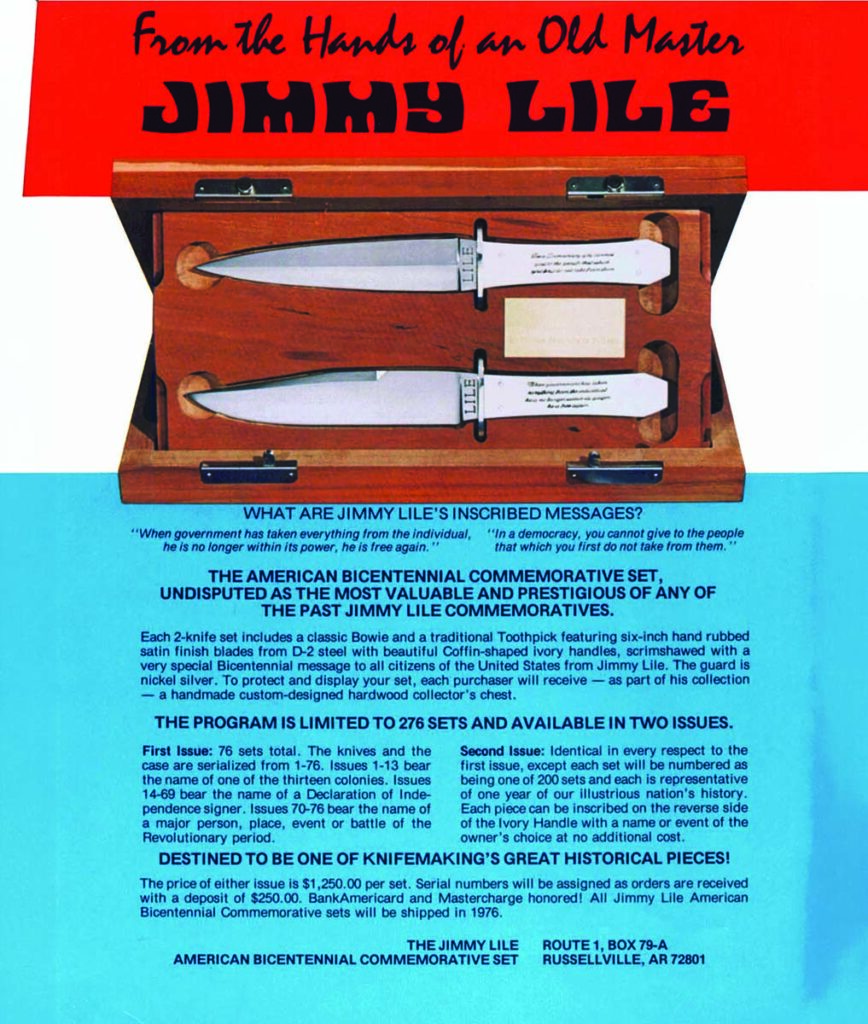
Jimmy Lile produced 276 bicentennial sets. The first run of 76 featured historic inscriptions: colonies (1-13), Declaration signers (14-69) and Revolutionary icons or battles (70-76). The second identical run was numbered 1-200 to mark each year of American independence.

The bowie and dagger composing the set were sober in design and ornamentation, with clean lines the defining feature of the coffin-handle knives. Yet, what the pair lacked in stars and stripes celebration, they more than made up for in Lile’s deadly serious and patriotic scrimshaw on the handle scales. One might even cast the inscriptions as stark warnings.

On the bowie it reads: “When government has taken everything from the individual, he is no longer within its power, he is free again.” While the dagger is inscribed with, “In democracy, you cannot give to the people that which you first do not take from them.”

Interestingly, these do not appear direct quotes but paraphrases by Lile. The first most closely resembles a passage from Aleksandr Solzhenitsyn’s novel The First Circle. The second bears a striking resemblance to a line from an essay by French economist and philosopher Frédéric Bastiat.

No matter the words’ origins, they stand as portents as sharp as the knives they were inscribed on. And they’re as relevant 250 years after our country’s founding as they were at its bicentennial.

More Knife History:

50 Years Ago In BLADE: Big Bucks Bowie

Harvey McBurnette etched his name in high-dollar knife sales.

Harvey McBurnette of Piedmont, Alabama, landed in the July-August issue of the 1976 American Blade for somewhat patriotic reasons. Somewhat, because the lead of Harry K. McEvoy’s exposé on the maker was McBurnette’s celebrated Bicentennial Bowies. But there’s more to the matter than a simple commemoration of the nation’s birthday in steel.

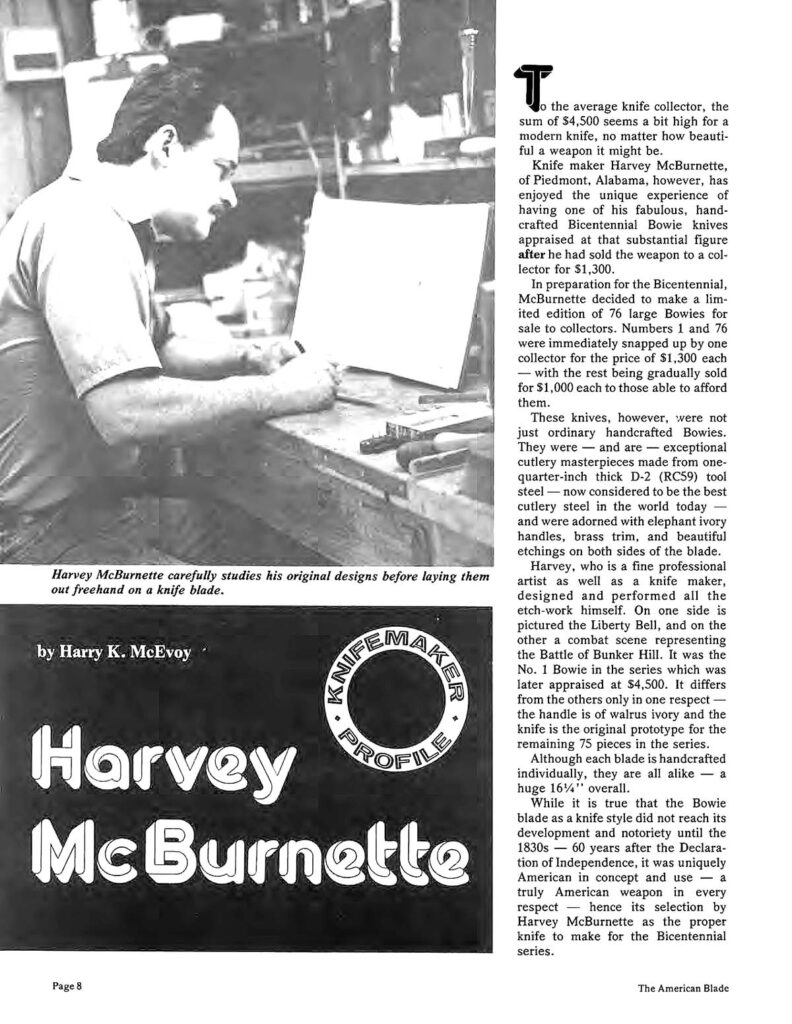
McEvoy hooks readers by showing what the artistically talented knifemaker’s work commanded back when your dollar went a long way. In 1976, the exact sum was $4,500. As McEvoy wrote, “[O]ne of his fabulous, hand-crafted Bicentennial Bowie knives appraised at that substantial figure after he had sold the weapon to a collector for $1,300.”

The lead image of the profile on Harvey McBurnette shows him studying his original knife design and free handing it to the steel. The maker had a strong artistic streak and was known, in part, for the embellishments he etched onto his knives.

For context, that’s roughly $26,000 in today’s dollars. What likely made the run of 76 bowies desirable was McBurnette’s unique system of adorning the knives—etching. This system, seen on many of his knives, was a very conscious choice on the maker’s part, as the story reports, serving to differentiate his work from other custom craftsmen of the day.

“I wanted to do something unique, or at least different, with my knives,” McBurnette was quoted as saying in the article. “And since I was an artist I thought if I engraved or etched my blade, I would add a touch I felt was needed to make them stand out. I chose the art of etching because there were a few other knife makers who engraved their knives. Besides, even a master engraver cannot do what an etcher can do.”

McBurnette’s Bicentennial Bowies had quite a motif etched on either side of their D2 tool steel blades. On one side of the 16.25-inch knife is an image of the Liberty Bell, and on the other a battle scene depicting Bunker Hill. The images are the same on all 76 knives, and 75 of them had elephant ivory handles. The knife appraised for the then astronomical sum did differ; the No. 1 of the series was a prototype with a walrus ivory handle.

More Knife History:

The Viking Seax And Where To Get One

Deeply Rooted In Scandinavian History, The Seax, AKA “Scramasax” Or “Sax,” Was The Blade Shape Of Choice For The Much-Feared And Revered Vikings.

Typically the Norsemen were associated with their famous axes, but, truth be known, they also carried a knife that saw more general use: the seax.

The Scandinavians usually lived in villages, farmed the land and raised animals. In such an agrarian society, they also needed tools to help them work the land and harvest the fruits of their labor. This is also where a knife came into play.

“Their personal knife was called the seax and it never left their side because it was their version of an EDC,” begins Ernest Emerson of Emerson Knives, Inc. “The knife was tasked with a myriad of chores, from skinning a freshly taken deer to cutting up the turnips they grubbed out of the ground with the same knife.”

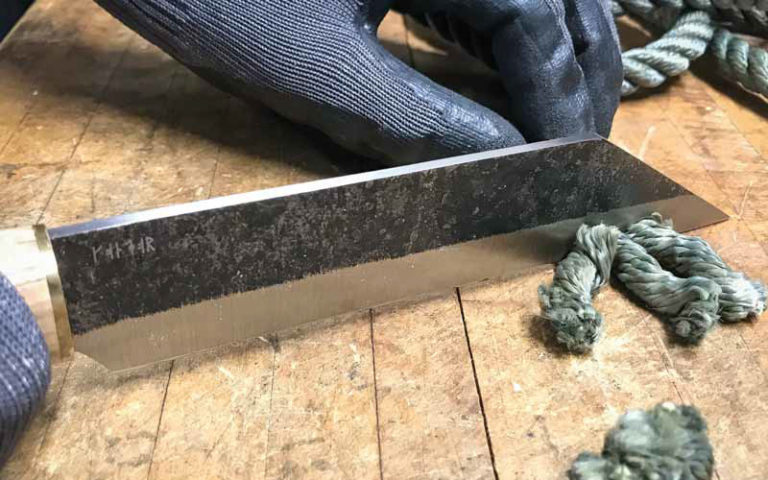
Seax blade shapes
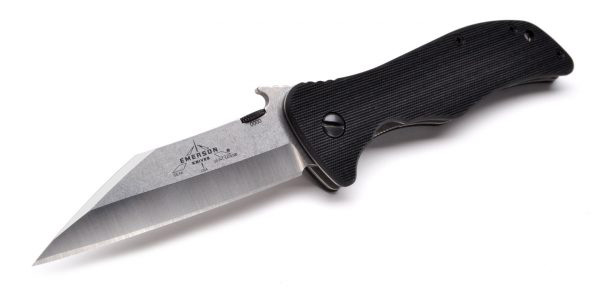
The folding Emerson Knives Seax puts a modern twist on this age-old blade design. (Image via Emerson Knives)

Emerson said the seax also could be employed as a self-defense weapon if needed. It was truly a blade for all seasons: Harvest produce in the morning, fend off the enemy after lunch, and then prepare supper in the evening—all with the same blade.

Seax Designs

All joking aside, the seax was a handy blade.

“It is a bowie-style blade, a spear-point type of blade, a Loveless drop-point hunter-style of blade, and, of course, the well-known ‘broken-back’ style featuring a severe clip close to the front, finishing in a point well below the center line,” Emerson said.

He said the broken-back seax style is the most common and appears in TV shows and movies depicting Vikings.

Broken Back Seax
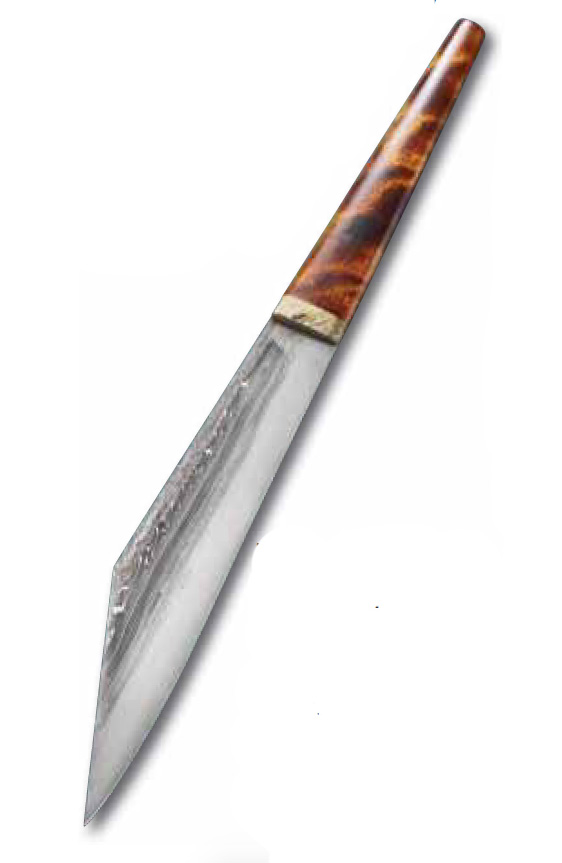
The Broken Back Seax by Aidan Garrity of Iron Lion Blades features a 10-inch damascus blade of 1095 carbon and 15N20 nickel alloy steels, and wrought iron. The handle is maple and the bolster is moose antler. Overall length: 18 inches. (SharpByCoop image)

Blade lengths varied wildly from seven inches on the short end and topping out at 30 inches, the latter Emerson called a short sword, basically.

“The seax needed to be an all-around utility tool that could chop, cut, slice, and sometimes stab, all with equal ease of application,” he said. “A Viking’s livelihood depended on self-sufficiency, resourcefulness, and the quality of his toolkit.”

What is a seax
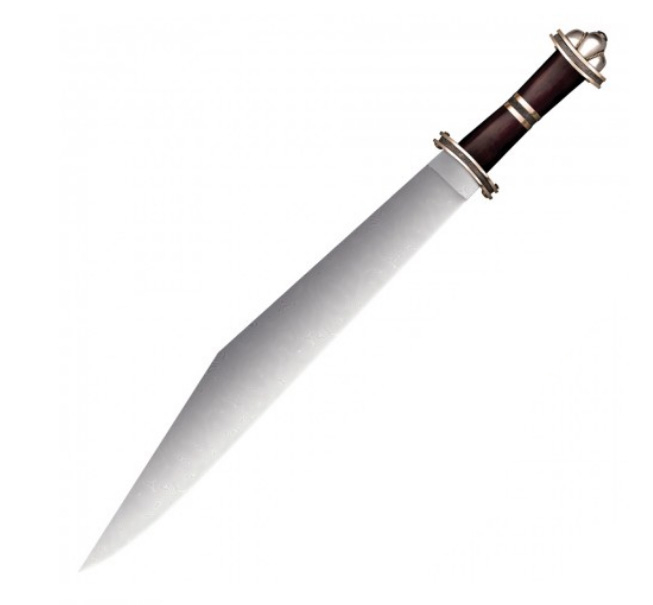
The Cold Steel Damascus Long Sax features a 17.25-inch blade with an edge that curves up toward the tip. MSRP: $635.99. (Cold Steel image)

At first glance, the seax may not seem as exciting as a recurve blade, but looks are not always everything. The beauty of such a blade lies within its ability to tackle cutting chores.

The straight-line cutting edge tackles a variety of tasks easily, and the point of the blade is both precise and powerful, with the ability to score as well as penetrate.

5 Best Seax Knives

The long history of the seax is still going strong today as companies young and old are making new versions of the historic blade.

These five are some of the more unique and exciting seax knives available today.

Terävä Skrama 240

Terävä Skrama 240
Terävä Skrama 240

Direct from the Finnish brand Terävä, the Skrama is a rugged bush knife great for chopping, slicing, and building shelters in the outdoors. The 9.4-inch blade is made from 80CrV2 steel with a 59 HRC. It comes married to a textured rubber handle for easy grip in any weather conditions.

The blade has a full tang and a flat edge but with a twist. It’s sharpened to a 34-degree edge except for the two inches closest to the hilt. That small section is sharpened to a finer 25-degree edge for more meticulous, precise knifework.

The Skrama comes with either a leather sheath or a plastic cover and has an MSRP of $69.99-109.99.

SZCO Supplies Brass-Studded Seax

SZCO Supplies Brass-Studded Seax

SZCO Supplies has made a fun, durable knife with its Brass-Studded Seax. The piece features a 10-inch blade married to a wooden handle. The knife is adorned with brass studs on the handle as well as a brass guard and pommel.

For a budge knife, it does have some weak points. The two main ones are that the leather sheath may need some working in to be at its best, and the knife may need a sharpen out of the box to have a pristine edge. Other than that, this is a good knife for the money.

Strong enough for a log, sharp enough for a piece of chicken, SZCO Supplies has made a  seax that is well priced at an MSRP of just $27.63.

Medieval Collectibles Viking Seax Knife

Medieval Collectibles Viking Seax Knife

This seax from Medieval Collectibles has the look and feel of a knife from the Viking era. It’s made from 5160 tempered carbon steel with a full tang, which is peened over the end of the handle’s metal end cap.

Just over 17 inches in length, and a blade length of 12.1 inches, the Viking Seax comes with a handle that has a wood grain finish and a hand-stitched leather scabbard with a belt hanger.

At just 14.4 ounces in weight this is a utility knife great for everything from chopping through wood and brush to defense and protection. The Viking Seax comes with an MSRP of $169.

Grimfrost Broken Back Seax, Type IV

Grimfrost Broken Back Seax, Type IV with scabbard

From Grimfrost comes a full-tang seax made of 1045 carbon steel. A reproduction of a 1,000-year-old seax found in London, the Broken Back Seax is 16 inches in length with an 11-inch blade.

The handle is handmade ash and the included leather scabbard is hand-stitched. It also features “Grimfrost” stamped in runes on the side of the blade.

Lots of time and care went into making this knife as authentic as it could be and it shows. So whether you want to feel like Leif Eriksson exploring new lands or just want a strong knife while chopping, Grimfrost has you covered.

The Broken Back Seax has an MSRP of $132.

Lunar Light Forge Damascus Sanmai Seax

Lunar Light Forge Damascus Sanmai Seax

This amazing seax is from the husband & wife duo of Nathaniel and Megan Everett at Lunar Light Forge in Akron, Ohio.

The damascus blade is made from 42 layers of 1095 and 15n20 steel around a 5160 core. It is paired with a handle made of Buffalo horn and Cocobolo wood, and it comes with a hand-tooled & hand-stitched leather sheath.

It’s just as much an art piece as it is an excellent utility knife. The 7-inch blade can process an animal, hack off tree limbs, and chop in the kitchen. It does have an MSRP of $722.50, but for the amount of craftsmanship and care that went into the piece, you’ll know you’re getting a knife of the highest quality.

Editor’s Note: Mike Abelson contributed to this piece

Read More

Medieval Diners Sang Grace From Notation Knives

The V&A Museum in London is in possession of a rare notation knife.
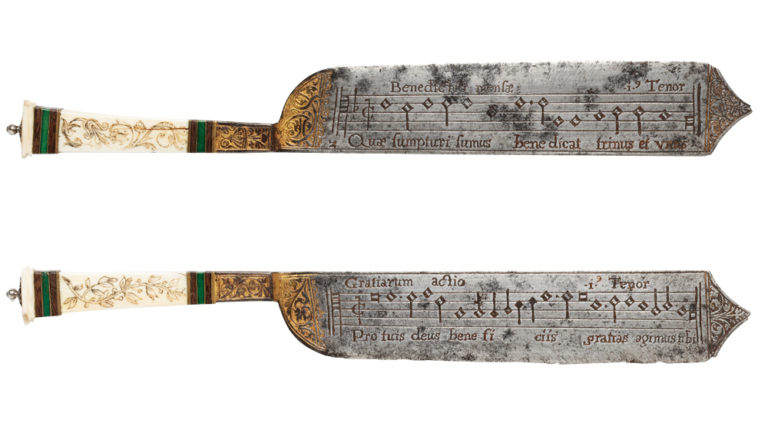
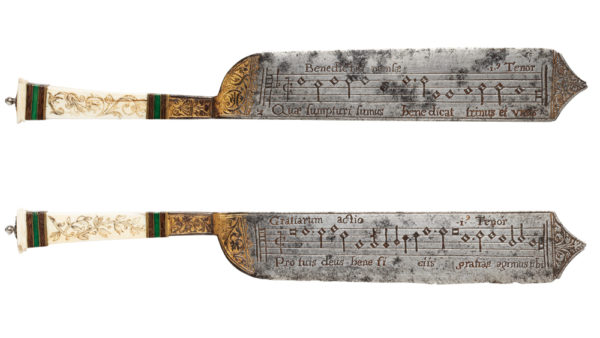
Notation knives dating from the mid-16th century were used to sing a pre-meal blessing and a post-meal grace. This example is on display at the Medieval and Renaissance Galleries at the Victoria & Albert Museum in London.

They’re called notation knives, and they’re engraved with what amounts to sheet music for multi-voiced song. They’re indicative of the formal role music played in medieval dining, according to Flora Dennis, an art historian and author of the book “Re-thinking Renaissance Objects: Design, Function and Meaning.” Holding the knife in the left hand, edge up, diners could see the notes and lyrics for the benediction, or blessing, sung before a meal. After the meal, again held in the left hand, edge down, the knife showed the music for the grace, thanking God for his generosity. Since cutting was done with the right hand, the knives may have been ritualistically transferred to the left hand, or they may have been solely used for singing purposes. Dating from the mid-1500s, one notation knife is on display at the Medieval and Renaissance Galleries at the V&A (Victoria & Albert) Museum in London, where Ms. Dennis works. There are others—seven in Paris, three in Philadelphia, two in The Hague, one in Austria, some in private collections—but as much as is known, much more remains unanswered about these rare items.

In addition to the 16 surviving notation knives, there are also written references to at least four others, according to Ms. Dennis. Essentially, though, the knives have been overlooked by historians because they don’t fit neatly into either “knives” or “music” and have been relegated to curiosity status. All the notation knives share a similar look. The steel blades are broad with straight spines and triangular points on center. According to V&A curator Kristen Kalber they may have been used to proffer a slice of meat to a diner, the point skewering the serving. Then again, squires normally carved meat and that was a highly skilled, status-imbued position. Carving rose to the level of entertainment with offerings carved from cooked fowls and beasts held aloft on forks. So, while some knives seem not to have been used other than to sing from, others show wear on the point and were definitely used.

Museum Curator And Historian Bring Notation Knife To Life

In this 2009 video V&A Museum curator Kristen Kalber shows the notation knife in the museum’s collection and demonstrates its use. Flora Dennis, an art historian at the museum, discusses the project that allowed the music on the knife to be recorded. Ms. Dennis holds a PhD in musicology, specializing in early music, and through an Arts and Humanities Research Council grant she was able to convert the music into modern notation, and then work with the Royal College of Music to bring it to life.

The points and the bolsters are engraved with leaf scrolls and strapwork, often gilded. The handles are made of ivory and green-dyed horn or bone with copper or brass spacers. The ivory is decorated with foliage, empty tablets of scrolls, Arabic or Moorish designs or winged cherub heads inlaid in black. The pommels are adorned with silver spherical knobs. The engravings are usually in Latin, though some are in the vernacular. The one from the V&A reads Benedictio mensae (The blessing of the table) on one side and Gratiarum actio (The saying of grace) on the other. The musical stave runs the length of the blade. In the upper right is the voice part, in this case “Tenor.” What this means is that there were different knives for different voices, in some cases as few as five or six or substantially more than 20.

Royal College Of Music Singers Record Two Versions Of The Meal Benediction


Knifemakers across Europe at the time would have been members of guilds and were specialized. Handles would have been made separately and assembled by the cutler who sold them. Ms. Dennis’ writings detail how challenging it can be to pinpoint where the notation knives were made or by whom. Knives were being made in Solingen and Nuremberg, Germany, and in Milan and Brescia, Italy. Possible guild marks show up in the form of arrows, fluers-de-lis or clovers, and etched Ns can be found on many of the blades, but those are more likely an engraver’s mark. One of Ms. Dennis’ knife consultants intimated that a Nuremberg mark would be on the tang, not the blade. The best guess is that they were made in France, with Italianate influence or for an Italian patron.

Were the knives collected after the gathering or did each singer keep his or her knife? In Ms. Dennis’ summation, judging by the scattering of surviving pieces, the latter might be more likely. It could also be that the knives were made for a group, such a monastery. In some instances, the strict, mass-like approach to such a shared meal could result in latecomers being fined for missing the benediction. What is clear is that the knives are not all from the same musical piece; there are two separate pieces of music represented by the known notation knives.

Royal College Of Music Singers Record Two Versions Of The Meal Grace


Interestingly, the notation knives are representative of both coming together and separating. It is the very nature of a knife to cut apart, but in this instance it is for the purpose of sharing, both repast and praise.

As Ms. Dennis writes:

“Benediction and Grace texts are inherently collective, expressing notions of conviviality and sharing. The knives reiterate this idea, needing to be brought together in a social context in order for their music to function. Simultaneously, however, they represent a contradictory action of dismembering and dividing. By slicing meat, the knives permit it to be shared between the gathered company in the same way that dismembering and scattering the musical text across the knives enabled a group to perform it collectively. The acts of uniting to say the Benediction and Grace, uniting to eat, and uniting to sing become inextricably intertwined with those of separating, dividing and sharing both meat and music.”

Bladecrafting Collection Includes 6 Classics

The 6-volume bladecrafting collection is available at less than half its normal cost.
The Bladecrafing Ultimate Collection includes two paperbacks and four ebooks for $34.99

Makers can’t go wrong with this collection. You’ll get two paperbacks: the third edition of “Blade’s Guide To Making Knives” and “How To Make Knives; and four e-books: “Greatest Loveless Knife Designs,” “Knife Grinding Secrets,” “Making Everyday Carry Knives” and “Fashioning A High-Tech Folding Knife.” Normally, this collection would cost over $70, but you can get it for half that.


Bayonets: An Iconic, Historic Blade

Few Blades Are As Historic As The Bayonet. The Knife Has Evolved Into An All-Rounder Still Issued By The Marines. 

Oddly enough, the history of the bayonet likely began in the hunting field, not the battlefield. By at least one account, the edged weapon was a tool of the French boar hunter in the 1500s. Tusks and a bad attitude, it’s understandable why these gents strapped their hunting knives to the muzzles of their muskets.

Soon after some enterprising soldier figured the invention–in original French baïonnette–might prove useful in warfare, and the iconic edged weapon was off to the races for the next four centuries. Presently, bayonets have essentially become military relics, if employed generally only as a training tool to acclimate soldiers to close-quarters combat.

Despite this, these fairly antiquated edged weapons still stir the imagination of military heroics of yore. Not to mention, in nearly all their versions, bayonets remain one of the coolest and most accessible historic edged weapons to collect.

In the article, we’ll look at some of the major styles of these modified edged tools, how the implement has evolved and who actually continues to make them. So gird your loins, we’re charging forward on bayonets.  

Major Bayonet Styles

A bayonet is so much more than just that. There were, and still are, several different designs of the implement, most mirroring the technology and ethos of war fighting of its particular era. 

Plug Bayonet

The plug bayonet is the earliest known bayonet and dates back to the 1500s or 1600s. The idea is rather simple. if you couldn’t use your gun to shoot or simply don’t have time to reload you turned to the knife. In this case, typically a double-edged dagger with a rounded handle that affixed the implatment directly in the muzzle of a musket barrel.

These earliest bayonets were really fully-fledged daggers in their own right. They lacked a proper pommel as can be imagined, but they could be used exactly like any other dagger. Most in this era were used in a manner of last resort. If a soldier found himself out of ammunition or facing a fast-moving enemy, he would likely want to put in his bayonet and hope for the best. 

The bayonet at this time was the product of changing warfare. While firearms were becoming more prevalent on the battlefield, they were slow to load. Additionally, the close-quarters combat of the medieval era still reigned supreme. In turn, soldiers required an option to hold off infantry and cavalry charges once their one shot was spent. 

Offset (Socket) Bayonet

While it may surprise some, the classic socket bayonet most think of during the flintlock era of warfare was not in full use by 1700. Attempts had been made prior to developing an offset bayonet allowing the soldier to load and fire with it attached. But it wasn’t until several critical battles in the late 1600s that evolution took hold. In particular, the battle of Killiecrankie in 1689. HereScottish Protestant forces were thoroughly defeated by Jacobite Scottish Highlanders, who charged and destroyed their enemy with broadswords and targes. 

This defeat came in part due to the plug bayonets the Protestants utilized. In what would be a rather ironic turn, the Scottish Jacobites would eventually meet their end and the end of their cause at the tip of the bayonet. Outfitted with socket bayonets at the Battle of Culloden in 1746, the British were able to let loose a point-blank volley on the charging Highlanders, then finish the rest with their bayonets. The British had even devised tactical doctrine for the use of the weapon, training to a charging man to their side, instead of in front to strike beneath his raised sword arm.

History Of The American Bayonet

M7 Bayonet
The M7 is a legendary American bayonet that is still manufactured today.

Americans were somewhat slow to adopt the bayonet in warfare, giving the British somewhat an edge in the early days of the Revolutionary War. Of course deadly in charges, attached to the British Pattern 1769 Short Land musket–or Brown Bess–the implement also was somewhat a psychological weapon. Said to be the most feared weapon of the British arsenal, the Red Coats mass assaults with a long, gleaming triangular knife at the end of their muskets made all but the most disciplined break.

The Continental Army proved a quick study once trained with the bayonet  by Maj. Gen. Baron von Steuben at Valley Forge in 1773. By the end of the war, there were even strokes of genius with the American use of the bayonet, such as when American Lt. Col. Alexander Hamilton (also the first Secretary of the Treasury) led a bayonet-only assault on redoubt 10 during the last days of the Battle of Yorktown. 

Early on, the Continental Army utilized a triangular socket bayonet similar to the British, however on the French Charleville Musket. But its use spread and the wicked device was eventually found on the Brown Bess–the most used arm of the Continental Army.

The bayonets in American service were standard European-style socket-mounted with triangular blades. This remains so through several iterations, including the Harper’s Ferry 1801 pattern, 1807 and 1810 Springfield patterns, M1816, and M1855.   

The M1855 served through the Civil War, where it saw extensive use on the Springfield rifle muskets. The .58 caliber rifle muskets loaded the same way as old muskets and could fire quickly and were very accurate and had substantial range. The bullets used in these guns had a hollow base that expanded into the rifling when it was fired, thus imparting spin. The war was devastating, and there were many bayonet charges, most with mixed results and high casualties. 

More accurate firearms and the introduction of repeating arms mitigated the effectiveness of the bayonet during the Civil War. It is estimated, only around 1 percent of all casualties were a result of bayonet wounds.

Sword Bayonet

sword bayonet
Pattern 1907 Bayonet. (Source: CC by 4.0)

Despite the effectiveness of “cold steel” assaults waning in the face of technological advancement, the bayonet persisted, though evolved to remain relevant.   

A more interesting detour around the time of the American Civil War, was the multi-purpose sword bayonet used by the British. The British Infantry Rifle of 1800–1840–later known as the Baker Rifle–utilized this style. The idea, essentially, was to give soldiers the ability to stave off cavalry charges when used as a bayonet, but also outfit them with a side arm–a short sword–for close-quarters combat. These sword bayonets had knife handles mated to exceedingly long blades, sometimes over 20 inches. 

Surprisingly, this style of bayonet was used all the way into World War I, despite little evidence the elongated blade provided any advantage. Perhaps the most famous final rendition was the Pattern 1907 Sword Bayonet, found on the British Short Magazine Lee Enfield rifle in the Great War. 

The American bayonets of the pre-WW1 era were a bit more well-designed. The bayonet designed for the American Krag rifle (the M1892), for example, had an 11.7-inch blade and could serve as a camp tool as well for daily chores. The Americans ended up following the Europeans’ lead in World War I a bit with the M1905 bayonet, which sported a 16-inch blade. Additionally, there were 17-inch versions used on the trench shotguns and backup rifles like the M1917 Enfield. 

Knife Bayonet

M9 Bayonet
The M9 bayonet works as a traditional bayonet but is more commonly used as a fighting/camp knife.

After WWI, most militaries of the world focused on making the bayonet in the form of a camp knife, something that was worth it to carry for general use that had more than one regular use. The time leading to WW2 produced the highly functional and realistically-sized M1 bayonet for the M1 rifle. The M1 carbine was also set up to use one, and it had its own small setup in the M4 bayonet knife. These knife-style bayonets eventually ran through several iterations leading up to the M7 bayonet for the M16 rifle in the late 1950s. 

As a regular tool, the knife bayonet is great and doesn’t remove any of the function in either role. It can be used for all sorts of tasks and also be mounted on the gun. The later M9 became a full-on utility and fighting knife for the M16 series. It is a large, Bowie-style knife that closely resembles the Ka-Bar. It added some additional utility features like serrations for cutting straps and rope and a wire cutter. Later on, the OKC-3S knife bayonet was adopted by the USMC. These remain standard today. 

Bayonet Realities

The reality of the bayonet is that it is not a principle fighting weapon. Today we are seeing most rifles fitted with a mountain of accessories, from variable power optics, lasers, suppressors, and bipods. 

 The bayonet has, for most of its history, been a weapon of intimidation. Very few times did any two armies charge each other with bayonets, usually one side fled first. Even in our modern era there have been bayonet charges, but again to no effect other than to scatter the enemy. 

Edged weapons do have a role in modern warfare; everyone needs a good knife at minimum. If your rifle has no provision to attach one or you’re using a suppressor, there is no real need to carry a bayonet specifically as opposed to a dedicated knife that serves your purposes. 

Bayonets will always be a curiosity not because of how they were used, but rather why they were used well beyond their abilities. While it is certainly a dangerous thing and absolutely lethal, getting that close to your enemies means you’re having an exceedingly bad day. But, as history has shown, a man with a sharp stick and nothing to lose can sometimes win the day.

Read More

  • The M7 Bayonet: From Combat To Campsite
  • Best M9 Bayonet Options For The Civilian Enthusiast
  • Best Ka-Bar: Modern Options Of The Historic Knife

American Knives: Legendary Designs From The Land Of The Free

0

Are these the best American knives? Maybe, maybe not. One thing is for sure, these are some of the blades folk most associated most closely with the good ol’ USA.

If the knife isn’t man’s oldest tool, it’s probably a close second. It has been around in some form since time began. Styles, looks, form and function have steadily evolved, and even though the basics of a particular type may have originated somewhere else, there are those that are associated most closely with the good ol’ USA.

These are knife styles that the buying public, the collector, the factory, and the custom maker would probably associate with the United States more closely than any other country.

“You have to start with the time period when knives actually became ‘American,’” explained BLADE Magazine Cutlery Hall of Fame® member Bruce Voyles. “From the first settlers, the Spanish in Florida or the Vikings, every knife they brought to this country was made and came from somewhere else.”

American Designs Come Into Their Own

Voyles points to the truly American knife and says that the history of the country allows for a nod to the J. Russell Green River Works in the 1830s—the mountain man period when skinning knives were pretty much an enhanced version of the butcher knife—the epic sandbar fight that brought the bowie knife to the forefront, George Schrade and the introduction of the switchblade, and other examples of knives that are associated with America.

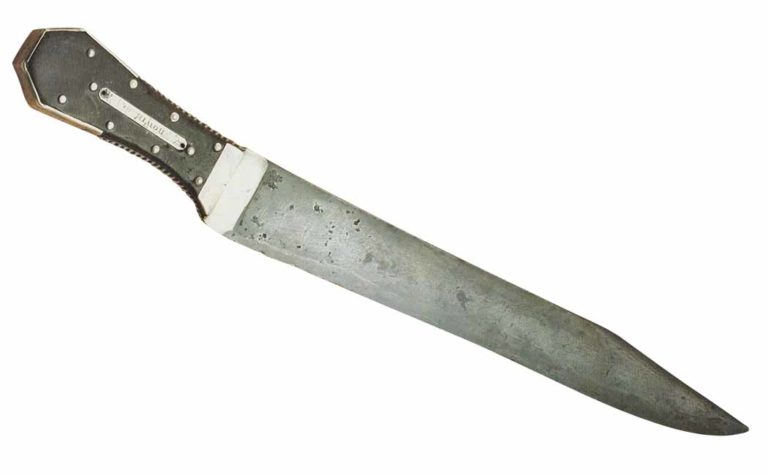
“Everything changed, and the cutlery world was turned on its ear when Jim Bowie got into a duel and that turned into a melee in 1827,” Voyles commented. “This happened across the river from Natchez, Mississippi, and you didn’t have good roads in those days. The rivers were the highways and when this happens, soon the story is heard in other river cities—New Orleans, Memphis, St. Louis and Cincinnati. Everybody hears this amazing story. Everybody wants a knife like Jim Bowie used, Bowie’s knife and then the bowie knife.”

Voyles related the story of George Schrade and the New York City patent office. “A guy comes in with something that looks like an automatic,” Bruce smiled. “George Schrade tinkers with it and invents the switchblade knife. He is the one that made it a production knife that people could afford. There were others around, but he got the patent on that style knife. Schrade kept tinkering with it, and he brought his brothers in and started Schrade Cutlery Company to produce George Schrade’s switchblades. So, now the modern American switchblade is truly an American knife, though the government banned it in 1958.”

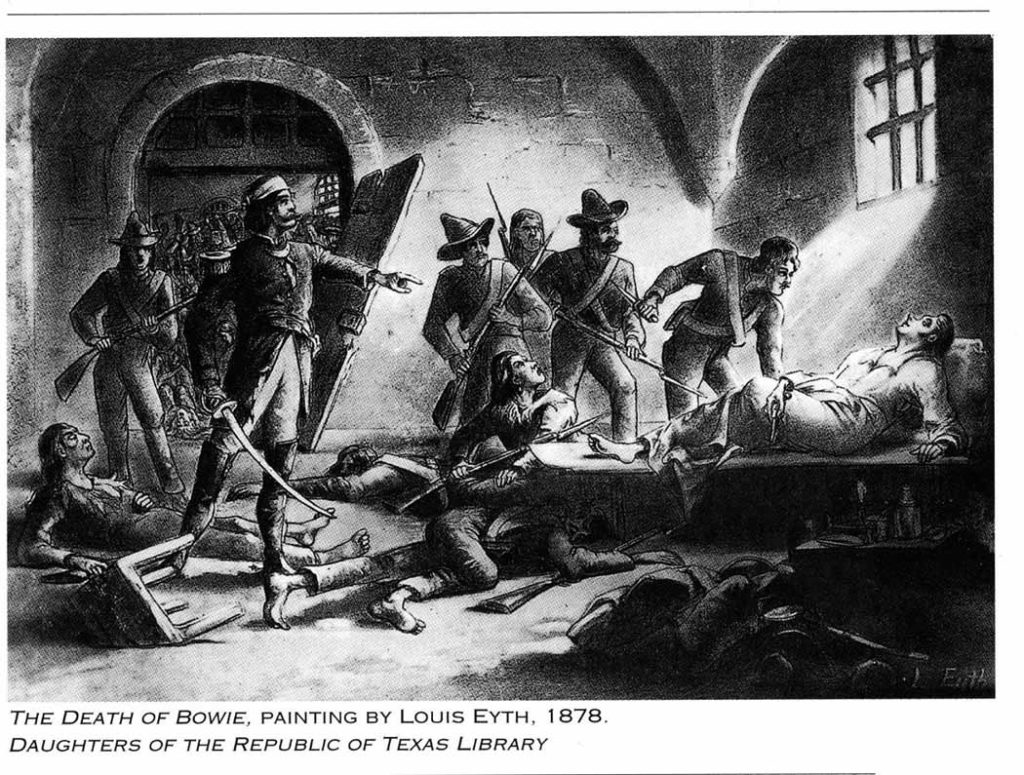
In addition to his participating in the famous Sandbar Fight after which his knife became a sensation on both sides of the Atlantic, Jim Bowie also fought and died in the Battle of the Alamo.

There is, of course, with every innovation in cutlery or other endeavors, a ripple effect. And Schrade Cutlery is a great example as its knife production expanded and the brand became one of the most recognized in the world.

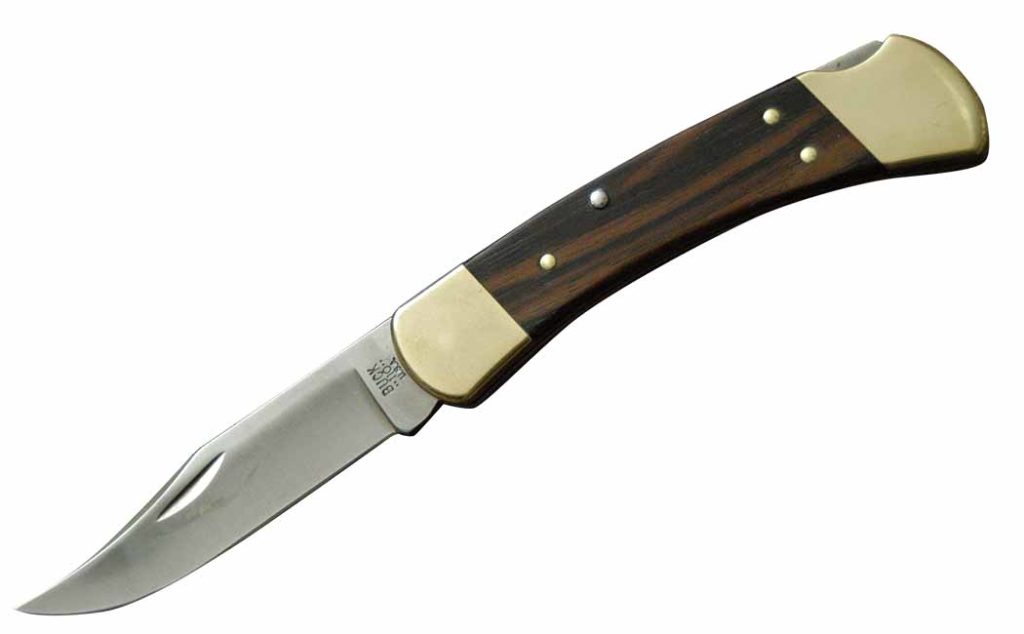
While folding hunters have been out there seemingly forever, Voyles categorically asserts that the Buck 110, which took the knife world by storm almost 60 years ago, is an American knife that deserves to be categorized all by itself.

“Nothing else looked like that knife when Al Buck made it,” Voyles reasoned. “The other lockback folding hunters looked like pocketknives, but I defy you to show me a look like the Buck 110 that existed any earlier. It’s an American style of its own because everybody copied it. The Buck 110 had different construction and sturdiness, and it was so distinctly different that everybody else copied it. The design was so different, and that is attested to by the number of people who copied it.”

According to Bruce Voyles, when Al Buck made the Buck 110 in the mid-1960s, nothing else looked quite like it.

Cutlery Hall-Of-Famer Dan Delavan of plazacutlery.com adds, “Americans have introduced a lot of different blades in the past, including the bowie, KA-BAR combat knife, the hollow-handle survival knife, as well as the basic Boy Scout knife. Each knife served a very basic function, from war to camp and basic scouting activities.

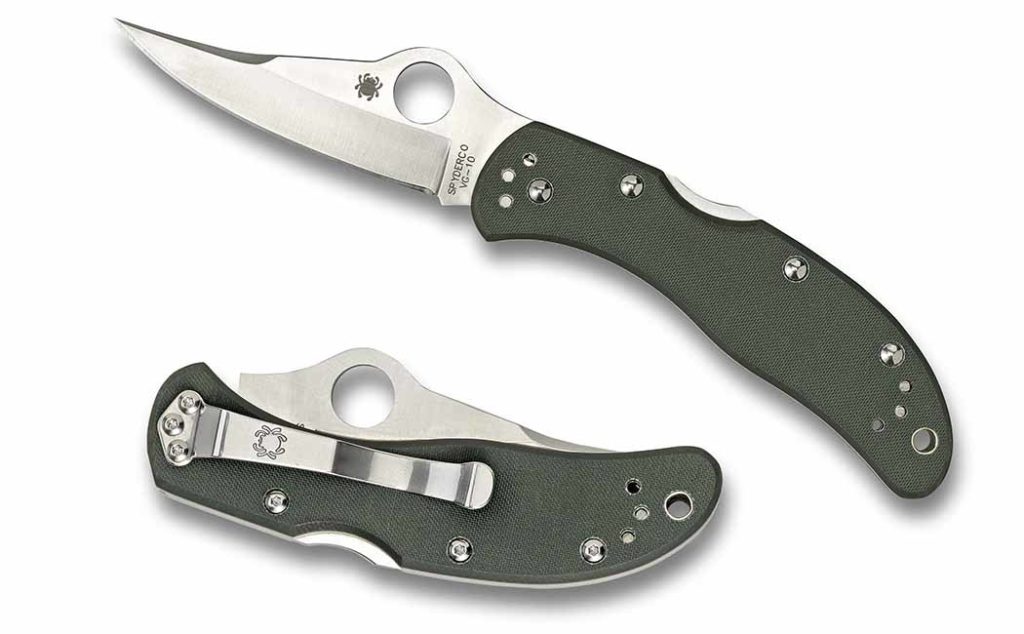
“I think the Spyderco hole is all American,” Delavan opined. “Sal and Gail Glesser came into my shop [the old Plaza Cutlery retail knife store in Costa Mesa, California] back at the very beginning with their folder with the pocket clip and the hole in the blade. They were doing county fairs at that time with their sharpener and introducing their knives. We bought on the spot and have been a lifelong dealer ever since. That has led to a lot of different openings for folders and remains a mainstay in the industry.”

While many may think serrations when they think Spyderco—and they would be correct—the most significant Spyderco innovations are the hole in the blade and the pocket clip. The Worker was the first Spyderco knife with those features, and it was reproduced in 2017 as seen here in one of the company’s sprint production runs.

Quintessential American Knives

Bowie

Historical or modern, vintage or recent, knives with that American flair are identifiable and recognized at home and abroad. Cutlery Hall-Of-Famer Goldie Russell of A.G. Russell Knives sees the bowie as iconic.

“The bowie knife is the quintessential American knife,” she noted. “It is believed that the first was made for Jim Bowie in the blacksmith shop of James Black* in south Arkansas. [Bowie knives] became so popular that they were manufactured by Sheffield cutlery factories for the American market.”

Fixed Blade Hunting Knives

Russell goes on to raise the work of Cutlery Hall-Of-Famer Bob Loveless and his fixed-blade hunting knives to the top as well. “Bob Loveless forever changed the style of the hunting knife with his drop-point, semi-skinner and utility blade shapes, with the drop-point hunter being the most popular,” she continued. “The influence these knives have had on the world knife market includes not just the blade shapes, but also the shaping of the handles to better fit the hand. These models have clearly influenced the shapes, look and feel of knives made by generations of knifemakers, and will continue to do so for decades to come.”

Bill Moran’s Mark

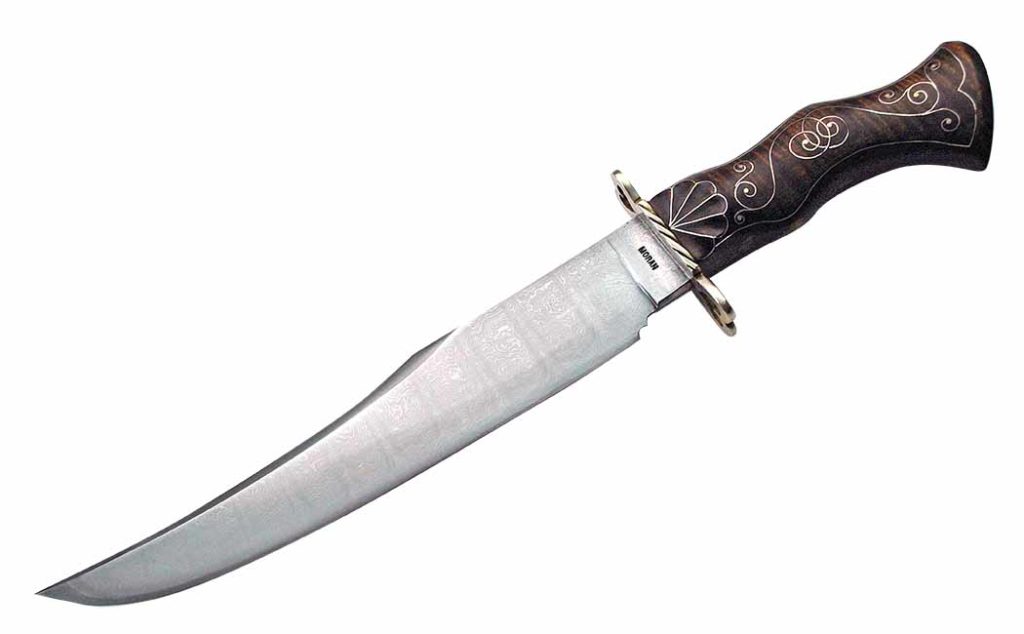
Bill Moran’s statuesque ST-24 not only paved the way for knives of carbon damascus in the 1970s and beyond, but subsequent models in mosaic and stainless damascus as well. (Dave Ellis image)

Also influencing generations of knifemakers were the many camp knives, bowies, fighters and other fixed blades forged from the damascus steel reintroduced by Cutlery Hall-Of-Famer Bill Moran in the early 1970s. Moran’s damascus knives set the stage not only for a plethora of standard carbon damascus knives but also later for stainless damascus and mosaic damascus knives.

Multi-Tool

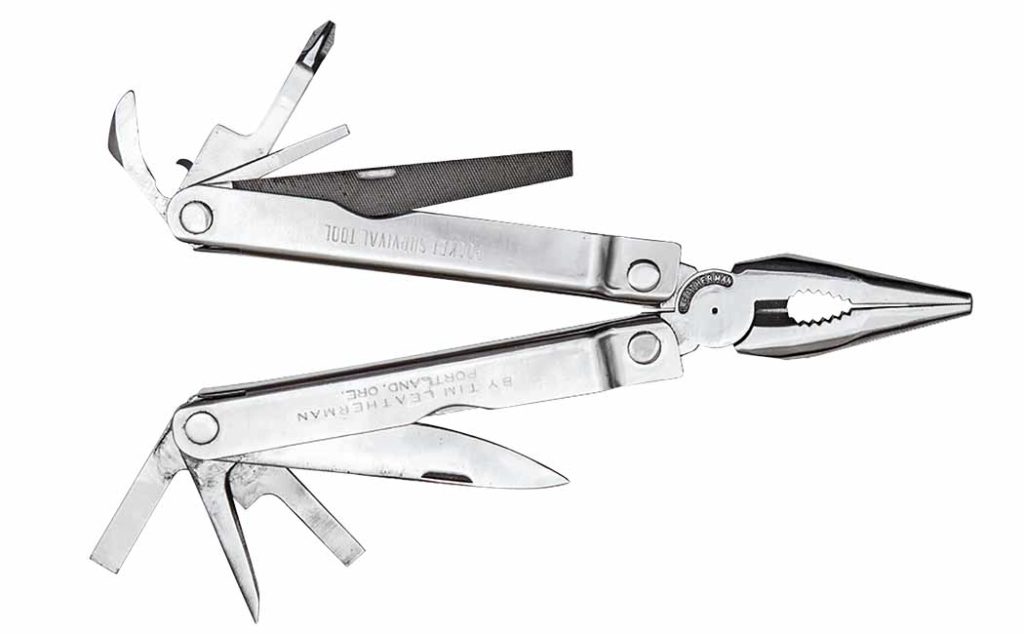
Tim Leatherman holds the multi-tool (also inset) that started it all: the original Leatherman tool, the PST (Pocket Survival Tool).
Tim Leatherman holds the multi-tool that started it all: the original Leatherman tool, the PST (Pocket Survival Tool).

Then, there are the variations on a theme. The multi-tool, for some a knife and for others something totally separate, has nonetheless influenced the cutlery market and is among those chiefly American styles.

“Tim Leatherman’s inspiration in the design of the first Leatherman tool created an entire category in the world of knives,” Goldie Russell explained, “but also in the tool industry. Most construction workers, farmers, carpenters, forestry workers and many other segments of our society carry a multi-tool every day. Those who are not carrying one will usually have one in their toolbox.”

American Knife Innovation

Linerlock

Inventiveness, in itself, is not uniquely American. However, at times the original has the potential for improvement, and just as Schrade improved the switchblade, Cutlery Hall-Of-Famer Michael Walker revolutionized what would become the linerlock.

Cattaraugus made a pocketknife with a brass spring/lever that helped prop the blade in the open position. “Walker changed the design so that when the lever locked it kept the long, clean lines of the knife,” Voyles observed. “The bottom side of the blade is blocked, and the big bump there has got something to hold onto. Walker’s lock does not block the bottom of the blade. It blocks the butt end of the tang. Michael didn’t patent it†, and every major manufacturer in the world has knocked it off. Nobody thought it would have such an impact. However, any knife with a locking liner is an American knife because it was an American innovation that did it.”

Russell echoes the sentiment that Walker’s linerlock was revolutionary and an American innovation. “Michael Walker’s genius of replacing the slip-joint spring with the ball detent spawned the entire generation of modern EDC knives,” she added. “His innovation allowed a portion of the liner to be utilized as a locking device. The idea caught on quickly with handmade knifemakers and has now become an integral part of the manufacturing process for almost every manufacturer of knives. This method of creating a locking folder has made knifemaking much simpler, with much less skill necessary to make an excellent functioning knife.”

Tactical Folder

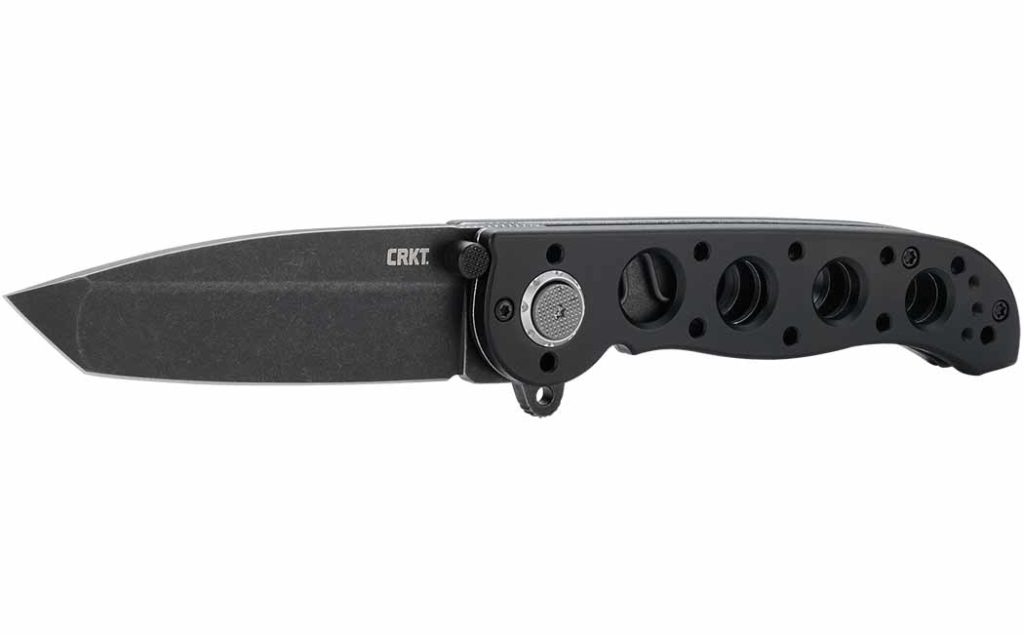
One result of Kit Carson’s popularization of the flipper folder is his long-running series of M16 flipper folders for CRKT. Among the latest iterations is the M16-02DB. In addition to being a flipper folder, the original M16 also was among the earlier top factory tactical folders.

The tactical folder took the world of knives by storm in the mid-to-late 1990s, offering a one-hand folder—usually black—with a non-glare stainless steel blade, a synthetic handle, a linerlock and a pocket clip. While some called it more a marketing approach than a knife, the fact that the folder dominated the market for at least a decade if not longer cannot be denied.

Flipper Folder

Searching her memory and experience, Goldie Russell also identifies the flipper folder popularized by Cutlery Hall-Of-Famer Kit Carson and the SpeedSafe assisted opener by Cutlery Hall-Of-Famer Ken Onion as innovative, influential styles that the world associates with the United States. “When combined with the Walker linerlock, the Carson flipper adds the ability to open the knife as fast, or faster, than a switchblade knife,” she remarked. “It’s a clear improvement over the stud or hole in the blade for the purpose of one-hand opening. The use of the flipper as an opening device has become prevalent throughout knifemaking across the world.

“Then, Ken Onion’s addition of a spring to launch the blade open** is another American innovation that has changed the landscape of the knife industry,” she concluded. “Nearly every American brand utilizes some variation of Ken’s way of using a spring to open a blade quickly. The genius was the bias toward closure that kept a folder from being deemed an automatic.”

Rambo’s Influence

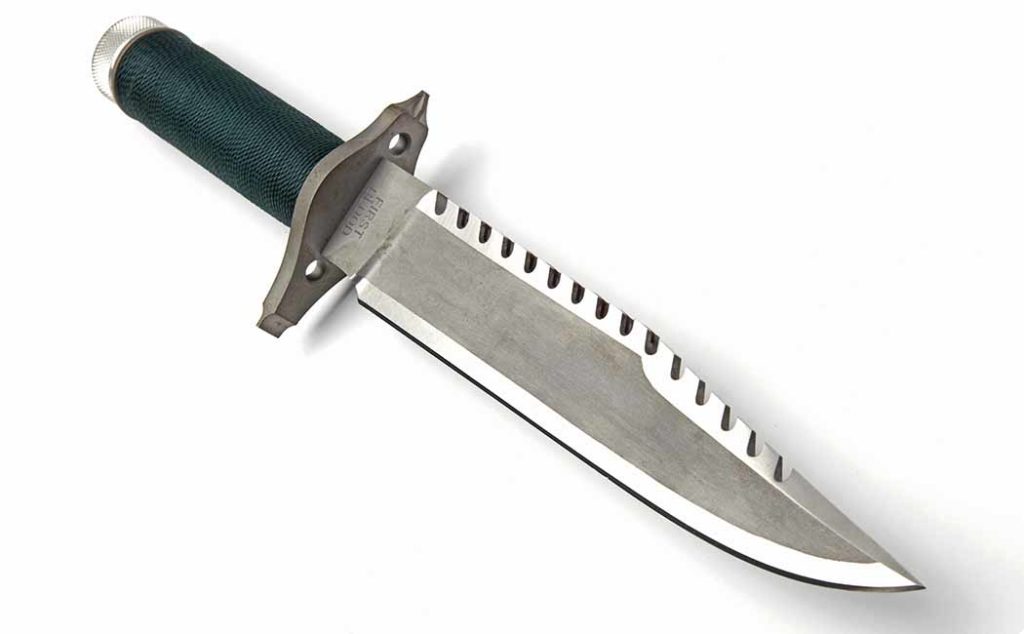
Jimmy Lile’s Rambo knives started the hollow-handle-survival-knife craze that dominated the 1980s and beyond. (from the Randy Rousseau collection)

As the Rambo film franchise grew in popularity during the 1980s, the work of Cutlery Hall-Of-Famers Jimmy Lile and later Gil Hibben made the knives in those motion pictures stars in themselves, rivaling Sylvester Stallone for worldwide acclaim. Voyles insists that the Rambo knife is an American phenomenon that still impacts the knife market today.

“The Rambo knife is uniquely American for two reasons,” Bruce said. “Jimmy Lile designed it and made the knives for the first two movies, and it ignited a boom in survival knives that exists today. Then, the other historical tie-in is that in the 1980s every boy who could walk had a survival knife with a big, round compass on the end and a hollow handle. Even today, those boys are adults and they love the nostalgia of that handmade Rambo knife. Indirectly, Jimmy Lile created all this, and the Rambo knife is uniquely American in that regard.”

Final Cut

Considering the knives closely associated with the United States, their impact is obvious. Those styles associated with the good ol’ USA still resonate across the market and in the inventive minds of those who brought them into being.

*Editor’s note: While many do indeed believe that James Black made a knife for Jim Bowie in Black’s shop, such a knife has never been definitively proved to be as such because Black did not mark his knives.
†Though unable to obtain a patent on the linerlock, Walker was able to obtain a trademark on the name linerlock, a trademark that has since elapsed.
**Cutlery Hall-Of-Famer Blackie Collins also made one of the first versions of an assisted opener.

More Knife History:

Advertisement

Must Read Articles

Read this before you make a knife

Knifemaking 101 – Read This Before You Make a Knife

  by Wayne Goddard My experience has taught me that there's nothing like digging in and getting started. I've often said the hardest part of the...
how to forge damascus steel

How to Forge Damascus

Advertisement
Advertisement