Knife History

The history of knives and other edged instruments is tied to the history of people in general. As humankind’s oldest tool, unraveling knife history can lead to even more surprising and enriching information to better understand the world.

The Sea of Mud Knife: James Bowie’s Knife Found? Pt. 3

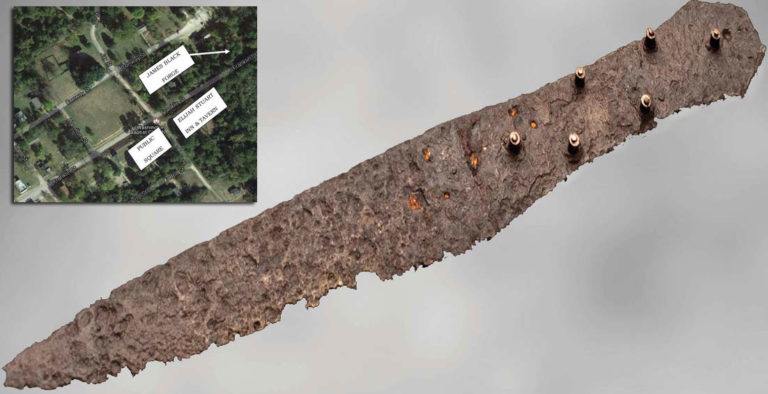
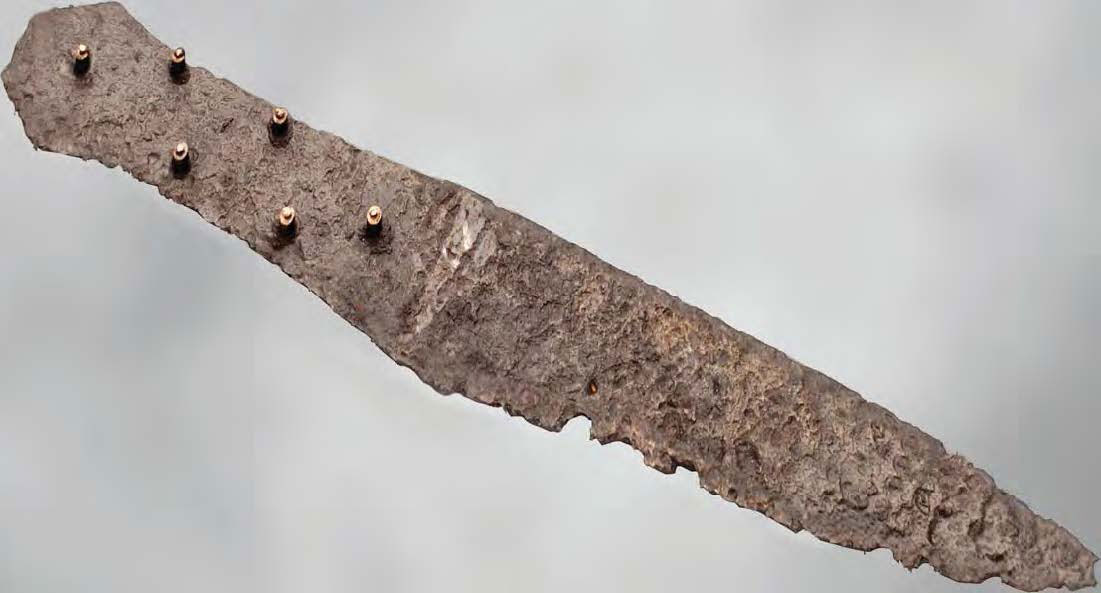
James Bowie knife
(relic image courtesy of the Cushing Memorial Library and Archives, Texas A&M University Libraries)

Editor’s note: Read part one and two of this series first.

Did the Sea of Mud Knife Belong to Davy Crockett?
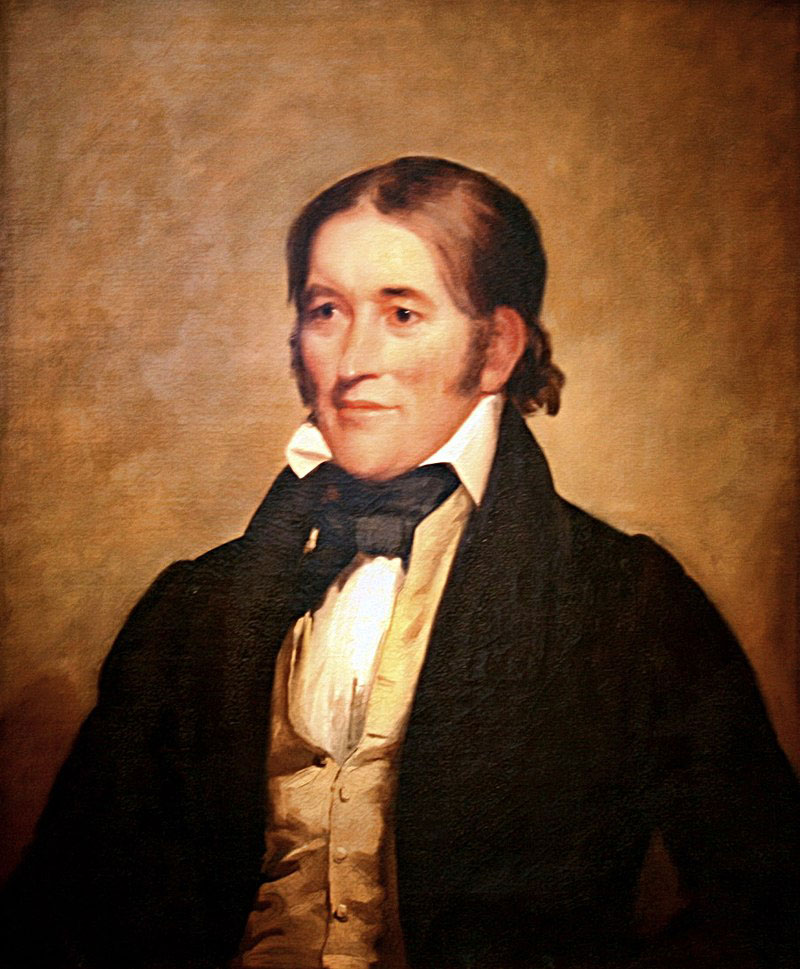
Davy Crockett picture
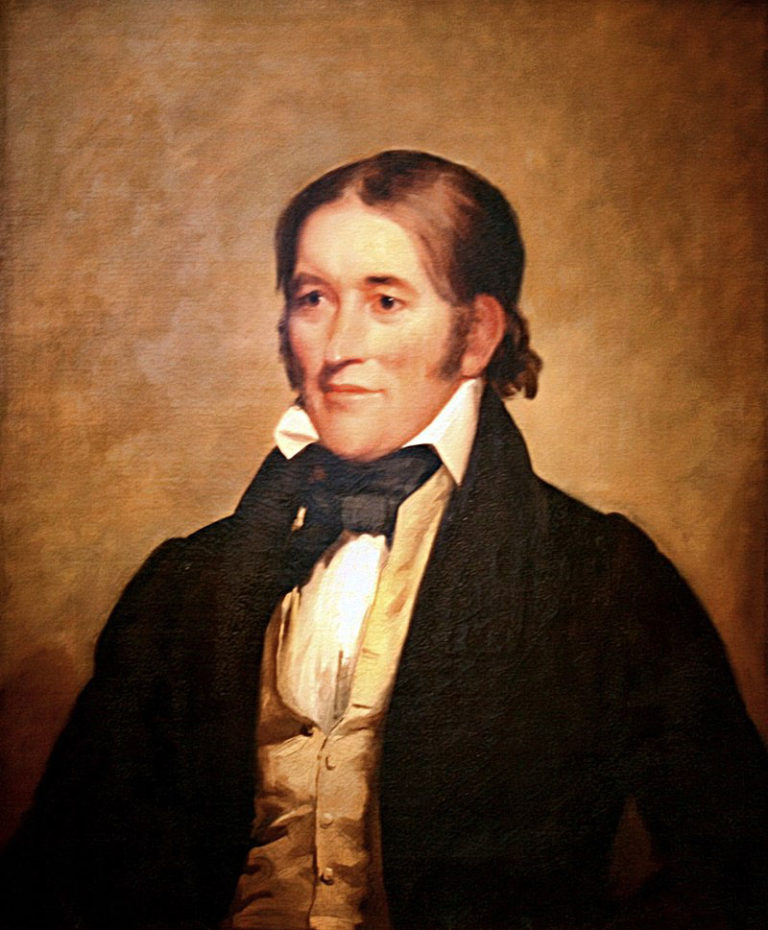
Davy Crockett passed by James Black’s Shop in 1835 on his way to the Alamo. Could he have bought the Sea of Mud knife (above) from Black or received it as a gift?

On about Nov. 18, 1835, the most famous fallen hero of the Alamo and his entourage crossed Town Creek on the Southwest Trail that led up the hill past James Black’s Shop to the Elijah Stuart’s tavern in Washington, Arkansas. Did former Tennessee congressman, Col. David “Davy” Crockett, or one of his companions buy the Sea of Mud knife from Black? Did Black give the knife to the famous folk hero?

On Nov. 1, 1835, Crockett, along with three others—William Patton, Abner Burgin and Lindsey K. Tinkle—left Crockett’s log cabin home near Rutherford, Tennessee, on a journey of adventure, exploration and fortune hunting.

Having recently lost his U.S. House of Representatives seat to Adam Huntsman, “a one-legged Jacksonian,” Crockett told his constituents, “Since you have chosen to elect a man with a timber toe to succeed me, you may all go to the devil and I will go to Texas.” Most certainly he told this tale over and over, all the way to Texas, always to the delight of his audience. He traveled to Jackson, Tennessee, arriving there with 30 well-armed men, where he gave a speech from the steps of the Madison County courthouse.
Davy Crockett history
Crockett left his log cabin home in Rutherford, Tennessee, on Nov. 1, 1835, on a journey of “adventure, exploration and fortune hunting.”

From there he rode southwest to Bolivar, where he spent the night at the residence of Dr. Calvin Jones, once again drawing crowds—including one that sent Crockett off the next morning.
He arrived in Memphis with a much-diminished company on Nov. 10. There that night much time was spent enjoying horns of drink with citizens and comrades at the Union Hotel, Hart’s Saloon and Neil McCool’s establishment.

At 7:30 a.m. on Nov. 11, Crockett and his entourage of six to eight men left Memphis on a packet steamboat. He obviously was recovering from a night of carousing. The steamboat traveled 311 miles down the Mississippi River and up the Arkansas River, arriving at Little Rock at 4:30 p.m. on Nov. 12. The local newspapers reported that hundreds of people swarmed into town to get a look at Crockett, and a group of leading citizens put on a dinner in his honor that night at the Jeffries Hotel. He spoke “mainly to the subject of Texan independence,” as well as federal politics.

Washington, Arkansas

Crockett had traveled 150 miles in nine days on his large chestnut horse with the star on its forehead. He had at least three more traveling companions with him when he left Little Rock that morning. It was only 125 miles down the Southwest Trail to Washington, Arkansas, and just a few more miles to Texas. It is not known how long he stayed in Washington, maybe just overnight, because he was so close to that wonderful land called Texas.
Hugh Armstead Blevins history
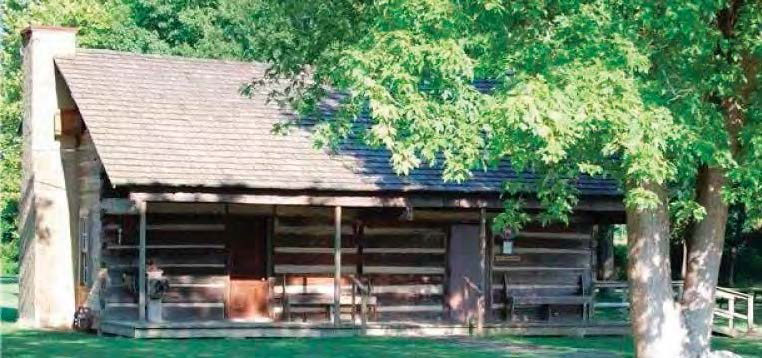
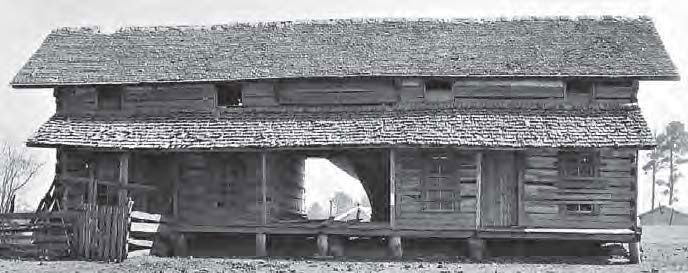
On the way to Washington, Arkansas, Crockett stayed at the home (above) of Hugh Armstead Blevins in present-day Blevins, Arkansas.

He had stayed with an old and dear friend from Rutherford County Tennessee, Hugh Armstead Blevins, in present-day Blevins, Arkansas, before riding into Washington. Blevins family tradition maintains that Crockett went on a weeklong deer-hunting trip with Hugh. Crockett stayed at Elijah Stuart’s tavern next to James Black’s shop in Washington. The people came in from all around to hear Crockett speak from the courthouse steps. After some celebrating, Davy and a half-dozen mounted companions could have ridden to the Red River and crossed into Texas at Dooley’s ferry.
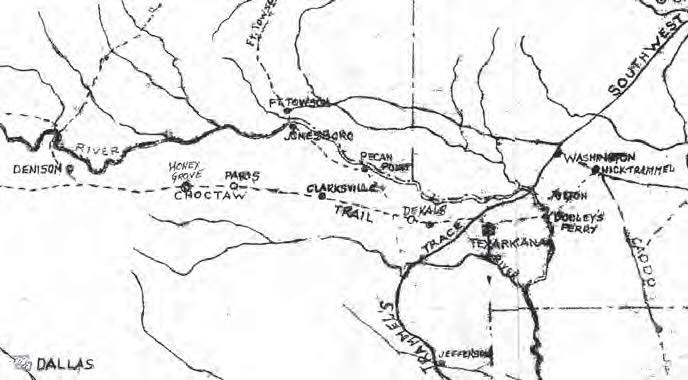
Some historians say he went down the Fort Towson road 115 miles and crossed the Red River into Texas at Jonesboro, just north of present-day Davenport, Texas. He may have crossed the Red River at Dooley’s Ferry just as W.G. Featherstonhaugh did.
Davy Crockett travels
Crockett stayed at Elijah Stuart’s tavern next to James Black’s shop in Washington. He may have crossed the Red River at Dooley’s Ferry as did W.G. Featherstonhaugh. Some say Crockett went down the Fort Towson road 115 miles and crossed the Red River into Texas.

Several weeks after the fall of the Alamo Crockett’s widow, Elizabeth, received a small package from Isaac Newton Jones. The package contained a watch with Crockett’s name engraved inside. In an accompanying letter, Jones wrote:

“Last winter, Colonel Crockett … passed through Lost Prairie, on the Red River, where I live … the Colonel visited me the next day, and spent the day with me. He observed, whilst here, that his funds were getting short, and proposed to me to exchange watches. He priced his at thirty dollars more than mine, which sum I paid to him, and we accordingly exchanged … I was gratified at the exchange, as it gave me a keepsake which would remind me of an honest man, a good citizen, and a pioneer in the cause of liberty … the object of this letter is to beg that you will accept the watch which accompanies it … please accept, dear madam, for yourself and your family …”

Crockett’s Letter
Davy Crockett De Kalb
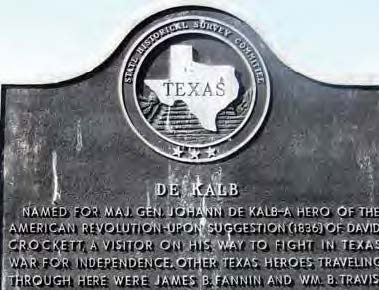
Crockett reportedly suggested the name for De Kalb, Texas and traveled through the area on his way to the Alamo.

The distance from Lost Prairie to Nacogdoches down Trammel’s Trace was 165 to 170 miles. At the rate of 25 miles per day Crockett should have arrived at Nacogdoches, Texas before the end of November. Crockett and his entourage were welcomed in Nacogdoches on Jan. 5, 1836.

Here is what Crockett stated in a letter written to his son and daughter from St. Augustine, Texas, dated Jan. 9, 1836:

“This is the first time I have had the opportunity to write to you with convenience. I am now blessed with excellent health and am in high spirits. Although I have had many difficulties to encounter, I have got through safe, and have been received by everybody with the open arm of friendship. I am hailed with a hardy welcome to this country. A dinner and a party of Ladys have honored me with an invitation to participate with them, both in Nacogdoches and this place. The cannon was fired here on my arrival, and I must say, as to what I have seen of Texas, it is the garden spot of the world. The best land and the best prospect for health I ever saw is here, and I do believe it is a fortune to any man to come here. There is a world of country to settle. It is not required here to pay down for your League of Land; every man is entitled to his head right of 4,000 & 428 acres. They may make the money to pay for it off the Land.

“I expect in all probability to settle on the Bodark or Choctaw Bayou of Red River. That, I have no doubt, is the richest country in the world. Good Land and plenty of timber, and the best springs and good mill streams. Good range, clear water and every appearance of good health, and game plenty. It is in the pass where the Buffalo passes from the north to south and back twice a year, and bees and honey plenty.

“I have a great hope of getting the agency to settle that country, and I would be glad to see every friend I have settle there. It would be a fortune to them all.

“I have taken the oath of the Government, and have enrolled my name as a volunteer for six months, and will set out for the Rio Grand in a few days with the volunteers from the United States. All volunteers is entitled to a vote for a member of the convention, or to be voted for, and I have but little doubt of being elected a member to form a constitution for this Province.

“I am rejoiced at my fate. I had rather be in my present situation than to be elected to a seat in Congress for life. I am in hopes of making a fortune for myself and family, bad as has been my prospects.

“I have not wrote to William, but have requested John to direct him what to do. I hope you show him this letter, and also your brother John, as it is not convenient at this time for me to write to them.

“I hope you will do the best you can, and I will do the same. Do not be uneasy about me, for I am with my friends.

“I must close, with great respects, your affectionate Father, Farewell David Crockett”

Crockett spent December roaming the north Texas countryside along the Red River visiting friends and looking for a prosperous place to settle down where there was good bear and buffalo hunting. He was also dodging Comanche Indians. He headed west along Ridge Trail or Choctaw Trail 175 miles along the Red River as far as Choctaw Bayou. Choctaw Bayou runs from Grayson County northeast into the Red River at the northwest corner of Fannin County above Sherman and Denison, Texas.
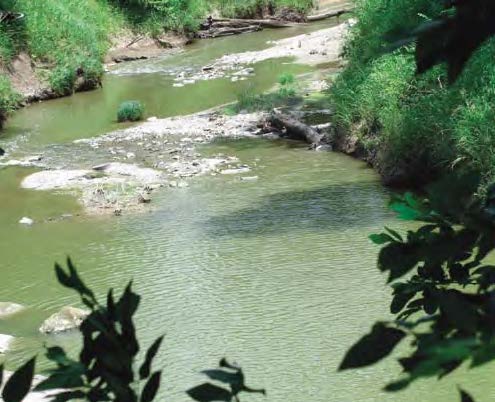
Davy Crockett Texas
Crockett stayed at Elijah Stuart’s tavern next to James Black’s shop in Washington. He may have crossed the Red River at Dooley’s Ferry as did W.G. Featherstonhaugh. Some say Crockett went down the Fort Towson road 115 miles and crossed the Red River into Texas.

It is said that the morale of the defenders of the Alamo in San Antonio enjoyed a boost on Feb. 8, 1836, when the former U.S. congressman from Tennessee, bear hunter and Indian fighter rode in with a contingent of Tennessee Mounted Volunteers.

Next time: The fortifications by the defenders and the probing of them by the Mexican Army during the Alamo siege.


Read part three of this series here.

Keep Learning About Knife History

BLADE magazine back issues

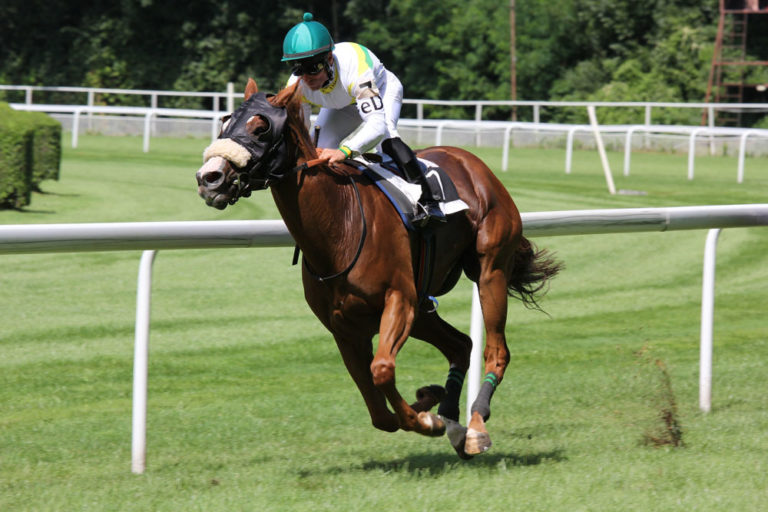
That Time that BLADE Magazine was Traded for a Horse

Yep, that’s right—a thoroughbred racehorse.

Known as The American Blade at the time, the magazine was traded by then-publisher Jack Marvich to Wally Beinfeld for a racehorse—or at least that’s what Beinfeld reportedly told one of his successors, former BLADE publisher and editor and BLADE Magazine Cutlery Hall-Of-Fame® member Bruce Voyles.

Marvich was a dentist living in New Orleans. He acquired the magazine and served as publisher beginning with the January-February 1974 issue and ending with the November-December issue of the same year. That’s when Beinfeld assumed the, ahem, reins. But first let’s, ahem, backtrack a bit.

knife magazines of the 1970s
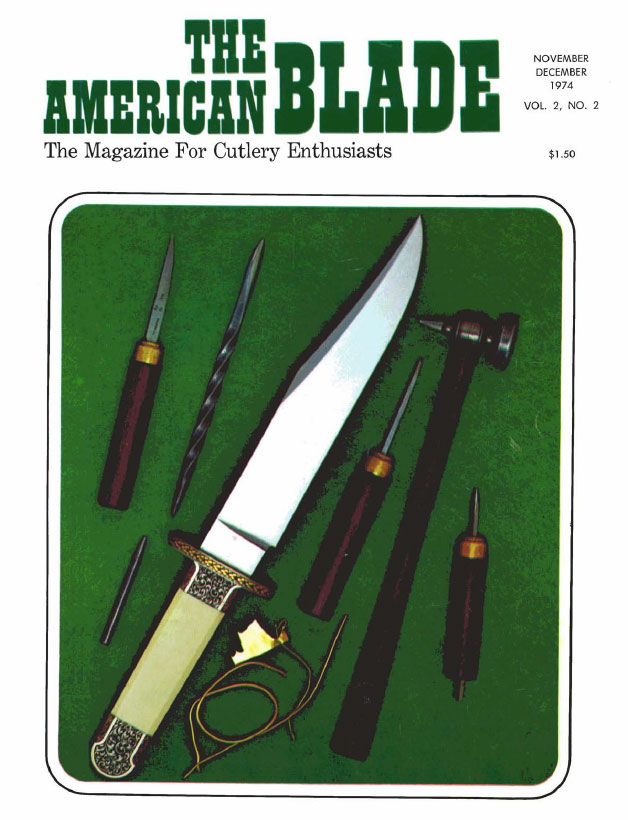
The cover of the November-December 1974 issue of The American Blade.

Beinfeld ran what was probably the country’s premier antique arms show and, in part to help promote it, published a gun magazine called the Arms Gazette. The Gazette had a large editorial, graphics and production staff that was more than big enough to produce a second magazine. Hence, Beinfeld decided to add a knife publication—The American Blade—to his, ahem, stable.

However, there was one problem. Marvich and Beinfeld could not make a deal, even if, apparently, the racehorse was at least part of the payment.

“They were sitting there talking about it one day and the more they talked, the worse it got,” Voyles recalled Beinfeld’s version of what happened.

Beinfeld and Marvich were making no headway at all. Finally, Beinfeld stood to call the whole thing off and leave when in walked Marvich’s wife.

“Marvich looked at her and said, ‘Honey, the deal’s not going to go through, we just can’t come to terms.’ And she looked at him and said, ‘What about my racehorse?’ And in Wally’s words, ‘So I sat back down.’ From what I understand,” Bruce recalled, “I don’t know if the racehorse was just part of the deal or what, but I believe it was the entire deal. That was the way it was told to me.”

And, thus, Beinfeld bought The American Blade. Bruce said he can’t recall the horse’s name, which is understandable considering how long ago it was. Meanwhile, Mr. Beinfeld passed away a few years back, and we don’t know the whereabouts of Mr. and Mrs. Marvich.

As for the horse, here’s hoping he was put out to stud and lived happily ever after. (Insert your impression of a horse whinnying here.)

Subscribe to BLADE Magazine

Sign up for a subscription to the world’s foremost knife magazine here, no horse required.

Photos: World War II Fixed Blade Knives

Armed Forces Day 2018

Saturday, May 19, 2018, is Armed Forces Day. It’s a day to “participate in exercises expressive of our recognition of the skill, gallantry, and uncompromising devotion to duty characteristic of the Armed Forces in the carrying out of their missions,” as President Harry Truman put it in 1950

BLADE is doing its part by taking a look back at the knives that accompanied those in uniform during World War II. When BLADE writes about lives depending on knives, it’s not only referring to the user. If a soldier depends on a knife, then citizens also depend on that knife.


Editor’s note: The following is by Richard D. White.

MARK 1

Examples of World War II knives
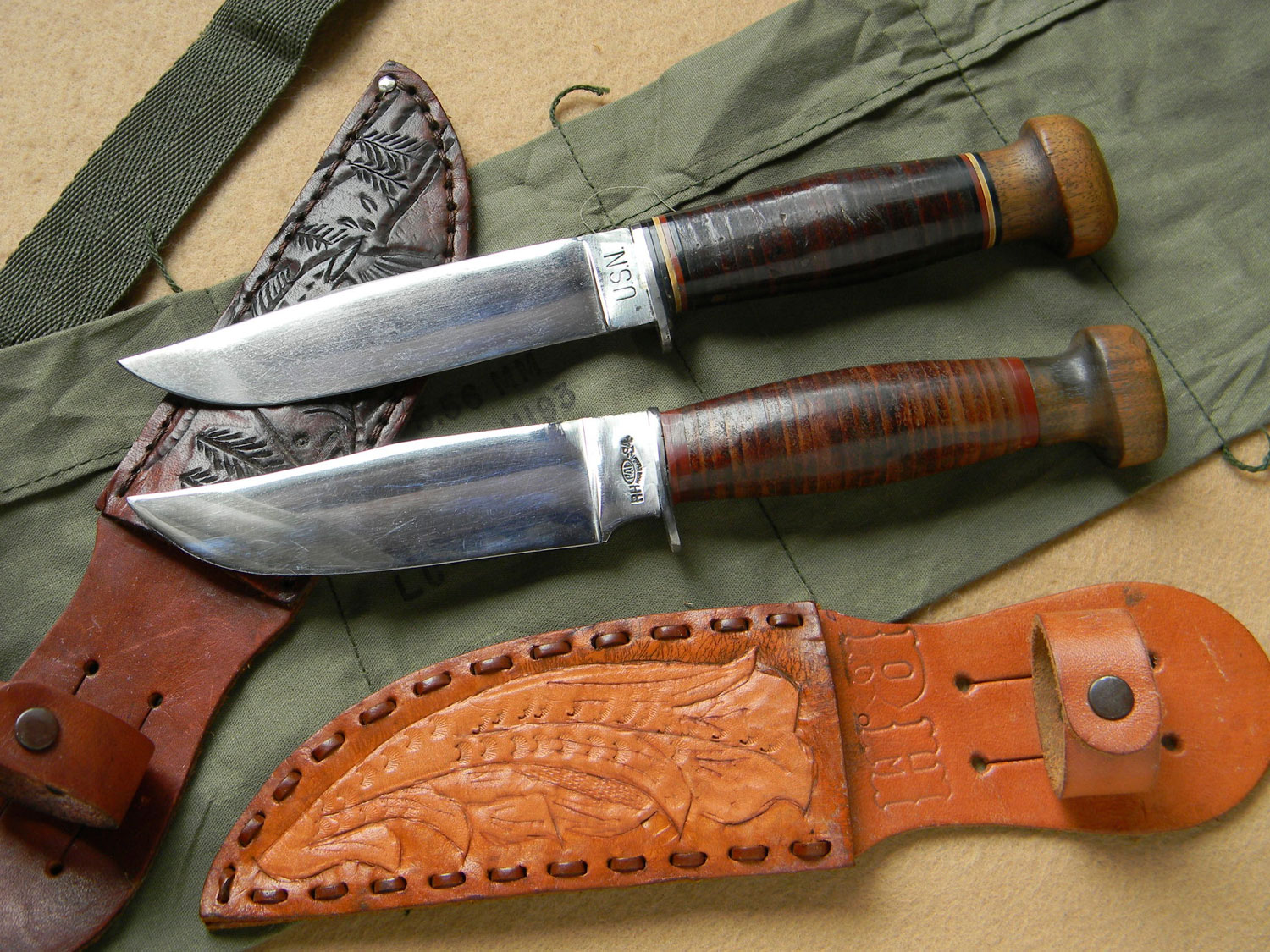
Pal (bottom) and Robeson made these Mark 1’s with wood pommels. Wood was used because of a shortage of aluminum during World War II. Both knives feature handmade sheaths, probably made on ships by servicemen. (All images by Richard D. White)

Featuring a 5-to-5.25-inch flat-ground blade, the Mark 1 utility knife was adopted by the Navy as a survival-type knife with sheath. Every sailor who worked “topside” was issued a fixed blade for cutting ropes/line.

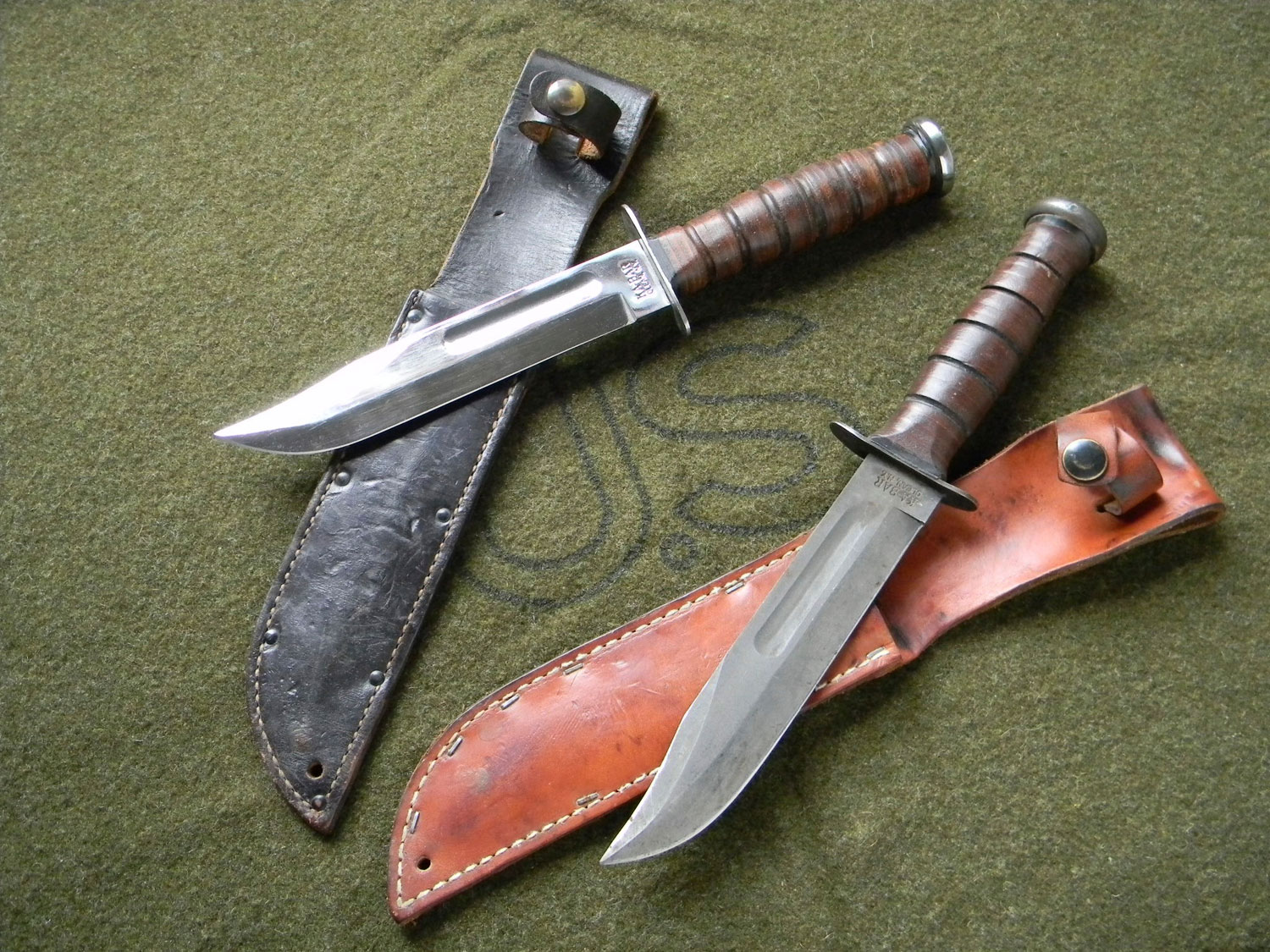
The Mark I probably the World War II military knife encountered most in the marketplace. There are a significant number of different varieties—some historians say as many as 42. Camillus, Colonial, Geneva Forge, Pal, Robeson, KA-BAR, Boker and Kinfolks made them.

Blade finishes included polished, blued and Parkerized. Pommels were the traditional bird’s-beak design or flat of steel, plastic or wood. Handles generally were stacked leather—some with fiber spacers, some without. Mark 1’s by Colonial had injected plastic handles.

MARK 2

World War II knives
Two excellent Mark 2’s stamped “KA-BAR” are synonymous with World War II U.S. military combat knives. Union Cutlery Co. made approximately 1 million USMC-stamped KA-BAR knives for distribution in the South Pacific. 

The Mark 2 was made available to combat soldiers in 1943. It was 12 inches long with a 7-inch blade. The handle was stacked leather, generally grooved. It was held in place with a steel washer pinned to the tang. Examples are plentiful and often were photographed hanging from the belts of soldiers who fought in the South Pacific Islands.

KA-BAR World War II knives
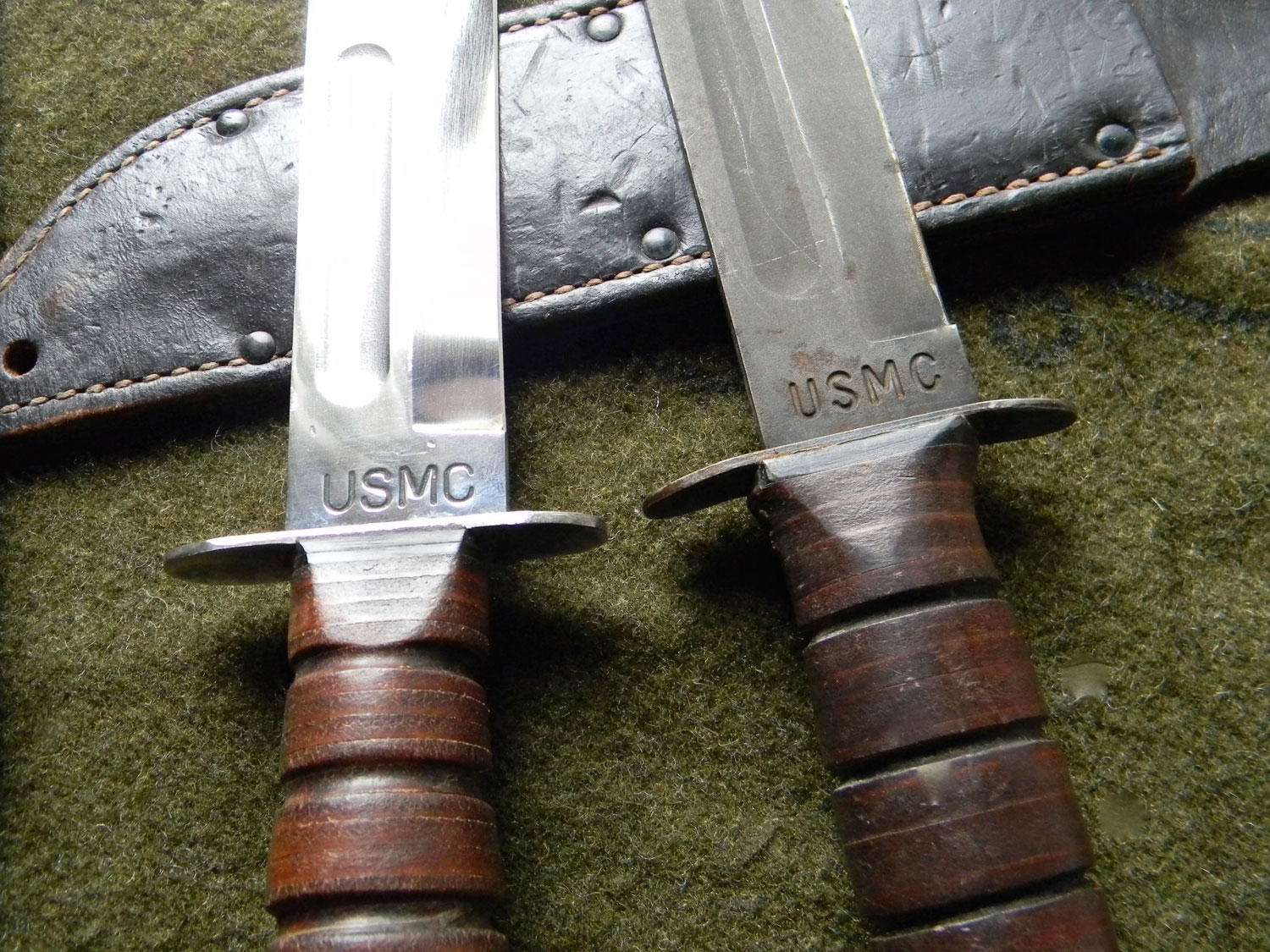
The backs of the KA-BAR Mark 2 tangs show the very deep, distinctive “USMC” stamping—a stated preference of the author’s—on the polished (left) and coated blades.

KA-BAR, Robeson, Pal, Utica, Ontario and Camillus were the major manufacturers of the Mark 2. Variations included different spacer colors, marks/stamps, pommel thicknesses and materials, piening vs. welding of the pommels, blue vs. polished blades, and smooth vs. grooved handles.

M3

Mark 3 knife
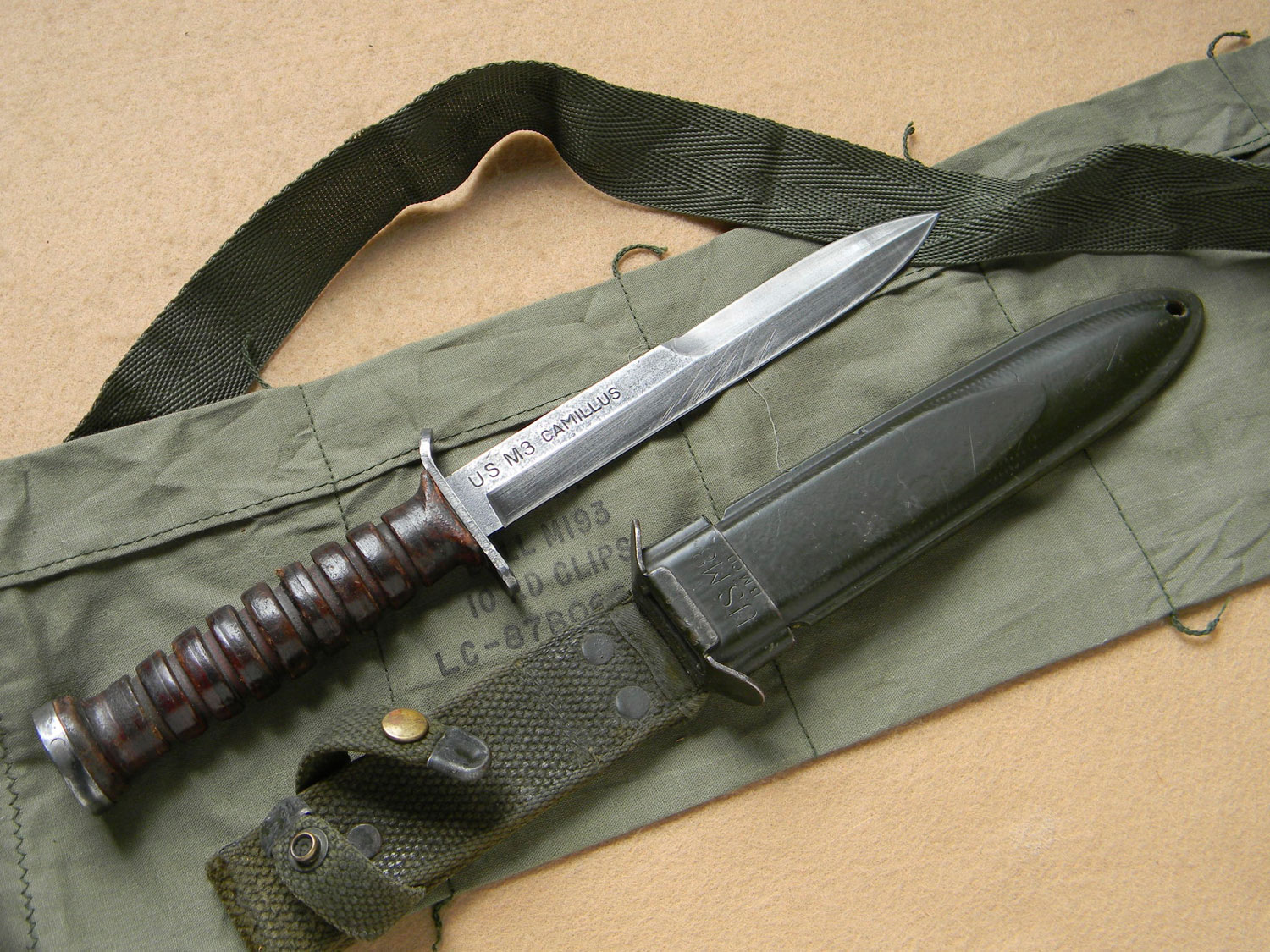
The M3—this one by Camillus—is one of the most desirable World War II combat knives because of its double-edge blade. Though over 2.5 million supposedly were produced during World War II, prices remain quite high for them. Boker, Kinfolks, Robeson, Utica, Imperial, Case, Aerial and Pal also made M3s.

The M3 was designed to meet a shortage of combat knives, especially in early 1942. According to Frank Trzaska, a military knife historian, the decision to design the M3 rather than continuing to produce the Mark 2 was based on a U.S. steel shortage.

The M3 was selected because it was easier to manufacture and had a thinner blade, which was 6.75 inches and sharpened the full length, excluding the stamped tang area. The top edge was sharpened about a third of the blade length. The guard was thick steel angled on top to form a thumb rest.

The handle was stacked leather with a series of cut grooves. Originally there were supposed to be eight grooves, but some companies generally used to six to seven. The grooves provided better purchase. The pommel was flat steel and pinned to the tang.

The M3 had many variations, including added spacers at the guard and pommel end, or piening the tang over to hold the pommel in place as opposed to pinning the pommel onto the tang.

GO WESTERN 

Baby Shark knives
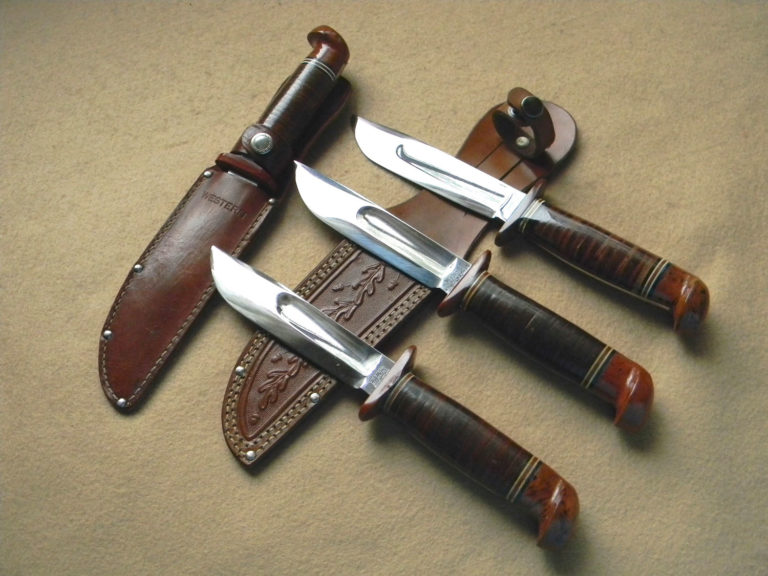
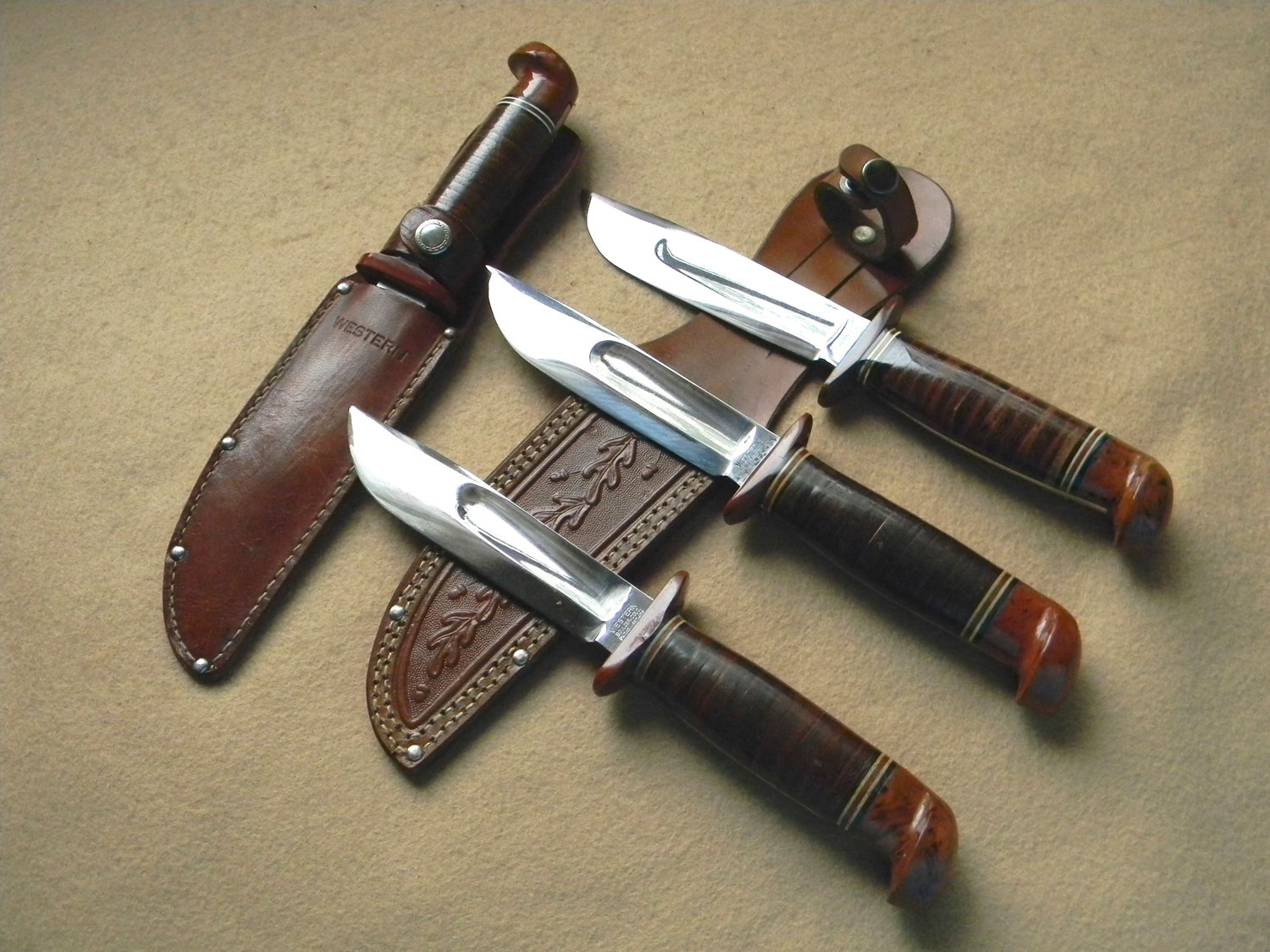
Because of the shortage of brass and aluminum during World War II, Western used plastic for the guards and pommels of its “Baby Shark” models.

Any review of World War II military fixed blades must include several examples of Western knives. While some are very rare, such as the L-76, L-77, “Bushman” and USMC parachutist knives, several examples are more ubiquitous.

One is the “Shark.” Western made two: one with a 6-inch blade, the G46-6, and one with a 5-inch blade, the G46-5. Both had huge blood grooves, stacked leather handles, and several different guards and pommels. Both came with flat steel, aluminum or mottled-brown-plastic pommels.

Guards were double steel, the very rare brass or plastic like the pommels. Many times the guards and pommels were mixed and matched. The smaller Sharks were issued to Navy and Army Air Corps pilots as a bailout knife. Blade finishes were blued and polished.

World War II combat knives
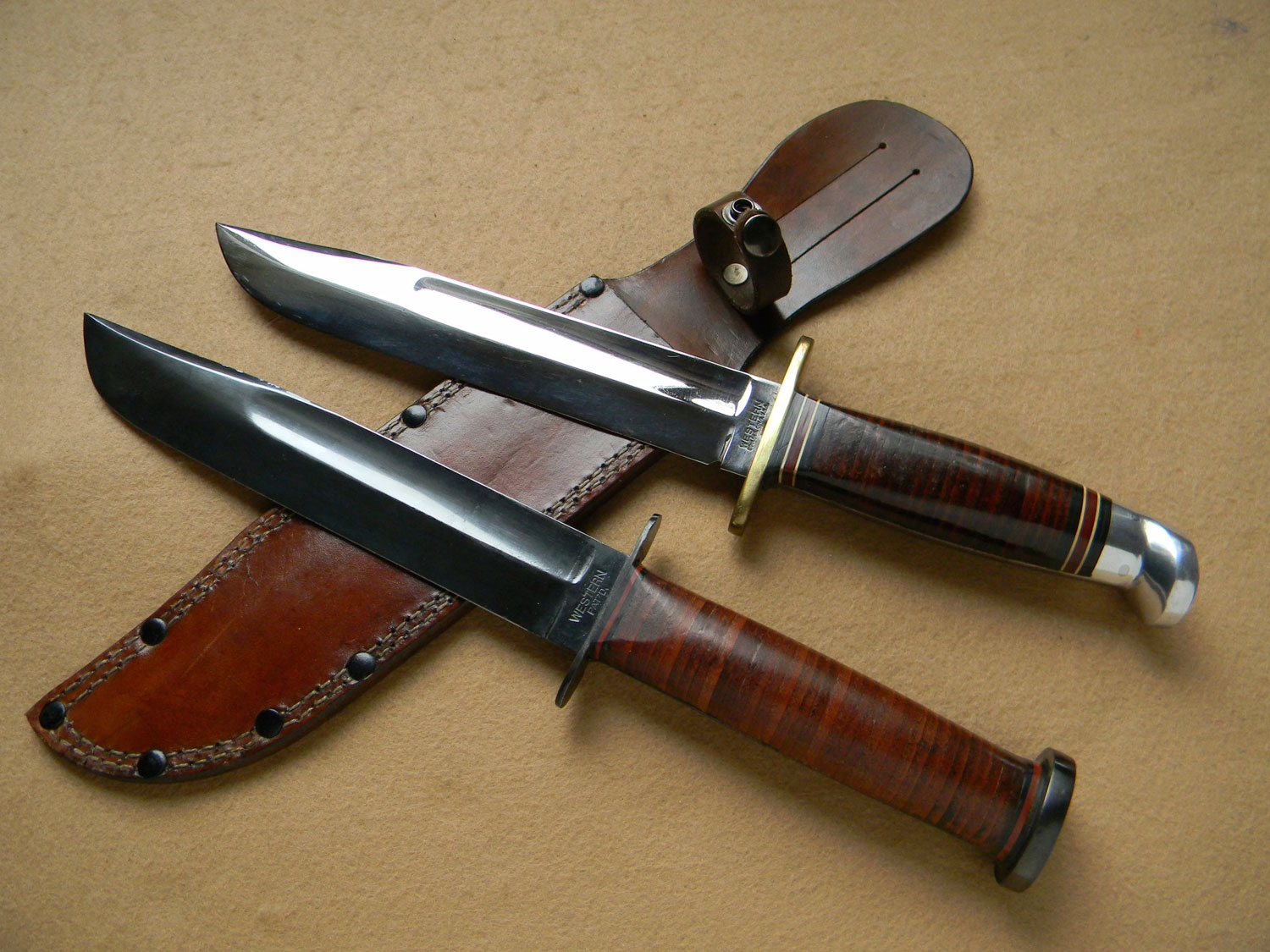
Of these two Western 46-8 combat knives, the more traditional World War II vintage is the bottom one, with flat steel pommel and blued blade. The top model is perhaps post-World War II because it features a brass guard. Because of the demand for brass for artillery shells and ammunition, few World War II military knives feature the material for guards.

Another Western World War II fixed blade was the 46-8, a huge, impressive combat knife with an 8-inch blade. It was officially known as the G46. The blade had a massive blood groove and upswept false edge on the spine. The knife featured stacked leather handles, double-sided steel guards, and flat steel pommels. Most had blued blades, though some were polished.

225-Q

US military knives World War II
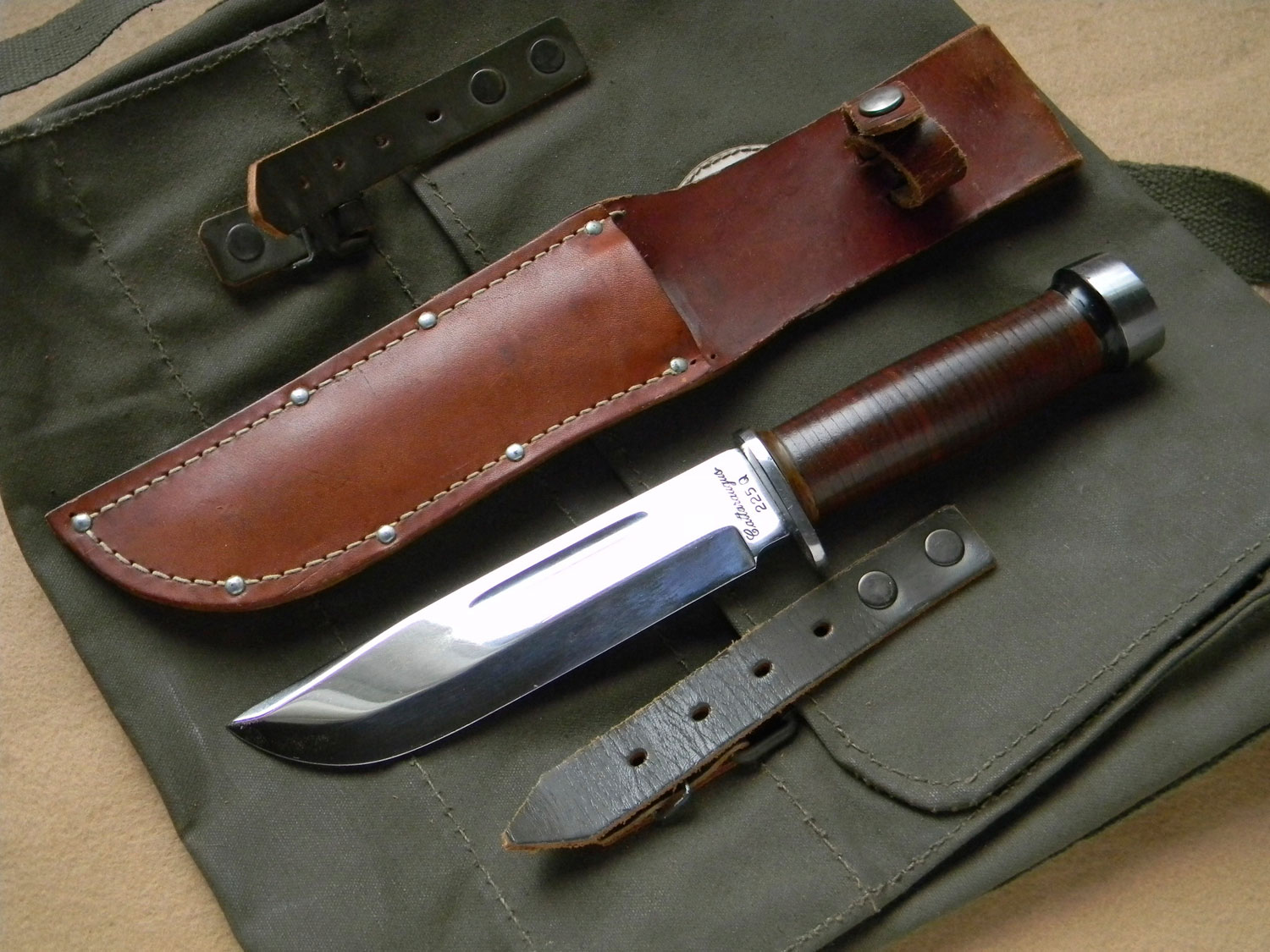
The Cattaraugus 225Q was favored by GIs because of its massive, thick blade and the three-part steel pommel. The sheath is in mint condition and was bought with the knife from a 95-year-old veteran of World War II. Most 225Q’s have a rough groove cut into the stacked leather handle for enhanced purchase.

The Cattaraugus 225-Q had one of the strongest blades of any World War II combat knife. Many observers say it was for quartermasters, with the “Q” standing for quartermaster. As the thinking goes, the rather stout blade was designed to open various wooden crates—an important part of the quartermaster’s job—and the triple steel pommel was used to nail the crates closed.

Still others say the knife was designed for and used by U.S. special operatives during World War II. As with any military knife, be careful not to fall victim to the opinions of so-called experts, especially when they attribute particular knives to units like the Devils’ Brigade, Commandos, OSS, Underwater Demolition Team, etc.

Some military knives—not just the 225Q—were stamped very lightly, while others were deeply stamped.


Keep Learning About Knife History

Download BLADE magazine back issues

The Sea of Mud Knife: James Bowie’s Knife Found? Pt. 2

Sea of Mud knife

James Black’s original blacksmith shop was located on Franklin Street, one block northeast of the town square in Washington, Hempstead County of the Arkansas Territory. According to the author, Black made the Sea of Mud Knife. Click image for a larger view. (relic image courtesy of the Cushing Memorial Library and Archives, Texas A&M University Libraries)

Editor’s note: Read the first part of this series about the “Sea of Mud Knife” here.

“Only Men of Means Could Own One”

To acquire a James Black silver-mounted coffin-handle knife similar to how the Sea of Mud Knife originally appeared, you would have had to visit Black’s shop circa 1830 or so. The price would have been high—more than $20, which would be at least 500 in today’s dollars. Only men of means could own one.

There are indications Black made knives that were less ostentatious for the common man. These were tools and as tools were worn out and discarded. Few have survived.

James Black blacksmithing shop

The Pioneer Washington Restoration Foundation built a recreation of James Black’s blacksmithing shop in Washington, Arkansas, in 1960.

Black’s shop was located on Franklin Street, one block northeast of the town square in Washington, Hempstead County of the Arkansas Territory. Black had apprenticed for Stephen Henderson in Philadelphia, Pennsylvania, for at least nine years. Henderson learned the art and craft of making Sheffield silver plate in Sheffield, the cutlery center of England.

He could clad silver sheet to the ricasso area of the blade.

Black had set up his blacksmith shop on his town lot in 1829 after he married Anne Shaw. Black had worked in William Shaw’s shop doing general blacksmithing for five to six years. Black made knives of cast steel, the best steel known at the time from Sheffield. He knew how to heat treat to get the best cutting edge. Back then, most crossroads blacksmiths made knives of inferior steel with hardly any heat-treating expertise. Some were even made of wrought iron. Black’s knives became known for their edge holding, craftsmanship and beauty.

Plaque James Black blacksmithing shop

A cat keeps vigil on the rock pedestal that marks the original 1829-1832 location of Black’s shop (right). The iron plaque on the pedestal gives one version of how the original bowie knife was made. There are other versions, too.

The Southwest Trail

The frontier town of Washington is located on a sand hill in southwest Arkansas on the Southwest Trail. The Southwest Trail, or the Military Road, led from St. Louis, Missouri, diagonally across Arkansas through Washington to Fulton on the Red River. It was only 12 miles from Washington to Fulton. Across the Red River is Texas. In Texas, Trammel’s Trace led to Nacogdoches and to El Camino Royal—and to San Antonio de Bexar and the Alamo.

The Southwest Trail was the major land route from the Northern United States to Texas. You left Washington, D.C., by the National Road to Parkersburg, West Virginia, and boarded a steamboat to the Falls of the Ohio River at Louisville, Kentucky. You crossed the river to New Albany, Indiana, and took a stagecoach to East St. Louis, and crossed the Mississippi River to the Southwest Trail. You could also go by steamboat down the Mississippi River and up the Arkansas River to Little Rock and down the Southwest Trail.

Three other roads intersected at Washington. The road due west led to Fort Towson in the Indian Territory above the Red River and the ferry crossing into Jonesboro, Texas. A road led due east past Nick Trammel’s Tavern through Camden to Gaines Landing on the Mississippi River in Chicot County, Arkansas. Trammel’s Trace, the route in Texas to Nacogdoches, originated at Trammel’s Place and crossed the Red River at Dooley’s Ferry below Fulton. The other trail led south to Natchitoches, Louisiana, and to Texas.

From 1832 to 1834 most of the Choctaw Nation was removed from Mississippi and Alabama down the Southwest Trail from Little Rock, or from Gaines Landing across the Mississippi River from the Choctaw Trail, which intersected the Natchez Trace in Mississippi. From Washington they proceeded down the Fort Towson Road to Doaksville, Oklahoma, one mile west of Fort Towson.

Black’s Shop Visitors

Two struggling young lawyers from Logan County Kentucky who died at the Alamo, Daniel William Cloud, 21, and Peter James Bailey III, 26, passed by Black’s Shop in the fall of 1835 on their way to Texas. Could they have bought the Sea of Mud knife from Black? They had headed to Illinois where they heard there were more clients.

However, they found the weather too cold, the fees too low, and the “Yankee Lawyers” too active. They went down the Southwest Trail in Missouri and found the same thing. So they went further south through Arkansas to the Red River. From there they took the road to Natchitoches, Louisiana.

James Black blacksmithing shop

The sign outside the recreation of James Black’s blacksmith shop carries the year 1961. According to at least one other source, the recreation was built in 1960.

On Dec. 29, 1835, near Natchitoches, Cloud wrote his brother a letter describing his trip to Texas:

“We found Arkansas Territory in some places rich, well watered and healthy and society tolerably good, but the great body of the country is stony, sandy, and mountainous, in passing through, we traveled ten days constantly in crossing the mountains.

“On Red River the lands were immensely rich, and planters also, many of them worth two and three hundred thousand dollars. Had we chosen to locate in Arkansas, we could have made money rapidly if blessed with health and life; dockets and fees being large.

“The reason for our pushing still further on must now be told, and as it is a master one, it will suffice without the mention of any other one. Ever since Texas has unfurled the Banner of Freedom, and commenced warfare of liberty or death, our hearts have been enlisted in her behalf. The progress of her cause has increased the ardor of our feeling until we have resolved to embark in the vessel which contains the Flag of Liberty and sink or swim in its defense.”

An Englishman, George William Featherstonhaugh (pronounced “Fenshawe”) came down the Southwest Trail through Washington in late November or early December 1834.

He writes in his journal, Excursions Through the Slave States of North America:

“And we made an agreeable excursion in the neighborhood, calling for a short time at the little insignificant wooden village of Washington, where the government land sales were holding.

“I was not desirous of remaining long at this place. General Houston was here, leading a mysterious sort of life, shut up in a small tavern, seeing nobody by day and sitting up all night … There were many persons at this time in the village from the states lying adjacent to the Mississippi, under the pretense of purchasing government land, but whose real object was to encourage the settlers in Texas to throw off their allegiance to the Mexican government.”

Sam Houston was back from his peacemaking journey among the Texas Indians. He was staying at Elijah Stuart’s Tavern that was next to Black’s shop on one side and the town square on the other.

Plantation Bound

“It was a charming sunny day, the thermometer (Dec 11) stood at 74 degrees out of doors, and not a cloud in the sky,” Featherstonhaugh wrote.

The Englishman crossed the Red River at Dooley’s Ferry into what the ferryman called “Spain.” After three or four miles, Featherstonhaugh came upon a dry and black land called Lost Prairie, “a tract of about 2,000 acres of incredible beauty and fertility, bearing extraordinary crops of cotton, and gracefully surrounded by picturesque woods.”

James Black Judge Buzzard bowie knife history

After James Black (believed to be at left in the above vintage daguerreotype) lost his eyesight, Dr. Isaac Newton Jones tried to restore it circa 1840. Around the same time, Black went to live with Judge Jacob Buzzard (believed to be at right) on Buzzard Bluff southeast of Dr. Jones’ plantation.

He rode to Dr. Isaac Newton Jones’ plantation and spent the night. After a short stay exploring this area of Texas, Featherstonhaugh returned to Little Rock upon his steed, Missouri, loaded down with bundles of Texas treasures. He then went to New Orleans by steamboat.

The Jones plantation is located about 3.5 miles south of Fulton in Miller County, Arkansas. In 1835, Lost Prairie was in the Texas province of Mexico but was also claimed as part of the Arkansas Territory. Arkansas Gov. Daniel Webster Jones was born on the plantation on Dec. 15, 1839.
Southeast of the Jones plantation is Buzzard Bluff, home of Judge Jacob Buzzard. In about 1840 after James Black had lost his eyesight, Black lived with Jacob Buzzard on Buzzard Bluff. Buzzard died in 1842.

Meanwhile, try as he might, Dr. Isaac Newton Jones could not restore Black’s eyesight. However, he took Black into his home and cared for him.

After Jones died in 1858, his wife and the Jones’s son, Daniel Webster Jones, cared for Black until Black’s death in 1872. Daniel penned the definitive story of Black’s life in 1902. In that story he wrote: “About 1833 or 1834, perhaps earlier, James Bowie came to Washington and gave Black an order for a knife …”

Read part three of this series here.

Keep Learning About Knife History
BLADE magazine back issues

Heroic Cherokee Knife Thrower vs. Nazi: The Nazi Loses

Grey Otter
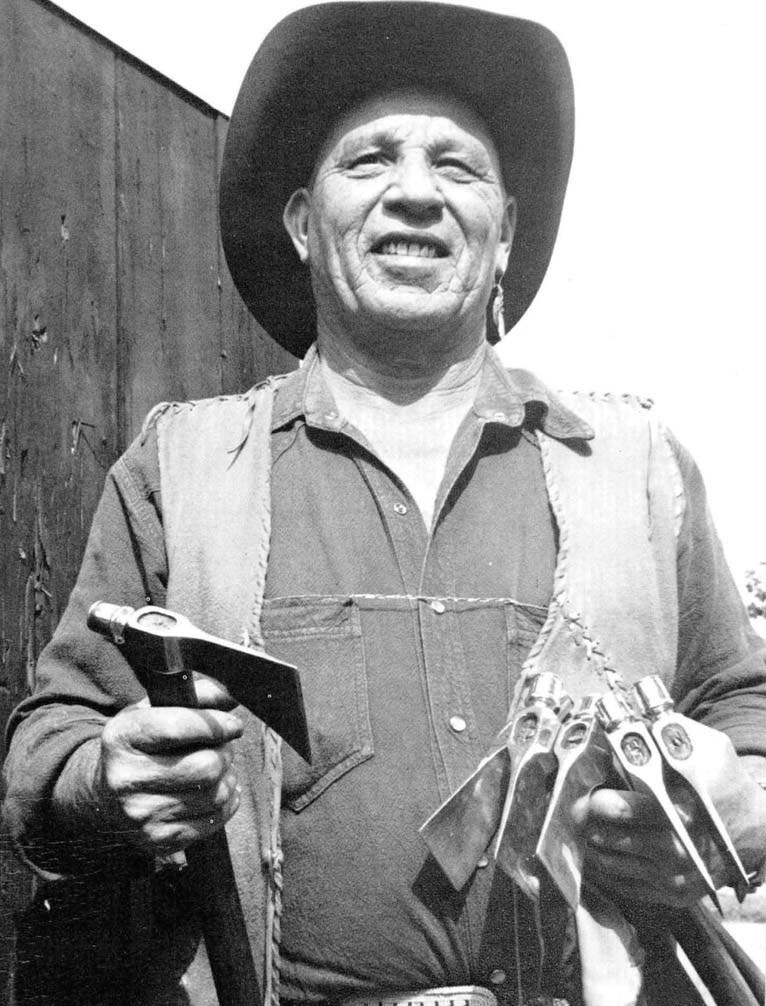
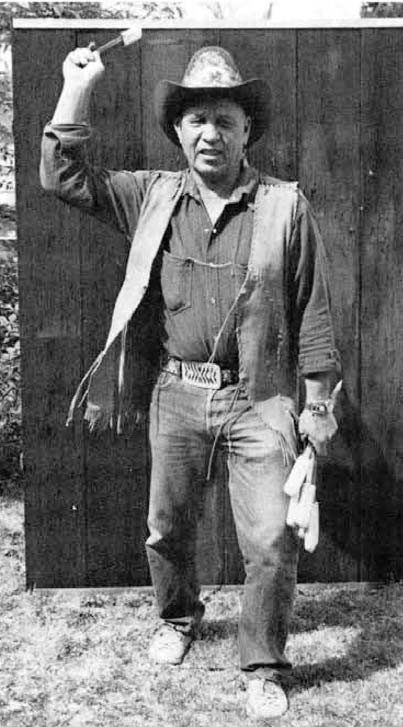
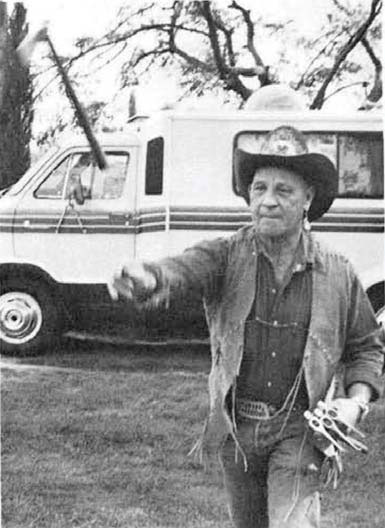
George E. “Skeeter” Vaughan (Grey Otter) was a sergeant in the Army’s U.S. Moccasin Rangers during World War II when he eliminated a German sentry with a prodigious knife throw on a snowy
night in 1944.

Editor’s note: Few if any writers were better equipped to write about one of their peers than knife-throwing legend and BLADE Magazine Cutlery Hall-Of-Fame© member Harry K. McEvoy. Join us in celebrating BLADE®’s 45th anniversary with a recap of Harry’s story “The Saga of Skeeter Vaughan” from the April 1982 issue of The American Blade.


George E. “Skeeter” Vaughan holds the distinction of making the most fantastic knife throw in recorded history—and considering the circumstances surrounding his legendary feat, he most likely will maintain his grasp on that honor for a long time to come.

An American Cherokee Indian whose given name was “Grey Otter,” Vaughan was a member of an elite Army unit called the U.S. Moccasin Rangers, all 15 members of which were American Indians especially gifted with excellent night sight. At the age of 19 he enlisted in the U.S. Cavalry in 1942, and later landed with his unit on Omaha Beach two days after D-Day in June 1944. Two weeks later the Moccasin Rangers were formed.

On a snowy November night in 1944, Skeeter and five other members of the Moccasin Rangers were given the assignment of knocking out a German bunker with pillbox on the Siegfried Line to make way for an American advance. Belly down in the snow behind the bunker concealed on the brow of a hill in a small stand of timber about 35 yards away, Vaughan and his men were faced with the problem of how to neutralize the emplacement.

Skeeter Vaughan
Skeeter contracted trench foot during the war and doctors recommended his feet be amputated. He went AWOL from the service hospital and returned to his old unit, asking to be put on active duty rather than lose his feet. His request was granted. He was wounded five times and decorated profusely. He was the only member of the Moccasin Rangers to survive the war. He passed away in 1989.

Outside the bunker was a German sentry with his back to the hill where Vaughan and his men were positioned. The sentry had to be eliminated—and eliminated silently so he could not warn the other German soldiers. There was too much open ground for one of the Rangers to cross it and silence the sentry, and a gunshot would alert the enemy.

A sergeant and commander of the patrol, Vaughan was asked by one of his men if he could take out the sentry by throwing his bayonet/knife. As a boy, Vaughan had lived on Indian reservations and was taught all about weapons by his grandfather, old Limping Bear, a Cherokee born in the Smoky Mountains of Tennessee. Skeeter’s training included throwing knives and tomahawks, and he had put that training to use prior to the war hurling hawks and 16-inch knives made from old bayonets in performances at rodeos and in “Doc Willetson’s Big Medicine Show” that toured the West.

However, that training was about to undergo a test like no other.

World's longest knife throw in combat
As adept as he was at throwing knives, Skeeter was believed to be the world’s best at throwing hawks. His model of preference was a pipe hawk.

Skeeter crawled from the timber as far as he dared and stood, hoping he would not be spotted. The sentry’s back was still toward him. Skeeter threw the knife with a high trajectory, aiming about three feet above the sentry’s head. The knife turned silently over and over in its long, downhill pinwheel flight. The sentry dropped without a peep face down in the snow.

Considering the distance thrown—later measured at 87 feet—it was probably the longest successful throw in battle in the annals of knife throwing.

Later in life, Skeeter found acting roles in Happy DaysGunsmoke, The Six Million Dollar Man, Magnum, P.I. and Revolution, per IMDB. He died in 1989.

Video Re-enactment

To get a better feel for what happened on that snowy day in 1944, here’s a re-enactment. Remember that Skeeter only had one chance to get it right.

Photos: Ancient Roman Cavalry Sword Still Cuts

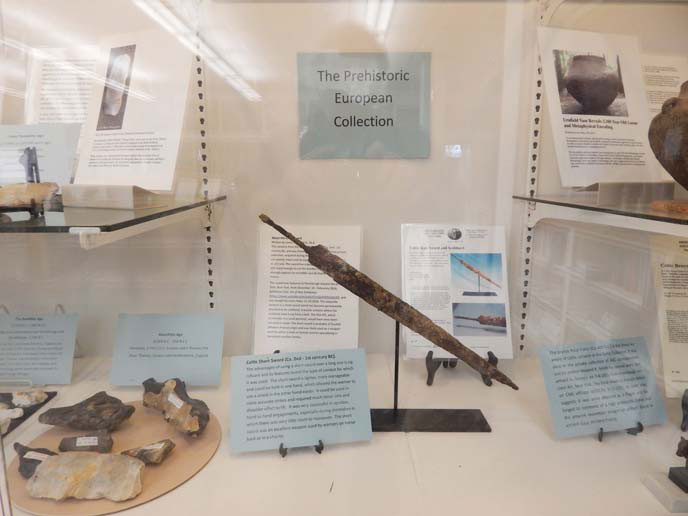
Roman short sword
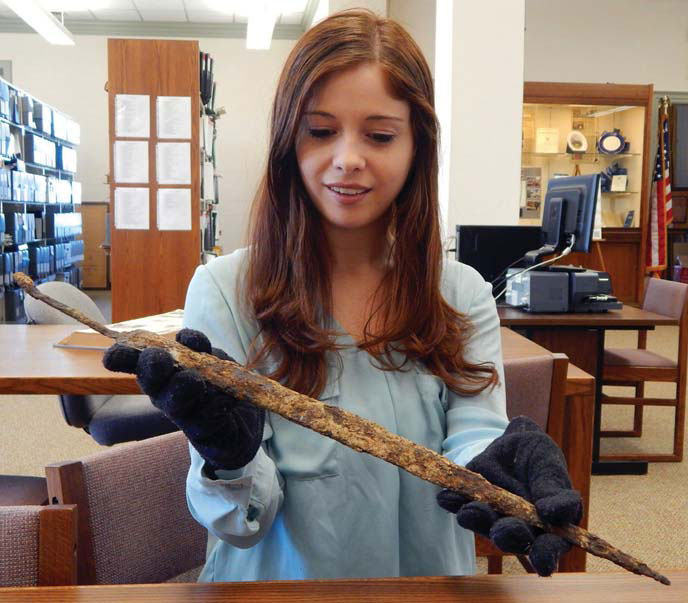
The sword is 2,100 years old. Click for a larger view.

A rare Roman cavalry short sword made before the time of Christ that has been preserved in its entirety and still cuts is one of several recent highlights of the Celtic Collection Program in Milner, Georgia.

The ancient short sword is from the La Tène III (circa 2nd to the 1st century B.C.) timeline. It was in the H. Liebert private collection, Cologne, Germany, and was acquired during the 1960s and ’70s.

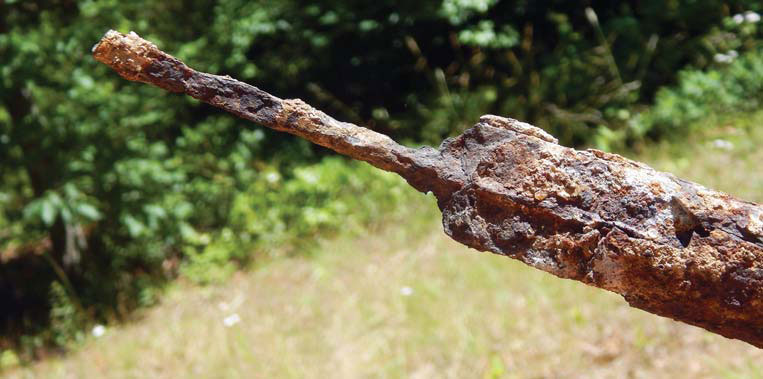
The iron sword is completely intact and is 20.5 inches long. Over time it has become permanently attached to its iron scabbard, and the buckle remains from where it once hung from a belt. Its thin hilt, which terminates in a small pommel, would have once been encased in wood.

According to a spokesperson, the sword has a double-edged blade still sharp enough to cut.
Though the ancient sword is believed to be from Gaul (modern France), Peter Connolly reports comparable swords in his book, Greece and Rome at War.

Similar swords reportedly have been recovered from Switzerland, France, the Thames in London, and Embleton, England.

The sword belonged to either a male or female warrior specializing in close combat tactics, a spokesperson stated.

Roman short sword museum
Jamesan Stuckey, director of the Thomaston-Upson Archives, examines the Roman short sword relic. (Lewis
Hales image)
Roman short sword hilt
The sword’s thin hilt, which terminates in a small pommel, would have once been encased in wood. Part of the sword’s edge, which has remained sharp all these centuries, is exposed above the guard. (Lewis Hale image)
Ancient Roman sword
The buckle remains from where it once hung from a belt. (Lewis Hales image)
Museum Roman sword
The sword relic as contained in the Prehistoric European Collection at the Thomaston-Upson
Archives. (Lewis Hales image)

Learn More About Knife History
BLADE gathered 14 years of Knives annual books into a single collection. Get it here.

Knife history book collection

Video: The Truth About Edwin Forrest’s “Gift” Knife from Jim Bowie

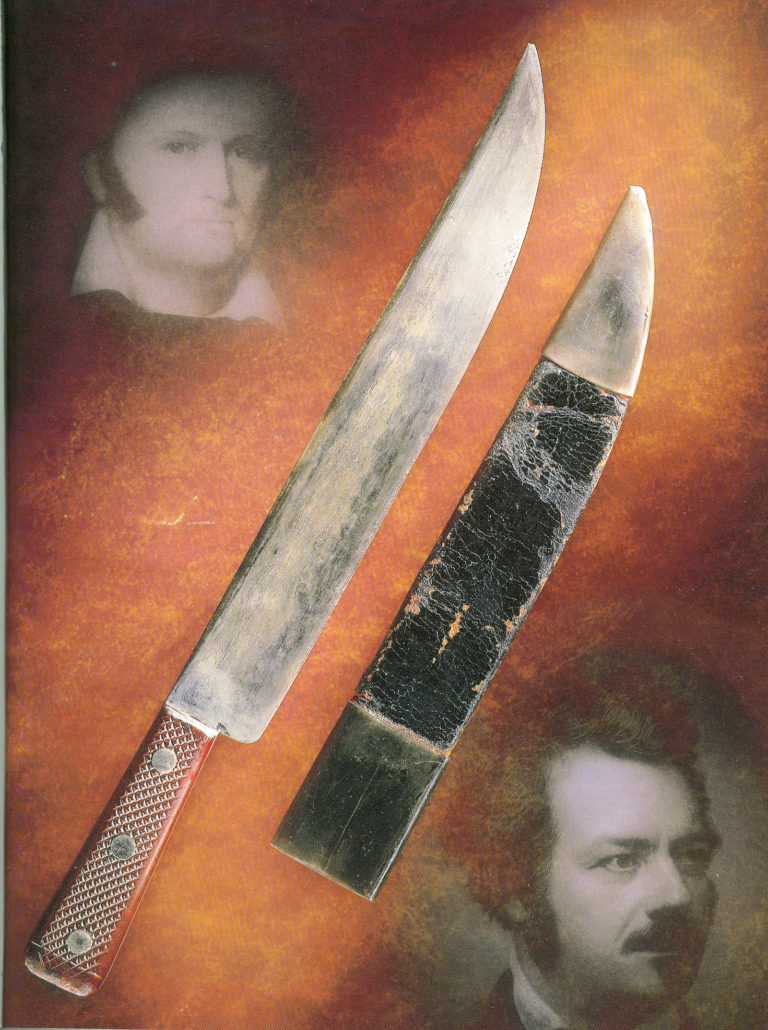
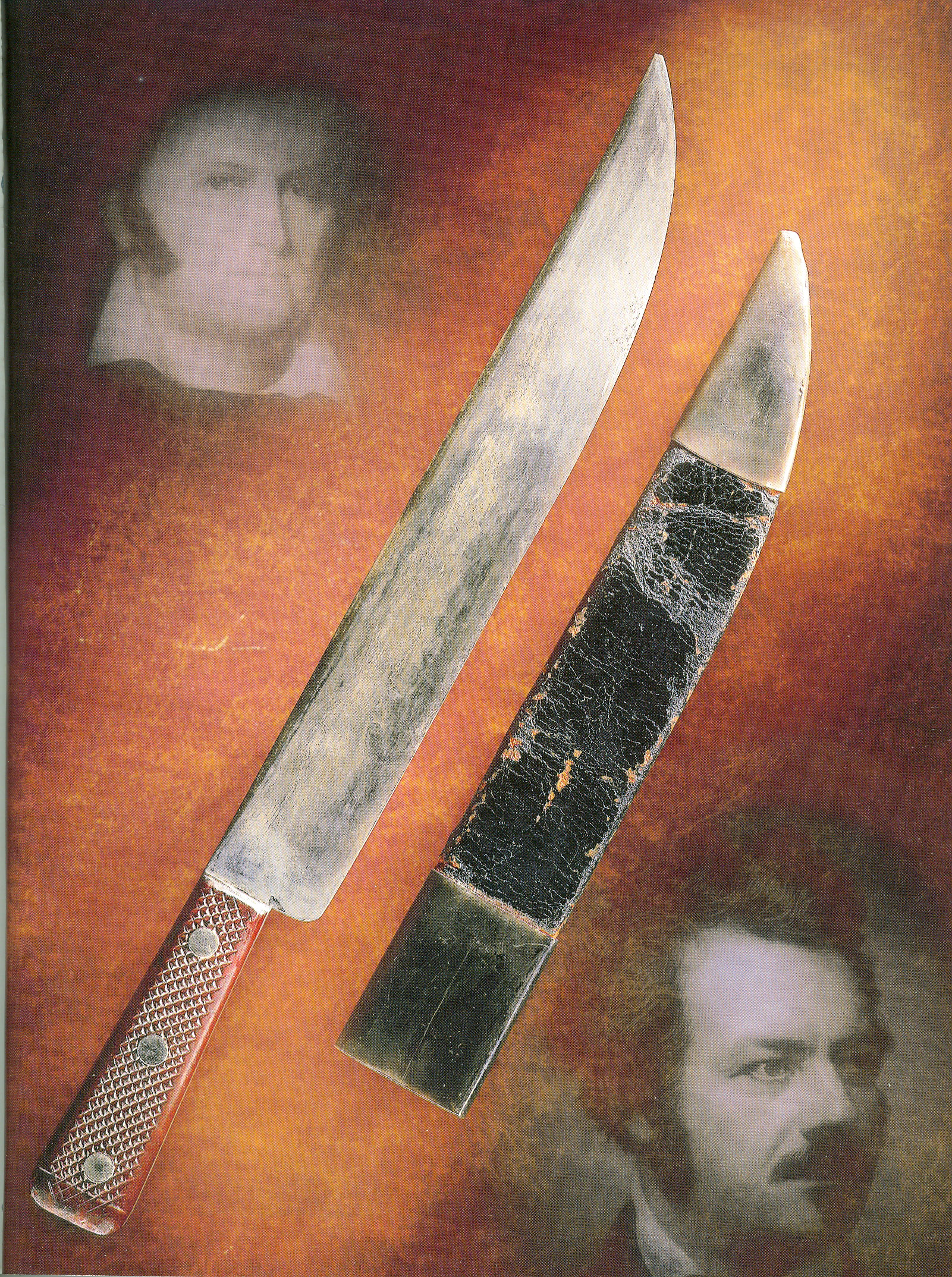
edwin forrest bowie knife
Some say that Jim Bowie (upper left) personally gifted a bowie knife (above) to Edwin Forrest (lower right). Jim Batson, one of the world’s leading bowie knife authorities, shares his findings on the subject.
james batson
Jim Batson

BLADE recently sat down for an extensive interview with Jim Batson, one of the leading bowie knife researchers in the world. The interview was recorded on video, which can be seen below, and consists of two parts.

Most significantly, Batson reveals what he discovered about the controversial Edwin Forrest bowie knife, claimed to be gifted to the 19th Century actor by James Bowie himself. That can be seen at 25:06 in the video.

Look below the video for further timestamps and summaries.

Batson Looks Back on 30

ABS master smith Jim Batson has been conducting his Batson Bladesmithing Symposium for three decades and just completed the 30th one April 8 at the Tannehill Ironworks near Bessemer, Alabama.

Join us for an exclusive interview with Batson as he talks about those 30 symposiums, the major industry changes he’s seen in his bladesmithing career, his induction into the BLADE Magazine Cutlery Hall of Fame in 2017 and what the future holds for this icon of the forge.

Use these timestamps to help you navigate the video.

0:00 Changes in knifemaking looking back
1:34 Forged in Fire
2:34 Changes in knifemaking looking forward
4:10 Batson’s contributions to the world of knives
5:55 Impact of Batson’s symposium
6:41 Batson’s “double-decker” shop
7:32 Including non-bladesmiths at the symposium
10:22 Batson reflects on his induction into the BLADE Magazine Cutlery Hall Of Fame©
11:51 Batson’s future

Bowie Knives According to Batson

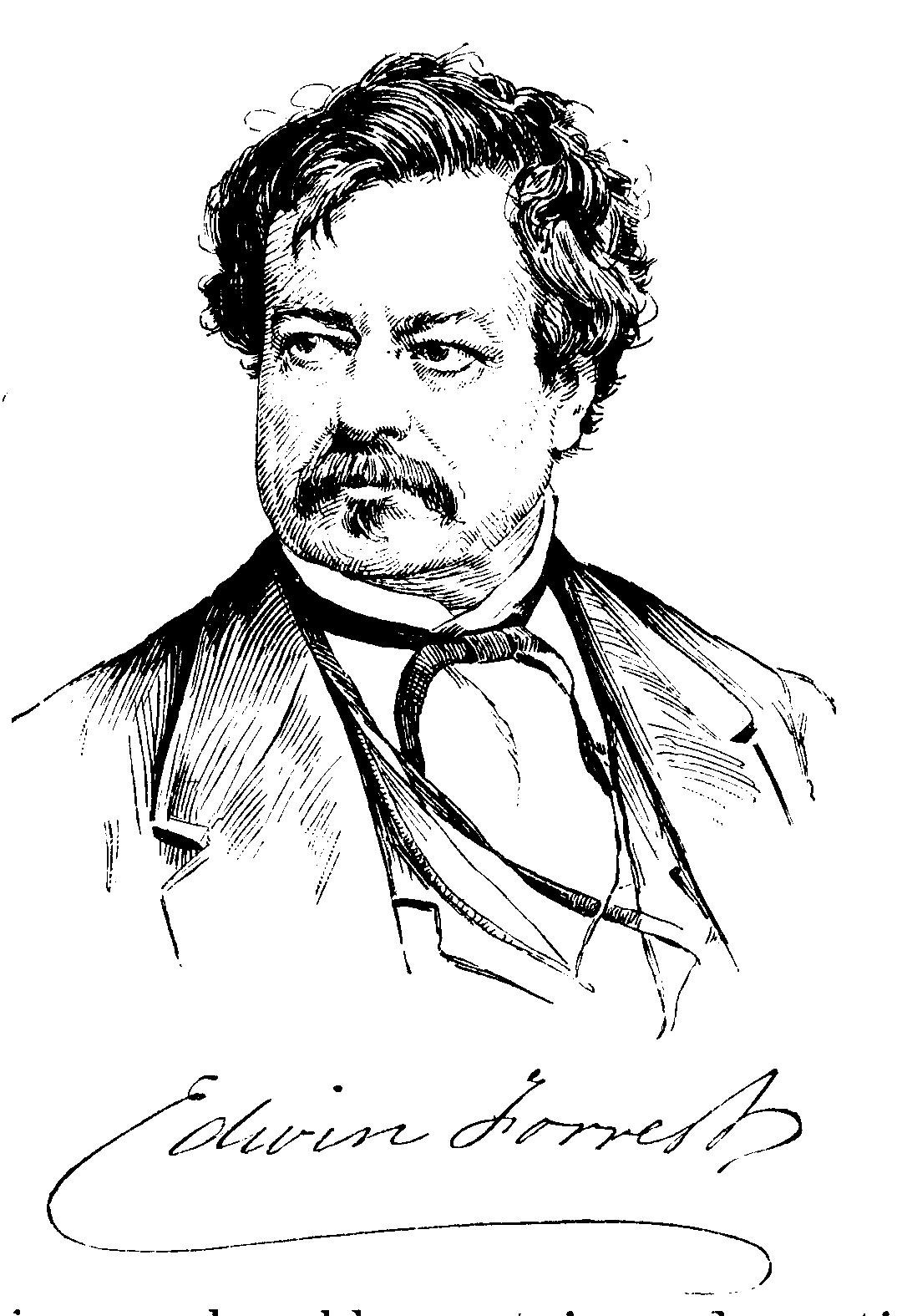
edwin forrest actor
Edwin Forrest

ABS master smith Jim Batson has scoured the Bowie Trail from the Southeast USA to Texas for decades, researching anything and everything about James Bowie and bowie knives.

Watch the video above to see Jim recount the highlights of his research, including his book about the Sandbar Fight where the bowie knife legend was born, whether James Black really made bowie knives—including those in the Carrigan style—whether the Edwin Forrest bowie actually belonged to James Bowie and more in this exclusive BLADE® interview.

12:27 Contributions to bowie knife history research

15:01 Surprising finds
15:53 New facts about the 1827 Sandbar Fight
17:57 James Black controversy
23:14 The Carrigan knives
25:06 The Edwin Forrest “Gift” bowie knife
27:22 Where did the Forrest knife come from?
30:47 End


Advertisement

Must Read Articles

Read this before you make a knife

Knifemaking 101 – Read This Before You Make a Knife

  by Wayne Goddard My experience has taught me that there's nothing like digging in and getting started. I've often said the hardest part of the...
how to forge damascus steel

How to Forge Damascus

Advertisement
Advertisement