The history of knives and other edged instruments is tied to the history of people in general. As humankind’s oldest tool, unraveling knife history can lead to even more surprising and enriching information to better understand the world.
The 12th president was and is a hot knife commodity.
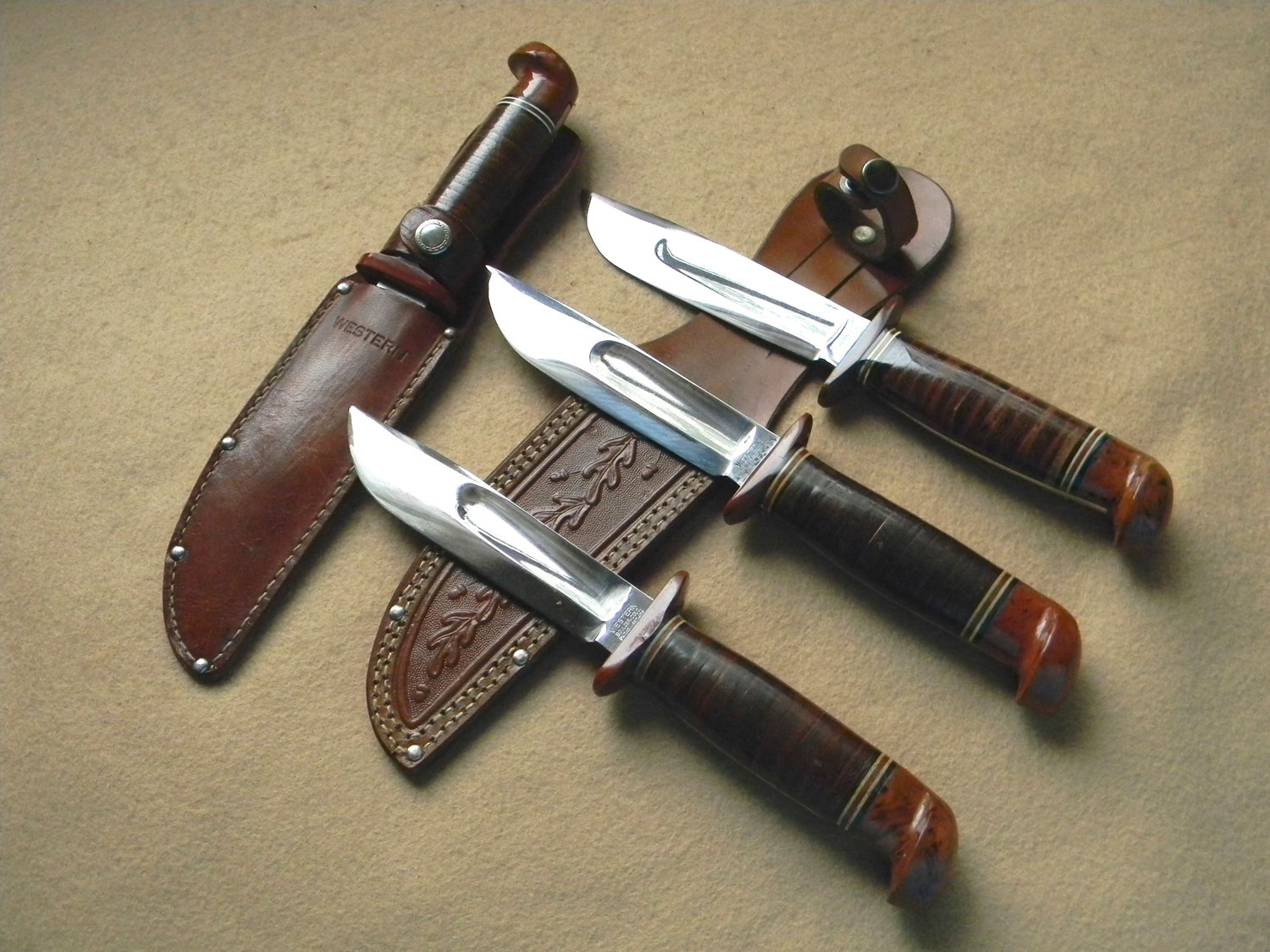
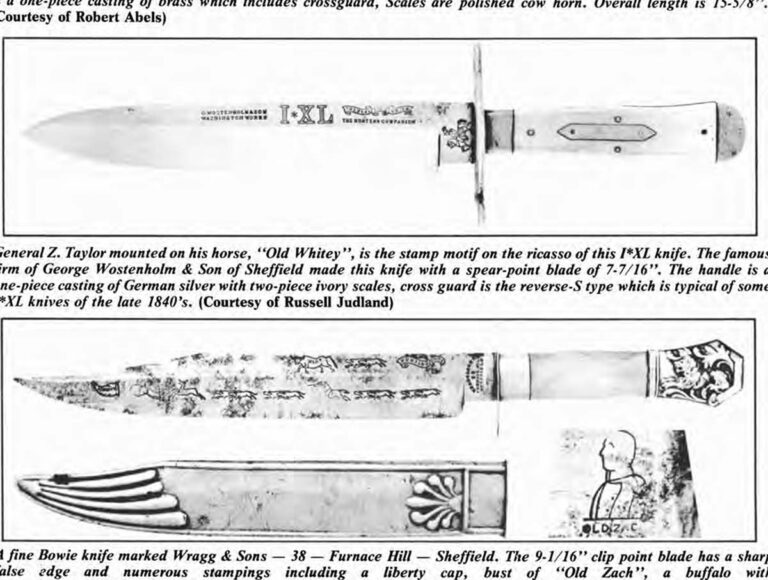
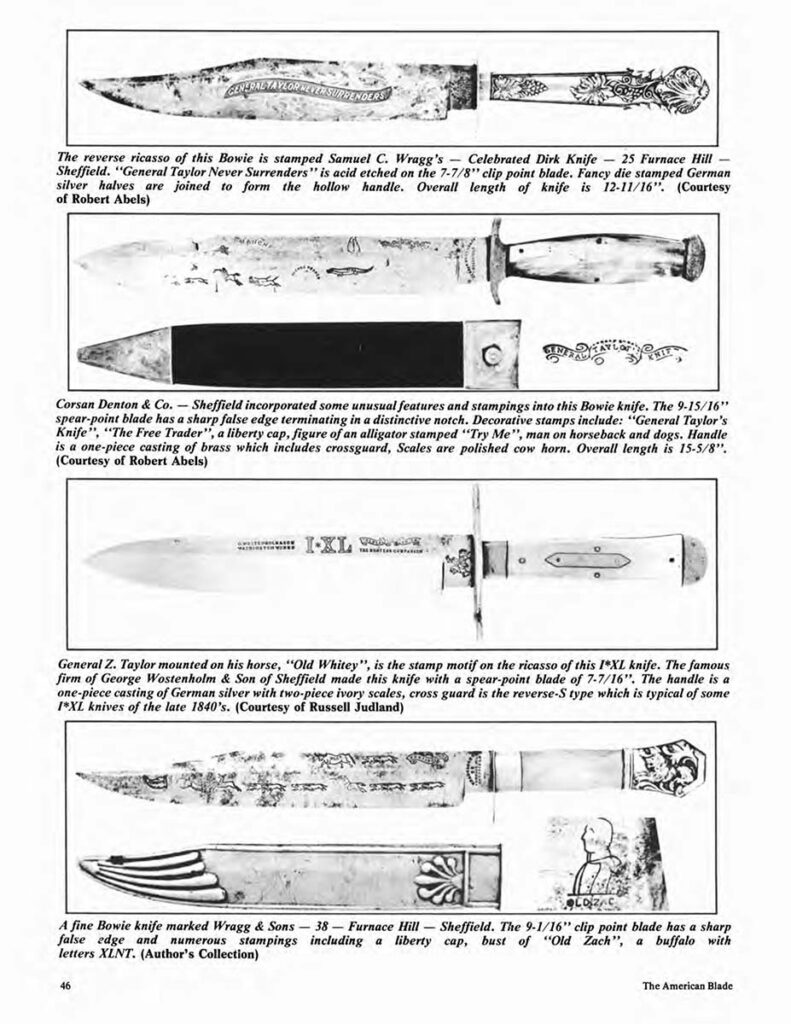
Some examples from the article of “Old Zach” bowies that included the American general and president’s name, slogans or likeness. The lower bowies have his visage, the second from bottom a stamp motif on the ricasso of Taylor on horseback, the bottom a bust of the celebrated general.
Ever in tune with what’s popular at the moment, knifemakers have never been afraid to cash in on a hot trend. William R. Williamson documented one of the more peculiar vogues of the middle 19th century when Zachary Taylor and bowie knives were all the rage.
Fresh off his triumphs in the Mexican-American War, Taylor was the 1850’s version of a rock star—Americans just couldn’t get enough of him. And while not known to carry a bowie nor affiliate with the hero of the Alamo—Jim Bowie—the general and president’s likeness began to pop up on the most American of knives.
Funny thing is, as William’s points out in his article “Old Zach and the Bowie Knife,” from the March-April issue of The American Blade®, it wasn’t the Yanks cashing in. Instead, England Sheffield’s makers had the pulse of the USA and stamped Taylor’s visages on blades and bolsters.
Unfortunately, Old Rough and Ready’s short-lived presidency didn’t inspire the same outpouring of effigies. But modern collectors did and do find these unusual and patriotic blades desirable, as Williamson points out in his article.
Revel in a short list of knife industry milestones that transformed the knife world.
Editor’s Note: BLADE Magazine is celebrating its 50th anniversary of its founding this year. To recognize this milestone, we are running a series of articles looking at the changes to the knife world the publication has been privy to over its history.
Time marches on. And in the cutlery industry, the half century from the early 1970s to the present has been filled with both revolution and evolution.
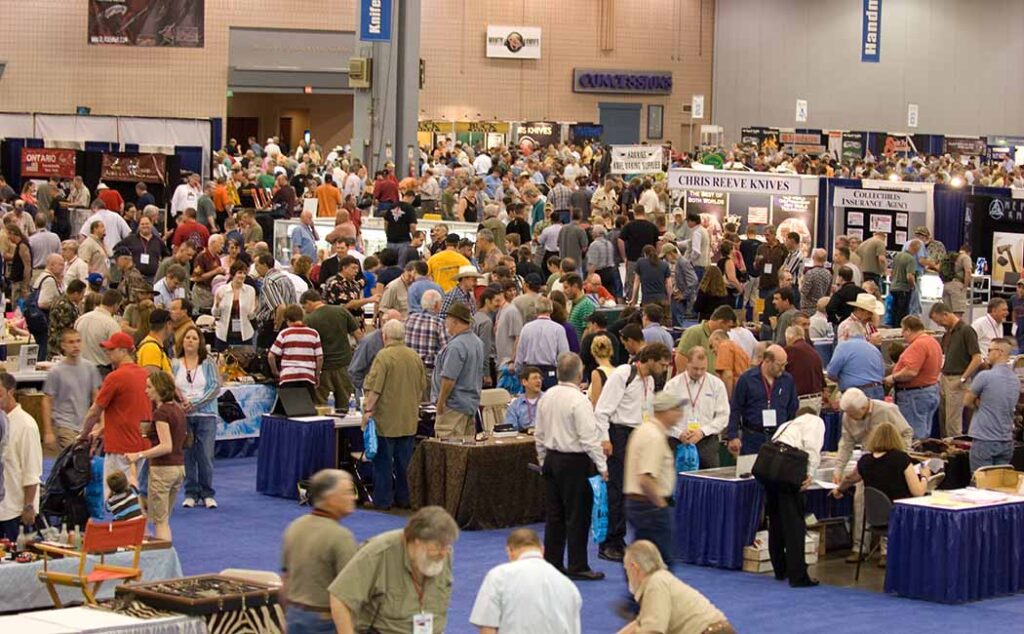
From the corner of a massive hall at a gun show, the slight mention of a new style of field tool, and the basic everyday factory blade carried in the worker’s pocket, the knife industry, both custom and factory, has blazed its own trail over the past 50 or so years, emerging from a somewhat obscure existence to the mainstream. And along the way have been those moments of discovery, awareness and excitement that have marked the trail.
For reference, a few of those moments include the following.
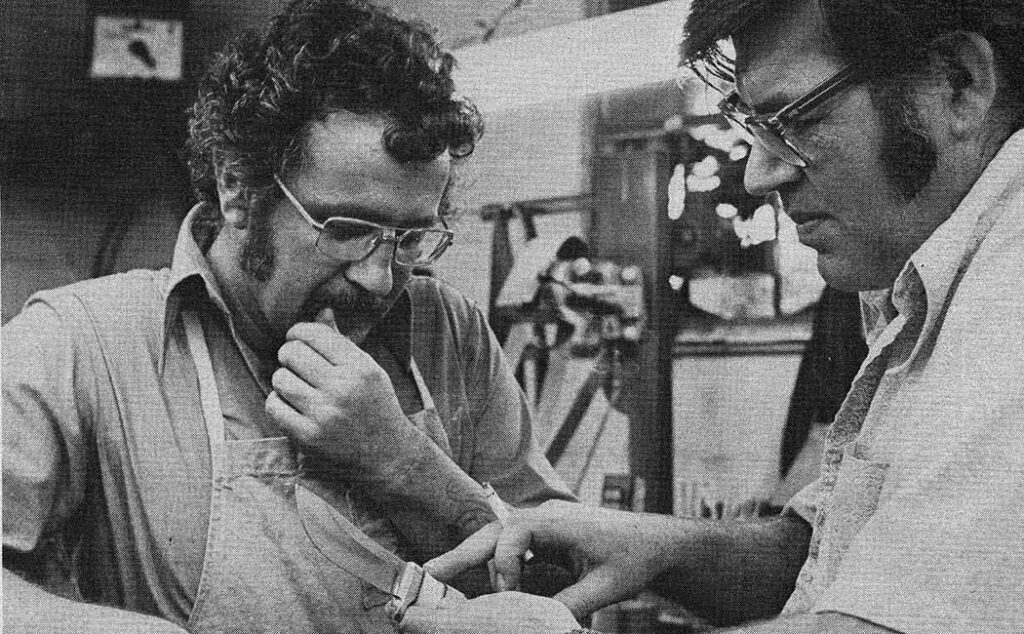
The first “meeting” of the Knifemakers’ Guild basically was the idea of A.G. Russell. What would become the Guild Show was the leading knife show for decades. A.G. (right) discusses a Harry Morseth knife with maker Lloyd Hale (left). (Sid Latham image)
1970s
Though what would become the Knifemakers’ Guild Show was first held in 1970, the show that occurred three years later is still talked about today. That was when Bill Moran reintroduced damascus steel for knife blades, kindling a revival of interest in damascus as the new “super steel” and generating a wave of collector fervor. Also in 1973, Blackie Collins founded The American Blade, a magazine for the knife industry like nothing that had been seen before. Known today as BLADE®, the publication remains a voice for the industry and a tangible contributor to the life and times of the knife enthusiast.
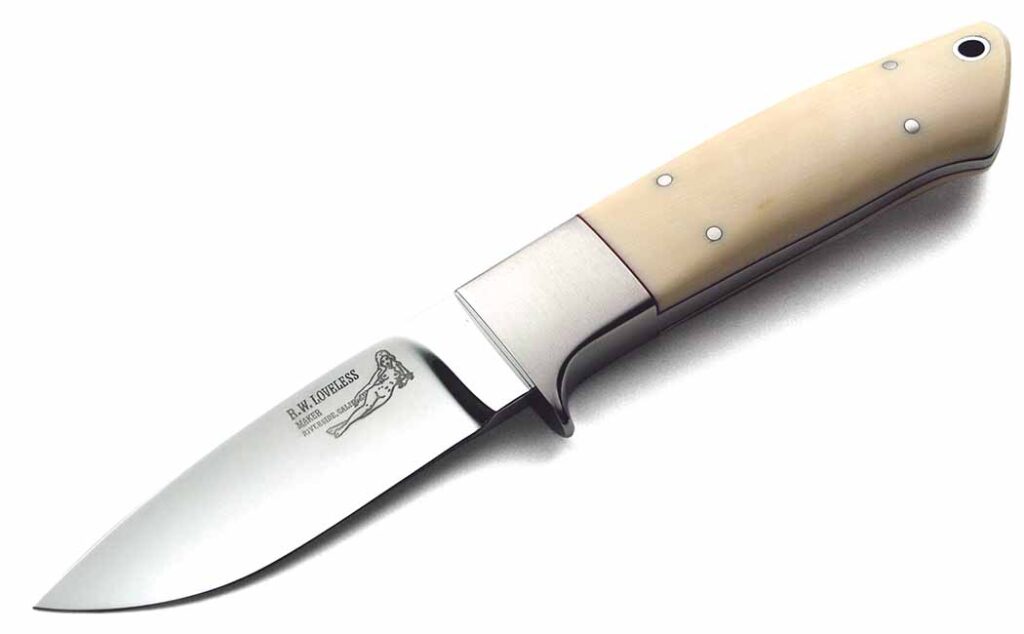
In the following decade, knife shows increased in number and attendance, including the BLADE Show, the New York Custom Knife Show, California Custom Knife Show and the Guild Show, the latter which led the pack for at least 20 years. At the same time, Guild members established industry trends, including the drop-point hunter and the popularization of super steels 154CM and ATS-34 by Bob Loveless, while A.G. Russell vigorously supported the knife industry through his advocacy, sharpeners, knives and growing catalog business.
Eric R Eggly, PointSeven Studios
In 1976, the American Bladesmith Society was formed, and those who forged their blades and worked in damascus at long last had their own organization to promote training and excellence with hammer-ins and other events that brought people together to learn the art of bladesmithing. By 1988, the ABS opened its own school, the Bill Moran School of Bladesmithing. For the first time, bladesmiths and knifemakers could take advantage of a year-round school that offered instruction in forging, bladesmithing and more.
1980s
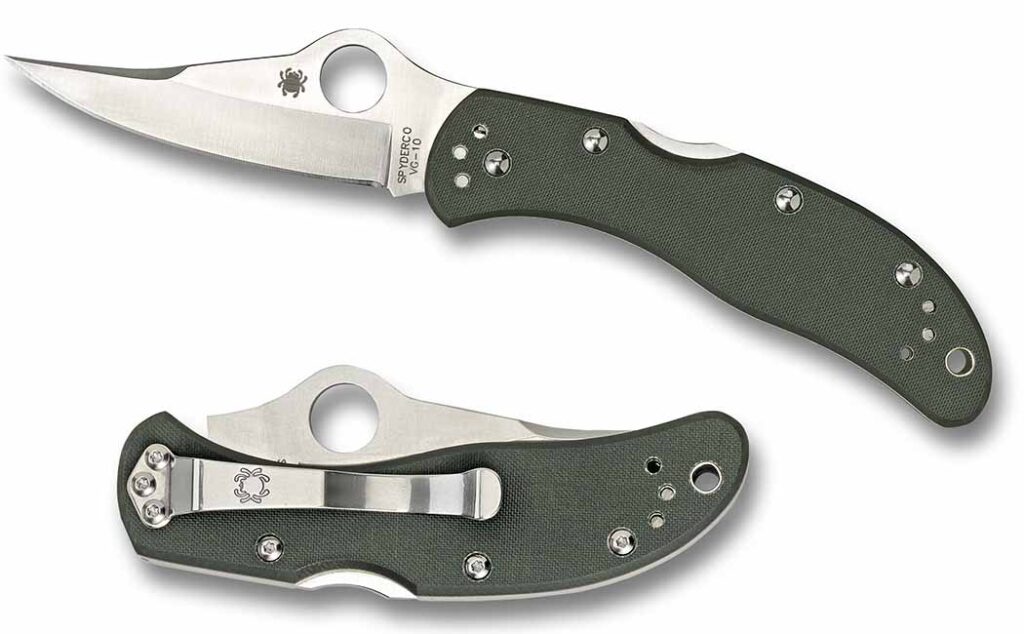
Nineteen-eighty-one saw the introduction of two watershed knife creations by Spyderco and Michael Walker. With the C01 Worker, Spyderco headman Sal Glesser introduced the first knife with both the famed hole in the blade for easier one-hand knife opening and a pocket clip for enhanced carry. Walker, meanwhile, debuted his groundbreaking linerlock folder. The innovations led to a concentration on ease of carry and deployment, focusing the industry on such elements that made the experience of knife ownership something even more special.
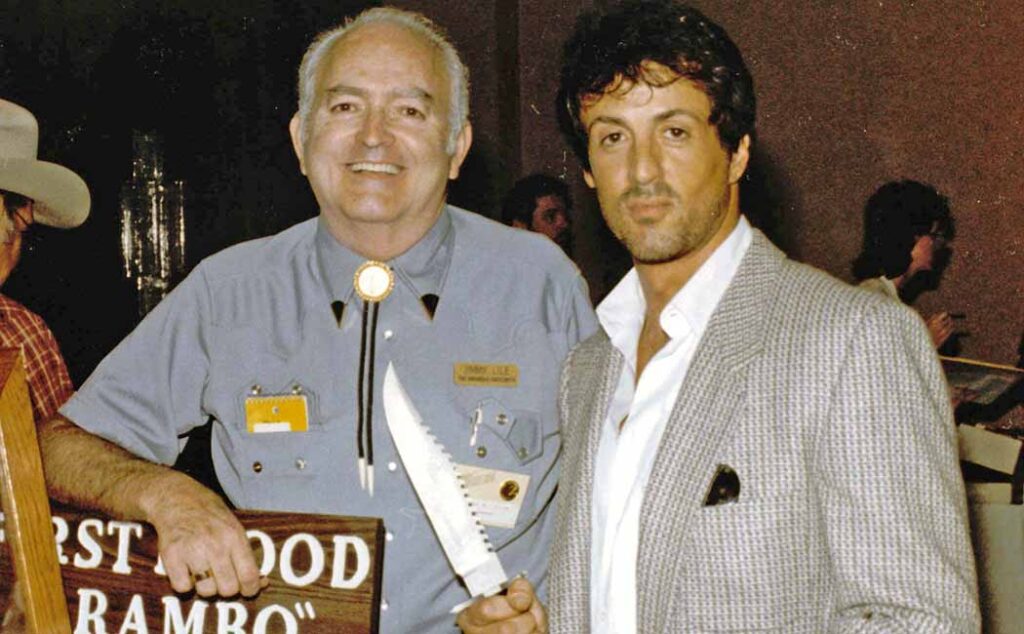
Jimmy Lile and Sylvester Stallone combined to use Lile’s survival knife in the 1982 movie First Blood, and knives were never the same again.
Hollywood took its turn in the early 1980s with the Rambo series of feature films and the knives that played starring roles. Cutlery Hall-Of-Famers Jimmy Lile and Gil Hibben became celebrities in their own right, and sure enough, other knife-and-sword-oriented films followed, including the Conan series, Commando, Predator and The Last of the Mohicans. These were just a few but the knives of custom makers profoundly influenced the marketplace. Soon enough, collaborations between custom knifemakers and factory knife companies began to flower.
1990s
By the 1990s, equipment such as CNC, laser cutters and CAD/CAM entered the knifemaking realm and brought about rapid change in the way custom and factory knives were made. The introduction of such hi-tech equipment into the maker’s shop gave rise to a debate over the very definition of handmade—a debate that continues to this day.
As early as the 1990s, the use of laser cutters—here cutting a hole in a Spyderco blade—CNC machines and other high-tech equipment began to take hold in the making of knives.
At the same time, the emergence of the internet brought the commercial knife market to the world, as custom makers, factories, dealers, collectors and others offered knives for sale on an unprecedented scale. The global reach of the internet led to a burst of information on every aspect of the knife industry, from websites, forums for the exchange of information, how-to videos, online auctions, and even a bit of the dark side—buyer beware! Know your customer and other maxims rang true.
Along with the information explosion, competition was more robust than ever, particularly with the onrush of China’s factory presence, not only in quantity but also, later, in quality. The Chinese influence has redefined notions of affordability, value, and how knives are produced and distributed, and the resulting market conditions continue to impact the buying habits of consumers worldwide.
2000s On
Of course, there are ongoing challenges. Two significant advocacy groups, the American Knife & Tool Institute (AKTI) and Knife Rights, assumed leading roles in responding to knife laws and particularly to the zeal of government regulation, which at times has threatened the livelihood and freedom of Americans to carry one of man’s oldest tools. Pro-knife legislation and the legalization of automatics in many states are evidence of the credible work that has been done, with much of the organized response from the knife industry resulting from the defeat of the 2009 effort led by U.S. Customs to reclassify one-hand knives as switchblades/automatics.
With the C01 Worker in 1981, Sal Glesser and Spyderco introduced the first knife with both the famed hole in the blade for easier one-hand knife opening and a pocket clip for enhanced carry. Released in 2014, the company’s C01GPGR Worker Sprint Run paid homage to the original C01.
Knife Innovation
The history of the modern knife industry is one of rapid change and continuing innovation. Long-time maker Tim Britton recalls the influence of Blackie Collins and Blackie’s foray into publishing. “Blackie could sell refrigerators to Eskimos,” he commented. “The American Blade magazine was one of his favorite projects, and his input and support facilitated the start of the Knifemakers’ Guild. We had one show, the Guild Show, where we could share fellowship and technology. Names like Buster [Warenski], Henry Frank, [W.W. “Bud”] Cronk, Jim Schmidt and Bob Loveless became famous at our annual shows.
“Virgil England took us to another planet and then along came the Chinese industrial monster,” he continued. “Tactical knives were their focus and they had no hesitation in copying American designs. The American Bladesmith Society developed a business model whereby rediscovered damascus steel could be taken to all new levels. There was never any question in this group about ‘what is a handmade knife’ or who is copying whose design. Knifesmiths flourished, and Forged in Fire has taken us all to a new level. Knifemaking caught on in other countries, and those makers continue to produce some of the finest work imaginable.”
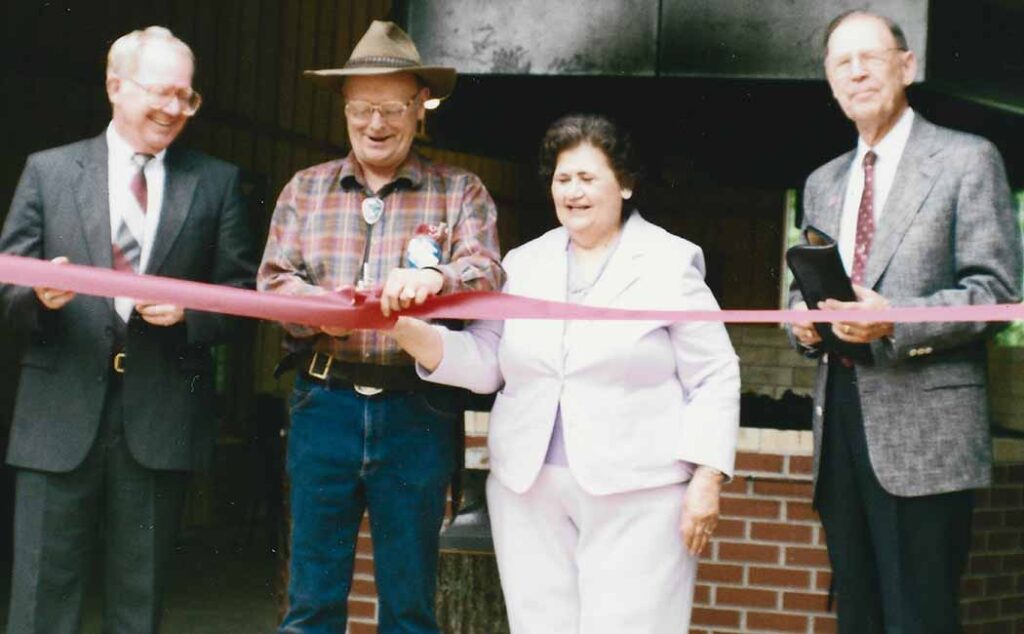
The ABS opened the Bill Moran School of Bladesmithing in 1988. The principals at the school’s ribbon cutting ceremony were, from left: Carl Nelson, president of Texarkana College, Bill Moran and Mrs. Margaret Moran, and Judge James Pilkington.
Custom knifemaker Jim Sornberger well remembers the early days of the Guild and its organization. “The Guild thing was first discussed in 1970, and that was Bob Loveless and A.G. Russell,” he said. “Actually, A.G. bought tables for a bunch of the guys and set that up. He said, ‘Let’s have a show and get a block of tables,’ and so he did that. The Guild was the best organization of knifemakers in the world, and it had the biggest knife show anywhere in the world for many years.”
As for technology, Sornberger says it is simply a fact of life. Evidence of progress and efficiency are seen in makers’ shops routinely today, including CNC equipment, mills, lathes, ingenious versions of versatile grinders and more. “You can’t reverse technology,” he reasoned. “There are always new methods of doing something.”
Ron Lake had a huge hand in the evolution of custom knives, introducing his clever tab-lock interframe folder and helping popularize 416 stainless. “It was a different world back when,” he remarked. “We had a small corner at a gun show, and Blackie Collins was sitting off by himself 30 feet away from me with a slipjoint knife, and I remember Loveless cut himself with that knife! A lot of people came and went from the knife world back in those days.”
Contributions such as the dropped hunter by Bob Loveless were among the trends started by members of the Knifemakers’ Guild in the 1970s and beyond. (Exquisiteknives.com image)
As Moran brought damascus back into the spotlight in 1973 and other developments were coming along, Lake remembers the growing ranks of the virtuoso custom knifemakers, including Billy Mace Imel, Buster Warenski and others. He also recalls the sudden impact of Spyderco. “I think maybe it wasn’t so much the hole,” he said, “but the clip. That in itself was a mind-boggling event—maybe not so much at the time, but later as people started using it.”
Ron Lake, Bob Loveless, Bill Moran and A.G. Russell
The influential journalistic career of B. R. Hughes has made its own contribution to the modern knife world. Hughes was there in the beginning of the modern era. He planned the first Gun Digest Book of Knives along with Jack Lewis, and it hit the market in 1973.
“That was a meaningful year,” Hughes remembered. “Ron Lake, Bob Loveless, Bill Moran and A.G. Russell are the most influential individuals in the history of custom knifemaking, and A.G. played a bigger role than a lot of people give him credit for. He saw the need to organize and there was a meeting in Tulsa in 1970, and the first Guild Show was in 1971, and it grew unbelievably. They met in Houston and there were about 20 or so makers, and then the next year the show was in Kansas City, and there were 40 or 50, and it just kept growing.”
According to B. R., damascus was a catalyst for revival in American bladesmithing. “The inclusion of damascus saved bladesmithing,” he said, “and there were fewer than 15 bladesmiths in America in 1973. The number was going down. There was Bo Randall and then Rudy Ruana as well, but just a few younger bladesmiths.”
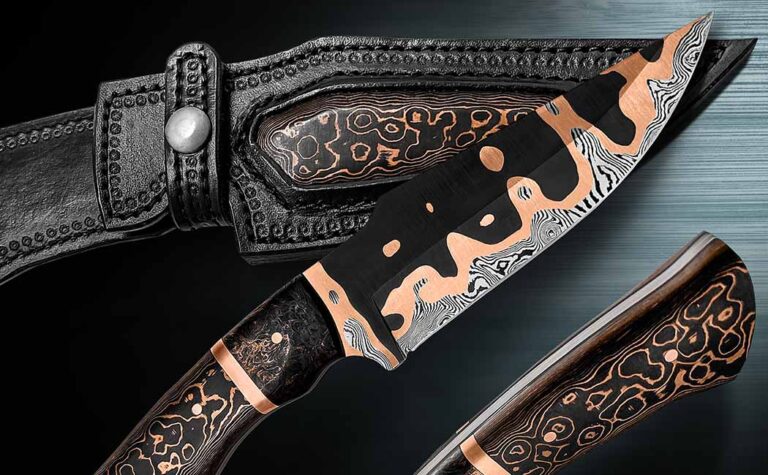
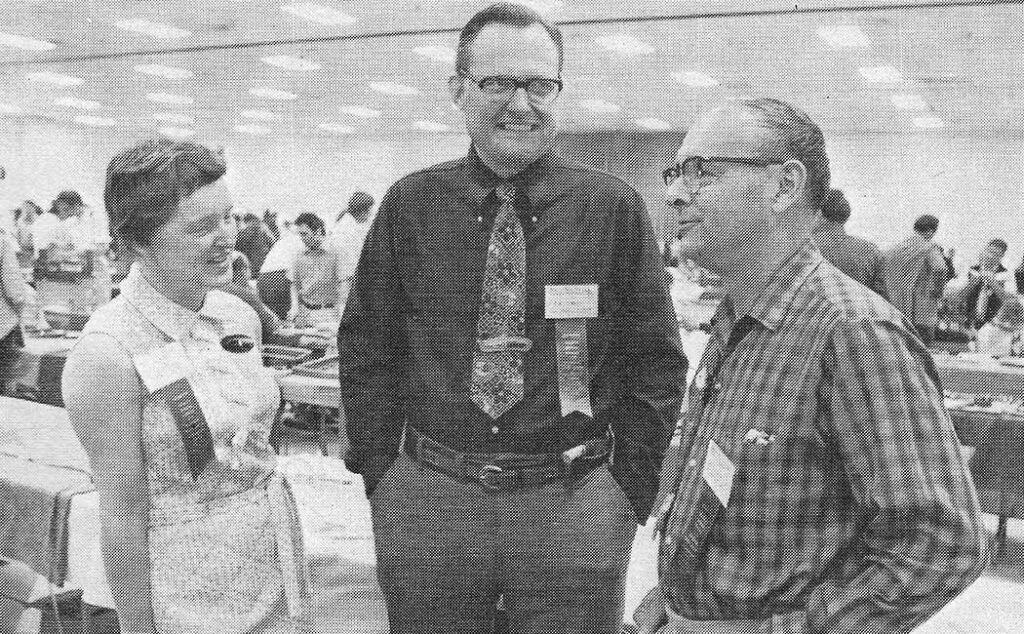
The use of a wide range of new materials in the making of knives exploded in the 1990s and continues to this day. One of the latest examples is Bill Moran reintroduced damascus for knives at the 1973 Guild Show and the rest is history. Moran (right) observes another successful Guild Show with Betty and Ted Dowell at the ’74 event in Kansas City. (Sid Latham image), employed here by Gerry Michael on the blade of his Fancy Harpoon model. (Jocelyn Frasier image edit)
Then, he says, the founding of The American Blade weighed in. “That was immense,” he offered. “I started writing about knives in the early 1960s, and there were primarily just gun magazines. I wrote for Gun Week, doing some knife articles for them, but there was no knife magazine, and the people I wrote about were people I met at gun shows. Without a knife magazine, it made it tough to write about knives.”
Hughes added, “I was fortunate to be around the first meeting of the Guild and things like that.” Indeed, B. R. saw and wrote about history as it was made.
Knife Industry Ups and Downs
These days, the world of knives continues to expand, to change, to elicit praise and criticism. Britton has watched much of this evolution. “Quality Chinese repros are available at flea markets and gun shows for $15 to $40,” he observed. “Many knifemakers are designing knives for knife companies, further blurring the differences between handmade and factory/manufactured. The internet is being used extensively for marketing—from very ornate websites to knife forums. The ‘Show Calendar’ page in BLADE is crammed full of announcements of shows from San Francisco to Paris. Several knife dealers have created a secondary market, and literally thousands of knives are available for sale 24/7.”
Concurrently, Britton is excited about what he notices these days. “We’re seeing abrasive materials, grinders, CNC equipment, new steels, and exotic types of handle materials from paua shells to hippos’ teeth,” he noted. “Creative craftsmen are exploring new horizons with acrylics and phenolics and stabilized wood burls. We see something new at every show.”
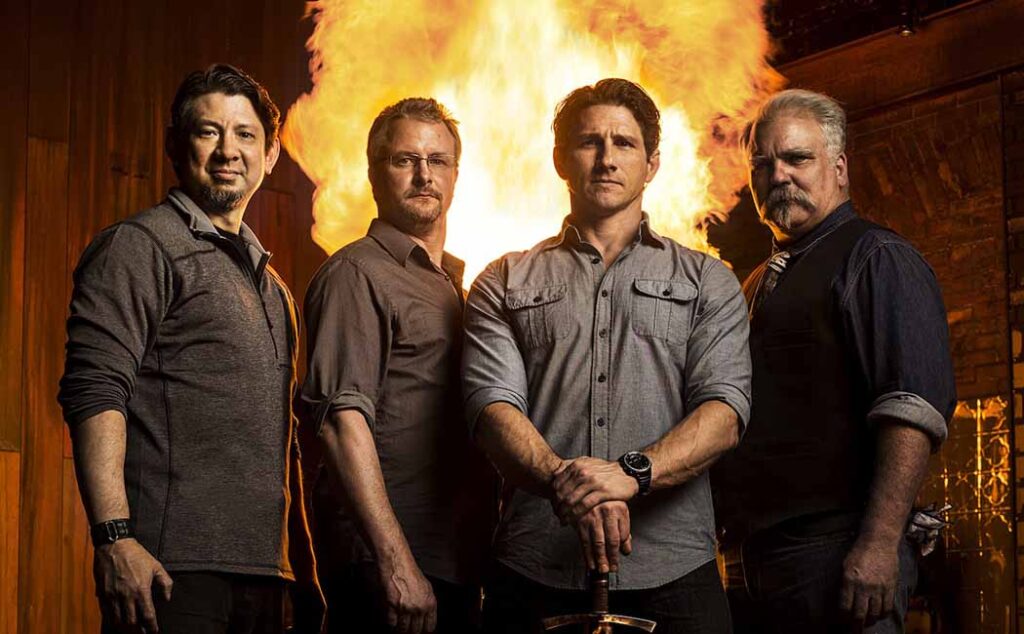
Forged in Fire debuted in 2015 and since then has exposed millions of television viewers to knifemaking and bladesmithing on a weekly basis.
That, succinctly, is a strong indication of an industry, a passion, a way of life that continues to flourish despite the strain and stress that are natural byproducts of absolutely anything and everything that is alive. A half century from now there will be more milestones, more discussions and even greater achievement.
Members of the BLADE Magazine Cutlery Hall Of Fame® mentioned in the story and sidebar are Blackie Collins, Sal Glesser, Gil Hibben, B. R. Hughes, Billy Mace Imel, Ron Lake, Jimmy Lile, Bob Loveless, Bill Moran, Bo Randall, Rudy Ruana, A.G. Russell, Jim Sornberger, Bruce Voyles, Michael Walker and Buster Warenski.
25 Knife Industry Milestones
1973 Bill Moran reintroduces damascus for knife blades at the Guild Show 1973 The American Blade debuts 1976 Bill Moran, B. R. Hughes, Don Hastings and Bill Bagwell found the American Bladesmith Society 1981 Spyderco debuts the C01 Worker, the first knife with both a blade opening hole and a pocket clip 1981 Michael Walker introduces a folder with the linerlock mechanism 1982 First Blood and Jimmy Lile’s Rambo knife appear in theaters 1983 Michael Walker first uses titanium in the construction of one of his linerlocks 1987 Buster Warenski completes the King Tut dagger reproduction 1988 The Bill Moran School of Bladesmithing opens in Old Washington, Arkansas 1992 Bruce Voyles moves the BLADE Show to the Renaissance Waverly Hotel in Atlanta, where it opens to rave reviews 1990s An explosion in Crucible Particle Metallurgy and the so-called “super steels,” and such materials as carbon fiber, mosaic damascus and more revolutionize knifemaking 1990s Computer numerically controlled equipment, laser cutters and more for knifemaking begin to appear 1990s Internet knife web pages, knife discussion forums, knife instruction videos and more start making their mark Mid-1990s Tactical folders begin to dominate the custom and factory knife industries 1997 The BLADE Show moves from the Renaissance Waverly Hotel to the adjoining Cobb Galleria Centre and completes its ascendancy as the world’s most important knife event 1990s Chinese companies begin entering the factory knife business 1998 The American Knife & Tool Institute (AKTI), the oldest surviving knife advocacy group, debuts 2001 Terrorists bring down the Twin Towers and the knife industry reacts with a slew of military inspired knives, tomahawks and more 2006 The Knife Rights advocacy group debuts 2009 The knife industry unites to defeat an attempt by U.S. Customs to declare all one-hand-opening knives switchblades/automatics 2010s Social media begins taking the internet knife business to the next level 2010s Knife Rights and AKTI work to overhaul anti-knife legislation, including overturning automatic/switchblade bans and establishing knife preemption laws at the state level 2010s European knife manufacturers such as LionSteel, Fox Cutlery, Maserin and others begin winning more than their share of BLADE Magazine Knife-Of-The-Year® Awards 2015 Forged in Fire debuts and exposes millions of television viewers to knifemaking and bladesmithing for the first time 2020 The pandemic ravages the world and also the knife world, closing knife shows everywhere—including the BLADE Show 2020s The knife industry survives the pandemic, and, thanks to internet sales, even thrives in some segments—and knife shows begin to return
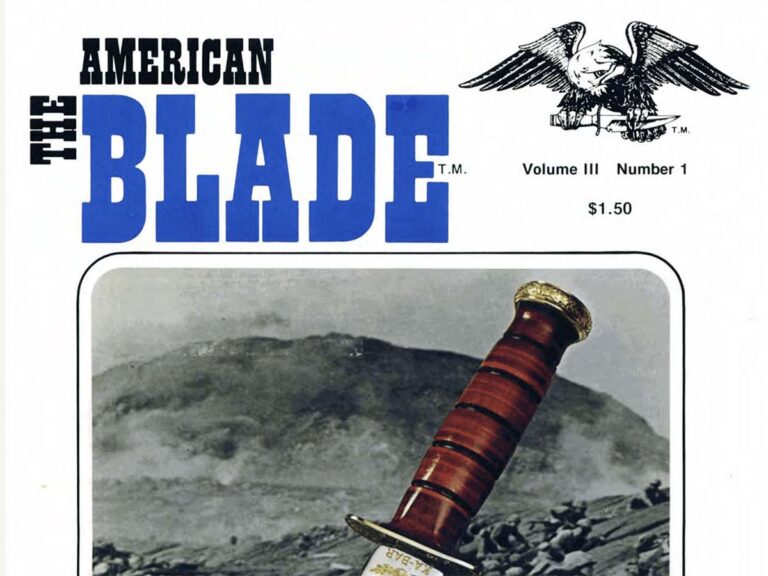
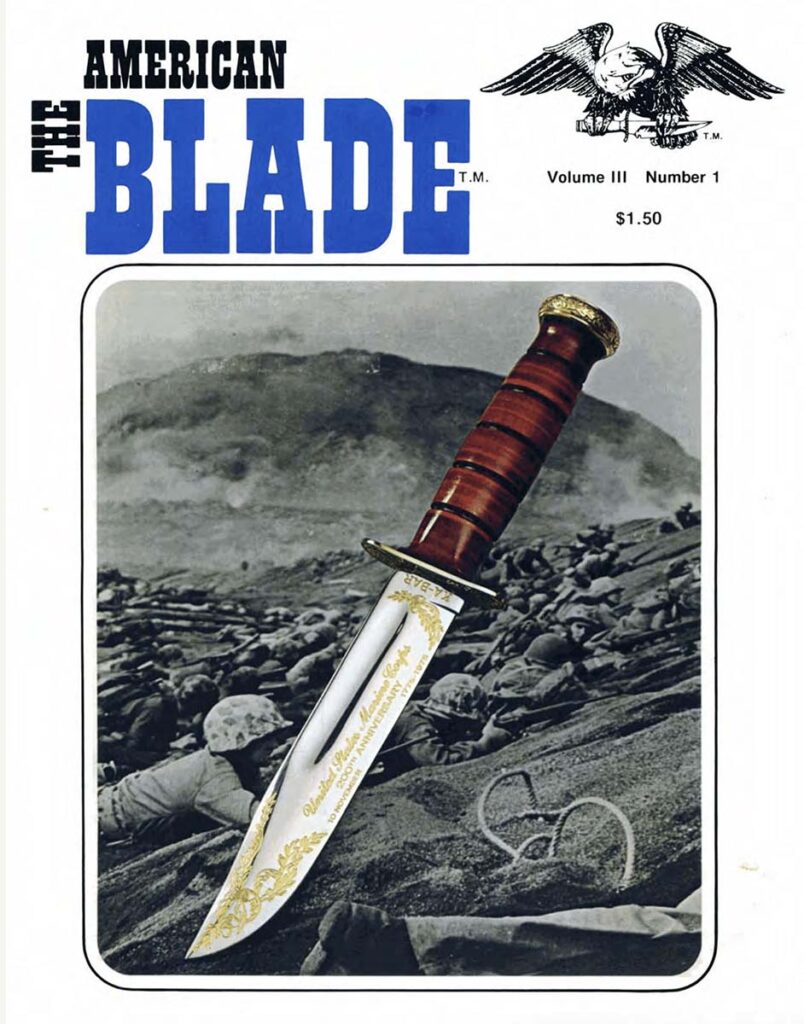
The American Blade Cover saluted the Marines’ bicentennial in grand fashion.
A half-century ago, the November-December issue of The American Blade recognized the 200th birthday of the United States Marine Corps with a special commemorative KA-BAR U.S.M.C. fighting/utility knife on the cover.
The cover of the November-December 1975 issue of The American Blade featured the 200th anniversary “Commemorative U.S.M.C. Fighting Knife” by KA-BAR Knives. The Corps celebrates its 250th anniversary this year.
Paired with the iconic image of U.S. Marines inching their way up the beaches of Iwo Jima during the titanic struggle to take the island from the Japanese during World War II, the cover knife featured a blade with “gold accents” that included the Corps’ founding date of 10 November and 1775-1975, oak leaf patterns and 200th Anniversary under United States Marine Corps in script.
The commemorative’s “top quality leather handle” was an exact duplicate of the handle on the original 1941-45 issue knife. The commemoratives were made in a limited edition of 2,500 with individual MSRPs of $300 for knives serial numbered two through 49, $200 for serial numbers 50 to 99, $150 for serial numbers 100-199, and $100 for serial numbers 200 and up.
Ka-Bar Makes One Of The Most Legendary American Combat/Utility Knives. First Issued In 1942, The Knife Continues To Impress And Inspire Today.
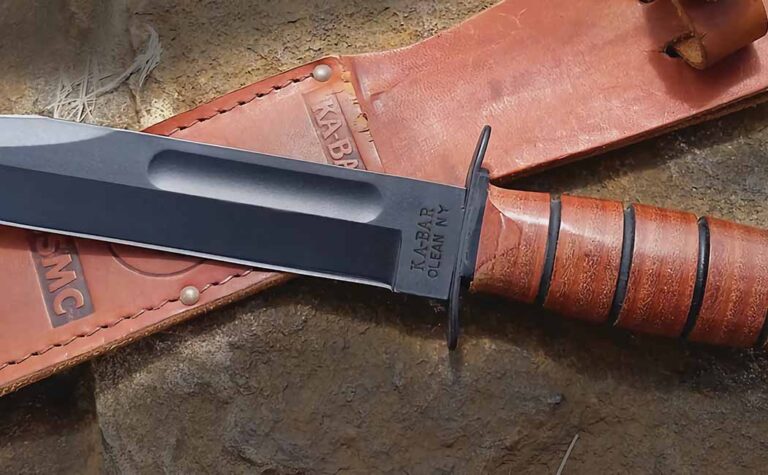
Few knives are as beloved and inspire more contemporary blades, than the Ka-Bar USMC fighting/utility knife. Ka-Bar Knives’ designation for it is the 1219C2, aka “the Ka-Bar,” and the knife was, and still is, a high-quality combat/utility tool. Ka-Bar Knives makes the contemporary version in its factory in upstate New York.
The History Of The Ka-Bar
As America entered World War 2, the Army and Marines took issue with the old World War 1-era trench knives that were being issued to them. The handles were too bulky, the blades were too brittle, and they were expensive to make.
After trying a few stopgaps, the Army asked arms suppliers to design a new combat/utility knife. Marine officers John Davis and Howard E. America worked with the Union Cutlery Company (now Ka-Bar Knives) to design a model that took elements from an old Navy knife and civilian hunting knives to create the 1219C2. In addition to Ka-Bar, Camillus, PAL, Robeson Shuredge, Case and Ontario were among those who made a USMC fighting/utility knife or a reasonable facsimile.
The knife was first issued to elite Marine units in November, 1942 and became standard issue for all Marines by 1944. Today, the knife is manufactured for military use and marketed to civilians as a utility/hunting knife.
Modern Ka-Bar Knives
Along with the original USMC fighting/utility knife, Ka-Bar makes many different combat/utility knives. This trio is a prime example of what the company produces today.
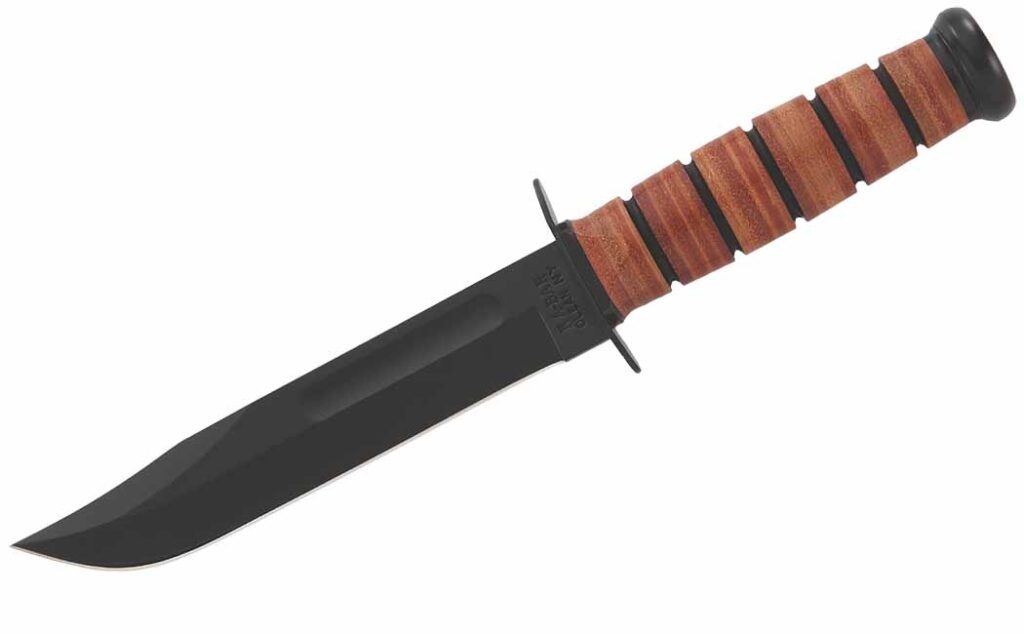
USMC Ka-Bar Plain Edge
The knife that made the Ka-Bar name famous is as popular as ever. There’s also a serrated version, but the plain edge is the original and is a hefty, economical knife.
The 7-inch clip point blade is made from 1095 Cro-Van steel with a 20-degree flat grind and a Rockwell hardness of 56-58 HRC. At just 11.2 ounces, it’s lighter than you might expect from a knife that size, which lets it flow smoothly when slicing, and the leather handle provides a secure grip. The rigid plastic sheath is MOLLE-compatible and can be carried vertically or horizontally.
Classics are classic for a reason, and the USMC fighting/utility knife is everything you could ask from a combat/using piece.
MSRP: $128.53
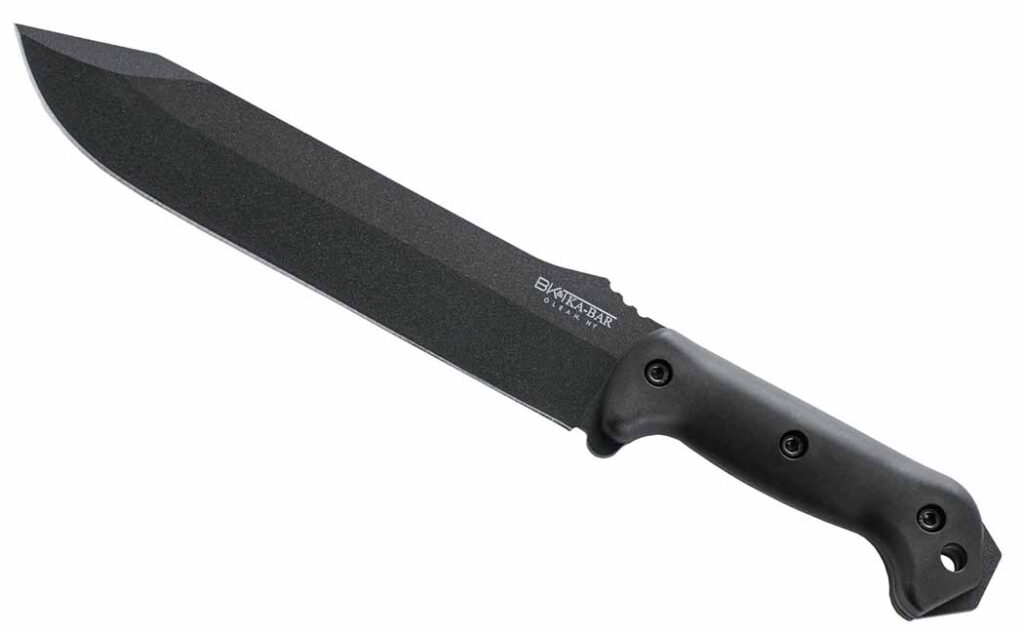
Becker Combat Bowie
Melding an American bowie-style blade with Becker’s trademark ergonomic handle design and you get this sleek, all-black combat knife. It is designed for bushcraft or camping too.
The 9.25-inch blade is married to an Ultramid handle that provides a strong grip. At 17.12 ounces, it’s a bit heftier than the USMC fighting/utility, making it excellent for more heavy-duty work like trimming thicker branches and vines or cutting through medium brush. Similar to the USMC fighting/utility, the Combat Bowie is made from 1095 Cro-Van and has a Rockwell hardness of 56-58 HRC.
A heavy-duty polyester sheath is included and is MOLLE-compatible as well.
MSRP: $178.61
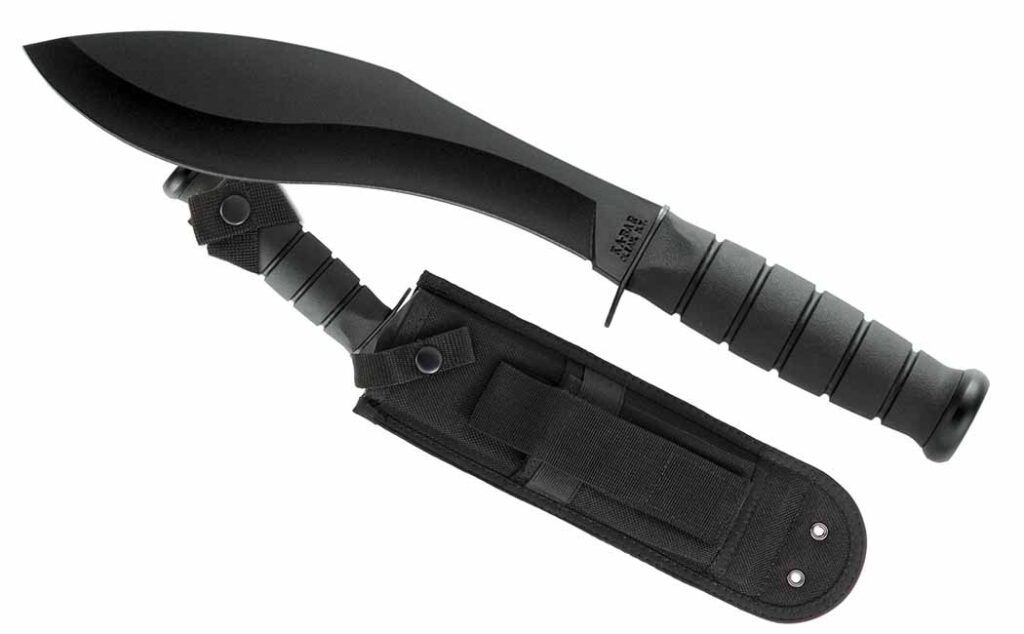
Combat Kukri
This knife may have “combat” in the name, but its bread and butter is decimating small trees and vines. The kukri is smaller than a standard machete and is more finite in its cutting. That doesn’t mean that this blade can’t flex its muscle and chew through almost any brush you put in front of it.
This knife may have “combat” in the name, but its bread and butter is decimating small trees and vines. The kukri is smaller than a standard machete and is more finite in its cutting. That doesn’t mean that this blade can’t flex its muscle and chew through almost any brush you put in front of it.
At just under 16 ounces, it’s relatively lightweight yet robust.
If you’re buying it you’re most likely looking for a high-quality outdoors knife, and this kukri is it. The 1095 Cro-Van will need to be maintained to get the best out of it over time, but that comes with the territory of owning good knives. This knife will make a great companion working through the bush while camping or while cutting through bushes in the backyard.
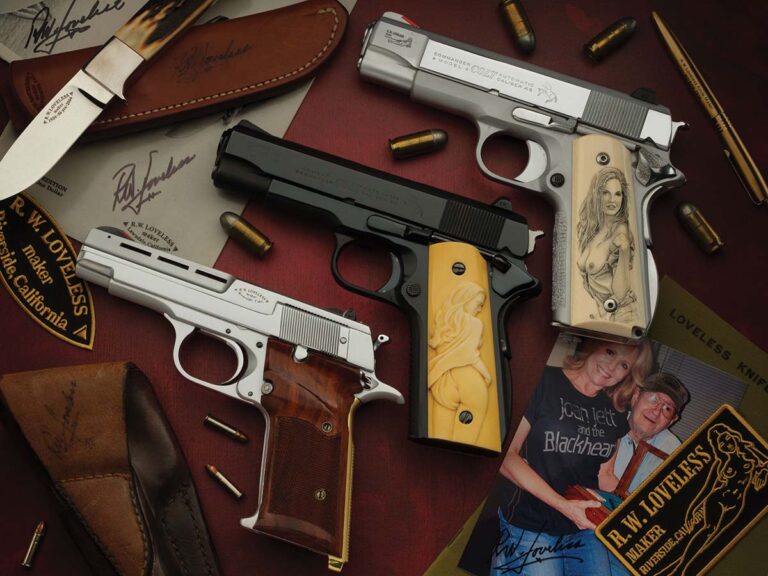
Three highly coveted firearms modified by the Cutlery Hall of Fame® legend—including his “de-fanged” Colt Commanders—head to Rock Island Auction.
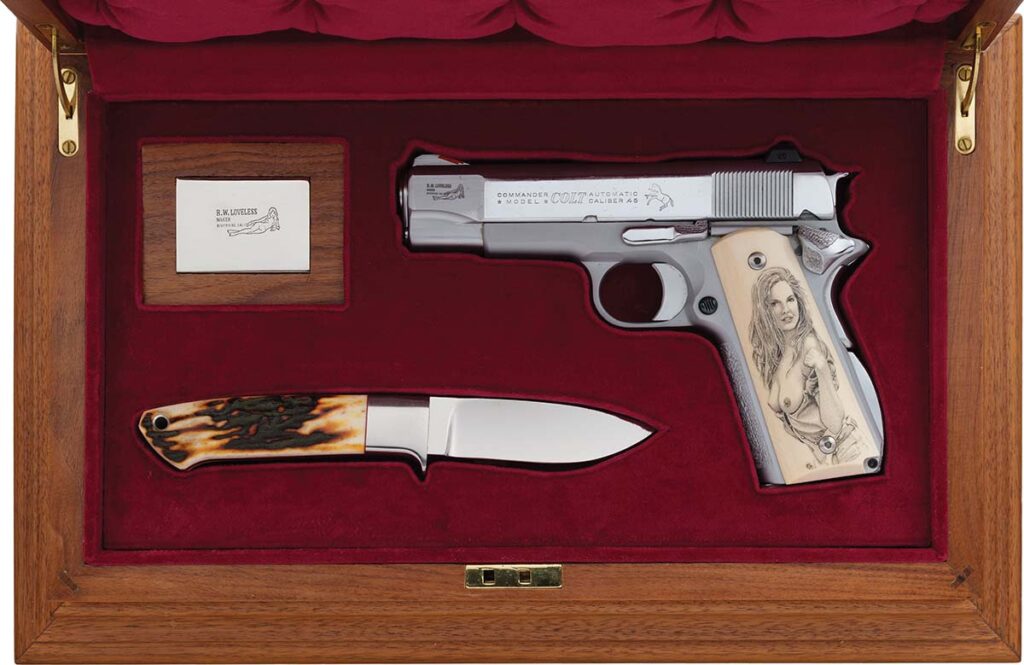
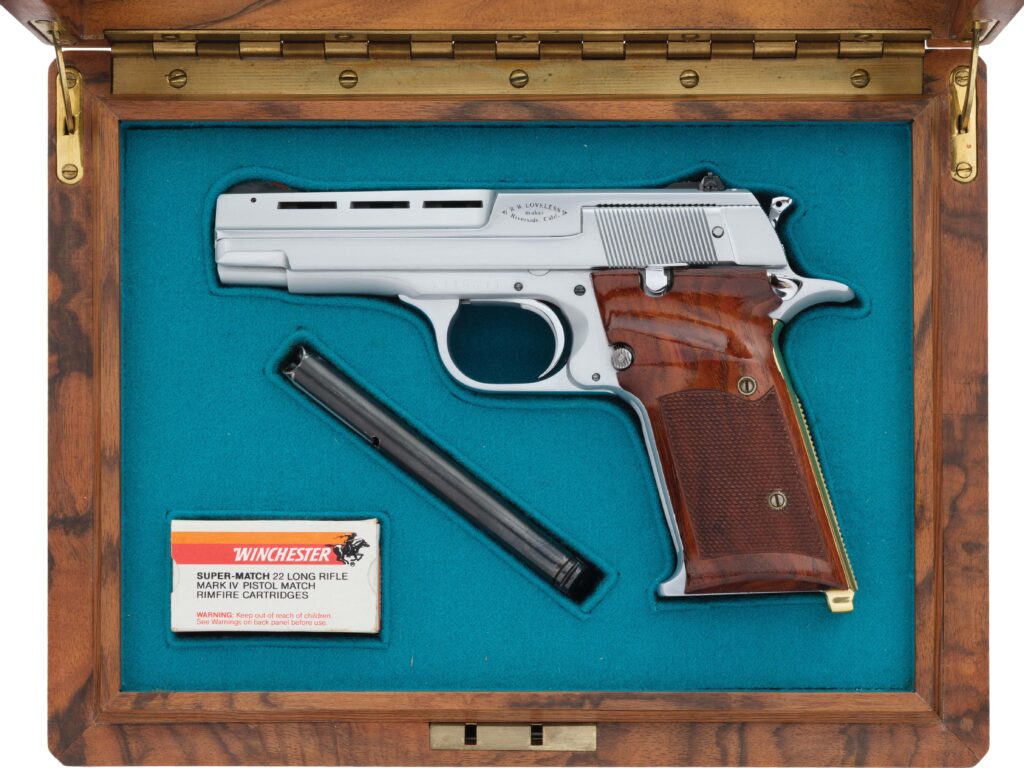
Bob Loveless Colt “Old Smoothie” Lightweight Commander semi-automatic pistol with scrimshawed ivory grips, drop-point Loveless Knife and sheath. Rock Island Auction image
While the late Bob Loveless secured his legacy as a titan of the cutlery world, the BLADE Magazine Cutlery Hall of Fame® member also brought his legendary eye for utility to the firearms world. His knives remain some of the most desirable, coveted custom creations on the planet, but a rare trio of his personal, customized handguns are now heading to the auction block at Rock Island Auction in the company’s June 27 American Sale (now live online). The selection highlights how the master craftsman applied his famous Bauhaus-inspired design ethos to custom gunsmithing.
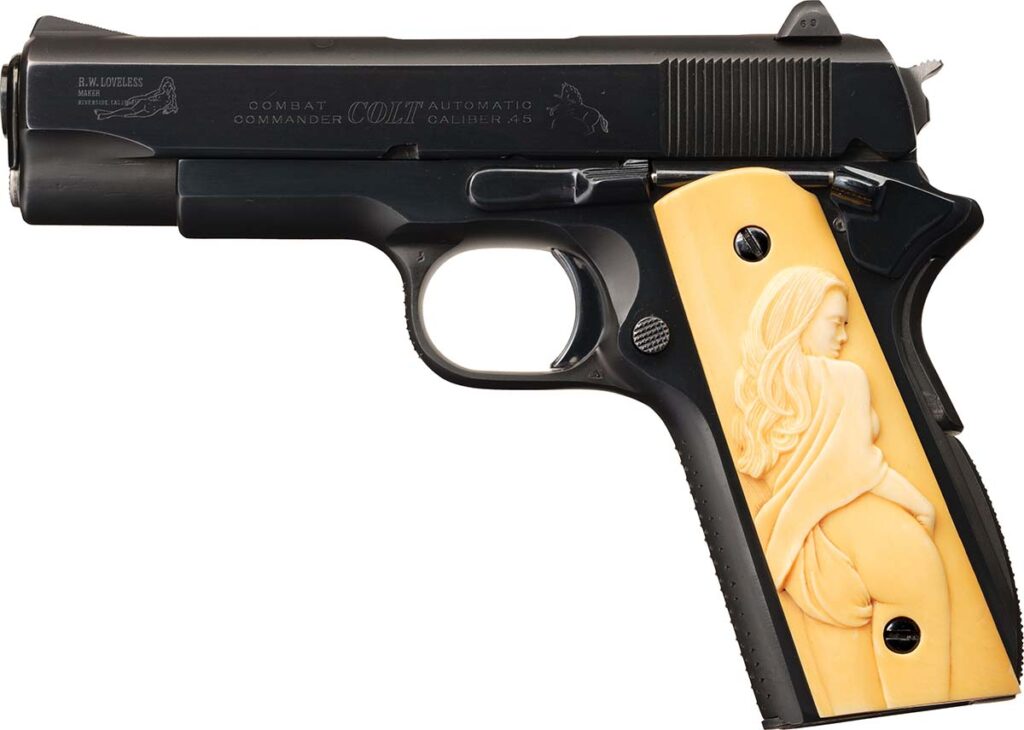
Bob Loveless Colt “Old Smoothie” Combat Commander semi-automatic pistol with relief carved ivory grips. Rock Island Auction image
The lineup features two Colt Commander pistols that Loveless thoroughly “de-fanged,” a signature modification process where he systematically bobbed the hammers, radiused the frames and smoothed away every sharp edge that could gouge a shooter’s hand. The first is a c. 1980 Lightweight Commander, featuring his electro-penciled initials, custom Browning cuts on the slide, and smooth ivory grips scrimshawed with nude artistry. This rare piece is housed in a custom hardwood case alongside a matching 2004 Loveless drop-point hunting knife. It is joined by a scarcer steel-framed Combat Commander variant, a platform Loveless rarely altered because he felt the extra weight defeated the purpose of a carry gun, making this particular build exceptionally rare.
Bob Loveless Smith & Wesson Model 41 semi-automatic pistol with case and signed photographs. Rock Island Auction image
Rounding out the trio is an extensively reworked Smith & Wesson Model 41 target pistol, believed to be one of only 70 ever built by Loveless. This highly modified rimfire pistol features a shortened barrel with a custom vented rib, an exposed hammer conversion, a checked gold-washed backstrap with a lanyard loop, and his personal initials electro-penciled on the slide. Complete with signed photographs of Loveless, a custom leather holster and a glass-topped display case, the group offers collectors a rare look at how one of the greatest knifemakers of all time refined factory firearms into high art.
Read More On Bob Loveless:
Bob Loveless: The Icon’s Indelible Mark On The Knife Industry
Stepping away from standard issues, combat veterans recount the off-beat military knives they used day-to-day during their service.
Since BLADE® Magazine went to press for the first time 50 years ago, there have been wars and rumors of wars. Even in peacetime, the U.S. military has stood ready in defense of freedom around the world.
When service men and women have deployed into harm’s way through the years, their knives of choice have been by their side, sheathed or strapped, buckled or pocketed, or carried in a duffle bag. From Vietnam to Iraq and Afghanistan, service personnel have taken their chosen tools abroad and put them to use for a variety of chores.
Kim Breed
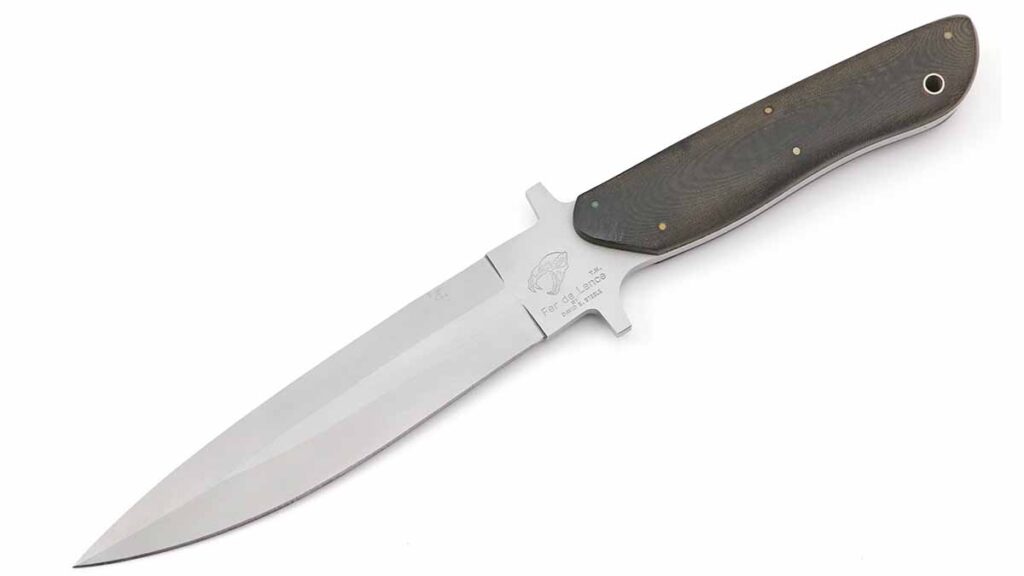
Fer de Lance from Pacific Cutlery
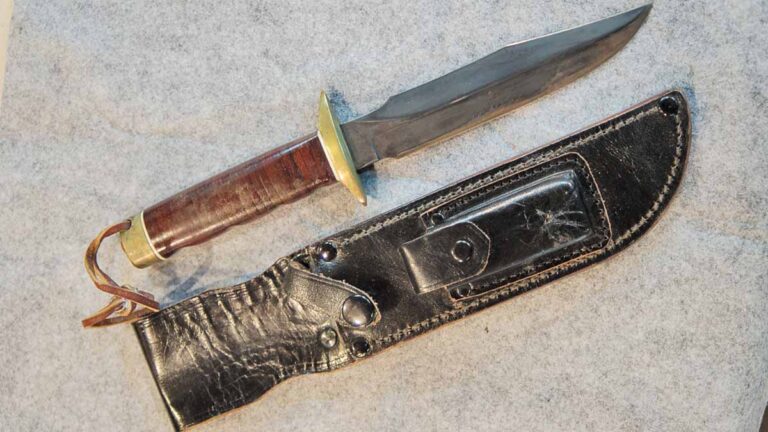
Ka-Bar-type fighting/utility fixed blade
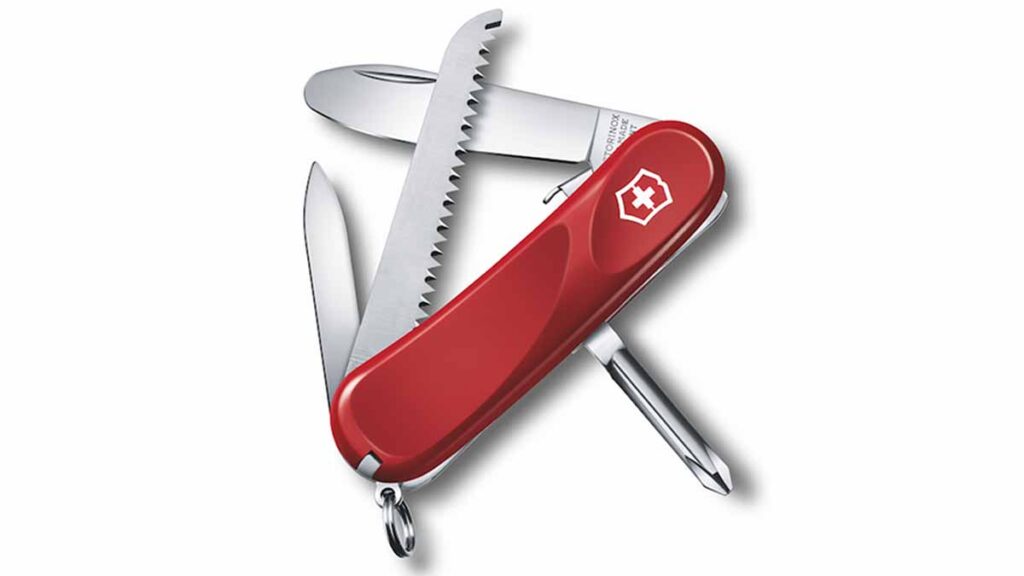
Swiss Army knife with tweezers
Cold Steel SRK
Randall Models 1 and 14
BLADE field editor/knifemaker Kim Breed spent nearly two decades in the Army, serving with the 10th and then 5th Special Forces Groups. His experience in the Gulf War included a mixed bag of available knives for anything that was needed.
BLADE® field editor/knifemaker Kim Breed said his experience with military knives in the Gulf War included a mixed bag, including the Fer de Lance designed by David Steele for the now-defunct Pacific Cutlery. Pacific Cutlery was owned and operated by BLADE Magazine Cutlery Hall-Of-Fame® member Les de Asis, who went on to found Benchmade Knife Co. (image of Fer de Lance courtesy of Arizona Custom Knives)
“I carried the Fer de Lance designed by David Steel and produced by Pacific Cutlery,” he said. “It’s a double-edged fighter and I carried it almost my whole career. It’s light in the hand and has a big enough blade to do the job. Two edges meant I had one sharp for heavy duty and the other for finer stuff. Plus, the locals would freak out when I brought out a double-edged knife. It was good psychological warfare.”
Along with the Fer de Lance strapped to his back, Breed also had a Swiss Army knife at his side and an Arkansas toothpick.
An unexpected military knife: Kim Breed indicated Swiss Army knives were especially handy in Somalia for removing stickers and thorns with the tweezers.
“It wasn’t the real big Arkansas toothpick,” he remembered. “It was a smaller dagger with an aluminum handle. A lot of guys would buy the Ka-Bar because it was a good knife—but it was also cheap. When we got bored, we would throw knives, betting for a cigarette, chocolate bar or pound cake. The Ka-Bar might break but the aluminum-handle dagger wouldn’t.”
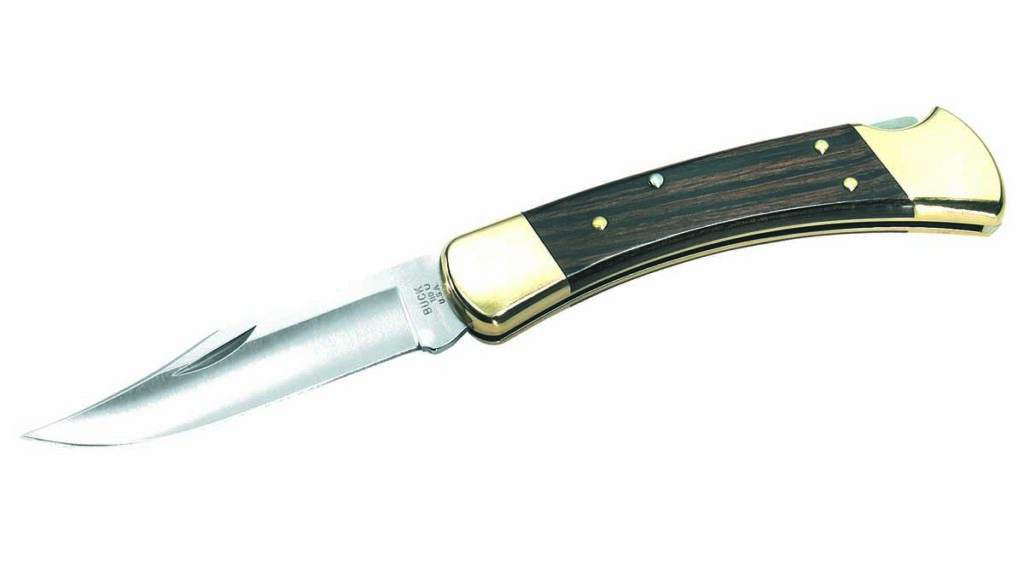
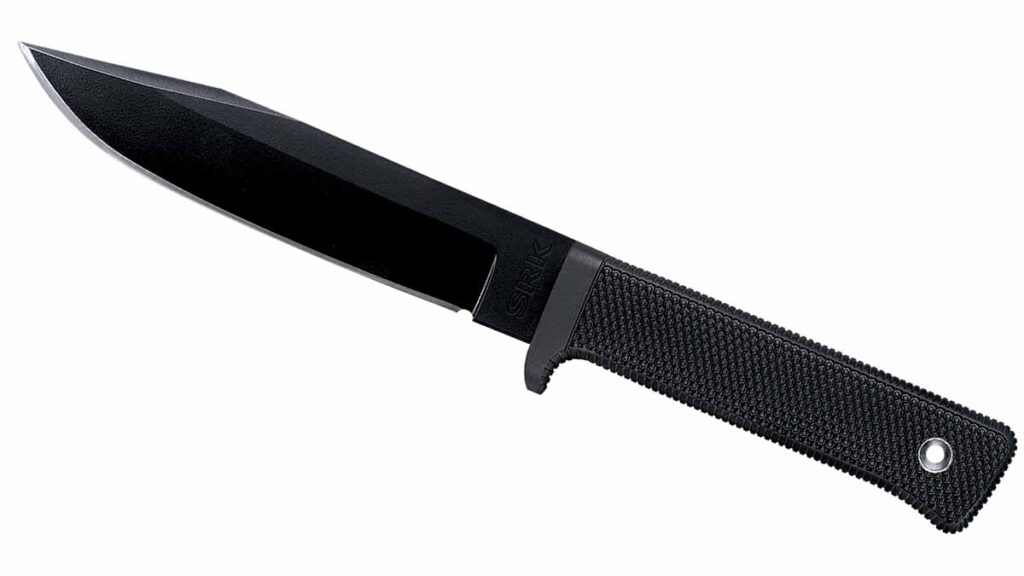
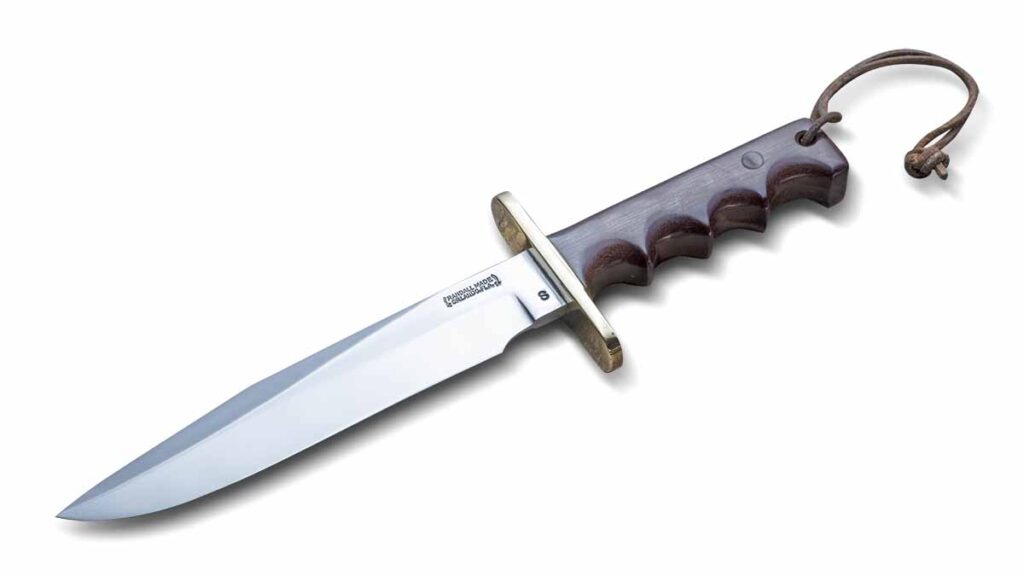
Speaking of the Ka-Bar*, it is among the top five knives of Breed’s Gulf War assessment, along with the Cold Steel SRK, Swiss Army knife, Randall Models 1 and 14 and the Buck 110. Each earned a bit of praise from the veteran.
The Buck 110 folder was widely available at the local PX and had good blade steel and easy carry for assorted cutting jobs.
The Ka-Bar has stood the test of time, and its generational tie to earlier combat deployments of family members from World War II forward may have been an influence, but for the most part, there was value, performance and availability to spare with the iconic fixed blade.
“It was in all the PXs,” Kim added. “You could get one for $12 and it worked pretty good, but if you broke one now and then you could have two or three around.”
Kim Breed said the Cold Steel SRK was a favorite among the troops, citing its molded Kraton handle in particular for praise.
Breed says the SRK was a favorite with its molded Kraton handle, while the Swiss Army was especially handy in Somalia for removing stickers and thorns with the tweezers. The Randalls were another legacy play. They were expensive knives but the troops’ fathers and grandfathers had carried them, so they were passed along to the sons and grandsons. The Buck 110 folder was also available at the local PX and had good blade steel and was easy to carry.
Jack Stottlemire
Ka-Bar-type fighting/utility fixed blade
Benchmade Stryker
Air Force/jet pilot survival knife
Custom Bob Horrigan
Randall Models 1 and 14
Knifemaker Jack Stottlemire served with the United States Marine Corps and the Army for a total of 27 years, with 14 combat deployments. He saw action in Operation Just Cause in Panama, Desert Shield and Desert Storm, the air war in Bosnia, Kosovo, Afghanistan and Iraq. The Marine service was first and he saw all his combat duty with the Army, retiring as a sergeant major with Special Operations. Like Breed, he stresses that knives were used for camp chores, prying, slicing and such.
Randalls were expensive but fathers and grandfathers had carried them, so they were passed along to the sons and grandsons. Developed in the mid-1950s, the Randall Model 14 Attack gained fame as a military knife during the Vietnam War. (Dan Clinton image)
“Using a knife in combat to stab somebody is pretty much bull,” he declared. “I don’t know anybody that used a knife for that in all my years. But if you’re in a helicopter crash and you need to cut strings or get somebody else out of the wreckage, that’s more realistic.”
Again, the Ka-Bar makes an appearance in the top five knives from his experiences, particularly in the desert environment. Stottlemire’s top five knives of the Iraq and Afghanistan wars include a custom Bob Horrigan** piece with a green Micarta® handle and a 5.5-inch blade of 440C stainless steel. “Bob and I were in the same squadron together and he was a real hero,” Jack offered.
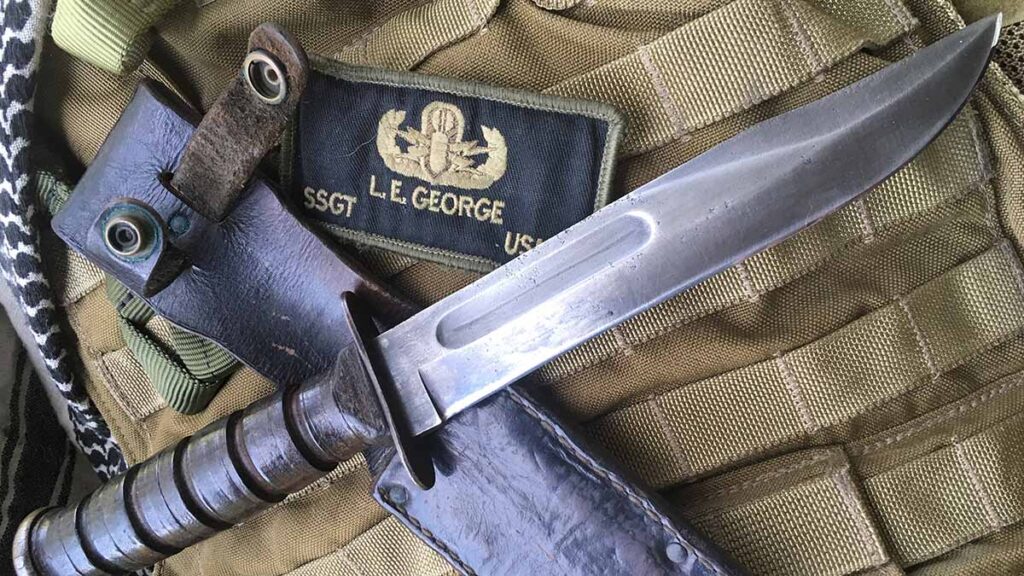
Les George said he’s “pretty sure” his Ka-Bar saw action in the Vietnam War, the Korean War and possibly even World War II. The last time the knife was in combat operations was when George saw active duty in the Iraq War in 2005. (Les George’s knife and image)
“The Ka-Bar is everywhere and I carried mine from the time I was in the Marines, and still have it 40 years later,” he continued. “I remember getting them for $25 or $35 and using them to pry and hammer and to open MREs [Meals Ready to Eat] and ammo boxes. That’s what we used them for 99 percent of the time.”
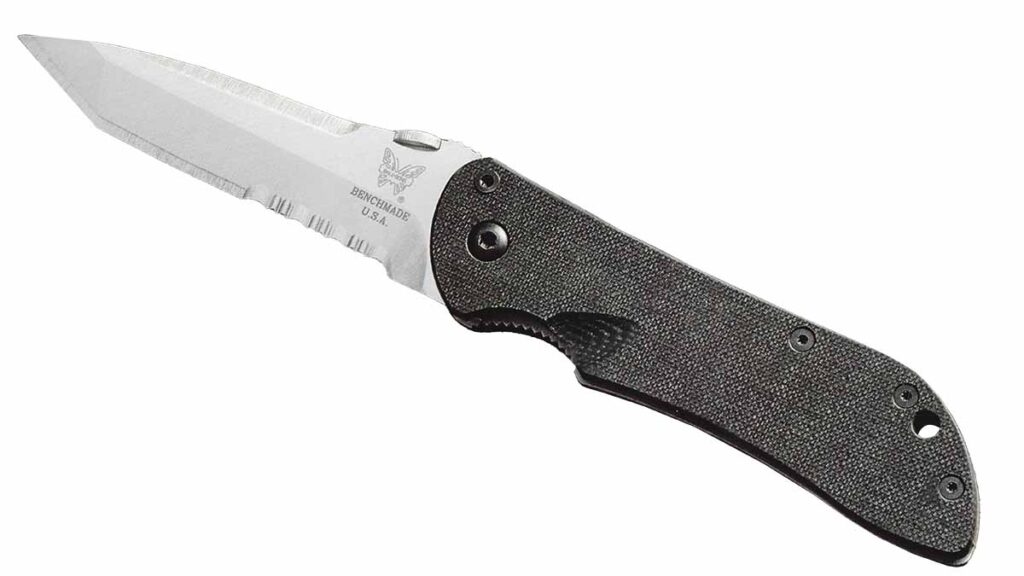
The famed Randall had stayed around as well, again identified as a legacy knife handed down from one generation to another. As for folders, Jack’s units were issued the Benchmade Stryker. “It was common to have a lot of Benchmade autos and one-hand flippers, and there were Gerbers in the same category,” he commented. “I always carried my auto on my vest front for easy access in case I needed to cut a bandage or something like that.
Air Force survival knife
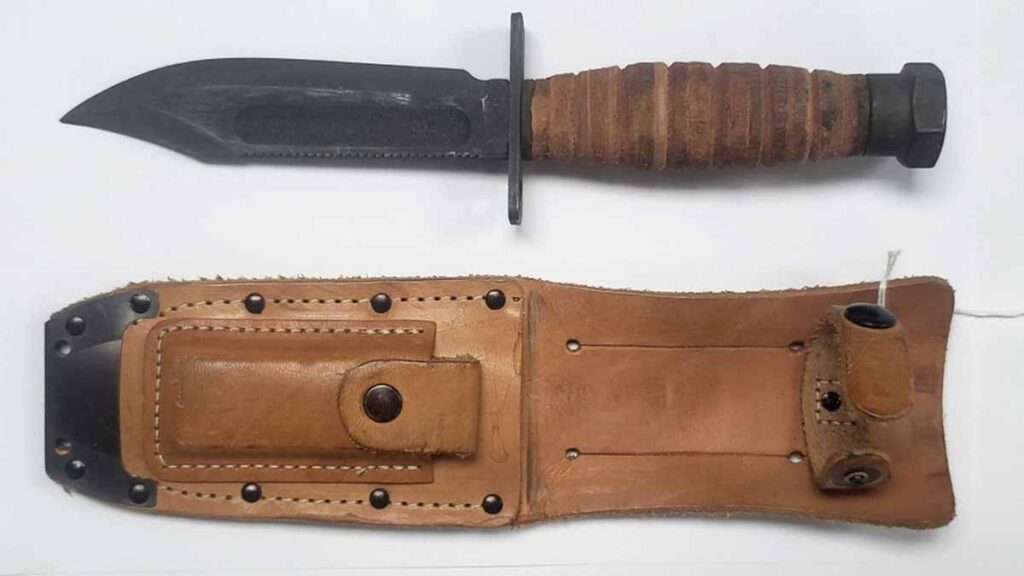
“Then we also had the Air Force survival knife. It was a jump master knife that looked like a little Ka-Bar with a stacked leather handle and a short bowie blade. A lot of guys carried more than one knife. They usually had a folder stuffed in their vest or pocket and a fixed blade on their chest next to their magazine pouches. That was for easy access. It’s hard to get to your stuff unless it’s on the vest, especially when you’re in a vehicle or helicopter.”
Les George
Custom EOD knife (self-made)
M11 EOD knives by Lan-Cay
Gerber multi-tools/Leatherman Wave
Benchmade Stryker and AFO
CRKT M16
Knifemaker Les George served with the U.S. Marines in explosive ordnance disposal (EOD) and carried a knife specifically for EOD use. “I actually made my own EOD knife in Iraq,” he remarked. “It was the first in a series that would become the M12 EOD knife that is currently listed as an option for USMC EOD units to purchase and use.”
As for folder military knives, Jack Stottlemire’s units were issued the Benchmade Stryker, an Allen Elishewitz design that debuted in the late 1990s.
Among the other knives that Les saw regularly in Iraq were the M11 EOD knives by Lan-Cay, Gerber multi-tools, Benchmade Stryker and AFO, and the Columbia River Knife & Tool M-16.
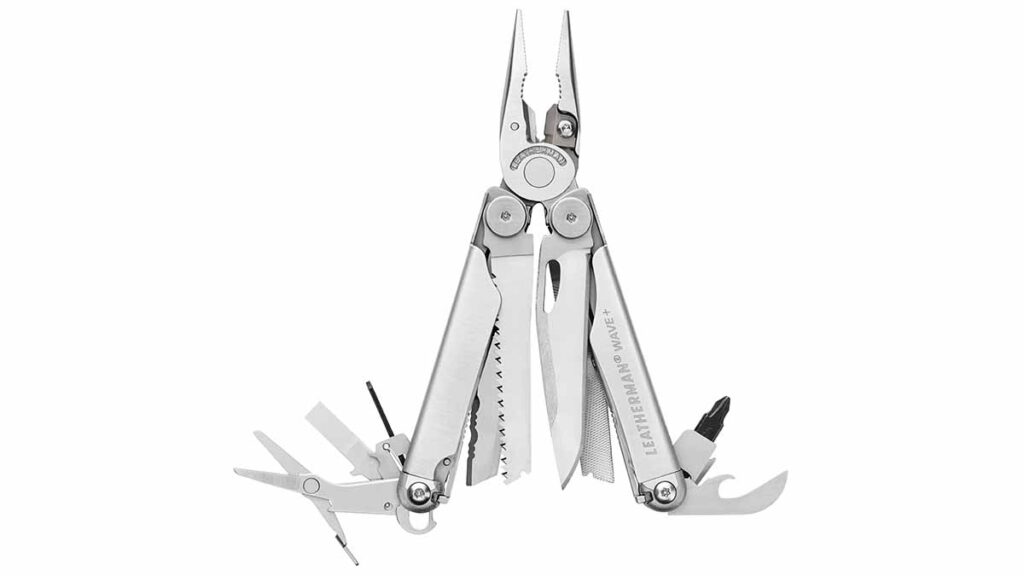
“The CRKTs were available at the PX and the other knives were issued to the Marines by unit,” George recalled. “Obviously, the Ontario bayonet was common for that reason. I had my large fixed blade that I used to probe for and dig up IEDs [improvised explosive devices] and UXOs [unexploded ordnance]. It was a brute force tool, the very epitome of a sharpened pry bar. I had a small Benchmade fixed blade that I had bolted to my pistol holster. I used it to cut tape or prepare demolition charges, and all the cutting utility I needed was done with that knife. I also carried a Leatherman Wave multi-tool. I liked the Wave over the issued Gerber because it closed up smaller, and I could access the blade without opening the tool.”
Thanks to their versatility and affordability, multi-tools have been popular with the troops since Leatherman Tool Group introduced its original multi-tool in 1982. Les George carried the Leatherman Wave because it closed up smaller and he could access the blade without opening the tool. The Wave+ is a Wave descendant.
Les chose his knives based on the situations he might find himself in during deployments. “The big and small fixed blades had their niche, while the multi-tool was available as a catchall. With the kind of war that I saw, there was not much thought of knives used outside of tools, and for me cost was not a factor. I would have spent about whatever the price to get the knives I wanted.”
Top 5 Knives From The Vietnam War
Ka-Bar-type fighting/utility fixed blade
SOG fixed blade
M7 bayonet
Air Force/jet pilot survival knife
MIL-K
After studying the Vietnam War era and the knives that were most often found during that period in Southeast Asia, Frank Trzaska has come up with his top five from that timeframe. His list includes—you guessed it—the Ka-Bar, which sits at the top. “The U.S. Fighting/Utility knife, the Mark 2, the Ka-Bar, call it whatever you will, but to me it is America’s fighting knife—adopted in 1942 and still serving our troops to this day,” he smiled.
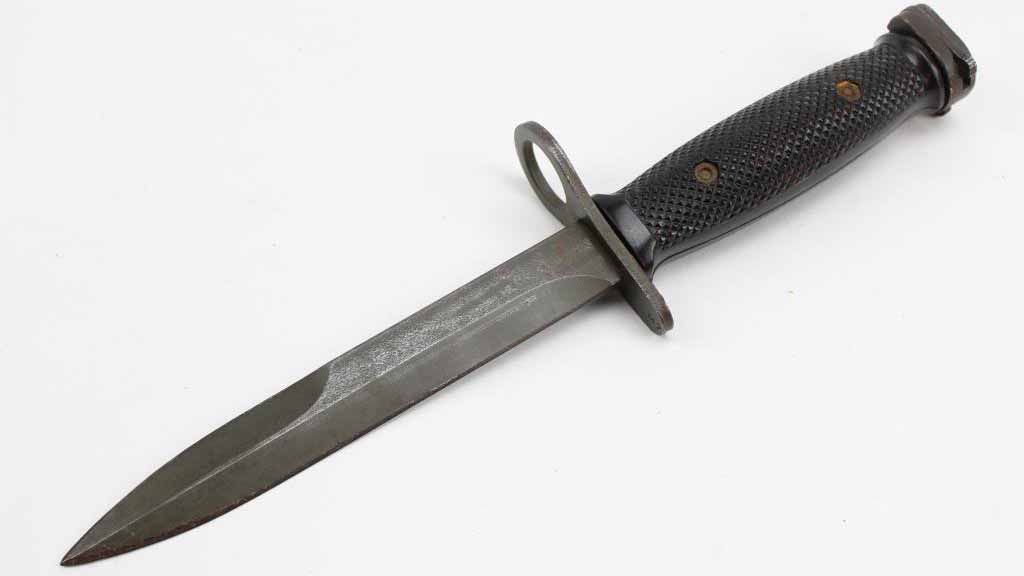
M7 Bayonet was a common ‘Nam era military knife.
Others topping Frank’s list include the original SOG, which he calls “a very hard-to-find knife made in limited numbers for the super-secret Studies and Observation Group [SOG], Green Berets that went out into the field to locate the enemy—Recon.”
Frank has also found the M7 bayonet, designed to fit the M16 rifle, to have been in regular use. “It was another piece in succession that was originally adapted from the M3 trench knife of World War II fame,” he noted. “The M3, M4, M5, M6 and M7 all used the same blade profile.”
MIL-K was a handy addition to a soldier’s kit.
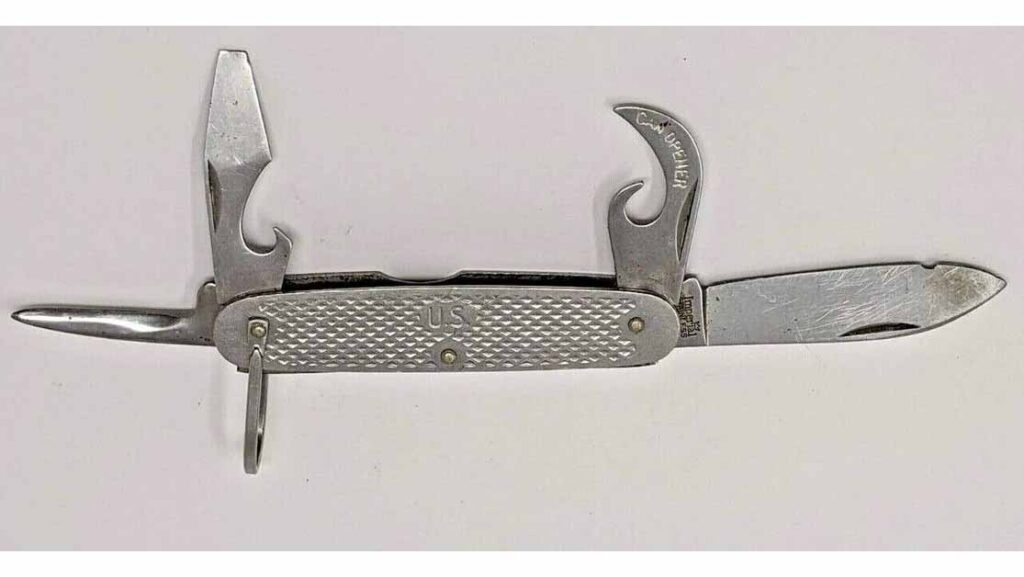
The Jet Pilot Survival knife, aka Air Force survival knife, and a small all-metal pocketknife called the MIL-K were frequently seen with troops in Vietnam, Frank noted. “The Jet Pilot Survival knife was an iconic knife of the Vietnam era, and it was shown in photographs everywhere,” he related. “Although the name was ‘Jet Pilot,’ it was seen on ground pounders just as often. The MIL-K was the perfect all-purpose pocketknife that, as an extra, is dated so you can collect all the years and at a somewhat low price.”
Trzaska has spoken with troops all over the world, and the multi-tool has surged to the forefront among military personnel deployed these days, but he also quickly adds that the Ka-Bar is still a favorite. Given the salaries of enlisted men, he speculates that cost was always a factor in the purchase of a Vietnam-era knife.
Final Cut
Times change but for soldiers through the last half century/publication life of BLADE, knife uses have stayed the same in many ways. “Almost everyone in Vietnam carried two knives, a pocketknife and a fixed blade, and if you count the bayonet, it would be three,” Frank observed. “They were used mostly for opening meals, mail and boxes. A pocketknife was handy but a fixed blade on your harness was meant for fighting. Along with your bayonet, they were weapons of last resort.”
From the more expensive models to everyday carry in the field, military personnel in Vietnam had their pick. “The Randalls were the knives everybody wanted,” Trzaska said, “but few had them. They became a status symbol of a professional. Young guys also liked big knives until they had to carry all that extra weight and never use them. Then the small knife was the king. Most knives of the era were common steel and would rust easily. Stainless steel was a big plus and found its way into knife production over time.”
Through the years, BLADE has published many accounts of knives in the hands of military personnel deployed around the globe. Since the early 1970s, these stories have brought valuable information to readers regarding performance, personality and collectability. That trend will continue into the future.
*As Frank Trzaska notes, no matter whether you call it the USMC fighting/utility knife, Mark 2, Ka-Bar or what have you, the fixed blade with the leather-washer handle and clip-point blade made by several different companies that first appeared in 1942 and did yeoman’s duty throughout World War II remains a U.S. military icon.
**Robert “Bob” Horrigan, a member of U.S. Army Special Operations Command, was killed in action in Iraq on June 17, 2005. His twin brother is award-winning ABS master smith John Horrigan.
The story of a prototype Airman and a Marine pioneer.
Editor’s note: The author contacted BLADE® and asked if we would be interested in his story on a special Marine Corps knife and a special Marine to coincide with the semi-quincentennial of the United States Marine Corps. Needless to say, it was an easy decision on our part. Meanwhile, please join us in wishing a happy 250th birthday to the Corps and Marines everywhere.
The core values of honor, courage and commitment have defined the United States Marine Corps since its inception on Nov. 10, 1775. To remain an elite fighting force, the Marine Corps has adapted as the world has changed over the past 250 years, incorporating new technology and developing new doctrine.
One of the most significant transformations began with the birth of Marine Corps aviation in 1912. During World War II, Marine aviators played a vital role in the Pacific campaign, working closely with ground units to seize heavily defended island strongholds. As Gen. Keith B. McCutcheon, a pioneer of Marine aviation, later emphasized, “The Marine Corps is proud of the fact that it is a force of combined arms, and it jealously guards the integrity of its air-ground team.”
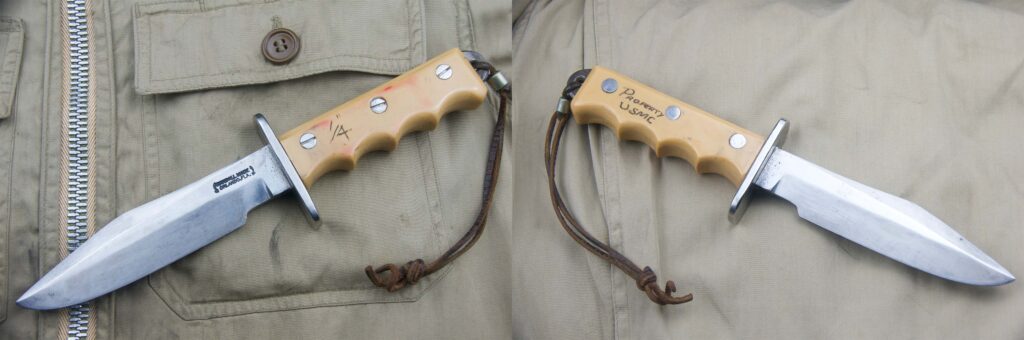
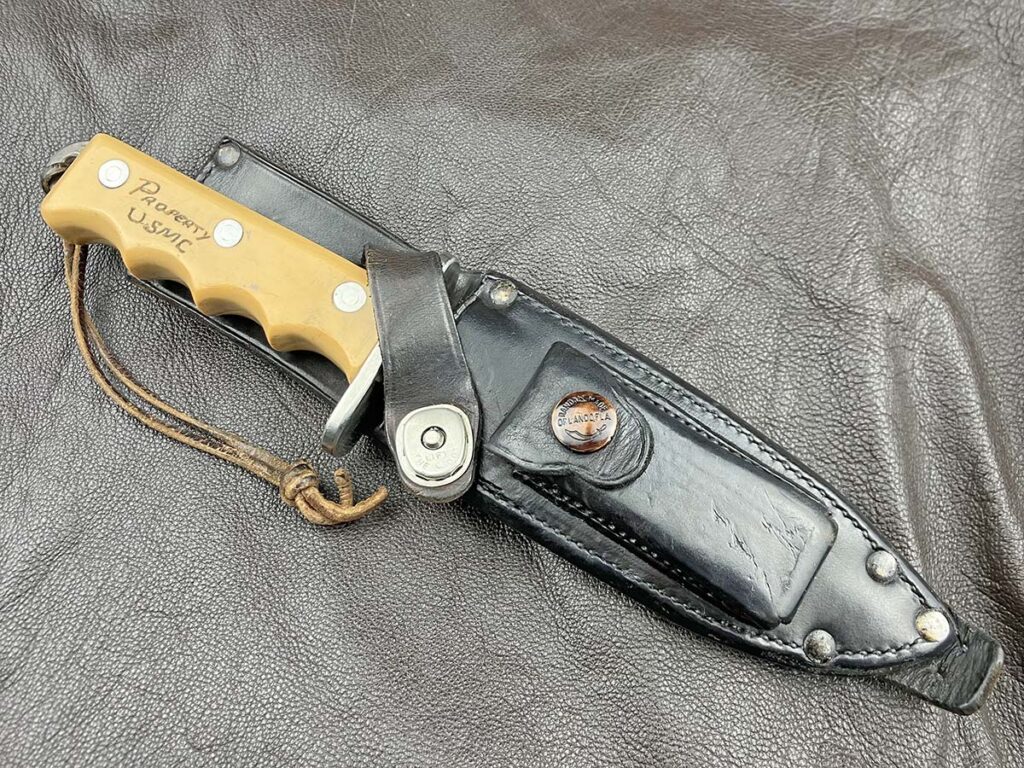
The mark and non-mark sides of a prototype Airman.
The evolution of air combat brought new challenges, challenges that extended even to the knives that aviators carried. One result was a collaboration between Marine aviators and BLADE Magazine Cutlery Hall-of-Fame® member Walter D. “Bo” Randall, who would redefine survival and combat knives with the now-iconic Randall Model 15. This article features one of Randall’s prototypes—a rugged, full-tang Airman’s Knife that was carried for more than 15 years by Gen. McCutcheon himself.
The Challenge
Marine aviators amassed extensive combat experience in World War II and Korea. By 1953, the Marine Corps recognized that the rigors of combat aviation demanded a new type of knife—one that was rugged, compact and versatile.
As documented by Randall historian Robert Gaddis, the Marine Corps Equipment Board assigned Lt. Col. H. Ross Jordan and Maj. Harold N. “Tex” Mehaffey to develop a survival and combat knife for Marine aviators. The knife had to be nearly indestructible—strong enough for an airman to pry, cut or smash his way out of a downed aircraft. At the same time, it had to be short enough to be worn in a cramped cockpit, and the sheath needed to allow the knife to be carried on the upper arm or lower leg.
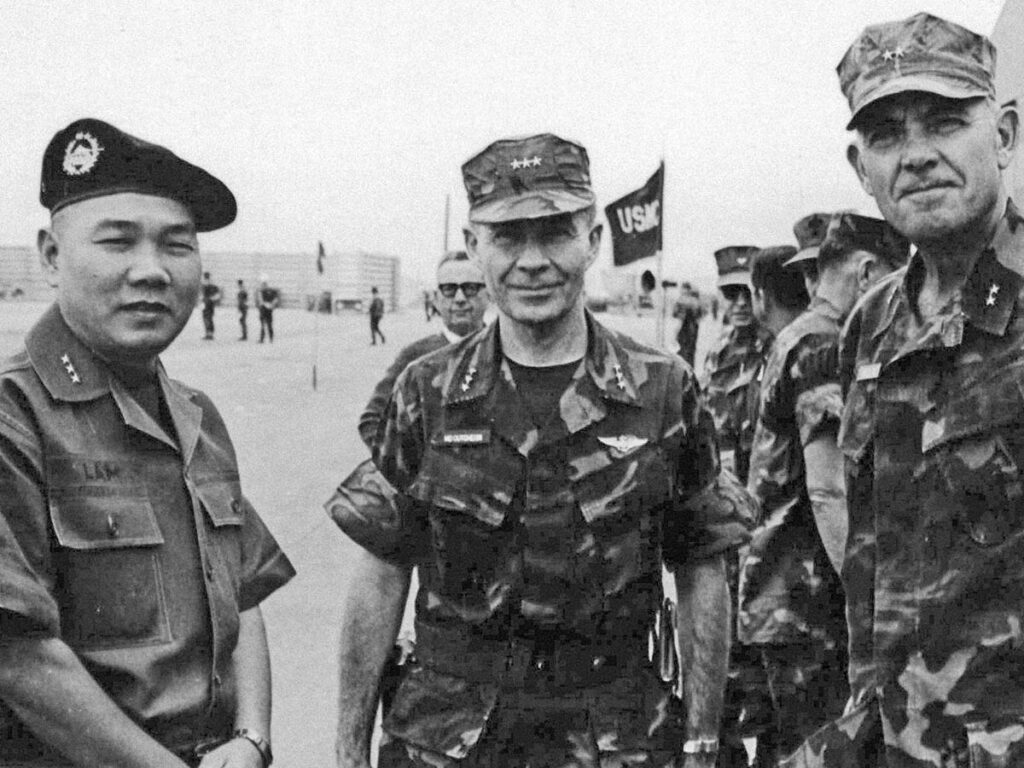
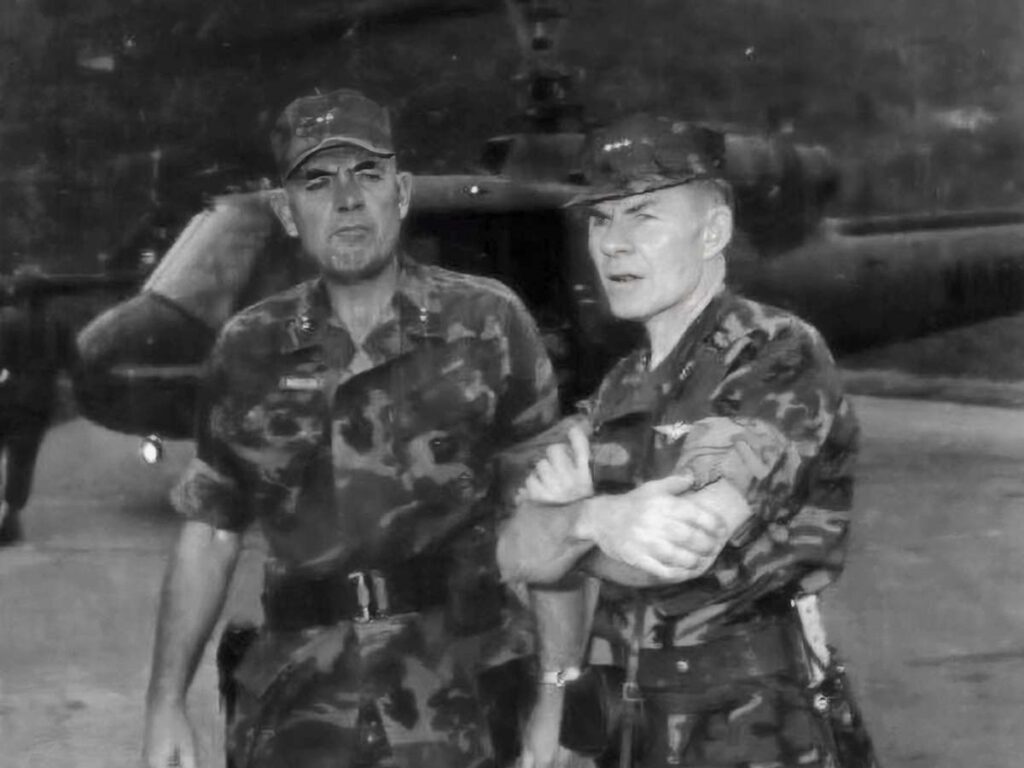
Wearing his sheathed Randall Model 15 Airman on his left hip, United States Marine Corps Gen. Keith McCutcheon (center) is flanked by South Vietnamese Gen. Hoang Xuan Lam, Commander of I Corps, and USMC Gen. Edwin B. Wheeler (right), commanding general of the 1st Marine Division. (image of McCutcheon, Lam and Wheeler from somewhere near Da Nang, Vietnam, March 16, 1970)
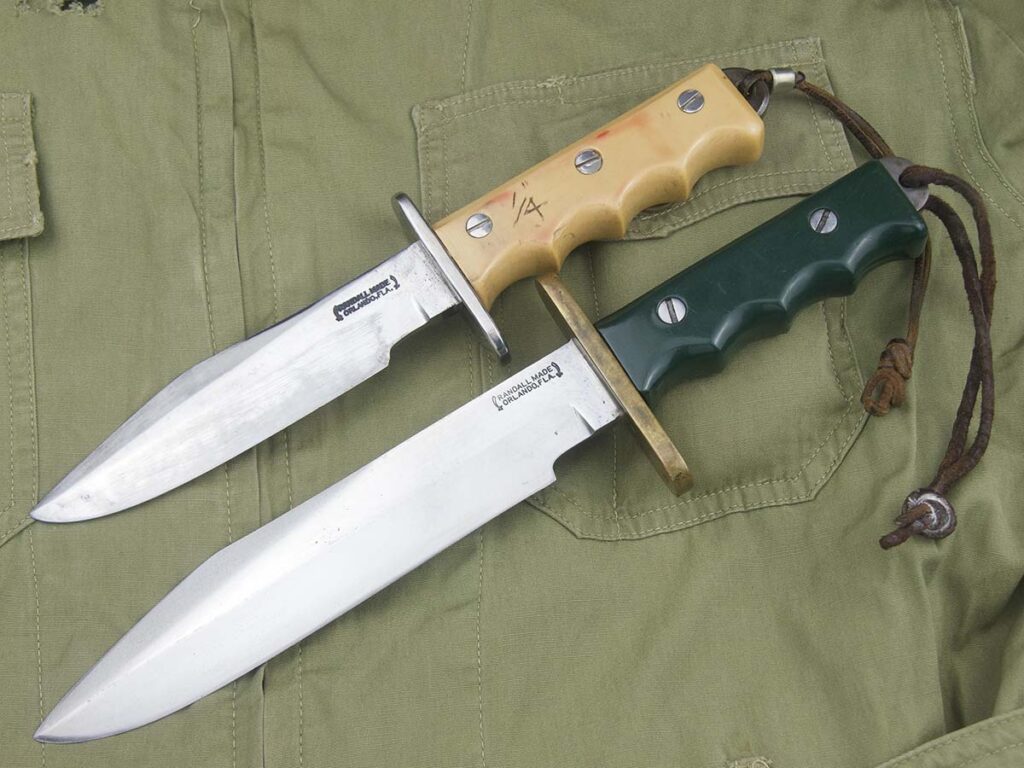
After reading a December 1953 magazine article about Bo and his expertly crafted blades, Mehaffey and Jordan arranged to tour his knife shop in Orlando on Feb. 11-12, 1954. By the end of their fruitful discussion on February 12, Bo had arrived at the basic design of the Randall Airman’s Knife. He also planned a longer-bladed version for ground troops, a design that would become the Randall Attack. Thus, this meeting launched the line of full-tang Randall models that would expand and evolve over the coming years.
Bo moved rapidly to fabricate prototypes that embodied his innovative design. The 5.5-inch blade would be forged from quarter-inch-thick O1 tool steel, a material that had been proven in earlier Randall combat knives. To strengthen the tip, the blade would retain the full quarter-inch thickness nearly to the point. To strengthen the junction between blade and the handle, the tang would be 7/8-inch wide along the entire grip. An extended segment of the tang would have a hole for a wrist thong and provide a surface that could be used for hammering. A heavy double hilt would prevent a gloved hand from slipping forward onto the blade. The handle would be made from a single piece of Tenite plastic, shaped with finger grips and a channel to snugly fit the tang. Stainless steel bolts would secure the handle.
To complete the package, Randall designed a sheath that could be worn on a belt, attached to a harness, or tied to the lower leg or upper arm with leather laces. It featured a diagonal keeper and rivets at stress points. The Randall shop completed the prototypes of the Airman’s Knife and the longer Attack Knife by the end of February 1954—barely more than two weeks after the formative design discussion—and Clarence Moore readied the sheaths soon after.
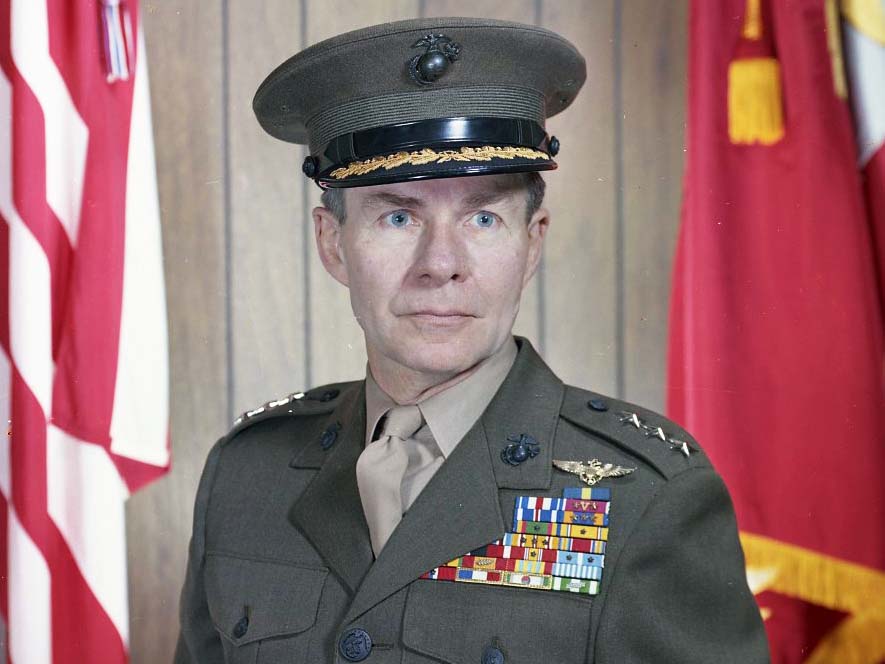
Three-star Gen. Keith McCutcheon, February 1970
The innovative features of the new knife and sheath designs were memorialized on certified blueprints on March 4, 1954. Randall filed a patent application on Aug. 11, 1954, and the United States Patent Office granted patent 177,590 for the Randall Airman’s Knife on May 1, 1956.
Prototype Testing
With prototypes in hand, Randall travelled to Quantico, Virginia in mid-March 1954 to present the new full-tang knives to Mehaffey, Jordan and other USMC and U.S. Navy officers. The group enthusiastically recommended that the Navy’s Bureau of Aeronautics purchase 10 prototype Airman’s Knives for evaluation: five from quarter-inch stock according to the original design, and five lighter examples from 3/16-inch stock.
The requisition arrived in early April 1954 and the shop shipped the 10 prototypes in early May. The invoice listed the Airman’s Knife as the #14, but later that month Randall adopted the still-current model numbers: the Airman became the Model 15, and the longer version became the Model 14 Attack.
The Marine Corps Equipment Board received two of the prototypes, one of each blade thickness, and the remaining eight were sent to squadrons and other units for real-world testing. In late May, Mehaffey informed Bo that preliminary testing had begun.
One of the original Randall prototypes is featured in the accompanying photographs. Made from quarter-inch steel, as indicated by the inscription on the handle, the prototype closely follows Bo’s patented design, except the blade lacks the fuller shown in the drawing. As in the original design, the prototype’s handle is secured by three bolts; this feature sets the prototype apart from later production examples of the Model 15, in which only two bolts were used.
Leatherworker Clarence Moore made the sheath for the prototype Airman according to Bo Randall’s design. Moore made the sheaths for the earliest full-tang knives until Heiser took over production in 1955.
The handle is made from white Tenite, a material used only for a year or so before Randall adopted the more familiar green Tenite that was characteristic of production for nearly 10 years, until Randall Made replaced Tenite with Micarta® in the mid-1960s. The prototype’s hilt is nickel silver in contrast to the brass hilts seen on almost all Model 15s with Tenite handles. The sheath was made according to Bo’s design by master leatherworker Clarence Moore, who made sheaths for the earliest full-tang knives until Heiser took over production in 1955.
After more than 70 years, the knife and sheath are in outstanding condition—a testament to Randall’s craftsmanship and superb design.
Project Setbacks
Despite starting with such promise, the project faltered in the summer of 1954 when Mehaffey was transferred for duty in France and Jordan retired. The departure of the two enthusiastic advocates delayed testing and communications. The next official update was in December 1954, when Bo heard that testing had been underway for two months with positive feedback. In April 1955, the United States Air Force also ordered a group of Model 15s for evaluation. Bo wrote again to the USMC in June 1955 but heard nothing further from the Marines or the Air Force.
Although Randall was never officially informed of the results, author Frank Trzaska uncovered a September 1955 testing report in the USMC archives. The report was authored by USMC Maj. Norman W. Gourley, who had succeeded Mehaffey. Extensive testing of the Randall Airman prototypes showed that the quarter-inch-thick version (i.e., Bo’s original design) was “suitable for aviators’ survival use.”
SONY DSCAfter a fruitful meeting on Feb. 12, 1954 with USMC Maj. Harold N. “Tex” Mehaffey and Lt. Col. H. Ross Jordan, Bo Randall had arrived at the basic design of the Randall Airman’s Knife (top). Bo also planned a longer-bladed version for ground troops, a design that would become the Randall Model 14 Attack (one from 1955 is shown at bottom). The meeting launched the line of full-tang Randall models that would expand and evolve over the coming years.
The report, which pictures this story’s featured prototype, notes the high quality of the design, materials and workmanship of the Randall knife and sheath and concludes that it is acceptable for extreme survival tasks. The report also noted potential changes that would improve the knife further, such as the addition of saw teeth, a flat butt surface for hammering, and different handle configurations. Bo independently incorporated most of these features in various full-tang Randall models by the mid-1960s, and presumably he would have made the changes sooner if the request had ever been made.
While the tests of the Randall Airman were underway, the Navy adopted the Imperial Pilot Survival Knife for its aviators. Because the Marine Corps operates as part of the Department of the Navy, this surely complicated any attempt by the Marines to adopt a different design. The Randall Airman was never issued by the military, but Bo added the Model 14 Attack and the Model 15 Airman to the new Randall catalog printed in 1954, which showed prototypes of both models as “patent pending.” As envisioned by Bo and the Marine aviators who helped to shape the design, Randall’s full-tang combat and survival knives were embraced by many American servicemen who purchased them privately, especially during the Vietnam War.
Pioneer & His Prototype
One Marine who had a high opinion of the Randall Airman was aviation pioneer Keith B. McCutcheon, who as a colonel served as Chief, Air Section, Marine Corps Equipment Board from June 1954 to July 1957. After the Randall Airman tests concluded, McCutcheon carried the quarter-inch prototype for the rest of his career.
An attack helicopter warms up in the background as Gen. McCutcheon surveys the situation six miles southwest of Da Nang, March 17, 1970, his trusty Randall Model 15 Airman sheathed at his side. At left is Gen. Edwin B. Wheeler.
In January 1966, while commanding the 1st Marine Aircraft Wing in Da Nang, Vietnam, then-Brig. Gen. McCutcheon wrote that the Airman was a “wonderful knife” that he had carried for “10 or 11 years.” Photographs from 1970 show McCutcheon wearing the knife when he returned to Da Nang as a lieutenant general and commander of the III Marine Amphibious Force (III MAF).
Commissioned as a Marine 2nd lieutenant in 1937, McCutcheon was a brilliant, courageous leader who transformed Marine aviation over the course of his illustrious 34-year career. Gen. Earl Anderson said McCutcheon “was one of the finest and most dedicated Marine officers [whose career] reads like a history of Marine Aviation. He earned his wings as an aviator in 1940 and served in World War II, Korea and Vietnam.”
McCutcheon was instrumental in integrating helicopters into Marine operations, and has been called “the Father of Marine Helicopters.” But, as historian William Fails observed, that title does not capture McCutcheon’s central contributions to numerous other areas. He also advanced close air support doctrine and techniques, guided missile systems, and the AV-8 Harrier jump jet. McCutcheon was also an effective leader of ground operations, launching successful operations as commander of III MAF.
For his exemplary service over 34 years, McCutcheon received many of the nation’s highest military decorations, including three Distinguished Service Medals, the Silver Star Medal, three Legions of Merit with Combat “V,” the Distinguished Flying Cross, 10 Air Medals and others. He was appointed to become the assistant commandant of the Marine Corps but was unable to assume the post because of failing health. He retired as a four-star general on July 1, 1971, and passed away from an illness soon after.
Enduring Legacy
On the 250th birthday of the United States Marine Corps, it is fitting to honor the legacy of Gen. Keith B. McCutcheon, an extraordinary leader who helped shape the modern Marine Corps. McCutcheon’s prototype Randall Airman remains as a tangible link to his many accomplishments and to the connection between the Marine Corps and Randall Made Knives.
Sources
William R. Fails. 1978. “Marines and Helicopters 1962-1973.” History and Museums Division, Headquarters U.S. Marine Corps. Robert L. Gaddis. 1993. “Randall Made Knives: The History of the Man and the Blades” Paladin Press. James Anthony Ginther, Jr. 1999. “Keith Barr McCutcheon: Integrating Aviation into the United States Marine Corps, 1937-1971.” Doctoral Dissertation, Texas Tech University. Norman W. Gourley. 1955. Marine Corps Equipment Board report A9-E-1039 on Project E-1039. Frank Trzaska. 2001. “Randall’s Model 15 & the U.S.M.C.” February 2001 Knife World.