The history of knives and other edged instruments is tied to the history of people in general. As humankind’s oldest tool, unraveling knife history can lead to even more surprising and enriching information to better understand the world.
Fowler had a lasting impact on handmade knives and knife writing.
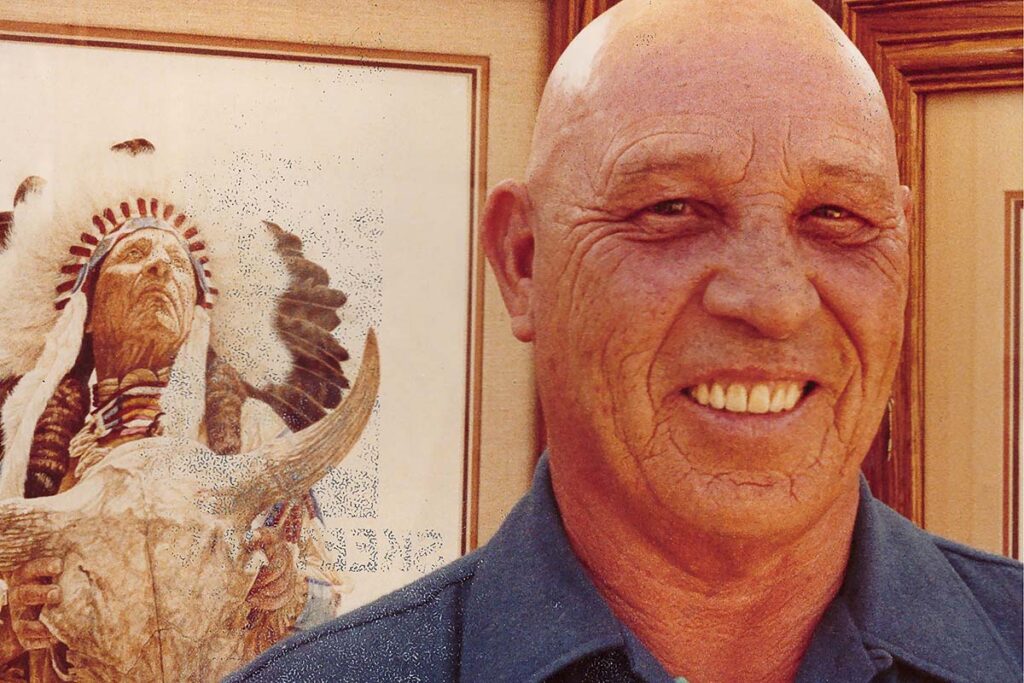
The cutlery world recently lost one of its most steadfast creators and philosophers. Ed Fowler, a man who epitomized the spirit of the custom knife movement, passed away on January 17.
Ed’s journey in the industry began in 1962. Over the following six decades, he became a driving force in the evolution of functional cutlery. While he didn’t invent the use of 52100 ball-bearing steel, he was arguably its greatest champion, popularizing the material alongside his then-controversial methods of multiple quenching during heat treatment. For Ed, a knife wasn’t just a tool; it was an ongoing experiment in maximum performance.
To the readers of BLADE Magazine, Ed was a household name. For over a quarter century, he penned his monthly “Knife Talk” column, which consistently ranked at the top of reader surveys alongside BLADE Magazine Cutlery Hall of Fame® member Wayne Goddard. His writings were eventually compiled into two essential volumes: Knife Talk I: The Art & Science of Knife Making and Knife Talk II: The High Performance Blade. Whether he was conducting demos at BLADE Show or teaching at BLADE University, Ed was always eager to share his findings with anyone who sought a deeper understanding of the craft.
A former ABS master smith, Ed eventually founded the High Endurance Performance Knife Association. This organization was a reflection of his own soul—dedicated to understanding the limits of steel and ensuring every knife reached its absolute potential.
Ed’s voice was unmistakable. In his writing, a knife was never an “it”—always a “she” or “her.” He spent his life in a relentless search for what he called “Excalibur,” his version of the perfect knife. He drew deep inspiration from the legends of the past, including Hall of Famers Bill Moran, William Scagel, Rudy Ruana, and the 19th-century bowies of Henry Huber.
He was perhaps most famous for his insistence on testing. Ed had no patience for makers or companies that didn’t put their blades to the trial, and he was never shy about saying so. This commitment to truth in steel earned him a fiercely loyal following. Many of his readers didn’t just follow his column; they traveled across the country to visit him at his Willow Bow Ranch in Riverton, Wyoming, to spend time in the shop with the man who helped define the modern high-performance blade.
Remembering Others The Knife Industry Has Lost:
Betty Dowell, Driving Force Behind Knifemaker Ted Dowell, Passes
B. R. Hughes, Pioneering Writer And Bladesmithing Teacher, Passes Away
Editor’s note: A long-time vintage knife enthusiast originally from England, Jim Taylor wrote a number of stories on antique knives for BLADE®, including this one on a knife that belonged to Abraham Lincoln and fetched almost $100,000 at auction in 1989. Help us celebrate BLADE’s 45th anniversary with his story from the July/August 1989 issue.
by Jim Taylor
The hammer fell. The auctioneer at Sotheby’s January 1989 auction in New York couldn’t get another cent. The buyer, an anonymous American collector, had bought a 4.25-inch pearl-handled pocketknife.
The facts reported above are true. The sums of money mentioned are certifiable. Add the 10 percent buyer’s premium and the knife’s new owner got back $175 change out of 100 grand! Yep, the net price was $99,825.
The knife in question was not one you’re likely to find on a dealer’s table. This one was special!
An “Historic” Knife for President Lincoln
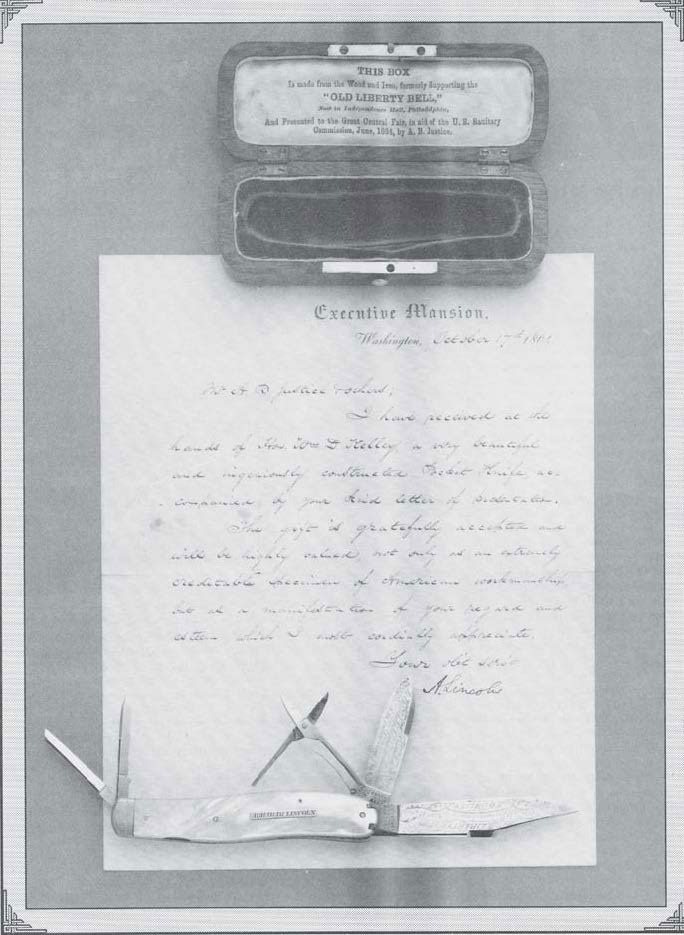
On June 16, 1864, President Abraham Lincoln spoke at the Great Central Fair in Philadelphia. To mark the occasion, prominent Philadelphians presented him with what Sotheby’s catalog described as an “historic mother of pearl presentation ‘American Army’ multi-bladed pocketknife of slightly serpentine outline. Paneled with mother of pearl and inlaid with a gold plaque engraved ‘Abraham Lincoln,’ the pocketknife is fitted with polished steel scissors, nail file and five various blades, two of which are damascened (decorated with inlaid patterns of gold or silver) with foliated inscriptions.”
Accompanying the historic knife is the original presentation box, made of fitted oak and lined with velvet and satin. The inscription inside the lid states that the wood and iron used in the box’s construction came from the “Old Liberty Bell.” The lid is inlaid on the outside with a spread-winged eagle surrounded by 13 stars. The sale also included a handwritten letter of thanks from Lincoln. The letter, dated Oct. 17, 1864, states:
“I have received at the hands of the Hon. Wm. D. Kelley a very beautiful and ingeniously constructed pocketknife accompanied by your kind letter of presentation. The gift is gratefully accepted and will be highly valued, not only as an extremely creditable specimen of American workmanship, but as a manifestation of your regard and esteem which I most cordially appreciate.
Your ob’t serv,t A. Lincoln
Abraham Lincoln lived at a time when knives were carried by most everyone on a daily basis—not only as a convenient tool but because, quite simply, knives were indispensable for a wide variety of tasks and personal needs. And, back then at least, Lincoln apparently was no different than anyone else.
The inscription on the clip blade reads, “LIBERTY, July 4th, 1776. Abraham Lincoln, Jan. 1st, 1863 EQUALITY.” The blades all carry the tang stamps “J. Ward & Co., Bronxville, New York.” It also is apparent from the photograph—kindly supplied by Sotheby’s—that various implements are fitted behind the pearl handle, such as a tweezers, pick and more.
Ward originally made the knife to the order of Albert B. Justice, a Philadelphia hardware merchant. Justice presented the knife to the fair’s board of directors, of which he was a member. He then solicited some 130 wealthy Philadelphians to endorse its subsequent presentation to the president. When presented, the knife was accompanied by a document containing the 130 Philadelphians’ signatures.
The document is currently in the Library of Congress in Washington, D.C. Other items sold with the knife include a bronze medal commemorating the fair, as well as photographs of the presentation document, photocopies of a publication called Our Daily Fair that described the fair, and the text of Lincoln’s address.
The Bronxville factory in New York was originally a grist and saw mill prior to the Revolutionary War, and the four-story building housing the factory came into the hands of James Swain circa 1849. Swain utilized the building for the manufacture of axles, among other things.
In 1880, James Ward bought the property solely for the manufacture of cutlery.
Ward, like so many of his countrymen of the day, sought the aid of qualified and experienced Sheffield cutlers, and he even advertised for them. One tiny fragment of a prospectus survives. It reads:
“Dear Sir,
The undersigned, Manufacturers of PEN AND POCKET CUTLERY, are now prepared to sell to the trade, a first class article, manufactured on the English system…”
Knives made by Ward in Bronxville are certainly not plentiful, nor are the records clear about how long the company lasted. The factory later became the police headquarters for the Bronx River Parkway before its eventual demolition circa 1959.
Editor’s note: The current location of the Lincoln pocketknife was unknown at press time.
Daggers have struck home the U.S. military’s point from the trenches of Europe to the jungles of Vietnam.
Through the years, the military dagger has been considered an essential piece of equipment for the soldier on the ground and the pilot in the air. As a second line of defense, the dagger must be accessible and capable of quick deployment, not to mention efficient at its job. As U.S. military personnel have gone into action, their choice of daggers provides a window into their operational history and a view of their actual aptitude when seconds count. Design and dexterity are hallmarks of dagger use in the heat of a life-and-death situation, and these storied weapons of war have gained their place in the annals of close combat.
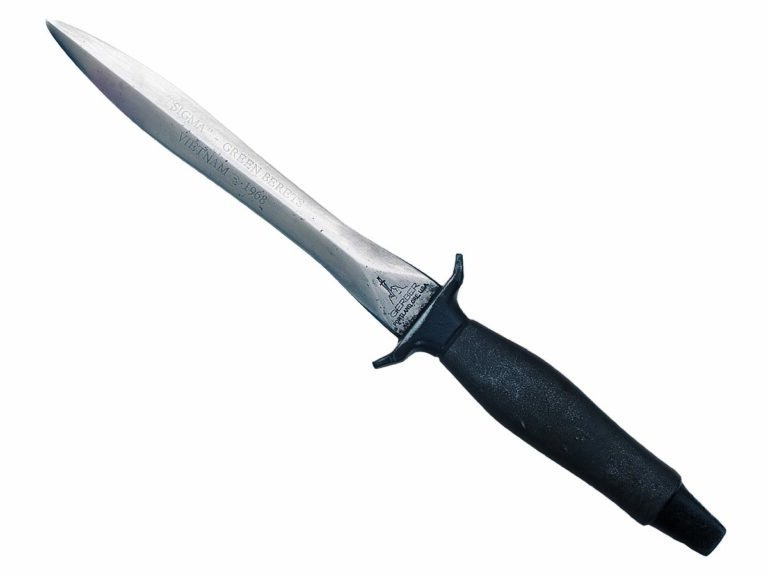
“A good friend of mine was a chopper pilot in Vietnam,” recalled BLADE® Magazine field editor Kim Breed. “The pilots carried the Gerber MK II upside down on their flight vests. When he was shot down, he and his crew chief went through their ammo; then they drew their daggers while they waited for pickup. They locked onto the enemy, rammed them through the side [with their daggers] and hung on. Then they took [the enemy’s] AK-47s away from them and got back into the fight. They defended themselves while Cobra gunships laid down suppressing fire and a rescue bird, a Huey, came and got them.”
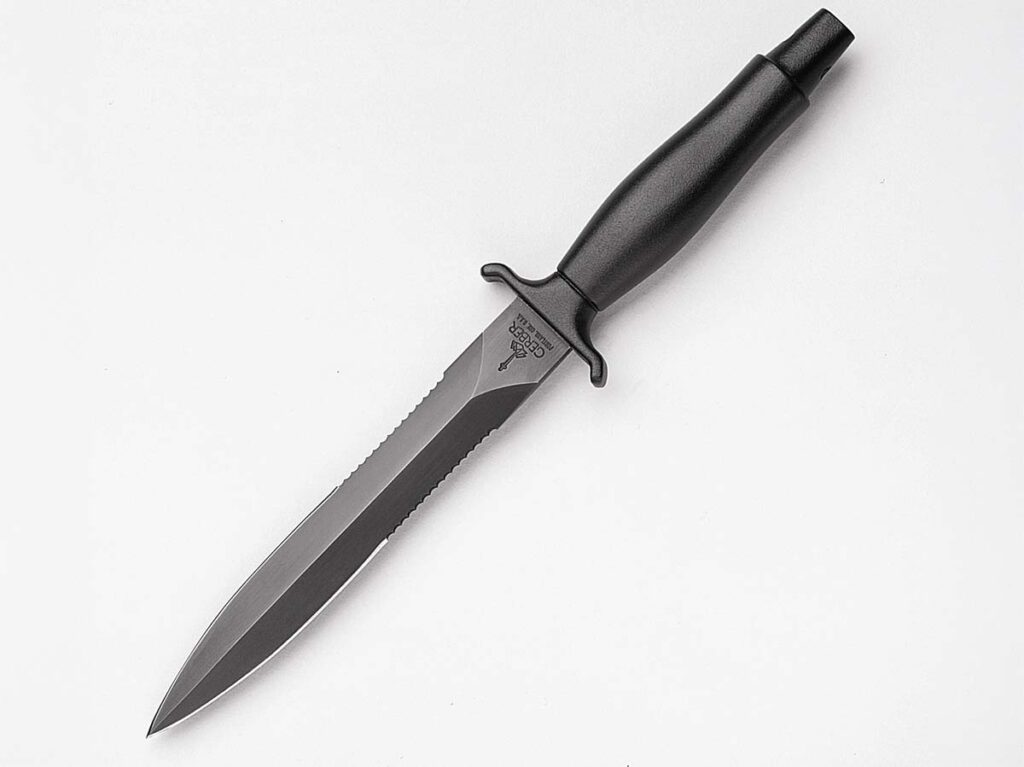
Kim’s comrades might well have been killed in the melee had they not had their Gerber Mk II daggers when needed. Designed by Clarence “Bud” Holzmann, the knife gained legendary status during the Vietnam War, and though it was not standard issue, the Gerber Mk II was popular with U.S. troops—from airmen to special forces and everything in between. The wasp-waisted blade of the original remains a symbol of the close combat sometimes experienced in Southeast Asia, while its intimidation factor led to a redesign for the consumer market.
Later variants of the MK II included saw teeth, a feature added by Al Mar, who worked at Gerber at the time. This allowed the company to market it as a survival knife, not a fighting knife. Sporting goods stores and PXs were more likely to sell the latter. (Les George image)
“It was designed the same as the [original] Mk II except it had serrations on both sides. The serrations might be considered a weak point,” Breed explained. “They had cast aluminum handles and a little thinner blade with that wasp waist. When you actually penetrated something, [the waist] helped along with a bit of extra weight up front.”
While the original Mk II may have been a stronger choice back in the day, the serrated Mk II is also a sought-after collectible. A knifemaker, Kim relates some owners have asked him to grind the serrations completely off this Gerber dagger. He declined to do so. One more story Kim recounts is of a friend who found himself in hand-to-hand combat during a recon deployment in Vietnam. A Viet Cong patrol was walking past, and the last man in their line spotted the Americans in their cover. “Rather than alerting the whole enemy patrol, my friend took the last man down and used his knife,” said Breed.
Regarding the Mk II, knifemaker Les George added, “Al Mar was a designer at Gerber at the time and he added ‘saw teeth’ to the blade to make it a survival knife. The PX was happy to sell it as such since they didn’t want to sell a ‘fighting knife.’”
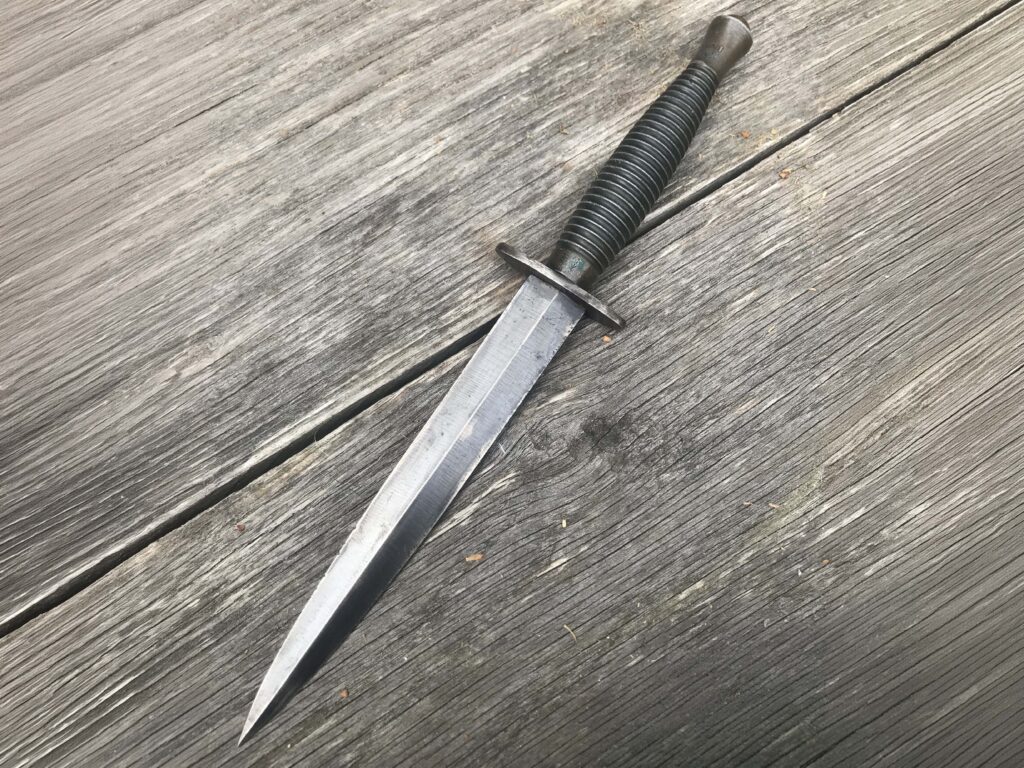
A great many modern military daggers trace their roots back to the legendary English Fairbairn-Sykes dagger. The one pictured is a third-pattern variant with a ring grip. (Les George image)
Industry veteran Bill Harsey also tells a story of combat survival with the Gerber Mk II in Vietnam. “I heard from a Medal of Honor recipient over dinner that his team was overrun by enemy combatants. In close-quarter combat, he drew his knife and stuck it in an enemy soldier. The knife stuck. Even with both hands he couldn’t withdraw it. I have no idea why the knife stuck and he didn’t offer any thoughts. But just to be careful, we have never made a wasp-waisted blade.”
Fairbairn-Sykes And Beyond
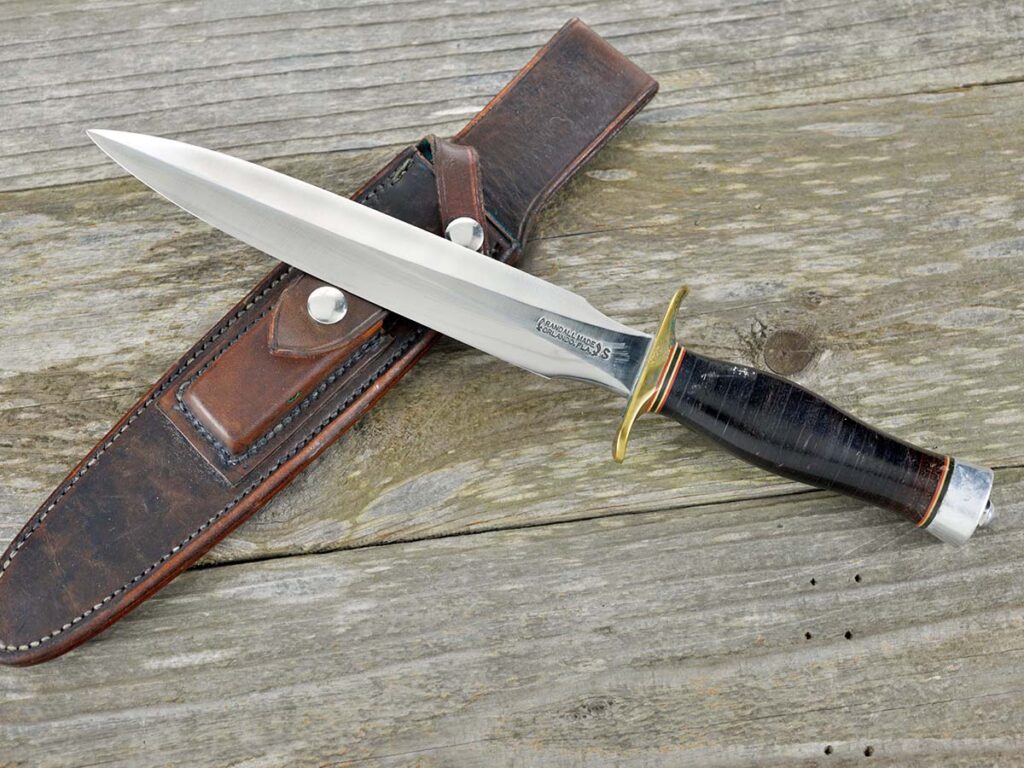
The Randall Knives Model 2 Fighting Stiletto bears the name of one of the most famous knifemakers in history and was developed as a robust alternative to the legendary Fairbairn-Sykes dagger. Randall has gone to war with several memorable designs, and according to Breed, the Model 2 is one of the best remembered.
“The blade is a little wider than the well-known Fairbairn-Sykes dagger,” said Kim. “The Randall was more handle-heavy, with only about a 5-inch blade, as I remember. It feels good in the hand. The guard is not sharp on the fingers, which was a challenge with some of the others. Any Randall daggers are collectible, just like Randalls in general. They didn’t make many of them. The Model 2, to me, is a cross between the Fairbairn-Sykes and the V-42 with a leather stack handle.”
The Randall Knives Model 2 bears the name of one of the most famous knifemakers in history—Bo Randall—and was developed as a robust alternative to the legendary Fairbairn-Sykes dagger. (Les George image)
The Marine Raider Stiletto remains a classic weapon of the World War II era, and it is said to have been the first Marine knife in the Corps’ history designed by a Marine, designed by Lieutenant Colonel Clifford H. Shuey. The story goes that this dagger was developed because the elite Raiders specifically requested a knife for close fighting.
Les offered some observations concerning the Marine Raider stiletto’s proper mission. “When the Marines were issued the Raider Stiletto in World War II, they had been specifically told not to pry with them or throw them,” he said. “So, obviously, they threw them at the first tree they could find and broke the tips off many of those knives.
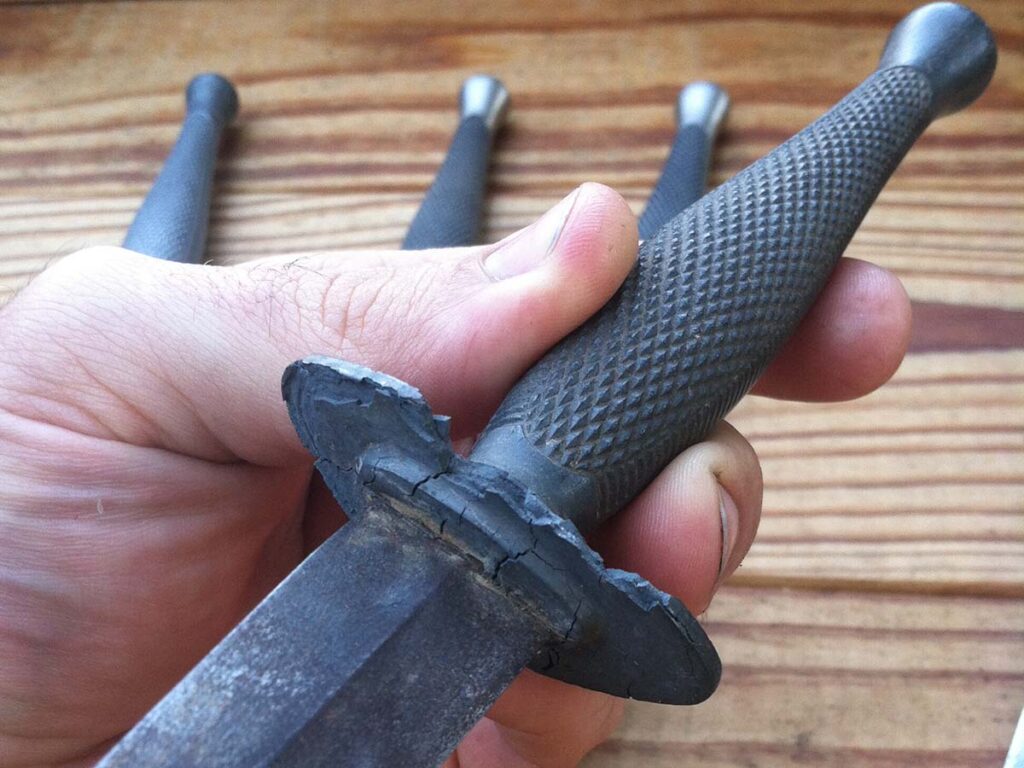
“I think the Marine Raider Stiletto has the best handle design of all the many knives derived from the Fairbairn-Sykes daggers,” George continued. “It’s not just round. It has features and a shape allowing the blade to be indexed by feel. But the blade is very thin, the tip was fragile and the metal that they cast the handles out of reacts with air. They are all disintegrating. Eventually, we will lose them all.”
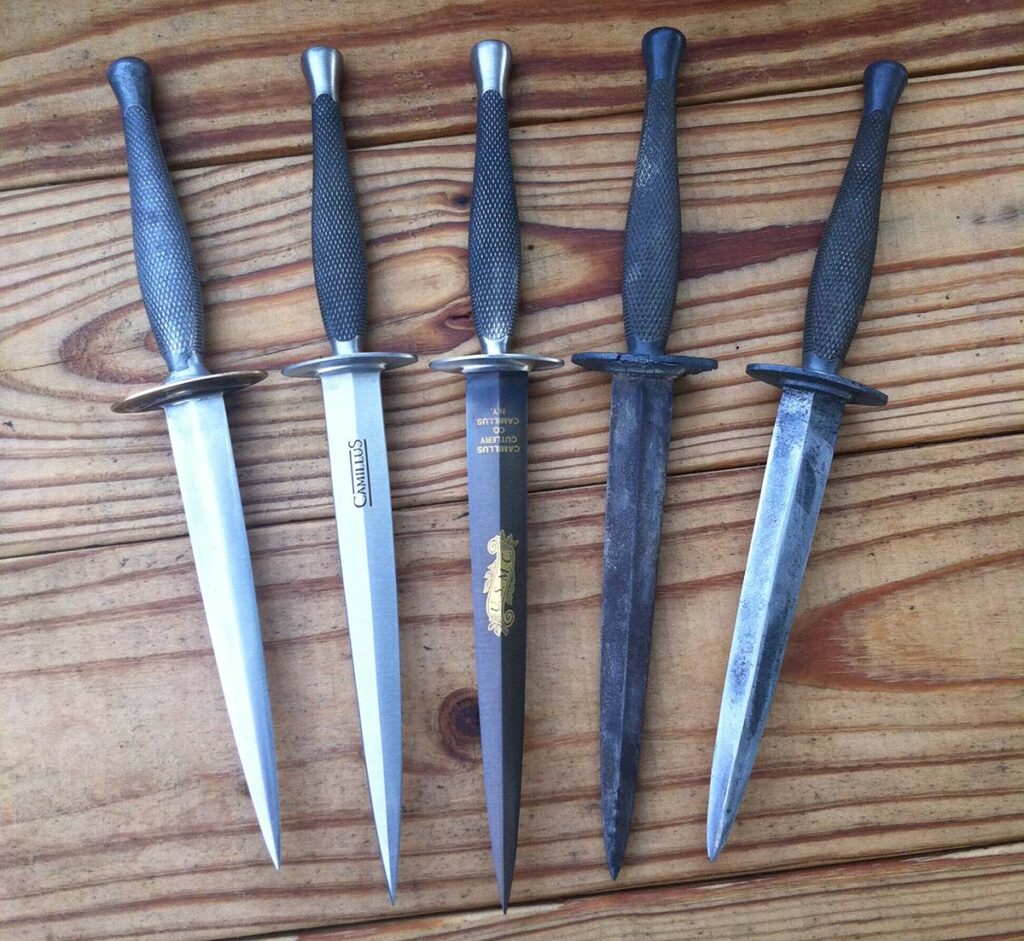
Knifemaker and military dagger aficionado Les George is a fan of the Marine Raider stiletto, seen by his collection of the dagger—new and old. (Les George image)
The handle of the Camillus-made Marine Raider Stiletto was fashioned with a die-cast zinc alloy, while the 7- to 7 ½-inch blade was made of blued or bright steel. The overall feel of the stiletto was hilt-heavy for optimal balance.
“The Marine Raider Stiletto has probably the smallest group of collectors since it primarily appeals to Marines,” commented George. “The rest can be categorized in different ways and have broader appeal. These knives and their more modern counterparts may not find their way to the battlefield as a matter of course, but the history they represent is invaluable.”
Knuckled Under
Les includes the iconic M1918 trench knife among those favored few military daggers carried in wartime by American soldiers. Its design was based on the French M1916 Avenger, and the military held field trials after initial 1917 and early 1918 variants were found inadequate. The M1918 was first made by Landers, Frary & Clark, a housewares and hardware company, production was later increased with Oneida, Henry Disston & Sons and the French manufacturer Au Lion.
George considers the knife’s handle the best designed of all the Fairbairn-Sykes derivatives. Unfortunately, this is also the dagger’s weak point as the metal used for the handle reacts with the air and disintegrates. (Les George image)
“The LF&C M1918 trench knife did not see action in World War I,” George explains. “It was made for that war, but it ended before the knives made it to Europe. A lot of them were melted down to reuse the handle material. When the Japanese attacked Pearl Harbor, they were the only knives in the system available to be issued to Marines … The M1918 saw use in World War II, Korea and Vietnam. I’m not aware of any combat use of the knife since then, but it is possible.”
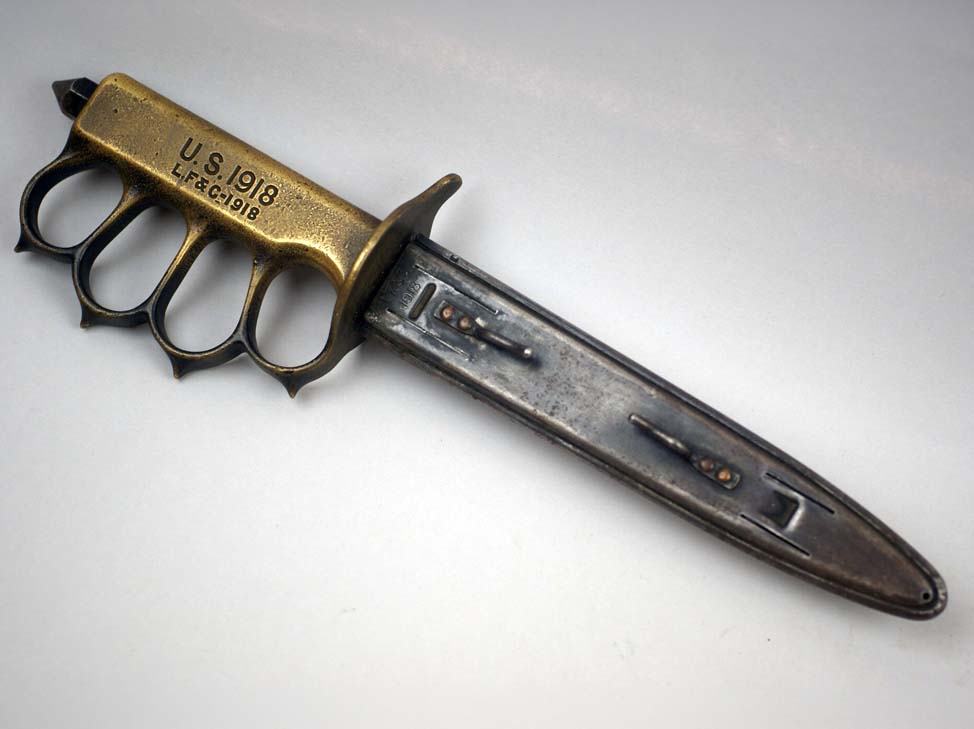
The M1918 is distinctive with its integrated cast brass handle and brass knuckle grip designed for close combat, along with small spikes on the finger bows and a skull crusher pommel. The medium carbon steel blade has been criticized at times for being brittle, but nevertheless the knife is recognized as formidable in a hand-to-hand brawl.
“The M1918 was designed to be an effective tool for close fighting,” observed Breed. “With a positive grip and the brass knuckle guard, you didn’t have to stab, or you could hit your opponent with the skull crusher. There were dozens of confirmed kills with this dagger. It was not recommended to dig with them because they were prone to breakage or ‘bendage.’ You could drive that big brass handle into the dirt, but that half shaft that came down from the blade was short on steel and weakened the knife around the tang.” The eye appeal of the M1918 makes the dagger collectible. “It’s pretty popular and one of the iconic knives of its type,” Kim concluded.
Many think of the M1918 as the quintessential World War I trench knife, though the variant didn’t see action in that conflict, adopted too late. Based on the French M1916 Avenger, it was meant to replace the 1917 and early 1918 variants, which were found inadequate. (Les George image)
Representative of the fighting men who carried them into harm’s way, these U.S. military daggers of the 20th century continue to fascinate with their double-edge blade, balanced feel and handle characteristics. Their place in history is secure, while collectors and knife industry veterans are doing their best to preserve and retell the stories that surround them.
Editor’s note: Ken Warner, the visionary behind and original editor of the acclaimed KNIVES annual book series, recently passed away. In tribute, BLADE is featuring this article from the August 2009 magazine issue about this titan of knives.
The turn of a phrase, the flow of the narrative, and simply getting the story straight are hallmarks of the writing craft. BLADE Magazine Cutlery Hall-Of-Famer® Ken Warner brought the ability to perform each of these, along with an unmatched eloquence, to the knife industry.
Universally, knife authorities acknowledge him as the individual who lifted custom knives out of the shadows. He helped to accomplish this with a straightforward, crisp, and clean writing style that captured the imagination of readers for nearly half a century.
A “True Poet” of the Knife Community
Warner edited and wrote much of the first Knives annual in 1981. The series went on to transform the knife industry. He continued editing the annuals until 2000. BLADE managing editor Joe Kertzman assumed the reins beginning with the 2001 edition.
“Ken Warner is the true poet of the knife community,” related BLADE field editor Ed Fowler. “While he did not write the most knife articles, what he did write was worth reading and serves as an eloquent inspiration for all who have thoughts to share. He had no axe to grind other than to share knowledge. As a fledgling knifemaker, I used to read his comments and soon learned that he knew well his subject matter.”
Though he is not currently writing—he instead stays busy offering a wide range of fixed blades and folders through his Ken Warner Knives knife company—there is always the possibility that Warner will return to print. Meanwhile, he says he is becoming computer savvy enough to run a knife forum on the internet and to continue his online blog (kenwarnerknives.blogspot.com). He also stays busy designing knives.
“I’m 80 years old,” he reflected, “and I have some things I want to say and there are some stories I can do that nobody else can do because I was there. I will get to that when I get to it.”
Forging a Path
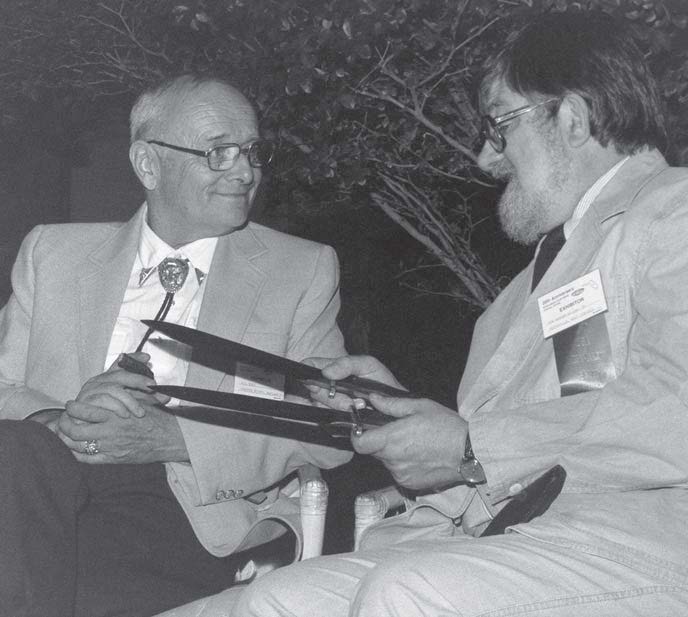
Blade Magazine Cutlery Hall-Of-Famers Bill Moran (left) and Ken Warner were good friends. According to Cutlery Hall-Of-Famer B.R. Hughes, Warner was the first to write about Moran and his knives in a national magazine. Here Moran and Warner visit and talk knives at an early 1980s Knifemakers’ Guild Show. (photo courtesy of B.R. Hughes)
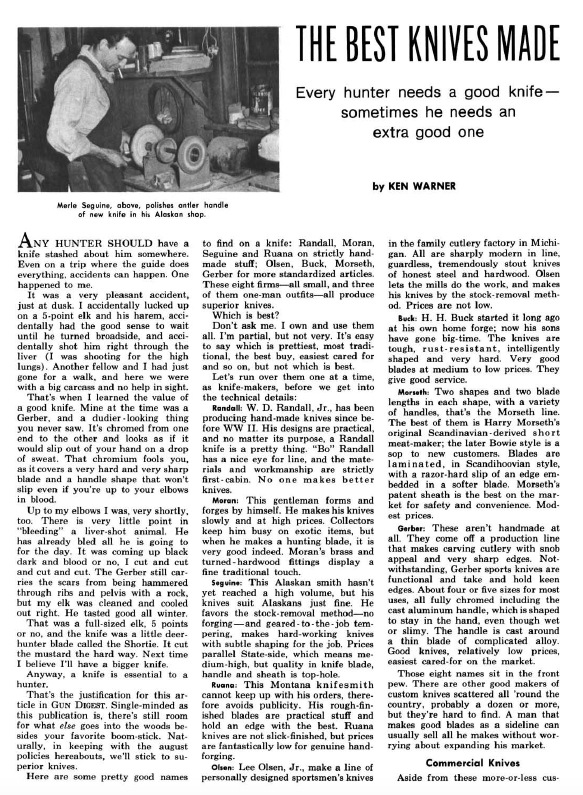
Literally, when custom knives began to gain national and international attention, Warner was there. In fact, he was the prime mover in publicizing the work of the knifemakers. As a writer for the popular annual Gun Digest, he started writing about knives in 1964. That first article, titled The Best Knives Made, has been reprinted numerous times.
Back then, though, it was a challenge just to get enough material to put a story together.
“I could hardly find any knifemakers,” Warner commented. “I found [Bill] Moran and [Bo] Randall, and Buck was small then and I wrote about them. However, a number of knifemakers and collectors have told me that the article got them started. Bob Loveless, for example, has told me that he was about to give up making knives because it wasn’t going any place. Then, he read the article and decided that somebody would understand. There was a time that I was actually giving away Loveless knives just to see what people thought of them. Butch and Rita Winter were pre-eminent collectors of handmade knives, and they told me I got them started.”
A Calling
Educating the general public about knives evolved into something of a mission for Warner. In 1976, he wrote The Practical Book Of Knives, a primer of information on the mechanics, components, function and terminology associated with knives. Through editorial contributions to a number of publications, he has managed to spread the word.
Along the way, he has gained a multitude of friends and admirers. One of the closest was with the legendary Cutlery Hall-Of-Famer, Bill Moran. BLADE field editor and Cutlery Hall-Of-Famer B.R. Hughes, co-author of the Moran biography, Master Of The Forge, credits Warner with his introduction to the great bladesmith.
A Man of Many Firsts
Ken Warner’s The Best Knives Made article in the Gun Digest 1966 book was a game-changing moment for what is now the modern knife industry.
“Ken was one of the first to write knowledgeably about handmade knives, and he’s important to me personally because he’s how I heard about Bill Moran,” Hughes remarked. “Ken used to live close to Moran’s shop and visited there often. He was the first to write about Moran in a national magazine. He mentioned Moran in the Gun Digest article in 1964, and that article did more to publicize handmade knives than everything written about them up to that time.”
Of course, Moran, Hughes, Don Hastings and Bill Bagwell went on to found the American Bladesmith Society in 1976 and the rest, as they say, is history.
Hughes said he remembers working at a magazine called Gunsport in the mid-1960s and Warner was the editor. Even then, Hughes knew Warner was something special.
“Ken’s writing was a cut above what I was used to seeing in a gun magazine,” Hughes continued. “I soon became shotgun editor of Gunsport, and no gun magazine of that day was going to publish a lot of knife articles, but Ken got a knife article in there from time to time.”
When Warner left Gunsport to publish his own magazine, Gunfacts, the idea of writing about knives had caught on.
Hughes said he recalls a memo circulating to ask if anyone else at Gunsport had an interest in or knowledge of handmade knives. Hughes raised his hand, contacted Cutlery Hall-Of-Famer A.G. Russell for a crash course in handmades, and took up writing about knives himself.
The Knives (KNIVES) Books
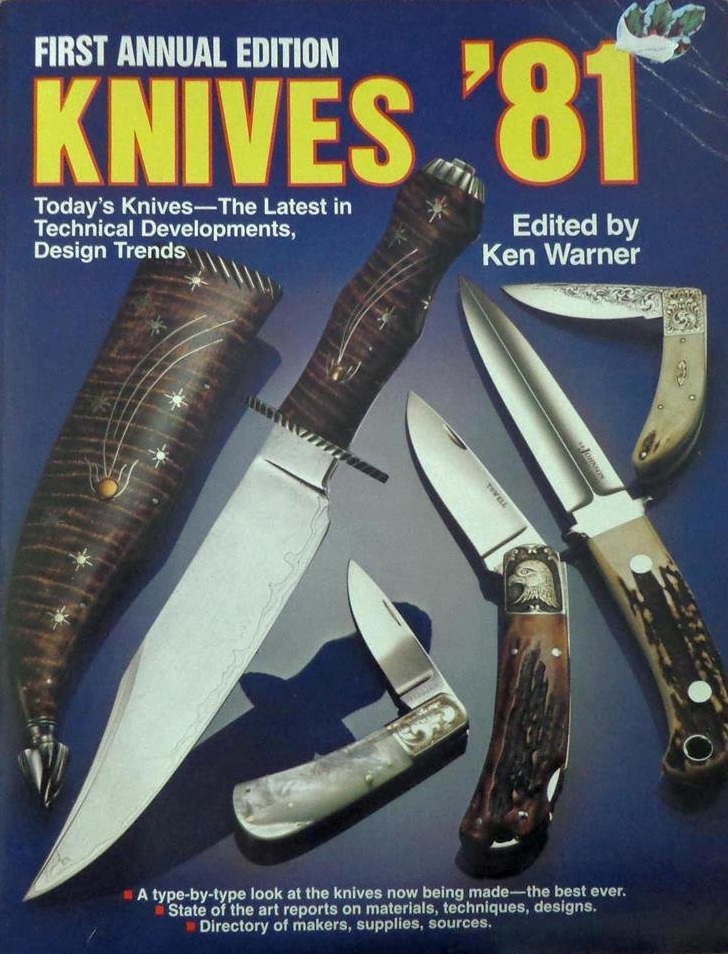
The cover of the knife book that started it all.
For many, Warner’s greatest single contribution to the knife industry was not that first article in Gun Digest, nor his continuing effort to publish knife stories in popular magazines. Rather, it was the publishing of the first Knives annual in 1981 that sparked what became an explosion of interest in handmade knives.
“The big thing with Ken is that he mainstreamed knife interest, and everybody credits him with that,” assessed Cutlery Hall-Of-Famer Bruce Voyles, with whom Warner co-authored the book Knives Digest in 1999. “That, in my opinion, was not his greatest contribution. That came when he got the Knives series started. For the first time you had a listing of not just a particular organization’s members but all knife people. You also had pictures. It was a snapshot of the state of the knife industry at the time, particularly handmades—and the industry was pretty disorganized at the time unless you were a member of the Knifemakers’ Guild.
“I think he gave tremendous publicity to people that had not gotten publicity,” Voyles continued. “Plus, there’s something that most people will not notice about him unless he has edited something they’ve written. He’s one of the most gifted editors I have ever known in any genre. He takes average stuff and makes it sound good, and makes good stuff sound fabulous while making it flow easily. The different thing about Ken’s writing and editing is that Ken made it readable. Most of the stuff before Ken was clumsy, and he made it interesting. He could make the phone book interesting. One of my favorite quotes was when his former wife said some years ago, ‘Ken has the most annoying habit of being right most of the time.’”
Recognition
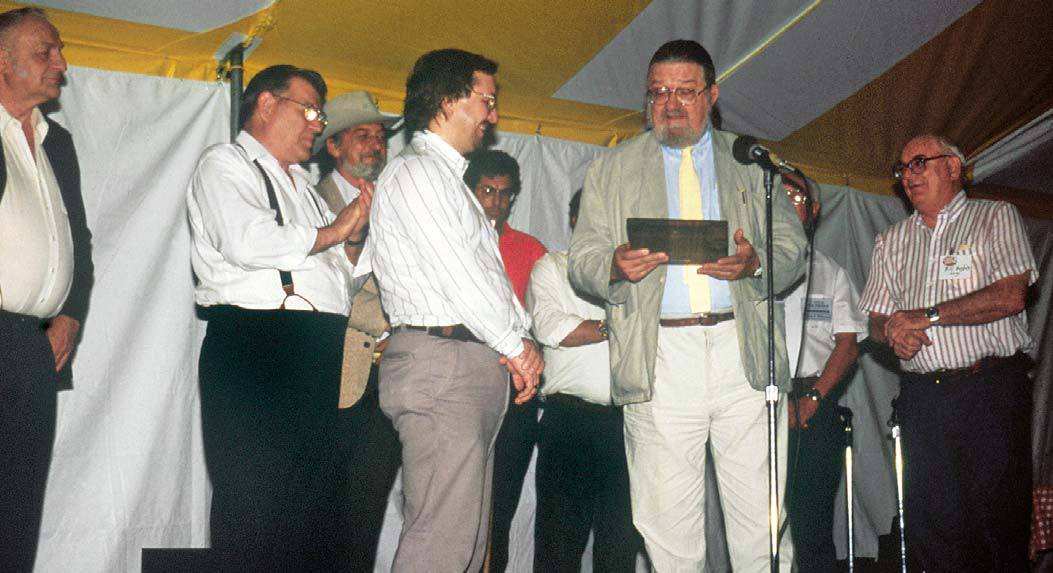
Ken Warner inducts Bruce Voyles into the BLADE Magazine Cutlery Hall Of Fame at the 1993 BLADE Show Awards Banquet in Stone Mountain, Georgia. From left: George Herron, A.G. Russell, Buster Warenski, the inductee, Paul Tausig, Joe Mangiaracina, Warner, Houston Price and B.R. Hughes. All but Tausig and Mangiaracina are in the Cutlery Hall Of Fame. Along with Col. Rex Applegate, Hughes joined Voyles as an inductee that year.
Among the many happenings during his association with Warner, Voyles will never forget that it was Warner who organized Voyles’ induction into the Cutlery Hall of Fame at the awards banquet of the 1993 BLADE Show. It was Voyles’ 40th birthday, and Warner took the stage to announce—to Voyles’ surprise—that he was being inducted by acclamation of all living members of the hall at the time.
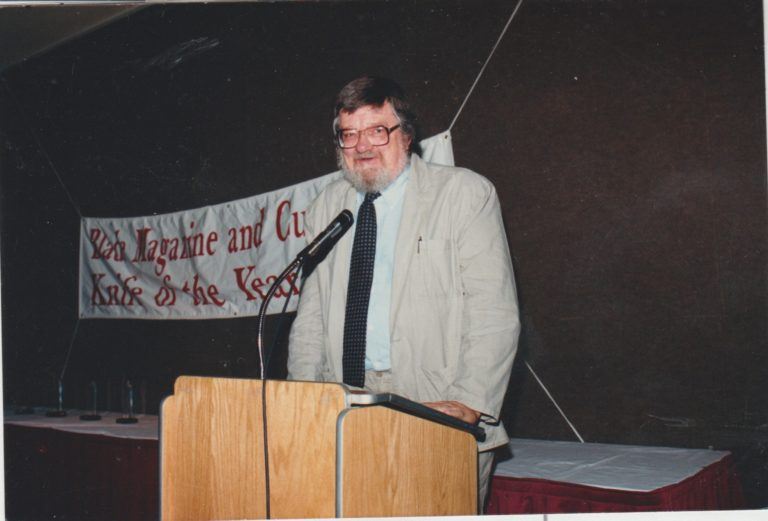
When Warner and A.G. Russell were inducted into the hall at the 1988 BLADE Show, each was invited to the banquet to provide the introduction speech for the other’s induction. Neither Russell nor Warner knew they were being honored themselves.
“Ken said at the time that as long as there was a BLADE Show, he would eat the BLADE Show’s rubber chicken,” Voyles grinned. “Then, the next year we presented Ken with a rubber chicken and taped a knife that he liked inside the chicken’s mouth.”
Warner is also a member of the ABS Hall Of Fame and counts the society’s prestigious Don Hastings Award among his many honors.
A Lasting Legacy
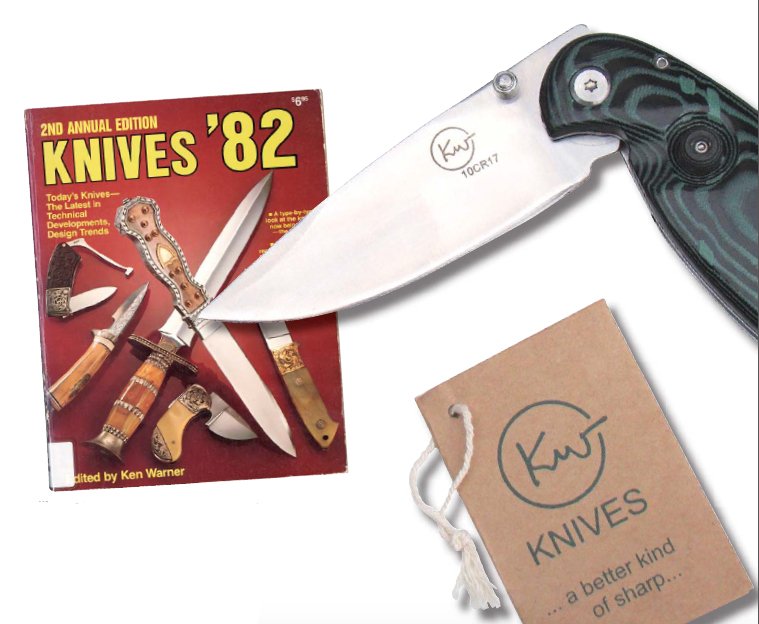
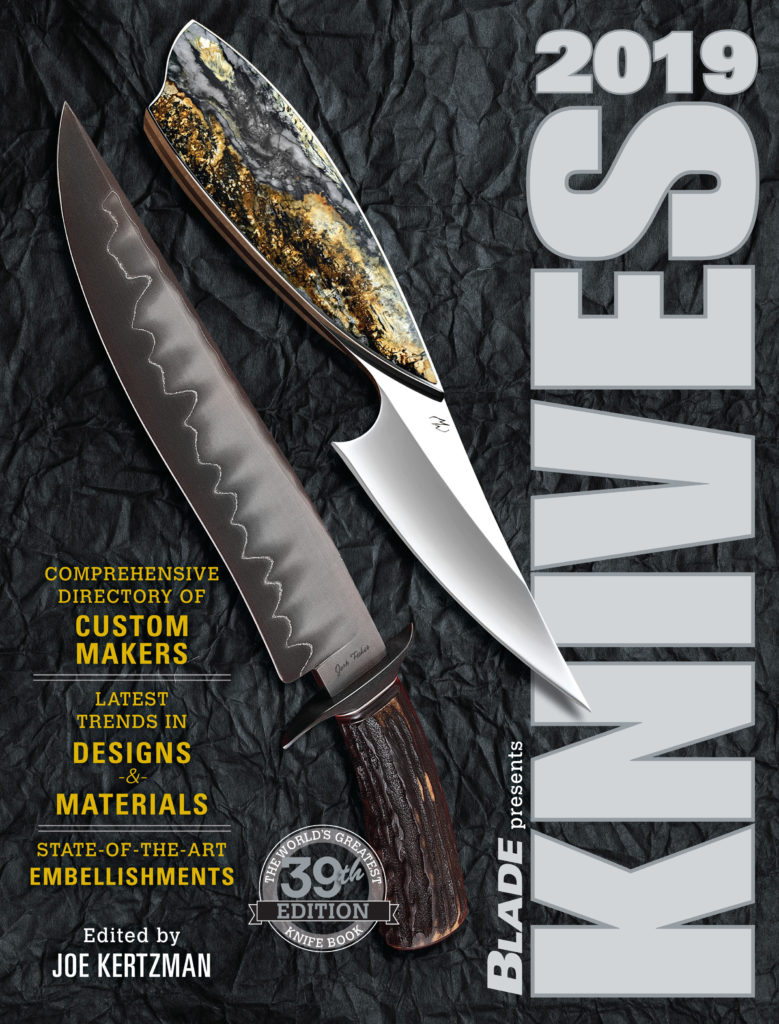
The most recent KNIVES annual book on shelves is KNIVES 2019.
Fowler said Warner was the right man for the successful development and promotion of what has become a virtually indispensable part of the knife industry, a book which will celebrate its 40th anniversary in 2020.
“Thanks to his knowledge, editorial ability, choice of writers and relevant topics, Ken started a legacy to the knife community that continues to this day,” Fowler noted. “Ken knew the difference between a hunter and an art knife, as well as the pretenders, and described each knife eloquently. Many of his one-sentence comments were worth hundreds of words. He inspired many makers through his comments on design, steels, handle materials, leatherwork and scrimshaw. Reading back through my collection of his books, I find many of his comments that I once glanced over were far from simple but offered great understanding and predictions of the future and well being of our community.”
A Renaissance Man
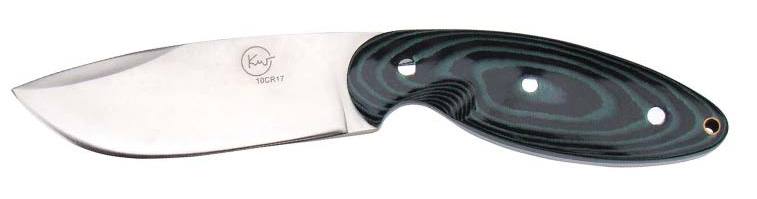
The Warner SGG is a knife of all work, with lots of belly and a good bit of sharp. The blade is 5 inches of 10CR17 and, of course, is convex ground all the way. The drop of the grip puts the edge where it is needed. (Warner photo and caption)
Warner, it turns out, is something of a renaissance man as well. Fowler related sharing a huge bowl of crab legs following the BLADE Show a few years back.
“We debated the styles of Steinbeck and Hemingway, as well as other great authors, what makes poetry great, and the responsibilities of authors,” Fowler recalled. “I learned that everything we write is an echo of our total experience. The more we read and the greater our personal experience, then the better we will be able to express our thoughts. There is no question in my mind that Ken Warner has been, is and continues to be one of the great, if not the finest, of icons of the community of knives.”
Perhaps the greatest test of a true “living legend” is that he has contributed to his lifelong interest, building something where little or nothing existed before, and assuring that his influence will last long after he and his contemporaries are gone.
In the case of Ken Warner and the knife industry, there is no better definition.
A fine example of a tool and weapon of war, the chute knife more than rose to fulfill the roles for which it was intended.
Harry Archer was a somewhat shadowy figure. At the height of the Vietnam War, he was engaged in nasty business—fighting a stealthy enemy in a steaming jungle, sometimes up close and all too personal.
Those who knew Archer acknowledged that some of his exploits were “larger than life.” They considered him an early non-movie version of author David Morrell’s fictional character of John Rambo*. Still, Archer was real, flesh and blood. And it seems altogether fitting that responding to his need for knives that “deliver” in a tight spot—survival, seconds along the fine line between life and death—he would come to know and rely on another legend.
According to John Denton, perhaps the world’s foremost authority on the knives of BLADE Magazine Cutlery Hall-Of-Fame® member Bob Loveless, Loveless and the man he came to describe as the “head of CIA operations in Vietnam” were introduced to one another by knife writer/Cutlery Hall-Of-Famer Ken Warner. It followed that Loveless made several knives for Archer’s use in the field, among them a fine sub-hilt and stag-handle example of his well-known Big Bear, along with several other Big Bears. Loveless’s close friend and fellow maker Steve Johnson was working in Bob’s shop at the time and participated in crafting these. A fighter in a tulip wood handle is another cold beauty.
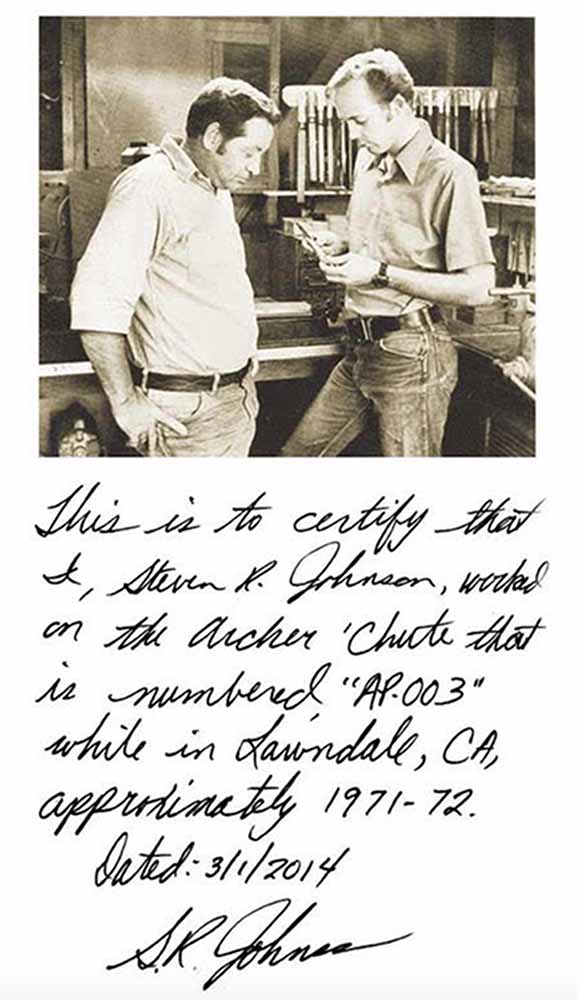
Johnson worked with Loveless from June 1971-October 1974 in the Lawndale and Riverside, California, shops. Steve had a hand in the production of the prototype chute knife in the earliest days, and 23 years later signed a photograph for John Denton attesting to his work on that piece of history. Steve’s inscription reads in part: “This is to certify that I, Steven R. Johnson, worked on the Archer ’chute that is numbered ‘AP-003’ while in Lawndale, CA, approximately 1971-72.” (images courtesy of John Denton)
Then there is the well-known Harry Archer chute knife, a versatile fixed blade with good looks and the ability to travel light but cut paracord for a quick exit from a tangled parachute shroud, and with a stout spine for prying loose from the wreckage of a helicopter. The chute knife was made for the jungle. It was made for Harry Archer.
“It seems that Loveless had been left out of a book by Warner, and Loveless sent Ken some knives to review,” Denton recalled. “It just so happened that Archer was there with Warner. Harry saw the knives and bought them all.”
Johnson worked with Loveless from June 1971 to October 1974 in both the Lawndale and Riverside, California, shops. He had a hand in the production of the prototype chute knife in the earliest days and 23 years later signed a photograph for Denton attesting to his work on that piece of history. Steve’s inscription reads in part: “This is to certify that I, Steven R. Johnson, worked on the Archer ’chute that is numbered ‘AP-003’ while in Lawndale, CA, approximately 1971-72.”
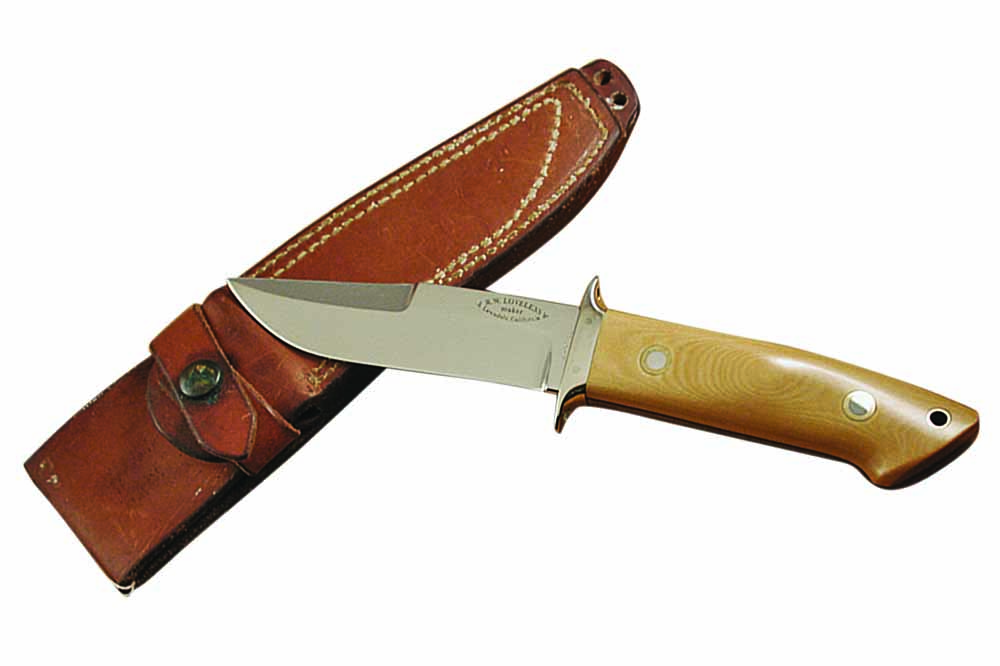
Johnson explains that the chute knife is a fairly small, compact fighter and survival knife, short, light, double-edged and strong, but not made in stock thicker than 3/16 inch. Holes for thongs are placed in the rear of the handle and the guard for lashing the knife to a pole or limb to make an improvised spear. It rides into action atop a chest pack or secondary parachute for quick, easy access. Claims that Warner had a hand in the design are unconfirmed, but “the chute” simply looks the part of the warrior’s dependable asset.
“You’re able to cut both ways with the knife via the swipe of an arm or hand,” Johnson related. “Specifically, it’s for cutting parachute cord should it be tangled or caught in a tree. It’s a knife that a pilot, paratrooper or soldier should carry, and it would not be a burden but useful and available in every situation.”
HARRY ARCHER LORE
Stories of Archer’s combat prowess have been told and retold, but to raise awareness of the immediacy of a close-in fight, nothing is better than the harrowing tale that Denton remembers Loveless repeating. John points to a photo of a vintage Big Bear, identifies it as a knife that Archer took into combat, and says, “Harry and his men got into a hand-to-hand fight, and the tip of the blade was broken off inside the enemy. Harry took the knife back to Bob to fix, and Loveless said, ‘Where’s the tip?’ Harry replied, ‘It’s still in the rib cage of the Viet Cong soldier.’ So, Loveless fixed the blade.’”
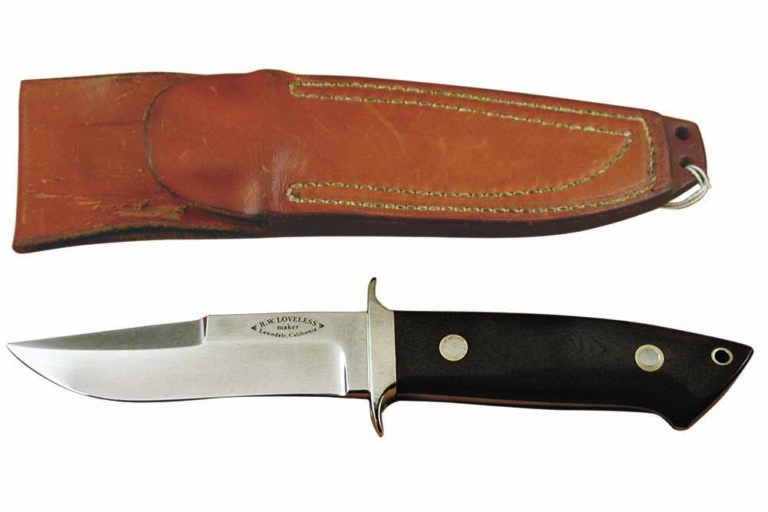
Made in Bob Loveless’s Lawndale, California, shop about 1973-74, this chute knife in ivory Micarta® is stamped BR-003. It was made for the Brass Rail, a famous gun shop in Hollywood, California, where all the celebrity types hung out to see guns and knives. Note the holes in the guard for lashing the knife to a pole to make a spear. (images courtesy of John Denton)
Like the Big Bear and other Loveless creations, the chute knife has its place in the lore of Harry Archer. After he collaborated to produce the prototype, Johnson continued to work with Loveless on more of the chute knives. He remembers meeting Archer in the California shops.
“Loveless really admired Archer and his adventures in the Vietnam War era, working with USAID**, the CIA and different assignments in various parts of the world,” Steve commented. “[Harry and I] discussed life in camp in Vietnam, interactions with Vietnamese soldiers and personnel with whom he was serving. That was quite interesting.”
Steve calls the chute “one great knife” and remembers conversations in Lawndale when the veteran operative praised it as light and small enough to carry so that it could always come along on a mission. Johnson also made a chute knife for Archer and continues to produce his own model today.
“We worked together on Archer’s order for a ‘Johnson’ version of a chute knife on a bench in the rear of Bob Loveless’s shop, in his garage in the back of his house in Lawndale,” Steve smiled. “Archer asked me to make my version, which we—mostly he—designed in the early 1970s. He did a drawing for me. The 154CM blade was about 4.5 inches long, the handle slim and a bit longer than normal, and it had a large thong tube, three handle screws, a stag handle, and checkering on the top and bottom of the tang just behind the guard.”
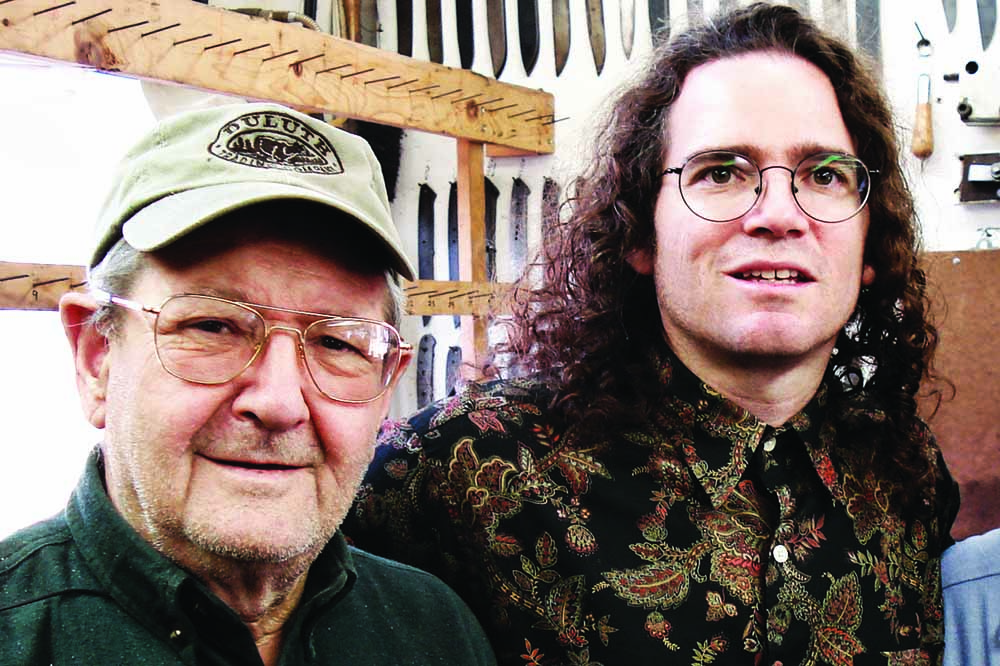
Bob Loveless (left) and John Denton (right)
For Johnson, working with Archer was a pleasure and a defining moment in his illustrious knifemaking career, which, after recovery from a serious accident, took him from Loveless’s shop to his own space in Manti, Utah, more than 40 years ago. “Harry Archer was a great guy who appreciated my work, as well as Bob’s,” Steve added, “and I made him a few knives after California. He was very easy to talk to, respected others, and he really was a man of intrigue and adventure. And Bob Loveless treated me like a son.
“I’m making a chute knife for Atlanta [Steve was interviewed prior to BLADE Show 2021] as we speak, with the blade polished so far, instead of the top grind being just the length of the clip,” Johnson concluded. “I use the pattern that Loveless gave me when I left his shop in Riverside in 1974 or 1975. This particular knife is going to have a stag handle and stainless steel fittings. I’ll make more when asked, and I still have a few on order in my books.”
Long-time maker and designer Bob Dozier was a friend of Loveless and went on to design a chute knife for Cutlery Hall-Of-Famer A.G. Russell. Though his only acquaintance with Harry Archer is through the recollections of A.G., who knew him, Bob says his version of the chute knife remains in demand for one simple reason: “It sells.”
Dozier turns out his chute knife with a 4.75-inch D2 tool steel blade and overall length of 9.75 inches. The handle is green canvas Micarta® “because Goldie [Russell] won’t let me put anything else on them. I’ve got some blades hanging right now, getting ready.”
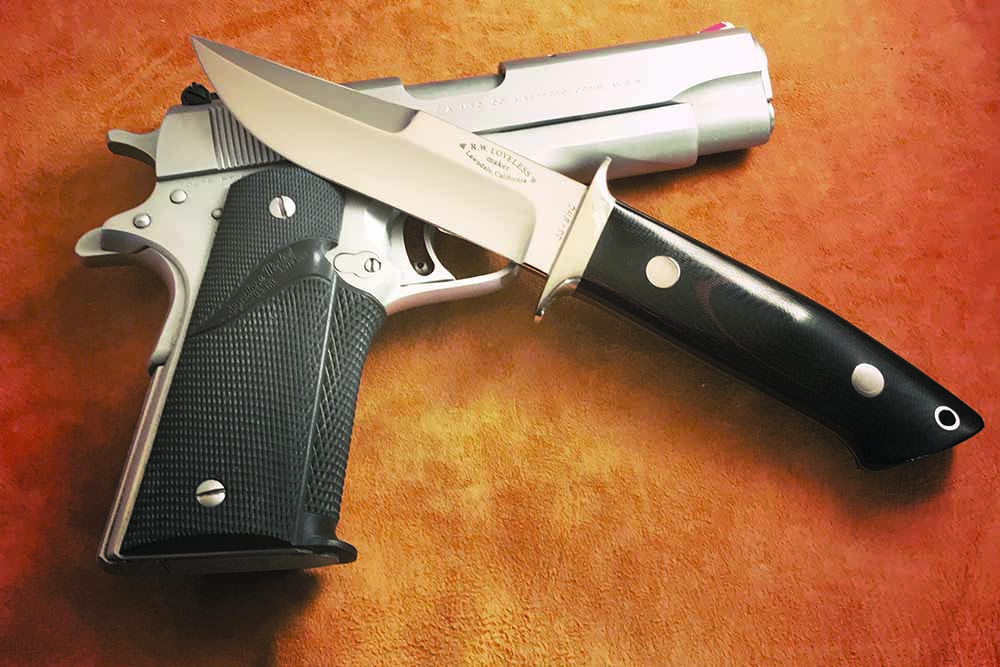
The “RR” on the guard of this Loveless chute indicates it was for the Ram Rod gun store in New Castle, Indiana. Early on Ram Rod sold knives by Loveless, Bill Moran, Ron Lake, W.W. Cronk and others. It appears here with a Smith & Wesson Model 41 modified by Loveless.
Dozier is familiar with the Loveless chute knife configuration but never had the Loveless pattern. He looked at the earlier chute knife profile and made some tweaks. “My handles are like the Loveless, but I don’t cut the butt off as square as he did. I leave more of a point on it than he did. Mine is still mostly like Bob’s, and he was one of the first to make a really good slab-handled knife. That’s one reason why most of us have copied him.” Dozier’s chute knife, designed and built for A.G. Russell Knives, has a manufacturer’s suggested retail price of $895.
SAGA of The CHUTE
The saga of the chute knife certainly has a human side. While Denton estimates that early Lawndale chute knives might fetch as much as $14,000 if found for sale today, and chute knives made in Riverside command up to $12,000 each, they are desirable on the collector market. Nonetheless, the greatest value of the chute knife lies in its lifesaving and protective capability in the hands of a dedicated professional such as Harry Archer.
Through those years of association, Loveless and Archer became friends, sharing a common bond of respect and admiration for the best in fighting and utilitarian knives.
“Loveless said that Harry would come by his shop after periods of being in the jungle for months at a time,” Denton remembered. “He used Bob’s place to unwind and try to become civilized again before heading home to Virginia. But Loveless also said, ‘Harry was like a wild animal when he came to the shop, trying to keep his head straight before he saw his family.’”
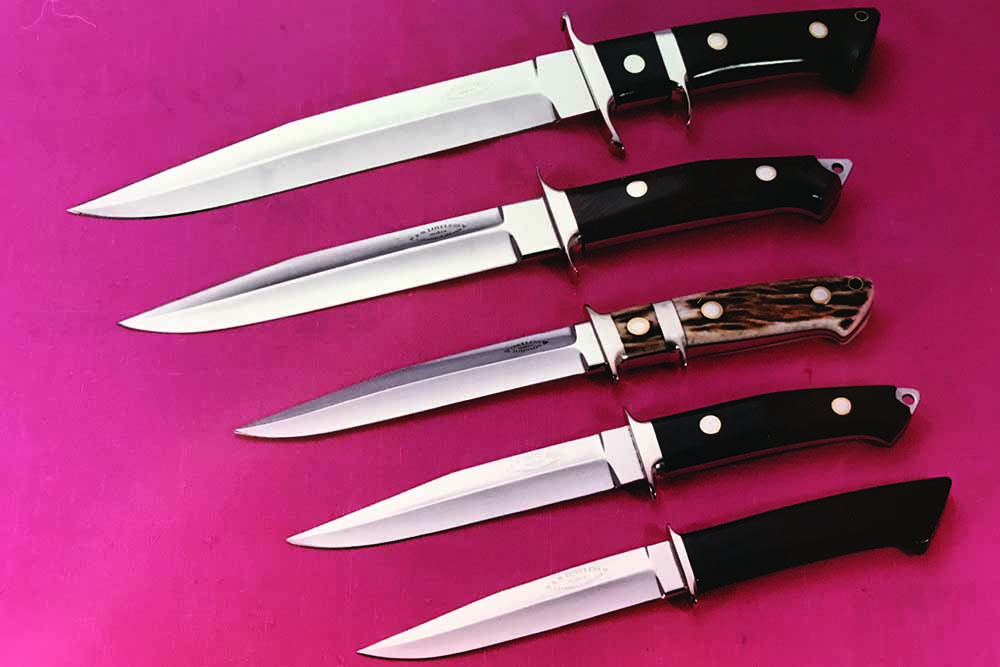
Whenever Harry Archer ordered several Big Bear fighters from Bob Loveless, Loveless said Archer told him to “send the bill to the Pentagon.” From top: the Big Bear Harry broke the tip off inside a Viet Cong soldier during the Vietnam War; tulipwood fighter with skull cracker; Loveless/Johnson sub-hilt with the initials HJA for Harry J. Archer; boot knife with skull cracker; and one Loveless called the Pig Sticker. (image courtesy of John Denton)
The chute knife is indeed a fine example of a tool and weapon of war rising to fulfill the roles for which it was intended. It remains a popular pattern because of its looks, quality and versatility. And for one other reason in particular: It helped men like Harry Archer survive the most desperate of situations and make it home.
*In actuality, Morrell based the Rambo character on Medal-Of-Honor recipient Audie Murphy.
**USAID is the acronym for United States Agency for International Development, with the inference here being that in this instance it functioned as a cover for the CIA.
Not only could you carry knives on flights, you could buy them in airports.
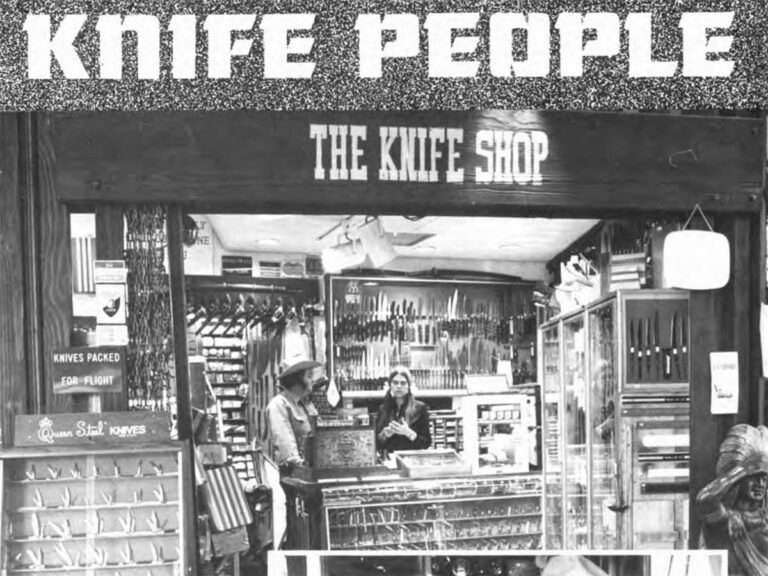
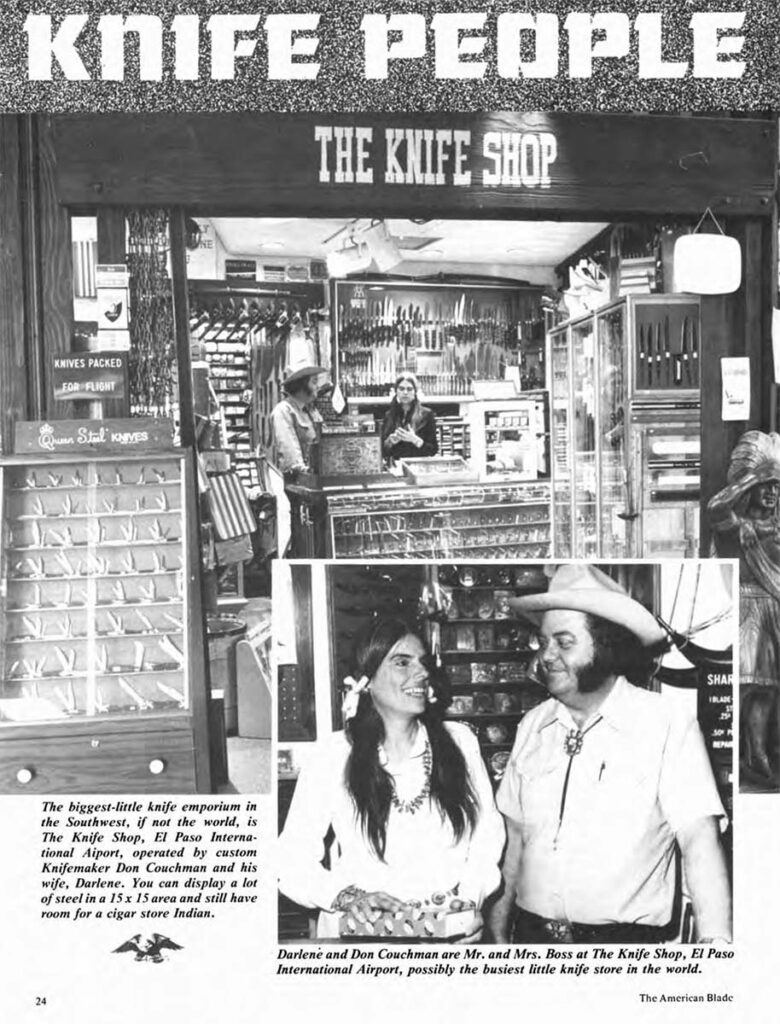
Operated by Darlene and Don Couchman half a century ago, The Knife Shop sold factory and custom knives, sharpeners, knifemaking supplies and more—all in a 15-by-15-foot store in the El Paso International Airport.
A knife shop in an airport is not exactly something you would expect to see today, but such was not always the case in 1976. It was then that Darlene and Don Couchman operated The Knife Shop in the El Paso International Airport.
Airline passengers on their way to parts unknown could stop and avail themselves of knives of almost “every major brand of commercial household and sporting cutlery,” antique knives, straight razors, sharpeners, cutting boards and various knife displays, along with a full line of custom knives that included Don’s custom models.
Of course, as writer/then The American Blade editor L.V. Baker noted in his story “Knife People,” how Don found time to both make knives and help tend the store was “problematical.” Moreover, the Couchmans provided a special packaging and delivery service through the air carrier so passengers could take their newly bought knives on their flights.
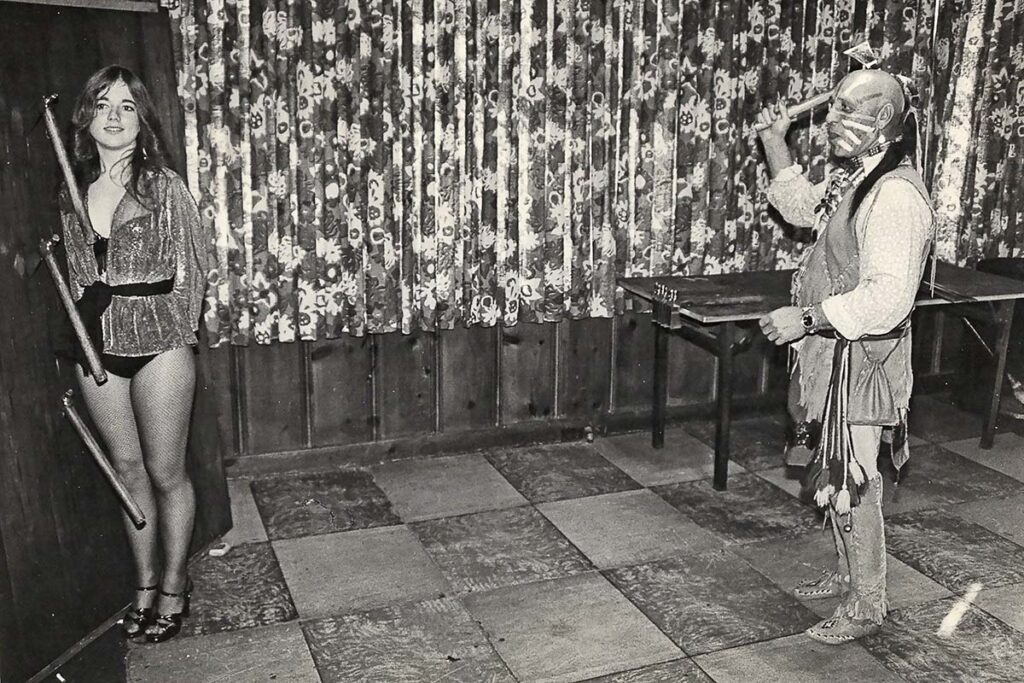
“The biggest-little knife emporium in the Southwest, if not the world,” The Knife Shop had a 15-by-15-foot sales area that somehow also found room for a cigar store Indian. What’s more, the Couchmans sold parts to make knives, including finished blades, brass for guards and buttcaps and more, all in neatly arranged drawers so you could find it all easily. Now boarding!
Born as a side hustle, the legendary throwing knife company continues to hit the mark.
Small businesses that have operated continuously for 75 years are a testament to the quality of their products and the dedication of their founders and owners. Such businesses have stood the test of time and have been able to adapt to changing market conditions and consumer preferences. Knifemaking is no different.
In 1949, Harry K. McEvoy, who would soon be considered the father of modern-day knife throwing and one day be inducted into the BLADE Magazine Cutlery Hall of Fame®, was a long-time resident of Grand Rapids, Michigan. He worked for the Meyercord Co. as a traveling district salesman selling decals to wallpaper and decorating stores. In his spare time, Harry spent hours in his shop designing and crafting knives. His passion for knifemaking was fueled by his ongoing search for the perfect throwing knife.
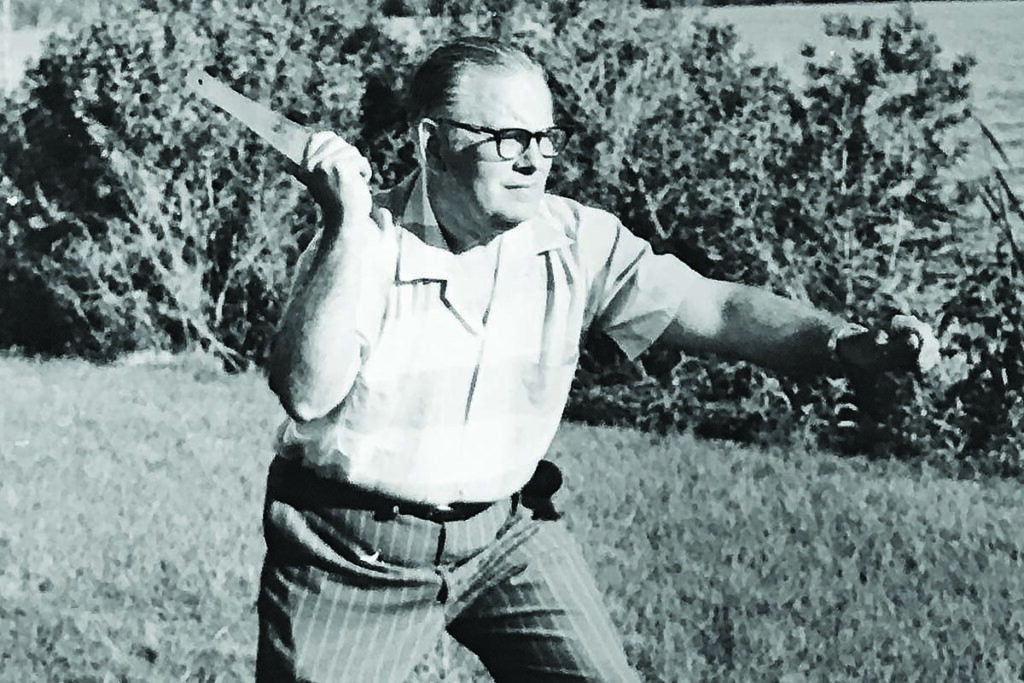
BLADE Magazine Cutlery Hall-of-Fame® member Harry McEvoy shows the form and throws one of the Tru Balance knives that helped revolutionize knife throwing.
Knife throwing as a modern sport began shortly after World War II and centered around a few individuals who threw knives at stumps or targets in their backyards. The knives they used consisted of very primitive homemade throwers that were often much smaller than the ones you see today. Harry began making his own knives around this time because he was unable to find any commercial knives suitable for throwing.
While he practiced throwing knives in his backyard, neighbors would gather to watch. Intrigued by how well his throwers performed, the onlookers were compelled to discover the source of his knives. When he responded that he, in fact, had made them himself, they asked him to make knives for them and others who were interested, and thus was born the Tru Balance Knife Co.
Randall & Scagel’s Influence
The author (left) bought Tru Balance Knife Co. from Stephen McEvoy (right) in 2017. The business continued to grow but the author had to sell in 2021 due to physical issues.
Around 1951, Harry learned of a knifemaker from Orlando, Florida, and another future Cutlery Hall-of-Famer by the name of W. D. “Bo” Randall. As a fledgling hobby knifemaker, Harry decided to write to Bo about his knives and the two became fast friends, exchanging letters regularly.
McEvoy soon found out that Bo had an interest in throwing knives and was surprised to learn that a throwing knife could even be found in Bo’s catalog. As a father with young children, money was scarce for Harry, so he convinced Bo to trade a Randall thrower for a couple of McEvoy throwers. Generous and willing to help a fellow knifemaker, Bo was happy to oblige.
George E. “Skeeter” Vaughan made the most fantastic knife throw in recorded history, taking out a German sentry with a modified bayonet from 87 feet during World War II. Skeeter was also an outstanding tomahawk thrower, showing his skills here with the help of a “target girl.”
Around 1952, Bo asked Harry if he would visit yet another future Cutlery Hall-of-Famer, William Scagel, who lived very close to McEvoy in Fruitport, Michigan, and buy some of Scagel’s knives for his collection. McEvoy was more than happy to do his friend a favor. Harry would eventually befriend the reclusive Scagel, too, and on his visits watched him make knives and bought knives for himself and Bo.
As their friendship grew, Harry would visit Bo at the Randall summer home in Michigan and would even travel to the Randall home in Orlando, Florida. The two became quite close and eventually, Bo decided to feature two Tru Balance Models in the Randall catalog. The Model #1 Professional Thrower and the now world-famous Bowie-Axe Throwing Knife made their catalog debut in early 1960, which resulted in a spike in sales for Harry.
In his spare time, Harry McEvoy spent hours in his shop designing and crafting knives.
Bo thought so much of Harry’s work that he gifted one of Harry’s Tru Balance Bowie Axe throwers to astronaut Gordon Cooper. He also took Harry’s popular Bowie Axe design and modified it into a large machete-style knife and submitted it to NASA in the 1960s when NASA was looking for a machete for astronauts to carry on the Gemini missions. Unfortunately for Harry, NASA required a much thinner design and eventually chose another manufacturer, Case Knives, to make the machete.
AKTA
Meanwhile, Tru Balance soon became the go-to company for anyone who wanted a high-quality professional throwing knife. Tru Balance throwing knives became highly sought after by soldiers heading to Vietnam, professional knife throwers and knife collectors around the world.
In 1971, Harry started the American Knife Throwers Alliance (AKTA) to aid and offer guidelines to individuals and groups who wished to organize competitively in their local areas. Harry became very close friends with professional knife throwers like Kenneth Pierce, aka Che Che Whitecloud, Paul LaCross and George E. “Skeeter” Vaughan, who holds the distinction of making the most fantastic knife throw in recorded history. Considering the circumstances surrounding his legendary feat of taking out a German sentry during World War II with a modified bayonet from 87 feet, he most likely will maintain his grasp on that honor for a long time to come. “The Saga of Skeeter Vaughan” is told by McEvoy in the April 1982 BLADE®.
Harry went on to author such books as Scagel: The Man and His Knives; Archery Today; Crusader in the Wilderness; Knife Throwing: A Practical Guide; Knife and Tomahawk Throwing: The Art Of The Experts; For Knives Lovers Only; and co-authored Knife Throwing a Modern Sport, with Charles Gruzanski. McEvoy also held two design patents and trademarks for his knife designs. He also authored other articles for BLADE, as well as for Knife World (today’s KNIFE), Muzzleloading Magazine, Fighting Knives Magazine and many more.
McEvoy Legacy
In 1991, McEvoy was inducted into the Cutlery Hall of Fame for his exceptional contributions to the world of knives. It was around this time McEvoy’s son Stephen had taken an interest in his father’s knives and had begun learning more about the business. Stephen eventually took over the company in 1993 following Harry’s passing from an illness.
When McEvoy—here mugging during a lighter moment—practiced throwing knives in his yard, neighbors would gather to watch. The onlookers showed interest in the knives, and Tru Balance Knife Co. was born.
This writer, a friend of Harry’s and a fellow knifemaker, reached out to Stephen via telephone to offer condolences and advice. We chatted regularly and, over time, as we shared stories, we developed a friendship. Our phone conversations led to Stephen’s yearly visits to my home. During one of those visits, I asked him if I could take over the defunct American Knife Throwers Alliance (AKTA) and Stephen agreed.
Stephen would continue to run Tru Balance Knife Co. the same way his father ran it for many years. In 2015, after retiring from his job as an executive at a major insurance company, Stephen began speaking to me about slowing down and retiring from making knives. Already a full-time knifemaker with my own line of throwing knives, I envisioned bringing Tru Balance Knife Co. into the 21st century by selling Tru Balance knives on its own website and promoting the business via social media.
Skeeter Vaughan’s Cherokee Indian name is Grey Otter. He served as a chief of the Federated Indian Tribes for a number of years.
With the newfound success spearheaded by the new business plan, Stephen finally decided to fully retire from the business. A deal was brokered and I bought Tru Balance Knife Company in 2017, moving it to my hometown of Awendaw, South Carolina. The business would continue to grow but, not long thereafter, I developed some knee issues and struggled to keep up with the company’s new customer demands. Unable to find a qualified apprentice to help me fill orders, I decided to sell the business in 2021.
Tru Balance Heads Home
Though several companies made offers to buy the company, I decided I wanted to hand-pick my successor to ensure the legacy of the Tru Balance Knife Co. and that the knives would continue to be made in the USA. As the search for the right successor was underway, a mutual friend brokered a connection between me and two brothers from Michigan who had an interest in the business and the revitalization of the AKTA. The brothers made knives as a hobby and also happened to be skilled knife throwers.
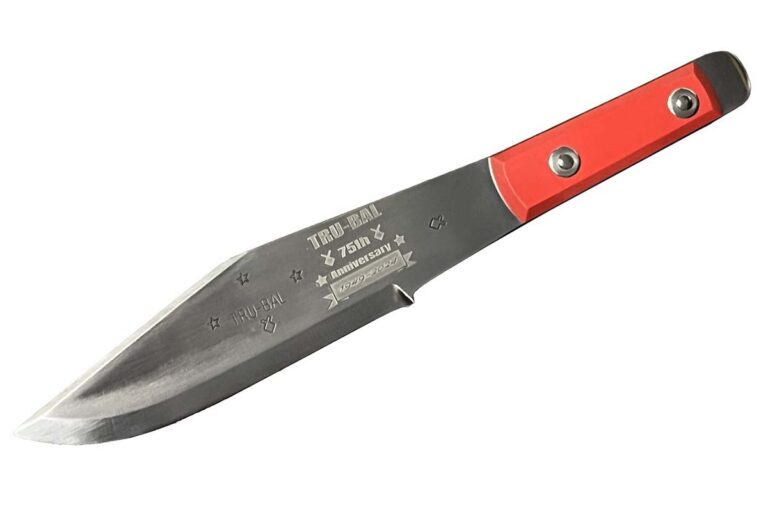
Bill and James Bednarick turned out to be the perfect choice to preserve the company’s legacy and bring it back to its original home in Michigan. With their keen eye for detail, quality and passion for knife throwing, their dedication has ensured that the Tru Balance Knife Co. has lived on to see its 75th anniversary in 2024.