The Newest Tactical Folder From Kershaw Looks Phenomenal And Is A Ton Of Fun To Use.
Yet again, Kershaw has produced an excellent piece with its new Outlier folding knife. Featuring a Blackwash hawkbill blade, the Outlier is excellent for tactical use. The knife is made from 8Cr13MoV steel, and the handle is made from glass nylon.
Kershaw Outlier in the closed position.
The large steel ring at the end of the karambit-designed handle allows you to use the knife in a forward or reverse grip. Great for slicing and cutting, the Outlier is a great utilitarian knife as well, especially when it comes to doing things like cutting rope or cardboard.
The Outlier has an assisted opening and a reversible pocket clip so you can easily take it with you on the go. At an MSRP of $57.59, Kershaw has hit another home run.
Editor’s Note: This article was written by Mike Ableson.
The Kukri Is A Historic Knife With A Long History Of Military And Outdoor Use. These Are Seven Of The Best Kukri Knives Out There Today.
The way a kukri feels in your hand makes you want to obliterate thick foliage and saplings. The blade’s forward-weighted feel, the ultra-secure handle, and the reach the knife provides all work together in an ancient cutting and chopping tool that packs more punch than a machete for tackling the tough stuff.
What Is A Kukri?
The kukri is a variant of the machete with a recurve blade that developed in South Asia hundreds of years ago. It may have evolved from the sickle and is today used as the standard utility knife for the Ghurkas in Nepal. The kukri is the national weapon of Nepal and still synonymous with the Nepalese Army. It remains the main weapon for all Ghurka military units around the world including the British Army’s Brigade of Ghurkas.
How To Use A Kukri
The kukri knife is designed for chopping outdoors. Like other machetes, the kukri has a longer blade of 10-15 inches depending on the type. It is a useful military weapon because its center of mass allows the fighter to slice as they chop to penetrate an enemy deeply and even slice through bone.
As an outdoor tool, the kukri machete can do a bit of everything. Nepalese use it to do everything from chopping wood, digging, slaughtering livestock, chopping vegetables, and even opening cans.
Due to its shape, with a more narrow blade by the hilt and a wider blade by the tip, the kukri can function as a nimble utility knife up close and do the work of a small spade or even an axe as well.
The 7 Best Kukri Knives Today
Today, the kukri is made of modern materials and is used around the world for its durability outdoors. These are seven of the best kukri knives on the market today that would make any lover of the outdoors happy.
CAS Iberia APOC Kukri
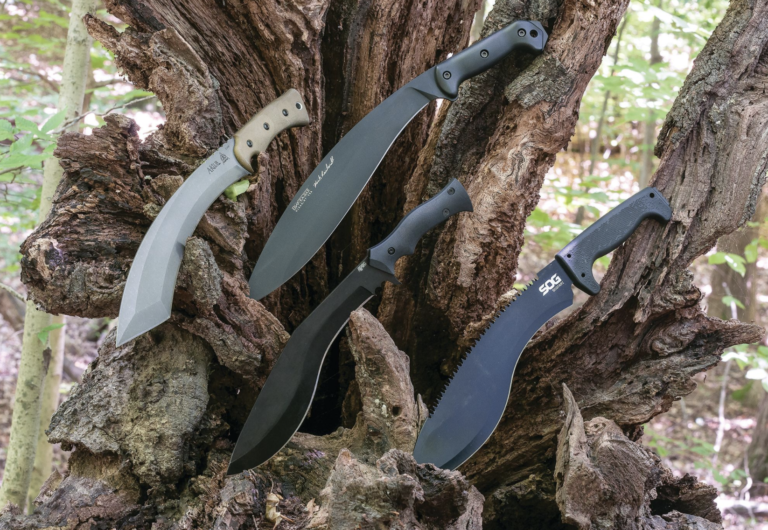
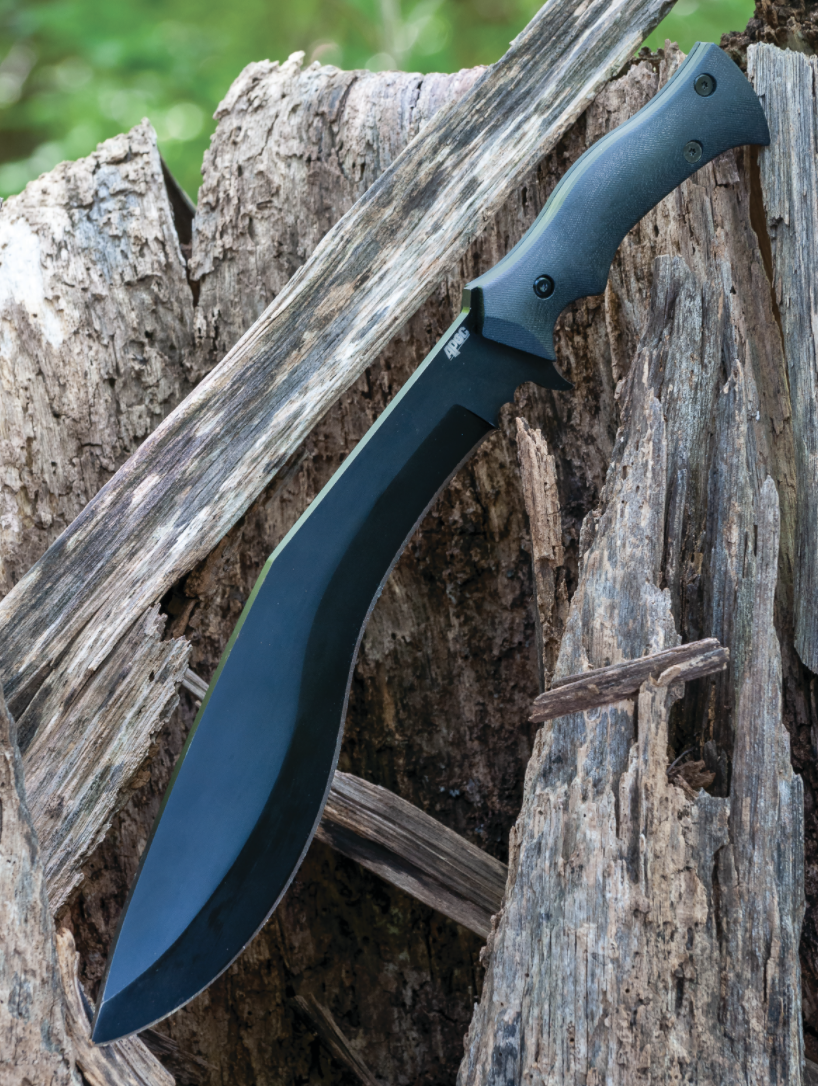
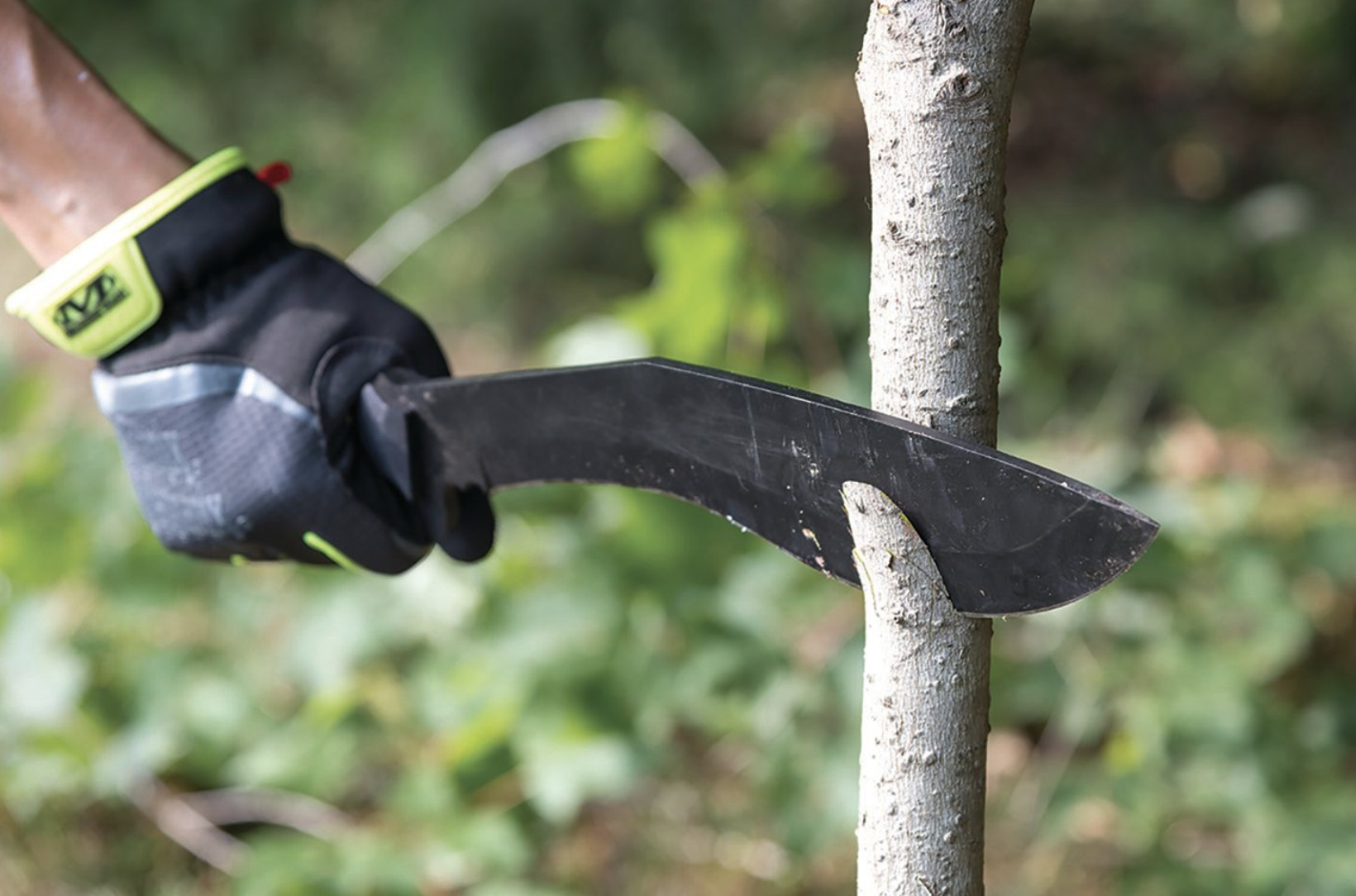
This APOC Kukri is one the author found to be very controllable—so controllable, in fact, it even whittles well in a pinch.
At 16.25 inches overall, the APOC Kukri from CASIberia is a formidable chopper. The 10.25-inch blade of this knife is .22-inch-thick 9260 spring steel with a low-glare, rust-resistant black coating. Though it doesn’t hold an edge as long as some other steels, expect it to be easy to maintain in the field. It also is a forgiving material, able to withstand heavy use and abuse.
The ultra-ergonomic handle is machined black G-10 fastened by three Torx-head screws. The multi-faceted grip features a pronounced index finger recess, an integral front guard, and a flared butt to prevent backward sliding of your hand. At 23 ounces, the knife harnesses the devastating cutting power of traditional kukris, and amplifies it using modern materials.
I found rather crisp edges on the tang and guard where crispness shouldn’t be. The easy fix? Lightly file the harsh edges to soften them a bit.
Once past the aesthetic imperfections, what you see is a forward-weighted chopping tool whose overall blade shape was inspired by traditional kukris as well. The graceful curve of the belly houses the sweet spot.
I found the handle rather interesting with its varied curves and prominent finger groove. When I first held it, I didn’t like it. My initial impression was it didn’t “fill” my hand. However, once I took the kukri into the woods and began swinging it, only then did the handle start to make perfect sense. The dip behind the guard acts as a sort of pivot. The knife will move a bit in your grip because of this, but it doesn’t move so much that it’s distracting or impossible to use. The slight movement actually works with your hand in creating powerful chopping strokes. And, due to the blade’s weight and thickness, I found the knife a really effective chopper.
The APOC Kukri excels at chopping, with the sweet spot in the middle of the blade belly. It was the surprise of the bunch in terms of how well it performed, especially for such a relatively unknown brand.
Out of the box the cutting edge was sharp but rough—rough as in a coarse edge and not looking very refined. Nonetheless, that’s also good because the coarse edge has “teeth’’ and bites in harder. The APOC kukri really turned out to be the surprise of the test bunch. It performed very well. I was able to modify the edge by hand, evening it out a bit—and it does seem to sharpen up fast in the field.
The Kydex sheath is a side-break design, allowing the kukri to tilt itself out of the sheath. However, the sheath needs more tension as it locks onto the handle to secure the knife. A secondary button snap strap extends around the upper part of the handle to secure the kukri into the sheath. Be sure it is securely fastened or it may fall out of the sheath accidentally. The belt loop webbing is fairly flimsy as well, but it will do the job. It does, however, allow the kukri to move around in the sheath in response to your movements, so, in case it snags a branch while you’re walking through the woods, it might free itself as you move.
All in all, I think this would make a great use-and-abuse chopper, one that you won’t be hesitant to go out and beat up. Made in China, it has a manufacturer’s suggested retail price (MSRP) of $175.
SOG Knives SOGfari
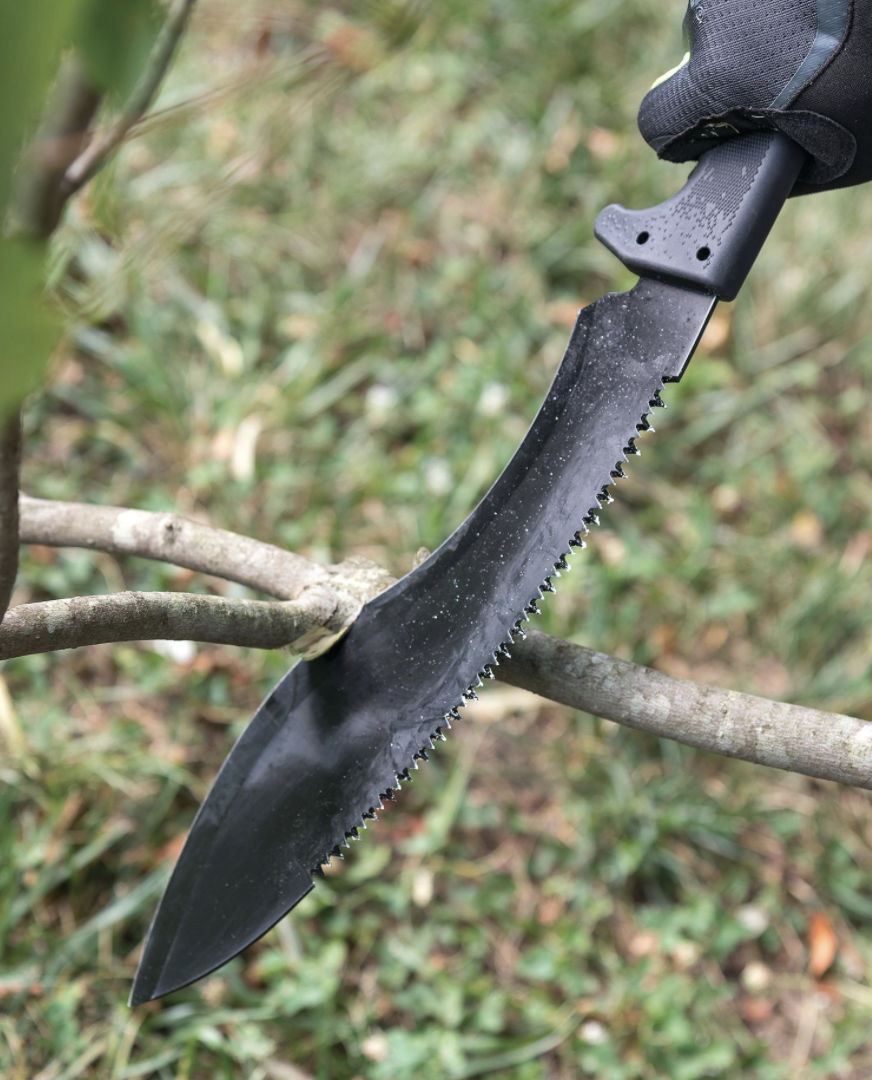
The SOGfari kukri is sharp all the way around—both the plain-edge blade and the sawtooth spine. Not as heavy as the other test knives, the author rates it for intermittent use.
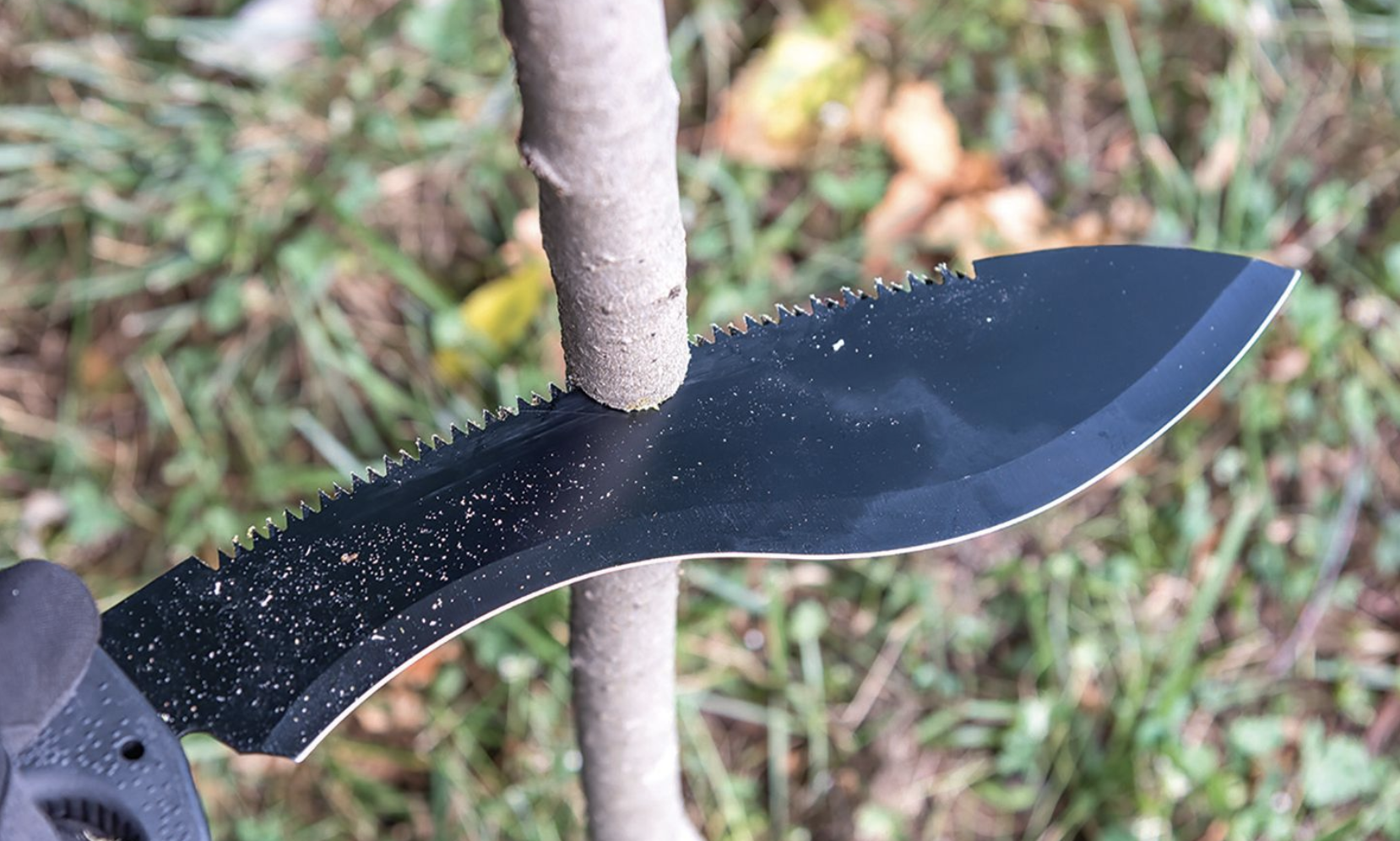
The SOGfari Kukri Sawback Machete from SOG Knives combines three tools in one: kukri, machete and saw. The 12-inch blade is .1-inch-thick 3Cr13 stainless steel.
Overall length: 18 inches. The recurve blade adds cutting power and the double-cut sawback spine easily zips through saplings. The handle is molded Kraton rubber and sports dual guards at either end to prevent forward or rearward sliding of your hand. There’s plenty of handle belly to fill your grip and make the knife feel comfortable and secure. The exposed pommel is notched and can be employed as a hammer if needed. A black blade coating enhances rust resistance and cleans easily.
The sheath is heavy-duty, sewn-and-riveted ballistic nylon with plastic liners. It secures via a zipper pull. A fabric fastener flap protects the zipper to prevent accidental unzipping—a very thoughtful design. A large loop of ballistic nylon accommodates all belt sizes and a button snap secures the handle. The sawback makes it more difficult to slide the blade in and out, though the sheath unzips partially to provide more room.
The SOG SOGfari Kukri is the only piece in the test bunch with sawteeth. While not intended to replace a nice, high-quality folding saw, it is better than no saw at all. The only problem is its tendency to bind up due to the blade’s thickness.
I found the SOGfari lacking in the weight-forward design of most kukris. This is good in that there’s less weight on your belt or pack—bad in that you must put more muscle behind chop strokes, which can be tiring. Normally, with a weight-forward blade you’d benefit from gravity on the down stroke. The sawback is more gimmick than anything. It really doesn’t work well and forces you to open the cut more to enable the thicker blade to slide through. If not, the saw binds up every time. Conversely, in a survival situation having the saw is better than no saw, so in that case it’s a plus. I would not rely on the SOGfari as your primary saw, so carry a dedicated folding saw if you’re exploring the woods.
The SOGfari is well made for the price but the lack of a weight-forward blade keeps it in the occasional-use category. Made in China, it has an MSRP of $29.99.
KA-BAR’s BK21
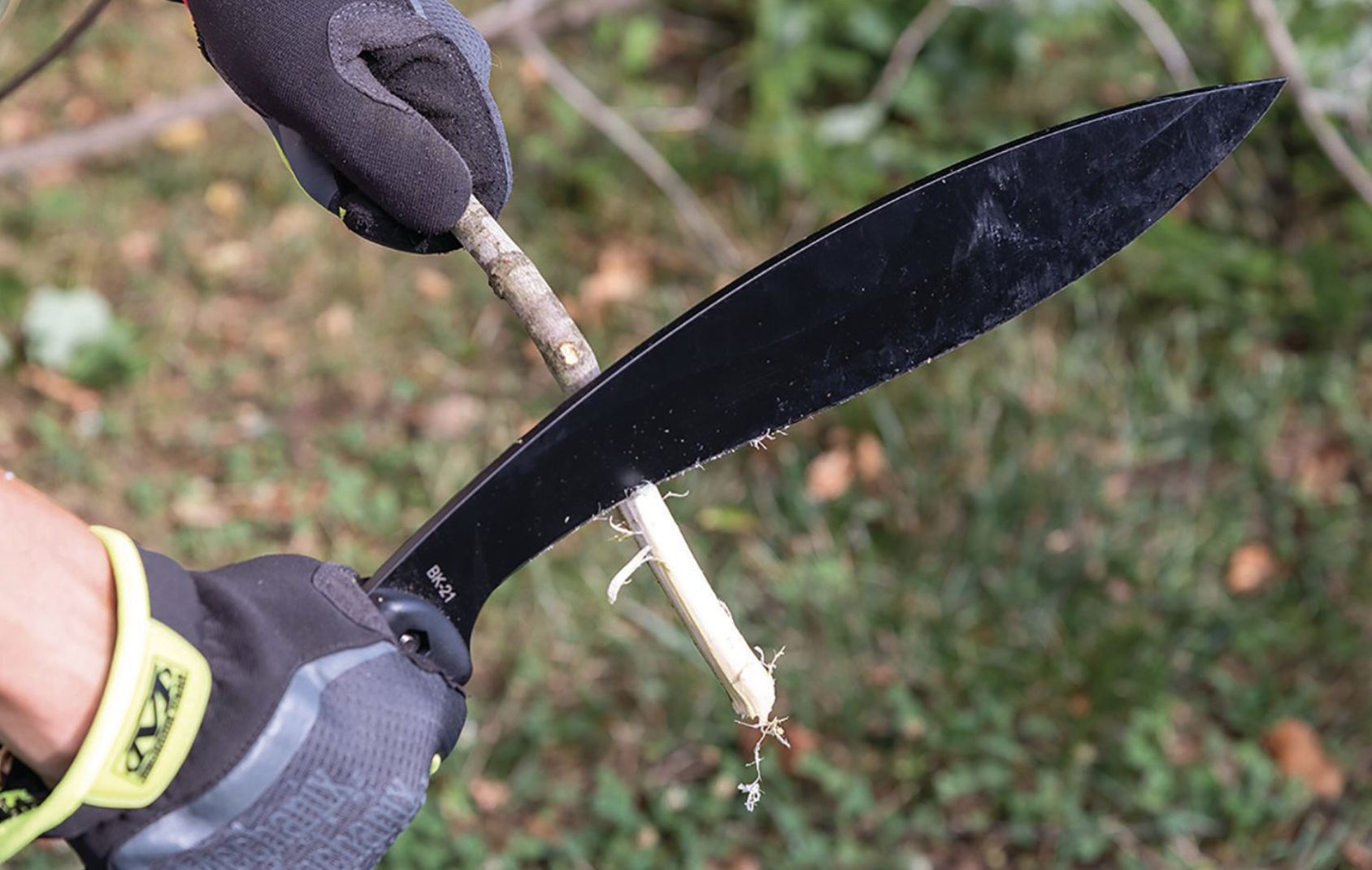
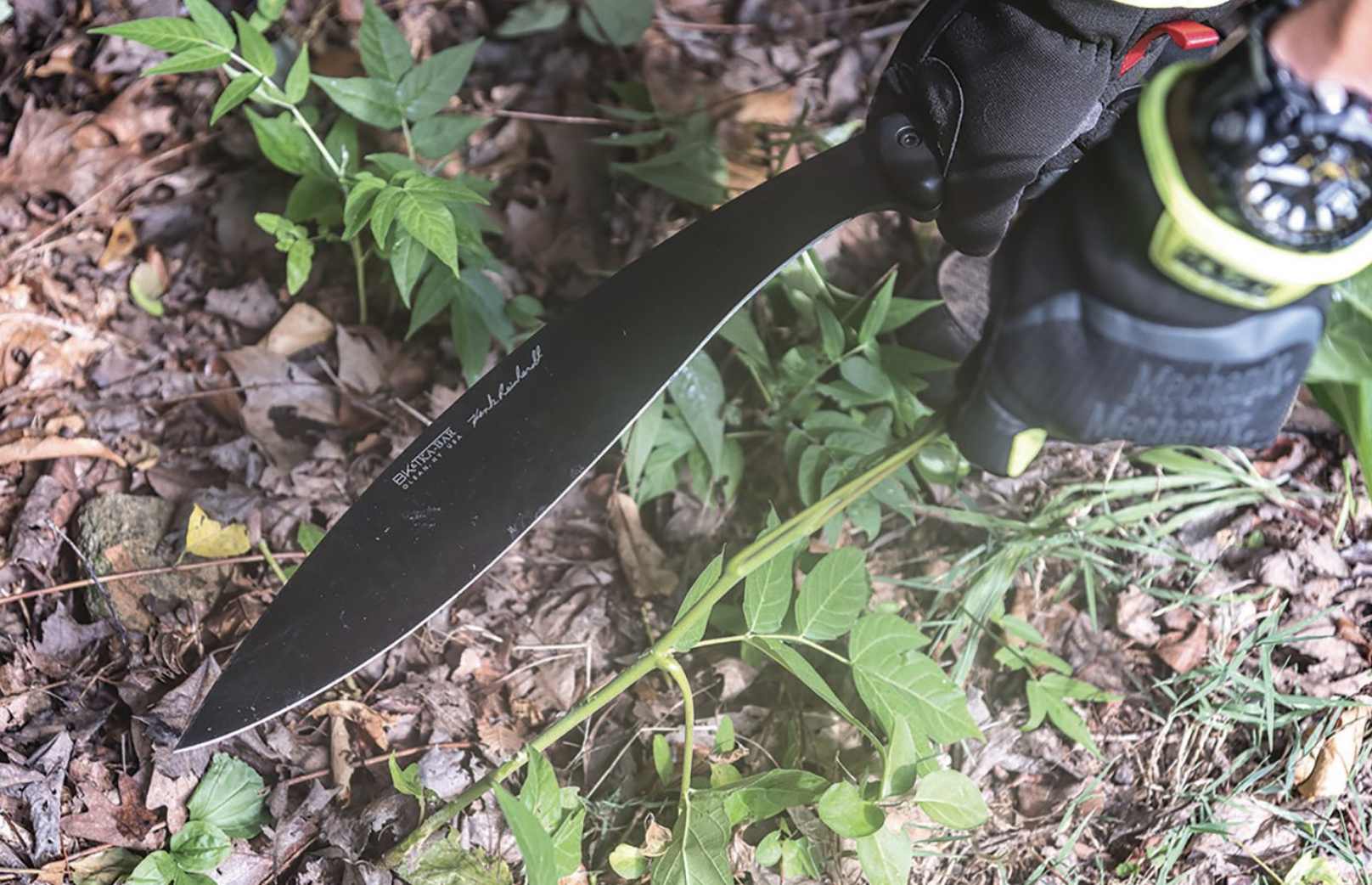
The KA-BAR BK21 Becker/Reinhardt Kukri is an exceptional all-around performer. It can be used as a chopping tool, machete or a utility knife as demonstrated here. It balances very well. Inset is Ethan Becker, one of the knife’s designers, outlining the rules of the chef’s knife cutting competition at the 2019 BLADE Show West. (Becker image by Eric Eggly)
KA-BAR’s BK21 Becker/Reinhardt Kukri was designed in conjunction with Ethan Becker and the Hank Reinhardt Estate. The 13.25-inch blade offers reach and power with plenty to spare. The blade is .195-inch-thick 1095 Cro-Van carbon steel epoxy coated for rust resistance. There is that forward-tilt signature of kukris, and the blade’s profile gently swells toward the center. Along with the flat grind, it enables the BK21 to be used as both a machete and a chopping tool.
Molded from an impact-resistant polymer called Ultramid®, the handle is dense and lightweight. It resists absorbing liquid and moisture, which makes it almost impervious to the elements. The rounded/blocky handle shape may look a bit awkward at first, but don’t knock it until you try it. The contours make for a very comfortable grip that isn’t tiring when evaluating for long-term use. Three rather large hex-head bolts secure the handle onto the full tang design, and the exposed pommel can be used as a hammer.
The BK21 has a high-quality sewn & riveted nylon sheath with a hard-plastic reinforced tip to prevent puncturing. An integral nylon loop promotes easy belt carry. A button snap closure secures the blade.
Due to the weight distribution of the KA-BAR BK21 Becker/Reinhardt Kukri, it excels as a machete in clearing tall grass, weeds, and vines.
The overall shape and weighted feel of the BK21 is reminiscent of traditional kukris. It’s not forward-heavy like some and is balanced well. Due to its length and weight/balance, it excels as both a chopping tool and a machete. It can cut vines and tall weeds as well as fell saplings. It’s really two tools in one. The entire kukri is solid. The designers knew what they were doing.
The BK21 is 18.75 inches overall, retails for $240.74, and is made in the USA. The sheath is imported from China.
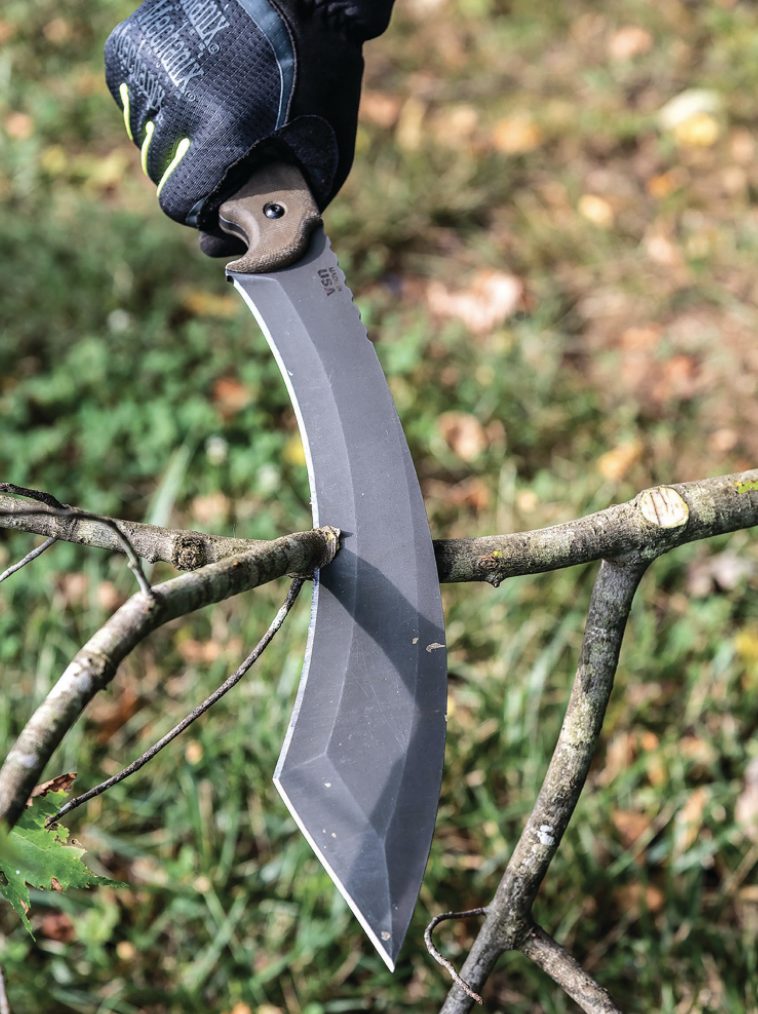
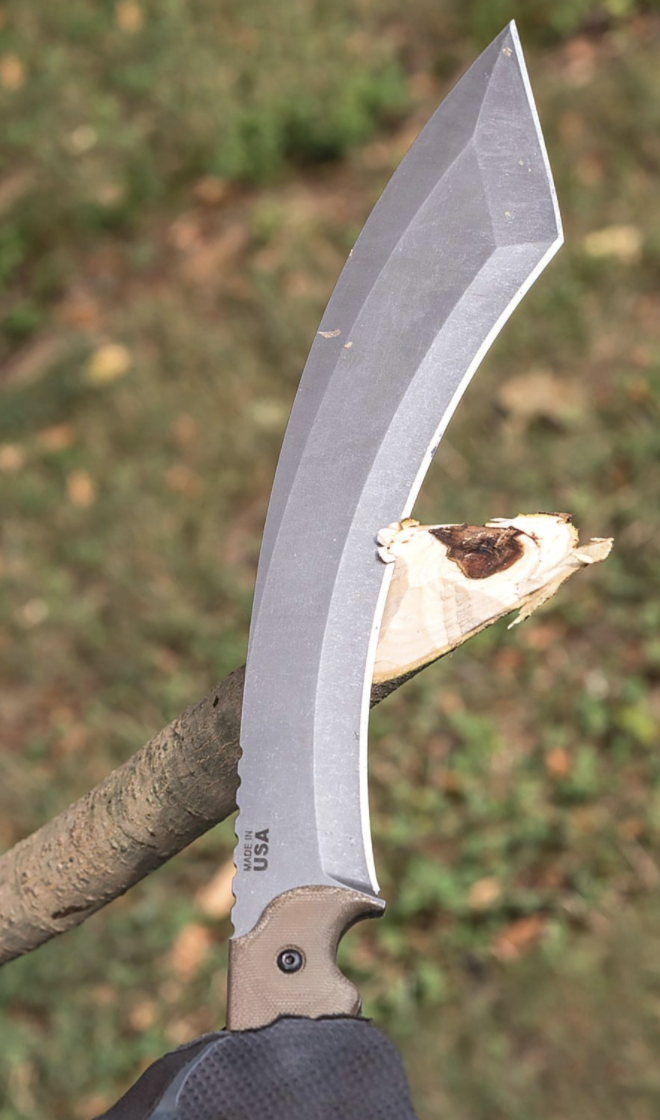
The gunstock war club used by Native Americans inspired Amanda Kaye of Discovery Channel’s Naked and Afraid TV show in the design of the TOPS Knives A-Klub. The blade’s curvature accentuates cutting and chopping power.
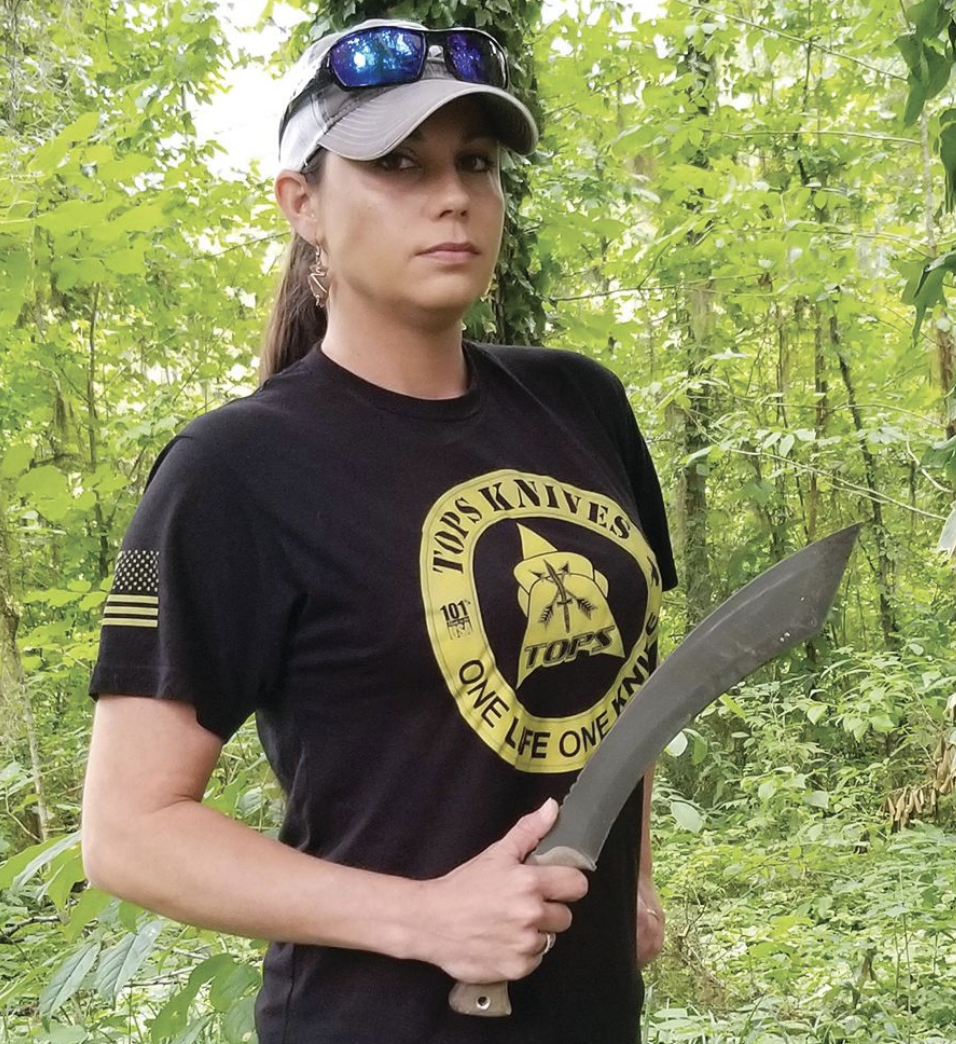
Heavy duty and ruggedly built perfectly describes the A-Klub chopper by TOPS Knives, the company’s first knife designed by a female—Amanda Kaye of Discovery Channel’s Naked and Afraid television series.
She is an avid hunter and outdoor enthusiast, as well as having an interest in Native American primitive skills. Kaye employed the gunstock war club as the design inspiration for the A-Klub.
The gunstock war club was a blunt-strike weapon used primarily in the 18th and 19th centuries by Native Americans of the Eastern Woodland, Central, and Northern Plains tribes. Named for their resemblance to the wooden stocks of muskets and rifles, gunstock war clubs were fashioned from ash, oak or hickory. The swinging force put into the weapon meant it would strike with the points of the design, and it proved very effective and devastating.
The gunstock war club used by Native Americans inspired Amanda Kaye of Discovery Channel’s Naked and Afraid TV show in the design of the TOPS Knives A-Klub. The blade’s curvature accentuates cutting and chopping power.
Due to the blade’s curve and angular tip somewhat reminiscent of a tanto, the A-Klub is also effective and devastating as a chopper. The blade is just over 12 inches of .19-inch-thick 1095 spring steel in the company’s subdued Acid Rain finish. The overall length is 18 inches.
The 23.8-ounce A-Klub is a beast. It has a forward-weighted tendency, though not as much as some choppers or even a traditional kukri. However, the blade curve accentuates swinging power and presents the edge at an angle in relation to the target, so the knife shears on contact.
Kaye designed the handle to maximize user comfort and control. An index-finger groove assists in locking in your hand, along with a curved main grip area that accommodates your other fingers. The green Micarta® handle is very lightweight and durable, and practically impervious to the elements, fluid absorption, and impact. Three hex-head screws fasten the scales to the full tang, and there’s a hole for a lanyard.
Coming off the index-finger groove, folks with smaller hands can shift their grip rearward on the handle for increased swing leverage. The A-Klub has a pronounced rectangular profile, which helps make it feel more secure in your hand.
Due to its weight-forward design, the TOPS A-Klub harnesses very effective cutting and chopping power. No matter how you swing the blade, the edge is almost always going to catch the target at an angle and, therefore, cleave through it cleanly.
The knife includes an expertly designed side-break Kydex rig. The rig’s leather-dangler attachment permits the heavy knife to swing and pivot freely on your belt in response to your movement, being accidentally snagged on brush, etc. Having the knife swing freely makes it more comfortable to carry.
Performance-wise the A-Klub bites in deep and hard, consistently discharging large chunks of wood with each blow. The blade’s “sweet spot” extends from the bottom of the tanto tip about two inches back toward the curve.
The handle can be gripped in at least two ways. One is with your index finger nestling inside the forward finger groove to provide a degree of control and also leverage. In the second, back your hand out of the forward finger groove and grip the handle further rearward toward the butt end. The latter handhold will enhance the power of each stroke.
Of the test bunch, I rate the A-Klub the best chopper, hands down. Made in the USA, it has an MSRP of $350.
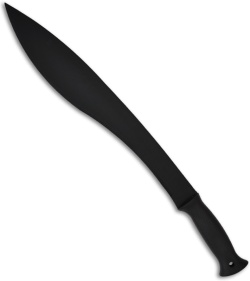
It’s been said that good things come in small packages. Cold Steel has no time for that. Their Magnum Kukri Machete comes in two varieties with the larger having a massive 17-inch blade and an overall length of 22 inches.
At 2.8 mm thick, the blade is made of 1055 Carbon Steel with a black baked-on anti-rust matte finish. It weighs in at 20.1 ounces and is weighed forward to give you better leverage while slicing.
It has a five-inch polypropylene handle and comes with Cor-Ex sheath. It will most likely need some sharpening when you get but with an MSRP of just $35.99, the price can’t be beat.
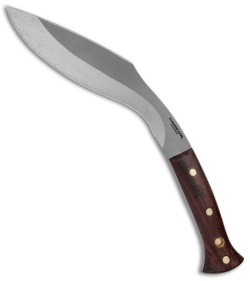
Condor Tool & Knife of El Salvador have made a kukri that combines the best of machetes and the best of an EDC knife. It’s smaller than traditional kukri machetes, with a blade at just nine inches, but what it lacks in size it more than makes up for in manuverability.
The blade is 6 mm thick and made from 1075 high carbon steel with a blasted satin finish. It has a more pronounced bend in the knife than most other kukris which allows for more precise knife work when needed.
With a sturdy walnut handle, and a sheath of welted leather, Condor’s kukri is made of quality materials from top to bottom. The only knock on it is that it will need sharpening out of the box to get the type of edge you want when cutting through brush. With an MSRP of $117.91, it’s a good knife for its price.
Smith & Wesson makes more than just guns, and their Outback Kukri is a great example of the company’s knifemaking prowess. The 11.9-inch blade is made of 7Cr17Mov Stainless Steel and finished with a black powder coat. The rubberized steel handle provides great grip while slicing.
It’s a light knife at just under 20 ounces, and that lightness brings both pros and cons. The pros are that you can a better feel of what the knife is cutting through and can slice with more speed. The cons are that it could get damaged more easily than heavier kukri knives due to overuse.
The balance comes with its price. The MSRP is just $34.15, which is a great price. If you’re not looking to become the next Bear Grylls, this kukri might be all the knife you need.
Smithwesson Smith WessonA SWBH Outback Kukri Fixed Blade
Kershaw’s New Parley Is A Unique EDC Knife That Is Fun To Use And Built To Last. The Cleaver Blade Makes It Stand Out From The Crowd.
Kershaw has once again made a fantastic folding knife that is beautiful, functional, and exciting. The new Parley features Kershaw’s non-locking, slipjoint design and a cleaver-style blade made of 7Cr17MoV stainless with a satin polish. It opens with a nail nick and features a lanyard hole for excellent portability.
Kershaw Parley in the closed position
While the polished black Micarta handle is smooth to hold and feels good in the hand, the star of the show is the blade. The 3.1-inch cleaver is inspired by the hulking kitchen meat cleaver. It can handle kitchen tasks but is far more nimble than its bigger brothers.
As a folder, the cleaver blade works great handling small tasks outside and anything in and around the house. The plain edge cuts true and gracefully and is easy to sharpen and maintain. With an MSRP of just $39.99, it’s a bargain that should absolutely be snatched up.
Editor’s Note: This article was written by Mike Ableson.
Puukko Knives Are A Traditional Knife Of The Nordic Countries. It Is Used For Everything From Hunting To Chopping Vegetables
Puukko is Finnish for “knife.” It is deeply rooted in Scandinavian countries where the knife is both tool and art form. In fact, the puukko plays an important part in Nordic culture. Often included as part of the traditional cultural dress, the puukko is a historical symbol, especially in Finland and Northern Scandinavia.
The Finns treat the knife with deep respect. Many men in the country take great pride in how they carve their knife’s handle. It’s so ingrained in the culture that the Finnish Defense Forces don’t issue a standard knife to its soldiers. Instead, most men simply bring their own puukko with them into service.
What Is A Puukko Knife?
Rich history aside, puukkos are first and foremost solid work knives. They are of basic construction, consisting of a high carbon steel blade mated with a handle that is usually of a natural material, though some modern versions are synthetic.
The steel is traditionally crucible steel made from limonite iron, which was almost exclusively the type of steel made in Finland before more modern manufacturing methods were invented in the 19th century.
Primary uses are woodcarving and food prep as well as most anything requiring a cutting tool. Outside the Nordic culture, puukkos have earned a solid reputation as stout knives built for serious labor. It’s easy to see why these knives are favored among outdoor folks.
If you spend time camping or hiking or are simply in need of a good, solid fixed blade that withstands hard use and requires low maintenance, consider the sleek, slender puukko.
What Is A Puukko Handle Made Of?
One of the more common puukko handle materials is Masur (curly birch, though you’ll also find antler, bone, leather, and other hardwoods. Modern factory-made knives can come with a plastic handle instead of using traditional materials. The handle has no guard, and the blade boasts a gentle upsweep to the edge to facilitate easy cutting.
Puukko Sheaths
Puukko sheaths are usually leather and may or may not have fancy tooling. A belt loop is separate and affixed via a metal ring. Also known as a dangler, the sheath is free to move separately from the belt loop and you. This comes in handy if you’re seated, as the knife can move freely and adjust itself into position yet remain easy to withdraw.
Best Puukko Knives
Today, puukkos have become a popular knife beyond just Scandinavia. In places ranging from El Salvador to Russia and the USA, puukkos are prized for their durability and ruggedness. Below are five of the best puukkos that are available today.
TOPS Tanimboca Puukko
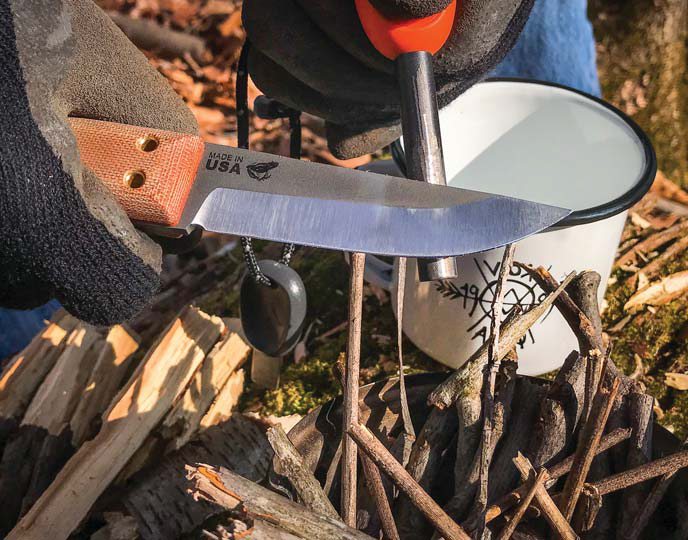
The 90-degree blade spine on the TOPS Tanimboca Puukko is for use with a fire restarter. Scrape the corner of the blade spine down the ferro rod to create a shower of sparks. (Marty Stanfield Photography)
From TOPS Knives, there is the Tanimboca Puukko. Designed in conjunction with Serbian knifemaker Goran Mihajlovic, who has spent the last two decades living in Colombia, the Tanimboca combines the best of a puukko knife with the toughness of the Amazon.
The blade has a slight clip point at the end and a flat spine is great for fire starting and scraping tasks. The knife is made from 1095 steel with a 56-58 Rockwell hardness and a length of 3.63 inches and a tumbled finish. The Tan Canvas Micarta handle honors the traditional puukko and looks great.
The knife comes with a brown leather sheath and has a belt loop so it’s easy to take with you. A cool, contemporary take on a historic knife makes the Tanimboca work the $170 MSRP.
Benchmade 200 Puukko
Benchmade 200 Puukko
You know Benchmade is going to put out a good product, and their 200 Puukko is no exception. The drop point is made of CPM-3V steel, the 200 is super hard and super durable even by puukko standards. The rubberized Santoprene handle provides excellent grip, and the lanyard hold in the handle makes the 200 easy to bring with you outdoors or on the job site.
Add in a leather sheath and you have a top-tier knife that can handle any situation you throw at it. With an MSRP of $160 it’s fairly priced and worth every penny.
Ahti Vaara Finnish Puukko Knife
Ahti Vaara Finnish Puukko Knife
Direct from Finland comes a budget puukko from Ahti. The Vaara is made from carbon-vanadium alloy steel with a traditional Masur birch handle and brass fittings. The is sharpened with a Scandi grind and is 3.74 inches in length. Overall, the knife is 8.31 inches long and well-weighted.
A neat design element is a black spine made of carbon steel. The flat edge, like with other puuukkos on this list, is great for starting fires and scraping away at material.
With a reasonable MSRP of just $51.45, the Vaara is a well-priced knife, and even with the shipping cost from Europe, it should still be under $100.
Marttini Tundra Kelo
Marttini Tundra Kelo
Another puukko made in Finland, the Marttini Tundra Kelo is not just a beautiful knife but also a quality one. Unlike most puukkos, which have a narrow tang within a solid wood handle, the Tundra Kelo is a full-tang blade surrounded on either side by a wax-coated gnarl birch handle.
The 4.33-inch blade is longer than most other choices on this list and is made from stainless chromium steel with an HRC 58 in terms of hardness. The black leather sheather contrasts nicely with the look of the knife itself.
The MSRP is € 139, which converts to $146.87 before shipping. One of the pricier knives on our list but worth it if you’re looking for a high-quality authentic Finnish puukko.
Condor Indigenous Puukko Knife
Condor Indigenous Puukko Knife
The last knife on our list is from Condor and is one of the most visually striking. The Indigenous Puukko Knife has a 3.9-inch blade made of 1095 high carbon steel with a Scandi grind.
The walnut handle features an inlaid golden wire wrap to help with grip, and it looks great. the handle is meant to combine elements from Polynesian and Sami cultures to celebrate indigenous cultures from around the world. The Sami are an indigenous group that lives in northern Norway, Sweden, Finland, and a small portion of Northwest Russia.
The knife comes with a welted leather sheath and is incredibly light at just 4.6 ounces. At an MSRP of just $95.45 this is a well-priced, nimble, and beautiful knife.
GiantMouse Ace Nimbus V2
This folder is inspired by the puukko and other Nordic knives and is built to be a mix of EDC and tool for the jobsite. The 3-inch blade is made from satin-finished Elmax steel meted to a green micarta handle for a secure grip. The blade has a full flat grind and thin edge. This allows for longer, more precise slicing strokes, and since the blade comes to an extremely fine tip the knife is also great for puncturing as well.
The nuts and bolts of this knife are great. The liners are made from AISI 420 hardened steel, and the liner lock keeps everything rigid. At 3.8 ounces it’s both light yet heavy enough to feel good in the hand.
The blade is .138 inches thick. That’s more than fine for many standard tasks around a jobsite but you might not want to start using it as a pry bar if you don’t have to.
MSRP: $185
Kellam Knives Ranger Puukko
This knife is a puukko to its core. It’s designed and built to stand up to not only combat but also the ferocious winters of Northern Europe. The 6-inch blade is made from forged 80CrV2 carbon steel with a teflon coating for added wear resistance and a Scandi grind.
At two-tenths of an inch thick, the blade is a beast and can stand up to almost anything life can throw at it. Use is aided by a 5-inch tempered rubber handle that won’t crack or deform even in hostile conditions.
Th Ranger Puukko is standard issue for troops from both the Finnish and Estonian militaries, and it’s easy to see why.
MSRP: $186.45
Helle Temagami CA
Designed by Les Stroud, the Temagami is a full-tang puukko that was precisely built to be among the best of its type on the market. It starts with a half-full tang design. That means the blade can be seen along the spine of the handle except near the fingers; this is done to better weight the knife and to better withstand harsh conditions.
The curly birch handle looks great and is ergonomically designed for hard, intense work. At 4.34 inches long, the triple laminated carbon steel blade is long enough to be used for slicing, puncturing, and even chopping for food-related tasks. The leather sheath allows for easy transport and storage.
MSRP: $209
Editor’s Note: Mike Abelson contributed to this piece
The Three-Layer Construction Of San-Mai Results In Sharp, Durable, Beautiful Blades
San-mai is an ancient blade construction technique that originated in Japan around 1300 A.D. Those who continue to use the technique harken back to those early days of craftsmanship and take pride in their finished product, a combination of the old and new that presents a dazzling aesthetic in three layers combining tensile strength and edge holding in a working knife blade.
“San-mai is a Japanese term describing a knife composed of three layers of steel that are forge welded together and ideally unite some different properties of the used steels within one knife,” explained Benjamin Kamon of Korneuberg, Austria. “Or, it serves another purpose as, for example, to ‘save up’ rare high-carbon steel used in the middle for the edge, which is what I believe started it originally.”
Jeremy Bartlett of Parkersburg, West Virginia, agrees. “Traditionally, two softer metal outer jackets and one high carbon core steel for the edge are used,” he said. “The main reason to use san-mai is so you have a soft steel jacket and a high-carbon core cutting edge. This will make the knife very durable with a great edge.”
The san-mai process is similar to the layering of damascus, a.k.a. pattern-welded steel, but retains a methodology all its own. In damascus, the layering and relayering of component steels typically result in numerous layers in the billet, while the object of damascus forging is often to create a pattern in the steel itself, along with the enhancement of blade performance.
“San-mai ends up taking much less time to make [than damascus],” added Noah Vachon of Mistissini, Quebec, Canada. “For one thing, you’re starting with fewer layers—three instead of 15 or 20 in my case. That’s fewer surfaces to grind clean when prepping the billet material. Also, unlike making pattern-welded steel, there’s no need to restack or further manipulate the billet. One thing that is a bit trickier is the core material has to be kept centered. I try to work a blade evenly from both sides when forging san-mai. With damascus, this is less of an issue.”
How To Make A Knife With The San-Mai Technique
Curt Zimmerman of Longview, Texas, uses two methods of san-mai construction. “I make it with a laminate billet and sandwich my core material between it, or I will use a canister. For the core I use 1084 because it is the most forgiving steel that I have been using as far as heat treating and workability. For the jacket or laminate billets I use 1080, 15N20 and pure nickel shim material because it is readily available and easy to work with. For the material in canister, anything from chainsaw chains to fishhooks, ball bearings, scrap damascus or other stuff lying around the shop will work. I like this because it’s great to experiment with.”
The texture on the san-mai blade of Benjamin Kamon’s chef’s knife is what he calls denty. “The technical term would probably be tsuchime,” Benjamin noted. “The denty serves the purpose of benefiting food release as the texture in the blade will produce small air pockets between the blade and foods that like to stick.” (SharpByCoop image)
Zimmerman showcases his san-mai talent in a beautiful fixed-blade fighter with a ball-bearing san-mai blade and an ancient walrus ivory handle. With inch lengths of nine for the blade and 14.5 overall, the fighter flaunts contrast between light and dark. The san-mai blade’s distinctive pattern and the integrity of the cutting edge are well defined.
“The most visible sign of a well-made san-mai is the center core showing equally on both sides,” Zimmerman observed. “I’ve only been building knives for about a year, and it has become a true passion of mine.”
Vachon is familiar with 1084 and 1095 carbon steels for the core of his san-mai blades and intends to branch out to 26C3 and White Paper #1. “I try to choose materials that play well with each other,” he commented, “that is, that bond easily and move at comparable rates when worked.
“I’ve been using 410 stainless for the jacket. It stays bright when etched, which gives a nice visual contrast with the darker core, and the carbon migration that goes on where the layers meet can be very attractive. A stainless jacket with a carbon core is sort of the best of both worlds in terms of function. Antique wrought iron is also a fascinating and beautiful jacket material that tells a great story.”
When Noah completed a breathtaking chef’s knife with a 10.25-inch blade and overall length of 16.2 inches, he knew he had done something special—a tour de force in his cutlery journey.
“This knife is the culmination of all the skills I’ve learned during my career as a maker, with a cherry on top,” he related, “everything I learned from cabinetmaking and lutherie*, as well as the years studying ergonomics as an industrial designer.” The knife combines the san-mai blade of antique wrought iron and 15N20 and 1095 core with a handle of stabilized redwood burl and denim. A copper Micarta® bolster completes the package.
“This knife was forged from my first- ever house-made billet of wrought-iron san-mai,” Vachon recalled. “The iron is from a piece I brought home from the New England School of Metalwork in Maine. The outer layer visible near the spine is the wrought iron. It’s full of impurities from the way it was manufactured over 100 years ago, and that gives it loads of character. The next layer that looks brighter than the rest is the 15N20. It has nickel in it and that prevents it from etching darkly. The layer at the edge is the core material. Having five layers would usually be referred to as go-mai I suppose, but it’s the same idea.”
Kamon identifies a departure from the time-honored in his san-mai construction. “The biggest difference to traditional san-mai is probably that my outside layers are made from stainless steel instead of mild steel, which is mostly used in traditional san-mai,” he noted. “The advantage of stainless steel is exactly that. It’s stainless but with that comes also the visual advantage of a strong contrast after etching the finished blade as the stainless steel stays silver, shining while the cutting layer gets very dark. The cutting layer is from a tungsten-alloyed high carbon steel called 1.2519 that is not stainless, and the reason for its etching quite strongly in an acid such as instant coffee or ferric chloride.”
Benjamin’s chef’s knife with a 10-inch blade of seven-layer stainless steel with the 1.2519 cutting edge presents a dazzling effect. At 15 inches overall, this issue’s cover knife features a handle of ringed gidgee wood and a bolster of dark gray titanium.
“Behind the edge is the darkly etched cutting layer,” he related. “After that is the nickel layer that prevents carbon from diffusing into the outer jacket layers of the blade. After the nickel there is a thin layer of high-carbon manganese-alloyed steel. This steel only serves a visual purpose and produces a slightly cloudy and dark faded effect in the stainless steel jacket. Last but not least, there is the outer layer of stainless steel in a shiny silver color.
“My years spent learning to forge and my countless failures have eventually led to this first—but not last—house-forged wrought iron san-mai blade,” noted maker Noah Vachon. “It’s long and tall, thick at the ricasso and thin at the tip, and feels just right. (Caleb Royer knife image)
“The texture on the blade is what I call denty, my brand for it. The technical term would probably be tsuchime. The denty serves the purpose of benefiting food release as the texture in the blade will produce small air pockets between the blade and foods that like to stick. It also makes a given blade lighter in weight compared to the same blade without texture.”
Delam Safeguards
One of the biggest challenges in constructing san-mai is the potential delamination of the steels—when the layers literally start separating from each other—during the forging process. Bartlett has devised techniques to help guard against that.
“When delamination happens, not only is the structure and durability of the blade compromised,” Jeremy reasoned, “but now you also have a void where contaminants can enter and cause the blade to rust from the inside out. The key to not having any delaminations in your san-mai billet is to take your time and make sure your mating surfaces are clean. Also, you need to make sure that you have no oxygen getting into your billet while heating in the forge. Check for small pin holes in your MIG welds all around the billet. I’ve tried using flux core to weld around the billet, but now I use only MIG wire with argon/CO2 gas. The last thing is to make sure that you don’t try and draw the billet out too much at one time. The jacket [sides] material and the core material will want to move at different rates because of the different makeup of the steels.”
Bartlett’s 15.25-inch fighter with a 9.25-inch blade of 416 stainless clad around a 1095 core, and a handle of curly koa wood with black G-10 spacer presents a highly contrasted look.
“You can see a total of three distinct areas on the blade,” he said. “The black area down to the edge is the core steel. Moving toward the spine, the next area will be the carbon migration area. This is where during the forging process some carbon leaves the core steel and migrates to the low carbon stainless jacket. This leaves a distinct crystal-like line between the two layers. The carbon leaving the core steel only affects the area where it meets with the stainless. No carbon is leaving the edge, where you need all of it for a good blade. The third area of the blade is the stainless jacket material. This area will be shiny and mostly free of any effect from the etching process. You will sometimes see, as in this case, a ghost hamon that will follow the peaks and valleys of the san-mai pattern in the blade.”
What Does San-Mai Look Like?
The look of high quality san-mai is readily apparent. The finest san-mai exhibits core steel that is centered in the billet along with the presence of the carbon migration line in the blade. In poorly made san-mai, the jacket steel approaches the edge of the blade too closely. After sharpening a few times, the soft jacket steel may run directly into the cutting edge, rendering the blade less than useful.
The watchful eye, the practiced hand and the awareness of control in each stage of construction will bring san-mai to life and perpetuate this centuries-old artistry of form and function beautifully.
*Lutherie is the construction and repair of stringed instruments that have a neck and a sound box.
Whether A Stone, A Rod, Or An Electronic Device, There Are Many Quality Knife Sharpeners Out There. Here are five of the best.
There are all sorts of knife sharpeners out there. Some can fit in your pocket. Some are full-on appliances. Some are literal stones. No matter the type of sharpener you use, it’s important to make sure you get the best bang for your buck.
That’s why we’ve scoured the world of sharpeners to show you a variety of the five best out there today. Whether you’re looking for something quick and easy to give your knives a once over or a sharpener the pros use, there’s a knife sharpener out there for you.
Chef’s Choice Model Trizor 15XV 3-Stage Professional Electric Knife Sharpener, Platinum
Chef’s Choice Model Trizor 15XV 3-Stage Professional Electric Knife Sharpener, Platinum
The first one on this list could be called the Cadillac of home knife sharpeners. Named the best knife sharpener by numerous organizations including America’s Test Kitchen, the Trizor 15XV by Chef’s Choice is a beast of an electric knife sharpener.
It utilizes three separate stages to sharpen, hone, and polish your knives. It sharpens using proprietary diamond abrasives and then stropping discs to polish. It even adjusts between 15 and 20 degrees so you can sharpen multiple types of knives.
Yes, this is made for chefs and their kitchen knives but it’ll sharpen your EDC knives just as well. It’ll even sharpen serrated knives too! While it can’t sharpen ceramic knives or larger outdoor blades like axes, it does pretty much handles any other edge in your home or workshop.
It is pricey with an MSRP of $179.99, but if you want to sharpen like the pros you won’t find a better option on the market today.
Sharp Pebble Premium Whetstone 2 Side 1000/6000 Waterstone
Sharp Pebble 1000/6000 waterstone
I love sharpening my knives freehand. I find it meditative, fun, and refreshing. As more and more people look to whetstones as a way to sharpen their knives, there’s a glut of products on the market.
This is the type of stone I’ve used for the last several years, and it’s an excellent entry point into whetstones. Sharp Pebble has made a quality stone out of aluminum oxide that can sharpen and polish your straight-edge knives.
Starting with the coarse 1000-grit side, and finishing with the fine 6000-grit side, you can give your knives the love and care they need to stay sharp and cut at their best.
Another reason I like this stone is its accessories. It comes with a bamboo base to keep the stone secure as you sharpen. And it comes with an angle guide if you’re not confident in being able to keep the angle steady as you grind away.
While I love using my whetstone, it can be a bit confusing to jump into at first. Luckily, popular Youtube Ethan Chlebowski goes over the most common mistakes people make while using a stone and how to avoid them.
At an MSRP of $40.99, Sharp Pebble has made an affordable stone and a great entry point for those interested.
WorkSharp Guided Field Sharpener
WorkSharp Guided Field Sharpener
Need a sharpener while hunting or camping? The team at WorkSharp has you covered with their Guided Field Sharpener (GFS). Smaller than your cell phone, the GFS is packed with features any outdoorsman can appreciate.
The sharpener comes with two stones of 320 and 600-grit diamond and a 20-degree angle guide so each pass counts. It also comes with two finishing options, a ceramic honing rod and a leather strop, to polish your blade. You can even remove the diamond sharpening plates to reveal a small storage compartment with a built-in broadhead wrench.
And did we mention it can sharpen straight-edge blades, serrated knives, and even fish hooks? It really can do it all outside for you. It even has a lanyard hole so you can carry it without worry about losing it on the trail.
At an MSRP of $34.95, you get so much for the price and the peace of mind that comes with buying something sturdy from WorkSharp.
KitchenIQ Edge Grip 2-Stage Knife Sharpener
KitchenIQ Edge Grip 2-Stage Knife Sharpener
If you’re looking for a sharpener on a budget, this little countertop sharpener packs a big punch.
Available at numerous retailers, this sharpener from KitchenIQ is priced between $10-12 and will get your knives back to a sharp edge.
It uses two angled slots, one coarse (carbide) and one fine (ceramic), for you to pull your knife through. You hold it down with one hand and pull your knife through with the other. Pulling it through 5-10 times a side should be enough to reset the edge and polish it back to new.
Your sharpening time is seconds. If you’re looking for a sharpener that’s easy to use, doesn’t take much time, and gets your knives back to fighting fit, this is the sharpener for you.
Wusthof 9-Inch Honing Steel
Wusthof 9-Inch Honing Steel
The last piece on this list isn’t a sharpener, per se. Honing steels, or honing rods, are used to fix the small, microscopic imperfections that affect a knife over time. Using a honing steel will help get the edge back to where it was before but without removing material, as occurrences when sharpening.
A good honing steel should be used a few times a week while sharpening should be done a few times a year, and you can’t go wrong with this steel from Wusthof. From a company with more than two centuries of experience making knives, the honing steel is made from stainless and will help restore the edge of your kitchen knives.
With a low MSRP of just $25, you can’t go wrong with a steel from one of the most trusted knife brands in the world.
The Correct Sheath Is Pivotal To The Complete Hunting Knife Package. A Good Sheath Can Keep Your Knives Safe And Sharp For Decades.
The Correct Sheath Is Pivotal To The Complete Hunting Knife Package. A Good Sheath Can Keep Your Knives Safe And Sharp For Decades.
For the hunter in the field, a dependable and durable hunting knife is indispensable equipment, and it follows that the sheath that holds the knife must be equally up to the task.
Secure carry, protection for the blade and handle, easy access, and the ability to stand up to the elements and hard use are essential. While there is a variety of sheaths available and each one contributes something to the equation, the sheathmakers themselves have come to eye-opening conclusions as to the making and deployment of the correct sheath for the hunting knife. Personal preference is still a prime mover, but the basics make the difference between cooperation and catastrophe in the field.
“The best style for a hunting knife sheath is whatever the hunter wants,” explained veteran sheathmaker Paul Long. “Personal preference is very important. However, the knife that would best be described as a hunter would be best suited in a deep seat pouch with a loop that would carry relatively high on the belt. In most cases the deep pouch would preclude the need for a retention strap. For a double-guard hunter, a drop-loop belt sheath would probably be best with a snap strap for secure retention.”
Depending on the style of the knife, the guard often dictates the best pouch configuration. “I favor the pouch-type sheath, and the hunting knife generally has a single guard as opposed to a double guard,” related sheathmaker Paul Lebatard, who also has found success with his custom knives through the years. “I make a lot of doubles, too. You would have to make a snap-type sheath with a keeper strap, but on hunting knives with single guards the pouch type is always best.”
Three different styles of pouch sheaths by Kenny Rowe, from left: regular pouch, plain leather; strap pouch, floral hand carved; and full flap pouch, full coverage gator. (Kenny Rowe image)
A sheathmaker for over 50 years, Chris Kravitt zeroes in on the personal preference perspective. “First and foremost, it’s a matter of the configuration of the knife, and then if more than one style will work it becomes a matter of personal preference,” he observed. “My preference is to go with the pouch because it is easier to draw and resheathe the knife without worrying about straps.”
At the same time, Kravitt acknowledges varying hunting knife construction and its influence in sheath form and function. “If a knife has a double guard, it isn’t going to work on a pouch sheath, and if you have a knife with an integral handle, possibly,” he said. “Certain things don’t lend themselves to the traditional style, like when the blade is the widest part of the knife or there is no bolster or ricasso extending beyond the edge.”
Kenny Rowe, owner of Rowe’s Leather in Hope, Arkansas, adds another option on the hunting knife sheath. “Ninety percent of these sheaths would be the pouch type because they cover most of the knife, and with the guard you can make a welt where the knife has some resistance coming in and out,” he noted. “Some sheaths will have a lid that has a snap on it, and that is as secure as you can get with the flap snapping over the front of the sheath.”
The consensus with the pouch sheath makes sense for all the reasons that the hunter encounters in the field. For its toughness and the ability to shape and mold the sheath as desired during the construction process, cowhide reigns supreme among sheath materials. Most sheathmakers use 7-to-9-ounce* vegetable-tanned cowhide.
Style Of Sheaths
The use of exotics such as ostrich, stingray, alligator, crocodile or other hides is a continuing option, though for the most part they are used as accents, often in the form of inlays, rather than adding any performance-related component to the sheath.
“Exotics are very useful in sheathmaking but primarily for aesthetics,” Long explained. “Elephant and shark are two that are tough enough to withstand very hard use and are usually built as an overlay on a vegetable-tanned base sheath. I work with various snakes, lizards, ostrich and many others.”
Ultimately, Chris Kravitt—here working on a sheath in his shop—stands by the individual perspective. “First and foremost,” he begins, “it’s a matter of the configuration of the knife, and then if more than one style will work it becomes a matter of personal preference.” (Chris Kravitt image)
As Kravitt noted, “The basic sheath is going to be cowhide 99 percent of the time, but for overlays and inlays my favorite is stingray, which is near bulletproof but more expensive and harder to work with—but great stuff. Ostrich leg or shin is very nice, and Malaysian horned frog has a very nice texture to it. Snakeskin is not very durable, but it’s fine when the knife and sheath are for show since it won’t hold up with regular use.”
Tooling and carving also provide style points and may be pleasing to the eye. However, neither actually contributes to the performance of the sheath in field use. “I occasionally do some tooling with stamps, but carving is a talent I don’t have,” Lebatard remarked. “Still, on almost every sheath I’ll put something in keeping with the theme of the knife, like a small deer. Someone might place an order and specify that they just want a bare, plain sheath, or they may want just their initials on it. That’s a good thing about leather. When it is wet it can be molded and stamped, and when it dries it will hold that impression.”
Tanning And Steel
Vegetable tanning is essential when the blade meets the sheath leather for an extended period. In contrast to chrome-tanned leather, a vegetable-tanned leather is not known to corrode or stain a blade left in the sheath for any length of time. That old admonition to store the knife itself separately from the sheath will then get a longer look.
“A lot of people say not to store knives in the sheaths, but as long as the sheath is made of good vegetable-tanned leather, I’ve never had a problem,” Lebatard noted. “I made a knife for a friend a few years ago and he didn’t want a sheath. He was going to get someone else to make the sheath for him. Several years later, he brought the knife to me and he had had it in a chrome-tanned leather sheath. It was nearly rusted through. The chrome-tanned leather is very corrosive.”
Kravitt has had similar experiences. “I hear so many people say not to store knives in leather sheaths, but I have kept knives in sheaths for years and never had a problem,” he recalled. “My sheaths are all vegetable tanned as opposed to chrome tanned. Chrome-tanned leather may have salts and other things in it.”
Drainage And Inserts
Waterproofing is another essential element, and in the construction itself there are questions surrounding drainage holes and inserts as well.
Most sheathmakers shy away from inserts since contact with the blade may dull the edge. After all, the welt and/or strap should suffice for a snug fit. Inserts in and of themselves may be judged to provide some measure of redundancy, but contribute little to the overall stability of the lockup or in protecting the knife itself. Long says, “Even the best inserts, being rigid, will do more harm to a blade than top grain leather.”
The different decorations Kenny Rowe offers with his sheaths include, from left: smooth; border tooled; basket weave; acorn and oak leaf hand carving; exotic skin overlay (gator); exotic skin inlay (beaver tail); and exotic skin full coverage (ostrich leg). (Kenny Rowe image)
At first glance it might appear that a drainage hole is a good idea to help maintain cleanliness and prevent the buildup of moisture or debris within the sheath. Not so fast!
“I do not ordinarily put a drain hole in my sheaths,” Long asserted. “Nor do I do any waterproofing of the interior of the sheath. Rather, I depend on the normal intelligence of my client to not go swimming with their sheath, and to at least try to clean the blood and guts off the blade before reinsertion.”
Rowe agrees. “I don’t see any sense in it,” he commented. “I can count on one hand the number of sheaths I’ve made with drain holes in them, and I’ve been making sheaths for 35 years at least. The only time I would expect someone to have their sheath in really wet conditions would be if they accidentally rolled into a deep river or their boat sank. I wouldn’t expect someone to haul off into neck deep water with their hunting gear on. For debris, it’s easy enough to take a wire with a little hook in the end and just rake the sheath out, or blow it out with air, or stand it upside down and shake it or tap it on a table.”
Kravitt, on the other hand, will utilize a drain hole and an insert from time to time. Often, the insert itself is fashioned from leather to avoid additional friction against the knife edge. The employment of the drain hole is in direct response to the future use of the gear in the field.
“If I know the sheath will be used in harsher conditions, I think it should have a drain hole,” he remarked, “not just for draining moisture, but also removing debris—especially when the user has spent a lot of time in the woods.”
Sheathmakers do tend to rely on the owner of the product and of the hunting knife to exercise responsibility in the field. “Explain to the client, if they are a novice, about the ‘care and feeding of a leather sheath,’” Long smiled.
How To Care For A Hunting Sheath
The well-crafted sheath is the constant companion of the hunting knife, either in the field or a collector’s cabinet, and the best measure of the sheath’s contribution is its role in that partnership. For the sheath to function properly, owners must remember the fundamentals of hunting knife care. Keep both the knife and sheath clean. Wipe away moisture and other fluids. Maintain the surfaces as needed. Don’t put the knife away wet and expect the sheath to do more than expected.
Adhering to best practices will ensure long life for both the hunting knife and its all-important sheath.
*According to the Montana Leather Co. website (montanaleather.com), leather thickness is typically measured in ounces. For instance, an ounce of leather is equal to 1/64 inch. As a result, 7-to-9 ounce leather will be in the 1/8 inch range, give or take a few millimeters.