Caping Knives, Or Capers, Are Necessary For The Finer Parts Of Creating Taxidermy. They’re Also Capable Carving Knives Or A Great EDC.
Caping knives, a.k.a. capers, aren’t mentioned very often in the grand scheme of all things cutlery—though don’t tell that to those who like to mount their trophy game. The caper is a huge part of skinning game in preparation for taxidermy where preserving the fine details is absolutely essential.
Tasks such as trimming around the animal’s eye sockets and mouth area are particularly critical, and the blade must be sharp and small enough to get down to the nitty gritty. That’s not to say a caper can’t handle other functions, such as fine carving and cutting cord. Heck, it can even be used as an EDC.
WEB Pocket Hunter-Caper
The A.G. Russell Knives Pocket Caper cut nice, tight circles in the suede thanks to the sharp tip and thin blade geometry. The two cutouts at lower right were made with the Russell blade, and the one on the lower left by another blade that didn’t fare as well.
The WEB Pocket Hunter-Caper is produced under the War Eagle Blades division of A.G. Russell Knives, hence the WEB in the name. We’ll just call it the Russell Pocket Caper for simplicity’s sake—and what a simply utilitarian knife it is! The hidden-tang fiberglass-reinforced-nylon (FRN) handle comes in black or bright orange. The blade is a straight-back style with a V-grind from edge to spine. The snap-lock FRN color-coordinated sheath has a tubed hole in the base to hold a lanyard or neck knife cord/chain.
Since one main function of a caper is precision cutting, I wanted to see which of our test knives could turn on a dime—or in this case, a nickel. Using spray adhesive, I tacked a square of suede to a smooth wood surface and drew a group of circles using the perimeter of a nickel as a guide. I then hand-cut each circle to see how precise I could be in removing it from the base. The Russell Pocket Caper, with its much thinner blade, allowed the tip to glide around the outline of the nickel with precision and cut the suede with very little effort. As you might guess, the thinner the blade, the less resistance I encountered.
Bear & Son Rosewood Caper
Two nice features of the Bear & Son Rosewood Caper handle are 1) the choil adds excellent purchase and 2) the gimped thumb rest on the spine enables you to choke up on the blade.
The Bear & Son Rosewood Caper is a modern take on the classic trailing-point knife many of us grew up with. The upswept blade is devoted to cutting chores. The knife’s weight is very manageable and a natural leather belt sheath is included.
The Bear & Son has the second thinnest blade of the test group and placed second to the Russell in cutting out suede circles. I also tested the knives on slicing graceful curves and upward pull-through cuts and found the Bear & Son to have its own advantages.
The generously gimped thumb rest enables you to choke up on the blade, which allows more precision and force to be placed on the task at hand, and, just as importantly, with great comfort. Similarly, the index finger has a nice place to land in the reverse grip while executing pull-throughs, which makes skinning—an equally important part of caping—easier.
Puma SGB Smooth White Bone Caper
The Puma SGB Smooth White Bone Caper slices like a house afire, cutting strips of tanned leather with ease. Drop-point blades are skinners at heart and this little gem does the job well.
The Puma SGB Smooth White Bone Caper is the smallest of the test subjects but makes up for anything it may lack in size with stylish good looks. The decked-out caper boasts a hollow-ground recurved blade in a drop-point pattern. Like most all of the more budget-friendly SGB models, the blade is made in Germany and the knife is assembled in Asia.
The handle is curvaceous, tapering upward from the base to a bolster that serves as a guard. A round Puma shield graces the scales and a hole in the base has a leather lanyard attached. (I removed the lanyard for photographic purposes.)
With its recurved drop point, the Puma SGB is a totally different blade design than the other test capers. Drop-point patterns are well known for their skinning ability, particularly riding under flesh without piercing organs. This is where the White Bone Caper is at home—slipping under skin and separating viscera from its meaty rewards. It wasn’t as agile cutting out tight circles of suede because where the blade is wide at the tip got in the way as I turned it. That said, it’s a superb slicer.
Utica Shoehorn Elk 1
The Utica Shoehorn Elk I is the bull of the woods among the test capers. The blade is 4 inches long, 3.75 of that in cutting edge. Though similar in blade configuration to the Bear & Son offering below it, the Shoehorn Elk I dwarfs it in size.
The Utica Shoehorn Elk 1 is by far the largest of the test knives. The drop-point blade has a healthy choil and a two-inch dip on the spine that serves as a thumb rest. The handle sports ample, curvaceous scales. The knife weighs over twice that of any of the other review capers. Considering the knife’s size, the price is very reasonable.
The Shoehorn Elk 1 is not billed as a caper but it has a blade configuration very similar to that of the Bear & Son test model. The Elk in the name is a dead giveaway that the knife is meant for caping and skinning large game.
I deviated from the suede leather in testing the blade and went to something tougher. I glued together three layers of tight-patterned, corrugated postal board—stout stuff—and gave the knife a go at slicing it the hard way: across the grain. It took some pressure but the blade severed 5.25-inch lengths in single strokes. I have no doubt the Shoehorn Elk 1 could take on tough hide—even alligator scute. While the tip mauled the circle in the nickel-size precision test, it would perform much better on game proportionate to its size.
Finding The Best Caper
All of the knives brought something to the table in the tests. For tight precision caping on small-to-medium game, the Russell and Bear & Son capers were virtually neck-and-neck—the former slightly more geared to precision, the latter a tad more versatile. The Puma SGB excelled more in slicing and a bit less in precision. The Utica can handle the tough hide of larger game the others can only dream of.
Bottom line, it’s really just a matter of choosing which caper fits your needs the best.
Counter-bending begins with the counter-bending jig. These are made by forging a steel bar .75-1 inch square and about five inches long into a “bottom swage” device. This looks something like a cradle. It can be placed into your anvil’s hardy hole or locked in a vise.
You don’t necessarily need to weld the hardy stud on the bottom, just lock it in the vise. A banana would fit nicely into this cradle. File a groove into the top-right edge to “catch” the point. I use railroad spikes to make this jig. As you make more knives you may choose to change that radius depending upon factors between you, your tools, and your steel.
Bending With The Railroad Spike Counter-Bending Jig
Place the counter-bending jig in the hardy hole or vise. Place the blade bar in the forge at the most convenient position for extraction and quick placement on the jig. Heat to orange. Place the bar on its spine, with the choil and cutting edge looking up and the point at the groove. Keep the bar at the center of the jig.
Note the “air” between the billet and the spike. The blade is almost resting at the bottom of the jig. The next blow will force it completely into the concavity of the railroad spike jig.
NOTE: Blacksmiths will refer to shaping tools like this railroad spike jig as a swage. Sometimes as a bottom swage. Swages (sometimes called ‘swedges’) are concave in shape. Fullers, on the other hand, which are also shaping tools, are convex.
With the round hammer face strike the bar in the center. This will take one to several heats and hits depending on how hot the bar is and how hard you hit it. Rarely will it take one heat and one hit. Usually it takes many. Do not hit it any more than necessary. We want the entire blade in the concavity of the jig. When it’s there, stop.
NOTE: Remember that straightening blows are much lighter than forging blows. Straightening blows are just hard enough to bring the blade back to straight and flat.
Then, put the blade back into the forge, take a heat, and do the swage business again. Steel, when hot, is extremely malleable (like soft clay) and can be told what shape to take.
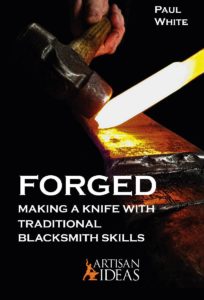
You can purchase Paul White’s Forged: Making a Knife With Traditional Blacksmith Skills here.
TIP: The most important principle in this section is to overlap hammer blows. The right edge of your previous hammer blow becomes the center point of your next hammer blow.
Forge-beveling allows a consistent pushing of the hot steel in all directions at each blow. The physics are consistent, predictable, and reliable. At each strike, the force of the rounding hammerhead pushes the bottom half of the blade and the spine in opposite directions. The tip-to-choil forces are contained for the most part by the blade’s mass.
It’s much like when the smith makes breakfast sausage patties. Imagine pushing the center of that sausage patty down with the heel of your hand (hammer) against the counter (anvil). The patty spreads out in all directions with a dimple in the center, the same as the steel. With repeated overlapping blows the bevel thins and widens downward as the spine stretches upward. The resulting geometry is a thinning and reshaping of the blade between the cheek line and the cutting edge. A bevel is forged and formed with your rounding hammer, anvil and blacksmith’s eye.
Once forge-beveling is mastered you can actually form a hollow “grind” by hollow forging (another lesson, another book).
NOTE: Look at a knife with the pommel to the left and the point to the right, cutting edge down and spine up. For reference and description, this is the right side of the blade.
This is the right side (i.e. right-hand side) of the knife blade
Setting the Bevel
The forge-beveling procedure is advanced forging. Beveling with a hammer is a blacksmith secret used by few these days. Learn this method and you will certainly be connected to the smiths of old.
This forge-beveling procedure takes me six heats or more, at minimum; three on each side. Theoretically, one heat per line, three lines per side (explained below in Half, Fourth, Eighth). Make these passes down the bottom half of the blade traveling its full length. Because you might be a beginner it may take many more passes than six.
You may need more heats due to being hammer shy or because of rookie hesitation. You may start and stop frequently due to under-heating, overheating, dropped blades, re-positioning your piece or “Where’s my hammer?”. All of those are OK. We all do them.
Half, Fourth, Eighth
Let’s go through the forge-beveling principle. First think of cross-section geometry. Develop a visual in your brain of the relative distance from the center point of the hammer face to the bottom one-half of your blade as you travel along its length from ricasso to tip.
Do this by visualizing one-half, one-fourth, and one-eighth. If we were to saw a blade vertically in half and view its cross-section, we would see that its shape is thickest at the top, along its spine. It holds that dimension down to the cheek (about the halfway point) and then dramatically loses thickness as it approaches the cutting edge. This is the bevel. Your bevel. Think halfway from cheek line to cutting edge. This is the 1/2 line.
This traditional way to set this bevel can only be acquired with dozens of latitudinal hammer strikes passing from left to right at those three descending levels: 1/2, 1/4, 1/8. Remember one-half, one-fourth, one-eighth.
Note and maintain a mental image of the three all important forge lines.
NOTE: This 1/2, 1/4, 1/8 business does not mean fractional inches. The fractions refer to the position of your hammer’s center face on the horizontal bar (i.e. halfway, a quarter of the way, and an eighth of the way from the edge to the cheek).
Remember this is a theoretical thing becoming a real thing. The blade is 1-inch wide, and the face of a 2.5-pound rounding hammer is about 1.5 inches. Think exact center of a hammer face on those latitudinal forging lines.
TIP: See the author setting the bevel on YouTube. Search for: Paul White FORGED.
Try not to strike above the imaginary cheek line that runs about halfway between the spine and edge. Your hammer passes will form the cheek line. The final cheek line usually falls well above the halfway point because maintaining that line exactly in the center is almost impossible with a round hammer face, your billet bouncing around on the anvil, and you’re trying to hit on exact points. However, the primary objective is to maintain the original thickness in the spine (1/8-inch) as far down to that halfway line as possible.
Blade Tipping
Each pass will require a slight upward tipping of the spine to acquire about a 10° to 12° angle to be set in the bevel as you hammer. It takes a simple inward twisting of the wrist to keep the blade from resting flat on the anvil face. It must be done at each horizontal pass. This smartly places just the right amount of bevel angle. After a few passes, the blade will “find” that angle as you place it down.
After a complete pass from choil to tip on the right side of the blade, flip the piece over, tip to 10° to 12°, place at the top of the anvil, and do the left side. This is the place to use your indexing skills. It takes most smiths some time and practice to fully master this concept. I’ll go over this beveling thing a couple more times. Read this whole section and look at the drawings and photos several times before doing this.
TIP: Sometimes it takes fewer total passes than I indicate in this book. This is due to the individual smith’s power and/or heat control and/or blade position and/or hammer penetration and/or steel composition. There are lots of variables. If your blade is almost straight after fewer than the recommended strikes or passes, back off on the heat and/or reduce the power or reduce the passes. If you place blows beyond what is needed, the blade will curve upward. Usually, fewer strikes per pass will be necessary as the beveling chore proceeds. This happens because the smith usually increases his or her power and confidence as time at the anvil is increased. Also, the bevel becomes thinner with repeated heats requiring less steel to be moved.
The forging sequence is as follows. Take a heat. Place the blade at the bottom of the anvil. Tip to 12°. Place overlapping blows down the blade on the right side at the 1/2 line. Take a heat. Flip to the left side of the blade at the top of the anvil. Tip to 12°. Forge down the left side at the 1/2 line at the top of the anvil. Take a heat. Flip to bottom. Tip. Place blows down the right side of the blade at the 1/4 line. Heat. Flip. Tip, down the left side at the 1/4 line at the top. Take a heat. Flip. Tip and down the 1/8 line on the right side. Heat. Flip. Tip. Then down the left side at the 1/8 line. Your blade should be nearly straight after three or five passes and however many heats as needed.
By hammering in this 1/2, 1/4, 1/8 method you will “set the bevel” of your knife in the traditional way, FORGING! Ninety-three percent of all bladesmiths set their bevels at the grinder. I have met only a handful of smiths that do this the old way. You’ll be the only blacksmith in the surrounding ten counties that sets the bevel with your three-pound hammer!
Do not strike randomly up and down the blade or space-out (i.e. not overlap) your blows and expect anything good to happen.
BLACKSMITH SECRET: To gauge forging heat have a wooden box close by and away from any direct light. Hold your blade in the box to see the true forging heat. Even when hot the “red” is sometimes difficult to see in a lighted room. However, the red will show in the shade of your box. This means you are above forging heat and will thus avoid potential edge cracks. Remember this is high carbon steel and your working parameters are narrower. Iron can be worked over a greater temperature without damage. At the end of each forging and before you lose forging heat in your blade use the last few seconds to straighten and align your work. Make all lines right with the world.
The successful counter-bend is placed at the “bottom” of the anvil with the choil just at the anvil’s corner next to the table. Several hammer blows are placed at the halfway point/line and then the hammer travels down the blade to the smith’s right.
You can buy Forged: Making A Knife With Traditional Blacksmith Skills here
Keychain Knives Provide Utility And Protection In A Compact Package. There Are Many Quality Keychain Knives At An Affordable Price.
From a conversation piece to the handiest blade available, nothing adds to the everyday carry equation better than the right keychain knife. With little notice until needed, a keychain cutter is ready for action but doesn’t weigh down the pocket or take up too much space in a purse.
Coming in different sizes and blade types, keychain knives are as varied as any other type of everyday carry knife but is smaller and more nimble.
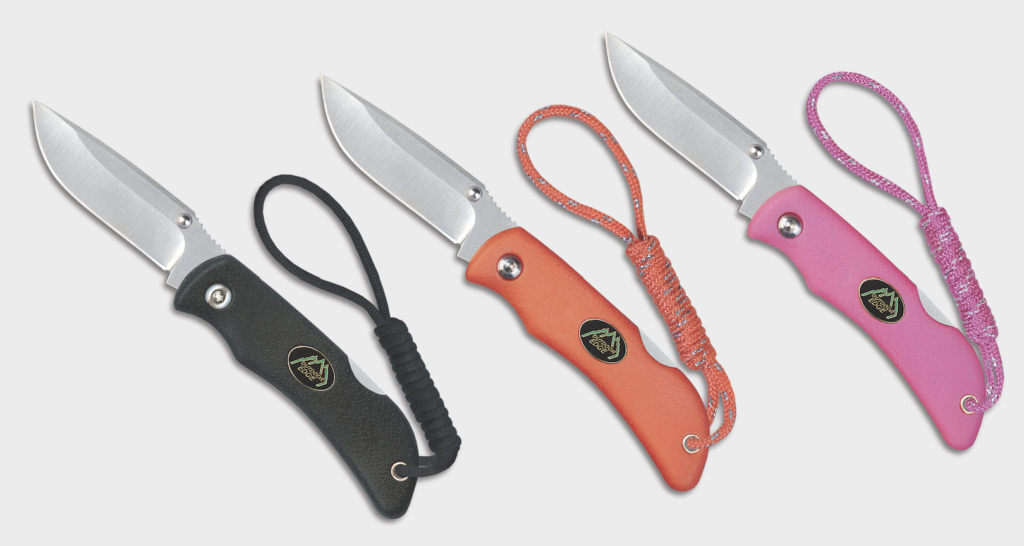
At Outdoor Edge, the MiniGrip, MiniBlaze, and MiniBabe are the same knife differentiated only by color in black, blaze—an orange shade—and pink, respectively. “They’re designed to meet the needs of anyone who needs a small lightweight blade that is always within reach,” Outdoor Edge marketing director William Morgan said. “We designed these knives in three colors to cater to all knife enthusiasts. When we developed this series of knives, we noticed a gap in the market for an affordable and mostly practical small knife that can be easily attached to a keychain or carried in one’s pocket.
The Outdoor Edge MiniGrip, MiniBlaze, and MiniBabe are the same keychain knife differentiated only by color in black, blaze—an orange shade—and pink, respectively. “They’re designed to meet the needs of anyone who needs a small lightweight blade that is always within reach,” related Outdoor Edge marketing director William Morgan.
“We opted to make three colors to accommodate a larger audience,” William continued. “Obviously, the orange is great for high visibility, reducing the chance of losing the knife, while the black is a little more inconspicuous, and the pink seems to be a hit with the female audience.”
Designed in Colorado and sporting a low MSRP, each knife in the Outdoor Edge series includes a 2.2-inch 8Cr13MoV stainless steel blade, rubber TPR handle, 1.4-ounce weight, and 2.9-inch closed length. Each model comes complete with a lanyard that makes attaching it to a keychain easy. Each has an ambidextrous thumb stud for easy one-hand opening as well.
“The razor-sharp blade is up to any task, from opening the latest round of Amazon Prime boxes to cutting rope or even performing field-dressing tasks,” Morgan said. “The rubberized TPR handle serves a few functions. First, this is a small knife, and we were concerned about creating a secure, non-slip grip to avoid accidents. Second, the handle does not jingle against the keys on your keychain, making it a perfect silent addition to anyone’s keys.”
MSRP: $23.95
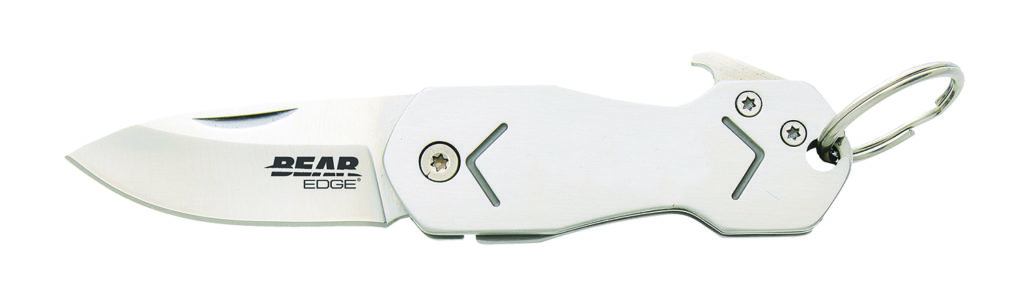
The Bear Edge 71523
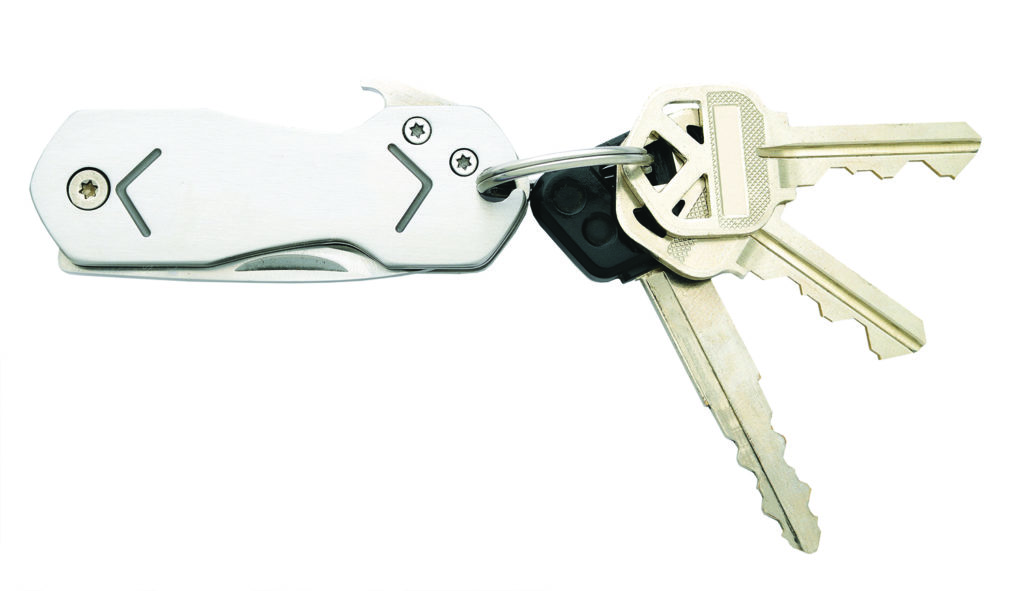
The Bear Edge 71523 from Bear & Son Cutlery complements a substantial line of knives, and company spokesperson Jacob Eaton says it’s a hit. “It’s affordable, compact and a functional tool,” he said. “Customers really like it because it’s lightweight, sharp and just the right size. Plus, you will always know where a knife is when it’s attached to your keys. We find both genders purchasing the Bear Edge 71523, and it fits everyone’s lifestyle.”
The Bear Edge 71523 is a framelock-folding keychain knife with a 2-inch blade of 440 stainless steel and a stainless handle. Weight: 2.3 ounces. Closed length:2.875 inches. The imported knife has an MSRP of $17.99.
The imported 71523 is complete with a two-inch blade of 440 stainless steel, stainless handle, and closed length of 2.875 inches. It’s almost lighter than air at just 2.3 ounces. According to Eaton, the blade length is ideal for typical cutting tasks encountered on a daily basis. “Cutting boxes open, adjusting cordage length and other similar chores are easy with the sturdy framelock design,” he said. “And one can cut confidently.” Another utilitarian feature is the built-in bottle opener.
The company chose the stainless components for durability, and the knife is sized for maximum versatility. “Stainless steel is a timeless design element and proven to stand against wear and tear,” Eaton said. “The finish looks natural on a keychain and doesn’t call attention. The frame pattern was developed to fit comfortably into both large and small hands. The blade is a drop point shape, allowing it to complete most tasks, and the 71523 attaches with a standard split key ring.”
MSRP: $21.49
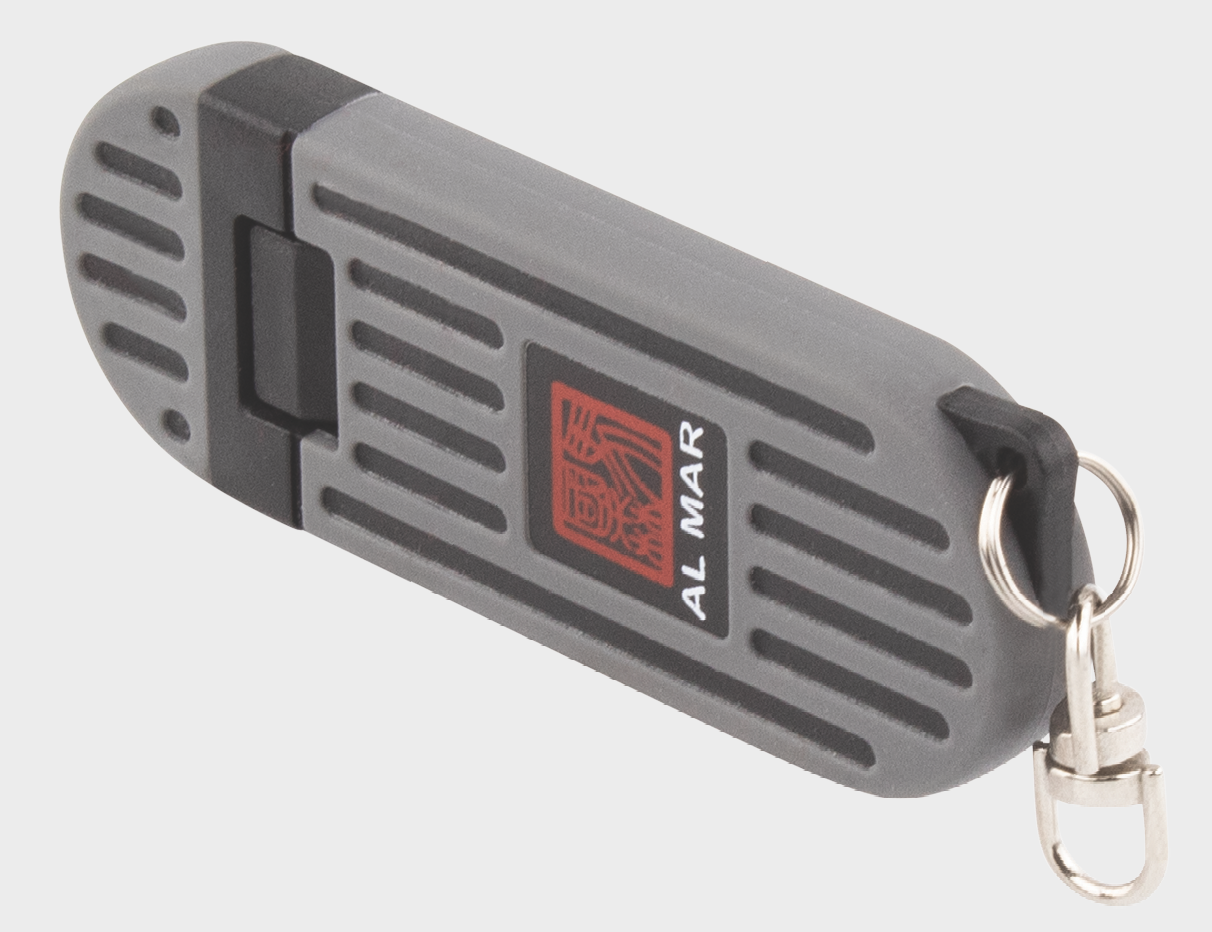
Al Mar Knives Stinger
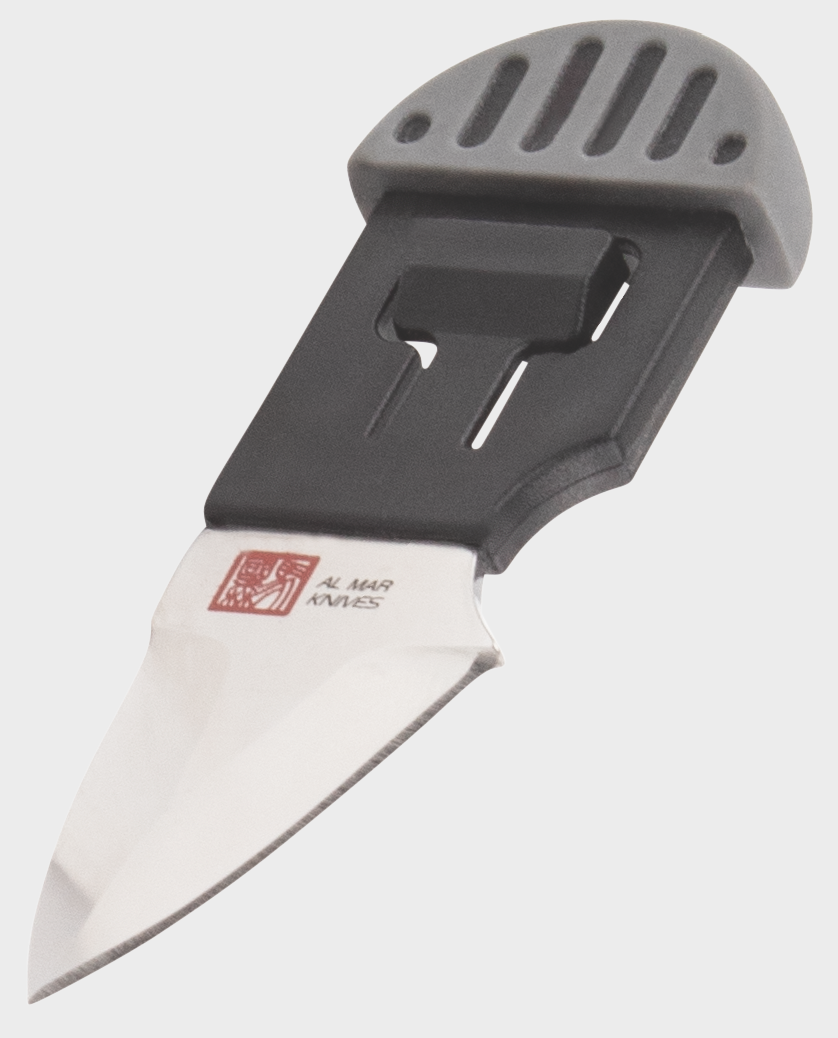
The Al Mar Knives (AMK) approach to keychain knives involves easy access and long-term performance, and the Stinger was developed to deliver classic AMK design and function.
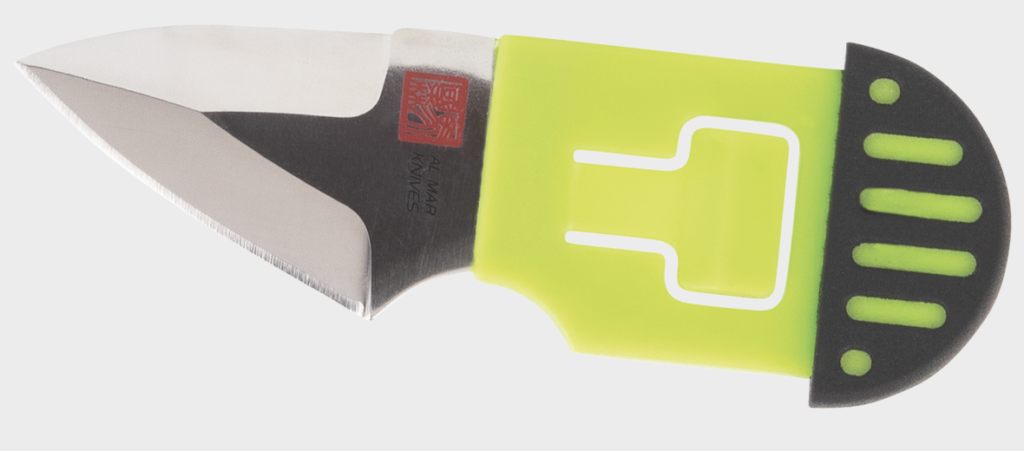
Above: The Stinger fixed-blade keychain knife from Al Mar Knives features a 1.3-inch D-2 tool steel blade in a flat grind, a synthetic PP+TPR rubber handle, and dual-injected sheath of the same material. It weighs just .7 of an ounce. Overall length: 3.1 inches.
“This knife is designed to be great at slicing and fast cuts.” — Justin Rabon
“Our Stinger keychain knife is designed for anyone looking for a durable blade they can keep concealed and on hand, with or without pockets,” AMK representative Justin Rabon said. “Our users find creative ways to incorporate these on their bags, gear and keys. We feel this versatility can help reach a wide range of users across many different lifestyles. We want our keychain knives to be practical for the majority of our users. We want to find the needs in the industry and have our knives be the solution to those needs.”
The fixed-blade Stinger comes complete with a snug-fitting sheath and deploys with a push of a button. It features a 1.3-inch D-2 tool steel blade in a flat grind, a PP+TPR rubber handle, and dual-injected sheath of the same material. It weighs just .7 of an ounce. Overall length: 3.1 inches.
“This knife is designed to be great at slicing and fast cuts,” Rabon said. “It can be used for anything where a short, sharp knife is needed. To accomplish these tasks easily and repeatedly, we gave the knife a D-2 blade. D-2 is known for retaining a sharp edge after repeated use. We also designed the Stinger to have Al Mar’s Wedge-style blade. This provides a superior dagger point where needed.”
The AMK Stinger comes complete with a snug-fitting sheath and deploys with an easy push of a button. It comes in red, blue, black and green—and the green really stands out in a crowd.
The Stinger’s finer points add flair and good looks as well. “The four colors that were chosen for the four Stinger knives—red, blue, black and green—were picked to provide variety while staying true to the traditional red and black of Al Mar Knives. The plastics in the handle were chosen to add extra grip and durability.”
Integral to the Stinger design is an eyelet built into the sheath, and sturdy construction prevents failures. “This makes sure the sheath doesn’t detach from the eyelet,” Rabon said, “and also allows you to replace the smaller key loop with a smaller diameter cord if desired. The Al Mar Wedge provides a superior point if needed, and the finger groove at the base of the blade allows the Stinger to sit comfortably in most hands. This improves the fit, feel, and functionality of the knife.”
MSRP: $12-23
Gerber Key Note
Gerber spokesperson Josh Headley said the focus on the company’s Key Note keychain knife is compactness. “We also wanted to add some chisel/scraping capabilities for additional functionality,” he said. “Gender wasn’t a big consideration. We just wanted to make a tool that was worthy of a place in your pocket or purse.”
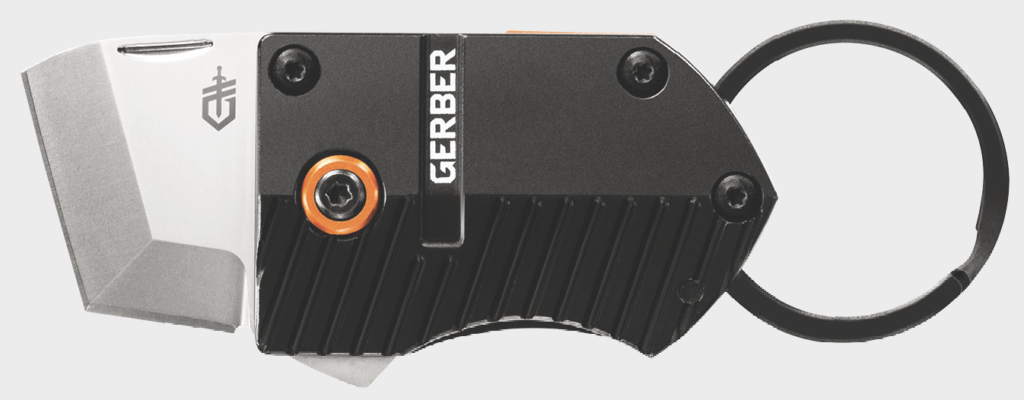
Also available in black as shown, the Gerber Key Note linerlock keychain knife has a 1-inch blade of satin-finished 5Cr stainless steel that is designed to scrape as well as cut. Handle: aluminum. Weight: 3.98 ounces. Closed length: 2 inches.
Features inherent in the Key Note design brought that idea from the drawing board to reality. “We added the wide clip so that you can also hang keys on your belt,” Headley said. “The knife was designed to not draw too much attention when worn on the clip, but still have a pleasing and almost symmetrical shape. We took a lot of inspiration from the history of Gerber. The overall profile is inspired by the shield logo, as well as Gerber’s past logos and heraldic-naming conventions with a modern twist.”
The Key Note combines function with a tip of the cap to Gerber tradition. With a 1-inch blade of satin-finished 5Cr stainless steel, the knife weighs just 3.98 ounces, and its aluminum handle scales are built to last.
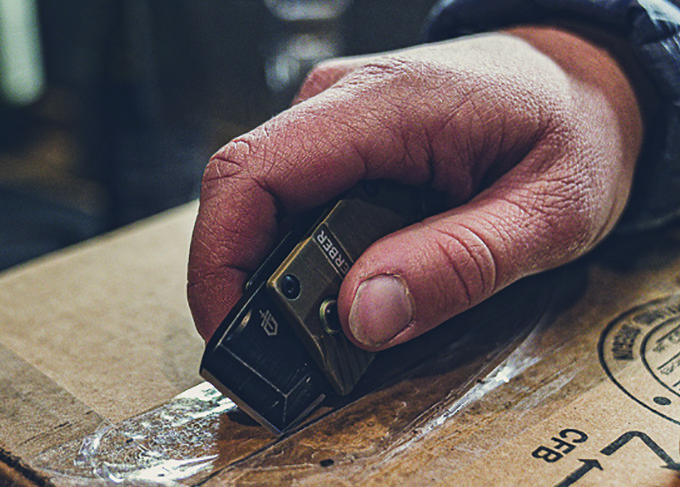
“The primary function of the Key Note is to open packages,” Headley said. “The thought was you get home, grab a package off your porch and open your door. You have the tool set to open your door and open your package in hand.”
The Key Note’s tanto-style blade allows for scraping & chiseling along with cutting.
Available colors add to the Key Note’s appeal for those who look for discretion or want a bit of flash. “We set out to have a modern option and an old-school option for the EDC community,” Headley commented. “The matte-black anodize with the bright contrast from the orange is meant to look at home next to your key fob. The coyote and sage is designed to camouflage among a set of brass keys. We made the scales out of aluminum to increase the strength of the lockup, and so that the weight of the keys won’t knock the blade off balance. To improve longevity, the blade runs on brass washers and operates on a classic linerlock.”
The blade is in a compact tanto style to provide two flat edges that are easy to sharpen. A flat key ring gives an appropriate amount of flexibility between the ring and scales. Several different diameters of rings were tested to determine the best component. A kick-out tab is incorporated to assist in deploying the blade and allow easier opening rather than solely depending on the nail nick.
“The Key Note should be suited to light and medium opening and cutting tasks,” Josh said. “The flat edge on the front can be used to scrape everything from a label to that last bit of errant head gasket. In addition, the front of the scale can be leveraged so that the midpoint of the blade will puncture tape without damaging the contents of a box.”
MSRP: $21.60
Kershaw Cinder
Kershaw Cinder keychain knife.
If there was a knife out there that could be called adorable it’s the Kershaw Cinder, but don’t judge a book by its cover. This knife comes with a blade of 3Cr13 blade steel, and you know with the Kershaw name that it will be a quality knife from blade to handle. An excellent box cutter and utility knife or a protection piece for your keychain or purse, the Cinder plays far bigger than its size. Also, it has an integrated bottle opener and we could always use another of those.
Sypderco has made a nimble keychain knife that feels like it should cost more than it does. At less than three inches in total length, the Bug easily slides onto a keychain and works as an excellent low-profile EDC for protection and whatever else life throws at you.
A flat-ground blade made of 3Cr13MoV stainless steel, the Bug also features a flat, stainless steel handle great for engraving or personalizing for yourself or a friend as a gift. The smallest folding knife made by Spyderco, the Bug delivers in nearly every way.
MSRP: $24.50
SOG Centi II Knife
SOG Centi II Knife
Featuring a lockback design, and a blade coming in at 2.1 inches, the Centi II is a versatile knife fit for your pocket, keychain, or even on a necklace. Strong yet thin, it’s even thinner than your car key, the Centi II is robust enough to tackle any day-to-day tasks you’d expect from any other EDC. The hardcased black finish is gorgeous and adds a sleek design touch to the knife.
Victorinox Classic Swiss Army Knife
Victorinox Classic Swiss Army Knife
When it comes to keychain knives it’s impossible to make a list without the famous Swiss Army Knife. With seven tools and functions built into a body just 2.3 inches in length, the Swiss Army Knife is famous for its versatility and is still one of the gold standards of keychain knives.
With tools made of stainless steel that include a small blade, scissors, and a nail file with a screwdriver, the Swiss Army Knife can handle pretty much any situation life can throw at you where you’d need a quick tool. The classics become classics for a reason, and you can’t go wrong with a Swiss Army Knife on your keychain or in your pocket.
Drawknives Are A Woodworker’s Best Friend And One Of Many Unique Knives Craftsmen Use Regularly
Knives take on many shapes and sizes. As tools, their designs sometimes focus on specific tasks. In the case of the drawknife, it is designed for woodworking. Drawknives have been found to date back to the Viking era more than a millennium ago.
The design itself takes many different shapes for a variety of purposes. At times, it is not referred to as a drawknife but, at first glance, you can see the relationship and how a number of tools can be considered part of the same family. As with any tool, different cultures have different interpretations of how the tool should be designed.
What Is A Drawknife?
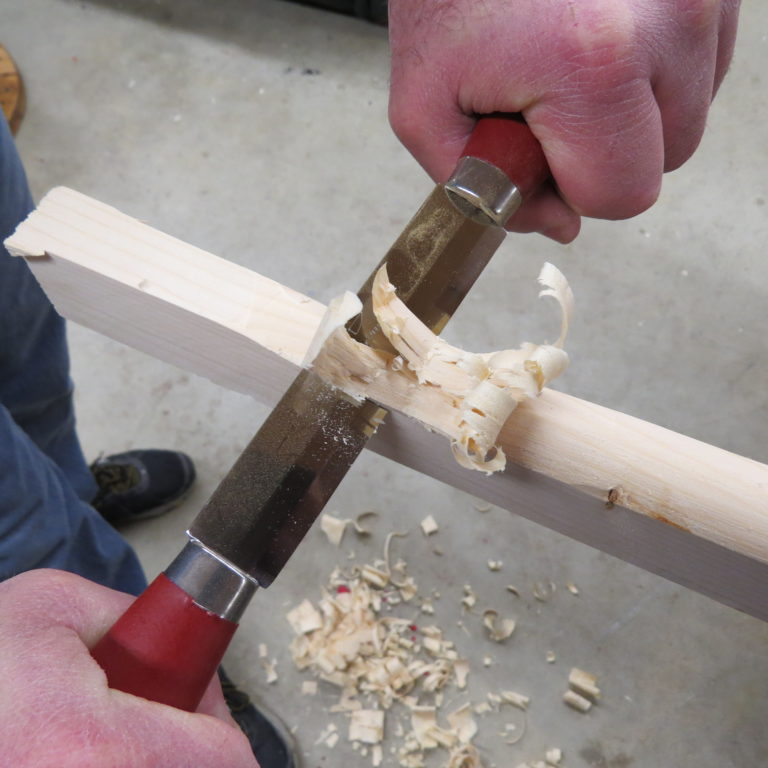
A drawknife is a single-beveled blade placed between two handles. The tool gets its name from how it is used. You simply grab both handles and draw the knife towards you bevel up. Controlling the angle that the blade enters the wood will control the depth of cut. A steep angle will get you a deeper, more aggressive cut but will also require more effort.
Lowering the angle makes for a shallower cut and also gives you a finer finish as the material is removed less aggressively. Some designs have long handles on plane with the blade. Other designs have the handle tight in and below the plane of the blade. No matter where the handles are, the action is the same but the point of control changes.
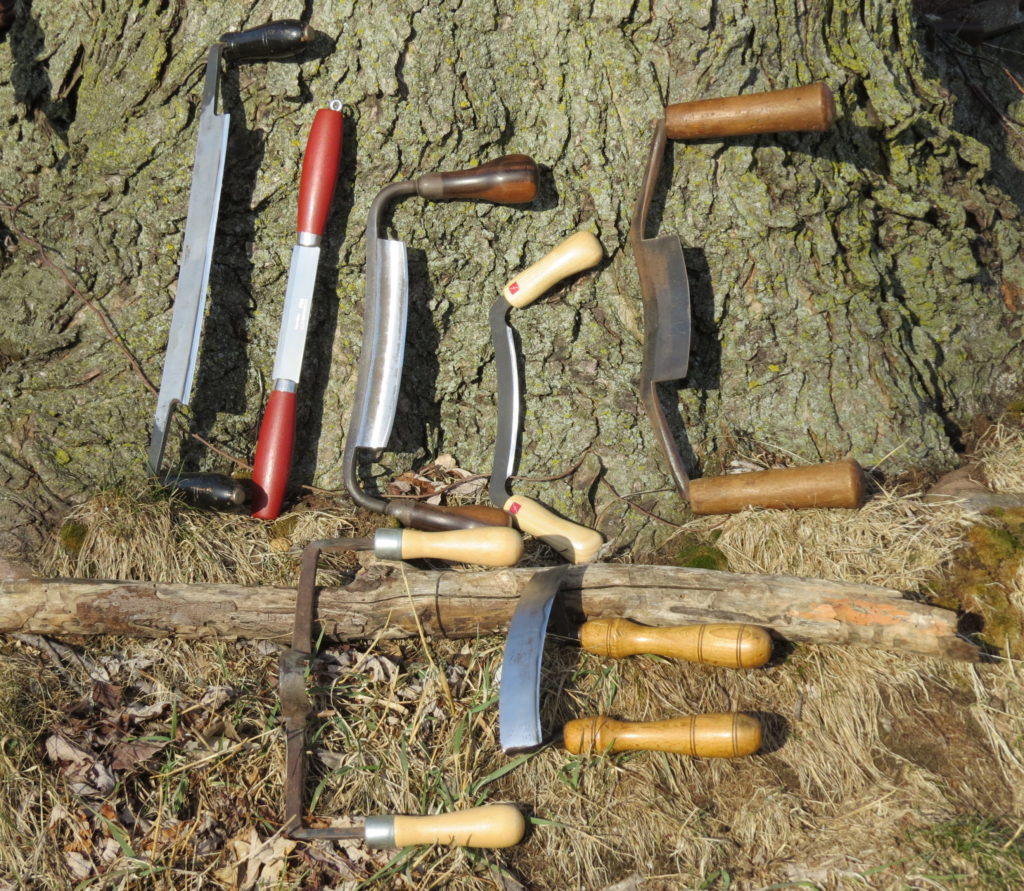
Top row, from left: a German-style drawknife made in Western Germany, Mora push knife, English-style drawknife, Flexcut 5-inch drawknife and a cooper’s knife. Bottom row, same order: Round drawknife and a chair maker’s scorp.
How To Use A Drawknife
When working with a narrow stock up to two inches wide, it’s easy enough to draw the knife straight back toward you. On wider stock, it is better to skew the knife. Skewing the knife provides a leading edge and causes less resistance during the cut. When working with hardwoods you want to keep the cut light, as the dense grain provides more resistance and bogs the knife down.
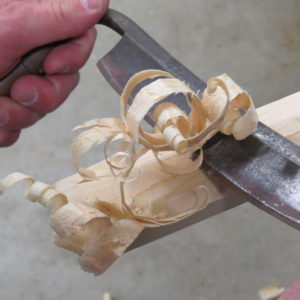
If you skew the knife and work the corners it is easy to remove long curls.
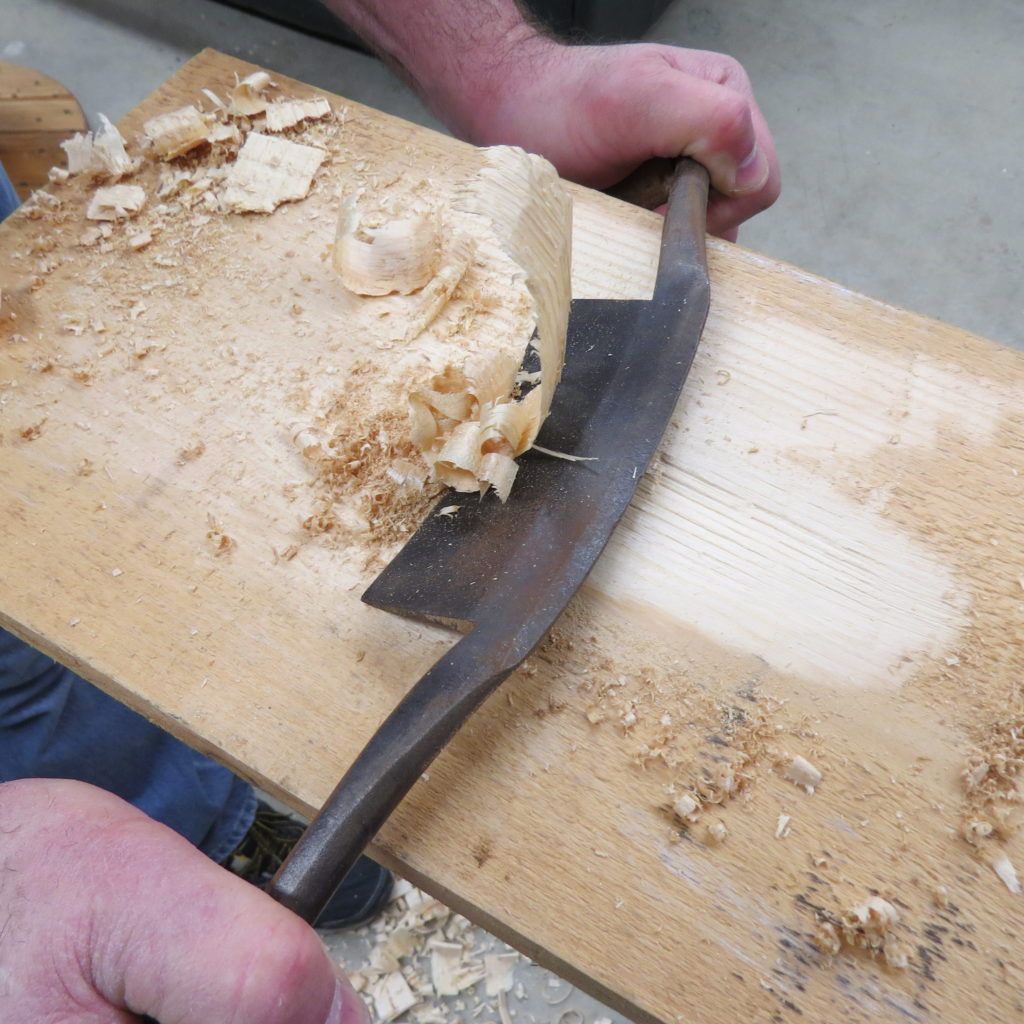
Even when working a flat when skewing the drawknife blade you can get some beautiful shavings.
Learning to use a drawknife properly is a bit like working a puzzle. The easiest way to make a cut is to work the facets of the material. For instance, say we are working on a piece that is square. To shape the piece to the required size it is easier to work the corners down, creating more corners until you get to your desired shape. By working the flats, you must use more energy and struggle to make a cut.
When first using a drawknife, the tendency is to use your arms to power the tool. Instead, use your back muscles, which are larger and less likely to fatigue quickly. Draw the knife back as if you were using the same muscle for rowing. If done right, it should feel like your shoulder blades are trying to meet in the middle of your back. For safety’s sake, keep your elbows in tight. As you draw the knife back your elbows will hit your core acting as a safety stop, preventing you from slipping and cutting yourself.
Types Of Drawknifes
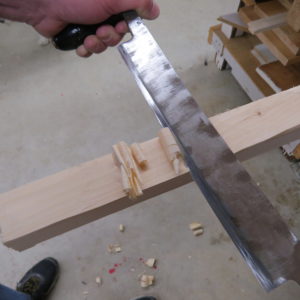
A debarking knife is usually a larger style of drawknife used for extracting bark from logs. They are larger and heavier than their woodworking counterparts so that you can blast through the bark.
It has been my experience that when working green wood, the knife doesn’t need to be kept as sharp. In fact, it is somewhat more helpful to keep the knife a bit dull when cutting green wood so as to avoid diving too deep into the wood itself. On seasoned logs, because of the lack of sap between the bark and sapwood, I find it better to have the knife a bit sharper.
Woodworking drawknives come in a variety of shapes and sizes. The two main types I have used: English and German. The English style has a blade that bares a slight arch and the handles are on the same plane as the blade. German-style knives have handles that sit lower than the blade and the blade tends to be straight. The knives’ handles can vary. Most of mine have a pear-like shape. There are other styles like a round knob style, which is a ball shape.
The English style drawknife has a small but thin bevel that makes for some beautiful curls.
The German knife has a steep angle to the bevel. If used straight across a narrow piece wood, it can remove large amounts of material. At the time of the photo, the author had not finished cleaning up the blade, ergo the hammer marks in it.
Specialty styles of knives include any drawknife that is shaped to obtain a specific result. A cooper’s knife is shaped to accommodate the making of barrel staves. I also have a handle-making knife. The handle-making knife is a tight arch designed to make handles for things like brooms or garden implements. The basic shape is a half circle, so instead of trying to round a piece off by angling a number of cuts, you get a piece of wood close to size and simply let the knife shape it.
The cooper’s shave is designed to hollow out the staves of a barrel.
Push Knife
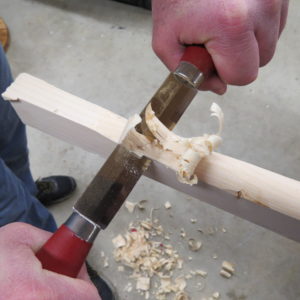
The model uses the Mora push knife to clean up curls left at the bottom of a curve. With the push knife, you can work the wood in an opposite direction without repositioning the piece.
A Scandinavian invention, the push knife is similar to a drawknife in that it has a blade attached by two handles on either side. Using a push knife is different in the way that you are expected to force the edge away from your body instead of pulling it toward you. Unlike a drawknife, the handles come straight out from the sides, which allows you to either push or pull the knife. I normally use the knife in the manner that gets the job done—meaning on occasion I will draw the knife toward me rather than push.
What Is A Scorp?
Technically, scorps are not drawknives. However, in terms of looks and use you can’t help but lump them in the same family. I have a chair maker’s scorp that is designed to hollow out the seats of chairs. On older chairs is a slight depression where the person sits. A chair maker’s scorp was used to produce the shape. The tool operates just like a drawknife except it has a shorter blade with a more pronounced arch.
How To Sharpen A Drawknife
Like any other cutting tool, a drawknife must be sharpened. Perhaps the trickiest part of sharpening a drawknife is finding a way to brace it. I find dynamic sharpening the easiest way to sharpen a drawknife. I brace the knife and move the sharpening medium instead of the other way around. One way to brace the knife for sharpening is to put one handle in your armpit and hold the other handle in your off hand. Once the knife is braced this way, take a stone to it. Another way is to brace one handle on the bench, lean your chest on the other handle, and then begin sharpening. Keep in mind a drawknife must be sharp (except where noted previously) but since it is not necessarily a fine woodworking tool, don’t get carried away.
YouTuber James Wright shows you how to sharpen a drawknife using a set of sharpening stones in his shop.
Lastly, keep it oiled. Even the newer ones are not made from new high-tech steels. Most are from simple carbon stock and a light coat of oil goes a long way. Among others, Flexcut offers a contemporary drawknife.
Other Wood Carving Tools
Beyond drawknives and planes, there are many other types of wood carving knives out there that can help with some of the finer points of woodworker. Small, nimble wood carving knives like a sloyd knife or a spoon knife.
A sloyd knife is a short, sturdy blade good for small, finite carving tasks. A spoon knife, as the name suggests, is meant to carve out the concave scoop of a spoon but can be used for any other situation where you are trying to create a concave dip in the material.
There are certainly more than just these few tools to being a successful woodworker, but knowing how to use wood carving tools big or small can get you on the path to success.
Why To Use A Drawknife
Long before there was solar power, fossil fuel power, steam power, etc., there was muscle power. Humans developed the world using tools with muscle and sweat. There is something satisfying about making something by hand. The feel of a good day’s work is sometimes what the soul needs. A drawknife not only gets the job done but also gives you an accomplishment to savor.
Bob & John Horrigan Made Knives Together. After The Former Died Defending The Country, John Kept Their Knifemaking Legacy Alive
It was a night mission, and it was dangerous—just like every mission, every moment in the deserts and villages of western Iraq or the mountains of Tora Bora in Afghanistan.
“You don’t have to come,” the others said matter-of-factly to Master Sergeant (MSG) Bob Horrigan. “You’ve only got two weeks left in the country.” The veteran Delta Force NCO, with 19½ years in the U.S. Army, three tours in Afghanistan, and a fifth in Iraq coming to an end, simply replied, “If you’re going, I’m going.”
True enough, Horrigan was just days away from returning to the USA, and he planned to retire from the Army in six months, then, in peace, to make custom knives in his shop and share that time with his twin brother, ABS master smith John Horrigan.
This night, however, there was dangerous work to be done. A raid was planned on a safehouse known to be frequented by terrorists, particularly Iraqi al Qaeda leader Abu Musab al-Zarqawi, a ruthless murderer pledged to support Osama bin Laden. Horrigan
A veteran Delta Force NCO, Bob Horrigan served 19½ years in the Army, including three tours in Afghanistan and five in Iraq. He was killed during a raid on a safehouse frequented by terrorists, including Iraqi al Qaeda leader Abu Musab al-Zarqawi. Bob was laid to rest with full military honors at Arlington National Cemetery.
When the call went out for someone to serve as a master breacher during the mission, blasting doors and first inside a building where hostiles might be hiding, Bob Horrigan said without hesitation, “I’ll breach.” In the town of al Qaim in western Iraq, the Delta Force team, accompanied by additional Special Forces personnel, moved toward the suspected Zarqawi safehouse. With MSG Michael McNulty at Bob’s side and the rest of the team close by, the two were first to enter the enemy compound.
Bob made it into a nearby room, and a machine gun opened up. McNulty was hit in the doorway. Bob was fatally wounded seconds later. Both died within a few hours.
“It was about 7 in the morning. I was at home, and Bob’s brother-in-law, Mark England, came to the house,” John Horrigan recalled. “Our sons were best friends, and I thought he was coming to tell me that my son had gotten into trouble. He said, ‘No, John. It’s Bob.’”
The news was devastating, and Bob Horrigan was laid to rest with full military honors at Arlington National Cemetery, following a funeral service in Austin, Texas. He left behind his wife, Denise; young daughter, Courtney; older sister, Lisa; younger brother, David; many friends and relatives; and, of course, twin brother John.
To say Bob and John shared a special bond, even as identical twins, would be an understatement. Their mannerisms and speech patterns were so alike, and they experienced the joy of growing up inseparable. They also shared their love of service to their country, and later came a great interest in custom knives.
First Drop Zone
The brothers were born in Limestone, Maine, on Jan. 13, 1965. “I came into the world seven minutes before Bob, so I cleared the drop zone. We always said he was a hung jumper,” John smiled. “We’re identical twins, so I got into fistfights for him, and he got into fistfights for me. It was like the Doublemint®-Spearmint commercial, and it was that way in school and in the Army. He continues to be half of me. He is still here, and I can feel his presence out in the shop now and then.”
John made his first knife in high school. Instead of making a planter as his shop project, he found a piece of O1 tool steel and went to work on the knife. His son carries the same fixed blade today, first with a cherry handle and later with one of maple. For 24 years now, John has worked as a firefighter with the Austin Fire Department, the family’s hometown after moving from Maine to Florida and then to Texas years ago.
John enlisted in the Army in 1984, six months ahead of Bob. The two became Rangers, elite soldiers engaging in demanding training programs and taking on the most hazardous combat operations. They served in the 3rd Ranger Battalion, 75th Ranger Regiment, and Captain Stanley McChrystal, who later reached the rank of general and commanded American forces in Afghanistan, led Company A.
John spent three years on active duty as an Army Ranger. Bob stayed in and spent about eight years with the 7th Special Forces Group and 9.5 years with Delta Force. Even among the elite of the 7th Special Forces and the clandestine Delta Force, Bob stood out. He attended just about every training school imaginable, including the Basic Airborne Course, Jungle Warfare Training Course, Special Forces Qualification Course, Military Freefall Jumpmaster Course, and several others. In 1987, he competed in the Best Ranger competition at Fort Benning, Georgia, and placed second.
He was a leader of hardened, highly trained military professionals, and among his numerous decorations were the Bronze Star, Purple Heart, Legion of Merit, Combat Infantryman Badge, and Expert Infantryman Badge. The full list of his accomplishments during a distinguished two-decade career is literally too long to include in this story.
Several well-known authors have written about his exploits, including Brad Thor, Pete Blaber, Sean Naylor, and George Hand IV. In writing of the funeral of a central character in one of his novels, Thor is actually describing Bob’s funeral, an all-too-real and somber event.
In his book The Mission, The Men, and Me, former Delta Squadron Commander Blaber remembered Bob and wrote, “After unshouldering his ruck, Bob H. scotched forward on his belly. He stopped behind a small pile of rubble. Canting his head slowly, he spied the valley below. His eyes and ears strained to detect any unnatural noise or movement; Bob was focused like a man whose finely tuned autonomic nervous system is programmed to maintain perfect equilibrium between the thrill of the hunt and the thrill of the chase. Bob understood his status as both the hunter and the hunted. He liked it that way … Courage has been called a contradiction in terms, meaning a strong desire to live manifesting as a readiness to die. It described Bob and his mates to a tee.”
During those long deployments to combat zones, Bob stayed in touch with John, mostly via email. “He would send one to me, and I would respond,” John said. “The next morning there was another one waiting for me. Robert downplayed a lot of what was going on. He’d say, ‘Not much happening here … I’m bored.’ But he was lying. They were in firefights every day; he just didn’t want people to worry about him.”
In his book The Mission, The Men, and Me, former Delta Squadron Commander Pete Blaber wrote of Bob Horrigan (above): “Bob understood his status as both the hunter and the hunted. He liked it that way … Courage has been called a contradiction in terms, meaning a strong desire to live manifest as a readiness to die. It described Bob and his mates to a tee.”
Meanwhile, there were those precious times that Bob came home, mostly during the Christmas season, and the twin brothers picked up where they had left off during a prior visit. One of their primary topics was—of course—knives.
$50 Sander
John was 21 when he left the military, and he visited a knife and gun show in Austin with a pair of his own custom knives and a couple of makeshift cardboard wheels under his arm that he used as sharpeners. He met Houston-based custom knifemaker Ed Thuesen, who also owned Texas Knifemakers Supply.
“Ed saw those under my arm and said, ‘Don’t use that crap!’” John recalled. “I told him I couldn’t afford a new sander, and he said that he had a used one in Houston that he would sell for $50, but I would have to drive there to pick it up, and he wanted cash. I said, ‘Deal!’” Later, John bought a brand-new Bader sander and sold the used one to Bob—
for $50.
“I got into knifemaking, and then I got Bob into it,” John smiled. “He mainly made military fighters for guys in his unit, for Navy SEALs or whoever. He had more business than I did.”
At Fort Bragg, North Carolina, home of the Army’s Airborne and Special Operations Forces, Bob set up a knife shop in a lawnmower shed. Power was supplied with an extension cord, running through a sliding glass door to the shop’s tools. He enjoyed working with 440C and 154CM stainless steels, but he couldn’t forge on the Army post. Hence, when he needed a piece of damascus, John gladly supplied it.
“He wrote me a letter once telling me how much he loved coming home, coming to the shop and learning new things,” John remarked. “He would tell me that copying someone else was the highest form of flattery, and if you look at Robert’s knives they were similar to the knives I made. But he’s my brother, and I don’t care. Later, he got into his own designs, and now my best-selling knife is one of Robert’s designs.”
That legacy design is the Robert “Bob” Horrigan Military Fighter, available from John today in the notable style that has become popular in the military as well as the general public. The fighter is 11.25 inches overall with a 6.375-inch blade of 440C stainless steel and a handle of black linen Micarta®. The knife weighs 8.7 ounces and is accompanied by a Kydex sheath.
“I actually didn’t make the Bob Horrigan,” John related. “I made my Model 1 and others, but there were some guys from the 160th Night Stalkers who were on the mission that night and asked if I would make the Bob Horrigan knife. Now I make the Bob Horrigan, and I make them the way he did.”
Through the years, John has established himself among the best bladesmiths and custom knifemakers around. His daggers, tomahawks, and fighters are acknowledged as fine work, and his dazzling inlay with precious metals is something to behold. “I tell everybody that is my Picasso work,” he laughed.
Tremendous Spirit
Living quietly in Burnett, Texas, about an hour outside Austin with Donna, his high school sweetheart and wife of 33 years, John works in a 30×40-foot shop on his farm, dotted with chickens, goats, and bees. Donna says the shop is as big as the couple’s first house. They have two grown children, Matthew and Krystal, and two grandchildren, whom they adore.
Reflecting quietly, John observes, “The greatest thing that has happened since Bob’s death is that he brought me back to God, and that is the best thing he could ever leave me. Being twins, it was pretty rough, and it felt like half of me was gone. Bob came to me at the BLADE Show* two years before he was killed and said, ‘I’m coming back to God. At the time I just said, ‘Great!’ but when he was killed, God was what got me through it.
Designed by Bob Horrigan, the Robert “Bob” Horrigan Military Fighter is ABS master smith John Horrigan’s best-selling model. “I make them the way he did,” John said, including a 6.375-inch blade of 440C stainless steel, a black linen Micarta® handle and a Kydex sheath.
“I started living for Robert, for my family and doing what God wanted me to do,” John continued. “I know where Robert is now, and I know where I’m going. Bob killed a lot of people and that worried him. So he went to the chaplain, who told him that the Bible said not to murder. It didn’t say not to kill in defense of your country. So, he was good with that. I don’t think my brother ever had PTSD because he had God.”
John received his ABS master smith rating shortly before Bob was killed, and as he continues to live his dedicated life, he takes comfort in the fact that his brother, who also wanted the ABS designation, knew that John had achieved it.
In recent years, John has made presentation knives depicting the American flag for Delta Force and for former President George W. Bush, whom he met at Fort Bragg during a visit after Bob’s death. He presented the knife to “W” sometime later in Dallas.
John is generous with Honor Flight Austin, donating knives that raised $19,000 at auction, paying for 19 veterans of World War II to visit their memorial in Washington, D.C. At one auction event, he presented a Bob Horrigan fighter to Admiral William H. McRaven, commander of U.S. Special Operations Command. At an auction the following year, he presented a Bob Horrigan fighter to Medal of Honor recipient Sergeant Salvatore Guinta of the 503rd Infantry Regiment, 173rd Airborne Brigade Combat Team.
During each of these events, John has felt his twin brother right there with him. In service to his country, Bob made men. In the shop, he made knives with lasting, honorable attributes like those who carry them today. Noted John, “The sacrifice of these young men and women is incredible.”
For the elder Horrigan, every day is a tribute to his brother. Their love of the custom knife is an unbreakable link, and to be sure, every knife that John will ever complete carries something of Bob’s tremendous spirit with it.
The Lorenzi Foundation and Museum showcases one of the finest collections of rare and historical knives in the world.
One of the most extensive collections of ultra-rare modern custom and historical knives, cutting implements and many other items connected with the cutler’s art is displayed magnificently in a new museum in Milan, Italy.
A labor of love by Aldo and Edda Lorenzi, the museum is under the auspices of the aptly named Aldo and Edda Lorenzi Foundation (established July, 2020). The museum showcases the Lorenzi Collection consisting of about 2,000 pieces in all, catalogued and accompanied by specific information: era, origin, artisan (if known), function, material, construction and more.
Aldo & Edda Lorenzi
It gathers cutting utensils and related items dating from the Etruscan period (approximately 900-27 B.C.) to today. It is complemented by a series of specialized publications, testimony to the incessant research that was necessary to bring the operation of the Lorenzis’ internationally recognized G. Lorenzi retail knife store in Milan to exceptional levels, and to which Mr. and Mrs. Lorenzi devoted their efforts and creativity for many years. It is all housed in a state-of-the-art edifice containing many of the displays and other historical examples of the cutler’s art from the original G. Lorenzi shop and elsewhere.
The Foundation’s premises include a library where visitors and specialists may view the bibliographic materials. A special fit-out of the space enables visitors to relive the shop’s atmosphere. Thanks to an attentive recovery, a number of the original furnishings have been reinstalled on site. This includes an exterior window from G. Lorenzi, one of six “eyes” that communicated with window shoppers in one of Milan’s most exclusive retail store districts, and the display counters on which, over the years, over 18,000 types of sales items were placed. The space also features oak display cases in which the items were shown, as well as the copper-paneled room that featured the small entrance door opening onto the larger shop.
Historic Excellence
The collected items demonstrate, by starting from an artisanal craft as ancient and humble as that of the knife grinder, how it is possible to evolve and then achieve historic excellence. As further informational support, there are over 700 books, about 1,000 magazines and 150 prints, which for the most part depict traveling knife grinders. In fact, Aldo’s father, Giovanni Lorenzi, started his career as a professional knife grinder. Giovanni
Edda Lorenzi examines and arranges some of the many cutlery items from the Lorenzi Collection. (Lorenzi image)
founded Coltelleria G. Lorenzi—a small shop at the time—at the address of via Montenapoleone 9, Milan, a shop later operated by his sons Aldo, the sole administrator, and Franco. (Regrettably, Franco passed away a few years ago.)
In the course of over 60 years, the Lorenzis collected and kept the pieces which best represented their profession until the closure of G. Lorenzi in 2014. Their selection of the most recent items from their collection was made possible thanks to the close, precious relationship with the artisans—many Europeans, a number of Americans and Japanese—whom Aldo and Edda visited periodically at their shops. It was in such shops that the artisans created their unique pieces, full-fledged artworks that stand the test of time and which enabled G. Lorenzi to become renowned and appreciated at the international level.
Custom Gems
Included in the collection are 150 custom knives by American makers, knives that are particularly near and dear to Mr. and Mrs. Lorenzi. Having collected such knives since the mid-1970s, the Lorenzis traveled the USA, not only visiting the makers in their shops but also attending most every major knife show, meeting just about every maker worth his or her steel along the way.
Among the Lorenzis’ honors are The Knifemakers’ Guild’s Nate Posner Award (1995); the BLADE Magazine Industry Achievement Award (2014); the American Bladesmith Society Special Achievement Award (2014); and the Gold Star Award of Recognition from the William Moran Jr. Museum and Foundation (2014). Three of the Lorenzis’ favorites among their favorite custom knives in their collection are:
The number one of an art piece by W.W. “Bud” Cronk, the maker some consider the father of the modern art knife. Aldo ordered a copy of the knife for one of the Lorenzis’ best customers, but Cronk passed away before he could finish it. It would’ve been a coup for the Lorenzis if they could have gotten the copy too, as Cronk never made duplicates of his work. The copy was used later as the model for the logo of the W.W. Cronk Award, a private honor Don Henderson sponsored for 25 years for the Guild Show’s best art knife
A Bob Loveless/Barry Wood folder Loveless gave to Aldo when the Lorenzis visited the Loveless shop in 1977. Unaware at the time that U.S. knifemakers’ shops were not retail knife stores, the Lorenzis knocked on the Loveless shop door unannounced. Loveless answered the door and, unsure at first what to make of the couple from Italy, soon hit it
Loveless/Wood Folder
off with Aldo—so much so that he gave the Lorenzis the Loveless/Wood folder. Before the Lorenzis left, they asked Loveless why he had trusted them so much at first sight that he gave them a knife (at the time, Aldo and Edda had no idea what Loveless knives were worth). “He replied that we ‘had our history written on our foreheads,’ a phrase that we have never forgotten!” Edda wrote. “These are the kinds of bonds that have made us love American knives and knifemakers even more!”
A Multilock folder by Ray Appleton. Edda recounted a memorable trip the Lorenzis shared with Appleton from Georgia to Chicago, including visits to an Atlanta racing museum and Kentucky’s Mammoth Cave in the process, the latter where the 6-foot-8-inch Appleton bumped his noggin on a cave overhead. Recounted Edda: “Since Aldo wanted to stop at every cutler shop he knew along the way, Ray generously offered to make the phone calls for him to warn the shops of our arrival. ‘I’m Aldo Lorenzi’s secretary, Hot Pants,’ he announced himself on the telephone, making us laugh a lot!”
These are but three of the many American custom knives and their stories among the scads of other custom and assorted knives and cutting implements in the museum. Meanwhile, a 300-to-400 page catalog of museum items is due for completion by early 2022 at the latest.
If you ever get Milan way, a visit to the Aldo and Edda Lorenzi Foundation and Museum is a bucket-list must.






![8 Affordable, Cool, And Compact Keychain Knives [2022]](https://blademag.com/wp-content/uploads/Screen-Shot-2021-03-18-at-1.21.33-PM-768x577.png "8 Affordable, Cool, And Compact Keychain Knives [2022]")