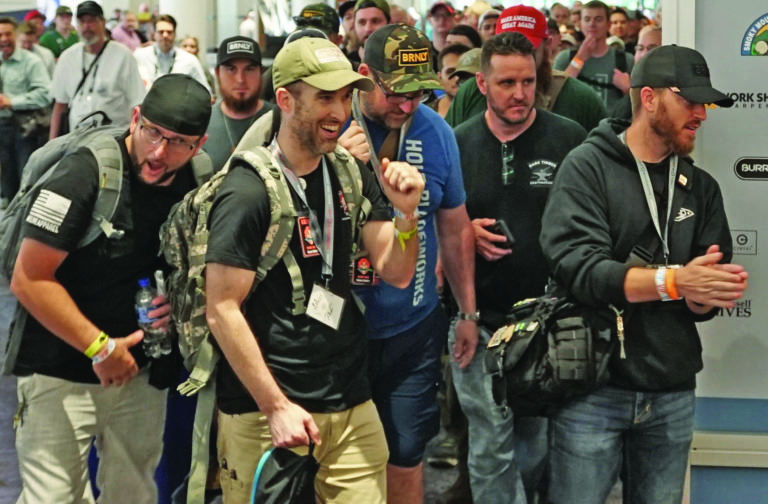
Learn the latest about knifemaking techniques and other trending sharp subjects during the 9th Annual BLADE University 2022 Friday and Saturday of the BLADE Show.
Sponsored by Work Sharp, BLADE University has the most extensive schedule of knife, knifemaking and other instruction held at any knife show. New classes for 2022 include How To Forge a Sub-Hilt Knife with ABS master smith Steve Randall; Post-heat-Treat Grinding with custom knifemaker RJ Martin; How To Start a Knife Company with Diane Carver and Kimi Jensen of Brighten Blades; Keys to Outstanding Hamons with ABS master smith Brion Tomberlin; and more.
For the full list of classes, see the accompanying schedule. For enrollment and other information visit show.com/show-info/classes, or the Registration Counter in the show lobby.
8 a.m.-9:30 a.m.: Fundamentals of Grinding, The Courtyard. Award-winning knifemakers Tom Krein and Lucas Burnley take you through the process. 10 a.m.-11 a.m.: Exploring the History of Synthetics, Room 107. The Hawks Nest Customs team explores some of the types of synthetic materials used on knives. 10:30 a.m.-11:30 a.m.: Cryo-Quenching Steel: What It Does and Is It For Your Blades? Room 104. Steel authority and author Larrin Thomas explains the subject in detail. 1 p.m.-2 p.m.: How To Forge a Sub-Hilt Knife, Room 107. Steve Randall outlines his process for forging and building his hidden-tang sub-hilt model. 1:30-2:30 p.m.: Bladesmithing: A Teacher’s Angle, Room 103. ABS master smith Murray Carter delineates how he operated the Muteki bladesmith apprenticeship program for 10 years and provides advice on starting a larger knife manufacturing business. 3 p.m.-4 p.m.: Keys to Outstanding Hamons, Room 107. ABS master smith Brion Tomberlin will school you on most everything you need to know on the subject. 3:30 p.m.-4:30 p.m.: Hands-On Knife Sharpening Workshop, Room 113. Bring your own knife or a borrowed one and learn the progression of shaping a bevel, sharpening and edge maintenance from the team at Work Sharp. 4:30 p.m.-5:30 p.m.: Knives With History, Room 107. Knifemaker Jason Fry discusses different ways to incorporate historical material into knives.
SATURDAY, JUNE 4
8:30 a.m.-9:30 a.m.: Decorative Filework, Room 113. Knifemaker Kyle Daily of KHDaily Knives shows you his preferred files and step-by-step how he creates his five most popular patterns. 8:30 a.m.-9:30 a.m.: Post-Heat-Treat Grinding, The Courtyard. RJ Martin demonstrates techniques for grinding premium stainless steels after they have been heat treated. 9:30 a.m.-10:30 a.m.: How to Make A Coffin Knife Handle, Room 104. ABS journeyman smith Mace Vitale explains how he constructs the handles and shows you as well. 9:45 a.m.-10:45 a.m.: How To Start a Knife Company, Room 107. Diane Carver and Kimi Jensen of Brighten Blades recently started their new knife concern and share how you can start one, too. 11 a.m.-12 p.m.: Women’s Bladesmith/Knifemaker Panel, Room 113. Join ABS master smith Veronique Laurent of Belgium, Grace Horne of Sheffield, England, ABS journeyman smith Lora Schwarzer and Abie Lyons as they outline how to succeed as a woman in a male-dominated industry. 2 p.m.-3 p.m.: How to Texture Titanium Knife Handles, Room 104. Shane Magnussen of Scorpion 6 explains the grinder, appropriate machine setup, varieties of abrasive belts and more for the texturing method. 2:15 p.m.-3:15 p.m.: Hands-On Knife Sharpening Workshop, Room 113. For a redo of the class by the same name (see the description under Friday at 3:30 p.m.-4:30 p.m.), here’s your chance in Work Sharp’s encore presentation. 2:30 p.m.-3:30 p.m.: Exotic and Advanced Knife Techniques Used in Bushcraft, Room 107. Joe Flowers, knife designer and jungle guide, demonstrates and gives a presentation on outdoor-based knife skills from around the world. 4 p.m.-5 p.m.: Linerlock/Framelock Design & Construction Geometry, Room 104. David Carver of Carver Knife Co. teaches basic design, steps to build and the processes needed in detail, as well as flow, lock geometry and completion.
Kershaw steps up its balisong game with the introduction of the lightweight Lucha Carbon Fiber.
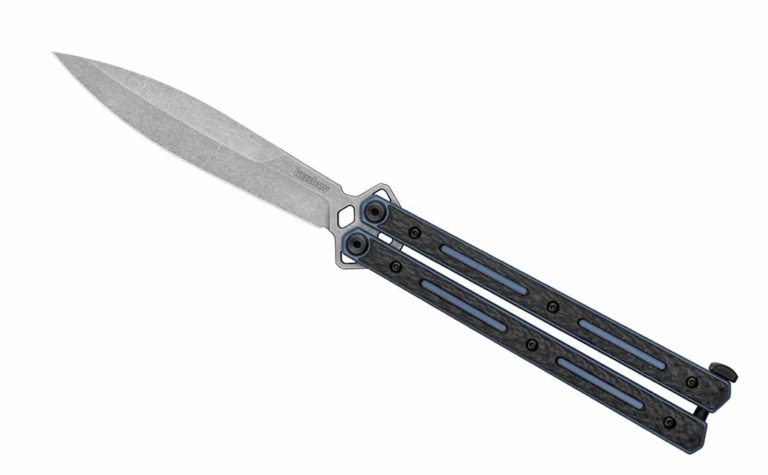
The original Kershaw Lucha made waves when it was released 2 years ago, and it’s only gotten better with a new twist on the design. Shake hands with the Kershaw Lucha – Carbon Fiber. Embracing cutting-edge materials, the Oregan company has cooked up a more nimble variation, one perfect in the role of a unique EDC option or a top-end balisong competition blade.
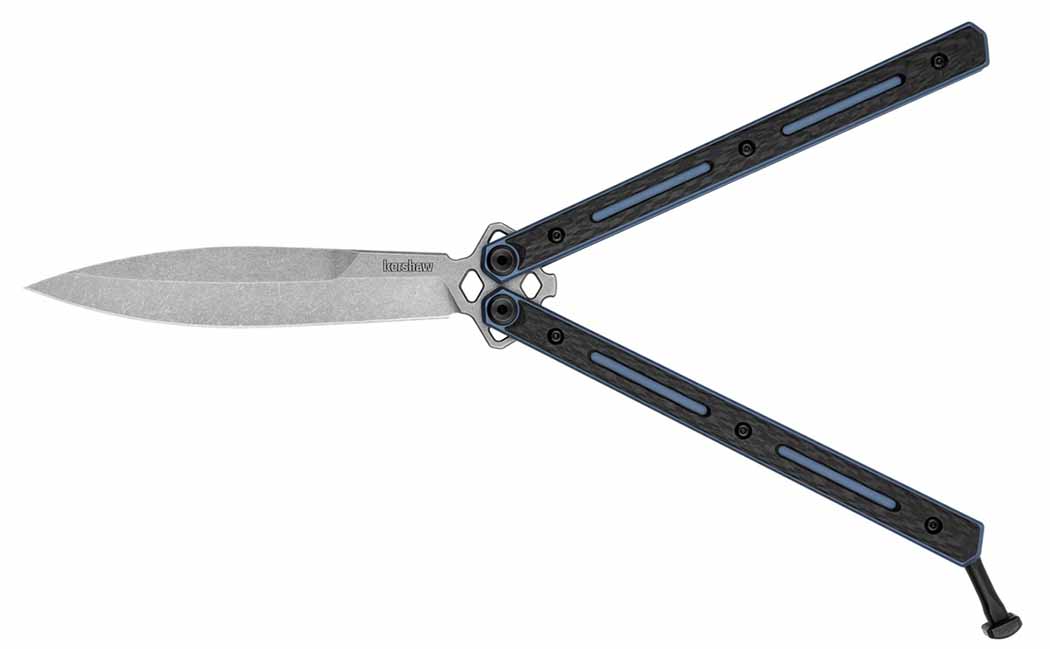
As its name suggests, Carbon Fiber is the belle of the ball in next-generation Lucha, with Kershaw applying it to the handle. Adding rigidity to the system, the company opted for a titanium skeleton, but offset the use of metal with weight-saving cutouts in the carbon-fiber exterior. The efforts paid off, the knife is a full ounce lighter than the original Lucha at a very svelt 4.9 ounces. Worth mentioning, the mix of carbon fiber and blue finished titanium gives the knife a dynamic look.
Kershaw didn’t skimp on the other aspects of the Lucha Carbon Fiber. Dual KVT ball bearings make the knife’s action silk smooth and quick as lightning, making opening and manipulating the knife effortless and smooth. A wicked spear-point blade, constructed of corrosion-resistant CPM 20CV stainless steel, facilities faster opening and proves useful for both cutting and perforating tasks. And a Kershaw’s “Working” finish maintains the aesthetic integrity of the blade, hiding scratches and gulls better other finishes.
While not the most expensive option on the market, the Lucha Carbon Fiber tilts to the expensive end of the balisong spectrum—$500 (expect around $300 retail). Yet, it’s difficult to argue the USA-made knife certainly offers plenty for the price.
Initial Impression
Describing the Lucha Carbon Fiber in one word is simple: streamlined. Building on the successful original, the new Carbon Fiber appears a more refined version in every way. From its single-edge spear point to its almost lighter-than-air titanium and carbon fiber handle, it should bring everything balisong fans appreciate to the next level.
Blending old and new, the modern period knife brings history alive in masterpieces.
Historical perspective is a relevant component in just about any undertaking. In the realm of cut, incorporating an appreciation of the past into the work of today brings another dimension to the custom knifemaker’s statement.
Interest in the knifemaking of a bygone era offers a window into the true artistry required to reproduce the knives of yesteryear, particularly with the absence of modern conveniences in the shop. Along with the interest in the historical knife, several custom makers bring famous designs, styles and patterns to life once again in tribute to those who have gone before.
The idea of the period knife blends old and new. “I’ve been making knives seriously since about 2002 when I took a class with the American Bladesmith Society in Washington, Arkansas,” related ABS master smith Lin Rhea. “Joe Keeslar and Greg Neely lit a fire under me and got me on my way. Since then the town of Washington has been like a second home, and I’ve even added to the personal connection between me and the area by interest in one of the town’s historical residents who was also a knifemaker. His name was James Black.”
A resident of Prattsville, Arkansas, Lin gained an appreciation for Black’s distinctive body of work*, using contrasting materials and techniques to create a bold, attractive look. “I’m grateful to get to know Mr. Black by studying his work,” Lin continued. “This intense study led me to try to recreate one of his knives, the Carrigan Knife. The original knife, a guardless coffin-handled bowie, was made by Mr. Black in the early 1830s in Washington, Arkansas. I chose the Carrigan as my first attempt because of its less intimidating size; however, as is often the case I found it to be just as intimidating once I started into the project.”
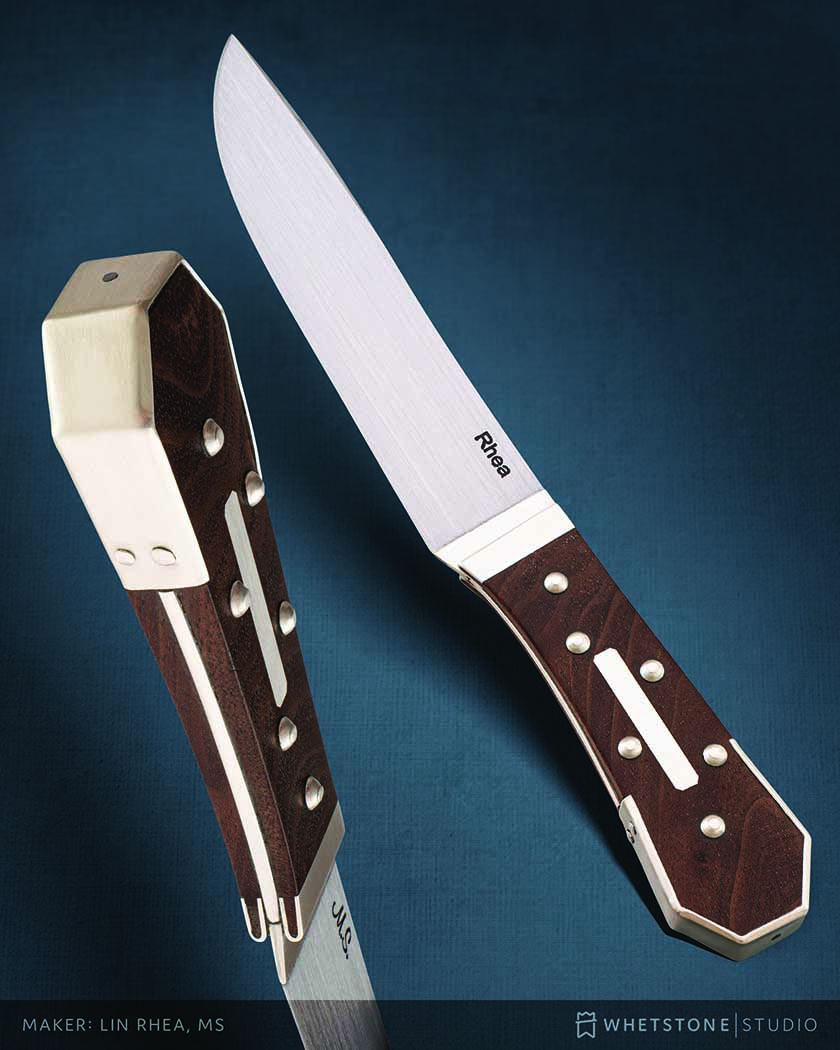
Lin Rhea’s period knife, a reproduction of the Carrigan Knife is based on a dress bowie James Black is thought to have made in the early 1830s in Washington, Arkansas. The original Carrigan includes a black walnut handle with coin silver pins and trim. The blade is about 6 inches long and the overall length is approximately 10.25 inches. (Whetstone Studio image)
The original Carrigan includes a black walnut handle providing a nice contrasting background to the coin silver pins and trim. The blade is about 6 inches long, and the overall length is approximately 10.25 inches. The full tang is virtually covered entirely by the walnut scales and the silver wrap.
When Rhea undertook his homage to Black and the Carrigan, he chose stabilized walnut, which he harvested himself several years ago, and trim in sterling silver. He forged the blade from 80CrV2 carbon steel and included at least 30 separate parts while attempting the same techniques used by Black nearly two centuries ago in fastening and assembling the finished knife.
“There is so much to be said about not only this knife but also Black’s work,” Lin concluded. “He was able to create a knife design utilizing only three materials yet impacting the knife world as few others could. His ability to arrange these materials into a functional, long lasting, beautiful tool is only enhanced by the knowledge that he also built in other qualities like moisture resistance, logical assemblage and ergonomics. All of this was done in a historic setting without modern equipment and epoxies. In my opinion, his design is ingenious.”
The Gold Rush Period Knife
Recently inducted into the BLADE Magazine Cutlery Hall of Fame® (September BLADE®, page 52), knifemaker Jim Sornberger has assimilated his gold and silversmith skill sets into custom knifemaking while helping introduce the modern world to the classic design, luster and embellishment of the Gold Rush era and boomtown San Francisco of the mid-19th century.
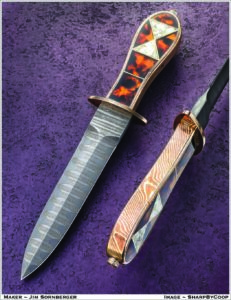
BLADE Magazine Cutlery Hall-Of-Fame® member Jim Sornberger’s interpretations of the Michael Price San Francisco/small dress bowie have won awards at various venues, including Best of Show at the 2019 International Custom Cutlery Exhibition in Fort Worth, Texas. This period knife features a blade in Vegas Forge stainless barstock AEBL and 412 stainless steels and san-mai damascus with a solid core. The guard and wrap handle are in Mike Sakmar mokumé barstock. Jim’s price for a similar knife: $3,500. (SharpByCoop image)
“I’ve been making knives since 1975 with the help of the late Les Berryman, an early Guild member, and with some guidance from Bob Loveless, Herman Schneider and Barry Wood,” Jim recalled. “The last three signed for me to join The Knifemakers’ Guild.”
For Sornberger, the style, embellishment and decoration of the canes, jewelry and knives of the Gold Rush era are most appealing. “San Francisco from 1850 to 1904, the Gold Rush period, was one of the wealthiest cities in the world, attracting some of the greatest artists, jewelers, carvers and engravers to ply their trade to a wealthy clientele. The work done in that period,” he opined, “rivals the best ever done.”
In the knifemaking genre, Michael Price and Will & Finck were among the most successful and prolific of the Gold Rush. Their work remains emblematic of the great migration to settle the American West, and the riches and ruin that were found with the experience.
“Price was Irish, and both cutlery firms hired workers who were English, German and possibly Scottish,” Sornberger explained. “Their dress knives are probably the most embellished American knives made in the 1800s-1900s. The dress knives had two common handles: an interesting, modified coffin shape and a more rounded, subtle taper shape. The blade shapes are spear-point dagger and San Francisco clip spear point.”
Sornberger is recognized as an authority on original San Francisco knives, as well as the magnificent gold quartz that was used so well by Gold Rush artisans. His modern interpretations of the Michael Price San Francisco/small dress bowie have won awards at various venues, including Best of Show at the 2019 International Custom Cutlery Exhibition in Fort Worth, Texas.
Jim’s dress fixed-blade bowie in the accompanying picture was made with Vegas Forge stainless barstock AEBL and 412 stainless steels, and san-mai damascus steel with a solid core. The guard and wrap handle are in Mike Sakmar mokumé barstock. Jim’s made such handles in gold and silver and nickel silver, also. The inlays are tortoise celluloid and California native gold/gold quartz.
According to Sornberger, the biggest challenge in his stunning creation was grinding the blade to show the distinctive pattern of the shell and the hardened core. The san-mai laminated blade was etched with ferric chloride, rinsed and color set with WD-40®.
Frog Knife
“The style of Michael Price’s work is a really good canvas with flowing lines, and there is a lot you can do with it,” observed ABS master smith Jon Christensen, who is in his 22nd year of making knives. “I wouldn’t call my San Francisco-style knives replicas. I do like to keep to the original form and honor the style of the maker, though.”
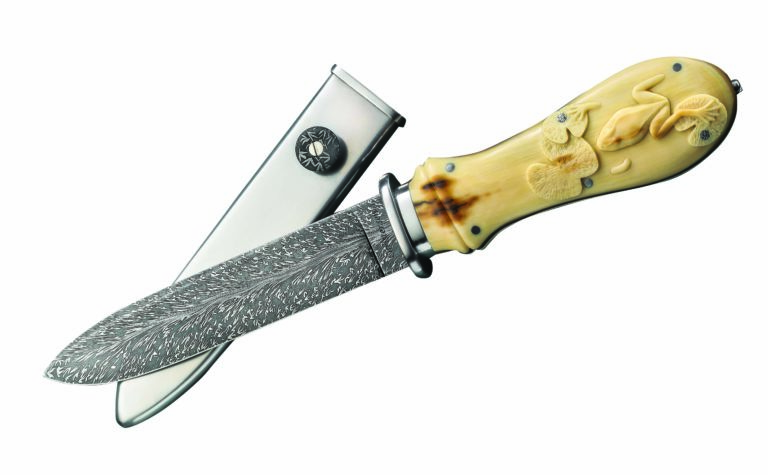
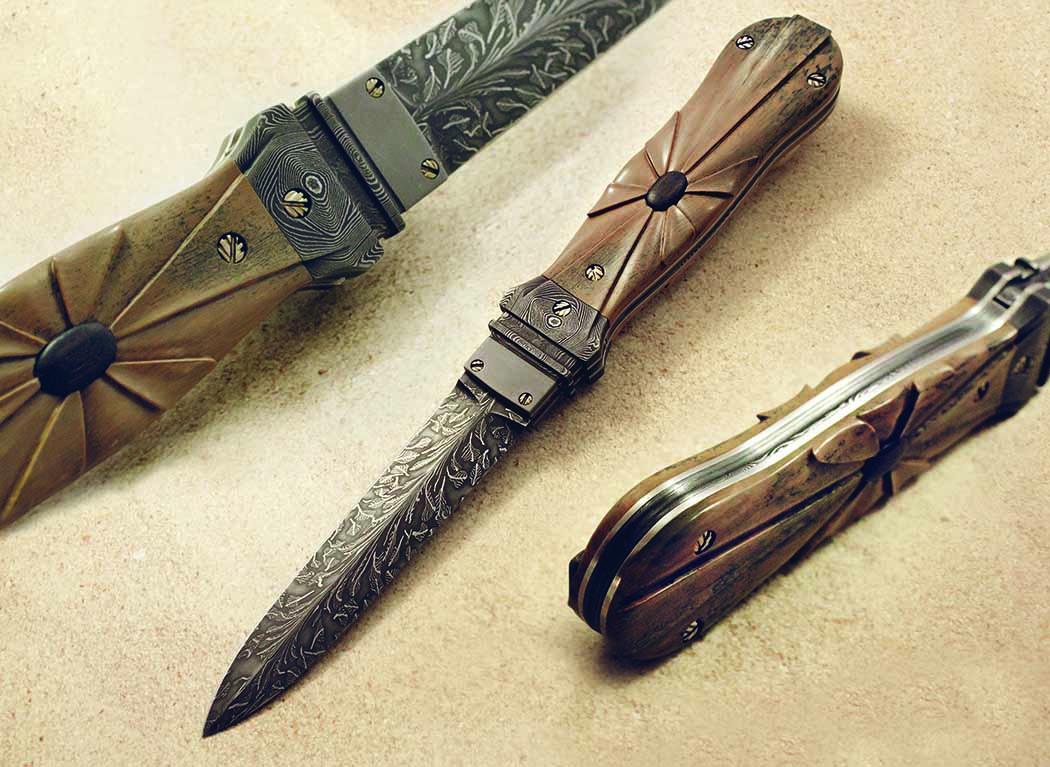
Jon Christensen’s San Francisco-style folder includes a blade of feathered leaf damascus steel and a handle of carved mammoth ivory with inlay of 4,500-year-old bog oak. Quite a period knife. (ChantryLeePhotography.com image)
One of Christensen’s most evocative pieces to date is referred to simply as the Frog Knife. However, the piece is far from simple, and Jon manages to convey the spirit of the Michael Price style while also imprinting some of his own personality.
“I built the feathered damascus for the blade with 1080 and 15N20,” he advised. “It’s a canister damascus. I forged the bamboo leaves and placed them in the can, welded it up, reduced it, and feather cut it so it would produce feather-cutting smears and leaves, and form branches to look like a little grove of bamboo leaves.”
The 10-inch knife has a 5.5-inch blade and a frame and sheath incorporating 410 stainless steel. Christensen utilized the “canvas” of the handle to the fullest, carving the mammoth ivory into a pleasing vignette of frogs and lily pads.
“The handle has something of a back story,” he smiled. “I had seen the Poppy Knife that Michael Price made and thought I would do my version. I took the knife to the BLADE Show and it didn’t find its owner. Then, the handle got ruined, and I just took the opportunity to rehandle it with the frogs and lily pads.”
Christensen got his start making stock removal knives after a career as a horticulturist. He learned to forge while working with ABS master smith Ed Caffrey and visited with knifemaker Rick Eaton and ABS master smiths Shane Taylor and Wade Colter. Jon also makes San Francisco folding knives and enjoys swordmaking. Plans for the future include more period knife examples.
Kimbll Style
ABS master smith Josh Smith owes his little league baseball coach, ABS master smith Rick Dunkerley, credit with getting him started making knives about 30 years ago. From the beginning, Josh has appreciated the thought process and craftsmanship of custom makers from a bygone era.
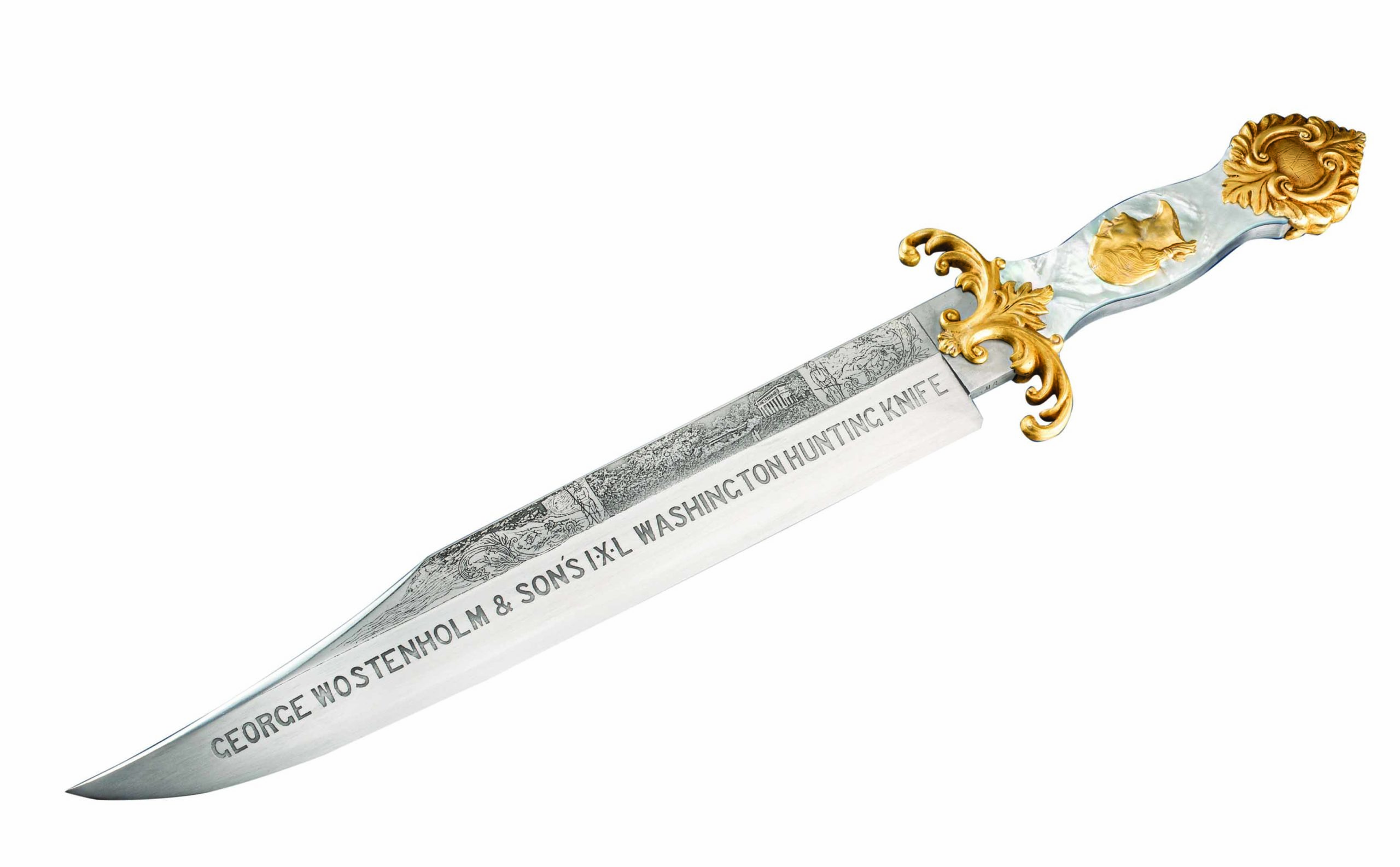
A period knife reproduction of the I*XL George Washington Hunting Knife by Doug Noren gets the full treatment in a 13.5-inch blade of 5160 carbon steel, a mother-of-pearl handle and 18k plated nickel silver. Overall length: 21.5 inches. (Whetstone Studio image)
“There’s something special about reproducing something that was built nearly 200 years ago,” he reasoned. “It’s easy to get lost in your thoughts while working on these knives, wondering what the makers were thinking about at the time. Was the knife going into battle? Was a rich man just wanting something unique? Was the maker just trying to be different and impress people? Were function and effectiveness of use the only factors that mattered? It’s really cool to think about.”
Josh has found the opportunity to consider historical context with a dagger in the distinctive dog-bone handle, recalling the mid-1800s when a gentleman named Loring Kimball of Vicksburg, Mississippi, owned several similar original pieces that were probably made by at least two different knifemakers in the New Orleans area. Knives in what many refer to as the Kimball style have been reproduced by a number of modern makers, mostly bladesmiths.
“The distinctive characteristic of the dog bone is clearly the shape of the handle,” Smith said, “but to me it’s more than that. The large domed pins and the flat facets on the handle provide such a neat look. One of the original Kimball daggers from the 1830s had silver wrapped around the butt of the handle and a small, thin silver guard. I never pretend to exactly reproduce these knives. I always put my own spin on the knife, trying to bring some of my style into it.”
Smith’s dog-bone dagger is fashioned from his own ladder pattern “W’s” damascus blade, African blackwood handle and 18k-gold pins and liners. The 9.5-inch blade is forged from 1080 carbon and 15N20 nickel-alloy steels, while a gold collar stretches over the back of the blade and bears the engraved name of the maker. Overall length: 14.25 inches.
“This particular knife was heavily influenced by Tim Hancock,” Josh said. “I feel Tim, Harvey Dean and James Batson are the three men who led the way in bringing these knives back to prominence, and Tim had the most influence on my construction of these knives. I love period knives and definitely plan on doing more. There are so many incredible weapons from the past that would be fun to recreate.”
*While a number of top industry authorities attribute such original 19th-century pieces as the Carrigan Knife, Bowie No. 1 and others to Black, no knives with Black’s mark are known to exist.
If you attend, a review of the following will pay dividends
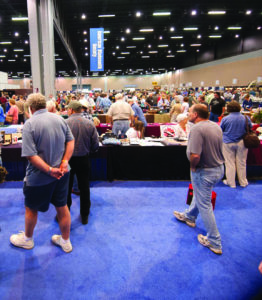
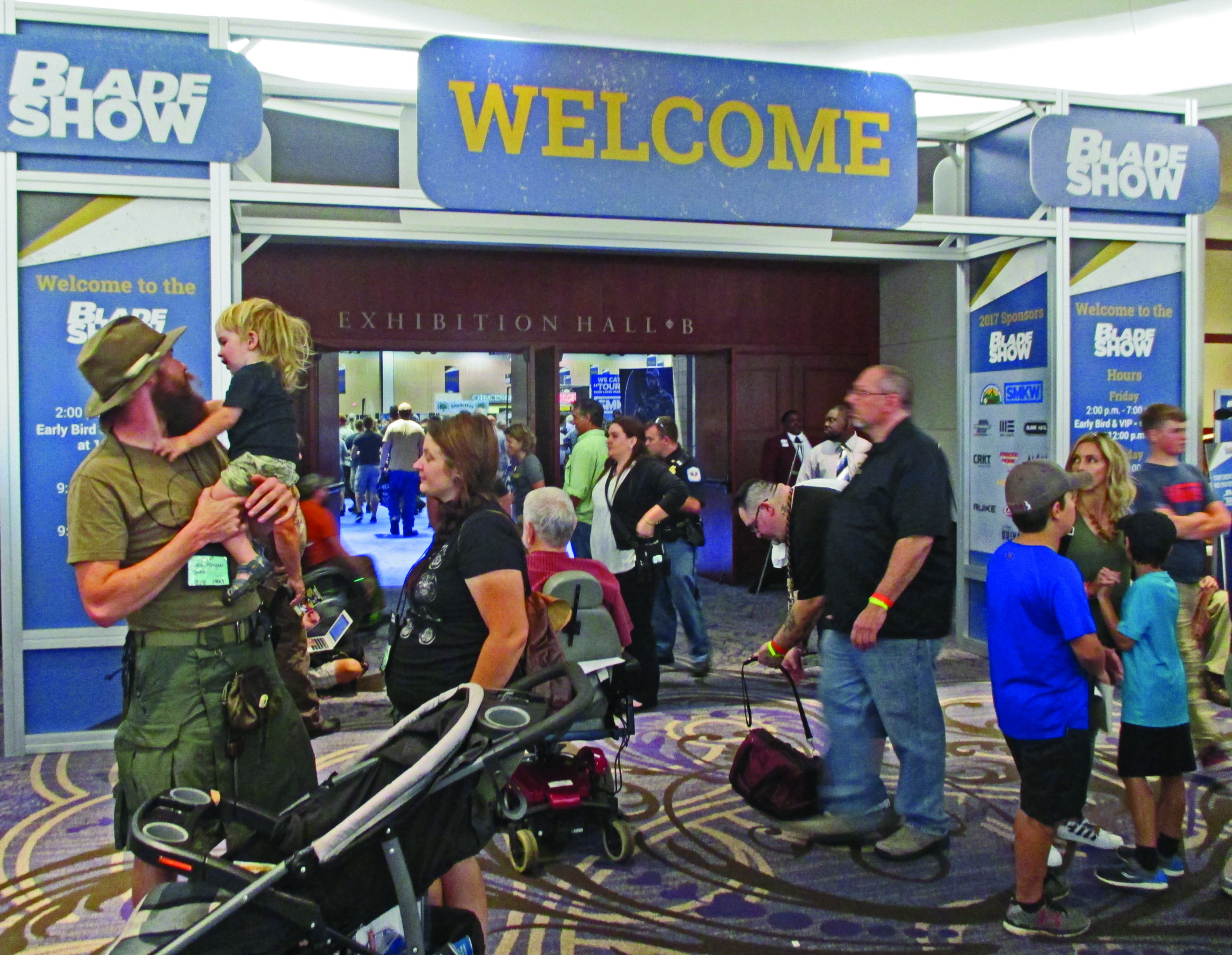
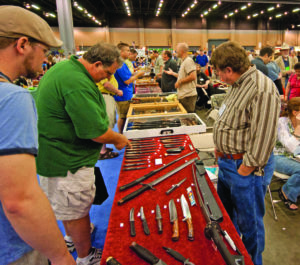
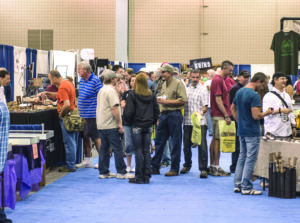
The BLADE Show is unlike anything you’ve ever seen. It’s the world’s largest knife show—period. It’s overwhelming, it’s massive and you need to pace yourself.
A major do of the BLADE Show is to enjoy yourself. (Eric Eggly/PointSeven image)
To begin with, inbound traffic is insane driving to the Cobb Galleria, so give yourself plenty of lead time. Wear comfortable shoes—the show hall floor is unforgiving—and also be sure to hydrate or you will cramp up while walking.
Wear comfortable shoes—the show hall floor is unforgiving. (Eric Eggly/PointSeven image)
There are free show programs with floor maps and exhibitor lists in the show lobby. Get two because you will lose one. The lobby also has free copies of the BLADE Show preview issue of BLADE® that you’re reading right now. (Editor’s note: The show program is newer and thus more up to date, so use its maps, lists, schedules, etc., instead of the ones in this issue of BLADE.) Assorted exhibitors and others will have cloth bags inside for free. Get a couple and use them to tote stuff if you don’t bring a small pack. Carry a small pad and a pen—you will see much you will want to return to, so mark down what the knife or accessory is, how much, the table number, etc.
There’s inexpensive food all around close to the show inside the Cobb. Local eats spots are easily Uber’d to, and using Uber, etc., is worth it—drive your car and you won’t have a space when you return.
You must see The Pit, the sunken bar in the lobby of the Renaissance Atlanta Waverly host hotel, at least for a few hours.
Yes, you must see The Pit, the sunken bar in the lobby of the Renaissance Atlanta Waverly host hotel, at least for a few hours. Again, pace yourself there—no one wants to be remembered as the sloppy drunk who dropped a thousand-dollar knife because he was hammered. Pit people are just as great as the show itself—wear your swag and favorite makers’ shirts and meet some new pals.
Cash is king. Bring as much as you can afford. Don’t screw up the mortgage but cash up before you come. The ATMs around the show get smashed fast and have a $300 limit per day anyway.
Take a ton of pictures. No one will believe you back home, and it will be sensory overload, so take photos to remember it all. Cell reception can be bad inside, so use text and times for meet ups. Soak it all in and let yourself enjoy being with thousands of likeminded folks for the weekend. However, there are some details all should know or get refreshed on as attendees, as well as table/booth holders. So, buckle up!
1 of 3
The people are just as great as the show itself—wear your swag and favorite makers’ shirts and meet some new pals.
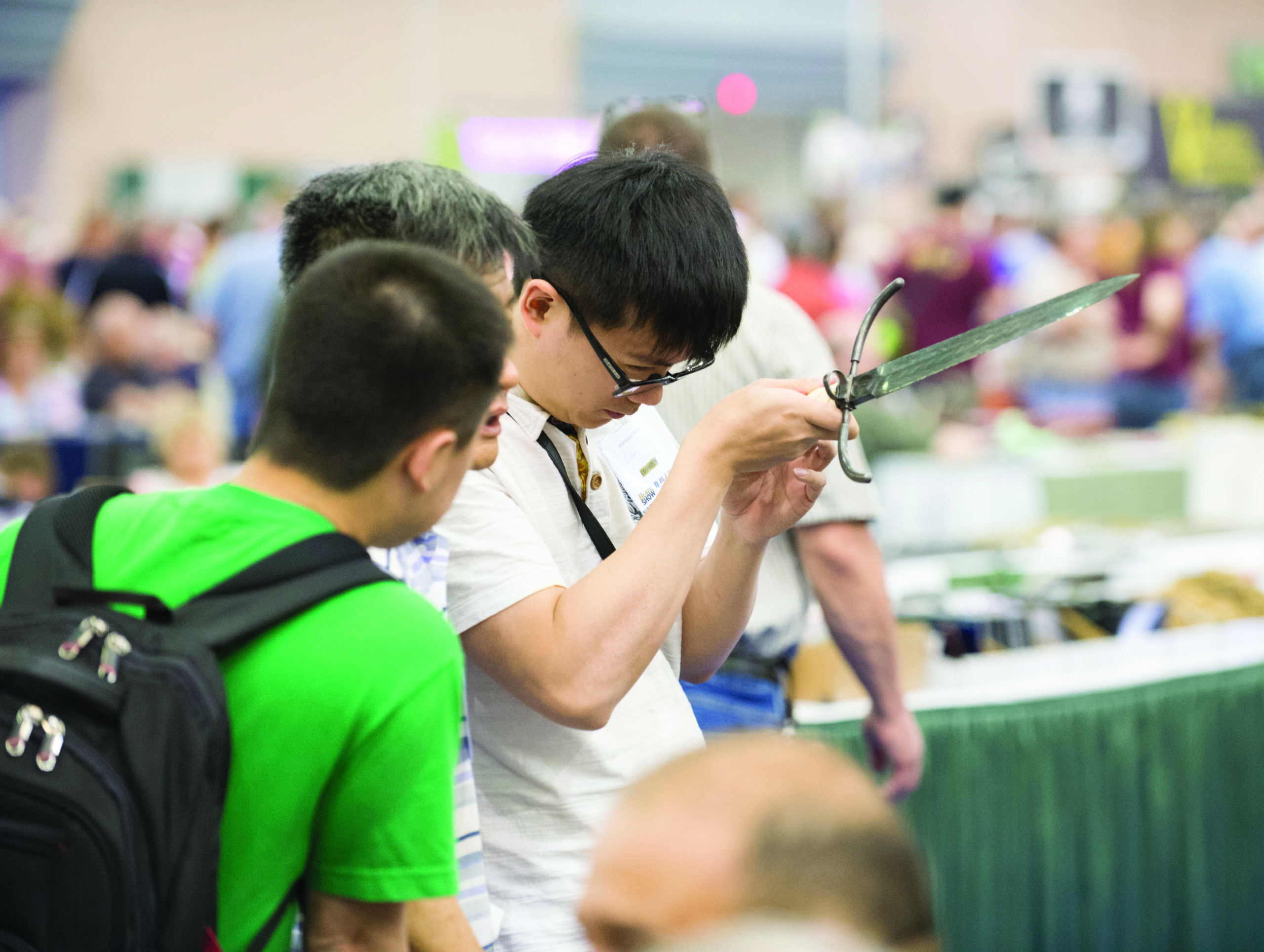
When examining an exhibitor’s knife, always be aware of the direction in which you are pointing the blade and avoid causing damage to anyone or anything.
Always ask before touching a knife, as a customer (left) appears to be doing at the table of knifemaker Barry Dawson (right). It’s simple politeness to ask first. (Eric Eggly/PointSeven image)
PATRON ETIQUETTE
An extra swipe of deodorant goes a long way. The show hall will get hot when full and the show lasts all day. Mints are a good idea as well.
Introduce yourself to the maker at each table you visit.
Never, I repeat, never set anything on a maker’s or dealer’s table.
Always ask before touching a knife. Some makers are more intense about it than others, but it’s simple politeness to ask first.
Always ask before touching a knife, as a customer (left) appears to be doing at the table of knifemaker Barry Dawson (right). It’s simple politeness to ask first. (Eric Eggly/PointSeven image)
Remove your super cool large rings before handling knives. They leave marks, and the hand polish on the knife took hours if not days to apply.
Don’t wipe the blade off on your shirt or your own cloth from home. The owner will do it—besides, he doesn’t know what’s on your shirt/cloth.
Keep track of your kids—they should have been told not to touch any knives long beforehand.
Be aware of placement when returning something to a table, and do it slowly and carefully. Don’t toss things back on a table!
Don’t “wrist flick” a side opener—the knife doesn’t need it if it’s made correctly. Besides, it not only annoys the maker, it shows you don’t know what you’re doing.
Same line of thought: don’t shave hair, cut a piece of paper, turn toward others with a live blade or be dumb enough to run your thumb along the edge to test it out. The owner doesn’t want to clean your blood off his knife.
Never block a table to hold a conversation with someone else. Politely move aside.
Never block a table—or an aisle—to hold a conversation with someone. Politely move aside. (Eric Eggly/PointSeven image)
There are more, of course, but these are some of the most important things to learn and know for attendees—and you see it every show.
EXHIBITOR ETIQUETTE
The biggest one is speak to everyone who comes by, even if it’s just
“good morning” or “good afternoon.” Itmatters!
Don’t bring a book to the show and sit and read. That is a sale killer and rude as hell. You will see lots of makers/dealers doing it, then complain endlessly about how the show isn’t good, or the buyers just aren’t buying. As a maker/dealer, you are selling yourself as much as your knives. If your personality is bad, people will move on quickly. Engage, smile, be polite, draw them in, show your work like it’s the greatest thing ever done, explain it, sell it—and make money! Everything else aside, that’s why you really came. You pay for lodging, gas, airline tickets, food, table/booth space, etc.—make the most of it and sell you as much as your work.
At the Chad Nichols Damascus booth, I never sit* and never walk off. I engage every person who gets within five feet of me. The guy in the suit, the couple I know is just looking, the ones who can barely speak English, the guy in overalls with no top teeth—any one of them could walk up and drop a roll of cash that would choke a horse. If I screw that up, it’s not the show, the venue, the economy or the weather—it’s me.
STOP ’n SAY HI!
Enjoy the show and stop by to say hello at the Nichols Damascus Southern Circus booth. The booth looks like a KISS stage from the ’70s with six or seven makers/parts/materials guys all in one spot, including Chad Nichols/Nichols Damascus, knifemaker Steve Kelly/TiConnector Inc., Nottingham Tactical, American Metal Exchange, Matt Diskin, FiberTech-Carbon Fiber and more depending on the day—oh, and me.
See y’all there!
*If you must sit, bring padded stools if possible—it’s a lot less stress on your legs and back to rise from a stool rather than from a camping chair.
Travis Payne’s knife has all the right curves in all the right places.
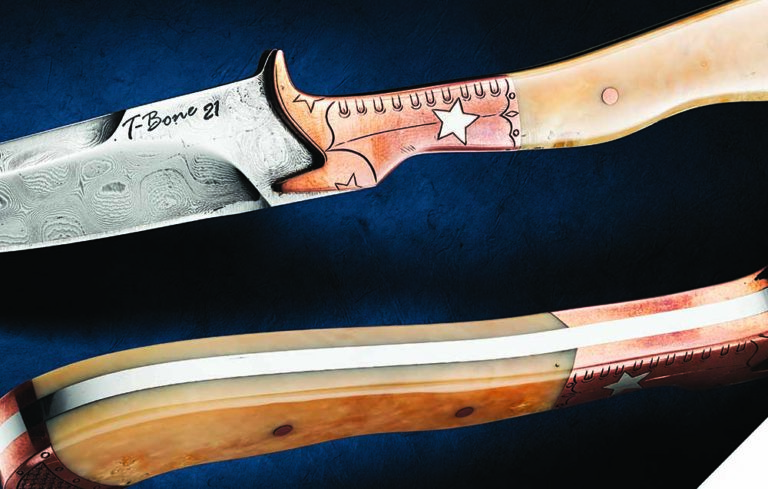
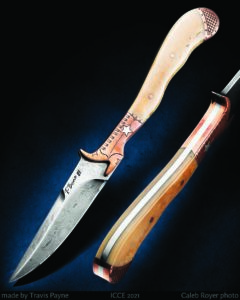
It’s hard to find anything more beautiful than a shapely woman’s leg, and Travis Payne revisits the concept in knife terms with his Gal Leg fixed blade.
Study the leg handle and you can see how it would be eminently ergonomic. “That was the whole point of the knife—to get a handle shape that both looked like a leg and was pleasing to grip,” the maker from Telephone, Texas, noted.
Travis Payne (inset) said his Gal Leg fixed blade finished second in its category in the knife judging competition at the 2021 ICCE in Fort Worth, Texas. The swedged blade bears Payne’s mark of “T-Bone 21.” Note how the boot toe curls up to form a top single guard/thumb placement area for an enhanced grip.
Leg handles long were favored among manufacturers of antique pocketknives back in the day, but there’s something about Payne’s version with the boot for a bolster, swaybacked handle with the indentation about where the back of the knee would be and the—ahem—handle butt that all comes together.
You might say the knife has a leg up on the competition.
Gal Leg Specs Maker: Travis Payne Knife type: Fixed blade Blade length: 3” Blade material: Pattern-welded steel forged by Alabama Damascus Handle material: Mammoth ivory Bolsters: Copper engraved by Matt Litz Overall length: 7” Maker’s approximate list price for a similar knife: $1,200
Bob Dozier’s Bare Bones Buffalo Skinner is sharp—and comfy, too!
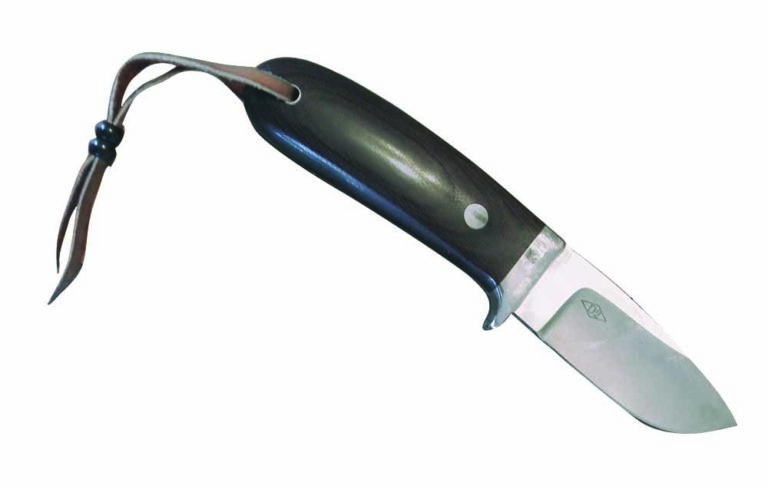
There’s nothing quite like holding a great-feeling knife that makes you want to cut something. Bob Dozier has been making custom knives to be used for over half a century and understands the importance of two major things: comfortable handles and sharp blades. They still have to cut and perform to be carried daily.
Let’s start cutting with the Bare Bones Buffalo Skinner.
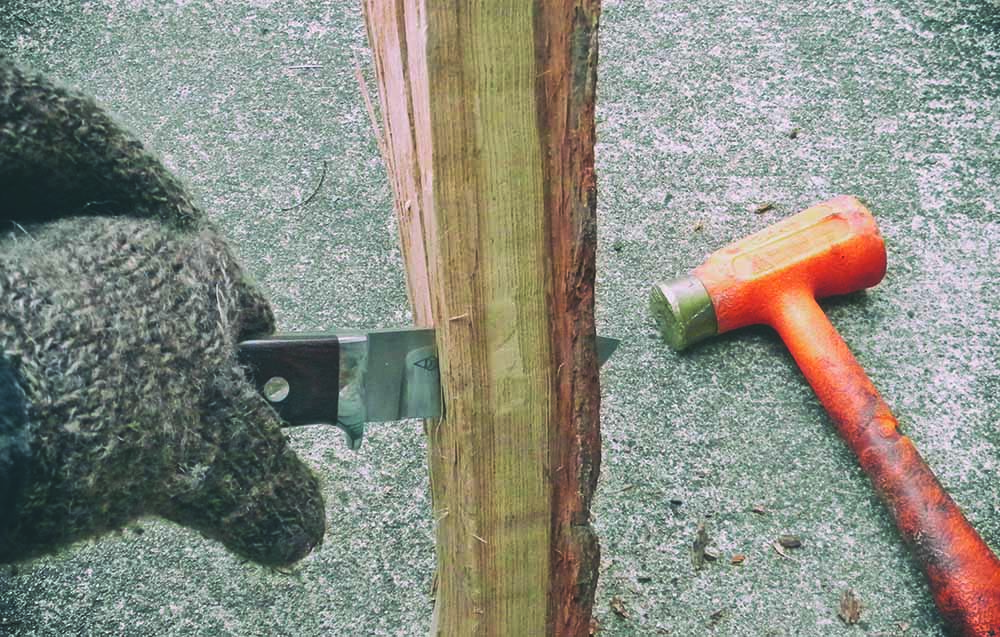
Using a dead-blow hammer, the author batonned the skinner into and through thin kindling. The knife proved a solid splitter. No damage occurred to the edge.
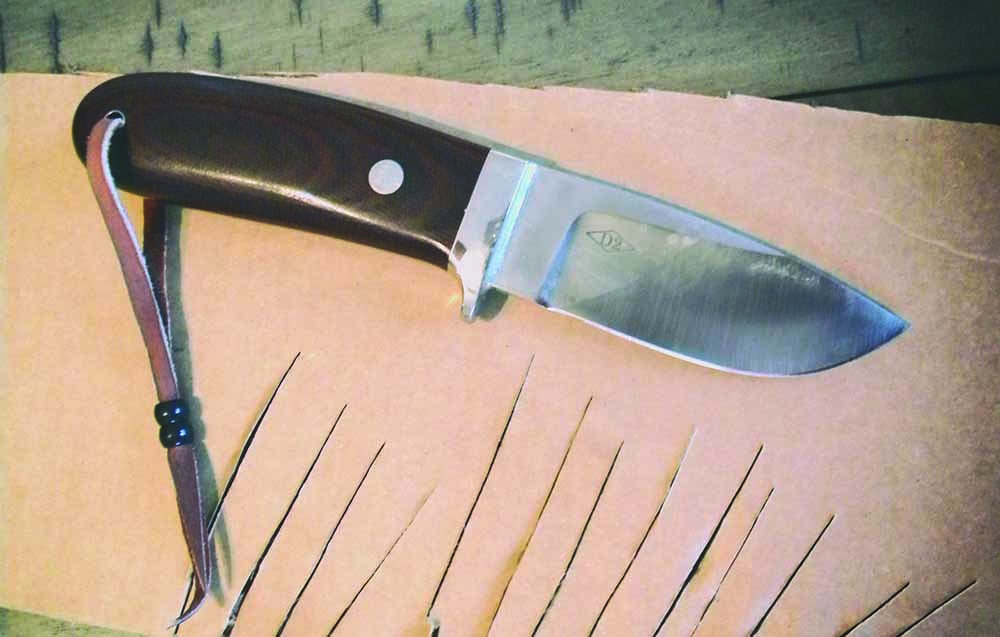
The quickest check to see if the knife has a sharp edge is to slice paper. You probably know by now that I use 20-pound bond copy paper for the job. The Bare Bones aggressively sliced into the paper using the knife’s own weight. The skinner is very controllable in use. The high hollow grind slid through the paper.
Moving on to single-walled cardboard for slicing, the aggressiveness continued. You could hear every cut made—the Bare Bones is a very loud slicer. I didn’t have any hang-ups during the test, just full, noisy cuts. The handle shape made controlling the cuts easy.
The knife performed aggressively in slicing single-walled cardboard. The handle shape made controlling cuts easy.
Next up: 8-ounce leather. This is where the Bare Bones was sweet. It zipped through the leather like it was cutting the 20-pound bond paper—just louder. It was super aggressive in slicing the medium, with hardly any resistance. I would love trying the Bare Bones on field dressing whitetail deer. Maybe come fall …
OLD-SCHOOL KINDLE
On to harder material. It was February, and I like to keep a supply of kindling and fire sticks to light a blaze faster. The Bare Bones made tight curlicues in the old pine. The wide blade and high grind worked out great for curling the wood. The handle shape excelled at controlling depth of cut. The single guard protected my fingers from getting splinters. Dozier’s knife embodies top-notch work.
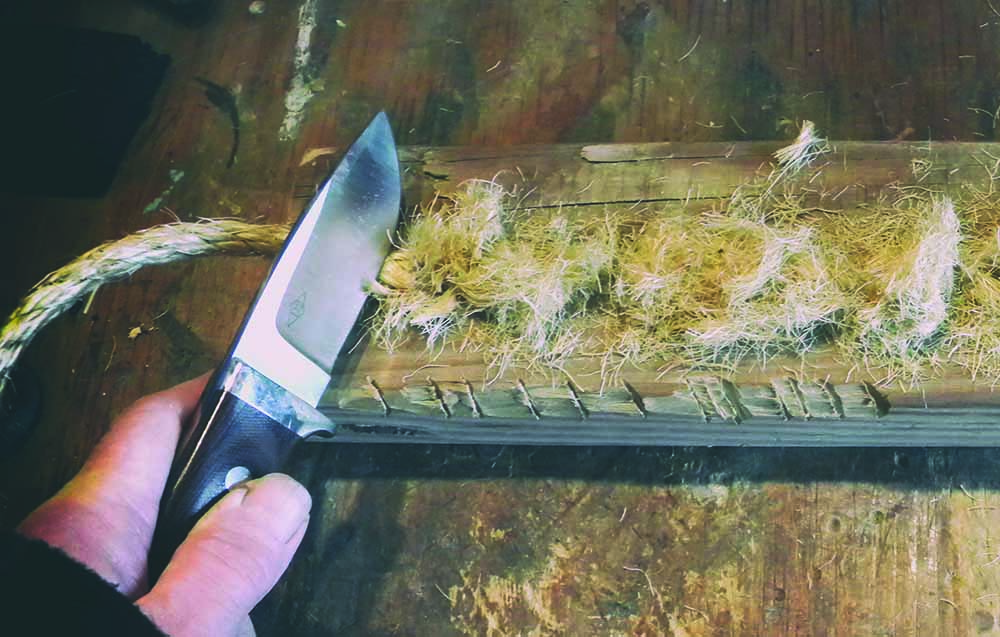
The Bare Bones crunched to 225 cuts. The author stopped at 225, as he didn’t want to risk slicing a finger.
It was time to make some thin kindling. Using a dead-blow hammer, I batonned the skinner into and through the wood. The knife’s solid overall construction prevented vibrations to my hand. The skinner proved a solid splitter. No damage occurred to the edge.
I had to warm up my fingers for the rope cutting. With no heat in my garage and the temperature at 17 degrees, I separated the test into 25 cuts per warm up. The Bare Bones crunched to 225 cuts. As I used the push method, it kept cutting. I stopped at 225, as I didn’t want to risk slicing a finger.
CHANGES
I might add some grooves to enhance grip.
OVERALL
This knife is a beast in the cutting arena. The comfortable handle made control easy. This knife is excellently made and perfect for the outdoors or hunting.
Bare bones Buffalo Skinner Maker: Bob Dozier Cutting edge length: 3.25” Blade material: D2 tool steel Blade grind: High hollow Blade thickness (at the thickest): .25″ Scales: Brown canvas Micarta® Guard: 416 stainless steel Extras: Tapered tang; thong Weight: 8 ozs. (123/8 ozs. w/sheath) Overall length: 8” Sheath: 8-ounce leather, pouch style Maker’s list price: $477
Four U.S.-based companies embrace making military knives stateside.
Make no mistake—manufacturing knives in the USA comes with challenges, including regulations, taxes, high costs of doing business and much more. While imported knives often beat American-mades on price, companies that choose to produce knives domestically carry a long tradition of equipping the U.S. military with the best American design and manufacturing has to offer.
Spartan Blades
For Curtis Iovito, with Mark Carey co-founder of Spartan Blades, the tension between creating high-quality knives and keeping costs down has been one of the primary challenges in running Spartan for the past 13 years.
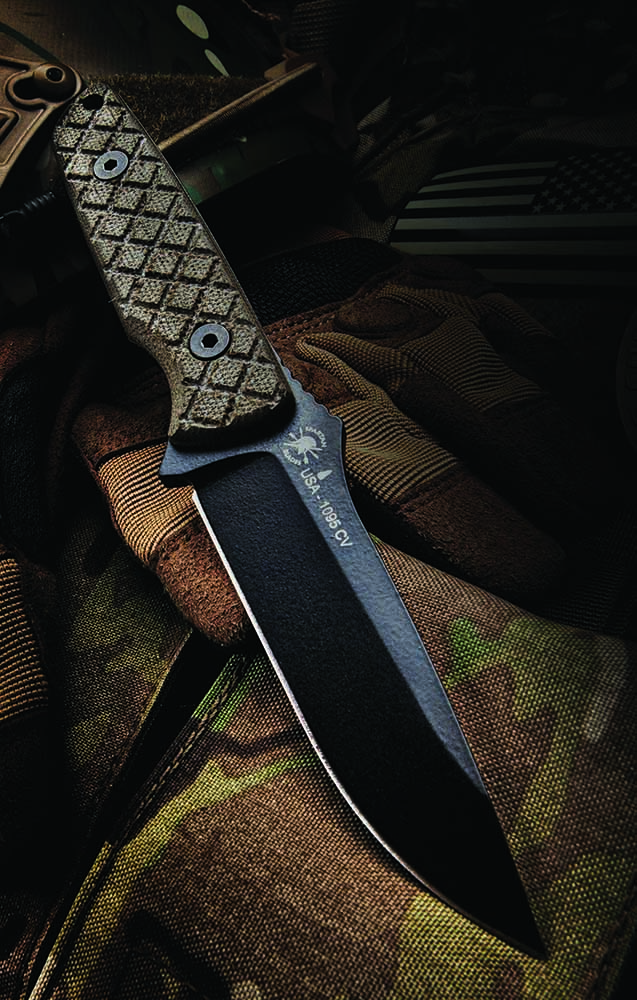
The Silver Line, also known as Pineland Cutlery, is a collaboration between Spartan Blades and KA-BAR to create a more affordable line made in the USA. The Alala is the first collaboration between the two. It has a 3.75-inch blade and a canvas Micarta handle. MSRP: $159.
“We did everything we could to keep our costs down, from buying in bulk, streamlining production and reducing shipping costs,” Curtis observed. “Even with that, we were lambasted by our customers for being ‘too expensive.’ It was our No. 1 complaint. We even received hate mail for it!”
For Iovito—who said those who staff Spartan Blades consider themselves soldiers first and knifemakers second—patriotism was among the top reasons to make knives in Southern Pines, North Carolina, despite the challenges of starting a manufacturing venture there. Another reason is the ability to have fine control over the deadlines and the manufacturing process, he added. That control and the pursuit of quality it allows has enabled Spartan Blades to make knives for special operations forces, the FBI, U.S. Marshals Service and “every other three-lettered group out there,” Iovito said.
Located on the backside of Fort Bragg, Spartan Blades has plenty of soldiers stopping by to shop, though there are many who do not have enough money to take home one of the company’s top-tier Gold Line knives. “Every single packing list I have ever seen for a soldier has ‘fixed blade knife’ listed on it,” Iovito said, “and most of the time the soldiers are required to acquire it themselves.”
Consequently, Spartan began offering two other grades of knives. The Bronze Line is manufactured in Taiwan and the Silver Line, also known as Pineland Cutlery, is a collaboration between Spartan and KA-BAR to create a more affordable line in the latter’s facility in Olean, New York. The Alala is the first result of that collaboration.
“We wanted to make a knife that was lightweight, easy to carry and that could be carried on airborne operations,” Iovito said. The Alala is made suitable for airborne operations by focusing a good deal of effort on developing a hard sheath with double retention. It’s been out for about a year now. It has a flat-ground 3.75-inch blade and a canvas Micarta® handle. It weighs just shy of a third of a pound and is ground from 1095 Cro-Van steel, where additional elements such as molybdenum and nitrogen make it tougher than standard 1095 spring steel. As Iovito noted, “KA-BAR has been using this steel for years and has the heat treatment down to a science.”
TOPS Knives
A couple of years ago, TOPS Knives of Ucon, Idaho, figured it hadn’t released any big combat knives in a while, so company president and knife designer Leo Espinoza developed the Operator 7.
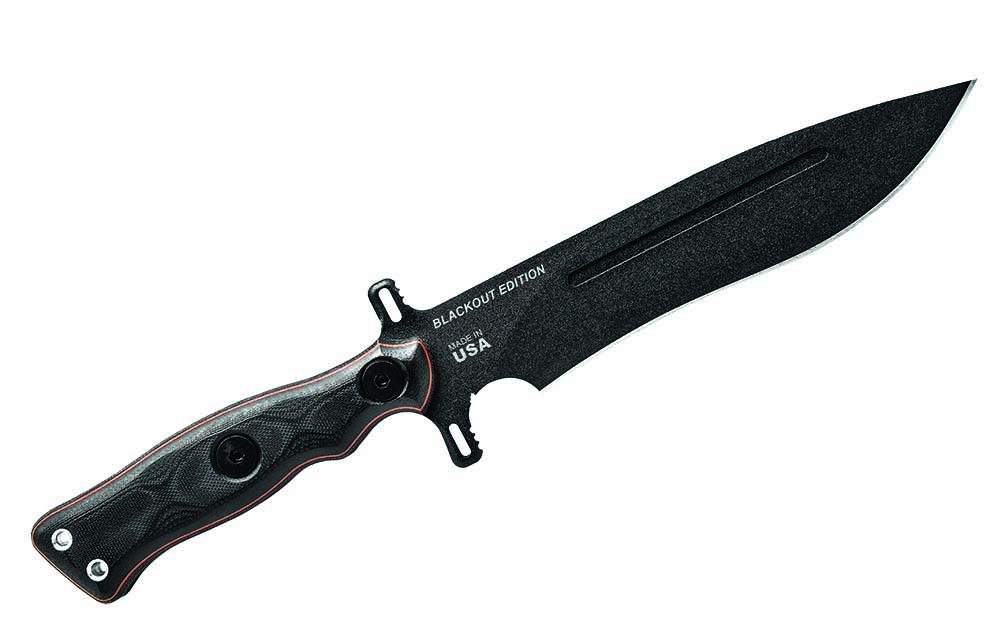
Every TOPS knife save one design is manufactured at the company’s shop in eastern Idaho. An example is the Blackout Edition of the Operator 7 in a 7.25-inch blade of 5/16-inch-thick 1075 carbon steel with a Black Traction Coating. MSRP: $240.
“Like most of our knives, we have a tendency to over-build them, so we made the Operator 7 out of 5/16-inch-thick, 1075 carbon steel to ensure that the knife could literally handle anything you need it to do,” wrote Dylan Waters, dealer liaison for TOPS. The Operator 7 and its 7.25-inch blade hit the market in 2018. In October of the same year, the company released the Blackout variation of the knife: Black Traction Coating on the blade and a black synthetic handle with a red border.
There are few cutting tasks that are too large for a big combat knife, a necessity when another knife isn’t an arm’s reach away.
“In a community where a lot of the time the only gear you have is what you carried in, the choice comes down to the individual’s personal preference,” Waters said, explaining why the knife is a good carry for members of the military. “The Operator 7 Blackout Edition is a very capable blade and it definitely has its place in the field.”
For the company known for its use of 1095, TOPS reached for 1075 steel for this project because it better resists impact and sharpens easily. Even the Micarta/G-10 combo handle helps aid in big cutting jobs. “The G-10 is on the bottom layer to help with impact because it is harder than Micarta,” Waters explained, “and the Micarta is on the top layer to help with grip.”
Every TOPS knife save one design is manufactured at its Idaho shop, and the company brain trust sees little advantage to manufacturing anywhere else. “We are a U.S. company supporting other U.S. companies by sourcing materials from them,” Waters pointed out. “Sure, sometimes prices are higher compared to sourcing overseas but when it is all said and done, the end user has peace of mind that they are getting quality product that they can trust.”
Though the U.S. military announced it is working toward leaving Afghanistan after about 20 years fighting terrorism there, the need for a good quality knife will continue, as the military is constantly training and preparing just in case, Waters said. And if things do go south, TOPS will “rest assured that these soldiers will have tools that are purpose-built and won’t fail when they need them the most.”
Bear & Son Cutlery
From the shipyards near Mobile to missile and rocket development in Huntsville, Alabama plays a big role in the nation’s space and military programs. Sitting amidst the state home to Fort Rucker and Maxwell Air Force Base is Bear & Son Cutlery, which takes pride in creating knives for customers that include troops and government contractors.
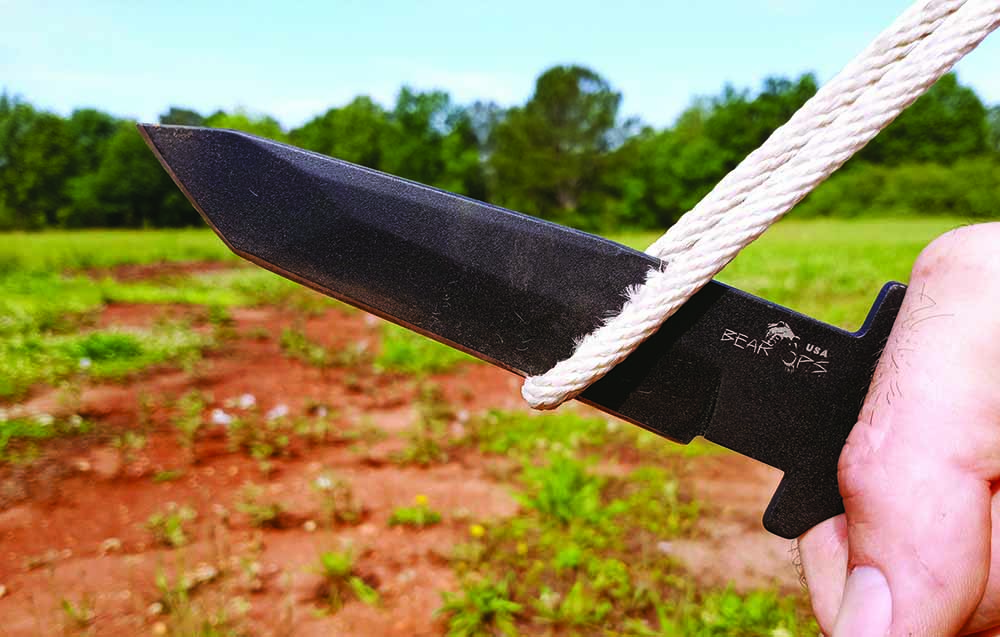
Bear & Son first released a version of the Bear Tac CC-110-B4-B in 1999. When the company launched its Bear Ops line in 2011, it brought the knife back because it liked the design with its “strong tip, full tang, solid handle material, non-reflective, easy to sharpen steel, and adaptable sheath,” company vice president Matt Griffey observed.
“We are one of only a handful of knife manufacturers in the United States, and the largest in the Southeast,” said Matt Griffey, company vice president. “Also, we’re a family-owned and operated business, something less common nowadays.”
Bear & Son has long manufactured knives with an eye toward people in uniform. For instance, the company first released a version of the Bear Tac CC-110-B4-B design using D2 tool steel and a Micarta handle back in 1999, a couple of years before 9/11 shifted the nation’s perception of what threats stood against it.
When Bear & Son launched its Bear Ops line in 2011, it brought the knife back because it liked the design with its “strong tip, full tang, solid handle material, non-reflective, easy to sharpen steel, and adaptable sheath,” Griffey observed. In a 1095 spring steel blade with an epoxy powder coat and a G-10 handle, the knife is 10.375 inches overall. The accompanying Kydex sheath is jump ready, meaning not only does the sheath hug the knife in place, it also has a snap for extra security.
Bear & Son makes the knife at its shop in Jacksonville, Alabama, a place where Griffey says members of the community quickly produce knife designs with pride and quality they can control. “A major advantage of keeping our Alabama factory in operation is providing families a career or skill they can be proud of,” Griffey said. “Understanding our products and services positively impact the lives of our friends, family and neighbors is worth the regulations and taxes of operating in the United States.”
For instance, students at a nearby state university gain real-world experiences at Bear & Son. Meanwhile, some Bear craftspeople and designers have 20-plus years of experience working with numerous types of steels and can develop client orders in a timely manner, Griffey noted.
While the mission of the nation’s military may change, the mission at Bear & Son continues to “provide quality made products that service personnel can depend on,” Griffey said. “The market for strong, reliable blades will be steady, though we will see some trends in sizes, shapes and materials move around.”
Winkler Knives
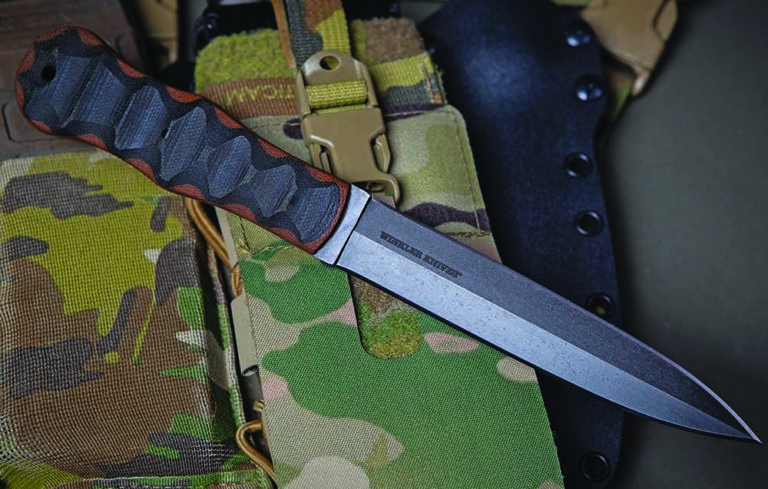
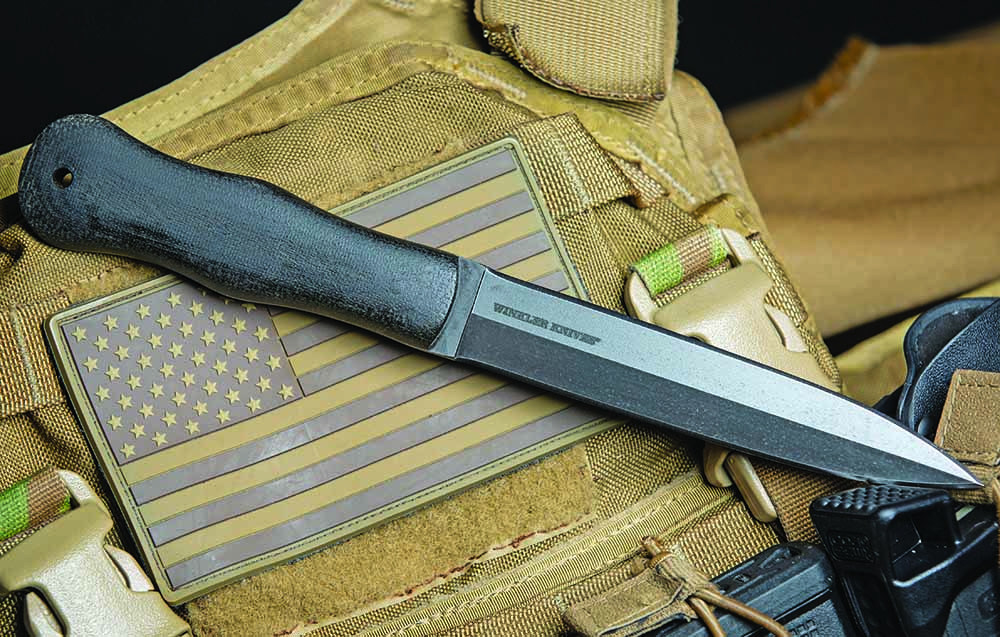
Daniel Winkler of Winkler Knives in Boone, North Carolina, readily admits that if you’re looking for a knife to take camping, his WK Tactical Dagger is not for you. With a 5.5-inch blade and short bevels the dagger has little utility use, he noted, beyond the thing knives can do when the enemy is close. “The design was a collaboration between me and one of the Army special operations team leaders,” he said. “It was a design they needed for their specialized type of fieldwork.”
Made in Boone, North Carolina, the Winkler Knives Tactical Dagger in a black Micarta® handle has the same specs as the WASP-pattern model pictured elsewhere herein. “The handle shape does not hang on clothing as a lot of cross-guard knives do,” Daniel Winkler noted. MSRP: $400.
The 80CrV2 carbon steel offers “the best consistent performance” of any steel Winkler works with, and the blade sits nestled in a lined, Boltaron sheath. “The handle shape does not hang on clothing as a lot of cross-guard knives do,” he noted. “The handle shape also gives good indexing and a flair to assist in removal leverage after use.”
The primary goal of Winkler Knives is to provide tools to first responders, law enforcement and the military, Daniel said, and most of its knives and other edged tools go to people working in those fields. He added that running a company in the USA allows Winkler Knives complete control over the tools it makes, thus ensuring consistency and quality.
Despite the taxes and other challenges of manufacturing domestically, Winkler said, “The advantage is we live in the greatest country on Earth. Taxes and regulations are sometimes tough but still better than any alternative I can see. We have been very fortunate to find great staff.”
When hiring people, Winkler usually passes over knifemakers as he wants to train workers to make the edged tools his way. Some of the folks working there have backgrounds in foodservice and construction fields. Staff must work well in the team and have integrity, he added.
Most design work is kept in-shop too, as most Winkler Knives customers are seeking out Winkler designs. In the end, Daniel does all his manufacturing for his military customers in the USA. As he concluded, “I wouldn’t have it any other way.”