With the end of the travel ban, exhibitors from nearly every continent are slated to converge on BLADE Show 2022.
On the heels of the cancellation of BLADE Show 2020, last year’s 40th Annual BLADE Show was the smash success everyone in the knife business longed for, got and celebrated with the most pointed of passions. However, one thing was missing: due to pandemic travel bans, many international knifemakers were unable to attend.
That is no longer the case with this year’s show set for June 3-5 at the Cobb Galleria Centre in Atlanta.
Top makers from every continent but Antarctica were scheduled to exhibit at press time, all bringing their latest and greatest knives. Due to the show’s cancellation in 2020 and last year’s travel bans, for many it will be their first BLADE Show since 2019.
Sponsored by Smoky Mountain Knife Works, the BLADE Show is year-in and year-out the world’s biggest and most important knife event, where more knives—new, old, custom, factory, etc.—are exhibited, bought and sold than any other knife show. Over 900 exhibitor booths and tables featuring factory and custom knife, sharpener and other knife accessory makers, knifemaking, steel and handle material supply companies, knife collections, knife purveyors and other cutlery entities too numerous to mention will showcase their wares as the world knife community descends on the Galleria Centre. All will renew friendships, make new ones, and visit with the living legends of the knife industry, today’s knifemaking stars and those of tomorrow.
The latest, hottest custom knives, factory knife debuts (page 24), the educational knife instruction class schedule of BLADE University (see sidebar) and action-packed free demos (see sidebar) await the hordes of show patrons that will descend on the Galleria Centre. The BLADE Magazine 2022 Knife-Of-The-Year® Awards (see sidebar), the custom knife judging competition (see sidebar) and the knife collection display competition are others. The ABS Knife Auction (page 34), the formal inductions of the latest members of the BLADE Magazine Cutlery Hall Of Fame® (see story beginning on page 50), and some of the best knives the ABS and the Knifemakers’ Guild and unaffiliated makers in general have to offer are still others.
And don’t forget The Pit, the after-hours meeting place in and around the sunken bar of the host hotel, the Renaissance Atlanta Waverly, where show patrons and exhibitors will congregate into the wee hours beginning the night before the show through the end of the weekend to compare knives, swap lies and otherwise celebrate the year’s most momentous cutlery weekend.
For the above and other show features, check the following pages and the BLADE Show Section on pages 50-65 for the sharpest three days anytime, anywhere.
When it comes to custom knives, the best utility hunters have many of the features outlined herein.
Countless articles have been written about hunting knives. Primarily, the stories discussed which knife is best for which game.
The two main features that get the most coverage are the blade-style/shape and the length. The knife referred to commonly as the hunter is more than likely a utility hunting knife.
No matter where you are, if you are using a guide—hunting or fishing—more than likely your guide is the one doing the dressing of the game. Chances are, he is using a utility hunting knife with some of the following features.
Blade Steel
If you ask 100 people what the best steel is for a hard-use field knife, you probably will get at least 50 different answers. Why? End users are very loyal to a steel that has proved itself in the field.
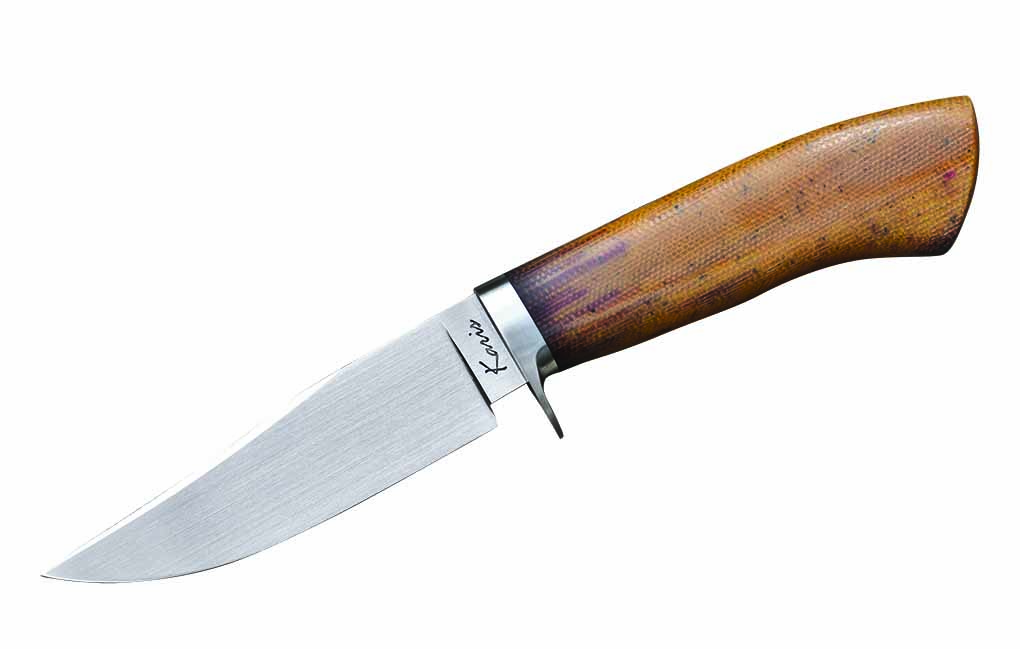
Karis Fisher (inset) is the daughter of ABS master smith Josh Fisher (see adjoining image). Karis not only earned her ABS journeyman smith (JS) stamp in March, she also won the Joe Keeslar Award for the best knife submitted by a JS applicant. The 4-inch blade is 1084 carbon steel and the handle is vintage Micarta®. Guard: 416 stainless steel. Overall length: 8.5 inches. Sheath: custom-made of leather. Fisher’s price for a similar knife: $375.
Steels are made primarily for commercial applications—very few are made specifically for knives. Knife blades have been made from saw blades, files and even railroad spikes. If the steel has enough carbon and can be hardened to hold an edge, somewhere in the past several hundred years someone made a blade of it.
The two primary choices for blade steel are carbon and stainless. Each has its pros and cons. Stainless steel’s biggest advantage is that it is rust resistant, meaning it will require less maintenance. Stainless is not code for “no maintenance.” Yes, stainless steel will rust.
Carbon steel requires maintenance. Many things will make carbon steel rust, several examples being the blood from the game that is being processed and some types of vegetation, including vegetables. However, the rust can be held to a minimum or eliminated simply by cleaning and oiling the knife after use. Keep in mind that storing your carbon steel knife in a leather sheath can also cause rust, especially a wet blade, as the tannic acid used to process the leather can cause rust spots.
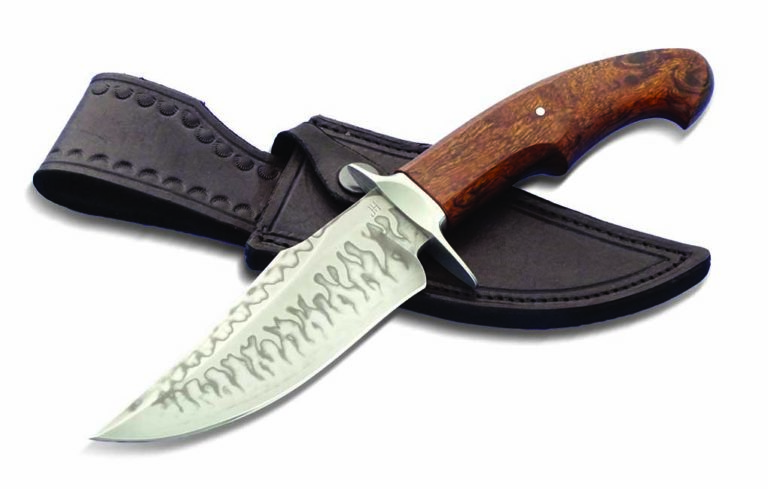
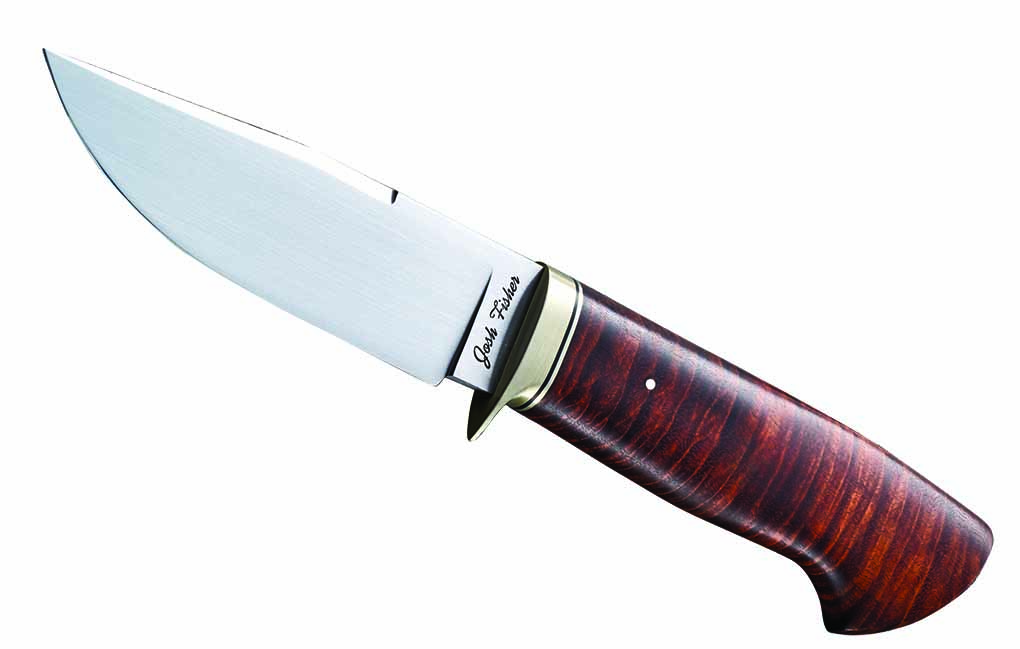
Winner of Best Utility Hunter at BLADE Show 2018, ABS master smith Josh Fisher’s model has a 4.25-inch blade of 1084 carbon steel, a ringed gidgee handle and a guard of brushed stainless steel. Overall length: 8.75 inches. The knife comes with a custom-made leather sheath. Maker’s price for a similar knife: $685. Josh (inset) earned both his ABS master smith (MS) stamp and the B.R. Hughes Award for the best knife submitted by an MS applicant at the same time his daughter Karis earned her JS stamp and the Joe Keeslar Award (see adjoining image). (Eric Eggly/PointSeven knife image)
While carbon steel can rust, it does have advantages over stainless steel, including two if the blade is forged. First, a number of bladesmiths forge distal taper into their carbon steel blades. The taper removes weight from the blade, thereby making the knife lighter in weight and thus easier to carry and manipulate. Second, carbon steel blades can be differentially heat treated to give them a hard edge for sharpness and a softer back for malleability, the latter resulting in a blade with greater flexibility that is much more likely to bend rather than break under high stress.
The steel you choose for your utility hunting knife should be one that can be sharpened in the field and fit the requirements for what you want your knife to accomplish. Remember—it is always best to resharpen your knife before it gets dull!
Handle Material
If you are looking for a group of custom knives that have diverse handle materials, utility hunting knives lead the way. Synthetics, wood, ivory, bone, antler, mother-of-pearl and others—you name it, utility hunters have it.
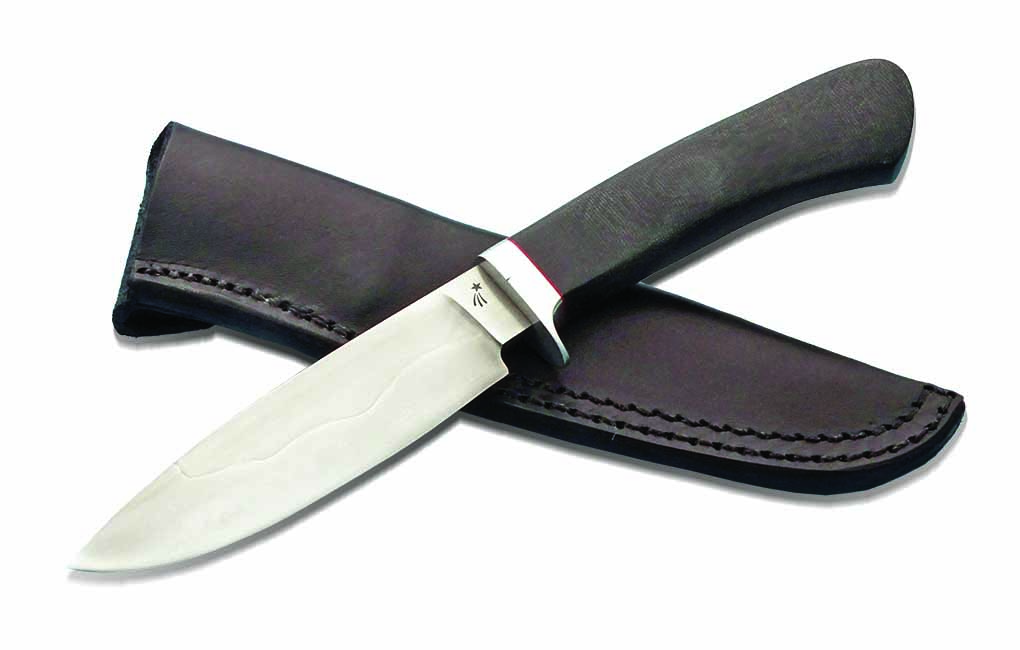
The 5-inch blade of W2 tool steel with hamon headlines a utility hunter by Jim Crowell (inset). The handle is black canvas Micarta® and the guard is stainless steel. Jim made the leather sheath. Overall length: 10 inches. Knife to know: this knife belongs to the author. Current price: $850. (Impress By Design image)
When many outdoorsmen dress their knives to impress, they want stag. Unfortunately, stag is experiencing two things simultaneously, and neither is good. Because of lack of supply, the quality is going down and the price is going up to the point that the ancient ivories are now becoming an alternative. After talking with knifemaker Mike Malosh at BLADE Show 2021, I have started to order some hunting knives with elk. While not as popular as stag, it is a great handle material and has a nice look.
My experience in the field has made me a true believer in synthetic handle materials. The two most popular are Micarta® and G-10. Canvas Micarta is my personal favorite. As the name implies, there are bits of canvas included when the Micarta is made. This gives the handle a little more grip when wet. Westinghouse Micarta is gaining in popularity. Often it’s referred to as vintage or antique due to the fact most of it was made before 1960.
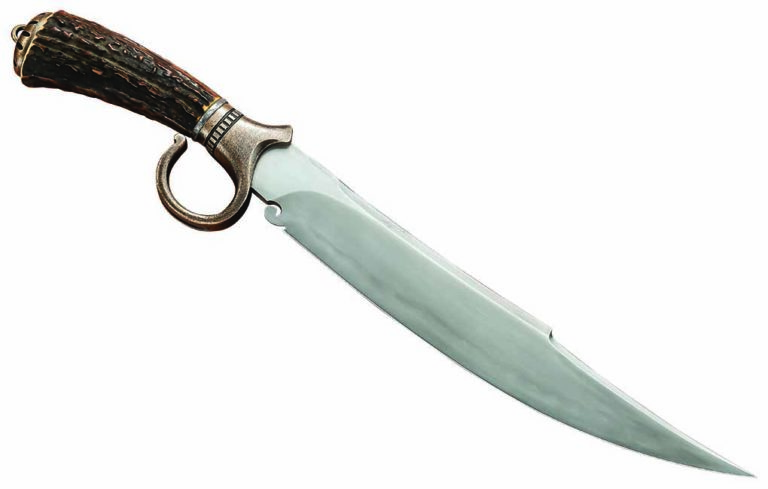
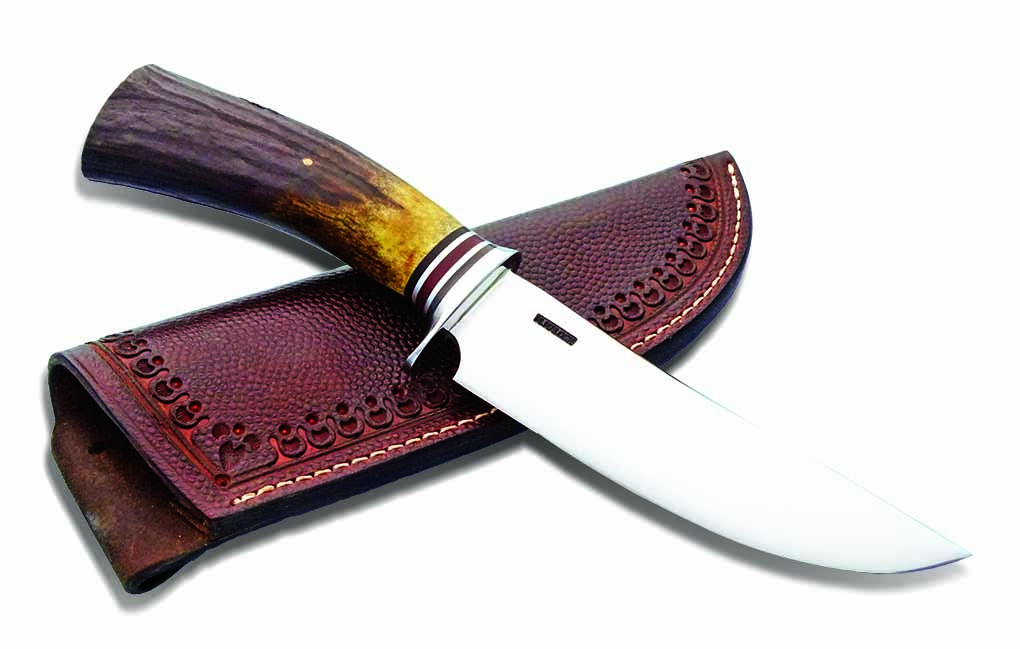
Mike Malosh opts for elk antler with black and maroon Micarta® and stainless steel spacers for the handle of his utility hunter. The 6-inch blade is W2 tool steel and the guard is stainless steel. Overall length: 10.75 inches. The knife comes with a leather sheath by Malosh. The maker’s price: $390. (Impress By Design image)
Carbon fiber is five times stronger than steel, twice as stiff and lighter in weight. This gave rise to numerous commercial applications, eventually finding its way into the custom knife market. Initially used by custom makers for scales on folders, you can now find them using it for fixed-blade handles, too.
The advantage of synthetics over natural handle materials is synthetics don’t shrink and, for the most part, are impervious to the elements. That said, natural handle materials can dress up a knife.
Guards
For the most part, integral guards are utilized as a quicker, less expensive way to make knives. Most are simply squared off to give the illusion that they are somehow protecting your index finger/hand. I learned the hard way that such a guard is not meant for hard work. If you are going to use a knife with this type of guard, wear a glove.
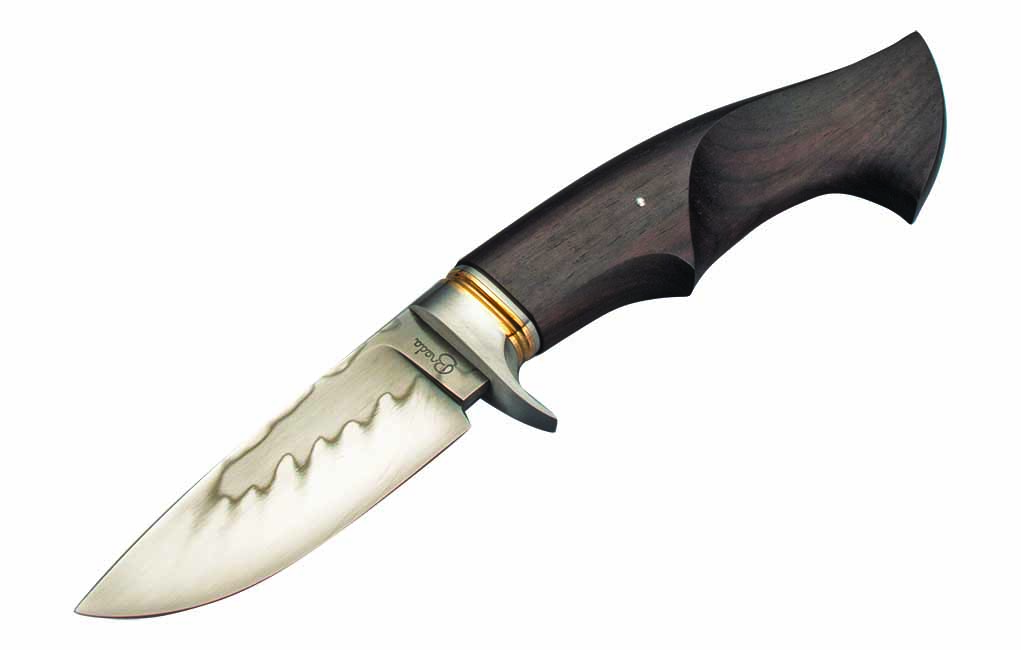
Ben Breda won Best Utility Hunter at BLADE Show 2019 for his model in a 4-inch blade of W2 tool steel with hamon. The handle is sculpted African blackwood with a bronze “S” collar and the blade is stainless steel. The knife comes with a leather sheath by Breda. Overall length: 8.75 inches. Current price: $575. (SharpByCoop knife image)
Most custom utility hunters have a single guard with some amount of curve built in to give you a better handle ergonomic. Additionally, it will provide some protection for your index finger/hand. The primary metals used for such guards are brass, nickel silver and stainless steel. While brass is a favorite among factories and new custom makers, the biggest problem is it is soft and can be easily nicked or cut, giving the guard a sharp edge or corner which can dig into your bare hand. Stainless steel guards provide the best protection and least amount of maintenance for your knife.
Ideal Sizes
Having judged custom utility hunters at the BLADE Show for over two decades (page 42), I can tell you there is no one ideal size. That said, most of the judging competition winners feature a blade between 3 7/8 and 5 inches long. (For the makers reading this, please do not submit your 10-inch bowie or 2-inch miniature in this category for judging.) Among the accompanying images for this story are three past winners of the category at the BLADE Show. Note the differences and similarities. In addition to dimensions, the importance of handle ergonomics cannot be overstated. Most handles will feature some kind of contouring and generally will be between 4.5 and 5 inches long.
Sage Advice
The custom utility hunting knife will be a workhorse in the field. Consider the factors I have outlined before you buy one. What will you use it for primarily? What size handle is best for your hand? Will you be able to do the maintenance required for the blade steel? Can you sharpen the knife in the field and, if not, will you be able to practice how to do so before you get there?
I prefer a 5-inch blade as my experience has taught me that a big blade can do little knife chores, but not the other way around. As my 7th-grade shop teacher always said, “Use the right tool for the job.” Sage advice!
The BLADE Magazine Cutlery Hall Of Fame® is proud to announce three most-deserving inductees for 2022: the husband-and-wife team of Mr. and Mrs. Aldo and Edda Lorenzi and Bill Ruple.
All will be formally inducted in a special Cutlery Hall-Of-Fame ceremony and breakfast during BLADE Show 2022 June 3-5 at the Cobb Galleria Centre in Atlanta.
One of the most prolific, long-running supporters of custom knives in modern cutlery history, the Lorenzis forged a name known in knife circles far and wide while operating their G. Lorenzi retail knife store in Milan, Italy, where they sold knives of some of the greatest knifemakers of all time, including Cutlery Hall-Of-Fame members Buster Warenski, Bob Loveless, Michael Walker, Jimmy Lile, Gil Hibben, Ron Lake, Frank Centofante and many more.
Meanwhile, hailing from Pleasonton, Texas, Ruple is one of the most successful slip-joint makers of the 21st century, winning many awards for his traditional pocketknives, and also serving as a teacher and mentor to an entire generation of award-winning slip-joint makers from Texas and elsewhere.
Aldo and Edda Lorenzi (Francesco Pachi image)
Aldo And Edda Lorenzi
Aldo and Edda Lorenzi operated G. Lorenzi retail cutlery store in Milan from 1959 until its close in February 2014. The Lorenzis regularly attended the world’s most important knife shows, buying scores of knives for sale in their shop. They bought so many knives at shows, in fact, that the Lorenzis’ presence often determined a show’s success or failure. The support and exposure they gave to American makers in particular by selling their knives in their store in one of the most exclusive shopping areas in Milan was pivotal in introducing American custom knives to Europe.
In 1995 they won The Knifemakers’ Guild’s prestigious Nate Posner Award “in recognition for outstanding service in the promotion of handcrafted cutlery.” They also won the BLADE Magazine 2014 Industry Achievement Award for their decades of supporting the custom knife industry. For five years ending in 2019, they sponsored the Aldo and Edda Lorenzi Award for the Guild Show and the BLADE Show, with each event’s award-winning maker receiving $1,000 cash and a plaque—10 awards and $10,000 in all. The Lorenzis also are most supportive of the William F. Moran Foundation and are one of the Foundation’s first chartered member couples.
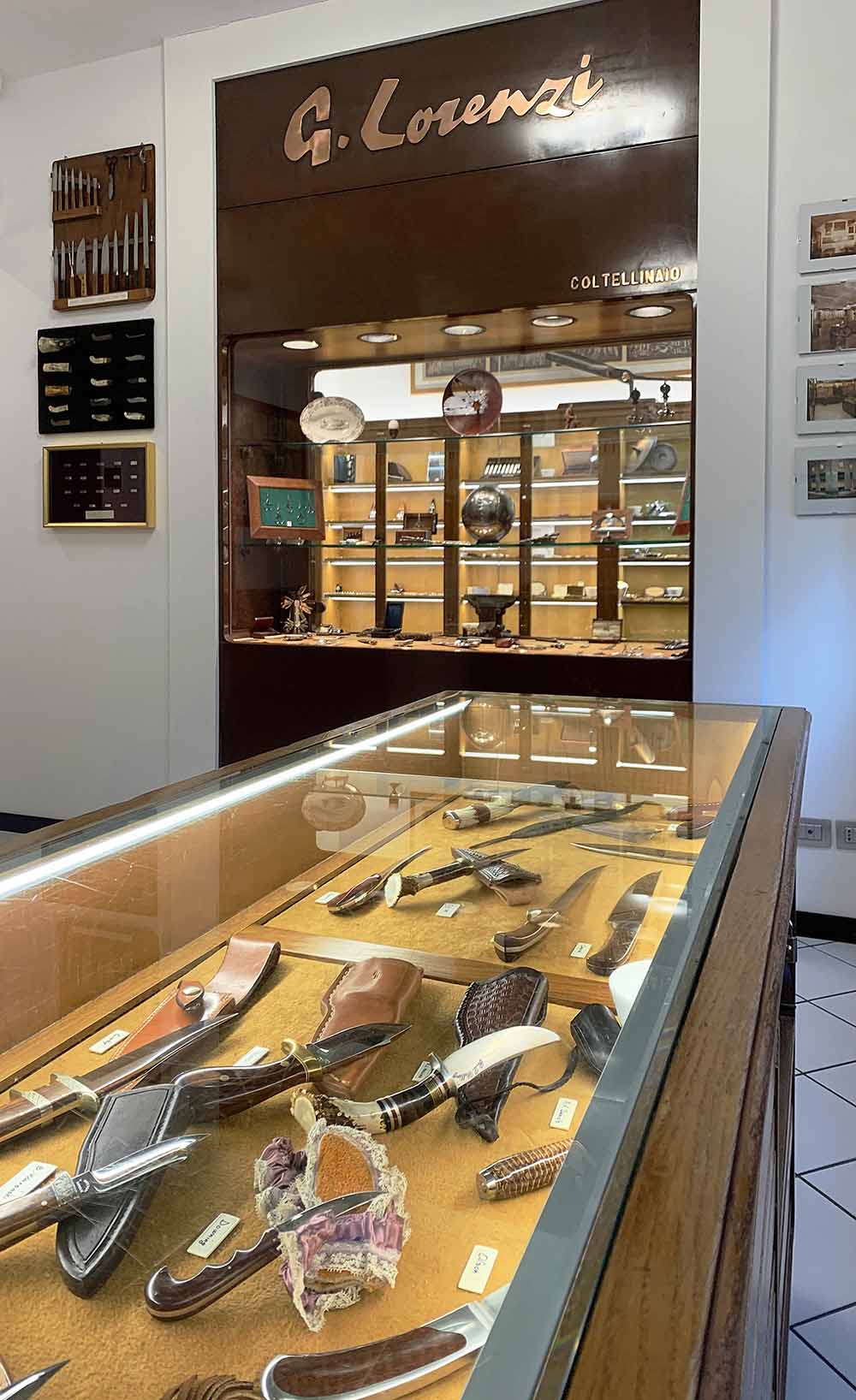
An exterior display window (shown here in the background) from the original G. Lorenzi shop is a centerpiece of the Lorenzis’ new museum. It was one of the store’s six “eyes” that communicated with window shoppers in one of Milan’s most exclusive retail districts, the counters of which, over the years, displayed more than 18,000 types of items. In the foreground is a display case of some of the Lorenzis’ favorite custom knives. (Francesco Pachi image)
“More loyal ambassadors of the art cannot be found,” one sitting Cutlery Hall-Of-Fame member noted of the Lorenzis. “Their store was like a museum, always welcoming visitors and ready to educate them on fine cutlery and custom knives. Several prominent collectors got their start by buying a custom knife at the Lorenzis’ store.”
In fact, the Lorenzis have assembled their massive collection of over 2,000 knives (including 150 custom knives by the world’s best makers spanning the past half century), 700 books, 1,000 magazines and prints, and related items in a new state-of-the-art museum in Milan (December BLADE®, page 60). The museum contains the knives in elegant oak display cases, a recreation of the copper-paneled room that featured the small entrance door to the G. Lorenzi store in Milan, a wooden portable knife grinder used by Aldo’s father and the store’s namesake, Giovanni Lorenzi, almost a century ago, and much more.
Bill Ruple
Bill Ruple
In the eyes of one sitting member of the Cutlery Hall-Of-Fame, Bill Ruple, an award-winning custom knifemaker specializing in traditional pocketknives/slip joints and multi-blades, has done as much as anyone to promote the knife business. Bill served on the board of the Texas Knifemakers Association, taught many how to make traditional knives and is very free with his knowledge. In recognition of this fact, he was presented with the BLADE Show 2019 Aldo and Edda Lorenzi Award. The award went to a knifemaker who excels in terms of teaching and mentoring his or her fellow makers in the art of knifemaking.
Having built knives for 34 years, Ruple is a premier maker of slip joints and possesses a selfless willingness to teach others how to do it, usually in his shop in Pleasanton, Texas, and also at BLADE University, the BLADE Show, BLADE Show West and other venues. He has helped many get started with the slip joint, one of the oldest yet most challenging folders to make. His kindness and patience validates something other makers know all too well—that he is most willing to share knowledge with and encourage, critique and mentor makers everywhere.
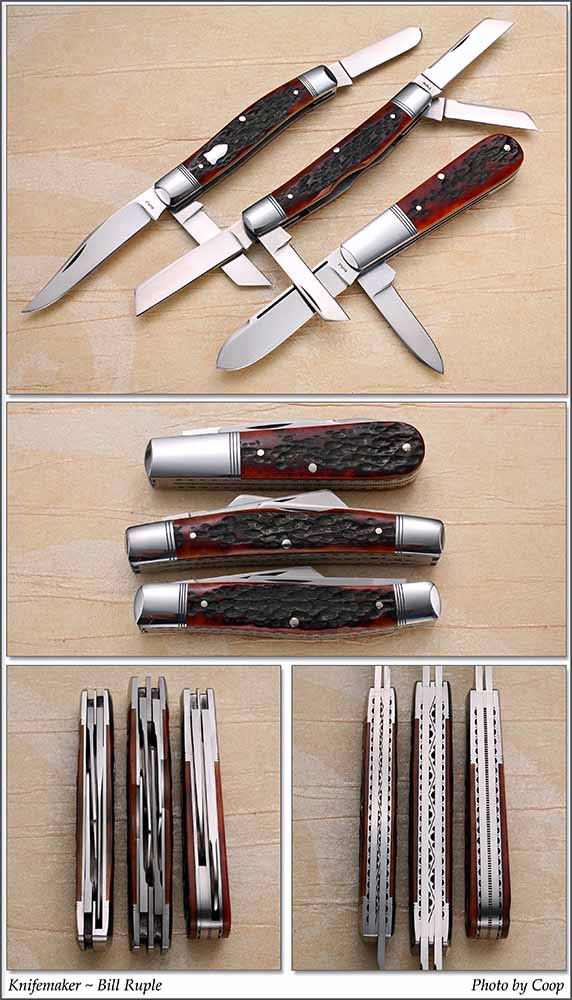
A selection of Bill Ruple’s slip joints in an array of open, closed and spine images show Bill’s awesome talent and versatility as a knifemaker. (SharpByCoop image)
Bill has taught quite a few who have become award-winning makers in their own right, including Rusty Preston, Luke Swenson, Tom Ploppert, Phil Jacob, Bubba Crouch, Toby Hill, Enrique Pena and others. A number have gone on to teach also, spreading Ruple’s knowledge to others who no doubt do the same as well. Bill does not limit his shared knowledge to just stock removal makers, receiving the American Bladesmith Society’s President’s Award for teaching ABS members how to make slip joints. Finally, Bill has donated some of his knives to knife shows and other cutlery organizations to raise funds for their various needs.
Hall Of Fame Criteria
Selected by a vote of sitting Cutlery Hall-Of-Fame members, the inductees are selected based on the following criteria: demonstrated extraordinary service to the knife industry; displayed honesty, character and integrity; advanced the industry by the creativity and originality of their works or contributions; as ambassadors or outstanding contributors, have furthered the positive impact of the knife industry on the world at large, and, in summary, have demonstrated a worthiness to be a member of this prestigious group.
The latest inductees exhibit all these qualities and more and represent a most worthy Cutlery Hall-Of-Fame induction class of 2022.
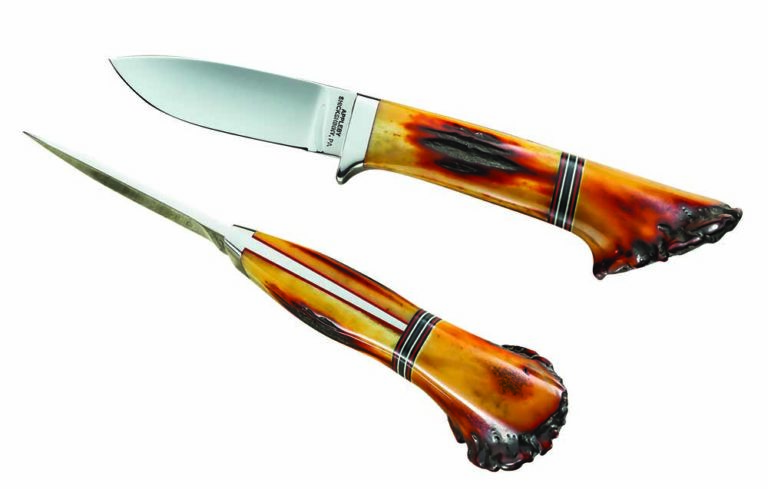
Robert Appleby nails a Loveless dropped hunter in crown stag.
Robert Appleby’s custom-order reproduction of a dropped hunter by BLADE Magazine Cutlery Hall-Of-Fame® member Bob Loveless in amber crown Sambar stag is Loveless in all the right places.
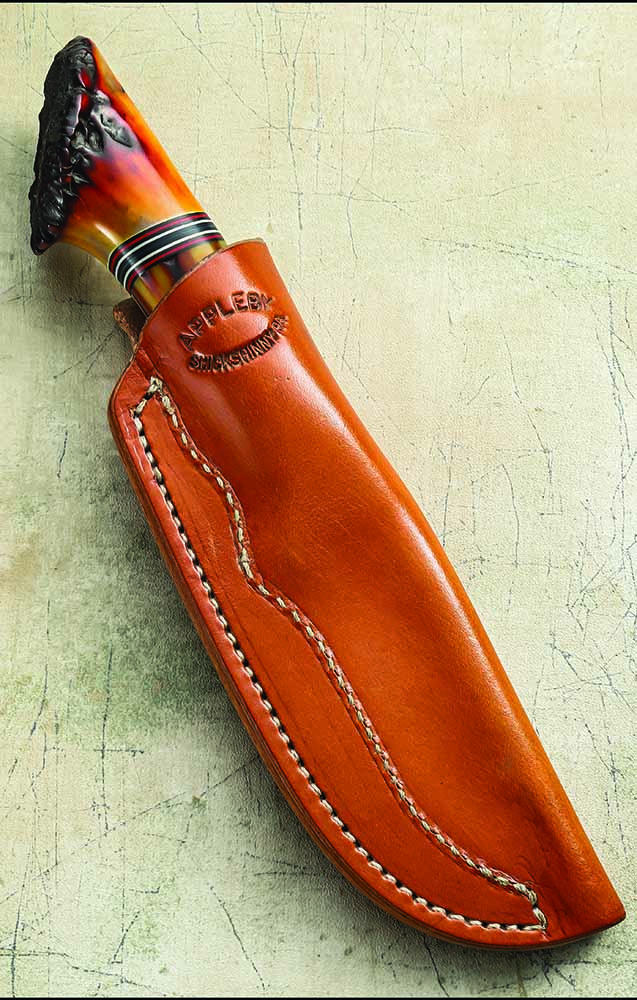
The pouch belt sheath of 8- to 9-ounce leather from Wicket & Craig is also in the Loveless style. Robert is celebrating 25 years of knifemaking.
A customer sent Robert an image of an original Loveless knife and Appleby went to town, reproducing the tapered full tang faithfully to the original.
“It’s still a full tang, not a frame,” he explained, “one solid piece from the point to the back.” He tapered the tang, left the stub at the end and mortised it into the stag crown handle butt. He glued the spacers like a block, which fit over the stub. The stag is from Culpepper & Co., which amber dyed it as well.
“I really enjoyed that knife,” Robert noted. He said the satisfaction he felt after he had finished it was similar to the same sort of happiness he has when experiencing “the old muscle cars.”
Loveless Repro Dropped Hunter Specs Maker: Robert Appleby Blade length: 35/8” Blade material: AEB-L stainless steel Blade finish: Mirror polish Handle: Amber-dyed crown Sambar stag Bolster: 416 stainless steel Overall length: 9” Maker’s list price for a similar knife and sheath: $625
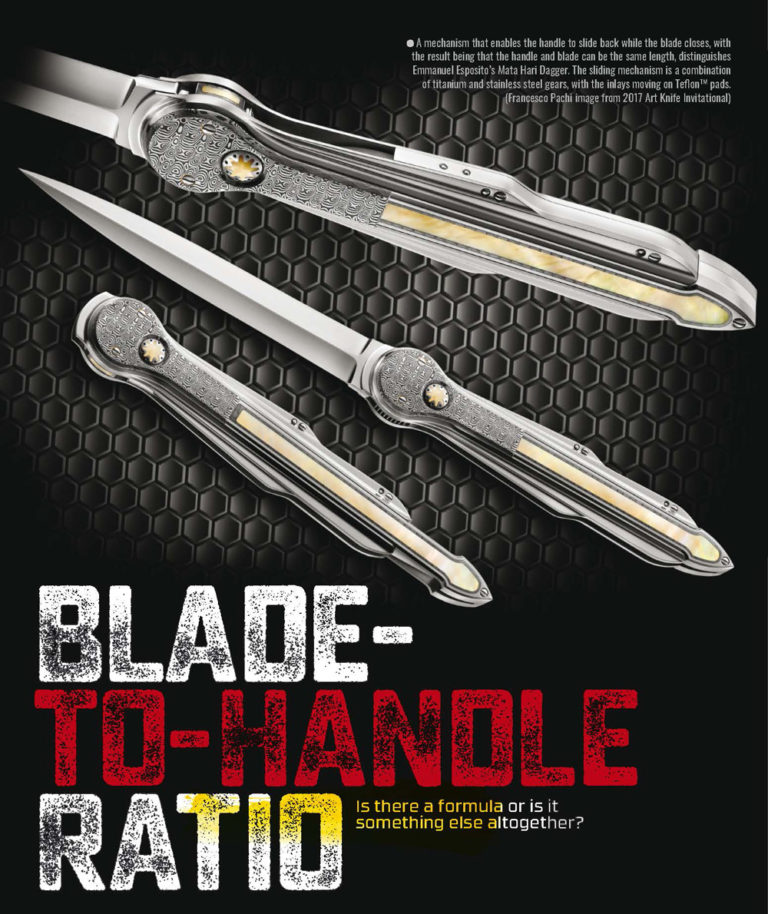
It’s the critical cooperation of handle and blade that makes the knife perform. One supplies the cutting edge, while the other allows you to exert control. So, then, the age-old question follows in finding the right ratio of length for each in a knife of proper construction.
In many cases, the experienced knifemaker follows his gut feeling to achieve the best knife handle-to-blade ratio, his understanding of just what it takes. Instinctively, the design brings balance and function to the piece.
Certainly, the process would be simpler if a formula existed to guide the maker in the optimal handle-to-blade ratio. However, according to those consulted for this story, there is no such formula.
The best knife handle-to-blade ratio, they reason, is driven by intended use.
Use, Not Size
It’s hard to establish the best knife handle size because no two hands are the same.
“I base the ratio on use, not size,” explained knifemaker and BLADE® field editor Abe Elias. “For instance, when you look at the knife you carry every day, you’re not usually out there skinning animals or felling trees. You’re cutting open boxes and packages, snipping string or tape, and—if you trust the cleanliness of the blade—cutting a piece from a block of cheese or peeling an apple. In the end, everything is based on what you do with the knife.
“So when you look at all that, everyday use versus bushcraft or camp use, then you might say to yourself that you don’t need a lot of handle for torque or control if you’re cutting a piece of tape or your Amazon box open. If the blade is small, you don’t necessarily have to put a small handle on it; but, if the job doesn’t require a good, full grip, I’ll shorten the handle to make it easier to carry in an urban environment to do non-strenuous jobs.
“Bushcraft requires that you do strenuous stuff related to torque, and with carving or craft ing or skinning an animal,” Abe concluded. “Therefore, the handle must be full size to provide the ability to control the blade and put enough force behind it. Small jobs need control but not always a lot of force.”
Instead of the knife’s size, knifemaker/BLADE® field editor Abe Elias bases handle-to-blade ratio on its use.
What Pleases the Eye
Don Hanson, making knives for three decades with the Sunfish Forge mark, has no exact, best knife handle-to-blade ratio formula, and he readily asserts that any standard such as a “handle length an inch longer than the blade” falls apart pretty quickly.
Don Hanson said he does not have a formula for the blade-to-handle ratio. “I just do what looks good to my eye,” he noted. “With folders I make the blade as large as possible to still be able to fit inside the handle when closed.” (SharpByCoop image)
“I don’t have a formula for the ratio,” he commented. “I just do what looks good to my eye. With folders I make the blade as large as possible to still be able to fit inside the handle when closed. I don’t think making the handle an inch longer than the blade on a fixed blade is accurate. That would not work for bowies or fighters, where blades are typically seven to 12 inches. On these the handles are usually 5 inches.
Now, it could be true for a hunting knife if it has a 3.5-inch blade. A 4.5-inch handle would be perfect for that hunter.”
The Golden Mean
Hanson allows that the mathematical “Golden Mean” ratio may be helpful, though he does not specifically use it in his work. Without launching into a prolonged Algebra lesson, two quantities are in the Golden Mean if their ratio is the same as the ratio of their sum to the larger of the two quantities. Dust off that old high school math book for the actual formula and a clearer definition.
“Handle-to-blade ratio is function first,” Hanson added, “but in this time of images on the internet and magazines, the visual aspect is very important. Sometimes we see a knife that looks pretty good but just doesn’t seem right—and it’s not apparent why. In most cases the handle-to-blade ratio is off.
“The Golden Mean ratio is a good way to get handle-to-blade ratio right. I don’t use it, but most knives that look right will fall within the parameters of that ratio. Still, there is no rule or ratio in folding knives. The handle is always longer than the blade.
“A folder just looks bad when the blade is too small. I just design knives that function well and look good. I rarely measure anything or use any rules. The knife has to look good to get someone to pick it up. Then, if it feels good in the hand you have a winner.”
The old adage that the handle should be about 1 inch longer than the blade doesn’t work with large knives. “In period pieces such as an 18th century Scottish dirk, the grip was typically in the 4-to-5-inch range despite a blade length that could be up to 16 inches,” Vince Evans (inset) noted. His Scottish dirk repro was the cover for the March 2020 BLADE®.
Function, Comfort, Looks
According to Vince Evans, a full-time maker since 1981, some handles do require a certain length or shape depending on function, and some hunters prefer a small grip that is completely in the hand to avoid getting in the way when field dressing an animal.
“Personal preference probably plays a big part in that idea,” Vince said. “In period pieces such as an 18th century Scottish dirk, the grip was typically in the 4-to-5-inch range despite a blade length that could be up to 16 inches. Knives of the past tended to have more similar grips than modern ones.
“People carried a knife all the time for various purposes, so I would think that the ratio worked out naturally over time, and I would imagine that overall weight had a lot to do with the size.”
“Aesthetically, if you have a blade that is too big for the handle, it can become wonky,” Joe Flowers, a knife designer for Condor Tool & Knife, reasoned. “If you don’t balance the blade with the handle on a fixed blade, it can become messy. The human eye picks up on imbalance, so, if you have a short blade and a long handle, you’d better have a good reason.
“For fixed-blade bushcraft knives the most popular example is a 4-inch blade with a 4.5-inch handle, with a point down the center line. As a designer, especially recently, I’ve tried to jump out of the ‘rule’ rut that I’ve made more or less for myself.”
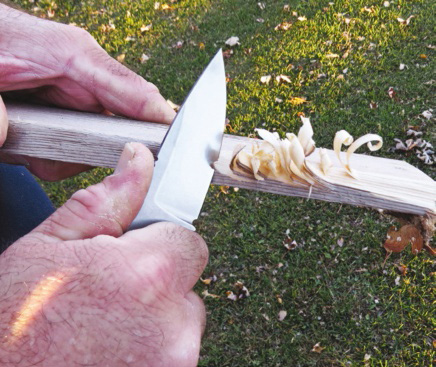
The White River Knife & Tool M1 Backpacker makes nice, tight curls. “Bushcraft requires that you do strenuous stuff related to torque and with carving or crafting or skinning an animal,” Abe Elias observed. “Therefore, the handle must be full size to provide the ability to control the blade and put enough force behind it. Small jobs need control but not always a lot of force.” (Abe Elias image)
Ergonomics are an integral component of the best knife blade-to-handle ratio, and the user surely appreciates that balance in the field.
“I’ve done a lot of research on human hands/tool use ergonomics,” Flowers offered. “More ergonomic knives have less geometry in their handle design for long-term use. Sometimes these handles don’t look very special, but after the third hour of whittling a kuksa [a Scandinavian drinking cup carved from birch burl] or an axe handle, you will appreciate them.”
Flowers adds that torque and dexterity dictate handle length in relation to a knife blade. In other words, if more force must be applied, then more surface area in the right points of contact with the hand allow the user to apply that torque.
“If it’s something like a neck knife,” he interjected, “you probably aren’t going to be applying that much torque, and are using it more for miniscule tasks such as cutting line rather than chopping down a tree. The handle length can sometimes dictate what the blade is capable of doing. An axe with a 3-inch handle would work differently than one with a 23-inch handle.”
The perfect combination of handle and blade is ultimately put to the test with intended use. In the absence of a formula, the true judgment may be found in the fatigue or the number of blisters on the palm when the job is completed.
Overthinking Handles?
Years ago, a well-known knifemaker offered Elias some advice.
“He said two things,” Abe smiled. “‘You’re spending too much time on your handles. You’ll never get your money back for it. And your handles are too long. They should be the bare minimum.’ Now, my whole thing is that the knife is only as good as your ability to control it.
“I will ask a customer what size their hand is. I’ll ask them to go to a store and find a pair of metric-sized gloves that fit and give me the number. That way I know the dimensions of their hand and can work from that accordingly.
“Still, it would be good to say that there is some kind of ratio that always applies, but like I’ve said, I don’t have a mathematical formula—I have a use formula.”
The best knife handle-to-blade ratio is, after all, the product of evolution, experience and the trained eye. Placing these elements in perspective produces the balance and control necessary for the knife to function as it should, while also making a pleasing presentation from a visual standpoint.
Shop Dump: Top makers reveal the key equipment that helps them get the job done
“Shop Dump” is a new BLADE® feature showcasing the special knifemaking equipment of some of today’s leading knifemakers and bladesmiths. The new feature kicks off with ABS master smith Rick Dunkerley and knifemaker Jason Fry.
Rick Dunkerley
Rick Dunkerley
“I’ve been making knives for almost 40 years,” Rick Dunkerley observed, “and in that time I think I’ve developed a style that is recognizable as my own.” It’s specific equipment that plays a crucial role in him making knives in that style. There are many more tools that help along the way, but he uses seven in particular on every knife.
1. Propane Forge
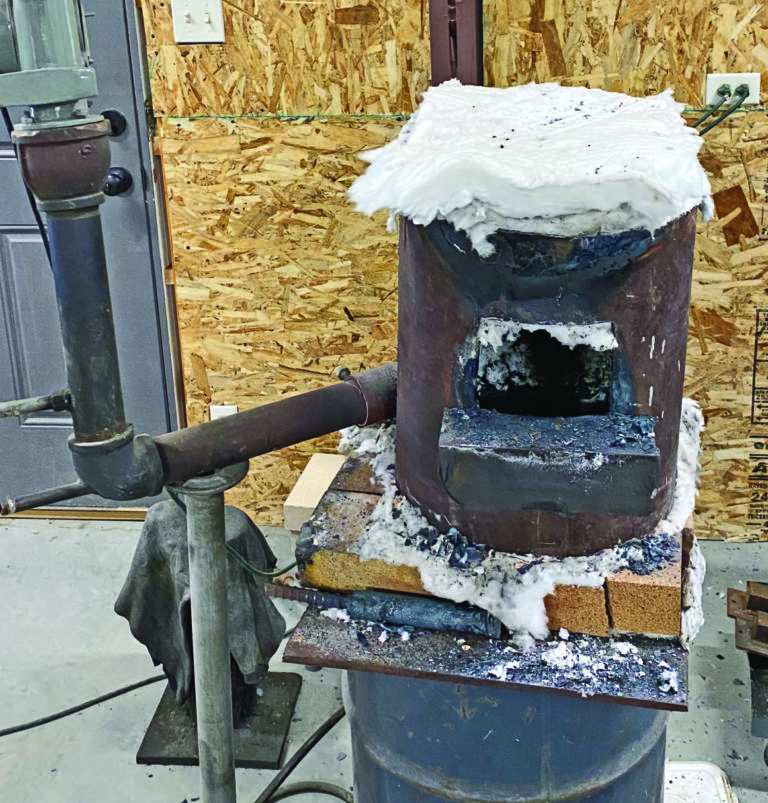
Dunkerley’s propane forge
His propane forge is homemade and the burner is over 20 years old. “It’s a vertical Don Fogg design,”he commented, “lined with ceramic wool lining. Since 99 percent of my knives are damascus steel, they begin in this forge.” Dunkerley began using his hydraulic press built by Billy Bob Sowell to forge damascus in the early 1990s. It’s Rick’s third hydraulic press, incorporating a larger cylinder, motor and hydraulic pump than his earlier models. The press helps him finish the damascus he forges.
2. eBay Bargain Surface Grinder
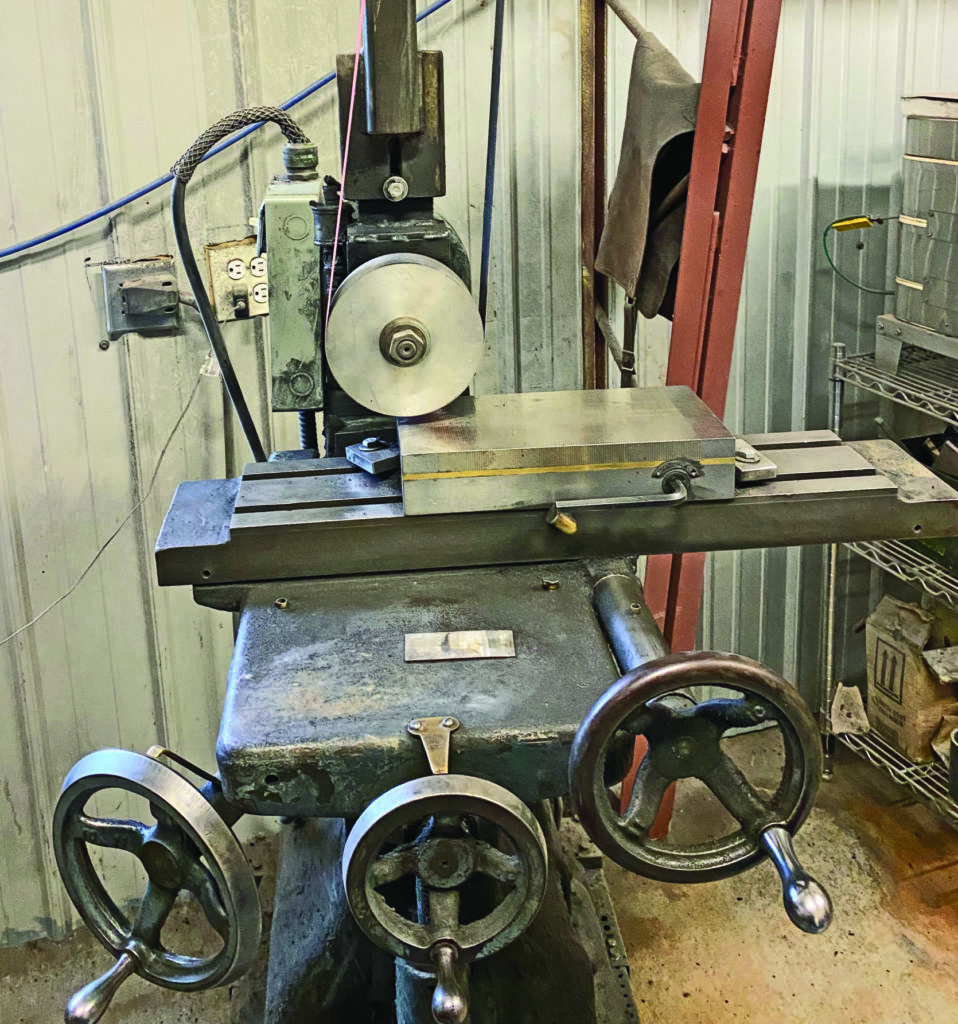
Surface grinder
An eBay-bargain ($300) surface grinder has served Rick well for 20 years. “I don’t know the make or the model,” he said, “and I changed it to a single-phase motor and converted it to run 2×72 belts with an aluminum contact wheel. It works on the damascus as it’s being made, and then precision grinds the blade and back bar material for my folders.”
3. Craftsman Drill Press
Dunkerley’s small Craftsman drill press “has drilled the holes on almost every folder to come from my shop,” he declared. “It’s very accurate and small, which is convenient as I can place it on my bench right next to my disc sanders. I added a keyless chuck to speed up the bit changes.”
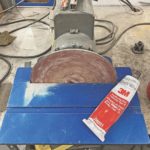
4. Tru-Grit Disc Sander
Tru-Grit Disc Sander
Rick’s 9-inch Tru-Grit disc sander is another machine he’s had for 20 years. “The disc is great for flattening material, dovetailing bolsters, shaping handles and grinding blades. It’s reversible and set up with a foot switch to allow me to place the material against the disc and then turn it on,” he explained. “I wouldn’t want to make knives without a disc sander. I actually have three in my shop and would like one more.”
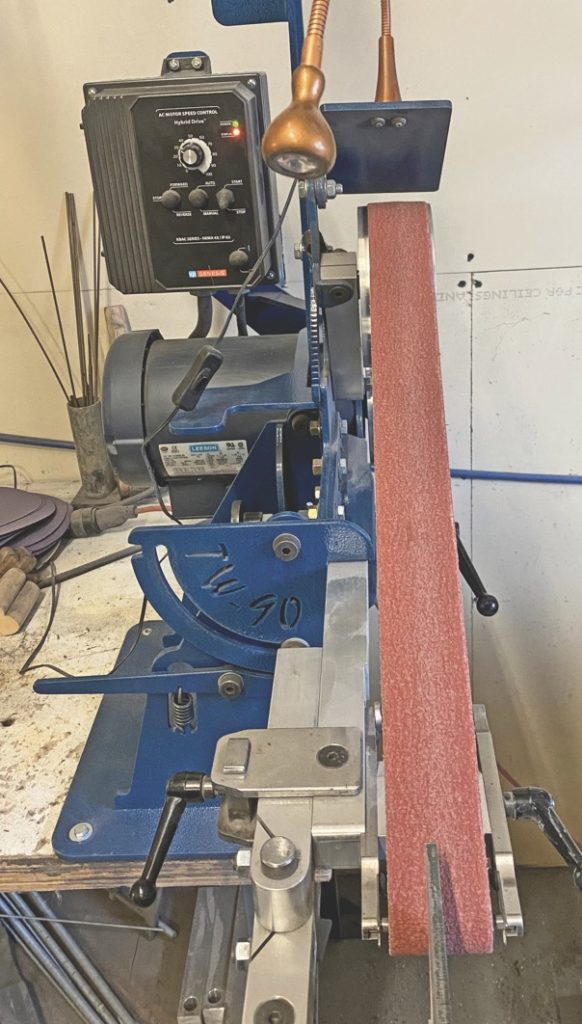
5. TW-90 Belt Sander
TW-90 Belt Sander
Dunkerley follows up with a TW-90 belt sander. “The versatility of this machine makes it one of the most used in my shop,” he remarked. “From rough grinding all types of material to fine finish work, this thing saves me huge amounts of time. The small wheel attachment and the fact that it turns into a horizontal grinder help me eliminate other machines that I would only use for specific jobs. The first time I saw one of these machines work, I knew it would make me a better knifemaker.
6. GRS Engraving Equipment
GRS Engraving Equipment
Rick uses his engraving equipment to give his knives an unmistakable quality and aesthetic. “Nearly every folder I make has engraving and some gold inlay,” he noted. “That happens here. My equipment was made by GRS and has served me very well. I continually think of new ways to use this equipment to add details to my knives.”
Jason Fry
Jason’s shop-proven equipment serves as a milestone along the way
Jason Fry
Jason Fry follows a direct route to excellence and each of his shop-proven pieces of equipment serve as a milestone along the way.
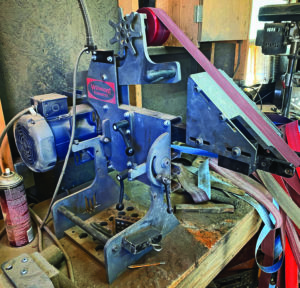
1. Wilmont Grinder
“My number one machine is my 2×72 Wilmont grinder,” he explained. “After 13 years on a homemade machine, I recently upgraded to the Wilmont Quattro.
Most of the recent high-end grinders will have variable speed, horizontal tilt, adjustable tool rests and specialty fixtures. This is the only ‘brand new’ machine I have ever purchased.”
Jason’s Wilmont Grinder
Fry adds a comparison of his heat-treat oven choice, relating, “You can argue Ford vs. Chevy or Evenheat vs. Paragon, but all the modern production ovens have digital temperature control. This gives the maker the ability to precisely dial in the heat treat of their chosen steels, and to heat treat stainless steels that require longer soaks at high temperatures.” Jason acknowledges that he bought a used Evenheat oven but he’s friends with all the folks at Paragon. “I got a good deal on the oven,” he smiled. “I had an old dental oven that I sold for three-fourths the price of my Evenheat, and it was a good upgrade.
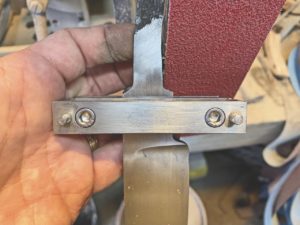
2. File Guide
A file guide, such as this one by ABS master smith Bruce Bump, has carbide inserts that allow the maker to grind up against the guide and create a square shoulder on the blade.
“Another important tool is the file guide. I use a Bruce Bump file guide with carbide inserts. Bruce was an inspiration to me with his epic WIP threads in the forum days before Instagram, so I wanted one of his file guides when it came available.
3. Power Hammer
Jason’s power hammer
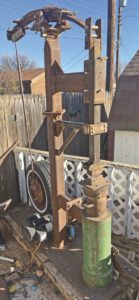
“My power hammer is a homemade ‘junkyard’ hammer in the ‘Appalachian’ or ‘Rusty’ basic design. It has a 40-pound head and hits at around 200 beats per minute. It makes the forging process faster and also allows me to efficiently make my own damascus. I chose the design because it was simpler to build from scrap than the tire hammer design.
“I competed on Forged in Fire back in May 2018 and my episode aired in September,” Jason added. “As I was preparing for the show, practicing forge welding and such, it came to mind to build a hammer. I prepared for Forged in Fire by building a hammer because even if I lost in the first round, I’d still have a hammer I could use for the rest of my career. This hammer took me about two months of intense weekends to build, and other than the initial test run, the first time I ran it was when I filmed the final [FIF episode] at my house. I still use it every forging session almost three years later, and having the hammer has made forging much more enjoyable and greatly expanded my capacity.”
Capitalizing on the right shop tools and equipment has made an enormous contribution in knifemaking, and listening to those who have been down the road gives others the opportunity to test, refine and choose what works best in their own shops. Meanwhile, the knife buyer can have an enriched ownership experience knowing more about the process and the pride that goes into each finished knife.
The Paring knife is there when you need it most, from big tasks to small. Here are options for every type of user.
Paring knives may often get overlooked in the kitchen for their flashy big brothers—chef’s knives—but like EDCs, they’re there when you need them most and there’s one for every type of user.
TOPS Knives embraces the paring knife market in conjunction with its Dicer line of kitchen knives. “We noticed, in the process of wanting to design a kitchen knife, that there were some amazing U.S.-made custom kitchen knives, but there weren’t many high-quality domestically made production kitchen knives,” TOPS spokesperson Jeremiah Heffelfinger observed. “This was a void that we were more than happy to fill, especially with the plan for a full line of kitchen knives in the near future.”
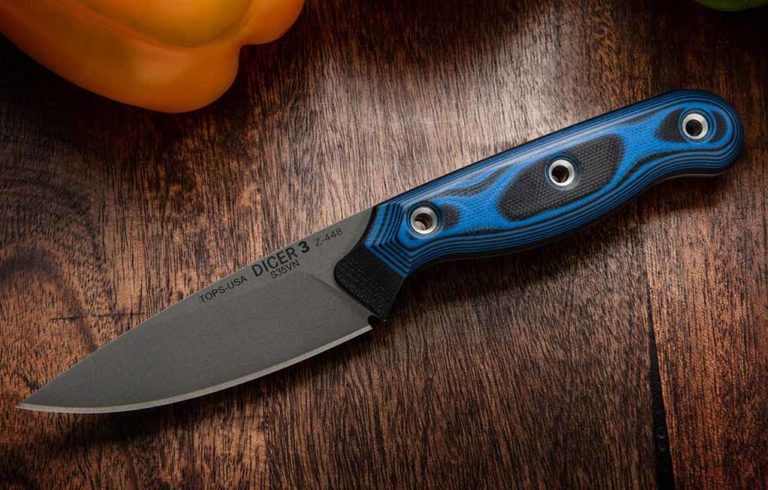
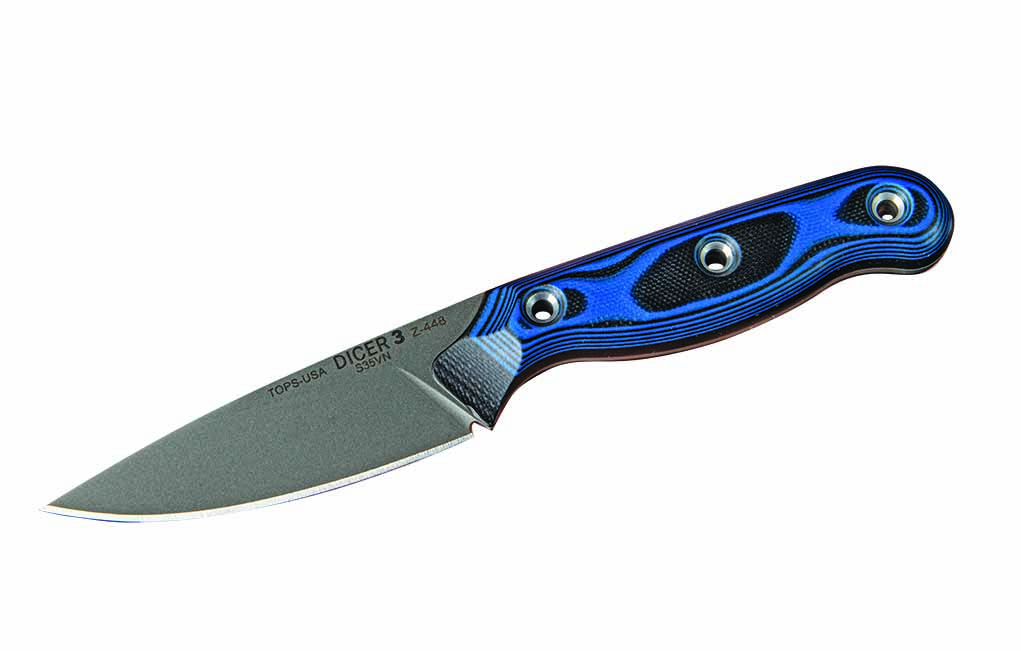
The Dicer 3 has balance, a great blade steel—CPM S35VN stainless—ergonomics and looks.
A design contest between the staff of TOPS Knives in 2017 yielded the Dicer, an 8-inch chef’s knife. TOPS President Leo Espinoza designed a companion paring knife. The Dicer 3, released with the chef’s knife in 2019, that sports the same steel and handle material. The paring knife has become a popular offering as the company has filled out its culinary lineup, including bread and steak knives.
“The chef’s knife typically gets the majority of the attention, but for fine and detail tasks the paring knife can’t be beat,” the TOPS spokesperson advised. “It affords more control for tasks like peeling and trimming meat, fruit or vegetables.”
Heffelfinger said the Dicer 3 is a package that sports balance, a great steel, ergonomics and looks. When company officials designed the chef’s knife, they wanted it ground from CPM S35VN stainless steel, a material they carried over to the diminutive blade.
“We hadn’t seen many kitchen knives using S35VN and, having used the steel before on our Camp Creek hunting knife, we knew it would perform very well with great edge retention and durability,” he said. “Being a stainless steel, it is much less prone to corrosion and rust, making user maintenance just a little bit easier.”
The blade is flat ground to reduce friction in cuts, a .09-inch-thick steel that tapers to .032 inch near the tip, and sharpened to about 20 degrees to balance clean slices and durability when chopping, Heffelfinger added. It’s a blade described as a medium-to-heavy weight for a paring knife.
“We have a reputation for overbuilt hard-use tools that are able to hold up under extreme-use scenarios. We brought this philosophy with the full-tang design on every one of our Dicer line of knives,” he explained, “but we also wanted a classic feel and look for them, with a TOPS flair.”
He indicated knife enthusiasts have noticed that overbuilding and some have taken the blade far from the kitchen knife drawer.
“We have had a number of customers purchase the Dicer 3 to use as an EDC knife,” Heffelfinger said. “Due to the size of the blade, the S35VN stainless steel and smooth, contoured handles, they have attached a clip to the sheath and roll with it on their belt every day.”
Dicer 3 Specs Designer: Leo Espinoza Blade length: 3.5” Blade steel: CPM S35VN stainless Blade grind: Flat Blade thickness at its thickest: .09” Handle material: Black canvas Micarta® and Blue-black G-10 Handle thickness range: .1875 to .75” Weight: 4.7 ozs. Overall length: 7.88” Sheath: Black Kydex Country of origin: USA MSRP: $200
Case Household Cutlery 3-Inch Clip Point
Sometimes it is best not to change the paring knife beloved by cooks through the decades, designs that have seen food crazes come and go: Jell-O salads, fondue pots, casseroles and avocado toast. Enter Case Knives’ Case Household Cutlery 3-inch clip point paring knife.
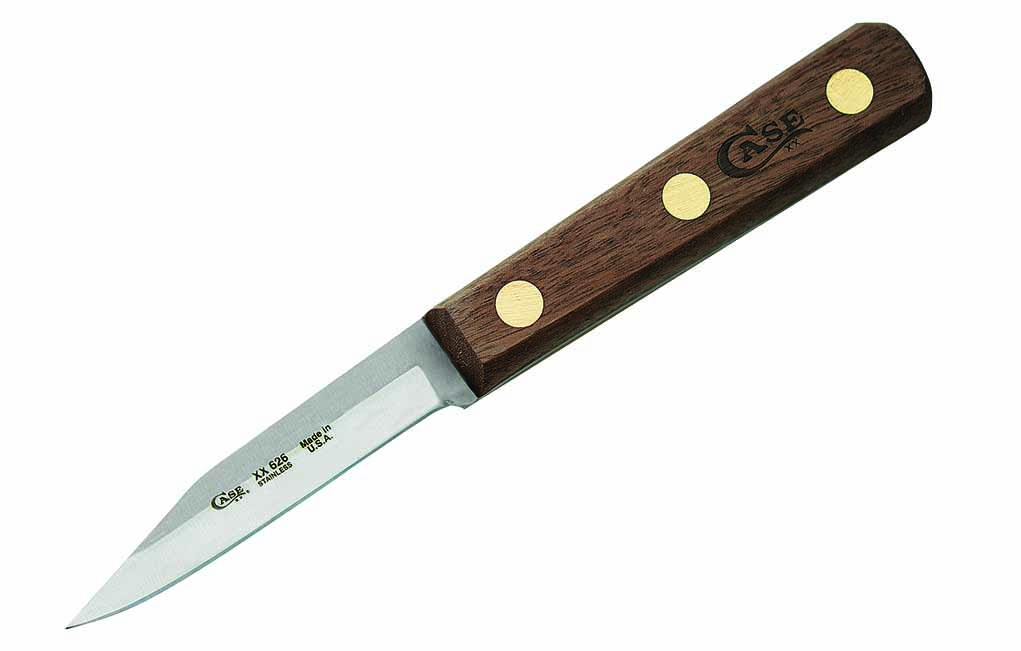
Case has two paring knife blade styles: a spear and a clip point (shown here). “The clip-point version excels at chopping smaller food items because of its blade design and the blade edge, which mirrors the flat cutting surface when used correctly,” Case spokesperson Fred Feightner noted.
“We use classic walnut wooden handles that have been used in millions of kitchens over time,” said Fred Feightner, Case senior marketing communications manager. “We purposely wanted these new kitchen knives to look, feel and perform like the Case household knives of old, and we feel our current offerings do just that very well.”
Case debuted the knife in 2012 while reintroducing its household line—in part by demand from its fans and also as a way to expand its brand and possibly place the knives with retailers who emphasized kitchen supplies.
Consumer advocates insisted on a simple handle design: a straight .5-inch-thick wooden handle, Feightner said. For the blade, the company turned to its Tru-Sharp™ surgical steel—the Case version of 420HC stainless—sabre ground and polished to a satin finish to resist the corrosion that can occur working around food.
The company has two paring knife blade styles. While the spear point slices and dices with ease, Feightner confided, “The clip-point version excels at chopping smaller food items because of its blade design and the blade edge, which mirrors the flat cutting surface when used correctly.”
It’s a knife Feightner says, despite its size, can hold up to kitchen tasks most anywhere. As he noted, “We think our paring knives are perfectly weighted so that intricate work is as easy as tougher jobs around the kitchen and at the barbecue pit.”
Household Cutlery 3-inch Clip Point Paring Knife Specs Blade length: 3” Blade steel: Tru-Sharp™ Stainless Blade grind: Sabre Handle material: Walnut Handle thickness at its thickest: .5” Overall length: 6.75” Weight: 1.7 ozs. Country of origin: USA MSRP: $27.99
V Nives Emerald Paring Knife
Mike Vellekamp, owner and founder of V Nives, indicated his company has recently entered the world of kitchen knives, too. At his house, the 8-inch chef’s knife is most often used to prep food thrown in a wok or barbecued.
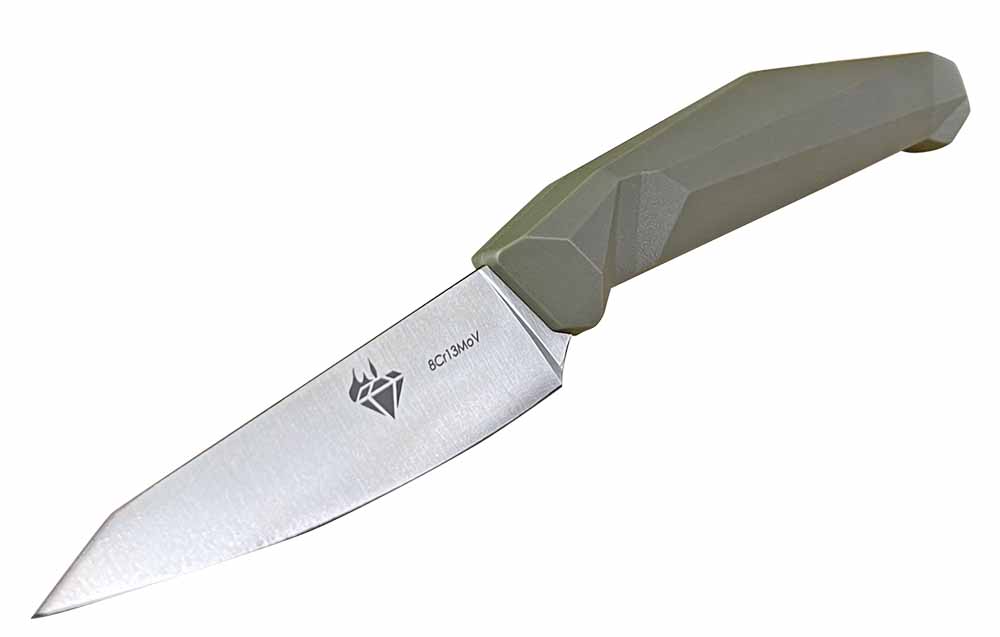
The green handle—an exclusive color for V Nives—of the Emerald Paring Knife is injection molded around the blade tang.
“However, for day-to-day utility in the kitchen, the paring knife is definitely a must have,” Vellekamp said, adding the genre of blade is “optimal for intricate cutting, mincing, slicing and dicing fruits and veggies, deveining prawns/shrimp, and cutting herbs.”
And what V Nives offers won’t be the type of model found moldering in grandma’s cutlery drawer: the angular and green-hued Emerald Paring Knife. Vellekamp said it’s an example of a modern, innovative kitchen implement.
“DiaFire actually developed the knife,” Vellekamp said. “We have a close relationship with the brand, and we are the exclusive distributor for the Americas. We chose their kitchen products because of their dedication to innovation and quality.”
The Taiwan-made blade is 1/16-inch thick and flat ground from 8Cr13MoV stainless steel. “This is a great blade steel because it holds an edge very well for its intended uses, it’s highly corrosion resistant and it’s very easy to resharpen,” Vellekamp noted.
The green handle—an exclusive color for V Nives—is injection molded around the blade tang, making an ergonomic handle that runs between .417 to .645 inch thick. It’s a grip Vellekamp calls tough and light. And while he and other knife enthusiasts will tell you it’s a terrible way to treat your most important tool in the kitchen, the handle can survive a trip through the dishwasher if the, er, less knife enlightened put it there.
“These knives are a perfect example of high value at an affordable price,” Mike said, “and I believe it is a perfect complement to the modern kitchen.”
Emerald Paring Knife Specs Blade length: 3.5” Blade steel: 8Cr13MoV stainless Blade grind: Flat Blade thickness at its thickest: .059” Handle material: Nylon and fiberglass injection molded Handle thickness range: .417 to .647” Weight: 4.25 ozs. Overall length: 8.15” Country of origin: Taiwan MSRP: $42
Bradford Knives Blue G-Wood Paring Knife
Brad Larkin of Bradford Knives said a wise knife collector once told him that any good chef’s knife needs a paring knife sidekick. As a result, he’s happy with the Washington state-based shop’s flagship paring knife.
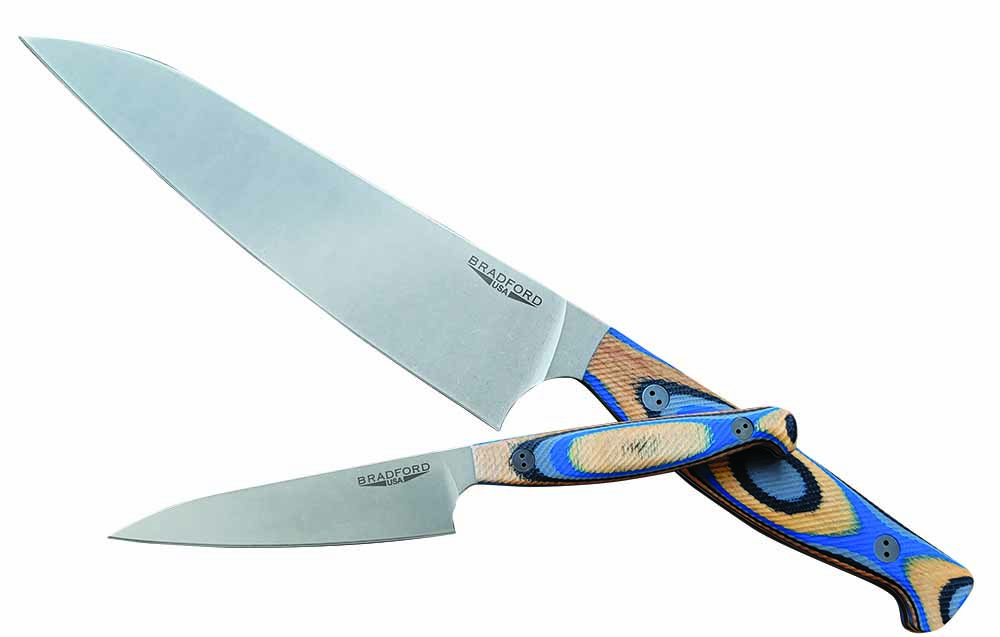
Brad Larkin of Bradford Knives said the handle of the company’s Blue G-Wood Paring Knife is designed to be held in a surgical-like pinch grip. He indicated the result is a lightweight knife focused on fine cutting.
“It complements our chef’s knife so well and we do find that customers seem to enjoy a ‘set’ of kitchen knives as opposed to our EDC knives, which are very carefully built around specific daily uses,” Larkin explained. “In the kitchen you need to be ready for a quickly changing, dynamic environment, and our hope is that the paring and chef’s knives can accomplish these mission-critical chores.”
Over the years, Bradford has released different versions of its paring knife. Recently, the company issued a limited run of handles made from blue G-wood, a composite of G-10 and wood veneer. Stainless blade steel choices are edge-holding, corrosion-resistant AEB-L or tough M390.
Bradford, which is known more for its tactical and EDC models, returned to its culinary roots with the paring knife. The first edged tool it made was the Gatsby, a steak knife.
The company’s paring knife features thin blade geometry—just the way Bradford Knives prefers it. The .09-inch-thick blade has a distal taper. “Our process allows for a full flat grind. It does produce a very mild hollow-grind effect,” Larkin qualified, “but it is hardly worth mentioning.”
The handle is designed to be held in a surgical-like pinch grip. Larkin said the result is a lightweight knife focused on fine cutting, such as making fruit twists for cocktails, for instance, though it could be considered a medium-weight model compared to most paring knives.
“A paring knife can be the best for overall utility, especially considering our blade size is larger than the typical paring blade and it shares design elements with our chef’s knife,” he opined. “It’s a real slicer!”
Blue G-Wood Paring Knife Specs Blade length: 3.8” Blade steel: Choice of M390 or AEB-L stainless Blade grind: Full-height flat Blade thickness at its thickest: .09” Handle material: Blue G-wood Handle thickness range: .2 to .55” Weight: 1.8 ozs. Overall length: 7.5” Country of origin: USA MSRP: $129