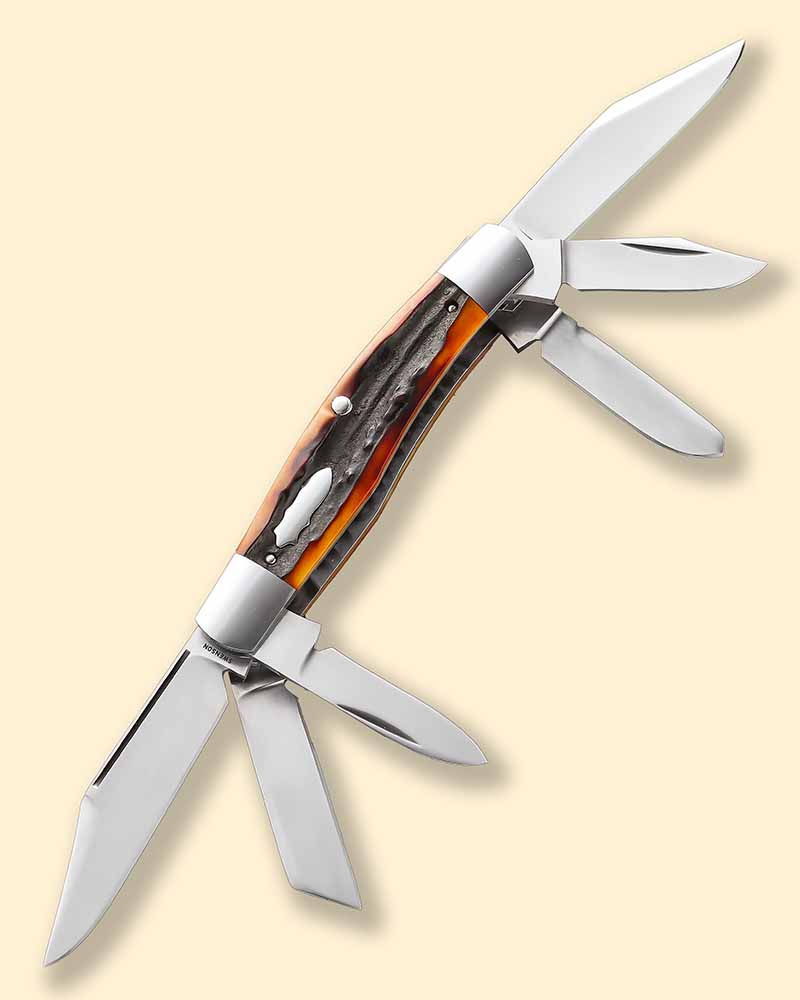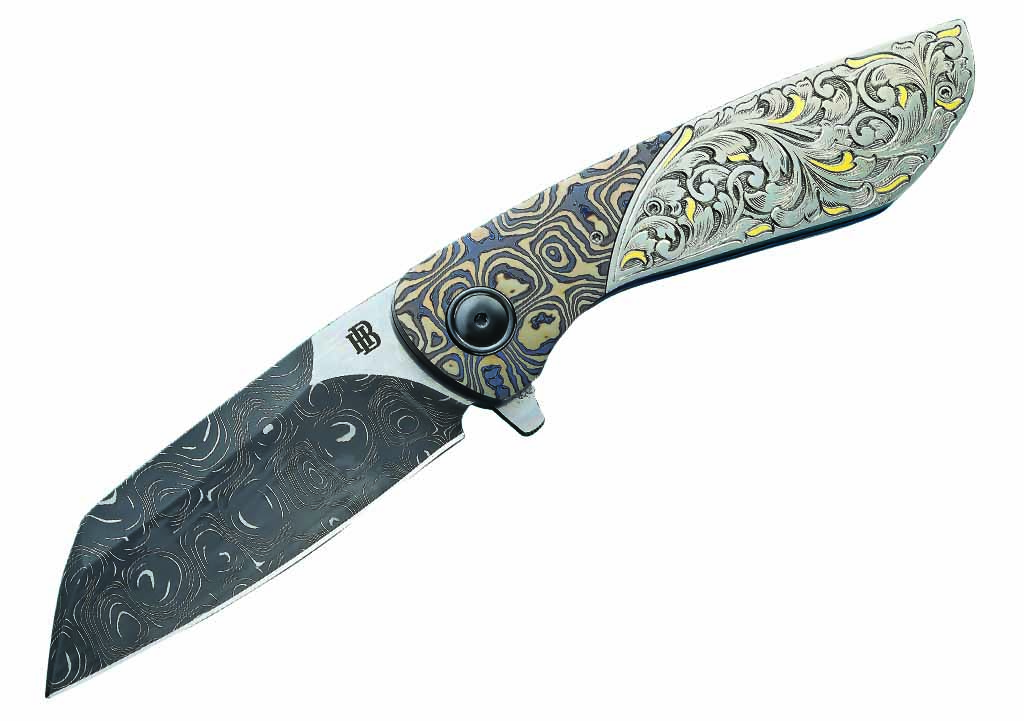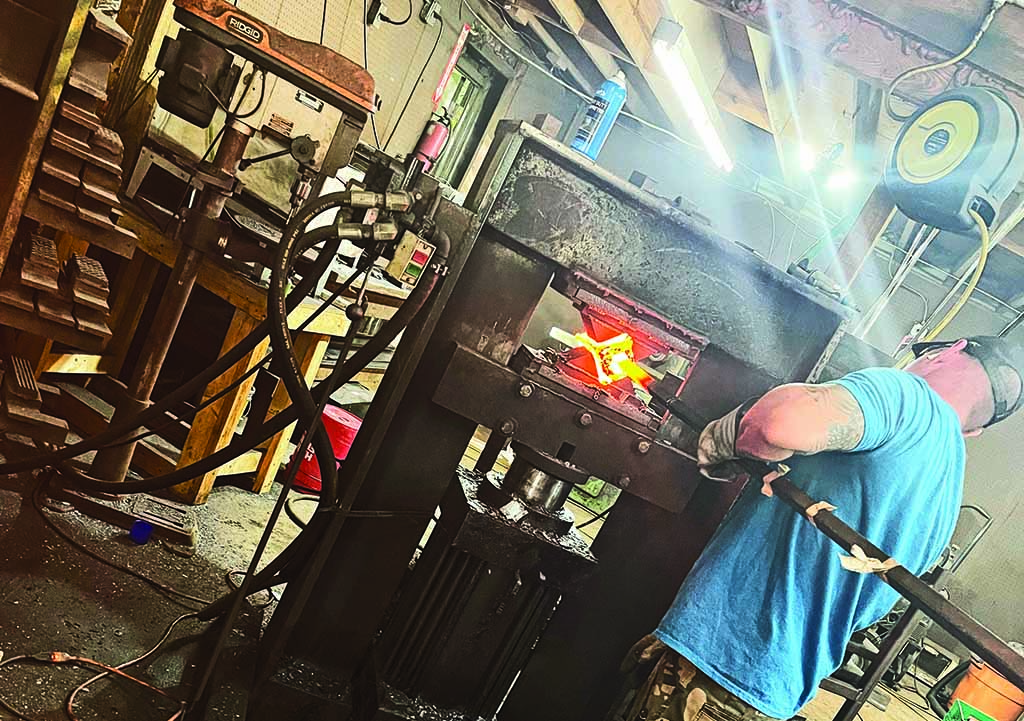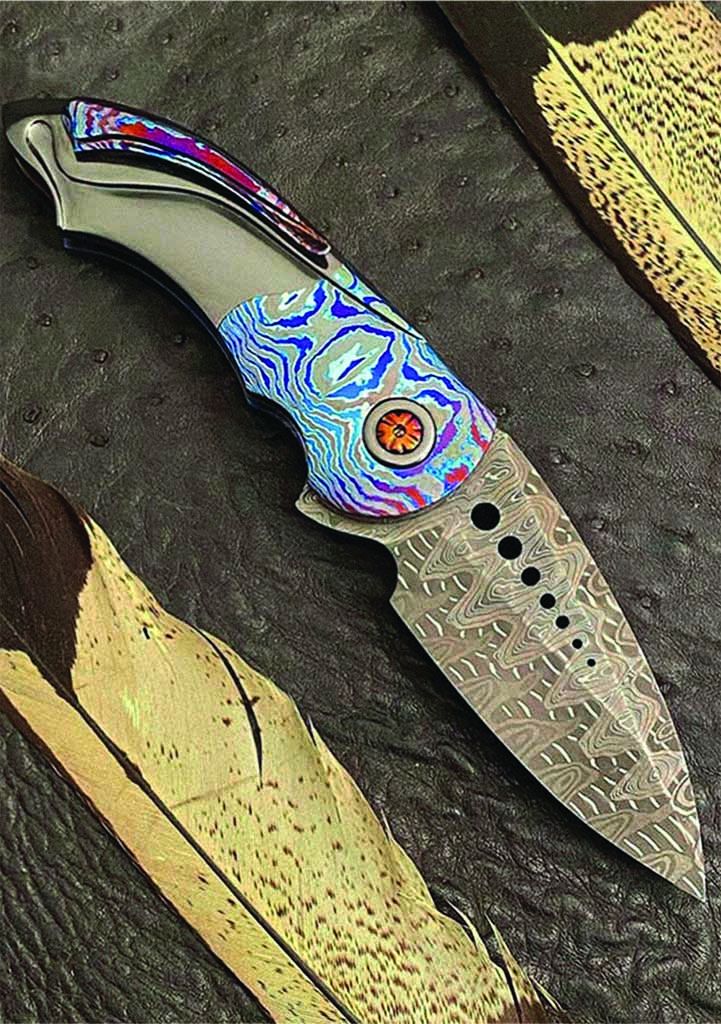
Katz three-blade Stockman Executive Drop Point stacks up against the knives of old school.
Most in my age group were raised with a slip joint knife. It’s the knife Dad always carried in his pocket. Being raised with a dad who was a commercial fisherman, I used knives as tools every day—everything from cleaning fish to making fishing nets.
The main blade carved nice curly-cues with great control. The sheepsfoot had a tendency to dig deeper into the pine for thicker curly-cues. The spey was about midway on the curly-cues and depth of cut.
My father, Jacob, always used a three-bladed stockman for working with twine while making or repairing 90-foot trawl nets. It would take him 30 days or more to hand-tie every square in the massive nets. He would always work with the knife’s smallest blade. When it was sharpened down to a nub, he would go to the next blade. The knife would last him five years of heavy work. Then he would put it in his junk drawer and start using a new one. Only carbon steel blades knives were allowed—stainless steel had not evolved to the performance levels of today.
Katz Knives has taken old-school looks and added blades of high-performance XT-80 stainless steel on its Stockman Executive Drop Point. Let’s see if Dad would have approved.
TEST ’EM UP
In a quick sharpness test on 20-pound bond copy paper, all three blades sliced cleanly and smoothly. The shorter blades can be a bit challenging till you get used to them. The sharpening notch/choil caught on the paper during testing.
My wife, Melissa, wanted to play with the knife so I got an apple from the fridge for her to slice. The drop-point main/master blade worked great for sectioning the apple into wedges. Next was the sheepsfoot blade for seed removal and skinning the wedges. (The wedges were yummy.)
The main blade crunched to 74 clean cuts on the half-inch sisal rope before the edge started to slide.
Single-walled cardboard was next. All blades bit into it aggressively. The cardboard got hung up on the sharpening notches of the two smaller blades while slicing. As a result, I had to slow down the slicing and control the edge placement. The master blade made short work of the cardboard.
It was time to make some firesticks as camping season was in full swing and I needed a fire to roast marshmallows. The master blade gave me nice curly-cues with great control. The sheepsfoot blade had a tendency to dig deeper into the pine for thicker curly-cues. The spey blade was about midway on the curly-cues and depth of cut. SAFETY NOTE: Care must be taken while doing heavy cutting with a slip joint. It does not take much pressure to accidentally close a blade on a finger.
To make kindling from end cuts of a fence, I softly batonned the main blade into the slabs. This worked very well and smoothly with no damage to the blade. Again, care was taken to avoid a blade closing on a finger.
The final test was cutting half-inch sisal rope. Only the main blade was consistent during cutting due to its ample enough length giving me the stand-off needed to make crunching cuts. The XT-80 stainless crunched to 74 clean cuts before the edge started to slide.
Melissa uses the drop-point main blade to cut the apple into nice bite-sized sections.
This knife is well-executed in design and manufacture.
REPORT
Using the stockman was a very nice experience and provided good memories. You have three blades to work with, so you should always have a sharp edge on hand. The Katz is a very welcome addition to your pocket.
CHANGES
I love the straight edge of a sheepsfoot blade. I would add a midsize wharncliffe blade instead of the smaller spey.
Stockman Executive Drop Point Specs Company: Katz Knives Blade Lengths/Patterns: 23∕4” drop point, 23∕16” sheepsfoot & 2” spey Blade Steel: XT-80 stainless Handel: Stag bone Bolsters: Nickel silver Liners: Brass Weight: 2 ozs. Closed Length: 3.75” Country Of Origin: Japan MSRP: $181.90
To learn more about the Stockman Executive, please visit katzknives.com
Latest cleavers are a hot ticket on the camp scene
By Pat Covert
The cleaver has been sneaking up on the cutlery market for several years now. However ironic it may seem, along with the razor, it was in demand on the tactical market before it became popular for culinary attire on the camping/survival scene.
Not anymore. Cleavers are now making their case as viable tools for outdoor use.
An interesting FYI here: Why do most cleavers have a curved blade edge? The curve allows the butcher to rock the blade back and forth to make sure he or she cuts the ends of the meat cleanly.
SMALL ’n SLICEY: CRKT Folts Minimalist Cleaver Blackout
The Columbia River Knife & Tool Folts Minimalist Cleaver Blackout is the most diminutive of the test bunch. It’s billed as a neck knife and aptly so. The blade features a hollow grind for enhanced slicing, and the deeply finger-grooved—three grooves total—handle has orange G-10 scales. All black is also available.
The diminutive CRKT Minimalist Blackout is more suited for small tasks than food prep. The blade was wicked sharp and whipped through 3/8-inch rappelling rope with verve.
A cleaver this light is not made for chopping—there’s simply not enough weight behind the blade. That said, the Minimalist Cleaver is not without utility. The old rope knives had deep, flat-edged blades preferred by many sailors, so I decided to try the small cleaver out on some 3/8-inch rappelling stock. The blade is wicked sharp and proved plenty long enough to slice through the rope in clean, one-stroke pulls. It even handled upper-guided pull-throughs with ease. All in all, the Minimalist Cleaver is a handy little neck knife—as long as you use it for slicing.
At 1.7 ounces, the CRKT Minimalist Blackout is hardly noticeable when carried about the neck. The small necker is handy around camp. Those who cut rope, such as rock climbers, will find it handy on the inclines.
SPECS: CRKT FOLTS MINIMALIST CLEAVER BLACKOUT
Blade length: 2.125”
Blade steel: 5Cr15MoV stainless
Handle material: G-10
Special features: Deep finger grooves
Weight: 1.7 ozs.
Overall length: 5”
Sheath: Black thermoplastic w/neck cord
Country of origin: China
MSRP: $39.99
SLICK ’n WICKED: RMJ Tactical Jackdaw
The RMJ Tactical Jackdaw is a small cleaver with a blade not unlike a miniature dao, a type of Chinese sword. In true RMJ fashion, the Jackdaw’s hollow-ground blade has upscale steel with a tungsten Cerakote® finish. The handle includes a nice index finger groove. The scales are machined blaze olive G-10 over orange liners, with diagonal grooves for enhanced purchase. The sheath can be worn for horizontal outside carry or reconfigured vertically inside the waistband.
RMJ Tactical’s Jackdaw is more of a slicer than a chopper, and excelled at taking off super clean slices of Boudin Cajun sausage. Self-defense may be the Jackdaw’s primary purpose but it’s at home in the camp as well.
The Jackdaw is another small cleaver that lends itself to slicing more than chopping. The blade rivals that found on many tactical knives but since the focus here is on camping, I needed to keeping it in its lane. I gave it a go slicing some Louisiana-made 1.25-inch Boudin sausage—Asian meets Cajun, if you will. It made quick work of taking off nice, clean slices. There’s no doubt the Jackdaw would excel in other chores such as cutting rope and paracord, skinning bark, cutting notches in wood and the like. While its looks may not scream camp knife, it’s more than willing to prove you wrong.
The RMJ Jackdaw definitely had the most versatile sheath of the group, here in Scout carry mode on a belt behind the back. It also configures for a vertical tote inside a waistband.
SPECS: RMJ JACKDAW
Blade length: 3.25”
Blade steel: Nitro-V stainless
Handle material: G-10
Special features: Chinese dao-style blade
Weight: 2.9 ozs.
Overall length: 6.625”
Sheath: Molded black Kydex, Scout carry
Country of origin: USA
MSRP: $200
Of the test bunch, the mid-sized Condor Tool & Knife Primal Cleaver most resembles the shape of the archetypical cleaver. It has a decent amount of heft, the bead-blasted, flat-ground blade does the heavy lifting and there’s an ovate hole in the blade for hanging. The curvaceous handle sports layered scales and there’s a tube lanyard hole in the base replete with a paracord lanyard ready for duty.
Note the scale of the Condor Primal Cleaver in relationship to a medium-sized hand. The cleaver more than excels as an efficient chopper/slicer when weight savings on the trail are at a premium (which they usually are).
I first tested the Primal Cleaver on a variety of veggies. The blade easily chopped through tomatoes and bell peppers in clean, single whacks. Then I tried it at dicing both and the blade performed like a champ. I also tried it on 2-inch-thick beef tenderloin and it chopped out slices admirably. The handle is very comfortable and, though it didn’t fill my medium-size palm, what you give up in length you gain in lighter weight and portability over a full-sized cleaver. I rate this as a very competent bulldog with enough heft to perform a myriad of cooking chores.
The Condor Primal Cleaver is a mid-sized chopper/slicer with the tenacity of a bulldog. It chopped and diced tomatoes and bell peppers with gusto, and did an admirable job on beef tenderloin as well.
SPECS: CONDOR TOOL & KNIFE PRIMAL CLEAVER
Blade length: 4.09”
Blade material: 1095 carbon steel
Handle material: Orange Micarta®
Weight: 5.75 ozs.
Overall length: 7.89”
Sheath: Brown leather belt model
Country of origin: El Salvador
MSRP: $84.98
DUAL PURSUIT: White River Knife & Tool Camp Cleaver
The White River Knife & Tool Camp Cleaver somewhat resembles a shortened Malaysian parang, which is ideally suited for chopping. This is the beast among the test group. The stonewashed blade sports a durable flat grind. A hole in the blade allows for hanging around the campfire for ready access. The handle is nicely sculpted with an ample palm swell and there’s a lanyard hole in the base. White River provides a well-crafted square-based belt sheath.
The White River Camp Cleaver is the beast of the test bunch. It chopped slices off like a house afire on a 2-inch-thick beef tenderloin en route to making a hearty stew. Other veggies like potatoes and mushrooms were a breeze as well.
Anything but typical, the full-size Camp Cleaver’s blade design struck me as one useful for both chopping and slicing, so I gave it a go both ways. I tested the blade on a couple of 2-inch-thick beef tenderloins for a stew. I know, extravagant, I love a good stew. The Camp Cleaver’s heft and sharp edge took off slices of the tenderloin effortlessly, and performed equally as well cubing the meat into squared chunks. Potatoes fared likewise. If you don’t mind packing a full-size cleaver, the White River offering will return the favor by prepping meals for a horde of campers.
The White River Camp Cleaver is 10.125 inches of chopping and slicing heaven. At 8.2 ounces it’s a cleaver with plenty of heft for group food prep, and its CPM S35VN stainless steel blade provides superb cutting ability.
SPECS: WHITE RIVER KNIFE & TOOL CAMP CLEAVER
Blade length: 5.625”
Blade steel: CPM S35VN stainless
Handle material: Black Micarta®
Special features: Traditional hole in the blade for hanging
Weight: 8.2 ozs.
Overall length: 10.125”
Sheath: Brown leather belt model
Country of origin: USA
MSRP: $250
CLEAVER CORNUCOPIA
As you have no doubt deduced, cleavers come in all shapes and sizes. The CRKT Minimalist necker is a nifty companion for a variety of small chores. The RMJ Jackdaw will slice with the best of them, and its versatile sheath is a nice bonus. Condor’s Primal Cleaver is a great blend of chop-ability and portability. The beastly White River Camp Cleaver is a full-size workhorse at preparing food for a cadre of campers. Next time you’re getting your gear together for an outing, consider the cleaver as part of the package!
There’s something irresistible about pressing the button of folding automatic knife and having the blade spring out with a resounding “THWACK!” as it locks open.
Types Of Automatic Knives
Automatic knives or autos come in two basic styles: the traditional side—or radial—openers and out the fronts (OTFs). There’s a great selection of both in today’s factory market. The majority center around the tactical trend in which the spring-powered opening action enjoys viability in high-stress situations where you need instantaneous blade deployment with little effort in action and thinking.
Side-Opening Auto Knives
Pro-Tech TR-3 1X Operator
When it comes to tactical automatic knives, Pro-Tech is a leader in the field. Its designs are highly refined and manufactured with the utmost attention to detail. The Tactical Response folder series is a company best-seller, the TR-3 being one of the most sought-after designs. Eight inches open, it is a great working knife featuring an ergonomic handle of T6-6061 aluminum paired with a drop-point blade of 154CM stainless steel. While the company manufactures different variations of the TR-3, the most eye-catching is the TR-3 X1 Operator Series model.
Something you will notice first is the knife is sterile—in other words, there are no markings denoting brand, blade steel or country of origin. It is all black, including the clip and hardware. Topping it off, the lock button is inlaid with a tiny vial of tritium, allowing the button to “light up” in total darkness. The handle has ProTech’s fish-scale machining pattern to aid in grip retention and cool looks. The clip is mounted toward the handle butt to carry the closed folder blade tip up and as low in a pocket as possible.
All black and stealthy, the Pro Tech TR-3 X1 Operator Series folder gets the job done with little fuss and effort.
The TR-3 is how you properly execute an all-black-finished knife. The modified drop-point blade tackles a variety of tasks with ease. American-made 154CM is an industry standard for heavy-use knives, holds a decent edge, and is not as difficult to resharpen as CPM high-performance steels. The handle shape is very appealing with its two large finger recesses to help index your grip, and the slightly tapered profile rests in your hand comfortably with no hot spots. Blade action is very snappy. Pro-Tech officials like strong springs in their automatic knives, so have a firm hold on the handle before you deploy the blade. The manufacturer’s suggested retail price (MSRP): $320. The knife is made in Pro Tech’s Placentia, California, factory.
Boker Plus Karakurt
Danish knifemaker Jesper Voxnaes is one of the hottest knife designers going, and Boker Plus has tapped him for several designs, the Karakurt auto being one of them. Starting with a modified clip-point blade a hair over 3 inches, the material of choice is 154CM stainless steel. The flat grind allows the edge to be thin and exert a great bite, much like the knife’s namesake. (Karakurt is the Eurasian equivalent of the black widow spider.) The handle is T6-6061 aluminum. A large finger recess permits easy indexing of your grip, and the handle curves accommodate the rest of your fingers nicely for a nonslip purchase. A deep-carry pocket clip totes the closed Karakurt blade tip up and low in the pocket for maximum concealment.
Action-wise, the knife is very quick. Press the firing button and the blade opens instantaneously. The overall design isn’t really tactical, though it does share some tactical traits. The Karakurt is designed more for everyday carry, and is excellent at opening mail, packages, breaking down cardboard boxes, stripping electrical wire, cutting corrugated plastic, etc. It carries very well, the slim profile allowing it to blend right into the pocket and have a lightweight footprint. It carries just as easily in casual dress as formal. The blade is available in a stonewash finish or black PVD coat. With an MSRP of $199.99, the Karakurt is priced very competitively to other knives of its class. It is made in the USA by Hogue Knives.
The flat grind of the Boker Plus Karakurt blade helps give it a nice bite. The Karakurt is made in the USA for Boker by Hogue Knives.
OTF Auto Knives
OTFs fall under one of two categories. One is single-action, where the blade deploys automatically and you must pull out the charging bar to retract it. A double-action OTF has automatic deployment and retraction of the blade, all by respectively pushing and pulling a slide button on the handle spine. The latter is the most popular, as most every OTF manufacturer makes one.
Heretic Knives Hydra
The Heretic Knives Hydra is a single-action OTF. It offers a choice of 3.6-inch drop-point or tanto pattern blades in CPM S35VN stainless steel. Handles are aluminum alloy machined with traction notches in strategic locations. The pocket clip is a distinctive “H”-shaped fold-over deep carry design and uses four screws as opposed to the standard two. It is anchored to the handle ultra-securely.
The firing button incorporates an unusual safety. It’s a teardrop-shaped cover that pivots downward to allow button access. When released, it covers the firing button to prevent accidental blade deployment. Very ingenious! The bad thing about single-action OTFs is that retracting it requires using both hands: one to hold the handle and press the firing button to unlock the blade, the other to pull back on the charging bar until the blade is fully retracted and locked closed. (Pull a paracord lanyard tied to the charging bar or grab the end of the bar and pull.) The Hydra is well made, and the ergonomic handle is comfortable and offers multiple-grip positioning.
Most OTFs have a boxy profile and maybe two grip positions at most, depending on the size. Admittedly, I am not a fan of the humongous clip but it does a great job at holding the knife to the pocket, and is a deep carry design that positions the Hydra low in the pocket.
The Hydra also has a safety (inset) by the fi ring button to guard against inadvertent opening of the blade.
When you fire the blade, it hits hard! Out of the box the blade was plenty sharp and the hollow-ground tanto offered great slicing ability. Heretic provides the knife in multiple handle colors and two blade finishes—we received the black-coated blade with a nice handle anodized blue (MSRP: $435).
Single-action OTFs are probably better suited for occasional use since the two-handed blade retraction can get cumbersome, especially if you have the use of only one hand at a time. Double-action OTF’s are what you need for more frequent use. However, if you collect OTF automatic knives, you need a single action in your collection. In this case, the Hydra is a perfect choice to fill the slot.
Microtech Scarab II
Easily the largest OTF in the Microtech line, the double-action Scarab II is a nice handful. The base steel of choice for the 3.9-inch drop-point blade is M390 stainless, though Microtech also uses other high-end steels depending on what’s on hand in quantity. The 5.25-inch handle is T6-6061 aluminum for lightweight and strength. Inlays of textured rubber tape are integrated to enhance grip in most all conditions.
A hefty push moves the textured actuation button forward to deploy the blade and a backward pull retracts it. The robust push is also a safety feature to avoid inadvertent blade actuation. The action is very quick given the blade’s size and
thickness.
Microtech added three fullers—two in the standard style on the blade’s side, as well as one on the blade spine. They look pretty cool but don’t add to performance. A few mini fullers are close to the blade’s base, where they are partially visible when the blade is deployed.
Given the knife’s size, it works quite well, and blade deployment is very easy even if you’re wearing work gloves. If you wear gloves frequently, this is the OTF for you. The handle is blocky and therefore fits the hand well with or without
gloves.
The Microtech Scarab II is the latest auto Microtech manufactures and the largest of the test group. This formidable-sized OTF is ready to tackle the toughest cutting jobs you may have and does so with aplomb.
The Scarab II is adept at handling bigger cutting tasks, and has excellent slicing capabilities given the blade’s length. It could easily be used as a food prep knife, as it does great in the kitchen. The flat ground blade sails through a variety of media and is easy to resharpen. M390 holds an excellent edge and, unlike S30V, is relatively simple to resharpen. Carry is a snap thanks to the heavy-duty steel pocket clip. It’s secured to the handle butt with a special conical glass breaker screw that has an inlaid steel ball bearing for transmitting impact energy to the glass.
If you’re looking for an EDC-able Microtech OTF, the Scarab II may not be your choice due to its larger size. You’ll need to look at the company’s smaller Ultratech series instead. However, for tactical or extended-period hard use, the Scarab II fits the bill perfectly. The MSRP is $551, making it one of the most expensive production OTFs—but it’s worth it!
Editor’s note: This article is an excerpt from the KNIVES 2004 book, but the information is still relevant.
Switchblades, or automatic knives, might attract the most attention, but reforms in recent years have relaxed restrictions in most U.S. states. The most banned knife in the country remains the ballistic knife.
Here’s a look at what ballistic knives are, how they became banned and why those bans should be repealed.
What Is a Ballistic Knife?
Federal law defines a ballistic knife as follows:
United States Code, Title 15 Section 1245
(d) “Ballistic knife” defined. As used in this section, the term “ballistic knife” means a knife with a detachable blade that is propelled by a spring-operated mechanism. Pub. L. 85-623, Sec. 7, Oct. 27, 1986. Amended Nov. 18, 1988.
In plain English, a ballistic knife is essentially a blade attached to a hollow handle that fits inside of another outer hollow handle, which contains a coil spring. The coil spring compresses inside the handle, and a latch holds the knife blade down against the spring pressure. When the latch is released, the knife and attached inner handle launch and “go ballistic.”
The federal law on ballistic knives is very similar to federal law on switchblades, except that the switchblade law exception for “the possession, and transportation upon his person, of any switchblade knife with a blade three inches or less in length by any individual who has only one arm” does not apply to ballistic knives.
That means one-armed individuals are forced by federal law to have to throw their knives by hand just like everyone else!
Hollywood and Ballistic Knives
“¿Como esta?” asks Arnold Schwarzenegger in the 1985 movie Commando, as he fires a ballistic knife into the chest of a bad guy, which amazingly causes immediate death. Hollywood never misses a chance to help fuel a misguided weapons ban, and the ballistic knife was no exception.
In May of 1986, Francis Ford Coppola’s son and Ryan O’Neal’s son were in an automobile accident in which Coppola’s son died. O’Neal’s son was charged with reckless driving and possession of a ballistic knife.
Hollywood elitism and hypocrisy is nothing new. What made the ballistic knife so frightening to career politicians, media talking heads and assorted hoplophobes (those who irrationally fear weapons) is that it’s a knife that shoots!
Why are Ballistic Knives Illegal? Hype and Politicians
Politically, the ballistic knife helped fill the gap between guns and knives. It enabled knife haters to join ranks with gun haters and both had a common, new, inanimate object to wail and screech about.
In addition to the ballistic knife being slandered and falsely linked to drug abuse, this was the newest national attack on knives since the 1958 Federal Switchblade Law.
Republican Sen. Alfonse M. D’Amato held a news conference pushing for and spinning the proposed ban. He announced that a ballistic knife “is a favored weapon used by drug dealers.” He further proclaimed, “Ballistic knives are at least as dangerous as switchblade knives that have been banned since 1958.”
A vintage poster from the USSR showing parts of a ballistic knife. Note the firearm cartridge used to propel the blade. (image via RussianLegacy.com)
The hype surrounding ballistic knives did not help matters. The knives were advertised for sale in tactical magazines with the pitch “The Commies Had It. We Stole It. Now You Can Buy It!!!!” Ballistic knives were advertised as being able to “kill swiftly and silently.”
Sen. D’Amato claimed a ballistic knife to be a “dangerous weapon, a terrorist weapon.” He further declared, “Ballistic knives have no legitimate sporting purpose. They are sought by professional criminals because they are easily concealed and capable of penetrating a policeman’s bulletproof vest.”
Democratic Rep. Mario Biaggi (a well known anti-gun politician and a sponsor of the so called “Cop-Killer Bullet Ban”) appeared at a news conference and asserted that ballistic knives were the “latest in cop-killer technology,” and that the ballistic knife can “…fire its blade like a bullet” and “penetrate police bullet-resistant vests.”
He stated he had bought his ballistic knife via mail order from the Florida Knife Corp. by putting the $79.95 on his credit card. Biaggi stated, “…there were no questions asked. I could have been anybody. The ballistic knife is totally accessible to anyone who wants it.”
A button or switch in the handle, seen here in red, is usually used to release the blade. (By Jerryk50 at English Wikipedia)
At the news conference, the typical “dog and pony show” was conducted by a New York police officer who fired a ballistic knife from 30 feet at a silhouette target of a person. Of course, there were no known cases at that time of anybody ever being killed by a ballistic knife, no less any reported cases of a police officer being shot at by a “drug dealer or terrorist” (or anyone else for that matter) with a ballistic knife.
Furthermore, I could not find any official poll taken of drug dealers inquiring as to whether a ballistic knife was their “preferred weapon” of the 1980s, but somehow I doubt it considering the ready availability of cheaper and more effective black market firearms.
The Florida Knife Corp. issued a statement that their ballistic knives do NOT penetrate bulletproof vests, but noted that any ice pick could penetrate a bulletproof vest. Bulletproof vests are NOT ice pick-proof, however banning ice picks is not as politically correct or headline grabbing. A ballistic knife has as much “sporting purpose” as any throwing knife.
Since when is the “sporting purpose test” applied to knives, anyway? What sporting purpose does an 8-inch chef’s knife have? Then again, why should facts get in the way of a feel-good knife ban?
The Final Cut to the Ban: Throwing Knives
There are many books that deal with the subject of knife throwing for both fun and combat. A knife can be thrown with substantially more power and accuracy than can be achieved by firing a ballistic knife. This fact alone makes the ballistic knife ban patently absurd and useless.
Any decent fixed blade knife can be thrown (although throwing your handmade, damascus, ivory-handled bowie is not recommended). But why should facts and logic stand in the way of any headline-grabbing politician pushing a weapons ban and holding news conferences?
So What? Who Needs a Ballistic Knife Anyway?
Okay, the law is ridiculous, so what’s the problem? Who needs to own a ballistic knife anyway, right?
Well, here is the problem: the ballistic knife ban is a KNIFE BAN, and just because it isn’t your ox being gored does not mean you should ignore it. This ban paves the way for more knife bans. The politicians see our knife rights as “easy pickin’s.” They can look like they are doing something about crime, terrorism or drug dealing, when in reality it’s just another hit on our knife rights.
Ballistic knife bans lay the groundwork for further knife bans and for activist courts to be judicially dishonest and to prohibit other lawful knives and weapons that are not ballistic knives. Don’t believe it? Then you have obviously not read State of Florida, Appellant, v. Pariya Darynani, Appellee, 4th District, Case No. 4D99-4172.
In this case, the Florida Court banned formerly lawful automatic/switchblade knives under the guise of Florida’s ballistic knife ban. The case is a classic example of anti-knife bias and the abuse of our knife rights that a wrongful knife ban can cause.
Modern broadheads used for archery remain legal, even though they function similarly to ballistic knives. (Wikimedia image)
New Jersey’s ballistic knife ban has even more potential for abuse. The New Jersey ballistic knife ban was signed into law by then Republican Gov. Thomas Kean, who stated, “We have to restrict the flow of knives that serve no useful or lawful purpose.” I
f the “bunny huggers” wanted to push it, New Jersey’s ballistic knife law is so overbroad that archery and bow hunting are threatened and could be banned.
Chapter 39 Of New Jersey Criminal Code Firearms And Weapons 2C: 39-1.
u. “Ballistic knife” means any weapon or other device capable of lethal use and which can propel a knife blade.
Bows and crossbows can all shoot broadhead arrows. Broadheads are and/or contain razor-sharp knife blades. Is a compound bow with a broadhead arrow a “weapon or other device capable of lethal use and which can propel a knife blade?” Of course it is!
Sure, it was not the intent of the New Jersey Legislature to ban archery and bow hunting, but it was not the intent of the Florida Legislature to ban switchblades/automatics, either, and yet the Darynani court did just that!
Stay Vigilant
Unfortunately, knife aficionados were not organized, prepared or ready for the ballistic knife fight in the mid-1980s. We were never warned about the future effect and ramifications of ballistic knife bans on our knife rights. We dramatically lost on the ballistic knife issue and are now paying a price.
Blades Will Hit the Beach! Hot new venue and even hotter knives foreshadow return of BLADE Show West
A new state-of-the-art show venue, some of the world’s top custom and factory knifemakers, and action-packed chef’s knife and knife flipping championships will be but a few highlights of BLADE Show West 2021 Friday and Saturday Oct. 8-9 at the Long Beach Convention Center in Long Beach, California.
Grinders, buffers and other knifemaking equipment will be on full display at BLADE Show West 2021.
As with this year’s BLADE Show, it’s been two years since the last BLADE Show West, which was held in Portland, Oregon, the two-year wait being the result of the worldwide pandemic. This will be the first BLADE Show West in Long Beach, though nearby Costa Mesa was home to the show at one time.
At press time such outstanding custom makers as BLADE Magazine Cutlery Hall-Of-Fame® member Ron Lake; Dennis Friedly; Duane Dwyer; a number of members of the South Texas Cartel of slip-joint knifemakers including Luke Swenson, Bubba Crouch, Tim Robertson, Enrique Pena, Tanner Couch and Toby Hill; ABS master smiths Bill Burke, Jason Knight, Murray Carter, and Adam and Haley DesRosiers; and many others—over 200 in all—were slated to exhibit.
Domestic and international factory knife exhibitors such as CRKT; Emerson Knives, Inc.; Fox; Heretic; Hogue; Medford Knife & Tool; Microtech; Pro-Tech; Spyderco; TOPS Knives; V Nives; We; Winkler Knives; and many others were slated to exhibit as well.
Spyderco will be among the factory exhibitors at BLADE Show West. The Smallfly 2 butterfly knife features a 3.37-inch blade of CPM S30V stainless steel and black G-10 handles with latch. Closed length: 4.5 inches. MSRP: $300.
The 208 Clipper cigar cutter will be among the knives displayed by TOPS Knives. The 2.25-inch blade is CPM S35VN and the handle is OD green G-10. Closed length: 5 inches. MSRP: $230. (TOPS Knives image)
Knifemaking suppliers set to exhibit include Damasteel, New Jersey Steel Baron, Adam Unlimited, Nichols Damascus, Vegas Forge and more. Other exhibitors will include purveyors Dave Ellis/Exquisiteknives.com, Michael Donato/knifepurveyor.com and Cutlery Hall-Of-Famer Dan Delavan/Plazacutlery.com, photographer Jim Cooper of SharpByCoop.com, sharpening companies Wicked Edge and Work Sharp, and many others.
Art knives and their makers will be in full flower at BLADE Show West 2021. Dennis Friedly will be exhibiting such pieces as this damascus beauty with engraving by Gil Rudolph. (SharpByCoop image)
SEMINARS and COMPETITIONS
The doors will open to the public each day at 10 a.m. and close at 6 p.m. The seminar schedule kicks off Friday at 1 p.m. with one on how to bring your edge back from the edge of dull by Clay Allison of Wicked Edge. At 3 p.m. let some of the world’s top knifemakers and bladesmiths—Ernest Emerson, Jason Knight, Steve Schwarzer, Andreas Kalani, Enrique Pena and Mike Tyre—critique your custom knife. And, at 4 p.m., Joe Maynard will demonstrate finishing and polishing techniques in his mobile demo trailer.
Kolter Livengood shows his championship form in winning the chef’s division in the Chef’s Knife Cutting Championships at BLADE Show West 2019. This year’s championships will be show Friday. (Eric Eggly/PointSeven image)
Friday will conclude with the 2nd Annual Chef’s Knife Cutting Competition at 8:30 p.m. in the lobby of the Hyatt Regency Long Beach Lobby (the Hyatt is connected to the Long Beach Convention Center). The event will be divided into two divisions, custom knifemaker and chef’s.
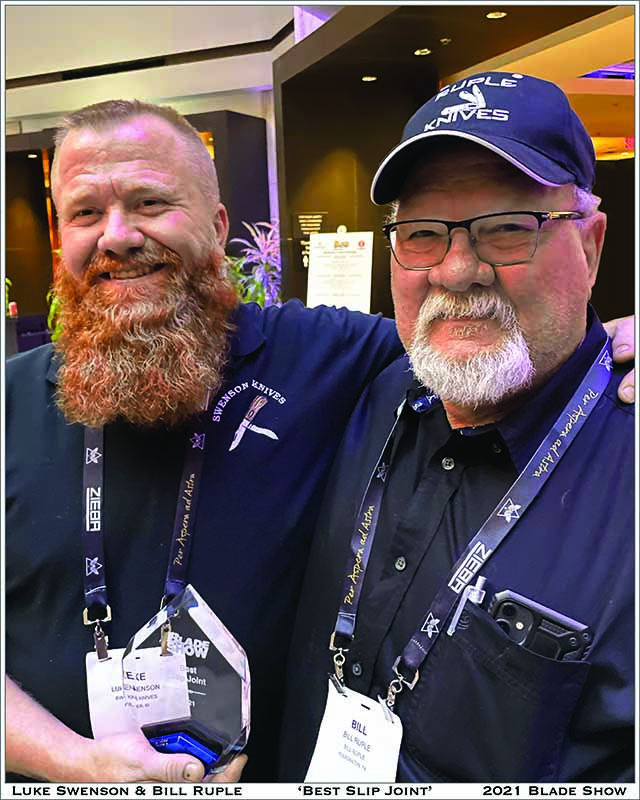
After the doors open Saturday at 10 a.m., Ernest Emerson will present his seminar “The Quest For The Uncommon Man” at 11 a.m. At 2 p.m. join Murray Carter and his Muteki Bladesmiths for a roundtable discussion on how to become a bladesmith and bladesmithing in general. Award-winning knifemakers Luke Swenson, Bubba Crouch and Bill Ruple will conduct the seminar on how to make a single-blade trapper at 3 p.m. Then, to close out the show, Squid Industries will conduct the West Coast Flipping Championships from 4 to 6 p.m.
The 2nd Annual West Coast Flipping Championships conducted by Squid Industries will be Saturday from 4 to 6 p.m. in Meeting Room 203.
For the complete seminar, competition and awards presentation schedule, along with capsule descriptions, see sidebar. Attendance is free to all show ticket holders.
KNIFE JUDGING AWARDS
At a time to be determined on Friday, the custom knife and factory knife judging competitions will be held. Categories in the custom knife category will be Best Slip Joint, Best Folder, Best Damascus, Best Chef’s Knife, Best EDC, Best Hunting Knife, Best Tactical Knife and Best In Show. Categories in the factory knife category will be Best Bushcraft, Best Folder, Best Kitchen Knife, Best EDC, Best Hunting Knife, Best Tactical Knife, Best Big Knife (bowie, kukri, machete, etc.) and Best In Show. Best Tactical Knife in the custom and factory categories will be open to both folders and fixed blades.
Master Smith David Lisch took home “Best in Show” in the custom awards at the last Blade Show West.
All award winners will receive trophies and coverage in the BLADE Show West recap edition of BLADE®. The winners will be announced at 8 p.m. in the Hyatt Regency Long Beach Lobby 30 minutes prior to the Chef’s Knife Cutting Competition.
NEW VENUE
Many knife enthusiasts, knifemakers, purveyors, suppliers, collectors and others in an around the Long Beach area seemed very excited to have BLADE Show West returning to the Los Angeles area, and a number said the show could not have found a better venue for the show than the Long Beach Convention Center. Many top restaurants and watering holes are within easy walking distance, and the venue itself is cutting edge in terms of exhibitor space and other amenities. The area is also home to an outstanding nightlife scene, gorgeous outdoor parks and gardens, museums and other attractions (longbeachcc.com/attendees/).
The Long Beach Convention Center. Source: https://cdn.saffire.com/
Meanwhile, there will be raffles and giveaways, vintage custom and factory knives on display, and no telling what Hollywood, military, knife or other celebrities you might meet—all at BLADE Show West 2021.
1-to-2 p.m. in Meeting Room 202: BACK FROM THE EDGE OF DULL—Maintaining a keen edge on your knife requires sharpening it on a regular basis. However, regular sharpening isn’t always done and the edge may go almost completely dull as a result. According to Clay Allison of Wicked Edge, his company has the tools to bring your knife back from the edge of dull. Let him show you how.
3-to-4 p.m. in Meeting Room 202: LET THE PROS CRITIQUE YOUR KNIFE—A panel of award-winning knifemakers and bladesmiths share their decades of knowledge and experience in critiquing your custom knife. Ernest Emerson, Jason Knight, Steve Schwarzer, Andreas Kalani, Enrique Pena and Mike Tyre will go over every square inch of your knife and tell you what is good about it, what is not and how you can make it better. NOTE: This is a limited-seating event! Bring one knife only. Questions from attendees will be entertained throughout. Sign-ups will be held onsite.
Enrique Pena will be both exhibiting such slinky slip joints as his South Texas Trapper and also serving as a panelist in the seminar, “Let the Pros Critique Your Knife” Friday at 3 p.m. in Meeting Room 202. (SharpByCoop knife image)
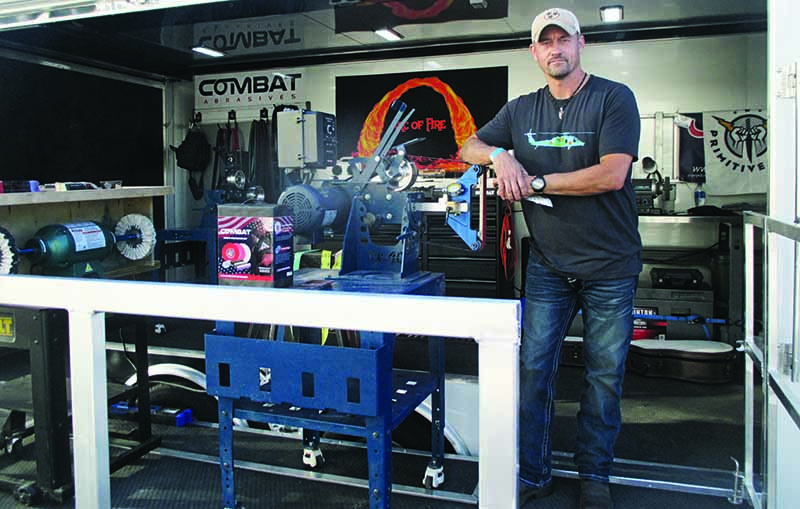
4-to-5 p.m. in the demonstrator’s mobile demo trailer: FINISHING & POLISHING—Joe Maynard of Primitive Grind will demonstrate finishing and polishing of various materials, including steel to a mirror finish and wood and composites using Combat Abrasives airway wheels and compounds. Attendees will also have a hand’s-on opportunity to take steel from a 600-grit finish to a mirror polish.
8 p.m. in the Hyatt Regency Long Beach Lobby: BLADE® MAGAZINE KNIFE AWARDS—Winners of the custom and factory knife judging competitions will be announced.
8:30 p.m. in the Hyatt Regency Long Beach Lobby: 2nd ANNUAL CHEF’S KNIFE CUTTING CHAMPIONSHIPS—A series of cutting challenges among contestants in two separate divisions: custom knifemakers and professional chefs. Murray Carter is the defending champion in the custom maker division, and Kolter Livengood won the chef’s division at BLADE Show West in 2019.
Saturday, October 9
11 a.m. to 12 p.m. in Meeting Room 202: Quest For The Uncommon Man with Ernest Emerson, CEO of Emerson Knives, Inc. In the modern world of unchallenging sameness, there are still those who choose to stand apart, “those determined to deny the mind-numbing regimen of spirit-crushing conformity,” Emerson observed. “Those who choose this path are the uncommon among us. If you have ever wondered, ‘Am I the last of my kind?’ then join me in a discussion of the values of being the uncommon man, and the strength it will require to preserve our way of life for future generations.”
1-to-2 p.m. in Meeting Room 202: ROUNDTABLE DISCUSSION WITH MUTEKI BLADESMITHS—Since 2006, Murray Carter has been sharing and teaching traditional Japanese bladesmithing techniques with a limited number of eminently qualified apprentices working under the cooperative company name Muteki Knives. Meet the Muteki Bladesmiths and participate in a roundtable discussion in which you may direct specific questions about your knife to each of the apprentices.
3-to-4 p.m. in Meeting Room 202: HOW TO MAKE A SINGLE-BLADE TRAPPER—Award-winning knifemakers Luke Swenson, Bubba Crouch and Bill Ruple will show you how it’s done based on Swenson’s video tutorial “Slipjoints with Luke Swenson.” Basic setup, assembly, tang geometry, spring tension, tuning and fixtures, including the Ruple Gauge and the Elite Folder Jig from Metal Head Tools, will be among the highlights.
4-to-6 p.m. in Meeting Room 203: West Coast Flipping Championship—The West Coast Flipping Championship hosted by Squid Industries returns! The event will feature head-to-head live blade flipping in an elimination bracket-style competition. The 2019 place finishers were Mika Seibel (1st), Diego Fuentebella (2nd) and Jeffrey Durr (3rd).
Many knifemakers use today’s best stainless steel money can buy. Other, more do-it-yourself types may scrounge a scrap yard for car springs or ball bearings. Still others go further because all that metal came from somewhere. What if a knifemaker went back to the beginning—starting with the iron pulled from the ground?
In recent years, some smiths have started from square one, pulling raw material from their surroundings to create metal from scratch—just like mankind did for thousands of years. Since the beginning of the Iron Age circa 1200 B.C., man has turned to the iron found in bogs. There, thanks to springs and bacteria, the iron forms into a spongy iron-bearing hydroxide mineral called a goethite.
This renewable source of iron was so important that even the first iron works in America, Saugus Iron Works in Massachusetts, gathered its raw material from nearby bogs. But to turn bog iron into a knife? It’s not a project for the faint of heart.
“You have to prepare hundreds of pounds of charcoal; find, harvest and prepare the ore, build the smelter and then monitor and feed the fire for hours just to produce the bloom,” ABS master smith Kevin Cashen notes. “Then the real heavy work begins of forging it down into a piece of steel that is historically interesting but nowhere near the quality product you get from your modern steel supplier.”
Take a peek inside the furnace at the end of the smelt during the Matherton Forge Iron Age Challenge. (Todd Combs image)
And then there’s the problem of smiths not knowing exactly how the ancients smelted iron.
Darrell Markewitz is a Canadian artisanal blacksmith and historical interpreter of the Vikings who settled in Vineland. He says he is “concentrating on rediscovering lost historic smelting methods.”
For example, he had to make intelligent guesses as to how Vikings tracked time during the smelting process, and how the ancients designed bellows because no bellows from that time exists today.
Sourcing Bog Iron For Making Knives
Relatively speaking, Jarkko Niskanen had it easy when he harvested iron out of a bog in Finland. From a boat, the 26-year-old blacksmith simply felt along the bottom of a bog for spongy chunks of material. Markewitz found himself kneeling over a rivulet running through a Canadian bog, feeling for deposits of iron.
Cashen indicates his home state of Michigan is filled with iron. However, only a small portion is bog iron, small chunks of concentrated iron deposited by bacteria on the slow-moving side of streams running through the bog.
“I have found entire cliff faces in the wilds of Michigan’s Upper Peninsula that a magnet will stick to, and huge sections of magnetic black sands on the shores of Lake Superior,” he observes. “But bog iron requires special conditions. I have found some scant deposits locally but not enough to work with regularly.”
There are different kinds of bog iron. All require the same kind of process to turn out a metal. Some types of bog iron react slightly different than others in the smelter, reducing to a smaller amount of usable material, for example. The end result is the same, however: a lump of relatively pure iron.
Once the smith harvested the bog iron, then he cleaned and dried it. Niskanen put his bog iron in a fi re to dry the pieces, and then broke them up until they were small and uniform.
Making Knives Like The Vikings
The process all happens in the bloomery furnace, in what looks like a chimney with an air pipe going into the side to pump in oxygen. It’s a design going back at least as far as Viking times.
“In operating a ‘short-shaft ,’ direct process bloomery furnace, higher air volumes have proven to produce larger, more dense iron blooms—in fact, blooms most like those few found in the archaeology,” Markewitz states.
As the temperatures rise and charcoal continues to be shoveled in, a chemical reaction takes place inside the furnace.
As the temperatures rise and charcoal continues to be shoveled in, a chemical reaction takes place inside the furnace. (images courtesy of Jarkko Niskanen)
“The ore is always an oxide,” Markewitz continues. “The smelting furnace is a reduction process removing the oxygen from the ore.”
Charcoal produces carbon monoxide, which reacts with the oxidized iron. As oxygen leaves, the iron particles are left behind and fall to the bottom of the furnace. At the interior temperatures, typically something around 2012-2192°F or more, the heavier iron particles are slightly “sticky” and sinter together has they fall, Markewitz adds.
However, bog iron is also filled with non-iron materials, such as ash and sand. In the furnace, the latter liquefy and fall to the bottom of the furnace where they create a greenish-black glass, or slag, in the shape of a bowl.
If all goes well after hours of running the furnace, a ball of iron that is fragmented and filled with pockets of slag, but iron nonetheless, will result in the bottom of the smelter. (image courtesy of Jarkko Niskanen)
“The top surface of this bowl is closer to the hot area of the furnace [at the blast level and] so remains a liquid,” Markewitz explains. “If too much of this slag is produced, its interior level can rise up to block the air blast. Before this happens, ideally you want to let some slag run out [by tapping the furnace].”
If all goes well after hours of running the furnace, a ball of iron that is fragmented and filled with pockets of slag, but iron nonetheless, will result in the bottom of the smelter. However, what if the metal workers make the furnace too hot? Then, instead of iron, cast iron may be the result—unusable for forging.
The pieces of iron begin to take shape after the first forge welding. (image courtesy of Jarkko Niskanen)
“If the iron particles are made too hot, they liquefy. As a liquid, iron will frantically absorb carbon—so fast, in fact, that the iron almost certainly shifts into a too high-carbon cast iron,” Markewitz states. “This material cannot be forged, and is so hot it usually melts through the bottom slag bowl and collects at the ground level of the furnace … The real truth is that it takes skill and experience not to get high carbon cast iron.”
Most smelts are a community effort. Cashen says his most satisfying smelt was in 2009, one he dubbed “The Matherton Forge Iron Age Challenge.” The goal was to smelt and forge an iron sword in three days as a public demonstration. When Markewitz reenacts Viking smelts, he does it with a team of three other people.
Another view of the piece of iron shows pockets of slag. (image courtesy of Jarkko Niskanen)
Niskanen took photos of the smelts, which he published online. For ancient metal workers, team effort was out of necessity. After all, bellows are hard to operate for hours at a time to feed a hungry furnace. To keep time, Markewitz’s team chanted, sang songs and focused on heartbeats—possibly historical timekeepers.
“The effective pumping rate was one stroke per second, alternating between the two chambers. Individuals varied on their stroke force [delivery pressure], but averaged 60-to-75 strokes per minute. This was without interruption over the course of the entire firing sequence extending roughly five hours,” he stresses. “We found that to maintain the needed consistency, we needed four individuals working in roughly 10-minute shifts. This labor force needed to be at least semiskilled to the task. This is a requirement totally separate to the needs of feeding and operating the furnace itself.”
Every few minutes, another person would shovel more charcoal into the furnace. Niskanen said he also added crushed limestone to his furnace to enhance the smelting process.
At The Matherton Forge Iron Age Challenge, ABS master smith Kevin Cashen extracts the bloom from the smelter. (Karen Cashen image)
Making Bog Knives
The metal worker is not done once the iron is pulled from the furnace.
“To actually form a solid working bar, the sponge needs to be compressed at welding heat to collapse the voids, squeeze out any glass slag and fuse to a solid block,” Markewitz explains.
While every bloom is different, the smith needs to fold, weld and hammer the metal until it’s a unified—and, hopefully, homogeneous—metal bar.
A kukri made from the bloom at The Matherton Forge Iron Age Challenge II rests atop the smelter that produced the blade material for it. (Kevin R. Cashen image)
“And every bloom is a bit different in terms of just how solid it might be at the start, how much slag needs to be ejected, and in what the actual starting carbon content might be,” Markewitz notes.
Then, finally, the bladesmith can practice his craft. For Niskanen, it was only natural to use the iron for a traditional knife. He made a puukko, an ancient Finnish knife (pictured at top of this article).
“Since the Iron Age, the knife has been used as a multifunctional tool in everyday life,” he opines. “And for a hunter it is, and always has been, one of those items you can’t go without into the wilderness.”
Niskanen was there from the beginning, when the knife was only a lump of iron oxide resting on the bottom of a Finnish bog, “It makes the blade really personal,” he says.
Markewitz used his iron as a decorative part of the knife.
“For the modern designs, I use the bloom iron specifically to highlight its unique texture,” he observes. “Blades like [my Hector’s Bane model] have bloom-iron exterior slabs forge welded to a carbon steel core. As with other inset-styled blades, it is this modern alloy core that is forming the actual cutting edge.”
He did it that way because iron blades don’t perform as well as blades of modern steel.
During the Iron Age, Markewitz says iron knives were so soft that users carried a small sharpening stone with them because they had to constantly hone the edges. Nonetheless, some knives no doubt performed better than others.
Cashen forges a seax (aka sax) blade from the bloom produced at The Matherton Forge Iron Age Challenge. (F. Page Steinhardt image)
In a 2013 study published in The World of Iron London, archaeo-metallurgists Quanyu Wang and Peter Crew compared the performance between three knives made from bog iron. Their paper, titled “Three ores, three irons and three knives,” found that the performance of the knives probably was determined by the skill of the smith and the trace elements in the blade, such as phosphorus, which is known for making iron stronger and harder in trace amounts.
However, phosphorous also can make the metal brittle in cold weather. They compared three bog-iron knives by examining the microstructure of the blades and using the knives to butcher a pig.
Wang and Crew concluded their study by writing, “The quality of bloomer iron depends very much on the smelting and refining techniques used, which may not always be recognizable from the structure and composition of the final metal.”
These smiths have more furnaces to build, iron to smelt and possibly blades to make.
“I have studied older bloomery steel, as well as modern smelted materials under the microscope, and tested the properties, and am quite impressed with the smelting skills of the ancients,” Cashen concludes. “Modern academics had only their best guesses about this process until people started actually doing it again, and then we learned how little we actually knew. We are fumbling our way through a process that our ancestors had completely mastered, developed to its highest levels and then discarded in favor of newer and better processes of making steel.”
EDITOR’S NOTE: Regular BLADE® readers will remember the story about the author, Edmund Davidson, on page 10 of the February 2021 issue detailing how he narrowly hung on to beat the COVID virus. It was several months before that he had learned of the heroics of Virginia police officer Corey Wood in rescuing two young girls from a most harrowing accident, an accident that could have cost them their lives if not for Officer Wood’s sound thinking and quick action.
To salute Wood for his performance above and beyond the call of duty, on behalf of the National Society of the Sons of the American Revolution, the author presented him the SAR Life Saving Medal and certificate on Aug. 6, 2020.
After the author told us of the presentation, we suggested he make a special knife for the officer, too, which the author did and which appears herein.
Following is the story of how Officer Wood saved the day for the two youngsters, and preserved for them what we all can only hope will be most rewarding futures.
The author made one of his signature integral fixed blades and presented it to Officer Wood for his heroic actions. On the right-hand side of the ricasso are the words “Corey Wood” over “June 8, 2020,” the latter the date of the officer’s actions. The sheath is by Don Moran. (Eric Eggly/PointSeven image)
This is the story of 1½-year-old Violet and 5½-year-old Gracie. In what seemed like a routine car ride with their mom, returning home late at night was no big deal—until the ride took an unexpected turn.
It was 12:06 a.m. June 8, 2020, when their mom’s cell phone last pinged the Craigsville, Virginia, tower a mere nine miles from their destination. However, they did not arrive.
At about 4:30 that afternoon, Officer Corey Wood was returning home from an administrative day and turned on his television. The news reported that a Craigsville family was missing. At the time Corey did not know of the family, so he called the Augusta County Sheriff’s Office for more information.
When he was told the family’s last name, he said he knew the grandmother and that family members were good people and not prone to unusual acts. After Corey learned of the last cell phone tower ping south of North Mountain on Route 42, he took it upon himself to look for them.
The Search
He drove his police car a few miles past the last ping and started his search. He parked the car and walked a quarter mile up one side of the road looking for anything unusual, then walked back on the other side doing the same thing. Corey did this quite a few times where there was no good visibility off the road.
When he got to Augusta Springs, he parked his car and, while talking to his mother via cellphone, walked to look at an area of heavy brush.
At 7:34 p.m. he told his mom he had to go, that the sun was reflecting off something deep in heavy underbrush 20 feet below the road’s surface. He noticed bark knocked off a locust tree and grass mashed down.
Without hesitation, he carefully descended into the heavy vegetation and undergrowth and discovered the missing family in their wrecked car.
Luckily the rear window had been blown out as a result of the impact, fully to pry open the damaged door, he finally had to use his issued ASP baton as a pry bar to gain access.
He found her anxious to exit the scene—but her safety latch was jammed. He worked hard to loosen it and with a great deal of effort finally got the latch to release. Corey checked Violet for physical injuries and, finding none, cradled her in his arm and proceeded to climb the steep bank to the road. That’s when tragedy nearly struck.
Fatigue was sapping his strength. He slipped and fell backward in a twisting motion, landing on his back so as to protect Violet from the fall, knocking his wind out.
Taking about a minute to compose himself, he resumed his climb, this time making it to safety with the baby, where first responders awaited her arrival.
Corey said he made the descent and ascent about 15 times while assisting in the recovery of the vehicle. Tragically, the mother of the two beautiful children was not wearing her seat belt and did not survive the crash.
Life-Saving Efforts
This is a more recent image of the girls and Officer Wood. Corey holds the author’s sheathed knife.
Gracie and Violet were taken to the hospital, where they were cared for and found to have suffered no physical injuries, a testament to the importance of child safety seats. Both girls had been trapped inside the car for over 18 hours, with temperatures near 90° F.
If not for Corey’s instincts and dedication to preserving life, plus taking on a one-man search-and-rescue mission with no one else around, Gracie and Violet might not have survived.
It is with great pride that we, the members of the General Daniel Morgan Chapter, the National Society of the Sons of the American Revolution, presented Officer Corey Wood with the SAR Life Saving Medal, along with the Life Saving Certificate.