Home Blog Page 139

Tips for Liquidating a Knife Collection After the Collector Dies

0

Selling a knife collection takes more thought than handing a box over to the first person who shows up with an offer.

Editor’s note: An expanded version of this article appears in the book, KNIVES 2020.

  1. Hopefully, the collector left behind documentation about what’s in the collection
  2. Get a sense for how much the knives are worth by researching what’s selling online
  3. Avoid relying on potential buyers to tell you how much the knives are worth (they may be dishonest)
  4. Find a reputable knife dealer or auctioneer for assistance
  5. Sell the collection through the dealer or auctioneer
  6. If the knives have historical value, consider donating them to a museum

Knife Collectors, Do This Now: Document Everything

Bereaved family members looking to liquidate a knife collection is a possibility for many reasons, not all of them bad, so it is important not to wait until the last minute to get knives in order. Document everything. Knowing how much is invested, where and when the knives came into possession, and the current value can help immensely.

Knife Collectors: It’s Time for a Difficult Talk

Some knife enthusiasts pass their collections on to their families and kids. If that is an appealing option, make sure you define this in your will. Talk to the family members first. It isn’t a fun conversation, but it is critical that it occurs. If you have grandkids or close relatives, a special knife gift can start the collecting cycle over again.

The First Step in Liquidation: Get Help

Often, relatives don’t share your interest in knives. Selling the collection as a group or putting it on consignment can work, but you are depending on the honesty of others. Get recommendations for reputable knife dealers or knife auctioneers first.

An honest seller will review the collection with you, account for each item and justify the asking prices. Documentation will help. While it is possible for knives to go down in price over time, it is usually easy to find their current values by comparing them to knives sold online and at auction.

You do need to accept that a reseller will want to make some money for his or her time, but once again, your documentation and knowledge are key.

Beware the “Helpful” Friend

Sometimes friends can help, though beware of the “friend” that swoops in and offers $500 to take the $10,000 collection off of your spouse’s hands “so you don’t have to worry about it.” It is sad that this occurs, but it happens a lot. 

Donating to Museums

If you have a significant knife with rare historical value, you might consider donating it to a museum. Frontier knives, military models and other antique or collectible pieces can find new homes and audiences. Discuss this with museum staff before any donation.

Occasionally, a museum will purchase a knife, but it would have to be very special, and there can be tax ramifications, so it is important to determine this first.

Are Custom Knife Dealers Still Relevant?

0

Answer: Even in the age of Instagram knife photos, online knife forums, and tweet-first-think-later social media, there is still a need for experts like custom knife dealers who stand behind their experience.

Editor’s note: An expanded version of this article appears in the book, KNIVES 2020.

It Takes a Certain Kind of Person to be a Custom Knife Dealer

Custom knife dealers must develop a unique skill set. Unlike knifemakers who, for the most part, only need to be concerned with their knives, custom knife dealers must familiarize themselves with hundreds of makers and their knives.

Through sheer repetition, custom knife dealers come to know more handmade knives and their makers than any collector can ever hope to achieve.

If you were to stand behind my table at a show, after three days of listening to me answer questions about the 50 or more knives on display, you’d have the handmade pieces committed to memory. Years later, you could still answer questions about any of those knives. Now imagine doing it for 34 years.

Something Only Time Can Give You: Perspective

This is what gives the purveyor of handmade knives the advantage of understanding what the market is truly about. The better-known dealers will buy and sell more custom knives in a year than most collectors will own in their lifetimes.

This should not be a revelation to anyone. If it were your profession or obsession to buy and sell handmade knives daily, developing a sense of “who’s who” in the market would be inevitable.

Generally, the custom knife dealers who are known as experts in certain knife styles have gained this reputation due in no small measure to longevity. Most of the nationally recognized dealers have been around for more than 10 years.

They Can See What’s Coming Before It’s Popular Elsewhere

The interesting thing about this expertise is that, for many of the dealers, it follows the trends. As with makers, many of the custom knife dealers are extremely versatile. Because of their unique perspectives of the entire knife market, some can move from specialty to specialty while still maintaining their reputation or even further developing their position in several areas.

Custom Knife Dealers Spread Knowledge

A custom knife dealer’s expertise is often sought out for a myriad of reasons. Magazines, such as BLADE, will solicit their expertise when researching stories on individual makers, trends or market sectors. In some cases, purveyors are commissioned to contribute or write articles based on their areas of expertise.

Expertise is further sought for seminars at knife shows like BLADE Show and BLADE Show West. Because of the spectrum of handmade knives submitted for judging at various shows across the country, a dealer is often called on to judge the pieces in these competitions.

They Increase the Return on Your Investment, Because They are Also Invested

For the more serious custom knifemaker and collector, custom knife dealers’ unique insights into the market are invaluable. Custom knife dealers can provide guidance with regards to pricing, position and potential return on investment.

I have given these words of advice to thousands of custom knifemakers and buyers: “Do your homework!”

Who Designed the Knives Used in Rambo 5: Last Blood?

0

Answer: Dietmar Pohl designed the two knives used in Rambo 5: Last Blood, called the MK-9 and MK-8.

Whereas in years past, the titular character of the Rambo movies carried a single knife on the silver screen, Rambo 5: Last Blood will feature two blades. Both were designed by Dietmar Pohl, a German custom knife designer.

Pohl joins Jimmy Lile and Gil Hibben on the roster of those supplying Sylvester Stallone’s Rambo. As a testament to the longevity of the franchise, and the importance of the knives appearing in the movies, Pohl cited Lile’s First Blood knife as an early influence on his path to knifemaking. In fact, he even came into possession of one of Lile’s movie originals.

“It closes a circle,” Pohl said in the video above about the chance to supply Rambo 5. He echoed the comment on Twitter.

 

MK-9

MK-9 Last Blood Knife
“You just don’t turn it off” Sylvester Stallone posted on Instagram about the “Heartstopper” knife, pictured here. (Photo via MovieKnife.com)

Nicknamed the “Heartstopper,” the Pohl’s MK-9 is the larger of the two knives Rambo uses in Rambo 5. Pohl said the MK-9 pays homage to the survival knife featured in First Blood, tweaked for a modern tactical aesthetic.

  • Blade length: 9 inches
  • Blade thickness: 0.24 inches
  • Steel: Niolox
  • Finish: two-tone satin finish
  • Style: sub-hilt fighter
  • Handle: olive drab canvas Micarta
  • Guard: titanium
  • “Skull crusher” pommel
  • Weight: 1.41 pounds

MK-8

Rambo V Last Blood knife
(photo via MovieKnife.com)

The MK-8 is the smaller of Pohl’s Rambo knives. This time, the maker dipped even further back into knife history for inspiration, paying respects to the bowie design that influenced the First Blood knife.

  • Blade length: 7.8 inches
  • Blade thickness: 0.24 inches
  • Steel: Niolox
  • Handle: ebony wood
  • Guard: titanium
  • Style: bowie
  • Weight: 1.1 pounds

Where to Get Rambo 5 Knives

Pohl is keeping reproductions of Rambo knives in-house. Collectors can order direct at MovieKnife.com, a website he created exclusively for the MK-9 and MK-8.

Rambo 5 Knife Photos

(via imdb.com)

Rambo knife pictures Rambo 5 knife photos Photos of the Rambo 5 knives Who made the Rambo 5 knives Knife Rambo uses in Rambo 5 Last Blood Rambo making a knife Rambo's knife in Rambo 5 Knives from the Last Blood movie Knife Rambo uses in Last Blood What knives are used in the new Rambo movie Rambo 5 Last Blood knife

Keep Reading About Knives Used in the Rambo Movies

Browse BLADE‘s archives about the knives designed and made for First BloodFirst Blood: Part 2Rambo III and Rambo.

What is a Camp Knife?

0

What are the characteristics of a camp knife?

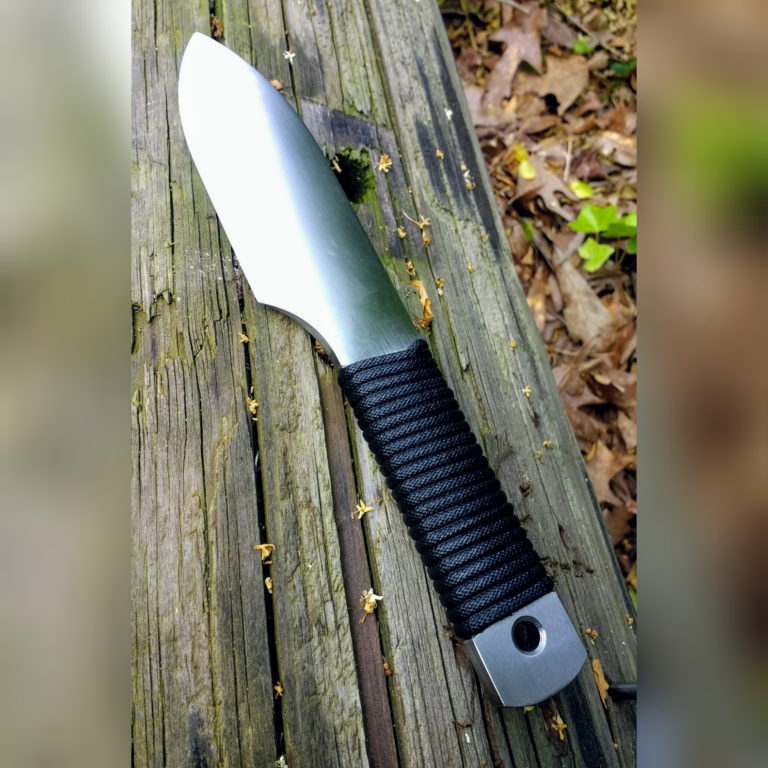
  • Design suitable to clearing vegetation, preparing meals and handling general camp chores
  • Fixed blade
  • Blade length: 6 to 10 inches
  • Full tang
  • Guard
  • Jimping
  • Pommel

Camp knife: the name conjures images of unlimited locations and scenarios. Most would agree that a camp knife would be some type of fixed blade suitable for odd jobs while camping and meal preparation. Here are some specifics to round out that general definition.

Camp knife photos
Most would agree that a camp knife would be some type of fixed blade. This one by Shawn McIntyre sports a clip point, damascus single guard and a bird’s-beak pommel.

Blade Length

Camp knives can start at a 5-inch blade but usually range between 6 to 10 inches. How much blade length you need often will depend on your campsite. If in an established hunting or fishing camp, a 6-to-8- inch blade probably will be all you need.

Longer blades would be necessary if you were making a campsite that was a short-term proposition. Areas may need to be cleared of thin vegetation for sleep areas or your tent. You may need to widen the trail or even break trail to get to your preferred hunting or fishing location.

Tang Size

Camp knife definition
Camp knives should feature full tangs—that is, the tang goes all the way to the end of the handle. Tangs can be hidden or exposed. Tim Steingass features an exposed full tapered tang on his Big Ol’ Camp Bowie.

The tang’s size often is used to off set the blade’s size, giving the knife better balance. Construction should feature a full tang—that is, the tang goes all the way to the end of the handle. Tangs can be hidden or exposed.

Guards

Custom camp knife
The author said most camp knives should have at least a single guard like this one by Josh Fisher.

While there are many camp knives without guards, I prefer one with a guard, and I like it to be of stainless steel. Whether it’s a single or double guard depends on the knife and its intended purpose. Most camp knives should have at least a single guard.

Jimping

Thumb serrations (jimping) on top and in front of the guard should be considered as they give you better knife control.

Pommel

Some prefer some type of pommel on the end of the handle for hammering. While in the Army I found using an “infantry hammer”—a rock—allows you to hit harder and what you aim at. It also accomplishes the task quicker and eliminates the potential for knife damage.

Handles

Handles are often overlooked on knives. If you have ever used a knife for an extended period of time and the handle was too thin or too wet environment, I recommend a material to allow your hand to mesh with the handle.

Natural materials are often used for handles. With its hills and valleys, stag is an excellent choice. The problem with natural materials is they can shrink and/or crack over time, giving your knife an uneven grip, limiting its utility.

Synthetic materials such as rubber, G-10 or Micarta® can be excellent choices. Rubber will deteriorate over time unless properly maintained. This is especially true in a saltwater environment. When choosing a synthetic handle material, it is best to pick one with some kind of grip to it. Rag Micarta can be an excellent choice.

Incorporating some kind of stippling of the Micarta or G-10 enhances grip. One last thing: Give some thought to using orange G-10. If you drop your knife in the woods, the color gives you a fighting chance to actually find it.

What is the Best Knife for Small Game?

0

The short answer: bird and trout knives.

Small game can be even more challenging to dress out than large game. Consequently, makers build what are called bird and trout knives, which generally feature thin, slender blades 3 to 3.5 inches long. You can find such knives with both drop-point and skinner-style blades.

The blade is primarily designed for the tasks of dressing out birds and fish, hence the name. Birds are generally dressed out to harvest the breast meat. Fish are dressed to get the fillets. (Most hunters and fishermen discard the remainder of the bird and fish.)

While a fillet knife may be the better choice for dressing out fish, you then must carry two knives.

The other choice is a folder with a 2.5-to-3-inch blade. Some feature a blade and a gut hook. As this implies, the idea is to insert the hook into the bird or other small game to pull out the intestines and the rest of the intestinal tract.

Generally, the ideal bird-and-trout folder has either a 2.75-inch drop-point blade or is a multi-blade with 2.25- or 2.75-inch blades featuring a combination of a skinner and a drop point.

While most don’t think of a folding knife when it comes to dressing out game, there is a place for such a knife in your hunting gear.

9/11: A Knife Forged From World Trade Center Steel

1

Here’s how one knifemaker forged a knife from 9/11 wreckage to fundraise for families affected by the attacks.

Do you remember where you were on Sept. 11, 2001, at 8:45 a.m. EDT when an American Airlines Boeing 767 loaded with 20,000 gallons of jet fuel crashed into the north tower of the World Trade Center in New York City? That day was forever etched in many of our minds as a reminder of how paramount it is to safeguard our freedoms.

One knifemaker, Murray Carter, never forgot that day. He was approached to collaborate with FDNY343 and Building Homes for Heroes® to forge a knife from World Trade Center steel, and told BLADE he was humbled at the opportunity.

Sept. 11 wreckage photos
Pieces of iron from the World Trade Center appear as they looked before (bottom) and after (top) light surface grinding to facilitate forge welding.

Building Homes for Heroes is a national non-profit, non-partisan 501(c)(3) organization founded in 2006. It has been at the forefront of making a significant difference in the lives of wounded American service members and their families, including those affected by the 9/11 attacks.

The knife Murray made went to auction, with all proceeds from the auction to be distributed to first responders who were directly affected by the 9/11 attacks.

World Trade Center steel knife
The three-layer blade of a Carter Cutlery chef’s knife is forged with WTC steel and a 1084 carbon steel core. The ironwood handle has a brass bolster. Judging from how much use Carter’s kitchen knives get, Murray opined this is probably the most valuable use of the precious WTC steel. Above the knife is a portion of the raw material from which the blade was forged.
World Trade Center commemorative knife
Here are the beginning (bottom level), middle (mid-level bar of steel) and end products (top level) of forge welding World Trade Center iron into a usable blade with a 1084 core. The blade is water-quenched for maximum sharpness and edge retention, and the blade surface still retains the soul-infused character of the WTC steel.

As he noted, “Being entrusted to recreate useful cutting tools from remnants of the WTC was an honor and one of the most humbling tasks of my 29-year career.”

This past November, FDNY 343 RIDE flew Murray to New York to give a presentation and explain what he did with the WTC steel and how it was used in a three-layer laminate to create high-performance knives. It was an experience Murray said he will never forget.

September 11 commemorative knife
The three pieces to be forge welded into a blade are, from left, two pieces of WTC iron and 1084 core shown both before grinding and polishing and after.

“It went incredibly well,” he noted. “Best of all was that I got to meet many of the New York Fire Department members, as well as many American military heroes—they are all heroes, all first responders—and there was such a huge sentiment of being proud to be American. It was a very refreshing spirit to witness.”

The knife went for $10,500, with all proceeds going to Homes for Heroes.

Murrary Carter custom knives
A Carter Cutlery bowie sports a three-layer blade of WTC steel with a 1084 steel core, a brass guard and Sambar stag handle.
Murray Carter neck knife
A Carter Cutlery neck knife gets the three-layer WTC/1084 carbon steel blade treatment and an ironwood handle.

Knife Used to Save Life of 6-Year-Old Boy

0

Thanks to a young man’s quick thinking and a pocketknife, a 6-year-old boy is alive and well in Flowery Branch, Georgia.

On June 25, Logan Simmons, 19, a Chick-Fil-A employee, noticed the youngster in a car choking on a seatbelt in the drive through. Climbing through the drive-through window, Logan pulled out his pocketknife and cut the boy free, saving his life.

As a result of Logan’s actions, Knife Rights awarded him the Knife Rights’ Carry a Knife – Save a Life Award™.

“Logan Simmons’ action to save a young child’s life is a dramatic testimony to the value of always carrying a knife,” said Doug Ritter of Knife Rights. “You never know when your knife will be the difference between life and death; these situations cannot be foreseen, as Logan discovered.

“There are still places in America where the pocketknife Logan used would be illegal to carry. Knife Rights is committed to ensuring that law-abiding Americans can carry whatever knife they want to be prepared for whatever challenges they may have to meet without irrational restrictions that do nothing to stop criminal activity.”

The Carry a Knife – Save a Life Award honors an individual who uses his or her EDC knife to save a life, demonstrating the practical advantages to always carrying a knife in order to be prepared for situations when a knife is invaluable—up to and including saving lives.

In addition to an award plaque, Knife Rights’ knife industry friends donated over $5,000 in EDC knives for Logan, including one-hand-opening folders, autos and fixed blades, all legal for him to carry in Georgia. The donors each donated two knives, one for Logan to display and one to carry.

In addition, Logan was presented with a Knife Rights Life Membership, a certificate for him to be Knife Rights’ and BLADE® Magazine’s VIP guest at BLADE Show 2020, and a certificate from W.A. Surls Knives and Pop’s Knife Supply of Braselton, Georgia, for a two-day knifemaking experience where Logan will make a knife from scratch with supplies provided by Pop’s.

Logan’s mother, Teri Simmons, also was presented with a number of pocketknives, recognizing that mothers make a difference. Logan’s co-workers at Chick-Fil-A also were given pocketknives to carry.

Advertisement

Must Read Articles

Read this before you make a knife

Knifemaking 101 – Read This Before You Make a Knife

  by Wayne Goddard My experience has taught me that there's nothing like digging in and getting started. I've often said the hardest part of the...
how to forge damascus steel

How to Forge Damascus

Advertisement
Advertisement