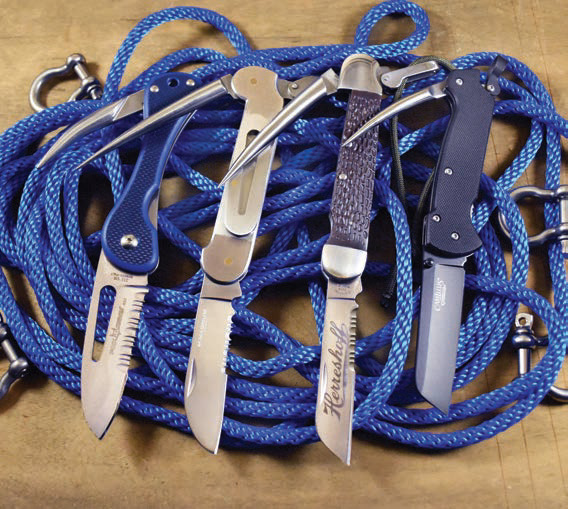
One of the more unusual patterns in the long history of folding knives is the marlinespike. It is a blend of the early rope knife—not the sunfish, but the wharncliffe version—and the singular, knitting-needle-like marlinespike.
These were combined into a single folder and have served many a sailor and diver well. The blade is a sure-handed rope cutter, and the spike is made for working with knots and splicing rope. In fact, there is a knot dubbed the marlinespike hitch that serves as a temporary knot for various needs.
Also known as rigging knives, marlinespike knives live today in the form of reproductions of the original folders and thoroughly modern send-ups. Climbers, who use a lot of different knots in their endeavors, also find marlinespike knives useful.
Example 1: Colonial Knife’s Marlin Spike
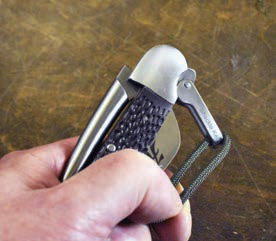
The press-lock is a common blade release for marlinespike folders that dates back to the knife’s early days. However, there’s more here than meets the eye: The Colonial Marlin Spike’s lock also serves as a bail and a shackle opener.
Colonial Knife’s Marlin Spike is a reproduction of the original marlinespike knife issued by the U.S. Navy in World War I—with some modern touches.
The locking, 440C stainless steel spike and partially serrated—a plain-edge version is also available—sheepsfoot slip-joint blade are both 3 inches long. The scales are a simulated brown jigged-bone Zytel and the bolsters are stainless. The spike locks via a press-lock on the base, which also serves as a shackle opener and bail for a lanyard.
Example 2: Boker Magnum Catamaran
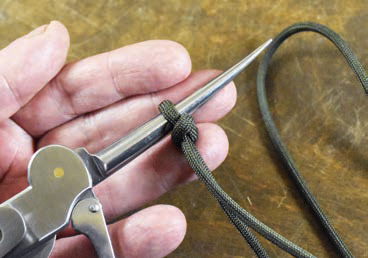
The marlinespike hitch is a simple, temporary knot that can be easily removed once it has served its purpose. The knot is attached to the Boker Magnum Catamaran’s spike in a scenario for which it can serve as a handle.
The Boker Magnum Catamaran has the traditional profile of the old marlinespike folders, replete with a press-lock bail/shackle opener for the spike tool and a 4.375-inch stainless steel frame.
The 3.3-inch spike and 2.75-inch partially serrated sheepsfoot slip-joint blade are 440A stainless steel. You’ll find a nifty shackle opener on the handle, also stainless steel, pinned to the frame.
Example 3: Camillus Marlin Spike
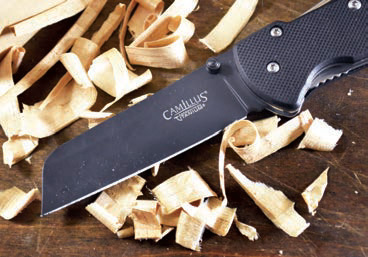
While the plain edge of the Camillus Marlin Spike’s sheepsfoot blade might not quite match the speed of a serrated edge, when it comes to wood it vastly out-carves the rest of the pack. This is a big consideration if you need a knife that will step outside The Rope Zone.
The Camillus Marlin Spike is a modern take on the original. The stylized, 4-inch frame is black G-10 with stainless steel liners. The 2.75-inch sheepsfoot blade—the only one of the test group without serrations—is VG-10 stainless steel with a black, carbonitride titanium coating.
It secures via a linerlock. The folder’s 2.25-inch spike locks via the press-lock/bail and is black coated as well. It is the lightest (3.2 ounces) of the test knives.
Example 4: Fox Sailing Knife
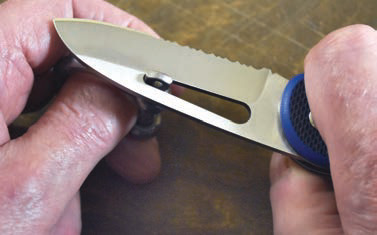
The Fox Sailing Knife has a cutout in the blade that serves as a shackle release. A shackle’s screw tab is caught in the jaws of the blade’s open maw.
The Fox Sailing Knife delivers with a cool, 4-inch handle of textured blue G-10. Stainless liners house linerlock mechanisms for both the 3-inch modified wharncliffe blade of 420 stainless steel and 2.25-inch spike.
The partially serrated blade has a cutout that serves as a shackle opener, along with a hole in the base of the frame that can accept a lanyard.
This year’s two new inductees to the BLADE Magazine Cutlery Hall Of Fame® have a decidedly military connection: ABS master smith Joe Keeslar and knifemaker Jim Sornberger.
Both military veterans—Keeslar in the U.S. Marine Corps and Sornberger in the U.S. Army—were selected in a vote of the sitting members of the Cutlery Hall Of Fame after an extensive nomination and final ballot process.
The two new members are scheduled to be inducted at BLADE Show 2020, Aug. 7-9, at the Cobb Galleria Centre in Atlanta.
In order to qualify for the Cutlery Hall Of Fame, the inductee must have…
demonstrated extraordinary service to the knife industry;
displayed honesty, character and integrity;
advanced the industry by the creativity and originality of their works or contributions;
as ambassadors or outstanding contributors furthered the positive impact of the knife industry on the world at large; and
in summary, demonstrated a worthiness to be a member of such a prestigious group.
The number of votes each new inductee elicited from the sitting Hall-Of-Fame voters would seem to indicate they qualify on all fronts.
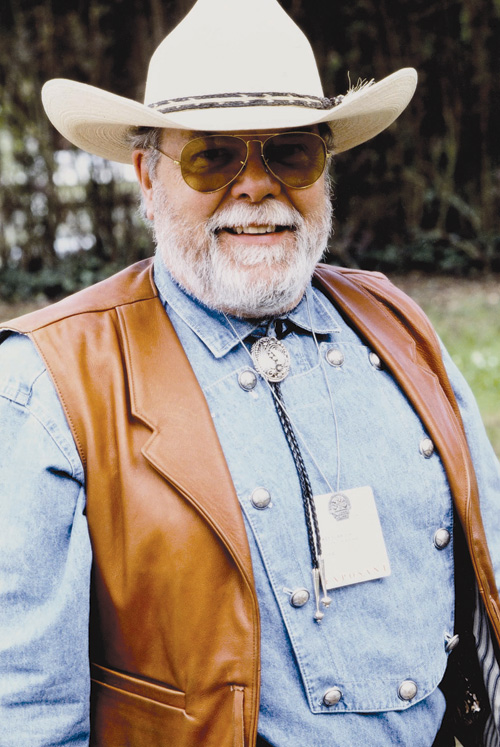
Joe Keeslar
Joe Keeslar
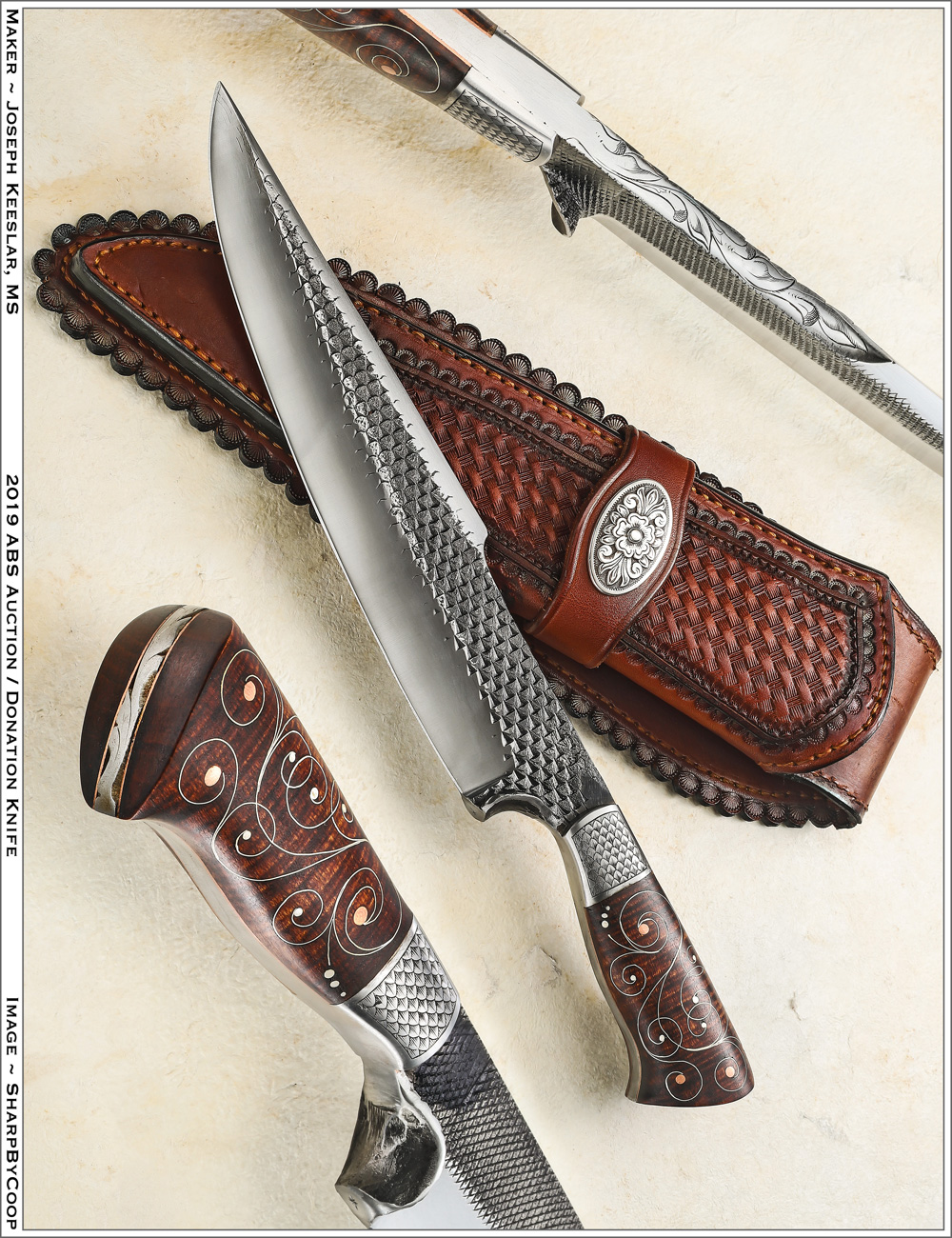
A resident of Almo, Kentucky, Joe has had an extensive, storied career in the American Bladesmith Society, earning his ABS master smith stamp in 1989. Known for his forged fixed blades, many in the brut de forge style, he also is noted for his beautiful handles with silver wire inlay and matching leather sheaths, the latter often adorned with conchos and other rich embellishments.
Joe joined the ABS board of directors in 1991, served as ABS president from 2003-07, and completed his second term as president in 2015. He has had a dramatic influence on bladesmithing in Europe, where he was chiefly responsible for the first modern hammer-in held in France. He is also a frequent demonstrator at the Thiers Knife Show, one of Europe’s largest knife shows, in Thiers, the knifemaking capital of France. He is the only American knifemaker to receive an honorary membership in the Confrerie du Couteau de Thiers, a French knifemaking organization.
Joe Keeslar (inset) is known for his gorgeous brut de forge fixed blades in silver wire inlay and sheaths to match. (SharpByCoop knife image)
As one nominator wrote, Joe is “the most effective maker in the USA to extend forged-blade activity in Europe,” and is the most active in spreading the ABS’s “high level of information.” He has taught knifemaking at the William F. Moran School Of Bladesmithing and at Haywood College, at hammer-ins in Alabama, Arkansas, North Carolina and Ohio, and at the first four renditions of BLADE University at the BLADE Show. He is author of the books Handles and Guards and Forging and Finishing the Brut de Forge Knife. He also is primarily responsible for the rapidly expanding ABS youth program, which holds an annual hammer-in at Smoky Mountain Knife Works.
According to another nominator, Joe “embodies the calm and consistent leadership, knifemaking skills, education and friendship that is so valuable to the entire world of knives.” According to another, “Joe has done more for the ABS than any person besides the late, great W.F. ‘Bill’ Moran.” Lastly, Keeslar was awarded the first annual Aldo and Edda Lorenzi Award at the 2015 BLADE Show for his many contributions as a mentor to bladesmiths worldwide.
Jim Sornberger
Jim Sornberger
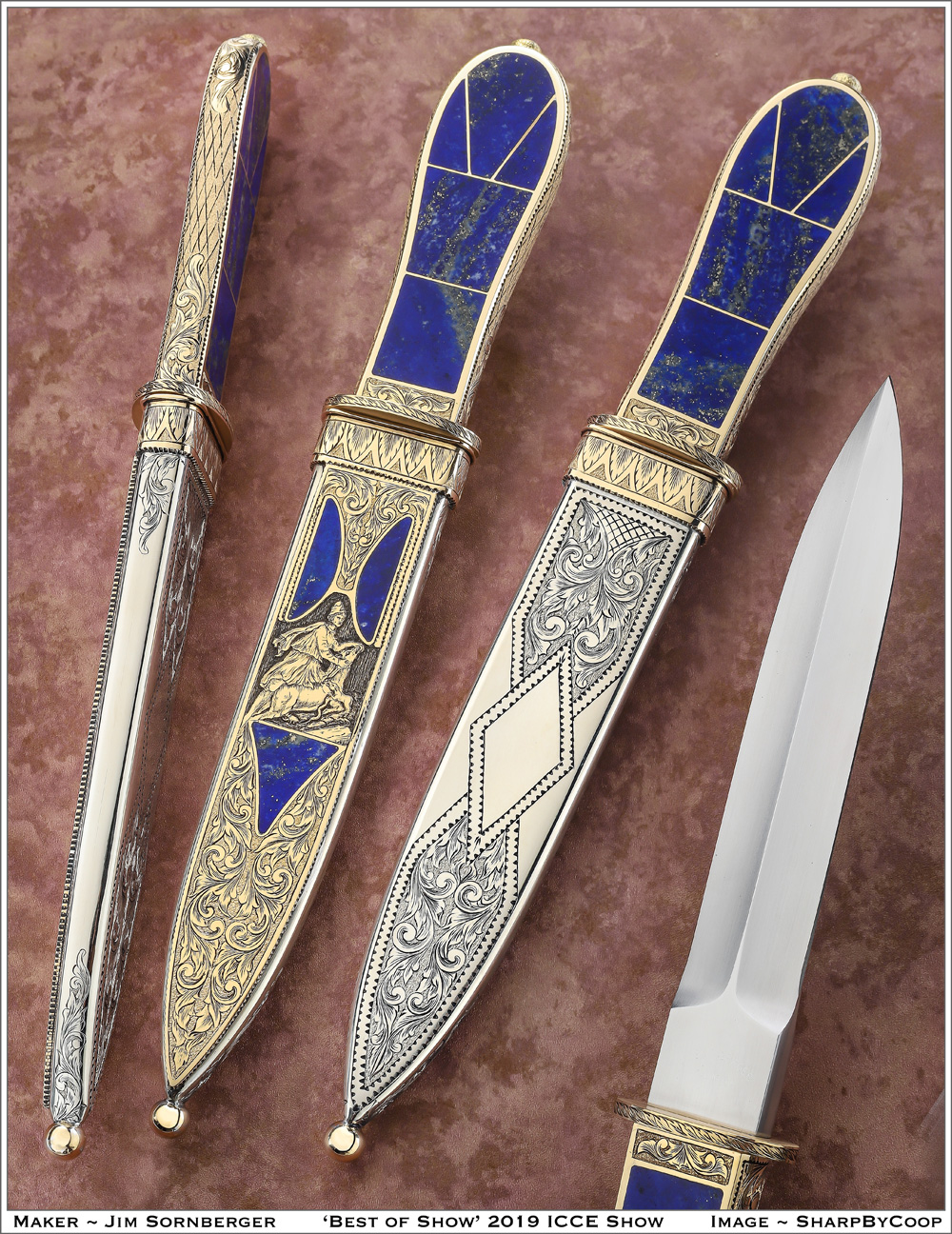
Calling Volcano, California, home, Jim is a veteran stock removal knifemaker known for his award-winning fixed blades and folders, among the former especially his ornate California-style dress bowies in exotic handle materials such as lapis lazuli and gold quartz.
According to a nominator, when Jim started building knives in 1970, there were only a handful of makers in northern California. As more people became interested in knives and Jim’s “knife family” grew, they experienced difficulty buying knifemaking supplies because no one on the West Coast sold them.
As a result, along with Bill Holt, Jim started H&S Supply in 1981. Cutlery Hall-Of-Famer Bob Loveless and Jim made sure H&S had the right-size steel for knifemaking, and when 154CM stainless steel became “unclean,” they helped bring in ATS-34 stainless so many West Coast makers would have it available. Jim and Bill helped support many of the makers who could barely make ends meet by selling them the steel on credit. In fact, Jim still has a bar of 154CM that Loveless gave him many years ago.
Jim Sornberger specializes in 19th-century-style dress bowies such as this San Francisco knife that won Best In Show at the 2019 ICCE. (SharpByCoop knife image)
Circa 1980, along with a few others, Jim sponsored and organized the Bay Area Knife Collectors Association (BAKCA) Show, which went on to become the most successful club show on the West Coast. Jim would generously give up his table space to help makers get started, including his good friend and outstanding knifemaker in his own right, Stan Fujisaka.
In later years, Jim helped bring interest to the California-style dress bowie in gold work and engraving. He shared most everything he learned with other makers, helping many to learn the craft. He writes articles for KNIFE Magazine and has written for BLADE®, and also helped write BAKCA’s by-laws. For a number of years he served on The Knifemakers’ Guild board of directors, including as vice president.
If you’re lucky enough to attend a knife show in-person this year, take advantage of the time to use your smartphone—or even a camera, heaven forbid—to help establish the provenance of the knife you buy.
A provenance that not only can you show proudly to anyone and everyone who might be interested in the cool little enclave of makers that comprise the knife industry, but also to help increase the knife’s value.
What Is “Provenance?”
Provenance, in case you don’t know, is defined by Webster’s as “place or source of origin,” and proof of it is something those who deal in the world of collectables value almost as much as the collectable itself.
Such is the case in the world of edged collectables, where the knives of certain makers can be extremely valuable. Being able to prove beyond almost a shadow of a doubt that one of those makers made the knife you assert he or she has made can mean hundreds if not thousands of dollars of difference in the amount of money you can get for it—if and when you decide to sell it.
In later years, if you keep the knife and its provenance together, it can mean even more money and prestige than that.
What Forms of Proof Count as Provenance?
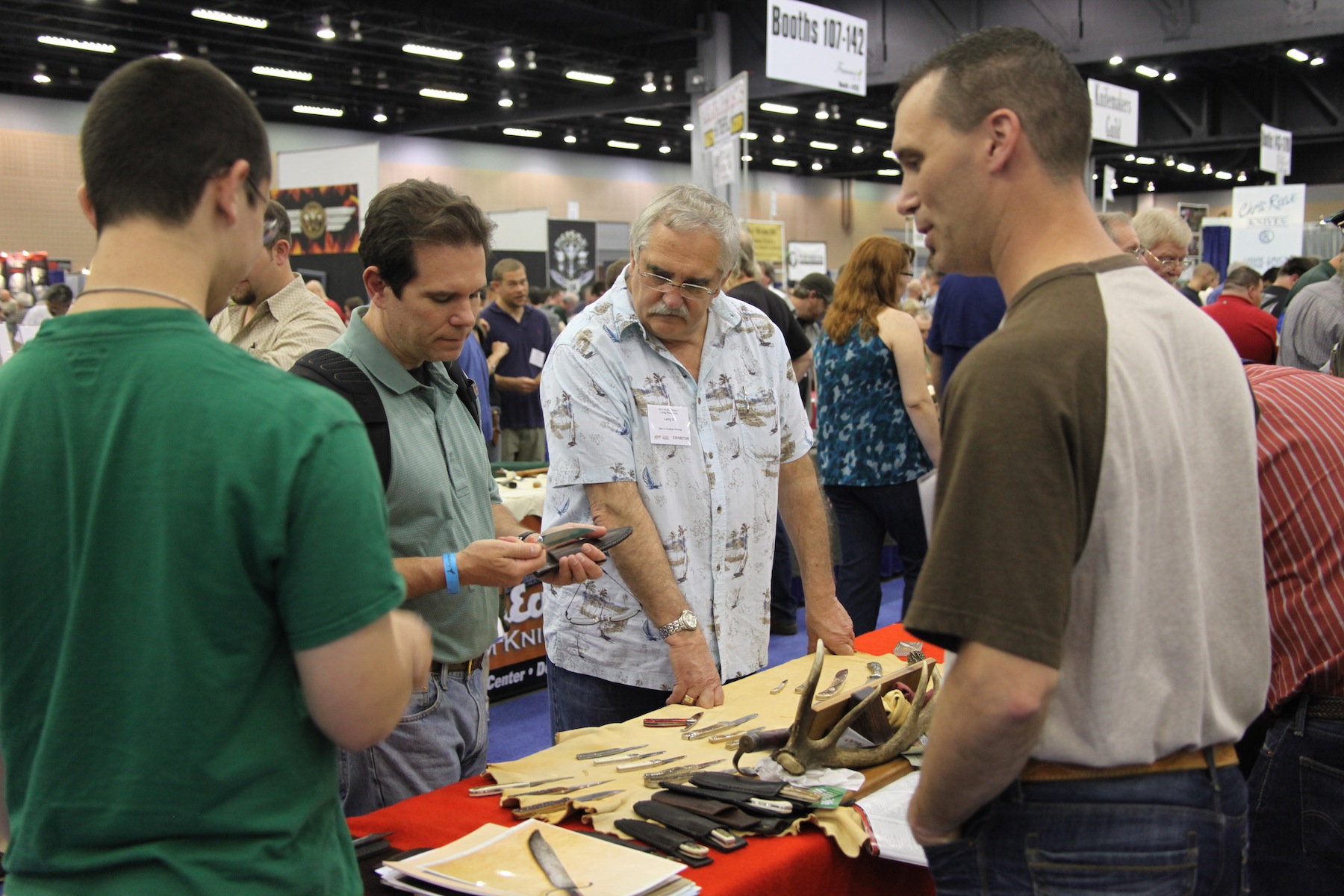
Even if you can’t make it to a knife show in 2020, such as this scene at Jerry Van Eizenga’s table during a past BLADE Show, you can still request signed business cards, specs, receipts and photos from the knifemaker through the mail. A notary public isn’t out of the question, either. (file photo)
Provenance can take any number of forms, including dated written and signed documentation, sales receipts, product boxes (with the overall condition of those boxes playing a large part in value, too), etc. The more legitimate examples of proof you have, the better the provenance is.
Among other forms of such proof are photographs, and such photographs can come in any number of renditions.
For instance, once you buy the knife from the maker at his or her table, you might ask if it’s OK if you:
photograph the knife on the maker’s table, perhaps even with his/her autographed and dated business card situated next to the knife;
have your photograph taken with the maker, with you and/or he or she holding the knife; and
any other image you can think of to date or memorialize the occasion.
And you don’t have to stop there. You can keep the maker’s autographed business card from the photo, any kind of signed and dated receipt, knife specs (including name of knife, steel, blade length, handle material, lock, any unusual facts or descriptions of how the knife was made, etc.) and so on, and store it all with the knife.
If you feel even more enterprising, bring a recorder and record the maker’s answers to questions concerning the knife.
Of course, you will need to ask the maker’s permission for all of the above beforehand, but, if you’re paying the maker’s asking price for the knife, chances are he or she is going to be more than happy to comply and help you establish the knife’s provenance.
Provenance Benefits Both Ways
After all, the more money you get/more prestige you establish for the knife is probably going to benefit the maker’s ability to get top dollar for/reinforce the collectability of his/her knives, too.
Besides, it helps you establish a better rapport with the maker and is all kind of fun to boot.
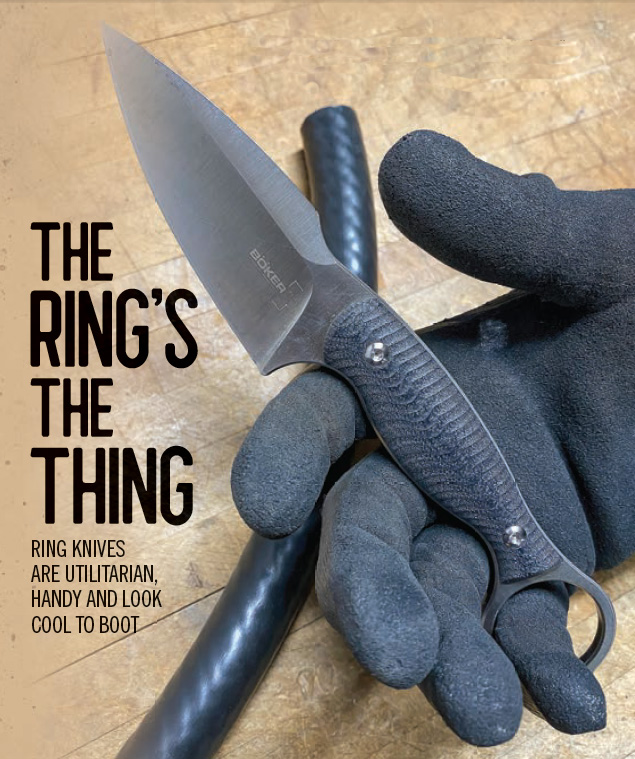
When you think of a knife with a ring in the handle butt, a karambit probably comes to mind. Fact is, there are other knives with such a feature. In fact, some have rings at the middle and also even at the front of the handle.
Unlike karambits, in which the ring is used for quickly spinning the knife in between different grips as well as affecting the grips themselves, non-karambit versions of such knives employ the ring in utilitarian ways that are less flashy.
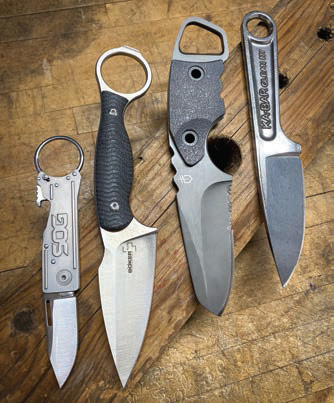
The latest ring knives from left, with manufacturer’s suggested retail prices in parentheses: SOG Keytron ($23.95), Boker Plus Accomplice ($119.95), Gerber Epic ($42) and KA-BAR Wrench Knife ($54.74). (Marty Stanfield Photography)
Examples include assisting in providing a more secure purchase on the handle, dangling the knife from a pinky to allow for full use of the hand while keeping the knife handy, attaching the knife to a keyring, or simply hanging the knife on a tool rack or elsewhere.
If your approach involves frequent intermittent knife use, interspersing it with employing your hand to grip, hold or pull the material you’re cutting or some other method all your own, then adding a ring knife to your collection might be beneficial.
Mail-In Knife Sharpening Services: Is There Anything New Under the Sun?
In absence of innovation, execution is everything.
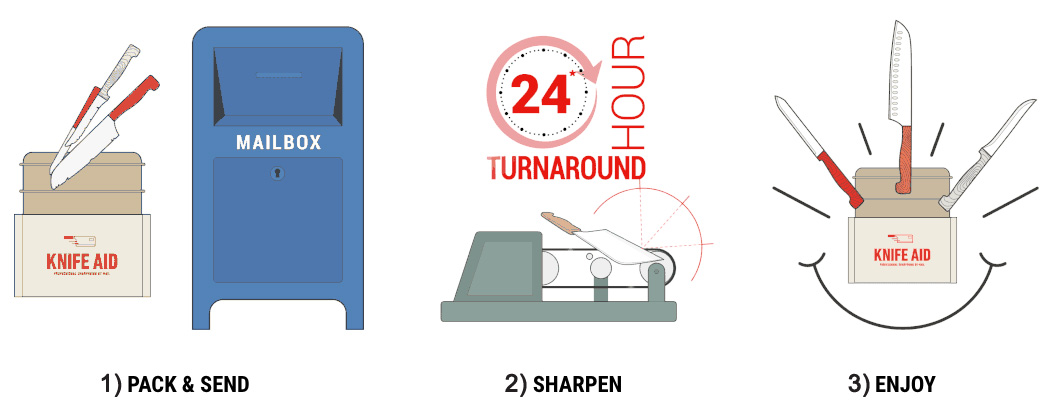
Knife Aid, as seen on ABC’s Shark Tank TV show, caught the attention of the wider viewing audience as a new way to sharpen knives. The pitch centered on consumers mailing knives to Knife Aid for sharpening. The knives returned later in the mail.
This excited the “sharks” of Shark Tank (including the surprisingly blade-savvy Mr. Wonderful), and a deal hatched to bring Knife Aid to the masses.
Billionaire investors aside, those in the world of knives likely yawned at this novelty. Mailing in knives for sharpening is Pony Express territory.
In Search Of The Better Mousetrap
Still, I wanted to try Knife Aid for myself for two reasons.
First, Knife Aid‘s execution seemed interesting. This operation looked as polished as a fresh blade, incorporating email updates about order status, slick packaging and the ability to scale. That last part is tough.
I’m a sucker for better mousetraps. I’m interested in how people stay on the cutting edge of what they do, especially in knives. (I’m also obligated by BLADE to use one knife pun per day. Hope you’re reading this, Steve.)
Second, I’m crunched for time like never before. I used to treat knife sharpening as a sort of meditation to unwind. Those days are gone, and my knives in regular rotation show it.
How Knife Aid Works
I contacted Knife Aid directly to try its service, but the process works the same for anyone.
After placing your order, Knife Aid mails you an envelope with everything you need to send knives or scissors in for sharpening.
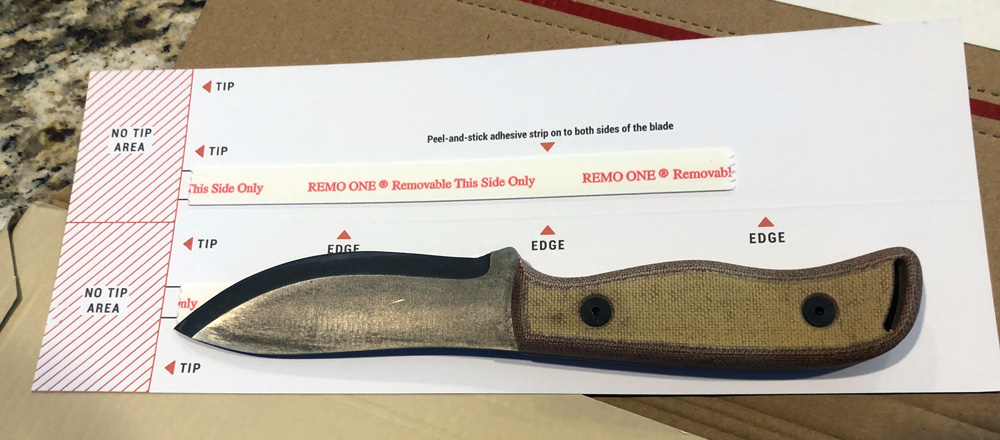
And I do mean everything: a sturdy envelope, pre-paid postage, adhesive blade guards, you name it. All you need to do is pack your knives according to the instructions. That’s it. You could be all set in three minutes.
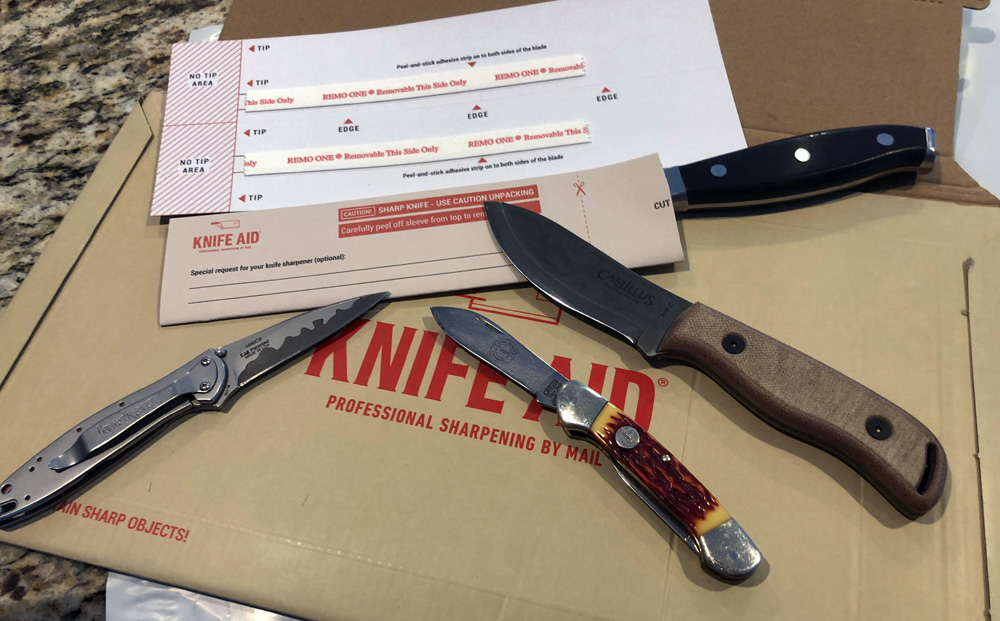
From left are a Kershaw Leek, a Camillus canoe, a Camillus Bushcrafter and a J.A. Henckels chef’s knife too embarrassed to be photographed. Not pictured are the Oxo scissors, but they also went out for sharpening.
Knife Aid takes almost any blade you can throw (figuratively) at them, but there are some restrictions to keep in mind. Daggers, autos, single bevels, straight razors and anything longer than 16 inches are out of bounds.
I selected a couple pocketknives, some go-to scissors that border on shears and a bushcraft fixed. However, the real test would be a chef’s knife. That poor thing endured a lot of kitchen abuse. It would be my benchmark.
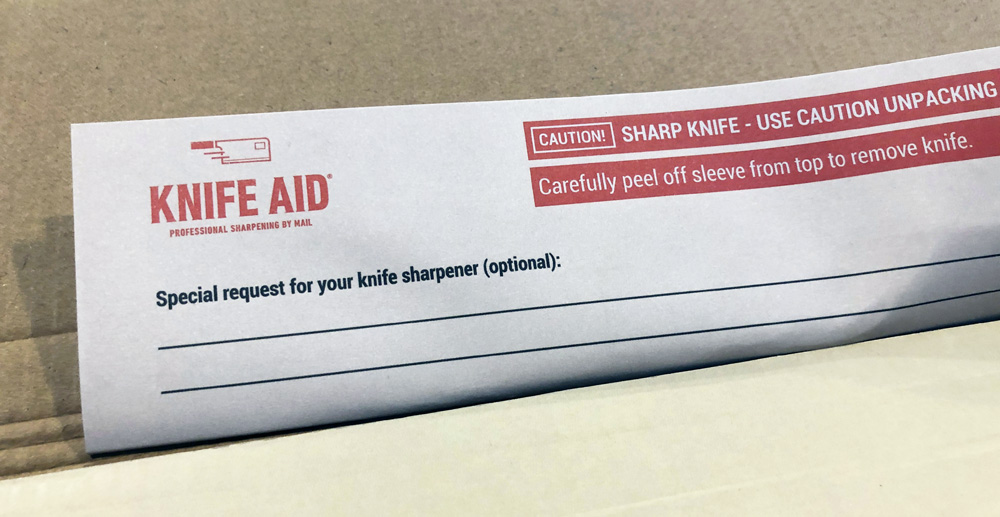
I liked that Knife Aid left room for custom instructions for the sharpener. This is great if you have a specific angle or grind in mind. You could also draw attention to a repair.
A spot for special instructions was a nice touch.A closer look at how those adhesive blade guards work.
I dropped the stuffed envelope off at the Post Office. Again, the pre-paid postage kept everything simple. I didn’t need to worry about weights or sizes. All I had to do is wait.
The Wait
Waiting didn’t feel like waiting, because Knife Aid kept me updated throughout the whole process with emails. At no point did it seem as though my knives fell into an abyss.
Testing The Sharpened Knives
It doesn’t get more straightforward than this.
I received the sharpened knives back about a week after I mailed them in. The 24-hour turnaround Knife Aid talks about on its website refers to the time from the start of the sharpening.
The scissors cut better than new. No joke. I use those scissors a dozen times a day around the house, especially the kitchen. Any resistance to the cut collapsed. I can’t quantify how much sharper they became, but I can say the fun factor went to 11. Yes, sharp scissors can be fun.
The pocketknives, more for tooling around outdoors, cut paper strips like champs, slicing with the weight of the blade and a feather grip. Had COVID-19 not welded the doors shut, a proper in-field exercise would be in order, but the paper told the story well enough.
However, that’s not what pushed me over the line on Knife Aid.
The Chef’s Knife: From Dull to Lightsaber Sharp
The chef’s knife. Oh, the chef’s knife.
Let me put this into context.
This degraded J. A. Henckels went into service in 2009 as the kitchen beater blade. It’s fought food and fixtures alike, pausing only to take a bath in the dishwasher.
Yes, I know what a sin that is, but you’ve got to understand something. Those clothes you wear while painting? Those shoes you mow the grass in? That truck you never buy tabs for? This is the knife equivalent of those. It doesn’t cut like butter. It cuts like butter. Hence the beating of the blade through the latest victim of food prep.
Things turned around big time after the sharpening. This chef’s knife zoomed past scary sharp to full-blown lightsaber. We’re talking near-zero resistance along the cut, greased only with gravity. Food prep for meals went from count-my-fingers-when-I’m-done bad to I-wonder-would-happen-if-I-tried-to-cut-XYZ great.
Excellent.
Knives to Avoid Sending to Knife Aid
Any time you stick knives through the mail, you risk losing them. Just ask any knifemaker at BLADE Show. Everyone has a story. You can’t count on postal insurance, either. Make that two stories.
For that reason, I’d only send knives to Knife Aid that you can afford to lose. As far as values, I’d peg a well-worn Sebenza as the top class of blade to trust.
The same goes for chef’s knives, which I imagine make up the bulk of Knife Aid’s business. Losing a $200 knife stings, but a $2,000 knife stings 10 times more.
Suggestions
In a perfect world, I’d like to know more about who did the sharpening. Maybe I’d even request the same person again and throw in a tip. Good work should be rewarded.
I also wish they offered to disassemble and clean pocketknives. Why stop at sharpening? Give that gummy knife a spa day.
Worth The Money: A Sharp Knife is Like Getting a New Knife
Here’s the deal. Most of the time, a sharp knife is as good as a new knife. As of this writing, Knife Aid charges as low as $10.64 a knife for its service (check the prices here). Would I re-buy each of my knives for about 10 bucks? You bet.
Raising that chef’s knife from the dead sealed the deal. Knife Aid is a winner. I’d recommend it to anyone.
Knife Aid is going to bring knife sharpening to a lot of people who don’t think about knives as much as the staff at BLADE does. That’s a big positive, because with it comes the appreciation of the craft inside each knife, and that’s pretty sharp.
(That’s two puns, Steve.)
Try Knife Aid For Yourself
If you’d like to try Knife Aid, click here and get started. It’s easy.
Full disclosure: BLADE receives a commission on orders it refers to Knife Aid, because we have to keep the lights on. That shouldn’t stain the service Knife Aid provides. Give it a shot. You’ll like it.
We recently published a picture of a custom knife with a price one observer indicated was exorbitant. This person questioned why we had published it.
When we publish the picture of a knife, we try to include the price. In the instance of a factory knife, the price we list is the manufacturer’s suggested retail price. In the case of custom makers’ knives, where possible we preface what the maker charges for the knife with “The maker’s list price”—for example, “The maker’s list price: $500.”
…And Value is Another
The reason we do it that way is the price is the one the maker is asking for the knife, not the collector value. We are no more going to change the maker’s asking price for a custom knife to reflect what we think the collector value is any more than we would do the same to a factory knife. It simply is not our place to do so. (Besides, it could open us up for legal action.)
We don’t list the collector value for custom knives because:
a) such values can be subjective;
b) such values are subject to fluctuation, sometimes almost overnight;
c) we simply may not know the collector value;
d) any number of other reasons; or
e) all of the above.
Why Doesn’t BLADE Publish Collector Values?
Now, sometimes we will list prices based on knife-show-opening bids, secondary market values, purveyor’s list and other prices, etc., but we never publish collector values for custom knives.
BLADE® is a knife magazine, not a price guide. Our mission is to show the work of as many makers as possible to as many knife buyers/collectors as possible, and let the latter decide what they want to buy and whether it’s worth the price.
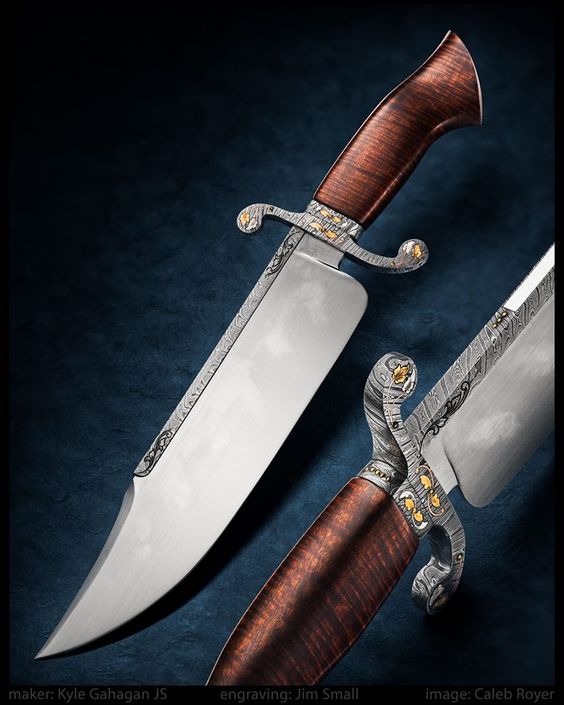
Kyle Gahagan made this 10.5-inch blade with forge-welded 1075 and 15N20 steels. The guard uses the same steel, and the handle is ringed gidgee wood. Maker’s list price: $3,500.
Do Knifemakers Charge Too Much?
The fact that some makers charge too much for their knives is no news flash. The temptation to make as much money as possible from one’s labors is always there and is understandable—if done within reason.
However, to do so beyond reason not only is unfair to buyers, it also is likely to backfire on the makers in question by turning off buyers, thus dampening the makers’ future knife sales. In some cases, it may drive the makers out of business.
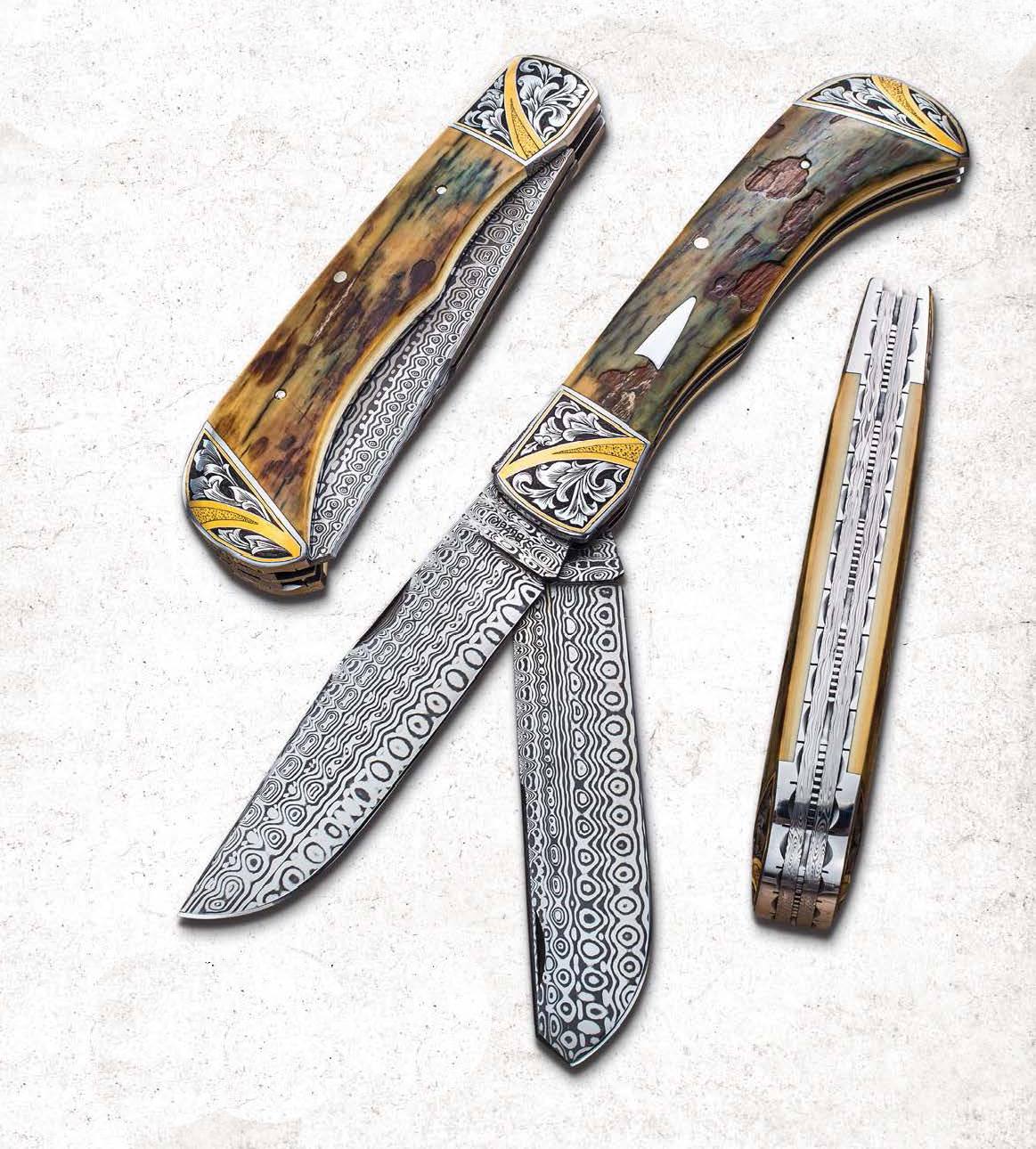
Stan Buzek based his slip joint on a Bill Ruple two-blade trapper. The hollow-ground blades are Damasteel damascus and 3.5 inches each. The fileworked liners are 416 stainless steel. Closed length: 4 3/8 inches. Buzek’s list price to make a similar piece: $1,950. (SharpByCoop photo)
On the other hand, if we publish a maker’s knife and list price and the maker gets feedback on how out of touch the price may be, it might serve as a teaching moment and help the maker get his prices more in line with reality—and help keep the maker in business.
Now, there are some makers who charge four, five and, in ultra-rare cases, six figures for their knives—and get it. And more power to them.
However, they get those prices by the grace of their creativity, ability, reputation, knowledge of the knife market and more, not because they simply ask for them.
Of the assorted American Bladesmith Society-sanctioned knifemaking classes I’ve attended, many pertained to the construction of a well-made knife. In one class, the subject of line and flow was a topic.
An ABS founder and a BLADE Magazine Cutlery Hall-Of-Fame® member, B.R. Hughes said, “A curve looks better than a straight line”—pausing for effect—“and a hint of a curve looks better than a curve.”
The human form and other objects in nature often have been used to illustrate proper execution of line and flow. Some of the simplest of things common in everyday life are there for our benefit if we would notice.
Taking Cues from Nature
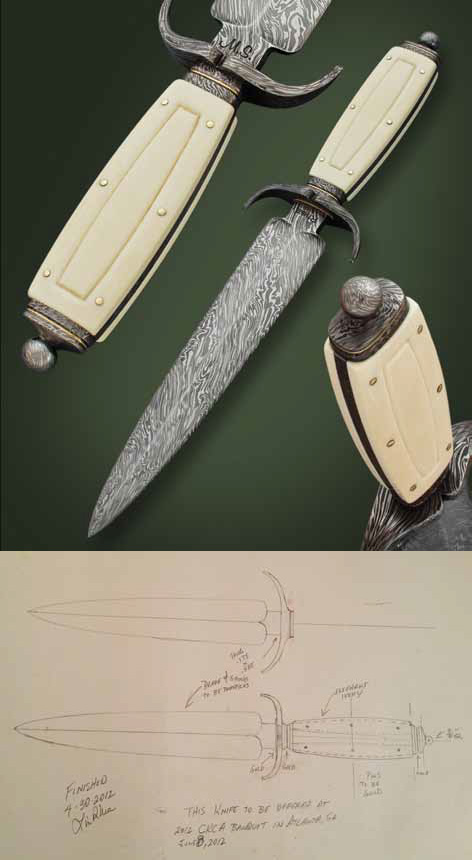
When flow is hard to achieve on a knife, Jerry Lairson puts the design on paper to figure out what does not look right. Once he has the general shape he wants, he starts changing things until the knife starts to flow. Lin Rhea also worked on his art dagger in drawn form (above) before arriving at the finished knife (top). (Chuck Ward knife photo)
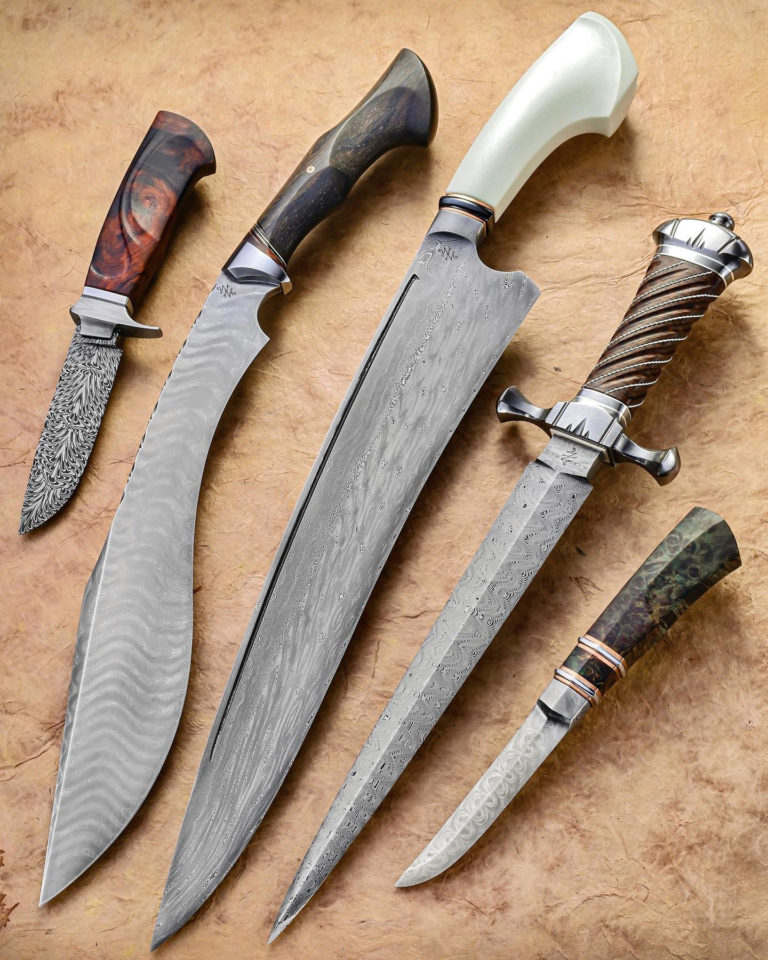
An unfurling fern, drifting snow, a vine climbing to the sun—these things look alive and give the impression of fluidity even though they are at rest. Consider a falcon’s dynamic grace. Simply when perched it looks designed for motion. These are things the great masters studied and emulated, often applying mathematical formulae, yet concealing any and every hint of math within the object’s overt beauty.
We are all “wired” to be attracted to certain combinations of lines that flow into the whole dynamic appearance of an object, whether a person, a falcon or a knife.
Knifemaking long has been elevated to an art form. It’s a natural medium to express artistry in a functional tool. Knifemakers are the formulators, mechanics and artists who create from raw materials something static that also has dynamic character. It looks like it wants to be moving even though it’s not. Remember the falcon?
The object of this brief dissertation is to help makers wanting to improve their work find a perspective. I say “a perspective” knowing it would be uniquely each maker’s since each maker is different and can’t see things exactly the same. Michelangelo’s perspective was not Leonardo da Vinci’s and vice versa, but each developed an eye for his own work.
Also, it may not be possible to explain to another exactly how to have an eye for line and flow. My attempt is simply to rationalize that it is possible to cultivate its development.
Developing an Eye for Line and Flow
If this development is possible, then each maker should ask, “How can I cultivate it in my own work?” Considering the question requires a level of honesty that some are just not willing to attach to something they mistake for “a knife.”
Indeed, the question pertains to the process rather than the product. It is a way of thinking about the craft and not simply “a knife.” That mistaken thinking will never allow a person to elevate knifemaking to an art form, and it can’t help but to manifest itself in a maker’s work. Fortunately, there are many examples of makers who have enhanced their natural talent by honest self-improvement.
What do some of the world’s best makers do to cultivate their eye for line and flow? Where do they look for inspiration? What influences have shaped their perspective?
How the Master Smiths See Line and Flow
Jerry Lairson indicated embellishments such as carving should enhance the line and flow of a knife rather than compete with it. (Buddy Thomason knife photo)
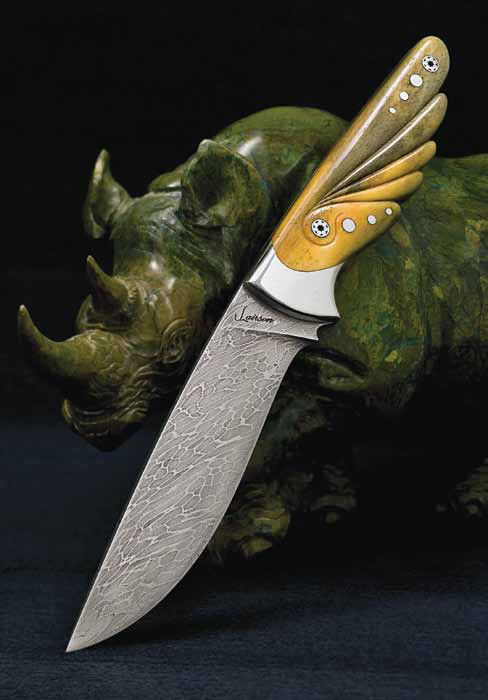
“Many of my best knife designs were inspired by nature,” such as a lily, a bird’s wing and vines, stated ABS master smith Jerry Lairson. “I think it’s good to follow a theme throughout the knife. An example is the fluting on French flintlock pistols combined with the other parts of the gun to create flow. If you see something you like, even if it doesn’t pertain to knives, try to use it as a theme to design a knife. If a knife is decorated with engraving, carving or filework, it should enhance the flow and line of the knife rather than
compete with it.
“Sometimes I see things in museums that have nothing to do with knives but have graceful lines that can help design a knife that flows. How a knife design starts and stops at the point and butt has a lot to do with flow. Sometimes flow is hard to achieve even when you have a good design in your head.
“When this happens to me,” Jerry continued, “I put it on paper and if it doesn’t flow, I start trying to figure what doesn’t look right. I always design a knife on paper. Once I have the general shape I want, I start changing things one at a time until it starts to flow. Sometimes one small line that isn’t right will throw the whole thing off. Sometimes simpler is better.”
Rodrigo Sfreddo’s eye for line, flow, and overall design and innovation shines in his “Dark Tulip.” (photo courtesy of Lin Rhea)
“What makes a knife more desirable than another? Good design,” he began. “Nobody spends hundreds or thousands of dollars on a knife just because they need a good knife for camping or cooking; they’re buying for collecting because [the knives] are beautiful, so good design and aesthetics are of the utmost importance.
“I always say to my students to think about the beauty when planning a knife, not what is easy or what not to make. It’s very easy to make the same blades, guards and handles we’ve already made and seen. The result is just a combination of designs we’ve already used before—one blade just like the one we made some time ago, combined with another guard we made in another project, with another handle, and even the filework, just new combinations of our same old ideas!
“That’s why it’s so important to pay attention to anything that’s beautiful and has great design,” Rodrigo maintained, “like cars, antiques, furniture, architecture and so on. We must refine our taste on everything so it will reflect on our work. It’s unbelievable how we can figure a knifemaker’s characteristics from his work, especially if he’s ‘thinking’ about his work or just following the crowd.”
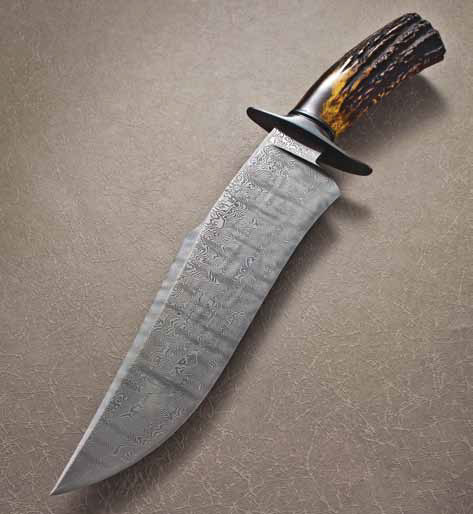
Jason Knight is a proponent of curves, and long and subtle arcs, in his knife designs. This recurve bowie in damascus and stag—winner of the award for Best Bowie in the 2012 BLADE Show custom knife judging competition—is an excellent example. (SharpByCoop.com photo)
ABS master smith Jason Knight’s knives are known for their superlative lines and great flowing execution. He spoke of the ancient ways of looking at and designing things, saying they work and that he won’t try to change them. He described his method as a “way of seeing” involving his eyes and his heart. He pointed out that makers have choices in materials that offer color and texture.
“Materials can limit or enhance design. Some designs might look cool but don’t work well. Usually,” he qualified, “if it looks good, it works well.”
He recommended taking inspiration from other art forms, such as sculpture and woodworking, adding that he likes curves and both long and subtle arcs.
Open Your Eyes
Trying to express the causes and effects of something whose nature is so intangible requires some degree of interpretation, and I’m not sure I am the one to carry this task to completion. However, most makers are in the same boat. Who would have thought so much would be involved in the making of a knife?
Do I understand it all? Not by a long shot. Am I overthinking the matter? Maybe. But it could be that considering these points will help my perspective become a little clearer. Besides, considering that the above three makers give serious attention to advancing line and flow in their work, I feel I’m in good company.