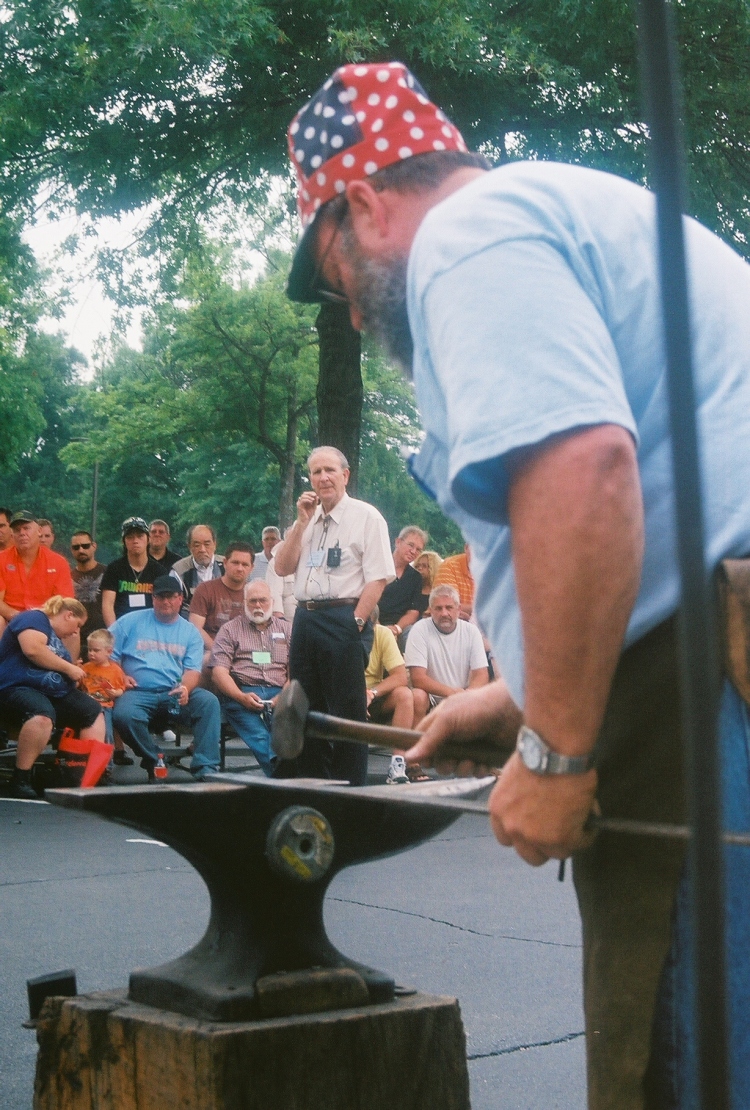
A few days with Andersen forge, just showing a little bit of how things go in the shop. Not a how too video. But more of a who is and where the knives come f…
Following the lead of the Federal Switchblade Act amendment of 2009, and language American Knife & Tool Institute (AKTI) officials said they successfully used first in California in 2001, Rep. Mark Neuman (R), Alaska House District 15, last year introduced clarifying “bias toward closure” language to the definition of gravity knife and switchblade in Alaska’s criminal law.
Unfortunately, time ran out last year for the legislation to be passed.
But as Rep. Neuman promised, he is reintroducing HB 55 this session. As Rep. Neuman states in his Sponsor Statement, “According to the American Knife and Tool Institute, there are over 35.6 million Americans who carry and use some type of utilitarian knife which opens with one hand.” He encourages fellow legislators to recognize the importance of one-handed or assisted-opening knives in Alaska to hunters, anglers and craftsmen, and to support the definition changes to protect Alaskans’ knife rights and clarify that the knives are legal to own and use.
Rep. Neuman attended a presentation last fall by members of the AKTI Board of Regents who showed him several examples of knives, answered his questions and explained the advocacy goals of the organization to protect the knife industry and all knife owners from restrictive and confusing laws.
Alaskans, encourage your representatives to support HB 55. Contact them today at http://w3.legis.state.ak.us.
To understand knife mechanisms and bias toward closure, check out www.AKTI.org/resources/additional-definitions.
For more information, call (307) 587-8296 or visit the American Knife & Tool Institute website at www.AKTI.org. The mailing address is 22 Vista View Lane, Cody, WY 82414-9606. Or follow AKTI at: http://www.Facebook.com/SaveOurKnives.
http://twitter.com/SaveOurKnives
For more on the latest knives, knife legislation, knifemaking instruction, knife trends, knifemakers, what knives to buy and where and much more, subscribe to BLADE® Magazine, the World’s No. 1 Knife Publication. For subscription information click on http://www.shopblade.com/product/blade-magazine-one-year-subscripti…?r+ssfb021512#BL1SU
I am a long-time subscriber—I think from volume one, number one—but have never, until now, been motivated to write. However, the “Web Chatter” section in the January “Readers Respond” of BLADE® magazine prompted my letter. With all due respect to Mr. Doug Metzger, not everyone shares his defeatist attitude. His statement, “American consumers will never pay the prices for a knife made in the USA,” amazes me.
I favor Case (made in Bradford, Pennsylvania) and Queen (Titusville, Pennsylvania) knives and have quite a few of each. If I am clearing brush around the property, I use a Woodman’s Pal (Boyertown, Pennsylvania). I might take a break from brush clearing and light up with a Zippo lighter (Bradford, Pennsylvania), then haul the brush away in a Jackson Trailer Cart (Harrisburg, Pennsylvania) behind my made-in-the-USA Craftsman tractor. After a hard day’s work, I might hop—more likely crawl—into my F-150 (Ford didn’t take a stimulus handout) and go buy some Yuengling beer (Pottsville, Pennsylvania). Sometimes people even notice my made-in-the-USA N.R.A. cap. If it starts to rain, I know the beer will stay dry thanks to my Jeraco truck cap (Williamsport, Pennsylvania).
Well, guess I’ll get in the F-150 and go to the hardware store. They have a neat Case I just have to buy.
Dale Wunsche, Chalfont, Pennsylvania
For more on the latest knives, knife legislation, knifemaking instruction, knife trends, knifemakers, what knives to buy and where and much more, subscribe to BLADE® Magazine, the World’s No. 1 Knife Publication. For subscription information click on http://www.shopblade.com/product/blade-magazine-one-year-subscripti…?r+ssfb021412#BL1SU
Bladeart.com’s Larry Brahms includes Todd Rexford among the makers who employ exceptional design, materials, and fit and finish, and yet never deviate from the knife’s ultimate purpose—to cut. “Injection” features Chad Nichols’ Fade stainless damascus and Mokuti accents throughout. (SharpByCoop.com photo)
Here are a few to add to your list of those “moving on up”
By Stephen Garger
Technological and design advances in the knifemaking arena seem to have come quicker over the past couple of years. This may be due, at least in part, to the increasing number of makers—including those outside U.S. borders—exploding on the scene. In addition, steels, patterns and handle materials are evolving within a context of quickened networks of communication that allows information to be shared instantly.
Taken as a whole, this may make it difficult for the average knife enthusiast to keep up—not only with advances in knifemaking, but with the makers who bear watching in the coming year. Such a group includes not only new makers but also experienced ones who may just be coming into their own, or have developed a new style or technique.
Bladeart.com’s Larry Brahms lists knifemakers Brad Southard, Jeremy Marsh, Todd Rexford, Michael Burch, Sal Manaro and Aaron Fredrick among those to watch, noting that over the past year all six have grown dramatically in the craft. “Each utilizes exceptional design, materials, and fit and finish, and yet they never deviate from the piece’s ultimate purpose, which is to cut,” Brahms noted.
Frederick also is one BladeGallery.com President Dan O’Malley tabbed to watch in 2012. “Aaron was one of the first tactical makers to really hit the market and was becoming very well known when, in 2004, he went into the military to serve his country,” O’Malley said. “When Aaron returned to the U.S. and knifemaking toward the end of 2010, his designs were highly influenced by his overseas experiences, and his melding of tactical styles with gent’s folders is spectacular—combining an exceptional fit and finish with brawn.”
Frederick’s 3PS model is a good example and combines materials such as lightning-strike carbon fiber with damascus bolsters and a stainless blade for a BladeGallery.com price of $525. “Aaron’s work was on the forefront of the movement toward using the flipper mechanism,” O’Malley stated, “and his smooth action makes this opener a fantastic choice for quick tactical deployment.”
Price Competitive
Two other makers O’Malley said to study are Andre DeVilliers and Michael Quesenberry. DeVilliers is a self-taught member of the South African Knifemakers Guild O’Malley described as “a maker who is going places. His distinctive knives are innovative, dependable and beautiful.” The relatively lower cost of living in South Africa allows DeVilliers to be price competitive in the U.S. market while keeping pace with the coolest and hottest materials.
“Most of his knives are designed for hard use but also have a refinement that is rarely found in knives of that type, which creates a category I like to call ‘dress tactical,’” O’Malley said. “Andre is using hi-tech steels like 19c27 and Damasteel stainless damascus, and is a big fan of ‘nightmare grinds,’ and does some of the best of those grinds in the business.” O’Malley indicated DeVilliers’ “Pathfinder” is a well-thought-through folder featuring strong construction, with aggressive geometric lines and a BladeGallery.com price of around $550, depending on materials.
“Michael Quesenberry is a part-time knifemaker, a self-confessed hobbyist, but an extraordinarily talented one,” O’Malley began. Most of Quesenberry’s knives are forged, though he will grind stainless steel on customer request. “Michael considers it a point of pride that he does all his own leatherwork and damascus, as well as heat treating and cryogenic treatment,” O’Malley reported. “He does everything from field-use hunters to dramatic art knives, and his control over damascus is particularly exceptional—even creating mosaic damascus knives with integral bolsters, which is a particularly difficult technique.”
Quesenberry credits Roy Holt with getting him started on the right path to knifemaking, and also values the friendship of makers Gary Iames and Buz Johns for inspiring him to craftsmanship levels he never dreamed possible. BladeGallery.com’s price for a Quesenberry damascus integral with a stag handle is around $1,100. O’Malley also mentioned Andre Thorburn, Daniel Winkler (specifically the Winkler II line), and Sniper Bladeworks (Lance Abernathy and Jody Muller) as makers to watch.
Guild’s Field
The makers purveyor Don Guild deems those to keep an eye on in 2012 are all well known: Emmanuel Espinosa, Stephen Olszewski, Ken Steigerwalt, Juergen Steinau and Wolfgang Loerchner. An award-winning maker, Loerchner has crafted many fixed blades. According to Guild, though, Loerchner is concentrating on art folders that display exceptional fit and finish.
“An art knife of superior, velvety mechanical operation that also has the eye appeal that drives [Loerchner’s] work is not being done by another maker I know of,” Guild opined. “To combine art and mechanics [Guild’s emphasis] in the same knife is a rare talent only a few makers possess, and that combination serves to provide an understated beauty of form and function. Everything he creates is truly handmade and has been sought by top collectors for years, and now the international trade is chasing his work.”
The proliferation of makers renders the field increasingly hard to chart—a challenge that merely adds to the fun of buying and collecting knives. The makers described herein only scratch the surface of those to watch in 2012. However, they give you some to be on the lookout for while balancing the search with your own experience and subjective taste.
For more on the latest knives, knife legislation, knifemaking instruction, knife trends, knifemakers, what knives to buy and where and much more, subscribe to BLADE® Magazine, the World’s No. 1 Knife Publication. For subscription information click on http://www.shopblade.com/product/blade-magazine-one-year-subscripti…?r+ssfb021312#BL1SU
Zack Jonas earned his American Bladesmith Society (ABS) journeyman smith stamp at the recent ABS Show in San Antonio, Texas.
The five knives Zack submitted for judging are in the photograph by Point Seven. All feature 1095 carbon blade steel.
Zack said he’s received more comments on the Honey Badger (second from top in the photograph) than any other of the knives.
“Apparently there’s this video on YouTube where somebody has dubbed over some footage of a honey badger being a honey badger, and it’s supposed to be fairly inappropriate,” Zack noted. “[ABS maser smith] Tommy Gann cracked up when I told him what that knife was called.
“I named it that because as I was working it, the swedge reminded me of the coloration on a badger’s back/face, and because the ironwood was distinctly honey-hued. That’s the whole story.”
For more on the knives, contact Zack at [email protected] or click on www.JonasBlade.com.
For more on the latest knives, knife legislation, knifemaking instruction, knife trends, knifemakers, what knives to buy and where and much more, subscribe to BLADE® Magazine, the World’s No. 1 Knife Publication. For subscription information click on http://www.shopblade.com/product/blade-magazine-one-year-subscripti…?r+ssfb021212#BL1SU
Sandy McClure of Giraffebone.com says giraffe bone remains hot because it is available, can be dyed several rich colors and can look like ancient ivory, as here on Dan Piergallini’s push dagger. (SharpByCoop.com photo)
Preference, use, and supply and demand help determine the most popular grip materials
by Stephen Garger
Getting a clear idea of what is hot in materials for knife handles can be difficult. Aside from obvious factors such as personal taste or intended use, there are considerations of supply and demand and national/international economics.
“Typically, in our business, whatever is ‘hottest’ has more than one answer,” observes Kristi Culpepper of Culpepper & Co. “People may be looking for what’s hardest to get and consider that material hot because of its rarity.” Shannon Edgington of Knife & Gun Finishing Supplies (K&G) has a similar take.
“Stabilized woods are hot and look great, with box elder burl the most successful dyeing wood,” she says. Aside from the woods, Edgington noted that water buffalo “is being jigged to look like impala and stag.” Meanwhile, giraffe bone continues to get heavy use as a handle material.
“It’s pretty hot because it’s available, and you can get it in natural dyed colors, and it can also look like ivory,” says Sandy McClure of Giraffebone.com, which deals primarily in African materials. “There is plenty of giraffe bone because lions are still killing giraffes through a [natural] culling process,” she notes.
A different perspective accompanies trends in synthetic handles. Chris Hartman, co-president of Masecraft Supply Co., says G10 laminates and canvas paper and linen Micarta® remain hot. “The materials are impact resistant, waterproof and highly suitable for individual makers and manufacturing without worry of warping, twisting, shrinking or cracking,” he notes. “In addition, the substances are readily available and cost effective, thus far better suited than natural materials for the high-tolerance needs of today’s manufacturers.” Mike Sheffield of Sheffield Knifemakers Supply shares Hartman’s assessment.
“Working/tactical knifemakers and manufacturers are buying Micartas and G10s because they are easier to machine, get in sheets and cut out handles,” he says. “Micarta and G10 also tend to hold up better than natural products.”
Hartman indicates the Masecraft line of paua, abalone and awabi shell and acrylic laminated veneer sheets is finally beginning to take off. “These are great new products as they look genuine, use a combination of actual shell and acrylic, and are less than a third of the cost of solid-shell-laminated sheets. It’s like working with acrylic with all the natural beauty of real shell,” he notes. “Two years ago we started to develop some of these materials. It always seems to take about two years from prototype to actually showing up on production knives.”
Sheffield says his company has been applying CNC machining to grips. “I’ve been making handles for a couple of manufacturers and producing an end product out of Micarta or G10 to their specifications,” he states. “I scan their template/design and produce a handle for them on a short-run basis.” For example, using a regular blank Sheffield has been selling for years, he can produce a pattern you would expect to see on bone, a process that accounts for the jigged-bone appearance seen on some Micarta and G10 handles.
According to Hartman, composites also have grown in popularity. “[The supply of composites is] steadier than that of natural products, and the materials themselves are more stable and cost effective for individual makers and manufacturers,” he says. “In addition, some of the best composite materials are made in the USA, and are far better suited for today’s high-tolerance manufacturing needs, with good durability.”
New Resources
The natural material side of the handle market is also dynamic, with suppliers always on the lookout for new and interesting resources.
“We currently have a supply of bison bone and jaws [dating back to] the Pleistocene Era that have been underground and exposed to ground minerals, so they have the coloring and look of mammoth ivory,” Culpepper reports. “We also have a stock of whale bone that should be coming into the custom market on some knives, some traditional jigged patterns in hot new colors for 2012 like Sunset and Bamboo, and several new jigged patterns.” She points out that a number of companies that specialize in tactical knives are updating their more traditional lines with limited-edition dyed and jigged bone, mother-of-pearl inlays and other natural materials. Meanwhile, Edgington says K&G’s resin wood shows promise for handles. “It has gone through a lot of testing and has been found to be similar to Micarta, and is used in various patterns for kitchen knives and cutting boards,” she notes.
Hartman says red carbon fiber did not make the cut. “It was simply too expensive to produce with not enough demand to support the cost,” he says. “We developed a new product which uses black carbon fiber with red G10 layering, creating a hybrid available in several colors including blue, yellow and soon a carbon fiber with a green layer.” The material has the advantage of being “about a third less expensive than the old red carbon fiber,” Hartman notes. Sheffield also has a material that is a red-and-black carbon fiber alternating with G10.
Scarcity and Shortages
I asked whether sambar stag, ironwood and mother-of-pearl remain scarce, and if there will be any shortages in other natural materials.
“Natural materials have such a demand all over the world that the U.S. is no longer first on the list when it comes to purchasing them,” Culpepper says. “Mother-of-pearl and stag both are commodities in China because of uses in all their industries, from furniture and jewelry [mother-of-pearl] to medicine [stag].” Hartman concurs, opining that eventually sambar stag and ironwood either will disappear or the price will become so outrageous that only a few will be able to afford them—though for now both are available in pretty good supply.
“Actually, I believe it will be the cost of bone, horn and exotic woods you will see continuously rise over the next several years,” Hartman notes. “Eventually, these supplies will be wiped out or the labor force that’s willing to cut and supply them will have moved on to better jobs. Sources of these products in China are already gone due to economics, and prices from India are on the rise with supplies decreasing.” Though these things are happening now, it is difficult to provide an accurate time frame in which the changes will be felt in a meaningful way.
“Business has been very slow related to the economy since knifemakers are not buying unless they’re selling something,” McClure observes. “They’re not stockpiling anything but are using what they have.” Sheffield notes there is a lot more competition and Edgington says she does not carry the stock as in years past. “We don’t want to come across as price gouging and will absorb a lot to keep the prices down for the customer,” she sighs, “but the price to us keeps going up on the nice stuff.” Hartman agrees, concluding on a positive note, “The knife and gun industries seems to be much more stable than other similar markets in this economy.”
For more on the latest knives, knife legislation, knifemaking instruction, knife trends, knifemakers, what knives to buy and where and much more, subscribe to BLADE® Magazine, the World’s No. 1 Knife Publication. For subscription information click on http://www.shopblade.com/product/blade-magazine-one-year-subscripti…?r+ssfb021112#BL1SU
Kansas Rep. Gary Hayzlett has introduced HB2584 that would repeal the antiquated ban on switchblade knives and enact knife law preemption in the state, a KnifeRights news release reported. The report added that Hayzlett introduced the bill at the request of KnifeRights officials.
Preemption prevents local political jurisdictions from enacting knife regulations that are more restrictive than state law.
If you live, work or travel in Kansas, please contact your representative and ask him or her to support HB2584.
For more information click on www.KnifeRights.org.
For more on the latest knives, knife legislation, knifemaking instruction, knife trends, knifemakers, what knives to buy and where and much more, subscribe to BLADE® Magazine, the World’s No. 1 Knife Publication. For subscription information click on http://www.shopblade.com/product/blade-magazine-one-year-subscripti…?r+ssfb021012#BL1SU