Home Blog Page 84

Ahoy Matey: Rigging Knife Buyer’s Guide

1

Battened down the hatches, we’re going full-speed ahead talking about the sailor’s rigging knife!

Rigging knives are a particular type of cutting tool developed in conjunction with sailing ships. There is not a particularly well-documented history on the use of these knives, but by the Age of Exploration, the tool was quite common aboard virtually every vessel.

Bear bones, the rigging knife was designed to cut line. Together with the equally common marlinspike, it could be used to manage lines by cutting, splicing, and freeing knots. The simplicity of these tools has given them long life, and as a result, the knives are available in modern versions suited to our uses today.

The knife has not changed much in hundreds of years, a testament to how it was perfected before it became miniaturized and able to fit in a pocket.

Use And Evolution Of The Rigging Knife

The rigging knife is a similar case. You are almost always better served by a heavy fixed-blade knife than by a small, delicate folder. But, as time has gone on, the need for chopping through lines thicker than your arm has declined for most nautical enthusiasts. In turn, as line material changed from Manila and natural materials to nylon, large-blade rigging knives went the way of the tri mast. In its place, a smaller folding version became the norm.

The rigging knife has, like the penknife, been a multitool of sorts for generations. The earliest examples were of course dedicated to their task. As times changed, it was combined with similar tools that were also at one point their own thing. Let’s take a look at some of the tools likely found on a modern rigging knife.

Sheepsfoot Blade

A sturdy sheepsfoot blade tackles cutting and chopping tasks with easy, while protecting the user from perforating him or herself.

Long before this profile was in fashion for EDC knives, the sheepsfoot profile was used for cutting rigging. The blade shape was perfected over time and was considered the best way to cut heavy lines. The cleaver-like abilities of this profile, when combined with a thick spine, allows it to chop through thick line as well as be pounded through with a mallet if need be. The lack of a defined tip reduced the chances of injury as it couldn’t really be used to stab or otherwise harm by thrusting.

Marlinspike

Need to loosen a mooring line? The marlinspike is your tool.

The marlinspike is a linework tool and it is quite simple in terms of how it’s used. It is like a large needle of sorts, meant to work in between tightly tied ropes in order to loosen knots. That is just about all it does. This less-than-glamorous job is of the highest importance on any vessel from canoes to warships and the lack of it can cause serious issues.

Historically these tools were not small, some even exceeding 20-plus inches. Heavy rope, 5 inches or thicker, was common for mooring lines and these massive marlinspikes could move even the largest lines. Today most people use much thinner lines, usually 1-inch or so, on recreational vessels. Half-inch is common for duck boats and other flat-bottom craft. Kayaks and canoes usually work with a 1/4-inch line. Most of the work a modern marlinspike encounters is going to be on a relatively thin nylon line, making huge spikes unnecessary.

Shackle Key

The shackely key is a must to break open a problematic shackel on deck.

The shackle key is just that, a key for unlocking shackles. Shackles are a D-shaped clip used to attach various parts of the rigging together. These devices are usually tightened down beyond what can be accomplished with bare hands, so the key is applied and used to open it. There isn’t a high degree of utility for this accessory on most small, single-person watercraft. Many people, however, still find the tool useful for other duties. If not, it’s prized for its connection to sailing’s golden age.

Top Rigging Knives Available Today

Davis Instruments Deluxe Rigging Knife

Inexpensive, rugged and handy, Davis' rigging knife has all based covered.
Inexpensive, rugged and handy, Davis’ rigging knife has all based covered.

This is among the most baseline functional rigging knives on the market today. Davis‘s knife is inexpensive, under $30 retail, and has every single tool you want in a rigger. Because of salt water’s corrosiveness, the knife is constructed completely out of stainless steel and is easily kept clean and in service. If it ever gets to the point rusting out it won’t break the bank to replace. Functional knives like this lack glamor, but for what it is used for you will have a hard time finding something that truly exceeds it in utility. The folding knife features a marlinspike, shackle key, screwdriver, and blade.

MSRP: $27

Gill Marine Multitool

A modern iteration of the classic rigging knife, <a href=
Gills’ option offer a nice update to the design—particularly the G10 handles.” width=”696″ height=”431″> A modern iteration of the classic rigging knife, Gills’ option offer a nice update to the design—particularly the G10 handles.

This tool retains many of the necessary, time-honored features common to rigging knives but adds some much-need advancements. Taking a hint from automotive rescue tools, the Gill tool a glass breaker and strap cutter to deal with tie-downs and hard-surface obstacles. The blade locks open, which is more than can be said of most rigging knives. The edge of the blade has deep, scalloped serrations that won’t hang up in nylon rope. To increase grip in wet conditions the knife has a machined G10 handle in bright orange. Lastly, the knife has an integrated screwdriver and shackle key. It does not come with a lanyard but has a pouch that can be worn. Interestingly, the knife has a titanium coating, something not usually found on tools at this price point.

MSRP: $45

Old Timer Mariner

The materials that make up the Old Timer Mariner might not endure hard salt-water usuage. However, the knife more than looks the part and is capable of lighter duty.

In terms of classic appearance at a very low price, the Old Timer Mariner is just the ticket. The knife is relatively simple, it has a classic sheepsfoot blade and a functionally tapered marlinspike. The knife is of traditional construction and isn’t made of materials that are particularly resistant to salt water. That said, this style has been in use for decades and is just about what you think of when you imagine what your granddad or great-granddad may have used in the early part of the 20th century. As is common in traditional designs, the blade is nonlocking. Taking into account that many modern versions of this knife incorporate this safety feature, it is up to you to decide if you want the added liability in wet conditions.

MSRP: $27

Parker River Bosun Knife

Parker's River Bosun Knife harkens back to the earliest versions of the rigging knife. Expensive, it more than speaks to your maritime cred.
Parker’s River Bosun Knife harkens back to the earliest versions of the rigging knife. Expensive, it more than speaks to your maritime cred.

If you find that you are in the market for the luxe version of a rigging knife, look no further than the Parker River Bosun Knife. This one isn’t at all on the cheap side, you could easily buy every other knife on this list and still have money left over. But, for the discerning mariner, a tool like this is not just a status symbol but a nod to a long-past way of doing things.

This knife is made in the original bosun knife style, fixed blade and all. It lacks any other adornments, including a marlinspike. However, just like in the old days, you can of course buy a separate marlinspike and tie it on with a lanyard. The interesting part of this knife is it really has not lost function over a multi-tool in that the blade aspect. Having a separate knife and marlinspike allows larger models of, thus makes them easier to use and not hinder you with a folding mechanisms. The knife comes with a leather sheath and is available with custom engraving.

MSRP: $315

Perkin Handcrafted Rigging Knife

Traditional in design, Perkin's rigging knife is built for heavy usage, but offers throwback appeal.
Traditional in design, Perkin’s rigging knife is built for heavy usage, but offers throwback appeal.

Another traditional fixed-blade design is the Perkin Handcrafted Rigging Knife. It has many of the same features as the Parker River example and even comes with a leather sheath with an integrated marlinspike loop.

The knife is heavily constructed and bears a thick, heavy spine. It is substantial enough it can be pounded through rope much in the way these knives were originally used. The physical construction is simple, a pinned scales and a bolster. Overall this is a good entry-level kit if you want a classic setup for your boating adventures.

MSRP: $64

More Knife Buyer’s Guides:

YouTube Censorship: Losing The Battle For 1A & 2A

0

Editor’s Note: While this article pertains to the deletion of gun channels on YouTube — including our sister publication Recoil’s channel — we believe it is an interest and pertinent to the knife community. While it hasn’t happened yet, it is perceivable knife content may one day end up under social media’s microscope. Thus, we wish to keep our readership fully informed on the present-day digital landscape.

YouTube Bans Channels Days Before SHOT Show 2023

YouTube has everything from cat videos to documentaries about war to child predators, all six clicks away.

While even mainstream “family-friendly” content creators have complaints about YouTube, there is one form of YouTuber the platform loves to hate – GunTubers.

Recently, YouTube made another push to de-platform and demonize GunTubers. 

Starting just days before SHOT 2023 with the deletion of Ammoland.com’s YouTube page, the site either suspended or issued strikes against channels like Rodger Barrera, 1911 Syndicate, and Lucky Gunner.

Spurring the writing of this article was the deletion of Kit Badger’s channel. Little did we know only a few days later, RECOILTv’s YouTube channel would also be summarily nuked.

Why is this happening, and what can we do about it? The answer isn’t very encouraging, but cold truths rarely are.

Why Does YouTube Hate Your Second Amendment?

Based on what we know – I don’t think YouTube actually hates the Second Amendment as a construct. 

From multiple conversations with multiple content creators on YouTube, they’ve spoken with many people that worked at YouTube who were pro-gun. The problem is, that’s not enough.

YouTube is here to make money. It isn’t here to make the world a better place or to uphold morals and values. The company is in it for the almighty dollar. 

Those dollars come from advertisers. While there are some firearm-friendly brands advertising with YouTube, the super majority of the site’s money comes from mega-corporations like Disney and Amazon, household goods manufacturers like Procter & Gamble, and electronics brands like Samsung. The names of those who advertise on YouTube are nearly endless, but you get the idea. 

YouTube made over $28 billion in 2021. 

Of that, GunTubers are a very small drop in the bucket. The exact totals are unknown, but it’s easy to conjecture firearms content is nowhere in the top ten on YouTube.

2017: YouTube’s Worst Nightmare

Since most major brands prefer to avoid controversy or even the appearance of being on the wrong side of issues, it’s easy to understand why most only want to advertise products on channels and videos no one objects to. 

But in 2017, YouTube screwed up. Truthfully, YouTube had been doing this for a long time – but people noticed in 2017. Due to a series of news articles showing YouTube ads playing alongside extremist videos — the kind with people’s heads being cut off — advertisers made it clear to YouTube that the money could stop.

Huge brands like Walmart and Verizon pulled ad dollars completely. In the month of April 2017, YouTube lost 5% of its top advertisers.

This happened again in 2019 when reports came out of YouTube’s grossly ineffective methods of dealing with child exploitation videos. Again, huge brands like Disney, Nestle, and others pulled ad money until YouTube fixed the problem or the public turned its attention to something else.

Firearm Hysteria

This is a supposition, I believe it’s reasonable to conclude YouTube hates gun channels because it is scared of firearms being the next big thing to lose money over.

dk mags gun store rifle wall

With the mass media’s fetish for murder porn on the nightly news, guns are (as always) an easy target for (real or imagined) ire.

Even as large as the American firearm industry is, all of its marketing money combined isn’t enough for YouTube to sacrifice its Apple/Disney/Hulu cash.

The Omnipotent Algorithm

While firearms are clearly not on its list of favorite things as a corporation, even vanilla channels have a rough time of actually communicating with anyone at YouTube who can make a difference. 

Because of the staggering amount of content posted on the platform, the vast majority of moderation is automated. 

Every minute, over 500 hours of content are uploaded to YouTube. More than 30,000 hours of video are added per hour. While YouTube employs thousands of moderators, this is far, far short of the tens of thousands of human moderators required to view all the content.

Instead, YouTube uses powerful AI and machine learning algorithms to comb through videos automatically. Everything from the words spoken to the images shown is scanned and processed by the algorithm.

This algorithm — more accurately many sets of different algorithms — work together to control everything from what you see in your recommended feed to what videos are allowed to make money.

As much as everyone hates this system, there isn’t a practical alternative. Not without YouTube spending an astronomical amount of money to fund human moderation teams. Not exactly something the company is likely to do if it wants to keep profit margins high. 

YouTube Guidelines

One of the major problems all YouTubers have is the site’s guidelines don’t matter. While YouTube maintains two sets of rules, one set that covers everything on the platform and another set specifically for videos that are monetized, the rules often are simply ignored. 

When a channel gets a warning or a strike, the channel has the option to appeal it. This is, in theory, sent to a human moderator who looks at the issue and rules on it. The problem is these human moderators are unreliable in their judgment. 

Videos that clearly do not violate the rules are still removed or demonetized. Channels can try to delete the video, reupload it, wait for the automated demonetization, and appeal to a different moderator for a different ruling — but this also runs the risk of multiple strikes for one video.

Some rules are so broadly written they become nonsensical. For example, 1911 Syndicate received a warning for swapping a charging handle on camera and a strike for unthreading a suppressor from a rifle.

Other channels, like Kit Badger, don’t even know exactly why its channel was deleted.

Instead, all that is offered is the name of the video supposedly violating the rules and a copy of the entire YouTube Firearms Policy. Too many of these strikes and the channel as a whole is simply deleted.

Even when YouTube deletes an entire channel, it barely tells you why except there were “too many violations.”

Goal Posts Moving Faster Than Light Speed

Another huge obstacle YouTubers face is old videos.

As YouTube has updated and changed its policy over the years, these new rules apply to old videos as well.

Videos that have been up for 5, 7, or 10 years are subject to YouTube rulings overnight. One recent change was creators could not show 30-round magazines. This resulted in multiple channels I spoke with having to spend hours, even days, going through old videos to self-censor them before YouTube found them.

Instead of warnings or a grace period, these old videos can cause a channel’s deletion overnight.

As of this writing, this is what we believe happened to the RECOILTV YouTube channel. Videos that were years old featuring suppressors triggered strikes against the channel, followed by the entire channel being deleted.

Mo Money, Mo Problems

Something a few channels have found is YouTube cares much more about channels that are monetized than channels that are not. But this isn’t the good kind of caring like a mother’s hug. This is more like attracting the Eye of Sauron.

InRangeTV has been proactively demonetized for years, and Karl — the channel’s main host and creator — feels this helped keep the wolves at bay. Without ad revenue or sponsorships, InRange instead relies on the viewers to join and donate through other platforms like Patreon or Utreon.

However, even this has not kept the channel from receiving a warning in the past. 

InRange’s great crime? A video about the Ghost Gunner machine that even didn’t show the machine. Instead, Karl overlaid videos of cats playing with yarn to self-censor the version of the video uploaded to YouTube.

Other channels, like 1911 Syndicate, are demonetized but do not rely on the YouTube for revenue to stay afloat. For the concern, its channel is a marketing tool for its real estate business

We monetized our channel around 40,000 subscribers, and were demonetized about 2 months later.  Since then our channel has been demonetized, which probably helped us not get strikes

1911 Syndicate

This has (probably) helped keep it off YouTube’s naughty list, but as its recent warning and strike shows, being demonetized does not make it immune.

Best YouTube Alternatives

The main problem with other video platforms — YouTube’s competitors — is the lack of viewers. None of the channels I’ve spoken with actually like YouTube, but it’s the place where you can find the most viewers.

If you want to be the change you want to see in the world, the first step is to stop watching YouTube. 

These are some of the best platforms to make this move. 

Recoil.TV

Call it a shameless plug if you want, but Recoil.TV offers a video platform free of YouTube crapola. An aggressively pro-2A and 1A video platform, Recoil.TV is a great way to find and watch your favorite creators. It also acts as a backup in case YouTube persecutes your favorite channel. For example, you can still find Kit Badger on Recoil.TV.

You can also find original content from RECOIL Magazine and our sister publications like OffGrid, Gun Digest, Blade, and Carnivore. 

Utreon

The preferred site, according to several channels I know, Utreon is a mix of Patreon and YouTube. A video platform for people to watch their favorite channels, but also the ability to donate money directly to the channel.

Run by a founder and owner who believes in 2A and giving the people what they want, Utreon offers a lot of options and a lot of flexibility to channels while also using a fee structure that results in more of your donations going to the channel instead of the platform.

InRangeTV is a fan stating it’s their preferred alternative to YouTube:

From my content creator perspective, the best alternative to YouTube at this point is Utreon. They are a good mix of Patreon and YouTube combined, providing a lot of the benefits of both – it’s not a paywall, but does allow for direct viewer support and a lot of Patreon perks integrated into the platform. The owner has proven to be reliable, respectful and capable. I believe their heart is in the right place, but it is ultimately still a centralized solution.

Karl Kasarda, InRangeTV

BitChute

In the media, BitChute has a bad reputation, some of that is well earned. With a strong belief in freedom of expression, there comes the unavoidable reality of some real nut cases abusing the system to spread hate speech, crazy off-their-meds conspiracy theories, and lots of lies.

That said, BitChute offers a decentralized method of sharing and watching videos. Using a webtorrent for distribution means BitChute is extremely difficult to take down, reduces overhead costs, and gives a platform to those who would otherwise be left off major platforms like YouTube.

Viewers be warned: BitChute is definitely not a site I would let my children have free access. Scrolling through the most popular videos makes me want to take a shower and watch something wholesome, like cat videos… on YouTube.

Rumble

Another platform that is home to anyone with a video camera, Rumble hosts everything from wholesome content like America’s Funniest Home Videos to the likes of Alex Jones and Andrew Tate. 

Rumble also provides a clear and simple method for channels to monetize content, very similar to how YouTube AdSense works. 

While again falling victim to the reality that not everything on the internet is good content, Rumble does draw a line at pornography, harassment, racism, antisemitism, copyright infringement, and illegal content. 

I would still caution viewers to exercise their best judgment when browsing Rumble.

Loose Rounds

The writing is on the wall and has been for years. Sooner or later, YouTube will probably ban firearms from its platform. If it doesn’t, it will at least make it so hard and unprofitable for gun channels to stay on the platform that, by choice or force, all of them leave.

While there is probably very little that can be done to prevent this, there are at least some alternatives, as I mentioned. 

Until then, if you can and when you can, consider supporting your favorite channels directly via Patreon, Utreon, and other platforms.

Hawk Creek Blade E-VAC Review: Cutting-Edge Karambit?

Cutting-Edge Karambit-Style Knife? Or Dull Player? The author searches for his cutting mojo with the Hawk Creek Blade E-VAC.

Though karambits/ringed knives are popular, I am not a fan. New from an equally new knife company—Hawk Creek Blade E-VAC is such a special-use knife, and it requires practice to use it to its full potential.

Normal cutting situations just don’t feel right to me with this knife pattern. I’m sure that with enough repetitions—that’s why they provide a mild steel training blade with the standard version—it would feel normal during most cutting chores.

Hawk Creek Blade E-VAC Edge Test

In slicing 20-pound bond copy paper, when the author got the cutting angle correct he was rewarded with an aggressive slice. When he got the angle wrong, the result was more of a torn slice.

In slicing 20-pound bond copy paper, when I got the cutting angle correct I was rewarded with an aggressive slice. When I got the angle wrong, the result was more of a torn slice. I need more practice with the E-VAC to get the hang of it.

E-Vac Heavy-Duty Cutting

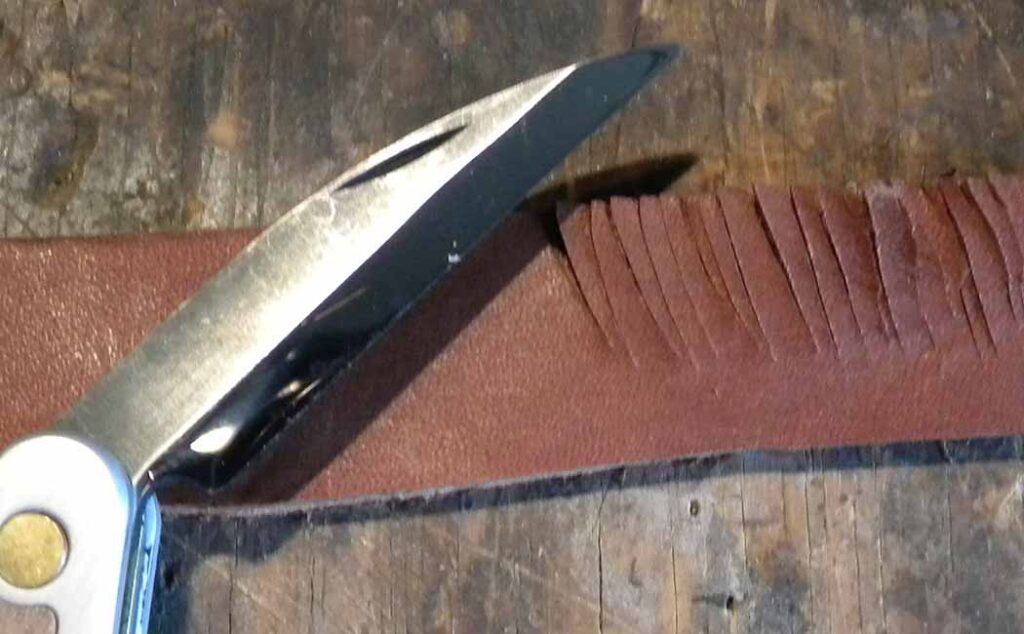
The E-VAC worked great skiving 8-ounce leather. The size of the cuts was controllable both in width and depth. Again, using the ulu style of rolling into the medium worked great.

On single-walled cardboard I did better with a push cut than a pull cut. Again, when I got it right, the knife cut aggressively. On the cardboard, I rolled into the push cut like cutting with an ulu. Using more of the wrist than the hand seemed to work best.

Moving on to some 8-ounce leather, I tried my luck at skiving. The E-VAC worked great. The size of the cuts was controllable both in width and depth. Using the ulu style of rolling into the medium worked great for me.

Batonning The E-Vac

The author batonned the E-VAC through some left-over fencing 1/2-inch thick by 6 inches wide.

I batonned the E-VAC through some left-over fencing 1/2 inch thick by 6 inches wide. It was somewhat of a challenge to keep my knuckles out of the path of the dead blow hammer. However, once I got a rhythm going, the knife made short work of the scrap wood. The thin blade split deep on each blow.

E-Vac Smaller Wood Cuts

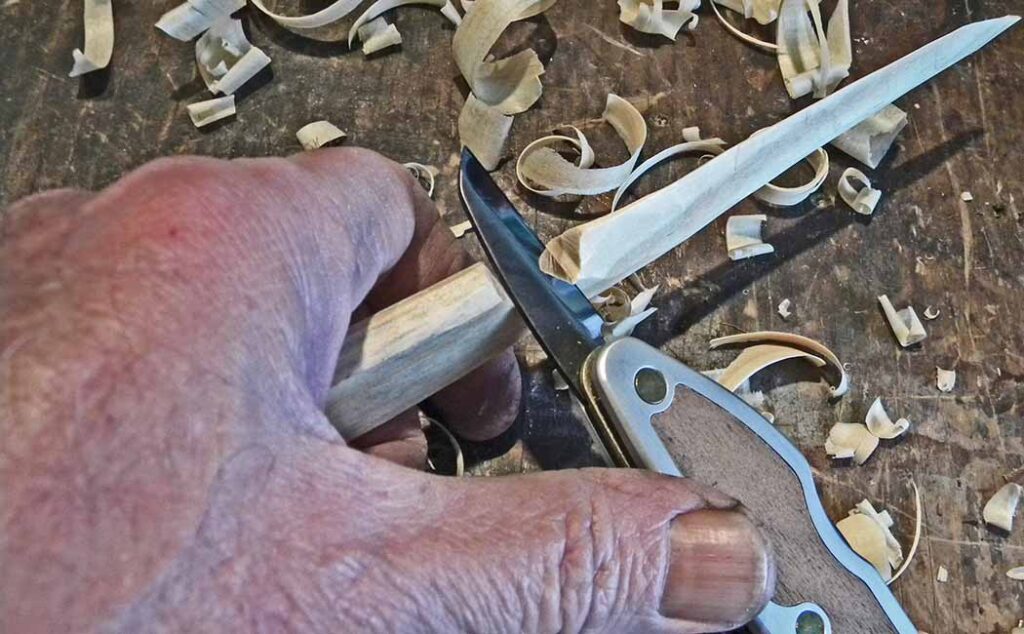
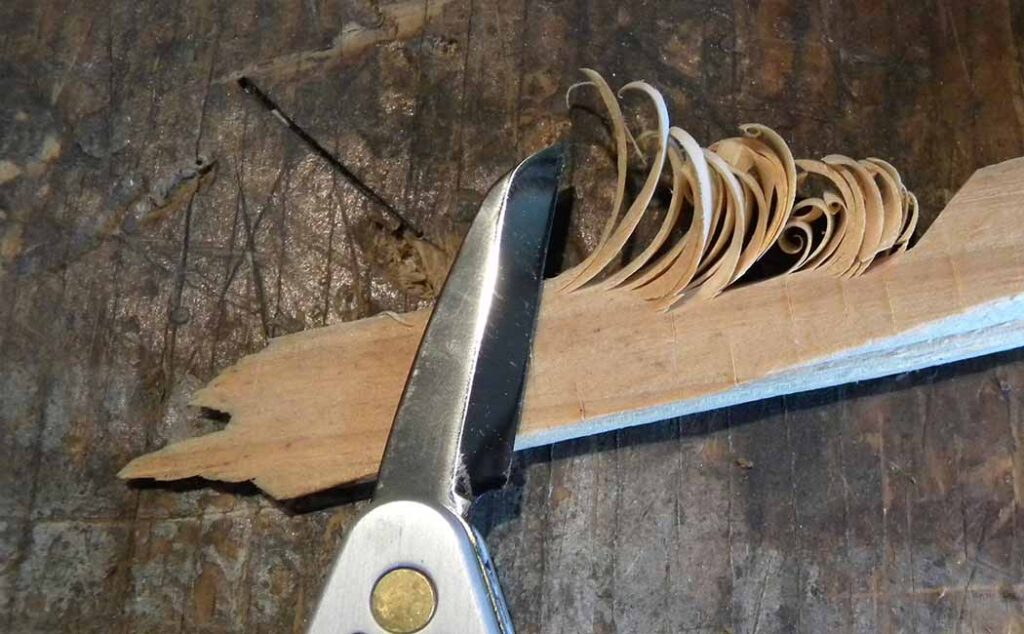
The E-VAC gave the author some decent curly-cues on the wood pieces left over from the batonning. Depth of cut was quite controllable.

Since I had a bunch of smaller pieces of wood, whittling was next. The knife gave me some very nice curly-cues. Depth of cut was quite controllable. Some thin scales or a 550 cord wrap would have given me a better grip for power cuts.

E-Vac Vs Sisal Rope

Once he got a rhythm going, the knife made short work of the scrap wood.

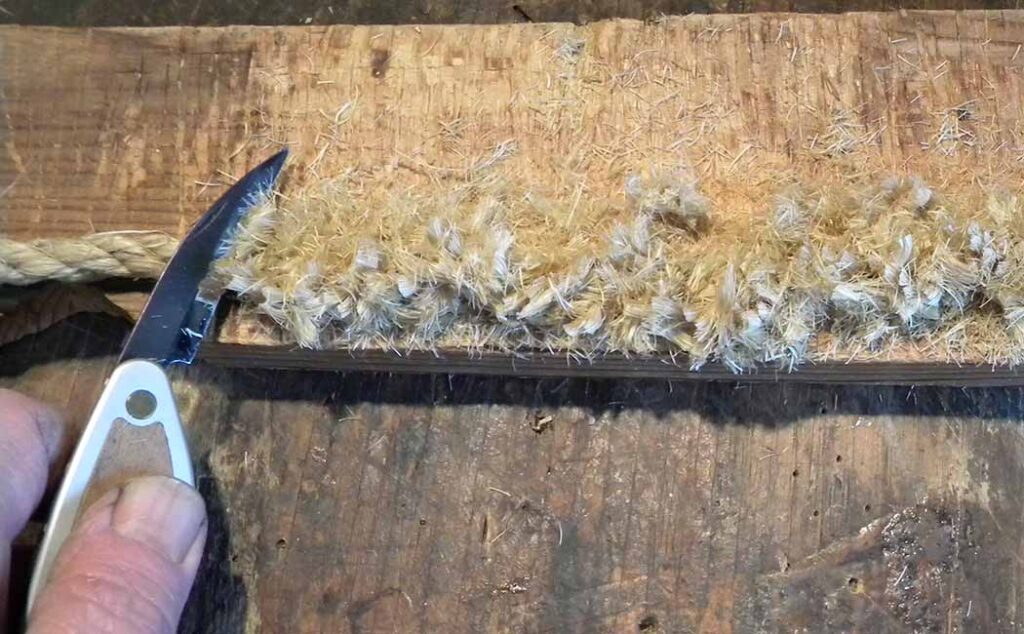
I did not do a sisal rope cut as I did not have the time to work on my rope-cutting technique with the E-VAC. Nonetheless, the edge feels plenty sharp enough to work well on rope.

As noted, Hawk Creek Blade provides a non-sharpened, coated mild steel trainer blade to practice your twirls and swirls without cutting yourself. It’s a very good addition to the overall package.

Assessment Of The Hawk Creek Blade E-VAC

The E-VAC works great for its designed purpose. Thinness and lightweight add to its usability.

Recommendations…

A somewhat thicker handle would give a more comfortable grip for stronger cuts.

Hawk Creek Blade warrants its knives against defects in material and workmanship. For more information contact Hawk Creek Blade Co., www.hawkcreekbladeco.com.

Hawk Creek Blade E-VAC
Knife: E-VAC
Company: Hawk Creek Blade
Knife Pattern: Karambit
Blade Length: 27/8 inches
Blade Material: A2 tool steel
Extras: Includes a coated mild steel trainer for training purposes
Weight: 3 ounces (7 ounces w/sheath)
Overall Length: 5 inches
Sheath: Kydex
MSRP: $135

More Knife Reviews:

Bowie Knife: Shorter Customs Are Where It’s At

Forget the traditional 10-inch blade, the new sweet spot for a custom bowie knife is now a 9- to 9.5-inch blade!

In July 1990 I was in the Army, home on leave from South Korea and attending The Knifemakers’ Guild Show in Orlando, Florida. While there, I was introduced to the forged blade.

I stopped by the table of ABS Master Smith Jim Crowell. He explained to me what it took to gain the prestigious rating of ABS master smith. It wasn’t just the quality of the knife that impressed me. I was amazed at how a 15-inch knife with a 10-inch blade could be so lightweight. While I was not new to fixed blades, my experience to that point had been with stock-removal knives.

Bad to the bone, Mark Fleming’s forged Southwest Trail Bowie has a 9.5-inch blade made of 1084 carbon and 15N20 nickel-alloy steels in a ladder pattern. The handle is ancient walrus tusk, capped with a damascus pommel, ferrule and guard. Almost a steal, with Fleming marking the price at $1,900 for a similar knife.

Jim explained that distal tapering is a procedure to thin the blade from guard to tip and spine to edge. The amount of tapering depends on the purpose of the knife. As I moved through the show, I started paying more attention to the forged blades on the exhibitors’ tables. What I discovered was what was called the ABS Bowie. The dimensions of the knife were a blade of 10 inches in length, 1.5 inches wide and a quarter inch thick, generally with a 5-inch handle.

Development Of The Shorter Custom Bowie Knife

Those who have been involved with custom knives for some years know that the knives tend to move in cycles. Innovation leads to demand from collectors. There’s a lot of “following the leader” in the custom knife business. This could have helped explain why so many knives were dimensionally identical at the ’90 Guild Show. While some had damascus blades and hardware, most were carbon steel. 

In 1992 the custom knife market cycled to a new entry into the custom knife world: the tactical folder. Toward the end of the decade, tactical folders started to wane, and forged blades once again established their prominence in the custom knife world. This time around the cycle began with hunters—basically, those with forged carbon steel blades, stainless guards, and wood or stag handles. The price point was predominantly in the $150-to-$210 range. By 2002, collectors buying hunters were ready to move to the hunter’s “big brother.” Meanwhile, the decade was populated with damascus patterns such as ladder, raindrop and twist, all of which began to show up more regularly.

Another nine-and-a-halfer, Ben Brea’s Forged Stag Bowie has a ladder-pattern damascus blade and a checkered koa handle. The superlatively executed custom bowie knife comes with a custom leather sheath. Breda set the price of a similar knife at $2,000.

While damascus was in demand by the higher-end collectors, it was W2 tool steel blades with hamons that took center stage for about five years. No two hamons were exactly alike. They looked cool and, for most collectors, were affordable. While antique designs from the mid-1800s were showing up more regularly, the one thing that hadn’t changed was the ABS Bowie, the majority of which continued to have 10-inch blades or longer.

BLADE Magazine Cutlery Hall-Of-Fame® member Jim Bowie was at least 6 feet tall. Depending on your source, the knife he carried had a blade with a length anywhere from 9.25 inches (on the one his brother Rezin stated was made for Jim), to 121/8 inches (the knife known as the Edwin Forrest Bowie), and a handle length of up to 6 inches. For size comparison, the Japanese ko-wakizashi, a short sword that was carried by samurai, started with a 12-inch blade. The ko-wakizashi was worn outside the clothes in a belt at the waist. Current knife laws aside, a knife that long would be difficult to carry and use openly. After all, have you ever tried carrying around a knife with a 12-inch blade? My only experience was a two-week field exercise while I was in the Army. The knife I took with me had only a 10-inch blade. Granted, I am at least 1 inch shorter than Jim Bowie was. But the 10-inch blade was cumbersome to carry and, quite frankly, just too long for what a soldier needed. Also, it would be challenging to deploy the knife without having it in a cross-draw setup similar to what the samurai employed.

Dimensional Changes To Cutom Bowie Knives

While it isn’t much different from the ABS Bowie, the current hot custom bowie features a 9-to-9.5-inch blade. The other difference on many of the blades is that the width has expanded from 1.5 to 1.75 inches. The additional blade width allows makers who so desire to use some curves along the primary edge.

A big boy of the bunch, Brian Sellers’ 9.5-inch custom bowie knife boast a twist-pattern damascus blade (double-edged) with stainless steel liners. The handle is ironwood and features a sub-hilt design, which Sellers would ask $2,400 for a similar creation.

I think that the shorter, wider blade is more aesthetically appealing. It no longer looks long and thin like its lengthier, narrower cousin. Moreover, the additional width results in a more substantial blade. Finally, extending the blade width allows bladesmiths to tweak the accompanying damascus patterns. Mosaic damascus patterns have gained favor among makers and collectors over the past two years. The extended blade width may give rise to new mosaic patterns. At the same time, the extra width may add a fresh take on standard damascus patterns such as ladder and twist.

The Constant Change Of The Bowie Knife

Today, most of us don’t use large bowies to defend our honor or protect our loved ones. Whether antiques or current models, many bowies have been relegated to collections. Given the amount of 10-inch custom bowies made over the past 30+ years, hundreds of them are for sale in the primary market and thousands are available in the aftermarket. Should you want a 10-inch bowie, your choices of materials and combinations are almost limitless. Given the number of 10-inch bowies available in both the primary market and aftermarket, it should be no wonder collectors are looking for something different.

As many of you may know, as a purveyor I keep pretty close tabs on several custom knife market sectors. Damascus bowies is one such sector. Over the past 18 months, I’ve seen both collectors and makers move away from the standard 10-inch bowie. This is not to say such bowies are not being made but that the demand has slowed. Makers are creating new types and patterns of damascus. Is it any wonder then that what were considered standard dimensions over the past 30 years are being revisited? The new sweet spot of the 9-to-9.5-inch blade is appearing more on today’s custom bowies. Eventually, bowie collectors will once again look for something new and different for their collections. As the Greek philosopher Heraclitus said, “The only constant in life is change.” The same is true in custom knives.

More Bowie Knives:

Bone Handle Knife: Tips For Picking The Best One

0

There’s something primal about a bone handle knife. We break down this eye-catching natural material, show what to look for and give you some top picks.

Bone has been around as a handle material just about as long as we have. It is safe to say that ancient cultures across the world have used bone as a handle material for as many as 100,000 years. Perhaps longer. Nobody knows for certain because these materials don’t last forever, even if perfectly preserved.

Bone Handle Knives History

Antler and bone have been used across the world and by virtually all peoples. We see, however, a distinct trend around 12,000 to 10,000 BC where they became the choice handle material for stone or volcanic glass blades. These handles were often carved to allow the instillation of replacement blades, given the brittle nature of the material.

These types of blades were state-of-the-art technology for millennia, with their traditional means of construction still in common use with many cultures at the time Europeans began exploring the world. The stone blades were extremely sharp and could last for months or even years if properly maintained.

Ancient people were experts at shaping these stone blades, and they could do so with great precision. Many of them were not small either, some stone spear points rival modern Bowie’s in length. The strength of these knives is largely dependent on the skill of the craftsman, and some of these blades and their handles still exist today.

Fast forward to the early modern era around 500-1000 years ago, we see that bone is purely a decorative choice on most knives. While functional, there is more of a challenge to working with it than there is wood. Wood in most cases is easily shaped while bone is a much more finicky medium. Bone is substantially more brittle, and it is harder to seal and finish. While it may seem like a durable material, it is quite porous and can shatter if struck.

In a way, bone went from being the material of choice to the choice of those who perhaps wanted to show off. Today this is the same story. It is hard to find individuals who carry around knives with ancient mammoth ivory grips, but they do exist. Will that same individual use that knife for camp work like ancient man? Again maybe, but not likely at the cost of that material.

Common Types Of Bone Used In Handles

Bone

Ken Hall’s sgian dubh features a 4.25-inch blade of twist damascus in a blend of 1075 spring and 15N20 nickel alloy steels. The pommel is formed from stone and giraffe bone. The African blackwood handle not only is ideal for its carvability but also in keeping with the sgian dubh’s name, which is Scottish for black knife.

For the most part, bone handles were typically made from whatever animal was available in the region. In ancient times, this could be any type of bone that was easily hollowed out or shaped. The femur bone (thigh bone) was quite common. Equally popular were the bones of the arm, and even the jawbone, depending on the animal.

Antler

Mike Malosh opts for elk antler with black and maroon Micarta® and stainless steel spacers for the handle of his utility hunter. The 6-inch blade is W2 tool steel and the guard is stainless steel. Overall length: 10.75 inches. The knife comes with a leather sheath by Malosh. The maker’s price: $390. (Impress By Design image)

Antler is and always has been a better alternative than skeletal bone. Antlers grow on members of the deer family only, from the skull and are semi-vascular. This means they have blood flow and skin while they grow. What makes them appealing then and now are they are shed by the animals yearly. This makes them easier to source, not requiring a kill to obtain. Furthermore, antler is extremely strong and dense, much more so than skeletal bone. In turn, it is less prone to shatter and is substantially less porous, meaning it is easier to finish and maintain.

Ivory

Sharpe used an ancient walrus ivory tusk he already had on hand. Richard (Hutch) Hutchings volunteered to scrimshaw the handle.

Ivory is another material that falls into the bone category. Elephant ivory has been strictly regulated for years. As a result, the material is exceedingly rare and possession of an unaccounted-for sample can land you in trouble. The ivory trade has been bad for the elephant population worldwide, but the animals are largely out of danger now, though this has not lessened ivory restrictions. It is a semi-grainless material that is not only strong but also easily shaped—lending to its popularity.

Mammoth Tusk

Raffir fossil mammoth
Raffir fossil mammoth ivory comprises the handle of Danish knifemaker Tommy Astrup’s mosaic damascus fixed blade.

While there are regional laws pertaining to mammoth tusk— California, New Jersey, and New York you can’t transfer it—this ancient material is generally legal to sell and possess. (Always check your local laws to make sure this holds true for you.) Given restrictions on ivory, this material has become more common in recent year, sparking a rush to collect it on the Siberian tundra. The permafrost makes it so that these tusks are almost like new. Working with it is no more challenging than working with modern ivory, given the state of preservation is usually excellent. Other ancient materials that are suitable for use on knives include the tusks of walruses and narwhals, but these too are regulated in some states.

Most Desirable Bone Handle Knives

Beauty is truly in the eye of the beholder. While bone handles are certainly attractive, they are not always the best choice for daily use.

The main reason, aside from antlers, most bone material gets very expensive very quickly. Mammoth ivory can run well into the thousands of dollars for enough to make a couple of handles. For this reason, you typically see it as thinner scales as opposed to a full carved grip. If you go that latter route, the finished knife cost can skyrocket into the thousands, perhaps even over $10,000 on a nicely executed custom knife.

Pros And Cons Of Bone Handles

In the world of Micarta and G10 there is little advantage in bone or antler, particularly in durability and longevity. Like any naturally occurring material, there is the presence of unseen flaws that may become liabilities during use. These materials aren’t weatherproof in a true sense and can take on moisture and pull in oils. The mineral structure is different on each bone or antler and as a result, there is no true gauge for strength across the board. The ergonomics are also a challenge as most of these bones and antlers are shaped in a preexisting manner by the animal they came from.

This is not to say that they are useless, rather it is a matter of personal preference. Some people truly prefer how these materials look and feel and that is their right. That does come with accepting that they may be restricted to certain uses as opposed to other handle materials. For instance, hard chopping work and batoning are difficult on handles due to flex and vibration, and bone or antler may simply crack at the pins if a strike is not performed perfectly. The nature of these materials is sentimental, not just to the individual but to mankind as a whole being that they have been with us since the beginning.

Top Bone Handle Knives

Wess Barnhil Gentleman’s Hunter

Wess Barnhil Gentleman’s Hunter
Wess Barnhil Gentleman’s Hunter (bottom)

A custom offering by Wess Barnhill, the Gentleman’s Hunter was featured in the November 2022 print issue of Blade alongside some other fantastic bone or antler-handled knives. Modestly priced for a Damascus steel blade, Barnhill’s knife displays an excellent profile and layout for real-world use but is so damn beautiful you’ll probably want to keep it safe from blood and guts! Barnhill’s portfolio features several knives with natural material handles, each a work of art.

MSRP: $1400

Mark Fleming Forged Southwest Trail Bowie

Mark Fleming Forged Southwest Trail Bowie

This knife was featured in the December 2022 print edition of Blade Magazine. Mark Fleming is an ABS journeyman smith, but his work looks exceedingly masterful at this point in his career. While this particular knife is custom, a similar piece will run you about $1,900, which is quite reasonable for such a complex execution. The knife as featured included an awesome-looking ancient walrus ivory grip, itself a relic.The grip material was salvaged from a native fire spindle that was used to start friction fires. Interestingly, you probably could still use this in that manner and you wouldn’t be outside the times. Grip indentations for starting friction fires are common on many knives today.

MSRP: $1,900 (for a similar design)

Rapid River Knifeworks Kodiak

Rapid River Knifeworks Kodiak

Rapid River Knifeworks offers a tremendous number of custom services and a wide range of knife products. Located in Michigan’s upper peninsula, the company has excelled in adding traditional flair to its lineup and the products stand out from others across the board. The Kodiak is a hammer-forged knife that is offered in a dizzying number of configurations, not even including custom engraving. The variant we’re concerned with here comes with elk antler as a grip material, and it sure does look great! Unlike many knife companies, Rapid River has a showroom you can visit in person.

MSRP: $175

Randall Knives 3-Piece Carving Set

Randall Knives 3-Piece Carving Set

Randall Knives needs no introduction here, however, we are pleased to take a look at a less-prominent product from their standard lineup—its 3-Piece Carving Set. The set comes with a 9-inch carbine knife, serving fork, and sharpening steel, all of which are finished with stag handles. The set includes a storage box and the company notes that you should not put them through the dishwasher. Randall Knives, of course, offers some very well-known classics in natural material handles, many of them available in their standard lineup. If you so desire, you can also take a look at having something custom-built, but you had best get your orders in now. The company website is currently taking orders for delivery in four years!

MSRP: $680

Silver Stag Universal Chef Pro

Silver Stag Universal Chef Pro

Silver Stag makes a great number of products that feature natural handle materials, but a standout example is the antler-handled Universal Chef Pro. This is an all-use kitchen knife that is at home in just about any setting—be it your home or base camp. The knife is ruggedly constructed and has a unique shape with a curved belly and sheep’s foot tip that allows it to be deftly handled for large tasks like carving down to fine dicing. Silver Stag offers a full line of antler-handled kitchen knives, as well as many other outdoor knives from filet knives to custom scrimshawed skinners.

MSRP: $218

More On Knife Handles:

Moran Bladesmith Academy Dedicated To The Father Of Modern Damascus

0

by b.R. Hughes

Dedicated in honor of the “Father of Modern” damascus—William F. Moran—the Moran Bladesmith and Artisan Academy is now a reality.

William F. “Bill” Moran, Jr., the first American bladesmith to successfully forge damascus steel blades and a founder of the American Bladesmith Society (ABS), was honored on October 16 in Middletown, Maryland, with the dedication of the Moran Bladesmith and Artisan Academy. Under the auspices of the Moran Museum & Foundation, the Academy is an impressive structure that stands less than 100 yards from Moran’s now idle knife shop.

The weather was virtually ideal as a large crowd assembled in front of the building. Director Nancy Hendrickson, mistress of ceremonies, welcomed the audience and introduced Robert Wilson, president of the Moran Foundation, who opened the proceedings with a prayer and gave an overview of the activities leading up to the dedication.

Mrs. Hendrickson next introduced the speakers for the afternoon: John Miller, burgess of Middletown; Jerry Donald, district commissioner; Jay Hendrickson, founder of the Moran Foundation and past ABS president; Joe Keeslar, past ABS president; Johnny Perry, past vice president and director of the Moran Foundation; and yours truly, a founder of the ABS and author of Master of the Forge, a Moran biography.

Jay Hendrickson uses one of Bill Moran’s favorite knives to cut the ribbon officially dedicating the Moran Academy. Looking on from left are Robert Wilson, Nancy Hendrickson and the author.

Following the oral presentations, a ribbon cutting done with a Moran knife was conducted by Jay Hendrickson, Robert Wilson and Gordon Conner, Foundation vice-president.

Mrs. Hendrickson closed the ceremony and the group enjoyed a round of refreshments that featured a cake cutting. The assemblage then toured the new building, which contains an office, classroom, museum and gift shop, and a large room where forging, grinding and related skills will be taught.
The Moran shop, which is in excellent condition, will be a museum and a working smithy. A knife show was held October 15 in the space between the Moran Academy and the Moran shop, followed by an auction conducted by Robert Wilson.

FATHER of MODERN DAMASCUS
Moran unveiled his eight damascus knives a half century ago at the 1973 Knifemakers’ Guild Show in Kansas City, Missouri. The knives were the hit of the show and rekindled interest in bladesmithing, which was a dying art form in America at the time. There were only about a dozen practicing smiths back then, including such notables as Bo Randall, Rudy Ruana and, of course, Moran.
Under Moran’s leadership, the ABS was formed in 1976, with Moran elected president, Don Hastings, treasurer, Bill Bagwell, secretary, and yours truly, director. Moran, Bagwell and Hastings were the first three American smiths to successfully forge damascus knife blades.

Bill Moran hammers away in his knife shop in this vintage photograph. The shop stands about 100 yards from the new Academy. The knife is the ST-24, considered one of the finest Moran knives ever. (Images from William F. Moran, Jr.: “Forever A Legend”)

As the meeting broke up, Moran turned to me and said, “If we play our cards right, Bill, one of these days we could have 25 members.” Today, of course, the ABS membership is many times that number and has gone global.
The Moran Academy stands as mute testimony to the fact that Bill played his cards very well indeed. Almost single-handedly, he preserved the art of bladesmithing not only in America, but around the world.

Author’s note: Jay Hendrickson, Hughes, Keeslar, Moran, Randall and Ruana all are members of the BLADE Magazine Cutlery Hall of Fame® and the ABS Hall Of Fame as well.

More Knife Collecting And Custom Knives

On The Edge Of War: Knife Pros And The Ukraine Conflict

0

A knifemaker and other knife pros take different approaches to the Ukraine-Russia conflict.

The ravages of war often have global impact—even when the fighting is half a world away and the devastation is seen through pictures and words rather than bullets and bombs. War, anywhere, tends to touch the lives and livelihoods of many.

The knife industry, both factory and custom, is no different. The war in Ukraine has brought devastation to the country, and its end was nowhere in sight as BLADE® was going to press. Ukrainian resistance is robust, probably in sharp contrast to the results anticipated when Russian President Vladimir Putin decided to invade his sovereign neighbor. While the resilient Ukrainians defend against such aggression, where and how does the knife industry feel the long reach of war?

Oleksii Nesterenko is a custom knifemaker. He is also Ukrainian.

“On February 24,” he commented, “Russia, with the support of Belarus, launched an open military attack on Ukraine. My city, Kyiv, was one of the main goals. After systematic rocket attacks on the city, my wife and children were forced to evacuate to Germany.”

At press time, Ukrainian knifemaker Oleksii Nesterenko had signed a contract as a territorial defense volunteer for Ukraine and had stopped making knives.

The war came home to Oleksii, and his life may very likely never be the same. He has responded to the call to defend his country. “I signed a contract for a territorial defense volunteer and stopped making knives,” he said. “As far as I know, the work of some knifemakers who work in the cities where there are no active hostilities has changed too. Many have abandoned the making of collectible knives and make simple, utilitarian knives and other devices for the military.”

Purveyor Dave Stark of Steel Addiction Custom Knives sells Oleksii’s work, and despite the fact there is a temporary suspension of custom pieces from the Ukrainian maker, Dave praises the quality of his knives.

“Oleksii’s fit and finish and his attention to detail are what set him apart from his peers,” Stark noted. “His choice of materials and the manner in which they are finished really make his work stand out. His hand-rubbed satin finish on his blades is some of the best I’ve seen. The knives feel great in the hand and mechanically are spot on. I would say his style is ‘dress tactical.’ He uses Damasteel’s pattern-welded steel, damascus, mother-of-pearl, mokuti, zircuti and zirconium.”

Perhaps current events will make Nesterenko’s knives even more highly sought after in the future. Meanwhile, he is consumed with the dirty business at hand.

“Now in the Kyiv region where I live, Russian troops are defeated and active hostilities have ceased,” Oleksii reported. “But I am still on duty at checkpoints and volunteer. We help the civilian population in the villages near the front. I think that in a few weeks I will have time to partially return to knifemaking.”
While he is hopeful and actively involved in the defense of his country, Nesterenko has kept an eye on the conditions of the knife industry in Ukraine and anticipates some adaptations.

“Currently, there are no problems with the supply of materials for the production and shipment of knives abroad,” he advised, “so I look forward to returning to work. I am sure that a knifemaker can make a quality knife only if he uses it for its intended purpose. That’s why I used to make only EDC knives. Thanks to the war, I understand what requirements a tactical folding knife must meet. I have already drawn several designs and am waiting for the opportunity to get started.”

Changes in demand are not noticeable at this time, according to Oleksii, and orders are in the queue for delivery around the world into 2023. Still, he warned, “I think that the consequences of the war in Ukraine will affect the economies of many countries. And over time, that will affect collectors.”

Little Change

In much of the domestic knife industry, little in the way of change has occurred due to the war thus far. Custom knife purveyor Les Robertson said that by mid-April FedEx service to Ukraine had been suspended. Therefore, the volume of knives conventionally being sent to Ukraine has probably been curtailed, at least somewhat. Neighboring European Union countries are still moving mail into Ukraine.

Les Robertson
Les Robertson

“No one is sending knives directly to anyone in Ukraine,” Les noted. He went on to comment that factory sales to “armchair warriors” may in fact tick upward as the war persists.

Purveyor Neil Ostroff of True North Knives agrees that the current custom knife market is maintaining its status quo. “In my opinion, as a dealer,” he commented, “we have no change from the customers concerning knives from either Ukraine—now on hold—or Russia. Several Ukrainian knifemakers have set up in Poland, and they do not want to be named.”

Still, Ostroff is somewhat insulated businesswise from the turmoil in Eastern Europe. “Going forward, I see no issues coming through, as there have been none so far,” he observed. “And most if not all of my clientele prefer to buy only USA-made items, which is what I prefer to supply as well.”

From the factory perspective, Joe Bradley, director of sales and marketing for KA-BAR, has noticed virtually no changes in activity. “The war in Ukraine hasn’t had any impact on us at all,” he remarked. “As far as production, and even consumption, the impact has been zero.”

Bradley added that supply and demand are in line. “We have not seen an increase. Currently, we are seeing the market being more impacted by inflation than anything else. I think most of the people, at least Westerners, in the Ukraine already had their supplies and as a result didn’t have a need to buy anything new. Production and logistics have been a problem since the start of COVID,” he observed, “and are just now starting to get back on track and return to a semblance of normalcy.”

KA-BAR has experienced no changes in product offerings or knife styles as a result of the war in Ukraine. However, Bradley offers one interesting point of view. “If anything, this war has shown the merits of what some might consider antiquated weaponry like the AK-47,” he pointed out. The AK-47 is perhaps the world’s most famous assault rifle, arising in the Soviet Union during the Cold War, experiencing authentic production models and knockoffs made in the millions, and arming military organizations around the world for well over half a century.

“Free The Oppressed”

Spartan Blades is located in Fayetteville, North Carolina, near the gates of Fort Bragg, home of the U.S. Army’s XVIII Airborne Corps and Special Operations Command. Spartan owners Curtis Iovito and Mark Carey, both Special Forces veterans, have seen a groundswell of support for Ukraine. Knife sales bear the unmistakable mark of the conflict.

According to Curtis Iovito of Spartan Blades, more military professionals and contractors buy the company’s Gold Line knives. An example is the Spartan-Harsey Dagger in a 6-inch blade of CPM S35VN stainless steel with a hollow grind. MSRP starts at $390. Bill Harsey is the designer.

“Most of the sales are to people here in the U.S. with notes that they are purchasing for folks in the Ukraine,” explained Curtis in acknowledging the market uptick. “Several orders have had short tags like ‘Free the Oppressed in the Ukraine’ or ‘Support the War against Russian Aggression.’ Because we are at Fort Bragg, we have several Special Mission units from friendly foreign countries drop by the shop to pick up knives for their use. While that isn’t uncommon, it’s happening more than usual. We’ve noticed during our discussions with them that things have a more serious tone.”

Others buying more knives from Spartan Blades include people from all walks of life and military involvement. Curtis said, “Our Gold Line knives are going to more of the military professionals and contractors, and our Silver- and Bronze-grade knives are selling to folks across the spectrum. Many of the knives bought are by civilians that later donate the knives to NGOs [non-governmental organizations] that ship in bulk to Ukraine.”

As far as production, it’s business as usual at Spartan Blades, a longtime producer of knives that go to war. There are a few new items on the horizon, and the owners expect business to be brisk in the days ahead.

Oleksii employs M390 stainless steel for the 3.75-inch blade and a handle of black and purple Fat carbon fiber for his Morph flipper folder. The bolster is Timascus™ and the pivot rings and back spacer are zirconium. Closed length: 8 5/8 inches. Retail price: $2,800. (Steel Addiction Custom Knives image)

“Honestly, the war in Ukraine hasn’t affected how we do things here at Spartan Blades,” Iovito asserted. “We’ve made knives through the last two decades for troops in both Afghanistan and Iraq, so things are kind of par for the course.
“We have several new knives coming out around the end of this year,” he continued. “We had planned on releasing these later but have sped up because the price point and style match some of the requirements we have seen lately. They are being designed by William W. Harsey, Jr.—a fighter, a Nessmuk and a kukri blade. They will be in 1095 Cro-Van blade steel and made in conjunction with KA-BAR Knives. Pricing has not been determined yet, but we are shooting for a sub-$200 retail price. The first one produced will be a fighter later this year.”

Surveying the knife landscape today begs a few questions as Iovito and Carey plan for the future, uncertain as it may be.

“We have seen a slight increase in steel prices, but we haven’t raised our prices in over a decade,” Curtis stated. “We assume we will continue to see price increases soon in commercial, off-the–shelf parts but are keeping our fingers crossed. We believe we will see an increase in knife demand as it appears the conflict in Ukraine [will not end as soon as many thought it would].”

The war has had other effects, including dampening attendance at European trade shows.

“We were very surprised that most of the U.S. knife companies did not attend the IWA show* in Nuremberg, Germany, this year,” Curtis noted. “We even had people thanking us for attending, as you could tell they are counting on U.S. support even if it is just showing up to support them in spirit. There was definitely a new and urgent concern about military spending. The German government approached two companies that I know of and bought their whole inventory—cutting checks the same day!”

Curtis Iovito indicated Spartan’s affordable Silver- and Bronze-grade knives are selling well to people across the spectrum. One of the latest examples of a Silver-grade knife is the Alala in a 3.75-inch blade of Cro-Van carbon steel with a saber grind. MSRP: $159.

In wartime, uncertainty often reigns. However, awareness, preparation, and the desire to return to the shop are evidence that the ongoing conflict in Ukraine will influence the future of the entire knife industry for the foreseeable future.

*Held each spring, the IWA OutdoorClassics (iwa.info) is the European equivalent of the Shooting, Hunting, Outdoor, Trade (SHOT) Show stateside, and is a place where many new factory knives are debuted.

More On Custom Knifemaking:

Advertisement

Must Read Articles

Read this before you make a knife

Knifemaking 101 – Read This Before You Make a Knife

  by Wayne Goddard My experience has taught me that there's nothing like digging in and getting started. I've often said the hardest part of the...
how to forge damascus steel

How to Forge Damascus

Advertisement
Advertisement