Home Blog Page 86

BLADE Show Texas 2023 Preview

0

In Just Over Two Weeks Time, BLADE Show Texas Will Descend Once Again On The City Of Fort Worth.

BLADE Show Texas ’23 expects to follow up on its wildly successful ’22 rendition when it rides herd on the Fort Worth Convention Center March 17-18 in Fort Worth.

Over 300 national and international exhibitors, including the best in custom and factory makers and companies, will display their hottest knives, knifemaking supplies and more. All will coalesce in the roomy Fort Worth Convention Center in the heart of downtown Fort Worth. Spanning 14 city blocks of the city’s central business district, the convention center is surrounded by four-star hotels, restaurants, shops, galleries and assorted performance venues, with free transportation provided throughout the downtown area via Molly the Trolley.

Helping make the show a reality are its sponsors, which include Smoky Mountain Knife Works, WE Knife Co./Civivi/Sencut, The Blade Bar, Nottingham Tactical, TOPS Knives, Hogue Knives, Microtech, Jantz Supply and New Jersey Steel Baron.

Beat The Line And Buy Your BLADE Show Texas Tickets Now!

BLADE Show Texas 2023 Set To Top 2022
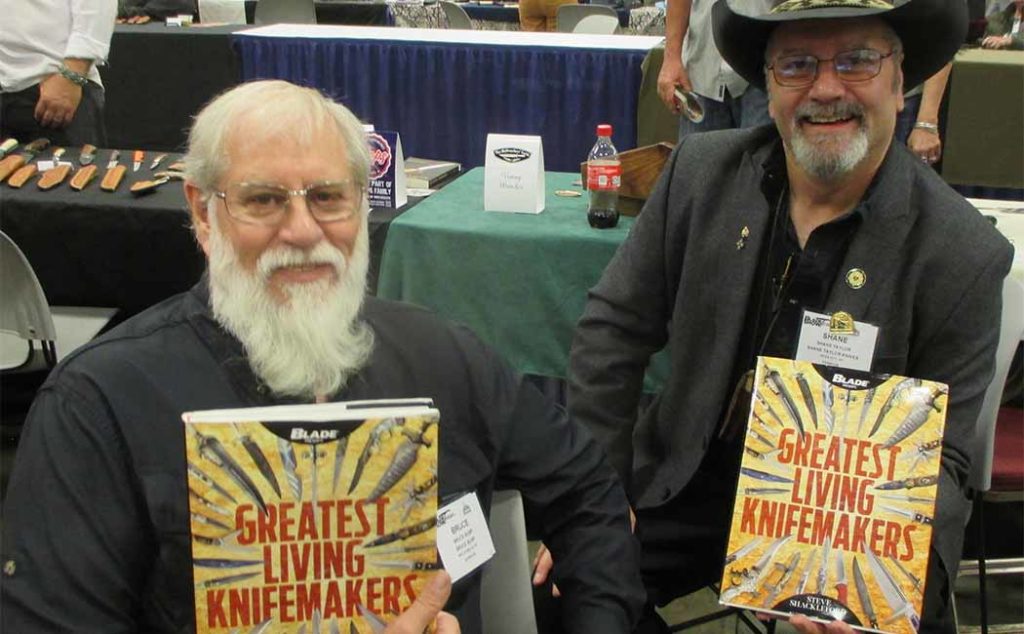
Blade Show Texas Greatest Living Knifemakers
ABS master smiths Bruce Bump (left) and Shane Taylor (right), both of whom are in the book The Greatest Living Knifemakers, return to display their knives. At press time, others in the book who will be exhibiting at the show are Bill Ruple and Tom Overeynder.

While Texas long has been hailed as a hotbed of knives of all shapes, sizes and types, its knife shows haven’t always seemed to keep pace. Debuting under its new name in ’22 after several years as the International Custom Cutlery Exposition (ICCE), BLADE Show Texas seemed to buck that trend, with custom and factory exhibitors praising the event.

“The attendance was excellent and sales were awesome,” BLADE Magazine Cutlery Hall-Of-Fame® member Bill Ruple observed of BLADE Show Texas ’22. “What a great show!”

“BLADE Show Texas was a great one. Attendance was crazy good,” agreed ABS master smith Bruce Bump. “And it was good to connect with old friends and make some new ones.”

“BLADE Show Texas was a great success as far as our time there,” noted John Cammenga of White River Knife & Tool. “We sold a lot and there was great traffic.”

“One thing I personally really liked was the eclectic mix of makers throughout the show,” pitched in maker Tom Krein. “You just didn’t know who or what would be at the next table.”

This year’s array of talented artisans promises to be even better. Also on hand will be a wealth of premier custom knife purveyors, engravers and other embellishers, many more knife professionals and entrepreneurs of all stripes—and, of course, knife enthusiasts, users and collectors galore. 

Award Changes

The knife judging awards for BLADE Show Texas have been especially tailored this year to address the specialties of the exhibiting makers. As a result, there are two changes, one each in the custom and factory categories.

The new category in custom is Machine Assisted Custom Knife, or M.A.C.K (see next section. Last year’s custom category of Best Fixed Blade was scratched in the middle of show judging and was broken down into three separate categories: Best Bowie, Best Fighter and Best Hunting Knife. 

As a result, this year’s custom awards will be Best M.A.C.K., Best Art Knife, Best Bowie, Best Damascus, Best EDC, Best Fighter, Best Folding Knife, Best Hunting Knife, Best Kitchen Knife, Best Slip Joint and Best in Show. 

To differentiate it from Best Slip Joint, Best Folding Knife will be for non-slip joints only. Each category winner will be determined in terms of how well it fits the category, quality design, construction and materials, fit and finish, line and flow, and the other intangibles that identify most top knives.

Best Tactical is the new factory category and will include both folders and fixed blades. Hence, the awards in the factory category will be Best EDC, Best Fixed Blade, Best Folder, Best Tactical and Best in Show. Each category winner will be determined in the same manner used to rate the custom winners as outlined in the preceding paragraph.

M.A.C.K.

The fastest growing and, some would say, most exciting segment in custom knives now has its own category: Machine Assisted Custom Knife. 

In conjunction with a number of intrepid pioneers in the category, BLADE® Magazine and BLADE Show have created an awards segment that aims to recognize the diverse array of knifemakers whose fertile minds are dedicated to creating knives that exist in the space between the entirely handmade custom knife and the entirely machine-made custom knife.

To qualify for the category, the knife must have one or more key elements crafted by hand. It is up to the maker to determine which element(s) to handcraft, but the judges will look for makers who challenge themselves in this regard. Judges will look for a knife that is first and foremost a cutting tool. 

The design must be functional, beautiful, have great ergonomics, yet still have practical applications and uses. The winning knife should be able to go from the debutante ball to the wrecking ball without changing shoes. From a technical standpoint, execution of fit and finish across the entire knife, basics such as blade centering, lock kinetics, lock feel and lock positivity/safety, etc., will all factor heavily into choosing a winner.

To reiterate, overall aesthetic design must be cohesive and beautiful without compromising the knife’s primary purpose as a cutting tool. Exhibitors should bring their best of kinetics, aesthetics and handcraft to this category. And may the best knife triumph!

Demos And Seminars
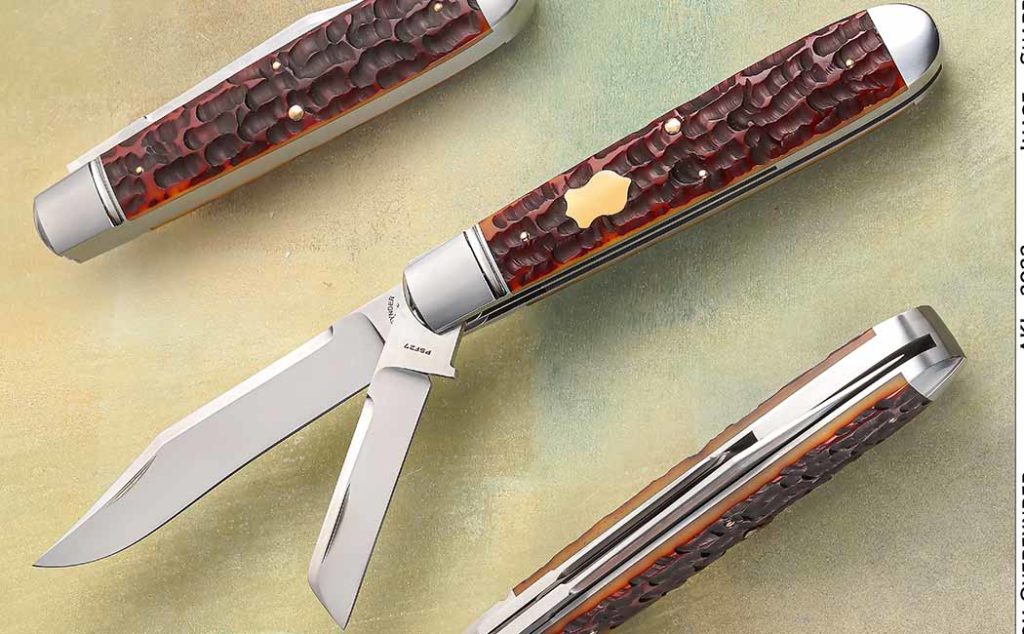
Slipjoint Knife
Tom Overeynder will bring an Art Knife Invitational level of talent to the show with such pieces as his 34 Big Jack slip joint in PSF-27 stainless blade steel and a new handle material—jagged bone. Closed length: 5 inches. Maker’s price: $3,250. (SharpByCoop image)

Friday

12 p.m.-Grinding Fundamentals, Room 104: Co-owner of Brodbeck Ironworks, knifemaker Vince Molina will showcase the Brodbeck grinder complete with flat platen and integral bolster attachment.

2 p.m.-Let the Pros Critique Your Knife, Room 104: Award-winning knifemakers Bill Ruple and Tom Krein and ABS master smiths Jason Knight, Steve Schwarzer and Brion Tomberlin will examine your knife and tell you the good, the not so good and how to make it better. This will be a limited-seating event. Bring one knife only. Sign up when you enter the class on a first-come, first-served basis. Questions will be entertained from attendees throughout.

3:30 p.m.-Building an 1830s Knife with Modern Tools, Room 104: It seems almost certain that James Black made a number of knives circa 1830. Though he did not mark his knives with his name, the style attributed to him is one of the most distinctive and admired of his or any era. ABS master smith Lin Rhea is a student of Black and antique bowie knives in general. His seminar will be a discussion of how to build knives in the Black style in the modern knifemaker’s shop, substituting modern techniques for those of the 1830s. In addition, Lin will outline the things to consider in recreating a historic knife style.

Saturday

10:30 a.m.-Grinding Fundamentals, Room 104: Co-owner of Brodbeck Ironworks, knifemaker Vince Molina will reprise his Friday seminar on the Brodbeck grinder complete with flat platen and integral bolster attachment.

12 p.m.-Trainer Knife for Kids, Room 104: Nicole Larkin of Bradford USA will introduce Bradford’s newest trainer for kids. Nicole will cover what makes the trainer a great first knife, outlining such topics as utility, basic safety principles and sharpening. “We wanted to build a trainer knife that will grow with your child as he or she matures beyond the need for one,” Nicole noted.

1:30 p.m.-Silver Wire Inlay in Wood, Room 104: A past Forged in Fire champion, ABS journeyman smith Allen Newberry will demonstrate silver wire inlay in wood, how to make the tools required and where to procure the needed supplies.

The official BLADE Show Texas photographer will be SharpByCoop. 

Get more information about BLADE Show Texas, the foremost knife show in the Lone Star State.

Learn more about the Fort Worth Convention Center.

Click here for the complete exhibitor list.

Read More About Our BLADE Shows
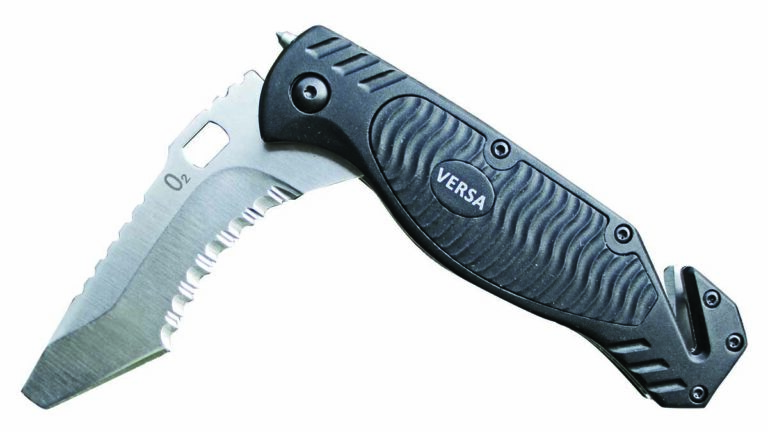
Versa Rescue Knife: How Good Is This Folding Multitool?

Is The Versa Rescue Knife As Good As Advertised Or Does It Come Up Short Even With All The Extra Features?

When he worked for the Central Intelligence Agency, Jason Hanson came across tool needs the average knife did not fulfill. Enter the Versa rescue knife.

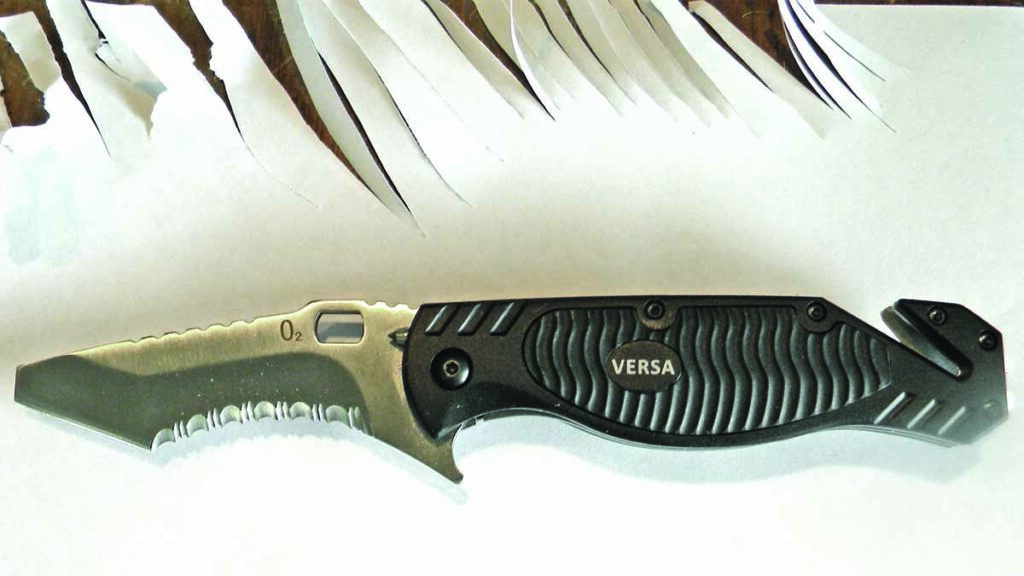
Besides the blade having two distinct edges—one short and flat, the other recurved and serrated—the tip is flattened for a screwdriver. When you close the knife, a glass breaker sticks out the front of the handle. 

On the butt is a mini pry bar and a webbing/line cutter. Yes sir, there are lots of things going on with this rescue tool. However, I’m mostly concerned with testing the Versa’s cutting capabilities, so here goes.

Testing The Versa Rescue Knife

VERSA RESCUE KNIFE sharpness test
Via a push cut, the flat edge zipped through the paper smooth and clean, though it was somewhat challenging to use the flat front edge of the blade to start the cut.

Slicing 20-pound bond copy paper was first on the list. Via a push cut, the flat edge zipped through the paper smooth and clean. It was somewhat challenging to use the flat front edge of the blade to start the cut.

Onto the serrated edge, the paper tore sometimes depending on whether I started with the tips of the serrations or the bottoms during push cuts. The serrations did better used in a slight forward motion, giving cleaner cuts.

From there, the knife easily dispatched double-walled cardboard. With only a slight twisting of the blade, the serrated portion cut aggressively through the medium. Likewise, the flat edge sliced effortlessly and was very controllable, providing nice, even cuts.

The flat edge cut smooth through six-ounce leather, producing a bit of a crunching sound. It was very easy to control the cuts. The aggressiveness of the serrations really went to work on the leather, emitting loud crunching noises as it bit deep—and without need of a sawing motion at that.

To test the webbing/cord cutter, I used 550 cord. With one end of the cord locked in a vise, I held the loose end and pulled the cutter through the material. The cutter worked great with no resistance, severing the ends of the cord clean.

Carrying The Versa

VERSA RESCUE KNIFE glass breaker
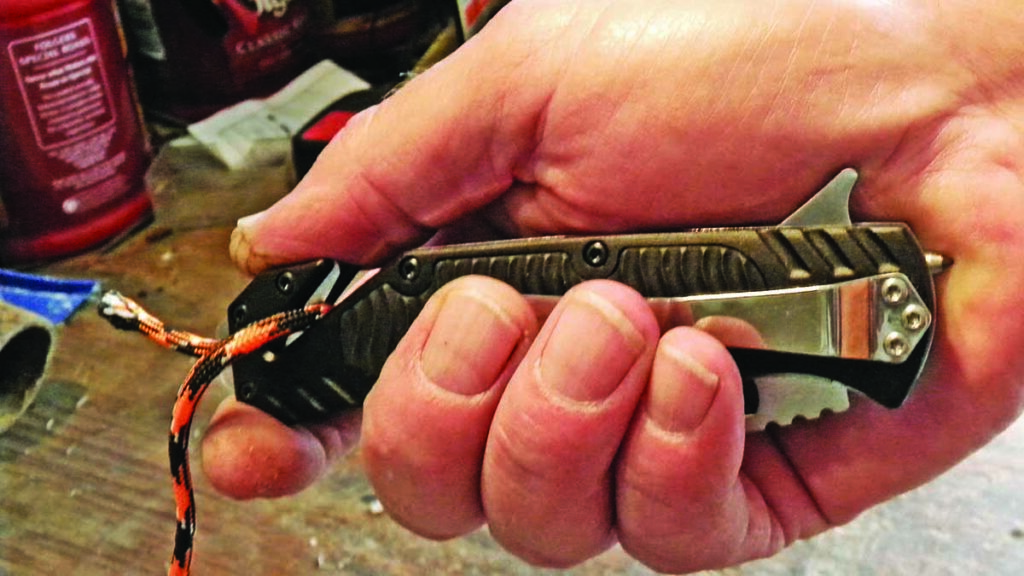
Even though the glass breaker works, the author didn’t like it poking him in the hand each time he grabbed the knife.

I carried the Versa for a week to see how it rode in my pocket. It’s a bit on the heavy side for my taste. The pocket clip held the knife secure with no side-to-side movement while I climbed a tree. 

Even though the glass breaker works—I’ve used the type before—I didn’t like it poking me in the hand each time I grabbed the closed knife. Clipped in your pocket, it will also poke your hip when you’re wearing shorts and sit down. The concept behind the glass breaker is sound and useful, but it suffers from the same poking problem as on all the similarly equipped knives I’ve tested. 

On the other hand, the pry bar rode great without sticking me in the leg. The handle design is very comfortable and the rubber inserts are perfect for a non-slip grip—a great using design.   

Versa Rescue Knife: Final Thoughts

I would reduce the Versa’s weight for pocket carry and design a glass breaker that doesn’t poke the user. (Editor’s note: Also, the flipper/blade action is sluggish and needs work to make the knife open easier and smoother). 

I would carry the Versa in a pouch or stashed in my vehicle. It works/functions great.

Versa Rescue Knife Specs

Blade length: 3.25 inches
Blade steel: AUS 8A stainless
Blade grind: Hollow
Blade edge: 2/3 recurve and serrated, 1/3 flat and plain
Blade openers: Flipper and blade hole
Liners: Stainless steel
Handle: Coated stainless w/rubber inserts
Pocket clip: Stainless steel
Lock: Linerlock
Weight: 6.5 ounces
Closed length: 4-15/16 inches
Extras: Glass breaker, web/line cutter, pry bar
MSRP: $69

Read More

The Provoke EDC Adds Style To The Enduring Line.

Originally A Karambit, The New Provoke EDC From CRKT Takes The Kinematic Technology Into The Realm Of More Casual Knives.

Do you love Joe Caswell’s innovative Kinematic deployment system but don’t need a knife as aggressive as the CRKT Provoke? Say hello to the newest knife in the line: the Provoke EDC. 

The knife takes all the best parts of the original Provoke but with one more casual, but massive difference: a drop point blade–the first in the line to veer from the karambit design. 

Provoke EDC Blade

The drop point is just 2.56 inches long, but it really makes its money thanks to its thickness. It’s .27 inches thick, 22-percent thicker than the blade on the original Provoke and more than twice the girth of any of CRKT’s seven most-popular pocketknives.

This makes for a knife adept at heavy work, be it batoning wood or slicing through rope or even prying open anything short of a manhole cover. 

At 3.6 ounces and 4.66 inches when closed, it’s light and easy to carry. The flush-mounted clip keeps it invisible in your pocket and quick to pop out. When deployed, the knife is 7.25 inches and is easy to control thanks to the handle. The handle is molded, similar to the original Provoke, so hot spots are non-existent as it sits flush in the hand when cutting. 

Kinematic Action

The one-of-a-kind kinematic action is unlike any other deployment system on the market today. When released it’s fast-moving, smooth, and keeps that thick blade securely in place. It’s nearly impossible to flex the blade when deployed, a sign of a strong lock.

The action is powered by two pivoting arms connected to both the handle and the back of the blade. When released the arms swing forward, sending the blade out and locking it in place.

It is a dynamic system and is an excellent fidget, however, it may be a bit cumbersome for those with smaller hands. Since the handle was originally designed for a karambit, which is traditionally deployed in a reverse grip, it could be tricky to securely hold when trying to deploy the knife one-handed. To some, this might not prove as intuitive as a flipper or folder. 

Other Provoke EDC Features

Beyond the blade, the most noticeable feature of the knife is its brilliant blue handle. The anodized aluminum visually pops and perfectly complements the satin-finished blade. And, since it’s aluminum, it is lightweight and can hold up to pretty much anything you can throw at it.

Overall, the Provoke EDC is a fresh take on everyday carry and is going to appeal to knife lovers looking for something that stands out. 

Provoke EDC Knife Specs

Blade Length: 2.56 inches

Blade Steel: D2

Blade Finish: Satin

Blade Thickness: .27 inches

Overall Length: 7.25 inches

Closed Length: 4.66 inches

Weight: 3.6 ounces

Handle Material: Aluminum

MSRP: $175

Read More

Knife Review: CRKT Bamboozled

No Need For Confusion, CRKT’s Bamboozled Shows Itself A Competent Light-Duty EDC Option.

There are so many assisted-opening knives for sale today that to compare them all is a fool’s errand. However, when you come across a good one you know it pretty quickly. The new CRKT Bamboozled stands out from the pack thanks to its classy, sleek lines, quality construction for a casual EDC, and its incredibly fair price.

New for 2023, the Bamboozled comes in under $100 and feels worth a lot more. Designed by Ken Onion Jr, son of BLADE Cutlery Hall of Famer Ken Onion, his first knife for the company looks straightforward because it is. It’s simply an excellent light-duty EDC.

The proof? After a few weeks of using the Bamboozled, I realized I hadn’t picked up any of my other knives. It pushed some truly excellent blades into the bullpen, and I don’t see that changing for a long time. 

The CRKT Bamboozled: The Ergonomics

The first thing you notice about the knife is how nice it feels in your hand. That’s thanks to the G10 handle and stainless-steel bolster. It looks and feels clean right out of the box and even after a few months of use, it remains pleasurable to employ.

Aside from a tidy look, the ergonomics are there in the Bamboozled’s handle. The straight handle avoids any hot spots you might encounter, and fits a medium-sized hand relatively well. The G10 scale is well-textured, yet not overly aggressive. At once, this offers solid control over the knife on light tasks—even when wet—while avoiding the cheese-grater texturing found on some heavy-duty options.

As with many other CRKT models, the Bamboozled succeeds thanks to a good skeleton. The handle is great, and it’s made even better by the steel liner lock that secures the knife upon deployment. It’s easy to close one-handed although the ridges on the lock itself can dig a bit if you open and close several times in quick succession. I’ve tried for months to find a way to loosen the lock with hard use and it hasn’t budged an inch. 

You can open the knife easily one-handed thanks to the assisted-opening flipper. The flipper tab is well-placed, though it does take a touch of force to get it going. But be careful. Once the assist mechanism kicks in the blade fires out at high speed.

A Blade For Everyday 

The blade is made from D2 steel which holds an excellent edge (more on that later) and is known for its wear resistance. In short, it is a fairly common, yet solid choice for blades likely called into numerous roles.

In total, the Bamboozled is 7.81 inches long and has a blade of 3.34 inches in length. For the user, this means having a blade long enough to make somewhat sizable cuts and a handle long enough to keep a relaxed and secure hold while cutting. The handle’s sharp lines and small profile also work to keep you feeling relaxed while cutting as you can position your hand in a way that works for you instead of being forced into a certain grip by a more contoured and bulky handle. 

This is the knife that will serve you well around the house. I wouldn’t use this for something like prying open rusty or locked boxes, though. The blade is just .11 inches at its thickest point and tapers at the tip. It can flex with your fingers.Thanks to being under four ounces, and just 4.45 inches when folded, the knife is a great casual carry option that will easily fit into a pants or a jacket pocket.

Bamboozled Vs Paper 

CRKT Bamboozled cutting paper
The bamboozled cut through the paper blind with ease.

After losing some blinds to our lovable but rambunctious dog I needed to replace a busted one. I was able to get an inexpensive paper blind at a home improvement store, a great light-work test for the Bamboozled.

Nicely the Bamboozled made it through the thicker paper of the blinds–folded over a dozen times–without any frayed or torn edges. However, it took nearly a minute of intense sawing action to chew through using the entire length of the blade. So while I would call it a success I definitely would say the knife had its work cut out for it in this task. 

Bamboozled Vs Leather 

CRKT Bamboozled cutting leather
The 1/8-inch leather belt was no match for the folder.

Wishing to see how the Bamboozled fared against a more robust material, I pitted the blade against leather. An old belt proved the perfect foe.

Interestingly, the Bamboozled made easier work of the ⅛ inch leather than the blinds. A moderate sawing motion with the belly of the knife cut the belt into tidy strips with clean edges. Given I’d already put the blade to use on other tasks and the edge was no longer pristine, I was surprised with the results.

Bamboozled Vs Nylon Rope 

CRKT Bamboozled cutting rope
The nylon rope provided the stiffest test for the Bamboozled.

 A piece of ⅜-inch nylon rope was the most formidable challenger for the knife. It did cut through but it was a process. Push cuts were only good for getting the main length of the knife to bite in, but the ensuing pull cut made quick work of the rope. 

However, it was hard to get a pull cut to bite and one time it took two pushes to get the knife to chew into the rope. Additionally, the cuts weren’t as clean as the paper or the leather belt. A win for the Bamboozled, but we’ll call it a split decision rather than a unanimous victory.

Not Bamboozled By Everyday Chores

My wife and I welcomed our first child a month ago, providing ample opportunity to put the Bamboozled through everyday paces. Boxes, wrappers and packaging of every sort from stacks of diapers to new furniture needed opening–which meant the Bamboozled had a legion of practical work ahead, which let me see what the knife could do.

Its straight-back blade comes to a point that is excellent at piercing, which was a plus as it easily punctured the material. The knife also was great at cutting straight down cardboard of every thickness in clean, even lines.

Beyond the cardboard, the Bamboozled easily cut through tape without taking on much of a residue and it was able to cleanly cut through foam without peeling off bits. The foam, both thick and thin, was no match for the puncturing blade. 

Judging The CRKT Bamboozled

The D2 blade provides a strong edge that resists wear.

Overall, I really like this knife. It’s easy to use and comes at a great price. The edge is no joke and really does hold up against everyday usage quite well. 

This is a great piece for the small speed bumps that come up in day-to-day life in suburbia or the city. Have to downsize a mountain of cardboard boxes at the office after a bunch of new product is delivered? The Bamboozled will get the job done quickly. Just don’t ask too much from this knife. The Bamboozled is well made but it’s not a heavy-use utility knife. I wouldn’t want to baton wood with it, use it for prying, or use it as my main knife in the backwoods.  

What it does well it does exceptionally well; if you keep the knife in its wheelhouse it should serve you well for years. The $75 price point makes this an affordable, accessible knife that’s great for both knife lovers and someone looking to get their first blade. 

CRKT Bamboozled Knife Specs

Blade Length: 3.34 inches

Blade Edge: Plain

Blade Steel: D2

Blade Finish: Satin

Blade Thickness: .11 inches

Overall Length: 7.81 inches

Closed Length: 4.45 inches

Weight: 3.7 ounces

Handle: G10 with Stainless Steel Bolster

MSRP: $75

Read More

Fast And Furious: Our Top Picks for the Best OTF Knives On The Market

Despite A Rocky History Of Legality, OTF Knives Have Endured And Are Some Of The Most Popular Pocketknives On The Market Today

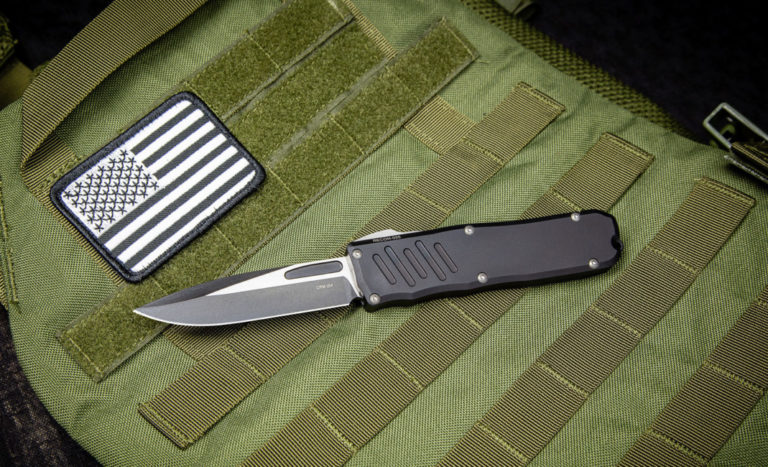
As its name suggests, an Out The Front (OTF) knife is a fairly straightforward affair.  In short, it has an enclosed handle with a blade that deploys from the front–the bolster, hilt or what have you. In general, these fast-from-the-gate options are small, most with an average blade length of 3-3.75 inches, though there are certainly larger examples. 

The knife is distinct from its “Out-The-Side” cousin, at least as a switchblade–one of its most common forms–in the variety of the way the blade is brought into action. Furthermore, the OTF knife needn’t any push-button, assisted-open system to flash cold, hard steel in the wink of an eye. 

Overall, OTF knives are a fascinating, if not slightly intimidating, corner of the knife world. In this guide, we’ll look at some of the history, usage and types of OTF knives. Then we’ll show you some of the best options on the market today. Get ready to flick into action.

Legality Of The OTF Knife 

In the past, these knives were favored by paratroopers and sailors. However, thanks to a media campaign in the 1950s that showed automatic knives as the tool of choice for criminals and underworld types, including popular movies like “Rebel Without A Cause”, automatic knives were banned nationwide. The Federal Switchblade Act passed into law on August 12, 1958 and effectively banned auto knives across the country. 

Going into 2023, the panic over OTF knives and other switchblades has somewhat subsided. Most states now allow ownership and carry of OTF, and other types of, automatic knives. However, 11 states still have a blanket ban. Furthermore, there are some issues when it comes to what many places call ‘stabbing instruments’ and other vague terms. Where this becomes an issue is some states that allow automatic knives have laws against double-edged blades. Given many OTF knife options fall into both categories, certain models have a narrow window of legal ownership.

As always, if OTF knives or switchblades tickle your fancy, please check your local laws before picking one up. Better safe than sorry.

Types Of OTF Knives

As mentioned above, there are four types of OTF knives. Each has positives and negatives, and the prices will vary wildly. It’s important to know the differences so you purchase the option that best suits your needs.

Manual OTF Knife

The most basic and least expensive OTF knives are the manuals. They are exactly that, knives that deploy and retract through manual operation. The most common way of doing this is via a slider on the handle. The upside is that you are in total control of the speed of your blade. However, it may not have the wow factor of other knives on the list. But hey, you’ll be safe while using it. 

Single-Action OTF Knife

These knives feature a powered deployment, usually with a button of some type, but require you to manually retract the blade to reset it. And it isn’t retracting like you might think. You pull a handle at the bottom to both retract the blade and recharge the spring so it’s ready to deploy again. 

Double-Action OTF Knife

When you think of an OTF knife you probably think of double-action OTFs–better known as fully automatic. The blade deploys and retracts with the touch of a button or flip of a switch. Prominent companies like Microtech and Cobra-Tec make dozens of different double-action OTF knives.

Gravity Knives

The four-leaf clovers of OTF knives are definitely gravity knives. Few companies still make them. The blades deploy and retract with the help of gravity.

The Reate EXO is one of the most popular gravity knives on the market today and a great example of the style. Just take into account your local knife laws as some places have specific laws banning the ownership or carry of gravity knives.

What To Look For In A Quality OTF Knife

You can find decent, but basic, OTF knives in the $30 range, but expect to pay ten times that for a model that extends and retracts on its own with the push of a button. Though, the sky is really the limit when it comes to the features on these knives, as some can easily jump over $1000 depending on what’s included.

The rub, for the price, is that even the expensive options do not do well for anything other than basic and light use as they are not as strong as other types of knives.

The basic selling point of OTFs–aside from inherent coolness–is convenience. Read that as they can be entirely used with one hand. It’s best to think of the OTF knife as a refined gentleman’s blade: a cutting tool that you could rely on for daily life and its inconveniences. 

OTF Blade Quality

The main issue surrounding blade quality on OTF knives is how light the blades have to be to function. Because the blade is entirely surrounded by the handle, the blade itself cannot be wider or longer than that existing space. As a result, most OTF knife blades are short and light. 

These blades are rarely what we would call a full-profiled knife and many are under 3 inches despite a full-sized handle. These blades are not especially strong and are essentially for cutting only, though there is utility in thrusting or stabbing depending on the strength of the locking mechanism. 

The small tang area is where the mechanisms are anchored, and this space is usually quite insignificant in surface area. It is entirely possible and even easy to break OTF knives if used improperly. 

Practicality Of OTF Knives

If you are in the market for an OTF knife, realize that there are better designs for most daily work that are substantially stronger and can handle a much wider variety of tasks, not to mention are cheaper. OTF knives do have their niche, much like karambits, balisongs, and friction folders, but each of these designs has hard limits on what they can accomplish as opposed to a fixed blade or a suitably strong folder. 

Best OTF Knives

SCHRADE VIPER OTF

Coming in at a relatively low cost (comparatively) is the Schrade Viper. The knife lacks some of the features of higher-end OTF knives, but at 1/10 the price of some of the others on this list, it is a good starting point should you want to familiarize yourself with the OTF style in general. 

The knife is a bit more manual than others in that it is assisted opening but needs to be manually closed. The overall structure of the knife is not cheap. The handle is made of aluminum and includes an integrated glass breaker in the pommel. It also features a manual safety system for opening and closing the blade to ensure it only opens when you want it to.

MSRP: $75

SMITH & WESSON M&P OTF

The M&P OTF retails in the same range as the Schrade Viper and is largely a product that appeals to an entry-level crowd. Many OTF knives on this list retail for more than some of S&W’s guns–a telling sign this market is for the discerning individual. with the M&P OTF, you get a large degree of utility without some of the additional features and glamor of higher-end models. 

Like the Schrade, this knife has an integrated glass breaker in the pommel and is similarly assisted opening/manual closing. If you already own an M&P pistol, you’ll notice that the handle contouring matches the slide machining cosmetically, including a safety lever that resembles the one on the pistol. MSRP: $70

HOGUE KNIVES COUNTERSTRIKE 

Hogue’s new Counterstrike is a flagship design that is sure to impress, not only with its modest price point for a fully-automatic knife but also the materials it is made from. 

What sets the Counterstrike apart is not just that sweet-spot price, but the high-end materials it’s made from and its excellent strength. Among these is the MagnaCut blade, which itself is a prime selling point. This steel is among the best in the industry and gives the Counterstrike excellent edge retention and adds rigidity to the already thin OTF blade profile.  Additionally, the knife has a glass-breaker pommel, aluminum, and carbon fiber handle, and is made in the USA. 

MSRP: $400

KERSHAW JENS ANSO KAPSULE MANUAL OTF 

The Kershaw Capsule is a small manual OTF excellent for concealment. At just 3.25 inches while closed and with a 1.9-inch blade, this small knife is a great self-defense tool because of its size and unassuming appearance.

However, it’s much more than that. The spear point blade works like a box cutter. The tip is great for puncturing the and edge can handle the type of slicing work you’d expect from a commercial box cutter. It’s convenient and compact enough that it can even fit on a keychain.

MSRP: $35

MICROTECH ULTRATECH D/E 

Microtech is one of the companies that popularized the modern OTF knife. In fact, most knife enthusiasts would go so far as to say that Microtech is completely responsible for this trend and has set the bar for all OTF knives going forward. The Ultratech is a solid example why the company calls the tune.A dependable OTF,  the knife displays an excellent balance in terms of material, strength, and utility. It is a fully-automatic design that opens and retracts with the same switch. If you want an incredibly reliable OTF knife for your daily use, the Ultratech is arguably the knife on this list with the most pocket hours across the board and is from an established OTF brand. Like others on this list, it features a glass breaker pommel and is made in the USA. 

MSRP: $310

HERETIC KNIVES ROC

Now here is something you don’t see every day. The Heretic Knives ROC is visually stunning, it is just so rare to see a curved blade on an OTF knife. The company no longer has the ROC listed on its site as of this writing, but it is available and in stock online. The ROC accomplishes its one-of-a-kind appearance by using a curved handle to match the blade, which overall seems like a no-brainer.

But it just isn’t seen these days, despite the advantages in self-defense or martial arts. While it resembles a karambit, this knife lacks a finger ring on the pommel. The ROC is a fully-automatic design that retracts and deploys on its own. If you are in the market for an eye-catching OTF design that is USA-made, you’d better get them before they are gone.

MSRP: $750

PIRANHA RATED-R 

The Piranha Rated-R is one of the most discreet and well-designed knives on this list. The others we’ve looked at have release buttons/switches on the side of the grip in line with the spine of the blade, whereas the Rated-R has it conveniently mounted where the thumb rests near the end of the handle. 

It is a fully-automatic knife and requires no movement of the hand to deploy and retract the blade thanks to the switch location. Unlike most of the others here, it lacks a glass breaker pommel, further adding to its discreet appearance. The knife is on the higher end of cost for OTF blades. But like any semi-custom product, it appeals to a certain customer that has specific needs for a strong, durable, and unassuming knife. The Rated-R is made in the USA. 

MSRP: $490

BENCHMADE AUTOCRAT

This list wouldn’t be complete without a knife from Benchmade. The company has been producing visually attractive and highly functional blades for the most demanding end users: hunters, cops, rescue crews, anglers, and bushcrafters, among many more. The Autocrat is the most sought-after Benchmade OTF model and it has an excellent reputation for strength and sharpness.

The knife is in the same cost range as most high-end OTF knives at $500, making it an investment for most people but a steal for those who desire American-made quality. The knife is fully automatic and is available in two colors. It does not include a glass breaker pommel, making it easier to use in the hand and a bit more classy in overall appearance. 

MSRP: $500

Read More

Civivi Cogent Review: How Versatile Is This Flipper?

The Cogent Flipper Folder From Civivi Is Ready To Cut Through Pretty Much Anything

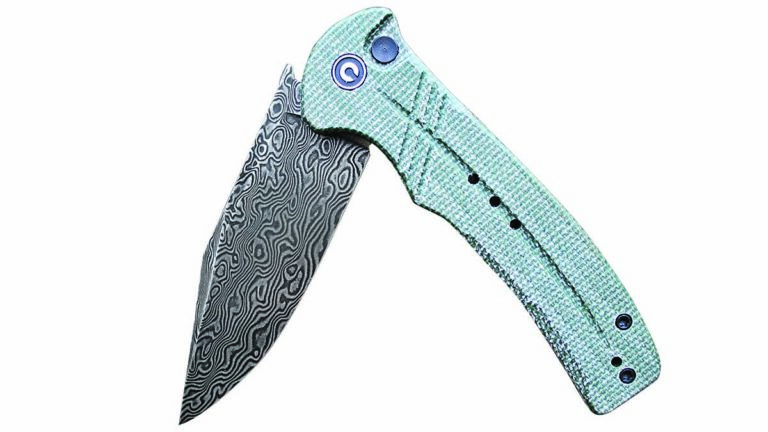
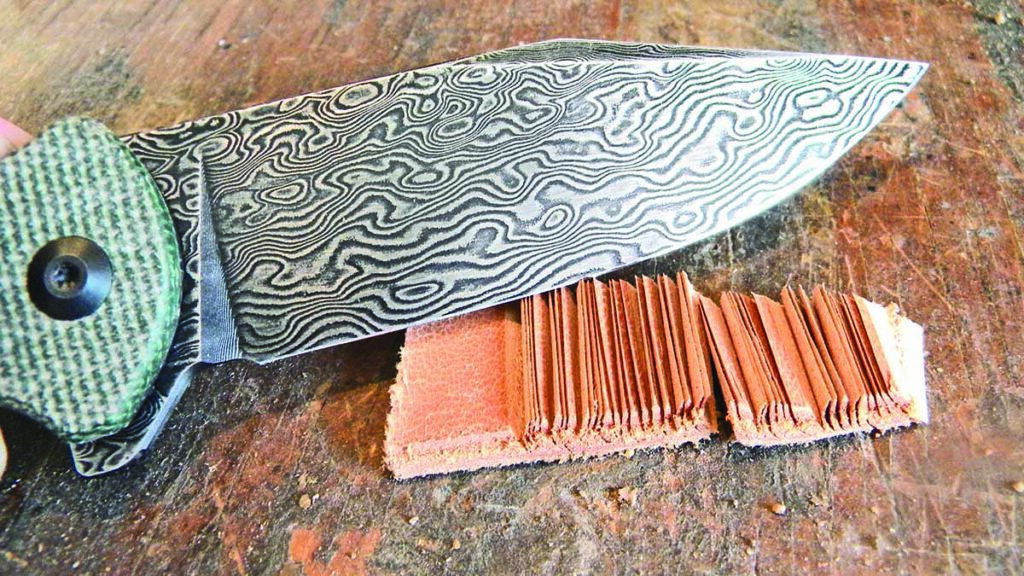
The Cogent button-lock folder from Civivi is well put together. It has a great feel and a classy blackened stainless steel damascus blade. 

Civivi uses 10Cr15CoMoV and 9Cr18MoV stainless steels in the damascus mix. The blade has a full flat grind designed to slim the edge geometry down for efficient slicing.

Testing The Civivi Cogent

Civivi Cogent skiving leather
Skiving 6-ounce leather was no problem as the Cogent did the job aggressively and noisily—the author easily could hear the crunch on each skive.

First up on the test agenda: 20-pound bond copy paper. The Cogent zipped through it without hesitation. The blade was super smooth during slicing. I used a push cut for a full slice. The knife most definitely has a fine edge.

Staying with a push cut, I used the Cogent to effortlessly slice single-walled cardboard to shreds. The edge never stalled in dispatching the medium. Man, this thing is wicked sharp! There was no twisting of cuts, just straight slices. In fact, it sliced so quickly I had to really watch my fingers to avoid cutting them.

I took it up a notch by slicing plastic board. It was like there was no variation at all in the speed and control of cutting. The only difference was the absence of the zipping noise emitted by the cutting of the cardboard. It was nice, quiet slicing with no hang ups.

There was some 6-ounce leather on the bench for skiving. I decided to slice just a part of it up first. Talk about aggressive cutting! I could easily hear the crunching from every skive. The Cogent sounded like it was actually taking a bite out of the leather—which I guess it was. I did some skiving on another piece of leather with similar results. This knife is a wicked sharp cutter.

Wood & Rope

Civivi Cogent cutting rope
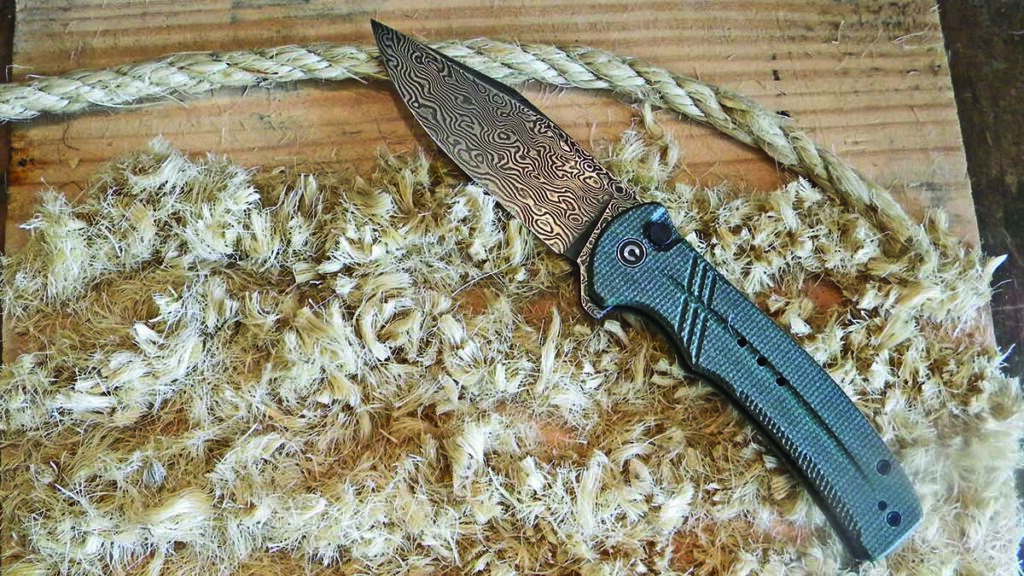
The Cogent worked its way to 214 crunching cuts on the 3/8-inch rope before the author got tired and quit.

It was time for some firestick making. Utilizing the fine edge, I whittled some curly-cues in a pine stick. I did some very fine curly-cues and some thicker ones. The Cogent was excellent controlling curly-cue thickness. The thumb notches were very comfortable during the deeper bites. The handle was quite comfy.

For some splitting action to test the lockup, I batonned the Cogent into a half-inch-thick board. It split the wood very quickly with no smears on the blade. The button lock stayed at 100 percent lockup. No wiggle here!

The last challenge was the 3/8-inch sisal rope. The Cogent worked its way to 214 crunching cuts before I got tired. The edge would still shave hair from my arm*. The blade boasts excellent heat treatment. I didn’t find one hot spot on the handle and the knife was very comfortable for heavy cutting.

Civivi Cogent: Final Thoughts

I would carry this knife every day. It holds a sharp edge longer than most. The second-best thing is the comfortable handle. It is made for using. The Cogent is an excellent folder. I’d maybe add more handle color options. I love everything else.

*Editor’s note: BLADE® does not recommend shaving arm hair to test blade cutting ability. It can result in injury or worse.

Civivi Cogent Knife Specs

Blade length: 3.47”
Blade material: Blackened stainless damascus
Blade thickness at the thickest: 1/8 of an inch at ricasso and tapers to the tip
Rockwell hardness: 58-60 HRC
Handle: Green Micarta®
Liners: Stainless steel
Opening: Flipper
Lock: Manual button lock
Knife to know: Open-handle construction for easy cleaning; handle textured; thumb notches on base of blade spine
Country of origin: China
Weight: 4 ounces
Closed length: 4.25 inches
MSRP: $115

Read More

Inside The Shop Of RJ Martin

0

Known For His High-Quality Custom Knives, RJ Martin Has Earned A Spot As One Of America’s Most Creative Knifemakers. 

Between his exquisite custom knives and numerous collaborations with factory cutlery companies, RJ Martin has become a legacy name in the knife industry. As a teenager he was inspired by a Sports Afield article on knifemaker Bob Dozier and decided to try his hand at knifemaking, which he did with very satisfactory results. The seed was planted for what would become a lifelong passion of working with steel, the results of which are his incredible knives today.

To get there he studied at Rensselaer Polytechnic Institute in Troy, New York, graduating in 1984 with a degree in materials engineering. From there he spent 17 years working in the aircraft industry designing parts and mechanisms for hi-tech helicopters. This exposed him to a wide range of materials including carbon fiber and titanium and, just as important, CNC (Computer Numerical Control) machining. You couldn’t ask for a better prelude to becoming a custom knifemaker.

When Martin retired in 2001, he rediscovered his love for knifemaking and set up shop. At the time the modern tactical knife era was in full swing, so RJ jumped on board and hasn’t gotten off the train since. His tactical folders are his mainstay and if you look at his body of work, his designs flow like a river.

RJ Martin’s Most Important Tools

One half of Martin’s favorite, and most important sets of tools: his hands.

RJ came right out of the chute with a surprise when tendering his most important shop tool. 

“My two favorite tools, bar none, are my own hands,” he begins. “Without them, I could not use any hand or machine tools. More importantly, I’d miss out on the incredible satisfaction working with my hands brings me. It’s important to take good care of your hands and eyes, and your lungs, because knifemaking will take its toll over time. I have had multiple hand and finger surgeries over the years to correct wear and tear—and a couple of my digits have suffered substantial injuries from knifemaking—so they’ve got character! Knifemaking is a contact sport and, banged up as they are, I wouldn’t trade them for anything. Lynyrd Skynyrd had it exactly right in their song Red White & Blue when they sang, ‘If you want to know where I’ve been, just look at my hands.’

“My favorite grinder is my Burr King BBA20, 2×72-inch belt model. It’s super smooth, runs incredibly true, and the 20-inch-diameter 60 durometer wheel lets me grind my bevels high while keeping my blades very strong. I re-grind almost all my blades after heat treating using this machine. The slow speed range is critical for steels like CPM S110V, S125V and MagnaCut, as they must be ground slowly with coolant and light pressure after the heat treat because they are so incredibly wear resistant. I got the adjustable-height pedestal stand because I’m tall, plus the super fancy ergonomic work rest option because it’s just too cool. This machine is also very quiet!”

The Tools RJ Martin Uses

RJ’s Sears 6×48-inch belt sander and the stand it’s sitting on belonged to his father, Richard, “who was a gifted artist, a great parent and—most of all—a decent and caring man. He never made a knife in his life but he encouraged me to make them.”

“And then there’s Sophia, my alter-ego and companion,” RJ continues. “Sophia is an Ares Seiki R5030, three-axis CNC mill built in 2021, and she’s, well, a badass! With 14 tools in her carousel and a 20,000 RPM dual-contact spindle running high-precision Big Kaiser 30-taper toolholders, she is my girl with a short skirt and a long jacket! With properly designed tooling, good [numerical control] programs and quality carbide tools, her precision is incredible. I named her Sophia because her name literally means ‘Wisdom,’ and she is indeed wise! I gave her some awesome LED lights made by OC White to illuminate her beautiful work, and I keep her super clean. She is, after all, a woman of class and distinction! Sophia wears my mom’s American flag, which I pass by every morning when I enter my shop.

“Finally, my Sears 6×48-inch belt sander and the stand it’s sitting on belonged to my father, Richard, who was a gifted artist, a great parent and—most of all—a decent and caring man. He never made a knife in his life but he encouraged me to make them.

“Those hands I wrote about earlier? They came from my father. Of this, I am certain. He passed before I really hit my stride as a knifemaker and I miss him dearly,” RJ notes. “So, I keep this machine in my row of grinders to remind me every day where I came from and how grateful I am to be able to work hard at a job that I love and am successful at.”

Read More

Advertisement

Must Read Articles

Read this before you make a knife

Knifemaking 101 – Read This Before You Make a Knife

  by Wayne Goddard My experience has taught me that there's nothing like digging in and getting started. I've often said the hardest part of the...
how to forge damascus steel

How to Forge Damascus

Advertisement
Advertisement