Ernest Emerson Is One Of The Leading Designer Of Tactical Knives, And We Get To See His Shop And How He Works
Ernest Emerson is entering his 44th year of knifemaking and his manufacturing company, Emerson Knives, Inc., is celebrating its 25th anniversary. Many knife nuts who have been around awhile remember Ernest when he was purely a custom knifemaker who was making exquisite folders exclusively. Then things changed.
When the first Gulf War came along, Emerson—who has an extensive background in martial arts—had already been working on tactical knife designs and, being the patriot he is, was ideally positioned to do his part in the war effort. Along with a handful of other talented custom makers, it wasn’t long before Ernest was instrumental in helping kick off the modern tactical knife movement that is still a huge part of the cutlery market today.
He never looked back and 25 years ago took his designs to the masses, switching his focus to becoming a cutlery manufacturer of tactical knives, primarily of the folding kind. He continues to make a limited number of custom knives and also uses his skills designing new knives for his factory line. We asked Ernie to give us the lowdown on the tools and equipment he relies on most to do his custom work and prototypes for Emerson knives.
Ernest Emerson’s Tools And Machines
Emerson employs a number of light, low-cost bench-top drill presses. He leaves them set up for various drilling and reaming operations, which saves him a lot of time as he moves down the row drilling liners and handles.
He opened by praising his vintage mill.
“The old Bridgeport has been fixed and rebuilt more than once but it is solid old-school quality and can still easily hold +/- .001-inch tolerances,” he observes. “I use it for all of my milling, tool, jig and fixture building, as well as all operations on bolsters and handles that require precise tolerances and hole depths such as bolsters, counterbores and handle countersinks.”
For grinding, he calls out one grinder maker in particular as his favorite.
“I use a variety of grinders but my go-to machines are those by Travis Wuertz. They are solid, sturdy, virtually silent, and extremely well thought out—and engineered by Travis,” Ernest says. “Their real value to me is that I can build a wide variety of specialized fixtures and tools that allow me to do very precise grinding operations on both blades and handles.”
Emerson uses a number of low-cost bench-top drill presses.
“At $125-$150 each I can afford to own several of them and leave them set up for various drilling and reaming operations,” he notes. “This saves me a lot of time as I can just move down the row as I drill liners and handles. The light drill presses work perfectly for me because all the holes I drill, tap or ream are small diameters and don’t need heavy drill presses to perform the operations. Plus, I get a better, lighter feel when I’m drilling delicate and expensive materials like pearl without damaging them.”
Keeping Things In Order
Hammered-6 in Moku-Ti bolsters with distressed solid copper scales and a hammered blade. Emerson’s list price: $10,000.
Ernest is a firm believer in being organized.
“Although my work area may look a little cluttered or messy [he was preparing for a show when the accompanying photos were taken], I am extremely organized and orderly,” he emphasizes. “Having come up through an apprenticeship program to become a tool-and-die maker, I had it drummed into me the importance of cleanliness and organization in producing precise results.”
He also relies on the smaller things that make up the whole of knifemaking.
“Although machines seem to play the biggest role in most shops, in my endeavors it is the jigs and fixtures that are my most valuable tools,” he states. “Coming up through the apprenticeship program early in my career and eventually earning the title of tool-and-die maker, it was hammered into me that the best machinists are the ones that can conceptualize and invent the most efficient and precise tools, jigs and fixtures to help them do their job. There is a lot of truth in that statement. I also have a full machine shop and woodworking shop with all the jointers, planers, sanders, table saws, routers, lathes and woodworking tools that I use.”
The TILI Ultralight By Origin Handcrafted Goods Might Be Small But It Packs One Heck Of A Bite.
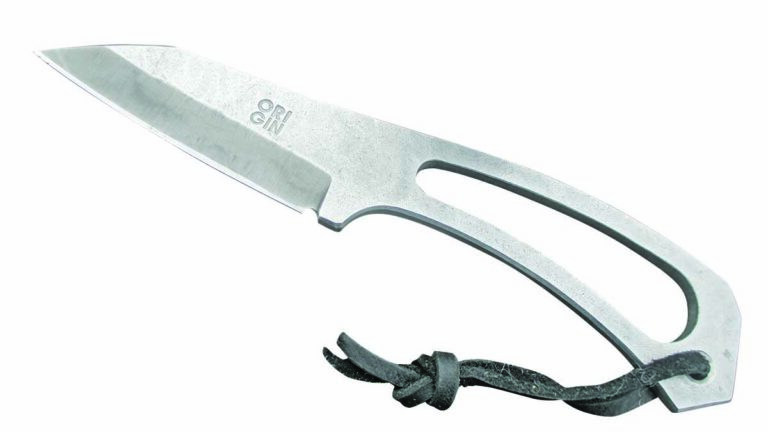
The TILI Ultralight by Origin Handcrafted Goods is a small fixed blade that can fit in your pocket like a pocketknife with no need to figure out how to open the blade or disengage a safety. Pull it clear of the pocket sheath and you’re ready to cut. Among the things I love about smaller fixed blades is that people don’t give you the evil stink eye when you use the knives in public.
Testing The Ultralight
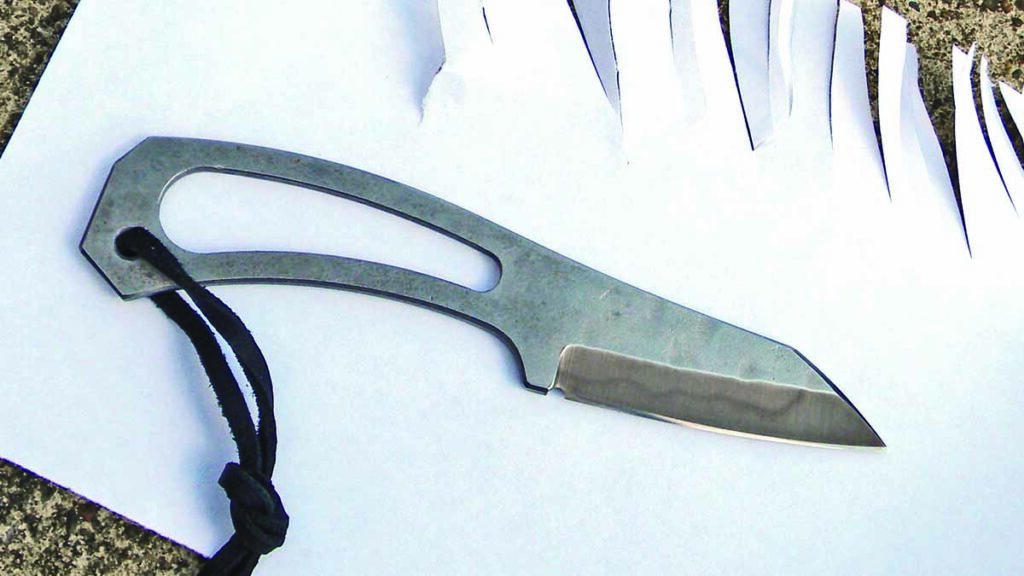
The TILI Ultralight handled slicing copy paper with ease.
I started with a simple paper slice using 20-pound bond copy paper. The TILI sliced very smoothly using both a draw cut and a push cut. The knife was controllable in making the width of the slices—I just had to move my fingers out of the way fast.
Next up: single-walled cardboard. The handle shape of the TILI Ultralight made for extremely controllable slices in the cardboard as well. I could hear the aggressive edge as it sliced. The edge is very fine and ideal for such a job.
Plastic board was next. There was a little more blade grab in this medium as the TILI’s blade bevel is short—around 3/8 of an inch. The full thickness of the blade engaged the plastic board quickly. It still made quick, clean cuts as fast as I could move my fingers.
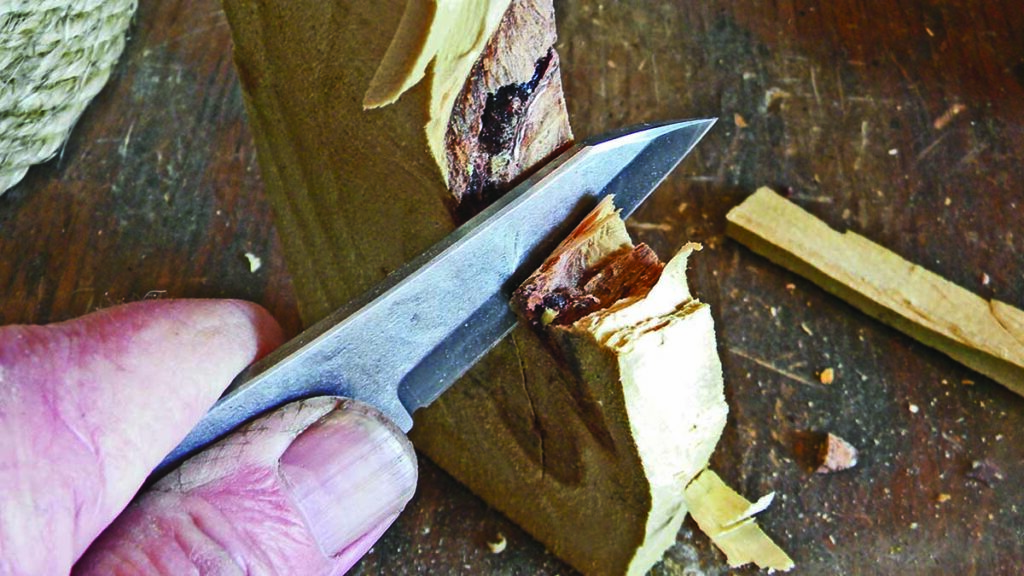
The little fixed blade produced beautiful curly-cues in half-inch pine, producing nice, clean cuts. It was easy to control the depth and thickness of the curly-cues. The TILI Ultralight is great for making fire sticks and a handy little knife to put in a pack. It would be excellent at cleaning small game.
Slicing Through Challenges
The author drove the edge through a pine knot twice. He felt some micro chipping on the edge but it still cut great.
Skiving leather strips was next on the menu. The blade made a forceful crunching sound as it parted the 8-ounce leather. The small blade was controllable in making the slices thin. It favored skiving with the tip more than with the blade’s belly. This is a very sharp knife!
To push the fine edge more, I switched to 3/8-inch sisal rope. The TILI crunched to 125 cuts before my hand said “enough!” It’s hard to keep the pressure on a thin knife without your hand getting sore somewhere. The edge was still sharp and ready for more.
I switched to half-inch pine for some baton practice. The knife was easy to hold onto and it split the wood great. I even drove the edge through a knot twice. I felt some micro chipping on the edge but it still cut great. The steel might be a point too hard on the Rockwell hardness scale for heavy work. Keep the use to slicing and you won’t have any issues.
The TILI comes with a leather pouch sheath to protect the blade. I would put stainless steel pins in the holes at the end of the sheath to prevent accidental penetration as this knife is very pointy and razor sharp.
Bottom line: The TILI Ultralight is a handy knife that’s a perfect little backup blade for all-around use.
Changes I’d Make To The TILI Ultralight
I would add a couple of thumb notches on the blade and extra protection on the tip of the sheath to prevent blade penetration. (EDITOR’S NOTE: The latter is especially crucial if you carry the knife sheathed in your pocket.)
TILI Ultralight Specs
Blade Length: 2.38 inches Blade Material: 1095 carbon steel Blade Grind: Hollow Heat Treat: Differentially Hardened with Hamon Handle: Skeletonized Steel with hole for included leather lanyard Weight: 2 ounces Overall Length: 2.75 inches Sheath: Black Veggie Tanned Leather Weight with Sheath: 3 ounces MSRP: $125
First Announced At SHOT Show 2023, CRKT And Hogue Knives Announced A New Manufacturing Partnership To Create The Next Generation Of CRKT Knives.
The collaboration between the brands launched at SHOT Show 2023 in Las Vegas with the release of two new American-made knives: the Definitive and LCBK. This new joint effort showcases CRKT’s eye for design, craftsmanship, and making purpose-driven products.
First announced at SHOT Show 2023, Columbia River Knife & Tool and Hogue Knives will join forces in a new manufacturing collaboration. The partnership blends the Oregon-based CRKT’s innovative and user-friendly ethos with Hogue’s long history of precision engineering and will focus on the next era of CRKT knives.
CRKT Definitive And LCBK
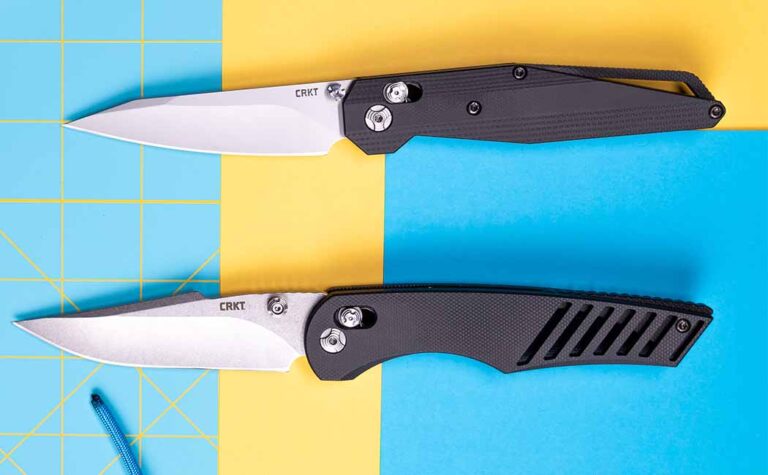
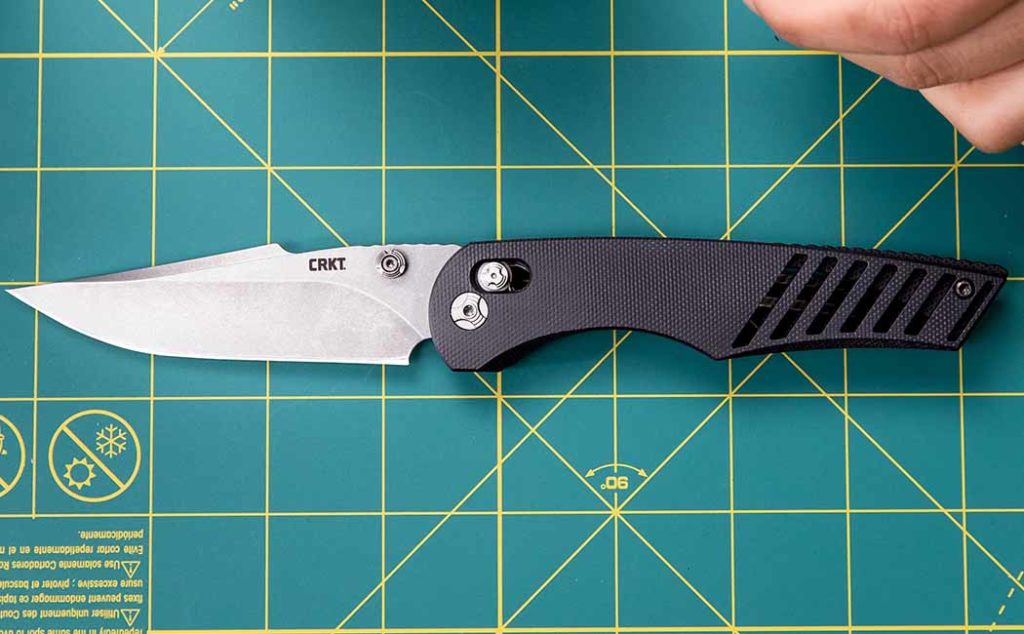
The sleek CRKT Definitive has an MSRP of $215, the same as the LCBK.
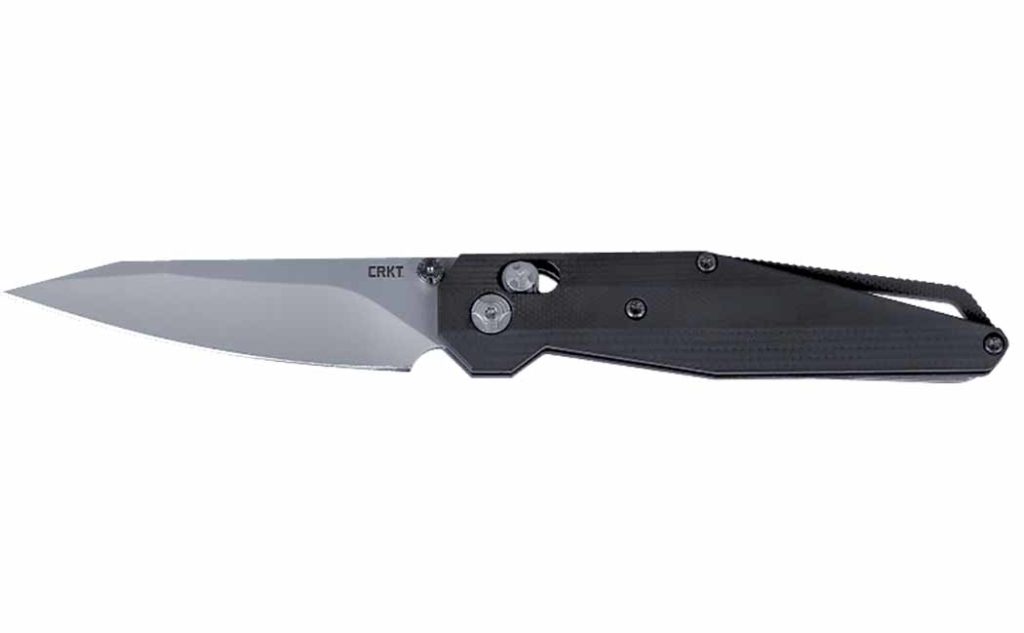
The companies showcased their first two knives together at SHOT: the Definitive and LCBK. Both models are high-end folding EDC knives made from 154CM steel married to a G10 handle. Both are also among the first in the CRKT lineup to feature a crossbar lock, the ambidextrous, one-handed locking mechanism.
The Definitive is the bigger of the two knives with a 3.7-inch blade (vs a 3.48-inch blade on the LCBK), and it outweighs the LCBK 3 ounces to 2.8 ounces. The blade on the Definitive features a stonewashed finish while the LCBK has a bead blast finish.
Both knives have an MSRP of $215.
The Future Of The CRKT/Hogue Collaboration
The LCBK has a bead blast finish and is a light 2.8 ounces.
These knives are meant to be the first launch in a long-term, wide-sweeping alliance between the two companies. Both have said they are excited to work together and learn from each other’s expertise.
“We’ve known the team at Hogue Knives for quite some time and their sterling reputation in the marketplace is well deserved,” said Doug Flagg, VP of Marketing & Innovation for CRKT. “As we looked towards partners in US manufacturing, they were an obvious fit in helping us develop top-notch American-made knives and we couldn’t be more pleased to be working with them.”
“This partnership with CRKT is a natural extension for our business,” said Jim Bruhns, President of Hogue Knives.“CRKT’s penchant for design and willingness to take risks and stand out fits right in with the ethos here at Hogue Knives and we’re excited for what the future holds for both brands.”
Few Blades Are As Historic As The Bayonet. The Knife Has Evolved Into An All-Rounder Still Issued By The Marines.
Oddly enough, the history of the bayonet likely began in the hunting field, not the battlefield. By at least one account, the edged weapon was a tool of the French boar hunter in the 1500s. Tusks and a bad attitude, it’s understandable why these gents strapped their hunting knives to the muzzles of their muskets.
Soon after some enterprising soldier figured the invention–in original French baïonnette–might prove useful in warfare, and the iconic edged weapon was off to the races for the next four centuries. Presently, bayonets have essentially become military relics, if employed generally only as a training tool to acclimate soldiers to close-quarters combat.
Despite this, these fairly antiquated edged weapons still stir the imagination of military heroics of yore. Not to mention, in nearly all their versions, bayonets remain one of the coolest and most accessible historic edged weapons to collect.
In the article, we’ll look at some of the major styles of these modified edged tools, how the implement has evolved and who actually continues to make them. So gird your loins, we’re charging forward on bayonets.
Major Bayonet Styles
A bayonet is so much more than just that. There were, and still are, several different designs of the implement, most mirroring the technology and ethos of war fighting of its particular era.
Plug Bayonet
The plug bayonet is the earliest known bayonet and dates back to the 1500s or 1600s. The idea is rather simple. if you couldn’t use your gun to shoot or simply don’t have time to reload you turned to the knife. In this case, typically a double-edged dagger with a rounded handle that affixed the implatment directly in the muzzle of a musket barrel.
These earliest bayonets were really fully-fledged daggers in their own right. They lacked a proper pommel as can be imagined, but they could be used exactly like any other dagger. Most in this era were used in a manner of last resort. If a soldier found himself out of ammunition or facing a fast-moving enemy, he would likely want to put in his bayonet and hope for the best.
The bayonet at this time was the product of changing warfare. While firearms were becoming more prevalent on the battlefield, they were slow to load. Additionally, the close-quarters combat of the medieval era still reigned supreme. In turn, soldiers required an option to hold off infantry and cavalry charges once their one shot was spent.
Offset (Socket) Bayonet
While it may surprise some, the classic socket bayonet most think of during the flintlock era of warfare was not in full use by 1700. Attempts had been made prior to developing an offset bayonet allowing the soldier to load and fire with it attached. But it wasn’t until several critical battles in the late 1600s that evolution took hold. In particular, the battle of Killiecrankie in 1689. HereScottish Protestant forces were thoroughly defeated by Jacobite Scottish Highlanders, who charged and destroyed their enemy with broadswords and targes.
This defeat came in part due to the plug bayonets the Protestants utilized. In what would be a rather ironic turn, the Scottish Jacobites would eventually meet their end and the end of their cause at the tip of the bayonet. Outfitted with socket bayonets at the Battle of Culloden in 1746, the British were able to let loose a point-blank volley on the charging Highlanders, then finish the rest with their bayonets. The British had even devised tactical doctrine for the use of the weapon, training to a charging man to their side, instead of in front to strike beneath his raised sword arm.
History Of The American Bayonet
The M7 is a legendary American bayonet that is still manufactured today.
Americans were somewhat slow to adopt the bayonet in warfare, giving the British somewhat an edge in the early days of the Revolutionary War. Of course deadly in charges, attached to the British Pattern 1769 Short Land musket–or Brown Bess–the implement also was somewhat a psychological weapon. Said to be the most feared weapon of the British arsenal, the Red Coats mass assaults with a long, gleaming triangular knife at the end of their muskets made all but the most disciplined break.
The Continental Army proved a quick study once trained with the bayonet by Maj. Gen. Baron von Steuben at Valley Forge in 1773. By the end of the war, there were even strokes of genius with the American use of the bayonet, such as when American Lt. Col. Alexander Hamilton (also the first Secretary of the Treasury) led a bayonet-only assault on redoubt 10 during the last days of the Battle of Yorktown.
Early on, the Continental Army utilized a triangular socket bayonet similar to the British, however on the French Charleville Musket. But its use spread and the wicked device was eventually found on the Brown Bess–the most used arm of the Continental Army.
The bayonets in American service were standard European-style socket-mounted with triangular blades. This remains so through several iterations, including the Harper’s Ferry 1801 pattern, 1807 and 1810 Springfield patterns, M1816, and M1855.
The M1855 served through the Civil War, where it saw extensive use on the Springfield rifle muskets. The .58 caliber rifle muskets loaded the same way as old muskets and could fire quickly and were very accurate and had substantial range. The bullets used in these guns had a hollow base that expanded into the rifling when it was fired, thus imparting spin. The war was devastating, and there were many bayonet charges, most with mixed results and high casualties.
More accurate firearms and the introduction of repeating arms mitigated the effectiveness of the bayonet during the Civil War. It is estimated, only around 1 percent of all casualties were a result of bayonet wounds.
Sword Bayonet
Pattern 1907 Bayonet. (Source: CC by 4.0)
Despite the effectiveness of “cold steel” assaults waning in the face of technological advancement, the bayonet persisted, though evolved to remain relevant.
A more interesting detour around the time of the American Civil War, was the multi-purpose sword bayonet used by the British. The British Infantry Rifle of 1800–1840–later known as the Baker Rifle–utilized this style. The idea, essentially, was to give soldiers the ability to stave off cavalry charges when used as a bayonet, but also outfit them with a side arm–a short sword–for close-quarters combat. These sword bayonets had knife handles mated to exceedingly long blades, sometimes over 20 inches.
Surprisingly, this style of bayonet was used all the way into World War I, despite little evidence the elongated blade provided any advantage. Perhaps the most famous final rendition was the Pattern 1907 Sword Bayonet, found on the British Short Magazine Lee Enfield rifle in the Great War.
The American bayonets of the pre-WW1 era were a bit more well-designed. The bayonet designed for the American Krag rifle (the M1892), for example, had an 11.7-inch blade and could serve as a camp tool as well for daily chores. The Americans ended up following the Europeans’ lead in World War I a bit with the M1905 bayonet, which sported a 16-inch blade. Additionally, there were 17-inch versions used on the trench shotguns and backup rifles like the M1917 Enfield.
Knife Bayonet
The M9 bayonet works as a traditional bayonet but is more commonly used as a fighting/camp knife.
After WWI, most militaries of the world focused on making the bayonet in the form of a camp knife, something that was worth it to carry for general use that had more than one regular use. The time leading to WW2 produced the highly functional and realistically-sized M1 bayonet for the M1 rifle. The M1 carbine was also set up to use one, and it had its own small setup in the M4 bayonet knife. These knife-style bayonets eventually ran through several iterations leading up to the M7 bayonet for the M16 rifle in the late 1950s.
As a regular tool, the knife bayonet is great and doesn’t remove any of the function in either role. It can be used for all sorts of tasks and also be mounted on the gun. The later M9 became a full-on utility and fighting knife for the M16 series. It is a large, Bowie-style knife that closely resembles the Ka-Bar. It added some additional utility features like serrations for cutting straps and rope and a wire cutter. Later on, the OKC-3S knife bayonet was adopted by the USMC. These remain standard today.
Bayonet Realities
The reality of the bayonet is that it is not a principle fighting weapon. Today we are seeing most rifles fitted with a mountain of accessories, from variable power optics, lasers, suppressors, and bipods.
The bayonet has, for most of its history, been a weapon of intimidation. Very few times did any two armies charge each other with bayonets, usually one side fled first. Even in our modern era there have been bayonet charges, but again to no effect other than to scatter the enemy.
Edged weapons do have a role in modern warfare; everyone needs a good knife at minimum. If your rifle has no provision to attach one or you’re using a suppressor, there is no real need to carry a bayonet specifically as opposed to a dedicated knife that serves your purposes.
Bayonets will always be a curiosity not because of how they were used, but rather why they were used well beyond their abilities. While it is certainly a dangerous thing and absolutely lethal, getting that close to your enemies means you’re having an exceedingly bad day. But, as history has shown, a man with a sharp stick and nothing to lose can sometimes win the day.
BLADE Show West 2022 Was A Smashing Success In Its New Home Of Salt Lake City.
So you’re having BLADE Show West in Salt Lake City,” the man began, interjecting a pregnant pause before continuing. “In Utah? Isn’t that kind of a gamble?”
Of course, any change in a knife show venue is a gamble, and so it was with the switch of BLADE Show West from Long Beach, California, in 2021 to Salt Lake City this past October. But the gamble paid off as BLADE Show West ’22 in the plush Salt Palace Convention Center met with banner reviews.
Makers Loved BLADE Show West
Grant (left) and Gavin (right) Hawk of Hawk Knives were two of the many makers displaying their knives in Salt Lake City.
The main concerns of any knife show—attendance, the venue and easy accessibility both to it and to the surrounding hotels and restaurants, and, most importantly, the number of knife buyers and how many knives they bought—were all addressed in fine fashion. The fact that the weather was sunny and in the 70s on a beautiful fall weekend didn’t hurt, either.
“The show surpassed our expectations,” observed Spyderco’s Joyce Laituri. “Not knowing what to expect in Salt Lake City, we were amazed.”
“The crowd was way more than I expected,” echoed BLADE Magazine Cutlery Hall-Of-Fame® member Bill Ruple. “I’d say it was close to BLADE Show Texas this past March in terms of attendance.” And those numbers were very good.
“It was extremely busy,” wrote knifemaker Mike Tyre. “Both days were non-stop people.” Chimed in knifemaker Duane Dwyer, “The show was full for both days and that’s all we as exhibitors can possibly ask for. I had a great show and met a good group of new people.”
“Numbers seemed good for the venue size,” wrote knifemaker Princeton Wong. “The traffic stopping by [our] table was more consistent than even at the BLADE Show in Atlanta.”
Not only knives but bodaciously long swords had show-goers agog in Utah.
As for the all-important issue of knife sales, a goodly number of makers came away very pleased.
“Sales were great. I sold all my high-end fixed blades and several folders,” wrote Tyre. “There were a lot of serious buyers at the show.”
“Most everyone I talked to had really good sales,” Ruple stated. “I saw a lot of the same buyers but also sold to some local folks. I took 10 knives and sold all of them.”
Knifemaker Tim Robertson said he brought seven knives and sold six. “We brought 11 knives,” ABS master smith Steven Koster wrote. “I only sold four but they were in the medium price range, and took two orders: one fixed blade and one folder.”
Wong indicated there seemed to be plenty of buyers for the custom folder and balisong markets, and he did a healthy business with some knife purveyors in attendance. “I had dealers requesting between five and 100 pieces,” he observed, “and had approximately 10 buyers from the show waiting on book spots.”
The Salt Palace Was A Star
The factory booth section was a beehive of activity.
As for the venue and the accessibility to it and nearby hotels and restaurants, the Salt Palace Convention Center met with high marks from almost everyone.
“The venue was excellent. My hotel was really upscale with great parking and a free breakfast that was good,” Tyre noted. “The show was a short walk across the street. The convention center was a great place.”
“The venue was good, we liked it and the city was good, also,” Koster observed. “The hotel and food were very convenient and easy to get to.” Added Wong, “The show venue was nice and easy to access. It’s relatively close to hotels and the weather was good for the short walk. We had surprisingly great meals.”
Awards & Seminars
In the seminar Let the Pros Critique Your Knife, from left, Steve Schwarzer, Lucas Burnley, Bill Ruple, Enrique Pena, and Will Stelter explained to show attendees what they did and did not like about attendees’ knives submitted for their inspection, and how to improve them.
Some outstanding knives won awards in both the factory and custom knife judging competitions*. Highlights in the custom category included Trevor Morgan winning both Best in Show and Best Kitchen Knife for his damascus chef’s knife and Shayne Carter taking home Best Hunter and Best Bowie.
WE Knives was the big winner in the factory judging, capturing Best Folder and Best in Show for the Peter Carey Nitro Mini and Best EDC for the Shakan. All of the winners were announced and presented trophies at the show’s After Party sponsored by Black Rifle Coffee at the company’s facility Friday night.
The show hosted a state-of-the-art slate of seminars, among others including 3D Printing for Canister Patterns conducted by ABS master smith Steve Schwarzer and Ron Hardman, Let the Pros Critique Your Knife with Schwarzer, Enrique Pena, Bill Ruple, Will Stelter and Lucas Burnley, and the 3rd Annual West Coast Flipping Championships hosted by Squid Industries.
BLADE Show West 2023
Next year’s show will return to the Salt Palace Convention Center Oct. 13-14. Plan to attend now. Many already have. “We’re in for the next two years,” Spyderco’s Joyce Laituri wrote, “and our employees are already arguing over who gets to work the show next year.”
For more information on BLADE Show West ’23, visit bladeshowwest.com or email [email protected]. For more on BLADE Show Texas ’23, visit bladeshowtexas.com, and for more on BLADE Show ’23 visit bladeshow.com.
The New Tellus ATK From SOG Is Easy To Use And As Rugged As Can Be, And It Won’t Hit You Hard In The Wallet
Looking for an assisted-opening knife that won’t melt your wallet? SOG Knives might have you covered with its 2023 release–the Tellus ATK. The folder is marketed as an outdoor knife, making it a versatile EDC option.
Interestingly, the Tellus is now the most affordable assisted-open knife SOG now offers. Previously, the Flare held this distinction–a button lock clip point that, at the time of writing, was pulled from the SOG assisted-open page.
Tellus ATK Blade
The blade on the Tellus ATK is made from Cryogenically treated 440C stainless steel. The cryogenic process brings the steel to its optimal hardness to resist wear to the corrosion-resistant steel. Overall, what has become a popular economy knife steel should prove hard enough to stand up to the abuses of outdoor and fairly impervious moisture.
The clip-point blade comes in a stonewashed finish (a black oxide finish on the Squid Ink varietal), which–besides looking clean–hides scratches and nicks. The spine is thick at the handle and tapers to a fine tip. The small swedge adds to the taper. Furthermore, the blade features jimping on the spine to provide added grip, aiding in certain cutting tasks.
Add in a wide belly and a 3.5-inch length, and you get a multi-dimensional blade, strong enough to attack most jobs demanded of an EDC knife.
Additional Features
SOG Tellus ATK Squid Ink & Yellow
The knife comes in three colorways. The black & blaze orange is seen atop this article, and you can also purchase versions in olive drab & blaze orange as well as squid ink & yellow. All versions of the Tellus ATK feature a glass-reinforced nylon handle that is impact resistant and stable at high temperatures.
The one-handed nature of the knife is made even easier thanks to the assisted-opening mechanism that fires the blade open in a flash and keeps it securely in place. The Tellus ATK has two deployment options: a kick opener and a thumb stud. Both make it easy to open the knife in myriad situations and get to using it quickly. A frame lock keeps everything securely in place.
At 4.5 ounces in weight, the piece isn’t too heavy, and it’s easy to carry in either pocket thanks to the reversible low-carry pocket clip. However, the real star of the show is the price with the knife boasting an MSRP of $40.
High-Quality Folder Or Cheap Piece Of Metal? The Beagle From Oknife Gets Put Through Its Paces To Figure It Out.
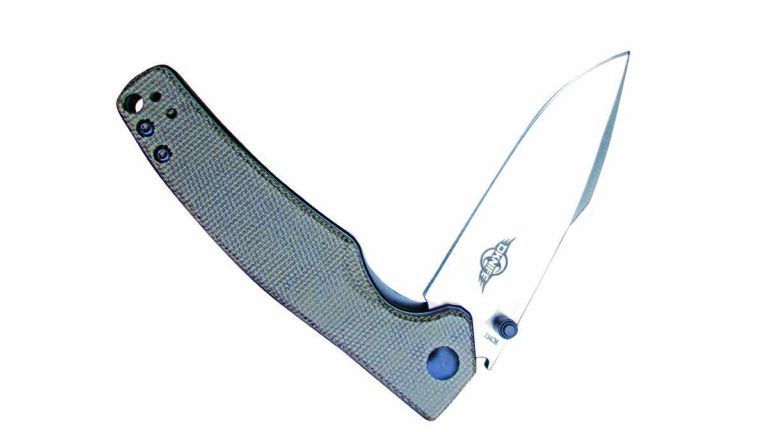
The Beagle linerlock folder from Oknife feels good in the hand and rides quite well in a pants pocket. Action is very smooth with a positive lockup. When you close the knife, the detent ball grabs the harpoon-pattern blade securely. Balance is excellent. As for cutting performance, let’s see.
Edge Test
The Beagle whacked 22 times into the bone before breaking it. Afterward, the author detected a very small nick in the edge. Not bad at all!
First up: a check of the factory edge with a slice of 20-pound bond copy paper. Via a pull cut, the Beagle sliced very clean with no snagging. Cuts were controllable and smooth.
Double-walled cardboard provided the next test medium. The blade cut neat and fluidly with a minimum of grab by the cardboard. The Beagle worked better using a push rather than a pull cut. I felt no snagging in the process. Control was a tad wobbly as more pressure was needed to part the thick cardboard.
Heavy-Duty Cutting With The Oknife Beagle
The folder made very fine slices and emitted a nice crunching sound during the skiving. The author used the blade belly mostly to keep the leather together instead of in a pile of pieces.
Plastic board was next. The Beagle cut effortlessly with hardly any wobble. The folder was controllable during the test with only a few zigs in the plastic board. I exerted medium pressure with a push cut.
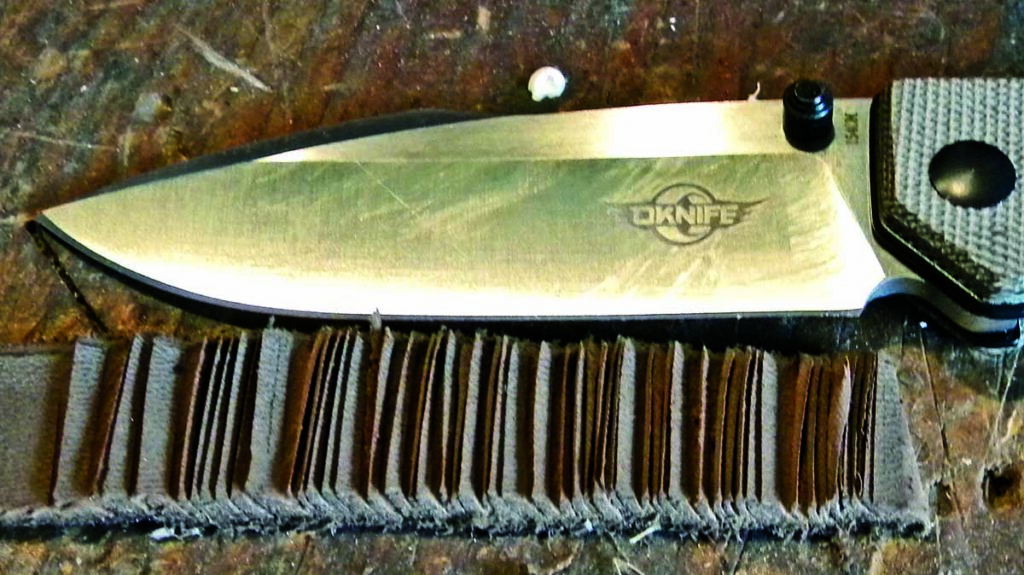
I used quick, short push cuts in a strip of 8-ounce leather. The Beagle made extremely fine slices and emitted a nice crunching sound. It was very manageable during the skiving. I skived with the belly of the blade mostly to keep the leather together instead of in a pile of pieces.
Beagle Takes On Wood And Sisal Rope
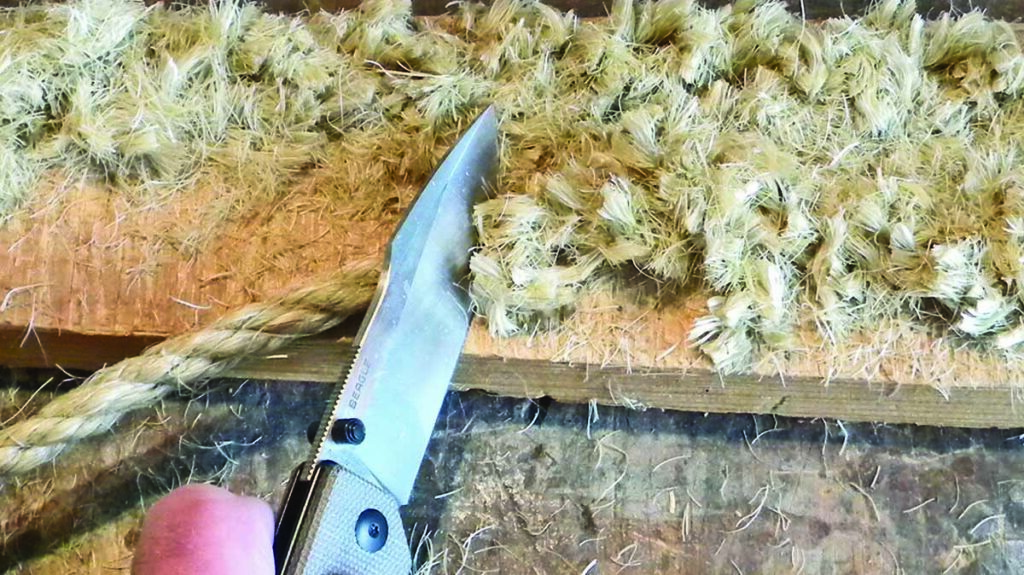
Working on 3/8-inch sisal rope for the final medium, the edge made it to 98 clean crunching cuts. The author suffered no hotspots or pinches of his hand during all 98 cuts.
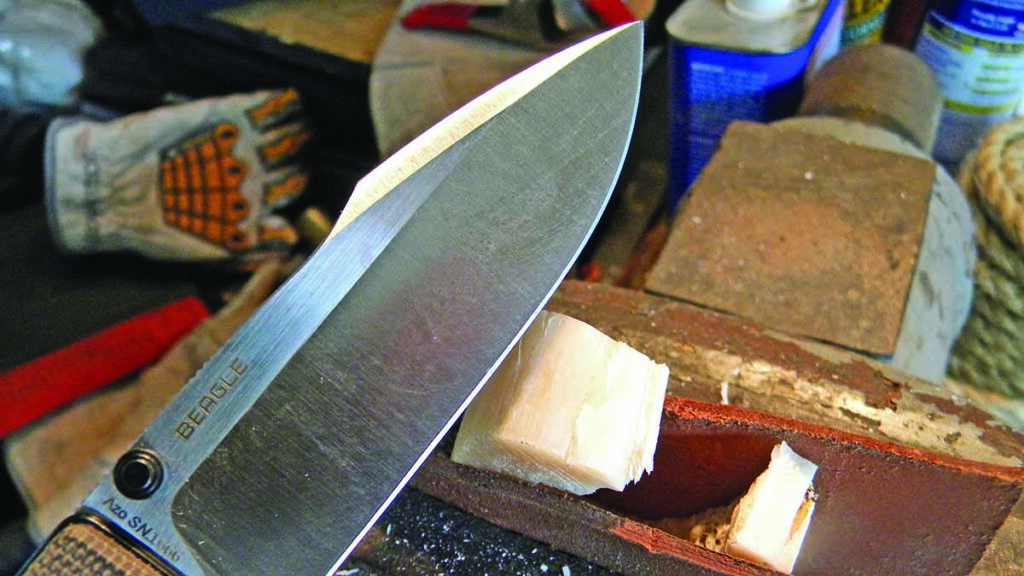
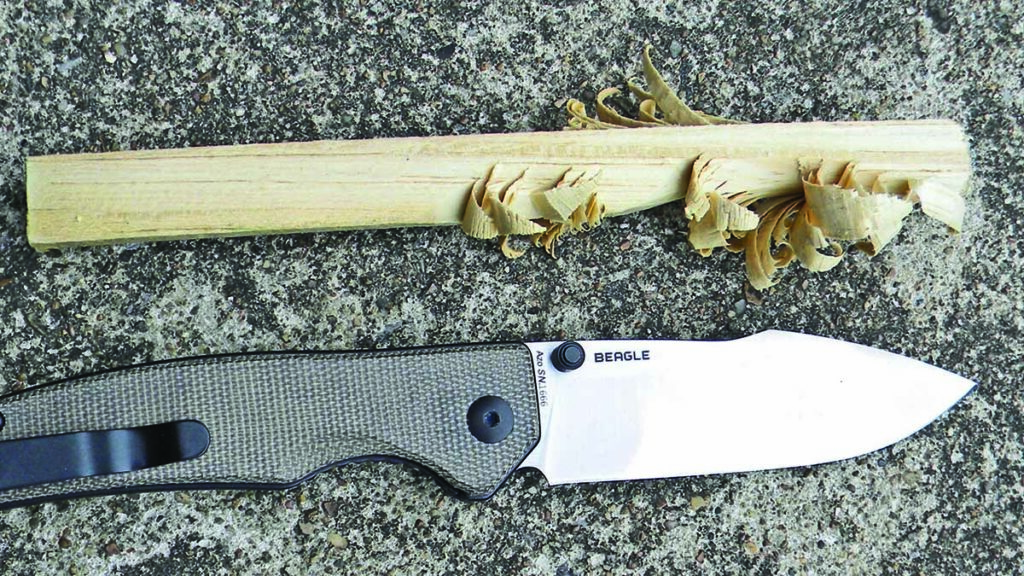
Grabbing some pine leftover from my fencing, I commenced to whittle. The 154CM stainless steel blade made some very nice curly-cues. It was controllable for the thin curly-cues and for the deeper bites, too.
The handle felt good in my hand with no pinch spots during the heavier cuts. The Beagle finished four fire sticks with no issues. Whittling with it was a pleasure.
Next, the edge made it to 98 clean crunching cuts in 3/8-inch sisal rope. After that, the edge slowed down and crunching was not achieved throughout the full cut. My hand suffered no hotspots or pinches during all 98 cuts. The Beagle exhibits outstanding handle contouring.
Oknife Beagle Vs Bone
The 154CM stainless steel blade was manageable for the thin curly-cues and the deeper bites, too
For a possible destructive test, I clamped a piece of cow bone in the vise and slammed the edge into it repeatedly. The Beagle whacked 22 times into the bone before breaking it. I detected a very small nick by running a fingernail along the edge. Not bad at all!
Recommendations
I know that for production purposes the liners extend past the handle material. I prefer them to be flush. (Editor’s note: The action is very smooth and fast upon closing—so fast, in fact, take care when closing the blade one-handed that the edge does not nick the skin just below your thumbnail.)
Final Assessment Of The Oknife Beagle
The Beagle is a nice mid-size linerlock with a great handle and excellent edge retention. I would put this one in my pocket for daily carry anytime.
Oknife Beagle Knife Specs
BLADE LENGTH: 3.25 inches BLADE STEEL: 154CM stainless BLADE PATTERN: Harpoon HANDLE: G-10 LOCK: Linerlock LINERS: Stainless steel WEIGHT: 3.25 ounces CLOSED LENGTH: 4 ⅜ inches EXTRAS: Includes a pouch w/fabric closure that contains a collector coin in a small pocket MSRP: $79.95