High-Quality Folder Or Cheap Piece Of Metal? The Beagle From Oknife Gets Put Through Its Paces To Figure It Out.
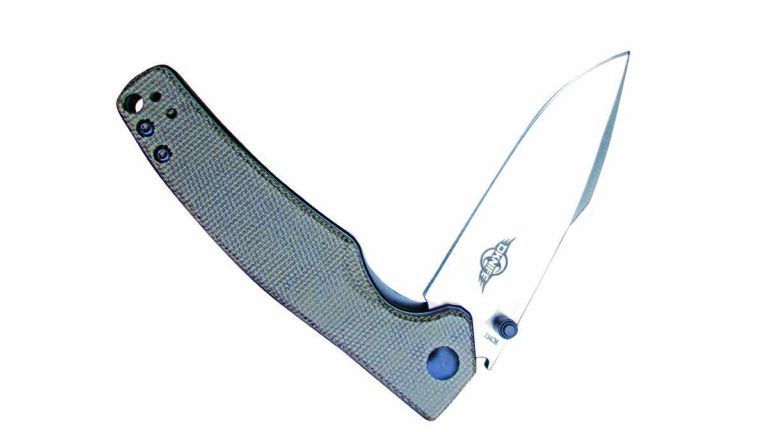
The Beagle linerlock folder from Oknife feels good in the hand and rides quite well in a pants pocket. Action is very smooth with a positive lockup. When you close the knife, the detent ball grabs the harpoon-pattern blade securely. Balance is excellent. As for cutting performance, let’s see.
Edge Test
The Beagle whacked 22 times into the bone before breaking it. Afterward, the author detected a very small nick in the edge. Not bad at all!
First up: a check of the factory edge with a slice of 20-pound bond copy paper. Via a pull cut, the Beagle sliced very clean with no snagging. Cuts were controllable and smooth.
Double-walled cardboard provided the next test medium. The blade cut neat and fluidly with a minimum of grab by the cardboard. The Beagle worked better using a push rather than a pull cut. I felt no snagging in the process. Control was a tad wobbly as more pressure was needed to part the thick cardboard.
Heavy-Duty Cutting With The Oknife Beagle
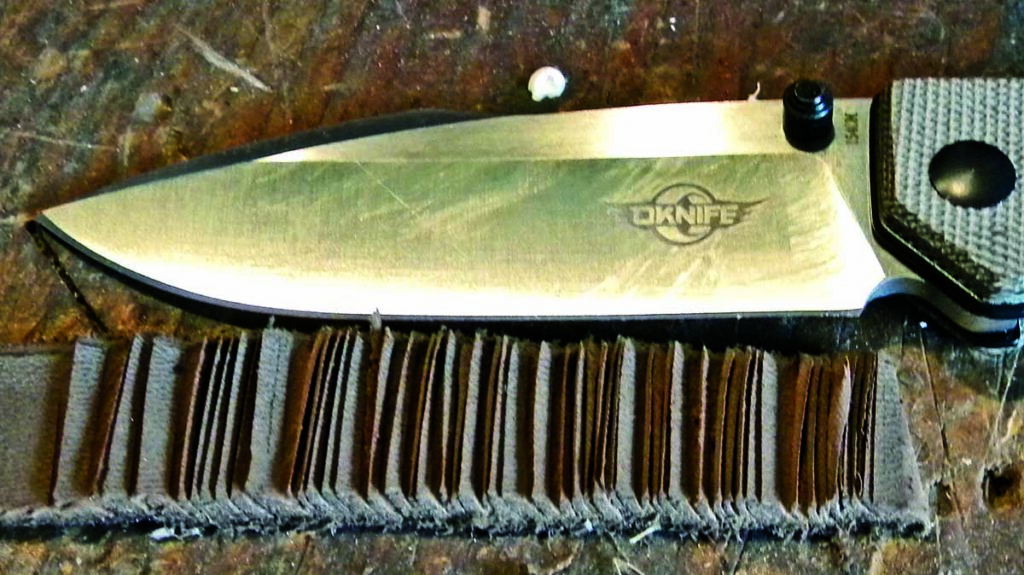
The folder made very fine slices and emitted a nice crunching sound during the skiving. The author used the blade belly mostly to keep the leather together instead of in a pile of pieces.
Plastic board was next. The Beagle cut effortlessly with hardly any wobble. The folder was controllable during the test with only a few zigs in the plastic board. I exerted medium pressure with a push cut.
I used quick, short push cuts in a strip of 8-ounce leather. The Beagle made extremely fine slices and emitted a nice crunching sound. It was very manageable during the skiving. I skived with the belly of the blade mostly to keep the leather together instead of in a pile of pieces.
Beagle Takes On Wood And Sisal Rope
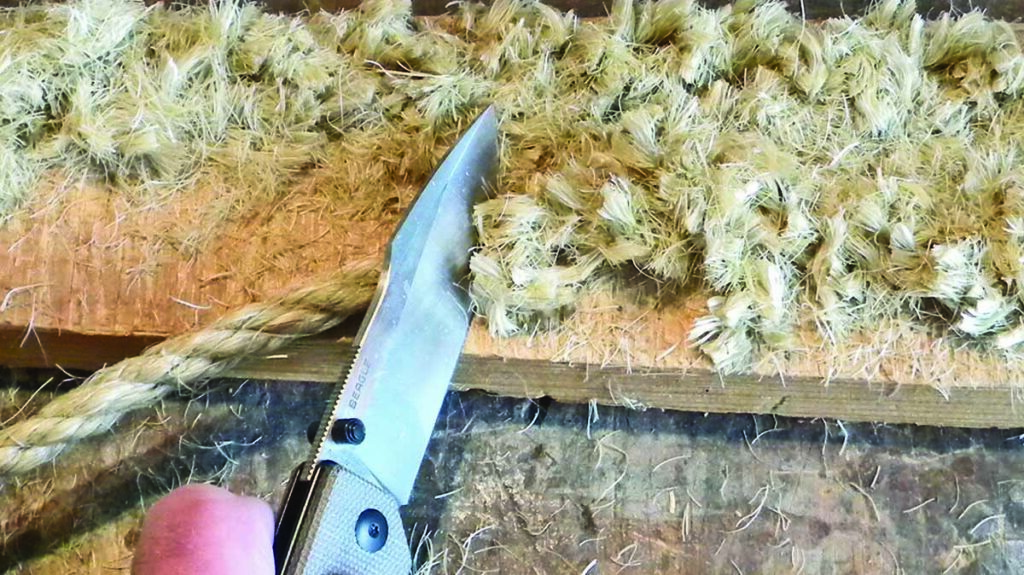
Working on 3/8-inch sisal rope for the final medium, the edge made it to 98 clean crunching cuts. The author suffered no hotspots or pinches of his hand during all 98 cuts.
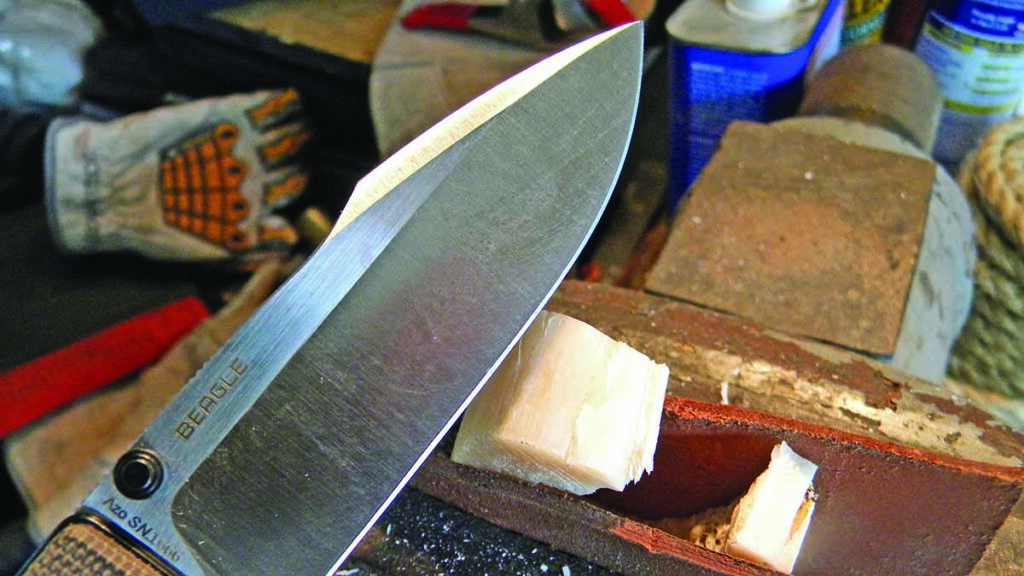
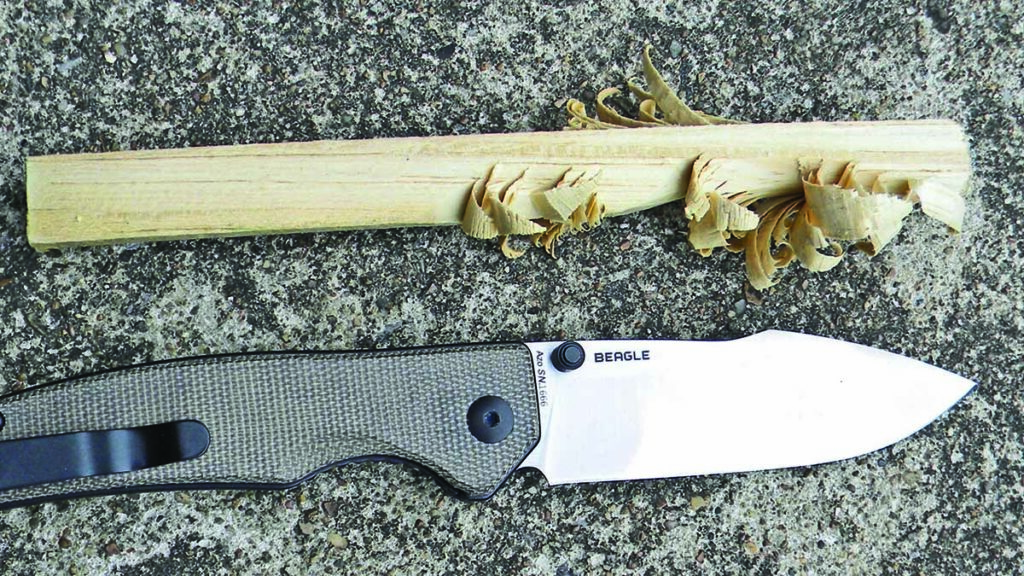
Grabbing some pine leftover from my fencing, I commenced to whittle. The 154CM stainless steel blade made some very nice curly-cues. It was controllable for the thin curly-cues and for the deeper bites, too.
The handle felt good in my hand with no pinch spots during the heavier cuts. The Beagle finished four fire sticks with no issues. Whittling with it was a pleasure.
Next, the edge made it to 98 clean crunching cuts in 3/8-inch sisal rope. After that, the edge slowed down and crunching was not achieved throughout the full cut. My hand suffered no hotspots or pinches during all 98 cuts. The Beagle exhibits outstanding handle contouring.
Oknife Beagle Vs Bone
The 154CM stainless steel blade was manageable for the thin curly-cues and the deeper bites, too
For a possible destructive test, I clamped a piece of cow bone in the vise and slammed the edge into it repeatedly. The Beagle whacked 22 times into the bone before breaking it. I detected a very small nick by running a fingernail along the edge. Not bad at all!
Recommendations
I know that for production purposes the liners extend past the handle material. I prefer them to be flush. (Editor’s note: The action is very smooth and fast upon closing—so fast, in fact, take care when closing the blade one-handed that the edge does not nick the skin just below your thumbnail.)
Final Assessment Of The Oknife Beagle
The Beagle is a nice mid-size linerlock with a great handle and excellent edge retention. I would put this one in my pocket for daily carry anytime.
Oknife Beagle Knife Specs
BLADE LENGTH: 3.25 inches BLADE STEEL: 154CM stainless BLADE PATTERN: Harpoon HANDLE: G-10 LOCK: Linerlock LINERS: Stainless steel WEIGHT: 3.25 ounces CLOSED LENGTH: 4 ⅜ inches EXTRAS: Includes a pouch w/fabric closure that contains a collector coin in a small pocket MSRP: $79.95
The Kershaw Heist Offers A Righty/Lefty-Friendly Option, Built Tough For Optimal EDC
Southpaws and righties can both rejoice! Kershaw has you covered with one of its newest additions to its extensive EDC lineup. Shake hands with the Heist.
While every knife—save examples like a traditional Nakiri—are ambidextrous sheerly by being a knife, Kershaw has tweaked the Heist to make it a bit more appealing to sinistral users. In particular, the knife’s bar lock with a release situated on both sides of the handle makes it a smidgen more user-friendly no matter the dominant hand.
Added to this, Kershaw has outfitted the Heist with a reversible deep-carry pocket clip, allowing for safe tip-up carry in any pants pocket, thus keeping it right at hand—left or right. Slightly protruding over the handle, the clip also puts the knife deep undercover when not in use, yet facilitates quick retrieval thanks to a flared end.
Kershaw Heist Blade
As to the makeup of the Kershaw Heist, the Oregon-based company appears to have put together a serious work tool. Sporting a 3.2-inch D2 steel blade, the knife should have respectable edge retention and excellent toughness—especially for a knife at its affordable price point.
Furthermore, for tool steel, D2 has decent corrosion resistance, nice since Kershaw seems to aim it as a utilitarian option meant for hard use. But it’s still carbon steel at heart, thus requires maintenance to keep it in good shape and absolutely corrosion free.
The blade has a clip-point profile with a long, wide belly, excellent for long slices. On this, the folder is outfitted with a decent-sized thumb stud. Little surprise here, as Kershaw has stayed true to the opening method, even as flippers have become more popular. And the company has applied a stonewash finish, which gives it a flat, blue-collar look that hides minor dings it’s sure to endure.
Other Heist Features
The Heist boasts a glass-filled nylon handle, made to withstand a beating. Its Duralock opening system is outfitted with a brass washer, which aids in the knife’s fast and smooth opening. And if you need to tether the Heist to something or want to add a quick-retrieval lanyard, the handle comes with a lanyard hole.
Perhaps the Kershaw Heist’s most attractive asset is its price. With an MSRP $85, the knife falls within almost every buyer’s budget. And at this price point, it just begs for hard everyday use, without worrying about shedding tears if you happen to bust it up.
Are these the best American knives? Maybe, maybe not. One thing is for sure, these are some of the blades folk most associated most closely with the good ol’ USA.
If the knife isn’t man’s oldest tool, it’s probably a close second. It has been around in some form since time began. Styles, looks, form and function have steadily evolved, and even though the basics of a particular type may have originated somewhere else, there are those that are associated most closely with the good ol’ USA.
These are knife styles that the buying public, the collector, the factory, and the custom maker would probably associate with the United States more closely than any other country.
“You have to start with the time period when knives actually became ‘American,’” explained BLADE Magazine Cutlery Hall of Fame® member Bruce Voyles. “From the first settlers, the Spanish in Florida or the Vikings, every knife they brought to this country was made and came from somewhere else.”
American Designs Come Into Their Own
Voyles points to the truly American knife and says that the history of the country allows for a nod to the J. Russell Green River Works in the 1830s—the mountain man period when skinning knives were pretty much an enhanced version of the butcher knife—the epic sandbar fight that brought the bowie knife to the forefront, George Schrade and the introduction of the switchblade, and other examples of knives that are associated with America.
“Everything changed, and the cutlery world was turned on its ear when Jim Bowie got into a duel and that turned into a melee in 1827,” Voyles commented. “This happened across the river from Natchez, Mississippi, and you didn’t have good roads in those days. The rivers were the highways and when this happens, soon the story is heard in other river cities—New Orleans, Memphis, St. Louis and Cincinnati. Everybody hears this amazing story. Everybody wants a knife like Jim Bowie used, Bowie’s knife and then the bowie knife.”
Voyles related the story of George Schrade and the New York City patent office. “A guy comes in with something that looks like an automatic,” Bruce smiled. “George Schrade tinkers with it and invents the switchblade knife. He is the one that made it a production knife that people could afford. There were others around, but he got the patent on that style knife. Schrade kept tinkering with it, and he brought his brothers in and started Schrade Cutlery Company to produce George Schrade’s switchblades. So, now the modern American switchblade is truly an American knife, though the government banned it in 1958.”
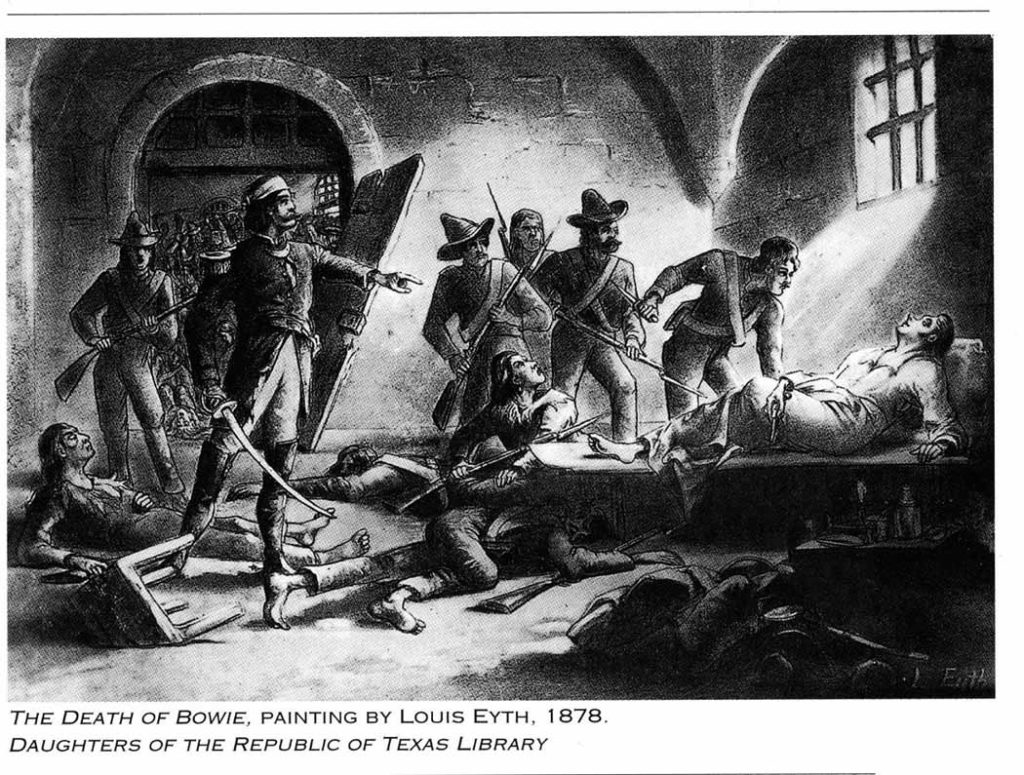
In addition to his participating in the famous Sandbar Fight after which his knife became a sensation on both sides of the Atlantic, Jim Bowie also fought and died in the Battle of the Alamo.
There is, of course, with every innovation in cutlery or other endeavors, a ripple effect. And Schrade Cutlery is a great example as its knife production expanded and the brand became one of the most recognized in the world.
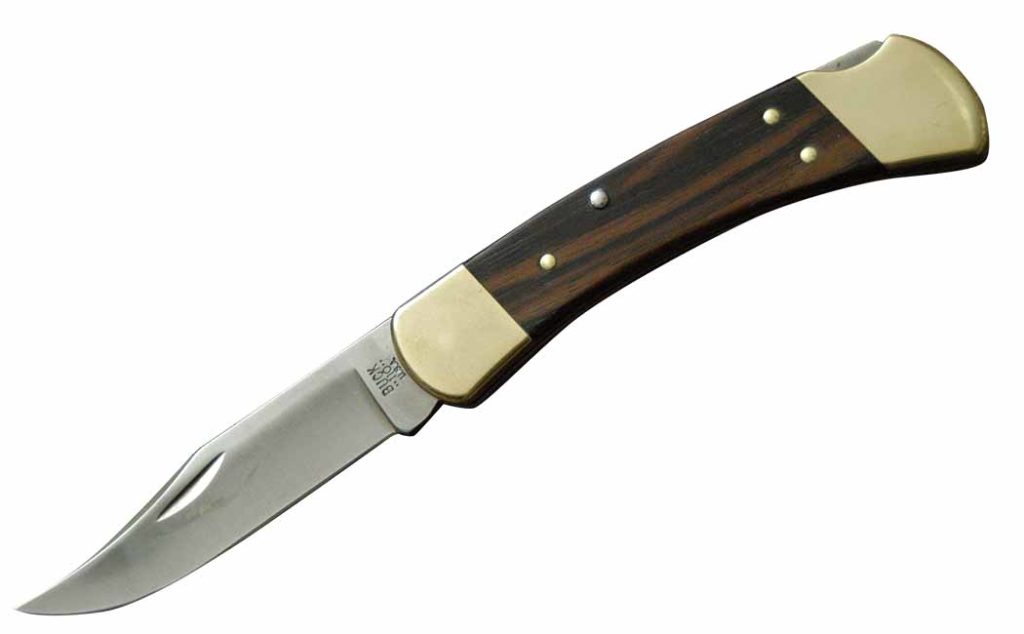
While folding hunters have been out there seemingly forever, Voyles categorically asserts that the Buck 110, which took the knife world by storm almost 60 years ago, is an American knife that deserves to be categorized all by itself.
“Nothing else looked like that knife when Al Buck made it,” Voyles reasoned. “The other lockback folding hunters looked like pocketknives, but I defy you to show me a look like the Buck 110 that existed any earlier. It’s an American style of its own because everybody copied it. The Buck 110 had different construction and sturdiness, and it was so distinctly different that everybody else copied it. The design was so different, and that is attested to by the number of people who copied it.”
According to Bruce Voyles, when Al Buck made the Buck 110 in the mid-1960s, nothing else looked quite like it.
Cutlery Hall-Of-Famer Dan Delavan of plazacutlery.com adds, “Americans have introduced a lot of different blades in the past, including the bowie, KA-BAR combat knife, the hollow-handle survival knife, as well as the basic Boy Scout knife. Each knife served a very basic function, from war to camp and basic scouting activities.
“I think the Spyderco hole is all American,” Delavan opined. “Sal and Gail Glesser came into my shop [the old Plaza Cutlery retail knife store in Costa Mesa, California] back at the very beginning with their folder with the pocket clip and the hole in the blade. They were doing county fairs at that time with their sharpener and introducing their knives. We bought on the spot and have been a lifelong dealer ever since. That has led to a lot of different openings for folders and remains a mainstay in the industry.”
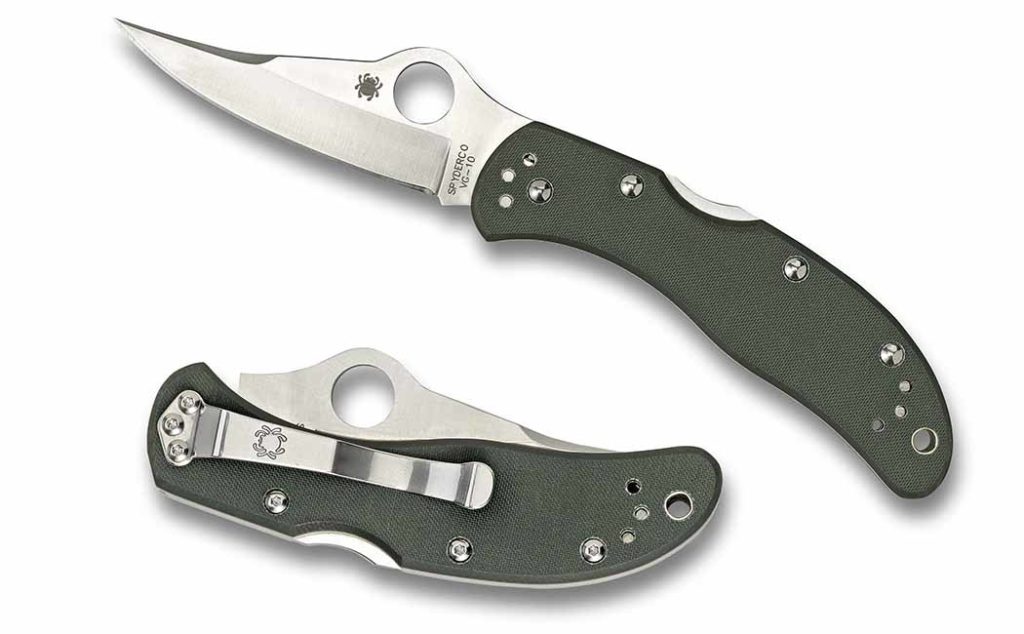
While many may think serrations when they think Spyderco—and they would be correct—the most significant Spyderco innovations are the hole in the blade and the pocket clip. The Worker was the first Spyderco knife with those features, and it was reproduced in 2017 as seen here in one of the company’s sprint production runs.
Quintessential American Knives
Bowie
Historical or modern, vintage or recent, knives with that American flair are identifiable and recognized at home and abroad. Cutlery Hall-Of-Famer Goldie Russell of A.G. Russell Knives sees the bowie as iconic.
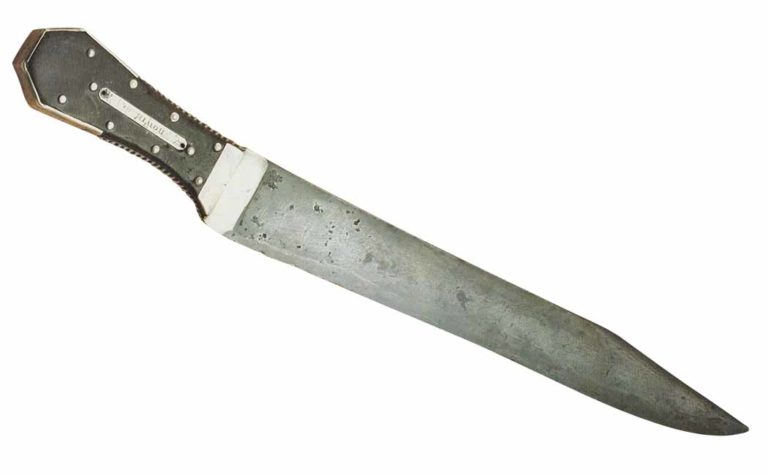
“The bowie knife is the quintessential American knife,” she noted. “It is believed that the first was made for Jim Bowie in the blacksmith shop of James Black* in south Arkansas. [Bowie knives] became so popular that they were manufactured by Sheffield cutlery factories for the American market.”
Fixed Blade Hunting Knives
Russell goes on to raise the work of Cutlery Hall-Of-Famer Bob Loveless and his fixed-blade hunting knives to the top as well. “Bob Loveless forever changed the style of the hunting knife with his drop-point, semi-skinner and utility blade shapes, with the drop-point hunter being the most popular,” she continued. “The influence these knives have had on the world knife market includes not just the blade shapes, but also the shaping of the handles to better fit the hand. These models have clearly influenced the shapes, look and feel of knives made by generations of knifemakers, and will continue to do so for decades to come.”
Bill Moran’s Mark
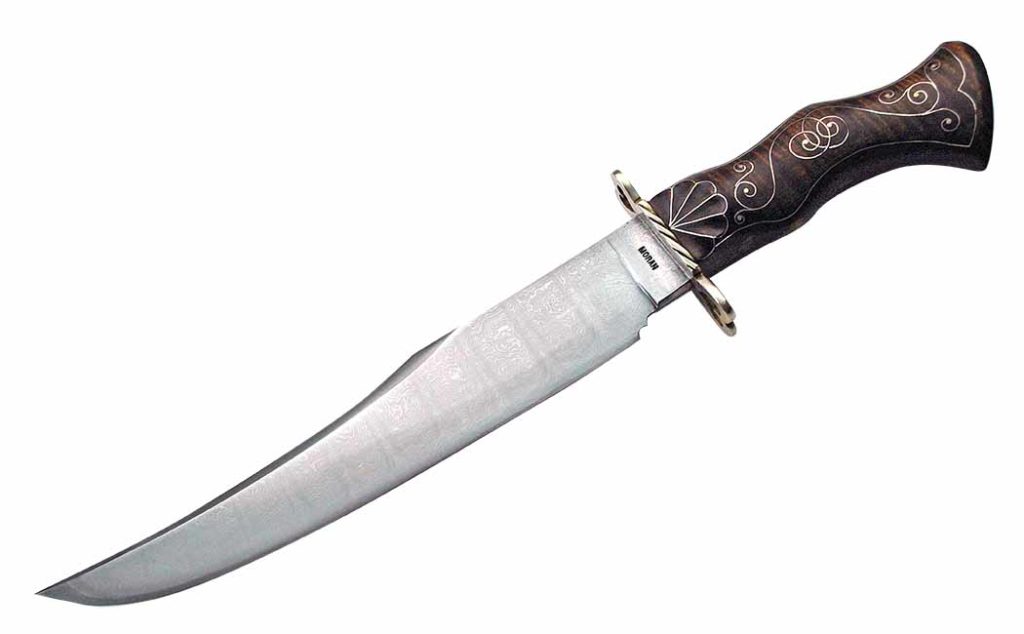
Bill Moran’s statuesque ST-24 not only paved the way for knives of carbon damascus in the 1970s and beyond, but subsequent models in mosaic and stainless damascus as well. (Dave Ellis image)
Also influencing generations of knifemakers were the many camp knives, bowies, fighters and other fixed blades forged from the damascus steel reintroduced by Cutlery Hall-Of-Famer Bill Moran in the early 1970s. Moran’s damascus knives set the stage not only for a plethora of standard carbon damascus knives but also later for stainless damascus and mosaic damascus knives.
Multi-Tool
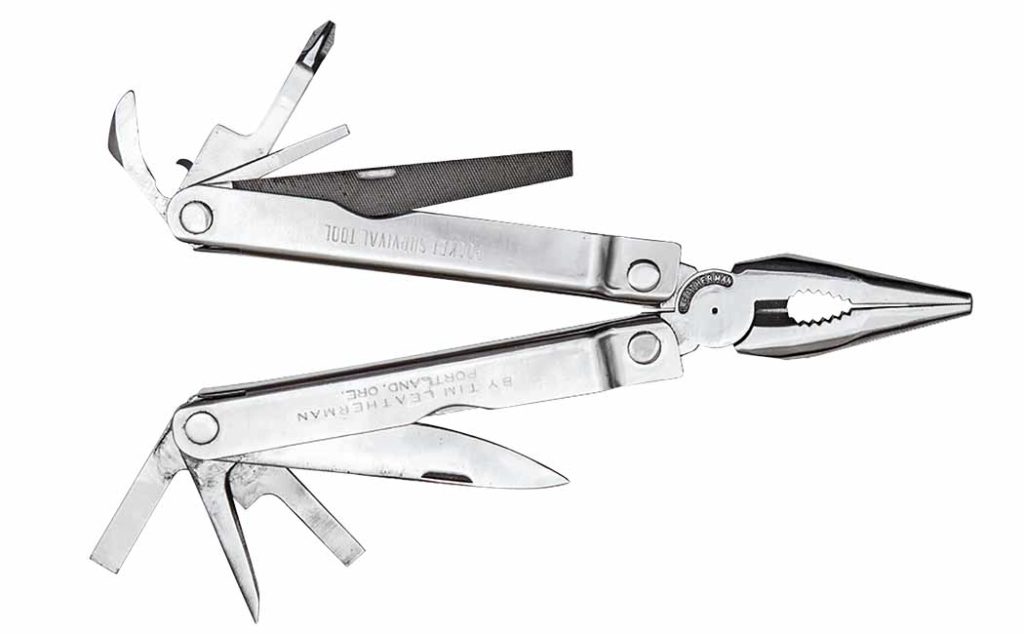
Tim Leatherman holds the multi-tool that started it all: the original Leatherman tool, the PST (Pocket Survival Tool).
Then, there are the variations on a theme. The multi-tool, for some a knife and for others something totally separate, has nonetheless influenced the cutlery market and is among those chiefly American styles.
“Tim Leatherman’s inspiration in the design of the first Leatherman tool created an entire category in the world of knives,” Goldie Russell explained, “but also in the tool industry. Most construction workers, farmers, carpenters, forestry workers and many other segments of our society carry a multi-tool every day. Those who are not carrying one will usually have one in their toolbox.”
American Knife Innovation
Linerlock
Inventiveness, in itself, is not uniquely American. However, at times the original has the potential for improvement, and just as Schrade improved the switchblade, Cutlery Hall-Of-Famer Michael Walker revolutionized what would become the linerlock.
Cattaraugus made a pocketknife with a brass spring/lever that helped prop the blade in the open position. “Walker changed the design so that when the lever locked it kept the long, clean lines of the knife,” Voyles observed. “The bottom side of the blade is blocked, and the big bump there has got something to hold onto. Walker’s lock does not block the bottom of the blade. It blocks the butt end of the tang. Michael didn’t patent it†, and every major manufacturer in the world has knocked it off. Nobody thought it would have such an impact. However, any knife with a locking liner is an American knife because it was an American innovation that did it.”
Russell echoes the sentiment that Walker’s linerlock was revolutionary and an American innovation. “Michael Walker’s genius of replacing the slip-joint spring with the ball detent spawned the entire generation of modern EDC knives,” she added. “His innovation allowed a portion of the liner to be utilized as a locking device. The idea caught on quickly with handmade knifemakers and has now become an integral part of the manufacturing process for almost every manufacturer of knives. This method of creating a locking folder has made knifemaking much simpler, with much less skill necessary to make an excellent functioning knife.”
Tactical Folder
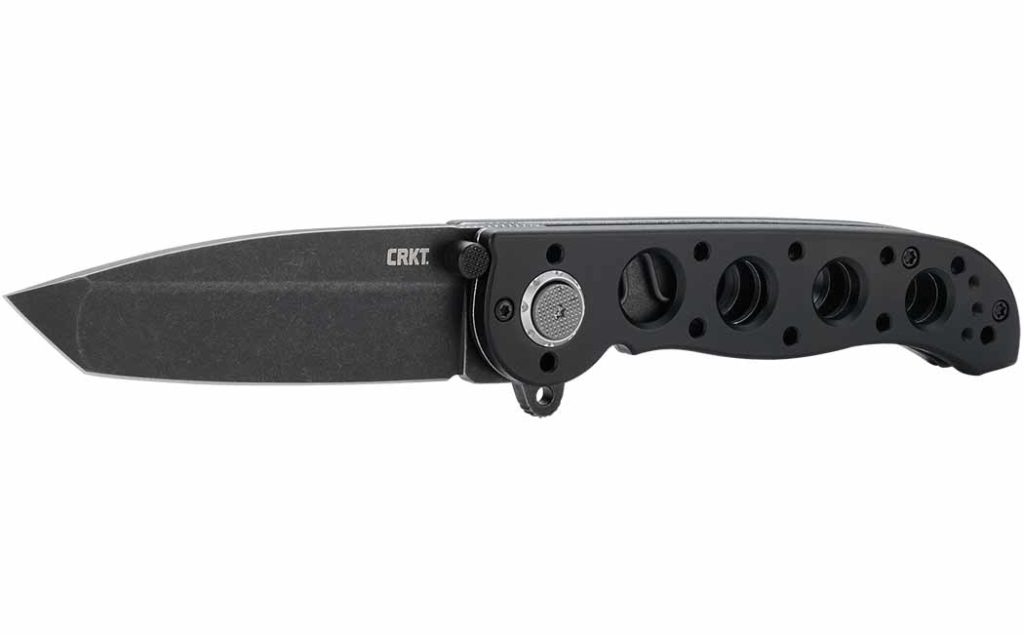
One result of Kit Carson’s popularization of the flipper folder is his long-running series of M16 flipper folders for CRKT. Among the latest iterations is the M16-02DB. In addition to being a flipper folder, the original M16 also was among the earlier top factory tactical folders.
The tactical folder took the world of knives by storm in the mid-to-late 1990s, offering a one-hand folder—usually black—with a non-glare stainless steel blade, a synthetic handle, a linerlock and a pocket clip. While some called it more a marketing approach than a knife, the fact that the folder dominated the market for at least a decade if not longer cannot be denied.
Flipper Folder
Searching her memory and experience, Goldie Russell also identifies the flipper folder popularized by Cutlery Hall-Of-Famer Kit Carson and the SpeedSafe assisted opener by Cutlery Hall-Of-Famer Ken Onion as innovative, influential styles that the world associates with the United States. “When combined with the Walker linerlock, the Carson flipper adds the ability to open the knife as fast, or faster, than a switchblade knife,” she remarked. “It’s a clear improvement over the stud or hole in the blade for the purpose of one-hand opening. The use of the flipper as an opening device has become prevalent throughout knifemaking across the world.
“Then, Ken Onion’s addition of a spring to launch the blade open** is another American innovation that has changed the landscape of the knife industry,” she concluded. “Nearly every American brand utilizes some variation of Ken’s way of using a spring to open a blade quickly. The genius was the bias toward closure that kept a folder from being deemed an automatic.”
Rambo’s Influence
Jimmy Lile’s Rambo knives started the hollow-handle-survival-knife craze that dominated the 1980s and beyond. (from the Randy Rousseau collection)
As the Rambo film franchise grew in popularity during the 1980s, the work of Cutlery Hall-Of-Famers Jimmy Lile and later Gil Hibben made the knives in those motion pictures stars in themselves, rivaling Sylvester Stallone for worldwide acclaim. Voyles insists that the Rambo knife is an American phenomenon that still impacts the knife market today.
“The Rambo knife is uniquely American for two reasons,” Bruce said. “Jimmy Lile designed it and made the knives for the first two movies, and it ignited a boom in survival knives that exists today. Then, the other historical tie-in is that in the 1980s every boy who could walk had a survival knife with a big, round compass on the end and a hollow handle. Even today, those boys are adults and they love the nostalgia of that handmade Rambo knife. Indirectly, Jimmy Lile created all this, and the Rambo knife is uniquely American in that regard.”
Final Cut
Considering the knives closely associated with the United States, their impact is obvious. Those styles associated with the good ol’ USA still resonate across the market and in the inventive minds of those who brought them into being.
*Editor’s note: While many do indeed believe that James Black made a knife for Jim Bowie in Black’s shop, such a knife has never been definitively proved to be as such because Black did not mark his knives.
†Though unable to obtain a patent on the linerlock, Walker was able to obtain a trademark on the name linerlock, a trademark that has since elapsed.
**Cutlery Hall-Of-Famer Blackie Collins also made one of the first versions of an assisted opener.
Have vegetables that need knocked down to size? Get chopping with the Nakiri.
The Japanese people have historically produced excellent knives specialized for dedicated tasks. The culture of the region did not put a heavy emphasis on speed and slop, but rather precision and the utmost perfection of a given craft. Following this ethos came a specialized knife dedicated to culinary artistry.
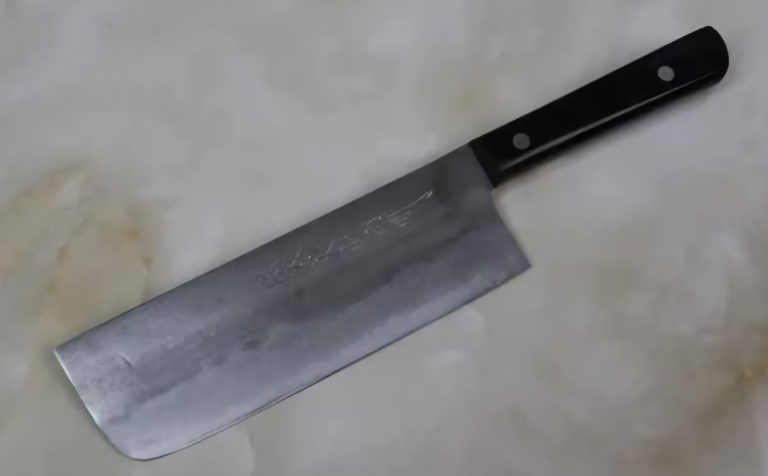
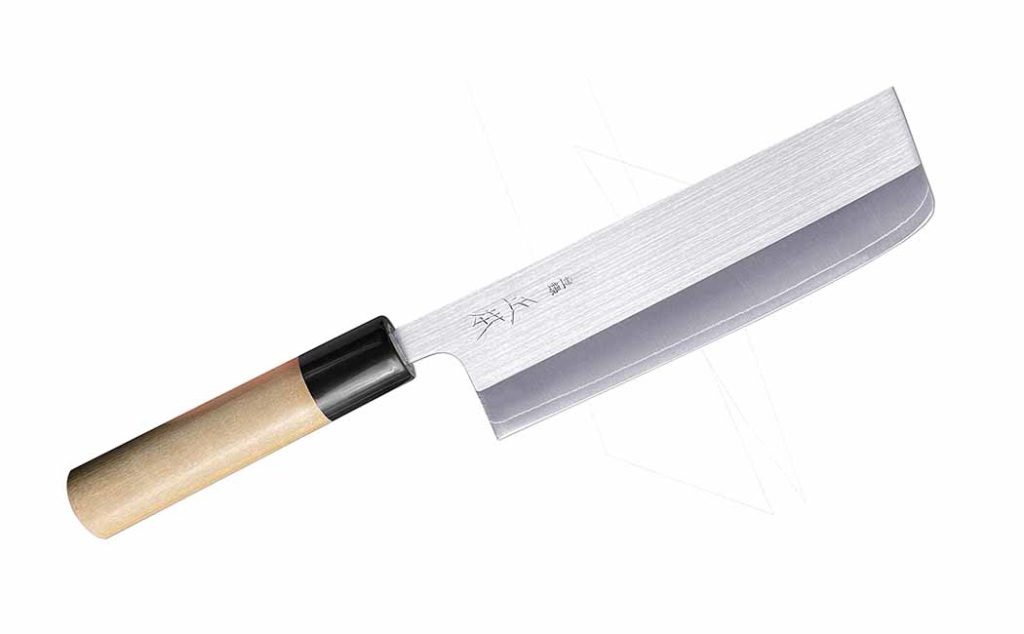
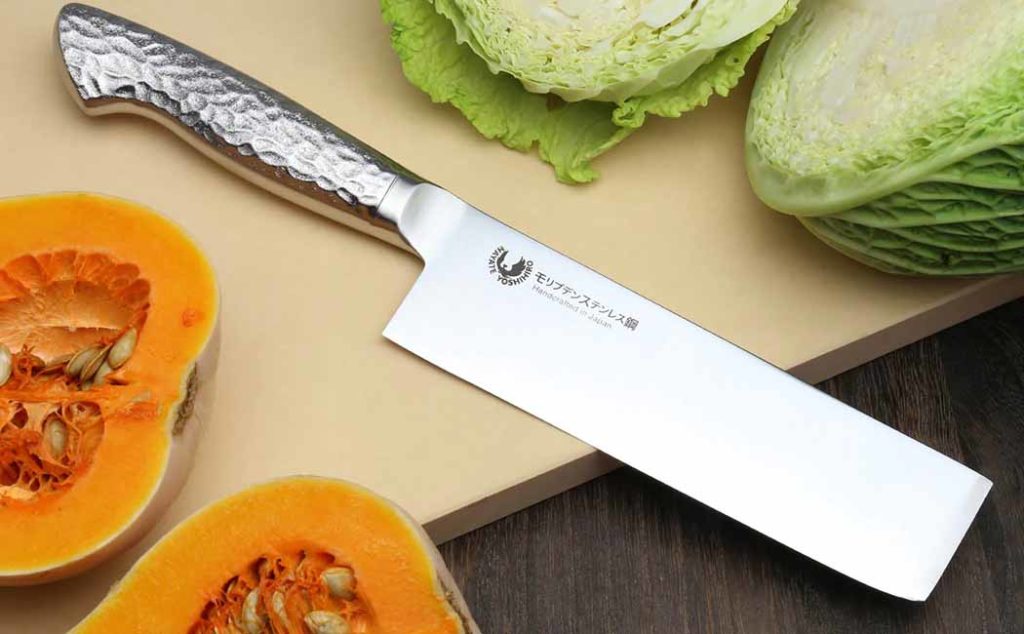
The Nakiri (also Nakiri Bōchō) was developed specially for cutting vegetable and not much of anything else. The blades on these knives are thin, sharp and, surprisingly, not as ancient as we understand many Japanese blades.
In this article, we’ll explore the history of this dedicated tool, its modern uses and look as some of the best nakiri available. So, chop, chop… let’s get cooking.
History Of The Nakiri
Many blade styles we associate with Feudal Japan came into use after Western contact was established. The Nakiri was one such product and it came at a time of significant modernization in the country.
Traditional feudal culture in Japan would come to an end over the course of the 1800s, culminating in a tremendous shift from a medieval society to a completely industrialized nation. These culinary tools became a feature of Japanese blade makers, and eventually, they arrived at a point of heavy specialization.
The Nakiri is a vegetable knife, plain and simple, in fact, the name translates to ‘knife for cutting greens’. It was made over time to excel at this one task. As a result, it isn’t ideal for much else.
Despite its round, tipless shape it is not a cleaver. The blades on these knives are very thin, sometimes to the point of being fragile. They should not be used against bone or even used on meat for the most part. The entire concept is that the Nakiri makes clean cuts in veggies, as opposed to the more coarse, crushing cuts found on chef knives.
Nakiri Vs Western Chef’s Knife
Looking at the Nakiri next to common Western chef knives isn’t exactly a fair comparison. The chef knife is meant as a multipurpose blade that cuts virtually anything in a kitchen without missing a beat.
Most Western chef knives are derived from our own historical camp knives, seax blades, and Central European ‘messer’ knives. These are structurally far more robust and usually taper down to a fine tip with a thicker spine at the handle. Not so with the Nakiri.
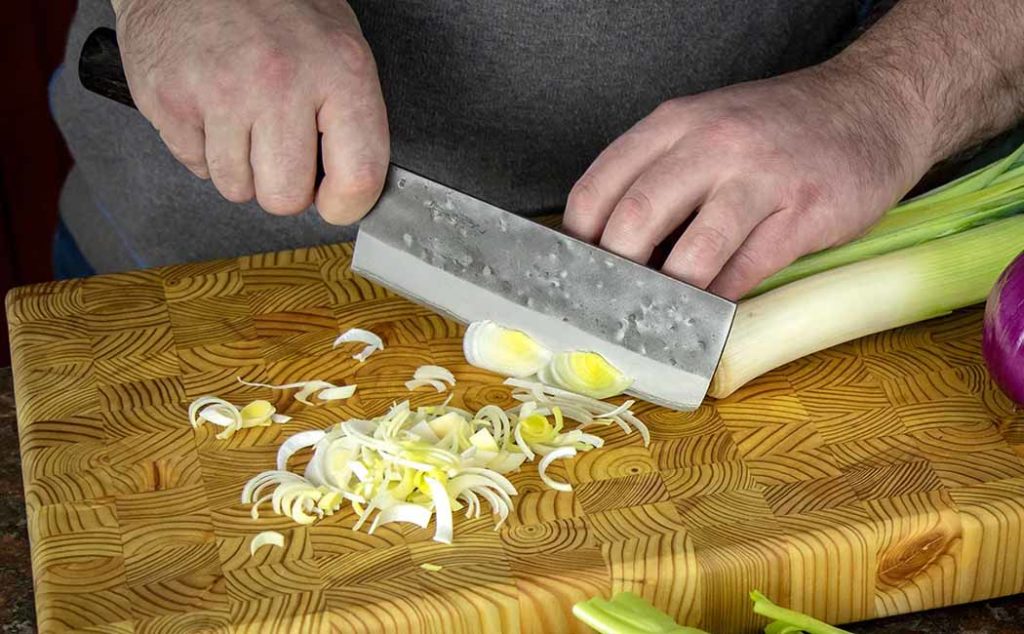
Its shape is slim and has a straight edge, meaning in one motion it can be made flat against the cutting board. The height of the blade from the spine to the edge is also greater, enabling the hand to come to rest above the cutting surface. Contrast this to the Western chef knife, which works in a back-and-forth rocking motion. The Western chef knife is in theory not as efficient for motion, but how much this matters is subjective to the user.
The Nakiri Edge
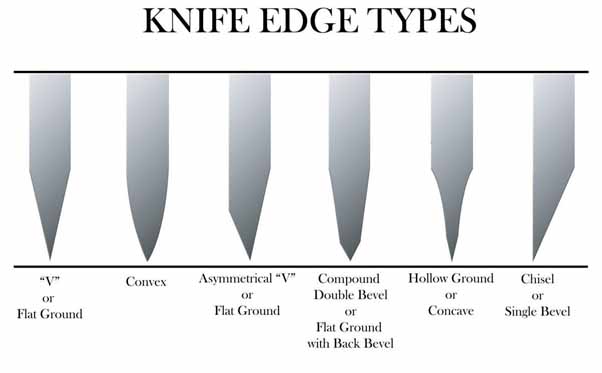
While the knife is commonly available on the commercial market with a standard, double-beveled edge, many traditional Nakiri boast a chisel-beveled. In short, as previously mentioned, one side of the blade is completely flat. Depending on if you are right- or left-handed determines which side your blade is beveled. Advanced users can take advantage of this feature for enhanced cosmetic presentation of food, such as spiral peeling, ornamental julienned strips, and more.
Advantages Of The Nakiri
Honestly, one-on-one against a standard chef knife in your own kitchen you may not notice the difference at of an Nakiri. The exception being, in the overall style of your food presentation. Furthermore, if cooking is part of your livelihood, you will like the shape, style, and ease of use of the Nakiri. It is a tool that can be used to step up the cosmetic end of delicacies
In short, if you spend time with this knife style in a professional setting, where aesthetics are equal to edibility, you might find the Nakiri an excellent companion. Home chef’s, on the other hand, might discover there cuisine doesn’t gain much with one at hand.
Disadvantages Of The Nakiri
The elephant in the room, you need more knives to accomplish a given task if you use a Nakiri for its intended role. This doesn’t jib with many pro or amateur chefs in the west.
Most Western cooks appreciate the flexibility and ease of the Western-style chef’s knife, a dedicated vegetable chopper seems redundant. In turn, it’s a great leap to investing in a specialized tool such as a Nakiri.
Best Nakiri Options At Every Price Point
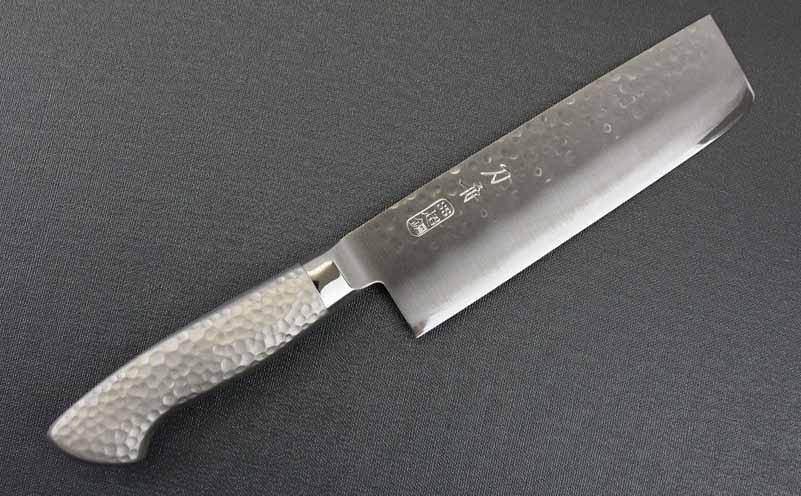
Toshu Hammer Finished
Made in Japan, the Toshu knife is made to work without compromise. The knife is not traditionally constructed, rather it is made of all stainless steel and is dishwasher safe. This is an important consideration for the home chef short on time. The knife features the beveled “Edo-Togi” grind, meaning that it isn’t double-beveled like most Western knives. It is very easy to keep clean, and sharp choice for everyday vegetable chopping vegetables duty.
MSRP: $213
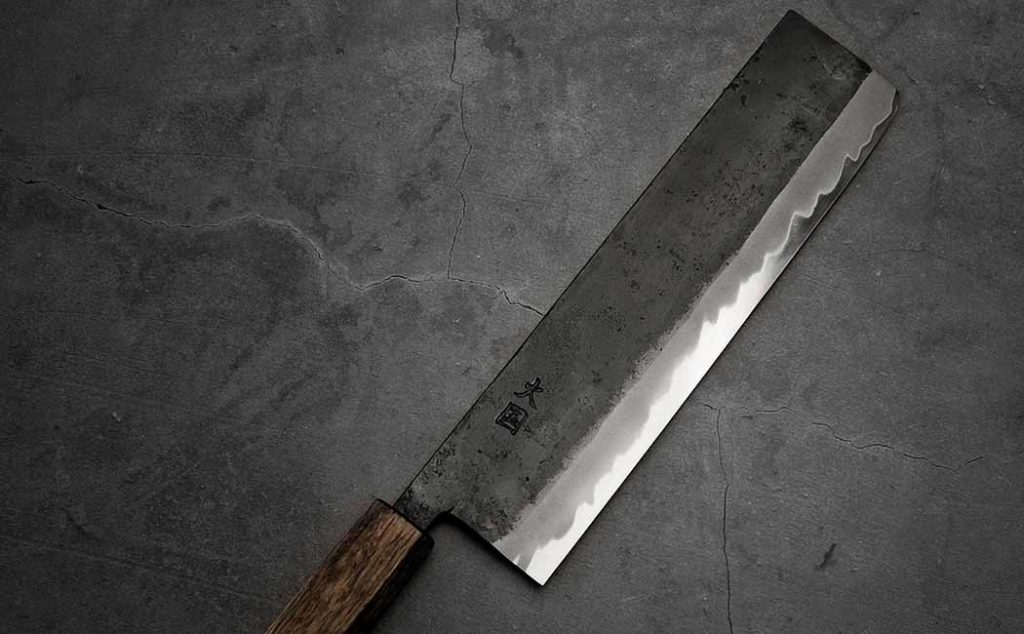
Hinokuni Shirogami #1 Tall
A custom Nakiri from a smaller maker, the Tall Nakiri might be the perfect large-format vegetable knife. If you are making salads, working on squash or melons, or trying to dice up a large quantity of veggies, this knife will knock them down to size. The knife is a labor of love, the maker of this brand is a young blacksmith that is well-versed in traditional methods. Interestingly, the knife is made of an uncommon (in America) type of carbon steel, Shirogami #1. This is a blade steel favored by the best Japanese smiths. However, neglected it can easily corrode. Like many traditional items, regular care is necessary to maintained it, but do so and the blade should last a lifetime.
MSRP: $180
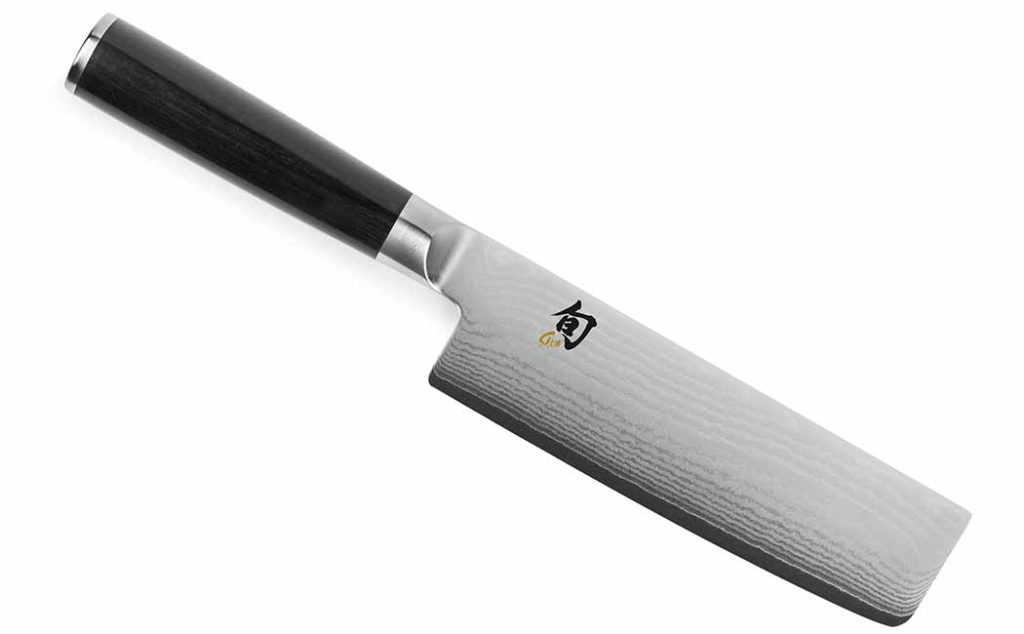
Shun Cutlery Classic
This Japanese knife is popular, well-constructed, and made in… China? No surprise, the broad Western market sees just about everything made in China these days. While not exactly up to the quality or authenticity of a true Japanese Nakiri, Shun Cutlery does a great job with this knife for the price. Chef among these assets includs using a novel layering method. The blade itself is not entirely Damascus, rather it is a stainless core sandwiched in layer of Damascus. It is a great starting point for getting into Nakiri but is priced in such a way that it may be your only one for years.
MSRP: $170
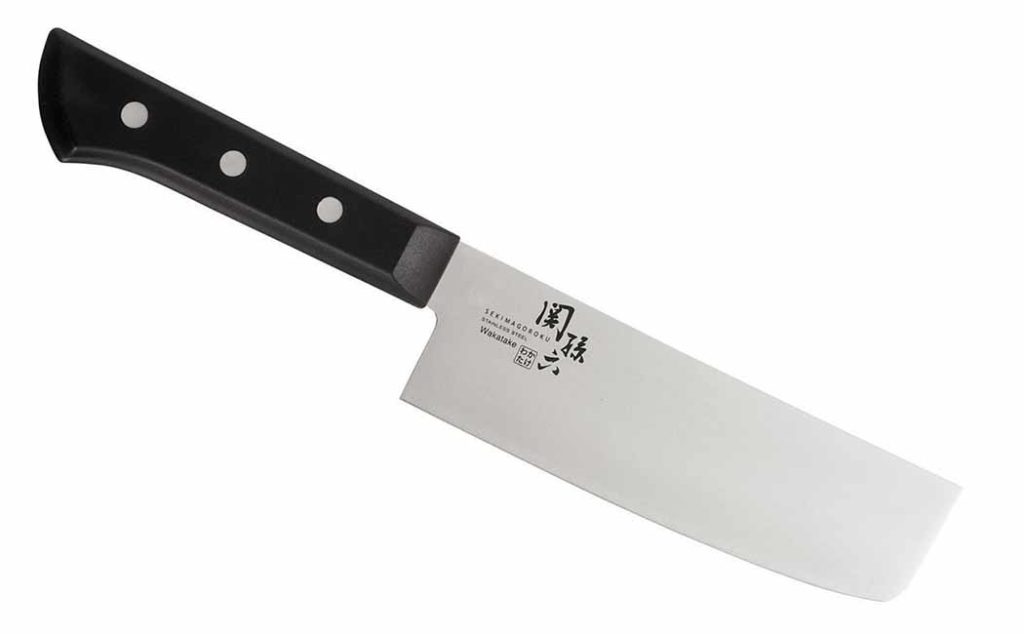
Kai Seki Magoroku Watakake
This Kai knife is a genuine Japanese-made Nakiri, fully sized in every way but price. Retailing at under $20, this is a great knife to add to your drawer if you want the function of a Nakiri but don’t do enough dedicated veggie chopping to warrant a several hundred-dollar in expense. Many people are just casual cooks and can certainly appreciate the utility a Nakiri brings, though just not enough to make a hobby of fleshing out an entire Japanese kitchen set. This knife is not of the same quality as the others on this list in terms of the overall construction but is certainly capable of most uses. Considering chopping veggies are the end use, you should do just fine, except perhaps in some of the most advanced techniques that require the features of a custom knife.
MSRP: $20
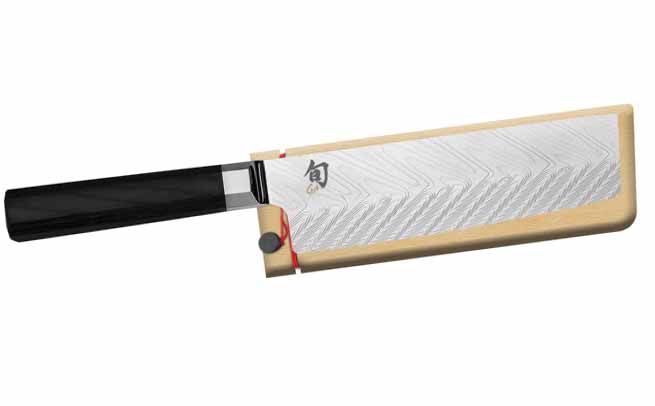
Shun Cutlery Dual Core
Another great product from Shun, the Dual Core Nakiri is a dull Damascus blade of 72 layers of VG10 and VG2 steels. As far as production Nakiri knives go, this is probably as good as it gets before you start to look at custom options. The knife here is priced higher, more than double that of the other Shun listing in this article. The manufacturing process results in a blade holds its edge longer and remain in service for extended periods of time, especially in a high-production restaurant setting. As a production knife, this product is great for showy use in a hibachi, but also easily replaced should it become damaged. The styling on this knife isn’t quite traditional Japanese, though patrons and guests will likely not notice that minor detail.
MSRP: $330
Masamoto FH Japanese
Masamoto’s product is a reasonably priced, high-performance traditional Nakiri made in Japan. This knife is just about as good as it gets from the standpoint of function and traditional appearance. Made of modern steel and reasonably corrosion-resistant, it’s a forgiving knife. But you still need to care for it after every use. The handle is made in traditional style out of buffalo horn and magnolia wood, both of which add to its already incredible appearance. It is not the most costly Nakiri here by far, though when combined with the extra maintenance needed to keep it ship-shape, isn’t for someone who will just throw it in the dishwasher.
MSRP: $229
Yoshihiro Hayate
Last on this list is certainly not the least. The Yoshihiro Hayate is a handcrafted, high-end Nakiri that is for use by the most discerning culinary aficionado. The knife is made of extremely hard and difficult-to-work with ZDP-189 steel. Not only is it beautiful, but the knife is also NSF-approved for use in commercial kitchens, making it one of the most expensive single-use products in a restaurant. However, thanks to its superior steel and impressive edge retention, the knife will ultimately save the chef effort on high-volume cutting and other laborious tasks. This Nakiri is made with excellent materials in the handle as well, including premium ebony with a sterling silver ring. Completing this knife is a lacquered cover for storage. Of note, this knife is double-beveled, making it great for use with both hands as opposed to specializing to left or right. If you decided to spend the money on something like this, you will never need to seek out a replacement. Short of a completely custom knife made to your hand and style of cutting, this is as good as it gets.
Harking back to American military glory and post-war prosperity, antique switchblades from the 1940s and 1950 have enduring appeal.
From its first patent in 1884, the switchblade was an important addition to most early U.S. cutlery companies.
According to Mark Erickson, author of Antique American Switchblades, between 35-to-40 companies made and/or sold switchblades, including almost all of whose names long-time collectors recognize: Aerial, Camillus, Case, Challenge, Colonial, George Schrade, KA-BAR, L.L. Bean, Novel Shapleigh Hardware, Queen, Remington, Schrade Cutlery Co., Utica, Wade and Butcher, and Shapleigh Hardware, to list a few.
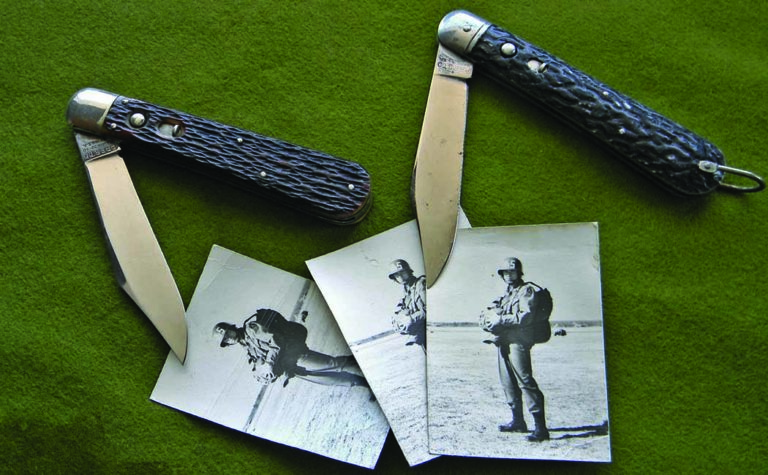
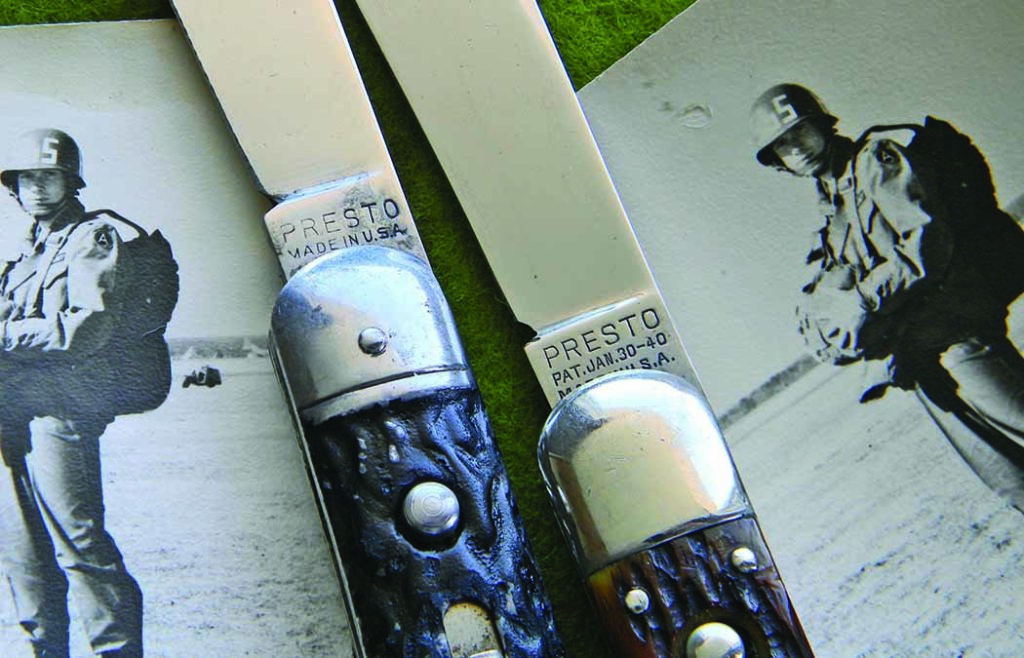
These two switchblades with the Presto stamping by George Schrade Knife Co., are among those that played an important part in the success of American paratroopers during World War II.
Because of the collectibility of the named companies and the significant variety of styles, sizes and handle materials associated with them, switchblades have become a serious endeavor for many collectors of antique knives.
Invention Of The Switchblade
As a serious cutlery collector, my downfall has been fingernails that bend backward with even the smoothest opening blades. The switchblade innovators had fingernails in mind when they produced a knife that could be opened without using a nail. In fact, some of the best switchblades are found in women’s old sewing baskets.
In fact, early switchblade ads tout the folder’s ability to be used by people with weak fingernails. “These knives will be a wonder for those who have difficulty opening a traditional knife” stated one such ad.
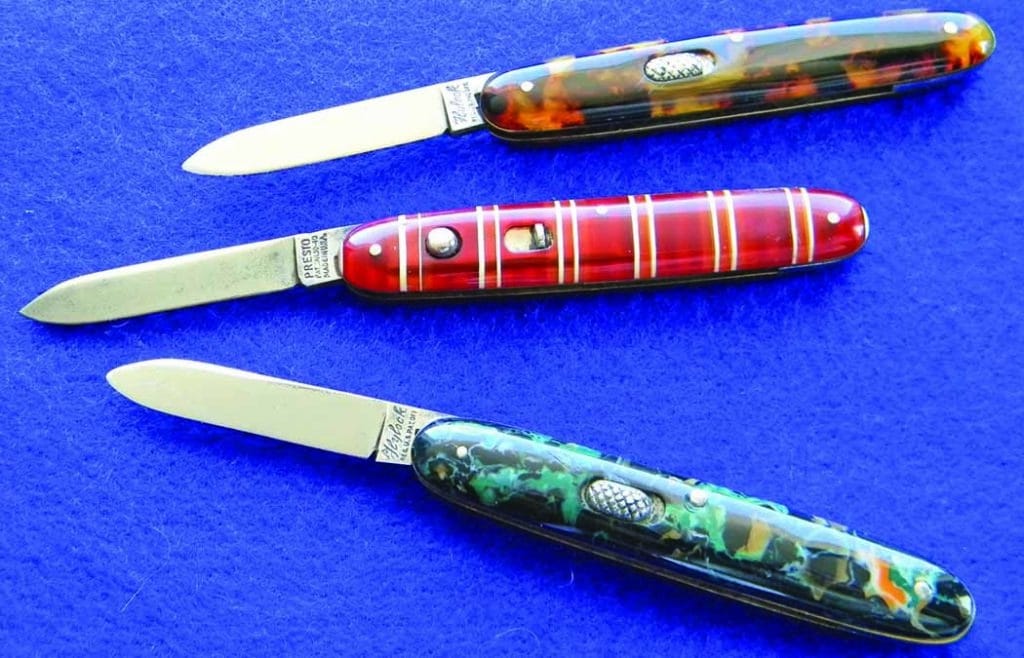
Celluloid was a very popular handle material on antique switchblades. Celluloid types, from top: a George Schrade in imitation tortoise, another George Schrade model in candy stripe, and one from Flylock Knife Co., in blue, pink and black swirl.
For many other occupations, the switchblade and its ability to be opened with one hand has proven immensely important. Mechanics, fishermen, ranchers, soldiers, veterinarians and even Boy Scouts were frequent users of the pocketknives. With a wiggling fish in one hand, it is easy to see how a switchblade could be a valuable asset to most fishermen when cutting a line.
Moreover, most switchblades have a lock/safety that keeps the blade from opening accidentally and the open blade from closing on the hand. An early Flylock Knife Co. ad touted, “The ideal knife for all outdoors and sports use. One hand only required to open or close, leaving the other hand free to grip a rod or gun.”
World War II Switchblades
World War II brought with it the necessity of supporting soldiers who parachuted behind enemy lines. Switchblades procured for the U.S. military were designed to cut the parachute suspension lines that became entangled during landing. The knives were carried in what has been described as “neck pockets’ in jump uniforms.
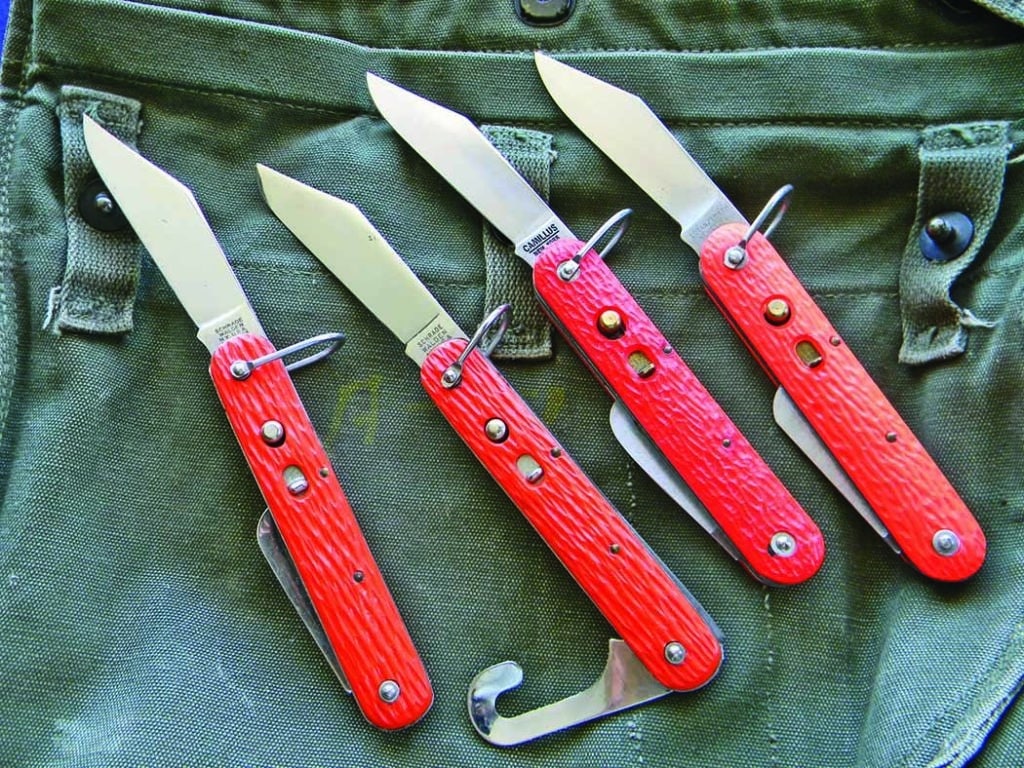
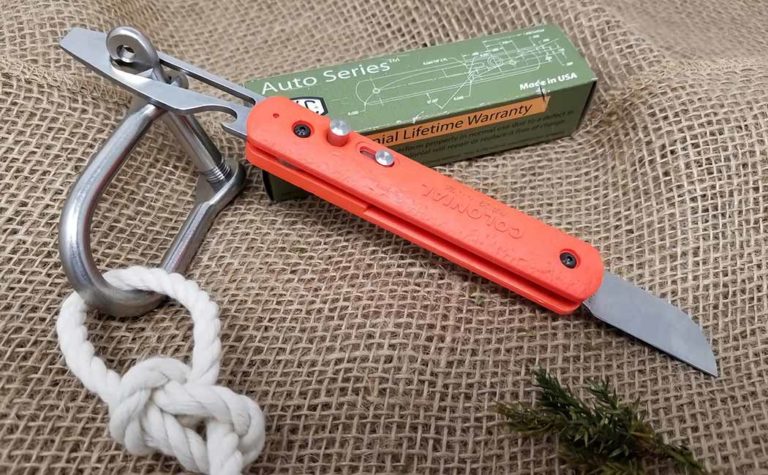
Military switchblades designated “MC1” included models in orange handles for heightened visibility. They were made by Schrade until 1960, when Camillus took over the contract. The knives have a master blade opened by a push button and a manual shroud cutter.
There are continuing discussions about the knives specifically made for and used by the U.S. military during the war. The discussions center around whether switchblades issued to troops all had jigged bone handles or jigged metal sides. Another discussion is whether all switchblades used by paratroopers had a bail—known in the military as a “lanyard staple”—or whether knives without bails also were used.
Units that used the knives included paratroopers in the 82nd Airborne and 101st Airborne Divisions, which included the 505th, 507th and 508th parachute infantry regiments. The 505th Infantry Regiment website shows switchblades made by Schrade Cutlery Co. stamped “Presto” with jigged bone handles and metal handles made to look like jigged bone painted black. Knives both with and without bails are included in the photographs. Switchblades made for World War II paratroopers also include those stamped Schrade-Walden and Schrade Cut. Co.
The book, 4 Stars of Valor: The History of the 505th Parachute Infantry, describes the equipment carried by paratroopers. In addition to main and reserve chutes, full uniform and helmet, the paratroopers carried over 70 pounds of equipment, including an M-1 carbine with ammo, Mae West life jacket, switchblade, water-filled canteen, trench knife, fragmentation and smoke grenades, mess kits, three days of K rations, escape map and compass, gas masks, toiletry items, 30 feet of rope, blanket, half a shelter and first-aid kit.
Post-War Military Switchblades
After World War II, several companies made switchblades for military personnel. According to one website, the first such knife was produced for the armed forces by Schrade Cutlery Co., designated as MC-1, an airman’s paratrooper knife, in 1957. Sometimes the knives are referred to as aircrew survival knives.
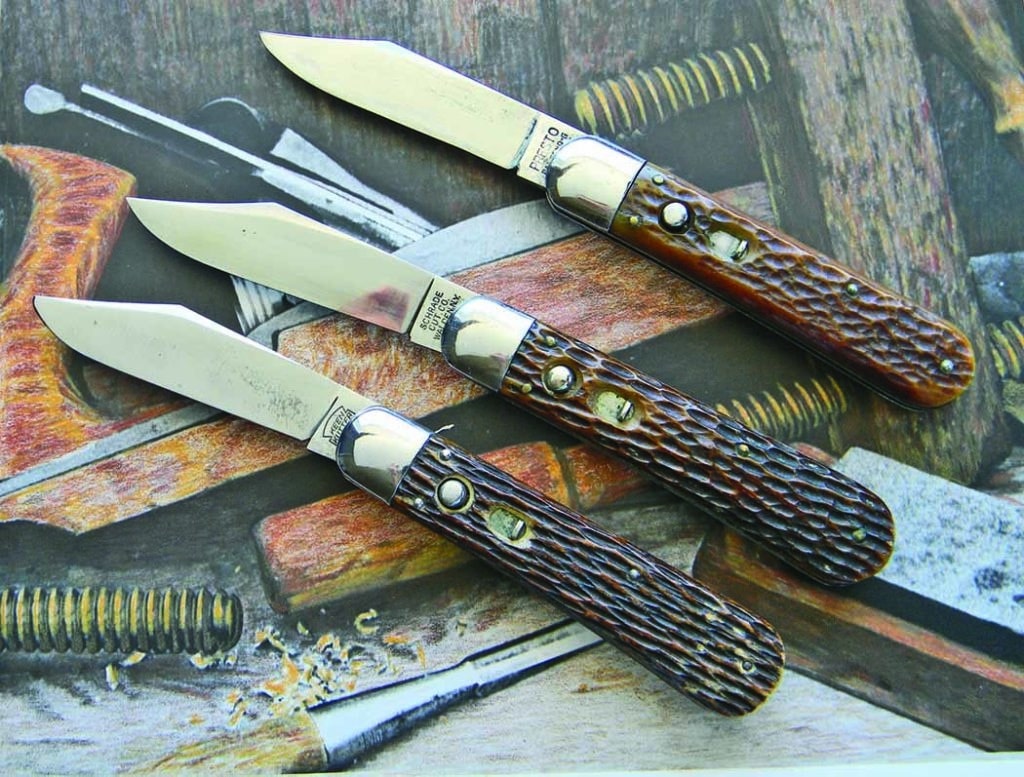
Three jigged bone switchblades, from top: Schrade Cutlery Co., George Schrade Knife Co. and one of the rarest of antique models, one stamped “Keen Kutter,” a trademark of Shapleigh Hardware. Schrade made the knife.
The first contract was awarded to Schrade Cutlery followed by a second contract to Camillus, and a third to Logan-Smyth. The orange-handle switchblades had two blades: one a master spear pattern opened by depressing the button, and a second blade shaped like a hook to cut parachute suspension lines. In my estimation, the hooked blade is not sharp enough to easily cut parachute lines and must be resharpened.
Civilian Switchblades
The early 1950s brought a renewed interest in cheap, colorful switchblades, with thousands of knives made by Imperial in its Jack-O-Matic Texas toothpick model, and Colonial, which used the Shur-Sharp stamp on its colorful models. The fishtail jackknives and the Texas toothpick styles were by far the favorite examples produced by the two companies.
The George Schrade Knife Co. continued to produce popular switchblades with celluloid handles stamped Presto. The knives were made with a single blade, double blades (the latter with a push button for each blade) and even a letter opener with a push button in one end.
Celluloid Handles On Antique Switchblades: Why?
The handle material for most of the inexpensive switchblades was celluloid. Thin sheets of the versatile plastic-like substance were molded around the knife’s metal sides. The most popular celluloid style was candy stripe. The knives also can be found in a wide variety of swirled celluloid handles in a myriad of different color combos, some with such recognizable celluloids as cracked ice and imitation tortoise.
Because the knives were inexpensively priced, they were extremely popular with boys in the 1950s. Because of the knives’ widespread use, some advertisers saw an opportunity to emboss various ads on them, giving them away as a novel company promotion gimmick.
Allure Of Antique Switchblades
Because of their connection with the heroic actions of airborne troops during World War II, antique switchblades have continued to be a popular cutlery collecting niche. Moreover, since almost three dozen companies, each producing a vast array of sizes and handle materials, made the knives, the collecting field is wide open.
Even in the 1950s cheap construction, made more evident by the continuous opening and closing of the blades, the knives remain popular collectibles. No doubt one reason for the popularity is that antique switchblades remind many of the Golden Age of the 1950s and ’60s when kids played outside all day, shot their BB guns, and hit the corner gas station for a cold soda and a candy bar.
Battened down the hatches, we’re going full-speed ahead talking about the sailor’s rigging knife!
Rigging knives are a particular type of cutting tool developed in conjunction with sailing ships. There is not a particularly well-documented history on the use of these knives, but by the Age of Exploration, the tool was quite common aboard virtually every vessel.
Bear bones, the rigging knife was designed to cut line. Together with the equally common marlinspike, it could be used to manage lines by cutting, splicing, and freeing knots. The simplicity of these tools has given them long life, and as a result, the knives are available in modern versions suited to our uses today.
The knife has not changed much in hundreds of years, a testament to how it was perfected before it became miniaturized and able to fit in a pocket.
Use And Evolution Of The Rigging Knife
The rigging knife is a similar case. You are almost always better served by a heavy fixed-blade knife than by a small, delicate folder. But, as time has gone on, the need for chopping through lines thicker than your arm has declined for most nautical enthusiasts. In turn, as line material changed from Manila and natural materials to nylon, large-blade rigging knives went the way of the tri mast. In its place, a smaller folding version became the norm.
The rigging knife has, like the penknife, been a multitool of sorts for generations. The earliest examples were of course dedicated to their task. As times changed, it was combined with similar tools that were also at one point their own thing. Let’s take a look at some of the tools likely found on a modern rigging knife.
Sheepsfoot Blade
A sturdy sheepsfoot blade tackles cutting and chopping tasks with easy, while protecting the user from perforating him or herself.
Long before this profile was in fashion for EDC knives, the sheepsfoot profile was used for cutting rigging. The blade shape was perfected over time and was considered the best way to cut heavy lines. The cleaver-like abilities of this profile, when combined with a thick spine, allows it to chop through thick line as well as be pounded through with a mallet if need be. The lack of a defined tip reduced the chances of injury as it couldn’t really be used to stab or otherwise harm by thrusting.
Marlinspike
Need to loosen a mooring line? The marlinspike is your tool.
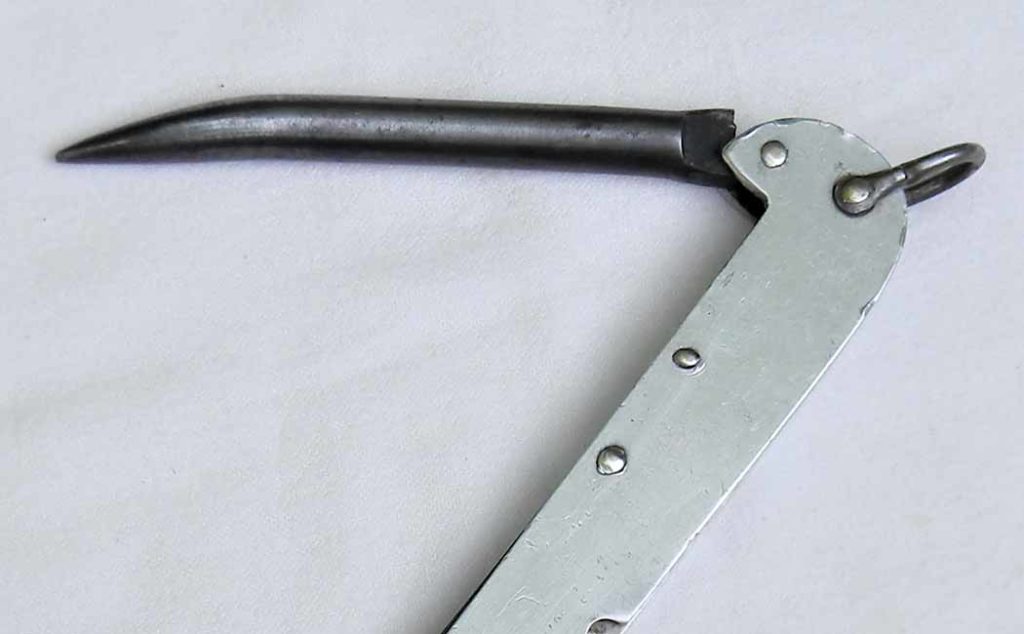
The marlinspike is a linework tool and it is quite simple in terms of how it’s used. It is like a large needle of sorts, meant to work in between tightly tied ropes in order to loosen knots. That is just about all it does. This less-than-glamorous job is of the highest importance on any vessel from canoes to warships and the lack of it can cause serious issues.
Historically these tools were not small, some even exceeding 20-plus inches. Heavy rope, 5 inches or thicker, was common for mooring lines and these massive marlinspikes could move even the largest lines. Today most people use much thinner lines, usually 1-inch or so, on recreational vessels. Half-inch is common for duck boats and other flat-bottom craft. Kayaks and canoes usually work with a 1/4-inch line. Most of the work a modern marlinspike encounters is going to be on a relatively thin nylon line, making huge spikes unnecessary.
Shackle Key
The shackely key is a must to break open a problematic shackel on deck.
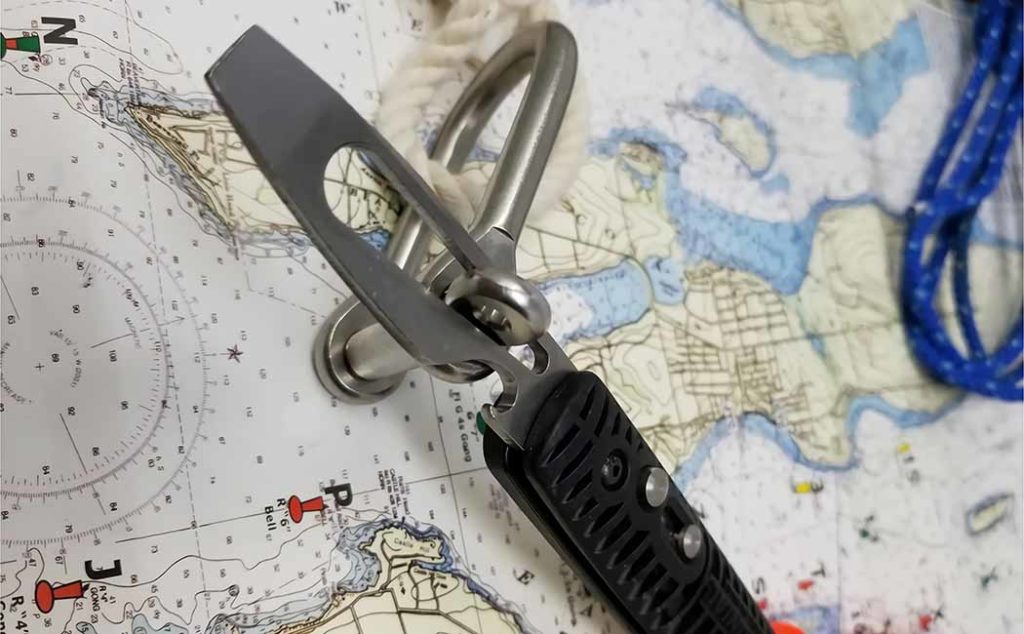
The shackle key is just that, a key for unlocking shackles. Shackles are a D-shaped clip used to attach various parts of the rigging together. These devices are usually tightened down beyond what can be accomplished with bare hands, so the key is applied and used to open it. There isn’t a high degree of utility for this accessory on most small, single-person watercraft. Many people, however, still find the tool useful for other duties. If not, it’s prized for its connection to sailing’s golden age.
Top Rigging Knives Available Today
Davis Instruments Deluxe Rigging Knife
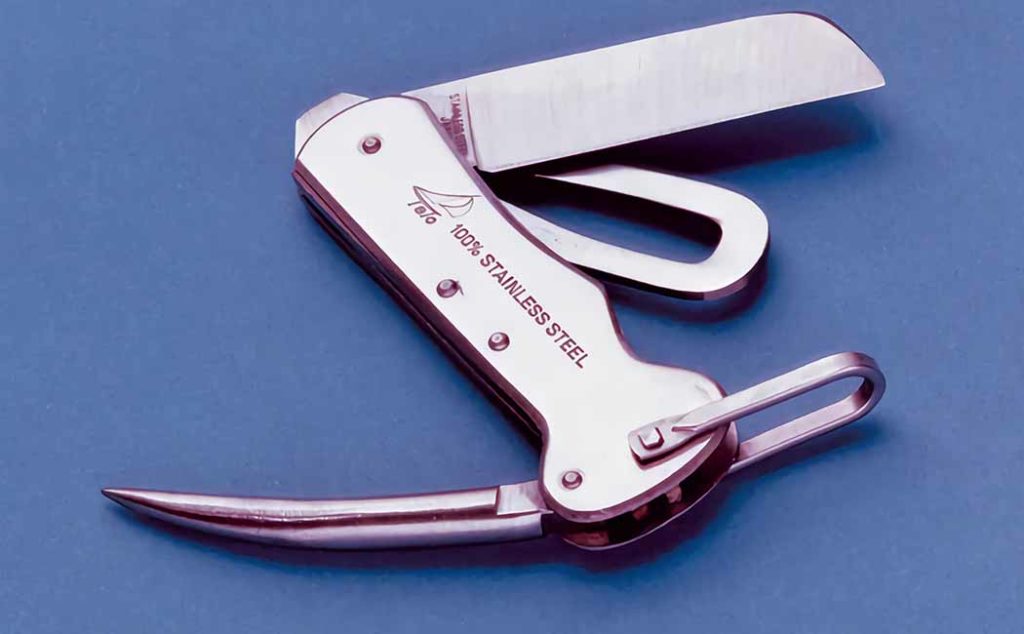
Inexpensive, rugged and handy, Davis’ rigging knife has all based covered.
This is among the most baseline functional rigging knives on the market today. Davis‘s knife is inexpensive, under $30 retail, and has every single tool you want in a rigger. Because of salt water’s corrosiveness, the knife is constructed completely out of stainless steel and is easily kept clean and in service. If it ever gets to the point rusting out it won’t break the bank to replace. Functional knives like this lack glamor, but for what it is used for you will have a hard time finding something that truly exceeds it in utility. The folding knife features a marlinspike, shackle key, screwdriver, and blade.
MSRP: $27
Gill Marine Multitool
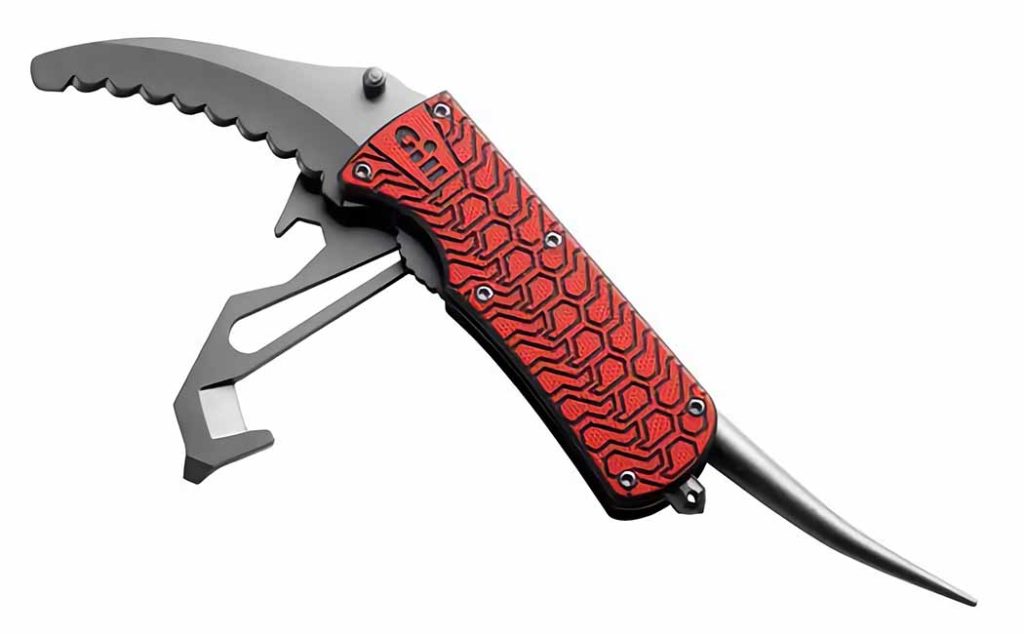
Gills’ option offer a nice update to the design—particularly the G10 handles.” width=”696″ height=”431″> A modern iteration of the classic rigging knife, Gills’ option offer a nice update to the design—particularly the G10 handles.
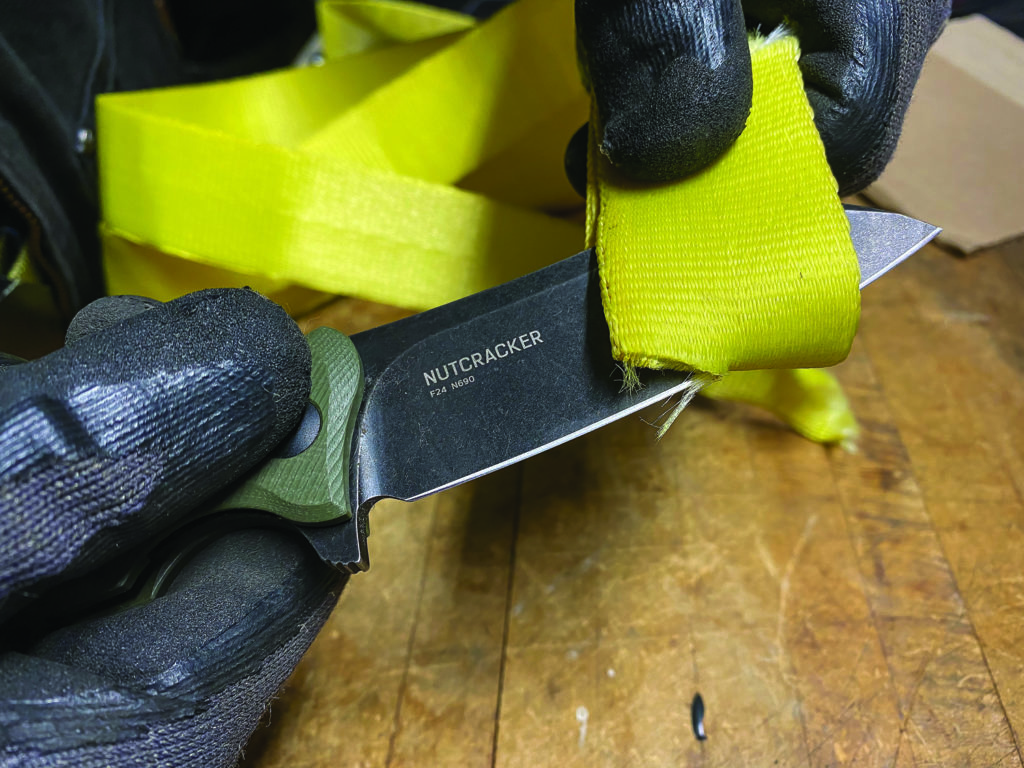
This tool retains many of the necessary, time-honored features common to rigging knives but adds some much-need advancements. Taking a hint from automotive rescue tools, the Gill tool a glass breaker and strap cutter to deal with tie-downs and hard-surface obstacles. The blade locks open, which is more than can be said of most rigging knives. The edge of the blade has deep, scalloped serrations that won’t hang up in nylon rope. To increase grip in wet conditions the knife has a machined G10 handle in bright orange. Lastly, the knife has an integrated screwdriver and shackle key. It does not come with a lanyard but has a pouch that can be worn. Interestingly, the knife has a titanium coating, something not usually found on tools at this price point.
MSRP: $45
Old Timer Mariner
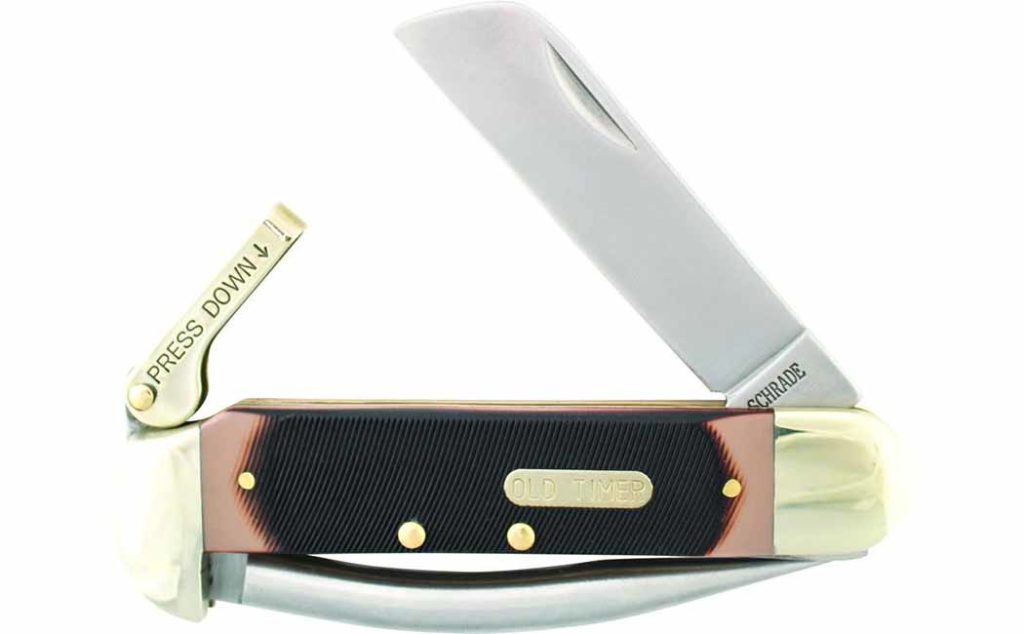
The materials that make up the Old Timer Mariner might not endure hard salt-water usuage. However, the knife more than looks the part and is capable of lighter duty.
In terms of classic appearance at a very low price, the Old Timer Mariner is just the ticket. The knife is relatively simple, it has a classic sheepsfoot blade and a functionally tapered marlinspike. The knife is of traditional construction and isn’t made of materials that are particularly resistant to salt water. That said, this style has been in use for decades and is just about what you think of when you imagine what your granddad or great-granddad may have used in the early part of the 20th century. As is common in traditional designs, the blade is nonlocking. Taking into account that many modern versions of this knife incorporate this safety feature, it is up to you to decide if you want the added liability in wet conditions.
MSRP: $27
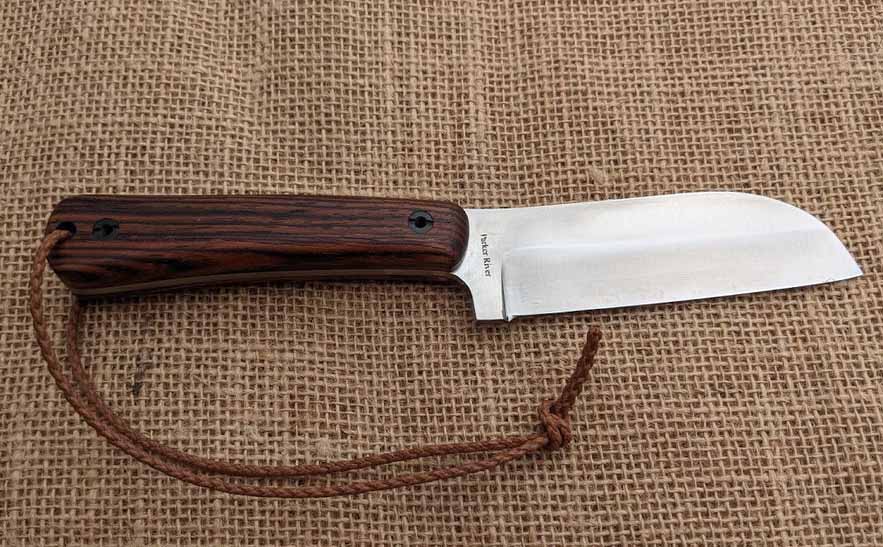
Parker River Bosun Knife
Parker’s River Bosun Knife harkens back to the earliest versions of the rigging knife. Expensive, it more than speaks to your maritime cred.
If you find that you are in the market for the luxe version of a rigging knife, look no further than the Parker River Bosun Knife. This one isn’t at all on the cheap side, you could easily buy every other knife on this list and still have money left over. But, for the discerning mariner, a tool like this is not just a status symbol but a nod to a long-past way of doing things.
This knife is made in the original bosun knife style, fixed blade and all. It lacks any other adornments, including a marlinspike. However, just like in the old days, you can of course buy a separate marlinspike and tie it on with a lanyard. The interesting part of this knife is it really has not lost function over a multi-tool in that the blade aspect. Having a separate knife and marlinspike allows larger models of, thus makes them easier to use and not hinder you with a folding mechanisms. The knife comes with a leather sheath and is available with custom engraving.
MSRP: $315
Perkin Handcrafted Rigging Knife
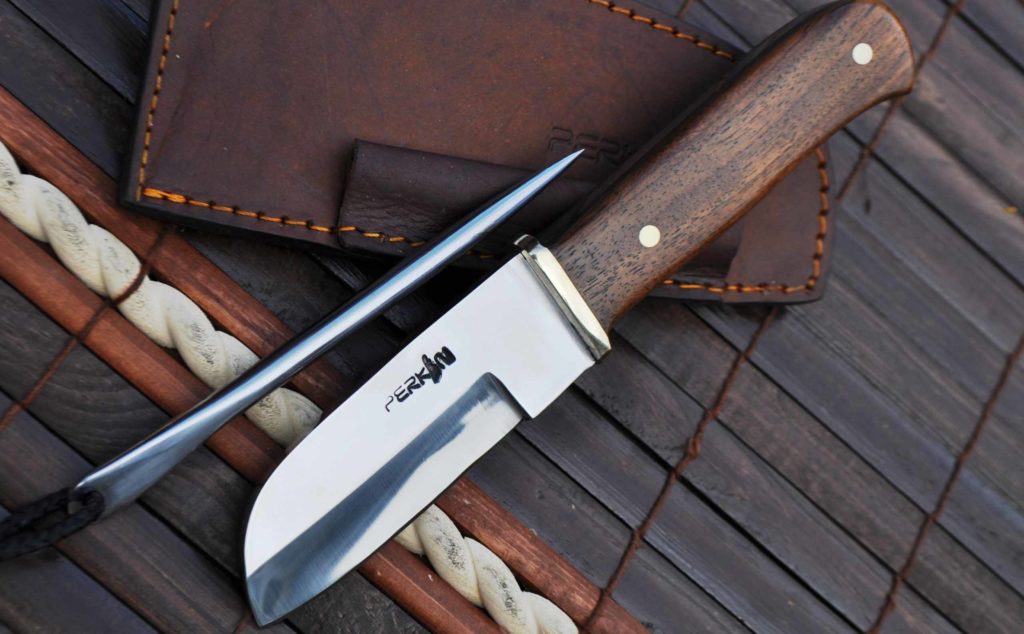
Traditional in design, Perkin’s rigging knife is built for heavy usage, but offers throwback appeal.
Another traditional fixed-blade design is the Perkin Handcrafted Rigging Knife. It has many of the same features as the Parker River example and even comes with a leather sheath with an integrated marlinspike loop.
The knife is heavily constructed and bears a thick, heavy spine. It is substantial enough it can be pounded through rope much in the way these knives were originally used. The physical construction is simple, a pinned scales and a bolster. Overall this is a good entry-level kit if you want a classic setup for your boating adventures.
Editor’s Note: While this article pertains to the deletion of gun channels on YouTube — including our sister publication Recoil’s channel — we believe it is an interest and pertinent to the knife community. While it hasn’t happened yet, it is perceivable knife content may one day end up under social media’s microscope. Thus, we wish to keep our readership fully informed on the present-day digital landscape.
YouTube Bans Channels Days Before SHOT Show 2023
YouTube has everything from cat videos to documentaries about war to child predators, all six clicks away.
While even mainstream “family-friendly” content creators have complaints about YouTube, there is one form of YouTuber the platform loves to hate – GunTubers.
Recently, YouTube made another push to de-platform and demonize GunTubers.
Starting just days before SHOT 2023 with the deletion of Ammoland.com’s YouTube page, the site either suspended or issued strikes against channels like Rodger Barrera, 1911 Syndicate, and Lucky Gunner.
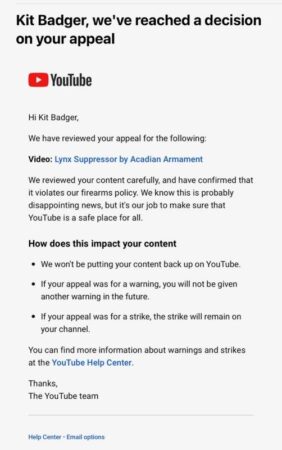
Spurring the writing of this article was the deletion of Kit Badger’s channel. Little did we know only a few days later, RECOILTv’s YouTube channel would also be summarily nuked.
Why is this happening, and what can we do about it? The answer isn’t very encouraging, but cold truths rarely are.
Why Does YouTube Hate Your Second Amendment?
Based on what we know – I don’t think YouTube actually hates the Second Amendment as a construct.
From multiple conversations with multiple content creators on YouTube, they’ve spoken with many people that worked at YouTube who were pro-gun. The problem is, that’s not enough.
YouTube is here to make money. It isn’t here to make the world a better place or to uphold morals and values. The company is in it for the almighty dollar.
Those dollars come from advertisers. While there are some firearm-friendly brands advertising with YouTube, the super majority of the site’s money comes from mega-corporations like Disney and Amazon, household goods manufacturers like Procter & Gamble, and electronics brands like Samsung. The names of those who advertise on YouTube are nearly endless, but you get the idea.
YouTube made over $28 billion in 2021.
Of that, GunTubers are a very small drop in the bucket. The exact totals are unknown, but it’s easy to conjecture firearms content is nowhere in the top ten on YouTube.
2017: YouTube’s Worst Nightmare
Since most major brands prefer to avoid controversy or even the appearance of being on the wrong side of issues, it’s easy to understand why most only want to advertise products on channels and videos no one objects to.
But in 2017, YouTube screwed up. Truthfully, YouTube had been doing this for a long time – but people noticed in 2017. Due to a series of news articles showing YouTube ads playing alongside extremist videos — the kind with people’s heads being cut off — advertisers made it clear to YouTube that the money could stop.
Huge brands like Walmart and Verizon pulled ad dollars completely. In the month of April 2017, YouTube lost 5% of its top advertisers.
This happened again in 2019 when reports came out of YouTube’s grossly ineffective methods of dealing with child exploitation videos. Again, huge brands like Disney, Nestle, and others pulled ad money until YouTube fixed the problem or the public turned its attention to something else.
Firearm Hysteria
This is a supposition, I believe it’s reasonable to conclude YouTube hates gun channels because it is scared of firearms being the next big thing to lose money over.
With the mass media’s fetish for murder porn on the nightly news, guns are (as always) an easy target for (real or imagined) ire.
Even as large as the American firearm industry is, all of its marketing money combined isn’t enough for YouTube to sacrifice its Apple/Disney/Hulu cash.
The Omnipotent Algorithm
While firearms are clearly not on its list of favorite things as a corporation, even vanilla channels have a rough time of actually communicating with anyone at YouTube who can make a difference.
Because of the staggering amount of content posted on the platform, the vast majority of moderation is automated.
Every minute, over 500 hours of content are uploaded to YouTube. More than 30,000 hours of video are added per hour. While YouTube employs thousands of moderators, this is far, far short of the tens of thousands of human moderators required to view all the content.
Instead, YouTube uses powerful AI and machine learning algorithms to comb through videos automatically. Everything from the words spoken to the images shown is scanned and processed by the algorithm.
This algorithm — more accurately many sets of different algorithms — work together to control everything from what you see in your recommended feed to what videos are allowed to make money.
As much as everyone hates this system, there isn’t a practical alternative. Not without YouTube spending an astronomical amount of money to fund human moderation teams. Not exactly something the company is likely to do if it wants to keep profit margins high.
YouTube Guidelines
One of the major problems all YouTubers have is the site’s guidelines don’t matter. While YouTube maintains two sets of rules, one set that covers everything on the platform and another set specifically for videos that are monetized, the rules often are simply ignored.
When a channel gets a warning or a strike, the channel has the option to appeal it. This is, in theory, sent to a human moderator who looks at the issue and rules on it. The problem is these human moderators are unreliable in their judgment.
Videos that clearly do not violate the rules are still removed or demonetized. Channels can try to delete the video, reupload it, wait for the automated demonetization, and appeal to a different moderator for a different ruling — but this also runs the risk of multiple strikes for one video.
Some rules are so broadly written they become nonsensical. For example, 1911 Syndicate received a warning for swapping a charging handle on camera and a strike for unthreading a suppressor from a rifle.
Other channels, like Kit Badger, don’t even know exactly why its channel was deleted.
Instead, all that is offered is the name of the video supposedly violating the rules and a copy of the entire YouTube Firearms Policy. Too many of these strikes and the channel as a whole is simply deleted.
Even when YouTube deletes an entire channel, it barely tells you why except there were “too many violations.”
Goal Posts Moving Faster Than Light Speed
Another huge obstacle YouTubers face is old videos.
As YouTube has updated and changed its policy over the years, these new rules apply to old videos as well.
Videos that have been up for 5, 7, or 10 years are subject to YouTube rulings overnight. One recent change was creators could not show 30-round magazines. This resulted in multiple channels I spoke with having to spend hours, even days, going through old videos to self-censor them before YouTube found them.
Instead of warnings or a grace period, these old videos can cause a channel’s deletion overnight.
As of this writing, this is what we believe happened to the RECOILTV YouTube channel. Videos that were years old featuring suppressors triggered strikes against the channel, followed by the entire channel being deleted.
Mo Money, Mo Problems
Something a few channels have found is YouTube cares much more about channels that are monetized than channels that are not. But this isn’t the good kind of caring like a mother’s hug. This is more like attracting the Eye of Sauron.
InRangeTV has been proactively demonetized for years, and Karl — the channel’s main host and creator — feels this helped keep the wolves at bay. Without ad revenue or sponsorships, InRange instead relies on the viewers to join and donate through other platforms like Patreon or Utreon.
However, even this has not kept the channel from receiving a warning in the past.
InRange’s great crime? A video about the Ghost Gunner machine that even didn’t show the machine. Instead, Karl overlaid videos of cats playing with yarn to self-censor the version of the video uploaded to YouTube.
Other channels, like 1911 Syndicate, are demonetized but do not rely on the YouTube for revenue to stay afloat. For the concern, its channel is a marketing tool for its real estate business.
We monetized our channel around 40,000 subscribers, and were demonetized about 2 months later. Since then our channel has been demonetized, which probably helped us not get strikes
1911 Syndicate
This has (probably) helped keep it off YouTube’s naughty list, but as its recent warning and strike shows, being demonetized does not make it immune.
Best YouTube Alternatives
The main problem with other video platforms — YouTube’s competitors — is the lack of viewers. None of the channels I’ve spoken with actually like YouTube, but it’s the place where you can find the most viewers.
If you want to be the change you want to see in the world, the first step is to stop watching YouTube.
These are some of the best platforms to make this move.
Recoil.TV
Call it a shameless plug if you want, but Recoil.TVoffers a video platform free of YouTube crapola. An aggressively pro-2A and 1A video platform, Recoil.TV is a great way to find and watch your favorite creators. It also acts as a backup in case YouTube persecutes your favorite channel. For example, you can still find Kit Badger on Recoil.TV.
You can also find original content from RECOIL Magazine and our sister publications like OffGrid, Gun Digest, Blade, and Carnivore.
Utreon
The preferred site, according to several channels I know, Utreon is a mix of Patreon and YouTube. A video platform for people to watch their favorite channels, but also the ability to donate money directly to the channel.
Run by a founder and owner who believes in 2A and giving the people what they want, Utreon offers a lot of options and a lot of flexibility to channels while also using a fee structure that results in more of your donations going to the channel instead of the platform.
InRangeTV is a fan stating it’s their preferred alternative to YouTube:
From my content creator perspective, the best alternative to YouTube at this point is Utreon. They are a good mix of Patreon and YouTube combined, providing a lot of the benefits of both – it’s not a paywall, but does allow for direct viewer support and a lot of Patreon perks integrated into the platform. The owner has proven to be reliable, respectful and capable. I believe their heart is in the right place, but it is ultimately still a centralized solution.
Karl Kasarda, InRangeTV
BitChute
In the media, BitChute has a bad reputation, some of that is well earned. With a strong belief in freedom of expression, there comes the unavoidable reality of some real nut cases abusing the system to spread hate speech, crazy off-their-meds conspiracy theories, and lots of lies.
That said, BitChute offers a decentralized method of sharing and watching videos. Using a webtorrent for distribution means BitChute is extremely difficult to take down, reduces overhead costs, and gives a platform to those who would otherwise be left off major platforms like YouTube.
Viewers be warned: BitChute is definitely not a site I would let my children have free access. Scrolling through the most popular videos makes me want to take a shower and watch something wholesome, like cat videos… on YouTube.
Rumble
Another platform that is home to anyone with a video camera, Rumble hosts everything from wholesome content like America’s Funniest Home Videos to the likes of Alex Jones and Andrew Tate.
Rumble also provides a clear and simple method for channels to monetize content, very similar to how YouTube AdSense works.
While again falling victim to the reality that not everything on the internet is good content, Rumble does draw a line at pornography, harassment, racism, antisemitism, copyright infringement, and illegal content.
I would still caution viewers to exercise their best judgment when browsing Rumble.
Loose Rounds
The writing is on the wall and has been for years. Sooner or later, YouTube will probably ban firearms from its platform. If it doesn’t, it will at least make it so hard and unprofitable for gun channels to stay on the platform that, by choice or force, all of them leave.
While there is probably very little that can be done to prevent this, there are at least some alternatives, as I mentioned.
Until then, if you can and when you can, consider supporting your favorite channels directly via Patreon, Utreon, and other platforms.