



e-mail [email protected]
Knife Carry: Useful EDC Blades With Useful Carry Systems

If you think carry systems are rote, you need to get a gander at these knives and their revolutionary ways to keep them on person.
The carry systems for EDC knives have evolved to offer you a seamless experience, with an array of different spins on pocket clips, sheaths, lanyards and more. This convenience benefits you by saving time, providing peace of mind, encouraging regular carry and increasing utility. The popularity of EDC knives has spurred innovation in design and materials, leading to a market rich with options catering to every preference and need.
The carry systems play a pivotal role in this dynamic, as they directly influence your experience and the practicality of the knife in everyday scenarios. The benefits of EDC knives extend beyond individual use; they represent a culture of preparedness and self-reliance that resonates with many, reflecting a broader trend toward function and efficiency in personal gear.
Big Idea Design TI Lookout Fixed Blade

TI Lookout Specs
Carry: Two Kydex sheaths for left- and right-hand pocket carry, each equipped w/a titanium pocket clip
Blade Length: 2.2”
Blade Steel: M390 stainless
Blade Grind: Flat
Blade @Thickest: .12”
Blade Finish: Satin
Handle Scales: Grade 5 titanium
Overall Length: 6.2”
Country of Origin: China
MSRP: $200
Pros
- Versatile Carry Options
- Excellent EDC Performance
- Stylish Design
Cons
- Small Size
The TI Lookout Fixed Blade by Big Idea Design offers precision engineering and high-quality materials, making it an essential companion for everyday carry enthusiasts.
At the heart of the compact and robust knife is the M390 stainless blade steel, renowned for its superior edge retention and wear resistance. The premium material ensures that the TI Lookout maintains its razor-sharp edge through extensive use, reducing the need for frequent sharpening. The addition of Grade 5 titanium scales provides a sleek aesthetic and contributes to the knife’s lightweight yet durable construction.
The lanyard hole in the rear handle screw adds a functional touch, allowing for easy attachment and accessibility. The knife offers a perfect balance of control and cutting power.
The two included Kydex sheaths provide versatile carry options for lefties and righties. Each sheath is equipped with a titanium pocket clip that easily affixes inside a standard pocket or sunglass/device pocket found on many outdoor cargo pants. Consider it a gentleman’s fixed blade.
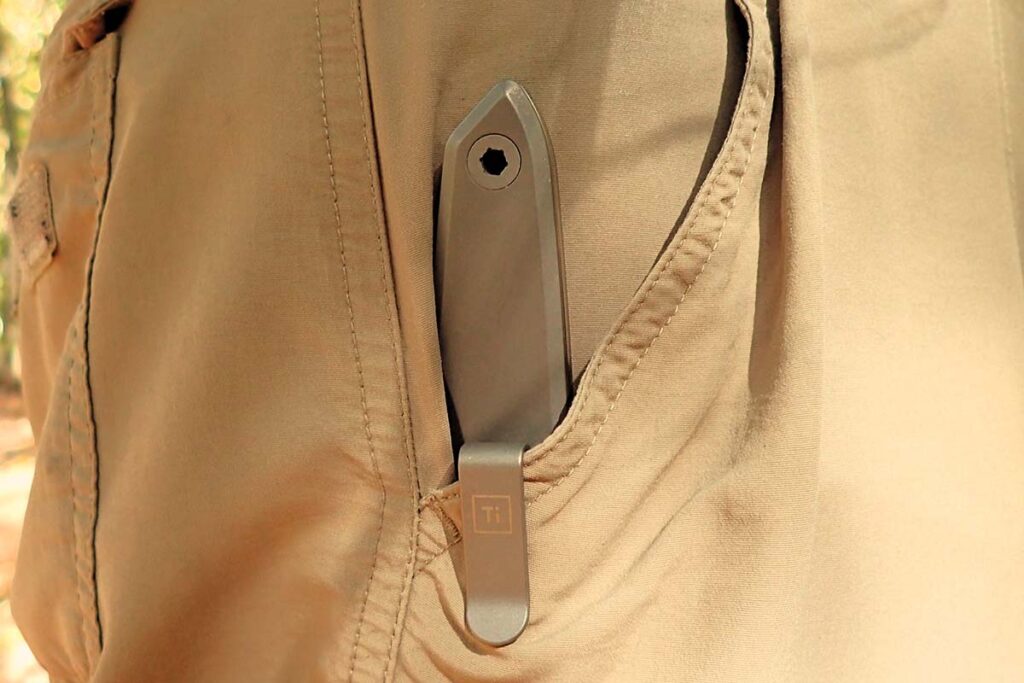
I put the TI Lookout through a range of EDC tasks, from cutting mundane materials to pushing it to the limits of the extremely aggressive, stabbing through light gauge metals. The knife thrived in this realm.
However, it dragged on thick, heavy-gauge cardboard. After slicing more cord, it remained sharp—it just got hung up a bit on cardboard. Wire, 550 paracord, nylon webbing and heavy leather succumbed to the keen edge.
In this writer’s humble opinion, the TI Lookout is not just a cutting tool but a statement piece reflecting the pinnacle of knife craftsmanship and material excellence.
TOPS Knives Quick Skin

Quick Skin Specs
Carry: Kydex w/beta material loops allowing for appendix, vertical, horizontal or scout-style carry
Designer: Leo Espinoza
Blade Length: 3.5”
Blade Material: 1095 carbon steel
Blade Grind: Flat
Blade @Thickest: .19”
Blade Finish: Tungsten Cerakote™
Handle Material: Dragonfly Tread Micarta®
Overall Length: 7.13”
Country of Origin: USA
MSRP: $230
Pros
- Efficient Skinning Design
- High-Quality Construction
- Versatile Carry Options
Cons
- Specialized Use
- Thick Blade Stock
The TOPS Knives Quick Skin marries master craftsmanship, elegance and utility.
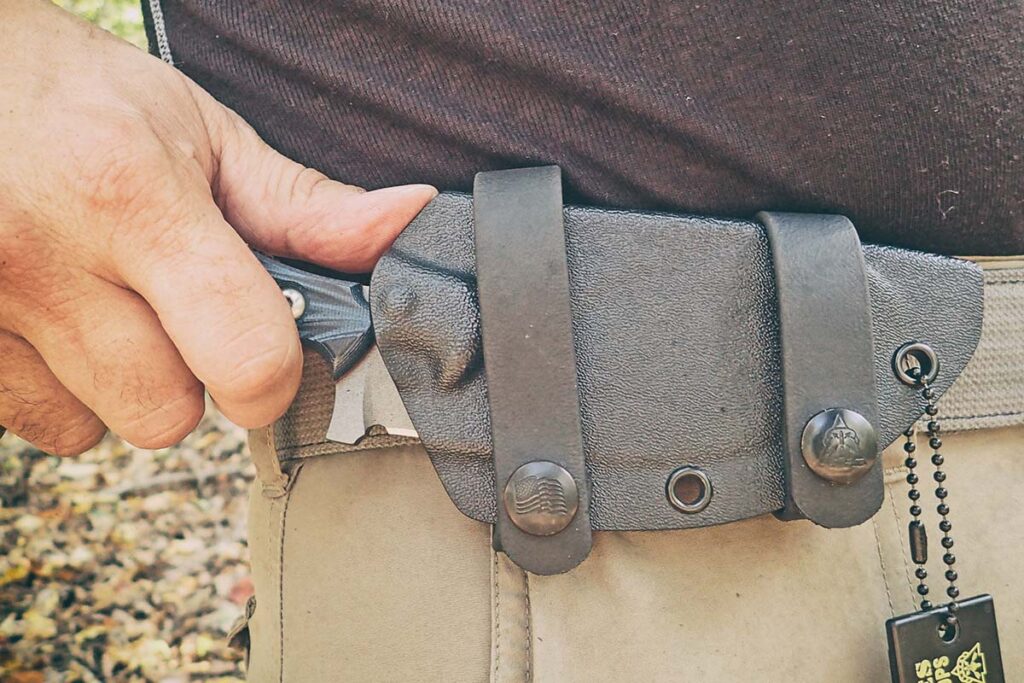
Designed with the avid hunter in mind, it boasts an “all-belly” blade in a Rockwell hardness of 56-58 HRC that ensures fewer strokes are needed, making skinning quick and painless. It comes with a versatile Kydex sheath sporting beta material loops allowing for various carry positions, including appendix, vertical, horizontal or scout-style. Ultimately, the beta loops will clip to pack straps, keeping the blade easily accessible regardless of your adventure.
The shape of a blade dictates its purpose. The TOPS is designed for slicing and skinning. I opted for an appendix carry for comfort and a non-rib-jabber solution.
While all wild game was out of season in my region, food wasn’t. Knives with a deep belly thrive on food. The Quick Skin followed suit. Despite its thick blade stock, the knife successfully sliced bacon, peppers, onions and mushrooms. Later, I moved to slicing beef, pork and chicken equally well. Thanks to its sophisticated design and practical features, the Quick Skin is a standout choice for hunters seeking a top-tier skinner.
Reiff Knives Circadian Clip Point EDC Fixed Blade
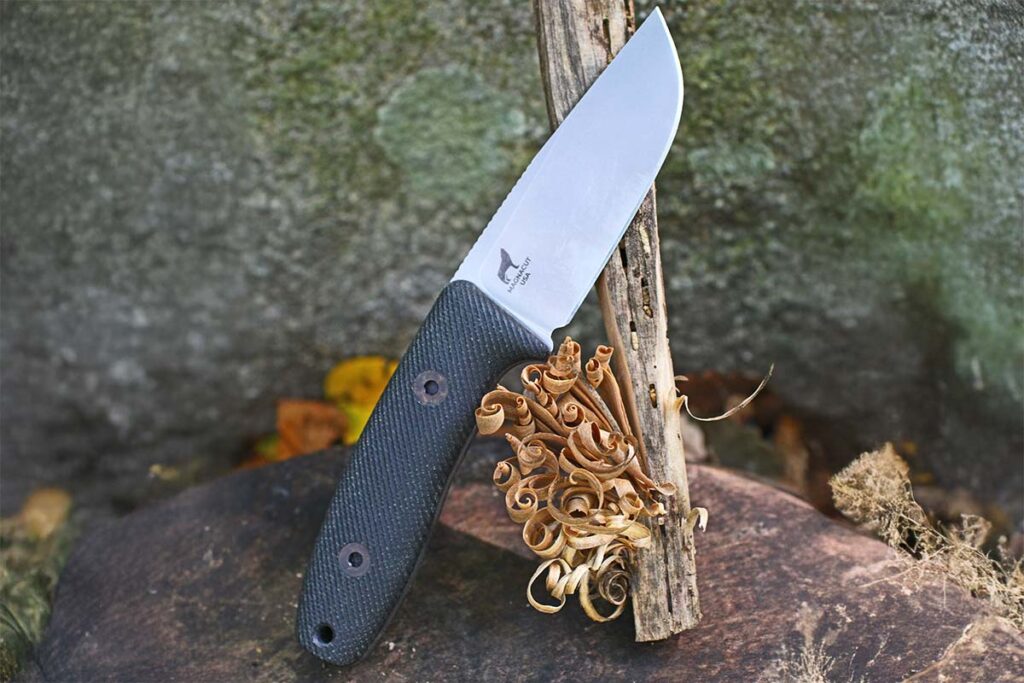
Circadian Specs
Carry: Crazy horse leather pocket sheath and UltiClip 3.3 Slim attachment
Blade Length: 3.28”
Blade Steel: CPM MagnaCut stainless
Blade Grind: Flat saber
Blade @Thickest: .12”
Blade Finish: Stonewash
Blade Pattern: Clip point
Handle Material: Black canvas Micarta®
Overall Length: 7.25”
Country of Origin: USA
MSRP: $285
Pros
- High-Quality Blade Steel
- Woods-Worthy Performance
- Lightweight Yet Sturdy
Cons
- Expensive
With its superior craftsmanship, utility and CPM MagnaCut stainless blade steel, the Reiff Knives Circadian Clip Point EDC Fixed Blade is an ideal choice for outdoor enthusiasts and everyday carry.
The blade’s stonewash finish adds a rugged aesthetic and helps hide scratches and wear. The handle provides a secure grip even in wet conditions, and the ergonomic design ensures comfort during extended use. Weighing in at only 4.1 ounces, the Circadian offers a lightweight yet robust solution for various cutting tasks.
The knife has a premium, deep carry, crazy horse leather pocket sheath and UltiClip 3.3 Slim for versatile carrying options. Inside-the-pocket carry is popular for discreetly carrying fixed blades. It makes the knife unobtrusive and out of the view of the sheepish.

More importantly, it gives a release option, making it easier to free the secure grip from your pocket. The UltiClip 3.3 Slim offers a versatile and secure method for attaching the knife to various clothing or gear, enhancing practicality and convenience.
As well as the Reiff fits into the EDC world, it teeters on the line of woods-worthy EDC. I was in the northeast woodlands during the test, and the Circadian was on hand. The knife was tasked with splitting wood via baton and also a round or two of feathering. It didn’t disappoint. Fit finish and comfort are standard. The handle offers a full-hand grip and the blade is stout.
A.G. Russell Woodswalker

Woodswalker Specs
Carry: Leather pocket sheath that fits into a back or cargo pocket perfectly, or a Kydex neck sheath
Blade Length: 2 3/8”
Blade Steel: 8Cr13MoV stainless
Blade Grind: Flat
Blade @Thickest: 1/16”
Blade Finish: Satin
Handle Material: POM thermoplastic
Overall Length: 6”
Country of Origin: China
MSRP: $34.95 to $36.95
Pros
- Lightweight and Compact
- Durable Full-Tang Construction
- Ergonomic Handle
Cons
- Not a Heavy-Duty Knife
The A.G. Russell Woodswalker is a versatile, durable knife designed in the 1970s for the outdoorsman who values tradition and function. Crafted for the casual hunter, this lightweight, non-folding pocketknife is perfect for a tranquil morning in the wilderness.
Whether you’re pursuing small game like quail, squirrel, dove or rabbit, or preparing a meal in the great outdoors, the Woodswalker excels with its drop point blade in a Rockwell hardness of 57-59 HRC. Full-tang construction ensures stability and balance, while the handle provides a comfortable and secure grip. Measuring 6 inches overall and weighing a mere 1.2 ounces, it’s an unobtrusive addition to any hunter’s gear.
Choose between the leather pocket sheath, which fits into back or cargo pockets perfectly, or the Kydex® neck sheath for convenient carry. I used both but I hate my pockets weighing me down. The neck carry option suited me well.
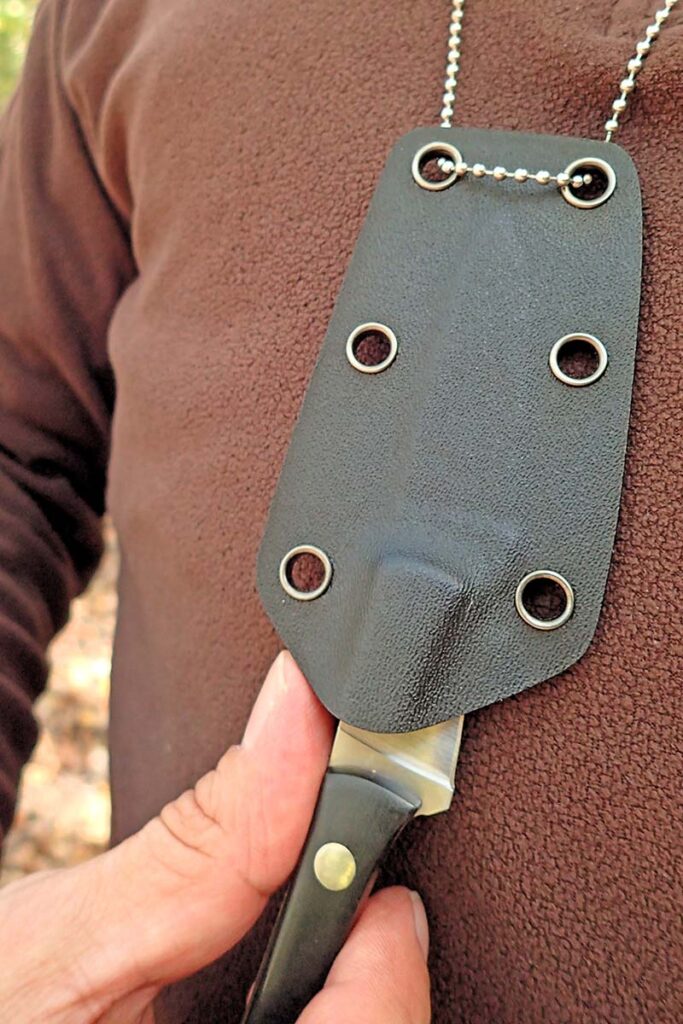
The Woodswalker is the classic of the test batch of roughnecks. It’s been there and back—that’s why I spared it no quarter. In my usual neck of the woods, I wanted to make a small fire and selected hardwoods like oak and maple to craft feather sticks.
This one isn’t a splitter or chopper, so act accordingly. It feathered wood like a dream and felt like a zipper effortlessly gliding through wood. The most impressive feature that’s not mentioned in any product description is the sharp 90-degree spine, ideal for striking a ferro rod and showering sparks worthy of the 4th of July. This knife isn’t just a tool, it’s a trusty companion for all your outdoor adventures.
Read More Knife Reviews:
- Best Rescue Tools
- Oknife Beagle Review
- Versa Rescue Knife Review
- Knife Review: CRKT Bamboozled
- M-1 Folder Review: How Good Is This Folder?
ABS Great Smoky Mountain Bladesmithing Symposium
4th Great Smoky Mountain Bladesmithing Symposium
March 4, 5, and 6, 2011
Offered by the American Bladesmith Society, Inc.
Hosted by Haywood Community College
Location:
Haywood Community College
185 Freelander Drive
Clyde, North Carolina
For more information Contact:
Laura Simmons, HCC at (828)565-4244
or Bill Wiggins, ABS at (828) 226-2551 or Email Bill
Registration:
$65 Registration fee can be paid in “Event Registration” in the ABS Store or contact Cindy Sheely, ABS Store Manager at (419) 832-0400 or Email Cindy
Event Flyer and Mail in Registration Form:
Click to download – Smoky Mountain Flyer and Registration Form
Featured Demonstrators:
Joseph Keeslar – Blade Forging, Grinding & Heat Treament
James Rodebaugh – Damascus Steel
—————————-
Demonstrators:
Greg Neely – Fit & Finish & ABS Knife Judging
Jason Knight – Handles & Guards
Daniel Warren – Slip Joint Folders
Butch Sheely – Forging Tomahawks
BR Hughes – ABS Knife Judging
Carolyn Hughes – Promotion and Advertising
James Batson – Making Antique Bowies
Ronnie Boydston & Demonstrators – Hands-on blade forging
Col. Tim Ryan – Auctioneer
Event Schedule:
Thursday, March 3 ………………..3 to 6pm Check in and Registration
………………..6:30 pm Demonstrators Dinner (All invited)
Friday, March 4 ………………..8AM to 5pm Blade Forging & Demonstrations
………………..7 to 9pm *Battle of the Bladesmiths*
Saturday, March 5 …………………8am to 12am Blade Forging & Demonstrations
………………..1 to 3pm Knife Show (Free to the public)
………………..3 to 5pm Auction (bring items for auction)
………………..5 to 7pm BBQ Dinner (pay at site)
………………..7 to 9pm Cutting Demonstration
Sunday, March 6 ………………..8 to 12am Blade Forging & Demonstrations
GiantMouse Turns 10: A Bold Idea Becomes A Global Knife Brand
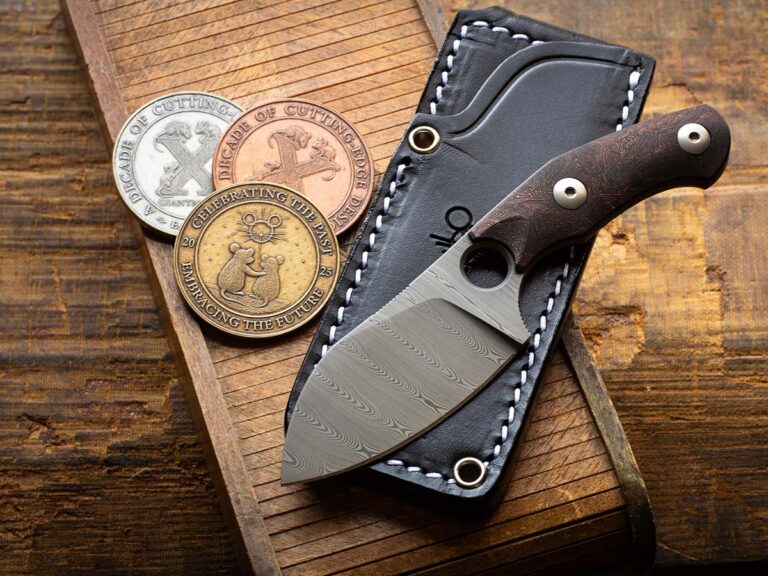
Built on collaboration, craftsmanship, and a no-compromise mindset, GiantMouse celebrates a decade of redefining what everyday carry can be.
GiantMouse Knives is hitting a major milestone in 2025—10 years of pushing the envelope in knife design, quality, and everyday adventure.
What started back in 2015 as a bold idea between a few passionate knife guys has grown into something much bigger. Over the past decade, GiantMouse has carved out a loyal following among collectors, adventurers, and EDC enthusiasts around the world—people who want tools that not only perform, but inspire.
From their iconic limited runs to reliable production models, GiantMouse has built its reputation on standout design, top-tier materials, and the kind of quality that makes a knife feel like it was made just for you.
“This anniversary is really about the people who’ve been with us since day one,” the company shared in a statement. “GiantMouse is for folks who demand quality, chase adventure, and believe their gear should tell a story. Ten years in, and we’re just getting warmed up.”
To celebrate, GiantMouse will be rolling out a year’s worth of anniversary content in 2025—including exclusive behind-the-scenes features, community shoutouts, and a look back at some of their most legendary designs. If you’ve ever carried a GiantMouse blade (or thought about it), this is a celebration you’ll want to be part of.
Here’s to the first 10—and the next adventure.
More On Knife Business:
- How To: Custom Knife Sales And Marketing
- Knife Steel After Crucible Industries LLC
- Tariffs & Knife Prices In 2025
- Collaboration Knives: How Do They Come Together?
- How To: Marketing Knives On Social Media
Mcnees Custom Knives MUK’s and necker
Recorded on December 22, 2010 using a Flip Video camcorder.
Japanese War Swords Part II
BY LEON KAPP
The great World War II Japanese swordsmiths, war sword souvenirs and more
Kurihara Akihide established the Nippon To Denshujo. Akihide was a member of the Japanese Diet or congress. The Diet asked him to help make swords and train swordsmiths. He set up the Nippon To Denshujo in Tokyo in 1933 and hoped to train about 1,000 swordsmiths. His first student was Yoshihara Kuniie, the grandfather of perhaps the today’s foremost living swordsmith, Yoshindo Yoshihara. Kuniie later became head of a sister forging organization in Yokohama, and the head of the Army Forge in Tokyo. Kuniie’s brother and son (Yoshindo’s uncle and father) also joined the Denshujo and began making swords at this time.

The Denshujo’s students usually took names beginning with the character Aki from the founder Akihide’s name (such as Akifusa, Akimitsu, etc.). Kuniie originally signed with the name Akihiro but soon began to use the name Kuniie, as did Yoshindo’s father (Yoshindo’s father was the second-generation Kuniie). The swords from the Denshujo are of very strong interest to collectors, as well as any Yoshihara sword from this period, and also any swords made by the Denshujo’s chief instructor, Kasama Shigetsugu, and its founder, Kurihara Akihide. A surprisingly large number of Japanese smiths working today can trace their professional lineage to someone who worked at the Denshujo from 1933 to 1945.

SEKI CITY
Seki was home to 350 licensed swordsmiths as well as a large number of associated craftsmen. The city had a population of around 30,000 and about half of them probably were involved in sword production, polishing and mounting. In the 1940s, Seki shipped about 18,000 mounted swords a month to the military organizations. Traditional tama hagane swords comprised about 6-to-7 percent of the output. Many others were made from puddled steel, and cheaper swords were made from foundry steel and salvaged structural steel. The leading smiths in Seki commonly signed with names beginning with the character Kane, such as Kanefusa, Kanenobu, etc, and many of the resulting swords are of interest to collectors today.

The Manchurian Railway Co. in Manchuria made specialty steels and used them for swords. All the swords were signed indicating they were made by the Manchurian Railway Co., and very rarely have an individual swordsmith’s name on them. The swords appear to be made of several types of proprietary steels folded and forged together. They almost always have a simple, straight hamon.
There were many very good smiths scattered around Japan whose work is valuable today. Some of them included Nagamitsu in Okayama, Takeshita Yasukuni in Hokaido, the Horii family in Hokaido, the Gassan family in Osaka, Minimoto Yoshichika, Masakiyo, Takahashi Yoshimune, and many others, as well as swords signed Koa Isshin Mantetsu saku made by Manchurian Railway Co.
All Japanese sword production stopped in 1945 and was illegal until the U.S. occupation ended in 1953. Sword production then resumed slowly and, by 1964 when the Tokyo Olympics was held, there was finally a healthy market in Japan again for newly made swords, or gendaito.
WAR-ERA KOSHIRAE
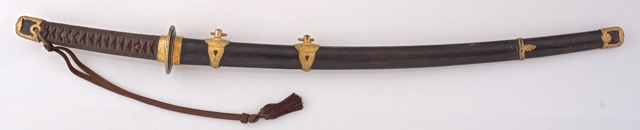
The original Westernized koshirae used by the Japanese military closely resembled 19th-century European-style mountings with slight adaptations to fit Japanese swords. Around 1931 or 1932, new koshirae styles were adopted and are the ones seen with most World War II Japanese swords. The new army mounting was closer in form to the traditional Edo-period-style koshirae. It could properly contain a traditional Japanese sword and allow it to easily be used in the traditional manner.
The navy also adopted a new koshirae at about the same time, and is how surviving Japanese World War II naval swords commonly are mounted. The army scabbards were usually covered with a thin sheet of metal lacquered a shade of khaki. There was a traditional sword guard or tsuba, and all the traditional metal fittings were present. The navy scabbards often were covered with sharkskin or rayskin, with all the traditional metal fittings and tsuba in tow, too. In 1944, a new model army koshirae appeared which seems to be an evolution of the 1932 version. Generally, swords that appear in these types of military koshirae have blades of tama hagane or puddled steel and are generally well made.
JAPANESE WAR SWORD COMPARISONS
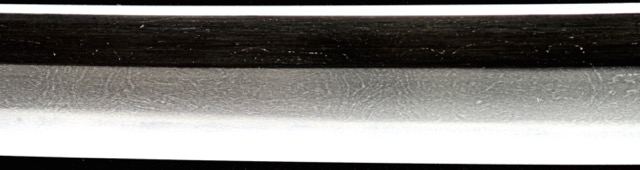
In general, Japanese sword blades of the 1930s and 1940s are well constructed. They feature steel that was forged proficiently and a visible jihada if they receive a new, quality traditional polish. However, in comparing World War II-era swords to older swords and to swords made after 1960, there are clear differences.
The differences arose from the lack of traditional tama hagane for the swords, and pressure to produce a large number of swords in as short a period of time as possible. Using tama hagane is very time consuming and requires expensive raw materials and a large amount of forging time. Consequently, when comparing swords from World War II to other periods, they appear to be stout and heavy with a strong amount of tapering in the width of the blade from the hilt to the point (typically about 20 to 30 percent). In addition, the hamon are usually straight, or are straight and have simple projections (ashi) extending to the edge, or are simple gunome or regular small loops or waves. This type of hamon is relatively easy and fast for swordsmiths to make.
Using puddled steel avoided the time necessary to make tama hagane and to fold it 12 times to give the steel the proper qualities. In addition, the puddled steel (and all swords not made from tama hagane) was made of a single piece of steel forged to shape. Traditional tama hagane swords are composite structures with a high-carbon outer jacket and a soft tama hagane inner core. This reduced the costs and time involved in making the swords, which was important because officers had to buy the swords from the various forging groups. Typically, a tama hagane sword was twice the price of a puddled steel sword, and the other types of swords were less expensive. Yasukuni swords were traditional and very expensive, and cost about twice as much as a traditional sword made in Seki.
WAR SOUVENIRS
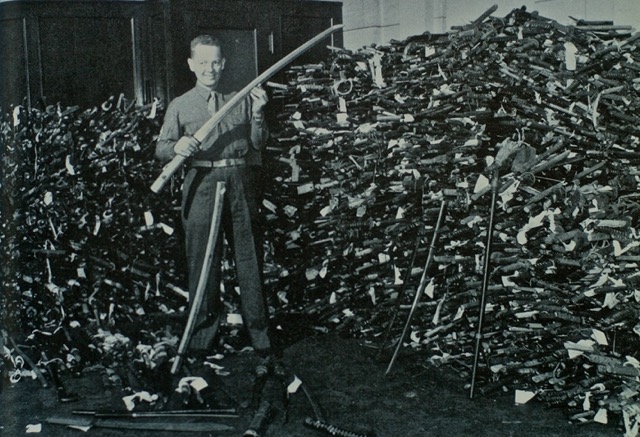
During World War II, many American soldiers simply picked up swords on battlefields. During formal surrenders, the Japanese soldiers surrendered their swords in the field. After the occupation began in 1945, U.S. military authorities went house-to-house to collect all weapons, including swords. In Tokyo, the Akabane Armory was the place where all confiscated swords were taken. At one point, one of the army staff members in charge of the confiscated swords said there was a stack of swords about 6 feet high and 300 feet long. Any U.S. soldier who wanted a souvenir sword simply went to the armory and picked out whatever he desired.
According to some collectors, in the early 1950s there were probably more Japanese swords in the USA than in Japan. As Japan recovered and became prosperous after the war, many of the swords here were bought and returned to Japan.
The World War II era was a unique period in Japanese sword history. The variety of swords made, the excellent quality of the fully traditional models, the somewhat distinct style of the swords, and the very large number made all help to define a very specific period in Japanese sword history.
GLOSSARY of JAPANESE SWORD TERMS
Ashi—simple projections from the hamon extending to the edge of the blade
Gendaito—newly made swords
Gunome—loops or waves in the hamon
Gunto—Japanese Army style of sword mounting
Hamon—temper line
Itame hada—a wood-grain pattern on the blade
Jihada—blade surface pattern
Kaigunto—Japanese Navy style of sword mounting
Koshirae—sword mounting
Puddled steel—steel from railroad rails used to make Japanese sword blades
Tama hagane—traditional steel for Japanese sword blades
Tsuba—traditional sword guard
References: Fuller, R. and Gregory, R. Japanese Military Swords and Dirks, Howell Press, Inc., USA. 1997
Kapp, L., Kapp, H., and Yoshihara Yoshindo, Y. Modern Japanese Swords and Swordsmiths, Kodansha International, USA 2002
Dawson, J. Swords of Imperial Japan, Stenger Scott Publishing, USA 2007
Modern Period Knife: A Link To The Past And Present
Blending old and new, the modern period knife brings history alive in masterpieces.
Historical perspective is a relevant component in just about any undertaking. In the realm of cut, incorporating an appreciation of the past into the work of today brings another dimension to the custom knifemaker’s statement.
Interest in the knifemaking of a bygone era offers a window into the true artistry required to reproduce the knives of yesteryear, particularly with the absence of modern conveniences in the shop. Along with the interest in the historical knife, several custom makers bring famous designs, styles and patterns to life once again in tribute to those who have gone before.
The idea of the period knife blends old and new. “I’ve been making knives seriously since about 2002 when I took a class with the American Bladesmith Society in Washington, Arkansas,” related ABS master smith Lin Rhea. “Joe Keeslar and Greg Neely lit a fire under me and got me on my way. Since then the town of Washington has been like a second home, and I’ve even added to the personal connection between me and the area by interest in one of the town’s historical residents who was also a knifemaker. His name was James Black.”
A resident of Prattsville, Arkansas, Lin gained an appreciation for Black’s distinctive body of work*, using contrasting materials and techniques to create a bold, attractive look. “I’m grateful to get to know Mr. Black by studying his work,” Lin continued. “This intense study led me to try to recreate one of his knives, the Carrigan Knife. The original knife, a guardless coffin-handled bowie, was made by Mr. Black in the early 1830s in Washington, Arkansas. I chose the Carrigan as my first attempt because of its less intimidating size; however, as is often the case I found it to be just as intimidating once I started into the project.”
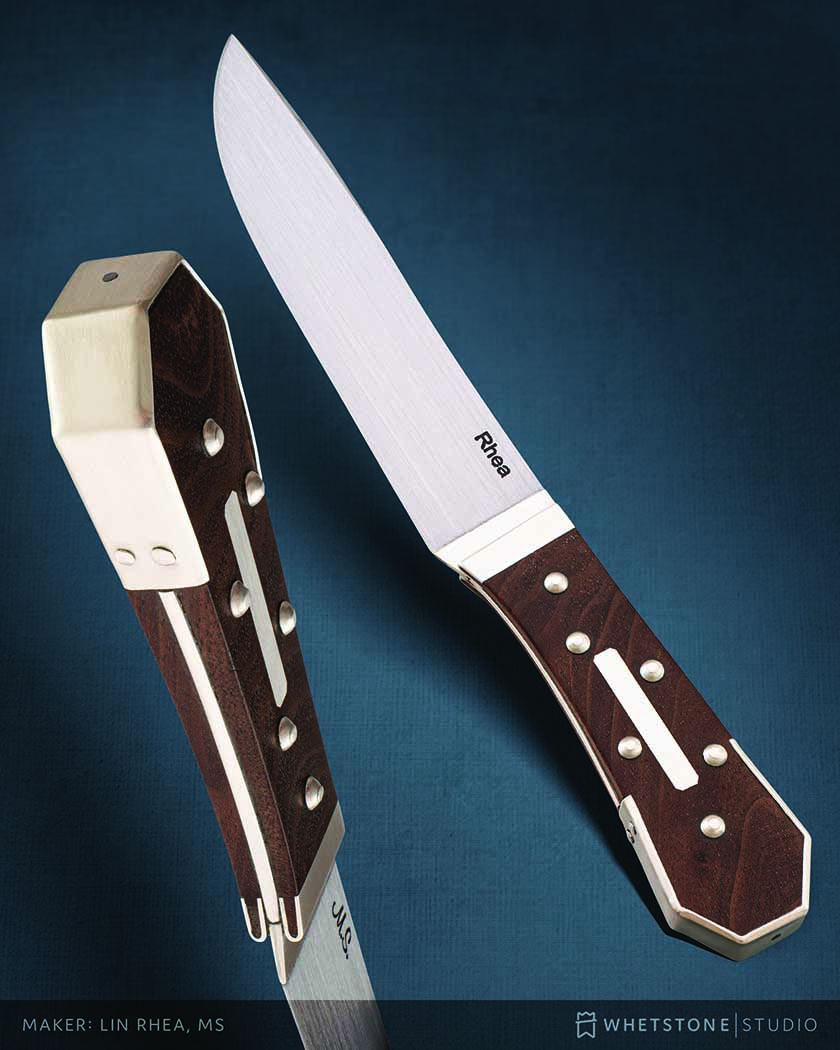
The original Carrigan includes a black walnut handle providing a nice contrasting background to the coin silver pins and trim. The blade is about 6 inches long, and the overall length is approximately 10.25 inches. The full tang is virtually covered entirely by the walnut scales and the silver wrap.
When Rhea undertook his homage to Black and the Carrigan, he chose stabilized walnut, which he harvested himself several years ago, and trim in sterling silver. He forged the blade from 80CrV2 carbon steel and included at least 30 separate parts while attempting the same techniques used by Black nearly two centuries ago in fastening and assembling the finished knife.
“There is so much to be said about not only this knife but also Black’s work,” Lin concluded. “He was able to create a knife design utilizing only three materials yet impacting the knife world as few others could. His ability to arrange these materials into a functional, long lasting, beautiful tool is only enhanced by the knowledge that he also built in other qualities like moisture resistance, logical assemblage and ergonomics. All of this was done in a historic setting without modern equipment and epoxies. In my opinion, his design is ingenious.”
The Gold Rush Period Knife
Recently inducted into the BLADE Magazine Cutlery Hall of Fame® (September BLADE®, page 52), knifemaker Jim Sornberger has assimilated his gold and silversmith skill sets into custom knifemaking while helping introduce the modern world to the classic design, luster and embellishment of the Gold Rush era and boomtown San Francisco of the mid-19th century.
“I’ve been making knives since 1975 with the help of the late Les Berryman, an early Guild member, and with some guidance from Bob Loveless, Herman Schneider and Barry Wood,” Jim recalled. “The last three signed for me to join The Knifemakers’ Guild.”
For Sornberger, the style, embellishment and decoration of the canes, jewelry and knives of the Gold Rush era are most appealing. “San Francisco from 1850 to 1904, the Gold Rush period, was one of the wealthiest cities in the world, attracting some of the greatest artists, jewelers, carvers and engravers to ply their trade to a wealthy clientele. The work done in that period,” he opined, “rivals the best ever done.”
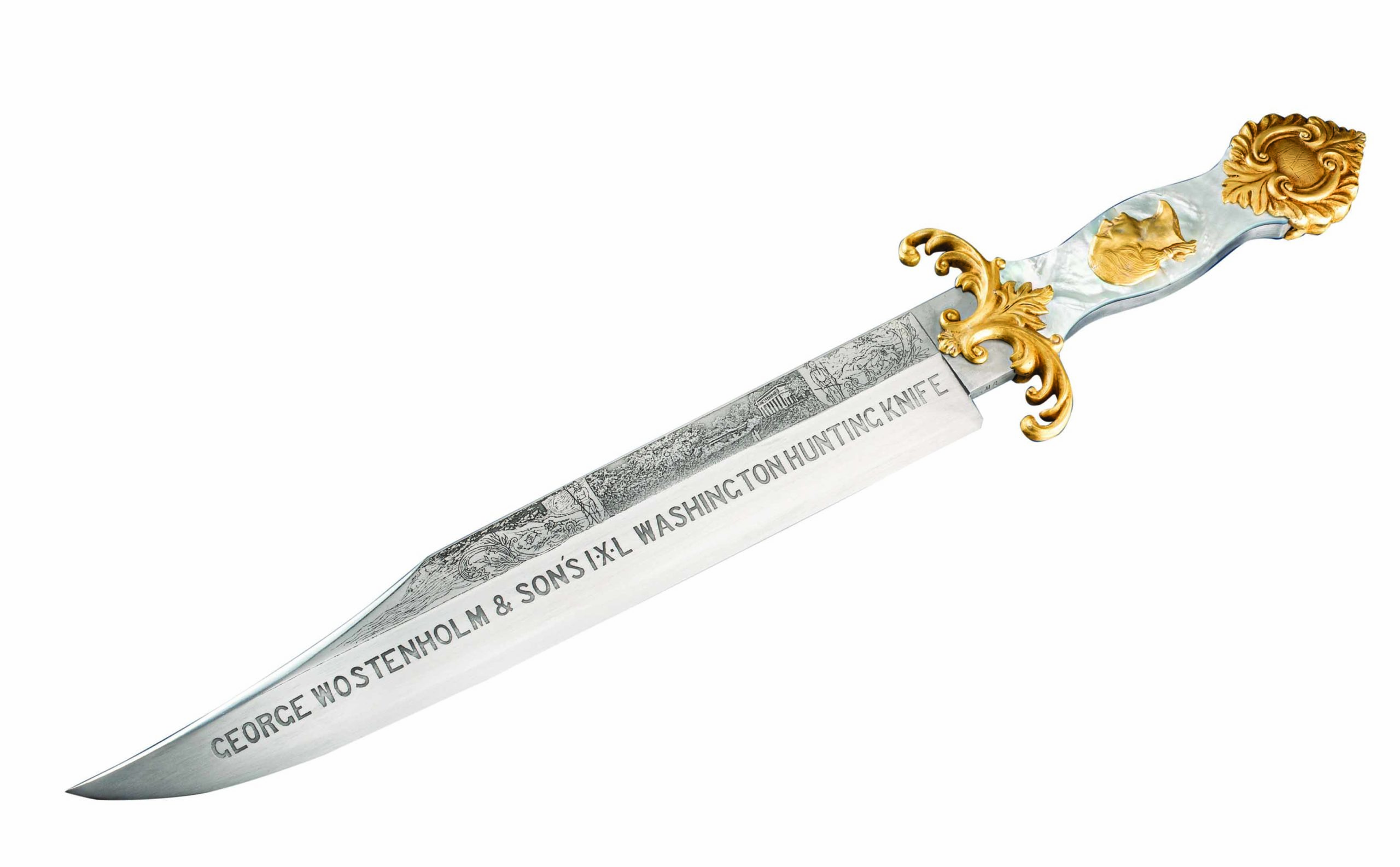
In the knifemaking genre, Michael Price and Will & Finck were among the most successful and prolific of the Gold Rush. Their work remains emblematic of the great migration to settle the American West, and the riches and ruin that were found with the experience.
“Price was Irish, and both cutlery firms hired workers who were English, German and possibly Scottish,” Sornberger explained. “Their dress knives are probably the most embellished American knives made in the 1800s-1900s. The dress knives had two common handles: an interesting, modified coffin shape and a more rounded, subtle taper shape. The blade shapes are spear-point dagger and San Francisco clip spear point.”
Sornberger is recognized as an authority on original San Francisco knives, as well as the magnificent gold quartz that was used so well by Gold Rush artisans. His modern interpretations of the Michael Price San Francisco/small dress bowie have won awards at various venues, including Best of Show at the 2019 International Custom Cutlery Exhibition in Fort Worth, Texas.
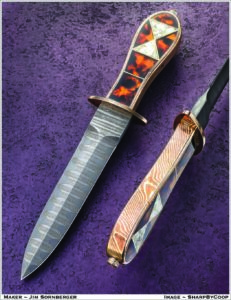
Jim’s dress fixed-blade bowie in the accompanying picture was made with Vegas Forge stainless barstock AEBL and 412 stainless steels, and san-mai damascus steel with a solid core. The guard and wrap handle are in Mike Sakmar mokumé barstock. Jim’s made such handles in gold and silver and nickel silver, also. The inlays are tortoise celluloid and California native gold/gold quartz.
According to Sornberger, the biggest challenge in his stunning creation was grinding the blade to show the distinctive pattern of the shell and the hardened core. The san-mai laminated blade was etched with ferric chloride, rinsed and color set with WD-40®.
Frog Knife
“The style of Michael Price’s work is a really good canvas with flowing lines, and there is a lot you can do with it,” observed ABS master smith Jon Christensen, who is in his 22nd year of making knives. “I wouldn’t call my San Francisco-style knives replicas. I do like to keep to the original form and honor the style of the maker, though.”
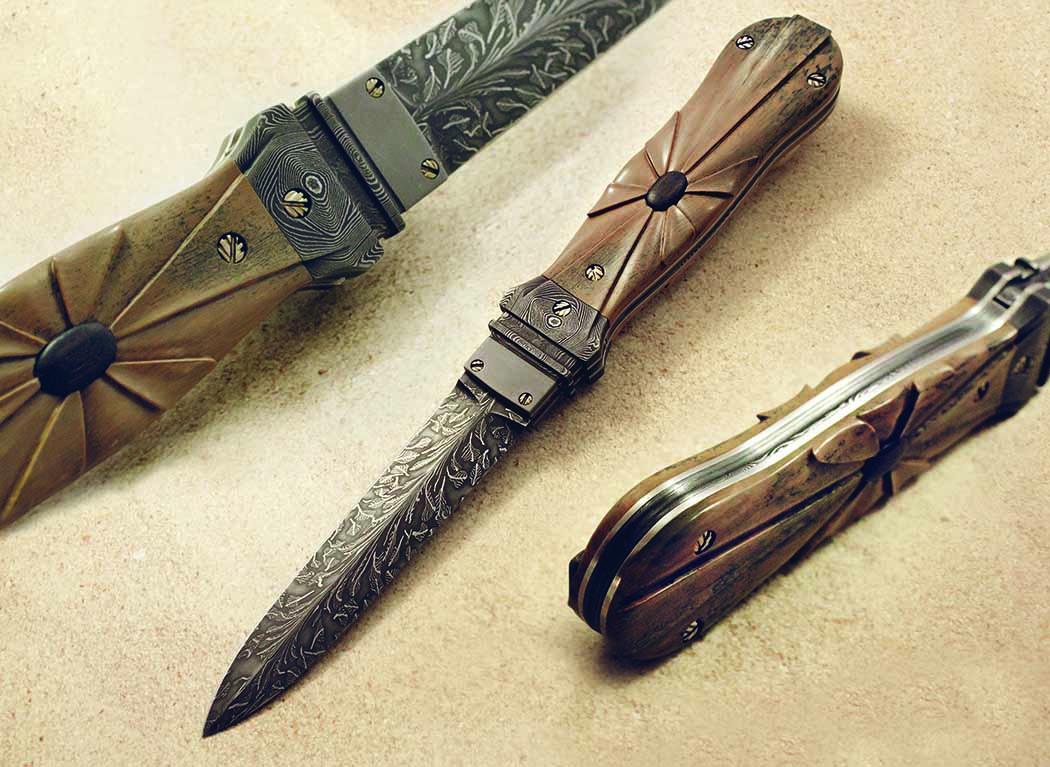
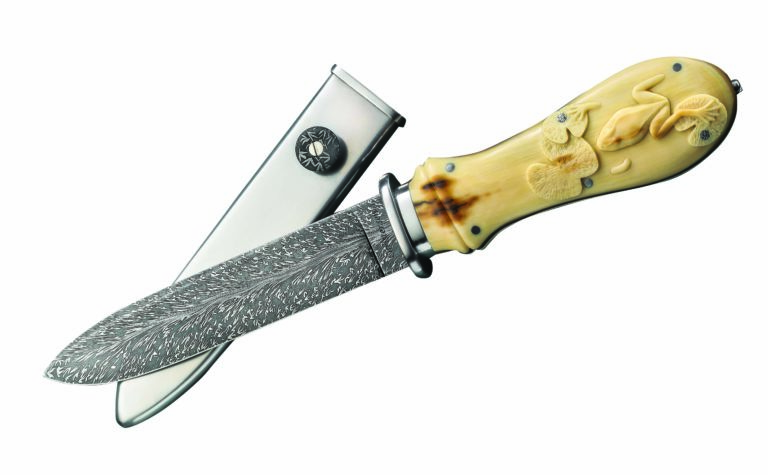
One of Christensen’s most evocative pieces to date is referred to simply as the Frog Knife. However, the piece is far from simple, and Jon manages to convey the spirit of the Michael Price style while also imprinting some of his own personality.
“I built the feathered damascus for the blade with 1080 and 15N20,” he advised. “It’s a canister damascus. I forged the bamboo leaves and placed them in the can, welded it up, reduced it, and feather cut it so it would produce feather-cutting smears and leaves, and form branches to look like a little grove of bamboo leaves.”
The 10-inch knife has a 5.5-inch blade and a frame and sheath incorporating 410 stainless steel. Christensen utilized the “canvas” of the handle to the fullest, carving the mammoth ivory into a pleasing vignette of frogs and lily pads.
“The handle has something of a back story,” he smiled. “I had seen the Poppy Knife that Michael Price made and thought I would do my version. I took the knife to the BLADE Show and it didn’t find its owner. Then, the handle got ruined, and I just took the opportunity to rehandle it with the frogs and lily pads.”
Christensen got his start making stock removal knives after a career as a horticulturist. He learned to forge while working with ABS master smith Ed Caffrey and visited with knifemaker Rick Eaton and ABS master smiths Shane Taylor and Wade Colter. Jon also makes San Francisco folding knives and enjoys swordmaking. Plans for the future include more period knife examples.
Kimbll Style
ABS master smith Josh Smith owes his little league baseball coach, ABS master smith Rick Dunkerley, credit with getting him started making knives about 30 years ago. From the beginning, Josh has appreciated the thought process and craftsmanship of custom makers from a bygone era.
“There’s something special about reproducing something that was built nearly 200 years ago,” he reasoned. “It’s easy to get lost in your thoughts while working on these knives, wondering what the makers were thinking about at the time. Was the knife going into battle? Was a rich man just wanting something unique? Was the maker just trying to be different and impress people? Were function and effectiveness of use the only factors that mattered? It’s really cool to think about.”
Josh has found the opportunity to consider historical context with a dagger in the distinctive dog-bone handle, recalling the mid-1800s when a gentleman named Loring Kimball of Vicksburg, Mississippi, owned several similar original pieces that were probably made by at least two different knifemakers in the New Orleans area. Knives in what many refer to as the Kimball style have been reproduced by a number of modern makers, mostly bladesmiths.
“The distinctive characteristic of the dog bone is clearly the shape of the handle,” Smith said, “but to me it’s more than that. The large domed pins and the flat facets on the handle provide such a neat look. One of the original Kimball daggers from the 1830s had silver wrapped around the butt of the handle and a small, thin silver guard. I never pretend to exactly reproduce these knives. I always put my own spin on the knife, trying to bring some of my style into it.”
Smith’s dog-bone dagger is fashioned from his own ladder pattern “W’s” damascus blade, African blackwood handle and 18k-gold pins and liners. The 9.5-inch blade is forged from 1080 carbon and 15N20 nickel-alloy steels, while a gold collar stretches over the back of the blade and bears the engraved name of the maker. Overall length: 14.25 inches.
“This particular knife was heavily influenced by Tim Hancock,” Josh said. “I feel Tim, Harvey Dean and James Batson are the three men who led the way in bringing these knives back to prominence, and Tim had the most influence on my construction of these knives. I love period knives and definitely plan on doing more. There are so many incredible weapons from the past that would be fun to recreate.”
*While a number of top industry authorities attribute such original 19th-century pieces as the Carrigan Knife, Bowie No. 1 and others to Black, no knives with Black’s mark are known to exist.
Must Read Articles

Knifemaking 101 – Read This Before You Make a Knife
by Wayne Goddard
My experience has taught me that there's nothing like digging in and getting started. I've often said the hardest part of the...




