
Three Blades with an East Asian Design Flair

Three blades with an Eastern design flair are zesty cutters

For many decades Asian knives, tools and swords languished in the cutlery industry, remembered most for blades brought back by U.S. service personnel who fought in the Pacific during World War II. Times have certainly changed, thanks in no small part to a highly accomplished custom knifemaker named Bob Lum.

Of Asian descent, Lum introduced the custom knife world to his “American” version of the Japanese tanto and leaf-shaped blades circa 1980. Through the balance of the ’80s, and later in the ’90s, Lum’s tanto design was rabidly embraced by a budding modern tactical knife crowd. The tanto has been a mainstay ever since. Other Asian blade styles, such as the bolo and kukri, have been embraced as well. My team and I look at three modern takes on the “Asian Equation” here and put these intriguing cutters through the paces.

CHAMP CHOPPER: Spyderco Lum Darn Dao
source: knifecenter.com

Designed by Lum before he passed away way too early in 2007, the Spyderco Lum Darn Dao is a full-tang Chinese dao-style knife. Overall length: 16.27 inches. The 10.63-inch blade is CPM 154 stainless steel with a flared tip and a swedge grind terminating at the clip on the spine. The 5.64-inch handle has a flared base and the black G-10 scales are ample, fully sculpted and highly polished. A handcrafted dark brown leather sheath with a thumb-break retention loop comes standard. Weight (minus the sheath): 17.89 ounces. MSRP: $649.95. This is a limited edition of one production run only.

The first thing we noticed about the Lum Darn Dao is that it’s not as cumbersome as it initially looks, and then we realized it’s just shy of 18 ounces, which is not that unwieldy as large knives go. The handle is an exercise in comfort—well sculpted all the way around.

The Lum Darn Dao has a deep V-grind, making it an excellent slicer. Sisal rope was a piece of cake. Full grinds like that of the Darn Dao slice and chop well, as the edge doesn’t encounter the hump of a ricasso when it goes about its work.

One inch seemed to be the Darn Dao’s magic number. Employing a basic hammer grip, we used the blade to cut through 1-inch sisal rope like it was butter. When we challenged it on an old phone book (remember those?) with diagonal full-force chops, it repeatedly sunk in an inch deep. For long-term use we’d opt for a rougher finish or texture on the G-10 grip, but all in all the Darn Dao chopped like a champ. 

Specs: SPYDERCO LUM DARN DAO
Blade length: 10.63 inches
Blade steel: CPM 154 stainless
Handle length: 5.64 inches
Handle material: Sculpted G-10
Sheath: Leather belt carry
Weight: 17.89 ounces
Overall length: 16.27 inches
Country of origin: Taiwan
MSRP: $649.95

SHORT, WIDE HYBRID: SOG’s Kiku XR Blackout
SOG’s Kiku XR Blackout is a mid-size folder 7.375 inches open and 4.3 inches closed. Designed by custom knifemaker Kiku Matsuda of Japan, the 3-inch black-coated blade of CTS-XHP stainless steel is a hybrid of the tanto style with some interesting twists. The main grind is recurved and there is a swedge grind on the spine that ends in a harpoon dip. The blade opens via a kidney-shaped hole in the blade or by an optional gimped flipper. The black handle has sculpted G-10 scales over black stainless steel liners, and SOG’s XR pull-down slide release unlocks the blade. On the rear is a blade-tip-up pocket clip. Weight: 5.19 ounces. MSRP: $189.95.
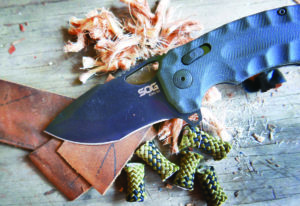
 

SOG’s Kiku XR Blackout has a hybrid version of the American tanto blade. The recurved portion of the main grind does a great job trapping leather and rope, and the tip finishes the job as it is pulled through.

The Kiku XR Blackout’s blade is shorter and wider than the traditional tanto pattern. We tested it first on 1.5-inch-wide harness leather, executing straight cuts and pull-throughs. The modified edge cut very well, though we almost ran out of blade while pulling upward through the leather strip.

Rope was much easier. The recurve of the blade trapped the rope, and the secondary grind from the dividing line—or yokoke—to the tip finished the job. It should be noted not all tantos have a yokoke; some simply sweep through upward to the tip. The cuts on 3/8-inch rappelling rope were clean as a whistle, while the edge tended to shred thicker 1-inch sisal. The handle was plenty comfortable and added to our cutting pleasure.

SPECS: SOG KIKU XR BLACKOUT
Blade length: 3 inches
Blade steel: CTS XHP stainless
Blade type: Hybrid American tanto
Handle material: Sculpted G-10
Special features: Multiple blade grinds
Carry: Pocket clip, blade tip upWeight: 5.19 ounces
Closed length: 4.375 inches
Country of origin: Taiwan
MSRP: $210.95

2-HAND HOSS: The TOPS CUMA Kage
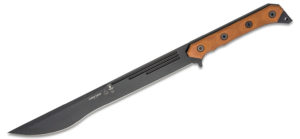
photo source: knifecenter.com

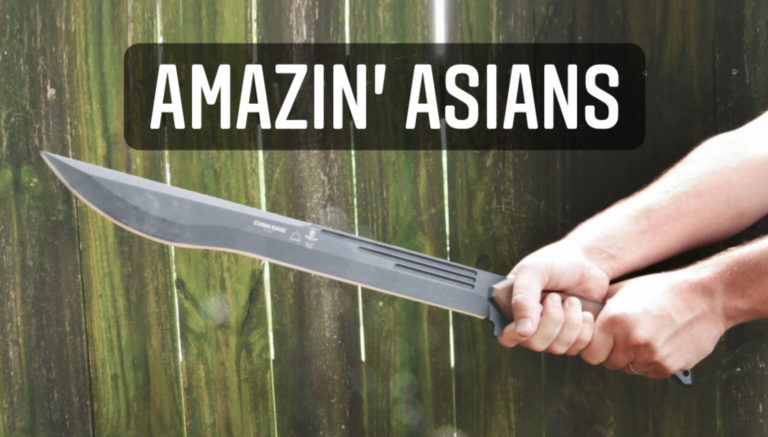
The TOPS CUMA Kage is a tour de force by martial arts guru Sijo Wayson Johnny Tsai. Overall length: 23.75 inches. The 15.5-inch blade of 1095 high carbon steel sports TOPS’ Black Traction Coating. The lengthy handle is 8.25 inches with Micarta scales sized for two-handed delivery. The blade is a hybrid straight sword pattern blended with 7 inches of kukri bulge at the tip to give it a bit of utility to go with its, ahem, badassery. It includes a full-length black Kydex sheath with a dangler/attachment ring. Weight: 31.5 ounces. MSRP: $360.
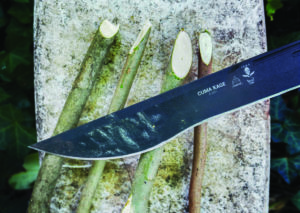
Using one hand or two, the author found the CUMA Kage cut brush equally well. However, as you might expect, you can take on much heavier tasks with it by using both hands.

To test the CUMA Kage for its utility billing, we took it outside for brush-clearing duty. We’ve always admired the kukri and have cleared an acre or two over the years with one, so this long send-up of the chopper intrigued me. We found out quickly we could use the CUMA Kage with one hand or two, which gives it a big leg up on its smaller cousin. The Micarta handle is well filled out and plenty grippy. One-handed we were able to easily whack through half-inch-thick green hardwood stalks and branches. Two-handed we sliced through stalks three-quarter of an inch with ease, and 1 inch as long as we had clearance to pull back for a full stroke. Though not the CUMA Kage’s original intent, it does have formidable utility.


Specs: TOPS CUMA KAGE
Blade length: 15.5 inches
Blade material: 1095 carbon steel
Blade finish: Black Traction Coating
Handle length: 8.25 inches
Handle material: Micarta
Special features: Kukri blade tip 
Sheath: Kydex w/leather dangler
Weight: 31.5 ounces
Overall length: 23.75 inches
Country of origin: USA
MSRP: $360

MELONIOUS ASSAULT

After testing the blades on a variety of fare, just for fun we took to the backyard to let them each have a go at a cantaloupe. Leading off with a reverse grip on the SOG Kiku XR, we stabbed the forlorn melon to the hilt. As stubby a version of the tanto as the Kiku XR’s blade may be, the cantaloupe’s pithy skin gave into the knife’s wishes quite easily.
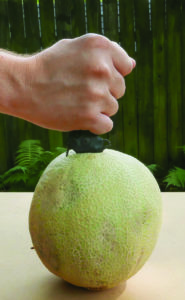
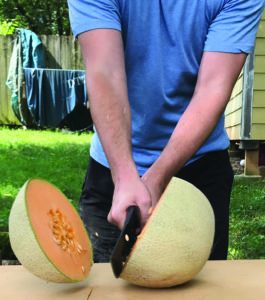
Next up the TOPS CUMA Kage tried the task of halving the cantaloupe in one fell swoop, which we captured in burst mode on my neighbor’s IPhone. Mission accomplished. Finally, we used the Lum Darn Dao to “prepare the meal” by using the blade in quick, rapid-fire chops. The sword’s deep V-grind—not unlike that of a chef’s knife—performed admirably.
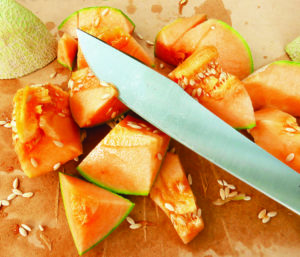
Like an oversized chef’s knife, the Lum Darn Dao deftly whacked the cantaloupe into chunks with speed and style.

BEASTS of the EAST

While we often think of knives and swords of an Asian design in the context of combat and martial arts, it’s easy to forget that many Eastern blades were used for everyday utility as well. The tanto was an everyday carry by the Samurai class in Japan, and men and women alike carried a smaller version, the kaiken, aka kwaiken. The chisel grind was not typical on tantos as we see on some of them today, but on knives for culinary purposes. The Japanese kiridashi, which is rapidly gaining a toehold in the cutlery world, was also chisel ground and used for wood carving and marking.

The wicked Indian/Nepalese Kukri was employed in combat, but is primarily a tool for clearing land and is used widely for bush whacking today. Even the Indonesian karambit was considered a working knife by its users. If nothing else, the distinctiveness of Asian cutlery design has added richly to our knowledge base of cutlery and given us a plethora of modern-day knives to explore.
Knife Steel Alloys: A Down-And-Dirty Guide

0

We break down what common steel alloying elements add to a knife.

Alloy… in the knife world we hear the word often. Blade aficionados—many almost journeyman metallurgists in their own rights—pour over steel composition. Newbies to collecting and making, however, might be a bit perplexed over exactly what the material modification is all about.

With this in mind, we’ve boiled down what certain elements—when alloyed with iron—bring to the table for your knife. Now this isn’t a deep dive into the nitty-gritty of what each element does in a steel alloy, complete with phase diagrams and quenching charts. Honestly, if you need to cut to this quick, we recommend Larrin Thomas’ website KnifeSteelNerd.com. The son of BLADE Cutlery Hall of Fame member Devin Thomas and PhD metallurgist and material scientist, Thomas offers a much more in-depth look at steel from an engineer and knifemaker’s point of view.

What we have here is a quick and dirty guide to alloy elements and what they bring to a knife.

What An Alloy Is

If your high school chemistry class is a bit foggy right now, perhaps we should take a moment to do a quick review of exactly what constitutes an alloy. Quite simply, an alloy is a mixture of two or more elements, where at least one of the elements is a metal. Note alloys are mixtures, not compounds—the former is a physical combination, the latter a chemical. For a mixture, think of something like oil emulsified in vinegar to create a tasty salad topping, while a compound is two gases like hydrogen and water bonding together to form water.

Alloying elements is done to enhance the properties of a material. In the case of knife steel elements are combined to improve toughness, wear resistance, corrosion resistance or other factors. While we won’t delve that deep in this article, we’ll point alloys can be classified into two main types:

Substitutional Alloys: In these alloys, the atoms of one element replace or substitute for the atoms of another in the metal lattice. An example is brass, which is an alloy of copper and zinc.

Interstitial Alloys: In these alloys, smaller atoms fit into the spaces (interstices) between the larger metal atoms in the lattice. Steel, which is an alloy of iron and carbon, is an example of an interstitial alloy.

Since we’ve dusted off some of those long-lost materials lessons you learned, let’s get into the down-and-dirty of what each common alloying element brings to knife steel.

Knife Steel Alloy Elements

Carbon: This ingredient makes the difference between iron and steel; all steel will have some amount of carbon. It is the most important hardening element, but it makes hardness by combining with other elements. As a simple generalization, the amount of carbon in the steel tells you a lot about the quality of the steel. Low-carbon steel has 0.3% carbon or less, medium has between 0.4-0.7% and high-carbon steel is 0.8% and above, maxing out at around 1.2% carbon for knife steels. Up to a point, the higher the carbon content within the range, the harder the steel will get.

Chromium: Chromium combines with carbon to make chromium carbides, which are resistant to corrosion. Stainless steel knives will have chromium as a major ingredient, typically at a minimum of 12-13%. Chromium also increases the strength of a knife to a degree, but adding chromium in large amounts decreases toughness.

Cobalt: In small amounts, cobalt increases toughness.

Manganese: This changes the rate of hardening. Manganese in carbon steels yields “deeper” hardening, which requires a slower speed quench and gives a wider range of acceptable heat before quench. If added in high quantities, it can increase brittleness. Manganese makes steel etch dark in damascus.

Molybdenum: Adding this maintains the steel’s strength at high temperatures.

Nickel: Nickel adds toughness to steel. It also makes steel etch bright in damascus.

Nitrogen: This element is sometimes used as a substitute for carbon in steel.

Silicon: Silicon increases strength and removes oxygen from the metal while it is being formed. It’s typically present in small quantities in most steels.

Sulfur: This increases machinability but decreases toughness.

Tungsten: Adding this increases wear resistance and forms tungsten carbides that are very hard.

Vanadium: Vanadium leads to smaller grains within the steel. Vanadium carbides are very small and hard, which increases wear resistance and edge retention.

More On Knife Steel:

12th Annual BLADE University Classes

Hone your cutlery acumen at the 12th Annual BLADE University

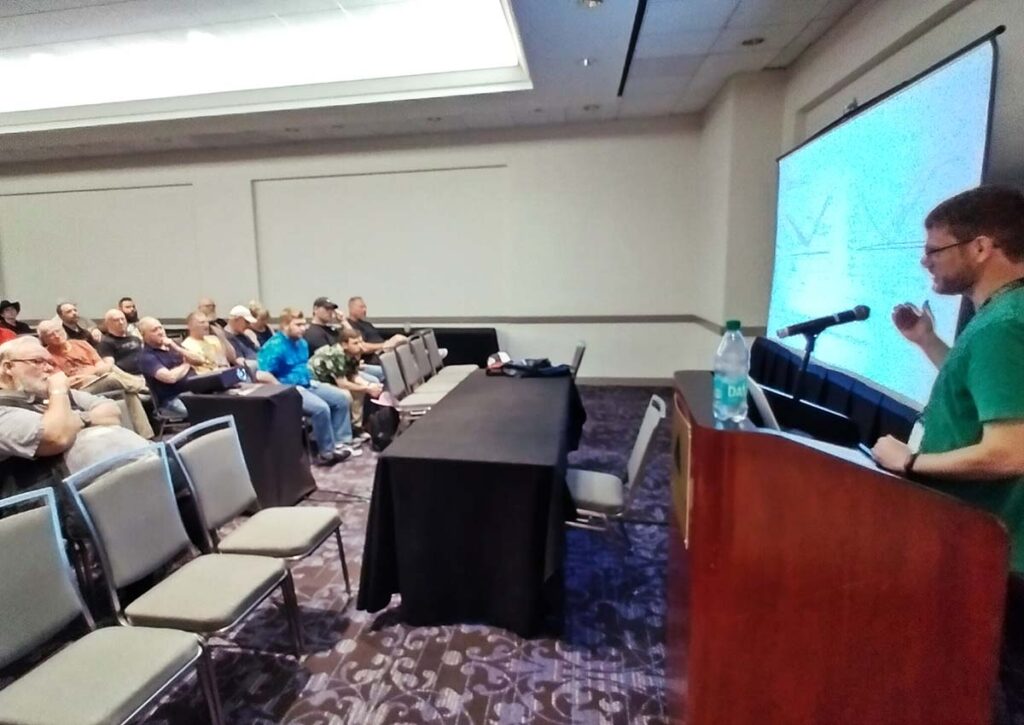
How to make and design knives, how to determine which steel for which knife, what to look for in proper damascus patterns and how to enhance their appearance and other incisive knife subjects will highlight the class schedule of the 12th Annual BLADE University.
Held in conjunction with the 44th Annual BLADE Show June 6-8 at the Cobb Galleria Centre in Atlanta, BLADE University will be sponsored by Work Sharp. Classes begin the Thursday before the show, June 5, and will run through Friday, June 6, and Saturday, June 7. All courses will be taught in the Cobb Galleria except one—Fundamentals of Grinding—which will convene under the tent in The Courtyard, aka the parking lot of the show’s host hotel, the Renaissance Atlanta Waverly.

BLADE University assembles some of the world’s best knifemakers, bladesmiths and other cutlery and steel professionals to teach a wide range of subjects for the knife user, knifemaker, knife hobbyist, knife entrepreneur, knife designer, and knife aficionado and novice alike. If you love knives or are just beginning to, BLADE University has a topic for you. The complete course schedule, with subjects, teachers, times and venues:

Thursday, June 5

In “Level Up Using Lasers, Ninjas and Other Cool Tools,” ABS master smith Neels van den Berg dives into how tools like laser engravers, digital design, and jigs and process design can streamline your workflow and enhance your work.
  • Material Conservation for the Forging Smith, Mareko Maumasi, 4 to 5 p.m., Room 104—Award-winning bladesmith Mareko Maumasi shares techniques and approaches he uses to reduce guesswork and material waste in the workshop. His approaches not only help the knifemaker’s material go further but also save time and money.

Friday, June 6

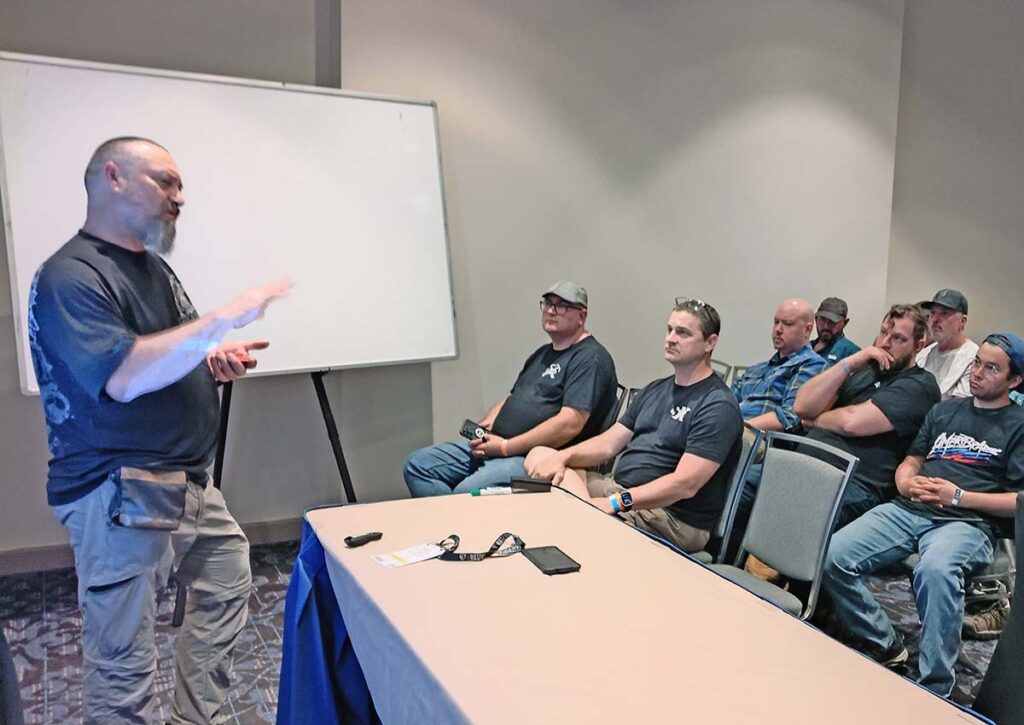
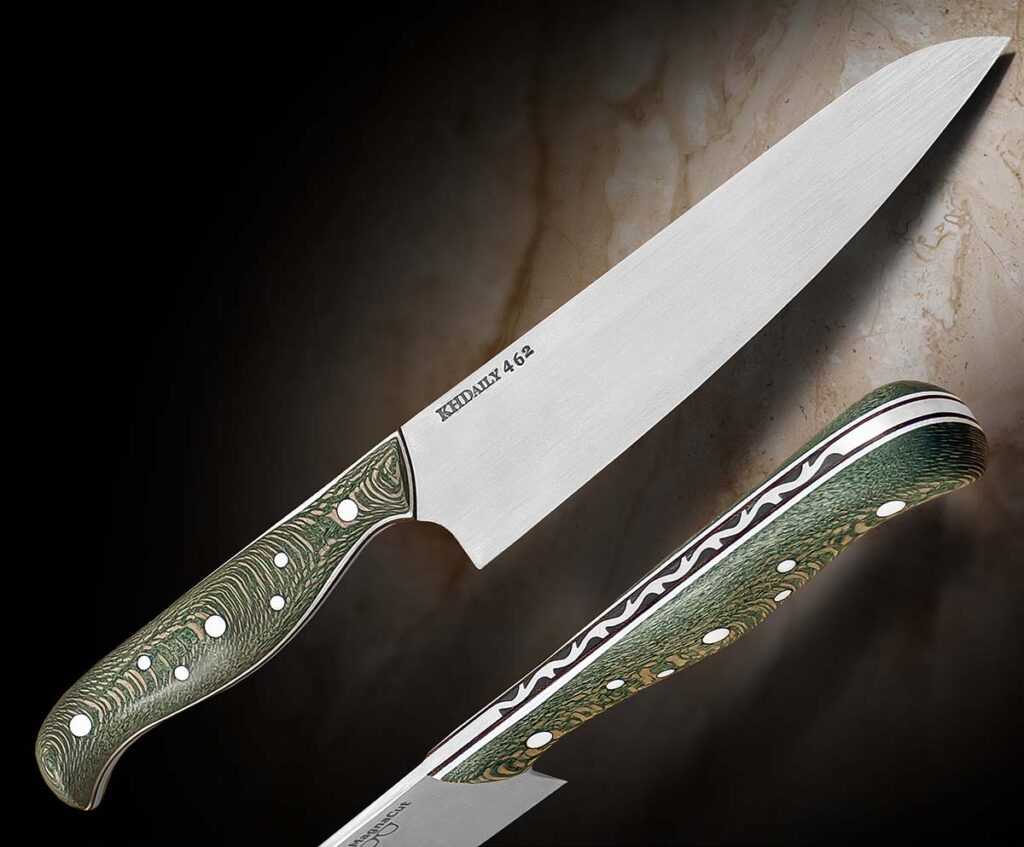
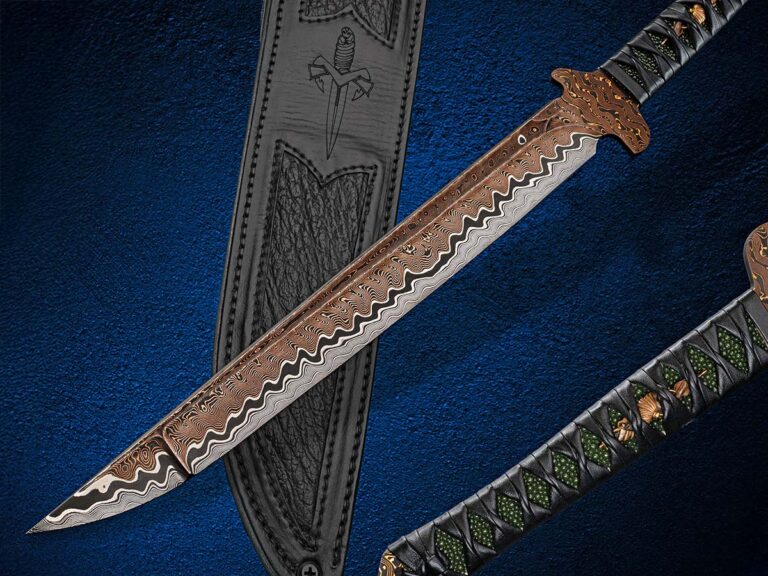
In “Elevating Your Handle Appearance: Spine Filework, Handle Shapes and Pin Placement,” knifemaker Kyle Daily shares his preferred files and specialized equipment for crafting his five most popular filework patterns, ensuring your knife not only looks exceptional but also feels comfortable and functional. (Jocelyn Frasier knife image)
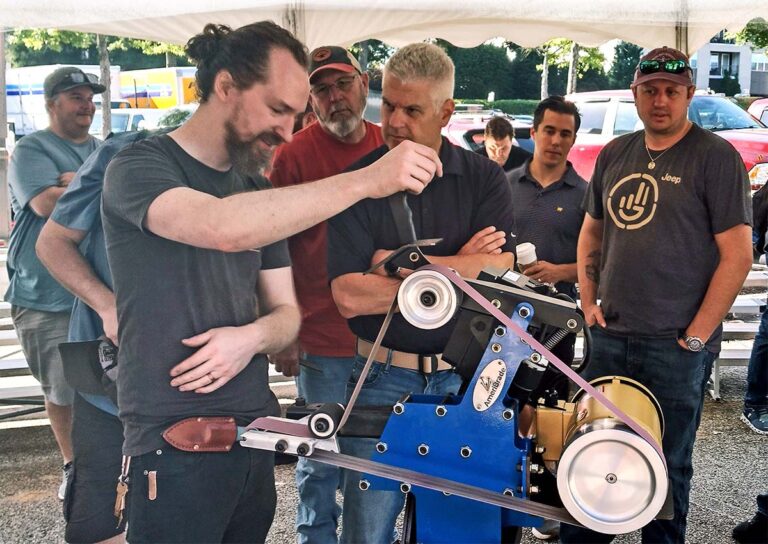
  • Fundamentals of Grinding, AmeriBrade and guest grinders, 8 to 9:30 a.m., The Courtyard—AmeriBrade and guest makers provide a general overview on grinds, techniques and different equipment. The class is interactive and the team answers questions and demonstrates suggestions for common issues.
  • Deep Dive into Culinary Knives, Mareko Maumasi, 10 to 11:30 a.m., Room 103—Mareko Maumasi returns to help collectors and makers better understand the nuances of high-performance culinary knives. The class covers design aspects from blade tip to pommel, aiding collectors in making more informed knife-buying decisions, and makers in creating higher-quality and higher-performing culinary knives.
  • The Tom Brown Tracker Experience, Mathew Williams, 1 to 2 p.m., Room 107—Experienced woodsman and tracker Mathew Williams discusses the iconic Tom Brown Tracker knife, including the blade’s notable features, how the knife’s function can be of benefit to the user and more. Mathew even dispels some Hollywood myths concerning the TBT. This one’s for old-time fans and newcomers alike.
  • Take Damascus Etching to the Next Level, Baker Forge, 1:30 to 2:30 p.m., Room 103—Greyson Weltyk of Grey Blades and Jordon Berthelot of JB Blades teach step-by-step processes on how to enhance intricate patterns in damascus with Gator Piss etchant, including in-person demos with damascus knives. Subjects include proper cleaning prep, temperatures, stacking oxide techniques, sealing oxides and more. Receive in-depth looks at new product offerings from Gator Piss for etching stainless damascus and properly sealing damascus with nano-ceramic technology. Have the opportunity for Q&A with authorities about damascus etching.
  • Hands on Sharpening, Work Sharp, 3:30 to 4:30 p.m., Room 113—What happens when a knife goes dull? How do you know when to sharpen it? Bring your own knife or borrow a demo model and learn the progression of shaping a bevel, sharpening and edge maintenance from the team at Work Sharp. You get hands-on practice and experience sharpening your blade using a variety of sharpeners and abrasives, from whetstones to belts. (See under Saturday’s classes for an encore presentation.)
  • Leather Sheath Making Tips, Tricks & Tools, John Dennehy, 4:30 to 5:30 p.m., Room 107—Classes on sheath making are conducted at knife shows, social media and elsewhere. Unfortunately, some of the online demos are by those giving the wrong advice. John Dennehy shares the sheath-making tips he’s learned after working leather for almost 50 years, including leather selection, the tools he uses and why he uses them. He also covers the construction details he employs that experienced leather workers recognize immediately as the ones needed to produce a professional sheath.

Saturday, June 7

In “How to Select the Best Steel for Every Knife,” steel metallurgist Dr. Larrin Thomas talks about the factors that are important for different types of knives, such as cost, toughness, edge retention, sharpenability and corrosion resistance.
  • Elevating Your Handle Appearance: Spine Filework, Handle Shapes and Pin Placement, Kyle Daily, 8:30 to 9:30 a.m., Room 113—Enhance the appearance of your knife with distinctive features that go far beyond standard production models. Knifemaker Kyle Daily from KHDaily Knives guides you through the intricate art of filework on the spine, while also sharing insights into handle design and pin placement on the handle. Discover Kyle’s preferred files and specialized equipment for crafting his five most popular filework patterns, ensuring your knife not only looks exceptional but also feels comfortable and functional. From laying out your pattern to a step-by-step tutorial, this class provides the essential knowledge to achieve a professional and eye-catching finish. A Q&A session at the end ensures you leave with the skills and knowledge to take your knifemaking to the next level.
  • Demystifying Damascus, Mareko Maumasi, 9:30 to 11 a.m., Room 104—Mareko Maumasi completes his third straight day of teaching BLADE University classes with a most challenging one. He breaks the subject down in a way to help collectors gain a better appreciation for the knowledge and skill required to make unique damascus patterns, and to deepen the makers’ understanding of pattern design and composition.
  • The Cutting Edge, Nick Italiano, 9:45 to 10:45 a.m., Room 107—Nick Italiano, seasoned outdoorsman and host of the Raise The Flag Podcast, discusses the nuances of various blade grinds. From common everyday uses to survival situations, Nick covers several common grinds and their real-world function.
  • Level Up Using Lasers, Ninjas and Other Cool Tools, Neels van den Berg, 12:30 to 1:30 p.m., Room 113—Step up your knifemaking game with cutting-edge technology, unconventional techniques and insider secrets from ABS master smith Neels van den Berg. In this high-energy session dive into how laser engravers, digital design, and jigs and process design can streamline your workflow and improve your work. Plus, explore the mindset and discipline—the “ninja skills”—that separate good makers from great ones. Packed with real-world examples, practical insights and a touch of humor, this is a must-attend for makers looking to work smarter, not harder.
  • Designing Knives: Philosophy, Tools and Inspiration, Jens Anso, 2:15 to 3:15 p.m., Room 104—Award-winning knifemaker Jens Anso shares his approach to knife design, including how he thinks about form and function, the tools he uses and where he finds inspiration. With decades of experience in the industry, he’s developed a clear design philosophy that balances aesthetics, ergonomics and real-world usability. He explains his workflow, from sketching and CAD modeling, to prototyping and refining details. His goal is to provide insight into the design process and share practical takeaways for makers and enthusiasts who want to push their work further.
  • Hands on Sharpening, Work Sharp, 2:15 to 3:15 p.m., Room 113—What happens when a knife goes dull? How do you know when to sharpen it? Bring your own knife or borrow a demo model and learn the progression of shaping a bevel, sharpening and edge maintenance in this encore presentation from the team at Work Sharp. You get hands-on practice and experience sharpening your blade using a variety of sharpeners and abrasives, from whetstones to belts.
  • How to Select the Best Steel for Every Knife, Larrin Thomas, 4 to 5 p.m., Room 104—Both the makers and buyers of knives have many options for steels, but how do they know which ones to choose? Steel metallurgist Dr. Larrin Thomas talks about the factors that are important for different types of knives, such as cost, toughness, edge retention, sharpenability and corrosion resistance. Which steels are more optimal for a large chopper, a kitchen knife or a folder? For makers, the topics of forgeability, grindability, polishability and ease of heat treating are covered to choose steels that perform well and fit the knifemaking setup.

More classes were being determined at press time. For more information on them and on how to enroll in one or more of BLADE University’s classes, see our course offerings. There will be additional information on BLADE University in the June BLADE® and also in the BLADE Show Program, copies of which will be distributed for free at the BLADE Show.

More BLADE Show Information:

Russ Kommer Makes a Knife Step-by-Step

0

Russ Kommer walks through the process of designing and making a knife with Stephen LeBlanc.

Damascus Steel: Experts Forecast Growth In The Knife Industry

From copper-infused patterns to stainless steel sheets, discover the innovations driving the red-hot market for production damascus.

Are we seeing a bit of “global warming” in the knife industry, where red-hot damascus steel is getting even hotter? BLADE® spoke with some industry leaders, and 2025 and beyond looks good to them when it comes to production damascus in both carbon and stainless steels.

There are many individual makers who make high-quality damascus in simple and complex patterns in their home shops, backyards or shared maker spaces. This article focuses instead on production damascus forged by specialized outfits such as Baker Forge & Tool, Damasteel, Chad Nichols Damascus and Vegas Forge. At a level beyond “regular” damascus makers, these companies make steel for the masses, for production companies, and specialize in innovative new materials that are sure to delight the industry.

BLADE readers will be familiar with Baker Forge & Tool, a prolific producer of innovative damascus patterns that include copper, such as CopperMai, TigerMai, GoMai and others.

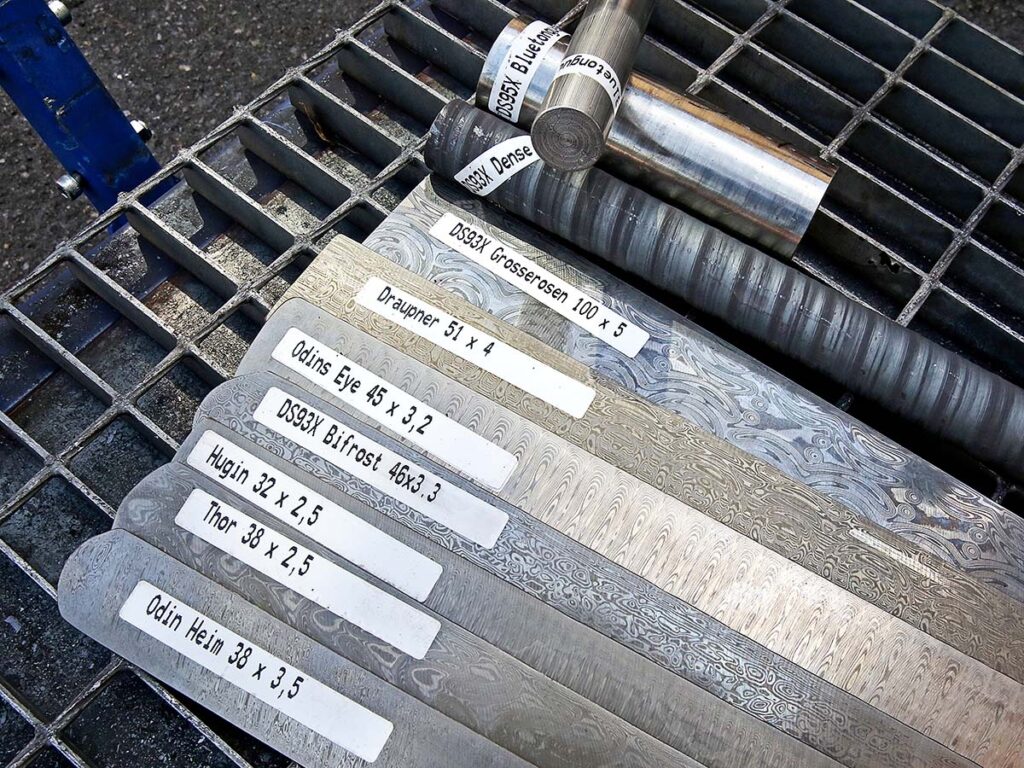
DS93X steel—fourth from bottom in bar form—is Damasteel’s standard mix, “combining good performance with good looks.” “For us it’s more about expanding the patterns than about trying new steel combos,” noted Per Jarbelius. The other patterns in bar form are representative examples of what you can expect from the Swedish steel maker.

“We make carbon steel damascus patterns with copper, and they’ve been hot. We expect them to stay hot through 2025,” Coy Baker said. When it comes to steel selection, the company most often sticks with the gold standard combination of 1084 carbon and 15N20 nickel-alloy steels.

Baker also has been experimenting with Apex Ultra as a core steel for its copper san-mai. For those unfamiliar, Apex Ultra is a tungsten steel alloy, kind of a super-52100 carbon steel. It’s made in small batches and is hard to get in the USA, but Baker has found that the material makes a great damascus core.

“Demand for our Apex core billets far outpaces supply,” Coy noted.

Baker has also been experimenting with stainless and copper damascus and san-mai, using 154CM and AEB-L stainless steels. This writer also makes knives and that combo sounds quite challenging to forge. Baker confirmed that it was very challenging and wouldn’t reveal any secrets, other than the 154CM etches light and the AEB-L etches darker.

Growth In The ‘Sip

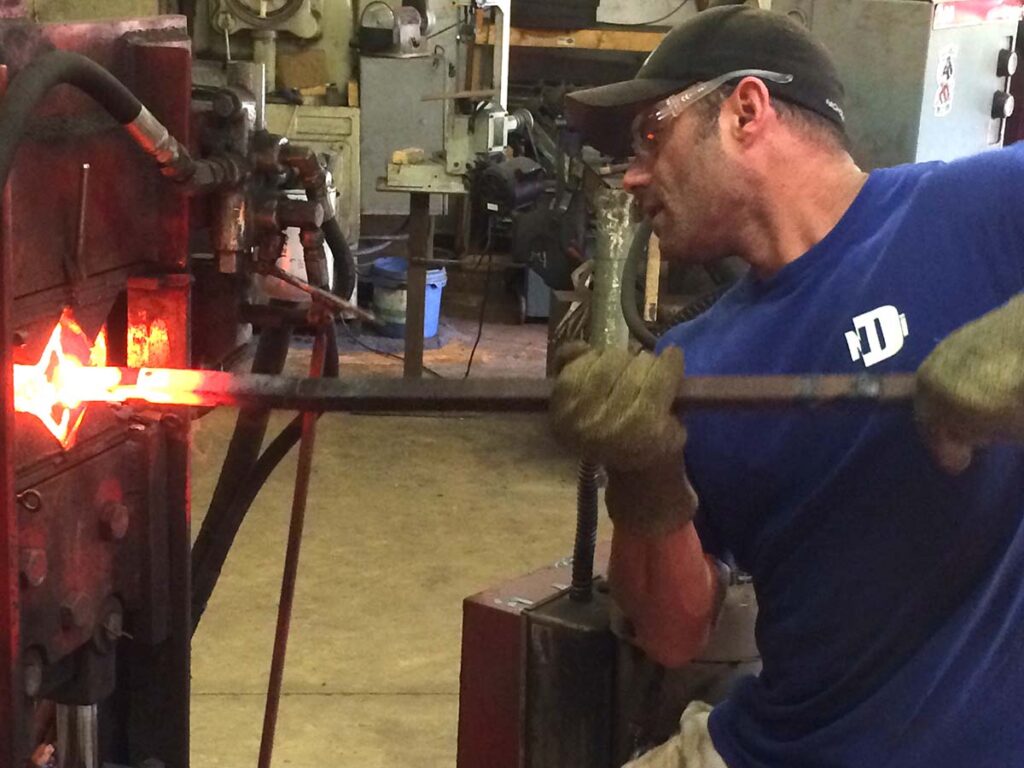
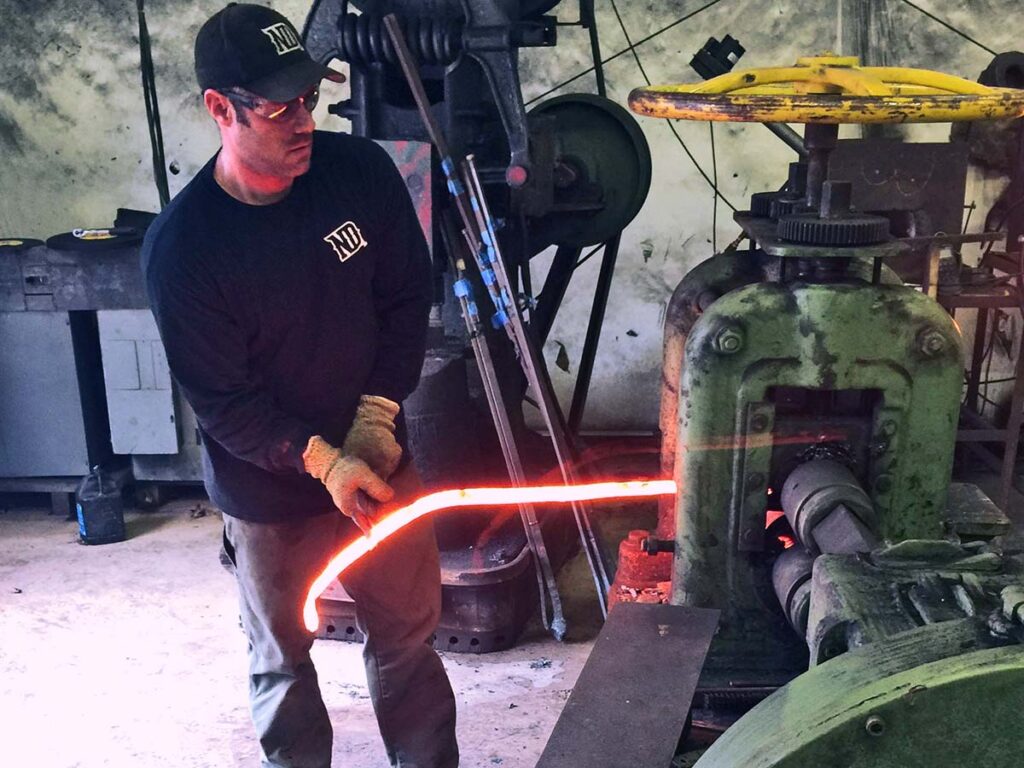
Down in beautiful Bush Springs, Mississippi, Chad Nichols makes traditional carbon steel damascus at a production level.

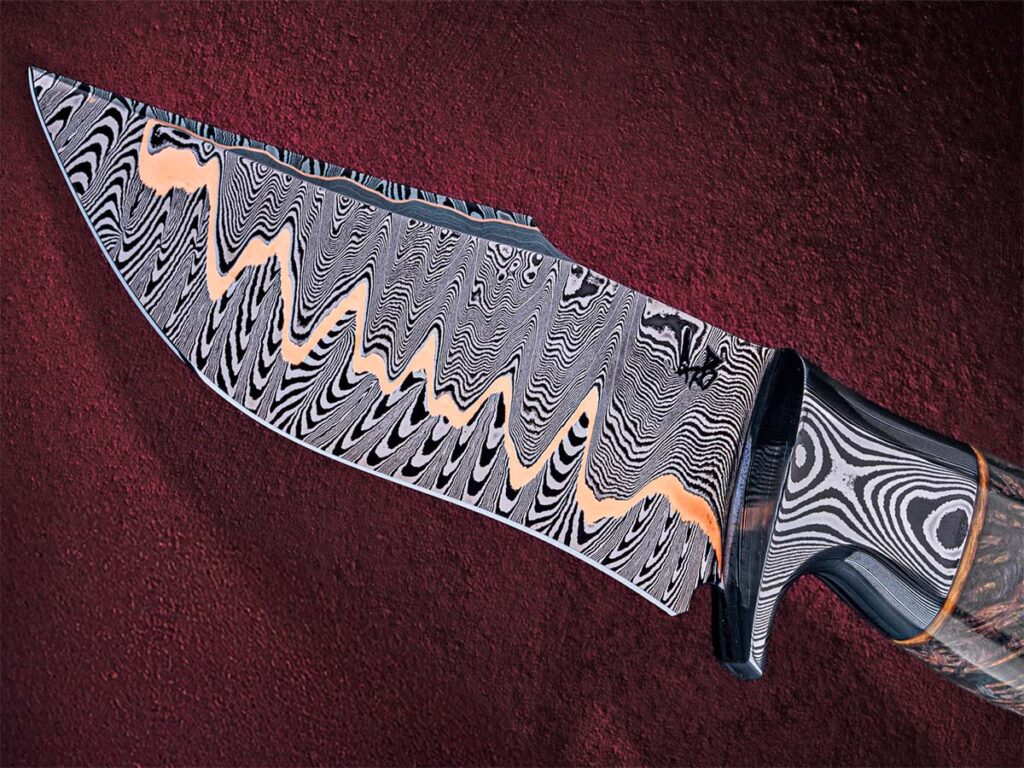
Vegas Forge has always been innovative and 2025 will be no exception. “We’ve figured out how to do copper in with the damascus pattern manipulation, not just as a line between san-mai,” Jesse Harber noted. (Vegasforge.com image)

“I stick mostly to carbon steel 1075 or 1095 plus 15N20 with occasionally a little bit of 3V,” Nichols explained. “I’ve got my process down and these steels go together well.” He makes a variety of mosaic patterns, most of which go to a single manufacturer. “The carbon steels are so much more organic,” Nichols said. “You can do so much more with them in a cost-effective way.”

Nichols’ goal for 2025 is to increase his production of mosaic patterns.

“There just aren’t many people doing production mosaics,” he said. “It’s a great opportunity for growth.”

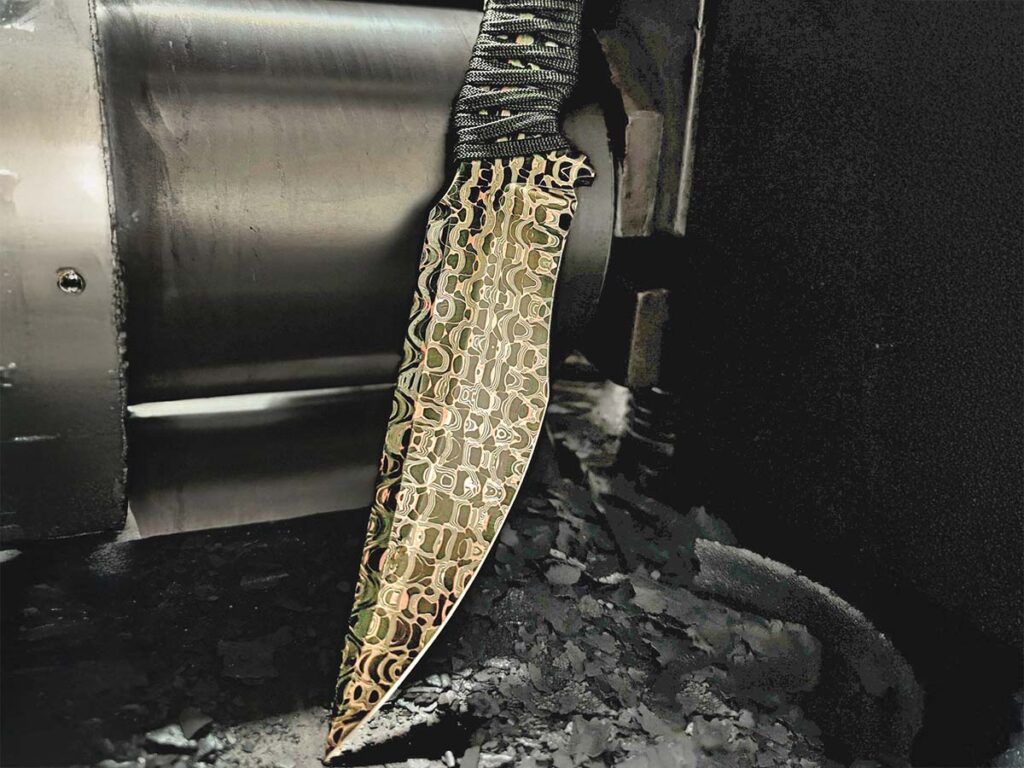
Another area he’d like to see grow in 2025 is the use of exotic and historical materials. He’s made a run of steel for Boker with steel from a German Tiger tank, and has a run coming for William Henry with some leaf springs sourced by WH.

Collab Designs

Damascus isn’t just a U.S. product. Damasteel produces high-quality stainless steel damascus in Sweden.

Chad Nichols (above) stated the goal at Chad Nichols Damascus for 2025 is to increase the production of mosaic patterns.

“Our DS93X steel is our standard mix, combining good performance with good looks,” Damasteel’s Per Jarbelius remarked. “For us it’s more about expanding the patterns than about trying new steel combos.”

DS93X is described as a “patented powder metallurgy product” that includes “two different hardenable steel grades.” “We use only stainless steel,” Jarbelius explained, ‘because it doesn’t rust and has the same or better performance.”

Damasteel historically produces a new pattern each year. For 2025 it also has begun a special project to collaboratively design patterns. Benchmade collaborated with Damasteel to make a steel pattern called “Monarch” exclusively for the Benchmade Gold Class Necron balisong. Jarbelius is excited for the potential to expand the collaborative effort with other companies who want proprietary patterns.

In another innovation, Damasteel has developed the capability to produce stainless damascus in sheets, not just bars. This will come in handy for small-batch and mid-tech production. The sheet steel pattern is called “Drakkar,” which is the old Norse word for the dragon-shaped Viking longboats.

Copper In The Pattern

What happens in Vegas may stay in Vegas, but that’s not the slogan for Vegas Forge, whose damascus is well known worldwide. It is a consistent producer of high-quality carbon and stainless damascus in complex patterns.

Baker Forge & Tool has been experimenting with Apex Ultra as a core steel for copper san-mai. This integral fighter by Greyson Weltyk features Baker copper damascus for its recurve harpoon blade. (Bakerforge.com image)

“One of our most popular patterns is ‘Reptilian,’ which has three alloys included: O1, 1075 and nickel,” observed the company’s Jesse Harber.

Vegas Forge has always been innovative and 2025 will be no exception.

“We’ve figured out how to do copper in with the damascus pattern manipulation, not just as a line between san-mai,” Jesse noted. “We can take our Reptilian pattern with copper in it, and then clad that billet over an O1 or 1095 core.”

As far as stainless goes, Vegas Forge continues to push the complexity of its patterns. Its most popular pattern, “Virus,” begins with a single stack of 1200 pieces! The company uses 154CM cores for most of its stainless san-mai, along with CTS XHP when available.

Ultimate Hotness

What kind of knives do the manufacturers predict for ultimate hotness in 2025?

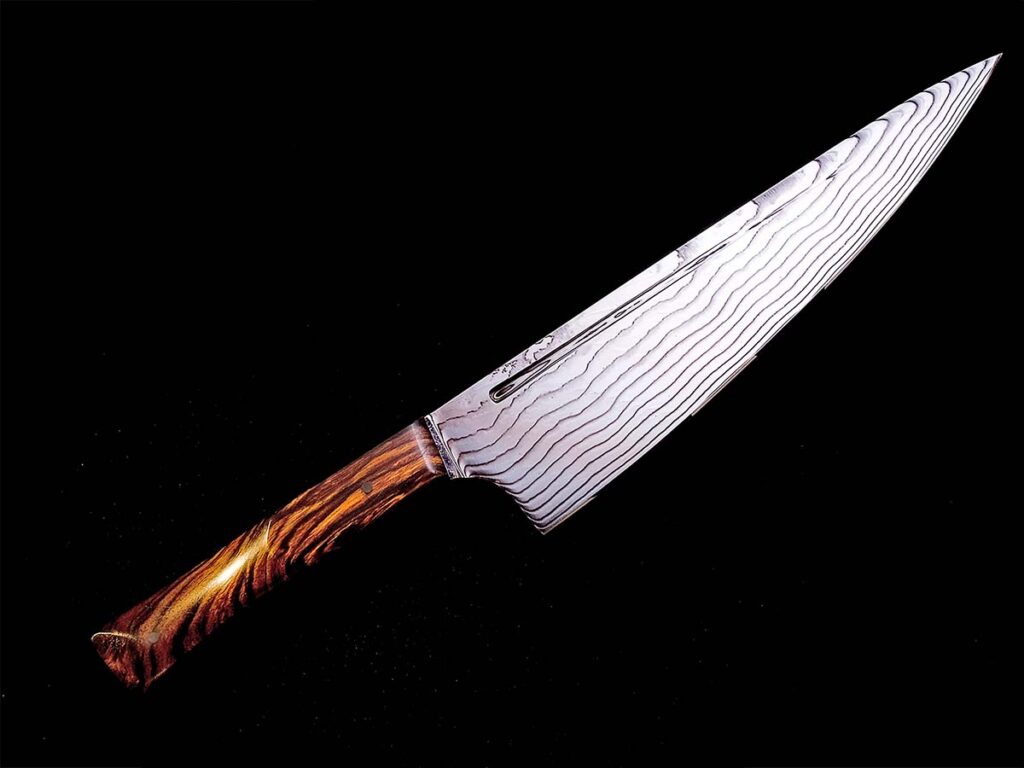
Damasteel has developed the capability to produce stainless damascus in sheets, not just bars. The sheet steel pattern is called “Drakkar,” the old Norse word for the dragon-shaped Viking longboats, and is used here on a chef’s knife by a local Swedish cutler.

Both Baker and Jarbelius indicated culinary knives will stay hot, especially in stainless. Baker pointed out that stainless steel handles kitchen abuse better, and this writer agrees. Per said Damasteel’s Damacore and DC18N nitrogen steels are top of the line, and the company has a culinary knife coming in partnership with BLADE Magazine Cutlery Hall-of-Fame® member Ken Onion and CRKT. Both Damasteel officials and Chad Nichols agree that complex patterns are expected to do well for the pocketknife and one-off makers.

Jarbelius “expects growth in the complex pattern market” even as Damasteel’s basic traditional rose, ladder and twist damascus patterns remain best sellers. Nichols states that the mosaic niche he addresses will continue to grow.

All four steel makers expect growth in the production side of the market. Even in a slower economy, the big knife manufacturing companies are still producing limited runs of high-quality damascus knives. Baker looks for growth in his damascus-core san-mai steels.

“They’re easier to get a consistent etch on than the mono-steel cores,” he explained.

Chad Nichols stated that he expects growth in the use of mosaic damascus steels by factory knife companies in 2025.

Manufacturing is all about consistency and efficient processes. Damasteel achieves consistency by using the same steel combo for all its patterns. Nichols gets there by batch building for specific manufacturers so that each run is internally consistent. Harber mentioned that he was approached at BLADE Show West* by multiple production companies looking to order steel for 100-to-200-piece runs. He indicated he expects the mid-range sub-$800 production folders to stay hot.

Gonna Be Intersting

The new year is going to be an interesting one for the economy and politics, both of which are inextricably entwined. Fortunately, thanks to the work of those in the damascus industry, it’ll also be an interesting year in the world of knives. If nothing else, knife enthusiasts will have plenty of beautiful damascus production knives coming off the assembly lines to keep them entertained.

More On Steel:

BLADE Show 2023: What To Expect In Atlanta

BLADE Show 2023 is just around the corner. Here’s what to look out for at the “World’s Greatest Knife Show!”

If the third time really is the charm, then BLADE Show 2023 is smack dab in the middle of charm’s way.

Why? Because it’s the third BLADE Show after the one that was cancelled in 2020 as a result of the pandemic, and most all travel restrictions instituted even as late as last year’s BLADE Show have been lifted. That means a full return of international knife exhibitors and fans in addition to all those domestic are expected to make the 42nd annual rendition of the world’s most important knife event the biggest and best ever.

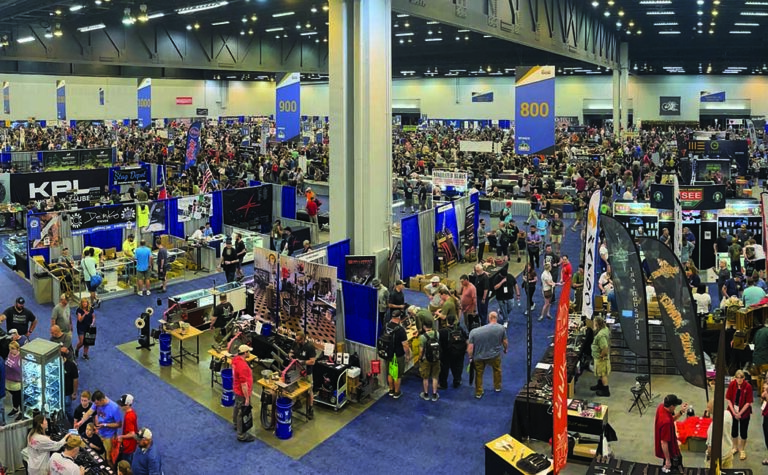
Sponsored by Smoky Mountain Knife Works, the BLADE Show is where more knives—new, old, custom, factory, etc.—are exhibited, bought and sold than at any other knife event. Almost 930 exhibitors* from every continent but Antarctica were scheduled to exhibit at press time, all bringing their latest and greatest knives and other edged tools, accessories, knifemaking supplies and more. Factory and custom knives, sharpeners, knife collections, knife purveyors and other cutlery entities too numerous to mention will showcase their wares as the world knife community makes the yearly pilgrimage to the Cobb Galleria Centre.

BLADE Show Overview

WHAT: BLADE Show
WHERE: Cobb Galleria Centre, Atlanta
WHEN: June 2-4
DAYS and TIMES:

  • Friday, 11 a.m.-6 p.m. (early bird ticket holders can enter at 10 a.m.)
  • Saturday, 9 a.m.-6 p.m.
  • Sunday, 9 a.m.-2 p.m.

Get Your BLADE Show Tickets

The latest, hottest custom knives, factory knife debuts, the educational knife instruction class schedule of BLADE University and action-packed free demos are among the sharp goodies awaiting hordes of show patrons. The BLADE Magazine 2023 Knife-Of-The-Year® Awards, the custom knife judging competition and the knife collection display judging competition are others. The ABS Knife Auction, formal inductions of the latest members of the BLADE Magazine Cutlery Hall Of Fame®, and some of the best knives the ABS and the Knifemakers’ Guild and unaffiliated makers in general have to offer are still others.

And don’t forget The Pit, the after-hours meeting place in and around the sunken bar of the host hotel, the Renaissance Atlanta Waverly, where show patrons and exhibitors will congregate into the wee hours beginning the night before the show through the end of the weekend to compare knives, swap lies and otherwise celebrate the year’s most momentous cutlery weekend.

BLADE University

Avail yourself of the latest knifemaking techniques and other trending sharp subjects during the 10th Annual BLADE University show Friday and Saturday.

Ed Flowler seminar
BLADE® field editor Ed Fowler will present the seminar “Seeking Safety In Knife Design” show Saturday at 1 p.m. in Room 107.

Sponsored by Work Sharp Sharpeners, BLADE University has the most extensive schedule of knife, knifemaking and other instruction held at any knife show. Among the highlight classes for 2023 are “CRKT Presents Q&A with Michael Walker” featuring the industry renowned creator of the linerlock; “Designing Kitchen Knives” and “How To Run A Successful Knifemaking Business” with chef’s knife maestro Bob Kramer; “Exploring the Performance of Pattern-Welded Steel,” with damascus forging legend Devin “Hoss” Thomas and his son, internet steel guru Larrin Thomas; and many more.

BLADE University Schedule

FRIDAY

  • 8-9:30 a.m. Fundamentals of Grinding, The Courtyard. AmeriBrade and guest makers cover grinds, technique and different equipment.
  • 10-11 a.m. Exploring the Performance of Pattern-Welded Steel, Room 103. Devin and Larrin Thomas review their experiments on the strength, toughness and edge retention of damascus steel.
  • 10:30 a.m.-12 p.m. Designing Kitchen Knives, Room 104. ABS master smith Bob Kramer discusses considerations to ponder when designing kitchen knives.
  • 1-2 p.m. CRKT Presents Q&A with Michael Walker, Room 104. BLADE Magazine Cutlery Hall-Of-Fame® member Michael Walker answers questions on the linerlock he developed in 1981, the evolution of the many other locking systems he designed post-linerlock and more.
  • 1:30-2:30 p.m. Dancing with the Devil: Algorithms, SEO and Ecommerce, Room 103. Ben Petersen explains how to sell knives online and build your brand while navigating Google, Amazon and Meta.
  • 2-3 p.m. What’s Hot in Knife Steels, Room 103. Join representatives from Mike Norris Damascus, Nichols Damascus and Vegas Forge as they discuss today’s hottest steels and why those steels are so much in demand.
  • 3-4 p.m. Forging Ancient Materials and Why It’s Important Today, Room 107. Award-winning knifemaker Ilya Alekseyev and friends explore how and why practicing forging methods used by the craftsmen of old translates into modern materials.
  • 3:30-4:30 p.m. Hands-On Knife Sharpening, Room 113. Bring your knife or a borrowed one and learn the progression of shaping a bevel, sharpening and edge maintenance from the team at Work Sharp Sharpeners.
  • 4:30-5:30 p.m. Unlearning Bad Habits: My Unique Path to JS, Room 107. Matt Stagmer focuses on makers that have been in the craft for many years, and how becoming an ABS journeyman smith differs from someone learning those standards from day one.

SATURDAY

  • 8:30-9:30 a.m. Decorative Custom Knife Filework, Room 113. Knifemaker Kyle Daily of KHDaily Knives shows you his preferred files and the equipment he uses to make his five most popular filework patterns.
  • 8:45-9:45 a.m. How To Forge a Hunting Knife, The Courtyard. Using his propane forge, ABS master smith Timothy Potier demonstrates how to forge a full-tang drop-point hunter.
  • 9:30-11 a.m. How To Run a Successful Knifemaking Business, Room 104. ABS master smith Bob Kramer shares his 35 years of experience running a successful knifemaking business.
  • 9:45-10:45 a.m. Reproducing Traditional Pocketknives, Room 107. Tim Robertson covers patterning traditional slipjoints from original factory knives in detail, including methods of disassembly, correct scribing techniques and proper hole layout.
  • 11 a.m.-12 p.m. 3D Printing for Canister Patterns, Room 113. ABS master smith Steve Schwarzer and Ron Hardman show you how to use this game-changing advancement to forge patterns on a budget that were previously unthinkable.
  • 2-3 p.m. Let the Pros Critique Your Knife, Room 104. Award-winning knifemakers Lucas Burnley, Luke Swenson and Devin Thomas, and ABS master smiths David Lisch and Mike Quesenberry examine your knife, tell you what’s good about it, what’s not and how to make it better.
  • 2:15-3:15 p.m. Hands-On Knife Sharpening, Room 113. Bring your knife or a borrowed one and learn the progression of shaping a bevel, sharpening and edge maintenance from the team at Work Sharp Sharpeners.
  • 2:30-3:30 p.m. Writing for a Knife Publication, Room 107. Author/ABS apprentice smith Jason Fry and a panel of industry insiders share the tips and tricks it takes to get into the knife writing game.
  • 4-5 p.m. Folder Design, Room 104. David Carver of Carver Knife Co. teaches techniques on making a folding knife that works well, looks good and feels great in the hand/pocket.

Enroll In BLADE University Classe Now!

World Cutting Title

The BLADE Show World Championship Cutting Competitions will be conducted by BladeSports International (BSI) and held in The Courtyard, the parking lot of the host hotel, the Renaissance Atlanta Waverly, Saturday at 4:30 p.m.

At press time, contestants in both men’s and women’s divisions were scheduled to compete. Last year, James Clifton won the men’s division and Terri Lynn the women’s.

Knives Of The Year

The BLADE Magazine 2023 Knife-Of-The-Year® Awards will be announced and presented during the BLADE Magazine Awards ceremony Saturday night in The Pit.

The entries are limited to BLADE Show factory booth exhibitors, and will be on display show Friday and Saturday under glass in a special locked cabinet in the lobby. The winners will be announced on BLADE’s here after the awards presentation, and a list will be posted outside the show entrance Sunday morning.

The award categories are: Overall; American-Made; Imported; Most Innovative American Design; Most Innovative Imported Design; Best Buy Of the Year; Investor/Collector; Collaboration; Manufacturing Quality; Accessory; Kitchen; Publisher’s; and Industry Achievement.

Custom Knife Judging

Leading industry authorities will pick the best custom knives by BLADE Show exhibitors in the annual knife judging competition, with the winners announced during the BLADE Magazine Awards ceremony Saturday night in The Pit.

Rhea knife
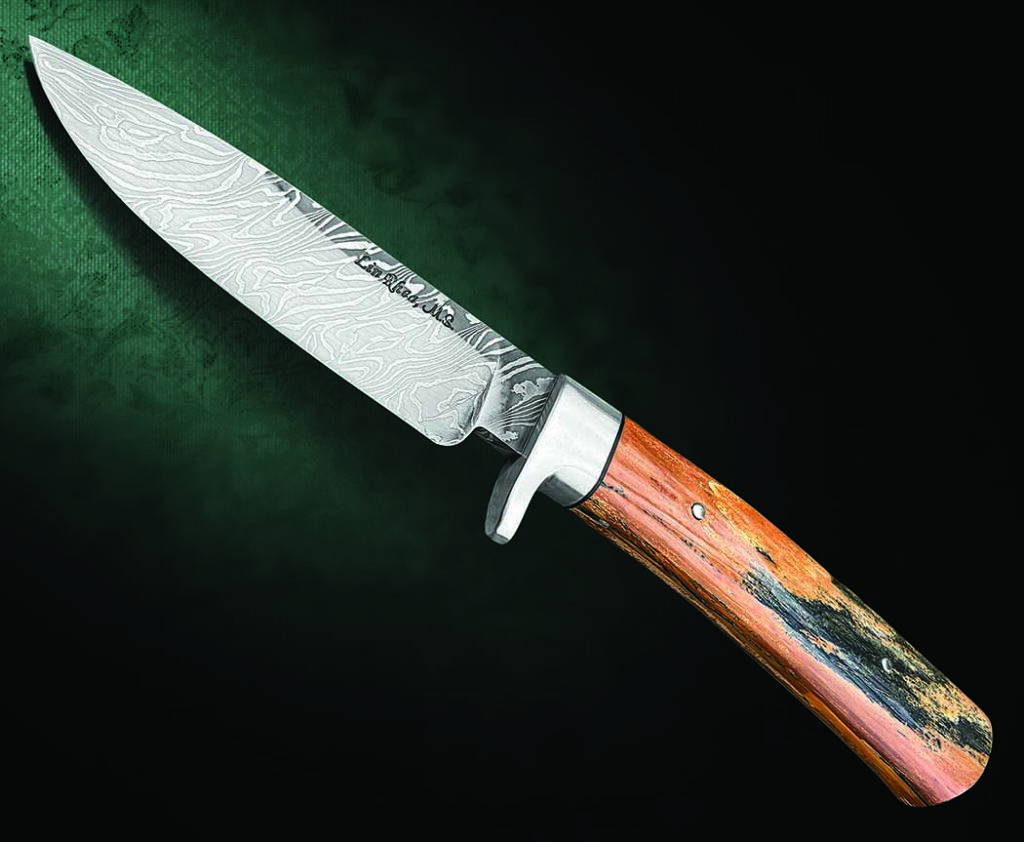
ABS master smith Lin Rhea will exhibit such forged wonders as his damascus hunter in mammoth ivory. (Jocelyn Frasier image edit)

The categories: Hugh Bartrug Best Of Show; Best Fixed Blade; Best Damascus; Best Kitchen Knife; Yvon Vachon Best Miniature; Best Art Knife; Best Fighter; Best Bowie; Best Handle Design; Best Tactical Folder; Best Utility Hunter; Best Folder; Most Innovative Design; Best Knife Collaboration; Best Sword; Best New Maker; Best Of The Rest; and a new BLADE Show category: Best M.A.C.K. (Machine Assisted Custom Knife).

The competition is open to the show’s custom knife exhibitors only. The winners will be announced on BLADE’s blademag.com website after the awards ceremony, and a list will be posted outside the show entrance Sunday morning.

Seminars & Demos

Seminars and demonstrations will be held in classrooms inside the Cobb Galleria or in The Courtyard, or under The Courtyard’s BLADE University tent. Admission is free to BLADE Show ticket holders.

Among the highlights will be “Knowledge Destroys Fear” presented by Ernest Emerson, CEO of Emerson Knives, Inc. Ernest will share the secrets of how Navy SEALs, Special Forces, Rangers and U.S. Marines conquer fear and thrive and prevail in the face of extreme life-threatening danger. Another highlight will be “Seeking Safety in Knife Design” with BLADE® field editor Ed Fowler. Ed will outline how to use knives efficiently and safely and what to look for in knives that cut effectively, do so without causing hot spots, and otherwise aren’t accidents waiting to happen in and of themselves.

Cutlery Hall Of Fame®

The BLADE Magazine Cutlery Hall Of Fame® will formally induct three new members at 8 a.m. show Saturday in the Kennesaw Room of the Renaissance Atlanta Waverly Hotel. (At press time, the new members had not been determined.) Tickets are required ahead of time for the ceremony, which includes a breakfast. Seating is limited. For ticket information, email [email protected].

Knife Colletions

Outstanding knife collections will be on display, with the best recognized via a judging competition. Last year’s winners: Larry Oden, Best of Show for “Buck Factory Production Knives of the 1960s.” Judges awards went to Gene Merritt for his “Yellowhorse” display of David Yellowhorse knives and Bruce Cannon for “Paul Bos: Alloys’ Greatest Ally.” Natalie Lindsey won the Youth Award for “Tinkerbell and Friends Put the Magic in BCCI and Buck Knives.”

Bali Championship

Top balisong flippers will vie for the title of “Grand Master” in the 7th Annual Battle for Bali-Champion sponsored and conducted by Blade HQ.

Bali awards
The 7th Annual Battle for Bali Champion conducted by Blade HQ will be Saturday in The Courtyard. Last year’s top finishers, from left: James Hill (3rd place), Leighton Gravely (first) and Moiz Khalil (second).

The top three finishers will receive prizes and all participants will get swag bags. The competition will be limited to 48 contestants.

BLADE Show ticket holders are invited to watch the competition in The Courtyard under the BLADE University Tent on show Saturday from noon to 2 p.m. Competitors will start flipping knives at 12:30 p.m.

BLADE Show Seminars And Events

SATURDAY

  • 8 a.m.: BLADE Magazine Cutlery-Hall-Of-Fame inductions, Kennesaw Room, Renaissance Atlanta Waverly Hotel: Buy Cutlery Hall Of Fame Tickets
  • 10-to-11:45 a.m.: ABS Knife Auction, Room 103
  • Noon-to-1 p.m.: Knowledge Destroys Fear—Ernest Emerson, Room 104
  • Noon-to-2 p.m.: 7th Annual Battle for Bali-Champion—Blade HQ, The Courtyard (the actual competition starts at 12:30 p.m.)
  • 1-to-2 p.m.: Seeking Safety in Knife Design—BLADE® field editor Ed Fowler, Room 107
  • 12-to-3 p.m.: Buck Collectors Club, Room 103
  • 4:30 p.m.: BLADE Show World Championship Cutting Competitions, conducted by BladeSports International in The Courtyard

Editor’s note: Microtech Knives and Heretic Knives are the presenting sponsors for BLADE Show 2023. RoseCraft Blades is The Pit sponsor. Work Sharp Sharpeners sponsors BLADE University. The other sponsors are Hogue Knives; Reate Knives; Nottingham Tactical; QSP Knife; Zac Brown’s Southern Grind; WE Knife; Glow Rhino; Columbia River Knife & Tool; and Artisan Cutlery.

Read More About The Blade Show:

Keep Your Edge with the Work Sharp Guided Sharpening System

Keep your edge with the Work Sharp Guided Sharpening System.

Next to a knife on their wish list, knife owners and collectors are typically on the hunt for one thing — a superior sharpening system.

Finding the right solution to handle a wide spectrum of blade styles, grinds and material is more difficult than it sounds. As most knife aficionados know, what draws a sharp edge on one blade may struggle on another.

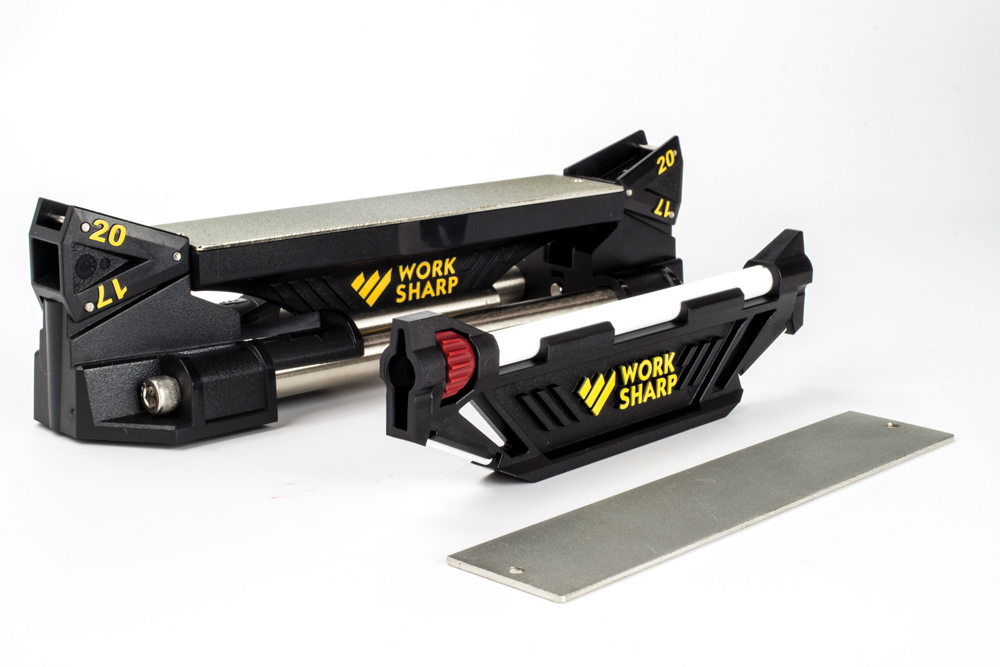
That’s what makes the Work Sharp Guided Sharpening System so exciting. This niffy and elegant sharpener has been designed to put a razor’s edge on every knife you own — from flat grinds to serrated blades.

At the heart of the sharpener is Work Sharp’s Pivot-Response system that allows the abrasive surface to follow the curve of the knife. This innovative feature permits the sharpening surface to tilt with the camber of the blade, thus allowing liner strokes to apply an edge. This takes much of the guesswork out of sharpening the entirety of a knife, making the process faster, easier and more precise.

The Pivot-Response, however, can be locked if a more traditional sharpening platform is desired. This makes the Guided Sharpening System ideal for novices and experts alike.

Making the system almost fool proof is the Angle-Guided Bench Sharpener. These guides — set at 17 and 20 degrees — are designed to ensure the proper angle is taken on each pass, thus guaranteeing a dynamite cutting edge.

Work Sharp Guided Sharpening System includes coarse and fine diamond plates, a three-position ceramic rod for honing, and two small diameter ceramic rods for serrations.

Work Sharp has also aimed to make this sharpener a life-long addition to your knife maintenance kit with a 42-year warranty.

Advertisement

Must Read Articles

Read this before you make a knife

Knifemaking 101 – Read This Before You Make a Knife

  by Wayne Goddard My experience has taught me that there's nothing like digging in and getting started. I've often said the hardest part of the...
how to forge damascus steel

How to Forge Damascus

Advertisement
Advertisement