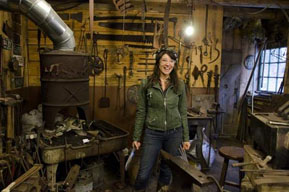
In an article titled “Sisters Of Steel: Vermont Women Forge Success Making Handmade Kitchen Knives,” initially published on BurlingtonFreePress.com, a Gannett Company, and written by Melissa Pasanen, the story is of Moriah Cowles and Chelsea Miller, both incredibly 30 years old, both slender and both with dark hair. They also both grew up in Vermont with fathers who work with their hands, and now they both live in Brooklyn, where each has built a reputation for making kitchen knives. And neither knew about the other, until recently, yet they’ve yet to meet in person.
Brooklyn-based knifemaker Chelsea Miller (left) fashions kitchen knives from repurposed materials like metal files in her family’s workshop in Peacham. / EMILY McMANAMY/FREE PRESS PHOTO.
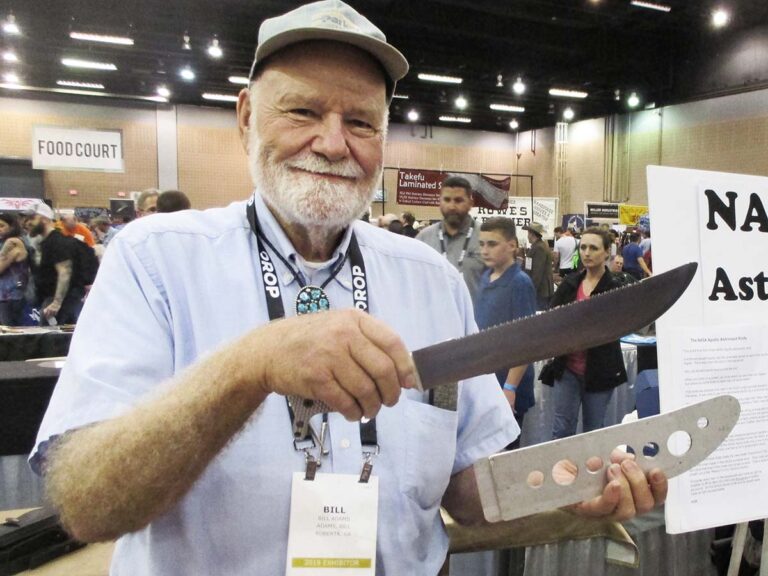
William “Bill” Adams was a revered knife entrepreneur, author and Cutlery Hall-of-Fame member. Learn about his immense impact on the knife community.
William Calhoun “Bill” Adams, knife entrepreneur, defender of all things knife, BLADE Magazine Cutlery Hall-of-Fame® member and invaluable friend of the knife community, passed away August 10. He was 87.
Known for his easy smile, snow white beard and amiable North Georgia drawl, Bill was liked and admired by many in the industry. He founded Atlanta Cutlery and, with Hank Reinhardt, co-founded Museum Replicas, both in Conyers, Georgia. Bill’s retail operations required him to travel the globe in search of the finest knives, swords and accouterments, including England, Ireland, Africa, India, parts of Central and South America, and all over the USA.
He served as president of the Antique Bowie Knife Association and helped found the Military Equipment and Weapons Collectors Association. He also helped found the Cutlery Collectors Legislative Committee, aka the CCLC, forerunner to today’s two leading pro-knife-legislation groups, Knife Rights and the American Knife & Tool Institute. In 1995, Bill was inducted into the Cutlery Hall of Fame.
He was a knowledgeable, gifted author, editing Sheffield Exhibition Knives and co-writing The Antique Bowie Knife Book, both of which are go-to guides for fans and aficionados of vintage Sheffield-made and antique bowies, respectively. He also was a dedicated knife collector, winning several awards for his wide-ranging collections at the BLADE Show. He retired to Roberta, Georgia, to live along the Flint River, where he enjoyed a quiet, peaceful and happy life.
He is survived by his sister-in-law Dee Anne Adams, his nephew David A. Adams and wife Cheryl, and dear friend and travel partner Elaine Barnes. The family wishes to express its thanks to Bill’s Roberta, Georgia, friends, especially Charles and Kate Rice, who cared for and treated him like family.
Remembering Others The Knife Industry Has Lost:
Betty Dowell, Driving Force Behind Knifemaker Ted Dowell, Passes
B. R. Hughes, Pioneering Writer And Bladesmithing Teacher, Passes Away
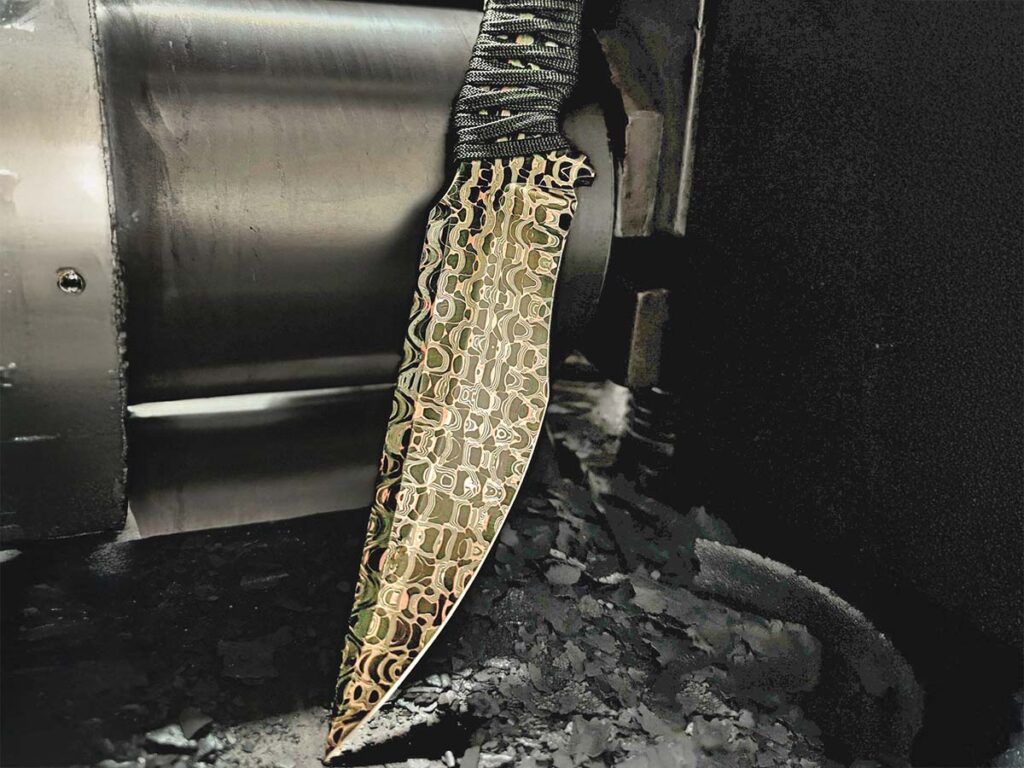
From copper-infused patterns to stainless steel sheets, discover the innovations driving the red-hot market for production damascus.
Are we seeing a bit of “global warming” in the knife industry, where red-hot damascus steel is getting even hotter? BLADE® spoke with some industry leaders, and 2025 and beyond looks good to them when it comes to production damascus in both carbon and stainless steels.
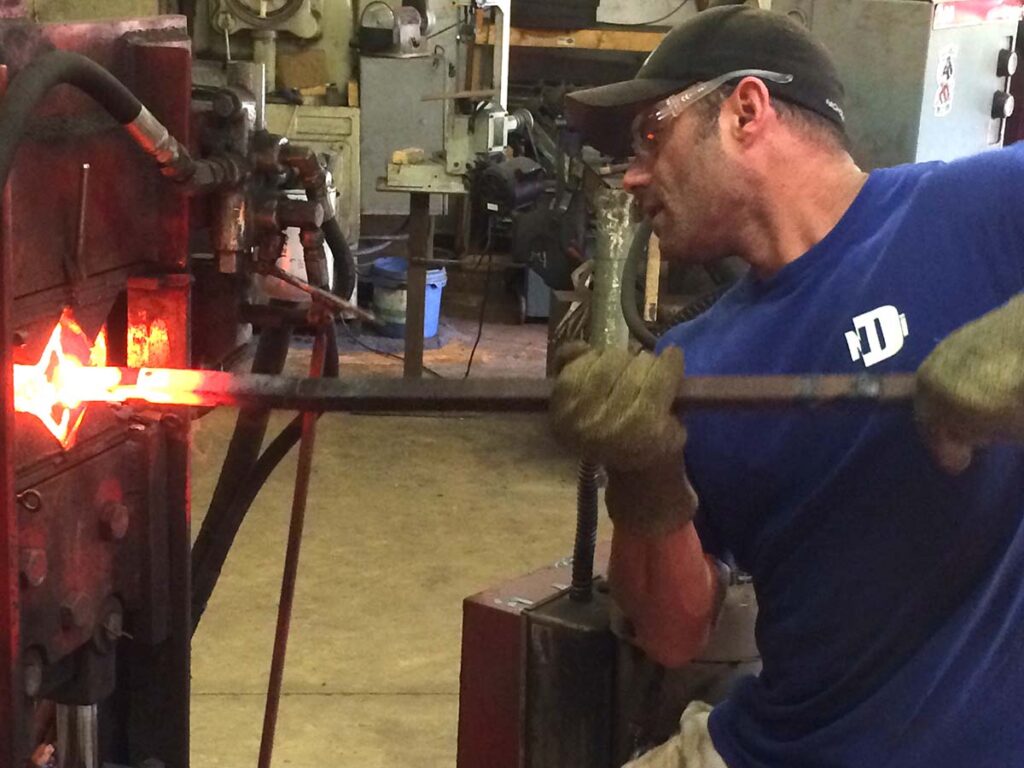
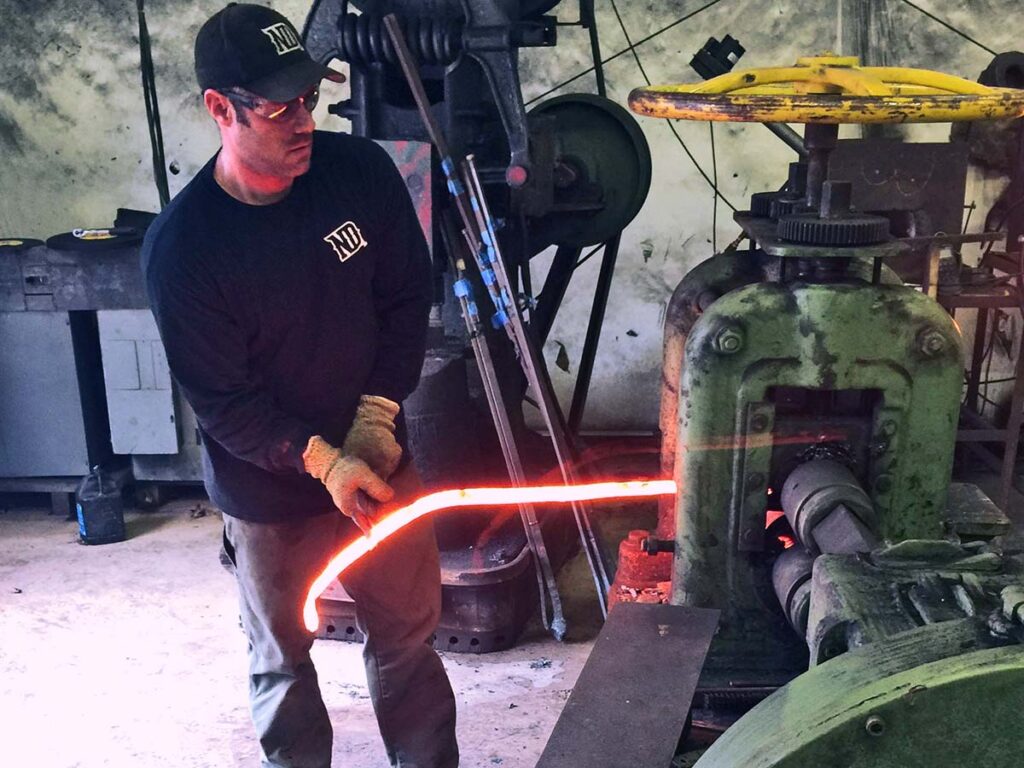
There are many individual makers who make high-quality damascus in simple and complex patterns in their home shops, backyards or shared maker spaces. This article focuses instead on production damascus forged by specialized outfits such as Baker Forge & Tool, Damasteel, Chad Nichols Damascus and Vegas Forge. At a level beyond “regular” damascus makers, these companies make steel for the masses, for production companies, and specialize in innovative new materials that are sure to delight the industry.
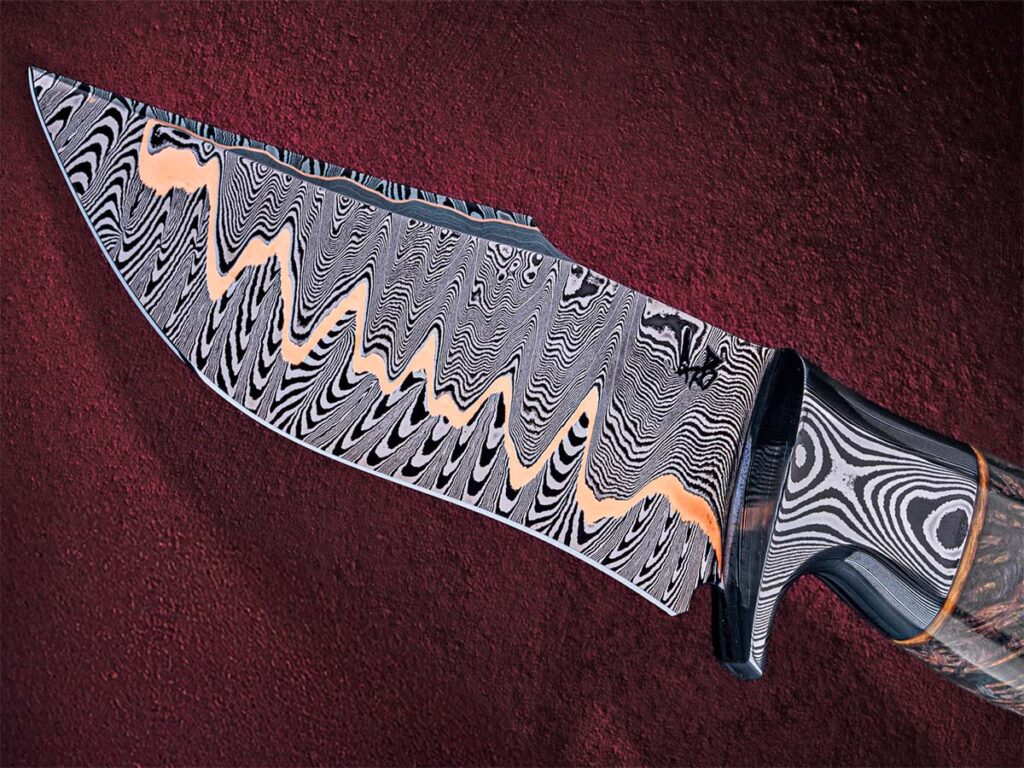
BLADE readers will be familiar with Baker Forge & Tool, a prolific producer of innovative damascus patterns that include copper, such as CopperMai, TigerMai, GoMai and others.
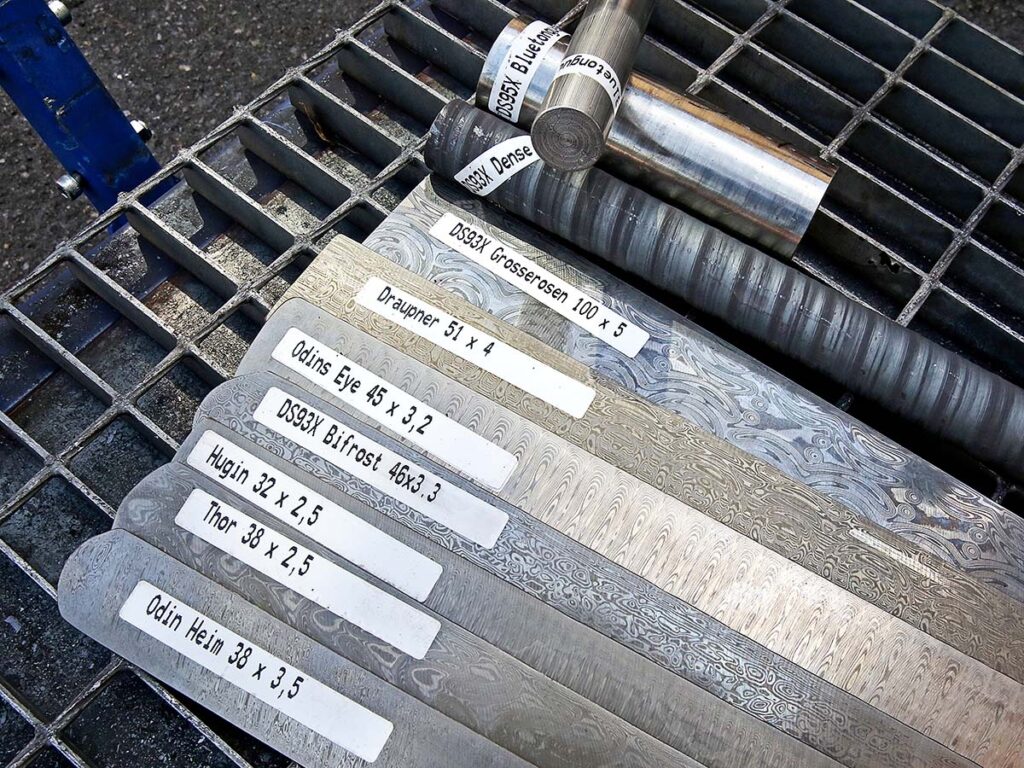
DS93X steel—fourth from bottom in bar form—is Damasteel’s standard mix, “combining good performance with good looks.” “For us it’s more about expanding the patterns than about trying new steel combos,” noted Per Jarbelius. The other patterns in bar form are representative examples of what you can expect from the Swedish steel maker.
“We make carbon steel damascus patterns with copper, and they’ve been hot. We expect them to stay hot through 2025,” Coy Baker said. When it comes to steel selection, the company most often sticks with the gold standard combination of 1084 carbon and 15N20 nickel-alloy steels.
Baker also has been experimenting with Apex Ultra as a core steel for its copper san-mai. For those unfamiliar, Apex Ultra is a tungsten steel alloy, kind of a super-52100 carbon steel. It’s made in small batches and is hard to get in the USA, but Baker has found that the material makes a great damascus core.
“Demand for our Apex core billets far outpaces supply,” Coy noted.
Baker has also been experimenting with stainless and copper damascus and san-mai, using 154CM and AEB-L stainless steels. This writer also makes knives and that combo sounds quite challenging to forge. Baker confirmed that it was very challenging and wouldn’t reveal any secrets, other than the 154CM etches light and the AEB-L etches darker.
Growth In The ‘Sip
Down in beautiful Bush Springs, Mississippi, Chad Nichols makes traditional carbon steel damascus at a production level.
Vegas Forge has always been innovative and 2025 will be no exception. “We’ve figured out how to do copper in with the damascus pattern manipulation, not just as a line between san-mai,” Jesse Harber noted. (Vegasforge.com image)
“I stick mostly to carbon steel 1075 or 1095 plus 15N20 with occasionally a little bit of 3V,” Nichols explained. “I’ve got my process down and these steels go together well.” He makes a variety of mosaic patterns, most of which go to a single manufacturer. “The carbon steels are so much more organic,” Nichols said. “You can do so much more with them in a cost-effective way.”
Nichols’ goal for 2025 is to increase his production of mosaic patterns.
“There just aren’t many people doing production mosaics,” he said. “It’s a great opportunity for growth.”
Another area he’d like to see grow in 2025 is the use of exotic and historical materials. He’s made a run of steel for Boker with steel from a German Tiger tank, and has a run coming for William Henry with some leaf springs sourced by WH.
Collab Designs
Damascus isn’t just a U.S. product. Damasteel produces high-quality stainless steel damascus in Sweden.
Chad Nichols (above) stated the goal at Chad Nichols Damascus for 2025 is to increase the production of mosaic patterns.
“Our DS93X steel is our standard mix, combining good performance with good looks,” Damasteel’s Per Jarbelius remarked. “For us it’s more about expanding the patterns than about trying new steel combos.”
DS93X is described as a “patented powder metallurgy product” that includes “two different hardenable steel grades.” “We use only stainless steel,” Jarbelius explained, ‘because it doesn’t rust and has the same or better performance.”
Damasteel historically produces a new pattern each year. For 2025 it also has begun a special project to collaboratively design patterns. Benchmade collaborated with Damasteel to make a steel pattern called “Monarch” exclusively for the Benchmade Gold Class Necron balisong. Jarbelius is excited for the potential to expand the collaborative effort with other companies who want proprietary patterns.
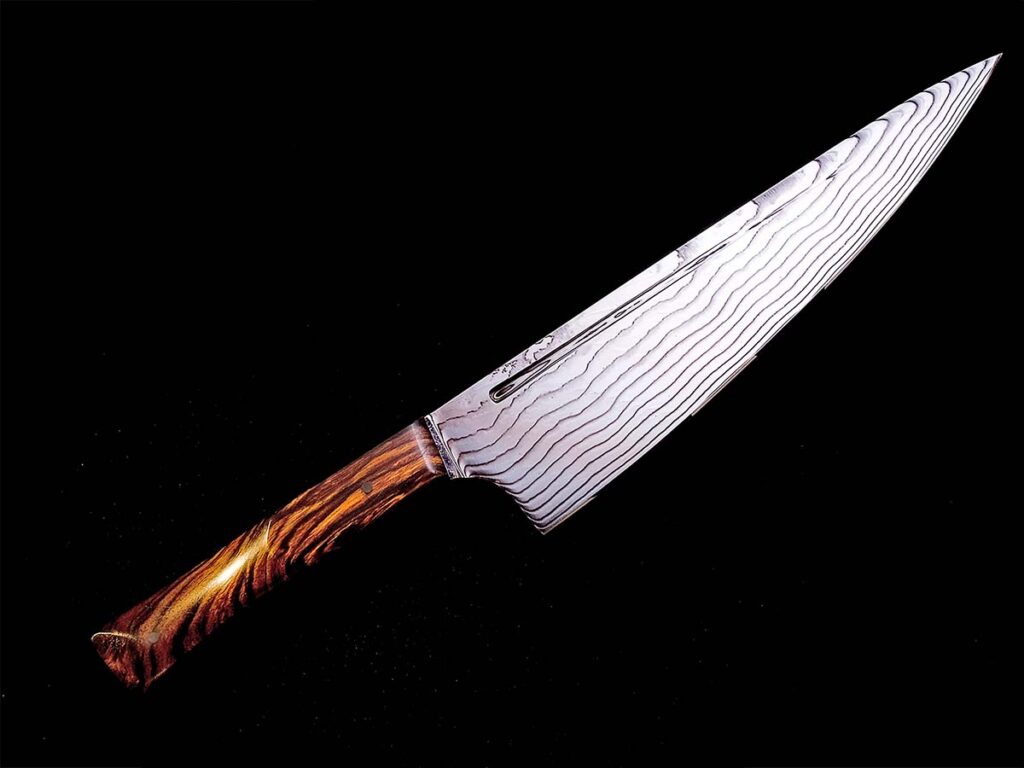
In another innovation, Damasteel has developed the capability to produce stainless damascus in sheets, not just bars. This will come in handy for small-batch and mid-tech production. The sheet steel pattern is called “Drakkar,” which is the old Norse word for the dragon-shaped Viking longboats.
Copper In The Pattern
What happens in Vegas may stay in Vegas, but that’s not the slogan for Vegas Forge, whose damascus is well known worldwide. It is a consistent producer of high-quality carbon and stainless damascus in complex patterns.
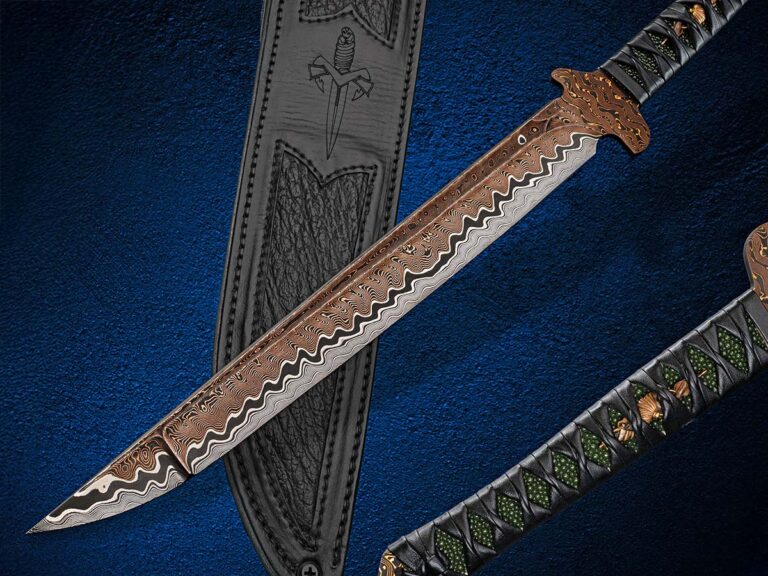
Baker Forge & Tool has been experimenting with Apex Ultra as a core steel for copper san-mai. This integral fighter by Greyson Weltyk features Baker copper damascus for its recurve harpoon blade. (Bakerforge.com image)
“One of our most popular patterns is ‘Reptilian,’ which has three alloys included: O1, 1075 and nickel,” observed the company’s Jesse Harber.
Vegas Forge has always been innovative and 2025 will be no exception.
“We’ve figured out how to do copper in with the damascus pattern manipulation, not just as a line between san-mai,” Jesse noted. “We can take our Reptilian pattern with copper in it, and then clad that billet over an O1 or 1095 core.”
As far as stainless goes, Vegas Forge continues to push the complexity of its patterns. Its most popular pattern, “Virus,” begins with a single stack of 1200 pieces! The company uses 154CM cores for most of its stainless san-mai, along with CTS XHP when available.
Ultimate Hotness
What kind of knives do the manufacturers predict for ultimate hotness in 2025?
Damasteel has developed the capability to produce stainless damascus in sheets, not just bars. The sheet steel pattern is called “Drakkar,” the old Norse word for the dragon-shaped Viking longboats, and is used here on a chef’s knife by a local Swedish cutler.
Both Baker and Jarbelius indicated culinary knives will stay hot, especially in stainless. Baker pointed out that stainless steel handles kitchen abuse better, and this writer agrees. Per said Damasteel’s Damacore and DC18N nitrogen steels are top of the line, and the company has a culinary knife coming in partnership with BLADE Magazine Cutlery Hall-of-Fame® member Ken Onion and CRKT. Both Damasteel officials and Chad Nichols agree that complex patterns are expected to do well for the pocketknife and one-off makers.
Jarbelius “expects growth in the complex pattern market” even as Damasteel’s basic traditional rose, ladder and twist damascus patterns remain best sellers. Nichols states that the mosaic niche he addresses will continue to grow.
All four steel makers expect growth in the production side of the market. Even in a slower economy, the big knife manufacturing companies are still producing limited runs of high-quality damascus knives. Baker looks for growth in his damascus-core san-mai steels.
“They’re easier to get a consistent etch on than the mono-steel cores,” he explained.
Chad Nichols stated that he expects growth in the use of mosaic damascus steels by factory knife companies in 2025.
Manufacturing is all about consistency and efficient processes. Damasteel achieves consistency by using the same steel combo for all its patterns. Nichols gets there by batch building for specific manufacturers so that each run is internally consistent. Harber mentioned that he was approached at BLADE Show West* by multiple production companies looking to order steel for 100-to-200-piece runs. He indicated he expects the mid-range sub-$800 production folders to stay hot.
Gonna Be Intersting
The new year is going to be an interesting one for the economy and politics, both of which are inextricably entwined. Fortunately, thanks to the work of those in the damascus industry, it’ll also be an interesting year in the world of knives. If nothing else, knife enthusiasts will have plenty of beautiful damascus production knives coming off the assembly lines to keep them entertained.
Follow these simple rules and you’re sure to have a great show.
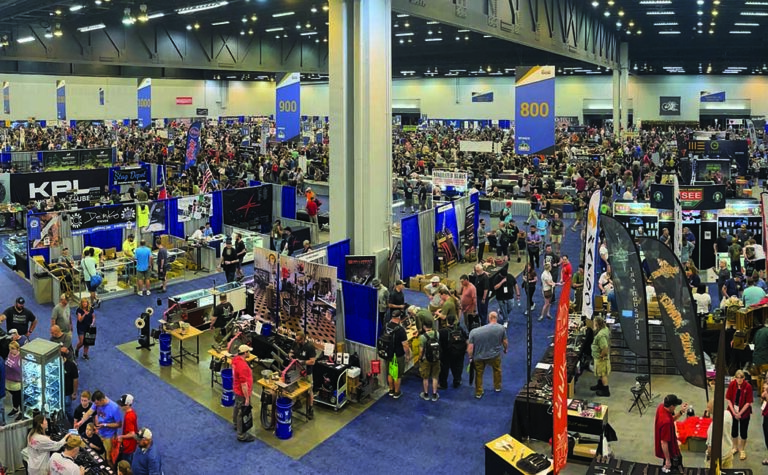
If you’re among the throng of thousands going to the BLADE Show June 7-9 at the Cobb Galleria Centre in Atlanta, here are a few tips on how to make the world’s largest, most important knife event work for you:
What To Wear
If in doubt “go dark”—any one or more of black shirt, blue jeans or black hat. While tactical doesn’t rule the way it once did, black remains the color of choice among many knife fans. Whatever color you choose, wear loose-fitting, comfortable clothes. If you want to overdo it, clip a knife to every pocket.
Comfortable shoes that provide full support against walking on concrete all weekend are an absolute must. Some bring two pair of such shoes. Bring a small backpack for snacks, a small plastic water bottle, etc. If you go outside for the BLADE University classes or free seminars, a ballcap helps protect against a June Georgia sun that has fried thousands of BLADE Show patron scalps over the years.
Party Proof Yourself
If you join the revelry and revel too much in The Pit (page 24), the lobby bar of the host Renaissance Atlanta Waverly Hotel, take some kind of headache relief before bedtime to reduce the dreaded post-Pit hangover. And, if you stay in the Waverly, bring some earplugs. The Pit can get raucous even into the wee hours and the noise can carry up to the hotel rooms, including the top floor.
Show Etiquette
Try to avoid walking fast and making sudden stops and U-turns in the exhibitor halls. Thousands of knife fans like you are moving, too, often closer to each other than they should. Any abrupt moves can result in collisions, so take it slow and easy. You’ll see more knives that way, too.
Never ask a maker how long it took him/her to make a specific knife. It’s natural to be amazed at some of the fabulous works of art and to be curious about how long it took to make one, but many makers bristle at the question. It’s not as important to know why they resent the query so much as the fact that they do, so don’t ask.
Don’t interrupt a maker/customer conversation. Patiently wait your turn or come back later when the maker is free to talk.
Ask the maker before you pick up a knife. If it’s a folder, it doesn’t hurt to ask permission to open it. The maker may want to open it for you. If a multi-blade folder, don’t open it so two or more blades are open at once. This puts undue pressure on one or more of the backsprings. It’s also a good way to cut yourself if you’re not careful. If you’re wanting to see what kind of clearance there is between opening/closing blades, ask the maker to demonstrate it for you. And when you finish examining the knife, return it the way it was handed to you—carefully, whether open or closed.
While it may seem courteous to wipe the blades off before returning knives to the makers, don’t. Let the makers do it instead. They are fully equipped to do so and are going to check the knife for any spots you may miss anyhow. That doesn’t mean you shouldn’t bring a chamois for your own purposes. However, if there’s any wiping down of their knives to be done, let the makers do it.
Don’t use a loupe/magnifying glass to examine a custom knife. It’s a good way to make the maker mad. There are going to be imperfections on custom knives—if not, they’re probably not custom—so some minute imperfections are to be expected.
After you finish talking to the maker and are ready to leave, even if you intend to return to his/her table, don’t say, “I’ll be back.” Chances are you won’t. It also implies you’ll be back to buy a knife when you may have no intention whatsoever of doing so. Don’t be an “I’ll Be Backer!”
One thing to be sure to do: have fun. If you’re going, see you there!