


e-mail [email protected]
First Look: CRKT Altai Ready For Backcountry Action
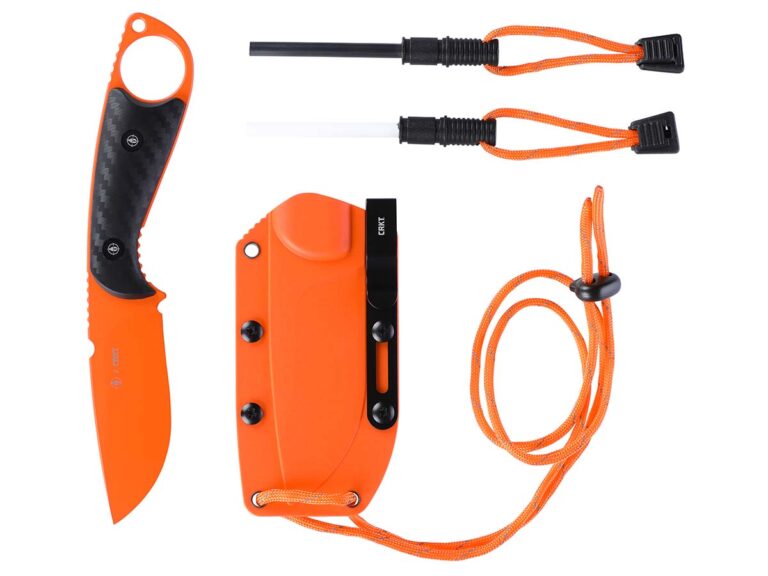
Designed with Spartan Precision Equipment, CRKT’s backcountry-ready Altai pairs 14C28N steel with an integrated fire rod and ceramic sharpener.
CRKT has teamed up with the shooting platform specialists at Spartan Precision Equipment to introduce a new backcountry fixed blade: the Altai. Named after Spartan founder Rob Gearing’s hunting excursions in Mongolia’s Altai Mountains, the knife integrates purpose-built field features directly into the cutting system and sheath setup.
Tailored for Field Processing
The Altai centers around a 3.53-inch plain-edge blade fashioned from 14C28N stainless steel. To withstand harsh outdoor environments, the steel is treated with a protective ceramic coating designed to bolster toughness and resist corrosion. The 0.13-inch thick blade is sized specifically to maintain maneuverability and control during game dressing, while jimping along the finger choil and spine provides positive tactile traction.
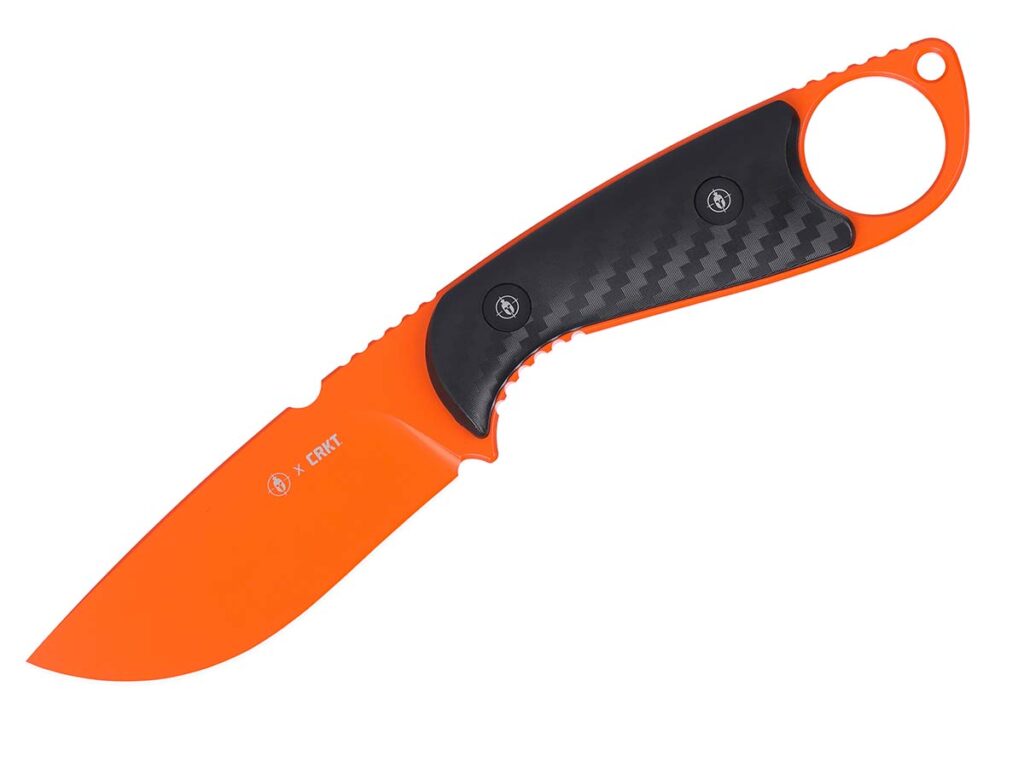
The knife features glass-reinforced nylon (GRN) handle scales textured with a carbon-fiber pattern, secured over custom pins bearing the Spartan head logo. High-visibility orange highlights run along the build, helping users spot the knife easily in dim light or deep cover. At the butt end, a ringed pommel allows for a fast draw—even when wearing thick gloves—and includes a lanyard hole for additional retention options.
Built-In Fire and Maintenance Kit
Rather than serving as a standalone cutter, the Altai incorporates essential survival and care tools into its carry rig. The knife’s spine includes a dedicated striking notch configured to work with an included magnesium alloy fire rod. For touch-ups during long trips, a ceramic sharpening rod is also housed directly alongside the blade.
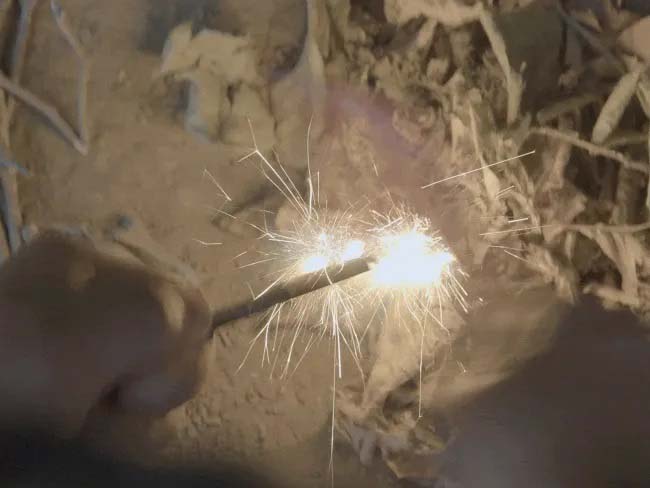
Both maintenance accessories stow in the included molded thermoplastic sheath. Reflective orange paracord is used for the main lanyard as well as the pull tabs on the fire and ceramic rods, ensuring high visibility when working in low-light conditions.
At 8.0 inches in overall length and a weight of 3.6 ounces, the Altai offers a complete backcountry processing and field-maintenance package in a compact carry footprint.
Altai Specs
Overall Length: 8.00 in.
Blade Length: 3.53 in.
Blade Thickness: 0.13 in.
Blade Steel: 14C28N Stainless Steel
Blade Finish: Ceramic Coating
Edge Type: Plain Edge
Handle Material: Glass-Reinforced Nylon (GRN)
Weight: 3.60 oz.
Sheath: Molded Thermoplastic
Integrated Extras: Spine striking notch, magnesium alloy fire rod, ceramic sharpening rod, reflective orange paracord lanyard
MSRP: $85
Read More:
- FIRST LOOK: SOG Knives 40th Anniversary Fat Guard Bowie
- First Look: Civivi High Grass Field Knife Ready For Fowl Play
- First Look: Field-Ready Böker Naturensöhne MK II NXT
- First Look: Bear OPS Nekema II Tactical EDC
Bill Moran and the Forged Blade
Bill Moran, American Bladesmith Society Founder and Master Smith, demonstrates how to forge a blade in his shop in Maryland and tells how he began his career…
right angle attachment
Created on March 13, 2010 using FlipShare.
How To: Forge Beveling & Blade Tipping
Forge Beveling & Blade Tipping Are Necessary Skills For Any Fledgling Knifesmith To Learn. Here’s The Skinny On Both.
TIP: The most important principle in this section is to overlap hammer blows. The right edge of your previous hammer blow becomes the center point of your next hammer blow.
Forge-beveling allows a consistent pushing of the hot steel in all directions at each blow. The physics are consistent, predictable, and reliable. At each strike, the force of the rounding hammerhead pushes the bottom half of the blade and the spine in opposite directions. The tip-to-choil forces are contained for the most part by the blade’s mass.
It’s much like when the smith makes breakfast sausage patties. Imagine pushing the center of that sausage patty down with the heel of your hand (hammer) against the counter (anvil). The patty spreads out in all directions with a dimple in the center, the same as the steel. With repeated overlapping blows the bevel thins and widens downward as the spine stretches upward. The resulting geometry is a thinning and reshaping of the blade between the cheek line and the cutting edge. A bevel is forged and formed with your rounding hammer, anvil and blacksmith’s eye.
Once forge-beveling is mastered you can actually form a hollow “grind” by hollow forging (another lesson, another book).
NOTE: Look at a knife with the pommel to the left and the point to the right, cutting edge down and spine up. For reference and description, this is the right side of the blade.

Setting the Bevel
The forge-beveling procedure is advanced forging. Beveling with a hammer is a blacksmith secret used by few these days. Learn this method and you will certainly be connected to the smiths of old.
This forge-beveling procedure takes me six heats or more, at minimum; three on each side. Theoretically, one heat per line, three lines per side (explained below in Half, Fourth, Eighth). Make these passes down the bottom half of the blade traveling its full length. Because you might be a beginner it may take many more passes than six.
You may need more heats due to being hammer shy or because of rookie hesitation. You may start and stop frequently due to under-heating, overheating, dropped blades, re-positioning your piece or “Where’s my hammer?”. All of those are OK. We all do them.
Half, Fourth, Eighth
Let’s go through the forge-beveling principle. First think of cross-section geometry. Develop a visual in your brain of the relative distance from the center point of the hammer face to the bottom one-half of your blade as you travel along its length from ricasso to tip.
Do this by visualizing one-half, one-fourth, and one-eighth. If we were to saw a blade vertically in half and view its cross-section, we would see that its shape is thickest at the top, along its spine. It holds that dimension down to the cheek (about the halfway point) and then dramatically loses thickness as it approaches the cutting edge. This is the bevel. Your bevel. Think halfway from cheek line to cutting edge. This is the 1/2 line.
This traditional way to set this bevel can only be acquired with dozens of latitudinal hammer strikes passing from left to right at those three descending levels: 1/2, 1/4, 1/8. Remember one-half, one-fourth, one-eighth.

NOTE: This 1/2, 1/4, 1/8 business does not mean fractional inches. The fractions refer to the position of your hammer’s center face on the horizontal bar (i.e. halfway, a quarter of the way, and an eighth of the way from the edge to the cheek).
Remember this is a theoretical thing becoming a real thing. The blade is 1-inch wide, and the face of a 2.5-pound rounding hammer is about 1.5 inches. Think exact center of a hammer face on those latitudinal forging lines.
TIP: See the author setting the bevel on YouTube. Search for: Paul White FORGED.
Try not to strike above the imaginary cheek line that runs about halfway between the spine and edge. Your hammer passes will form the cheek line. The final cheek line usually falls well above the halfway point because maintaining that line exactly in the center is almost impossible with a round hammer face, your billet bouncing around on the anvil, and you’re trying to hit on exact points. However, the primary objective is to maintain the original thickness in the spine (1/8-inch) as far down to that halfway line as possible.
Blade Tipping
Each pass will require a slight upward tipping of the spine to acquire about a 10° to 12° angle to be set in the bevel as you hammer. It takes a simple inward twisting of the wrist to keep the blade from resting flat on the anvil face. It must be done at each horizontal pass. This smartly places just the right amount of bevel angle. After a few passes, the blade will “find” that angle as you place it down.
After a complete pass from choil to tip on the right side of the blade, flip the piece over, tip to 10° to 12°, place at the top of the anvil, and do the left side. This is the place to use your indexing skills. It takes most smiths some time and practice to fully master this concept. I’ll go over this beveling thing a couple more times. Read this whole section and look at the drawings and photos several times before doing this.
TIP: Sometimes it takes fewer total passes than I indicate in this book. This is due to the individual smith’s power and/or heat control and/or blade position and/or hammer penetration and/or steel composition. There are lots of variables. If your blade is almost straight after fewer than the recommended strikes or passes, back off on the heat and/or reduce the power or reduce the passes. If you place blows beyond what is needed, the blade will curve upward. Usually, fewer strikes per pass will be necessary as the beveling chore proceeds. This happens because the smith usually increases his or her power and confidence as time at the anvil is increased. Also, the bevel becomes thinner with repeated heats requiring less steel to be moved.
The forging sequence is as follows. Take a heat. Place the blade at the bottom of the anvil. Tip to 12°. Place overlapping blows down the blade on the right side at the 1/2 line. Take a heat. Flip to the left side of the blade at the top of the anvil. Tip to 12°. Forge down the left side at the 1/2 line at the top of the anvil. Take a heat. Flip to bottom. Tip. Place blows down the right side of the blade at the 1/4 line. Heat. Flip. Tip, down the left side at the 1/4 line at the top. Take a heat. Flip. Tip and down the 1/8 line on the right side. Heat. Flip. Tip. Then down the left side at the 1/8 line. Your blade should be nearly straight after three or five passes and however many heats as needed.
By hammering in this 1/2, 1/4, 1/8 method you will “set the bevel” of your knife in the traditional way, FORGING! Ninety-three percent of all bladesmiths set their bevels at the grinder. I have met only a handful of smiths that do this the old way. You’ll be the only blacksmith in the surrounding ten counties that sets the bevel with your three-pound hammer!
Do not strike randomly up and down the blade or space-out (i.e. not overlap) your blows and expect anything good to happen.
BLACKSMITH SECRET: To gauge forging heat have a wooden box close by and away from any direct light. Hold your blade in the box to see the true forging heat. Even when hot the “red” is sometimes difficult to see in a lighted room. However, the red will show in the shade of your box. This means you are above forging heat and will thus avoid potential edge cracks. Remember this is high carbon steel and your working parameters are narrower. Iron can be worked over a greater temperature without damage. At the end of each forging and before you lose forging heat in your blade use the last few seconds to straighten and align your work. Make all lines right with the world.

You can buy Forged: Making A Knife With Traditional Blacksmith Skills here
Coffee With An Edge: Well-Known Knifemakers Forging Coffee Brands
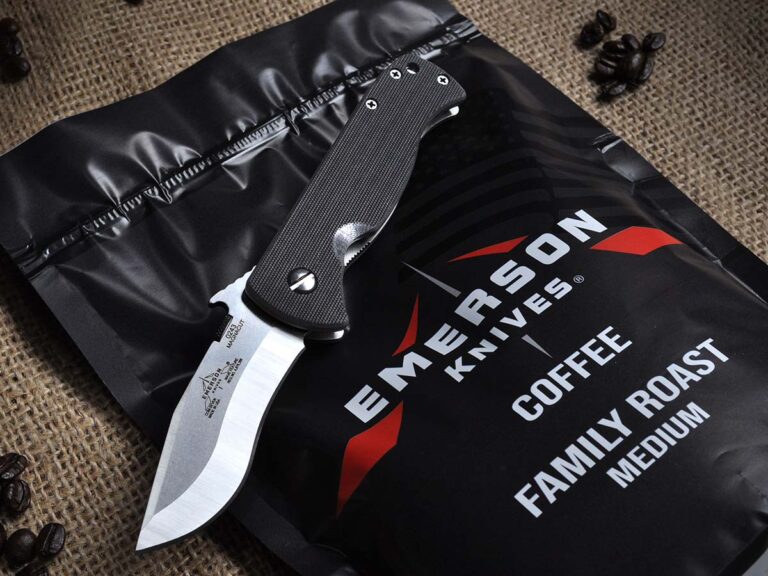
Knife companies offer their own brands of hot Joe and perk up consumers in the process.
For Ernest Emerson, it’s as strong as… well, a cup of dark roast. He’s a firm believer in the expansion of his marquis knife manufacturing company into other lines of business. The idea behind that expansion is the diversity of different sources of revenue while complementing the Emerson core business.
“We’ve owned our own coffee company since 2019,” Ernest related. “I’m friends with Evan Hafer, the founder of Black Rifle Coffee, and our conversations probably go back to 2016 when we were first to co-brand with Black Rifle. Evan carried our CQC-7 on his military deployments, and he knew who we were. We worked it out with him to package coffee and do labeling. That worked for a while, and then my wife [Mary] and I talked it over and decided we wanted to have our own brand of coffee.”
For Emerson, taking the coffee plunge complemented the other activities that go hand in hand with offering top quality knives. Barriers to entry were few.
“I talked to Evan, and he said there was plenty of room,” Ernest explained. “We started Emerson Coffee Roasters Company, and I know we were first and started that trend, just like the trend in knife company whiskeys that is going on now.
“We get coffee from a source in South America and have it roasted and package everything under our own ownership,” he added. “Some other companies do collaborations and have their coffee packaged up, but we do everything from start to finish. The way I look at it, everything is a backup for a backup for a backup. What if somebody in Washington can make knives illegal with the stroke of a pen? All our other companies are there as a family-run group of businesses from coffee to apparel, whiskey, fighting systems and others. We’ve built those companies so the family will have support, and then we are at the helm and decide what roasts we want and everything.”
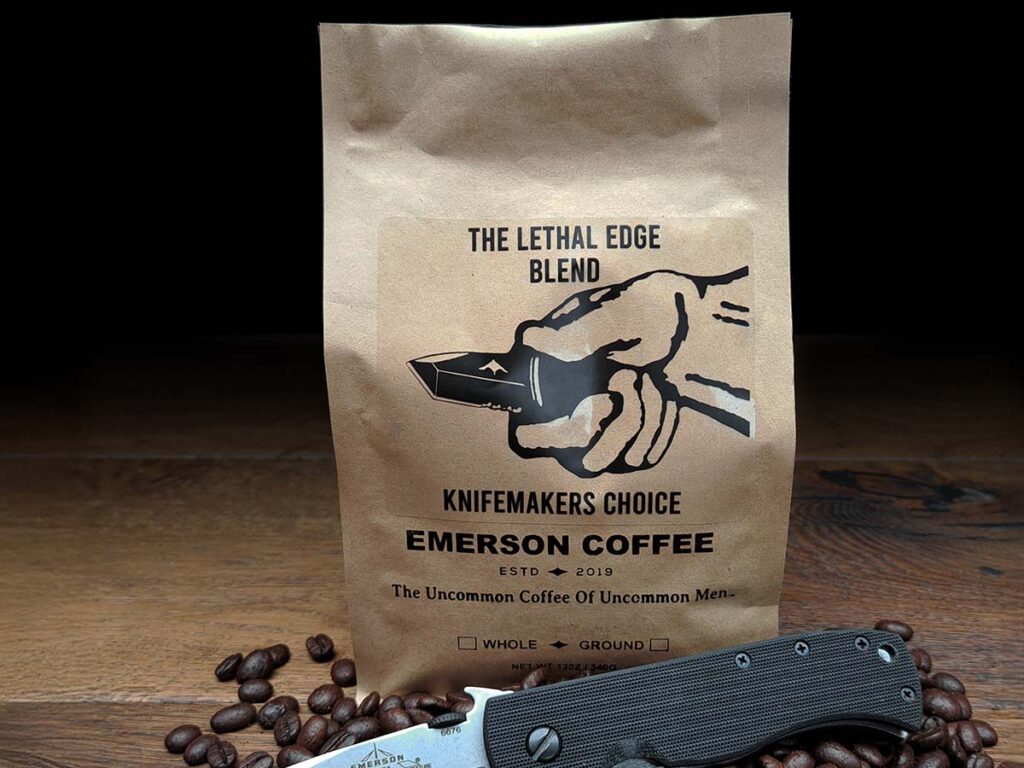
The future for Emerson and coffee may include some bundles of brew and whiskey or special flavorings for the coffee itself. Ernest sees flexibility and responsiveness always in the mix—a bourbon-flavored coffee when the time is right or a Christmas blend for the holiday season. Right now, the idea is simplicity with three blends: Renegade Roast is the Emerson family’s choice, Farmer’s Roast is the medium and Lethal Edge is the dark offering.
“It’s been a great thing to expand into coffee,” Ernest observed. “Our coffee is delicious, and people say they can’t drink any other coffee after trying it. Besides, we are a lifestyle brand and other than water more coffee is consumed around the world than any other beverage. I would bet that everybody who has ever bought a knife from us drinks coffee. So, if you buy or use knives, chances are you would drink our coffee and whiskey and wear our clothing.”
So, Ernest Emerson, the savvy businessman, finds another niche with coffee, one that complements the tried-and-true knife business and broadens the appeal of his entire spectrum of products. Seeing the big picture is expected to pay big dividends. Ernest points to recent history to back up his market perspective.
“No other knife entity on earth had a show in Las Vegas that revolved 100 percent around its brand like Emerson Knives,” Ernest concluded. “And the Usual Suspects Network was started for Emerson Knives. People tattoo our name on their body, and we say, ‘Show us your ink!’
Forbes Magazine said that there is only one other brand that loyal people tattoo on their bodies, and that is Harley-Davidson. The Forbes people actually told me that. We don’t know all the reasons for it, but again it is partly because people identify with who we are—American made by American workers with American grit and self-reliance. If people buy a $300 or $400 knife from us, then they buy other stuff that the company represents. Emerson truly is a lifestyle brand.”
And what says lifestyle better than a fine cup of brew?
Spartan Blades Tactical Beans
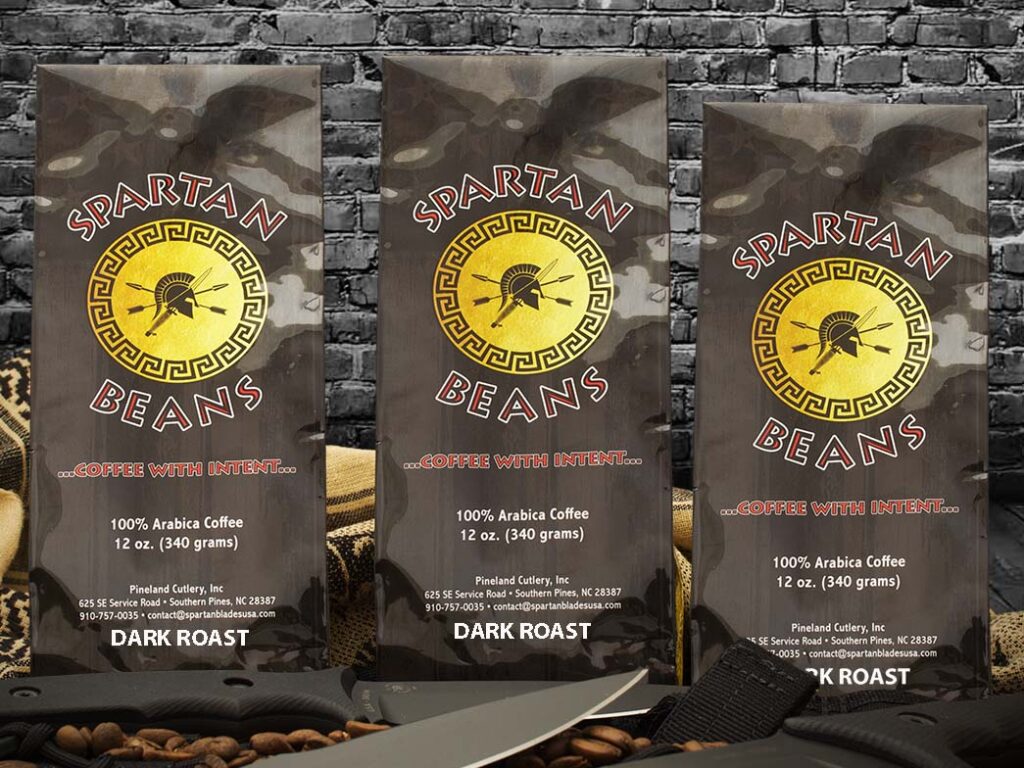
At Spartan Blades, company co-founder Curtis Iovito says offering a special coffee collaboration with Black Rifle is just fun. Fresh-roasted Spartan Beans fuels the consumption of a couple of gallons of brew per day around the office. The concept started when Curtis was chatting with a good friend who owns a roaster and has evolved into offerings consisting of 100 percent Arabica beans.
“Spartan Beans has been around for about three years now,” Curtis remarked, “and it has gone surprisingly well. Sometimes we will throw in some of our coffee when we ship a knife order to a dealer. The roaster is right up the street, so the coffee is about as fresh as you can get. We may look at doing an auto-ship program as demand increases, too!”
Spartan Beans is offered in 100 percent Arabica regular roast and dark roast, single or three pack, and there is also a sturdy mug available to top off the entire experience.
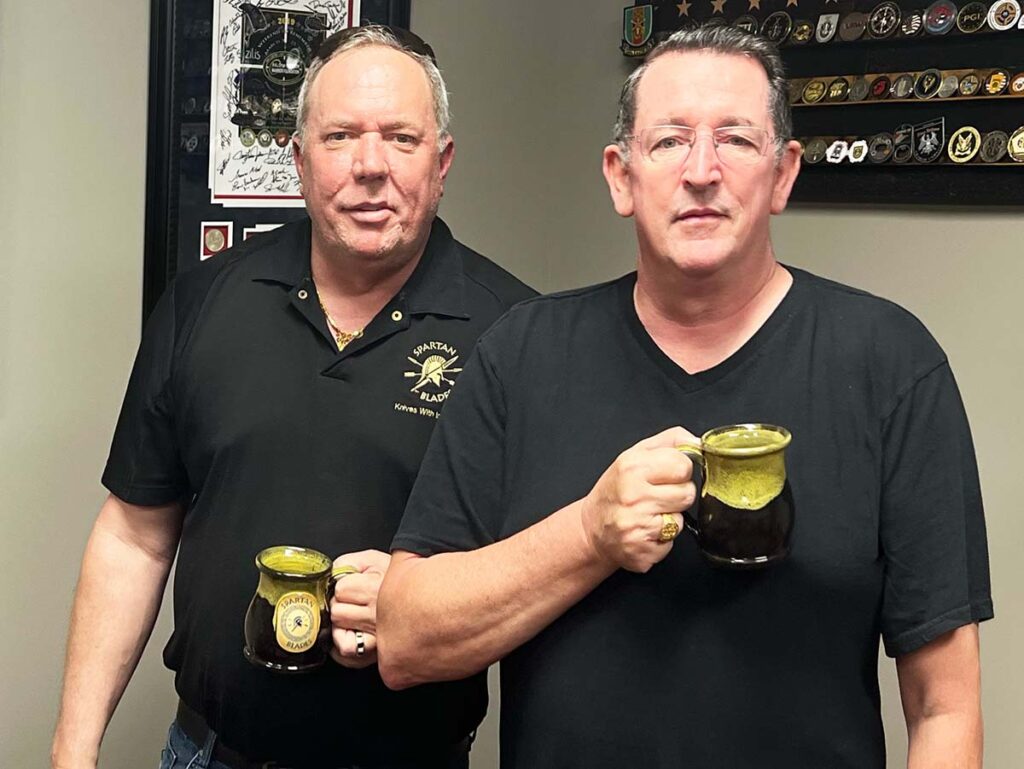
Through the years Curtis and fellow company co-founder Mark Carey have spent years traveling around the globe, teaching counter-terrorism and assisting with operations related to the use of knives in the field. And when time has permitted, they have searched for the finest cup of java available, whether in Malaysia or some other exotic location. The Spartan Beans blend includes the best from Colombia, Costa Rica, Africa and Sumatra.
“It’s like the United Nations of coffee, just more fun,” laughed Curtis.
Montana Knife Co. Backcountry Brew
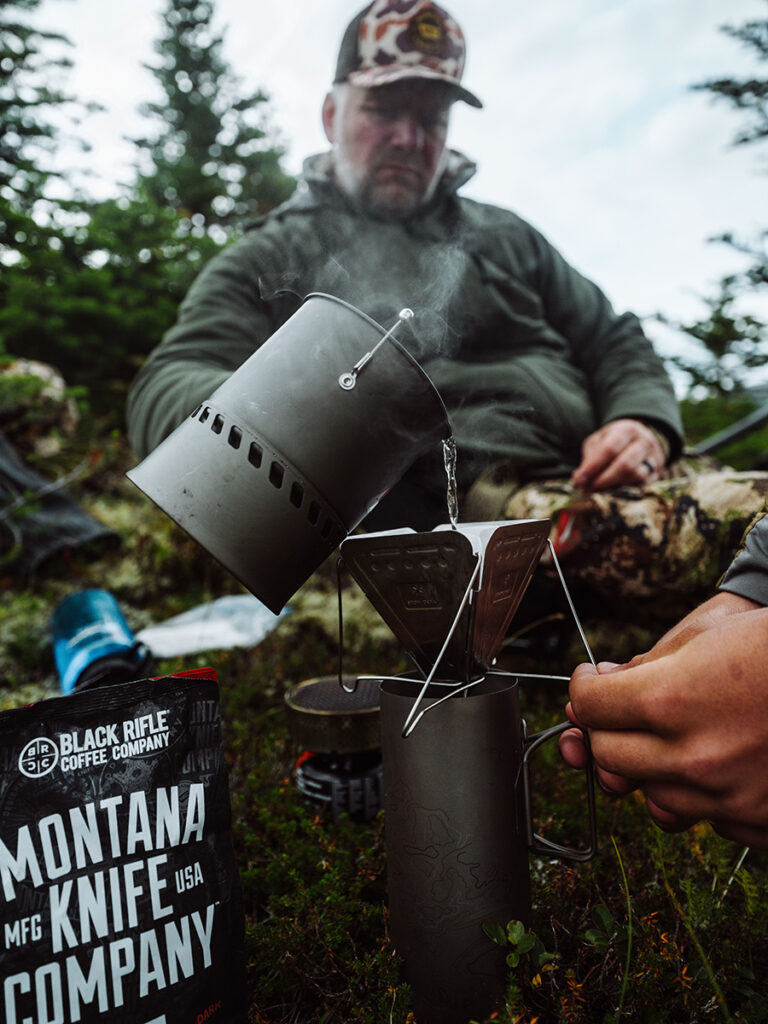
A more recent entry into the coffee arena, Montana Knife Co. (MKC) entered into a partnership with Black Rifle in the fall of 2024. The packaging tells customers, “Fresh from the forge, this dark roast offers notes of dark chocolate with an aroma of spice topped off with a smoky finish. American brewed and crafted to perfection.”
Josh Smith, founder, president and ABS master smith at MKC, has found the kinship between knives and coffee to be compelling.
“Over the years, I became friendly with the owners of Black Rifle Coffee Co.,” he said. “We share many of the same beliefs around love of our country and support of our active-duty soldiers and veterans. For the past few years, we have worked with them on some marketing-related promotions, but this was our first launch of coffee with Black Rifle.
“Personally, I love coffee,” Josh emphasized. “For me, coffee and knives seem to be loved by so many blue-collar workers. Clearly, white-collar people drink coffee too. But I think back to my grandpa or my dad, and they always started the day with a cup of coffee before going off to work the ranch or in a backhoe. That same guy always had a knife in his pocket. The best place I’ve had Montana Knife Co. coffee is in northern British Columbia on a horseback moose hunt with my son [Hank]. For 10 days, it was rainy and cold. But each time we sat down to rest we made coffee with our jet boil. Hot, steaming coffee while freezing on a hunt tastes so good!”
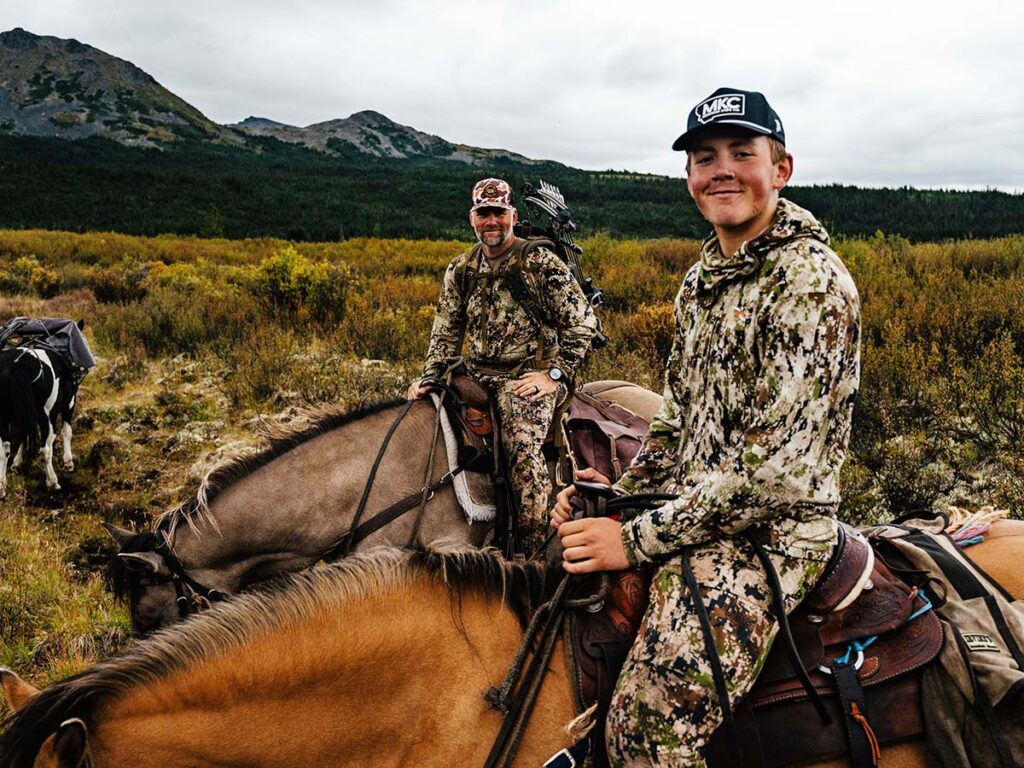
Montana Knife Company offers its MKC X Black Rifle Coffee Signature Dark Roast in whole bean and ground 12-ounce bags.
For many consumers, the blend of the knife and the good cup of coffee just comes natural. Now, it’s easier than ever. Exploring the best in cutlery and coffee simply enriches the experience with both.
More On Knife Business:
Knife Expo 2012
presented by Southern California Blades
Must Read Articles

Knifemaking 101 – Read This Before You Make a Knife
by Wayne Goddard
My experience has taught me that there's nothing like digging in and getting started. I've often said the hardest part of the...




