

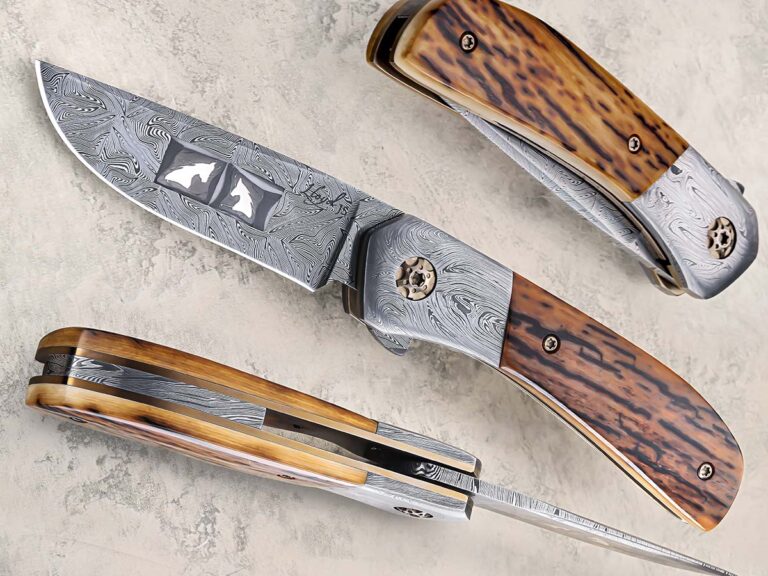
Aesthetically and mechanically challenging flipper designs that shine.
The flipper folder is one of those knife designs that continues to delight its makers and its owners with incredible vitality. Not only do the most recent flipper folders fill the traditional bill with great materials, mechanics and mesmerizing beauty, but they further garner high praise with an inherent level of energy.
Combining the attributes of excellence that set standards for custom knives with the sheer pleasure of smooth operation, the latest flipper folders hit the mark in quality and bring attention to their makers amid an ever-growing level of interest in the marketplace.
Scott Gallagher: Feather Damascus
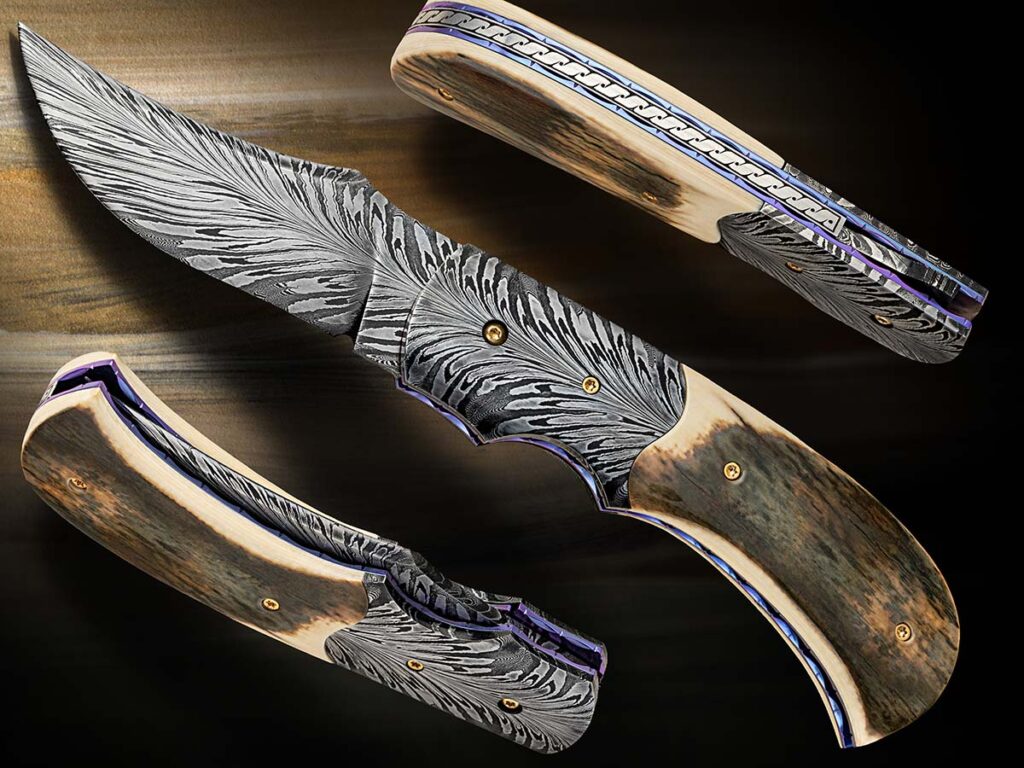
Scott Gallagher recently completed a beauty with a 3-inch feather damascus flat-ground blade complemented by a damascus bolster and fossil mammoth ivory handle. With an overall length of 7¼ inches, Scott’s flipper folder features an upswept curve for fantastic visuals and intricate filework along the spine.
“I am receiving more requests for flippers right now,” commented Scott. “They have become very popular. I think the reason why is because they’re fun to use, kind of like a widget—they’re functional, they can be embellished and they are easy to carry.”
The single attribute of fun helps set the flipper folder apart from other designs. Anything incorporating fun into the knife equation is sure to gain increased attention. Still, Scott makes his flipper folders with exacting specifications and attention to detail. “A quality flipper should have a blade steel that performs well—good fit, finish and symmetry,” he explained. “The blade should close in the center of the frame. It should be fast opening and close easily without a sticky lock.”
For Scott, achieving the proper mechanics involves a combination of precise construction with materials that work in concert with each other. “Making the flipper tab is a matter of incorporating it into the design of the knife in the design phase,” he related. “In the closed position, the tab has to sit higher than the frame so your index finger can access it. I use bearings on my flippers. They are ceramic and very fast. To avoid pinching the user’s hand, I use a small tab. It’s only exposed enough to open the blade. My flipper tab is hidden in the frame in the open position. I have finger grooves designed into the frame to avoid fingers slipping forward.”
Alan Hollerbach: Spectre
When customers consult with Alan Hollerbach on the attributes of a quality flipper folder, his response is straightforward. “Look for high-quality materials—hardened washers and bearings, a smooth action and a solid detent,” he offered. “I don’t take orders. I make knives I like and hope others do as well.”
The degree of knifemaker proficiency is tested somewhat further with the flipper folder in comparison to other designs. Alan welcomes the opportunity to put his skillset to the test. “It takes some more designing up front to get the layout and how it looks and the action correct,” he related. “The tab needs to be in a comfortable position for one-handed opening, tall enough to engage easily, but not too tall it looks out of place. It needs to have a strong detent to allow proper pressure to fire the blade and a smooth action with the bearings to allow the blade to open with minimum friction.”
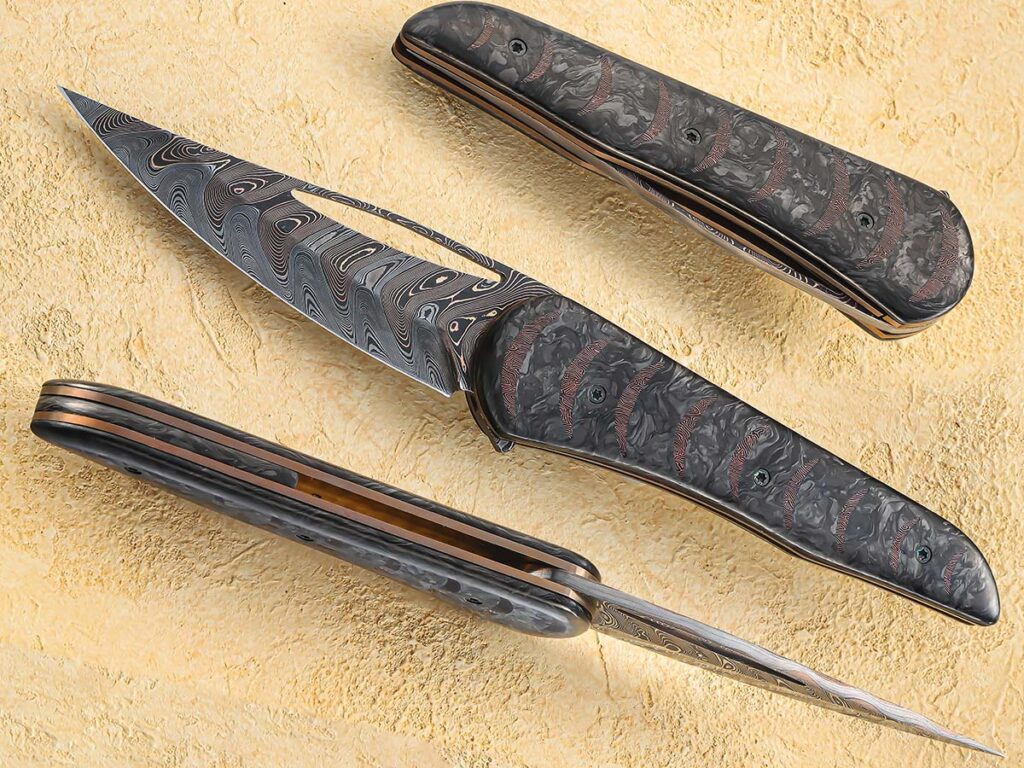
Alan achieves his technical and aesthetic objectives in a handsome flipper folder model he has christened the Spectre, in reference to the James Bond feature film series. This example includes a 4-inch hollow ground blade of Baker Forge TigerMai Chevron damascus steel with jeweled and anodized titanium liners and Skiff bearings with hardened washers. Handle scales are Fatcarbon Dark Matter with 18 inlays in nine different sizes of Space Coral. The backspacer is also Fatcarbon Dark Matter, and the screws are black anodized titanium.
Rising interest in flipper folders is a matter of likes and style, as Alan sees the buying landscape these days. “I think it is a personal preference,” he commented. “I like the flippers for easy one-handed opening, but you can do the same with most other ways. It takes some more designing up front to get the layout and how it looks with the correct action. I like the lines as clean as I can make them, so tabs are just to open the knife, as I try to hide as much as I can when the knife is open, just for aesthetics.”
The addition of a hole in the Spectre blade gets attention as well. “You can open the knife with the hole, but it was designed for aesthetics mainly,” Alan noted. “I wanted to smooth the lines of the knife in the closed position and show with the curves of the cutout it was done on a pantograph by hand.”
Robert Champion: Dark Wind
Examining the locking mechanism is a must for those contemplating an investment in a quality flipper folder, a tip Robert Champion emphasizes. “A 3-point constraint is better than a 2-point constraint,” he said. “A 3-point will lock the knife more securely in the open position as well as in the closed position. The blade should lock solid, not be loose and never have a sticky lock.”
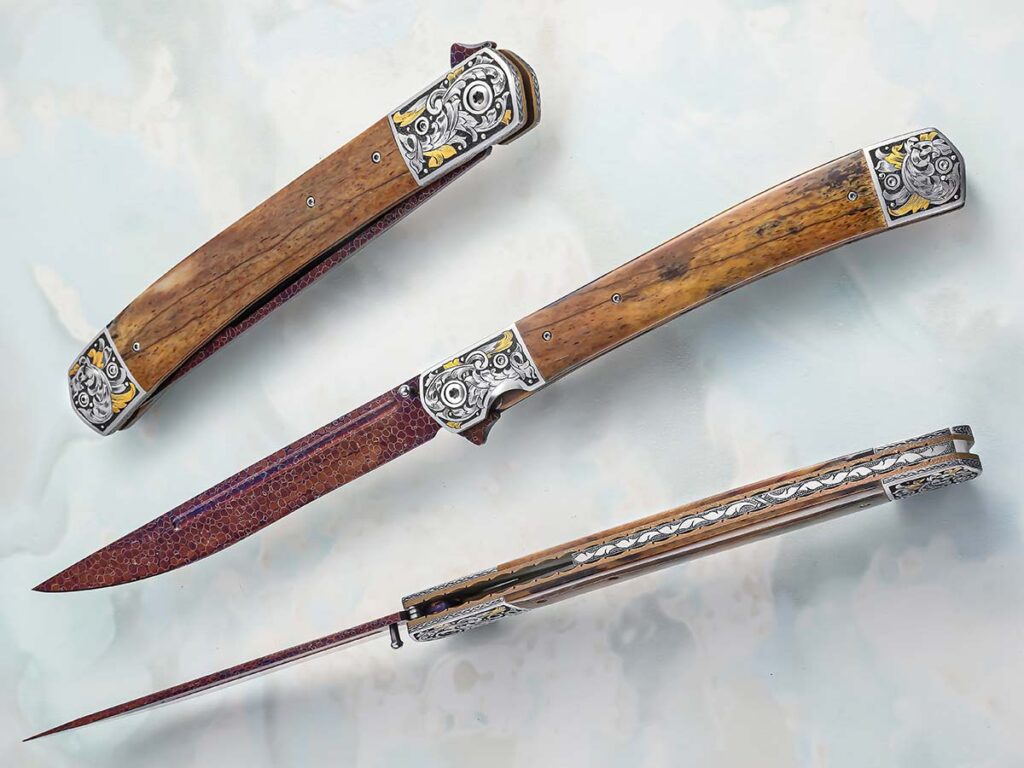
Robert’s Dark Wind model exemplifies his perspective on the flipper folder. Its 6-inch blade features hollow ground Dragonskin Damascus steel from Shaya Forge, while the furniture is in 416 stainless steel and the handle scales are fashioned from giraffe bone. Dale Bass’ engraving complements the piece in its entirety.
“I’m receiving more and more requests for flippers,” Robert remarked, “especially the more dressed and upscale models. Their popularity seems to be trending up. They’re easier to deploy and in regions where automatics are not permitted, the flipper is a great option. The flipper tab is an integral part of the tang design that is easily roughed in while profiling the blade. Thumb pegs and discs are separately fabricated components that require drilling, tapping and a turning process on a lathe. Then, they are attached to the blade. Tab location is important when designing a flipper. Placing it too far forward or too far back on the tang will cause inefficient deployment.”
Bringing all these components together in proper tolerance with respect to the look and feel of the finished product provides a worthy test for the makers of flipper folders. Like any folder, smooth deployment and ease of carry rise to the top. However, the flipper aspect brings another dimension to the requirements for optimal performance.
“Depending on the size of the knife, I use good-quality stainless or ceramic ball bearings,” Robert advised. “I tend to use stainless bearings on my smaller models, but that is just a personal preference. I also use dry slide oil lubricant. I design a low-profile tab to prevent pinching and currently make single-tab models. In the future, I plan to make flipper daggers that will have more of a guard-type tab.”
John Curran: Alpha 3
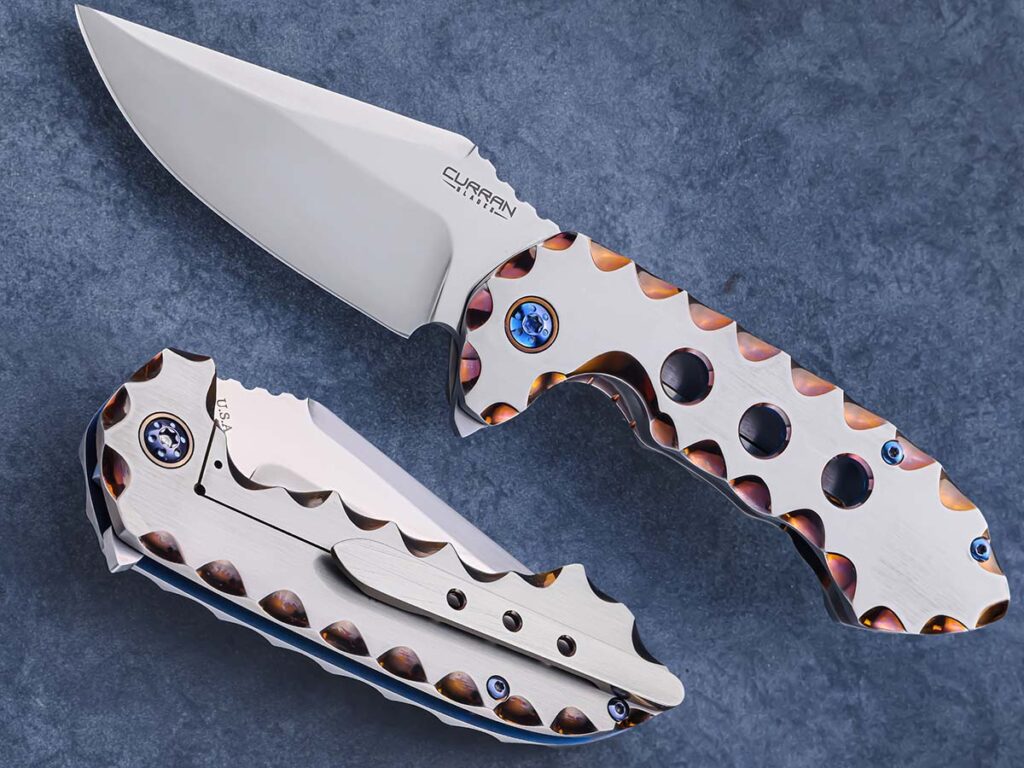
John Curran created a flipper folder in a model he calls Alpha 3 with a flat ground 3-inch blade of Elmax steel and an overall length of 7½ inches with a titanium handle and frame. The flipper design has been a mainstay of his work for some time.
“I’ve predominantly built flipper-style folders over the years, though I’ve done my share of thumb-stud and thumb-hole deployments as well,” he related. “In terms of trends, I haven’t noticed interest in one style rising or falling dramatically. What I have noticed is that customers are spending more carefully. People know what they want and they are choosing their purchases very intentionally.”
As John tries to fulfill his customers’ expectations, he watches the intricacies of the flipper folders he constructs carefully. “From my perspective, flippers don’t necessarily hold an advantage over other deployment methods,” he commented. “It really comes down to personal preference. Some customers want a classic flipper, others ask for a flipper paired with a thumb stud and some want a hole cut into the blade as an alternative opening method. There is no single best option, just what feels right in the user’s hand.
“The complexity of the build depends on the design more than the deployment style,” John continued. “I spend a lot of time sketching concepts only to discover during mock-ups certain ideas don’t translate well in hand. I typically prototype in G-10 or even wood to check ergonomics, mechanics and overall fit. That stage tells me a lot about whether the knife is going to meet my standards.”
John’s basic components include caged bearings and hardened stainless washers for smooth action. “If a customer wants to keep the cost down, I can build the knife without bearings and use phosphor bronze washers instead,” he advised. “Ceramic bearings undeniably offer the smoothest action, but bronze washers still perform well. It ultimately depends on what the customer values most. Milling pockets for the bearings adds time and labor and is reflected in the final price.”
Design concentrations on clean, reliable opening mechanisms and functional finger guards when the blade is deployed are hallmarks of John’s finished product. The challenge is always in the “tweaking” to solidify the geometry, but the result is worth the investment of time and effort.
The flipper folders emerging in the custom knife market today offer diverse profiles, materials and interpretations along with a wide range of price points. Each of these factors influences the consumer and makes the genre vibrant.
More On Flippers:
- Cool Custom: Robert Young’s New York Flipper
- Flipper Knives: Top Fast-Deployment Blades
- Best Flipper Knife: Blades That Win The Fidget Factor
- Civivi Cogent Review: How Versatile Is This Flipper?
 NEXT STEP: Download Your Free KNIFE GUIDE Issue of BLADE Magazine
BLADE’s annual Knife Guide Issue features the newest knives and sharpeners, plus knife and axe reviews, knife sheaths, kit knives and a Knife Industry Directory.Get your FREE digital PDF instant download of the annual Knife Guide. No, really! We will email it to you right now when you subscribe to the BLADE email newsletter.





