The BLADE Blogs

The blogs of the BLADE editors, Steve Shackleford and Erin Healy.

Knife Giveaway

0

Greetings From KnifeBroker.com

With all the excitement of the Johnny Stout knife give away, we have decided to extend the free listing period for an additional 30 days, but that’s not all.
KnifeBroker.com is going to give away another knife in September, each time you list a knife in the month of September you will automatically be entered into a drawing to be held October 1st 2010.
We are giving away a custom made knife by legendary knife maker Gil Hibben with a retail value of 400.00 dollars. The contest starts September 1st and ends September 30th. It’s that simple, just list your knives and your in the drawing, the more you list the better your chances of winning this beautiful Gil Hibben custom made knife.

Thank You,
KnifeBroker Staff

Ernest Emerson Plugs BLADE Show on Armed American Radio

Ernest Emerson talked about his knives, his seminar and more for the upcoming BLADE Show on Armed American Radio over the weekend.


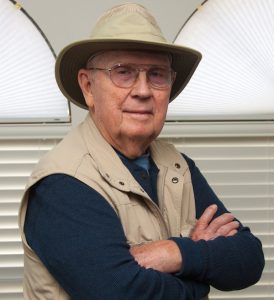
Emerson (pictured), who also will display his factory knives at his show booth, extolled the virtues of the BLADE Show and his seminar, “Countering Terrorism: Get Your Mind Right,” which will be BLADE Show Saturday at 1 p.m. Originally slated for Room 110 in the host Cobb Galleria Centre, the seminar will be held at the same day and time in Room 104 instead.


According to Emerson, Armed American Radio has 166 radio affiliates and recently picked up a new one in Phoenix, Arizona, the country’s fifth largest market.


The BLADE Show will be June 10-12 at the Cobb Galleria in Atlanta. For more information, click “BLADE SHOW” on the bar at the top of this page.

HallMark To Launch Bad Blood Line

     HallMark Cutlery will launch a new brand, Bad Blood, at the 2012 SHOT Show in Las Vegas. The line will consist of a mid-priced offering of tactical folders, fixed blades, and utility pieces.

     The new brand will also include a custom collaboration series from custom maker, Sean Kendrick. His line for HallMark Cutlery will include three folding knife patterns and three fixed blade models, and are expected to be available in the first quarter of 2012.

     Kendrick has been crafting knives professionally since 1998, but knives have been a passion since he was a child. Craft and design come naturally to the self-taught Kendrick. His mother is a talented artist and his father is a master electrician, plumber and mechanic. Sean’s great-grandfather was a blacksmith.

     Kendrick’s style and designs have been inspired by many elements, including music. Sean credits his friends and mentors, knifemakers David Mosier and Mike Franklin, for showing him the “ins and outs” of folding knives. Sean is also a member of the Usual Suspect Network. Kendrick won the award for “Best Tactical Knife” at the 2010 Spirit of Steel Show for his fixed blade “Partisan Hybrid.” His fixed blade version of the “Spiraling Demise” won “Best Tactical / Fighting Knife” at the 2004 Greater Ohio Valley Knife Show.

     For more information contact HallMark Cutlery, PO Box 220, Kodak, Tennessee 37764 866-583-3912 www.hallmarkcutlery.com.


     To read similar stories and all about the latest knives, knife trends, knifemakers and much more, subscribe to BLADE® Magazine. For information on how to subscribe, click on http://www.shopblade.com/product/blade-magazine-one-year-subscription-us/?r+ssfb211211#BL1SU


Strange Blade Brews

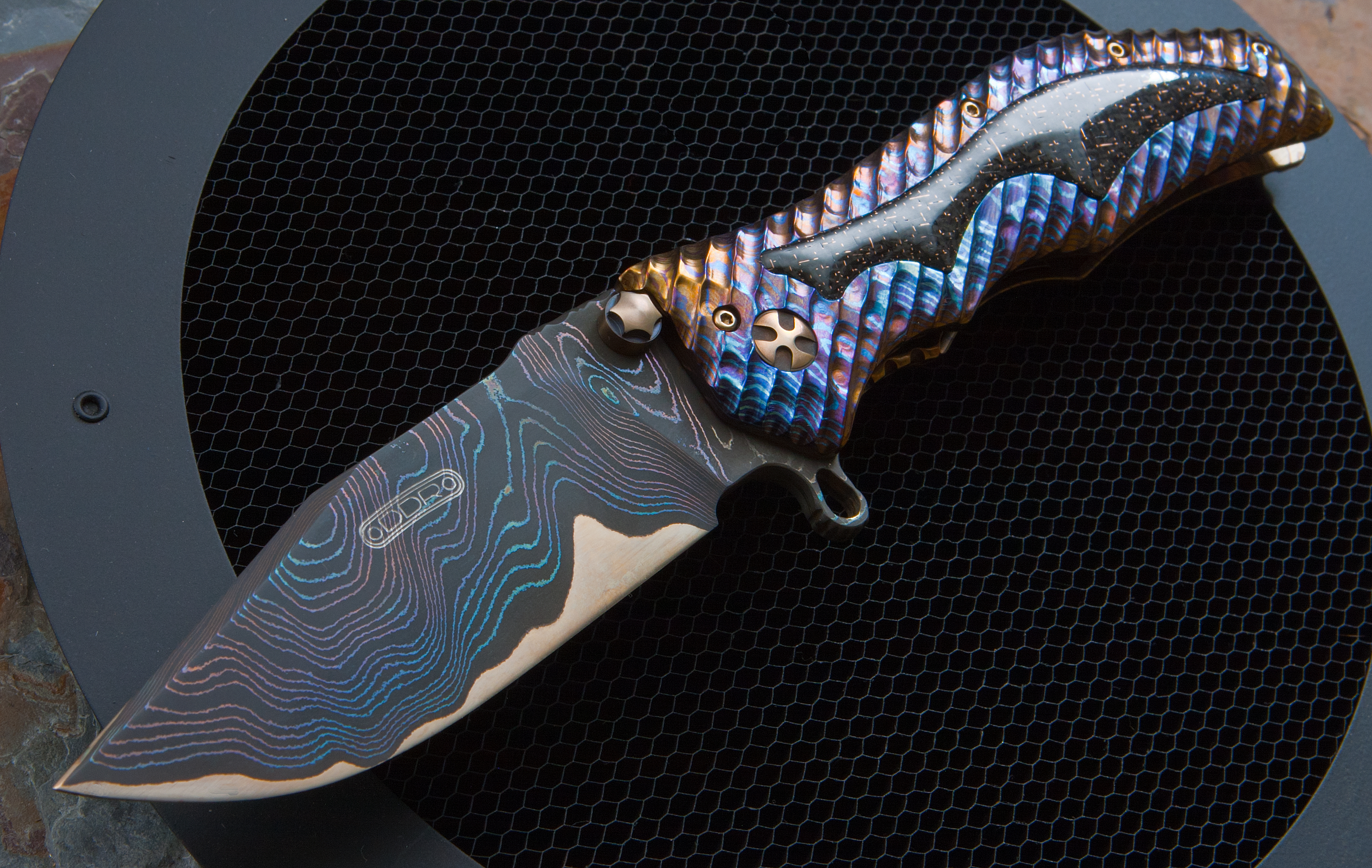
Darrel Ralph outfits his assisted-opening DDR Gun Hammer 3-D Alpha in a 3.95-inch blade of stainless damascus with a Stellite 6K core by Chad Nichols. The frame is Nichols 3-D-carved Moku-Ti titanium damascus. Ralph’s list price: $3,500. (knife photo courtesy of Darrel Ralph)

Some of today’s alternative blade materials may change the way you look at knives

By Pat Covert

TO MOST KNIFE ENTHUSIASTS, THE WORD STEELis so closely associated with blades it would be hard to describe a knife without it. After all, since its earliest known production about 4,000 years ago, in one form or another steel has ruled the roost not only in cutlery but so many other things that pervade our lives.

Simply put, steel is everywhere. Unfortunately, most versions of it rust.

Progressive thinking in the knife arena has led to a boom in the technological aspects of blades, which includes those of materials that do not rust or rust very little in comparison to stainless steel. (Stainless steel resists corrosion but is not impervious to it.) In the process, cobalt-based alloys such as Stellite®, Talonite and Cobalt Dendritic have received attention. Other materials such as laminates using titanium and carbon fiber, as well as ceramics, also have been used to good effect.

Frost on a Windowpane
Not a common metal, most of the world’s cobalt is mined in the Republic of the Congo. Today, most cobalt is used in corrosion-resistant “super alloys,” which are particularly suited for gas turbine and jet aircraft engines.

David Boye has been making knives for over 40 years. He offers fixed blades and folders for use around saltwater and other rust-inducing environments. He has used dendritic material exclusively since 1980 because he says he prefers its strength, cutting performance, ease of sharpening, and ability to cast roughly to shape.

(Editor’s Note: For a better understanding of forging various metals into blades, check out The Complete Bladesmith: Forging Your Way to Perfection, pictured at left.)

“Dendritic is the kind of pattern [damask] which naturally forms when a carbon alloy cools after smeltering,” Boye explains. “It looks like frost on a windowpane.”

According to many knifemakers, the finer the blade’s grain structure, the better it cuts. Boye supports the opposite view.

“These relatively large, rooted and fully bonded carbides produce microscopic teeth along the cutting edge, and this is what actually does the cutting,” he notes. The combined attributes of extreme cutting performance, no rusting in seawater and being non-magnetic so it does not affect a compass or electronics make the material ideal for the ocean environment. “We have used dendritic cobalt for over 15 years and have received virtually zero chips, broken blades or complaints,” Boye says, “and many customers have raved to me about the blade performance.”

He states that the material’s downside is each knife design requires a set of porcelain molds which are challenging and/or expensive to make, the mold created for each individual blade has to be discarded after only one use, the casting alloy is costly, and the waiting time for blades from the foundry can be lengthy.

Damascus Hybrid

Chad Nichols is a large supplier of damascus to the cutlery industry and has pioneered a new blend of patterned steel using cobalt 6K, commonly known as Stellite, and stainless steel—particularly AEB-L and 304. “The interesting thing about the 6K cored steel is that the cobalt alloy itself does not have to be heat treated to retain edge-hold abilities,” he observes. “The only reason the material needs to be heat treated is for corrosion resistance [for the stainless steels in the damascus] and for etching purposes.”

Nichols outlined several attributes of the hybrid damascus, “The addition of the cobalt-based alloy increases its durability and oxidation resistance,” he states. “The cutting performance of the 6K damascus is great. It’s a workhorse of a steel for cutting and can retain a razor edge even under the most vigorous conditions.” As for the disadvantages of the material, there are two. “The blade material is expensive. You already have a relatively high cost for the damascus and then you add the 6K which, pound for pound, costs more than the handmade damascus,” Nichols says, adding, “It’s not a lot of fun to make, either!”

“Won’t Crack Under Flex”

The book on modern laminate blades using metal bonded to synthetics was co-authored by knifemaker Warren Thomas (also, see page 114, August 2011 BLADE®). He indicates he began making laminate blades in 1991 using stainless steel and carbon fiber. Shortly thereafter he substituted titanium for steel, creating a lightweight, zero-magnetic knife. Thomas says he uses a “trade-secret” chemical bond that positively adheres the two materials.

“My laminates have half the weight of a steel blade, absolute zero corrosion, won’t crack under flex, and don’t micro-fracture under heavy stress along the cutting edge like steel blades do,” he explains. “To improve the performance of the blade, I weld tungsten carbide along the cutting surface to enhance the edge retention. This gives it a toothy edge that improves the cutting performance.

“There is no chance of corrosion using carbon fiber and titanium. Both materials are impervious to common destructive forces like sea salts, body sweat, and other elements that wreak havoc on steel,” he notes. “Steel knives have a very hard time cutting some synthetics, such as Kevlar™. My knives actually cut these materials quite well due to their ability to saw through them.”

Laminated blades do have their disadvantages. “In very rare circumstances, the blade can delaminate. I’ve had this happen approximately a dozen times in 20 years and have always corrected the problem for the customer,” he says. “Due to the direct cost of the state-of-the-art materials involved and the time spent fabricating the laminates, there is a higher cost for my blade over steel. However, you get what you pay for.”

That’s Edge Retention!
Ceramic blades are made by taking zirconium oxide—also known as zirconia—powder, compacting it under intense pressure, and heating it in blanks at high temperatures in the 1,400° Celsius range. The blades are much more common among kitchen knives, and for good reason. For straightforward slicing and dicing they are extremely effective, but for lateral blade movement with torque, such as for prying, they tend to snap or shatter.

Boker Knives has never shied away from thinking outside the box, and its ceramic knife line not only includes kitchen knives but tactical and everyday carries as well. “If used as intended, ceramic blades will outperform steel,” Boker USA CEO Dan Weidner says. “In an independent lab test performed comparing ceramic to steel, technicians measured the amount of pressure required to cut through a standard piece of cardboard. After 1200 cuts the pressure required to cut using the ceramic blade was the same as the first cut, while the identical task using a steel blade showed decline after 400 cuts.” Now that’sedge retention!

Ceramic blades also have other benefits over stainless steel, including corrosion resistance. “This is one of the prime advantages of ceramic,” Weidner opines. “It cannot rust, which is why it’s used so often in maritime and military saltwater environments.”

There is also good news on the economic front. “Initially the cost of ceramics was on the high side, but now there are sufficient manufacturers producing the material to put the price point in the same range as good, quality steel,” Weidner says. Moreover, ceramic blades are non-magnetic.

Is One For You?

The strange brews in blade technology are not for everyone, but they offer a wide range of features, including either no rust or a huge reduction of same, zero magnetism, weight reduction and enhanced edge holding. Granted, there are downsides in some instances, though apparently not enough to discourage enough buyers of the blade brews outlined herein.

Is there an alternative blade in your future?

For more on alternative blade materials such as Spyderco’s H1, Strider Knives’ Nitinol, and Bohler-Uddeholm’s Vanax 35 and 75, see page 68 of the April 2011 BLADE®.


Also be sure to check out BLADE’s Guide to Making Knives.


For more on the latest knives, knife legislation, knifemaking instruction, knife trends, knifemakers, what knives to buy and where and much more, subscribe to BLADE Magazine, the World’s No. 1 Knife Publication. Subscribe to BLADE magazine.


New BLADE Show Photographer is Chuck Ward

Chuck Ward/BLADE Show photographer
Chuck Ward is the new Official BLADE Show Photographer. (Chuck Ward image)

Long-time knife photographer Chuck Ward is the new Official BLADE Show Photographer, the BLADE Show and BLADE® Magazine are happy to report.

The BLADE Show is the world’s largest and most important knife show and will be held in its 36th annual rendition June 2-4 at the Cobb Galleria Centre in Atlanta.

Chuck replaces Eric Eggly and PointSeven, who had been the Official BLADE Show Photographer for about 20 years. Eggly retired from photography late last year to enter another industry.

The new Official BLADE Show Photographer counts being president of the Arkansas Knifemakers Association and membership in The Knifemakers’ Guild among his credentials. He is also the official photographer for the Oklahoma Custom Knife Show and the Arkansas Knifemakers Association Show—officially known as The Art of Steel Custom Knife Show slated for Feb. 18-19 at the Statehouse Convention Center in Little Rock. He has been photographing knives for over a decade and has been published in many magazines, including BLADE.

As the Official BLADE Show Photographer it will be Chuck’s job to photograph all of the annual BLADE Magazine Knife-Of-The-Year® winners, all of the winners in the annual BLADE Show custom knife competition, and all of the American Bladesmith Society’s annual best knives named at the show. All told those images will total 32, give or take a few. The resulting images will be the exclusive property of BLADE and will be used in the magazine’s stories recapping the annual BLADE Show.

The Official BLADE Show Photographer will be ably assisted by his staff. His grandson, Brennan Ward, will help Chuck with the photography, editing and printing of images. Brennan’s wife, Mrs. Anna-Catherine Ward, will handle all clerical duties and Chuck’s grandson, Grayson Ward, will assist in returning knives after they have been photographed. Brennan and Anna-Catherine are graduates of Belmont University in Nashville, Tennessee. Brennan is director of marketing at Elite Core Audio, and Grayson is custom shop director at ECA.

Save

Save

Save

Save

Save

Save

New American Bladesmith Society Office Announced


New American Bladesmith Society Office Announced

ABS Chairman Jim Batson has announced that effective immediately the Business Office for the American Bladesmith Society has been moved to Grand Rapids, Ohio and Cindy Sheely is the ABS Office Manager. Cindy can be reached at [email protected] or call (419) 832-0400.

The new American Bladesmith Society office address is:

American Bladesmith Society, Inc.

P. O. Box 160


Grand Rapids, Ohio 43522

The Cypress, Texas Office is now closed.


6 Knife Handles That Glow In The Dark

There are four categories of “glow.” Bioluminescence is, say, a firefly. There’s chemiluminescence, caused by a chemical reaction—think glow stick. Radioluminescence is most frequently used in clock or watch paints and on instrument panels. Then there’s phosphorescence, frequently used in toys, or toys for grown-ups: knives, or more specifically knife handles. The old-school invisible type of glow-in-the-dark scales show white-ish in daylight. The handle might have tinges of color, but it’s essentially white. If it has been exposed to enough sunlight, it will glow in blues, purples or greens in the dark. New-school daylight glow is visible day or night and comes in variety of colors. Here are six knife handles that glow in the dark, three of each variety, perfect options for Halloween or the everyday kid in all of us.

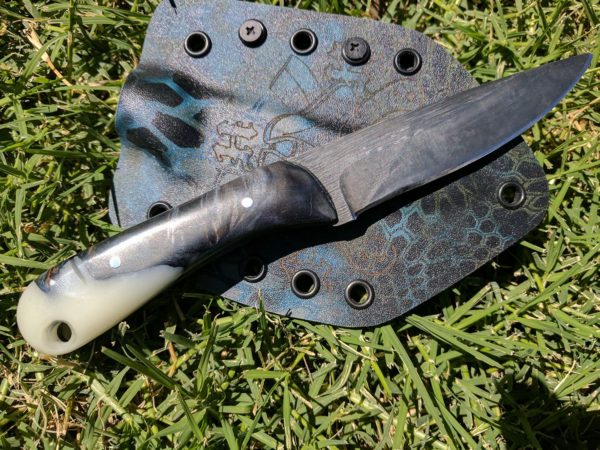
1. A son makes glow-in-the-dark-handled knife for his dad

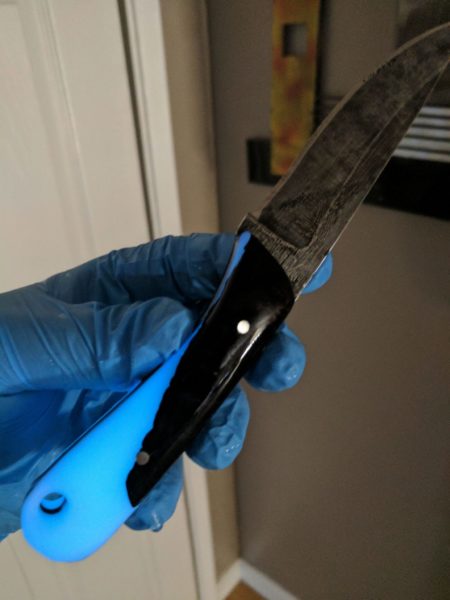
Randy Madan of Patriot Horde Knives made this Pig Poker for his dad, Randy, who uses it on his farm in Kentucky. This type of old-school glow will appear creamy or pasty by day and either blue-violet or green by night, provided it has absorbed some UV light, explained scalemaker, Rob Carper of Rob Carper Innovations (RCI).

This glow-in-the-dark knife handle is a hybrid by RC Innovations.
Randy Madan of Patriot Horde Knives made this 4.5-inch flat-ground blade out of 1095 steel from Aldo Bruno at New Jersey Steel Baron. The Pig Poker has an acid-washed finish and a hybrid glow-in-the-dark handle by Rob Carper of RC Innovations. The knife is 9 inches overall. Maker’s list price: $200. Contact Patriot Horde Knives, 760-885-9370, [email protected], on Facebook at Patriot Horde Knives or Jr Madan and on Instagram @the_patriot_horde.
Randy Madan made this glow-in-the-dark-handled knife for this father.
In low light this Pig Poker from The Patriot Horde Knives glows blue, provided it has absorbed enough light.

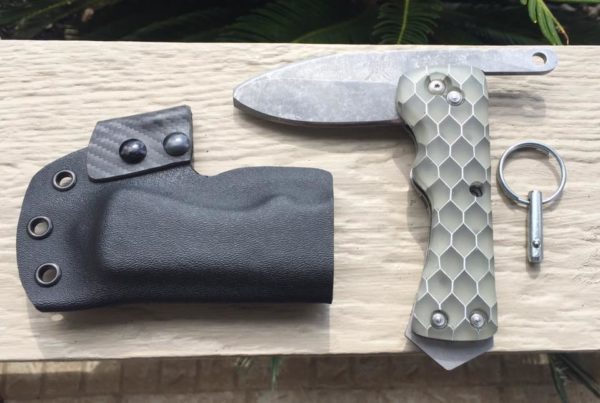
2. This GITD friction folder is pinned by a grenade pull

A rescue knife has a blunt point for two reasons, explained Denny Furey of Furey’s Urban Combat Knives – Unlimited. One, it can be used to pry with, and two, if you needed to cut someone’s seatbelt, for example, you don’t want to run the risk of sticking them with a sharp point.

The grenade pull locks the blade in the open position for secure cutting. The pin can then be stored in the attached slot on the sheath, similar to how a ferro rod might be stowed.

Denny Furey of Furey's Combat Knives - Unlimited made this blunt-tip rescue knife with grenade pull pin.
The “Resukyū” (Rescue) Friction Folder is a one-off by Denny Furey of Furey’s Urban Combat Knives – Unlimited. The 3-inch blunt-tip rescue blade is made out of O1 tool steel, as are the breacher/bottle opener and spacers. The blade and back spacer have an acid stonewashed finish. The knife measures 6.75 inches closed and 8 inches overall. The handle scales are Glow In The Dark by Voodoo Resins. The hardware, including the grenade pin lock, is stainless steel. Maker’s list price: $300 with Kydex/Holstex sheath. Contact Denny Furey, Furey’s Urban Combat Knives – Unlimited, 405-642-2198, [email protected], on Facebook at Furey’s Urban Combat Knives – Unlimited.
Furey Urban Combat Knives - Unlimited made this rescue friction folder as a one-off.
This Denny Furey friction folder handle was made by Voodoo Resins and appears green in the dark.

3. New-school daytime glow is visible day or night

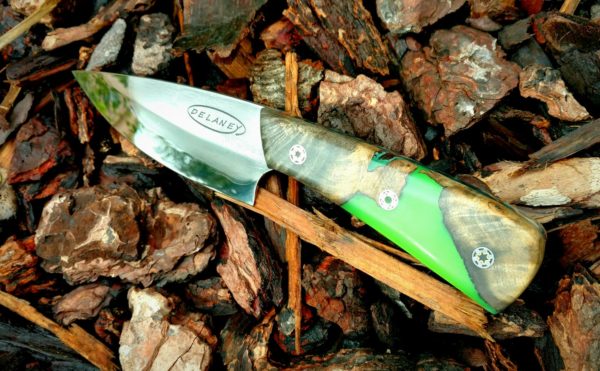
Jason Batdorf of Delaney Knives makes his own glow mix, using raw materials, but one would need to be a chemist with a laboratory to actually make the glow powder.

Jason Batdorf makes his own glow mix for his wood-glow hybrid knife scales.
Jason Batdorf made this 4-inch flat-ground Delaney drop-point blade out of 1095 steel with hamon. The handle is a buckeye burl and glow hybrid made by the maker with his own glow mix. Overall length is 8 inches. Maker’s list price: $250. Contact Jason Batdorf, at Delaney Knives on Facebook or call 419-583-8238.

4. Knife named for a customer’s departed sister

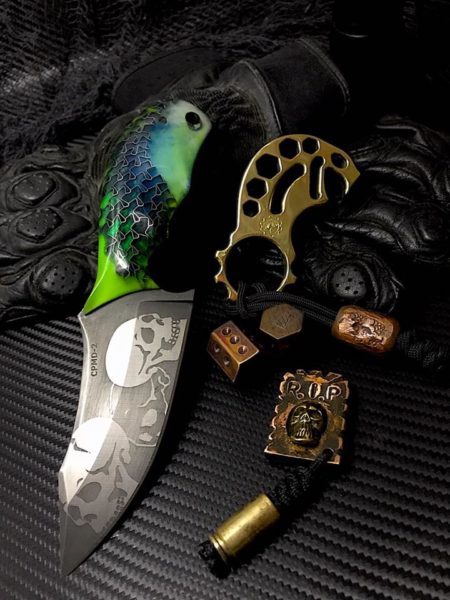
Brent Vacarro of Black Widow Knifeworks & Tactical Gear designed this blade for a customer as a custom order. When Brent began receiving interest in the knife, he wanted to introduce it into his lineup. But there were two problems. “First, I had to get permission from the customer, and second, I needed a name for it,” Brent explained. He contacted the customer and asked if it would be OK if he made more of this knife model. The customer was fine with that. “Then I asked him to name the blade,” Brent continued. “This is where it becomes very special very fast. He had told me about his sister passing away when they were younger, so he had asked if we can name the blade after her. My immediate response was ‘Of course!’ So that’s where H.E.R.L comes from, her initials.”

Brent Vacarro of Black Widow Knifeworks & Tactical Gear got permission from a customer to recreate his custom order. Brent let the customer name it after his deceased sister.
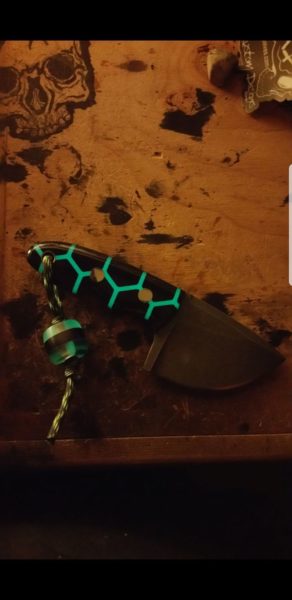
Brent Vaccaro’s H.E.R.L has a 4.5-inch flat-ground blade of CPM D2, acid-washed with etched skulls. The handle is Voodoo Resins’ Dr. Strangelove (green/blue glow) with green G-10 liners. Overall length is 7 inches. Maker’s list price: $280-$350. Contact Brent Vacarro at [email protected], 908-328-2049, on Facebook at Black Widow Knifeworks & Tactical Gear and on Instagram @blackwidowknifeworks.
Dr. Strangelove is a Voodoo Resins with blue and green glow in the dark.
Dr. Strangelove scales are made by Matt Peterson at Voodoo Resins. Dimensions are 5.9 inches long by 1.85 inches wide by .300-inch thick. Makers list price: $40/set.

5. Glow-in-the-dark honeycomb pattern is echoed in leather sheath

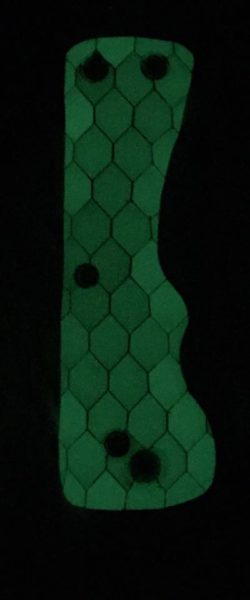
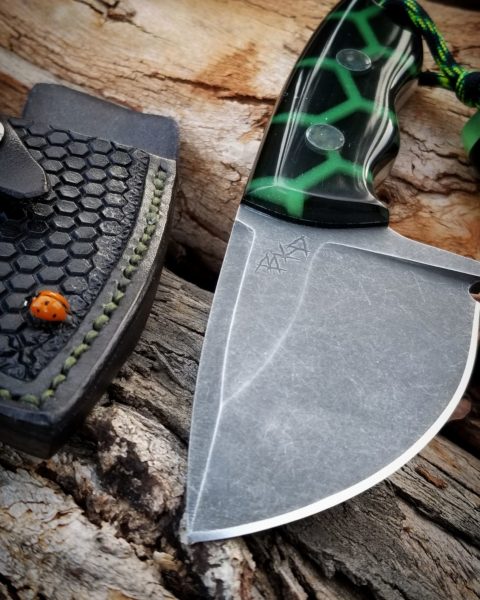
Namen Borras echoed the honeycomb glow-in-the-dark pattern in his accompanying leather sheath for the BKD Skinner.
Namen Borras’ BKD Skinner has a flat-ground 2.5-inch blade with swedge made out of CPM S35VN with acid and stonewashed finish. The knife is 6 inches overall. The handle scales are glow-in-the-dark honeycomb with clear resin by DerangedDonkey with black G10 liners. Maker’s list price: $350 with black leather sheath with matching honeycomb pattern. Contact Namen Borras on Instagram @borraskustomdesigns, www.bkdknives.com or at [email protected].
A knife handle can be a little or lot glow-in-the-dark, in random or purposeful design.
This is how the honeycomb pattern on the above knife appears in the dark.

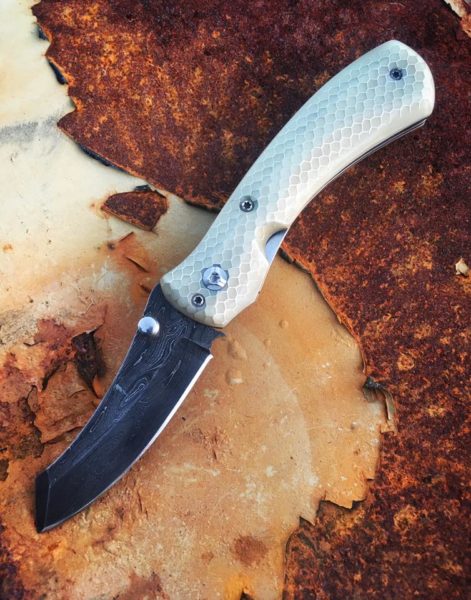
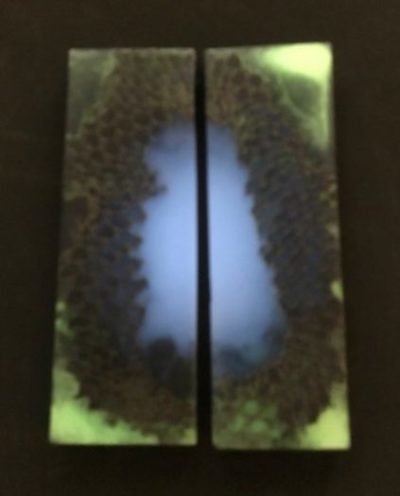
6. Old-school Glow Hex emits violet shade in the dark

Tyler Freund's custom folder glows violet in the dark.
Tyler Freund made this one-off custom folder with a 1.3-inch flat-ground blade of pattern-welded steel from Alabama Damascus Steel. The Glow Hex scales are by Beyond Wood Products, and are paired with titanium liners. Screws, pivot pin, pivot screw, backspacers and clip are also titanium. Overall length is 9.7 inches. Maker’s list price: $400. Contact Tyler Freund, Freund Custom Knives, 1755 Madison 541, Ironton, MO 63650; 573-366-3906, [email protected] and on Instagram @freunds_customs.
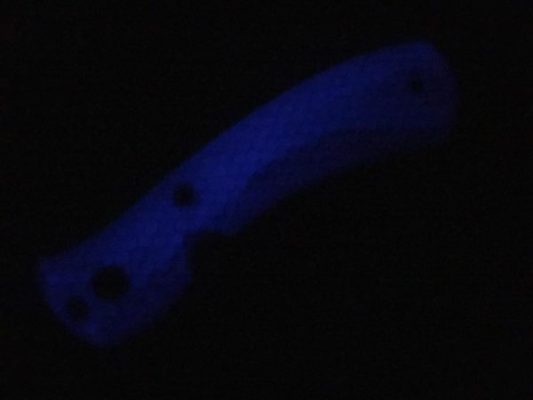
Old-school invisible scale material can glow blue, violet or green in the dark.
Tyler Freund’s one-off custom folder glows a blue-purple in the dark when it has absorbed sufficient UV light.

A Digital Subscription to BLADE Is The Answer

Save $4 off the print price of a annual subscription to BLADE Magazine with a digital subscription.
You can read your digital issues of BLADE Magazine anywhere you have your phone, tablet or computer, and there’s no need to find storage for all your old issues.

If piling-up issues of magazines seems like a waste to you… If you feel like you don’t have time to read a magazine… If you like the stories we offer in BLADE, but want a more economical option, then a digital subscription is the answer. An annual subscription to BLADE is $17.98, $4 off the print price.


Advertisement

Must Read Articles

Read this before you make a knife

Knifemaking 101 – Read This Before You Make a Knife

  by Wayne Goddard My experience has taught me that there's nothing like digging in and getting started. I've often said the hardest part of the...
how to forge damascus steel

How to Forge Damascus

Advertisement
Advertisement