The BLADE Blogs

The blogs of the BLADE editors, Steve Shackleford and Erin Healy.

New BLADE Show Photographer is Chuck Ward

Chuck Ward/BLADE Show photographer
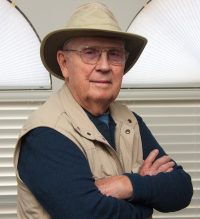
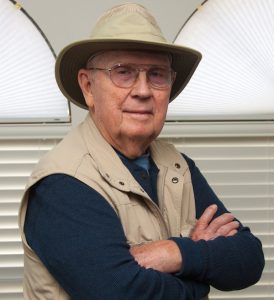
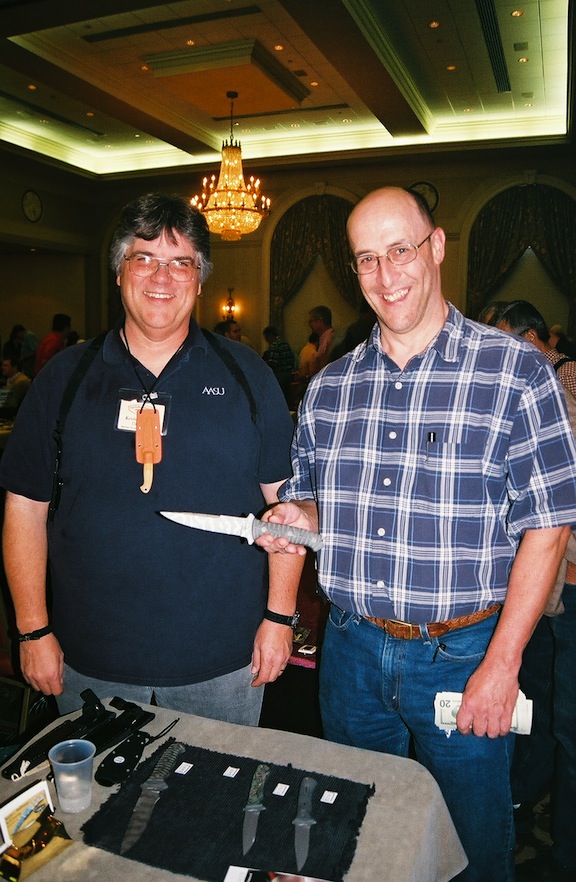
Chuck Ward is the new Official BLADE Show Photographer. (Chuck Ward image)

Long-time knife photographer Chuck Ward is the new Official BLADE Show Photographer, the BLADE Show and BLADE® Magazine are happy to report.

The BLADE Show is the world’s largest and most important knife show and will be held in its 36th annual rendition June 2-4 at the Cobb Galleria Centre in Atlanta.

Chuck replaces Eric Eggly and PointSeven, who had been the Official BLADE Show Photographer for about 20 years. Eggly retired from photography late last year to enter another industry.

The new Official BLADE Show Photographer counts being president of the Arkansas Knifemakers Association and membership in The Knifemakers’ Guild among his credentials. He is also the official photographer for the Oklahoma Custom Knife Show and the Arkansas Knifemakers Association Show—officially known as The Art of Steel Custom Knife Show slated for Feb. 18-19 at the Statehouse Convention Center in Little Rock. He has been photographing knives for over a decade and has been published in many magazines, including BLADE.

As the Official BLADE Show Photographer it will be Chuck’s job to photograph all of the annual BLADE Magazine Knife-Of-The-Year® winners, all of the winners in the annual BLADE Show custom knife competition, and all of the American Bladesmith Society’s annual best knives named at the show. All told those images will total 32, give or take a few. The resulting images will be the exclusive property of BLADE and will be used in the magazine’s stories recapping the annual BLADE Show.

The Official BLADE Show Photographer will be ably assisted by his staff. His grandson, Brennan Ward, will help Chuck with the photography, editing and printing of images. Brennan’s wife, Mrs. Anna-Catherine Ward, will handle all clerical duties and Chuck’s grandson, Grayson Ward, will assist in returning knives after they have been photographed. Brennan and Anna-Catherine are graduates of Belmont University in Nashville, Tennessee. Brennan is director of marketing at Elite Core Audio, and Grayson is custom shop director at ECA.

Save

Save

Save

Save

Save

Save

Mitt Romney Moment at Fox News Huckabee Forum

Knifemaker and panelist Michael O’Machearley lost his son in Iraq in 2003. Along the lines of an earlier question that Romney was asked, he questioned the candidate on whet…

Sale of New Bear Grylls Compact Scout Knife Nets Funds for Boy Scouts

0


From Gerber Legendary Blades:


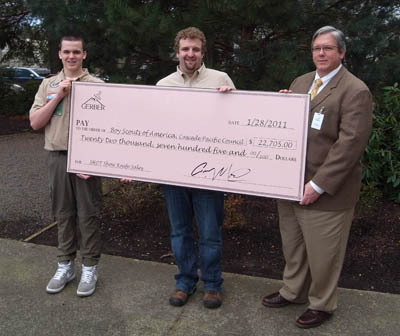
02.14.2011– Portland, OR – Gerber Legendary Blades, a leader in the knife and tool industry for over 70 years, is pleased support the Boy Scouts of America and the regional Cascade Pacific Council of the BSA.

With a promotion at the recent SHOT Show in Las Vegas, Nevada, Gerber was able to raise over twenty-two thousand dollars though the sale of Gerber’s new Bear Grylls Compact Scout knife over the course of the four-day show. Proceeds from the sale went directly to the Boy Scouts of America Cascade Pacific Council , which provides services and youth-development programs to families and community organizations in eighteen counties of northwest Oregon and southwest Washington states.

According to Michael Egan, Director of Development for the Cascade Pacific Council of the BSA, the funds will be used for Camperships for low-income youth. “Each year we invest over $100,000 for at risk kids to go to camp, yet do not have an ongoing revenue source to pay for them,” explains Egan. “So, when funds like Gerber’s generous gift come through, we put it right towards the kids who need it most.”

“At Gerber, we really pride ourselves on leadership, responsibility and action, all core tenants of the Boy Scouts, so we are very pleased to lend our support to the organization,” said Corey Maynard, Director of Marketing for Gerber. “Furthermore, by donating funds to the Cascade Pacific Council we are able to give back to our local community, a community that has greatly supported Gerber over the years,” concluded Maynard.

The launch of the Gerber Bear Grylls Survival Series, and Bear Grylls’ active role in the scouting movement, helped created a natural fit between Gerber and the Boys Scouts. In addition to the Bear Grylls Compact Scout knife, which helped raise funds from this sale, the 2011 Bear Grylls collection will feature a number of products including knives, tools and survival gear ideal for scouting.

Take the BLADE® Quiz and Get Sharp!

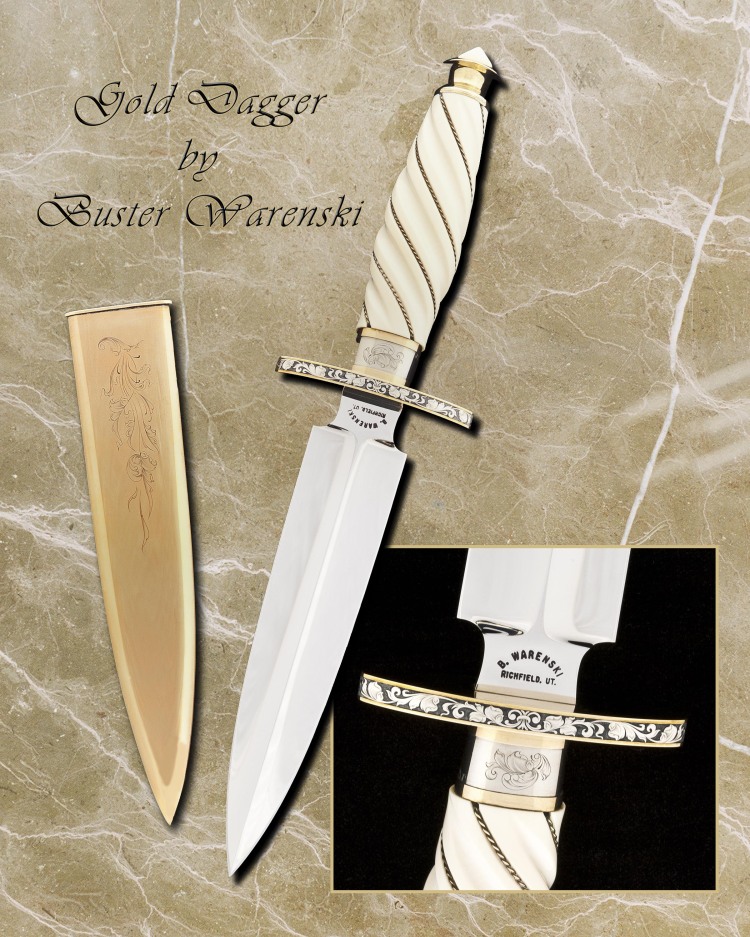
When knife enthusiasts think Knifemakers’ Guild, thoughts of Blade Magazine Cutlery Hall-Of-Fame© member Buster Warenski cannot be far behind. His gold dagger includes a gold separator band between the guard and also a gold pommel. The handle is carved antique ivory with twisted gold wire. The engraving is by Julie Warenski-Erickson. (from the Dave Nittinger collection; photo by Dave Siegel)

From One Cutlery Cradle To Another


The first BLADE Quiz focuses on Sheffield and the early days of the Knifemakers’ Guild


ARE YOU UP ON YOUR KNIFE HISTORY, especially the golden age of Sheffield and the beginnings of the Knifemakers’ Guild? Our first installment of a new BLADE® department, the “BLADE Quiz,” should let you know how schooled you are in short order. The answers appear below.

    1) The very early Sheffield knives carried the stamp “GR.” To what/whom did the initials refer and what were the knives better known as? A) Green River and Green River Knives; B) King George and Green River Knives; C) Great Britain and Green River Knives

    2) Knifemaker Ted Dowell served as a gunnery officer on which U.S. Navy ship during the Korean War? A) U.S.S. Minneapolis; B) U.S.S. Missouri; C) U.S.S. Intrepid

    3) How many cutlery factories were in Sheffield in 1910? A) 400; B) 1,400; C) 4,000

    4) Which Guild knifemaker was known early on by the moniker of “El Lobo Solo” (Spanish for “lone wolf”)? A) Chubby Hueske; B) Ruffin Johnson; C) Clay Gault

    5) Upon completion of 50 years of service, each Joseph Rodgers & Sons Ltd., employee was presented with: A) A 5-inch-tall silver statue of Vulcan holding the Rodgers trademark of a six-pointed star and a Maltese cross; B) a replica of the world-famous Rodgers “Year Knife”; C) a gold watch

    6) The obverse side of the blade is: A) the front or display side bearing the maker’s mark; B) the side without the maker’s mark; C) the blade spine

    7) Knifemaker Red Watson’s first name was A) Red; B) Herbert; C) Quinton

    8) In 19th-century Sheffield, the men who worked knife grinders feared: A) grinder’s asthma or grinder’s consumption; B) shattering grindstones, which could kill a worker; C) A and B

    9) Who stated, “Is knifemaking an art? I feel that anything done well is an art, be it a Rembrandt, a custom knife, or the Golden Gate Bridge. In short, what is art? More important, what isn’t?” A) Bud Cronk; B) Buster Warenski; C) Harvey McBurnette

    10) A cross guard has: A) Two quillons; B) one quillon; C) no quillons.

    11) According to The Knifemakers Guild Directory of the Membership, Bob Dozier is the son of: A) a blacksmith; B) an ironworker; C) a farrier

    12) The tool used by many Sheffield cutlers to put inlay holes in mother-of-pearl scales or to drill holes in scales is known as the: A) stidder or stiddy; B) parser or parsey; C) doller or dollie

    13) The first female knifemaker to apply for membership in the Knifemakers’ Guild was Carolyn Tinker, at the 1974 Guild Show. However, there was also another female maker who applied for membership at the ’74 show. Her name? A) Mary Jean; B) Ethel Waters; C) Rita Winter

    14) The term pocketknife originally referred to: A) a knife with blades opening at one end only; B) any knife that could be carried in a pocket; C) a knife that was always handy and could be used for any number of cutting chores

    15) Which of the following is not a founding member of The Knifemakers’ Guild? A) Jon Kirk; B) John Applebaugh; C) John T. Smith

    16) In old Sheffield, a bolster was cast or forged from nickel, iron or brass and had a projection used to tommy it to the liner. In this instance, to tommy means: A) to pin; B) to rivet; C) to solder

    17) Xylonite was the first of many types of imitation: A) bone; B) ivory; C) pearl

    18) Knives with handles made by burning an imitation tortoiseshell pattern into clear horn with lye were known as: A) spotted penknives; B) shell knives; C) turtle blades

    19) The Deguello, the tune Santa Anna adopted to signify no quarter would be given to the defenders of the Alamo, was originally used by: A) the Moorish invaders of Spain; B) Christopher Columbus; C) the Spanish conquistadores


Answers: 1) B; 2) B; 3) C; 4) B; 5) A; 6) A; 7) C; 8) C; 9) C; 10) A; 11) A; 12) B; 13) A; 14) A; 15) C; 16) B; 17) B; 18) A; 19) A. Scoring: 0-3—Your tongs just got gonged. 4-7—Have you considered foregoing knives and taking up Farmville? 8-12—You’re spending too much time playing mumbley-peg. 13-16—Your knife neurons are starting to fire. 17-18—You are qualified to run for mayor of The Pit at the BLADE Show. 19—You must be Pete Cohan, curator of the National Knife Museum.

For more on the latest knives, knife legislation, knifemaking instruction, knife trends, knifemakers, what knives to buy and where and much more, subscribe to BLADE Magazine, the World’s No. 1 Knife Publication. For subscription information click on http://www.shopblade.com/product/blade-magazine-one-year-subscripti…?r+ssfb050512#BL1SU.


TSA Delays New Small Pocket Knife Policy

A policy change by the Transportation Security Administration (TSA) allowing passengers to carry a small pocket knife or multi-tool on commercial airliners beginning April 25 has been delayed, federal officials reported.

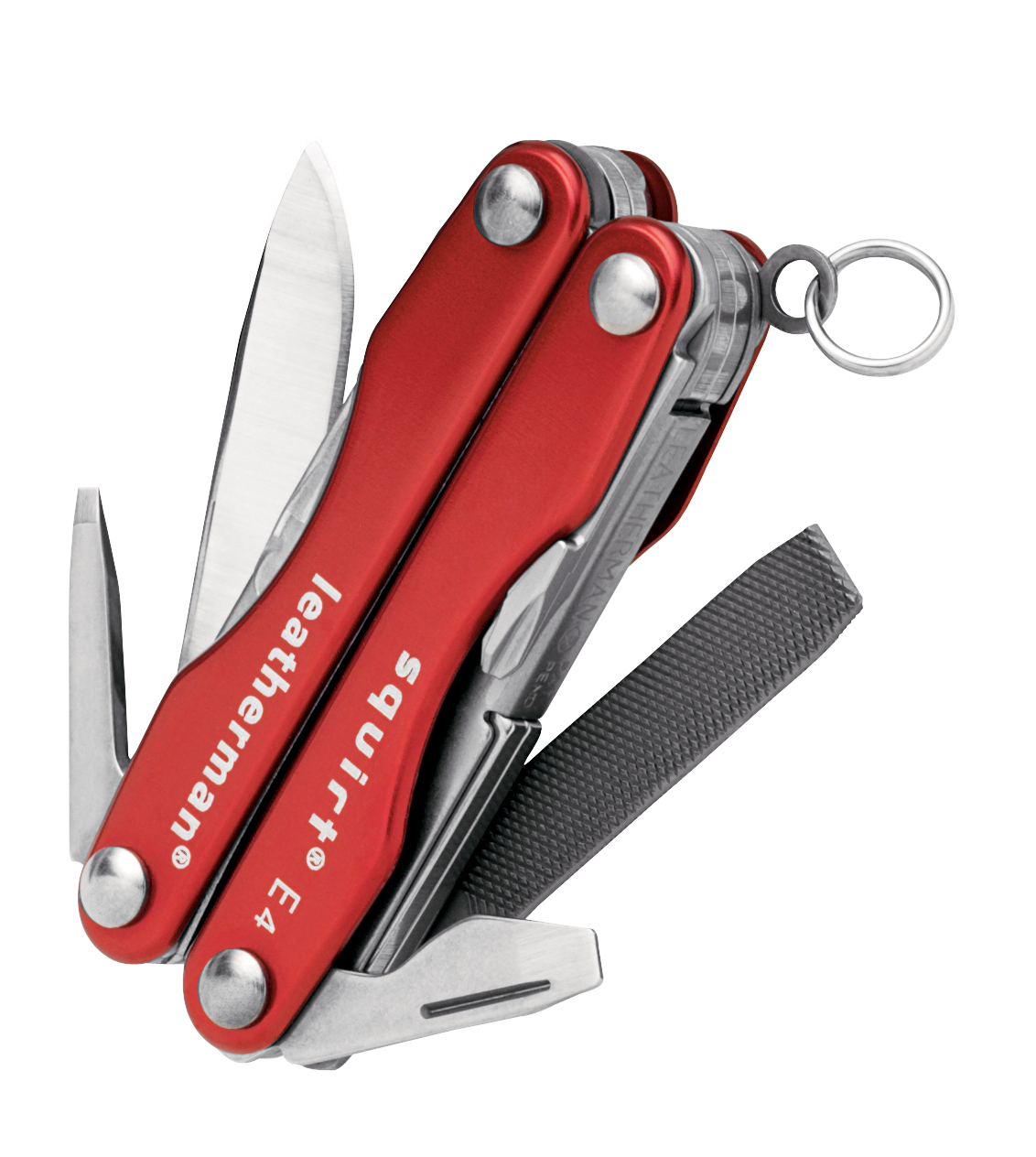
The Squirt by Leatherman.
The Leatherman Squirt is reportedly one of the multi-tools that would be allowed on board airliners if and when the new TSA policy change goes into effect.

The TSA indicated the delay is so it can consider a report on the subject from an advisory committee comprised of aviation, consumer and law enforcement officials. The TSA gave no time frame for how long the delay will last.

The delay has no effect on the International Civil Aviation Organization’s policy, which already allows certain small pocket knives and multi-tools on flights in a number of other countries.

The new TSA policy has been attacked from many corners. Some family members of people killed in the 9/11 terrorist attacks said they were outraged by it. At least one major airline official objected to the change, and the 90,000-member Flight Attendants Union Coalition has lambasted the policy.

Meanwhile, anti-knife politicians such as Sen. Charles Schumer (D-NY) and Rep. Ed Markey (D-Mass) say all knives should be banned from flights.

The new policy would allow certain small pocket knives and multi-tools with blades 2.36 inches long or less and a half inch wide or less. No knives with locking blades or fixed blades would be allowed, among others.

For more on the TSA ruling, see the July issue of BLADE®, on most newsstands today. For subscription info click on

www.shopblade.com/blade-magazine-one-year-subscription-us?icid=SHBLNCF2BL1SU-030613?lid=ssfbbl042313

Guild Show: Granddaddy Custom Knife Event

Great custom knives always highlight the Guild Show.
Alan Snow (right) holds the Stealth III made by Kevin Hoffman (left) at a past Guild Show.

The Knifemakers’ Guild Show will hold its 44th annual rendition—the granddaddy of all custom knife shows—this weekend at the Seelbach Hilton Hotel in Louisville, Kentucky. Knifemakers, knifemaking suppliers, purveyors and more from all over the world will convene in Derby Town, where some of the best custom knives will be shown and sold.

The Guild got its start in February 1970 when the Guild’s “founding father,” BLADE Magazine Cutlery Hall-Of-Fame© member A.G. Russell, rented tables at the Sahara Gun Show in Las Vegas and invited several knifemakers to display knives there. Later that year, 11 makers met in Tulsa, Oklahoma, to form the Guild. The makers were John Applebaugh, Cutlery Hall-Of-Famer Blackie Collins, John Nelson Cooper, Cutlery Hall-Of-Famer Dan Dennehy, Ted Dowell, Chubby Hueske, John Kirk, Cutlery Hall-Of-Famer Bob Loveless, John Owens, Jim Pugh and G.W. Stone. Loveless was elected secretary—the Guild office title today is president—and A.G. Russell was made honorary president.

The purposes of the Guild are to:

1) Promote custom knives and knifemakers

2) Assist the knifemaker technically;

3) Encourage ethical and professional business conduct;

4) Sponsor an annual business meeting and knife show.

The show has been held in assorted venues over the years, including Kansas City, Dallas, Orlando, New Orleans, Las Vegas and now Louisville. Some of the earliest Kansas City shows were held at the old Muehlebach Hotel, where, in addition to Loveless and Dennehy, such Guild legends as Cutlery Hall-Of-Famers Buster Warenski, Bill Moran, Ron Lake, George Herron, D’ Holder, Frank Centofante, Gil Hibben and many others displayed their knives and kick-started an organization that continues to be recognized worldwide today. Hibben, in fact, remains active in the Guild today, and is in his seventh and final year as Guild president. He will step down this year.

Make plans now to attend the show this weekend. There will be a special President’s Gala Thursday, Sept. 19, at the Seelbach, and should be a great place to see Gil and Linda Hibben in their final show as the Guild’s first family, as well as all the other makers and their great knives show Friday, Saturday and Sunday.

For the latest in knives and knife news, keep it here at www.blademag.com.

FROZEN SHARP! Cryogenically Treated Blades

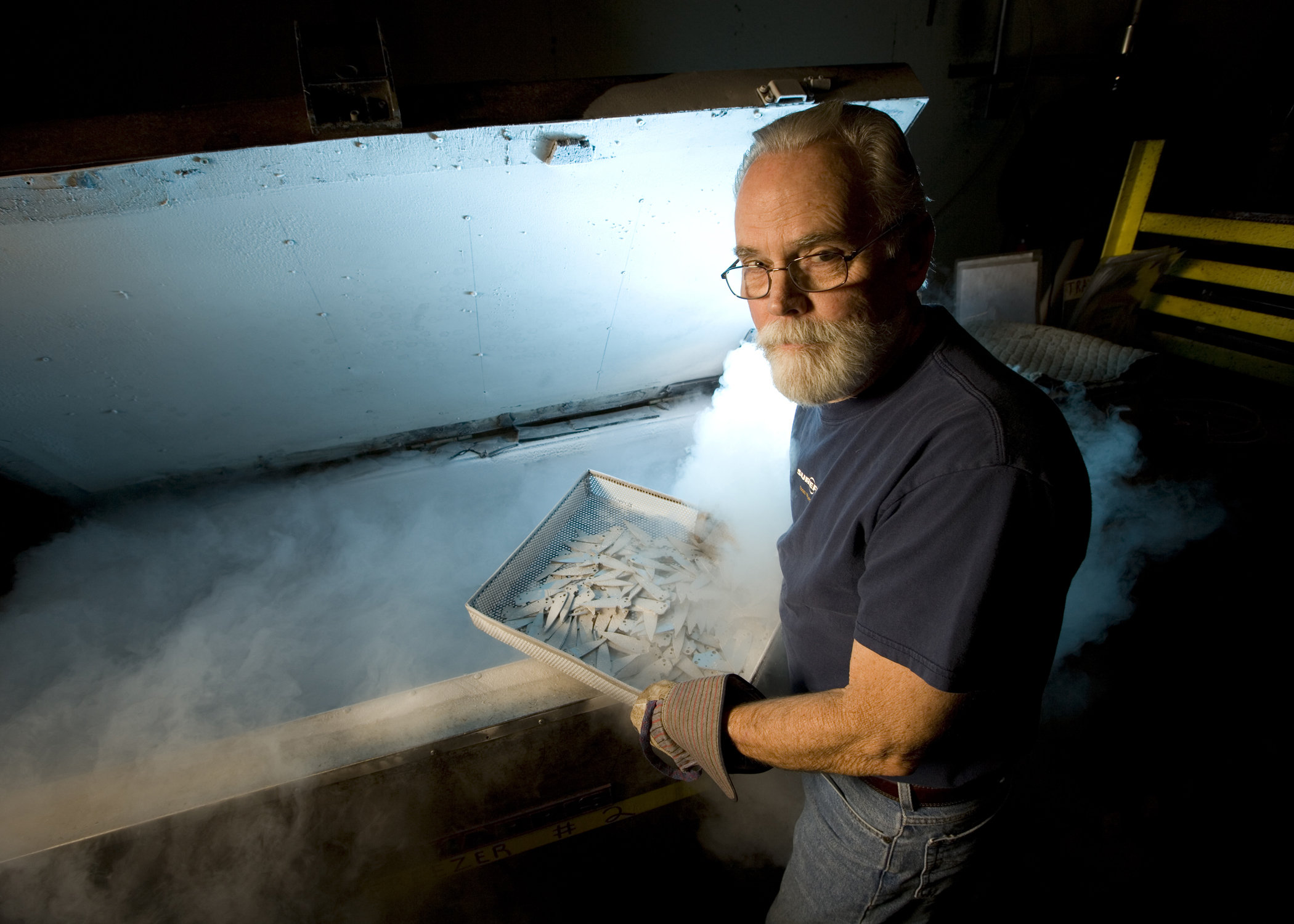
Cryogenic quenching may be performed on a single blade or hundreds at a time. Blade Magazine Cutlery Hall-Of-Fame© member Paul Bos said he may do a single blade or put a large quantity in a basket for immersion at one time, and control the rate of cooling and return to room temperature precisely. (Buck Knives photo)

Given the right steels, cryo treatments can enhance overall performance as well as aesthetics

By Mike Haskew, BLADE® field editor

Whether called cryogenic quenching or the probably more correct cryogenic treating of the steel, the process of freeze treating to help make a steel the best performer it can be is nothing new. Since the U.S. military became involved in cryogenically quenching steels during World War II and required it in the manufacture of various defense-related products, several methods have been evaluated with the same goal in mind: optimizing the amount of martensitic iron in the structure of the steel while minimizing the residual amount of austenitic iron. In turn, the qualities most sought in a knife blade are enhanced, particularly edge holding.

    “There are different ways that cryogenic treating is performed,” explained Scott Devanna, vice president of marketing and product development for Carpenter Steel, “but all methods are designed to accomplish the same goal, although the methods sometimes attain differing degrees of transformation from austenite to martensite. Cryogenic treatment is not a different type of quenching method but is an additional treatment normally used after quenching. It’s used after the quench in an effort to achieve more complete transformation of austenite to martensite [martensite being the hardest of the transformation products of austenite].

    “Most tool steels actually develop their hardened structure, or martensite, during the quench,” he continued. “For various reasons, however, in some cases transformation to martensite may not be complete even at room temperature. In such cases, some of the high-temperature microstructure, or austenite, may be retained after normal heat treating.”

    A2 and D2, as well as other high-alloyed tool and specialty steels, may contain as much as 20 percent austenite after normal heat treating. Cooling the steel to cryogenic temperatures furthers the conversion to martensite. However, the process is specialized and requires close attention to actual temperature, levels of exposure, and the time intervals involved in raising and lowering the temperatures of the steel itself.

    “The newly formed martensite is similar to the original as-quenched structure and must be tempered,” Devanna warned. “Cryogenic treatments should always be followed by tempering. Often the cryogenic treatment is actually performed between normally scheduled multiple tempers. Technically, cryogenic treatments are most effective as an integral part of the original quench, but due to the high risk of cracking, it’s recommended that tempering or a snap temper be performed before any cryogenic treatments.”

    The cryogenic quench itself is performed primarily in two ways: shallow and deep treatments. In the shallow treatment, the blade steel is brought to approximately -112°F for five hours, while in the deep treatment it is reduced to roughly -321°F for about 35 hours. This is most often accomplished through immersion in liquid nitrogen.

    “The term quench tends to imply that there’s a rapid change in temperature,” noted Spencer Frazer of SOG Specialty Knives & Tools. “In the case of cryogenic treatment, the quench term is quite misleading. Due to the severity of the temperature involved, quenching the material would cause it to crack or fracture. For that reason, cryogenic treatment is performed using computer-controlled temperature changes. At SOG, we use a version of deep cryogenic treatment, and some adjustments were made to the standard method to best suit the knife steels SOG uses. We consider it a supplementary process that helps improve the wear resistance of the blade steel.”

Blending In The Clumps

Blade Magazine Cutlery Hall-Of-Fame© member Paul Bos began heat treating knife blades in the 1950s. Back then he worked in the aircraft industry and treated a number of components. He said he also has seen the cryogenic process produce higher performance in guitar strings, women’s nylon stockings, gun barrels and engine parts.

    “I figured if the military wanted it done, then it would be good for knives,” Bos said. “Originally, it was there to get rid of austenite in martensitic steel. Austenite makes steel brittle, and under a microscope you can see what looks like little clumps of carbon. The cryogenic process is like putting stuff in a blender with clumps and pretty soon everything is mixed in a fine solution. Once you do the cryo on a steel, then the austenite dissipates and you are left with a fine grain structure.”

    Bos does a snap temper on high-carbon tool steel and then the cryogenic process at -280°F for about eight hours, and then brings the steel slowly back up to room temperature before a second temper. While cryogenic quenching is not a necessity on high-carbon steels*, its effects are more profound on higher-alloy-content steels, which do not completely transition from austenite to martensite at room temperature.

    “Once the steel gets past -100°F it’s in a state where you aren’t hurting it, but you can’t leave it in there too long,” Bos added. “Some guys go right from the quench into the cryo, but the blade could crack or break, and I don’t do that because I can’t take a chance with my customers’ blades.”

    Both factory and custom knifemakers take advantage of cryogenic quenching, and the process may be performed on a single blade or hundreds at a time. Bos’s career has spanned decades of heat treating blades for Buck and for a vast number of custom makers, including some of the most famous of all time. He may do a single blade or put a large quantity in a basket for immersion at one time, and control the rate of cooling and return to room temperature precisely.

    According to Bos, creating the optimal transformation of austenite to martensite is an integral part of the heat-treating process. To obtain the maximum formation of martensite, two or more complete tempering cycles are necessary following the sub-zero cryogenic quench. He stressed that the blades always should be allowed to cool to room temperature between tempering sessions.

Deep-Treatment Believer

For many custom makers, the benefits of cryogenic quenching are proven in the knife’s overall performance. Bob Beaty is a firm believer in the deep treatment below -300°F. A knifemaker since 1994, he does, however, note that simple steels do not seem to exhibit enhanced performance as a result of the procedure.

    “I do both forging and stock removal,” Beaty remarked, “and basically you find most of the benefit in the more complex stainless steels. I believe the knife stays sharper longer, and I’ve tested that a lot and am still testing it. Once a month I’ll cut rope, cardboard and leather. I always get a big difference, probably a 40-to-50-percent difference in edge-holding capability, as the cryogenic quench refines the grain of the steel.”

    Though he admits there are skeptics, Beaty says the enhancements of the cryogenic quench are real. In fact, he says he has experienced fewer incidences of edge chipping and an easier time getting a mirror finish on a blade after the cryogenic treatment.

    For the custom maker, outsourcing cryogenic treating remains the most efficient method of getting the job done. “I recommend it for those makers using complex steels, and I’m only charged a small amount for the blades I send for cryo treating,” Beaty noted. “One of the downsides of liquid nitrogen is it evaporates, and that would make the process more expensive for me. Not only would I have to buy the nitrogen, but also the tank and other equipment, including an oven. It really does not add much to the overall cost of the knife. Of course, if you wanted to, you could cryo treat something in a thermos bottle. Just don’t put the lid on it, don’t put your hand in it, and don’t do it in your wife’s kitchen!”

A Difference Maker

The choice of steel apparently drives the benefit of the cryogenic quench. From a knife buyer’s standpoint, a cryogenically treated blade could make the difference in performance and easily justify any minimal added expense.

    *According to Paul Bos, high-carbon steel usually is any steel containing anywhere from .6 to 2 percent carbon.

For more on the latest knives, knife legislation, knifemaking instruction, knife trends, knifemakers, what knives to buy and where and much more, subscribe to BLADE Magazine, the World’s No. 1 Knife Publication. For subscription information click on http://www.shopblade.com/product/blade-magazine-one-year-subscripti…?r+ssfb040312#BL1SU.


 

Advertisement

Must Read Articles

Read this before you make a knife

Knifemaking 101 – Read This Before You Make a Knife

  by Wayne Goddard My experience has taught me that there's nothing like digging in and getting started. I've often said the hardest part of the...
how to forge damascus steel

How to Forge Damascus

Advertisement
Advertisement