The BLADE Blogs

The blogs of the BLADE editors, Steve Shackleford and Erin Healy.

Midweek Maker Military-Style: Tracy LaRock

Tracy LaRock is known for his TimberJack and TimberJack Jr. traditional slipjoints.
In BLADE®’s continuing series entitled Midweek Maker, we are in our third installment of Midweek Maker Military Style: Tracy LaRock of LaRock Knives.

Tracy LaRock grew up on a dairy farm and spent every spare moment hunting, trapping and fishing. He served as a mortarman in U.S. Marine Corps from 1990 to 1995, but he didn’t stay out for long. In 1997 he signed on with the Texas Army National Guard, in artillery and recruiting, and still serves today. “So knives have been a part of my daily life since the beginning,” he commented.

“In 2008 Atmar Lester was showing a knife he made to some folks at church. I asked him some questions and he pointed me in the direction I needed to go,” Tracy related. “To start off it was basic tools and head-scratching, then I discovered the forums and tutorials.” Thomas Rucker and Percy Richardson let Tracy visit their shops. In 2014 he started making slip joints. After completing a few he reached out for help and received helpful insights from knifemakers Luke Swenson, Jared Oser and Enrique Pena among others.

“I hope to become a full-time maker in a couple years when I hang this uniform up for the last time,” he noted. Tracy lives in Lufkin, Texas with his wife, Mia, and their three sons.

  • Best-selling knife patterns: TimberJack and TimberJack Jr., traditional slip joints
  • Favorite blade steels: W2, 1095, O1. “Most are W2 because I have long since fallen down the hamon hole,” Tracy quipped.
  • Blade grinds: flat
  • How he tests his knives: rope, cardboard
  • Favorite handle materials: green canvas Micarta and ironwood
  • Price range: $350-$850
  • Forums he participates in: Facebook Group like Making Slipjoints and Lockbacks
Mia LaRock runs the LaRock Knives Facebook Group, and it is a lot of fun.
As Tracy LaRock retires from the military, he will be able to focus more time on making his TimberJack slip joints. His wife Mia LaRock does a terrific job running the Facebook Group at LaRock Knifes.

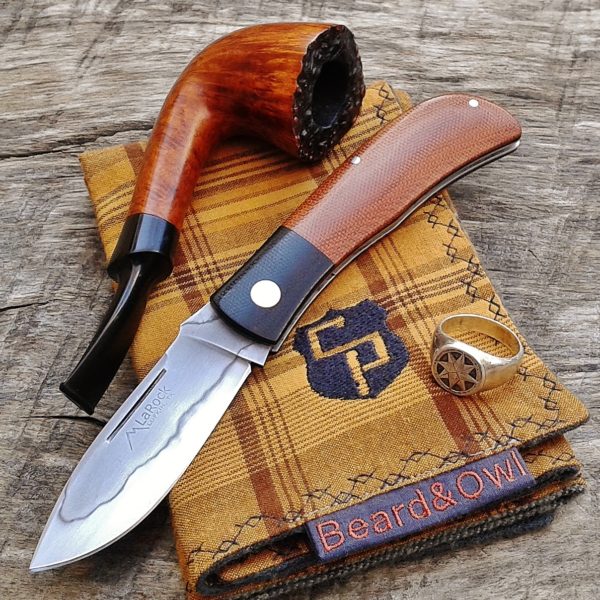
The above TimberJack has a 3-inch blade of W2 with hamon. The handle is fashioned from canvas Micarta scales. Overall length is 7.25 inches. Maker’s list price: $425.

Tracy LaRock is set to rock his retirement with knifemaking. His wife, Mia, handles his social media.
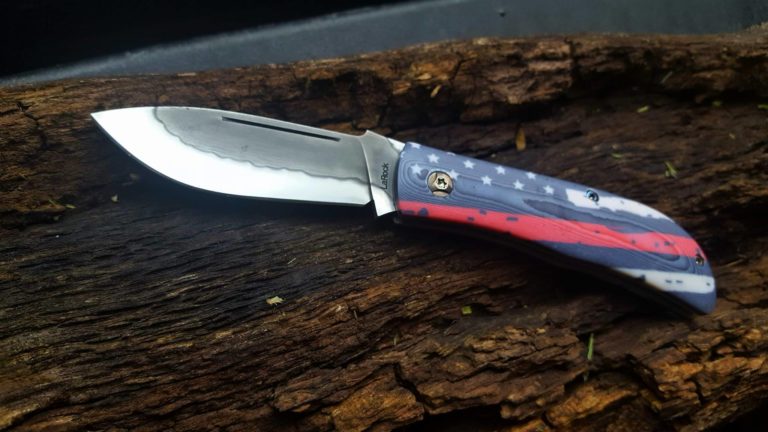
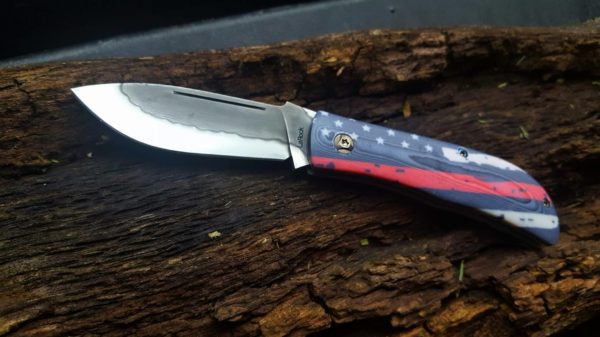
This Tracy LaRock creation is also a TimberJack with a 3-inch blade of W2 steel with hamon. The handle is American flag Carv-X. Overall length is 7 3/4 inches. The screw construction is done with titanium screws from TiConnector. Maker’s list price: $750.

Contact Tracy or Mia LaRock at 936-238-9077, [email protected], on Facebook at LaRock Knives or on Instagram @tracylarock.

Subscribe To BLADE For More Stories Like This

A U.S. subscription to BLADE magazine, 13 issues, is $21.98.
An annual U.S. subscription to BLADE is $21.98. You can get your 13 issues sent to Canada for $39.98 and internationally for $49.98. Or go green and get your issues sent digitally for $17.98.

A one year’s subscription to BLADE® will ensure you’re the first to read all six Knifemaker Showcase stories. You’ll also get the latest knife news, knifemaking how-tos, knife reviews, plus knife history and articles that tap into the knowledge of both the legends and the up-and-comers. Don’t miss out. Subscribe.

American Bladesmith Society Announces 2014 Hammer-In Schedule

One of the things that makes the knife industry such a pleasure to be involved with is artisans, bladesmiths and knifemakers in general sharing their knowledge, teaching people their craft and passing down the handcraft from generation to generation. 2

Some of the best at this are the members of the American Bladesmith Society, as well, of course, as those in the Knifemakers’ Guild and countless other knife clubs and organizations. The ABS claims to have had record attendance at its hammer-ins across the country in 2013, and has already announced its 2014 Hammer-In Schedule. Click here for a Complete Knifemaking Collection of books and digital downloads to get you started in your knifemaking endeavors. And without further ado:

ABS Hammer In Schedule for 2014

March 7, 8, and 9, 2014
Spring Great Smoky Mountain Hammer-In
Haywood Community College, Clyde, North Carolina
ABS Contact – Bill Wiggins (828) 226-2551 or Email [email protected]

April 26 and 27, 2014
Spring Piney Woods Hammer In
Texarkana College – Moran School of Bladesmithing, Washington, Arkansas
ABS Contact – BR Hughes (903) 838-0134 or Email [email protected]

June 2014
ABS Youth Hammer-In
Smoky Mountain Knife Works, Sevierville, Tennessee
ABS Contact – Houston Price (865) 397-0053 or Email [email protected]

July 11, 12, and 13, 2014
New England Hammer-In
New England School of Metalwork, Auburn, Maine
ABS Contact – Mace Vitale (203) 457-5591 or Email [email protected]

August 22, 23, and 24, 2014
Mid America Hammer-In
Miami County Fairgrounds, Troy, Ohio
ABS Contact – Butch Sheely (419) 832-5801 or Email [email protected]

September 13 and 14, 2014
Fall Piney Woods Hammer-In
Texarkana College – Moran School of Bladesmithing, Washington, Arkansas
ABS Contact – BR Hughes (903) 838-0134 or Email [email protected]

October 4 and 5, 2014
Heartland Hammer-In
Washburn Institute of Technology, Topeka, Kansas
ABS Contact – Steve Culver (785) 484-0146 or Email [email protected]

October 2014
California Hammer-In
College of the Sequoias, Tulare, California
ABS Contact – Mike Vagnino (559) 636-0501 or Email [email protected]

October 18 and 19, 2014
Smoky Mountain Fall Hammer-In
Haywood Community College, Clyde, North Carolina
ABS Contact – Bill Wiggins (828) 226-2551 or Email [email protected]

Hammer Knives Are What’s Cookin’!

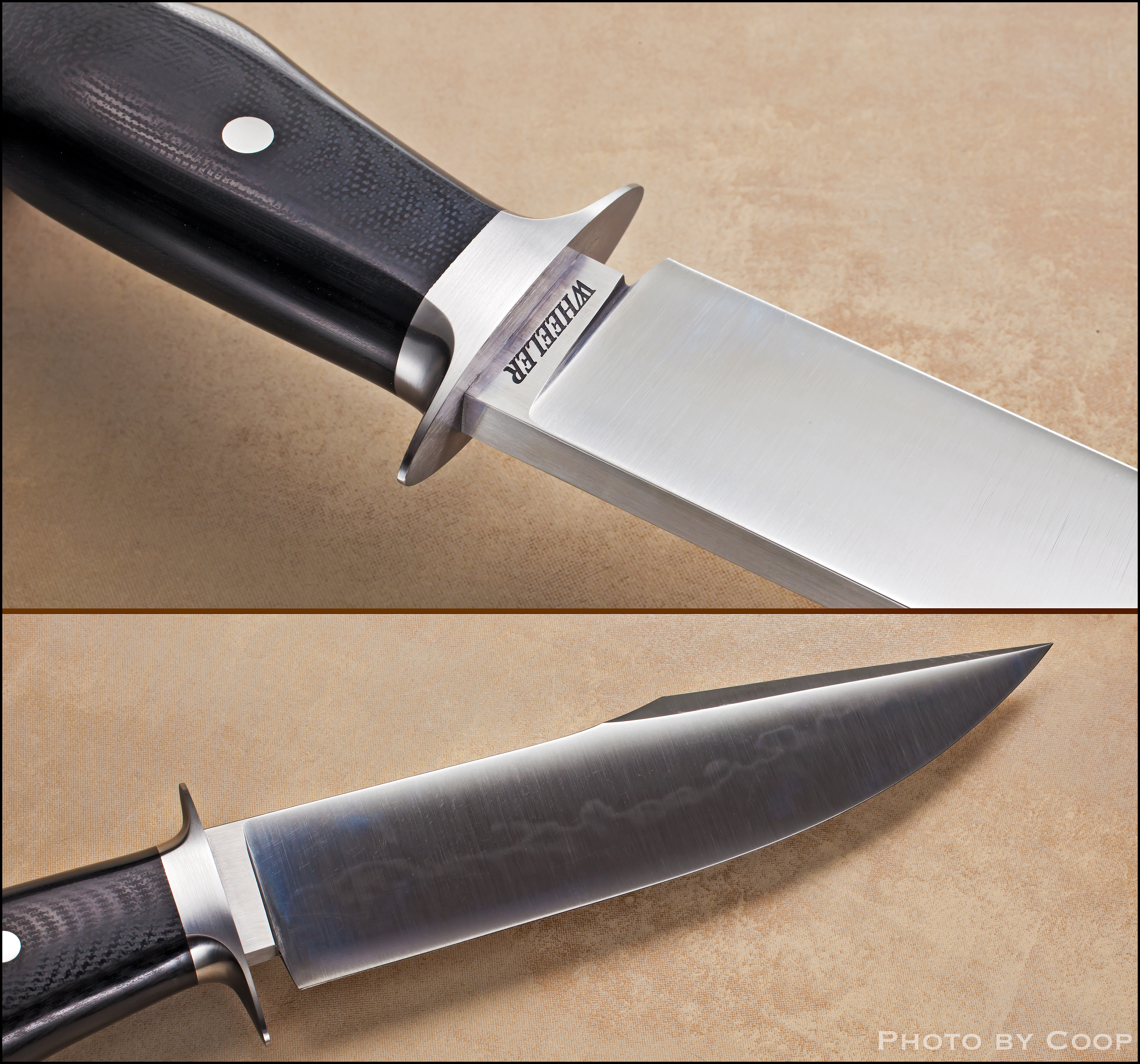
The Paranee/Wheeler fighter combines Nick Wheeler’s impeccable fit and finish and a Joe Paranee design, and is high on the list of collector Peter Gill. (SharpByCoop.com knife photos; photo of drawings courtesy of Nick Wheeler)

If you’re hungry for top handforged blades, prepare to cleanse your palate

By Mike Haskew


The selection of and appetite for handforged knives is as healthy as ever, and those who combine aesthetics with the hammer on hot steel occupy a noteworthy place among the pantheon of knifemakers. Both well-established artisans and up-and-comers are gaining attention, incorporating daring damascus and eye-popping ivory, tantalizing carbon steel and wondrous woods.

A collector for 15 years, Peter Gill said he is excited about the Founder’s Bowie series from Jason Knight, who devised the idea of selling a limited run of handforged knives to raise money to build his shop. The Founder’s Bowies include upscale handles of materials such as mammoth ivory and 10-inch blades of 1080 and 15N20 random-pattern damascus, and overall lengths of about 15 inches. Gill said each knife has sold in the $1,200 range. The Paranee/Wheeler Fighter, another limited run and a collaboration between Joe Paranee and Nick Wheeler, is a favorite of Gill and sells for around $850.

“They each make simply beautiful knives that approach perfection and are very hard to obtain,” Gill noted. “A plaque with the names of the 10 original owners of the Founders Bowies will be in Jason’s shop, and the fighter combines Nick’s impeccable fit and finish with a specific design concept from Joe.”

Collecting knives for nearly 40 years, Paul Kessler has seen his share of handforged standouts, and said the work of husband-and-wife team Adam and Haley DesRosiers is “wildly popular.” The pair is becoming known for damascus blades and high-end wood handles in a variety of knife styles. In addition, the damascus blades and fighters in the 7-to-10-inch range from Mike Ruth and the fighters and gun knives of Bruce Bump are gaining in popularity, Kessler observed.

“Tom Ferry is hot right now,” Kessler added. “He can do everything and do it well. He makes both folders and fixed blades, and his sole-authorship knives are in great demand. Cliff Parker is making a damascus gent’s folder in tortoise, stag and pearl, along with locking-liner folders, and he sells out at shows.”

According to Kessler, Wheeler has become a favorite on Internet knife discussion forums, while John White is known for his large choppers with lengths of 10 to 11 inches in premium carved stag handles and upscale damascus.

“John made a stunning dagger for me,” Kessler remarked. “It has a blade of about 9.5 inches and a beautiful reddish mammoth ivory handle. He built it with a clamshell guard that can be taken off to convert the knife to a simple dagger. He built a bowie that won Best Fighter at the BLADE Show, and my John White knife won Best Damascus at the show. I think he makes the best pattern-welded damascus, bar none. The choppers sell for $1,000 and up, and the high-end knives are $2,500 and up.”

Kessler said the Pirate folder by Don Hanson is another favorite of handforged purchasers and features a variety of handle materials with a wharncliffe or santoku-style damascus blade. Ranging from $1,700 to $1,800 depending on materials, the slip-joint Pirate folder comes with mammoth or walrus ivory and even antique ivory Micarta® scales. Hanson’s double-edged fighters with the damascus combination of 1084, 15N20, W2 and 203E steels are in demand as well.

Larry Marton and his wife, Marlene, have collected knives for more than a quarter century. They particularly prize the work of Robbin Hudson and his multi-bar damascus blades with a flame pattern etched into the edge. “We had talked with Rob about making a knife for us,” Larry said, “and he eventually sent us one with a blade twice the size of the one we had talked about. It is truly a spectacular blade.”

Also among their favorite makers and handforged knives are those by the husband-and-wife team of Van Barnett and Dellana. Marlene collects folders of about 3.5 inches in open length, and both Van and Dellana have made folders for her, while an oversized Owen Wood dagger is a prized piece in the Martons’ collection, too. With an 11.5-inch blade and mammoth tooth handle, the dagger is priced from $7,000 to $8,000, and its overall length is 16.5 inches.

Another of the Martons’ selection as a hot maker of handforged knives is Kaj Embretson. “We have two Viking daggers that he made, both with multi-bar damascus,” Larry commented. “We found the first one at the Solvang Show. That dagger has a wood handle, and the second one we got has a mammoth ivory handle. They run in the $5,000 range.”


In Big Demand

Purveyor Les Robertson said Hanson, White, Ruth and Knight are four of the handforged makers high on many buyers’ lists. Robertson singles out White’s Take Down Bowie, Ruth’s Seashell Bowie, Knight’s JK Classic and Hanson’s Mammoth Fighter as a coveted foursome. The Take Down Bowie sports a damascus blade of 15N20 and 1084 steels, along with a premium stag or ivory handle. The stag version sells for $2,250 and the ivory for $3,000 and up, Robertson notes. The Mammoth Fighter includes a frame mammoth ivory handle and DH3 damascus blade. Robertson’s price: $3,800.

For Robertson, the complexity of the Take Down Bowie is its big draw. “These knives are supplied with a matching ‘take-down tool’ with removable a damascus cap that holds spare assembly pins,” he said. “On the Mammoth Fighter, the DH3 damascus and the frame handle are in big demand, and the ivory is the icing on the cake. As [one of my] top 10 ABS master smiths, Don is an exceptional craftsman.”

Ruth’s Seashell Bowie includes a blade of Texas Wind damascus and an ancient walrus ivory handle with price points from $2,000 to $2,600 depending on such options as blade length and the ivory’s color. Robertson adds that big damascus blades are gaining favor now, and Ruth builds some of the best at value prices.

Knight’s JK Classic Bowie includes 5160, W2 or damascus blades, a handle of desert ironwood or ivory, and a stainless or blued carbon steel guard. Robertson said the knife sells for $1,200 to $2,000, depending on options, and he places Knight among his top 10 ABS master smiths. “This knife is the quintessential Jason Knight Bowie,” he related. “It has clean, crisp lines and that trademark ‘fits-like-a-glove’ handle. The knife is immediately recognizable as a Jason Knight.”

Among other handforged makers Robertson praised are Russ Andrews and Daniel Winkler. Robertson said Andrews’ Hawthorne Bowie sells for $1,100 in W2 blade steel and $1,500 in damascus. Its high-grade walnut handle and stainless steel furniture add luster to Russ’s signature bowie, and Robertson asserts collectors are always on the lookout for this “bowie that borders on being a fighter.” Winkler’s Razor Ridge hunter is complemented by a Karen Shook sheath and sells for $850, Robertson said. It has a blade of 1084 carbon steel, a stainless guard and bolster, and an elk-antler handle.

“Dan can never fill the demand for this knife,” Robertson opined. “It’s his hottest knife, made by one of [my] top 10 ABS master smiths, and is perfect for what it’s designed to do. It feels great in the hand.”

Lin Rhea, Shawn McIntyre, Scott McGhee, Tad Lynch and Phillip Patton are other makers with work to watch—and buy quickly if possible, Robertson advised. The purveyor indicated Rhea’s Sub-Hilt fighter sells for about $1,950, with a blade of W2 or damascus steel and a handle of presentation wood or ancient ivory.  McIntyre’s Black Tie hunter is fashioned with a blade of 1080 and 15N20 damascus and a black palm wood handle. Depending on materials, it sells for $550 to $750, Robertson said.

The purveyor indicated the Bushman utility knife from McGhee sells for $260 and includes a blade of Cruforge V steel with a hammer-marked finish and a paracord-wrap handle. Lynch’s Model 1 fighter comes in 5160 or W2 blade steel with a walnut handle and stainless fittings. Clean, functional and balanced, it sells for $600, Robertson said. The Drop Point camp knife from Patton is handled in Micarta or G-10 and comes with a choice of W2 or O1 blade steel. Robertson said the base knife goes for $250, and its combination of utilitarian design and handle ergonomics makes for a great field knife.


For more on the latest knives, knife legislation, knifemaking instruction, knife trends, knifemakers, what knives to buy and where and much more, subscribe to BLADE® Magazine, the World’s No. 1 Knife Publication. For subscription information click on http://www.shopblade.com/product/blade-magazine-one-year-subscripti…?r+ssfb250112#BL1SU

Prices* For Hottest Hammer Knives

Russ Andrews Hawthorne bowie $1,100-$1,500

Kaj Embretsen Viking dagger $5,000

Don Hanson Pirate folder $1,700-$1,800

Jason Knight Founder’s Bowie $1,200

Tad Lynch Model 1 fighter $600

Scott McGhee Bushman utility knife $260

Shawn McIntyre Black Tie Hunter $550-$750

Phillip Patton Drop-point camp knife $250

Lin Rhea Sub-hilt fighter $1,950

Mike Ruth Seashell bowie $2,000-$2,600

Nick Wheeler Paranee collaboration $850

John White High-end knives $2,500 and up

Daniel Winkler ` Razor Ridge hunter $850

Owen Wood Oversized dagger $7,000-$8,000


*According to the sources in the story.



Cutting Critique: Spyderco Persistence

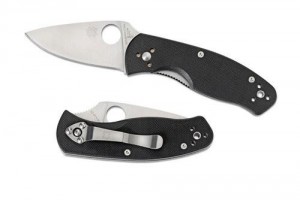
Consider the Spyderco Persistence—a small knife that cuts like a bigger one.
The Spyderco Persistence is a small knife that cuts like a bigger one and gets the once-over in our “Cutting Critique.”

The Spyderco Persistence is one of those compact cutting knives you may or may not like—depending on your tastes in general and how the knife fits your hand.

I have a medium-size hand and if I hold the handle in the standard grip, half of my little finger overlaps the butt. That’s bordering on too small for me.

However, for detail or draw cuts where I place my finger atop the blade spine, the fit is just about perfect. The 2.75-inch blade is 1.25 inches at its widest and tapers quickly to the point. Under 3 inches in blade length is a good thing in terms of many legal length limits. (Be sure to check your local and other pertinent knife laws.)

The G-10 handle material is good and solid and provides a nice abrasive-type feel for sure gripping for most any type of cutting.

The clip is reversible for tip up or tip down right-hand carry.

The plain-edge blade of 8Cr13MoV stainless steel out of the box is razor sharp and is a cutting moose. I like the blade shape, which is along the lines of the Spyderco Caly I carry on a regular basis.

The Michael Walker LinerLock@ is nice and tight and has a good spring to it that makes you work just a bit—though not too much—to push it open. I like that because it reinforces the notion that the lock will not disengage easily—always a good thing.

The Persistence is one of Spyderco’s knives made in China, and as many industry observers are noting, the Chinese are getting better and better at making knives—and the Persistence is an excellent example of this improvement.

At 4 ounces the Persistence may seem a bit heavy to some for a knife of its size (4.125-inch closed length), but not me. I like the overall weight and feel. It’s a small knife that cuts like a bigger one.

For more info on how to get your Persistence, click on www.shopblade.com/persistence-black-g-10-plainedge-w8476?lid=ssfbbl070313

DMT Brings You: Two Ways to Sharpen Your Hunting Knife

As every hunter knows, a hunting knife needs proper care, and there are countless methods for sharpening a hunting blade, depending on how the knife is used in the field or on the trail. The experts at Diamond Machining Technology (DMT) have composed a “how to” article below to help knife users understand which sharpening techniques are best for different hunting-knife tasks. If you enjoy the below, you’re also certain to like: “Sharpen a Knife & Care For Your Collection.”

Two Ways to Sharpen Your Hunting Knife

By Stan Watson

The hunting knife, whether the folding or fixed-blade type, is an invaluable tool for hunters since its hard, strong steel blade is made for cleaning and butchering game. But, truth be told, many outdoorsmen like to carry a hunting knife as an all-purpose cutting tool. So, when you think about the best way to sharpen your hunting knife, first think about how it will be used.

If you plan on using the blade for gutting and field dressing animals, you need a razor sharp blade. The hide of an animal is tough and you want your knife to make easy, smooth cuts through the skin and muscle. To get that result you want to sharpen at a shallower angle.

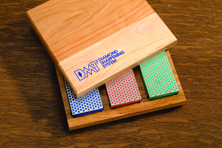
I always recommend manual sharpening on a diamond stone, because it removes only the necessary amount of metal—protecting your knife and prolonging its life. With diamond stones from DMT Diamond Machining Technology, you never need oil. If you want to moisten the stone, you can use water, but it’s not necessary. Start with a coarse grit diamond stone and, holding the knife so the blade meets the stone at a 20- to 22-degree angle, stroke the blade with modest pressure across the stone six or eight times; then change direction (if you began by stroking away from you, switch and carefully stroke the blade towards you using the same motion). Diamond stones sharpen blades quickly, so there’s no need to rush your strokes. Take the time to handle your blades and edges in a safe manner.

Once you’ve finished with the coarse grit, move on to a fine grit and repeat the process. Then, to get the razor edge you need, give the blade a few strokes along an extra-fine grit. Remember, the finer the grit, the lighter your strokes should be. The result will be a blade that has a straight, true sharp edge for cleaner cutting and dressing.

For those of you who like the feel and performance of a hunting knife, but want to use it as an all-purpose cutter, you don’t need the razor sharpness that comes with an extra-fine grit stone and a shallow sharpening angle. It’s better to have a micro-serration on the blade.

To get that result, use just a coarse grit diamond stone and hold the knife so the blade is at a steeper angle, about 24 to 28 degrees. This will give your blade greater strength to stand up to tough cutting tasks. A surface with tiny serrations allows the blade to work in a sawing motion—unlike the straight razor-sharp cuts you need when gutting a deer, for example.

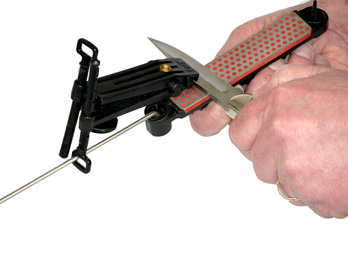
Whether you’re a pro or novice hunter, it can be hard to maintain a precise and consistent angle throughout the sharpening process. One solution is DMT’s Aligner Blade Clamp, which provides for guided sharpening to help you set and keep the correct angle for the task at hand. The Aligner is easy to use, offers seven-angle adjustability and accommodates wider and thicker blades. Plus, the clamp won’t damage your blades.

A well-made hunting knife can last for years, especially if you keep it sharp. With diamond sharpening stones from DMT, you will be able to quickly, simply and safely get the edge that keeps your knife working to its fullest potential.

Stan Watson is the technical director for Diamond Machining Technology, manufacturer of a full line of Made in the USA diamond sharpening tools for use in woodworking, camping, fishing, hunting, outdoor and winter sports, culinary arts, gardening, police/security and industrial applications. He is the holder of 11 engineering patents in the sharpening industry. He can be reached at [email protected].

If you enjoyed the above, you’re also certain to appreciate: “Sharpen a Knife & Care For Your Collection.”

Custom Knife Ambassador Lobred Passes Away

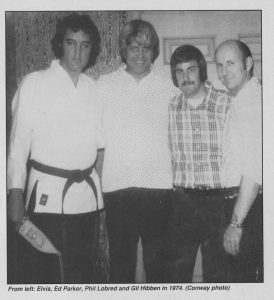
Elvis, Lobred and Hibben.
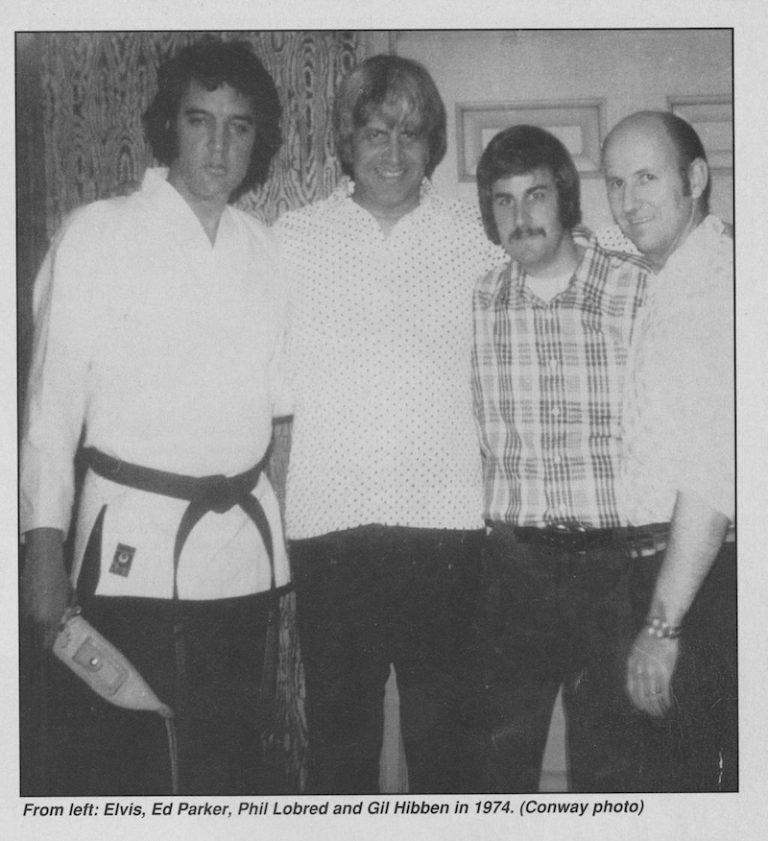
Custom knife ambassador Phil Lobred joined Gil Hibben in a special audience with Elvis Presley and Kenpo martial artist Ed Parker in 1974. From left: Presley, Parker, Lobred and Hibben. (Conway image)

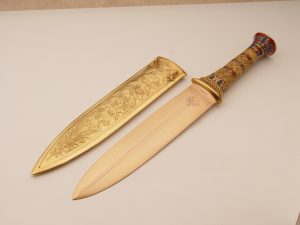
Custom knife ambassador Philip Carl “Phil” Lobred, the man who commissioned the reproduction of the King Tut Dagger by Buster Warenski and along with Gil Hibben enjoyed a special audience with Elvis Presley, passed away Dec. 14 after a long illness. He was 72.

Lobred was one of the first big-time collectors of custom knives. He began collecting them in 1968 and befriended many of the legendary custom knifemakers of the day, including BLADE Magazine Cutlery Hall-Of-Fame© members Gil Hibben, Bob Loveless, Buster Warenski and Bill Moran, and also such preeminent makers as Jim Schmidt, Ted Dowell, Herman Schneider and many others.

Hibben and Lobred were especially close. Lobred lived in Alaska in the early 1970s and Hibben moved to Anchorage and made knives out of Lobred’s garage. In 1974, Lobred accompanied Hibben on a private audience with Elvis Presley (see “The Elvis Knife,” July 1997 BLADE®). A member of the Martial Arts Hall Of Fame as well, Hibben knew Ed Parker, the renowned Kenpo martial arts instructor, who also had been one of Presley’s bodyguards. Hibben had made a Kenpo knife in which The King expressed interest, so Parker arranged a meeting for Hibben to present one of the knives to Presley. Lobred was invited along.

“I had the privilege to have Phil Lobred in my life, not only as a friend but as a brother for the past 47 years,” Hibben noted. “He was the closest friend I have ever had and I truly loved him. We shared a

King Tut Lobred commission
Phil Lobred commissioned the most iconic custom knife of all time, the reproduction of the King Tut Dagger by BLADE Magazine Cutlery Hall-Of-Fame© member Buster Warenski. (SharpByCoop image)
custom knife ambassador Lobred
Custom knives had no finer ambassador than Phil Lobred. (PointSeven image)

history that few others will ever know and my memories with Phil will live on forever in my heart. His loss is devastating, not only to his family and close friends but to the many, many hearts he touched in the knife community and around the world. ‘Here’s to you P.Q., we had a great time together.'” “P.Q.” is Hibben’s nickname for Lobred and stands for “Pretty Quick.”

One of Lobred’s crowning achievements is the biennial Art Knife Invitational. The AKI assembles 25 of the world’s finest knifemakers in a special show in which high-dollar collectors are invited and enter their names in drawings to buy the knives of their choice. It was the first successful biennial knife show and at least two other shows—the Solvang Custom Knife Show and California Custom Knife Show—are biennial shows today. As of this writing, this year’s AKI is scheduled for Oct. 28 at the Sheraton Hotel San Diego Bayside Tower. Exactly how Phil’s passing will affect the show’s status is unknown at this time.

Through it all, the thing Lobred probably will be remembered for most is his commissioning of the reproduction by Warenski of the King Tut dagger in 1982. It took Warenski five years to complete the knife, which included 33 ounces of gold, an ancient technique known as granulation for the handle and much more. When the knife was exhibited at the 1987 Knifemakers’ Guild Show it was a sensation, and served as the cover knife for the February 1988 BLADE. The knife has since been valued at $1 million.

Funeral arrangements are under the direction of El Camino Memorial-Sorrento Valley, San Diego, California. Service information is unavailable at this time.

Save

Save

Save

Save

Save

Save

Save

Save

Save

How to Sharpen a Knife

It doesn’t matter if you’re a hunter, outdoorsman, knife enthusiast, collector or even an experienced survivalist or do-it-yourselfer, learning the basics of knife sharpening often takes a backseat to more pressing matters. It’s a question on everyone’s mind—What’s the fastest, easiest way for me to sharpen a knife, and what’s the best sharpener on the market? Unfortunately, there’s no one right answer, but through researched and developed, step-by-step articles on knife sharpening, we’ve made it easy for anyone to learn the basics, and even some of the more involved methods of honing blades.V8724

The “Sharpen A Knife & Care For A Collection” digital download is an easy-to-navigate, read and enjoy eBook.  This digital guide is a PDF file you download and access with any home computer, lap top or digital device with the Adobe Reader program installed. In this guide you’ll find 11 chapters covering various facets of knife care and sharpening, written by noted knife industry experts, including Dexter Ewing, Durwood Hollis and James Morgan Ayres.

Here’s an excerpt:

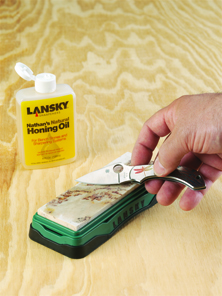
It’s one of the oldest methods of honing a blade bevel, the most traditional, conjuring up images of ancestors, grandparents, even Japanese bladesmiths working edges on whetstones or oilstones, fingers blackened from the grit. Stone remains a popular sharpening medium. It might not be the Stone Age, but you would hardly know it by perusing the rock-hard offerings of knife or knife sharpener and accessory companies.Sharpener01

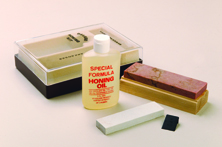
Unlike traditional stones bought for pennies apiece at the old hardware store, the Smith’s 2-Stone Sharpening Kit (www.smithsproducts.com) comes with a 5-inch, medium-grit stone, a 4-inch fine Arkansas stone, honing solution and a sharpening guide. The medium-grit stone, meant for quickly setting an edge, comes mounted on a molded-plastic base that features a built-in storage area at the bottom for holding the fine Arkansas stone, the latter of which is ideal for finishing or polishing an edge. The manufacturer’s suggested retail price (MSRP): $15.99.

“It is everything you need to put a razor-sharp edge on your large or small knives and tools,” Richard Smith says. “The neat thing about this kit is that, although you get two stones, they only take up the space of one bench-mounted stone. I never lose the fine stone because it’s always stored in the base, and it allows me to take the fine stone into the field with me if needed.”DMT-W6EFC

Click here for more, and enjoy!


Advertisement

Must Read Articles

Read this before you make a knife

Knifemaking 101 – Read This Before You Make a Knife

  by Wayne Goddard My experience has taught me that there's nothing like digging in and getting started. I've often said the hardest part of the...
how to forge damascus steel

How to Forge Damascus

Advertisement
Advertisement