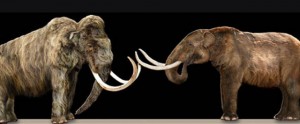
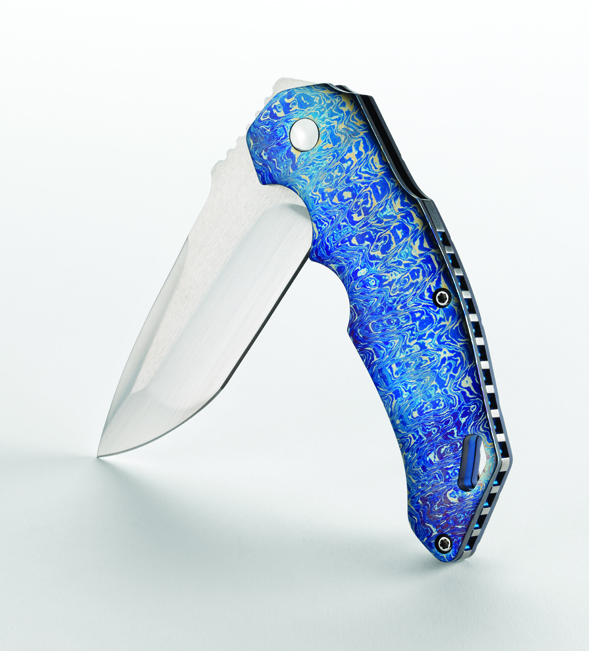
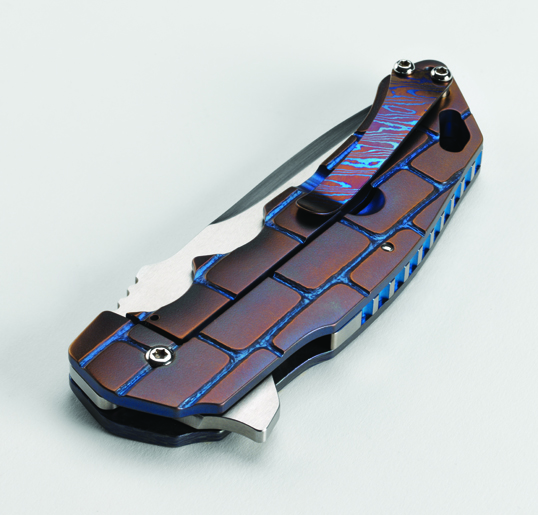
Fossil ivory could be banned with elephant ivory if federal and state governments are not stopped. Don Hanson uses fossil ivory on his folder.
Fossil ivory may well be on the way to being banned with elephant ivory if federal and state governments are not checked.
At least that’s the opinion of one informed source who wishes to remain unnamed, blademag.com has learned.
Ivory from the long-extinct mammoth and mastodon may be banned along with elephant ivory simply because many inspectors won’t be able to differentiate between elephant and ancient ivory.
As reported in blademag.com on July 29, proposed changes to the federal ivory laws are finally out and are designed to stop all trade in elephant ivory in the USA, no matter how old the ivory is. The proposed laws do not mention fossil or ancient ivory such as that of the long-extinct mammoth and mastodon. However, the concern is that the Fish and Wildlife Service (FWS) officials who would be charged with inspecting elephant ivory to determine its legality would have no problem with fossil ivory IF they can differentiate it from elephant ivory.
“The way I see it,” the source stated, whether the inspectors can differentiate between elephant and fossil ivory “will depend on [the inspectors’] training, or lack thereof, and level of enthusiasm.”
Meanwhile, it is the state legislatures that the source is most worried about.
“In all the states that have had [ivory] bills introduced, mammoth, fossil walrus and all forms of ivory are included [because, the state legislators say] ‘it’s so hard to tell the difference,'” the source noted. “Now, we’ve defeated almost every applicable bill that’s been introduced so far, but these guys are not going to roll over and play dead.”
For more information on how to protect your right to own and sell mammoth and other fossil ivories, and how to defeat the proposed changes to federal ivory laws that are designed to stop all U.S. trade in elephant ivory, visit elephantprotection.org.
Keep your hunting knife sharp and ready to perform in the field with two great sharpeners and a sharpening eBook from ShopBlade.
One of the more unusual and ingenious sharpeners is the Spyderco Duckfoot diamond sharpening system. Sporting various shapes for sharpening different edges, the Duckfoot includes:
•A 1”x 5” flat diamond stone;
•A surface with a large radius for sharpening plain edges and a small radius for serrations;
•Three grooves, including a wide radius channel for de-burring and a narrow radius channel for honing fish hooks, etc.;
•Includes a suede leather carry case and an instructional DVD.
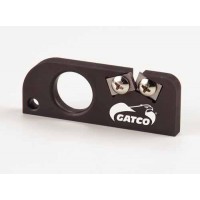
A great pocket sharpener for field touch-ups of plain-edge blades is GATCO’s Military Compact Sharpener (MCS). All it takes is a few strokes on the compact sharpener’s replaceable tungsten carbide blades set for a 40-degree angle and your knife is ready to cut. Size: 2.75” x 1.06” x .30”. Weight: 1.5 ounces.
The Road to San Antonio One Knifemaker’s Quest to Obtain ABS Journeyman Certification by Lydia McGhee
Sunday, July 24, 2011 Powerful whacks resonate from the metal shop behind the house – repetitive machine-like poundings followed by a pause, then softer whacks, less consistent, more human. Suddenly, the hammering stops. Inside the shop a powerful man stands a few feet from a roaring gas forge. Flames flicker out of a small opening in the front, and one end of a long metal bar soaks in the fire. The man holds the cool end gently in his hand and watches intently as the far end, which looks like a knife, begins to glow. Completely indifferent to the bead of sweat that trickles down his nose and splashes on the concrete floor, E. Scott McGhee’s motionless posture contradicts the sweaty shirt and dirty mule-skin apron that hug his body. . . but he isn’t still for long. As the knife blazes orange, he pulls the bar from the fire and the pounding begins anew.
E. Scott McGhee is a bladesmith. He forges knives and other edged tools from high carbon steels. It is a primitive art born in antiquity and nearly lost in this country during the 20th century. Expert bladesmiths craft knives born of fire and artisan vision, beautiful beyond imagination, and functional beyond belief.
In the mid-1970’s, the art of the forged blade was dying. At that time, factory produced knives dominated the market and only a few bladesmiths and their loyal customers understood what was being lost. According to the American Bladesmith Society (ABS), only 12 American artisans publicly practiced traditional bladesmithing in 1976 when four devotees created the ABS to preserve the art. Bill Moran, one of the founding members, hoped to double the number of active bladesmiths, and he wasn’t disappointed. There are currently 1,100 ABS members, 160 ABS journeyman, and 115 ABS masters worldwide.
E. Scott McGhee is an ABS apprentice on a quest to become a journeyman. He played at a coal forge on and off for over 30 years making historic kitchen implements, but only recently built a gas forge, joined the ABS, and began bladesmithing. He would like to forge blades full-time.
But why forge when you can simply grind?
According to E. Scott McGhee, “I forge because it allows me to be creative. While those who grind are limited by the shape of the stock, those of us who forge are not. Forging allows me to craft designs that flow for beauty as well as function.”
The American Bladesmith Society sponsors classes, hammer-ins, and shows to promote the art of the forged blade, and they certify journeyman and master bladesmiths. The process is intense. Journeyman candidates must be ABS members for three years (two years if they take an ABS class), pass a rigorous performance test, and survive a brutal peer review.
Scott passed his JS Performance Test in January of this year, but it wasn’t easy. Bladesmithing is more than just pounding metal into the shape of a knife. ABS-certified smiths heat-treat in house to produce products far superior to mass produced blades.
According to Scott, “Proper heat treating allows me to turn a piece of art that looks like a knife into a high performance blade.”
JS Performance Test knives must 1) Cut through a free-hanging 1-inch manila rope in a single pass 2) Chop through a 2×4 twice without dulling and 3) Bend to 90 degrees without breaking.Every Journeyman Performance knife is destroyed during testing, as are some dreams. Not everyone passes, but all who do say the performance test is the easy part.
The peer review is tougher. Twice a year at either the Blade Show in Atlanta or the Forged Knife Expo in San Antonio, journeyman candidates may present five knives to a panel of seven ABS masters. This year 17 candidates tested at Blade and 13 passed.
According to Haley DesRosiers, a new JS, “At 8am the door is locked and the judging begins. Then, after what feels like 6 or 7 years, they begin to call you in one by one. It’s like being on death row.”
If you fail, you can test again in a year. If you fail three times, the dream dies.
Masters are tough in the judging room but generous elsewhere. All ABS-certified smiths are expected to share knowledge and masters are expected to teach as preserving the art is the goal. Scott is apprenticing with ABS Master Jason Knight, but frequently communicates with other ABS-certified smiths and has been amazed by how generous all have been.
“I wouldn’t be where I am without them,” says Scott, “I stand on the shoulders of giants.”
At the Blade Show in June, ABS Master Adam DesRosiers said it best, “It’s a great time to be a bladesmith. If it were twenty years ago, we’d all be alone at our coal forges reinventing the wheel every time.”
Thanks to the American Bladesmith Society, that’s no longer true.
They are an eccentric lot, the ABS bladesmiths. All love knives, most love guns, and many are good ole’ boys and gals, but all are metallurgists and artists at heart and shouldn’t be mistaken for anything else. They are kind, knowledgeable, and generous – a good group to have on your side.
Hot knives, cool people – this is the community E. Scott McGhee is quickly making his own. Watch for him. He is fiercely passionate about forging and his peers recently named him an up-and-coming bladesmith.
Scott will present five knives at the Forged Blade Expo in San Antonio in January of 2012 and hopefully come home with a JS stamp.
Stamp or no, the art of the forged blade will be preserved.
NOTE: Lydia McGhee produced this multimedia project for a Gonzaga University graduate class in communications. Lydia chose to focus the project on her husband E. Scott McGhee and his quest to become an ABS Journeyman Smith. As part of the project Lydia produced video clips that include interviews with Haley and Adam DesRosiers, Shelly and Jason Knight, Kevin and Cheryl Evans, and herself about the ABS Journeyman Smith testing process. This multimedia project is very well done and I know that it will give some insight into the process from several different member perspectives.
Great job Lydia and all the best to Scott in San Antonio
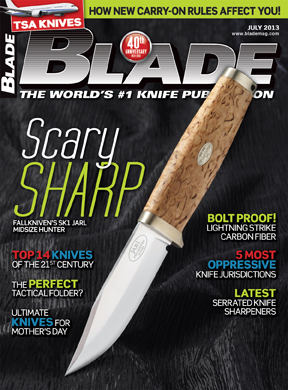
Fallkniven’s SK1 Jarl midsize hunter is the cover knife for the new BLADE®, on most newsstands NOW!
What are the top 14 custom knives of the 21st century? What features make a perfect tactical folder? Do you know why lightning strike carbon fiber got its name and why it’s in such demand among custom and factory knifemakers? What are the five most oppressive knife jurisdictions? What are the ultimate knives for Mother’s Day? Get the answers to these questions and much more in the latest issue of BLADE.
While the TSA announced yesterday that it will delay its new policy allowing passengers to carry small pocketknives and multi-tools on board commercial airliners, there was much that went into the creation of the original policy. Find out what happened behind the scenes, which knives qualified for the new policy and which ones didn’t, what industry leaders have to say about the new policy and much more in the new BLADE.
In other stories, find out how the cover knife performs in retired 5th Special Forces Master Sergeant Kim Breed’s “Spec Sheet” knife test; let Dexter Ewing show you how the latest serrated knife sharpeners do their duty; read Ed Fowler’s conclusion to his multi-part how-to on sheep horn handles; check out ABS master smith Rick Dunkerley’s Bear Tracks in “Cool Custom”; read part two of Wayne Goddard’s “Question & Answer” on the material that’s the most difficult to use for knife handles; enjoy mini-profiles of J.D. Smith, Tobbe Lundstrom, Glen Mikolajczyk, Libor Tobolak, Ronald Blystone and Tim Steingass in “Knifemaker Showcase”; and get up-to-date on the latest knives and knife accessories, knife show dates and much more in the latest BLADE.
Never having made a knife with over six blades, even multi-blade maestro Gene Shadley was challenged to reproduce a 19th-century sportsman’s knife based on a 10-blader made by Christopher Johnson & Co. of Sheffield, England.
Engraver Simon Lytton provided the old catalog Shadley selected the pattern from, which Shadley made larger than the original (5 7/8 vs. 3 5/8 inches closed). The knife required a locking master blade and a lockbar—neither were on the original—as per customer order. Hence, Shadley had to redesign the knife from the ground up, making nine blades work in slip-joint fashion along with having to figure out how to make the master blade work as a lockback.
The band in mid-handle, another first for Shadley, was also by customer request. Shadley had to make new rear bolsters to accept the tweezers and ivory toothpick. Even the file is different than anything he had done, requiring a knurling tool for the double grooves. The customer wanted no blade wobble, so Shadley made the lockback work with minimal tension, and installed bushings for all the blades to control the amount of play in each.
Shadley said he had orders for two more 10-bladers and planned on making a large exhibition knife with probably somewhere between 12-to-15 blades that he hoped to display at the Solvang Custom Knife Show April 28, 2012.
For more information contact Gene Shadley, 209 NW 17th St., Grand Rapids, MN 55744 218-244-8628 or 218-999-7197 [email protected].
Gene Shadley took the 10-blader without the sambar stag scales (top) to the 2010 New York Custom Knife Show “to show it off” and for photography, then took the completed version to the ’10 Guild Show, where Point Seven photographed it in a multiple exposure with the scale-less image (you can see the lockbar on the spine of the scale-less version). Blade steel: ATS-34 stainless. His list price for a similar piece: $10,000. (Point Seven photo)
Identifying the hottest custom knifemakers’ hottest knives for you is somethingBLADE® takes pride in doing. And one of the best ways we have found of doing it is to tap the knowledge of those who must do it well because it is their livelihood—custom knife purveyors. So, in the April 2013 issue of BLADE (on newsstands as of Jan. 29), we tapped into that knowledge.
Here’s part of the story from the April 2013 issue:
At Knifeart.com in Little Rock, Arkansas, Larry Connelley has his eye on Maciej Szczerbiak and Crusader Forge. A custom knifemaker since 1996, Szczerbiak is based in St. George, Utah. “His FIFP [Fear Is For Prey] is an overbuilt tactical folder,” Connelley said, “and is stoutly made with a thick titanium handle and Integral lock. The blade is CPM S30V stainless and prices start at around $900.”
The purveyor indicated Brian Tighe is another favorite among Knifeart.com customers, and the Nirk Tighe, designed in collaboration with Glenn Klecker, features Klecker’s Nirk locking mechanism that allows the lockback to function as an integrated component of the handle. “These knives start at $525 with BG-42 steel blades and titanium handles, each of them 3-D machined,” Connelley observed. “Brian has several designs that involve collaborations, and each one of them is innovative. He can deliver them with precision.”
According to Connelley, the knife market is steady and recovering with the slow turnaround of a sluggish overall economy. To read the rest of the story, pick up the April 2013 issue of BLADE off the newsstand, or click here.
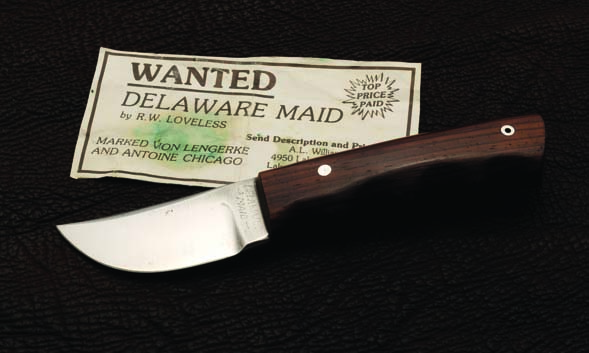
If you’re a fan of Bob Loveless knife designs, you likely have a soft spot for at least one of the Delaware Maids … no, not the logo, although that etched “Delaware Maid” is part of it … but perhaps a hunter such as the below. From 1954 to 1960 Loveless made over one thousand knives called “Delaware Maids” and they became Abercrombie & Fitch’s best-selling handmade items, outselling the Randall blades.
An ultra-rare (only three of seven survive) Loveless “Delaware Maid” hunter with the VL&A (Von Lengerke and Antoine) logo, the knife has a trailing-point blade and a slender double-pinned hardwood handle. The photo is by Hiro Soga, and the knife comes from the John Denton collection. It appeared on pages 114 and 115 of the book Knifemaking With Bob Loveless.