

The BLADE Blogs

The blogs of the BLADE editors, Steve Shackleford and Erin Healy.

Survivalist Creek’s Life Led Naturally to Whiskey Knives

All Whiskey Knives come with multiple sheaths that configure to however you like to carry, or you can upgrade to what you see here.
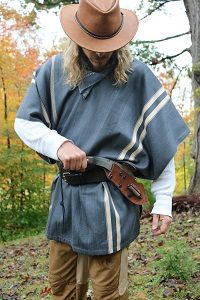
Survival instructor, author and TV star Creek Stewart cross-carries a Whiskey Knives Corvid.

When Matthew Stewart was 5, his grandfather gave him a nickname that would chart the course of his life. “I was always playing in the creek,” said Creek Stewart, survival instructor, author and star of The Weather Channel’s now-cancelled “Fat Guys In The Woods.” No matter the time or weather, the boy was at the creek—happy. Not much has changed, except the budding outdoorsman of yore has now built an empire on his comfortable, family-friendly style of survival instruction. All things Creek also includes the soundly crafted, old-timey line of Whiskey Knives, which in addition to being ideally designed for bushcraft and easy on the wallet, also offers some scaled-down versions of classic styles that hands of all sizes can control. You can read all about Whiskey Knives and how they are made in an upcoming issue of BLADE magazine. If you’re not a subscriber, sign up so you don’t miss it.

Creek is “everywhere” and there are good reasons for that, not least being that he is genuinely warm and friendly. “I like working with people,” he said. Creek was a Boy Scout and an Eagle Scout. The first E in the CRE///K logo is representative of a scratch from an eagle’s talons. He continues to be a devotee of the Boy Scouts of America and a counselor for the Wilderness Survival merit badge. He lives the Be Prepared Boy Scout motto, and opted for Not If But When as his own tagline. Yes, scouts are being taught all kinds of skills, explained Creek, “but they’re also building character and learning life lessons.” He listed perseverance, teamwork, manners, camaraderie—all things the Boy Scouts instilled in him.

At Butler University in Indianapolis, Creek first perused a pharmacy major, but the misdirection, the urban setting and a campus crow that thought it was an alarm clock brought him to an awakening. You can read about his adventures trying to snare the bird on his website at The Crow, but in summary, the crow reawakened Creek’s inner woodsman. He decided he wanted to teach wilderness survival skills and set about making it happen.

He settled on a business major, a plan that would serve him well. During his sophomore year, he wrote and illustrated a wilderness survival field manual that collected his knowledge at the time. He had the book printed and spiral-bound, and offered free classes at Boy Scout troops to peddle it. He sold books, but he longed for a way to bring his customers to him rather than traveling to them. He asked his parents if he could teach a class in the woods on the family farm. Although still unnerved by his switch in major, they agreed. He sent out press releases and 15 people showed up. He’s been teaching ever since, part-time for many years but never quitting on his dream.

Creek’s business schooling helped him hone his marketing strategy. His many brands include, in addition to Whiskey Knives, Willow Haven Outdoor Survival School where he teaches one-day and weekend getaway survival courses on his 20-acre property, complete with lodge, in Anderson, Indiana. He also is lead instructor for the Escape The Woods challenge, which takes place at various locales around the country. The Not If But When Survival Store, which his parents now run, offers a collection of widely available survival items. And, Apocabox is a bimonthly subscription; six times a year members receive a box of survival tools and gear, hand-picked by Creek. It also includes a challenge that you can practice in the calm and comfort of a non-crisis. For instance, the December box included instructions on making snowshoes from your Christmas tree.

Creek’s overview of Whiskey Knives includes a revelation: his first knife.

Creek also saw that writing was going to be essential to reaching the right people—namely men and women of all ages and abilities. (While other survival instructors might emphasize immersing you in a survival scenario while you’re still learning, Creek feels that people absorb more and retain it longer, if they’re warm, dry and fed.)

His best-selling book is “Build the Perfect Bug Out Bag,” but he offers one on putting together a bug-out vehicle, two on survival skills and an intriguing one on the survival skills used in “The Hunger Games.” But Creek has also written two fiction books. “Stuck” is a short story about a Boy Scout dropout who through a series of bad decisions finds himself in a crisis situation—quicksand!—that he can only survive by using what he learned in scouting. “Rugosa” is a young-adult romance, due out this month. The novel has been in the works for six years. “I’m really sticking my neck out on this one.” Creek is anxious to see if his fans “get” it. “I’m a survivalist, but I’m also a person,” Creek said. (Check back for an upcoming review.)

Some people learn about Creek via completely different avenues. They may read some of his guest posts on The Art of Manliness blog and other websites. “I’ve known Brett (McKay, founder of AoM) a long time. I’m so proud to be a part of that,” Creek said. The Art of Manliness celebrates men stepping boldly into their roles as men, husbands and fathers, and includes articles on everything from health and style to relationships and how to survive in the wild. Creek has also been a guest on television shows such as TODAY, Inside Edition and Fox & Friends. He’s been featured in magazines like Men’s Fitness, Backpacker and Outdoor Life. And he was the star of The Weather Channel’s hit show, “Fat Guys in the Woods.”

When IBM purchased the digital portion of The Weather Channel in 2015, many programs were slashed, and “Fat Guys in the Woods” was just one of them. The show provided Creek with the ideal outlet for his wildlife survival instructing and was an inspiration to viewers who wanted to spend more time in the outdoors or jumpstart a healthier lifestyle. Three sedentary buddies would spend a week with Creek, learning survival basics. The last 24 hours would be spent alone, each man building his own shelter and fire. Creek would award one of them with a knife-sheath set. One would stand out as needing encouragement, or being there for the right reasons or excelling in a certain skill. “He gave it everything he got—a job well done,” as Creek put it.

That kit was an Ontario Knife Company’s Black Bird SK-5 wilderness survival knife with a sheath designed by Paul Scheiter of Hedgehog Leatherworks. It was the sheath that had Creek thinking about how to fine-tune the products he offered going forward. “I love my parents, and every day I get to spend with them (at Not If But When) is a blessing,” Creek said. He’s also happy to provide a place where people can find all the products he recommends in one place. But what he really likes is working with small American businesses that reflect simple, well-made, traditional craftsmanship. “I like things that have a story.”

That quest for mom-and-pop entrepreneurship and throwback workmanship with a story behind it, is what led to one of Creeks proudest collaborations: Whiskey Knives made by Reptile Toolworks in Kentucky. To read more about this partnership and exactly how Whiskey Knives are constructed, be sure to subscribe to subscribe to BLADE magazine.
bl1su-70Don’t Let Your BLADE Subscription Lapse

BLADE Magazine is all about the blade: what it’s made out of, how its made, to what specifications and even who makes it. Be sure to keep your issues coming as the months tick down to BLADE Show, June 2-4 in Atlanta, Georgia. At $21.98 you’ll save 70 percent off the newsstand rate. Other options include digital, Canadian print and International print subscriptions.
FORGE FAVORITES: Adam and Haley DesRosiers

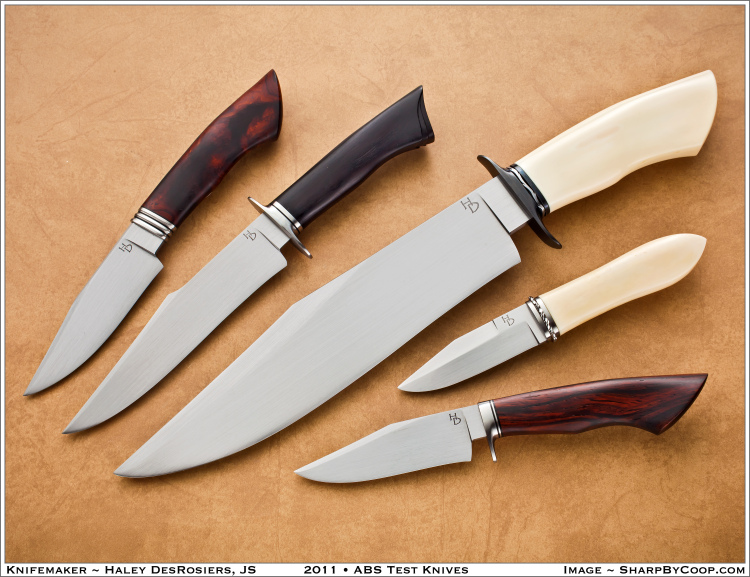
Haley DesRosiers’ five applicant knives for the rating of ABS journeyman smith include the one (center) judged best of all those submitted by JS applicants, thereby winning the 2011 George Peck Award. (SharpByCoop.com photo)


By B.R. Hughes, a founding member of the American Bladesmith Society, a member of the Blade Magazine Cutlery© and ABS Halls Of Fame, and BLADE® field editor


If you are old enough, you may recall a 1954 hit song written by Johnny Richards and Carolyn Leigh that went something like this:

    Fairy tales can come true, it can happen to you,

    If you’re young at heart …

    Don’t believe in fairy tales? After reading the storybook saga of Adam and Haley DesRosiers and the adventures they experienced at the 2011 BLADE Show, you just might alter your thinking.

    Let’s begin with Haley, a winsome lass born in Stika, Alaska, the daughter of a commercial fisherman and a mother who assisted in the family business. The future Mrs. DesRosiers spent many days on her dad’s fishing vessels working as a deckhand, and there were occasions when her boat was at sea for as long as several weeks.

    At 17 she developed an interest in knives, and, inspired by a video, decided to be a bladesmith. Her first forge was a hole in the ground, the air power supplied by an electric hair dryer via a pipe.

    As her skills improved, so did her smithy. One day she decided her beat-up anvil needed repairing. On an Internet knife discussion forum she learned her anvil could indeed be fixed, and ABS master smith Jason Knight e-mailed her about Adam DesRosiers, an Alaskan ABS journeyman smith who might be willing to help. In turn, Jason told Adam of the young Alaskan lady interested in bladesmithing. Adam promptly e-mailed Haley and offered his assistance.

    Setting up the initial meeting between the future husband and wife was not so simple. Both lived in remote areas, approachable only by air or sea, so they agreed to rendezvous at a folk festival in Juneau on April 8, 2008. While there, Adam took Haley’s anvil to the shop of ABS journeyman smith David Mirabile, where it was refurbished. Haley gave Adam some caribou antler and he presented her with a handmade gas forge. At the time, Haley was still using a hairdryer as a blower. Many communications between the two followed. A bit later, Haley’s father offered Adam a job as a deckhand for the balance of the season. He accepted and so, in reality, Adam and Haley’s first date consisted of six weeks of offshore fishing, both working as deckhands.

    Born in Anchorage in 1976, Adam is the son of a commercial fisherman and a nurse. After Adam was graduated from high school, he attended the University of Alaska, studying marine technology.  While there he worked at a local boatyard and, after college, joined the Merchant Marine, serving as a deckhand for three years.

    As for his first memory of making knives, at the ripe old age of 5 he took his mother’s butter knife and “improved it” in his father’s workshop, using the cement floor as a grinder. It must be noted that his mother was not impressed with the “improvements.”

    Adam’s first forge was a galvanized washtub, also featuring an electric hairdryer. In 2001 he attended the William F. Moran School of Bladesmithing in Washington, Arkansas, for the introduction to bladesmithing class, where his instructors were Kevin Cashen and Dickie Robinson. The same year he took a damascus class taught by John Fitch at the school. Adam returned the following year to take another damascus class, one taught by Steve Dunn. In 2006, Adam received his ABS journeyman smith rating. I was the head judge of the review panel that year, and Adam received not one negative vote from the panel.

    As Adam and Haley’s romance flourished, Haley took the introduction to bladesmithing class at Haywood College in Clyde, North Carolina. Adam joined her, deciding it would not hurt to take a refresher course. The instructors were Burt Foster and Jason Knight, the latter the man who initially introduced Adam and Haley. It was on the bank of Jason’s pond in South Carolina that Haley and Adam became engaged on April 12, 2009. 

    They were married Sept. 13, 2009. Haley was borne by a raft down an Alaskan creek to the ceremony. Using the anvil that had brought the bridge and groom together for the first time as an altar, the service was performed by Pastor Berry Byrd. ABS master smiths Knight and James Rodebaugh were among the groomsmen. Adam wore a sword for the ceremony, as did the groomsmen, and their swords provided the arch under which the happy couple departed. (For more, see Haley’s story “A Match Made in Handforged Heaven” in the October 2010 BLADE®.)

    Haley set up bladesmithing in Adam’s shop. There they made their first knife together, featuring a blade of 5160 carbon steel. Adam prefers to make camp knives and Haley likes hunters, which is certainly natural enough since she is a devoted outdoors enthusiast. When I inquired what type of game she most enjoyed hunting, she quickly replied, “Deer, duck, caribou, black bear and brown bear.”

    “Ever been charged by a bruin?” I asked.

    “Once.”

    “What happened?”

    “I dropped him with my .30-06.”

    Verily, a modern-day Diana!

    As the 2011 BLADE Show neared, the DesRosiers were extremely busy. Adam was preparing to test for ABS master smith, while Haley was getting ready for her quest for a JS stamp.

    “Did Adam do anything to help you get ready?” I asked. “Yes,” Haley smiled, “Among other things, he told me to quit playing with damascus!” For the ABS JS review, no damascus is permitted on any of the five applicant knives. Hence, she concentrated on knives featuring blades of 1084 and W2, her two favorite carbon steels.

    During the BLADE Show, each took his/her five review knives to two separate rooms in Atlanta’s Cobb Galleria Center, where judging panels awaited. In addition to passing or failing the applicants, the panels were also required to select the winners of the George Peck Award and the B.R. Hughes Award. The former is for the best knife submitted by a JS applicant, the latter for the single finest knife made by an MS applicant.

    A happy ending for this tale would have both Haley and Adam earning their respective ratings. They did—but there’s more. An incredible conclusion would have Haley winning the Peck Award and Adam receiving the Hughes Award—and they did! (See page 48, January BLADE.)

    If that is not a fairy tale come true, it will do until one comes along.


THE DESROSIERS’ FILE


Adam and Haley DesRosiers

POB EXI

Juneau, AK 99850

907-321-7258

www.alaskablades.com

Adam’s Specialties: Forged fixed blades, especially camp knives

Haley’s Specialties: Forged fixed blades, especially hunters

Adam’s Steels: W2, damascus in 1084 and 15n20

Haley’s Steels: W2 and 1084; damascus

Handles of Both: Natural materials, including the ancient ivories, assorted woods and others

Adam’s Honors: ABS master smith, winner of 2011 B.R. Hughes Award

Haley’s Honors: ABS journeyman smith, winner of 2011 George Peck Award

For more on the latest knives, knife legislation, knifemaking instruction, knife trends, knifemakers, what knives to buy and where and much more, subscribe to BLADE® Magazine, the World’s No. 1 Knife Publication. For subscription information click on http://www.shopblade.com/product/blade-magazine-one-year-subscripti…?r+ssfb040912#BL1SU.


Ohio Knife Show Starts Today

All Buckeye knife enthusiasts should point their wagons to Wilmington, Ohio, for a three-day knife show starting right now.


Click here for the full event details on the show’s Knife Showcase page.

Support Alaska’s “Knife Rights Bill”

In one of its latest e-mail newsletters, Knife Rights reports that Knife Rights Director of Legislative Affairs Todd Rathner testified at a hearing of the Alaska House Judiciary Committee on HB55 “Definitions of Gravity Knives and Switchblades” this past Wednesday. Referred to by sponsor Representative Mark Neuman as the “Knife Rights Bill,” the measure would clarify state law on the subject of assisted-opening and one-hand opening knives to ensure they are not considered gravity knives or switchblades, currently banned under Alaska statute. The bill was first introduced last year.

    According to the newsletter, Rep. Neuman introduced an amendment at Knife Rights’ request that was adopted into the bill to include Knife Law Preemption. Preemption means the state laws are applied throughout the state, regardless of where you are. With preemption, other political jurisdictions such as cities, towns and the like cannot pass laws regarding knives that are more restrictive than the state law. Preemption is the keystone to eliminating the patchwork of local knife laws that can trap the unwary citizen who cannot possibly know the particulars of the laws for each and every municipality. Preemption is the basis for further efforts to ease irrational knife restrictions altogether and is the cornerstone of Knife Rights’ efforts to protect Americans’ right to own and use knives.

    HB55 advanced out of committee with a unanimous vote.


    If you live, work or travel in Alaska, please contact your Representative and ask him or her to vote in support of HB55. For more information, click on http://www.legis.state.ak.us/basis/commbr_info.asp?session=27

    For more on Knife Rights, click on www.KnifeRights.org   

For more on the latest knives, knife legislation, knifemaking instruction, knife trends, knifemakers, what knives to buy and where and much more, subscribe to BLADE® Magazine, the World’s No. 1 Knife Publication. For subscription information click on http://www.shopblade.com/product/blade-magazine-one-year-subscripti…?r+ssfb022012#BL1SU

Ask BLADE®: Japanese-Style Heat Treatment

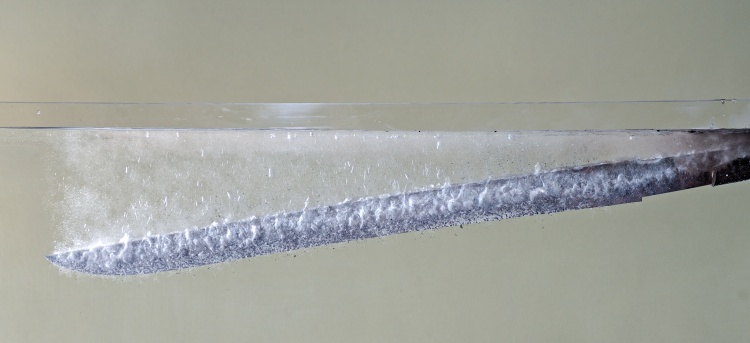
A tanto is plunged into the water during the hadaka-yaki process—yaki-ire, or heat treating, with no clay coating on the blade. (Yoshikazu Yoshihara photo)

Reader questions BLADE® story description of Japanese-style heat treatment

By BLADE staff


    Question: Regarding part three of the “HAMON!” series, page 46, in the November BLADE®: Bladesmithing articles written by observation sometimes lack accuracy. To heat treat tool steel you anneal first, then harden and then temper to change hardness into toughness. That temperature is usually 400°F to 435°F and it is called tempering for about 30 minutes.—Bob Rupert, Pittsburgh, Pennsylvania


    Answer: The author of the series, Leon Kapp, was kind enough to provide the following comments on Mr. Rupert’s letter:

    I described the process exactly as Yoshindo Yoshihara and other swordsmiths in Japan do it (and as I have done it myself). The process is at least 1,200 to 1,400 years old in Japan. It was developed and used for tamahagane—a raw steel made of Japanese iron-bearing sand that requires extensive refinement—and works beautifully for that steel. However, I think a main difference between tamahagane and modern steels is that tamahagane contains only small traces of anything except iron and carbon. Manganese or other elements in the steel might require changes in this process. If done right, the Japanese process hardens the blade all the way through the hamon, and not just near the surface.

    In fact, since all my experience is with Yoshindo and Japanese swords, I am very surprised and do not understand the technical reasons for the complex hardening methods I read about in BLADE or hear about from modern U.S. makers. It appears that Japanese-style yaki-ire (heat treatment) is a relatively simple process, but it does take years of experience to get it right.

    After yaki-ire, the blade is annealed by heating it in the forge, again as described in the story (that is, yaki-modoshi). If that is not done, the blade will be very brittle and even very difficult to polish.

    I think this is a reasonable answer to Mr. Rupert: The article is a detailed description of the process exactly as used in Japanese swords. The process and the steel are both very old and traditional in Japan, and it is done exactly as described—but the yaki-ire process was developed specifically for tamahagane steel.
Anthony Dicristofano (page 12, September BLADE®) has experimented with yaki-ire (Japanese style) for both tamahagane steels and for modern knife steels and told me he can see the differences. (Anthony works with Yoshindo in our backyard forge often during Yoshindo’s visits.) I think an important point to take from this is there are many ways to obtain great results with variations in materials and techniques.

    Oh, and one more point: There is another goal in Japanese and Western hardening. The Japanese method is designed to specifically harden only the edge region. As far as I know, the Western approach usually seems designed to harden or heat treat the entire blade. If yaki-ire were used to harden the entire blade, Yoshindo says the thin Japanese blades would crack or shatter immediately in use.

    Question: How much forging is enough? Is there a point of no return, or even a negative return? I typically start with 1-inch-diameter O1 drill rod for my knives, which I first must reduce to a flat piece of steel in the basic knife shape I want. This takes three-to-four heats to accomplish, and sometimes more depending on the size of the finished knife. Once the basic shape is attained, I then start working in the bevels.

    Is the reduction from 1-inch round to a quarter-inch flat going to give me all the benefits from forging that can be gained? Is the bevel forging simply gratuitous at that point? It occurs to me there must be a point in the process when additional heating and forging causes enough carbon loss to start degrading the steel rather than improving it. (Joshua States, a letter via e-mail)


    Answer (graciously provided by BLADE® field editor Ed Fowler): Starting with a 1-inch round bar should get you up into the 80-point rate of reduction range, depending on the size of the blade. This rate of reduction can definitely get you into the high-endurance performance realm, providing the steel you are using is of decent quality and you do not exceed a temperature of 1,725°F while forging. Forging at low temperatures equals fine grain and no measurable loss of carbon below the surface of the blade—about .002 inch, which is scale that comes off anyway. Forge the blades a little oversized and leave the edge of the blade about the thickness of a nickel for the heat treat (hardening and tempering).

    In our work at my Willow Bow Ranch, we have forged and tested to destruction many 5160 blades from 1-inch round bars (John Deere Load Control Shafts), and can get within 10 percent of the high performance of the blades forged from larger round bars.

    The more forging heats under 1,725°F, the better the performance potential of the steel. I take my bars to only 1,625°F to provide a margin of safety to prevent grain growth. Most of the benefits of forging will come from the round bar to quarter-inch flat bar. Merely forging the bevels only adds another two or three points if you are practicing reduction by forging. You are better off leaving the blades thick to protect the best edge, which will lay under the surface of the “as-forged blade.”

    When I start grinding, I take about the thickness of a dime off the edge of the hardened and tempered blade. The edge surface goes through a lot of thermal cycles and sometimes the best edge lies under the surface.

    As far as I know there is no “point of no return,” but the potential benefits between an 80-point rate of reduction and 99-point rate of reduction are not as significant as a difference between a 10-point rate of reduction and a 30-point rate of reduction. In other words, there is a decreasing rate of benefit, but always a benefit. Picture an ant crossing a table. The first trip he goes only halfway, second trip he goes half the remaining distance and the third trip he goes only half the remaining distance. How long will it take him to get to the end of the table?

    The answer is never. He will always be half the remaining distance to travel to the end, but the length of his trips becomes less each time.

     Send your question to “Ask BLADE,” c/o BLADE, 700 E. State St., Iola, WI 54990, or e-mail [email protected]. We will not print your name if you request it. If your question concerns the value of a knife, please understand it will be almost impossible for us to determine a value from a picture or e-mail image without being able to examine the knife from all angles in person.

    For more on the latest knives, knife legislation, knifemaking instruction, knife trends, knifemakers, what knives to buy and where and much more, subscribe to BLADE Magazine, the World’s No. 1 Knife Publication. For subscription information click on http://www.shopblade.com/product/blade-magazine-one-year-subscripti…?r+ssfb041912#BL1SU.


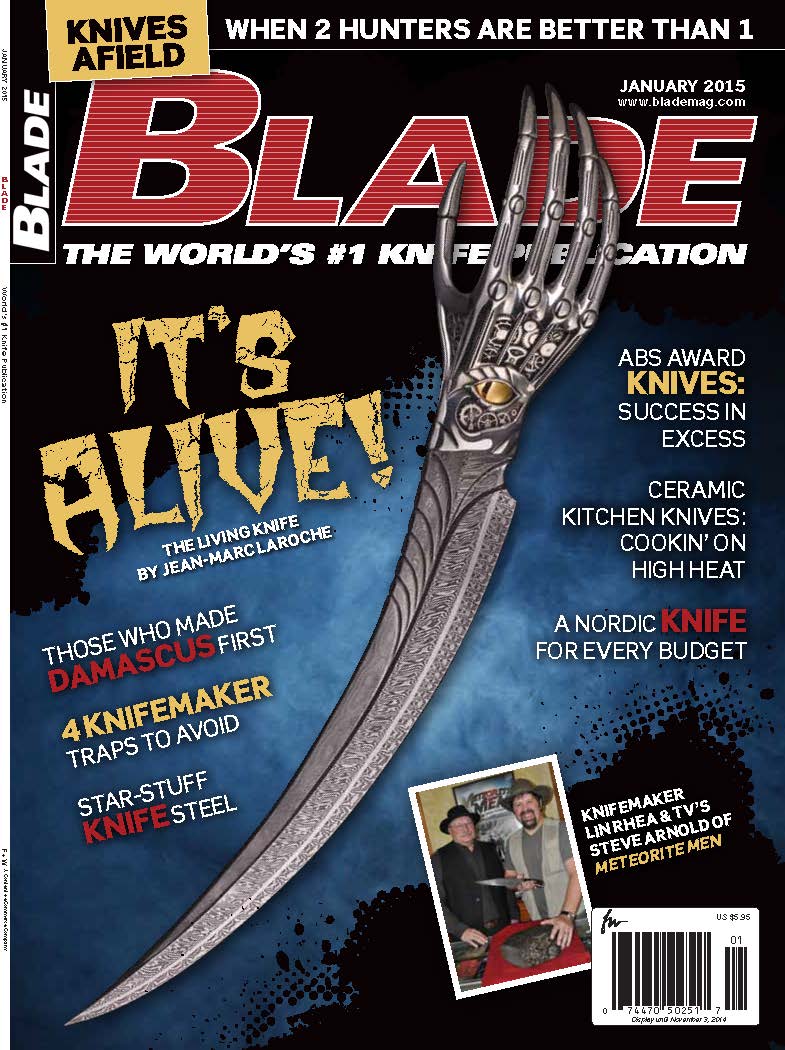
The Living Knife Highlights New BLADE®

On many newsstands today, new BLADE will literally grab you!
Living Knife by Jean-Marc Laroche highlights new issue of BLADE, on many newsstands today!

The Living Knife by Jean-Marc Laroche will literally grab you from the cover of the new BLADE®, on most newsstands today.

Featuring a damascus blade forged by Sweden’s Roger Bergh, the Living Knife includes a mechanical “hand” for a handle, the fingers of which will grasp your hand in return when you grip it! Find out more about this ingenious creation by Laroche, a French knifemaker and sculptor well known for his otherworldly approach to knives.

Speaking of out of this world, ABS master smith Lin Rhea visited Steve Arnold, one of the stars of the Discovery Channel’s “Meteorite Men” TV show, and obtained some meteorite material from Arnold for use in the damascus blade of a special bowie. Get the complete story on the meteorite material and its origin, how Lin made the knife and much more in this issue.

Speaking of damascus, it is one of the most fascinating materials for knife blades, among both knife neophytes and aficionados alike. How did this storied material first come about? How many different versions have there been? Get the inside scoop on this ancient material in the new BLADE.

The American Bladesmith Society traces its creation to the man who reintroduced damascus to the modern custom knife movement—Bill Moran. One of if not the largest organizations of knifemakers in the world, the ABS presented its annual best knife and bladesmith honors at the 2014 BLADE Show. See what those top knives and who those premier smiths are this issue.

Hunting season is in full swing and hunting knives are in hot demand. But is just one enough? Find out why two hunting knives are better than one in the new BLADE.

There’s much more, including a test of two automatics, the latest ceramic kitchen knives, a Nordic knife for every budget, the sharpest Christmas gifts anywhere, how Dan Keffeler won the BLADE Show World Championship Cutting Competition and much more in the January BLADE, on newsstands NOW!

SHOT Show: The Anniversary Edition

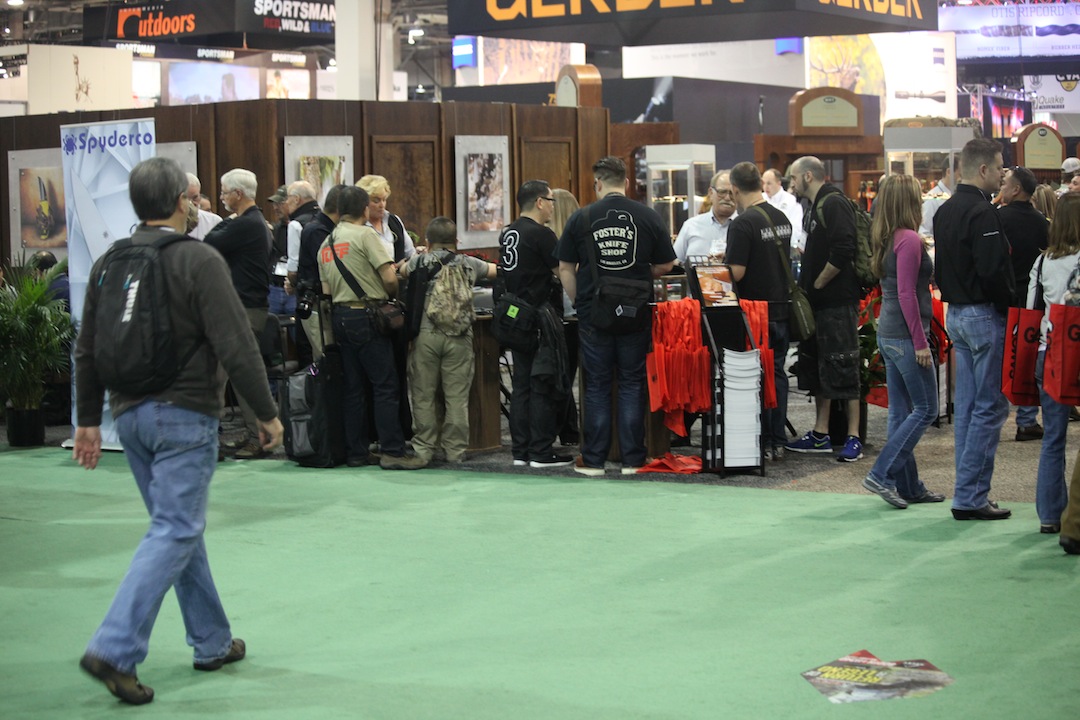
Knife retailers descended on the Spyderco booth during the 2014 SHOW Show.
The Spyderco booth was abuzz with activity during the 2014 SHOT Show.

The new knives, sharpeners and knife-related accessories for 2014 were the order of the week at the recent SHOT Show in Las Vegas.

It also was the scene of several companies announcing anniversaries in 2014, including: Boker (145th); Case and Ontario (125th); Gerber (75th); Buck’s 110 folding hunter (50th); Kershaw and Frost Cutlery (40th); Lansky (35th); Outdoor Edge (25th); Microtech and CRKT (20th); and Canal Street Cutlery (10th).

Knife companies from around the world descended on the Sands Convention Center Jan. 14-17 to display the latest in new models, materials, mechanisms and more. A sampling included:

•Celebrating its 125th anniversary, Case showcased a new Harley-Davidson line of knives, the latest Tony Bose factory-custom collaboration “teardrop” design and new Marine Corps knives;

•In addition to celebrating its 40th anniversary and welcoming Willie Robertson of TV’s Duck Dynasty fame (Willie was there to plug the upcoming Kershaw/Duck Dynasty knives and other new Kershaw/Duck Dynasty offerings), Kershaw introduced three new Ernest Emerson factory-custom collaborations and several of its new Black Wash handle models, including one designed by Rick Hinderer;

•Buck celebrated the 50th anniversary of the Buck 110 with a special golden anniversary 110 and introduced the new Strong Lock flipper;

•Queen showcased some new Schatt & Morgan designs and a Joe Kious factory-custom collaboration;

•On its 125th anniversary, Ontario debuted two new Dan Maragni designs: a bushcraft/survival knife with fire starter and a big machete, both sporting 5160 carbon blade steel;

•Lansky is celebrating its 35th anniversary and introduced a new line of Mikkel Willumsen folders;

•Victorinox touted its assimilation of Wenger and the former Wenger knives it will incorporate into the Victorinox line, including a number of the Eco models, as well as introducing a Carl Elsener damascus commemorative in a production run of 7,000 pieces;

•Gerber is observing its 75th anniversary with a renewed emphasis on domestic production, including three new folders in CPM S30V, CPM S35VN and 154CM stainless steels;

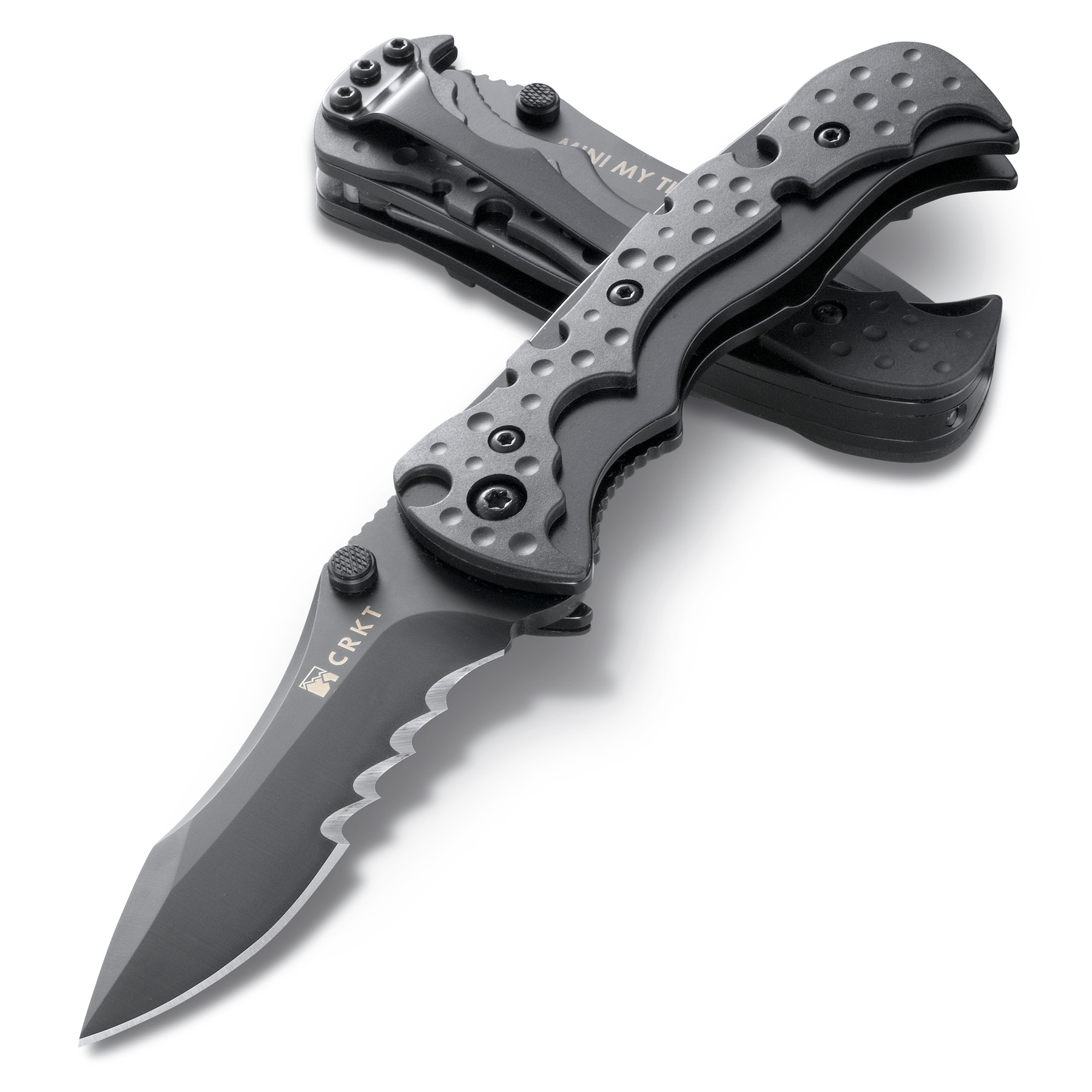
CRKT is celebrating its 20th anniversary and introduced factory-custom collaborations designed by Lucas Burnley, Alan Folts and Ryan Johnson.

There was, of course, much more. Read all about it in an upcoming issue of BLADE®.

Advertisement

Must Read Articles

Read this before you make a knife

Knifemaking 101 – Read This Before You Make a Knife

  by Wayne Goddard My experience has taught me that there's nothing like digging in and getting started. I've often said the hardest part of the...
how to forge damascus steel

How to Forge Damascus

Advertisement
Advertisement