
The BLADE Blogs

The blogs of the BLADE editors, Steve Shackleford and Erin Healy.

Ball Bearing Lock Secures 2 Pieces Into 1

From left, the ball bearing slides into the channel formed by the blade and the handle as the Spyderco Polliwog is closed. The ball bearing self-adjusts when the knife is opened and/or closed. (David Jung photo)

     The idea of a ball bearing used as a knife lock may seem like a contradiction. Ball bearings are designed to keep things in motion, not freeze them in place. However, it is the shape of the ball bearing that gives the Spyderco Ball Bearing Lock some of its greatest strengths.

     Since variations on knife shapes and handle materials are harder to patent, that leaves lock designs. Borrowing such a design involves paying a royalty. Devising your own lock negates paying the royalty but involves many hours of research, design and testing.

     The Ball Bearing Lock began on paper, progressed to plastic models and then to the metal prototype stage. Throughout the process, the lock’s patentability was considered—though holding a patent does not mean the patent holder is free and clear. Competitors love to pore over a design to look for loopholes to exploit. Defending a patented design is crucial to its economic success. In the end, Spyderco CEO Sal Glesser, a Blade Magazine Cutlery Hall-Of-Fame© member, said he felt his Ball Bearing Lock was different enough to warrant a patent, and the design would be difficult to copy.

     The Ball Bearing Lock and the evolutionary caged Ball Bearing Lock comprise Spyderco’s attempt to develop a robust lock that meets martial blade craft (MBC) standards without being too bulky or hard to open or close. The hardened ball bearing, which is the main element, is allowed to rotate freely throughout its travel. Because it will always be in a different position, wear and tear is greatly reduced. Another benefit is the lock continually self-adjusts with each use. Because of its design, it can be operated on either side of the handle. An additional benefit is the lock is hard to accidentally disengage, which adds to its safety.

     One look at the Ball Bearing Lock reveals the creative thought process required in its creation. “The design objective,” Glesser noted, “was to have a fairly simple, very strong, very reliable folding knife lock.”

How It Works

When the knife is closed, the ball bearing sits in a slightly curved channel. The channel provides the track for the ball bearing, which is pushed toward the blade due to pressure from a small shaft surrounded by a coil spring. Opposite the slightly curved ramp is the other side of the channel, which is formed by the knife blade.

     As the blade pivots, the ball bearing pushes past the resistance of the closed position detent and follows a circular path until the knife approaches the open position. When the knife is nearly open, the blade channel drops away, allowing the ball bearing to push out into the channel formed at the top of the blade. Throughout the travel, the ball bearing rolls unobstructed with the outward spring pressure, providing the resistance to allow the blade to swing freely. In the open position, the pressure to close is surmounted by the ball bearing locking in place, on top by the liner and below by the blade. When the user removes the outward spring pressure by pulling back on the ball bearing, the blade can be pivoted to the closed position. The hardened ball bearing is unyielding under normal use. In the case of the newer models, a cage of a durable proprietary polymer blend surrounds and centers a smaller ball bearing. The lock action is the same.

The Knives

The Ball Bearing Lock debuted in 2002 on Spyderco’s World Trade Center (WTC) Knife, a non-profit fundraiser for victims of 9/11. On the WTC knife and the follow-up D’Allara knife, Spyderco used FRN (fiberglass-reinforced nylon) handles. The FRN made for a fairly thick, though comfortable, knife. Subsequent knives with the Ball Bearing Lock, including the Polliwog, Phoenix and Dodo, used such “flat” handle materials as stainless steel and G-10, which addressed the thickness concerns.

     The first-generation version had a large, hardened ball bearing. Some seemed concerned it took two fingers to easily slide the ball bearing back in its channel. Eric Glesser, Sal’s son, designed the newer version, which addressed the concern by making the ball bearing smaller and enclosing it in the cage that has more grip and a much thinner profile.

     The original Ball Bearing Lock was visibly different than any other lock, and some of the first models using it did not look traditional. Eric’s Polliwog design allows the ball-bearing channel to be open when the knife is closed, making it appear the ball bearing could slip out. Eric’s Dodo design features an ergonomic handle. It is scheduled to return in Spyderco’s carbon fiber and orange G-10 “Sprint Run” versions. The Phoenix, designed by knifemaker Howard Viele, also used the larger Ball Bearing Lock.

     The P’Kal has the caged Ball Bearing Lock, The knife is based on an edged martial arts technique from the Philippines, which involves an “ice-pick” grip with corresponding downward pulling thrusts. Lock strength is crucial in knives used in the martial arts, so the P’Kal needs the MBC-rated lock.

     The knife that has received the most attention of the caged series is the Manix 2. The original Manix knives featured a massive, heavy-duty design. By moving to the caged version of the Ball Bearing Lock, Spyderco changed the Manix in a positive way for everyday carry.

Use & Maintenance

The Ball Bearing Lock takes some getting used to if you are accustomed to LinerLocks™ or traditional lockbacks. Opening is the same as with other Spyderco knives via the blade hole. The difference is in closing. While it is possible to unlock the blade using one side of the lock, the best way is to pull the lock cage back with the thumb and index finger until it releases. Once the lock disengages, the blade can be pivoted closed. “People either like it or they don’t,” Sal observed. “They like the smooth action. They like the strong lock-up. We wanted it functional and easy to open, but I guess ‘not too easy’ would be one way of saying it.”

     Among the advantages of having an exposed lock is ease of cleaning. “We usually just rinse them out and add a drop of oil here and there,” Sal said. “We’ve never had an issue with the spring. These coil springs go a long time, so really there is not much maintenance, other than occasional oil.”

     The Ball Bearing Lock is one of many locks on the market. Others that share similar characteristics include the Bolt Action Lock designed by Cutlery Hall-Of-Famer Blackie Collins, and the Axis lock designed by Bill McHenry and Jason Williams and found on several Benchmade folders.

     “I think all locks compete and have advantages and disadvantages, so I don’t know that one would be better than another,” Sal opined. “Most locks will either slide or rotate; I guess [the Ball Bearing Lock] would be considered sliding, although it is more rolling than sliding that is the action of the lock.”

     Hence, the Ball Bearing Lock takes the contradictory rolling motion of a ball bearing and the sliding of a piston into a channel to lock two pieces of metal into one. It is a contradiction that works.—by David Jung


For more information on the Ball Bearing Lock and the Spyderco knives that have it, contact Spyderco, attn: J. Laituri, 820 Spyderco Way, Golden, CO 80403 800.525.7770 www.spyderco.com, [email protected].


To read similar stories and all about the latest knives, knife trends, knifemakers and much more, subscribe to BLADE®Magazine. For information on how to subscribe, click on http://www.shopblade.com/product/blade-magazine-one-year-subscription-us/?r+ssfb171211#BL1SU


Two Knife Shows On Deck This Weekend

Check out the latest in custom, factory, antique and other knives at the SHARP Show and Ohio Classic Knife Show this weekend.

Held at the Fern Valley Inn in Louisville, Kentucky, the SHARP Show will be Oct. 20-22. It is sanctioned by the National Knife Collectors Association. For more information call 423-238-6753, e-mail [email protected] or visit www.spiritofsteel.com.

The Ohio Classic will be conducted Oct. 21-22 in the Pritchard-Laughlin Civic Center in Cambridge, Ohio. Call L.T. Wright at 740-219-1141, e-mail [email protected] or [email protected], or visit www.ohioknifeshow.com or www.bhkoutdoors.com.

AKTI To Give Away Meyerco/Darrel Ralph Knife

Thanks to a generous donation from Meyerco, a Board of Regent member of the American Knife & Tool Institute, AKTI members will be entered in a giveaway drawing for a Darrel Ralph-designed Meyerco knife.


The Darrel Ralph Madd Maxx is a black-DLC-coated assisted-opening folder with a rigid titanium frame. It sports a bayonet-style CPM-S30V blade with a false edge along the spine and a 3D-machined carbon fiber handle.    


According to the MeyercoUSA.com website, “Darrel Ralph is one of the true geniuses in the modern knife industry. He is also an accomplished custom knife maker whose work is among the most sought-after in history. His innovation and engineering is among the top designers today. In addition to his own custom knife designs, Darrel has provided technical insights into the mechanical designs and engineering for many knife companies around the world.


Ralph’s knives combine high-tech and artistic styling. Each one has excellent design but is also fully functional.”


Meyerco President Mike Manrose, chairman of the AKTI’s Education Committee, noted “Meyerco is very pleased to support our organization with the opportunity for a member to own one of Darrel’s knives.”

Anyone joining or renewing their membership to the nonprofit organization (AKTI) during 2012 will be entered in the drawing to be held in 2013 at the SHOT Show in Las Vegas.


The winner of the 2011 AKTI Membership Giveaway Knife donated by Ontario will be drawn Tuesday, January 17 at 2 p.m. at the SHOT Show in the Ontario booth #20305. This project is a special Ontario Knife Company OKC3S Marine Bayonet and the lucky AKTI member will also have a private factory tour and win a one-night stay in western New York State.


To join the AKTI, contact Jan Billeb, executive director, at [email protected], or call 307-587-8296.


Tribute to Samuel E. Polk, Switchblade Pioneer

0

Samuel E. Polk, former CEO of LATAMA (Latin American Import Export Company), passed away Nov. 5.

With his father, they revived the switchblade knife traditions of Italy through the development of LATAMA. Polk took over as CEO of the company in 1947, and set up shop in New York City. The move brought the classic Italian stiletto switchblade to American shores.

Knife Showcase member Walter Halucha, who heads the LATAMA brand now, sent this Polk tribute to Knife Showcase. (Polk is third from right with the glasses, Polincovsky is to the left of him with the black jacket.)

Tribute to Sam Polk

Click here to visit Latama.net.

Icons Celebrate Over A Century of Knifemaking

50 years for D'.
BLADE Magazine Cutlery Hall-Of-Fame© member D’ Holder celebrates a half century of knifemaking in 2016 to complete with Gil Hibben the package of a combined 109 years making knives. (PointSeven image)
60 years for Gil.
With D’ Holder part of a combined almost 110 years of making knives, BLADE Magazine Cutlery Hall-Of-Fame© member Gil Hibben observes 59 years of knifemaking this year. (PointSeven image)

Gil Hibben and D’ Holder are two of the world’s top living pioneer custom knifemakers, and together celebrate over a century of knifemaking in 2016.

Hibben has been making knives 59 years and Holder has done it for half a century—both impressive achievements by anyone’s standards.

It’s interesting to note that both long-time makers share similar career experiences over their over a century of knifemaking. Each was influenced by BLADE Magazine Cutlery Hall-Of-Fame© member Buster Warenski—Hibben through the “Utah School of Knifemaking” that also included the legendary Harvey Draper, and Holder through a lifelong friendship with Warenski until the latter’s passing in 2005. Each also owes much of his success to supportive better halves: Hibben and his constant knife show companion/No. 1 public relations agent, Linda, and Holder and his Pat, who also engraved many of D’s knives.

Both Hibben and Holder are Cutlery Hall Of Famers. Each served multiple terms as president of The Knifemakers’ Guild. Both have influenced many knifemakers through mentoring, teaching and their knives.

Hibben, of course, is probably best known for making the knife used by Sylvester Stallone in the third and fourth installments of the Rambo movie series. Holder is perhaps best know for his “My Knife” hunter with a handle of stacked spacers of beautiful natural materials, including amber and others.

Holder was one of the original board members of the American Knife & Tool Institute, the oldest existing organization that fights for common-sense knife laws. Hibben made some of the most spectacular fantasy knives ever, probably the most fantastic of which were designed by Paul Ehlers.

In addition to the Rambo movie knives, Hibben also made the knives for another Stallone action vehicle, The Expendables. Holder designed a number of factory/custom collaborations, including the Toad for Spyderco and a number of fixed-blade hunters for Canal Street Cutlery. Hibben has designed a number of factory/custom collaborations, too, including many for United Cutlery.

The above only touches on the outstanding careers of two invaluable members of the custom knifemaking community. Please join us in congratulating them on a combined 109 years making knives—and what we hope are many more such years to come.

Save

Save

Save

Save

Save

Save

Save

Save

Save

Save

Save

Save

Save

Save

Save

Save

Save

Save

Save

Save

Knives Of The Year in New BLADE

BLADE MAGAZINE 2014 OVERALL KNIFE OF THE YEAR@ went to the CRKT HI JINX. This flipper folder, designed by Ken Onion, sports a 3.320" blade made of Bohler-Uddeholm Sleipner. Made in a limited edition of 525 in Italy, the knife is already sold out and no more will be made. It had an MSRP of $500.
BLADE MAGAZINE 2014 OVERALL KNIFE OF THE YEAR@ went to the CRKT HI JINX. This flipper folder, designed by Ken Onion, sports a 3.320″ blade made of Bohler-Uddeholm Sleipner. Made in a limited edition of 525 in Italy, the knife is already sold out and no more will be made. It had an MSRP of $500.

The BLADE Magazine 2014 Knives Of The Year®, the top knives of the BLADE Show, the latest inductee into the BLADE Magazine Cutlery Hall Of Fame© and much more highlight the new BLADE®, on newsstands NOW!

Gracing this issue’s cover is the Rat Worx MRX, winner of the first-ever BLADE Magazine People’s Choice Award, voted on by visitors to the BLADE website, blademag.com.

Other top Knife-Of-The-Year winners named at the 2014 BLADE Show include the CRKT/Ken Onion Hi Jinx, Kershaw’s Kershaw/Emerson CQC-7K, Shun Dual Core Kiritsuke and the Zero Tolerance/Rick Hinderer 0562, Spartan Blades’ Les George V1-14 Dagger and Les Halpern Nymph and others.

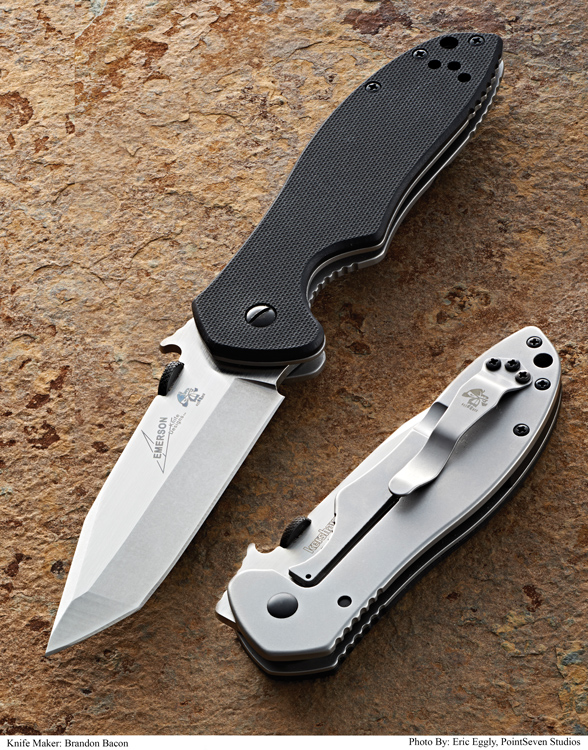
The BLADE MAGAZINE 2014 BEST BUY OF THE YEAR went to the KERSHAW-EMERSON CQC-7K. The tactical folder has a blade length of 3.25” made of 8Cr13MoV stainless. The wave-shaped feature can be made to catch on the pocket seam as the knife is removed from the pocket, thereby opening the blade. MSRP: $59.99
The BLADE MAGAZINE 2014 BEST BUY OF THE YEAR went to the KERSHAW-EMERSON CQC-7K. The tactical folder has a 3.25″ blade made of 8Cr13MoV stainless. The wave-shaped feature can be made to catch on the pocket seam as the knife is removed from the pocket, thereby opening the blade. MSRP: $59.99

The BLADE Show was one of the most successful in recent memory and, in addition to the Knives Of The Year, also featured the winners of the custom knife judging competition, the introductions of many new factory knives, the first-ever induction of a woman—Goldie Russell—into the Cutlery Hall Of Fame and much more.

In the custom knife judging, the Tembo Bowie by Russ Andrews, David Lisch, Mike Quesenberry, Steven Rapp, Jim Small and Jane Tukarski took home both Best Of Show and Best Collaboration, and was auctioned off to raise money for the Elephant Protection Association.

Other knifemaker winners included Mike Williams, Stephanie Lemelin, Brian Nadeau, John White, Joe Szilaski, RJ Martin and more.

And among the factory knives that debuted at the show were the “Battlechef” from Olamic Cutlery, the Emerson Knives, Inc. “Vindicator,” the Chris Reeve Knives “Impofu,” the Winkler Knives “Operator” and many more.

In one of the more popular inductions ever, Goldie Russell entered the Cutlery Hall Of Fame for her many contributions to the knife industry, including her pivotal role as president of the American Knife & Tool Institute when it helped defeat a U.S. Customs proposal that would have defined all one-hand knives as switchblades/autos, thus making them illegal nationwide.


The latest issue of BLADE is on newsstands now!
The BLADE Magazine 2014 Knives Of The Year® highlight the new BLADE®, on newsstands now!

These stories and many more are all awaiting your perusal in the latest issue of BLADE.

Save Legal Ivory & Mammoth Ivory Now!

Ancient walrus tusk handle.
Kevin Casey uses ancient walrus tusk for the handle of his knife. (SharpByCoop image)

Your help is needed to derail bills designed to ban not only ivory but also mammoth ivory—the latter ivory from animals extinct for thousands of years—that are pending in several states. Meanwhile, your support is needed for a federal bill (HR 697) that would effectively end U.S. Fish and Wildlife’s draconian moratorium on the sale and trade of legal ivory and also assist anti-poaching efforts in countries with elephant populations. (For more on the latter, visit http://elephantprotection.org/app/write-a-letter)

Hawaii, Maryland (HB713), Iowa (SF 30), Oklahoma (HB1787) and California (AB96) are all considering legislation that would or could be used to ban both ivory and mammoth ivory, and four bills are pending in Connecticut that could do the same. The penalties for violating any of the state bans if they were to pass run anywhere from $10,000 to $50,000 in fines up to classifying as felonies.

Meanwhile, a house bill in Washington (HB1131) eliminated mammoth from the definition of ivory, though the bill (SB5241) has yet to pass the state’s senate.

For more on these laws and what you can do to protect your right to sell legal ivory and mammoth ivory, including your knives with handles of the materials, visit elephantprotection.org.


GROUP-T1346-T1348Recommended for You:

KNIVES 2015

See the latest knives, swords, and edges of all types, and explore the latest trends in blades, steels, styles, and materials. Gaze upon a “State of the Art” section parading engraved, scrimshawed, jewel-inlaid, carved, etched, sculpted and forge-welded, and Damascus and mosaic-damascus knives. Click here.

Advertisement

Must Read Articles

Read this before you make a knife

Knifemaking 101 – Read This Before You Make a Knife

  by Wayne Goddard My experience has taught me that there's nothing like digging in and getting started. I've often said the hardest part of the...
how to forge damascus steel

How to Forge Damascus

Advertisement
Advertisement