The BLADE Blogs

The blogs of the BLADE editors, Steve Shackleford and Erin Healy.

Tribute to Samuel E. Polk, Switchblade Pioneer

0

Samuel E. Polk, former CEO of LATAMA (Latin American Import Export Company), passed away Nov. 5.

With his father, they revived the switchblade knife traditions of Italy through the development of LATAMA. Polk took over as CEO of the company in 1947, and set up shop in New York City. The move brought the classic Italian stiletto switchblade to American shores.

Knife Showcase member Walter Halucha, who heads the LATAMA brand now, sent this Polk tribute to Knife Showcase. (Polk is third from right with the glasses, Polincovsky is to the left of him with the black jacket.)

Tribute to Sam Polk

Click here to visit Latama.net.

A Revolution in Slip-Joint Construction

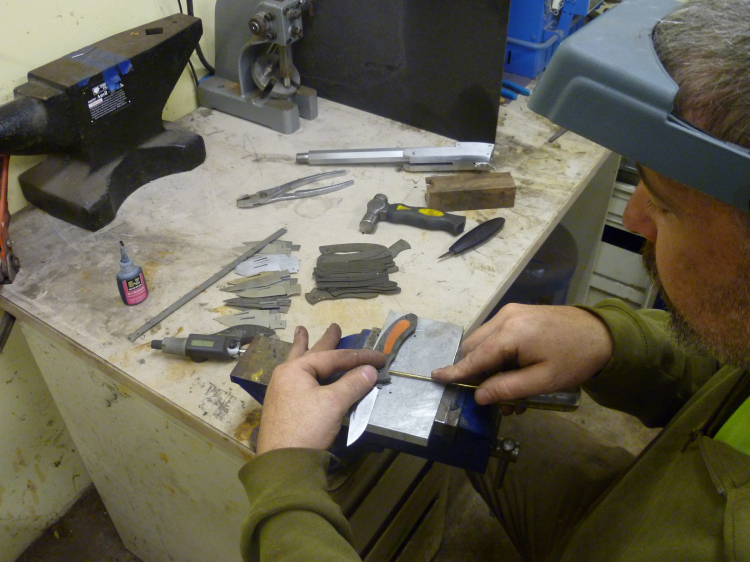
Unlike the traditional pocketknife in which the backspring rises and falls when the blade is opened and closed, the backbar of Tom Ferry’s model equipped with the Everflush Spring (top) remains flush when the blade is opened and closed. Ferry (above) works on a model with the mechanism in his shop.

The Everflush Spring takes the traditional pocketknife folding mechanism to the next level

By Lorien Arnold

As the traditional slip joint experiences a rebirth in favor among knife enthusiasts, there is increasing room for innovation in the knife’s classic, time-tested construction method.

    Enter Tom Ferry and Mike Vagnino.

    Innovators and educators, they have forged their paths in steel. Developing techniques and learning new skills, while at the same time teaching others, the two have collaborated on a concept that incorporates a generations-old method for assembling a slip joint, while bringing it into new worlds of materials and technology.

    “[An] idea evolved from the desire to engrave the backbar of slip-joint folders,” Ferry began. “The reason this was all but impossible before was that slip-joint backbars or [back]springs are heat treated, making them difficult to engrave, and, due to timing issues, [the engraving] was not easily done prior to heat treatment.

     “I had been bouncing the idea around trying to come up with a solution. One night while opening an automatic knife I noticed the internal kicker spring, which in many ways is similar in placement to a slip-joint spring. After doing some preliminary drawings, I contacted Mike for his input and assistance in developing the mechanism further. By sharing and combining forces, we cut the development time in half and have created a great working mechanism.

    “In total there have been at least five variations of the spring,” Ferry continued, “and Mike has taken the development further by creating the first multi-blade slip joint with the [new] mechanism. Mike coined the name the Everflush Spring because the backbar is always flush with the top of the handle.”

     You will notice the knives with the new spring in the accompanying photographs do not always correspond in form to the classic interpretation of the slip joint. Sporting titanium liners, bolsters and backbars, carbon fiber handles and high-alloy stainless blades, materials more common in the tactical category can be used to constitute the knives. To that end, the Everflush Spring allows for a completely solid handle configuration.

    The standard slip joint, whose backbar is a spring and must be free to move, can develop play on either side of the spring. The Everflush Spring design can incorporate pivot bearings for an action that is smooth with a crisp half stop. “The Everflush Spring is unlike common slip joints where the blade causes the spring to rise and drop as you rotate the blade from the open to closed position,” Ferry observed. “This innovation allows the opportunity for engraving of the backbar as well as eliminating the timing of the blade to the handle, as all the timing is internal.

    “[By] splitting the backbar in half, thus creating a lower spring upon which the blade rides and an upper tang stop which stays flush with the handle, the backbar does not need heat treatment. This allows a wider range of material choices and embellishing options.”

    Being intrinsic with the backbar, the lower spring diminishes the pressure exerted upon the pin, which traditionally would be used as the spring pivot. This allows the use of more exotic or fragile handle materials without fear of them cracking at the pin. In addition, the mechanism provides the potential for assembling a slip joint using threaded fasteners that allow for easy cleaning and pivot-tension adjustments.

    “The major disadvantage is that this design will not easily fit or adapt to many traditional designs,” such as folding patterns with three or more blades, Ferry noted. “The internal spring takes up more room and thereby creates issues with designing a knife for it.” Conversely, it challenges makers to devise new designs, which is always good for the knife industry.

Tango Foxtrot Knives

Ferry responded to the changing market with the creation of Tango Foxtrot Knives LLC, which he characterizes as his “new venture into the realm of semi-production knives” of his design.

    “The first knife from Tango Foxtrot is a tactical slip joint with the new mechanism, but I will also be introducing other models and types of knives in the future,” he said. “Tango Foxtrot Knives was conceived years ago but the timing never seemed to be right for me to proceed with the venture.

    “As with any new design or product, you can never be sure how it will be received by the buying public. Mike and I unveiled the Everflush Spring at the 2011 BLADE Show (www.bladeshow.com) and it was very apparent the design was a success, with both of us selling out of those knives prior to the end of the show’s first day. With the confidence of having innovated a great product, I decided to launch Tango Foxtrot Knives. The company’s first release was the prototype version of the T-1 folder at the 2011 USN Show, and again the design went over well.

“I am currently in production of the T-1 slip joint with the Everflush Spring,” Ferry maintained, “as well as designing other models of fixed blades and folders to develop a line of semi-production knives of my design. The components for the knives will be made out of shop, but all final assembly and fit and finish will be done in my shop. Most will be everyday user knives, but there will also be the occasional dressed-up model featuring my hand engraving.”

Another Level

The knife business tends to reward those who contribute to it. Moreover, there is always a connection to the past, as every maker builds upon the innovations, techniques and styles of those who came before. It is a rare cutler who introduces something completely new. It is an even rarer one who can take an innovation and bring it to the next level. There is always another level and, through Ferry and Vagnino’s innovation, the cutlery industry may be getting a peek at the next one.

    For more information on the Everflush mechanism, contact Tom Ferry at [email protected] or www.tomferryknives.com , or Mike Vagnino at [email protected] or www.mvknives.com.

For more on the latest knives, knife legislation, knifemaking instruction, knife trends, knifemakers, what knives to buy and where and much more, subscribe to BLADE Magazine, the World’s No. 1 Knife Publication. For subscription information click on http://www.shopblade.com/product/blade-magazine-one-year-subscripti…?r+ssfb031712#BL1SU.

Fish Knives Combine Form & Function

Here’s plenty of proof that a fillet knife can be put to extreme use, and still be a work of art.

The following is written by Tom Carpenter, and reprinted from the June 2013 issue of BLADE® Magazine.

Filleting fish under wet, sometimes salty conditions isn’t the kind of work or environment you want for your best knives. So you might suffer through with a mass-produced imitation of the real thing. But there’s no need to use an inferior tool. Consider the fish and fillet knives of Phil Wilson, Todd Kopp, Kevin D. Cross and John Cammenga of White River Knife & Tool. First, let’s get right down to the fish knife fundamentals.PhilWilson2
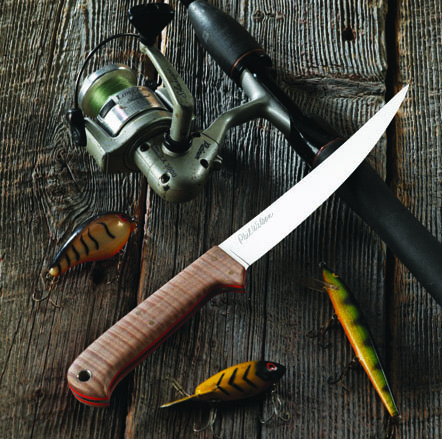
Knifemaker Phil Wilson’s “Shelter Cove” fillet knife (left) sports a 7-inch N690 blade, a fiddleback-maple handle and red spacers. He says a fillet knife should have some flexibility and be ground thin.


The basic features that make for a functional and efficient fillet knife are: a comfortable, secure grip that won’t slip and slide in your hand while doing wet, slimy chores; a sharp blade that is relatively thin and flexible for precision work, and holds an edge; and materials that can stand up to abuse like moisture, blood, and frequent washing and drying.

Wilson, Kopp, Cammenga and Cross craft fish and fillet knives that fit all these criteria and more. Here’s where they put their focus.

Working under the business name Seamount Knife Works, Wilson has been making fillet knives for almost 30 years. “A simple design is best,” he says, “clean and smooth without a lot of holes and crooks and crannies to get packed up with gunk. A good finger guard and a butt end on the handle prevent slippage under wet and slimy conditions.”kc3
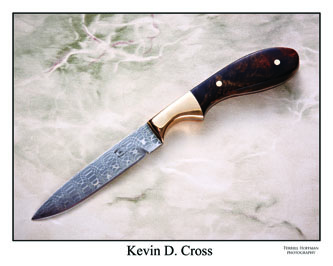
As far as the stainless-damascus blade Kevin D. Cross used for his bird and trout knife (left), the maker says there is a segment of sportsmen who appreciate a beautiful and functional knife. The piece also includes a desert-ironwood handle and bronze bolster. His list price: $400. (Hoffman photo)


As for blade material, “stainless steel is mandatory,” stresses Wilson. “I have used 440C, 154CM, AEBL, CPM-S90V, 12C27, CPM-S60V, CPM-S30V and CPM-154. Yes CPM-S90V—it still makes an awesome fillet knife, but now I feel it is overkill for the application. Given proper heat treatment, they all make a good fillet knife. These days I am using CPM-154, CPM-S30V and N690 mostly. These steels are in pretty much the same category for edge holding and ductility. A [reading] of 60 HRC seems to be the best target hardness for all of them.”

Blade characteristics are important, too. “A fillet knife should have some flexibility and be ground pretty thin,” says Wilson. “I like a springy feel in the first half of the blade from the tip back. Flex is a function of the blade geometry rather than hardness or steel grade.Mike Mooney Best Filet

Mike Mooney’s “Coho” model (left) won Best Fillet Knife at the 2011 Professional Knifemakers Association Show. It sports a 6-inch CPM-S30V blade, a dyed and stabilized redwood burl handle, and a 416 stainless steel bolster. (Buddy Thomason photo)

“Blade lengths from 6 to about 9 inches will handle most fillet work,” he adds, “and also double as boning, slicing and carving knives in the kitchen. Edge holding on a fillet knife is not quite as important as on a hunting/utility knife. A fillet knife can clean a box of fish and then get touched up at home or on the boat later. So a little lower hardness can be traded off for some added ductility on a thin, flexible blade.”


Non-Slip Grips

Handle material is critical. “I’m using mostly canvas Micarta® handles,” states Wilson. “An option is G-10. Both are naturally non-slip and do not soak up moisture.”

Kopp earned “Best Fillet Knife” honors at the 2010 Professional Knifemakers Association Show with his damascus fillet knife. He strayed from traditional stainless steel for his award-winning knife, opting instead for a damascus of 1084 and 15N20 carbon steels.StepUp_8_Maple_02
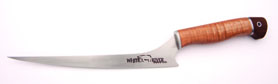
John Cammenga of White River Knife & Tool offers wood-handle fillet knives like this model (left) with a SM-100 blade and tiger-maple handle. Cammenga explains, “At the BLADE Show and SHOT Show, we introduced the world’s first fillet knife made with a blade of SM-100, a corrosion-proof alloy. This particular custom measures 63 HRC on the Rockwell hardness scale, features a 3/16-inch-thick spine and is still flexible! It is a ‘step-up design’ where the handle is notably higher than the cutting edge. The knife was designed by Steve Geelhoed, and while the original is not for sale, replicas sell at $750 each.”

“I used carbon steel on this because it holds an edge better than some of the stainless steels,” Kopp explains. “It does, however, require more care than stainless blades.”

The attractiveness of the damascus pattern is certainly inviting. “Yes, it’s kind of unique seeing a damascus blade on a fillet knife,” he admits. And what about function? “My brother used it on a fishing trip,” Kopp relates, “filleting 30 or so fish with it, and he was pleased with its performance. In fact, I think it outperformed an electric fillet knife!”Kopp Best Fillet orig
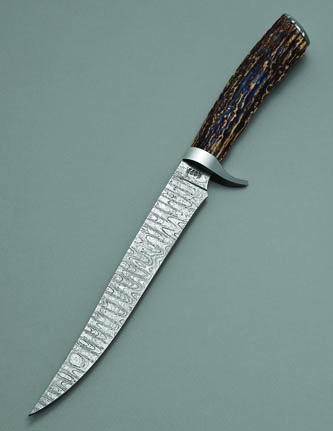
Maker of the Best Fillet Knife at the 2010 Professional Knifemakers Association Show, Todd Kopp chose a 7.5-inch damascus blade and sambar-stag handle for this particular model (left). Note the small details like how he carved the 416 stainless steel buttcap to match the natural grooves of the stag. The maker’s list price: $475. (Buddy Thomason photo)

Cammenga runs White River Knife & Tool, a family-owned business with a full array of fillet knives in its line. “A strong case can be made for many great alloys available today,” he says. “We chose 440C for our Limited Production and Custom Finished versions in 2013. This high-carbon, stain-resistant steel retains our hand-sharpened, leather-honed edge for a very long time. It also provides reasonable corrosion resistance.”

Cammenga uses wood handles on the fillet knives. “The wood is stabilized and will not shrink, swell, or absorb blood or oil,” he explains. “We also offer a cork handle with a wooden pommel. The cork handle with a 6- or 8-inch blade will float [if the knife is dropped in the water]. Also, our unique ‘step-up design’ helps to keep the handle [and knuckles] a little farther off the cutting area, a nice feature when filleting on less than ideal surfaces.”

Flexible On Flexibility

Cammenga says he thinks blade flexibility on fillet knives is largely a personal preference. “At the 2013 SHOT Show, we received some comments that our blades could be a little more flexible, and some that they could be less flexible,” he recalls. “Our current offering tends to be more rigid on the 11-inch blade, moderate on the 8- inch blade and more flexible on the 6-inch.

“That which makes a good knife makes a good fillet knife.”

Bird and trout knives certainly fit in the fillet knife family. Cross uses straight stainless steel on some of his knives, but adds a beautiful twist to others.

“Yes, actually I use both straight stainless and stainless damascus, depending on the customer,” Cross remarks. “With exposure to the water, the stainless aspect is important. As for stainless damascus, it looks a bit classier and there is a segment of sportsmen who appreciate a beautiful and functional knife to go with their Parker shotgun or Sage reel.”

Bird and trout knives have to pull double duty. How does damascus steel perform on the fishing half of that equation? “This knife works well for its appointed tasks,” he concludes. “But as with any short blade, there is not a great deal of flex. It is certainly possible to make the blade thin and flexible, though.”

Cross’s bird and trout knife employs bronze fittings. “Bronze is tough, and stain and corrosion resistant, especially to salt water. It is harder than brass, develops a nice, warm patina, and is easy to care for.” Function plus beauty: just the things knife lovers tend to value.

You make fillet knives do their work under tough conditions. But don’t suffer with low-quality knives. Craftsmen such as Wilson, Kopp, Cammenga and Cross have proven that you can combine function and form in beautiful fish knives.


Good and Bad Knife Bills Brewing


There is both good and bad news from Washington state. Starting with the good, two companion bills, Senate Bill 6179 and House Bill 2347, would make it legal to manufacture spring-assisted and switchblade knives in the state. The bills also clarify the definition of a switchblade, or what is referred to in Oregon law as a “spring blade knife,” so as to not include assisted-opening knives that are currently subject to adverse interpretation of the state statute, making them technically illegal. In addition, the bill would expand the existing law enforcement exemption for possession of “spring blade knives” to members of the military, full-time first responders and the citizens who hold a valid Washington concealed pistol license (Washington is a “shall issue” state).

Knife Rights Director of Legislative Affairs Todd Rather will be in Olympia on Wednesday to testify in support of the bills on behalf of Washington’s knife owners. The bills are a big incremental step forward in a state where any knife with a spring assisted blade has been interpreted as being illegal and where Washington knife companies, such as Fox Knives USA and SOG, were prohibited from even manufacturing such knives in the state, sending those jobs to other states with more rational knife laws, including neighboring Oregon.

The bad news is that last year’s ridiculous anti-knife bill, HB 1006, which would make it illegal to conceal any knife over 3 1/2 inches long even with a Washington concealed pistol permit (since it is not a concealed weapon permit), has been resurrected. In a state where a long coat is a normal part of every outdoor enthusiast’s, fisherman’s and hunter’s attire for a good part of the year, this would turn honest citizens into criminals for carrying a modestly sized sheath knife on their belt, along with quite a few common folding knives longer than the arbitrary length limit.

If you live, work or travel in Washington state, please contact BOTH your Senator and Representative in Olympia and ask them to support SB 1234 and HB 2347, respectively, and ask your Representative to help kill HB 1006 for good. Click here to locate your legislators, or the legislators who represent where you work or travel.

 The preceding is courtesy of Knife Rights. For more information click on http://kniferights.org/


For more on the latest knives, knife legislation, knifemaking instruction, knife trends, knifemakers, what knives to buy and where and much more, subscribe to BLADE® Magazine, the World’s No. 1 Knife Publication. For subscription information click on http://www.shopblade.com/product/blade-magazine-one-year-subscripti…?r+ssfb230112#BL1SU


12 Days To The BLADE Show: Custom Knife Awards

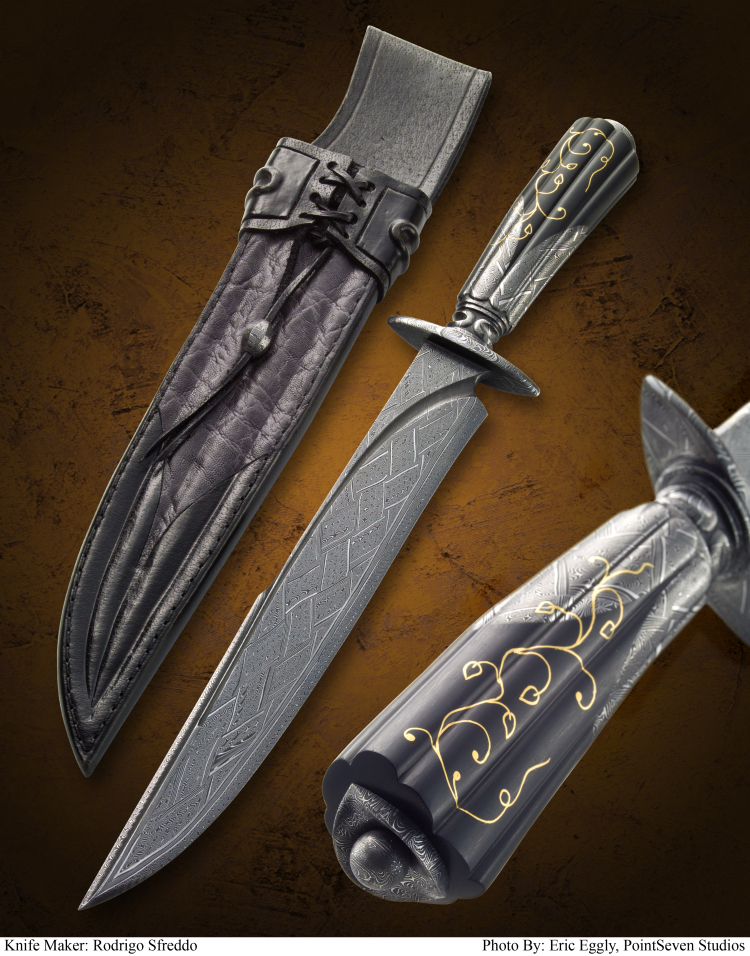
With the 31st BLADE Show (www.bladeshow.com) but 12 days hence at the Cobb Galleria Centre in Atlanta, don’t miss your chance to see the work of such award-winning makers as Brazil’s Rodrigo Sfreddo. Sfreddo’s “Magnifique” (above) won Best Fixed Blade at last year’s show, and this year’s custom winners promise to be among the finest examples of cut, too.

    The show’s custom knife judging competition regularly draws more knives entered by more makers than any such competition anywhere. However, it’s not so much the sheer number of entrants that is so impressive as the quality of the work itself. In fact, many of those that don’t win are among the finest knives you will ever want to see.

    The award categories are (with the 2011 BLADE Show winners in parentheses): Hugh Bartrug Best In Show and Best Art Knife (Dennis Friedly); Best Fixed Blade (Rodrigo Sfreddo); Best Folder (Richard Rogers); Best Tactical Folder (Brian Fellhoelter); Best Damascus Knife (John White); Best Fighter (RJ Martin); Best Bowie (John White); Yvon Vachon Best Miniature (Yoshio Sakauchi); Best Handle Design (Vince Evans); Best Utility Hunter (Dan Farr); Most Innovative Design (Joe Caswell); Best Knife Collaboration (Dennis Friedly and Gil Rudolph); Best Sword (Vince Evans); Best New Maker (Rod Watts); and Best Of The Rest (Mardi Meshejian).

    The show will be June 8-10. Don’t miss out!

For more on the latest knives, knife legislation, knifemaking instruction, knife trends, knifemakers, what knives to buy and where and much more, subscribe to BLADE Magazine, the World’s No. 1 Knife Publication.

Buck Knives Reports Successful 2009

0

American Commitment working, expansion planned for 2010

POST FALLS, IDAHO When Buck Knives announced their American Commitment a year ago, they
knew exactly what they wanted to do: greatly increase the percentage of knives made in their Post
Falls, Idaho plant.

“We had absolute faith in this major step; that’s why we made the commitment,” said CJ Buck,
president and CEO. “We fully anticipated a positive reaction and a successful year, but these were
forecasts and projections.”

Now the results are in for 2009, and this step forward has proved to be successful on all
counts. Dealers and consumers all reacted positively. Retail sales for Buck in a tough year for
American business were steady, headed by strength in the hunting segment of the market.
“Dealers welcomed the change,” Buck said. “They and their customers verified our belief that,
given a choice, most people prefer products Made in America.”

Based on this encouraging progress and a continued commitment to American-made product,
combined with the very positive response the new products received at the SHOT Show, Buck’s
plan for 2010 is an upsurge in domestic production. To achieve that growth they anticipate a 10%
increase in their Idaho work force.

Fight Anti-Knife D.A., Attend NY Custom Knife Show!

One of the oldest and best custom knife shows begins today at the Westin-Jersey City Newport Hotel with the commencement of the 34th Annual New York City Custom Knife Show in Jersey City, New Jersey.

The show runs today through Sunday.

Why is the New York City Custom Knife Show in New Jersey, you ask? Until last year the show was in the Big Apple—but that was before Manhattan D.A. Cyrus Vance began his illegal, oppressive witch hunt of legal manual-opening knives, mislabeling them as gravity knives, switchblades, etc.

Show your disapproval of Vance’s criminal behavior by attending the NYC Show. Not only will you be spitting in the face of a pox on knives, you will see some of the world’s best custom knives.

For more information visit www.nyckshow.com.

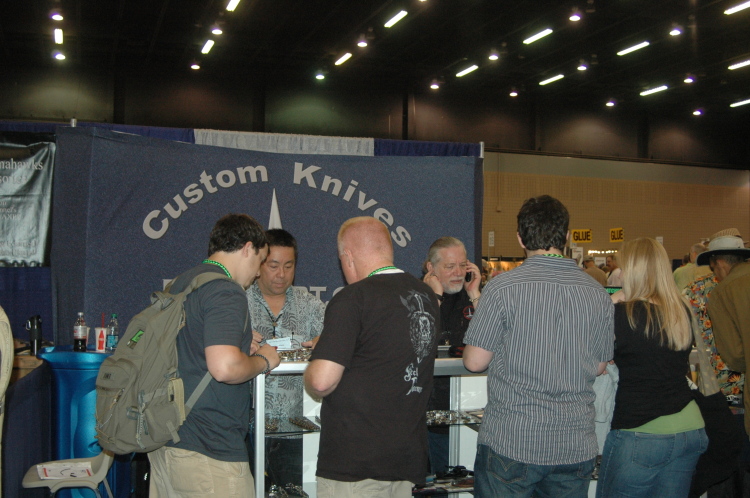
The accompanying picture is of the Bladeart booth at the 2011 BLADE Show.

Advertisement

Must Read Articles

Read this before you make a knife

Knifemaking 101 – Read This Before You Make a Knife

  by Wayne Goddard My experience has taught me that there's nothing like digging in and getting started. I've often said the hardest part of the...
how to forge damascus steel

How to Forge Damascus

Advertisement
Advertisement