Long-time knifemaker and knife-thrower Bobby Branton will demonstrate how to throw knives at the 2013 BLADE Show May 31-June 2 at the Cobb Galleria Centre in Atlanta.
As he has done at the BLADE Show for many years, Branton will bring his knife-throwing target and assortment of his custom Pro-Flyte throwing knives. He also has thrown tomahawks on occasion in his seminars. Word is he might be throwing some new factory hawks at this year’s BLADE Show, too.
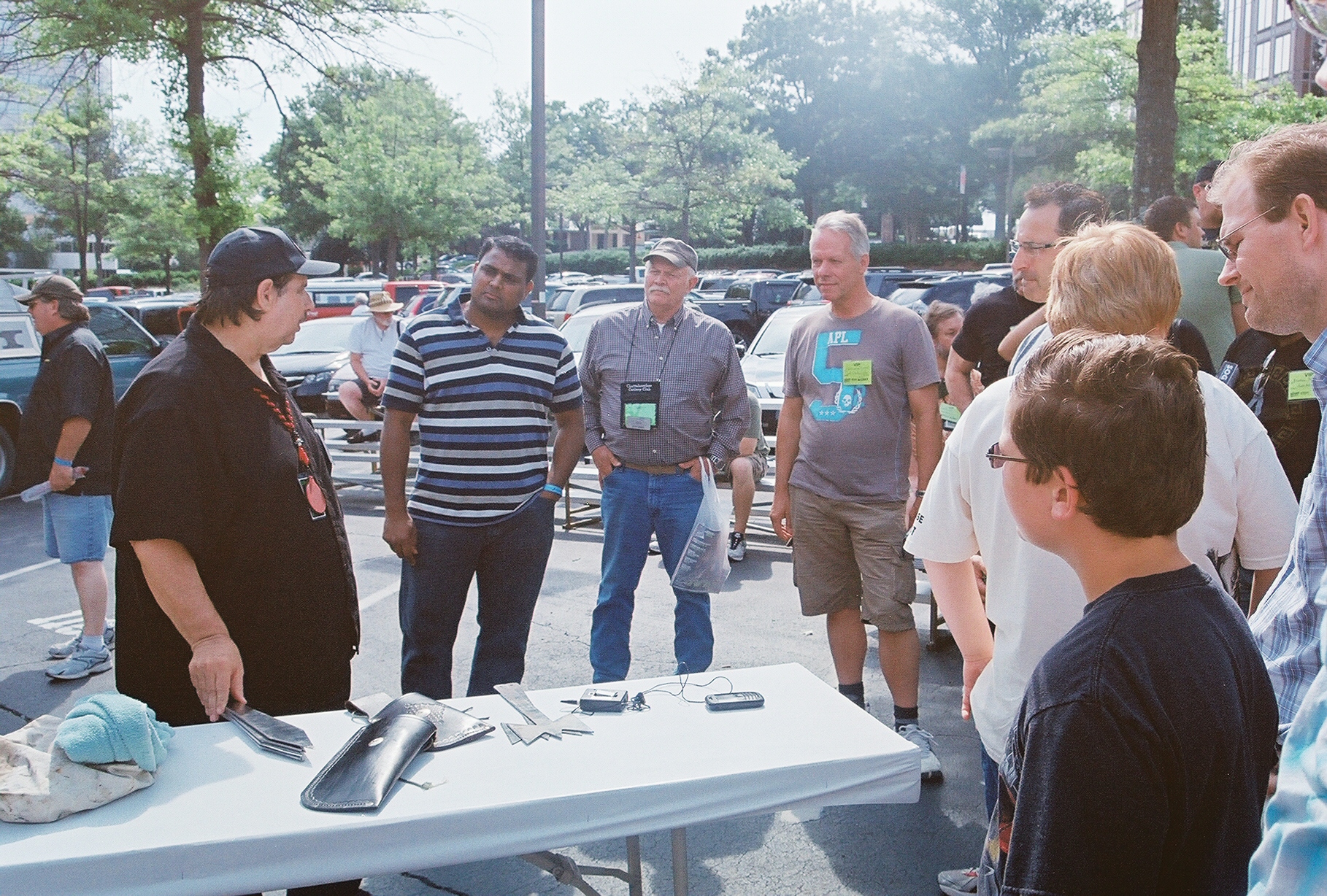
Bobby Branton (left) discusses knife throwing with patrons during his seminar at the 2012 BLADE Show.
Branton’s seminars are always casual and impromptu. He chats informally with his audience and encourages questions, comments and other open dialogue. It’s a seminar suitable for the entire family.
In fact, you never can tell who might show up for one of Bobby’s seminars. Past special guests have included Ernest Emerson, among others.
Branton has been active administrating the American Knife Throwers Alliance over the years, and has hosted many knife-throwing events near his shop in Awendaw, South Carolina.
Branton will throw his knives during his seminar the Saturday of the BLADE Show at 10 a.m. in “The Courtyard”—otherwise known as the parking lot of the host hotel, the Renaissance Waverly. Admission is free to all BLADE Show ticket holders.
The best custom knives by some of the world’s best custom makers were celebrated this past weekend at the world’s largest knife show, the BLADE Show (www.bladeshow.com), at the Cobb Galleria Centre in Atlanta, Georgia.
Michael Ruth Jr. won both the Hugh Bartrug Best Of Show and Best Sword for his elegant English hunting sword. Meanwhile, Mike Williams scored big time by winning two awards: Best Utility Hunter and Best Of The Rest. Japan’s Yoshio Sakauchi won the Yvon Vachon Best Miniature for a phenomenal fifth straight year.
All of the winners, by category:
Hugh Bartrug Best Of Show/Best Sword: Michael Ruth Jr.
Best Tactical Folder: Kirby Lambert
Most Innovative Design: Brian Tighe
Best Handle Design: Ron Newton
Best Folder: Ken Erickson
Yvon Vachon Best Miniature: Yoshio Sakauchi
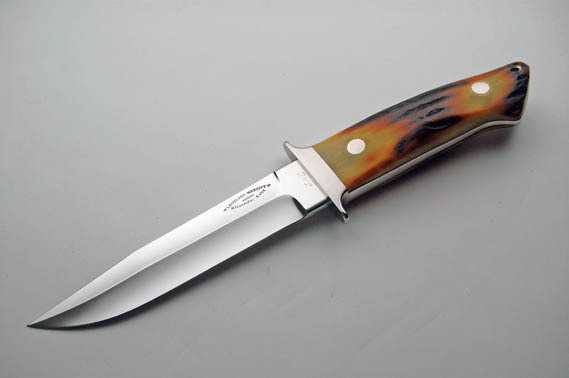
Best Art Knife: Van Barnett (pictured at top)
Best Fixed Blade: Kevin Cashen
Best Bowie: Jason Knight
Best New Maker: Tom Ploppert
Best Fighter: David Mirabile
Best Knife Collaboration: Bob Terzuola and Gus Cecchini
Best Utility Hunter: Mike Williams
Best Damascus: David Lisch
Best Of The Rest: Mike Williams
For the complete story on the winners and the knives, see the November BLADE®.
Find Custom Knifemakers in Your Area
The Knives 2012 book features a complete directory of custom knifemakers. You’ll find information to help you find and contact knifemakers in your area.
This Thursday, Sept. 8, the Public Safety Committee of the Boston City Council will hold a hearing with the intention of licensing the sale of knives in the city of Boston, Knife Rights reported. Below is the official stated purpose of the hearing:
That the appropriate committee of the Boston City Council hold a hearing to examine requiring the sale of knives to be licensed by the appropriate police agency that would monitor, regulate and license businesses selling knives. Representatives from the Boston Police Department, Inspectional Services Department, and other interested parties shall be invited to attend.
The meeting will be at Boston City Hall, Ianella Chambers, 5th Floor on Sept. 8 at 10 a.m.
Along with Knife Rights, Blademag.com urges all Boston area knife enthusiasts to contact the Boston City Council and express their opposition to this measure. According to Knife Rights, Bostonians currently need a license to possess pepper spray. In a year or so this measure could lead to licensing citizens to possess a basic pocketknife.
As noted in the article linked below, existing Boston law already prohibits knives with a blade two inches or longer from being sold to anyone under age 18. A number of stores were fined as a result of a recent sting operation for illegally selling knives to underage people. There is no indication of any factual connection made between violence committed with knives in the city and these retailers, or that licensing would actually help the situation any more than simply enforcing the existing law on the books.
Knife Rights has a representative in Massachusetts who will attend the meeting, but if you live in the area and can attend as well, the stronger the show of opposition to the proposal, the better.
While there is still no definitive proof that James Black made a knife for Jim Bowie, one thing is certain: a descendant of Black’s received a “recreation of a James Black knife” during the Natchez Antique Bowie Knife Show last month.
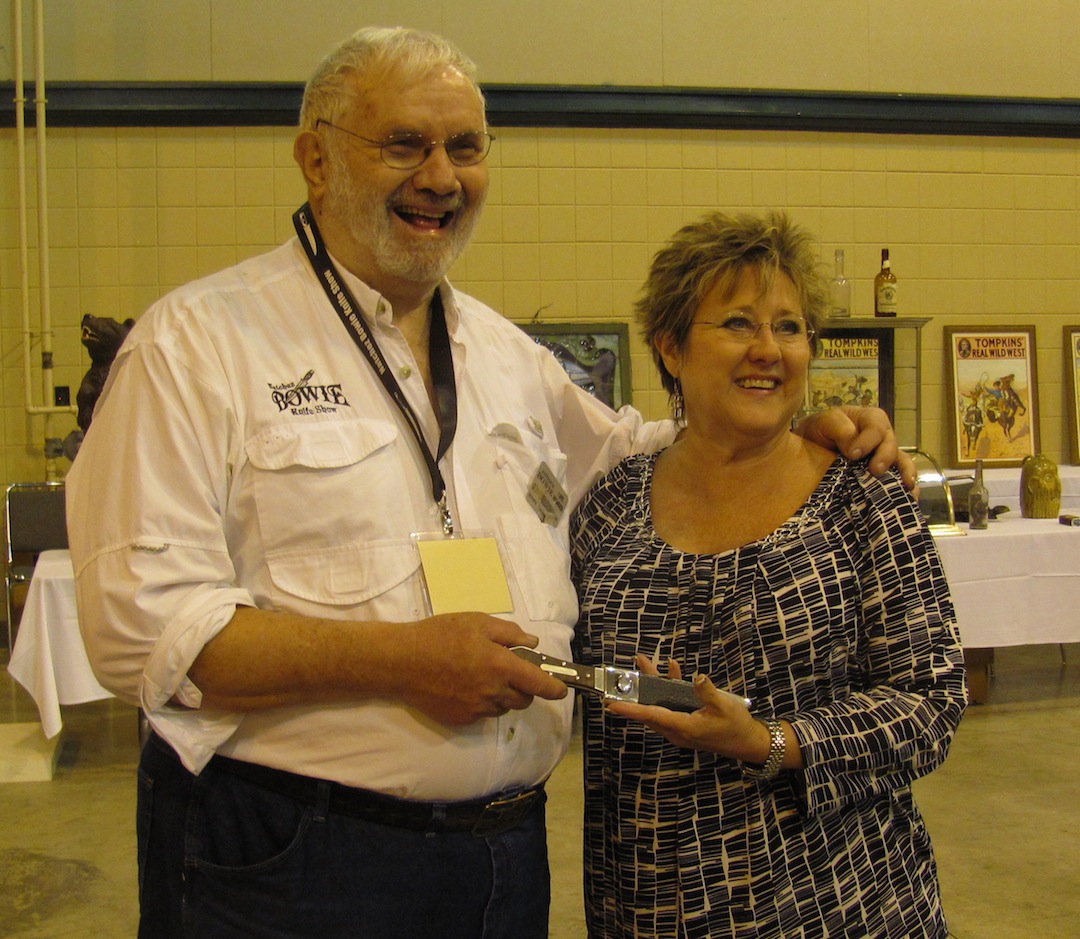
Jim Batson presents a “recreation of a James Black bowie” to Celia Johnson.
ABS master smith James L. “Jim” Batson made the reproduction of the knife and presented it to Mrs. Celia Johnson, who claims to be a descendant of Black. She says she is descended from Gradison DeRorysten Black, the son of James Black. Celia and her husband, Jerry, traveled from Baytown, Texas, to accept the silver-mounted knife and sheath fashioned by Batson and based on what is believed to be a Black knife in the Historic Arkansas Museum in Little Rock, Arkansas. The Johnsons stayed at the Dunleift Hall, owned by Mike Worley, during the show. Worley sponsored the show, which was held in Natchez, Mississippi.
The Johnsons brought a scrapbook full of old family pictures and a handwritten list of ancestors and originally showed it to Batson during the American Bladesmith Society’s 2012 All-Forged Knife Expo in San Antonio, Texas (see page 44, July 2012 BLADE® www.blademag.com). Batson is one of the world’s foremost authorities on Jim Bowie and James Black. He has conducted extensive research on Bowie and bowie knives, written any number of stories on the subject for BLADE, a book on Bowie’s famous Sandbar Fight, coordinated Bowie Symposiums at the BLADE Show (www.bladeshow.com), and much more. He also coordinates the Batson Bladesmithing Symposium each spring in McCalla, Alabama, and is a past multi-term chairman of the ABS.
Batson pored over the Johnsons’ documents and pictures at the 2012 San Antonio show. Among the topics of their discussion was the famous 19th-century daguerreotype that reportedly shows James Black and Judge Jacob Buzzard, the physical resemblance of the man some believe is Black in the daguerreotype to that of some of Celia’s ancestors, and Black family history in general.
For the latest on knives, knife news and more, stay honed at www.blademag.com (www.blademag.com).
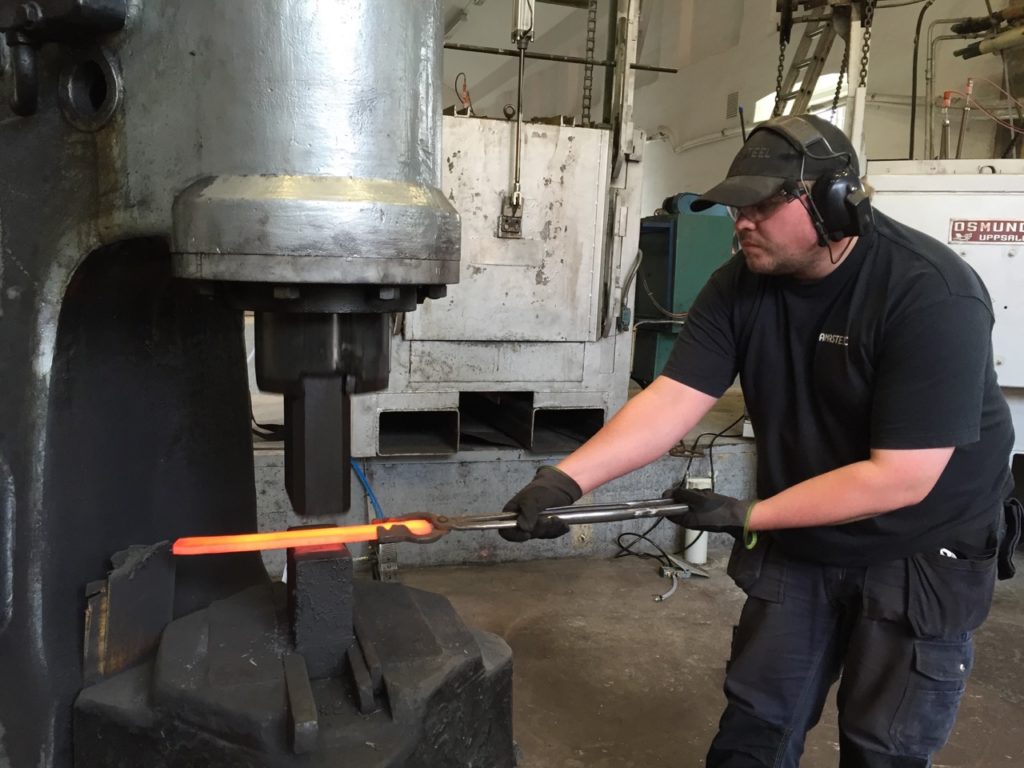
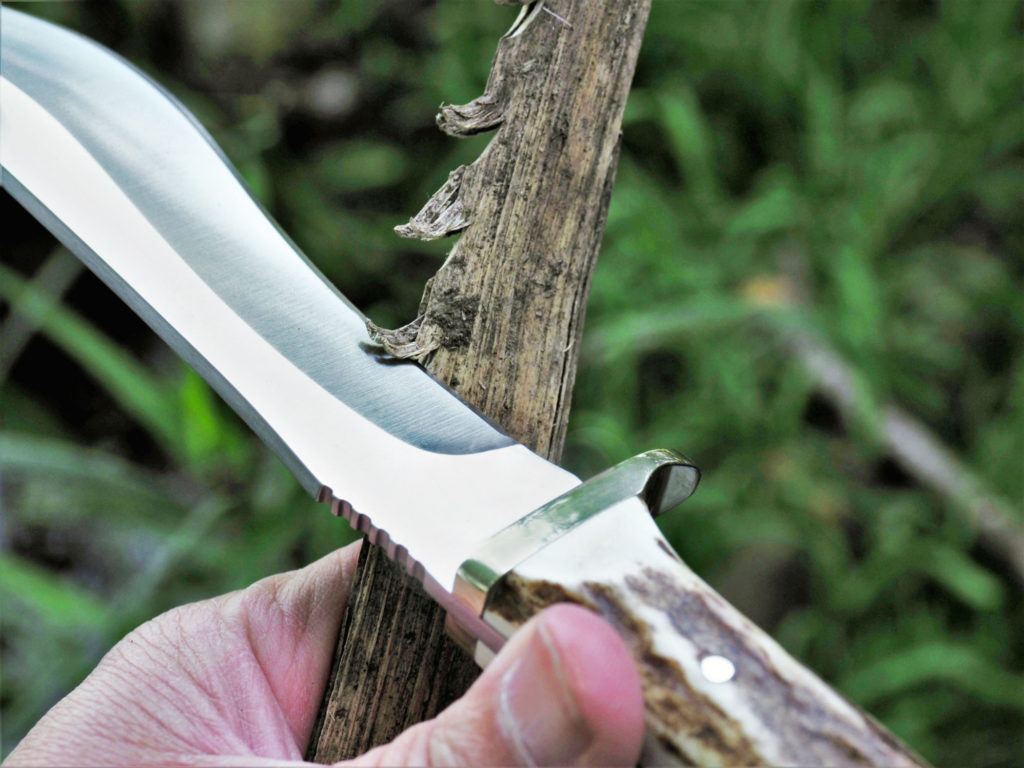
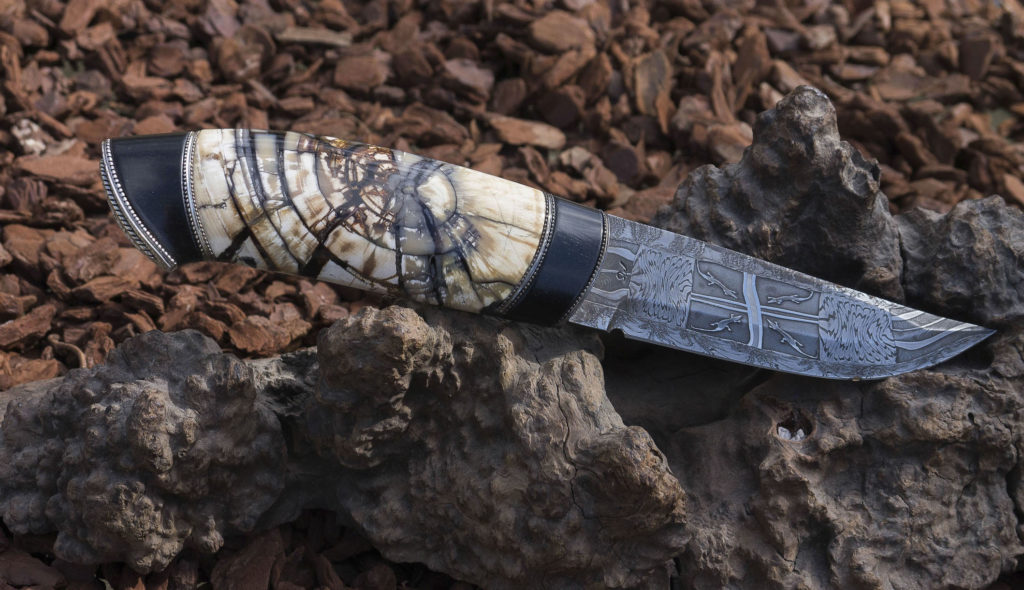
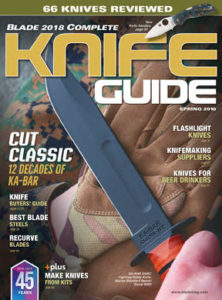
Forging some of the best blade steels is something with which Damasteel of Soderfors, Sweden, is well acquainted.The best blade steels combined with the best blade shapes can cut wonders. Puma’s SGB Buffalo Hunter comes in a recurve blade of 1.4116 stainless steel.Raffir fossil mammoth ivory comprises the handle of Danish knifemaker Tommy Astrup’s mosaic damascus fixed blade.The best blade steels, latest handle materials and more of what it takes to make the hottest knife are in the new BLADE 2018 Complete Knife Guide, on newsstands now!
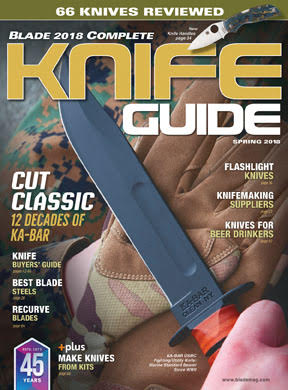
The best blade steels, latest handle materials, blade shapes, knifemaking suppliers and most everything else it takes to make a knife the sharpest it can be populate the BLADE 2018 Complete Knife Guide, on newsstands now!
What’s the best knife steel for one application can be a disaster for another. However, there exists a happy medium where a maker and an end-user get as many general bennies from the steel as possible. Dave Rhea examines the phenomenon in detail and considers some of today’s best cutting materials in his story, “Keys To The Best Blade Steels.”
Based in Hadsten, Denmark, Raffir offers an array of the most beautiful and durable synthetics yet in its range of fossil, wood and other materials. In Raffir Mammoth Tooth in particular, the cracks and abrasions that handle companies have to fill and re-fill during finishing operations with standard mammoth tooth are reduced by 80 to 90 percent. The material is most pleasing to the eye as well. Get a handle on the latest gripping stuff in “Most Beautiful Synthetics Ever?” by yours truly and Mike Haskew’s “What’s Your Handle?”
The “S”-shaped recurve blade has the rear of the cutting edge, or belly, curving inward toward the spine in a continuous curve from the point. Though most recurves have similar looks, subtle design differences mean that each knife has a distinct feel and performance. David W. Jung outlines some of the leading performers of the genre in “The Inside Edge.”
There is a wealth of knifemaking suppliers providing just what the knife doctor ordered, whether it be the best in handle materials, steels, specialized forging equipment, or the tools that make the sparks fly. Daniel Jackson reacquaints you with some of the best of the lot in “Go-To Guys of Sharp.”
There’s much more in the Complete Knife Guide, including the most comprehensive listing of factory knife companies and other professionals in the industry, a sneak peek at the coolest knife debuts for 2018, the brightest flashlight knives, three fun-to-build knife kits, the latest in beer knives and much more.
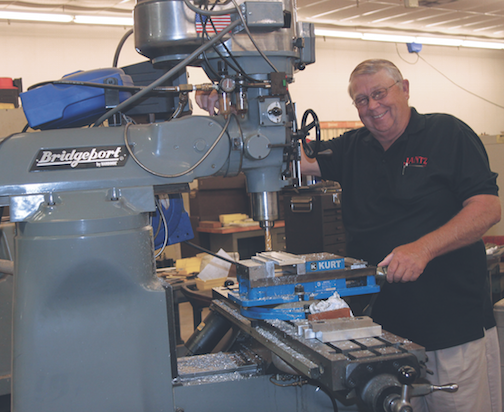
Ken Jantz of Jantz Supply works on a prototype for a new hollow-grinding fixture in the Jantz Shop in Davis, Oklahoma.
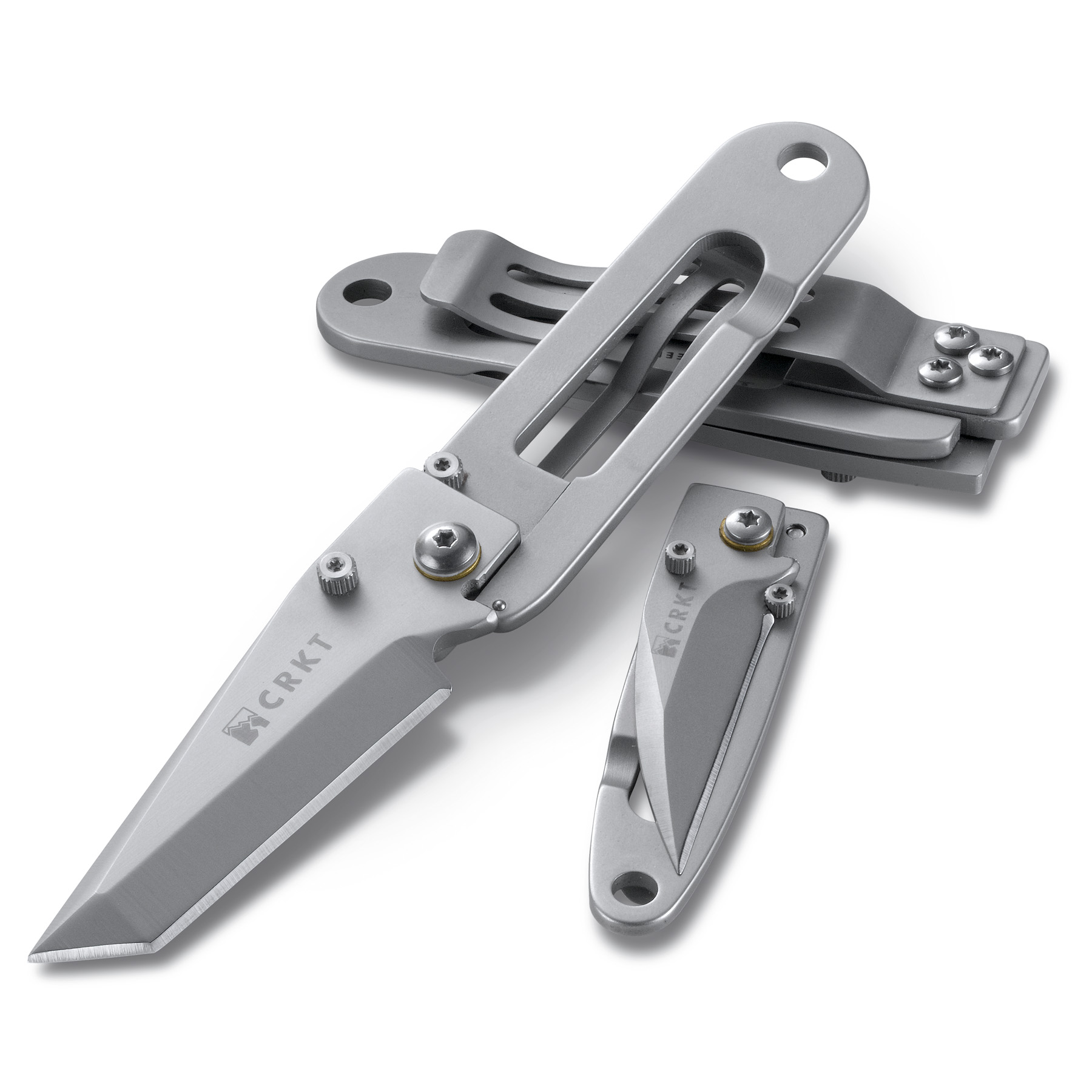
Ed Halligan’s K.I.S.S. design (left) revolutionized factory folding knives. At right is his Delilah’s P.E.C.K. design. Both knives are reproduced by CRKT. (CRKT image)
An unusually high number of knifemakers have died recently, all of whom left more than their fair share of lifelong marks on family, friends and the knife industry. In terms of influence on knife design, though, the two that probably had the largest impact were Ed Halligan and Kit Carson.
Ironically, both men designed wildly popular folding knives for CRKT, and it is those folders that have been so influential on the knife industry.
The K.I.S.S. is a simple yet ingenious folding knife. In the closed position, its two-piece frame-lock construction and safe, user-friendly design “seals” the cutting edge of the chisel-ground blade against the handle. As Halligan once explained, “With the K.I.S.S., the frame and the lock are all one piece … I made the original knife with the blade chisel ground on one side only so it would slide against the frame when folded and make a seal so you wouldn’t cut yourself.”
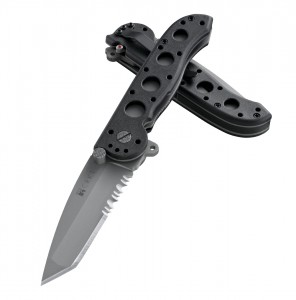
Kit Carson’s M16 design remains one for the ages. This is the M16-12Z CRKT repro. The flipper is the extension with the hole in it seen here acting as a guard just below the handle pivot. (CRKT image)
In fact, when it first came out, I recall talking to one long-time industry observer who thought the K.I.S.S. was a lawsuit waiting to happen because he thought consumers would cut themselves on the blade edge despite the blade’s seal against the handle in the closed position. However, Halligan’s version of the design works so well that such accidental cuts never happen. One of the main reasons the design is safe is that Halligan tested it in real-life conditions to be sure that such accidents never occur. “Safety is a big reason why I carried the knife around so much to make sure it worked properly,” Halligan said.
In 1997, Halligan signed a deal with CRKT for the company to reproduce the K.I.S.S., and CRKT launched the repro of the knife at the 1998 SHOT Show. Only four years old at the time, CRKT was struggling to find a knife that would help “drag the rest of the product lines along,” as CRKT’s Rod Bremer put it. The K.I.S.S. was that knife. Unfortunately, a number of unscrupulous companies blatantly knocked the K.I.S.S. off so much that it eventually became one of the most copied sporting knives worldwide. CRKT and Halligan weathered that storm, though, and Ed designed a series of K.I.S.S. iterations and spinoffs for CRKT that included the Delilah’s P.E.C.K. (for Precision Engineered Compact Knife), Samson’s K.I.S.S., the H.U.G. (Halligan’s Ultimate Gadget), the Slip K.I.S.S., the Neck P.E.C.K., the blackened K.I.S.S. In The Dark, even a fixed-blade version called the Stiff K.I.S.S. and others.
Just as they were linked in their passing, Halligan and Carson were also linked in their CRKT collaboration deals. CRKT must have been living right back in those days because it was just a year after signing the deal with Halligan to reproduce the K.I.S.S. that it signed the deal with Carson to reproduce Carson’s M16 folder. Even though Carson did not invent the flipper, his M16 is universally credited as the model that popularized flipper folders—folding knives with one-hand-opening “flippers” that double as guards when the blade is opened. “The M16 with the Carson Flipper was a huge improvement on non-assisted blade opening, making a manual knife open almost as fast as an auto without a secondary thumb stud or hole mechanism,” observed long-time knife writer Mac Overton. “Because it had less moving parts and its opening relied on inertia rather than a spring or torsion bar, the mechanism was inherently stable and reliable.”
The M16 and its military look—Carson was a U.S. Army career man—soon became not only immensely popular with consumers but with service personnel as well. In fact, by many accounts, the M16 was the most popular knife among active duty service personnel in the wars in both Iraq and Afghanistan.
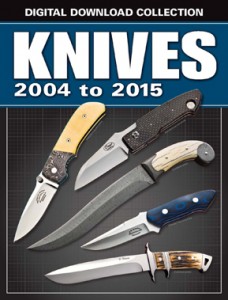
Turn back the clock with BLADE‘s digital collection of annual KNIVES books. Get every KNIVES book from 2004 to 2015 in one PDF download for just $79.99.