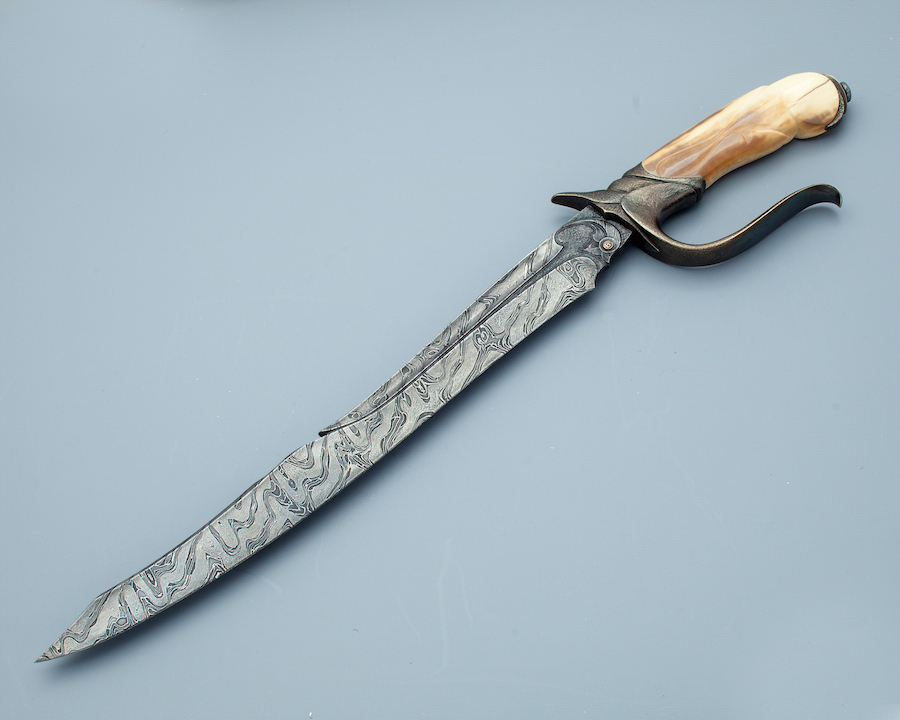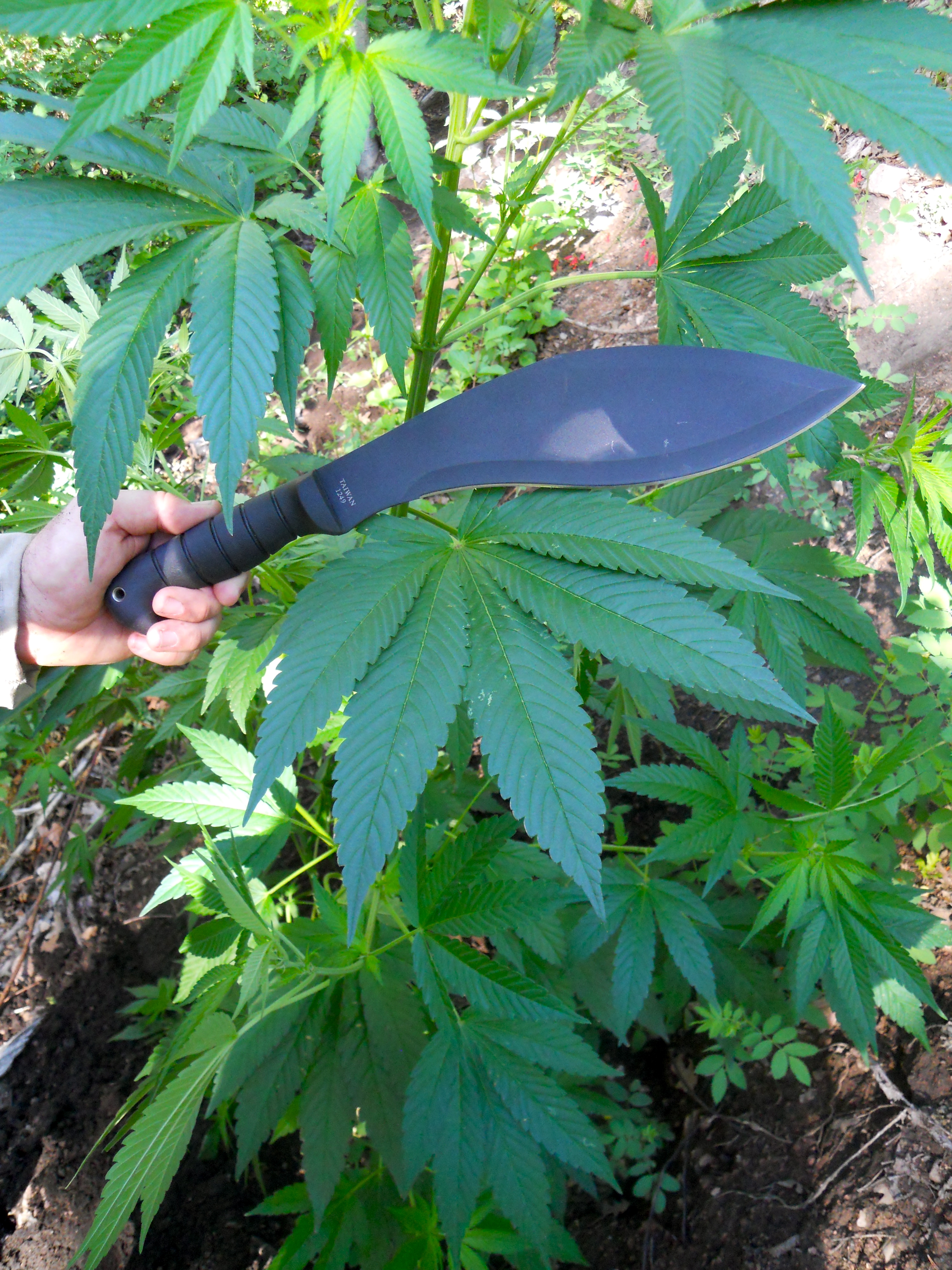
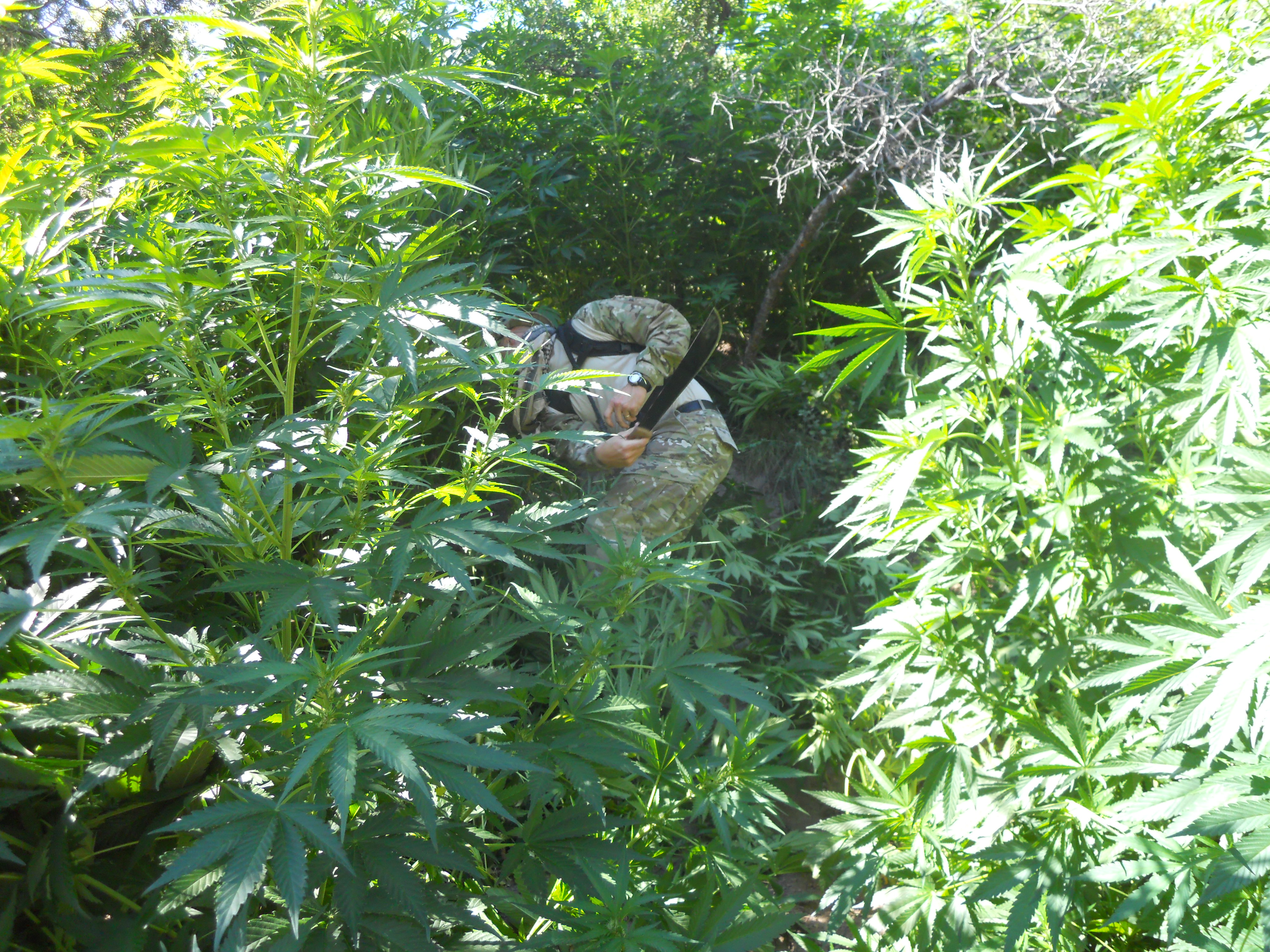
A big pot plant (top) requires a big knife such as the KA-BAR Kukri Machete. The 11.5-inch, hollow-ground blade is 1085 carbon steel with a Rockwell hardness of 52-54 HRC—the lower hardness providing the malleability needed for chopping—and the handle is black Kraton G. MSRP: $75.63. (Above) A U.S. Immigration and Customs Enforcement agent uses an ESEE light machete to eradicate a field of marijuana plants somewhere in South America. (photo courtesy of ESEE Knives)
The big blades have revolutionized the way drug enforcement eradicates marijuana plants
By Pat Covert
Sometimes only a big knife will do. Other times only a really big knife will do! Such is the case when eradicating plants that supply illegal drugs such as marijuana and cocaine.
You have seen news stories about busts of illegal pot fields and the controlled burns in their aftermath. BLADE® takes this opportunity to fill you in on drug raids and eradication and, in the process, give you some insight into the best in “weed whackers.” We consulted a panel of experts, including an active special agent for U.S. Immigration and Customs Enforcement (ICE) who has participated in eradications all over the USA and other countries. In addition, we talked to factory officials who shared information on the dope cutters they offer.
Marijuana is by far the most actively used controlled substance in the USA, comprising about 80 percent of all illicit drugs combined. In 2010, over 23,500 outdoor growth sites of the illegal weed were eradicated, and almost 5,000 indoor growing facilities were eliminated. Marijuana plants average between 5-to-10 feet high and even taller in the right climes.
Cocaine is processed from coca leaves. The coca plant, which averages 7-to-10 feet high, can be found throughout most of Latin America but is most prominent in Bolivia, Columbia and Peru. It is estimated that the USA consumes half the world’s processed cocaine. Since most of the cultivation is in South America, that’s where most eradication efforts, including those by U.S. enforcement agents, take place. It is a big job for law enforcement officials, and big knives play an important role.
The Takedown
The ICE special agent said he preferred not to get into the specifics of how illegal growing fields are located and monitored by the authorities, but he did comment on where such fields tend to be situated.
“A typical marijuana ‘grow’ [a.k.a. garden] is located in a remote section of the local wilderness accessible to a water source,” he begins. When raiding a field, he says the element of surprise is essential. “The takedown is similar to a military patrol and assault,” he explains. “The grow has to be surrounded to keep the growers from escaping the perimeters. Officers must be prepared to make multiple arrests and manage those arrests under pressure and confusion. Air support is also essential in providing cover, keeping the growers’ movements limited.”
Once arrests have been made and the field secured, the hard job of eradication begins. “Taking the plants out of the ground is hard work,” the ICE agent says. “All the plants have to be removed. Some are taken by the roots, while others are cut at the base. The intricate watering systems also have to be dismantled and removed. The harvested plants are destroyed by being burned.” Once the plants are cut and stacked, the agents use helicopters to sling load the plants out in large nets. “The grows usually net between 5,000 to 20,000 plants, depending on the location,” he adds.
Long Blade, Flared Tip
There is no shortage of knives that can be used to take down illegal crops. Typically, a good dope chopper will have a long blade with a flared tip to add extra weight—and power—to the main area of contact. An ample handle is also preferred to give comfort to the hand over extended use. Owner and founder of ESEE Knives, Jeff Randall has been with agents on eradication assignments where his knives have seen action. “Most of the agents we deal with love our product, especially the agents dealing with coca and marijuana crops in South America, but they are used domestically as well,” he observes. “The ESEE Lite Machete and Junglas models do the best, depending on the particular plant.”
KA-BAR senior designer and engineer Paul Tsujimoto says his company has a number of knives used for drug eradication. “The KA-BAR Heavy Cutting Tools line, which includes the Large Heavy Bowie, Grass Machete, Cutlass Machete and Kukri Machete, is almost entirely suited for heavy jungle-vegetation clearing duty,” he notes. “Our relatively new Big Brother [a large 14.2-inch version of the original USMC fighting/utility knife] has also proven itself in jungle environments.”
Tsujimoto cited some recent additions to KA-BAR’s lineup that have proved their worth in the battle against drugs as well. “We also have a new line, Zombie Knives, that has a [Pestilence] Chopper and [War] Sword that have proven excellent at clearing and leveling plants, and our Johnson Adventure Blades line has a model called the Potbelly that is an excellent chopper. All of these knives have seen service in the drug eradication service, both domestic and overseas.”
In knife circles, Becker Knife & Tool founder and chief designer Ethan Becker is perhaps best known for his Machax model, a machete/ax hybrid.
“Most of the feedback I have gotten over the years has involved the Machax,” he notes.” “I know the Kentucky State Police special ops team used the Machax for years with great success. In addition to the Machax, our most suited blades for the job are the BK9 Combat Bowie and the BK6 Patrol Machete.”
Becker related an incident most instructive involving the Machax.
“I made a cold sales call on a surplus store near Ashland, Oregon, some years ago,” he says. “The owner took one look at the Machax and said, ‘I’ll sell a bunch of these.’” When Becker asked the storeowner who the customers were he had in mind, the man replied, “Growers and the cops chasing ’em!”
Choppers In Action
The ICE special agent and his fellow agents had a chance to test a group of knives to evaluate their performance in cutting down the illicit drug plants.
“The ESEE Junglas was the first tool we tested on the first grow of the season. The Micarta® handle was very ergonomic and easy to grip. Compared to a typical machete it has a shorter blade, but is much thicker and more robust,” he notes. “The blade performed very well cutting through the base of the marijuana plants. The Junglas was probably the highest quality knife/tool we used and definitely did the job.”
However, for removing plants, the agent says he found the ESEE Lite Machete to be a better performer. “The Lite Machete changed the way we removed plants from the grows. Although the blade was much longer and not as thick as the Junglas, we were able to stand upright and cut the plants,” he explains.
The agents also ran several KA-BAR knives through the wringer. “KA-BAR sent the Grass Machete, Cutlass Machete, Kukri Machete and Wart Hog. We had several of each style and they were handed out to task force officers to be tested. I discussed with the officers how [the knives] performed, and the Grass Machete had the best fit and style for cutting the marijuana plants,” the agent says. Cold Steel also sent knives to be tested and, according to the agent, one particular model came out on top. “Cold Steel’s version of a light machete is called the Latin Machete,” he notes. “I would rate the Latin Machete 4.5 out of a possible 5.”
Of all the knives tested, the agents’ favorites were the light machetes. “All the officers that used the blades came to a consensus that the Cold Steel Latin Machete and ESEE Lite Machete were the best for working in the grows to remove the plants. This [took] into consideration the weight of the knife, ease of carry, performance in removing plants, and ability to hold an edge after use,” the agent relates. “We noticed a change in the way the grows were being taken down. What previously took several hours to remove was now taking less than or close to an hour.”
While BLADE recommends leaving illegal plant eradication to the professionals, if you have to clear land of brush and small trees, the information herein should prove quite helpful. I have used a kukri to clear underbrush for many years but plan on trying several of the light machetes used by the ICE agents.
For more on the latest knives, knife legislation, knifemaking instruction, knife trends, knifemakers, what knives to buy and where and much more, subscribe to BLADE Magazine, the World’s No. 1 Knife Publication. For subscription information click on http://www.shopblade.com/product/blade-magazine-one-year-subscripti…?r+ssfb031112#BL1SU